




Abstract
This article contributes to the burgeoning literature on why states ratify human rights treaties. It first analyses why Ireland, the United Kingdom and the United States did not initially ratify or accede to the 1948 Genocide Convention, and then explores why the three countries eventually did accept it, 20–40 years after it was approved by the United Nations General Assembly. The extent to which material costs and benefits, the logic of appropriateness, and acculturation played a role in each of the three cases is assessed. Acculturation is particularly evident in the Irish case, but it also helps to explain the UK and US acceptance of the Convention.
In December 1948, almost four years after the Nazi extermination camps of Auschwitz-Birkenau were liberated, the United Nations (UN) General Assembly adopted a Convention on the Prevention and Punishment of the Crime of Genocide, the preamble of which calls genocide an ‘odious scourge’ that is ‘condemned by the civilized world’. The Convention was the first human rights convention approved by the UN, and embodies the promise that UN members would ‘never again’ allow genocide to be carried out. Genocide has been called the ‘gravest violation of human rights it is possible to commit’ (United Nations Economic and Social Council, 1985: 5) and the ‘first and greatest of the crimes against humanity both because of its scale and the intent behind it: the destruction of a group’ (Destexhe, 1994/1995: 4).
It is perhaps surprising, then, that the Genocide Convention is not nearly as universally accepted as other human rights conventions. 1 Furthermore, many democratic states did not ratify or accede to it for several decades. Generally speaking, ‘democratic countries ratify human rights treaties at rates greater than those with autocratic regimes’ (Cole, 2005: 492; see also Simmons, 2009: 65). Several western democracies, such as the Scandinavian countries, were quick to ratify the Convention; the Swedish government even told parliament that the ‘desirability that Sweden should join all the other nations in ratifying the convention…needs no special emphasizing’ (Smith, 2010: 42). Yet other western democracies did not ratify or accede to the Convention for 20 or more years (see Appendix 1). 2
This article focuses on three of those western democracies: Ireland, the United Kingdom and the United States. 3 Ireland acceded to the Convention in 1976, the UK acceded in 1970 and the US ratified it in 1988. These three were selected as case studies because they are among the latest accepters of the Convention, but are otherwise different in several ways (especially size and type of democracy). Thus, the article explores whether similar explanations account for their reticence to accept the Convention and their eventual ratification of or accession to it.
The focus in this article lies on the arguments used by proponents and opponents of the Convention, and, in particular, the role played by three types of arguments: reference to material costs and benefits; the logic of appropriateness (conviction about the appropriate thing to do); and acculturation (unease at not conforming to the group of western democracies). In the US, the debate about ratifying the Convention took place in public, centred on deliberations in the US Senate; in Ireland and the UK, there was much less public discussion, and instead the issue was the subject of disputes behind the scenes between the foreign ministry and the home affairs ministry. In all three countries, the eventual decision to accept the Convention was taken at the top, by the President (US) or Prime Minister (Ireland/UK), thus overruling opponents. The focus here is on the arguments used to justify that decision. This article thus relies on sources such as parliamentary or Congressional debates, speeches, and the relevant papers in the British and Irish national archives.
First, however, the notion that the Genocide Convention is a human rights treaty needs to be nuanced. Although it clearly aims to prevent massive human rights abuses, it differs from human rights treaties because the latter do not usually define crimes, and a ‘typical human rights treaty prohibits certain conduct by states but does not provide for the punishment of individuals’ (Quigley, 2006: 79; see also Schabas, 2009: 2–3). The Genocide Convention does both, and thus contributes to international human rights law and international criminal law. It defines genocide as an international crime which the parties to the Convention ‘undertake to prevent and punish’. Persons committing genocide or other acts, including conspiracy to commit genocide or complicity in genocide, are to be punished, regardless of whether they are constitutionally responsible rulers, officials or private individuals. Persons charged with genocide are to be tried by a tribunal of the state in whose territory the act was committed, or by an ‘international penal tribunal’ (yet to be established). The fact that the Genocide Convention sets out an obligation not only to prevent genocide but also to punish the crime means that domestic criminal law almost always has to be altered to comply with the Convention. While some democracies, such as Sweden or Denmark, have had few problems with this (see Smith, 2010: 42–43), other countries, including all three considered here, have.
Why ratify an international human rights treaty? Why refuse to do so?
The reticence to ratify or accede to the Genocide Convention has attracted little interest from International Relations scholars, though a few studies cover the acceptance process in some western countries (Kaufman, 1990; LeBlanc, 1991; Power, 2002; Simpson, 2003; Smith, 2010). Yet several interesting questions for international relations are raised by these cases. Why do some democracies refuse to commit to international human rights treaties? What factors then lead them to drop their reticence? Analysis of the initial reticence of some western democracies to adopt the Genocide Convention, and their eventual acceptance of it, could provide us with more answers to the broad questions of why and how ‘state socialisation’ happens, and what might impede that process.
Why states commit to human rights conventions is a question inherently linked to the questions of why and how international norms in general are diffused and accepted by states – the process of state socialisation (see Johnston, 2001: 494–496). Norms are defined here as ‘collective expectations about proper behaviour for a given identity’ (Jepperson et al., 1996: 54), and acceptance of a human rights treaty signals acceptance of certain standards of state behaviour. The literature abounds in possible explanations for why states ratify human rights treaties (see Avdeyeva, 2007; Cole, 2005; Hathaway, 2007; Moravcsik, 2000; Oberdörster, 2008; Simmons, 2009; Struett and Weldon, 2006; Wotipka and Tsutsui, 2008), and how and why human rights norms spread, especially to non-democracies or recently established democracies (see Finnemore and Sikkink, 1998; Flockhart, 2006; Risse et al., 1999; Schimmelfennig et al., 2006).
The first assumption is that there have to be reasons why states ratify or accede to international human rights treaties in the face of what would otherwise be a reluctance to do so. 4 In other words, the default position for states is not to take on international commitments in the field of human rights, particularly commitments that would expose the state to international scrutiny or require domestic action to ensure conformity to the international treaty (and the more the state might have to fear scrutiny or undertake reforms, the less likely it is to accede to an international treaty). However, Beth Simmons points out that democracies are expected to ratify human rights treaties early, because ‘these treaties to a great extent reflect the values of civil and political liberties, equality of opportunity, and individual rights upon which these systems are largely based’ (Simmons, 2009: 65). In such cases, the ‘domestic salience’ of the particular international human rights norm is high (Cortell and Davis, 1996: 456). If a norm has domestic legitimacy, then the state will conform to it much more easily.
Yet there are also cases of what Simmons (2009: 58) calls ‘false negatives’, states that may value the content of the treaty but nonetheless fail to ratify or delay doing so. She argues that ‘common law systems provide incentives for governments to go slow when it comes to treaty ratification’ (2009: 71). There are greater adjustment costs in common law systems than civil law systems, and a risk that judges (more independent in common law systems) will interpret the treaty more widely than desired (2009: 72–73). All three countries considered here have common law systems. However, other common law countries – Australia and Canada – ratified the Genocide Convention quickly. Simmons also posits that the multiplicity of veto players in the ratification process could delay or impede ratification (2009: 68–69), but the ratification hurdles in each country considered here are different: she gives the UK a score of 1.5, Ireland a score of 2, and the US a score of 3 (out of 4) – the higher the score, the higher the hurdle. 5 Although neither of these two explanations – common law, the number of veto players – fully explains why Ireland, the UK and the US did not accept the Genocide Convention for so long, they could illuminate why it was difficult for proponents of the Convention to prevail.
Delays or refusals to ratify international human rights treaties could be caused by a domestic clash of norms. If ratifying the international treaty means incorporating norms that compete with other domestic norms, then the likelihood of ratifying the treaty will depend on the relative strength of that particular norm. Lower domestic salience of the new norm leads to preference for the pre-existing norm (see Cortell and Davis, 1996: 456). The clash of norms raises the costs of accepting the treaty, because to do so, the competing norm(s) must be put aside or adjusted. As discussed below, in the US, accepting the Genocide Convention entailed a clash with the norm of ‘national sovereignty’; in Ireland and the UK, acceptance clashed with a norm on granting asylum.
What, then, sways the balance in favour of ratification or accession in reticent countries? The literature in general often focuses on two factors: material incentives or disincentives used by more powerful actors (other states or international organisations) or the use of persuasive arguments by other actors (other states, international organisations or transnational advocacy groups). As Hiro Katsumata pointed out, ‘the existing literature suggest that norms without compatibility can be promoted in a local society, when they are backed by great powers or transnational struggles’ (Katsumata, 2011: 561).
Much of the literature, however, focuses on the spread of norms to non-western democracies. Some studies highlight the effectiveness of a combination of both strategies, persuasion and the use of incentives or disincentives. Thomas Risse and Kathryn Sikkink argue that ‘the diffusion of international norms in the human rights area crucially depends on the establishment and the sustainability of networks among domestic and transnational actors who manage to link up with international regimes, to alert Western public opinion and Western governments’(Risse and Sikkink, 1999: 5; see also Finnemore and Sikkink, 1998: 902). Western governments then put pressure on norm-violating governments to conform to human rights norms, including by setting conditions for aid or other benefits. Frank Schimmelfennig, Stefan Engert and Heiko Knobel find that transnational advocacy networks are less crucial than ‘socialising agencies’, namely regional organisations, and persuasion is less effective than material incentives: ‘successful international socialization…depends on the size and credibility of tangible political incentives manipulated by the community organizations and the size of political costs incurred by the target states in adopting fundamental community rules’ (Schimmelfennig et al., 2006: 255).
In the case of our three countries and the Genocide Convention, there were no international or regional organisations pressing or persuading them to ratify or accede to the Convention, and their membership in international or regional organisations was certainly not made conditional on doing so. Nor did other governments explicitly call for their acceptance of the Convention, much less try to persuade or coerce them into ratifying or acceding to it. Transnational advocacy networks played a marginal role in lobbying for the Convention in the UK and US, and no role in Ireland. Not only were transnational human rights groups largely non-existent until the 1970s (see Moyn, 2010: 120–148), but the lobbying in the UK and the US was primarily by domestic non-governmental organisations only, though there were links between some of these groups (International Christian Fellowship, World Jewish Congress, Women’s International League for Peace and Freedom, and so on). In Ireland, there was virtually no lobbying by domestic groups at all. Neither persuasion nor coercion by other states or international organisations played a role in the three cases considered here.
This article thus considers three other explanations for the acceptance of the Convention: reputational costs, a logic of appropriateness and acculturation. Although there may be no external actors directly imposing costs and offering benefits, domestic actors still perceive costs and benefits deriving from the acceptance of a norm or treaty. In this article, one such cost is reputational: by not accepting the Genocide Convention, governments may suffer because they either are viewed as hypocritical if they try to push other states to conform to international human rights standards or find themselves criticised in public fora by Cold War antagonists that have ratified or acceded to the Convention. (Soviet bloc countries were among the first to ratify the Convention – though with significant reservations.) Damage to a country’s reputation could jeopardise its ability to achieve other foreign policy objectives, such as gathering international support in the UN for their positions.
Constructivists often focus on the process of persuasion as leading to socialisation, and hence compliance with a norm (Johnston, 2001: 493). Persuasion entails a process of social learning, in which ‘actors are being convinced of the appropriateness and validity of new norms’ (Avdeyeva, 2007: 880). As noted above, the extent to which international actors can persuade other states to accept human rights norms has received scholarly attention, but in the three cases considered here there was almost no persuasion by international actors. Thus, the focus here is on the extent to which the various actors involved in domestic debates used arguments based on the ‘appropriateness’ of accepting the Convention. Was it considered something the country ‘was supposed to do’ (Wotipka and Tsutsui, 2008: 736)? Was acceptance seen as congruent with the country’s values and a refusal to accept seen as inconsistent with those values (Goodman and Jinks, 2004/2005: 655; Johnston, 2001: 497)? Another sign of persuasion is that it ‘would entail public conformity [with the norm] with private acceptances’ (Johnston, 2001: 499). Politicians and policy-makers (among others) are convinced – or learn – that accepting the norm is the right thing to do, in accordance with a logic of appropriateness (March and Olsen, 2011).
Besides the logic of appropriateness and consideration of reputational costs, ‘acculturation’ may prompt a state to ratify a treaty. (Johnston refers to this as ‘social influence’; Johnston, 2001: 499). This is ‘the general process of adopting the beliefs and behavioral patterns of the surrounding culture’ (Goodman and Jinks, 2004: 638). States wish to belong to certain ‘social groups’, and so will conform to the norms of that group (see Flockhart, 2006). ‘Identification with a group can generate a range of cognitive and social pressures to conform’ (Johnston, 2001: 499). Thus, the extent to which actors compared their country with others in a desired social group that had ratified the Genocide Convention is a sign of acculturation. Furthermore, acculturation is associated with public conformity in response to peer pressure that does not necessarily indicate private acceptance of the norm, in contrast to the private acceptance we would see if actors were persuaded of the appropriateness of a norm (Johnston, 2001: 499). Acculturation ‘requires neither the acceptance of promoted norms nor change in states’ behaviour’ (Avdeyeva, 2007: 881).
Acculturation is different from persuasion. For Goodman and Jinks, ‘persuasion involves assessment of the content of the message … Acculturation occurs not as a result of the content of the relevant rule or norm but rather as a function of social structure – the relations between individual actors and some reference group’ (Goodman and Jinks, 2004: 643). And, although acculturation involves ‘social sanctions and rewards, such as shaming and back-patting’, this is different to coercion because, with coercion, ‘actors conclude that social costs will translate into material costs’ (Goodman and Jinks, 2004: 645). With acculturation, actors conform because conforming brings benefits (‘cognitive comfort’) as well as social legitimacy (Goodman and Jinks, 2004: 645).
The importance of reference groups is acknowledged elsewhere in the literature. Finnemore and Sikkink’s work on the norm life cycle includes a ‘tipping point’, where a critical mass of relevant actors adopt a norm and then prompt a ‘norm cascade’. This critical mass, they surmise, may consist of one-third of the states in the system, but ‘it also matters which states adopt the norm. Some states are critical to a norm’s adoption; others are less so’ (Finnemore and Sikkink, 1998: 901). Beth Simmons argues that ‘the region in which a country is situated is theoretically most relevant to the decision to make a treaty commitment’ (Simmons, 2009: 90; see also Wotipka and Tsutsui, 2008: 748). As will be seen below, the reference group cited by Irish politicians is the European Community. However, in the case of the UK and the US, the reference group cited by politicians is usually other democracies – the countries listed in Appendix 1.
The international context – the ‘surrounding culture’ in Goodman and Jinks’ terms – is also important in acculturation processes. During the 1960s, the international human rights regime was strengthened: negotiations on the two international covenants (on economic, social and cultural rights and on civil and political rights) were concluded in 1966; in 1963, the UN General Assembly declared 1968 to be ‘International Human Rights Year’ during which an international conference on human rights was held in Tehran; and Amnesty International was founded in 1961 (though Moyn points out that only in the 1970s did human rights ‘explode’; Moyn, 2010: 129). Perhaps more importantly, from the early 1960s there was increasing awareness of the Holocaust (Power, 2002: 73), and in the US and Europe there was considerable mobilisation of civil society in response to purported genocide in Biafra, Nigeria (though other purported genocides in the former East Pakistan or Cambodia received less attention; see Smith, 2010: 67–97). The surrounding culture was shifting in ways that would make it more uncomfortable for a state to remain outside the Genocide Convention, and could thus increase the social pressure to conform to the Convention.
How useful are these factors for explaining the initial resistance of the three democracies and their eventual acceptance of the Genocide Convention? To answer that question, the arguments put forward by politicians, ministry officials and legislators are analysed in the following sections.
The domestic debates about the Convention
The positions of the three countries during the negotiations on the draft of the Convention cannot be covered in any depth here, but are worth summarising. Ireland was not a member of the UN at the time, so did not participate in the negotiations at all. The US and the UK did participate, the former more actively than the latter. The US voted for the Convention in the General Assembly and signed it on 11 December 1948, just two days after it was adopted by the General Assembly. The UK, in contrast, did not sign the Convention, and very nearly abstained from voting on it in the General Assembly, because of concerns that acceptance of the Convention into British law would entail changes to the laws on granting asylum and the Cabinet had not agreed to this. Though the UK did in the end vote for the Convention, the British delegate told the General Assembly that the UK’s vote was without prejudice to the right to grant asylum (Simpson, 2003: 14–35).
After the Convention was signed, all three countries had to consider whether they would ratify it (in the case of the US) or accede to it (in the cases of Ireland and the UK). The domestic debates on the Convention differed quite dramatically. In the US, there was a very public debate on the Convention, centred on the US Senate’s consideration of the treaty, in which vociferous opposition to the Convention was evident right from the start. The pros and cons of ratifying the treaty were thus played out in public. In both Ireland and the UK, there was hardly any public debate on the Convention; instead, the matter was the subject of disputes behind the scenes between the foreign ministry, keenly aware of issues such as the country’s international reputation, and the home affairs ministry, adamant that the incorporation of the Convention into domestic law had negative implications. Table 1 summarises the positions of key actors in those domestic debates on accepting the Convention: lobbying groups, parliament/Congress, key ministries (in the UK and Ireland) and leadership (prime minister/President).
Positions of key domestic actors on Genocide Convention.
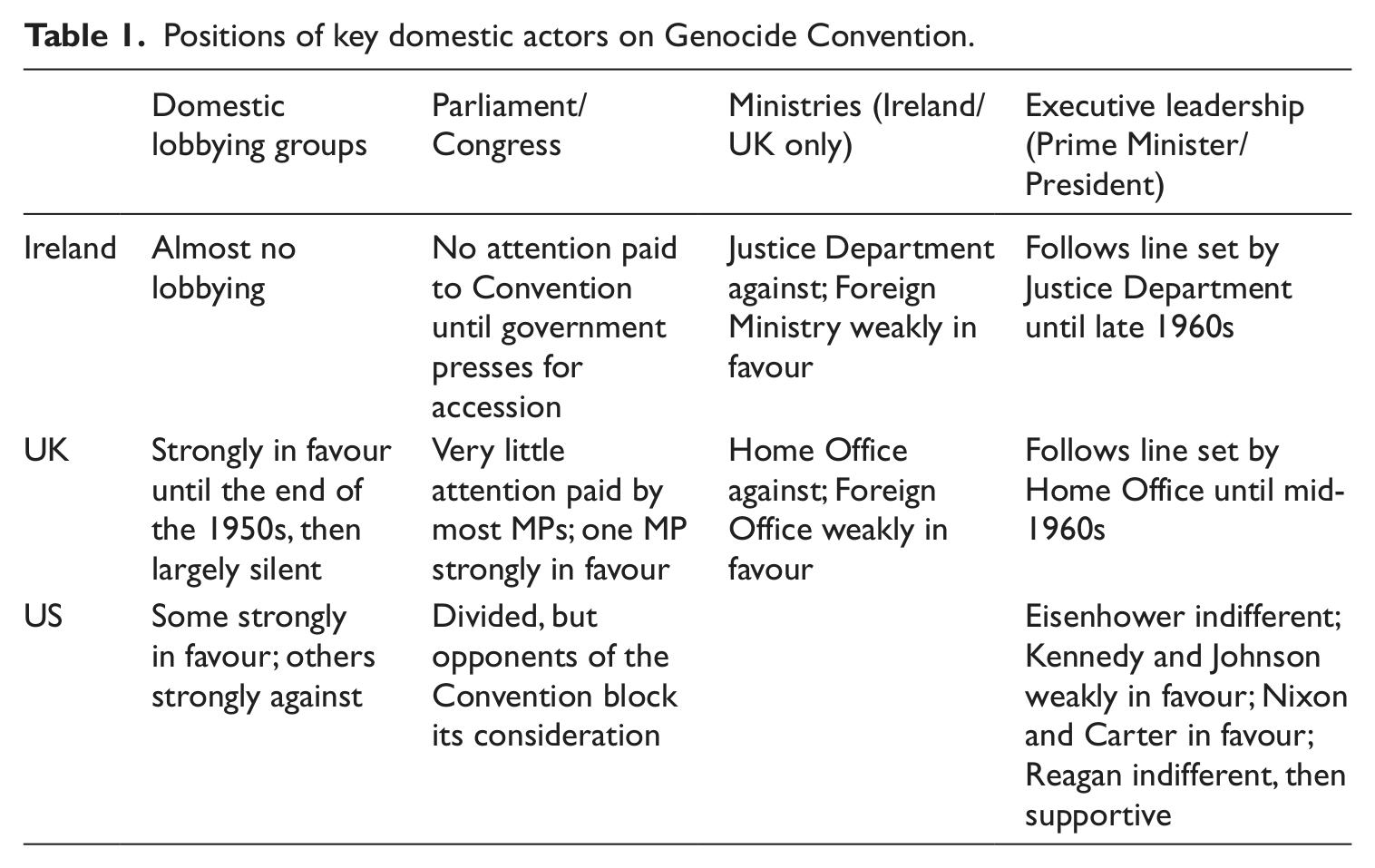
The rest of this section assesses the arguments used by these key actors during the lengthy period before the Convention was accepted and, in particular, considerations of costs and benefits (including reputational costs), clashes with domestic norms, conviction that accepting the Convention was the right thing to do and comparison with other states.
In June 1949, the Truman administration sent the Convention to the US Senate to request its consent. Domestic opponents immediately mobilised to prevent its approval by the US Senate. The opposition coalesced around concerns about the infringement of US sovereignty: this is a clash of norms, which results in a refusal to accept any adjustment costs at all. As Natalie Hevener Kaufman recounted, from early 1949, a committee of the American Bar Association (ABA) launched a campaign that portrayed the Genocide Convention in unremittingly negative terms: it would promote world government, subject American citizens to trial abroad, threaten the US form of government, infringe on domestic jurisdiction, increase international entanglements and violate the rights of the 50 states by leading to federal interference in segregation and race-related crimes in the southern US (Kaufman, 1990: 37–63; see also Cooper, 2008: 189–208). Such arguments were heard again and again (Kaufman, 1990: 196). Although the ABA endorsed US ratification of the Convention in 1976, numerous other conservative groups – Liberty Lobby, Eagle Forum, American Independent Party, Conservative Caucus – picked up the baton of opposition. 6 Opponents were aided by the procedural hurdles that any treaty must jump before it can be ratified by the US.
Conservative Senators such as Jesse Helms (Republican, North Carolina) and Strom Thurmond (Democrat, South Carolina and then Republican, South Carolina) led the opposition to the Convention in the Senate itself, and they created enough doubt and opposition within the Senate that the Convention remained stalled for decades. The Senate Committee on Foreign Relations declined to report it to the full Senate in 1950. Nothing then happened for 20 years: President Eisenhower retreated from pushing for human rights treaties, while neither President Kennedy nor President Johnson pressed hard for ratification. In the 1970s, both Presidents Nixon and Carter urged the Senate to consent to the Convention, and Nixon did so even though the US had been accused of engaging in genocide during the Vietnam War. 7 Nixon in fact considered ratification necessary to counter such accusations, as not ratifying it raised suspicions about US intentions (LeBlanc, 1991: 6–7, 91). But although the Committee on Foreign Relations favourably reported the Convention to the Senate four times (in 1970, 1971, 1973 and 1976), the Senate debated the question of ratification only once, in 1973–74, and a filibuster blocked further consideration. A similar story occurred in the 1980s, when in 1984 a filibuster again prevented the Senate from voting on a resolution regarding ratification of the Convention (LeBlanc, 1991: 6).
US ratification of the Convention was supported by a large number of civil society groups: religious groups, women’s organisations, trade unions and civil liberties organisations. Raphael Lemkin, the man who invented the term genocide and successfully pressed for an international convention to criminalise it, was very active both in lobbying Senators directly and in prompting non-governmental organisations (NGOs) to lobby them. In 1950, he claimed that thousands of supportive letters had been sent to the Senate (Cooper, 2008; 195). The Convention was also strongly supported by some US Senators, notably William Proxmire (Democrat, Wisconsin), who gave a speech favouring ratification on every single day the Senate met from 1967 until 1986 (see Power, 2002: 166).
Supporters of the Convention used arguments based on conviction about the appropriateness of ratifying it, unease with US isolation, and concerns about the reputational costs of not ratifying the Convention. Senator Proxmire used all three types of arguments. In 1977, for example, he noted that the Convention was a ‘moral document’ which the US should therefore ratify (Proxmire, 1977: 6). He pointed out that ‘all of our major NATO and SEATO allies have acceded to the treaty. We stand alone among free Western nations’ (Proxmire, 1977: 4).
Supporters also, however, noted that failure to ratify the Convention gave ‘enemies’ of the US a public relations victory. Proxmire argued that it ‘has been a constant source of embarrassment to us diplomatically that has puzzled our allied and delighted our enemies…There is no logic in continuing to provide others with a club with which to hit us’ (Proxmire, 1977: 4). This concern about the reputational costs of not ratifying the treaty was repeated frequently. The New York Times noted that if the Senate failed to approve the Convention again, it would merely ‘invite propagandists around the world, hostile or just simplistic, to take another shot’ (The New York Times, 1984). Proxmire argued that, time and again, Soviet representatives at the UN and at the Conference on Security and Cooperation in Europe indicated that a country that had not ratified the Genocide Convention ‘had no right to lecture the Soviet Union on human rights’ (Power, 2002: 159). Thus, supporters used arguments based on the appropriateness of the Convention, the reputational costs of non-ratification and acculturation (the US is not conforming to western democratic values). Until the 1980s, however, the opponents had the upper hand.
In the UK, the arguments used behind the scenes were a different mix. In particular, the appropriateness of the Convention – the conviction that acceding to it was the right thing to do – played less of a role. The Convention was blocked in the UK for nearly 20 years due to a stand-off between the Foreign Office and Home Office. The Foreign Office was never enthusiastic about the Convention, 8 but over time its disdain softened. The Convention began to gather enough ratifications/accessions to enter into force, and more countries began to accede to it (particularly from the Commonwealth), so the UK’s stance became more uncomfortable – inevitably affecting Foreign Office attitudes towards the Convention, as is clear in a 1962 Foreign Office memorandum for the Cabinet:
the crime of genocide is so clearly abominable that we shall always be open to criticism so long as we do not accede… there may be some who will see behind our reluctance to accede some unspoken intention to use weapons of mass destruction, or some other sinister reason for not acceding. … This would give a useful propaganda weapon to the Soviet bloc.
9
The unfavourable comparison with communist countries was particularly uncomfortable: ‘so long as we fail to accede, it is easy for countries who are ill-disposed towards us to cast doubt on Her Majesty’s Government’s position in the field of Human Rights.’ 10 This argument thus rests predominantly on the reputational costs of non-accession, rather than on the appropriateness of the Convention.
In contrast, the Home Office argued that accession to the Convention would require the UK to change its legislation regarding political asylum, because Article 7 states that genocide cannot be considered a political crime for the purposes of extradition. The Extradition Act of 1870 prohibits the extradition of a fugitive criminal if the offence is of a political character. The Home Office argued that making an exception for genocide would not only destroy the absolute character of the extradition rule, but make it difficult, if not impossible, to refuse extradition in cases where spurious accusations of genocide were made against someone benefitting from asylum in the UK. In 1961, the Home Office stance was supported by the Law Officers, whose opinion, issued on 22 November 1961, indicated that if the UK was to accede to the Genocide Convention, it would indeed be necessary to amend the Extradition Acts. In March 1962, the Cabinet Home Affairs Committee agreed that the UK should not accede to the Convention (Smith, 2010: 49).
In the UK, there was little domestic opposition to accession, except from within the bureaucracy. The strength of domestic support for accession varied. Initially, a wide variety of groups pushed for UK accession to the Convention: religious (both Jewish and Christian), peace and women’s organisations lobbied the Foreign Office, as did Raphael Lemkin. Through the mid-1950s, the Foreign Office received numerous letters from civil society organisations, pressing for UK accession to the Convention. But, by the end of the decade, the Foreign Office was under hardly any pressure from civil society about the Convention, as NGOs appeared to have given up the struggle (Smith, 2010: 47).
As for parliament, some MPs did call for accession. In particular, the MP from Leicester, Barnett Janner (later Sir Barnett Janner), raised the issue regularly in the House of Commons. Janner’s arguments relied extensively on a comparison with other western democracies. He persistently noted that the Genocide Convention had been developed by ‘civilised peoples’, and, in question after question, asked the government how many countries had ratified or acceded to the Convention (Simpson, 2003: 43–60). 11 In November 1961, Janner noted that among the states that had ratified or acceded to the Convention were ‘several of our fellow members of the Commonwealth and many of our West European and Scandinavian friends with legal and democratic ideas similar to our own. If they have found it possible to come in, why are we holding back?’ 12 For almost two decades, however, Janner’s attempts to compare the UK unfavourably with other ‘civilised countries’ had little success, given the bureaucratic stand-off between the Foreign Office and Home Office.
In contrast to the US and the UK, in Ireland there was hardly any domestic pressure in favour of accession. No parliamentarians pressed for accession (and no parliamentary questions were asked on the issue until 1973, when the government made moves to ratify several human rights conventions), and the Department of Foreign Affairs’ files in the Irish national archives contain just three letters from civil society organisations pushing for accession. There was almost nothing in the press about the issue.
In Ireland, adjustment costs – and particularly the need to change domestic law with respect to extradition – proved to be the key obstacle to accession. The Irish Foreign Affairs Department was not enthusiastic about the Convention: in 1951, the Convention was considered to be useless and superfluous, and inadequate because its purpose is penal rather than preventative. But the Department also held that:
although the Convention cannot be said to inspire any feeling of security, its condemnation of the crime of genocide, which includes religious persecution, is a healty [sic] indication of the abhorrence with which it is viewed by civilized states. Genocide is an international crime and any action against it must be by international accord and the Convention, while it might not go far enough, is at least a step in the right direction.
13
There is evidence of arguments based on both acculturation (other civilised states viewed the Convention as necessary) and a logic of appropriateness (the Convention is a step in the right direction).
In contrast, the Department of Justice was hostile, and adjustment costs motivated this. On 22 September 1950, the department wrote to the Foreign Affairs Department, indicating: ‘The [Justice] Minister is strongly of opinion that Ireland should not become a party to this Convention unless and until it is found that this is the only country not ratifying or acceding to it.’ 14 This is a clear indication that the ‘surrounding culture’ is important when determining whether to accept the Convention. The government’s official reasons for non-accession were ‘the difficulty of giving legislative effect to the definition of genocide, which was drawn in very wide terms. Some hesitation was felt about the extradition provisions, as to whether they would require an unjustifiable derogation from the exception from extradition of political offences’. 15
Thus, in all three countries, some supporters of the Convention pointed to the incongruence of not accepting the Convention and conformity to domestic values (indicating arguments based on the logic of appropriateness), though convictions that accepting the Convention would be the ‘right thing to do’ played a more minor role in their arguments. Supporters also pointed out that other ‘civilised’ countries had ratified it, indicating unease with isolation from peer groups. In the US and UK, supporters used arguments about the international reputation of their country, and the costs to that reputation of not committing to the Convention. But the strong opposition to the Convention in all three countries was based largely on the adjustment costs required, and supporters of the Convention simply could not override opposition in the US Senate or among bureaucracies in Ireland and the UK. What, then, eventually did?
Why did the three countries ratify or accede to the convention?
This section assesses why each country eventually accepted the Convention. As already noted, opponents considered domestic adjustment costs to be high in all three countries – principally because of the perceived clash with other cherished domestic norms. None of the three was subjected to pressure or persuasion from international actors. Thus, this section assesses the extent to which considerations of reputational costs, conviction and acculturation played a role in the eventual decision to accept the Convention. Table 2 summarises the conclusions.
Reasons for accepting the Genocide Convention.
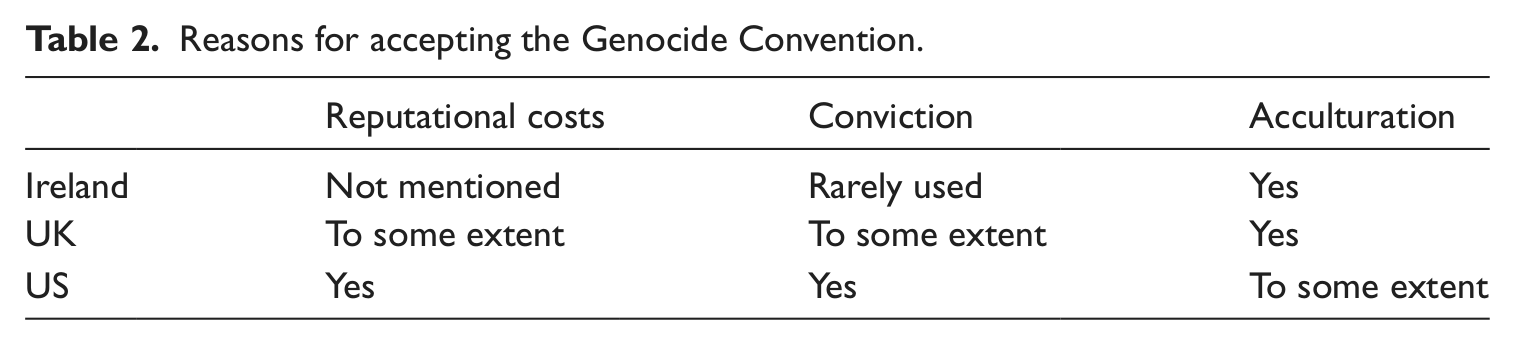
In the US, domestic political manoeuvring, reputational costs and conviction played key roles in the eventual ratification of the Convention, though acculturation helps explain the lack of enthusiasm for the Convention and illuminates the fact that the general context made it uncomfortable to continue to refuse to ratify. The Reagan administration had initially been indifferent to the Convention, and launched a long review of it. In 1984, citing the positive outcome of that review, Reagan announced his support for the Convention. He did so three days before he made a speech to the Jewish organisation B’nai B’rith, a move which sparked cynicism that it was timed only to boost support for Reagan in the forthcoming presidential election (LeBlanc, 1991: 142–143). The Democratic presidential candidate, Walter Mondale, had been about to endorse the Convention, and Reagan’s move was seen as an attempt to counter Mondale (Tolchin, 1984). The conservative groups and Senators opposing the Convention were isolated when President Reagan endorsed the Convention, as this led many opponents of the Convention in the Republican Party to support the administration (LeBlanc, 1991: 241).
Reagan’s announcement of his support for the Convention referred to the US’s leading role in promoting human rights internationally: ‘we intend to use the convention in our efforts to expand human freedom and fight human rights abuses around the world. Like you, I say in a forthright voice, “Never again!”’(Reagan, 1984). Reagan linked the Convention with American values, and thus it was appropriate for the US to ratify it. But the issue of reputational costs also played a role in the administration’s arguments. In September 1984, a State Department spokesman clearly pointed these out:
our failure to ratify this treaty, which has now been pending before the Senate for 35 years, and has been supported by Presidents Truman, Kennedy, Johnson, Nixon, Ford and Carter, has opened the United States to unnecessary criticism in various international fora.
Even after Reagan came out in favour of the Convention, however, it was not certain that the administration would actually seek ratification after Reagan’s re-election in November 1984. Samantha Power argues that the administration only sought ratification as a result of the public relations disaster over Reagan’s trip to the Bitburg Cemetery in West Germany in May 1985 (Power, 2002: 161–163). Reagan was widely condemned for visiting the cemetery, where 49 Nazi Waffen SS officials were buried, and for declining to visit a Holocaust memorial, though he belatedly added a visit to the Bergen-Belsen concentration camp (Hoffman, 1985). As a result of the public furore, Power argues that Reagan sought to undercut the critics by pressing for ratification of the Convention (Power, 2002: 163). With a Republican president strongly supporting the Convention, the Republican Senators opposed to the Convention were caught out, though they successfully minimised the adjustment costs by forcing through a series of reservations to the Convention which would accompany the US ratification instrument.
In February 1986, the US Senate overwhelmingly approved ratification (83–11), but also attached a series of conditions (a ‘sovereignty package’), which meant that the US ratified the Convention with two reservations and five understandings. The two reservations asserted the primacy of the US Constitution over the Genocide Convention, and stipulated that, before any dispute to which the US is a party may be submitted to the International Court of Justice, the specific consent of the US is required in each case (see LeBlanc, 1991: Appendix C). These reservations have generated controversy in other countries (the Netherlands, for example, does not accept that the US is a party to the Convention because it objects to the reservations; see Schabas, 2009: 628), but the sovereignty package proved to be necessary for the Convention to surmount the ratification hurdles in the Senate. It is significant, however, that the US has not ratified other international human rights treaties (e.g. the Convention on the Rights of the Child or the International Criminal Court), even with a sovereignty package attached. This points to some role for acculturation processes in this case: staying aloof from the Genocide Convention (but not other human rights treaties) in particular proved to be difficult, and the ‘sovereignty package’ indicates a rather superficial (and begrudging) acceptance of the Convention.
In the UK, a different mixture of reasons led it to accede to the Convention, and acculturation processes here are more evident. In 1964, elections were won by the Labour party, and the incoming Prime Minister, Harold Wilson, had already signalled his support for accession. During the 1964 election campaign Wilson indicated on two occasions that the UK should accede to the Genocide Convention. 16 In October 1962, in the debate on the Queen’s speech, Harold Wilson, then the shadow Foreign Secretary, asked why the UK had not ratified the Genocide Convention, and argued that it was all the more urgent to do so because of the ‘resurgence of evil, Nazi anti-social doctrines in this country’. 17 This seems to indicate that Wilson was aware of the domestic costs of non-ratification. But the Labour Party was, in general, keen to improve the UK’s influence in the UN, and to take a stronger positive stance on issues of freedom and racial equality (Smith, 2010: 50). So, conviction about the appropriate thing to do played a role in the Labour Party’s stance.
However, the Wilson government did not present the Genocide Bill in parliament until 1968, an indication that, despite the arguments recounted above, the government did not accord the Convention a high priority. 18 Symbolically, this occurred in 1968, so that the government would be seen to be taking steps during the International Year for Human Rights. 19 The government’s reasons for acceding to the Convention contained clear references to a peer group of western democracies that had already accepted the Convention. The main debate in the House of Commons took place on 5 February 1969, where the government position was presented by the Under-Secretary of State for the Home Department, Elystan Morgan. He noted that the extradition issue had prevented UK accession until now, but: ‘One cannot, however, overlook the fact that up to now 73 countries, many of whom are no less liberal in their outlook than ourselves, countries like Australia and Canada, the Netherlands and Sweden, have felt able to accept this restriction.’ 20 Further, Morgan argued:
The importance of this legislation does not lie so much in the number of prosecutions to which it will give rise, or in the number of persons whose extradition for offences of genocide it will secure, as in the proof which it affords that the United Kingdom, as a civilised nation and a firm defender of human rights, condemns this barbaric crime and undertakes to prevent and to punish it.
21
While a few MPs raised the extradition issue during the debate, the Genocide Bill passed smoothly through parliament, and received the royal assent on 27 March 1969. On 30 January 1970 the UK notified the UN of its accession to the Convention.
As is clear in the justifications presented for acceding to the Convention, a key concern of the UK was its identity as a ‘civilised nation’ and the fact that ‘what civilised countries do’ was the standard against which the UK was seen to be lacking. There is little sign of concern about the ‘reputational costs’ to the UK in the 1969 parliamentary debates (though these played a role earlier in Foreign Office support for the Convention), but some evidence of the logic of appropriateness – that the UK as a ‘firm defender of human rights’ should thus also accede to the Genocide Convention. However, the quotes also indicate a certain lack of conviction about the Convention (it will not make much of a difference), a sign of ‘public conformity without private acceptance’.
José Alvarez has criticised the argument that acculturation may explain the UK’s accession to the Genocide Convention: states do not just sign up to the Genocide Convention ‘because everyone else is doing it’; states aren’t ‘like trendy teenagers unthinkingly following the latest fad’ (Alvarez, 2004–2005: 972). He argues that it is very likely that considerations of costs and benefits instead played a role. Yet it is very difficult to ascertain that such a cost–benefit calculation was a crucial factor: there were no material incentives on offer to the UK if it acceded to the Convention; the costs of altering domestic legislation to comply with the Convention had already been noted and considered large beforehand. It is true that guarding against the resurgence of right-wing doctrines in domestic politics was mentioned in debates, and that the Foreign Office had been concerned about reputational costs. But in the debates on the Convention in parliament, the emphasis lay not so much on the costs to the UK of remaining aloof, but on the fact that the UK was standing uncomfortably apart from other western democracies.
The usefulness of an explanation based on acculturation is strongest in the Irish case. Here the ‘cascade’ of countries ratifying or acceding to the Convention created the conditions favouring accession. The relevant peer group was the European Community, which Ireland joined in 1973. As more and more countries acceded to the Convention (including the UK), the Department of Foreign Affairs became particularly concerned about Ireland’s isolation. In 1966, it stressed the need to improve the country’s human rights record by ratifying or acceding to human rights treaties, especially as ‘Human Rights Year 1968’ loomed – again indicating the relevance of the surrounding culture. 22 And, by 1972, when Ireland was about to join the European Community, the Department pointed out that Ireland was virtually alone amongst the EC member states in not having acceded to the Genocide Convention. 23 In 1973, the Foreign Affairs Minister indicated that he wished Ireland to accede to those UN human rights agreements to which Ireland was not already a party, given that 1973 was the twenty-fifth anniversary of the UN Declaration of Human Rights. In a letter to the Secretary of the Department of Justice, the fact that almost every European country had become a party to the Genocide Convention was highlighted. 24
In November 1968, under a new Prime Minister (Jack Lynch), the government approved the drafting of a bill to implement the Convention – and specifically stated that it was ‘mindful of the impression of lack of respect for the objects of the Convention to which our continued non-accession could give rise’. 25 This shifted the bureaucratic stand-off in favour of accession. But a Genocide Bill was presented to parliament (Tithe an Oireachtais) only in late 1973, an indication that accession was not seen as urgent. The Minister for Justice noted in parliament that it was desirable for Ireland to accede to the Convention because ‘to delay doing so any longer is likely to give the unfortunate impression that this country is lacking in interest in, and respect for, the objectives of the convention. This is so especially when so many countries have become parties to it.’ 26 Although the opposition spokesman noted that Ireland had a ‘moral obligation’ to help prevent genocide, he also noted this was part of a need to be an ‘equal partner’ in the UN – indications of conviction but also acculturation. 27 The Genocide Act was signed on 18 December 1973. Even then, there were still delays (an indication of the relatively low priority given to the Genocide Convention). The government did not take a decision to accede to the Convention until January 1976. 28 Still, though it took some time, acculturation eventually led Ireland to accede to the Convention.
Conclusion
In all three cases considered here, there was initially considerable domestic hostility towards the Genocide Convention, from within bureaucracies (in Ireland and the UK) or civil society and the Senate (in the US). Supporters of the Convention used arguments based on unfavourable comparisons with other like-minded countries, the logic of appropriateness, and, in the UK and US, discomfort with the ‘propaganda coup’ that non-acceptance gave to communist countries. But such arguments did not overcome the opposition, which focused on adjustment costs, and the clash of norms that made adjustment so costly: sensitivities about national sovereignty (particularly strong in the US) and attachment to traditions regarding extradition (overwhelmingly strong in the home affairs ministries of the UK and Ireland). In the US, ratification hurdles – the Senate’s ability to block debate on the Convention – gave opponents the upper hand. In Ireland and the UK, little or no public debate took place, as, behind the scenes, a bureaucratic stand-off prevented such a debate in parliament.
What eventually led all three to ratify or accede to the Convention was not coercion from other international actors, incentives offered by other international actors or persuasion by other international actors. In each country, there is a slightly different mixture of reasons why the Convention was eventually accepted.
In the US, considerations of reputational costs, conviction and acculturation all played a role, though acculturation is weakest in this case. The Reagan administration’s endorsement of the Convention seems to have come about because of, first, electoral politics and, second, embarrassment over Reagan’s visit to the Bitburg cemetery. But Reagan’s public arguments indicate appreciation of the appropriateness of accession, and of the reputational boost that accession would provide. A Republican administration in the US could overcome opposition based on adjustment costs; in addition, those adjustment costs were slashed by attaching a ‘sovereignty package’ to the ratification instrument. In the Senate, unfavourable comparisons with other western democracies jostled with arguments about reputational costs and the damage to American interests and values that was being done by not ratifying the Convention, indicating an element of acculturation. But it could be expected that acculturation would play less of a role in the western superpower than in other countries: the US considers itself a leader rather than a follower, and with little need to accept international human rights standards. That the US ratified the Convention at all, however, still shows how powerful the anti-genocide norm had become by the 1980s. The changing international context, in which guilt about the Holocaust loomed larger and the international human rights regime was developing quickly, made it much more uncomfortable for western democracies – even the most powerful western democracy – to stand aloof from the Genocide Convention.
In the UK, a newly elected left-wing government simply ignored opposition from within the bureaucracy– and the purported adjustment costs in the end proved to be much less controversial when compared with the factors favouring accession. Those included not just the reputational costs of not acceding, but also the new human rights environment and the UK’s isolation in the group of western democracies – indicating more of a role for acculturation than was the case in the US. Conviction that accession to the Convention was the appropriate thing to do arguably played less of a role in parliamentary debates than it did in the US.
In Ireland, a new prime minister (backed by the Foreign Affairs Department) could seize on the country’s isolation to push for a Convention for which no one seemed particularly enthused – and which still took almost a decade to accept. Acculturation seems to account almost entirely for the government’s decision to accede to the Convention. The unfavourable comparisons between Ireland’s stance on the Convention and that of the other European Community member states played a prominent role in the arguments for the Convention, and the International Year of Human Rights 1968 was seized upon to generate momentum in favour of improving Ireland’s human rights treaty ratification record. It might be expected that acculturation would play a prominent role in a small country – though Ireland nonetheless withstood comparison with other countries for almost 30 years. Interestingly, reputational costs did not feature in domestic debates, which also might be expected to be important to a small country, but evidently did not in this case.
In all three countries, ‘public conformity without private acceptance’ – a sign of acculturation – does seem to describe the domestic context in all three cases. The Genocide Convention was accepted almost reluctantly, grudgingly, without that much conviction.
Acculturation may play a role in many other cases of acceptance of international norms. Acculturation, like the other ways in which norms can be diffused, depends on some countries moving first. The difference is that those countries are not then acting as norm entrepreneurs, actively seeking to spread the norm, but instead as models or reference points. Concern about being left out of a (growing) group of countries that have accepted the norm then helps to overcome domestic resistance to the norm. As with the other means of norm diffusion, this may take time, and what leads to actual internalisation of the norm is a subject worthy of further study.
Footnotes
Appendix 1
Funding
This research received no specific grant from any funding agency in the public, commercial, or not-for-profit sectors.