




Abstract
The increasing reliance on private security companies (PSCs) in and around international peace operations has created new public–private constellations, influencing both military and civilian efforts, sometimes generating problematic relationships and even violence between public and private actors, as well as unclear divisions of labour, authority and responsibility. To explain how and why these problems occur, mapping out the understandings that these different actors have of each other in different contexts is of key importance. Through an analysis of Swedish officers’ views of private security actors, this paper aims to contribute to our understanding of the complex relationships between civilian authorities, state militaries and commercial security actors. Particularly, the article will shed new light on ‘PSC–military’ relations and the ways in which the private security sector functions as both a competitor and a career option for former or active service personnel. The article draws on a study commissioned by the Swedish Armed Forces and is empirically based on in-depth interviews and a survey of Swedish officers’ attitudes to PSCs.
Introduction
Increasingly, conventional military forces and civilian agencies involved in international peace, stability or reconstruction efforts find themselves operating alongside private security companies (PSCs). This development is part of a larger process of privatisation and commercialisation that has created new and complex public–private constellations, influencing both military and civilian operations, and sometimes generating problematic relationships and even violence between these public and private actors, as well as unclear divisions of labour, authority and responsibility (Bruneau, 2011; Dunigan, 2011). To explain how and why these problems occur, it is important that we pay attention to the understandings that these different actors have of each other. With a few exceptions, however, research in this field has not yielded much in terms of quantifiable data on the military’s view of PSCs or civilian contractors (Cotton et al., 2010; Franke and Von Boemcken, 2011; Schaub, 2010). 1 Through an analysis of Swedish officers’ views of private security actors in peace operations, 2 this article aims to contribute to our understanding of the complex relationships between civilian authorities, state militaries and commercial security actors. In particular, the paper will shed new light on issues related to the nature and formation of ‘PSC–military relations’ and the ways in which the private security sector functions both as a competitor and as a career option for former or active service personnel. This paper is based on a study commissioned by the Swedish Armed Forces and is empirically based on in-depth interviews and a survey of Swedish officers’ attitudes to PSCs in peace operations (Berndtsson, 2012a).
The Swedish case is interesting for several reasons. First, unlike the USA and the UK, Swedish state authorities – much like those in its neighbouring countries and in other parts of Europe – are fairly new to the contracting of PSCs in international peace operations (Leander, 2013). With the civilian and military involvement in Afghanistan, however, things have changed. In 2008, the Swedish Ministry for Foreign Affairs contracted Vesper Group – a Swedish PSC – to provide security coordinators to the embassy in Kabul and to the field office in Mazar-e-Sharif. The embassy also contracted a PSC (Saladin) to provide static protection and QRF (quick reaction force) capabilities. In addition, the Swedish Armed Forces have contracted Supreme Foodservice GmbH to provide logistics and support services, as well as unarmed access control personnel at military camps such as Camp Northern Lights in Mazar-e-Sharif. In turn, Supreme contracted an Australian PSC (Compass Security) to protect its convoys, including those serving the Swedish military base. Finally, Swedish civil servants working for international organisations such as the World Food Programme or EUPOL Afghanistan are also protected by PSCs contracted by their host organisations (Berndtsson, 2012b; Berndtsson and Stern, 2013).
As a result of this development, Swedish state authorities are rapidly becoming more acquainted with – and indeed dependent on – the hiring of PSCs to protect its staff and infrastructure, raising important questions about the consequences of this development for issues of state control of force and security governance. The move towards an increasing reliance on commercial security actors also impacts on the ways in which Sweden conducts civilian reconstruction or peacebuilding efforts, and how the military operate in international peace operations. On the ground, Swedish military officers, diplomats and aid workers serving in Afghanistan (and elsewhere) increasingly come in close contact with PSCs, and new public–private constellations and relations are created. Thus, in the context of so-called ‘comprehensive’ or ‘whole-of-government’ (Friis and De Coning, 2011) approaches adopted by Sweden (and many other states and organisations), where emphasis is placed on civilian–military cooperation and integration, the formation and workings of PSC–military relations are becoming increasingly relevant. 3
Second, like many other European militaries, the Swedish Armed Forces are undergoing organisational, strategic and operational changes to meet the demands of a new strategic environment and new sources of threats (King, 2011). In terms of defence policies, Sweden has entered into a phase of non-aligned ‘post-neutrality’ (Agius, 2011; Lödén, 2012), where the previous emphasis on a large territorial defence force has gradually given way to an increasing focus on international peace operations in collaboration with international and regional partners such as the United Nations (UN), European Union (EU) or North Atlantic Treaty Organization (NATO) (Kaunert and Léonard, 2012; Oma, 2012; Petersson, 2011). In addition, in 2009 Sweden decided to abandon the conscript system in favour of an all-volunteer force (AVF) and, in the process, to restructure the education system for the armed forces and to implement a new organisation of the officer corps (Hedlund, 2013; Ydén and Hasselbladh, 2010). One result of these changes is that contracts and terms of employment for soldiers and officers have changed, raising important questions about the future of recruitment and retention in the Swedish military. The present study thus comes at a point in time when the Swedish Armed Forces are undergoing significant changes that will help shape officers’ views of private security companies.
The reorganisation of the officer corps may increase the number of officers willing to work for private security companies (or indeed to start companies themselves), as well as the number of individuals (e.g. former officers or other state security professionals) with experience from private security work who want to (re-)join the armed forces. In view of these observations, understanding more about PSC–military relations in cases such as Sweden appears to be an important task. This development not only spells changes for recruitment and retention within the armed forces, but also raises questions about what it means to be a military professional in a Swedish context and the potential consequences of individuals moving in and out of military (public) and civilian (private) employment.
To sum up, the case of Sweden is relevant both as a contrast to larger states such as the UK and the USA, and as one example of a small European state whose experiences with PSCs are beginning to evolve. It is clear that we need more knowledge about how states such as Sweden deal with the increasing reliance on market-based security and support solutions in reconstruction and peace support operations. This article contributes to this body of knowledge by mapping out views about PSCs among Swedish officers. While PSCs are not military organisations in their own right, they may well compete with armed forces over personnel and in terms of delivering security expertise in areas that have traditionally been associated with state actors such as the police, the military or the intelligence services. Increasing our knowledge of how military officers view the private security industry will yield important insight not only into the ways in which officers see PSCs as a career option, but also into the workings of the communication and cooperation between military and market actors on the ground.
The article proceeds as follows: the subsequent section will flesh out the main theoretical arguments by discussing PSC–military and civil–PSC relations in more detail. Following this discussion, attention will be shifted to the survey of Swedish officers, covering issues of methodology as well as the main results.
A civil–PSC–military problematique
Certainly, there are many ways in which to approach the issue of attitudes and relationships between PSCs and national militaries. Following several authors in the field, this article finds that the literature on civil–military relations provides a useful point of departure for approaching relationships between state agencies, PSCs and the military, as well as for probing issues of control and governance (Alexandra et al., 2008; Avant, 2005; Baker, 2011; Berndtsson, 2009; Bruneau, 2011; Dunigan, 2011; Krahmann, 2010; Singer, 2003). While these studies differ in important respects, many of them make the observation that because of differences between PSCs and military institutions, particularly in terms of organisation, mandate and relationships with clients, the use of private security creates new civil–PSC and military–PSC relations, but also changes existing civil–military relations. Basically, the use of PSCs – especially for armed services in conflict areas – changes the composition of security-providing and violence-using actors and organisations, creating new modes of influence over security decisions and raising complex questions about state control of force. To paraphrase Peter D. Feaver (1996), we may characterise this as a ‘civil–PSC–military problematique’. In this article, we are concerned primarily with one aspect of this problematique: the relationship between the armed forces and private security companies.
PSC–military relations are determined by a wide range of different factors, such as the nature of the services PSCs are called upon to provide in a specific operation, who is doing the contracting (the military itself, civilian authorities or other contractors), whether the contractors are armed or unarmed, and so on. In addition, these relations are shaped by formal and informal rules, norms, attitudes and myths that influence the possibility of creating or maintaining communication, coordination and cooperation between military units and PSCs. Certainly, this applies not only to PSCs; in theatres of operation such as in Afghanistan there are a number of public and private, civilian and military actors working side by side. Yet PSCs are special in that they are often contracted (in the context of peace operations or armed conflict) to provide services that are usually associated with the military (e.g. armed convoy escorts or intelligence gathering). This means that the work of PSCs is potentially – though not necessarily – controversial in the eyes of the military. In this context, problematic PSC–military relations, rooted in negative images of each other, may lead to friction and increasing security problems for civilian actors, PSCs and military units alike. Yet PSCs may also be seen by the military as welcome supplements in peace support operations such as Afghanistan, as well as potential career options for former or active-duty officers and soldiers.
This brings us back to the question of similarities between PSCs and military organisations. Several authors have pointed to the ‘hybrid’ nature of PSCs, indicating that they are often characterised by a mix of public, private, civilian and military characteristics (see, for example, Abrahamsen and Williams, 2011; Berndtsson, 2012b; Carmola, 2010: 27–39). PSCs and their employees share certain characteristics with military professionals; for instance, many PSC employees are former military personnel who possess knowledge and skills within the same field of expertise as the military and may share similar ideas about loyalty, professionalism and ethos (Schaub, 2010: 373–375; Schaub and Franke, 2009: 92–94; also Higate, 2012). Hence, military officers might identify with PSCs, and vice versa. Yet PSCs are not the military; rather, they are commercial actors on a highly diversified and globalised market. In addition, and contrary to the military, PSCs are not bound to one specific client, nor do they engage purely in activities close to the core of military expertise (i.e. combat). In addition, their employees do not share a common training or ethos, nor are they necessarily tied to a single company. The point here is that PSCs are both similar to and different from military organisations and that the increasing use of private companies to perform functions traditionally associated with the military (or the police) challenges our notions of what constitutes a ‘military professional’ and how we distinguish between public and private actors and areas of responsibility (Schaub, 2010).
In light of these observations, charting and analysing the views that PSCs and military personnel have of each other is an important part of the effort to increase our understanding of how cooperation and communication between the actors work (or not), as well as the challenges arising from the increasing movement of individuals between public militaries and PSCs. Many of the people within the military and the security industry that this author has interviewed in Sweden, Britain and the USA since 2004 have pointed to the importance of acknowledging the rivalry and jealousy that sometimes exist between PSCs and military personnel, often because of differences in salaries, tasks or equipment. Others point to the view of PSCs as ‘mercenaries’; a primary source of PSC–military friction. Yet others suggest that risk-taking and aggressive behaviour among some PSCs, insufficient control or regulation of the security industry, or flaws in the formal working relations between PSCs and the military are important parts of the explanation (for several examples along these lines, see Berndtsson, 2009). In contrast to these negative images, other interviewees have expressed mainly positive images of PSC–military relations, and many have pointed to the usefulness of PSCs, not least in operations with large civilian components, whose protection is not easily incorporated as an additional task for the military. The argument here is not that the use of private security companies inevitably creates negative PSC–military relations or problems of security governance. However, it is important to acknowledge that these problems continue to emerge and that we do not yet know enough about PSC–military relations to draw general conclusions about their nature or potential consequences. Important steps in the right direction can, however, be taken by looking more closely at particular cases such as Sweden to see what military officers’ views of PSCs look like and how they might inform PSC–military relations in practice.
Swedish officers and PSCs in peace operations
Before turning to the results of the survey, a few words on methodology are in order. The data on Swedish officers’ views on PSCs were collected through a small-scale survey in 2011, targeting a population of 2731 officers, currently (June 2011) employed, under the age of 55 and with at least some international experience after 2001. 4 The target population covers all branches of the armed forces with one important exception: the Special Forces are not included in the normal personnel records and are thus excluded from the sample. From the target population, 300 individuals were selected through systematic random sampling. After about seven weeks in the field, 173 completed surveys had been received, resulting in a response rate of 58%, which is acceptable considering the timing of the survey. 5 Compared with similar studies, a response rate of 58% is in fact rather good; the aforementioned study conducted by RAND in 2010 yielded a response rate of just over 23% for the military sample (Cotton et al., 2010: 5). A handful of qualitative, semi-structured interviews were also conducted in order to supplement the data from the survey. The interviewees for the semi-structured interviews were chosen for their experience with international UN or NATO missions and/or dealing with or working for PSCs in high-risk areas such as Iraq and Afghanistan.
The aim of the survey was to create a broad overview of issues relating to the officers’ view of PSCs in international peace operations. The questions and themes of the survey and the interviews were inspired by the RAND study of 2010, although the questions had to be adjusted in most cases to fit a Swedish context. To stimulate a high response rate, the survey was kept fairly short (21 questions over five pages) and the number of questions with biographical content was minimised. As indicated above, Sweden is vastly different from countries such as the USA and the UK in several important respects, for instance in terms of military involvement in Iraq or Afghanistan. Yet Sweden is one out of several small European states that only recently have begun relying on PSCs in peace operations, and whose military forces are undergoing substantial transformation (Berndtsson, 2012b; Leander, 2013). Thus, results from the Swedish case may well form the basis for future comparisons with other cases, such as the Nordic countries. Turning now to the results of the survey, Table 1 provides us with an overview of the group of respondents in terms of their military rank and experience of international deployments.
Military rank and international missions.
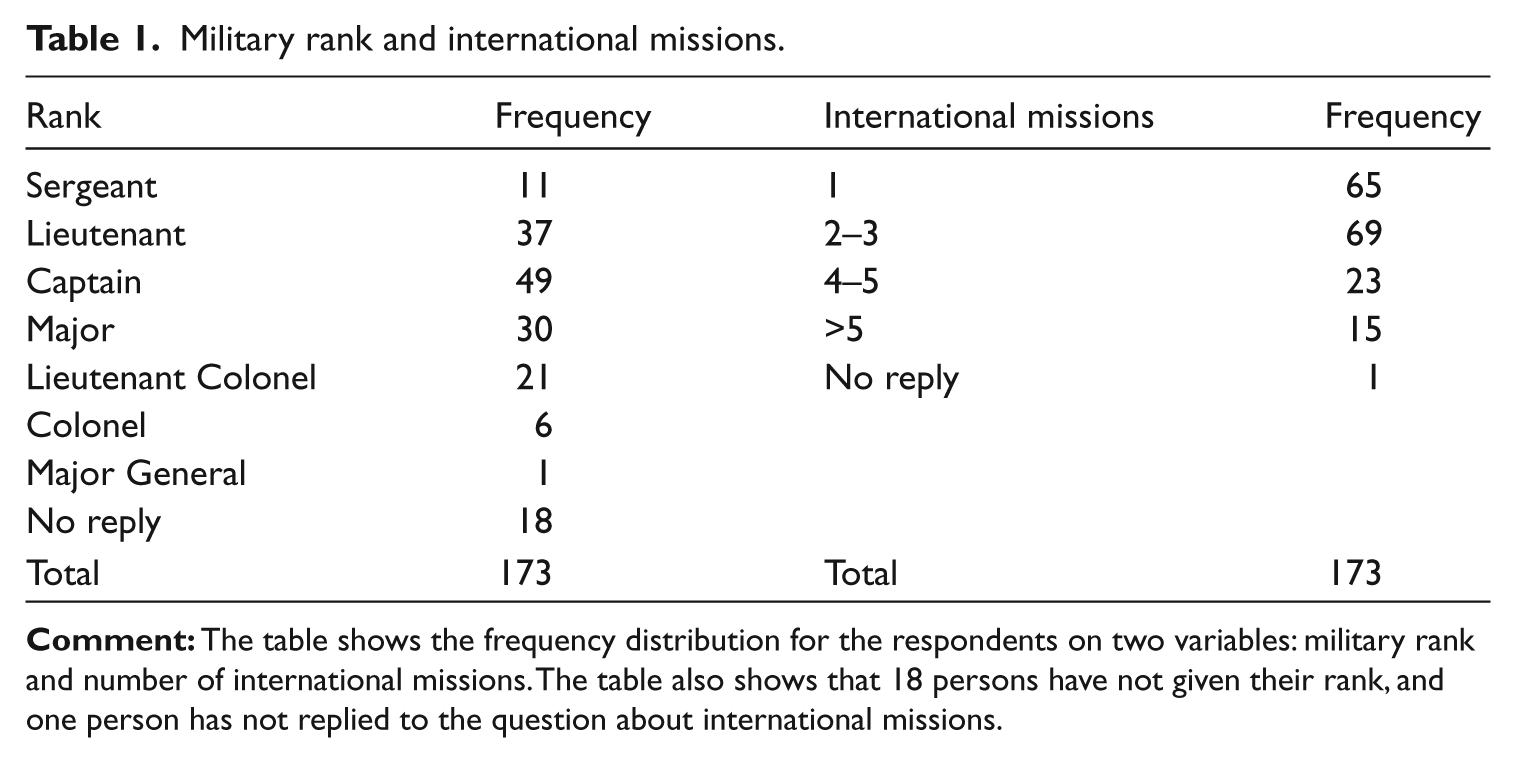
In terms of the distribution of rank within the sample, the relative proportion of the different categories of rank roughly matches the whole population of Swedish officers (as per September 2011). From the table, we can also see that over 60% have completed two or more international missions after 2001 (normally each deployment lasts from 6 up to 12 months), and that 20% of the respondents have completed four or more international deployments. Although the group as a whole is fairly experienced (at least from a Swedish point of view), this does not mean that Swedish officers in general have come in contact or worked with PSCs in the field. In the survey, experience with PSCs was measured in terms of how much the officers had come in contact with PSCs and whether they had worked directly with them.
As can be seen in Table 2, nearly half of the officers (46%) have come into contact with PSCs often or sometimes during their time abroad, but only about 20% have worked directly with PSCs. These figures are fairly low by comparison; in the RAND study, for instance, as many as 61% of US military personnel reported having experience interacting with armed PSCs (Cotton et al., 2010). Yet for a small state like Sweden with limited military engagement abroad and with only a few contracts with PSCs among state agencies, the low figures are not surprising. However, it is necessary to keep in mind that views reported by the Swedish officers are not always based on personal experience alone. In terms of mission-specific knowledge of PSCs, the figures are even lower. Asked whether the Swedish military provides any pre-deployment training concerning the presence, mandate and status of PSCs, less than 15% of the respondents reported having received any training of this kind. Insufficient knowledge about PSCs and their role in supporting military operations is an important part of why cooperation between private security companies and the military has sometimes worked badly and sometimes led to serious misunderstandings and even violence (Cotton et al., 2010; Dunigan, 2011). A limited understanding of the roles and mandates of private security most likely also contributes to sustaining many of the myths about and misperceptions of PSCs in the military and elsewhere.
Swedish officers’ experience with PSCs (%).

Another issue that is often at the fore of the debate on PSCs is whether and where to draw the line between what private companies can (should) and cannot (should not) do. Of course, the spectrum here is very wide, since PSCs provide everything from technical solutions to services ranging from armed convoy escorts and personal security details to unarmed protection and logistics. It is understandable that some of these activities should be seen as more controversial than others, and, usually, the closer the activity is to what can be seen as core military functions (combat), the less acceptable it appears. However, it is also true that drawing a distinct and general line between what the companies should be allowed to do and not is far from straightforward. Even so, a common argument is, as one interviewee expressed it, ‘[o]ffensive tasks are for public actors’ (Interview, 14 November 2011). In the survey, the officers were confronted with a list of 12 random activities and asked to mark those that they thought were suitable for PSCs. The results are shown in Figure 1, in which the activities are listed from low to high support.
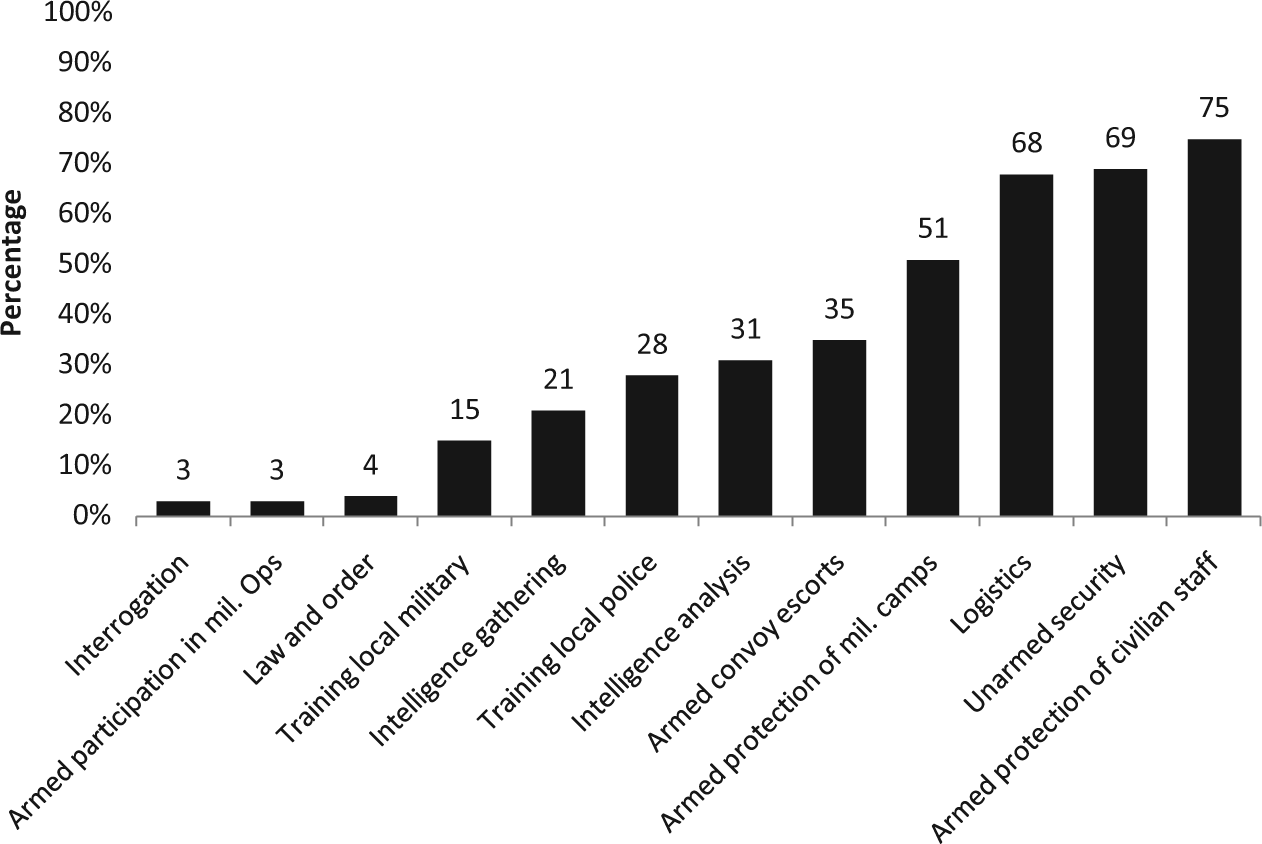
Officers’ views about PSC activities in high-risk environments (%).
As we can see, activities such as interrogation, active participation in military operations and maintaining law and order are largely considered out of bounds for PSCs. Training of military forces also appears fairly controversial, while around a third of the respondents think training local police forces and performing intelligence analyses are acceptable PSC activities. The least controversial activities are logistics, unarmed security and armed protection of civilian staff. From the perspective of the officers, there are several functions that are inappropriate for PSCs, most likely because they are associated with fundamental military (and police) functions. Similar results have also been reported among US military officers, where a vast majority reported that there are certain functions that should not be outsourced to private companies (Schaub, 2010: 377). Exactly where these lines between acceptable and unacceptable are drawn is bound to differ between cases (e.g. US officers are perhaps more likely than Swedish officers to accept military training as a role for PSCs). Yet, if this boundary is seen (by the military) to be transgressed, it is reasonable to expect that this will affect the workings of PSC–military relations and security governance. For instance, if Swedish civilian authorities were to hire PSCs for services deemed controversial or unacceptable by Swedish military officers, this might cause friction between the civilian leadership and military personnel (i.e. negative civil–military relations), as well as between the military and the PSCs (i.e. negative PSC–military relations). In turn, this might jeopardise the effectiveness of Swedish operations in Afghanistan, making it even more difficult to get the different parts of the ‘comprehensive approach’ together.
In the survey, the officers were also asked to report their views on several common claims about PSCs and their behaviour. Here, some observations can be made that provide additional insight into the views that Swedish officers have of the usefulness of PSCs for civilian and military missions. First, only 6% of the officers think that PSCs are important to military operations, while 26% think the companies are important to civilian efforts in peace operations. Judging from these figures, the Swedish officers’ views on PSCs in Iraq appear to differ from those of US military staff. In the study by RAND, the majority of US military personnel reported that PSCs contribute vital support and surge capacity to military operations (Cotton et al., 2010: 59). Here, the fact that Swedish authorities are fairly new to security contracting and the fact that Swedish officers have limited experience with PSCs in peace support operations might help explain at least some of these differences. Yet the results indicate that, at present, Swedish officers who have been deployed in international missions do not appear to associate PSCs with increased military capability.
Second, looking at the question of PSC behaviour in the area of operations, the results are inconclusive. A fairly substantial number (42%) of the respondents disagree with the claim that ‘PSCs behave as they see fit, without control or oversight’. Yet, at the same time, almost as many (38%) support the claim that more regulation of PSCs is needed. In addition, one in five officers (22%) thinks that PSCs tend to behave inappropriately towards the civilian population. These results seem to point to potentially problematic PSC–military relations, rooted in familiar (though not necessarily accurate) images of unregulated PSCs with a low level of concern for people who are not clients, in this case the civilian population. However, the image is more complicated: when it comes to the issue of PSC–military cooperation, communication and coordination on the ground, 30% of respondents report that cooperation between PSCs and military units in theatres of operation generally works well. Yet a majority (55%) have chosen the ‘no opinion’ option, indicating once more that Swedish officers and soldiers only rarely come in direct contact with PSCs and their employees. By way of comparison, among the military respondents in the RAND study, 40% of those with experience with contractors report that they had sometimes or rarely observed PSCs neglecting to coordinate with military commanders (Cotton et al., 2010: 39). In the free text comments of the Swedish survey, as well as in the in-depth interviews, some additional hints on these issues can be found, relating to different aspects of PSC–military relations and what Percy (2006: 17) has called ‘military control’ on the battlefield: The challenge with PSCs in the theatre of operations (from a military perspective) is the same as with NGOs… we have no control over them and their work can, from our perspective, be counterproductive. If they are involved in training of police/military forces, then they drain the civilian population’s trust in the military presence. If we say that we are in charge of security but that it is provided by ‘plain clothes’ then the civilian population is likely to ask what good the military does.
The comment is interesting because it points to a (perceived) lack of clear chains of command and divisions of labour. As several authors have pointed out, chains of command between PSCs and military forces are far from straightforward, especially when there is no direct link (e.g. through contract) between military units and the companies (Dunigan, 2011; Berndtsson, 2009; Percy, 2006). The comment is also important because it links the issue of perception to questions of legitimacy and trust and shows how PSCs might affect the legitimacy of the military operation in the eyes of the civilian population.
In sum, we can say that the views about PSCs in international peace operations among Swedish officers are mixed. One the one hand, the results indicate that there are a number of activities that officers find suitable/acceptable for PSCs to carry out, as long as they do not infringe upon core military and police tasks (combat, military and police training, interrogation, etc.). At the same time, however, many officers are wary of the behaviour of PSCs and the lack of regulation of their activities in conflict areas. Given the lack of pre-deployment training and the low level of experience that Swedish officers (currently) have of PSCs, we can expect many of these views to be based in part on common (and potentially skewed and prejudiced) images of, and rumours about, what PSCs and their employees are and what they do. This in turn might impact on PSC–military relations on the ground. Yet the question of how the military views PSCs in an operational context is only one part of the relationship between these actors. To investigate this relationship further, the following section will probe the question of how officers view the private security industry as a potential career option, and how the security industry may be understood as a competitor to military organisations.
The private security industry as career option and competitor
Previous research shows that many PSC employees who work in conflict areas are former military officers. At times, fears have been raised that the increasing demand for staff poses a challenge to military organisations as they find it harder to recruit or retain certain personnel. This movement from public militaries to the private security sector also challenges clear divisions between public and private (or civilian and military) actors, potentially blurring the boundaries of the military profession (Schaub and Franke, 2009). This development gives rise to a number of important questions as follows. How many officers would consider leaving the military for work with a PSC? How many former officers work for PSCs in high-risk environments? What motivates military personnel to seek employment with PSCs? What happens when former officers who have worked for a PSC seek re-employment with the Armed Forces? Neither the survey nor the interviews with Swedish officers yields comprehensive answers to these questions, but they do provide some important hints.
In the survey, the officers were asked whether they would consider working for a PSC in a high-risk environment. In another question, they were asked if they would consider starting up a security company operating in high-risk environments. Responses to the first question show that 29% of the Swedish officers would consider working for a PSC, while 13% answered that they would consider starting up a PSC. That almost a third of the Swedish officers with international experience would consider working for a PSC is a significant finding that raises questions about retention within the Swedish Armed Forces. What characterises those officers who would consider leaving active duty for work in a PSC? Again, the limited sample and number of questions does not allow for a detailed breakdown of the data, but some general observations can be made. For instance, it is possible to see how the willingness to work for a PSC relates to the issue of experience with these actors.
As shown in Table 3, there appears to be a connection between working in Afghanistan and attitude to working for a PSC. While 50% of the officers who have served in Afghanistan would not consider working for a PSC in a high-risk environment, as many as 73% who have not served in Afghanistan express the same opinion. This is interesting because it indicates that serving in areas where PSCs are active does not necessarily feed negative views of PSCs as potential employers. In fact, the data seem to suggest the opposite. A similar pattern can be seen in the question about experience with PSCs: 46% of those with some or significant experience with PSCs report that they would consider working for a security company, compared with only 16% of those with little or no experience. From these results, we can conclude that, for Swedish officers, contact with private security generates a more positive image of PSCs as potential employers. 6
Work for PSCs, service in Afghanistan and experience with PSCs (%).

In addition to personal experience, the data also suggest that, in terms of motivation, higher salary is another factor that might help explain why Swedish officers would consider leaving the Armed Forces for work with a PSC. As Cotton et al. point out, the difference in pay between the military and PSCs is ‘a recurring theme in interviews, anecdotal accounts, and analyses of how contractors are affecting the military’ (Cotton et al., 2010: 19). In the Swedish survey, the majority of respondents (69%) indicate that they believe employees of PSCs earn substantially more than Swedish officers. Money was identified as an important factor in several interviews and comments. As one respondent put it in an answer to an open-ended question: Money decides; working for a private company and making 3–4 times more money than you would in the Swedish Armed Forces. [But also] better equipment sometimes, for instance body armour. In many cases, it is virtually the same job [as in the armed forces].
As we can see, this respondent emphasises money as a key motivating factor, but also points to other issues such as equipment. This finding is in line with studies on other cases, where income has been identified as one of several motivating factors for those who leave active military duty to work for private security companies (see, for example, Franke and Von Boemcken, 2011; Schaub and Franke, 2009: 96–97). Apart from being a motivating factor, salary – or, rather, salary differences – is at the heart of the jealousy that sometimes characterises PSC–military relations. In the study by RAND, for example, military personnel were asked if they thought that high salaries among PSC employees impacted negatively on recruitment and retention for the US armed forces. A majority of the military personnel – regardless of age or grade – said this was the case (Cotton et al., 2010: 21). Admittedly, the two cases are very different considering the large market for PSCs in the USA and the massive reliance on private security by the US in Iraq and Afghanistan, but questions of recruitment and retention are relevant in Swedish perspective as well.
Currently, there are no data on the number of Swedish officers employed by PSCs in conflict or high-risk environments. Yet over 60% of the respondents report that they know personally of one or more fellow officers who have left the Swedish Armed Forces to work for PSCs in Afghanistan and Iraq, and a majority believe that the demand for Swedish officers on the private security market is fairly large. This demand is likely to be dependent on the level of training and specialisation. As one interviewee expressed it: Swedish Special Forces soldiers are very sought after … particularly by British and Swedish companies. A regular officer from an ordinary infantry regiment, he is less likely to be offered a job [with a PSC].
What is the significance of Swedish officers leaving the armed forces? As noted above, it has been suggested that, among other things, core competences might be lost, for instance in Special Forces units or among logistics and training units (Isenberg, 2004; Singer, 2004). Here, it would is possible to envisage a not-too-distant future when competition increases and military organisations find it more difficult to recruit (and retain) certain staff.
To take an example from a case where we know a bit more, and where the development of the security industry as well as the movement of officers to and from PSCs has progressed much further than in Sweden, we turn briefly to the case of the Royal Military Police of the British Army. An internal study shows that over 40% of those specialising in close protection leave active services within 3 years to work for private security companies. Of those who leave, almost half (45%) return to active duty within 2 years. Of those who leave the army, a majority do so to make more money; among those who return, a vast majority do so for reasons of ‘job security’ and a ‘sense of belonging’. Interestingly, half of those who return to the army after working for a PSC leave again within 2 years, often citing (what they experienced as) the ‘rigid control’ within the army as reason for leaving (Wellington PF Lt Col., personal communication, 25 January 2012).
This movement back and forth between military organisations and the commercial security sector underlines the problem of applying fixed categories and dichotomies (i.e. public–private) when discussing the use of PSCs. In addition, the development raises questions about the possibilities of former military officers finding employment, and about the ways in which armed forces should deal with experiences and competence from PSC work. In the British example, the officers who leave to work for a PSC and then return to the army find that the army tends not to rely on PSC experience as they perceive private sector close protection as sub-standard. Also, officers talking about those who have left, come back and then leave again often state that these individuals have become ‘reckless’, ‘tactically naïve’ and ‘risk takers’, potentially putting others (colleagues and clients) at unnecessary risk through their behaviour (Wellington PF Lt Col., personal communication, 25 January 2012).
Among those interviewed for this study, it is clear that the number of people who leave the Swedish Armed Forces to work in PSCs and then return to the army is still very small. Yet the sensitivity of the issue is apparent; those few who are accepted back into the armed forces are first rigorously vetted and questioned at length by MUST, the Military Intelligence and Security Directorate (Interview, 15 November 2011). While individuals will have different reasons for both leaving and coming back, the movement itself raises several important questions. As one interviewee commented: Some will quit the private security business and try to get back into the [Swedish] Armed Forces; they realize that they have to bear a number of costs themselves and that the grass is not always greener on the other side. Furthermore, I think some of those who have worked for foreign-based companies return when they have ‘had a go’. Kind of like those who work abroad for some time but then come back. When people return to the Armed Forces, it is important to have thorough vetting and assessment procedures. The Army should be aware of the risk of psychological reactions that may not surface until after they have finished working for a PSC. […] It is important to find out what they have been through – have they been shot at? How do they react? Are there signs of a ‘baggage’ that make them unfit for re-employment?
Regardless of reasons for leaving and coming back, there are both risks and potential gains associated with rehiring people who have worked for PSCs in high-risk environments. On the one hand, they can contribute substantial experiences that do not exist within the organisation, for instance in terms of working with certain tasks or in a specific geographical area. On the other hand, experiences of violence and extreme duress might also result in serious problems, such as PTSDs (post-traumatic stress disorders). This in turn can cause serious problems, both for the individual and for the organisation.
To summarise, the results indicate that the question of how Swedish officers view PSCs in peace operations cannot be given a simple answer. The same goes for the impact of these views or attitudes on PSC–military relations in specific cases. We know that, within certain limits, Swedish officers accept certain roles or functions for PSCs, and that quite a few (29%) would consider working for a PSC in a high-risk environment. These findings indicate potential challenges linked to questions of recruitment and retention within the Swedish Armed Forces, which is particularly pressing considering the current transition from conscript army to an AVF. At the same time, the survey also showed that many officers are concerned about the behaviour and lack of regulation of PSCs in peace operations, and about using PSCs for core military functions. In addition, a majority (60%) of Swedish officers would not consider working for a security company. Taken together, this seems to imply that many Swedish officers are still suspicious of PSCs, which in turn might also influence how they interact with these companies on the ground.
Concluding discussion
State and non-state organisations, agencies and private companies are increasingly reliant on PSCs for their activities in unstable environments. Security contractors are becoming important actors in international responses to crises and conflicts, and an integrated and, in many ways, indispensable part of how states such as the USA conduct their military operations abroad (see e.g. Kinsey and Patterson, 2012). In spite of the many challenges and problems associated with this development, fairly little is known about certain aspects of this commercialisation of security. This is perhaps particularly true when it comes to the ways in which different public and private actors view each other, and how the relationships between them function (or not). The aim of this article has been to shed some new light on what has been called the civil–PSC–military problematique, focusing on the case of Sweden and the PSC–military axis of this triangular relationship.
As the analysis above shows, it is a complex and somewhat contradictory image that emerges, and general observations must be made with caution. The Swedish officers are certainly not uniformly negative to PSC presence in peace operations, nor are they unvaryingly positive. That almost a third of the officers with international experience would consider working for a PSC in a high-risk environment raises questions not only about the nature of PSC-military relations relations on the ground, but also about recruitment and retention for the Swedish Armed Forces. While the number of former Swedish officers working for PSCs in and around conflict areas is still fairly limited, this might well change in the future, as might the number of former officers who seek re-employment after working for a PSC. In this context, questions of how to value such experiences, and how to avoid potential problems linked to PSC work, are key. Sweden, like the USA or the UK, might soon need to start considering how to deal with individuals who leave the armed forces to work for a PSC but then want to come back.
The results also indicate that Swedish officers distinguish between what they consider as acceptable PSC activities and those that are not; interrogation, participation in military operations and maintaining law and order are not widely accepted activities, while armed protection of military camps, logistics, unarmed security and armed protection of civilian staff clearly are. Although PSCs do not appear to be fully accepted as military professionals or capable of taking on certain tasks conventionally seen as the domain of the military, the lines of distinction are not sharp. This further emphasises the argument about the hybrid nature of PSCs and the blurring of distinctions between ‘public’ and ‘private’ or ‘military’ and ‘civilian’ actors, activities and areas of responsibility. The survey also shows that the level of interaction between Swedish Armed Forces deployed abroad and PSCs is limited. The fact that less than 15% report having had any pre-deployment training on the status of or interaction with PSCs in areas of operation is also cause for concern. Making such training part of the training programme in cases where companies are active might dispel some myths and pave the way to smoother PSC–military interaction on the ground.
For future research, it would be interesting and useful to make a more comprehensive study of the Swedish case, as well as more structured comparisons between different and similar cases in order to create a clearer image of how the military views PSCs (as well as former PSC employees) and how this might affect operations and civil–military relations. In order to gain further insight into the workings of PSC–military relations, research also needs to be focused on the views of the military among PSC employees. Certainly, there is no shortage of evidence based on qualitative data, but it would be productive to complement this with quantifiable data. Such research, however, faces the towering challenge of getting access to these kinds of data on a national or international level. To conclude, this article has scratched the surface and pointed to several theoretical and empirical questions within an area of research where much more work is needed to improve our understanding of PSC–military relations, as well as their impact on what constitutes ‘the military’, and on civil–military relations in theory and practice.
Footnotes
Acknowledgements
The author wishes to thank Christopher Kinsey, Åsne Kalland Aarstad and the three anonymous reviewers for their constructive comments.
Funding
This work was supported by the Swedish Armed Forces (grant no. AF9222021) and the Swedish Research Council (grant no. 2008:1877).