




Abstract
Innovative mechanisms of global governance are increasingly common, yet they defy easy categorization. The Alliance of Civilizations, a UN initiative that seeks to promote intercultural dialogue, is one such example. It is a hybrid entity that exhibits elements of networks, international organizations, and public–private partnerships, among other things. Only when we shift our gaze to its patterned activities do we discover that it might best be understood as a community of practice specializing in global-level public diplomacy. Practice-based analysis, therefore, allows a deeper understanding of the Alliance and, in turn, prompts a fresh consideration of an increasingly important form of diplomacy. I argue, in particular, that public diplomacy is not solely a national-level, state-oriented activity. In turn, this inquiry invites practice theorists to reflect on the degree of fit required to associate a unique social form with an identifiable set of patterned activities.
Keywords
Introduction
This article seeks to answer a straightforward question: ‘What is the Alliance of Civilizations?’. Superficially, it seems that there should be an easy answer. The Alliance of Civilizations (AoC) is a fairly recent initiative of the United Nations. Its mandate is understandable to any student of global politics, captured in the following statement: ‘the need to build bridges between societies, to promote dialogue and understanding and to forge the collective political will to address the world’s imbalances has never been greater. This urgent task constitutes the raison d’être of the Alliance of Civilizations’ (Alliance of Civilizations, 2006). Nonetheless, the AoC defies easy categorization. Our initial impulse is to try to fit it into our existing categories; however, this is unsatisfying. It is a UN entity, but it is qualitatively different from its UN peers such as the World Food Program or the World Bank. Furthermore, it fits uncomfortably into standard definitions of an international organization. It is at the centre of scores of actors around the world who are working toward its expressed goals; yet calling it a transnational network offers only partial understanding.
Ascertaining with confidence what characterizes the Alliance of Civilizations requires that we draw on innovative analytic tools. Employing the concept of ‘community of practice’ (Wenger, 1998, 2000; in IR, see Adler, 2005, 2008), I approach the AoC through its ‘patterns, repetitions, and daily performances’ (see Adler and Pouliot, 2011). In so doing, I build on, but also depart from, a similar attempt by Lachmann (2011), who conceives of the AoC as the embodiment of the ‘international community’. My analysis seeks to go further and specify the key practices that hold the Alliance together: a form of global public diplomacy. As a new political object in global governance, the AoC is best captured as a community of practice anchored in the joint performance of public engagement with global civil society.
This sort of inquiry is increasingly important for scholars of global governance. The global landscape has evolved in significant ways in recent years. Just a few short decades ago, International Relations scholars understood international institutions as mechanisms for facilitating cooperation between states (Keohane, 1988). This brand of analysis is not irrelevant, but it cannot account for the range of actors, mechanisms and processes that now operate at the global level. The field of Global Governance has emerged to offer new approaches and a new vocabulary for studying numerous and varied governance mechanisms, including private certification schemes such as the Forest Stewardship Council (Auld and Gulbrandsen, 2010); voluntary networks such as the UN Global Compact (Bernhagen and Mitchell, 2010); or standard setting bodies such as the International Accounting Standards Board (Büthe and Mattli, 2011). Such entities may or may not include states; more likely, they include some constellation of inter-state or non-state actors whose actions produce governance effects in the absence of participation by traditional governments. These require new tools, concepts, and approaches.
It is against this backdrop that I seek a better understanding of the AoC. What are the innovative approaches that we are using to govern or regulate specific domains? Who is involved in them? What strategies are they deploying to achieve their objectives? While I cannot answer all of these questions in a generalized way here, I can use the Alliance as a window on them. On the way to examining the Alliance, I discover resonances between practice theory and diplomatic studies.
This analysis should be of interest both to scholars of diplomatic studies and to practice theorists, as well as students of global governance. My inquiry shows that the primary activity of the AoC is not simply a ‘dialogue of civilizations’, but more specifically a global form of public diplomacy. The field of diplomatic studies is increasingly recognizing that various non-traditional actors are fulfilling diplomatic functions. The Alliance is a fascinating case to consider under that rubric – all the more so that the constituents on behalf of whom it is acting, as well as the constituency that it is addressing, remain quite ambiguous. The Alliance itself is not a diplomatic actor per se, notably because it does not represent anyone. Instead it serves as a catalyst and an umbrella for literally hundreds of individuals, groups, private sector, governmental, and non-governmental actors. Under this umbrella, these actors are engaged in a set of ‘patterned actions’ and ‘competent performances’ (Adler and Pouliot, 2011) reminiscent of public diplomacy.
Practice theory clearly helps diplomatic studies grapple with the emergence of hybrid forms of diplomacy. In order to know what something is, it is useful to look at what it does. Reciprocally, studying the evolution of diplomacy also contributes to the development of practice theory, in this case by forcing it to confront its own limitations when it comes to transformation. In my view, the framework faces some difficulties in addressing unique or deviating social forms: the AoC may be in a business that resembles public diplomacy but, contrary to its national form, it is performed by self-appointed actors to an amorphous global audience with whom civilizational concerns more or less resonate.
This sort of observation generates questions. For example, how close a match must something be before we can comfortably affix the label associated with a set of established practices to an entity not typically associated with those practices? If we find that the AoC reveals patterned activities that evoke public diplomacy, can we then infer that those working under the umbrella of the Alliance are public diplomats? Must the definition of public diplomacy now be expanded to accommodate this seemingly anomalous case? As we continue to apply practice theory to a variety of empirical cases, these sorts of issues will come into focus. In this article I offer tentative answers to these questions.
The article proceeds in four steps. First, I argue that the AoC hardly fits our traditional category of international organization, inviting new analytical tools. The next three sections analyze how the AoC conforms to the major components of a community of practice, as defined by Wenger and Adler. To begin, I look at the nature of the mutual engagement between the members of the community by tracing the origins and day-to-day functioning of the Alliance. Then, I review debates over public diplomacy to show that the Alliance’s joint enterprise is to engage with the public at the global level. Finally, I focus on the Alliance’s repertoire of communal resources and delineate the activities and actors that comprise it.
What kind of political object is the Alliance of Civilizations?
In trying to establish just what kind of political object the Alliance of Civilizations is, one’s first impulse is to see if it fits into existing analytic categories. Because of its close association with the United Nations, it is logical to ask if the Alliance is itself an international organization.
In its most straightforward, narrow textbook definition, IOs are understood to be ‘formal institutions whose members are states’ (Pease, 2010: 2). Of course, scholarship in recent decades, reflecting the evolution in global governance mechanisms, acknowledges that IOs are much more complex than this. At a minimum, their membership need not be restricted to states. Archer provides one of the more comprehensive taxonomies for thinking about IOs. He canvasses a broad range of sources to arrive at a working definition founded on three ‘irreducible essential characteristics’ of IOs: membership, aim, and structure. Thusly, according to him (Archer, 2001: 33), an IO can be defined as ‘a formal, continuous structure established by agreement between members (governmental and/or non-governmental) from two or more sovereign states with the aim of pursuing the common interest of the membership. Archer uses the three essential characteristics of IOs as a way to classify them.
One could arguably classify the Alliance in comparison to other entities based on its aim and structure. Certainly, the Alliance has identifiable aims, which are laid out in official statements and documents. Archer notes several axes along which one can plot an IO’s aims, including general/specific and cooperation/conflict/confrontation. Similarly, he explores variation in structure, from relative power and influence of members to composition of members to the independence of the body from its members. Tellingly for the Alliance, these two latter characteristics are reliant on establishing the first – that the IO indeed has members! What seems obvious superficially is exceptional in the case of the Alliance because it does not have members in the conventional IO understanding.
The Alliance was created at the initiative of a Head of State, but it has no member states of its own and UN members are not necessarily automatically associated with it. Most of its Group of Friends are states; however, some of them are other international organizations. None of them is a ‘principal’ of the Alliance in the way that principal-agent theorists envision (see, for example, Hawkins et al., 2006). While state involvement seems important, it is difficult to make the claim that the Alliance exists to promote specific state interests.
Archer offers another take on IOs through the lens of its typical roles. He lists instrument, arena and actor as the main IO roles. Again, the Alliance fits each of these uncomfortably. The notion of instrument picks up on a long-standing argument in international relations that member states use IOs to advance their (individual) interests. We have seen no evidence of this behaviour with the Alliance. On the contrary, the Alliance seeks to enlist sometimes reluctant states and other stakeholders in its work. The Alliance aspires to be an arena. Certainly, the Global Forum is intended to provide a venue and a platform where diverse interests can meet. However, to date, attendance of a critical mass of high-level officials has not been forthcoming. Finally, the Alliance is very clearly not an actor. Internal documents use vague language to capture the Alliance’s essence. Kofi Annan’s press release launching the Alliance calls it ‘an initiative’ (Secretary-General of the United Nations, 2005) as does the Report of the High Level Group (Alliance of Civilizations, 2006). In sum, the AoC fits very uneasily into the category of international organization.
In order to understand the nature of this hybrid political object, in line with practice theory I shift my gaze away from asking what the Alliance is to examining what it does. This leads me to capture the AoC as a community of practice. More specifically, I discover that what it does – that is, the competent performance that holds the group together – looks a lot like public diplomacy. Staff and associates of the Alliance of Civilizations engage in a global form of public engagement concerning the notion of civilizational dialogue.
More traditional thinkers about diplomacy might dispute that the Alliance of Civilizations is conducting diplomacy at all. However, I want to show that what the group does actually approximates Der Derian’s definition of diplomacy: ‘the mediation of estrangement’ (Der Derian, 1987; see also Constantinou and Der Derian, 2010). Indeed, such a definition seems particularly well-suited to the Alliance and its desire to bridge the divide between Western and Muslim societies which might appropriately be described, at least in some cases, as estranged from each other. In a similar vein, Lachmann (2011) argues that the AoC emerges out of a universalizing discourse with exclusionary practices. Because he is primarily concerned with the notion of ‘international community,’ though, Lachmann stops short of a full practice analysis of the AoC. However, if we are to grasp the Alliance as a ‘multilayered community of practice,’ we ought to specify what kind of performances make it hang together.
The concept of community of practice has recently attracted attention in IR. Adler defines it as ‘like-minded groups of practitioners who are informally as well as contextually bound by a shared interest in learning and applying a common practice’ (Adler, 2008: 197; see also Bicchi, 2011). He shows, among other things, how security communities emerge out of communities of practice. Building on Wenger (1998, 2000), I structure my analysis around the three pathways through which practices are the ‘source of coherence of a community’: mutual engagement, joint enterprise and a shared repertoire of communal resources. The analysis that follows unpacks these three elements and applies them to the AoC.
Mutual engagement: building the Alliance
As Wenger explains, ‘members build their community through mutual engagement. They interact with one another, establishing norms and relationships of mutuality that reflect these interactions. To be competent is to be able to engage with the community and be trusted as a partner in these interactions’ (Wenger, 2000: 229). In other words, it is necessary but not sufficient for members of a community of practice to belong to one organization or to have repeated interactions – members of the community need to ‘sustain dense relations of mutual engagement organized around what they are there to do’ (Wenger, 1998: 74). In this section, I show that the Alliance is built on mutual engagement. The successive steps that led to its creation defined the participants of the community and the nature of their relationships. The whole challenge of the Alliance in its early years was precisely to create the condition of a durable mutual engagement.
In September 2004, José Luis Rodríguez Zapatero, President of Spain, called for the creation of the Alliance of Civilizations. Speaking at the UN General Assembly, Zapatero noted Spain’s commitment to international peace. He specified various means for bringing it about: rule of law, human rights, democracy. He also listed education and culture. ‘Peace and security will only spread over the world… with the strength of education and culture: culture is always peace; let us ensure that our perception of others is coloured with respect. With the strength of dialogue among peoples.’ He continued: Thus, in my capacity as representative of a country created and enriched by divers [sic] cultures, before this Assembly I want to propose an Alliance of Civilizations between the Western and the Arab and Muslim worlds. Some years ago a wall collapsed. We must now prevent hatred and incomprehension from building a new wall. Spain wants to submit to the Secretary General, whose work at the head of this organisation we firmly support, the possibility of establishing a High Level Group to push forward this initiative. (Zapatero, 2004: 5)
Two months later, UN members held consultations on Zapatero’s initiative, creating a Group of Friends ‘to support the Alliance of Civilizations initiative in fostering global cooperation on cross-cultural issues and to promote initiatives aimed at encouraging dialogue and building bridges among societies and communities’ (Alliance of Civilizations, 2013b). In June 2005, Prime Minister Recep Tayyip Erdoğan of Turkey joined President Zapatero as co-sponsor of the initiative. The Alliance was officially launched in July 2005 with a press release from Kofi Annan, thenUN Secretary-General.
Three months later, Annan established a high level group to assess the backdrop against which the Alliance of Civilizations would function and to offer suggestions for practical ways to implement its vision. This group included eminent persons from around the world, among them Archbishop Desmond Tutu; former President of Iran, Sayed Mohamed Khatami; and religious historian, Karen Armstrong. The High Level Group met several times in 2005 and 2006, supported by a Secretariat. In late 2006, they presented their report to Secretary-General Annan.
These initial steps created the conditions for the emergence of a community of practice where mutuality and reciprocity constitute the founding rationale – what the Alliance itself calls the ‘bridging of multiple divides’. As the Secretary-General put it, The initiative is intended to respond to the need for a committed effort by the international community – both at the institutional and civil society levels – to bridge divides and overcome prejudice, misconceptions, misperceptions, and polarization which potentially threaten world peace. The Alliance will aim to address emerging threats emanating from hostile perceptions that foment violence, and to bring about cooperation among various efforts to heal such divisions. […] The Alliance of Civilizations is intended as a coalition against such forces, as a movement to advance mutual respect for religious beliefs and traditions, and as a reaffirmation of humankind’s increasing interdependence in all areas – from the environment to health, from economic and social development to peace and security. (Secretary-General of the United Nations, 2005)
Mutual respect aims to counter the impression that there is a clash of civilizations as suggested by Samuel Huntington’s 1993 article in Foreign Affairs magazine (Huntington, 1993) and the book that followed (Huntington, 1996). Indeed, the 2006 report of the High Level Group laments the impression created by this discourse and defines its role against it: ‘The anxiety and confusion caused by the “clash of civilizations” theory regrettably has distorted the terms of the discourse on the real nature of the predicament the world is facing. […] It is essential, therefore, to counter the stereotypes and misconceptions that deepen patterns of hostility and mistrust among societies’ (Alliance of Civilizations, 2006: 3). Later, the report notes that, ‘for global terrorist groups, a “clash of civilizations” is a welcome and potent slogan to attract and motivate a loosely knit network of operatives and supporters’ (Alliance of Civilizations, 2006: 16).
Since publication of that initial report, mutual engagement between participants in the Alliance has been enlarged and broadened. The Alliance has expanded its scope beyond the narrow conceptualization intended to counter the clash narrative. The founders of the Alliance intended that the UN program would give special attention to the relationship between ‘the West’ and ‘the Muslim world’. Yet, insomuch as one can detect a subtle evolution in the language of Alliance documents toward a more general goal of facilitating cross-cultural dialogue, alongside the civilizational referents, one finds similarly broad communities to be bridged – ‘cultures’, ‘religions’.
As a result, the Alliance now boasts a Group of Friends that includes 140 members. As I will show below, it has settled into a more-or-less regular round of activities. With the exception of 2012, the Alliance has held a global forum every year since 2008. At a local level, the Alliance claims a wide range of events – seminars, lectures, film screenings – as occurring under its auspices. In addition to these events, the Alliance sponsors grants competitions, a summer school workshop program, academic exchanges, and numerous initiatives that take place primarily via digital media.
In sum, in its early years, the members of the Alliance have defined the nature and the extent of their mutual engagement. Through repeated interactions, they have progressively made clearer the core values and basic norms that establish the parameters of their association.
Joint enterprise: public diplomacy
For Wenger, ‘members [of a community of practice] are bound together by their collectively developed understanding of what their community is about and they hold each other accountable to this sense of joint enterprise. To be competent is to understand the enterprise well enough to be able to contribute to it’ (Wenger, 2000: 229). This joint enterprise is ‘the result of a collective process of negotiation’ and ‘it is defined by the participants in the very process of pursuing it’ (Wenger, 1998: 77). In this section I argue that what AoC members do evokes public diplomacy (PD) more than any other form of diplomacy. To make my case, the present section explores the ‘competent performances’ that we associate with public diplomacy and their correspondence with Alliance practices.
There is no established consensus on what defines public diplomacy (Gregory, 2011: 355). Nonetheless, as our understanding of PD evolves, there are certainly activities and approaches that recur. Public diplomacy is a relatively permissive aspect of diplomacy, in the sense that it allows for the participation of non-traditional actors in diplomacy. The parameters of activity are also much wider, eschewing secretive, high-level, government-to-government relations for open communication about ideas, attitudes, opinions, and values.
Gregory (2011: 353) asserts that public diplomacy is ‘an instrument used by states, associations of states, and some sub-state and non-state actors to understand cultures, attitudes, and behaviour; build and manage relationships; and influence thoughts and mobilize actions to advance their interests and values’. Melissen (2013: 8) notes that public diplomacy ‘is increasingly based on listening to “the other”… it is about dialogue rather than monologue, and is not just aimed at short-term policy objectives but also at long-term relationship-building’. The targets of public diplomacy are citizens and publics. Pamment (2013: 6) adds more definitional food for thought and suggests that, ‘PD is about creating effects upon the conduct of diplomacy, indirectly through public attitudes’. PD is also about ‘bringing interest groups from different nations into contact with one another’ (Pamment, 2013: 10).
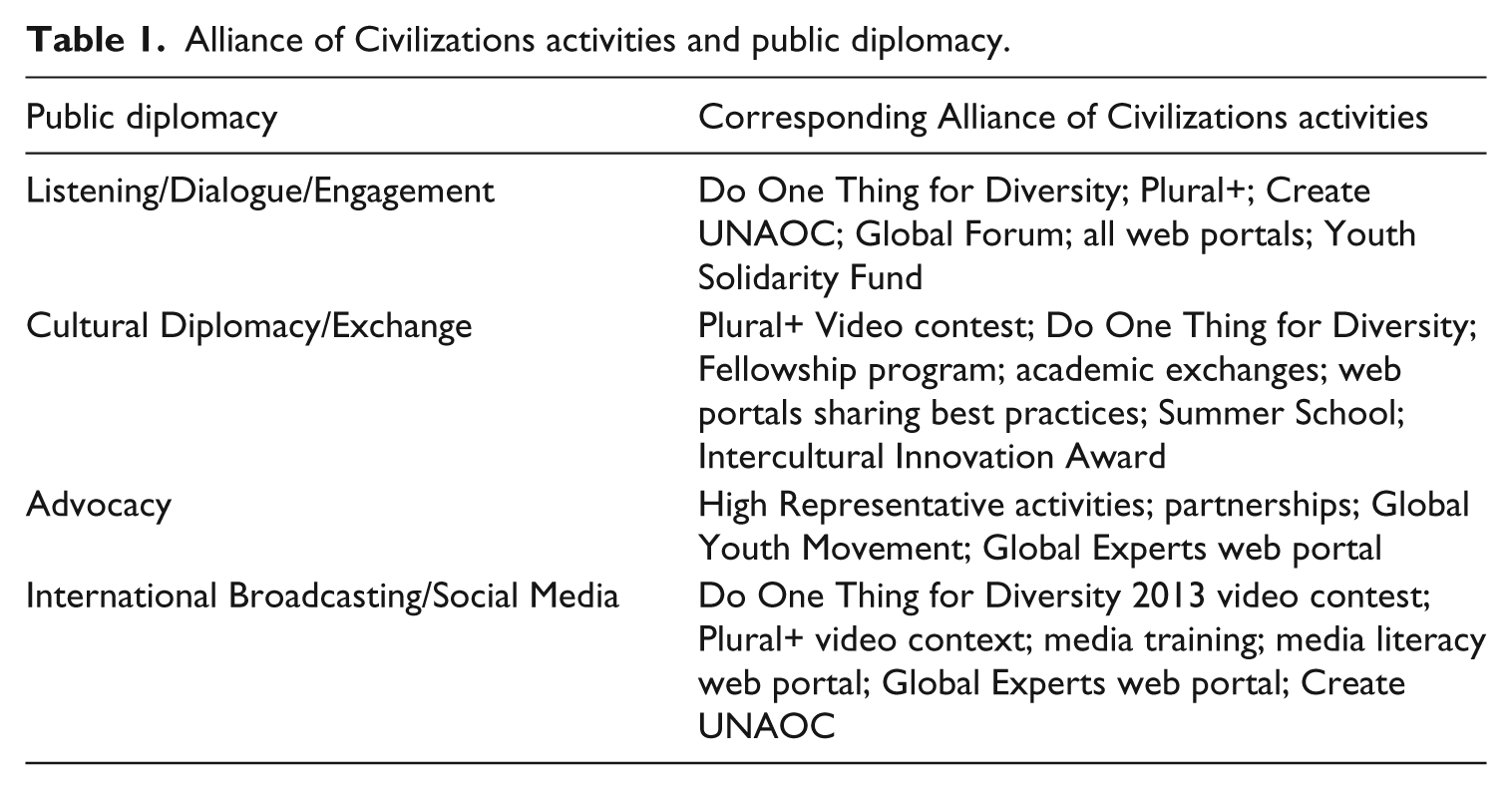
What brings the AoC together – its ‘joint enterprise’, in Wenger’s words – is precisely the performance of public diplomacy. This correspondence operates on four levels. First, PD aspires to be a two-way street implying not only speaking and promoting one’s values and opinions, but also listening. Public diplomacy increasingly emphasizes dialogue over one-way transmission of information to foreign publics. As Melissen (2005: 13) puts it, ‘the new public diplomacy moves away from – to put it crudely – peddling information to foreigners and keeping the foreign press at bay, towards engaging with foreign audiences’. In the definition provided by Gregory (2011: 355–356), engagement is one of the four core concepts associated with PD (see also Cull, 2008). This captures the dialogic and relationship-building elements of public diplomacy. ‘It is grounded in networks and participation in cross-boundary relationships. Engagement places a premium on dialogue, reasoned argument, openness to the opinions of others, learning through questions, not talking at cross purposes and working out common meanings.’ He adds that ‘engagement leads to mutual understanding, breaks down stereotypes and contributes to long-term cooperation’ (Gregory, 2011: 358).
Second, PD promotes cultural exchange. This sort of activity allows citizen ambassadors or examples of cultural achievement to communicate an alternative message in a subtle and more indirect manner (Goff, 2013). For Cull (2008: 20), cultural diplomacy and exchange are key components of PD. Cull notes, for example, that, ‘the element of reciprocity has tended to make this area of public diplomacy a bastion of the concept of “mutuality”: the vision of an international learning experience in which both parties benefit and are transformed’.
Third, advocacy is fundamental to PD. It is one of the core concepts identified by Gregory and Cull. For Gregory, whereas engagement is about dialogue, advocacy acknowledges the ongoing usefulness of the transfer of information. ‘Advocacy’s focus is on strategic action and non-deliberative elements in politics and diplomacy – agenda-setting, decision-making, persuasion and mobilizing actors’ (Gregory, 2011: 360). Gregory cites groups that work to mobilize the public to press for international agreements on climate change as an example of advocacy. That is also why, increasingly, analysts add in the internet as a key tool of public diplomacy. For example, Melissen (2013: 436) notes that ‘with e-bulletins, blogs and other Internet-based resources, public diplomacy is an activity that seems more at home in the global communications’ realm than other modes of diplomacy’. Indeed, these technologies map onto the fourth dimension of public diplomacy. Cull, especially, discusses the importance of mobilizing contemporary technologies, including broadcast and social media, in the service of PD objectives.
In the course of this survey of contemporary discussions of key elements of public diplomacy, one cannot help but recognize Alliance activities. These four features also characterize the AoC, as Table 1 summarizes.
Alliance of Civilizations activities and public diplomacy.
It is important to highlight that PD is a platform for dialogue that is open to actors of different kinds. Early discussions of public diplomacy presumed that its main agents would be states. As Gregory puts it, ‘Public diplomacy in the twentieth century was viewed as a state-based instrument used by foreign ministries and other government agencies to engage and persuade foreign publics for the purpose of influencing their governments’ (Gregory, 2011: 353). However, following ‘quite radical redefinitions of the concept of PD in the last decade’ (Pamment, 2013: 2), theorists of the ‘new public diplomacy’ acknowledge the range of actors that can be involved (Hocking, 2005; Melissen, 2013; Pamment, 2013). Hocking (2005: 30–31) goes even further, noting the ‘active role for publics rather than as passive objects of government foreign policy strategies…. individuals and groups, empowered by the resources provided by the communications and information technology revolution – and particularly the internet – are direct participants in the shaping of international policy and, through an emergent global civil society, may operate through or independently of national governments’. Indeed, Hocking (2005: 33) eschews the term ‘statecraft’, suggesting that ‘“actorcraft” is a more appropriate term for a mixed actor milieu…’ Gregory (2011: 372) concurs, noting that, ‘the role of the state will continue to diminish as networks of new actors gain power. Much more diplomacy will take place among publics’. For Melissen (2005: 22), public diplomacy ‘is also about building relationships with civil society actors in other countries and about facilitating networks between non-governmental parties at home and abroad. Tomorrow’s diplomats will become increasingly familiar with this kind of work, and in order to do it much better they will increasingly have to piggyback on non-governmental initiatives, collaborate with non-official agents and benefit from local expertise inside and outside the embassy.’ These sorts of descriptions of PD are very much aligned with the work of the Alliance of Civilizations.
The overall goal of the Alliance is ‘to improve understanding and cooperative relations among nations and peoples across cultures and religions and, in the process, to help counter the forces that fuel polarization and extremism’ (Alliance of Civilizations, 2007: 4). Early on, the report of the High Level Group asserted that the ‘Alliance seeks to address widening rifts between societies by reaffirming a paradigm of mutual respect among peoples of different cultural and religious traditions and by helping to mobilize concerted action toward this end’ (Alliance of Civilizations, 2006: 4). It is worth noting that two of the Alliance’s core areas – education and media – are also core elements of any public diplomacy effort. The first implementation plan identifies three main objectives for the Alliance: Develop a network of partnerships with States, international organizations, civil society groups, and private sector entities that share the goals of the Alliance of Civilizations…; develop, support, and highlight projects that promote understanding and reconciliation among cultures globally and, in particular, between Muslim and Western societies… Establish relations and facilitate dialogue among groups that can act as a force of moderation and understanding during times of heightened cross-cultural tensions. (Alliance of Civilizations, 2007: 4)
Overall, the joint enterprise of the AoC is reminiscent of that of public diplomacy. Both are platforms of cultural exchange that imply advocacy, open dialogue and listening on the part of state and non-state actors. Of course, the Alliance is not necessarily in a position to listen, conduct opinion polls, or gather data and intelligence as national public diplomats would. Instead, the AoC catalyzes it on behalf of the constituencies for which it works. As a result, it encourages representatives of specific groups to express themselves and for others to listen to them. What the Alliance does is not the traditional public diplomacy carried out by representatives of states on behalf of their domestic societies. It is public diplomacy carried out by disparate, often self-appointed actors with whom civilizational concerns resonate.
That the Alliance looks to be engaged in public diplomacy should prompt theorists of public diplomacy to reflect on prevailing definitions. As I noted above, public diplomacy was originally carried out by representatives of governments in the national interest. Nonetheless, the category of public diplomacy is a very fluid one. It has already shifted in response to world developments and it will likely continue to do so. This suggests that scholars of public diplomacy will be quite open to considering what this inquiry into Alliance practices might suggest about public diplomacy; in particular that it is also a global-level activity.
Shared repertoire: what does the AoC do and how does it do it?
For Wenger, communities of practice ‘produce a shared repertoire of communal resources […]. To be competent is to have access to this repertoire and be able to use it appropriately’ (Wenger, 2000: 229). These resources are the locus of the negotiation of meaning within the community of practice. The repertoire formed by these resources ‘can be very heterogeneous’ and includes ‘routines, words, tools, ways of doing things, stories, gestures, symbols, genres, actions, or concepts that the community has produced or adopted in the course of its existence’ (Wenger, 1998: 82–83). I focus in this section on the resources and tools employed by the Alliance.
In terms of its roles and functions within the UN system, the High Representative’s Implementation Plan specifies five: a bridge-builder and a convener; a catalyst and facilitator; an advocate for building respect; a platform to increase visibility; and a resource providing access to information (Alliance of Civilizations, 2007: 4, 2013d: 5). As I mentioned above, the plan envisioned an annual forum as the Alliance’s flagship event. This has taken place every year since 2008, with the exception of 2012.
In terms of actions, the AoC divides its work into three categories – National/Regional Strategies; Programs; and Special Projects and Events – and identified four key issue areas on which to focus: education, youth, migration and media policies. In almost every instance, it is clear that the Alliance itself is not an actor. The Alliance has neither the inclination nor the capacity to execute the projects and programs that would lead to the achievement of its primary goals. Instead, individuals, civil society groups, private sector actors and governments, among others, must take action. The AoC catalyzes, encourages, organizes, incentivizes and publicizes that action.
Among the most influential approaches produced by the community are the National and Regional Strategies. In order to bring state actors into the mix, the AoC has encouraged interested governments to define and undertake a National Strategy to promote intercultural understanding in their domestic environments. These Strategies are key components of the AoC’s actions ‘on the ground’. To date, 27 countries have submitted national strategies. This generally means that the Government must identify a list of activities that will be undertaken, as well as the government agencies and other actors who will be charged with undertaking them. The hope is that defining a strategy will reflect a tangible commitment on the part of state actors to the objectives of the Alliance. Furthermore, ‘they are a mechanism to exchange lessons learned regarding challenges of cultural diversity, including identity-based tensions’ (Alliance of Civilizations, 2013d: 6). As well as the National Strategies, four Regional Strategies have been drafted: for the Mediterranean; South Eastern Europe; the Black Sea region; and for Latin America. Others are apparently forthcoming, with the cooperation of regional organizations.
In addition to the National/Regional Strategies and the Programs, the Alliance oversees a third pillar of its work – Special Projects and Events. Among these is a series of campaigns, including Do One Thing for Diversity and Inclusion, launched in 2011. This campaign corresponds with the World Day for Cultural Diversity and encourages people to take concrete action to learn and/or teach about diversity.
The highest profile event of the Alliance is the Global Forum. Six forums have been held (Madrid, Istanbul, Rio de Janeiro, Doha, Vienna, and Bali), gathering representatives from civil society, governments, media, the private sector, religious groups and youth groups, among others. Moreover, AoC campaigns and competitions – for example, the Intercultural Innovation Award, Create UNAOC, and so on – are intended to support and catalyze ongoing work – especially by civil society groups – to ‘connect cultures’. In all instances, interesting connections are made by enlisting prominent figures as jury members to adjudicate the competitions.
Programs of the Alliance can be categorized according to the four core areas: Youth; Education; Media; and Migration. Not surprisingly, several activities engage with more than one core area, especially since many Alliance initiatives have a youth and/or an educational dimension. First, the Alliance identifies youth as a particularly important target audience and a potentially important change agent. The Youth Solidarity Fund (YSF) ‘provides seed funding to outstanding youth-led initiatives that promote long-term constructive relationships between people from diverse cultural and religious backgrounds. The YSF was established to answer the calls to action made around the world by youth organizations since the creation of the UNAOC’ (Alliance of Civilizations Youth, 2013b, 2013d). The YSF was launched in 2008. There have been three rounds of grant-making: 2008–2009; 2010–2011; and 2012–2013.
The Fellowship Program is aimed at emerging leaders from the United States, Europe, and the Arab World. Its aim is to ‘enhance mutual knowledge’ and to ‘promote dialogue, understanding, and cooperation.’ It is funded through grants from partners including the German Federal Foreign Office; the League of Arab States; the British Council; and the Qatar Committee for the Alliance of Civilizations.
Several other components comprise the Alliance youth initiative, including a Global Youth Movement ‘to mainstream youth representation on cross-cultural issues’; a Youth website (database and clearinghouse) that ‘enables users to obtain, post, and exchange information about youth organizations, opportunities, and tools to engage on cross-cultural issues’; and youth consultation and participation in the annual Global Forum (Alliance of Civilizations, 2013d: 8).
The Plural+ competition is aimed at young people between the ages of 9 and 25; however, it also makes a substantial contribution to two other core areas of the Alliance, Media and Migration. It is carried out in partnership with the International Organization for Migration, together with a number of civil society and private sector partners. The competition invites participants to ‘express themselves on key migration and diversity issues as well as inclusiveness, identity, human rights and social cohesiveness’ in a short video. Winning videos can find their way onto a variety of platforms – the Internet, film festivals, DVD, television, conferences, and events.
A web portal that serves as a clearinghouse, entitled ‘Education about Religions and Beliefs’, is a centerpiece of the Alliance’s second core area, education. It emerged from discussions in 2008 in a working group session at the Istanbul Global Forum. This portal provides a platform for educators and civil society actors to share resources, best practices and announcements about forthcoming events, all related to the theory and practice of education about religions and beliefs. Resources include syllabi, teaching tools and curricula organized in a searchable, multilingual database. There is also a searchable database of relevant organizations and an online journal that publishes scholarly research and book reviews, among other things. Users can not only avail themselves of existing resources, but also upload resources that they wish to share with the community. The portal underlines the centrality of education as a tool to enhance mutual understanding to the mission of the Alliance.
As part of its education mission, the Alliance sponsors a summer school, also aimed at youth. In partnership with Education First, the summer school draws participants from around the world for a one-week intensive skill-building and networking opportunity. Students meet in New York and learn about negotiation and peace-building; social media for social change; advocacy; global citizenship; media literacy; and social entrepreneurship, among other things, in conversations with guest speakers. Also on the education front, the Alliance is working to develop a network of academic institutions – think-tanks and universities – to engage in research.
Third, the Alliance’s focus on media has multiple components. It seeks to ‘amplify the role of media in furthering public understanding of cross-cultural issues… [it] engages with journalists, editors and media owners to promote best practices and build skills across the profession, with a specific view toward ensuring ever-improving quality of coverage on sensitive issues with a broad diversity of voices’ (Alliance of Civilizations, 2013d: 8). The AoC’s Media and Information Literacy is an online clearinghouse of information. This program acknowledges the centrality of media in our lives as a purveyor of ideas and stereotypes. It springs from the recognition that many obtain their information and ideas not from formal education or even family conversations, but from the media. Like the portal on Education about Religions and Beliefs, the Media and Information Literacy hub also gathers, in a searchable database, relevant resources, organizations and events. Resources include scholarly articles, lectures and analyses relating to media and information literacy, media education policy and youth. This program is crosscut with an emphasis on youth as both consumers and producers of media messages (Alliance of Civilizations, 2013a).
Global Experts seeks to create easy access to experts for journalists. The intention is to make available informed and balanced analysis on complex issues relating to the mission of the AoC. The experts chosen for inclusion in the database commit to providing free, quick and reliable reactions to world events. There is diversity among the experts themselves, injecting new voices into the public discourse. The program is also intended to help to make sense of complex world events, especially but not exclusively those of a cross-cultural nature. The database includes not only contact information for a range of experts, but also commentary by the same people. The Media component of the Alliance’s work also facilitates training of journalists ‘with the aim of improving cross-cultural reporting’ (Alliance of Civilizations, 2013d).
Fourth, the Migration core, like the other core areas, also features an online web portal. The Migration and Integration online platform seeks to connect migrants with their new communities. The site serves as a clearinghouse for integration practices. Communities from around the world can share their efforts aimed at ‘building inclusive societies’. In addition to best practices, the searchable databases include articles, papers and related events. The portal is developed in partnership with the International Organization of Migration (Alliance of Civilizations, 2013c).
It must be emphasized that this multifaceted repertoire of resources has been the object of negotiations between the members of the community. For instance, the High Level Political Dialogue, which took place at the first Alliance of Civilizations Forum, notes the distinction between ‘soft approaches’ and ‘hard approaches’. Some members of the Group of Friends ‘noted the challenge they face in striking a proper balance between “soft approaches” (education, exchanges, youth mobilization, etc.) that support increased cross-cultural understanding on the one hand, and “hard approaches” required to police and combat violent extremism, including countering the influence of external support for extremist ideologies and groups on the other’. The report goes on to emphasize that ‘the Alliance is primarily concerned with “soft approaches”’ (Alliance of Civilizations, 2008: 19). In the course of these negotiations, the Alliance has also clarified what it doesn’t do: ‘The Alliance does not seek, as its primary function, to take on the full development of projects on the ground, nor is it designed to run its own set of programmes. Rather, the Alliance will seek first to assist in the adaptation and expansion of existing efforts’ (Alliance of Civilizations, 2007: 3). That is why, as mentioned above, the Alliance itself would not typically be considered an actor.
Conclusion
The co-editors of this special issue (Cooperation and Conflict, 2015) identify three key entry points for thinking about the potential for cross-fertilization between diplomatic studies and practice theory. In terms of this analysis of the Alliance of Civilizations, the lens of ‘continuity and change’ seems particularly apposite. The very appearance of the Alliance of Civilizations embodies continuity and change. On the one hand, the Alliance is a post-September 11th (2001) development, influenced not only by those particular tragic events, but also the Madrid and London bombings in 2004 and 2005 respectively. These events ostensibly ushered in a new era in global politics, one in which extremist, non-state actors are pitted against powerful governments, each reaching out in their own way to (disaffected) publics. At the same time, responses to this new landscape did not always seem particularly innovative, relying instead on old tools and concepts to understand and to function in the new reality.
The Alliance itself represents something new – a hybrid entity that claims to work on behalf of civilizations; but the type of work that it does (or that is done through it) is familiar and, in some sense, very basic. It is increasingly difficult to claim that public diplomacy is new. Indeed, Gregory suggests that public diplomacy may soon be synonymous with diplomacy writ large, if it is not already so. ‘Public diplomacy is now so central to diplomacy that it is no longer helpful to treat it as a sub-set of diplomatic practice’ (Gregory, 2011: 353). Nonetheless, to mobilize the tools and practices of public diplomacy in the service of civilizations and at the global level is new. As other developments in global governance demonstrate, there is simultaneously innovation but also more of the same. This is true with the Alliance; new initiatives are necessary to counter 21st century security threats. However, the work of the Alliance – the practices that provide its foundation – mirror and reproduce the dispositions of public diplomacy.
That this is true points to two preliminary conclusions. First, while it might not be the definitive answer to the question, ‘What is the Alliance of Civilizations?’ one answer is, ‘it is a community of public diplomacy practitioners’. This in turn may tell us something about public diplomacy. Others have already established in a general sense that non-state actors practice public diplomacy. This study of the Alliance of Civilizations provides another case study to corroborate that view. In so doing, it defines public diplomacy not in terms of who participates in it, but in terms of practices and it emphasizes the possibility of practicing public diplomacy at the global level. Second, in terms of practice theory, it is important to establish that our understanding of an entity like the Alliance of Civilizations can be deepened by springing from the simple observation that the Alliance is what it does. Slicing into the Alliance of Civilizations by looking at its practices clearly gives us insight that we would not otherwise have. This confirms the usefulness of practice theory as an entry point into studies of mechanisms of global governance, but also the need to refine the framework in coping with transformative practices.
Footnotes
Funding
This research received no specific grant from any funding agency in the public, commercial, or not-for-profit sectors.