



Abstract
Peacebuilding attempts invoke a considerable amount of friction. In this article we argue that these frictional encounters can be made visible by focusing on articulations of resistance voiced by different actors in the intervention scene, including national elites and interveners. Departing from the discussion of the regionally led facilitation in Burundi, we show that the respective national elites and African interveners referred to different scales in order to legitimise their resistance: the Great Lakes Peace Initiative for Burundi resisted sedimented continental practices as well as international attempts to impose their conceptions of peace, whereas the Burundian elites repeatedly rejected regionally sponsored ‘solutions’ with reference to the domestic situation. Drawing on interviews with and statements by diverse national and regional forces, we show how claims to resist were articulated with respect to different spatial reference points and thereby explore how regional and domestic actors talked past each other.
Introduction
Peacebuilding is characterised by encounters between multiple external and domestic forces with different and often conflicting ideas about the intervention and the post-crisis order. In the previous decade studies on this subject matter tended to make sense of the complexity of an intervention by focusing on the liberal peace as the hegemonic external leitmotiv. Lately, they have concentrated on the hybrid peace as the actual manifestation in the post-crisis context. In contrast, we approach the complexity of an intervention in general and the Burundian peace process in particular by focusing on how a group of regional forces organised in the Great Lakes Peace Initiative for Burundi (henceforth, Regional Initiative) interacted with Burundian national elites. In doing so, we follow the academic trend of abandoning the liberal peace as a framework for analysis (Heathershaw, 2013: 276; Zaum, 2012: 122) without, however, entirely shifting our focus to the micro-dynamics of peace at the local scale (cf. Mac Ginty and Richmond, 2013). Even though we recognise the importance of a locally owned peace being sustainable (Autesserre, 2009), the encounters between regional interveners and domestic elites also constitute a crucial site of knowledge production in the intervention scene, which is often underappreciated in today’s sociology of intervention.
The case of Burundi is particularly insightful because, on the one hand, the domestic elites were not simply co-opted by the interveners and their statebuilding efforts but rather actively renegotiated, reinterpreted and subverted institutions and practices promoted by the interveners (Curtis, 2013: 84). On the other hand, instead of a Western-dominated so-called international community, the intervention politics were mainly crafted and carried out by neighbouring states that, while intervening, outlined a new identity for themselves as agents that are able to shape their own futures (Wodrig, 2014). Both regional and domestic forces laid claim to actively shaping the Burundian crisis context, thereby rendering friction almost inevitable.
In a nutshell, we specifically address the encounters between regional forces and national elites in the Burundian intervention scene. 1 This perspective paints a more nuanced picture of regional interveners, which were either neglected or depicted as conforming to international peacebuilding templates in previous research, and national elites often accused of being co-opted by the international community, as we argue in more detail below. Most importantly, the article highlights the frictional nature of these otherwise understudied encounters. Thus, intervention in the Burundian crisis constituted an essentially political endeavour, during which different interpretations of the crisis as well as different conceptions of peace and order coexisted against the backdrop of competing claims to power, both on the national and the regional scale. In this article we argue that such ‘friction’ (Björkdahl and Höglund, 2013; Tsing, 2005) can be made intelligible by focusing on the articulations of resistance 2 voiced by the domestic elite and regional interveners on how to build peace, with respect to the conception of the others. Based on the insight that domination is only discernible when it is questioned and resisted (Daase and Deitelhoff, 2014: 1), analysing articulations of resistance during the Burundian conflict renders visible entangled relations of domination between the different actors. Such a perspective on the Burundian intervention highlights the co-constitution of domination and resistance and calls into question the one-sided but widely accepted perspective on the localisation of domination and resistance, which objectivises not only domestic elites but also interveners as forces of domination aiming to enforce preset understandings of liberal peace.
The remainder of this article is organised as follows: based on the notion of intervention as a political process, we first discuss why and how analysing articulations of resistance helps to unravel the frictional encounters between domestic elites and regional interveners. Drawing on several months of field research in Burundi and Tanzania, 3 we then explore how these two groups articulated their practices as resistance while simultaneously seeking to dominate the process of establishing a post-war order for Burundi and how these actors talked past each other when articulating their resistance with respect to different scales. Scrutinising these self-referential articulations of resistance helps to disclose the fragile nature of establishing a post-conflict order in a case that has long been considered a success story, as we will show in the last section.
Theorising resistance in the intervention scene
For many years, Burundi has been considered an example of a successful externally mediated transition to peace, where the Regional Initiative and the wider international community assisted institutional engineering to address the conflict’s roots, including the uneven distribution of wealth and opportunity along ethnic and geographic lines (Ndikumana, 2005). As in many contemporary cases of peacebuilding and statebuilding interventions, the interveners sought to establish peace through constructing or ‘improving’ formal state institutions. The Arusha Peace and Reconciliation Agreement of 2000 and the subsequent constitutional reform put in place a power-sharing agreement that comes close to an ideal typical consociational model (Reyntjens, 2006; Vandeginste, 2009).
Intervention as a frictional process
In contrast to this (implicit) conceptualisation of international intervention, which focuses on the suitability of particular institutions to bring peace, we analyse interventions into a crisis as an essentially political process, in the course of which the numerous encounters between interveners and domestic elites as well as ordinary citizens are never without friction (Björkdahl and Höglund, 2013; Tsing, 2005). Due to the complexity of intervention processes, institutional and social change should be conceived of as a non-linear undertaking that is difficult to steer (Chandler, 2013: 18–22; Körppen and Ropers, 2011). The analysis of the complex interactions in the intervention scene is central to enhancing our understanding of the context-specific possibilities of crafting a peace and institutional change that is acceptable to both implementers and intended beneficiaries (Autesserre, 2014: 8–10).
We understand friction as a conceptual metaphor (Tsing, 2005: 5) that structures our analysis of the intervention scene. In contrast to the concept of hybrid peace, which primarily points to the outcome of global-local encounters in the intervention scene, friction highlights the process (Björkdahl and Höglund, 2013; Millar et al., 2013: 139). Friction should be understood as an interaction across difference (Tsing, 2005: 4); it points to various moments in which different forces, ideas and practices collide with each other, thereby frustrating any linear understanding of peace- and statebuilding. Having said this, the notion of friction defies any neat conceptualisation (Björkdahl and Höglund, 2013: 292) and may even remain unnoticed (Freire and Lopes, 2013). As a response, we suggest that frictional encounters can be made intelligible by retrieving intertwined articulations of domination and resistance (see also Björkdahl and Höglund, 2013: 292). This focus on domination and resistance captures the very essence of the concept of friction, which ‘reminds us that heterogeneous and unequal encounters can lead to new arrangements of […] power’ (Tsing, 2005: 5). At the same time, this understanding of friction captures the sometimes unexpected and contradictory ways in which local as well as international forces (and regional ones, as we would add) resist pre-defined solutions to the crisis context (Hughes, 2013). Such a notion of peacebuilding as a frictional process highlights, firstly, that the various heterogeneous interveners by no means agree upon how to interpret the crisis or, on this basis, which solution to push for (Campbell, 2008; Heathershaw, 2008). In Burundi, a variety of external forces, including a regional ad hoc merger as well as international agencies such as the United Nations (UN) and non-governmental organisations (NGOs), struggled to define peace (Daley, 2007: 334). Among them, the Regional Initiative emerged as an early example of the growing importance of regionally led peace processes (Crocker et al., 2014). Such regional interveners do not simply conform to a universalised template of what peace should look like (Chandler, 2009: 22; Mac Ginty, 2008: 143).
Secondly, our analytical focus also shows that we do not conceive of the crisis context as an ‘empty shell’, where the interveners, based on a linear understanding of peace processes, are assumed to construct a new political order from scratch, hence ignoring the existing political and social structures (Lemay-Hébert, 2011b). Instead, the intervention scene is not only shaped by the divergent visions of peace and order held by external actors, but also by the conflicting interpretations of those forces located in the crisis context. Against this backdrop, interveners cannot ‘just’ select and install the ‘right’ elites to become political leaders (Manning, 2006: 724), because being ‘chosen’ might negatively affect the latter’s domestic legitimacy (Goodhand and Walton, 2009: 315). Based on these deliberations, we analyse the intervention in Burundi as a political process in which regional forces struggled to define peace for the small Great Lakes country – a place where domestic elites and armed movements were themselves in conflict over the future of the state. By unravelling the frictional encounters between domestic and regional forces, we expand on previous applications of friction in the critical peacebuilding literature, which primarily look at the interplay of international and local forces, ideas and practices (inter alia Freire and Lopes, 2013; Van der Lijn, 2013).
The analytic focus on domestic and regional elites as the main protagonists within the Burundian intervention scene is unquestionably a simplified depiction. Just as Western and non-Western forces cannot be easily separated, neither can domestic elites and regional interveners, as actors and their ideas and practices often transcend such localisations (Björkdahl and Höglund, 2013). Yet, at the same time, the (geographic) proximity to or distance from the crisis context suggests certain kinds of politics towards the intervention scene and excludes others (Visoka, 2012).
In Burundi, this locatedness can be illustrated by the coup d’état in the summer of 1996. The Burundian army reinstalled the former Burundian president, Pierre Buyoya, who belonged to the Tutsi-dominated UPRONA (Union for National Progress). This event in the Burundian capital Bujumbura shaped the intervention scene for years. In response, the Regional Initiative decided to impose comprehensive sanctions on the Buyoya regime in the northern Tanzanian town of Arusha. These regional sanctions remained in place until early 1999 and shaped not just the daily life of the local population in the Burundian hills, but also led to the setting up of a policy forum in Washington DC, where US government, UN and NGO staff exchanged views on the peace process and regional sanctions. Thus, the meanings given to the crisis and the solutions proposed are a result of parallel discourses that, although related to each other, unfolded in different localities.
Theorising entanglements of resistance and domination
We argue that it is possible to conceptualise the frictional encounters between the regional interveners and domestic elites as a form of resistance to their counterparts’ politics of change. In this section, we explicate our take on resistance before embedding it into the wider discussion on resistance in the intervention scene in the next section. Despite the plurality of approaches through which resistance is studied (Weitz, 2001: 669), it is possible to identify at least two widely accepted elements: firstly, resistance refers to a sense of action in the broadest possible sense, ranging from non-participating (Mac Ginty, 2012) to questioning to objecting (Modigliani and Rochat, 1995: 112) to obstructing (Visoka, 2011). Secondly, resistance is founded on a sense of opposition (Hollander and Einwohner, 2004). Based on these elements, we consider regional interveners’ and domestic elites’ claims to oppose the domination of the respective other as resistance, regardless of whether the other recognised it as such. 4
Domination and resistance are intimately intertwined. Following Sharp et al. (2002), this implies that actors may voice or enact resistance and domination simultaneously. Rather than conceiving of resistance as being outside of power, domination and hegemony, it becomes necessary to understand the entanglements of power and resistance. There are multiple systems of hierarchy, and actors can be simultaneously powerful and powerless, dominating and resisting, within different systems (Ashcraft, 2005). Our take on resistance does not strip the concept of its analytical power. Instead, it highlights that those resisting, especially the less marginalised, cannot free themselves from their power to shape ideas, practices and subjects, thereby creating new forms of domination. Hence, we avoid the problematic tendency of most studies of resistance, which ‘begin by dividing the population into the powerful and the powerless’ (Miller, 1997: 32).
Neither those resisting nor those dominating are monolithic groups free of contradictions (Ortner, 1995), so ‘exercising power, as everyone does to varying degrees, cannot preclude one from also acting as an agent of resistance in relation to some other power’ (Jermier et al., 1994: 16). Those individuals or groups resisting may simultaneously support structures of domination that sparked resistance in the first place. Thus, we agree with Nadarajah and Rampton (2015: 69) that there are no autonomous spaces of indigeneity and authenticity from which resistance emerges or wherein it can exclusively take place. Based on these insights from resistance studies, we argue that analysing the articulations of resistance of the domestic elites and regional interveners helps to uncover friction in the intervention scene, since domination becomes most clearly discernible when it is questioned and resisted (Daase and Deitelhoff, 2014: 1). But how can resistance be identified if it is no longer conceptualised as a quality of subordinate actors? Following others who are sceptical about the idea that researchers can recognise ‘proper’ resistance, and insights about the difficulty to assess the actors’ true intention to resist, as this would require access to their internal state of mind (Hollander and Einwohner, 2004), we focus on their claims to resist. By exploring the construction of such articulations of resistance, we also refute a distinction between linguistic and physical resistance.
Resistance beyond the non-state local
Such a conceptual take on the entanglements of resistance and domination allows us to move beyond power/resistance and international/local binaries that still persist in the literature on resistance and friction in the intervention scene. To deconstruct the dominant peacebuilding approach that has focused on institutional change on the national scale (Autesserre, 2009), scholarship began to highlight the different perspectives on peace held by the ordinary people and how this clashed with external visions of order (for Burundi, see Uvin, 2009). Scholars examined how resistance vis-à-vis liberal peacebuilding led to hybrid forms of peace, yet attributed articulations of resistance mostly to those local forces that operate outside the state (Richmond, 2011: 430) – for example, locally based civil society organisations and networks based on kith and kin (De Heredia, 2012). Such an interpretation of resistance in the intervention scene reifies a power/resistance binary (Chandler, 2013: 31) and, as a result, cultural differences by reinforcing the impression that local, non-liberal subjects resist interveners who tend to advocate a variant of liberal peace (Sabaratnam, 2013: 266–268). This is not to deny that certain individuals, communities or organisations are privileged to exercise domination or, likewise, resistance. For example, certain elites have a clear advantage in that they can ‘talk the talk’ of international peacebuilding (Heathershaw, 2010). Not all domestic forces possess the capabilities required to critically engage with interveners (Hughes, 2013; Peterson, 2012).
Resistance in such a context is by no means inherently emancipatory (cf. Nadarajah and Rampton, 2015). Based on such a descriptive rather than prescriptive understanding of resistance (Millar, 2014), we contend that it is crucial to examine emancipatory, exclusionary (Visoka, 2011), illiberal and even oppressive (Mac Ginty, 2011; Richmond, 2010) forms of resistance and their entanglements with domination. Parts of the national political elite may not only exploit loopholes created by liberal peacebuilding for their own interests (Richmond and Mitchell, 2011), but they may also create different versions of peace and order (Öjendal and Ou, 2013). Hence, one cannot escape the inevitable irony and ambiguity stemming from the entanglements of resistance and domination by focusing on forms of resistance that appear to be – with respect to the social and political position of those resisting – further removed from the exercise of power. Understanding resistance as being inseparably intertwined with the exercise of domination justifies conceptualisations of intervention in a crisis (and, potentially, subsequent attempts to build peace) as frictional encounters that comprise the ‘potential for both empowerment and disempowerment’ (Björkdahl and Höglund, 2013: 294). Consequently, this notion of resistance in the crisis context allows scholars to overcome unhelpful binaries and examine complex processes of negotiating post-war orders that emerge out of the co-constitution of domination and resistance.
Domination and resistance in the case of Burundi
Even though regional intervention politics in Burundi continued beyond 2000, our analysis focuses on the period from 1996 to 2000, which was particularly characterised by the domestic political elite’s investment in resistance strategies vis-à-vis regional peacemaking attempts (Havermans, 2000) and vice versa. 5 During this time, domestic elites and regional interveners recurrently articulated their policies as acts of resistance and, as we will show, thereby sought to strengthen their position in the intervention scene. These frictional encounters were especially pronounced with respect to regional plans to dispatch a military force, the enactment of sanctions and regional insistence on owning the peace process, as we will demonstrate in the following.
Tabula rasa of a military option
After an initial peacemaking initiative by the UN and the Organization of African Unity (OAU) failed to curtail the violence in Burundi, the neighbouring governments of Tanzania, Uganda, Rwanda and Zaire created the Regional Initiative for Burundi in 1995, of which former Tanzanian President Julius Nyerere was designated as chief facilitator. With the memories of the 1994 Rwandese genocide still fresh, the Regional Initiative (1996a) decided to tackle the increased instability in Burundi by dispatching its members’ militaries in June 1996 and subsequently began preparing for the humanitarian intervention.
The Burundian elite, however, resisted this regional plan of interference so vigorously that the regional preparatory mission had to be cancelled (Khadiagala, 2003: 226). The ruling elites’ fear that the mission would threaten their control over the Burundian military (Brachet and Wolpe, 2005) led them to consider a coup d’état to be the only means by which to prevent potential regional military involvement (Hyera, 2004: 58). Yet, criticism of regional interference was not limited to the army and long-ruling elements of the Tutsi minority. The Hutu armed movements CNDD-FDD and Palipehutu-FNL also opposed the regional plans, arguing that a regional military intervention would undermine what they considered to be a justified struggle against Tutsi domination (Omach, 2000).
Both radical Tutsis and Hutus hence rejected the proposed military mission, not least because each group still believed that winning the civil conflict was a viable option. Following a compromise negotiated in 1994, the Hutu presidency and Tutsi military operated under a power-sharing arrangement (Nsanze, 2003), which both sides hoped to exploit to their advantage to gain control over the political process (interview with S Ntibantunganya, President of the Republic of Burundi from 1994 to 1996). Against this backdrop, the radical Tutsi and Hutu elites’ positions on the regionally led military intervention can be considered a way of sustaining their domestic domination through resisting a regional response.
Pushing for a humanitarian intervention
In contrast to the Burundian elites who resisted regional plans to militarily intervene on the grounds that it would put the Regional Initiative in a strong position to radically alter the domestic power constellation, the members of the Regional Initiative generally viewed the strategy as a way of preventing ‘a second Rwanda’ (Ould-Abdallah, 2000: 67). Drawing on the ‘false twins’ narrative, which represents Rwanda’s and Burundi’s inversed domestic history of domination by and subordination of Hutus and Tutsis (Museveni, 1998; Regional Initiative, 1995), the Regional Initiative sought to guard ‘the people from the agony and suffering that had befallen their neighbours in Rwanda’ (Butiku, 2004: 65). This analogy between Rwanda and Burundi was invoked to legitimise military involvement in the conflict. The OAU (1996) argued that such a humanitarian intervention constituted ‘a fraternal and genuine concern to prevent yet another African tragedy’ rather than unjustified interference in internal affairs. The Regional Initiative’s ‘never again’ stance articulated its resistance to the region’s past inaction and the then still dominant norm of non-interference.
Since the plan for humanitarian intervention collapsed, the Regional Initiative did not consolidate its domination in the intervention scene by force. However, the episode helped to unite the regional elites in aspiring to be a certain type of intervener. When the coup d’état of July 1996 occurred, the Regional Initiative (1996b) was quick to call ‘upon all the parties in conflict to abide’ by the regional decisions; this indicated that the Regional Initiative had firmly established a paternalistic attitude common to interveners, which imagines the respective elites in the crisis context as lacking the aptitude for making responsible choices (Merlingen and Ostrauskaite, 2005: 301). Thus, with the emergence of ‘never again’ as a shared rationale among the regional interveners, arguments like ‘who should help if not us’ (Bliesemann de Guevara, 2012: 1) came to be normalised and, hence, further engagement appeared self-evident.
The anti-sanctions campaign
The military planning of the Regional Initiative was interrupted by the Burundian army’s 1996 coup d’état, which brought former President Pierre Buyoya (1987–1993) back to power. In a swift response to the military’s seizure of power, Tanzania, Kenya, Ethiopia, Uganda, Rwanda, Zaire and Zambia issued national declarations of sanctions. The Regional Initiative (1996b) demanded the immediate restoration of Burundi’s National Assembly, the reinstatement of political parties and Burundian parties’ commitment to regionally sponsored negotiations, which later became the single most important condition in lifting the embargo.
Despite Buyoya’s display of power by unconstitutionally returning to the government, the regime reinvented itself as a government resisting regional intervention politics and particularly Tanzania’s alleged secret agenda of weakening ‘the proud and ancient nation of Burundi’ (Nyamoya, 1997). It developed a strategy that incorporated sanctions-busting activities to undermine the sanctions’ economic impact (Hoskins et al., 1997) and questioned the sanctions’ legality, proportionality and effectiveness in promoting peace (Grauvogel, 2015). This argumentation went hand in hand with rejecting the Regional Initiative’s interpretation that the July 1996 coup was an unconstitutional change of government, which was contrary to the Buyoya government’s contention that its seizure of power was necessary to stabilise the country (Zacarias, 1996).
While resisting external interference in the form of sanctions, the Buyoya government strengthened its dominance over society and its domestic political adversaries by using the shortage of goods and the opaqueness of trade under sanctions to its own advantage. The disruption to the economy and the widespread use of sanctions-busting tactics facilitated the restoration of clientelist networks and tied key supporters closer to the regime, with (former) high-ranking civil servants, local businessmen and even cabinet ministers profiting from clandestine trade activities (Daley, 2007; Ngaruko and Nkurunziza, 2000). Moreover, the Buyoya government discredited political opponents such as the major (Hutu) opposition party FRODEBU, who welcomed sanctions as a means of bringing the parties to the negotiating table (Burundi Büro, 1997), and Hutu rebels, who saw them as a chance to weaken Buyoya militarily (interview with J Ndiho, former spokesperson of the CNDD-FDD). According to the Buyoya government, these forces willingly accepted the population’s suffering to further their own political goals (interview with A Girukwigomba, former Minister of Finance and member of UPRONA’s executive committee; interview with J Ndayisaba, former Minister of Basic Education and Alphabetization).
Embargo against a ‘reactionary’ government
According to some influential members of the Regional Initiative, the coup was a clear manifestation of the ‘reactionary’ nature of the Tutsi elite, particularly the army (Nyerere, 1998), and needed to be resisted. The Tanzanian president justified the regional decision to impose sanctions on the putschist government as ‘a declaration of principle that the era of coups d’état was over’ (Mkapa, 1996).
In post-colonial Africa, coups were often justified as the only viable means to displace authoritarian and corrupt civilian governments (Clark, 2007: 141f.). The legitimisations given by the Buyoya government largely conformed to this discourse. In 1996, however, such an argument was no longer uncontested. Attempts to re-orient the continental organisation had culminated in a fuzzy affirmation of democracy as the aspired political order at an OAU heads of state and government summit in 1990, but it was not until 1997, one year after the Burundian coup, that the OAU explicitly condemned a military government for forcefully displacing a democratically elected government (Hartmann, 2005: 205). Thus, the Burundian coup happened at a time when the institutional and normative frameworks of the continent were being renegotiated in a process that was later described as a change from ‘non-intervention’ to ‘non-indifference’ (Centre for Conflict Resolution, 2005; Mwanasal, 2005; Williams, 2006). In this sense, the Regional Initiative was challenging the conventional practice of African states to not comment on unconstitutional changes of government and, by imposing sanctions, was demarcating itself from Burundi as a ‘regional aberration’ (Nyerere, 1998: 150; cf. also Bliesemann de Guevara and Kühn, 2011: 143). Former South African President Thabo Mbeki, who likewise campaigned for transforming the continental regime on sovereignty and intervention, has described such a stance as an act of resistance: ‘We must rebel against the tyrants and the dictators, those who seek to corrupt our societies and steal the wealth that belongs to the people’ (Mbeki, 1998).
Simultaneously, the Regional Initiative’s resistance against such non-intervention norms and practices enabled it to consolidate its dominant position in the Burundian intervention scene. By enacting sanctions, the Regional Initiative prioritised advancing its political goals through economic coercion over the welfare of the Burundians. Less obviously, by conditioning the lifting of sanctions, the Regional Initiative claimed that only it could ensure a peaceful solution to the Burundian crisis (Regional Initiative, 1996c), thereby reaffirming its superiority over the Burundian elites (cf. Chandler, 2013: 17f.). Even when signs of domestic negotiations between the major Burundian parties mounted, the Regional Initiative maintained the view that only regionally led negotiations could bring peace (Regional Initiative, 1998).
The quest for a domestic solution
The Burundian elites questioned the solutions advocated by the Regional Initiative, which demanded inclusive and unconditional negotiations between all armed movements and political parties under the facilitation of Nyerere in order to lift the sanctions (e.g., Regional Initiative, 1996c, 1998). The Buyoya government rejected the Regional Initiative’s insistence on Arusha as the place of negotiations and Nyerere as the chief negotiator (Reyntjens, 2000: 18). Instead, Burundian politicians put forth the idea of an internal peace process based on coalition-building and consultation, which precluded any potential attempt to externally approach the Burundian crisis context as an ‘empty shell’ that could be transformed from afar. Key political elites initiated a national debate that brought together representatives of the major parties, members of parliament, public officials and civilian groups, yet excluded the armed movements (Nsanze, 2003). At the beginning of 1998 this national debate led to the conclusion of a partnership agreement between UPRONA and the domestic wing of FRODEBU (République du Burundi, 1998).
The government, as well as members of FRODEBU, believed that the conclusion of this partnership agreement proved that internal dialogue between Burundians could possibly mitigate the political and societal antagonisms and, hence, demanded to manage the conflict domestically (Buyoya, 2011). 6 For that reason, the maintenance of sanctions – rather than allowing Burundians to find their own solutions – was rejected as an increasingly counterproductive way to bring about a peace process (Nijimbere, 2009). Nevertheless, the Burundian government’s emphasis on finding an internal solution was also viewed as a means to retain control over the negotiations. Buyoya was generally willing to negotiate (Buyoya, 2011; Manirakiza, 2007), but on his terms (interview with L Nijimbere, former military advisor to President Buyoya).
A fuzzy vision of change
By contrast, the Regional Initiative justified the maintenance of sanctions as a way to resist a particular vision of order that emphasised stability over change. According to its members’ claim, the Regional Initiative was the only force able and willing to facilitate a sustainable peace for Burundi that would ensure ‘democracy and security for all’ (e.g., Regional Initiative, 1996c, 1998). However, the regional embracing of democracy was limited: firstly, the region as a whole lacked a common understanding of democracy. Secondly, not every member of the Regional Initiative shared the view that democracy in Burundi was desirable. Nevertheless, even the Rwandese and Ugandan governments pressed for change over stability; this represented a clear departure from ‘old’ modes of African rule (Oloka-Onyango, 2004).
Despite this regional demand for change, Western policy makers largely replicated the Buyoya government’s position that the coup was necessary to consolidate the central authority (Lemarchand, 1998: 11). A takeover of power by Buyoya appeared to be the lesser of two evils. In many Western capitals, Buyoya still enjoyed the reputation of being a moderate, since he had accepted his defeat at the ballot box in 1993 (International Crisis Group (ICG), 1998: 48; Zacarias, 1996). Following the international community’s renewed engagement with the Buyoya government despite its unconstitutional seizure of power, the Regional Initiative concluded that only its facilitation could bring about profound change (Miller, 2011: 61).
This interpretation of events gave way to a broader resistance against the interference of the international community. After an initial endorsement of the Regional Initiative’s approach towards the new regime (UN, 1996), Western governments soon voiced doubts about the embargo’s ability to positively affect the situation in Burundi. By mid-1998, the UN, the European Union and the USA all intensified their demands that sanctions should be reconsidered (Mthembu-Salter, 1999), but the Regional Initiative questioned the international community’s historic dominance in the intervention scene and resisted its interference with regional mediation attempts.
The leading members of the Regional Initiative envisioned a division of labour according to which the international community would limit itself to providing financial support rather than obstructing regionally sponsored change (Mkapa, 1998a). With the Western envoys’ ‘tendency to want to dominate and control the process’ (Facilitator’s Report of the 1st Session, quoted by Khadiagala, 2003: 234), the proposed division of labour failed. Consequently, the Regional Initiative’s insistence on sanctions should be comprehended as a means of bringing about change in Burundi ‘without the help of outsiders’ (Museveni quoted by ICG, 2000: 19) – a representation that itself aimed at legitimising the dominance of African interveners over Western approaches to peacemaking.
The encounter of regional and domestic elites: Delineating gaps
The Burundian peace process illustrates the complex political dynamics that evolve between domestic elites and regional interveners. The encounters between the Burundian elites and the members of the Regional Initiative were not without friction, which we conceptualised as intertwined articulations of domination and resistance. The claim to resist also served as a means to dismiss the position of the respective other, thereby enhancing one’s own legitimacy.
In the previous section, we analysed articulations of resistance in three different temporal moments in which certain topics (namely the regionally led ‘humanitarian’ intervention, the regional sanctions in response to Buyoya’s military takeover and the desirable post-conflict order) shaped the debate in the intervention scene. By focusing on these articulations of resistance, interpretation gaps between the domestic elites and the regional interveners became visible. The domestic elites tended to resist external interference on the basis of their ‘just’ struggle, their attempt to stabilise the situation and their ability to find a domestic solution. In contrast, with regard to the same issues, the Regional Initiative feared a ‘second Rwanda’ if the struggle were to continue, resisted the ‘reactionary’ backlash of post-coup Burundi, and dismissed the possibility of an internal solution to the conflict. These gaps in interpretation in the Burundian peace process are an indication of the difficulties faced when crafting a post-conflict vision that is acceptable to both interveners and national elites, not to mention local elites and ordinary citizens. In other words, by adhering to certain categorisations, both regional and domestic elites persistently produced ‘zones of erasure and incomprehensibility’, where the others’ reading was either invalid or illegible (Tsing, 2005: 195f.). In our take on gaps, the latter do not only emerge when universalised knowledge schemes fail to seize local complexities (cf. Tsing, 2005; Van der Lijn, 2013). Focusing on the frictional encounters between interveners and the intervened upon renders visible how both sides necessarily reduce complexity and thereby create gaps of comprehension.
Yet, the domestic elites and regional interveners did not only understand the conflict and intervention dynamics in radically different terms, but – in order to justify their resistance – also referred to different scales (see Table 1). By rejecting the ‘regional diktat’, the Burundian elite refused to subordinate their national well-being to broader continental rationalities. In contrast, the regional interveners substantiated their intervention politics towards Burundi not so much with respect to the complexities on the ground. They primarily saw Burundi as a possibility to reinvent themselves as a region that is able to address its ‘own’ problems and enact ‘progressive’ change (Wodrig, 2014).
Gaps of interpretation and gaps of scale.
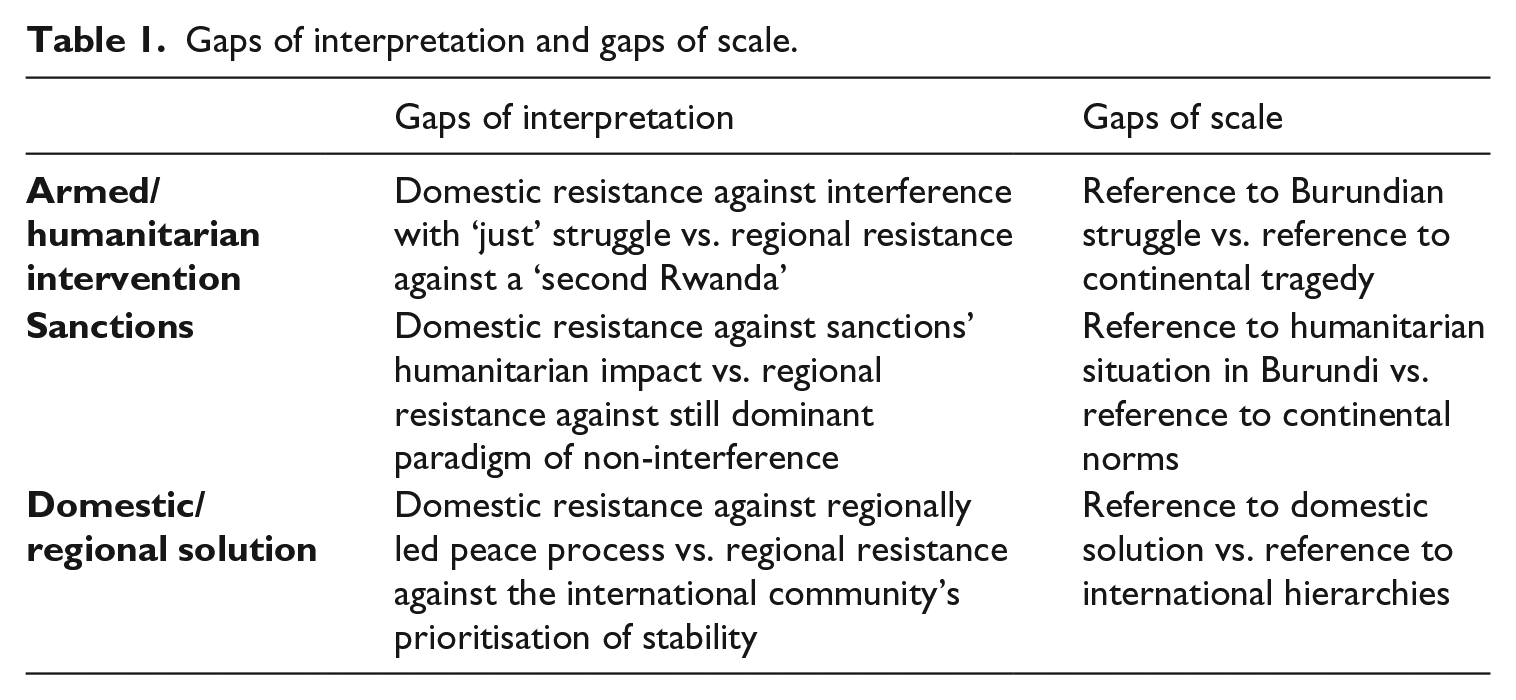
The intervention in Burundi therefore highlights how different scalar positions are hard to reconcile, thereby widening the gaps between different actors in the intervention scene to such an extent that, in the case of Burundi, regional interveners and Burundian elites talked past each other. Rather than struggling to define a shared understanding of peace, at least in the time period between 1996 and 1999, the regional and Burundian elites followed different scalar rationalities (cf. Neumann and Winckler, 2013: 620) that suggested a certain kind of peacebuilding at odds with the respective other vision of peace.
Our analysis of the interactions between regional interveners and local elites sheds light on how political, economic and social gaps between the interveners and those intervened upon emerge and deepen in the context of regionally led peacebuilding. Previous studies have often focused on disparities that became visible despite the physical presence of international staff in the crisis context. In the words of Autesserre (2014: 5), the latter ‘inhabit a separate world with its own time, space, and economics – and, even more importantly, its own system of meaning’. These gaps become manifest through enormous income disparities (Jeldres, 1993: 107; Lemay-Hébert, 2011a: 1833–1836), with interveners spending their leisure time at beaches rather than in the backyard with locals (Autesserre, 2014: 6f.) and more generally the interveners’ cosmopolitan habitus that is often not very sensitive to local viewpoints (Goetze and Bliesemann de Guevara, 2014). Such disparities prevent external intervention and external visions of peace and order from being accepted locally.
The case of Burundi indicates that gaps do not only emerge when interveners are physically present. As in other cases, the gaps in the Burundian intervention scene prevented a real transformation of the state–society nexus. Although the Regional Initiative was able to assert its demand for a regionally sponsored peace, the current crisis in Burundi – particularly President Pierre Nkurunzizas’ third term and the failed coup attempt on 13 May 2015 – suggest that the power-sharing arrangement did not radically alter the exercise of governance in Burundi. In addition, the current constellation displays a comparable gap to the one we just delineated for the past. While those demonstrating against Nkurunziza consider the current moment as one of democratic awakening, the regional interveners – this time being represented by institutionalised bodies such as the East African Community and the African Union – primarily fear renewed local and potentially regional instability, which they seek to contain through facilitating negotiations in the spirit of Arusha.
Conclusion
Our analysis reveals that the domestic elites and regional interveners accessed very different sites of knowledge – separated by scale – that suggested different lines of action for them and thus rendered their encounters frictional. The Burundian elite substantiated their critique of the regional intervention by referring to the national scale and its inherent rationalities. A regional military intervention appeared to interfere with what they deemed a ‘just’ struggle. With a political debate on the national scale taking off, the regional insistence on the facilitation under Nyerere increasingly appeared to be a diktat. By contrast, the Regional Initiative primarily referred to sites of knowledge located on the regional, continental or even international scale. The intervention was a critique of the inaction during the Rwandan genocide and of the continental practice of not commenting on unconstitutional changes of government. Based on their self-conception as belonging to the ‘new breed of African leaders’, most of the members of the Regional Initiative also challenged the international community’s prioritisation of order over profound transformation in Burundi.
We have also shown that the domestic elites and regional interveners articulated their actions as resistance in order to secure and strengthen their positions. By impeding a humanitarian intervention, for example, UPRONA was able to keep hold of the security apparatus. The Regional Initiative, by contrast, developed a paternalistic disposition in relation to the crisis context that is often discernible amongst interveners. With the enactment of sanctions and the conditions they attached to their lifting, the regional interveners were able to consolidate their dominance vis-à-vis the Burundian parties as well as the so-called international community.
This analysis reveals the regional and domestic elites’ difficulties to transcend their own locatedness. At the beginning of this article, we comprehended this locatedness in geographical terms. Now, we are able to specify it. By revealing the different scales of resistance and domination, we argue that such locatedness does not simply point to a geographical place but, more precisely, to the regional and domestic elites’ embeddedness into a discourse, that is, a system of relevance. Both discourses transform through the encounter but they do not converge in the course of the intervention.
This lasting gap between the Burundian elite and the Regional Initiative draws a pessimistic picture of the possibility of a peace that is acceptable to all the stakeholders involved. Authors have suggested that intergovernmental organisations and international NGOs involved in peacebuilding tasks should become more responsive to developments on the national and local scales (Campbell, 2011; Goetze and Bliesemann de Guevara, 2014: 801). Our findings, thus, hint at a major avenue for future research. While regional interveners often claim to be better equipped than the international community at large to manage conflicts, since they have better access to the knowledge of the crisis context (Mkapa, 1998b), the case of Burundi suggests otherwise. It is therefore essential that future research scrutinises whether such gaps between regional and national sites of knowledge have emerged in other instances of regional intervention.
Footnotes
Acknowledgements
Author names in reverse alphabetical order; both authors contributed equally to the article. We would like to thank Janusz Biene, Linnéa Gelot, Nicolas Lemay-Hébert, Antonia Witt, Franzisca Zanker and the two anonymous reviewers as well as the participants of the EWIS workshop ‘Resistance in International Relations’ for their helpful comments.
Funding
This work was supported by the Graduate School of the GIGA German Institute of Global and Area Studies, which funded the research in Tanzania, and the GIGA research project ‘Ineffective Sanctions? External Sanctions and the Persistence of Autocratic Regimes’, itself funded by the Fritz Thyssen Foundation (grant number 10.11.1.155), which supported the research in Burundi.