



Abstract
The concept of Europe as a normative power can be understood as a theoretical attempt to define a new type of protagonist in world politics, distinct from older concepts such as empire, hegemonic power, or great power. Because many scholars have used universal norms as a criterion for ‘normative power Europe’, the concept is often criticized as hidden Eurocentrism, soft imperialism, or hegemony. In this article, a normative power is defined not by the universality of the norms it seeks to diffuse, but by the underlying logic according to which it acts. A normative power takes communicative actions and acts in accordance with the logic of arguing, not consequentialism. This definition of normative power escapes the trap of a hidden Eurocentric imperialism by abstracting the theoretical concept from the specific case of Europe and detaching it from the criterion of universal norms.
Keywords
Introduction
In the field of international relations, the role of Europe in world politics has been discussed for a long time. The issue of interest is mainly to what extent the European Union (EU) as a postmodern state differs in its objectives, type of power, and behaviour from modern nation-states such as the United States. The debate goes back to the concept of ‘civilian power Europe’ (Duchêne, 1973) and its critique – for example the contrasting concept of ‘military power Europe’ (Bull, 1982). In recent years, Manners’ concept of ‘normative power Europe’ has provoked a debate about Europe’s role in world politics (Manners, 2002). While the concept of Europe as a normative power has been criticized for lacking clear criteria (Aggestam, 2008; Sjursen, 2006b; Whitman, 2013), scholars have identified as a decisive criterion that a normative power does not promote its own particular norms but, rather, universal ones (Eriksen, 2006; Manners, 2008; Sjursen, 2006a). This criterion, however, has similarly been criticized for being an expression of covert Eurocentrism (Diez, 2005; Hyde-Price, 2008; Merlingen, 2007), soft imperialism (Hettne and Söderbaum, 2005), or hegemony (Diez, 2013). A further problem is that the concept of normative power implies something new in comparison to older concepts such as empire, great power or civilian power, yet few scholars adequately compare the different aspects of these theoretical notions. Most scholars define normative power without clarifying their understanding of other actors or principles of power in international relations. In addition, although Tocci (2008a) and De Zutter (2010) clearly distinguish normative power from other actors of this sort, they are still confronted with theoretical problems. While Tocci fails to solve the problem of hidden Eurocentrism, De Zutter solves this problem, but only by neglecting the aspects that differentiate a normative power from classical powers. A promising approach comes from Forsberg (2011) and Lenz (2013), who define a normative power by its use of ideational means instead of the material means used by a military or civilian power.
In this article, normative power is defined as an analytical category in demarcation from other concepts such as empire, hegemony or great power. At the same time, the theoretical concept is detached from Europe and its Eurocentric perspective by taking communicative actions based on the logic of arguing, rather than cosmopolitanism or universality, as the centre piece of its definition. While Manners and others recognize persuasion as being an aspect of normative power, they see persuasion as just one means among others, rather than as its key characteristic (Eriksen, 2006; Forsberg, 2011; Keene, 2013). Although the present author is aware that normative power is a manifold concept with various aspects, this article will focus on communicative actions based on the logic of arguing as a – if not the – distinctive feature of normative power, leaving other characteristics aside. Nevertheless, it will be seen that the proposed definition of normative power helps to solve central problems arising from the critique of prior definitions, yet still retains the core aspects of Manners’ concept. By constructing normative power as an analytical category based on communicative actions, and demarcated from classical concepts such as great power, the proposed approach also highlights the role of communicative actions in international relation theories. In this respect the present article contributes not only to the literature about normative power Europe but also to debates about power – understood as both actor and means – in international relations. The fact that the proposed definition neglects different aspects of normative power emphasized by other scholars should not be misunderstood as an attempt to claim sole interpretive authority for it.
In the second section, the article summarizes the different definitions of normative power and its critiques. In the third section, different forms of actions are distinguished by using two dimensions regarding the behavioural logic of actors: norm compliance and norm diffusion. This is intended to promote a better understanding of normative power and facilitate comparison with other classical actors. In the fourth section, the article addresses the critique that normative power Europe may be merely an expression of Eurocentric imperialism. In addition, it makes the further point that most definitions of normative power miss an essential criterion that distinguishes a normative power from empires, hegemons or great powers; for while a normative power relies on material capabilities like other classical powers, it stands out because of its relinquishment of material power in favour of the logic of arguing. In the fifth section, the article considers these critiques and defines a normative power demarcated from other classical powers on the basis of its actions founded on a different behavioural logic. To escape the theoretical trap of a Eurocentric perspective, a normative power is not defined by the kind of norms it seeks to diffuse, but by the underlying logic according to which it acts. This definition of normative power escapes the trap of a Eurocentric imperialism by detaching the theoretical concept from Europe and from the criterion of universal norms: the generalized concept can then be used to analyse broader historical and cultural contexts. The sixth section shows that this definition enables two often-used examples to be interpreted in a new and diametrically opposed way. The examples highlight the importance of clarifying the criteria of normative power.
The various definitions of normative power
‘The concept of normative power is an attempt to suggest that not only is the EU constructed on a normative basis, but importantly that this predisposes it to act in a normative way in world politics’ (Manners, 2002: 252). According to Manners (2002: 240), ‘[…] the EU is not simply promoting its own norms in a similar manner to historical empires and contemporary powers’. Manners uses the term ‘power’ in the sense of an actor like a ‘great power’ (Diez, 2005: 615). A main concern addressed by Manners’ concept of ‘normative power Europe’ (Manners, 2006) is the elaboration of something new differentiating the EU from classical powers such as empires or great powers. Manners (2002) identified the promotion of universal norms as a new characteristic distinguishing the EU from classical powers: the EU does not just impose its own norms, it shapes universal ones.
Sjursen (2006a, 2006b) expounds the problem of unclear criteria for a normative power by raising the question: what kind of criterion can be used to identify the legitimate pursuit of norms? Sjursen offers three such criteria for identifying a normative power. First, it promotes universal norms – i.e. norms that will receive acceptance from participants in a free and open discourse including all who are affected. The second criterion is acceptance of law: the pursuit of norms is legitimate if it is in accordance with legal principles. The third criterion is the strengthening of cosmopolitanism, which builds on the rights of individuals, in contrast to multilateralism, which is based on the rights of sovereign states (cf. Bickerton, 2011; Eriksen, 2006; Nicolaїdis and Howse, 2002). These definitions, however, have been criticized as covert Eurocentrism (Diez, 2005; Hyde-Price, 2008; Merlingen, 2007), soft imperialism (Hettne and Söderbaum, 2005), or hegemony (Diez, 2013; Smith, 2011). According to Diez (2005), the EU uses normative power discourse to construct its own identity and separate itself from others. In this context, universality of norms may be just an expression of a particular conception of what is ‘good’. Referring to Foucault, Merlingen (2007) criticizes the criteria of universality and cosmopolitanism as invalid because norms are simply ambiguous: there are no norms that would ever achieve acceptance in the free and open discourse necessary to create cosmopolitanism.
Aggestam (2008) argues that the concept of normative power Europe is obsolete, and suggests another concept, ‘ethical power Europe’, which takes account of recent developments such as incorporating a military component into the EU. In a similar fashion, Damro (2012, 2015) sees the EU as ‘market power Europe’, seeking to achieve the externalization of its market-related policies by persuasion, and even coercion. According to Diez (2013), the concept of normative power can actually be replaced by that of hegemony. Furthermore, Del Sarto (2015) conceptualizes the EU as an empire which is diffusing its rules and practices to neighbouring countries in pursuit of its own interest, while this course of action helps the EU to construct a ‘normative’ identity. However, by asking which term most suitably describes the present EU, these scholars neglect the core idea of normative power as identifying, not only empirically but also theoretically, a new principle of action – and hence, too, a new actor – in matters of norm diffusion, in comparison with other classical powers. Kavalski (2013) defines a normative power not by the catalogue of norms it seeks to diffuse but by the recognition of other actors as such. In this definition, however, the difference between normative power and hegemony based on the consensus of the ruled vanishes.
A further problem concerning the debate about normative power is that Manners developed the concept of normative power in contrast to other powers, but the differences have not been sufficiently determined. A first step towards a comparative perspective was the clarification of the difference between normative and civilian power. Manners (2002, 2006) argued that, in contrast to both a civilian power and a great power, national interests and direct physical power are, for a normative power, no longer key elements. Diez (2005) objected to the proposal that this distinction between civilian and normative power stemmed from a reductionist interpretation of civilian power. Civilian power is a specific kind of normative power with civil norms as its basis (see Diez and Manners, 2007). Manners (2006) responded that civilian power is connected with the ontology of states and Westphalian norms, and that it has neocolonial undertones inasmuch as it attempts to civilize the world. Normative power, in contrast, emphasizes universal norms and cosmopolitanism (Manners and Whitman, 2003).
A broader comparative approach for identifying a normative power is taken by both Tocci and De Zutter. According to Tocci (2008a), a normative foreign policy is characterized by normative goals and means. Thus a normative power will comply with and promote international law and, by doing so, will bind itself to this law. An actor without normative goals or means will pursue an imperialist or realist foreign policy. However, this classification does not solve the problem of a hidden Eurocentric perspective, because international law cannot be equated with universal norms. De Zutter (2010) tries to escape the trap of a Eurocentric perspective by detaching the ontology of normative power from its ethical thrust. A normative power is simply an actor that diffuses norms in world politics, regardless of the instruments used: the instruments can be used to classify different forms of normative power as despotic, soft imperialist, or cosmopolitan. However, the problem with this definition is that it deconstructs normative power in a way that neglects the novelty of Manners’ distinction between normative and classical powers.
A final promising definition comes from Lenz (2013), who distinguishes a normative power from a military or civilian power by referring to the way in which it diffuses its norms. While military and civilian powers use material means, a normative power uses the ideational means of socialization and emulation. In a similar vein, Forsberg (2011) sees persuasion, activation of international norms, shaping a discourse and setting an example as central features of a normative power.
In the empirical debate, most studies assume that a normative power promotes universal norms such as human rights without considering either the issue of covert Eurocentrism or the whether the norms of the EU are in fact universal. Instead, they often propose two other criteria for identifying a normative power. Many empirical studies (e.g. Birchfield, 2015; Kerremans and Orbie, 2009; Orbie, 2011; Wood, 2009) argue that a normative power uses positive means such as incentives and rewards to promote universal norms, while negative ones such as sanctions or punishment are instruments of great powers. These studies generally see dialogue as a positive means – or at least do not explicitly exclude it from this category (for exceptions see Behrens and Janusch, 2012; Lenz, 2013; Lerch and Schwellnus, 2006). Other empirical studies (e.g. Diez and Pace, 2007; Noutcheva, 2008; Scheipers and Sicurelli, 2007) concentrate on the role of international law in defining a normative power, and view compliance with international law and its promotion as normative behaviour. Both criteria are easier to operationalize, and therefore attractive for empirical analysis, but neither solves the problem of a hidden Eurocentric perspective.
Recent literature rethinks the concept of normative power Europe from a non-European perspective (e.g. Onar and Nicolaїdis, 2013). Three different approaches can be distinguished. The first widens the empirical focus of the European debate by taking the concept of normative power and analysing the normative behaviour of non-European countries such as Japan (Zupančič and Hribernik, 2014), Russia (Makarychev, 2008) or Turkey (Oktav and Celikaksoy, 2015). The second approach analyses to what extent Europe can be seen as a normative power from a non-Western perspective (e.g. Romanova, 2009). The third approach seeks a new understanding of normative power by focusing on non-European countries and highlighting their cultural norms and thought patterns – for example, China and Confucianism (Kavalski, 2013; Wang, 2009; Womack, 2008) or India and Kautilya’s Arthashastra (Kumar, 2008). All three of these approaches emphasize the idiosyncratic aspects of normative behaviour depending on the cultural context. While the concept of normative power loses its Eurocentric bias by being transferred to non-European countries or rethought from a non-Western perspective, these studies do not aim to define normative power as an analytical category that can be used in different cultural contexts, although they are helpful supports in the quest for such a definition.
Behavioural logic: norm compliance and norm diffusion
For a better understanding of the critiques offered in the next section and a better categorization of the different actors treated in the fifth section, this article distinguishes different forms of actions based on two dimensions of behavioural logic regarding norm compliance and norm diffusion. While the first dimension helps to differentiate between the classical powers and to clarify the differences to normative power, the second is the decisive criterion which distinguishes a normative power from other concepts of powers.
Norm compliance can be distinguished by two disparate effects of norms on actors’ behaviour. First, norms can have a regulative effect: an actor will abide by a norm as long as it maximizes benefits. Once the costs of compliance exceed the benefits, the norm will be ignored. Such behaviour is in accordance with the logic of consequentialism and rationalism. However, norms can have also a constitutive effect – i.e. they define an actor’s social identity. Actors comply with such norms because they consider this behaviour appropriate. Thus, even if an existing norm minimizes its utility (as understood in rationalism), actors will continue to comply with it. This is called the logic of appropriateness (Kahler, 1998; Risse, 2003).
This distinction, however, does not explain the diffusion of norms, because the logic of appropriateness does not determine which norms will be diffused and become constitutive in the political arena. A more useful distinction here is between the logic of arguing and that of consequentialism and rationalism. If they pursue the logic of arguing, actors will discuss issues in a collective, communicative process subject to rational logic. They will not have fixed preferences and can be persuaded by superior argument. Communicative actions are as goal-oriented as any other strategic behaviour, but the goal is not the maximization of fixed interests. In fact, the actors will, in both practical and theoretical discourses, seek consensus about the validity of the claims at stake. The logic of arguing is based on three important assumptions: first, actors use arguments to persuade other parties; and persuasion in this sense excludes threat, sanction, coercion or reward. Second, actors are willing to be persuaded by a better argument. Third, physical power is absent from any discourse about norms (Habermas, 1981; Risse, 2000, 2003).
The logic of consequentialism stipulates that the parties in question have fixed interests and seek to maximize their own benefit through strategic behaviour. It further implies that they will rationally choose the instrument that most effectively promotes their norms and interests. This logic is based on three assumptions that diametrically oppose the logic of arguing. First, actors will use any instrument – e.g. material incentives or coercion – to diffuse the norms that maximize utility to themselves. Second, they will not be open to persuasion by superior argument and will rarely disavow their own norms – hence the logic of consequentialism rules out any consensus about norms in Habermas’ sense. Third, physical power will determine (or at least affect) which norms are accepted in world politics (Risse, 2003).
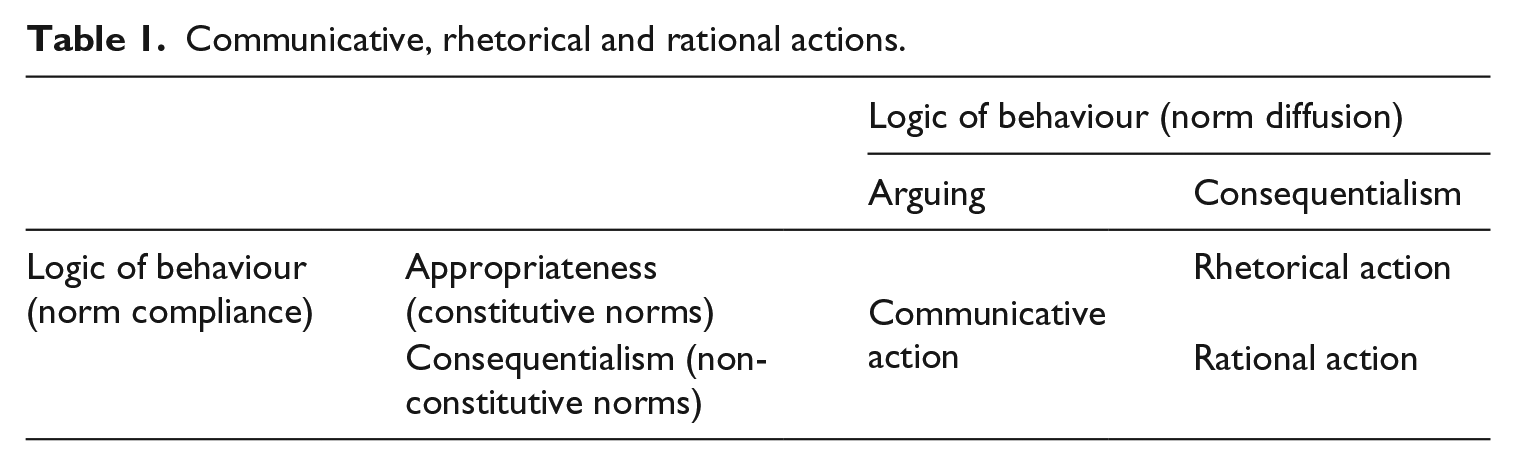
Combining the dimensions of norm compliance and norm diffusion enables political behaviour to be labelled in different ways (see Table 1). Irrespective of whether a norm is constitutive or non-constitutive for an actor’s identity, if a party behaves according to the logic of arguing, its actions can be called communicative (Risse, 2000). If norms are non-constitutive and actors behave according to the logic of consequentialism, their actions can be described as purely rational. In contrast, actions can be called rhetorical if norms are constitutive but actors choose their instruments pragmatically for success, rather than argumentatively for diffusion of the norms they entail. Rhetorical actions differ from rational ones because the goal is not to maximize utility but to convince others. At the same time, an actor following such logic will not be concerned with the truth implicit in its norms, as would be the case if it were pursuing the logic of arguing; its interest will be confined to enforcing its norms in the social environment. Thus rhetorical action is value-instrumental-rational – i.e. the choice of norms is value-oriented, but the choice of the means used to promote these norms is instrumental-rational (Schimmelfenning, 1997). In the following sections this differentiation in the scale of behavioural logic will be used to distinguish a normative power from an empire, a hegemon and a great power.
Communicative, rhetorical and rational actions.
Critique of current definitions
Before defining the concept of normative power, three points of criticism should be considered with a view to solving the problem of Eurocentrism: the universality of norms; positive/negative means and the promotion of and compliance with international law; and the connection between normative power and material capabilities.
Universality of norms
Many scholars criticize the assertion that Europe is a normative power because it promotes universal norms (e.g. Wallerstein, 2006). Indeed, to set up the universality of norms as a criterion carries the danger that the concept of normative power will reduce to an expression of Eurocentric imperialism or neo-colonialism. A solution to this theoretical problem may be to take communicative actions based on the logic of arguing rather than the universality of norms as a criterion. Accordingly, scholars should ask first whether a political actor takes communicative actions and pursues the logic of arguing, regardless of the norms it seeks to diffuse. If this is the case, they should then analyse the norms advocated by that actor and ask whether it can and does persuade others to follow those norms. In this line of reasoning, the identification of a normative power bypasses the issue of the existence of universal norms. The crucial issue is whether a normative power acts in compliance with the logic of arguing and has the ability to persuade others by argument alone.
Positive/negative means and promotion of and compliance with international law
These criteria have been used in many studies (e.g. Tocci, 2008b) to identify a normative power, but they generally prove inadequate; for although both criteria can be connected with normative power, they are neither necessary nor sufficient conditions for it: both miss the essential characteristic that a normative power should promote norms by dialogue. The criterion of positive political means is problematic because, by using such instruments for norm diffusion, a normative power would follow the same behavioural logic as a great power or hegemon. The distinction between them would consequently blur, and Manners’ main concern to define a new kind of powerful actor detached from material power would not be addressed. Positive incentives and negative coercion alike derive from a consequentialist logic, inasmuch as both can be interpreted as the positive or negative values of a cost–benefit calculation. Dialogue and persuasion are sometimes placed on the same footing as cooperation, concession and rewards – or at least not explicitly distinguished from these positive means – but they are, in fact, based on a different logic (Manners, 2008). The logic of arguing does not derive from a cost–benefit analysis; but the logic of consequentialism, which entails the selection of means (whether positive or negative) to achieve an end, does. Or, to put it the other way round, the impact of both positive and negative means on dialogue is to prevent the better argument from prevailing.
The criterion that a normative power should promote and comply with international law is also problematic from a normative power perspective. This criterion assumes that international law is cosmopolitan. However, cosmopolitanism relies on a discourse of individual rights. Cosmopolitan law, in contrast to international law, is achieved by open dialogue without coercion, and is based on universal norms (Manners, 2008; Sjursen, 2006b). Thus, compliance with international law that is not at the same time cosmopolitan law cannot be an indication of normative power. International law can be imposed by a dominant actor using either positive or negative means, in which case it would be just an expression of imperial or hegemonic rule.
Normative power and material capabilities
The concept of normative power reflects the attempt in international relations to detach powerful actors from direct physical power (Diez and Manners, 2007; Manners, 2002). In contrast to empires, hegemons, or great (as well as civilian) powers, the concept of normative power is ideational rather than material (Lenz, 2013; Manners, 2009). Specifically, a normative power relies on argument. This does not exclude the possession of economic or political capabilities, but renders these, in the view of most scholars, unnecessary (Eriksen, 2006; Sjursen, 2006b). Yet the concept of normative power does seem to be inevitably connected with material capabilities and physical power – but in a different way from that of empires, hegemons, or great powers. While scholars commonly distinguish between normative and physical power, there are two – if not logically necessary, but nevertheless good – reasons why a normative power should also possess material capabilities analogous to those of a great power.
First, a normative power needs material capabilities and a corresponding position of strength, because it is the relinquishment of that position that characterizes a power as normative. The promotion of a discourse among equals (despite its superior position) distinguishes a normative power from other powers. Thus, a powerful protagonist acts as a normative power when it refrains from acting like an empire, hegemon or great power, although it could do so. From the perspective of a weaker power, the logic of arguing is the rational choice, because a stronger power will forego its superior position in situations where the logic of arguing prevails. A rational actor in a weaker position will, therefore, always prefer an open discourse. However, because we cannot know how a weaker actor would behave if placed in a stronger position, we cannot determine whether such an actor is following the logic of arguing or of rationalism. Normative power, in this view, is not the rationalization of weakness (Kagan, 2003) but, rather, the relinquishment of strength. This does not mean that weak actors are all hypocritical, or cannot diffuse norms through dialogue, but that the logic of the proposed definition sees the relinquishment of material influence as characterizing a normative power.
Second, because of power asymmetries in world politics, which imply the absence of free and open discourse, a normative power will need and use its capabilities to encourage others to participate in a dialogue about norms. This raises the question why a normative power should not use its capabilities to impose its own norms. The answer is that a normative power is (again by definition) convinced of its norms and sees itself as a ‘force for good’. It is for this very reason that it relies on its argumentative power and refrains from using incentives and coercion in the discourse. For example, according to Manners (2002), the EU acts as a normative power in successfully advocating the abolition of the death penalty. In contrast, Uruguay has been supporting abolition of the death penalty since the late 1940s, within the framework of the Universal Declaration of Human Rights, but has not so far been recognized as a normative power (Schabas, 2002). According to the definition of either Manners or Sjursens, however, a normative power is based on the argumentative force of the norm itself, and in this definition Uruguay’s persuasive power should be equal to that of the EU; but this is not the case. The problem is that states without economic or political capabilities have no resources to encourage others to participate in a discourse. This creates the problem that a normative power will try to create room for free and open discourse in which power asymmetries do not matter; yet at the same time, because of its own stronger position, some sort of force will always be in the background of the discourse. This theoretical problem will be addressed below.
The logic of arguing and normative power
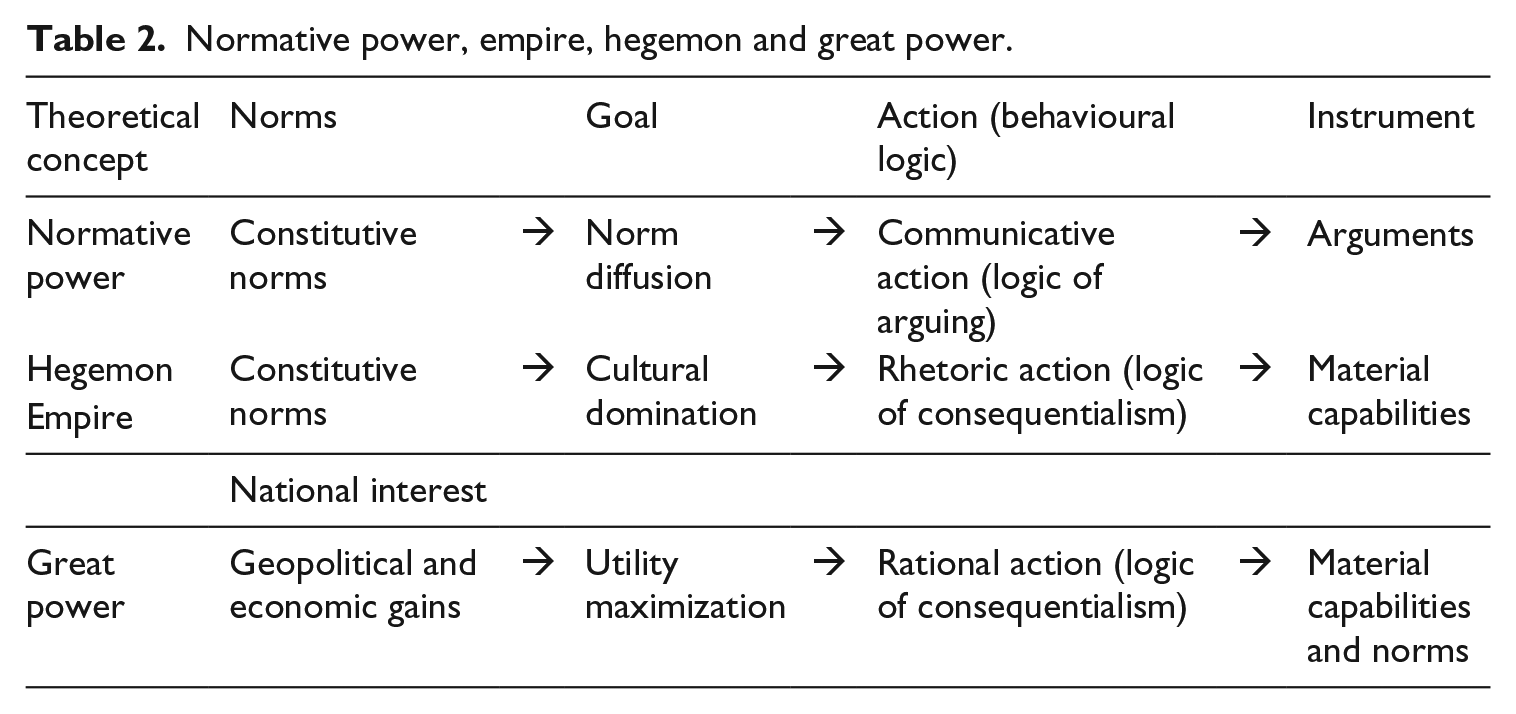
On the basis of the three forms of actions defined above and taking into account the points of criticism discussed above, a normative power can be clearly separated from other classical actors such as empires, hegemons and great powers (see Table 2) if – in the categorization proposed here – it takes communicative actions and can persuade others of its norms through its better arguments. A normative power is characterized by its relinquishing of physical power in favour of free and open dialogue in world politics. The norms that a normative power tries to diffuse are constitutive for it. This does not mean that (constitutive) norms cannot entail self-interest: it is the way in which a normative power seeks to diffuse its norms that characterizes it as such. A normative power is confident of its norms and has an intrinsic motivation to promote these by dialogue. However, the relinquishment of its material capabilities does not mean that a normative power never uses its physical power. In some cases, it can and will use its material capabilities to encourage other actors, with the help of incentives, to participate in a free dialogue. In other cases, a normative power may use its capabilities to pressure participating actors to accept other participants in an open dialogue. It is important that a normative power should not want to exclude anyone from a discourse, but will open a dialogue in which everyone can participate. By creating an open dialogue in this way, a normative power will lose its state-centred view. This is central for the normative power argument (Gordon and Pardo, 2015; Whitman, 2013). Thus, a normative power will use its capabilities to create room for a free and open dialogue, but will not use its physical power to influence the dialogue itself. Lenz (2013) describes this theoretical solution in a similar way, affirming that rewards, for example in the form of cooperation agreements, may serve as a channel of norm diffusion, but not as its underlying rationale.
Normative power, empire, hegemon and great power.
This, however, creates a further theoretical problem. The use of material capabilities to create a discourse may influence the opinions of participants. Furthermore, power asymmetries between a normative power and weaker actors are always in the background of a dialogue and can affect the opinions of the weaker parties. For this reason, as Kavalski (2013) has argued, a normative power is an actor that is recognized as such by others. Indeed, recognition and perception by other actors is crucial for the establishment of a power as normative (Diez et al., 2011; Larsen, 2014). While Kavalski (2013) emphasizes that a normative power will be recognized as such when it includes the interests and ideas of others into its strategy, the proposed definition takes the actions in and not the results of the discourse as its criterion. A normative power will be recognized by others as one that abstains from the use of material force in the discourse itself, and is able to create a credible situation in which weaker actors sense no coercion and feel themselves on an equal footing. Thus the relationship of a normative power with others is of its nature dialogical. This recognition will increase if a normative power acts in accordance with its norms, rather than simply maintaining these as a hypocritical façade (Manners, 2008), and if it is open to the norms of others (Kavalski, 2013). For a better understanding of the proposed definition of normative power, see the two examples below.
Non-Western scholars criticize the fact that the logic of arguing is based on notions of Western rationality. Thus, the proposed definition of normative power can still be seen as a European concept (Hutchings, 2011; Ling, 2013). The aim of this article, however, is not to create a non-Western approach but to understand normative power as an analytical category that can be clearly distinguished from classical powers and is not fixated on specifically European characteristics. By creating such an analytical category, the theoretical concept of normative power loses its Eurocentricity and can be transferred to other cultural contexts, although the definition is still based on European theories. Understanding normative power as an analytical category omits any question of its relative value in comparison with concepts of great power or empire, or indeed with non-Western concepts. While this debate should also be conducted, the proposed definition is not inevitably linked with it; it can, nevertheless, help put the discussion on a more analytical and reflective basis. Furthermore, the proposed definition can help solve the problem that the logic of arguing is difficult to apply to international politics because of existing power asymmetries and discourses. While Risse (2000) argues that a common lifeworld (albeit a thin one) that is necessary for communicative actions can also be found in world politics under a high degree of international institutionalization, his critics emphasize that this common lifeworld among equals is confined mainly to the West. The proposed concept of normative power can, therefore, also help to better apply the theory of communicative actions to situations outside the Western order.
A powerful actor for which norms are not constitutive and that wants to diffuse its own norms by rational actions can be categorized in neorealist terms as a great power. Great powers seek to maximize their material gains, which include geopolitical and economic goals, and in order to achieve these goals, they choose their instruments according to the logic of consequentialism. Norms have no constitutive effect on them and are not ends in themselves but instruments of realpolitik – or in other words a supplement to their material capabilities. Great powers can use norms in two ways – strategically or symbolically: the former, for example, when environmental standards are used as a protectionist measure to protect home markets rather than the environment; the latter when a profitable policy that might otherwise be contested is legitimized in the eyes of the domestic or international public. In both cases, a great power will ignore a norm if it does not enhance its material gains. An idealized example of a great power is the United States in the Vietnam War. The United States used its military and economic capabilities to fulfil the geopolitical goal of balancing the power of the communist bloc. From this perspective, norms such as human rights can be seen as instruments that were used strategically to form alliances and symbolically to gather domestic support, while their violations during the war indicate that these norms were not constitutive for US foreign political behaviour.
A powerful actor for which norms are constitutive and which takes rhetoric actions can be categorized as a hegemon or empire – the term hegemon being used in a sense that both refers to and diverges from that of Gramscian hegemony. According to (neo)-Gramscian theories, hegemony is a discursive term that does not necessarily entail political actors, although hegemony is not without acting parties – for when classes or social forces try to define their own interests as general ones, they struggle constantly over hegemony and may achieve hegemonic status for a time, but without ever becoming a hegemon. Hegemony means the leadership of classes in economic or socio-political discourse, and implies the integration of the conflicting interests of various classes in order to achieve social cohesion (historic bloc) (Diez et al., 2011; Haukkala, 2008). Hegemony is thus a mix of material and discursive elements, although the connection between these is contested. In contrast to (neo)-Gramscian theories, the term hegemon is used here of a political actor in the strict sense, in order to ensure comparability with normative power.
The goal of a hegemon or empire, however, is not only norm diffusion, but also domination through cultural hegemony or cultural imperialism. Norms have constitutive effects on empires or hegemons, as they do on normative powers, but the goals and instruments are different. An empire or hegemon chooses its instrument for norm diffusion according to the logic of consequentialism, and influences dialogue through incentives and coercion. Both hegemons and empires use material capabilities to promote their own norms, with the intention of gaining acceptance for these in world politics. The difference between the two is that imperial governance depends less on cooperation and more on (military) coercion than does hegemony. 1 Civilian power would also fall into this category (constitutive norms and logic of consequentialism), but in this case the norms would be civil rather than military and the instruments would be limited to economic incentives without military force. For example, assuming that Marxist-Leninist socialist ideology was constitutive for its identity, the Soviet Union in its relations to the German Democratic Republic or Cuba during the Cold War can be seen as a hegemon that sought cultural domination primarily through cooperative means. In the case of the annexation of the Baltic States during the Second World War, the Soviet Union can also be seen as an empire based rather on military coercion.
Identifying behavioural logic
The analytical categorization above is idealized for theoretical purposes. From an empirical perspective, normative power, empire, hegemonic power and great power are not necessarily mutually exclusive categories; they can be found in combined or mixed forms. Scholars have already pointed out that normative behaviour and rational action can go hand in hand and are difficult to distinguish (Eriksen, 2006; Hyde-Price, 2006; Youngs, 2004): an international protagonist can act like a normative power, an empire and a great power at the same time, depending on the norms or issues in question. The following two examples illustrate the difficulty of classifying actors’ behaviour. According to the definitions proposed above, each could be interpreted in favour of either ‘normative power Europe’ or ‘great power Europe’. The examples serve solely to illustrate the importance of clarifying whether a specific instance meets the criteria of normative power, not to determine whether or not the actor in question (here the EU) is such a power.
Example I
In the 1990s the EU started negotiations with Mexico on an association agreement. In these negotiations, the EU wanted to include the so-called conditionality clause, which entailed the suspension of the agreement in the event of urgent violations of human rights. This clause was the main point of contention during the trade negotiations. Because the Mexican government rejected the clause and was unwilling to connect trade with human rights policies, the EU threatened to break off the negotiations. Ultimately, the Mexican government accepted the clause because of this threat (Behrens and Janusch, 2012; Szymanski and Smith, 2005). At first sight, this case appears to support the concept of normative power Europe, because the EU was willing to sacrifice political and economic gains in favour of human rights. Further analysis, however, shows that the threat to cancel the negotiations contradicted the logic of arguing. The EU did not put up its norms for discussion, but threatened the Mexican government with complete failure of the negotiations – an action that is more consistent with the logic of consequentialism than with that of arguing.
Example II
In 1986 China applied for membership of the World Trade Organization and was successfully admitted in 2001. In the negotiations between the EU and China, the EU Commission and Council relegated human rights concerns from the trade negotiations to a dialogue that produced many documents but hardly any results (Mattlin, 2012; Men, 2011; Zimmerman, 2007). This disconnection of human rights from issues of trade contradicted the EU’s claim to promote human rights (Balme, 2008). At first glance, it looks as if the EU sacrificed human rights for economic gains, and the normative policy of the EU appears inconsistent and even hypocritical (Mattlin, 2012). Human rights were, it seems, only used symbolically – a typical stance of a great power. On further analysis, however, the actions of the EU can be interpreted as consistent with the logic of arguing that the EU had used the trade negotiations to initiate a dialogue about human rights, but could not, in the end, persuade the other side. Refraining from using threats or breaking off the negotiations indicated the behaviour of a normative power. Furthermore, the human rights dialogue comprised not only high officials but also trans-governmental actors: administrations, academics and NGOs (Balme, 2008).
These two examples show that the specific discourse and perceptions of the various actors need to be analysed in detail to ascertain whether the case in point follows the logic of consequentialism or of arguing. To identify whether a powerful actor behaves according to the proposed definition of a normative power, three tasks are necessary. First, it has to be observed that an actor abstains from using its material power directly to diffuse its norms and instead creates a discourse that is open to everyone. Second, it must be established whether this powerful actor uses its material power merely to open a discourse or, rather, to directly or indirectly influence its results. Because finding direct empirical evidence for the behavioural logic and intrinsic motivation of an actor – especially whether an actor is willing to accept the better argument – is quite difficult, a more promising approach is analysis of the perceptions of participants in the discourse. Hence, empirical analysis should focus on whether the weaker participating actors perceive the discourse as free from material power and coercion. Third, given that an open and free discourse is seen to exist, it must be determined in a final step whether the norms of the powerful actor prevail in this discourse. While individual case studies, or comparative analyses on the basis of qualitative methods such as expert interviews (for data collection) or discourse analysis (for data interpretation), seem especially appropriate to these three tasks, quantitative methods such as opinion surveys can also be useful to identify a normative power.
Conclusions
The theoretical concept of normative power claims to define a new power whose behaviour with regard to norm diffusion differs from that of classical empires, hegemons or great powers. The main theoretical concern is, therefore, to establish clear criteria that distinguish a normative power from other powerful actors. Appeal to the universality of norms is problematic because it can be criticized as imperialism, hegemony or neo-colonialism in disguise. To escape the theoretical trap of Eurocentrism, this article proposes that a normative power should be characterized not by the kind of norms it seeks to diffuse or the instruments it uses for norm diffusion, but by the underlying logic of its behaviour. A normative power acts in accordance with the logic of arguing, while empires, hegemons or great powers follow the logic of consequentialism regarding norm diffusion. A normative power, however, is not detached from physical power; on the contrary, it is the relinquishment of strength in favour of dialogue that distinguishes it from classical powers. In some situations, a normative power has to use physical power to create room for free and open dialogue. In this case, it does so merely to initiate dialogue, not to influence the discourse itself. Thus a normative power is characterized by the ability to create a credible dialogue in which weaker actors feel equal and sense no coercion.
By distancing the concept of normative power from the specifically European context, and differentiating it from the categories of imperial, hegemonic or great power, it can be removed from the trap of covert Eurocentric imperialism, while at the same time retaining the core aspects of Manners’ concept. To detach the definition of normative power from the per se normative – which assumes certain norms to be universal and therefore better – does not imply giving up a normative approach altogether. On the contrary, the proposed definition of normative power can be used as an analytical category in a broader cultural and historical context to analyse and compare the behaviours of different powers: normative, civilian, imperial, hegemonic and ‘great’.
Footnotes
Funding
This research received no specific grant from any funding agency in the public, commercial or not-for-profit sectors.