



Abstract
Social scientists treat stone-throwing as a non-violent act or argue that protest movements may be primarily non-violent despite stone-throwing. However, this study of an iconic example, the first intifada (Palestinian uprising, 1987–1993), demonstrates that stone-throwing is better characterized as unarmed violence. Definitions of violence underscore that throwing rocks is a violent act. Moreover, informed observers and data collected on stone-induced injuries during four years of the intifada illustrate the bodily harm caused by stones. The throwing of stones was central to the intifada and its identity and definition. Stone-throwing was the most visible tactic Palestinians used in the first intifada. Lastly, most scholars emphasize the protestors’ perceptions when it might be that the targets’ perceptions matter more for understanding definitions of (non-)violence and subsequent policy changes. These findings challenge important social science work and the mainstream Israeli and Palestinian narratives about the first intifada.
I have a rock from Jerusalem sitting in my office; it is somewhat larger than a baseball. In the fall of 1989 during the first Palestinian intifada (uprising), I was riding Bus 23 from downtown Jerusalem back to Hebrew University on Mt Scopus. Route 23 was usually a faster trip back to Mt Scopus because, unlike other routes, it cut through Palestinian neighborhoods in East Jerusalem, such as Sheikh Jarrah and the American Colony. 1 Other routes avoided these neighborhoods and instead took a circuitous route via Mea She’arim, an ultra-Orthodox Jewish neighborhood, and French Hill, one of the first large settlements Israel built across the green line on land it captured from Jordan in 1967. I still remember the thump-thump of the rocks hitting the bus as we passed Jerusalem’s Old City, the driver speeding up, and the woman whose now-bloody hand had been perched on a slightly open window.
How should we categorize protest movements that use stone-throwing? Many scholars have counted such movements as non-violent campaigns by relying on at least one of three arguments. First, rock-throwing is not a violent act. Second, rock-throwing may be violent but did not constitute the majority of protest actions; the majority of actions utilized non-violent tactics. Third, the way to determine how to characterize a campaign, non-violent or violent, is based on the range of protestor actions rather than on how the targets perceived those actions.
Each of these arguments is problematic, as a close study of the first intifada demonstrates. First, a look at scholarly definitions, the views of knowledgeable observers of the first intifada, and numerical evidence of injuries during the first intifada make clear that groups of protestors throwing rocks is a form of unarmed violence. It is an unarmed but violent act. Second, almost no one has put forward data for the first intifada that comprehensively distinguishes between different tactics. An oft-cited Israel Defense Forces (IDF) report does not support the claim that the intifada was predominantly non-violent. Third, the protestors’ distribution of tactics may vary significantly from the impression different tactics leave on the target. Even if one assumes the mix of Palestinians tactics was meant to be largely non-violent, Israeli Jews felt they faced a largely violent uprising. When tactics are mixed, violent ones will often stand out and overwhelm any other tactical pathways.
Thus, the primary purpose of this article is to delve into stone-throwing and how the characterization of stone-throwing affects social science categorization and conclusions. The article suggests we treat stone-throwing as unarmed violence, one stop along the non-violence/violence spectrum. Moreover, the article brings into the open the potential of a meaningful perception gap. The gap may be of two types: (1) two or more actors with different perceptions of reality (Krause, 2013; Wohlforth, 1993) or (2) one actor with a different perception than reality (Christensen and Snyder, 1990). On the question of stone-throwing in the first intifada, scholarly coding conflicts with target perceptions, affecting important works such as Chenoweth and Stephan (2011) and Pearlman (2011).
From a theoretical perspective, this article illuminates the categories of (non-)violence by being more intentional about the meaning and shadings of different terminology. Armed/unarmed and violent/non-violent are not interchangeable terms. By drawing on existing social science definitions of violence, we are able to better specify and categorize different types of protest actions and (non-)violent interactions, including stone-throwing. Nuance helps lessen ambiguity.
The disagreement about categorizing stone-throwing as violent or non-violent action also illustrates that certain tactics are better suited to mass protest while others are based on more selective participation, a point noted by Chenoweth and Stephan (2011) in relation to non-violence. Unlike gunfire, stone-throwing was a tactic that could work hand-in-hand with mass participation.
Also, the disagreement about naming violence is ultimately about what actors depict as good or at least legitimate forms of political protest. If stone-throwing is seen as non-violent, it is also likely to be widely accepted as legitimate protest. If it is seen as violent, even unarmed but violent, the media or public associate it with negative and illegitimate protest. In this article, I seek to disentangle the decision about how to characterize stone-throwing from its normative baggage.
Thus, this article’s interpretation highlights contradictory risks for the Palestinian and Israeli mainstream understandings of the first intifada, not to mention stone-throwing today. For Palestinians, it means that stone-throwing, however unarmed, is still a form of violence that opens the door to associating Palestinian protest with the tag of illegitimacy, thereby overshadowing the mass character of the uprising and the goal of statehood. It obstructs the dramatic imbalance in military capabilities between the Israeli military and Palestinian protestors and the organizations of the Palestinian national movement. Israelis face the opposite problem: a more differentiated view of violence means that merely noting that throwing a rock is violent is not enough to delegitimize an entire Palestinian national movement, given everything else that Palestinians did and did not do in the first two years of the first intifada. That stone-throwing meets most definitions of violence does not negate the Palestinian push for self-determination. The imbalance of military power lingers.
Rock-throwing is a violent act
Despite some suggestions that rock-throwing is not a violent act, it does meet inclusion based on definitions of violence. Most definitions emphasize the possibility of physical harm to persons or property. In addition, the opinions of several knowledgeable observers of the first intifada provide support for the idea of seeing stone-throwing as a violent act. Lastly, evidence from the Jerusalem Post of the numerous injuries caused by stone-throwing over four years of the intifada provides additional empirical support.
This article is focused on the case of the first intifada, because throwing stones was a central tactic during the uprising. This intifada has been an important case for many students of non-violence. In turn, the case has become an iconic example of mass protest against a more powerful adversary. Because of the array of Israeli and Palestinian tactics used during the first intifada, this case also helps demonstrate some of the shortcomings of a dichotomous view of protest: violent or non-violent. Lastly, focusing on the case suggests additional insights into subsequent Israeli policy decisions and about how some Israelis and Palestinians frame stone-throwing.
For example, in Violence, Nonviolence and the Palestinian National Movement, Wendy Pearlman’s conception of violence emphasized a judgment about intent and categorized tactics, even forceful ones, as either armed or unarmed tactics. She emphasized that the Palestinian stone throwers did not intend to cause harm or injury: ‘Violent protest entails the exertion of physical force for the purpose of damaging, abusing, killing, or destroying. Nonviolent protest does not entail physical force’ (Pearlman, 2011: 3). In categorizing violent acts, the exertion of physical force alone is not enough by this metric: note the use of the term ‘for the purpose of.’ Pearlman accepts that the intifada ‘was not without shows of physical force.’ The Unified National Leadership of the Uprising (UNLU) leaflets ‘periodically encouraged stone-throwing or other acts involving limited force.’ However, rather than intending to cause harm or injury, the intent of stone-throwing was as ‘symbolic forms of defiance,’ ‘self-defense,’ and as ‘a rite of bravery’ for Palestinian males. In other words, she distinguished between force and violence. Pearlman’s (2011: 3) claim is that the intent to harm or kill ‘is basic to the definition of violence’ (see also Pearlman, 2012). No intent to harm or kill, no violence.
Yet, in other definitions, the intent aspect that is central to Pearlman is often not a factor in drawing the line between forms of violence and non-violence. We can look at ‘revealed behavior,’ especially when intentions might be difficult to ascertain (Asal and Rethemeyer, 2008: 250). Assessing stone-throwing helps probe the margins of the category of violence and leads to the conclusion that stone-throwing is a form of unarmed violence. We may think of a spectrum of (non-)violence, ranging from non-violent moves to verbal violence (unrealized threats of violence) to property violence (e.g. graffiti, uprooting olive trees, vandalism) to unarmed violence (e.g. stone-throwing) to armed violence (e.g. the use of firearms and bombs) to catastrophic violence (e.g. nuclear weapons). The move from unarmed violence to armed violence to catastrophic violence involves a rapidly increasing potential for casualties. One might be able to assign casualty thresholds for dividing the categories (see Figure 1).

The (non-)violence spectrum.
Just because all the categories are listed on the same spectrum, one should not assume that each step from one category to another is equal in logistical, moral, or political terms. The ability or the decision to move between different types of (non-)violence may not be the same. For example, a decision to move from a verbal threat to damaging property with graffiti or vandalism is weighty but not of the same level of magnitude as the decision to use nuclear or biological weapons in a catastrophic fashion. Moreover, the necessary capabilities are not equally available to all parties, and certainly states and non-state actors do not have equal access to the means that make each category of (non-)violence possible.
Also, as non-violence is only one of the six categories, one might assume it is of lesser importance. However, that category, too, could be sub-divided. Sharp (1989: 4) offered one such division, explaining that non-violent moves could be split into at least three general categories: (1) ‘symbolic forms of nonviolent protest’ (e.g. a march); (2) ‘noncooperation’ (e.g. boycotts, strikes); (3) and ‘nonviolent intervention’ (e.g. non-violent occupations).
Pinning down exactly what does and does not constitute a violent act is no easy task. De Haan (2008: 28) reviews many aspects of violence, suggesting that the concept is ‘notoriously difficult to define because as a phenomenon it is multifaceted, socially constructed and highly ambivalent’ (see also Ralph, 2012: 2; Tilly, 1978: 176). How we define and understand violence and what constitutes a violent act may vary by cultural and social context. For example, Walker (2001: 575), echoing De Haan, notes the issue of cultural contingency, the idea that violence ‘means different things in different cultures and even to members of the same culture’ (see also Guilaine and Zammit, 2005: 232). So, there is a concern about constant variability in thinking about violent acts. Given the contentious context in which violence is generally used, that is hardly surprising: ‘Violence is regularly accompanied by social struggles to define its meaning and specify its causes, the outcome of which - for example, the labeling of an event as a pogrom, a riot, or a rebellion - may have important consequences’ (Brubaker and Laitin, 1998: 428).
What are the elements of a definition of violence? (See Table 1 for examples of such definitions.) Scholars have suggested a number of items: a violent act causes physical harm (Ball-Rokeach, 1972; Bond, 1994: 62; Chenoweth and Stephan, 2011: 13; Etzioni, 1971; Lowry and Rankin, 1972: 614; United Nations General Assembly (UNGA), 1993) or causes mental or emotional harm (Galtung, 1969: 170; UNGA, 1993). The harm may be threatened as opposed to realized (Ball-Rokeach, 1972; Galtung, 1969: 170; UNGA, 1993). In an important emphasis for this article, Bond (1994: 76) highlights the expectation of violence, where that expectation means ‘a hypothetical, informed, and impartial third-party observer to the conflict who seeks in a reasonable manner to assess the risk of physical injury or death inflicted by the use of physical force.’ The target may be property rather than just persons (Chenoweth and Stephan, 2011: 13; Lowry and Rankin, 1972: 614; Tilly, 1978: 177). Most scholars do not mention intent, but DeRosis (1971: 355) includes it and Tilly (1978: 175) minimizes it. Given the absence of intent in several of these definitions, is does not appear that, as Pearlman (2011: 105) writes, intent to harm or kill ‘is basic to the definition of violence.’
Selected definitions of violence.
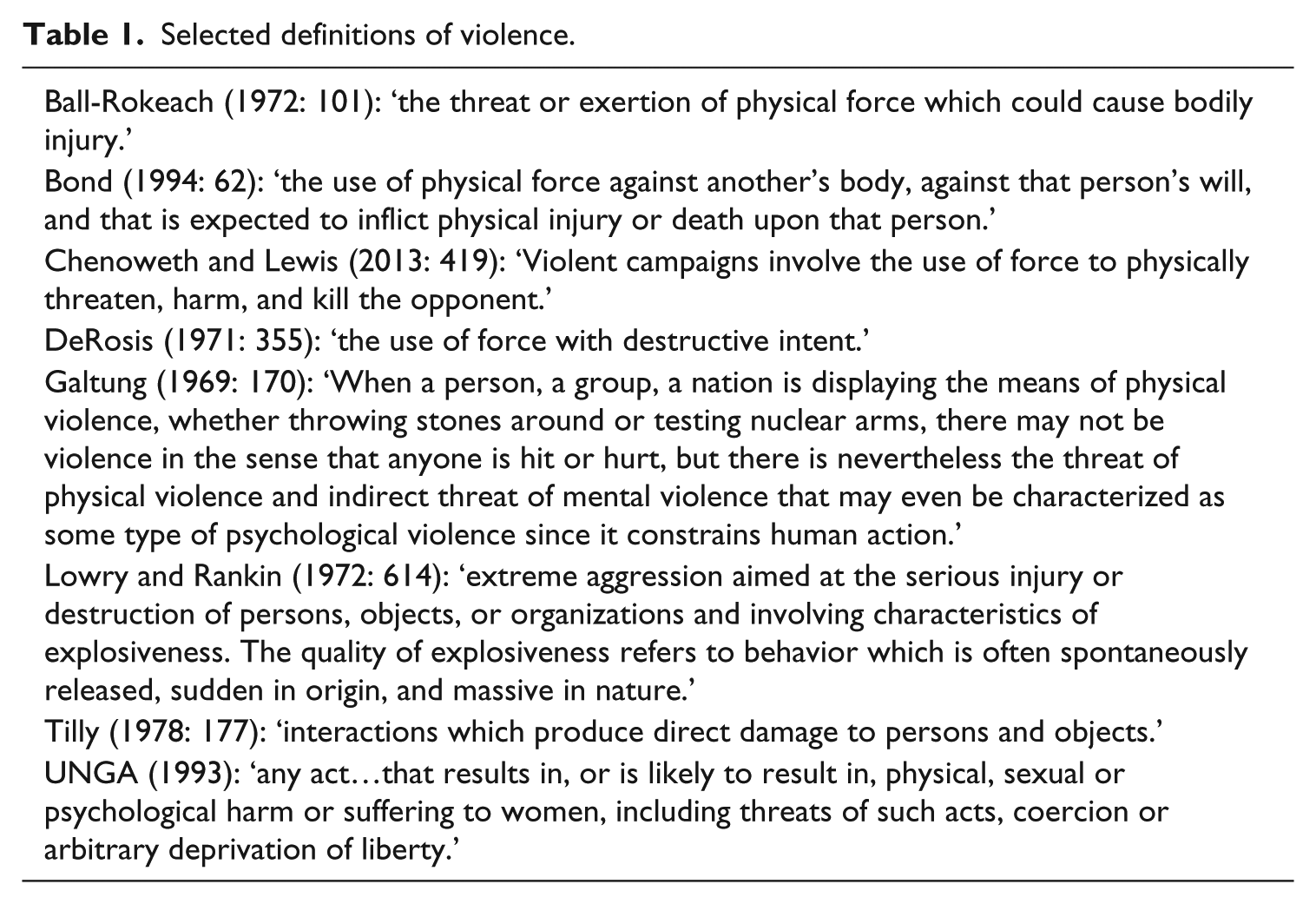
Pearlman is right to highlight the important symbolic dimension of Palestinian stone-throwing, but that symbolic aspect need not be seen as an alternative to seeing the act as a violent one. The act could be symbolic and violent simultaneously.
Just before and during the first intifada, several knowledgeable observers expressed middle-ground positions on stone-throwing, seeing it as neither a non-violent tactic nor the same as guns and tanks. Mubarak Awad (1984: 28), founder of the Palestinian Center for the Study of Nonviolence and once considered the leading Palestinian figure in favor of massive non-violence before Israel deported him, saw stone-throwing in a different, harsher light. In 1986, Center instructions said no ‘stones or any violence.’ Awad, Mary King (2007: 261, 149, 134) later wrote, ‘always classified stone-throwing as violent.’
In 1989 in Jerusalem, Narayan Desai, the son of Mahatma Gandhi’s long-time personal secretary, said, ‘stone-throwing and petrol bombs are definitely not Gandhian and are, in fact, counter-productive’ (Lynfield, 1989). While critical of the Israeli occupation, Bishop Desmond Tutu of South Africa also seemed to offer veiled criticism of Palestinian tactics during a visit to Jerusalem during the first intifada (Greenberg and Rees, 1989). Gene Sharp (1989), a central figure in the development and study of non-violence, did not include rock-throwing in the category of non-violence. Stone-throwing and petrol bombs were, in his words, forms of ‘limited violence.’ Sharp (1989: 3, 7) claimed that they constituted only 15% of the struggle but gave no source.
During the first intifada, media reports demonstrate that Palestinians throwing rocks caused many Israeli injuries. From 1989 to 1992, from the second to the fifth years of the first intifada, the Jerusalem Post reported 535 Israelis who were injured by Palestinian rock-throwing. The figures varied by year: 149 (1989); 197 (1990); 59 (1991); and 130 (1992) (see Table 2). In 1989 and in 1990, a stone also killed one Israeli. I only counted injuries where the cause was attributed to being hit by a rock, including direct hits as well as people injured in vehicles hit by stones. Israeli property, usually vehicles, also sustained significant damage as a result of stones, even in cases when no one was injured. 2
Israeli casualties from Palestinian stone-throwing during the first intifada.
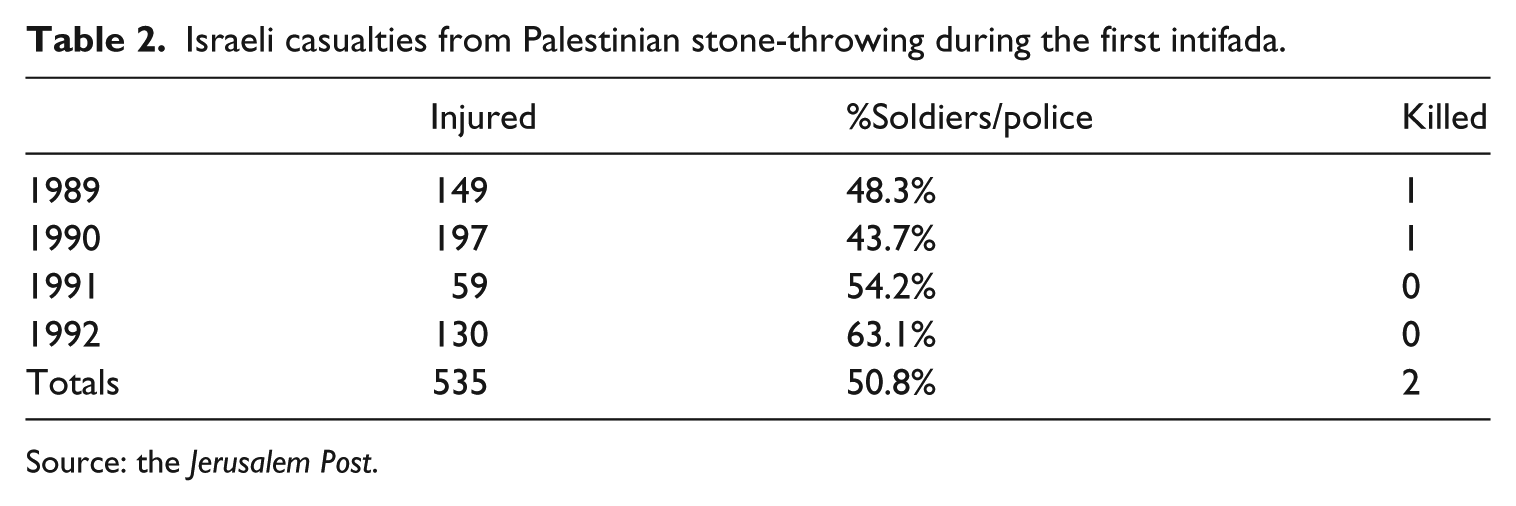
Source: the Jerusalem Post.
Could the Israeli military have over-reported injuries to soldiers to make it seem like the stones were hurting people when they were not? Maybe, but 49.2% of the injured identified in the articles were not listed as Israeli soldiers, police officers, border patrol, or other security personnel. Could Israel have ‘manufactured injuries’ by tagging people as lightly injured? Even if we discount all light injuries (no danger to life or limb) – and most of the injured were either light or, in 46.4% of the cases, the injury was not specified – 20 people experienced moderate injury, serious injury, or death. That is not a huge number but neither is it negligible.
Heering et al. (1992) identified the cause of injury for 1152 Israeli soldiers during the first two years of the intifada, from December 1987 to November 1989, in the West Bank and Gaza. The most common cause (62.1%) was from stones and that excludes cases of vehicular accidents (12.1%), whether caused by a stone or not. Stones caused 28 moderate injuries (danger to limb or quality of life), eight serious injuries (life threatening), and one fatality. In Northern Ireland from 1969 to 1972, James (1975) found 808 policemen had one or multiple injuries. Of the 986 injuries, 751 (76.1%) were caused by stones, such as half-bricks or ‘broken paving stone.’
At the time, then Israeli Defense Minister Yitzhak Rabin ‘said that up [to] 90 percent of all violent incidents in the territories now involved stone-throwing, which is the “backbone” of the uprising, and the “number one problem” facing the defence establishment’ (Brinkley, 1989; Greenberg, 1989). So, for the Israeli defense establishment, stone-throwing was a central Palestinian tactic. Whether one thinks of stone-throwing as violent or non-violent thus is central to characterizing the first intifada even in its early years.
While the main point in reviewing the Post coverage is that the first intifada included violent tactics on the Palestinian side, Israeli Jews also caused injuries and property damage when they threw stones at Palestinians and their property during the intifada. I have not included that evidence because the contested question in this article is how to characterize Palestinian tactics in the uprising, violent or non-violent.
I want to caution the reader who is tempted to use an absolutist lens to interpret this first section’s largely social scientific analysis. Suggesting that stone-throwing be categorized as unarmed violence is not a rejection of the Palestinian right to self-determination. It is not based on any assumption of military parity between the Palestinian national movement and the Israeli military. Rather, it is an effort to add an analytical lens to a question that is more nuanced than has often been assumed in popular and scholarly treatments.
Predominance
Many other scholars studying non-violence and/or the first intifada have called the intifada predominantly non-violent. I find this argument lacking. Firstly, symbolically, the throwing of stones was central to the intifada and its identity and definition, as I will illustrate with rhetorical and symbolic examples. The exact proportion of activities, if it could even be determined, may not always indicate the central meaning of the activity. Stones were central here. Secondly, while tactical prominence may have varied over the course of the first intifada – a move toward more armed violence and less mass action – stone-throwing, and associated tactics (barricades, tire-burning), was always the most visible tactic. Thirdly, there is little quantitative data available to try to determine the proportion of activities that were non-violent or some form of violent. The only report that has been used by some scholars suggests that a lot of unarmed violence took place.
The first intifada did include a range of Palestinian tactics, non-violent and violent, including commercial strikes, boycotts of Israeli products, raising the Palestinian flag, tax strikes, burning tires, throwing stones, and throwing gasoline bombs. Often, the use of such tactics was inter-related. Palestinian youth might build a barricade and burn tires so as to obstruct and slow down Israeli military patrols. In turn, this might make those patrols more vulnerable to stone-throwing or petrol bombs. Bearing in mind this wide range of Palestinian tactics is important to prevent a simplistic understanding of how Palestinians contest the overwhelming Israeli advantage in military capabilities.
Several scholars have depicted the first intifada as largely non-violent, especially during the first two years of the uprising. Zunes (1999: 47–48) noted the ‘largely nonviolent methods’ and the ‘nonmilitary means of resistance.’ Palestinians used ‘unarmed methods’ and ‘popular nonviolence resistance.’ In the first two years, Dajani (1999: 52–53, 56, 58, 65) explained, the intifada was ‘a largely nonviolent civilian struggle’ or ‘generally nonviolent resistance’ with a ‘largely nonviolent character.’ King (2007: 1, 336) called it ‘primarily nonviolent resistance’ and ‘predominantly nonviolent struggle.’ Sharp (1989: 3, 13) noted the ‘predominantly nonviolent forms of struggle,’ although he suggested Palestinians make the struggle ‘100% nonviolent.’ Chenoweth and Stephan (2011: 119) call it ‘primarily nonviolent’ and note its ‘relatively nonviolent character.’ Kazak (1994: 226) stated the inverse: it was ‘not yet a fully nonviolent movement.’ The Global Nonviolent Action Database considers the intifada’s ‘largely nonviolent thrust,’ in part because ‘other scholars in the field of nonviolent action include the Intifada, although acknowledging its ambiguities.’ 3 This last point is important: initial coding decisions influence later ones (see also Stephan and Chenoweth, 2008: 16).
Galtung (1989: 61–62, 64) noted that the stones meant the intifada was not non-violent but relative to other violence in the region, it was ‘almost nonviolence.’ Stone-throwing probably is violent, said J Kuttab (1988b: 30), but ‘compared with live weapons, the stone is rather nonviolent.’ Some authors, such as Abu-Nimer (2003: 138) and Dajani (1999: 58), argued that Palestinians themselves preferred the term ‘civil disobedience.’ A 1986 survey prior to the outbreak of the uprising found that while 60.7% of Palestinians felt ‘armed struggle’ would be most effective for solving the Palestinian problem, only 1.2% chose civil disobedience; another 20.2% chose ‘steadfastness’ (Shadid and Seltzer, 1988: 29; Tessler, 1994: 666).
Yet, the portrayal of the first intifada as largely non-violent is undermined in three important ways. Firstly, Palestinians and other onlookers often defined the intifada in terms of stones. The iconic image was of the children of the stones, throwing a stone at an Israeli tank – not the Children of Tax Strikes. Dr Majid al-Haj, a lecturer at the University of Haifa, called it ‘the revolution of the rocks’ (Rudge, 1989). Stone-throwing, Swedenburg (1995: 173) wrote, is ‘the renowned international signifier of the intifada.’
Sometimes the UNLU communiqués made glowing references to stone-throwing. ‘O heroes of the war of the stone and the Molotov cocktail!’ noted the UNLU’s second communiqué on 10 January 1988, continuing hopefully: ‘O youth of Palestine, O throwers of flaming stones, the neofascists will undoubtedly be forced to admit the facts forged by your uprising, which is marking the road to national independence.’ Among other tactics listed, ‘Let Palestinian stones rain down on the heads of the occupation soldiers…’ (Mishal and Aharoni, 1994: 55–56, 58). The next leaflet, on 18 January, praised the ‘masses of the stone’ and offered, ‘May your arms be strengthened.’ It explicitly mentioned, ‘the children of the stone and the Molotov cocktail’ (Mishal and Aharoni, 1994: 59–60). On 5 February, in the sixth communiqué, the authors called for an escalation, including ‘by escalating the war of the Molotov cocktail and the stone’ (Mishal and Aharoni, 1994: 66). Note the frequent pairing with another violent tactic, Molotov cocktails (petrol bombs).
Yasser Arafat, the leader of the Palestine Liberation Organization (PLO) and the dominant figurehead of the Palestinian national movement, also intertwined the intifada and the stone. On 10 December 1987, just as the uprising had started, he quickly associated himself with ‘the children of the stones in our beloved, country’ (Kimmerling and Migdal, 1994: 268). Palestinians confronted ‘the Israeli war machine with stones’ during the ‘revolution of the “children of stones”’ (Arafat, 1989: 209). Arafat claimed, ‘our independent Palestinian state and its capital Jerusalem are only a stone’s throw away’ (Arafat: expand uprising, 1989). He later warned, ‘the stones will not settle so long as you remain occupiers.’ The intifada was, said Arafat, ‘the sacred revolution of stones’ (Hasian and Flores, 1997: 89, 96).
In December 1987, Nizar Qabbani, a Syrian poet, published the poem ‘Children of the Stones,’ which was soon published ‘in newspapers and magazines throughout the Arab world.’ Many other poems followed, ‘producing and reproducing variations on the image of children confronting the amassed military apparatus of the Israeli Defense Forces’ (Harlow, 1989: 33–34). Najwa Farah wrote: ‘Did such a shiver of passion/Spur the children of Palestine/To rise, pick up a stone, which transformed, becomes/A symbol of the land?’ To Khadijah Al-Zeer, another Palestinian poet, ‘a boy of fifteen picks up a stone/and faces an army on his own’ (Hasian and Flores, 1997: 94–95). In literature about the intifada, including but not limited to poetry, Elad-Bouskila (1999: 106) writes that the ‘motif of stone appears often as a symbol and slogan of the intifada that embody its many characteristics.’ Swedenburg (1995: 173) notes many popular songs praised the children of stones as well.
Many others later identified the intifada with stone-throwing children. At the start of the first intifada, ‘The iconic image of Palestinians hurling stones at Israeli tanks and soldiers was born’ (Arnove, 2012; see also Kuttab, 1988a). Sandy Tolan (2012), author of The Lemon Tree, observed, ‘The atfal al hijara – children of the stones – were only the most visible symbol of the first intifada, or uprising: the vanguard of a war of liberation that cut across class, religion, and political affiliation.’ Hunter (1991: 60) added that, ‘Palestinians had decided not to use firearms…Stones would symbolize the revolt.’ The stone becomes a metaphor, symbolizing ‘the transformative power of resistance.’ Palestinians worldwide become part of the uprising through the symbol of the stone (Hasian and Flores, 1997: 94–95). In her book on Palestinian history and identity, the title of Matar’s (2011: 155) chapter on the first intifada is ‘Children of the Stones: Living the First Intifada.’ In summary, while Palestinians embraced a number of tactics during the intifada, the stone was the one that was often highlighted and commemorated.
The choice of tactics relative to one’s adversary’s behavior and abilities remains important. Palestinian choices took place in a historical context relative to Israel, its military capabilities, and the tactical choices Israel made. This analytical balancing act – the specific tactic versus the broader context – can be seen in some of the comments mentioned already, such as J Kuttab and the comparison of stones to live weapons, Hunter and the Palestinian decision not to use firearms, and Arafat’s reference to Palestinian children using stones to confront Israeli soldiers in armored vehicles. A re-evaluation of the stone does not erase the context in which it was the chosen means.
Secondly, stones are a far more visible tactic than many of the non-violent tactics. The intifada relied on many different tactics, but stones were especially prominent, whether because of the intrinsic nature of the act of throwing a stone or because of the media selection of stones as more newsworthy.
Stone-throwing takes place in the open, while a refusal to pay taxes to Israeli authorities does not. It is an active step, unlike a refusal to do something. For the media, pictures or video of stone-throwing youth are a dramatic illustration of the Israeli–Palestinian confrontation that is much harder to capture with most of the non-violent tactics (Kaufman, 1991: 14). Images of shuttered shops will have less of an impact than boys throwing stones at tanks, not to mention the Israeli tear gas and rubber bullets that often went along with the stone-throwing (Kepel, 2009: 85). Other Palestinians, Israeli soldiers and civilians, and the wider international audience probably did not see a proportional cross-section of tactics.
Thirdly, the little quantitative data that gets into the finer details of what tactics were used – an IDF report – seems to support the notion that stone-throwing was quite prevalent. So even if one discounts the symbolic aspects and the visibility issue already noted, the limited evidence does not support the idea that stone-throwing was marginal.
Several authors provide estimates that suggest most tactics were non-violent in nature, but the basis of such numbers raises questions. Kaufman (1990: 113), citing the Palestinian Center for the Study of Nonviolence, argued that over 90% of the recommended actions in the intifada leaflets were of a ‘nonviolent character’ (see also King, 2007: 257–258). While noteworthy, that does not reveal the distribution of actual protest actions, only the suggested options. In contrast, Hunter (1991: 90) claimed 60–70% ‘of the actions taken by demonstrators involved stone-throwing’; he footnoted the Jerusalem Post and al-Quds (Jerusalem), a Palestinian newspaper. Kaufman (1991: 1) called stone-throwing ‘its main method.’
Chenoweth and Stephan (2011: 119) write that over 97% ‘of campaign activities reported by the Israel Defense Force were nonviolent’ (see also Chenoweth and Lewis, 2013: 418, which uses the phrasing ‘nonviolent or ‘unarmed’; and Stephan, 2003). They cite two authors, King, who I mentioned above, and Pearlman. They provide a numerical chart, again citing Pearlman as well as an original report issued by the IDF Spokesman’s Unit in December 1992, ‘Incidents in Judea, Samaria and the Gaza District Since the Beginning of the Uprising, December 9, 1987-November 30, 1992.’ Pearlman (2011: 106) and Pearlman (2012) cite this same IDF report.
In the IDF report, general disturbances are defined as including ‘stone-throwing, tire-burning, demonstrations, breaching the peace and the erection of barricades.’ These tactics usually went hand-in-hand: burn tires, erect a barricade, throw stones, and demonstrate, all as part of what the IDF labeled a general disturbance. Yet, having elsewhere defined stone-throwing in a way that would be consistent with a violent act, Chenoweth and Stephan count such events, at a peak of 65,944 in 1990, on the non-violent side of the ledger. In Chenoweth and Stephan’s Table 5.1, that column is labeled ‘Unarmed Protest Incidents.’ For Chenoweth and Stephan, only shooting incidents, detailed on a different table in the same IDF report, count as violence. With a peak of 344 shooting incidents in 1992 (through to 30 November), it becomes clear that how one counts the general disturbances makes all the difference for understanding where the evidence leads.
Yet, this is IDF data and, as noted earlier, Israel’s Minister of Defense argued in 1989 that 90% of the violent incidents involved stone-throwing. In January 1989, an Israeli military source claimed 85% ‘of all incidents in the areas [West Bank and Gaza] now involve setting up stone barricades and stone-throwing’ (Kaplan, 1989). That could mean tens of thousands of rock-throwing incidents each year using the numbers from this 1992 IDF report. The IDF may well have been undercounting non-violent action, such as tax strikes and flag-waving, but that would not erase the significant role that stones played in the Palestinian protests. In the early years of the first intifada, Palestinian protestors intentionally avoided arms but they used unarmed violence to resist the Israeli occupation. Citing this IDF report as evidence of the non-violent side of the Israeli–Palestinian relationship only works with this report if either one rejects stone-throwing as a violent act or one is studying unarmed versus armed campaigns, as opposed to non-violent versus violent campaigns.
Kaufman (1991: 15) cites another source suggesting that over 10,000 buses were stoned in the first 1000 days of the intifada. In Kaufman’s own study of reporting on the intifada in two Israeli newspapers in April 1988, 1989, and 1990, he found that 60.2% of reported events were violent. The most commonly reported type of event was stone-throwing.
Protestor versus target
The last challenge to the notion of a non-violent intifada is about whose perception of the movement matters in terms of defining it as (primarily) non-violent or not. What are we to do with the disparity between the mainstream Palestinian and Israeli perceptions of the first intifada? Can a non-violent campaign be effective as a non-violent campaign if the targets of that campaign see it as a violent or mixed (violent and non-violent) campaign? Even some Palestinians, as well as other observers, noted that the key to a successful intifada would be how it affected Israelis. That seems to reinforce the notion that the perception of the target of a protest campaign is at least as important in coding that given series of events. In terms of stone-throwing during the first intifada, there is a meaningful perception gap between scholars and some Palestinians versus the Israeli mainstream and leadership.
Israeli leaders considered the intifada to be violent. For Yitzhak Rabin, the Minister of Defense, it was ‘mass violent demonstrations without weapons’ (Rabin et al., 1988: 154). Another time, Rabin said ‘stone-throwing demonstrations were “terrorism and violent disturbances”’ (Hunter, 1991: 85). The Israeli prime minister, Yitzhak Shamir, labeled it ‘“violent” agitation’ and a ‘war against the existence of Israel’ (Hunter, 1991: 85–86; Kaufman, 1991: 19). The then military deputy chief of staff, Ehud Barak, saw it as ‘a violent popular riot’ (Bregman, 2002: 187). Israel treated the first intifada as ‘violent rioting’ not as a ‘political struggle’ (King, 2007: 5).
Israeli soldiers ‘regarded this conflict as a war’ (Hunter, 1991: 95). Sharp spoke more broadly: ‘In Israeli minds, because of the stones, petrol bombs and killings, the Intifadah becomes yet another attempt to kill Jews’ (quoted in Kaufman, 1991: 8). In 1990, a survey of the Israeli public found that 96% felt that the intifada ‘uses force (violent acts) often (and mainly very often).’ More specifically, 74–78% believed that ‘stone-throwing at civilians and/or soldiers constitutes unrestrained violence’ (Kaufman, 1991: 10–11). Even in the early days of the first intifada, Israelis saw the violence and were ‘unaware of its nonviolent aspects’ (Peretz quoted in Kaufman, 1991: 24). That lack of awareness directly illustrates the perceptual gap.
The government and people of Israel during the first intifada would be looking to highlight the violence to justify their own violent tactics and to delegitimize the protestors’ struggle. That means it is incumbent upon the protestors to be highly disciplined and tactically selective if they truly want to advance their cause through a non-violent campaign. I am not suggesting they should choose a fully non-violent campaign. However, I am saying that if the protestors do not make that choice, tactics that are violent, even if unarmed, will significantly obscure the nature of the intended non-violent message. Mixed tactics might provoke a very different response than the desired one (Sharp, 1989: 5). Aggressive retaliation can be justified based on the perception of the protests as violent (Maoz and McCauley, 2008). The nature of protest and the perceptions about those protests, created in part through the media, may place the burden, however unfairly, on the protestor to consider how the choice of tactics affects the movement’s optics.
In addition, the case for seeing stone-throwing as unarmed violence does not solely rest on Israeli perceptions. Throughout this article, I have brought a range of evidence and analysis that, taken together, should mitigate concerns that the more powerful party, Israel, has been allowed to determine how a certain Palestinian tactic should be categorized. As the target, the Israeli view is a piece of the puzzle, but the consideration here is much wider than just that.
Sometimes Palestinians also acknowledged the centrality of influencing Israel in order to bring about change in Palestinians’ national status. It is not just a scholarly or Israeli insight. Arafat (1989: 209) himself thought about the needed impact on Israel: ‘We had hoped that the sight of children yielding stones to confront armored vehicles, gunfire, and suffocating gas would be sufficient to arouse the conscience of the Israeli occupiers and to open their minds to the future…’ In 1990, Sari Nusseibeh, a Palestinian academic, noted, ‘Our own road to statehood is through Israel, through Israeli public opinion’ (King, 2007: 342). To Dajani (1995: 125), a Palestinian-American academic, whether the pressure was on Israel directly or indirectly through Washington, ‘Palestinians have long been aware that there will be no movement to address their rights to independence and sovereignty unless and until Israel is convinced that it simply cannot continue to govern these areas.’ Dajani (1999: 60) later added, ‘In the final analysis, the success of the intifada should be evaluated in terms of its impact on Israel.’ To J Kuttab (1988b: 35), a Palestinian attorney and human rights advocate, ‘Palestinians realize the need to reach out to Israeli society.’ The Israeli perception of stone-throwing was even more important than the Palestinian perspective for understanding whether the stones would have any political impact on Israel’s desire to maintain or wind down the occupation. This need to consider the views of the other side is doubly frustrating for a national liberation movement; the oppressor not only oppresses but also often holds the key to ending that oppression.
Scholarly impact
For scholarly work, the common stone-throwing of the first intifada is at odds with the event’s treatment as a non-violent or predominantly non-violent episode. This could lead to a modified understanding of Pearlman (2011) and Chenoweth and Stephan (2011). 4
In Pearlman (2011), if stone-throwing is unarmed violence, then Palestinians resorted to violence from the start of the first intifada in December 1987, regardless of the level of Palestinian organizational cohesion or fragmentation. They did not turn to violence only when Palestinian fragmentation commenced. Yet, Pearlman would still have an important point that the nature of the violence intensified from the early years of the intifada to the later ones – stones to lethal violence – on the basis of national cohesion or the lack thereof. It was a shift from unarmed violence to armed violence. That correlation is probably the more important point: cohesion and a lower form of violence versus fragmentation and (more) lethal violence.
To look at it another way, a modified version of her puzzle would remain an intriguing question. After decades ‘of exaltation of armed struggle,’ why, did Palestinians use only unarmed violence and refrain from guns at the start of the first uprising (Pearlman, 2011: 105)? That would still leave the door open to an answer based on cohesion and fragmentation.
In Chenoweth and Stephan (2011), the first intifada is one of hundreds of cases. Coding this one case does not change their overall conclusion about the greater efficacy of non-violent protest. However, the first intifada was one of four case studies they used to illustrate their argument and assess why non-violent campaigns succeed or fail; in that sense, it might not be the best fit with the larger findings. This also suggests to me a related question about work on non-violence: What do readers have in mind when scholars tell them about non-violent events or campaigns? I doubt that they assume such interactions involve unarmed violence, an analytically distinct category from non-violence.
Conclusion
This article has argued that stone-throwing is a form of unarmed violence. Rather than thinking of protest tactics as violent or non-violent, I situate stone-throwing along a continuum of six categories of human action: non-violence; verbal violence; property violence; unarmed violence; armed violence; and catastrophic violence. A close study of the first intifada, paired with general definitions of violence, illuminates how this approach differs from previous writings.
From a theoretical perspective, this more nuanced scaling of protest tactics in relation to (non-)violence allows for greater precision in understanding protest movements and resistance to occupations or other governmental activity. This spectrum might be usefully applied to the study of other protest movements, their tactical choices, and their likelihood of success or failure. Reality is difficult to capture, and scholars regularly face a trade-off between parsimony and accuracy in doing so. The more detailed categories have the potential to yield a fuller understanding of moments of protest.
In addition, the argument here is a push for disentangling the categorization of a particular protest tactic from the legitimacy of the act. Often the desire has been to insert the context into the act itself and thereby prevent the weighing of both factors as a valid way of unpacking action by political actors. More specifically, the context in which Palestinians are throwing stones against Israeli targets and the Israeli occupation is crucial to a full understanding of the situation, the tactic, and the Palestinian–Israeli relationship. However, that context should not be used to eliminate the possibility of analyzing the acts involved from a social scientific perspective.
From an empirical perspective, the mis-categorization or minimization of stone-throwing has at least three implications. As noted already, it may affect the conclusions of scholarly work that use the first intifada as a case study, as with the work of Pearlman or Chenoweth and Stephan.
One implication is that stone-throwing as unarmed violence affects how we think about consequent shifts in public opinion and policy. In addition to other factors, like the end of the Cold War and the 1991 Gulf War, the first intifada was one element that helped Israeli Jews realize that holding the occupied territories carried a price; Palestinian nationalism was real and would not easily be marginalized or managed (Dowty, 2006: 14; Matar, 2011: 159; Schiff and Ya’ari, 1990: 79; Tessler, 1990: 50). As a result, a slight majority of Israelis swung behind Israel’s left-of-center parties, resulting in Yitzhak Rabin and Labor’s victory in the 1992 elections and, the following year, the Oslo breakthrough that led to the Oslo process, 1993–2001. From April 1987 – before the intifada – until March 1989, Israeli support for giving up ‘at least some territory in return for suitable guarantees’ rose from 41% to 54%; support for conducting negotiations with the PLO rose from 42% to 58% (Tessler, 1990: 53–54, 56). Since rocks were an important Palestinian tool in the uprising and featured prominently in Israeli understandings of the uprising, that means unarmed violence contributed to a shift in Israeli opinion and policy.
Lastly, seeing stone-throwing as unarmed violence challenges how both Israelis and Palestinians talk about the legitimacy or not of Palestinian protest. Abu-Nimer (2003: 144–145) succinctly expressed this point: ‘Many times governments, particularly those of the United States and Israel, will label actions violent and call for non-violence as a means of discrediting and squelching resistance to oppression. Many times nonviolent theorists and activists maintain the dichotomy to insist on the “purity” of nonviolent resistance.’ By calling stone-throwing violent, the Israeli and US governments hoped to undermine the entire Palestinian national movement, as if to say how could such a violent people want or deserve national rights. A taxi driver said with a shrug: ‘It’s a war. It should be treated the same as a war. They don’t have rifles, so they use rocks. They don’t have bombs, so they use Molotov cocktails. It’s a war just the same’ (Kifner, 1988). Yet, by distinguishing unarmed violence from armed violence, it makes the Israeli and US position weaker. Unarmed violence does not automatically carry with it the same sense of political illegitimacy or invalidate the underlying claim to Palestinian self-determination.
At the same time, Palestinians face risks associated with the unarmed violence tag. It is not the same as armed violence, but it is violence nonetheless. Of the first intifada, King (2007: 264) writes, ‘the stones fed Israeli fear and let antagonists criticize the uprising as inherently violent, thus diminishing its political results.’ Had Palestinian youth avoided stones, they could have had a more powerful argument: we do not use violence but the Israelis attack us with violence. Instead, the argument becomes somewhat weaker: we both use violence but the Israelis use a disproportionate amount. In short, thinking of stones in terms of unarmed violence rather than non-violence or armed violence creates a challenge for each side’s basic understanding and presentation of the battle in which they are engaged.
When considering the use of unarmed violence, demonstrators do not face simple trade-offs. For example, Hunter (1991: 119, 208) argues that the initial, harsh Israeli suppression of stone-throwing and street demonstrations led wider segments of Palestinian society to join the struggle against the occupation and for national self-determination. If he is correct, the very same stone-throwing that was alienating the targets, Israelis, was also facilitating a broader mobilization of Palestinian society. Further research on cases like Israeli stone-throwing against Palestinians; ultra-Orthodox Jewish stone-throwing in Israel; and stone-throwing in Northern Ireland might help illuminate the trade-offs and other aspects of this tactic, as well as the whole category of unarmed violence.
Footnotes
Acknowledgements
Thanks for comments to Max Abrahms, Boaz Atzili, Erica Chenoweth, Alise Coen, Bryan Daves, Ehud Eiran, Amaney Jamal, Peter J Krause, Ranan Kuperman, Fred Lee, Idean Salehyan, Raffe Sundberg, Mark Tessler, and Cyrus Ernesto Zirakzadeh. Thanks to Castella Copeland, Blake Giosa, Evan Jean Guillaume, Rohit Kandala, Matthew Lipson, Pratik Parikh, Andrea Rosato, Emily Roth, and S’ha Siddiqi for research assistance. I alone am responsible for the viewpoints and any errors.
Funding
Funding support was provided by Alan R Bennett.
