



Abstract
This article explores the everyday political economy of the Catholic World Youth Day in Panama, which was organized in January 2019. The aim is to shed more light on the relationship between the market and the religious sphere and, in particular, on the everyday experience of the WYD participants, and their encounters with the market and market practices. In doing so, the article challenges several commonly held assumptions, such as the priority of religious doctrine over everyday practices and the belief that the religious sphere is one-sidedly colonized by the market. Instead, the article shows that in this case, the interactions between the church and the market played out differently in three different areas – the discursive critique of the market by the Church leaders, the Church’s incorporation of market practices in its activities and the alliance between the local Catholic organizers and businesses. In the end, the complex interactions between the participants, businesses, discourses, spaces and technologies gave rise to a unique sacred-market network which blurred and at times entirely erased the difference between the religious sphere and the market.
Introduction
‘Do you want to talk about the meaning of your life?’ and ‘Go far!’ were among the slogans welcoming the participants of the Catholic World Youth Day (WYD) to one of its venues in Panama City. Although the two overlapping signs seemed to complement each other, the provenance of each was starkly different. While the first was meant to be an invitation to a private conversation with a Catholic priest, the second was a Nike advertisement which was hanging next to the confession invitation. This peculiar mixture of religious and market elements constituted an omnipresent feature of the WYD. The pilgrims gathered for prayer in the shopping malls, restaurants served special pilgrims’ menus and the electric appliance store next to my hotel continuously played meditative Taizé chants from its for-sale loudspeakers. On TV, loud arguments in the local version of Big Brother were regularly interrupted by WYD advertisements and calls for prayer. In short, the multiple encounters between the market and the religious were impossible to miss during the WYD.
The aim of this article is to shed more light on the everyday political economy of the WYD, on the multiple interactions between the religious and the market. I am not primarily concerned with a macro analysis of the financing of the mega event and the socio-economic impact the WYD had on Panama and Panama City. 1 Instead, my aim is to explore the everyday experience of the participants and their daily encounters with and appropriation of the market and market practices. It would be easy to juxtapose these practices with Pope Francis’ sharp critique of capitalism and argue that either the papal discourse or the participants’ experience is the true expression of the orthodox position. Instead, my research shows that the complex whole that emerged at the WYD is neither a rejection of the market nor a one-sided colonization of the WYD by the market. In fact, the interactions between the church and the market played out differently in three different areas – the discursive critique of the market by the Church leaders, the Church’s incorporation of market practices in its activities, and the alliance between the local Catholic organizers and businesses. The lived experience of the participants then reflected these three dimensions in various ways, rejecting, neutralizing or embracing them. The emergence of the sacred-market network is thus a result of a complex process of translation through which the ‘original’ positions of both the Church and the market were transformed but also, simultaneously, betrayed. 2
The aim of the article is to make two scholarly contributions. First, and most importantly, it wants to shed new light on the relationship between the market and the religious. Multiple studies have shown how the market dominates other spheres, including the religious one (most recently, the comprehensive monograph by McCarraher, 2019). The argument of this article is different as it shows that the market logic and the religious logic might not be as opposed as is often believed (Logan, 2017). From the point of view of the everyday religious practices, the two logics are often neither contradictory nor exclusive. In fact, in the case I studied, the two logics ceased to be identified as independent, distinguishable forces.
The article also brings new insight into the debates about the political economy of Catholicism, and, more broadly, the political economy of religion. It has been commonplace to focus on ideas and doctrines and derive the political economy of a particular religious tradition therefrom. Similarly, a common assumption is that to identify the most decisive factors, research should proceed in a top-down manner, starting with the sacred texts and the most relevant religious authorities. 3 This article is formally structured in the same manner, but in the end, it tries to show that the discourses of the most relevant religious authorities can be successfully neutralized by the practices of the believers’ everyday political economy (Hobson and Seabrooke 2007), hence reversing the entire pyramidal logic of the political economy of religion.
The article will proceed in five steps. First, it will introduce the political economy of Catholicism as a fascinating, but under-researched academic topic. Second, the article will explain its theoretical underpinnings, in particular shedding light on how the traditional approaches to the political economy of religion can be enriched by ‘new materialist’ insights. Third, the article will explore the Catholic discourses of political economy which were present at the WYD, claiming that the papal critique was skilfully neutralized by the counter-discourses produced by other influential actors as well as, paradoxically, by the Pope himself. In the following sections, it will try to show how the network of the WYD political economy emerged and how it succeeded in suppressing and perhaps even overcoming the religion versus market dichotomy. It will argue that the success was achieved due to a specific combination of discursive strategies, actor behaviour, transformation of various WYD spatialities, practices of mutual church-market emulation as well as technological interventions. Fifth, the text will conclude by posing questions about the stability and potential expansion of the sacred-market network beyond the WYD.
This article is a result of long-term research in Rome (2018–2019) as well as field research in Panama during and after the WYD in January 2019. The following sections are based on a discourse analysis of an extensive textual corpus, formal interviews and informal talks with dozens of participants and organizers, as well as direct WYD participation and observation.
Studying the political economy of a Catholic pilgrimage
In spite of the importance of religion for the seminal texts on political economy (Weber, 2009), the relationship between the market and religion 4 is an under-researched field. Already in 1998, Laurence Iannaccone (1998) argued that the economics of religion ‘got off to a slow start’ (p. 1465). The state of the art is not that different today; a recent article on the topic by Iyer claims that the study of economics of religion is still ‘a relatively new field’ (Iyer, 2016: 395) even within economics. The scarcity of the studies on political economy of religion is all the more surprising given how central economic questions are to many key religious phenomena of today. As far as Christianity alone is concerned, economic aspects are important for the spread of the most dynamic branches of Christianity: the success of the North American televangelists is directly tied to the prosperity gospel (Bowler, 2018) and the rapid growth of the Neo-Pentecostal movement in Latin America and Africa also owes its success at least partly to specific socio-economic conditions in which the believers find themselves (Meyer, 2007).
The study of the political economy of religion is further complicated by the fact that two markedly different traditions are sometimes referred to using the same label. Historically, the more visible and more influential tradition is, paradoxically, the one that is not directly interested in the economy of religious communities, but instead uses insights from economics analogically. This analogy is based on the seeming similarity between the market and the ‘religious market’. The scholars who take this approach then argue that religious communities compete for believers in a way not dissimilar from firms competing for clients or consumers (Bainbridge, 2002 and many others chapters in Iannaccone, 1992, 1995; Jelen, 2002; Hungerman, 2011; for a rare application of this model to the Catholic Church, see Chesnut, 2003). The analogy extends to state monopolies over religion, state regulation of religion and even official suppression of religion, all of which are also seen as impacting the levels of religiosity (McCleary and Barro, 2006).
This study draws from and further develops the other tradition that deals specifically with the economic activities of religious actors and the mutual influences between religion and the market. This tradition sheds light on the embeddedness of religious communities in broader economic structures, but also the (re)constitution of these economic structures against specific religious and spiritual backgrounds (Booth, 2014; Connolly, 2008; Finn, 2010). Being couched in this second tradition, this article challenges the assumption that the utilitarian considerations which are so essential for most religious market theories can fully explain the behaviour of religious actors. In fact, my aim is to show that the micro practices of religious actors often transcend the simple utilitarian or non-utilitarian binary.
But this second tradition exhibits certain limitations as well, especially as far as the political economy of Christianity is concerned. Two of these limitations stand out. First, most studies in this tradition are paradoxically focussed on non-material aspects of religion, ideas, discourses and narratives. As a result, they usually explore the influence of Christian principles on the formation of the modern economic system or shed light on the potential of the Christian theological critique of global capitalism (e.g. the groundbreaking text by Meeks, 1989 or Bell’s (2012) analysis), or on the Catholic defence of the free market (Woods, 2015). One of the first influential collections of studies of the relationship between religion and economics, which was edited by Brennan and Waterman (1994), distinguishes religion as spirituality, as ethics and as theology, again engaging only in discussions about the third type. In a similar vein, Connolly analyses the ethos behind the alliance between evangelicals and capitalism in the United States (Connolly, 2008, cf. also Hackworth, 2016).
Second, these studies usually focus on what Elizabeth Shakman Hurd (2008) calls ‘governed religion’ (p. 8), that is, on the beliefs of those in power and on the hierarchical aspects of religion. Not religious practice, but religious doctrine is seen as essential and its spread from the top-down to the faithful base is often explored. Hence, when exploring the relationship between the Catholic Church and the market, they often focus on what the Bible or the Church’s magisterium says about the economy. The plentiful studies on the Catholic social teaching fall exactly in this category (Booth, 2014; Finn, 2010; Yuengert, 2014).
My research draws not only from the political economy of religion, but also from the study of various aspects of what I, in my other studies, call ‘Catholic geopolitics’ (Kratochvíl, 2020), which includes, among other things, the revival of pilgrimage as well as papal diplomacy. Pilgrimage is a global phenomenon that is undergoing an unexpected comeback across a number of religious traditions. 5 It has long been seen as a kinetic ritual which is closely linked to social change (Turner and Turner, 2011: 2). Its current revitalization is thus also underpinned by broader social transformations, ranging from the political resurgence of religion (see the special issue of Religions edited by Mariano Barbato) to novel economic developments.
These new developments include the reorientation of pilgrimage towards the increasingly popular religious tourism (see an introductory study on this topic by Nolan and Nolan, 1992 or the fascinating paper by Terzidou et al., 2018) and the related reinvention and rebranding of religious pilgrimage as a consumerist experience. Ian Reader’s analysis is an excellent example of the latter, which also skillfully employs insights from the religious market theories (competition among pilgrimage destinations, the influence of various stake-holders and interest groups on the shape of the pilgrimage; Reader, 2013, see also the edited volume by Coleman and Eade, 2018, particularly the chapters by Rémy Delage and Carlos Alberto Steil). The consequence of this evolution is a growing pluralization of pilgrimage, both in terms of the combination of spiritual and economic factors, and in terms of the political attitudes of the pilgrims. 6
Beyond political economy of religion and pilgrimage studies, the third field that underpins this article is papal studies, particularly papal diplomacy. While the field is rather diverse, it is instrumental in linking various aspects of the Catholic influence in global politics. A good example of this overarching nature of the research on papal politics is the special issue of The Review of Faith and International Affairs dedicated to ‘the modern papacy in world affairs’, to which a number of leading scholars have contributed (such as Timothy Byrnes, Thomas Diez or Jodok Troy RFIA, 2017; for a different focus see Friedrichs, 2020). One final advantage for my research on the WYD is that papal diplomacy and Catholic piligrimages often overlaps both practically, and at the level of academic reflection thereof (see the newest article by Barbato, 2020).
Discourses, bodies, and commodities
This article tries to enrich the study of the political economy of religion by drawing from critical discourse analysis (Van Dijk, 1993; Wodak, 2004; Wodak and Meyer, 2016), but also from the new materialist insights (Connolly, 2013) which explain that materiality has to be critically re-assessed, exploring, among other things, ‘space, bodies, and commodities’ (Jackson and Scherer, 2013: 883). Discourses are embedded in practices and specific material setttings. These material conditions, corporeality and spatial and temporal aspects of social practices thus need to be given detailed attention, even when discourses are studied (cf. Alaimo and Hekman, 2008). In fact, the firm division between the material and non-material phenomena and objects itself should be challenged. As Michel Callon (1984) famously argued, the observer must abandon all a priori distinctions between natural and social events. He must reject the hypothesis of a definite boundary which separates the two. These divisions are considered to be conflictual, for they are the result of analysis rather than its point of departure. (p. 200)
With these assumptions in mind, this article explores the emergence of the network of Catholic political economy at the WYD in Panama. The network is not understood here as an already existing social network which simply connects Catholic individuals participating in the event, nor is it a localized incarnation of the Catholic Church as an institution. Instead, the article aims at showing how various actors contributed to the birth and stabilization of the hybrid sacred-market network. The actors include not only the human actors, that is, the organizers, involved business people, the clergy, the lay participants and so on, but also corporations, technologies, the event locales, spaces of meetings, communication channels and money flows (Latour, 2017). While interactions among the members of the network are influenced by various discourses, particularly the authoritative ones, these actors still interact in localized settings and share the need to move around, consume, gather in specific locales and partake in the flow of money and commodities, and all these factors may trump the discourses or at least contribute to their translation into a segment of the network that is compatible with its other parts. In this sense, the network I want to explore is firmly grounded in the material resistance to the one-sided focus on the ideological side of the WYD political economy (cf. Latour, 2017: 176). 7
The analysis of the Catholic Church with its clearly defined hierarchy and pyramidal structure tempts the researcher to focus on the top of the hierarchy, that is, the Pope and the high clergy. Especially when Catholic agency is discussed, it is the Pontifex or the central Vatican bureaucracy that becomes the object of analysis (Agnew, 2010; Diez, 2017; Ryall, 2001). As I tried to show earlier, this tendency also impacts the study of Catholic political economy, which is then seen as a branch of Catholic semiotics, with the focus being on the concepts used in the Catholic social teaching and the critique offered by the Popes regarding global inequalities and Western consumerist societies (see the excellent study by Joustra, 2017). While such an approach may yield interesting results, the reduction of Catholicism to the discourse of its leaders is often misleading. The rhizomatic ontology that lies at the root of actor-network theory (ANT; Deleuze and Guattari, 1987) is much more useful for the analysis of the multifaceted nature of the WYD’s political economy. In other words, studying papal discourses is a useful starting point, but these should be subsequently put in the broader context of the practices and interactions of the network which emerged at the Catholic mega event.
Even though it is difficult to put aside the seeming contradictions between the papal pronouncements and the enthusiastic involvement of the WYD’s participants in market transactions, the ANT’s emic stress on ‘following the actors’ (Spinuzzi, 2003) is again invaluable. The final instrument from the ANT’s toolkit that is useful for my research is thus its stress on multiplicity. The seemingly fixed objects around us with clearly defined limits are in fact not only negotiated, but always multiple, unclear and with blurred bordelines (Mol, 2002). The partial merger of the sacred and the profane which was so clearly visible during the WYD, is a case in point. Both what the church is and what the market is were contested at the WYD and the incompatibility of the two was challenged by the everyday practices of the WYD participants as well as by the transformations of the physical spaces in which these practices were enacted. To express this using another ANT-related term, the participants in the network underwent a complex translation, through which the incompatibility of the two fields was erased and the participants’ belonging to the network was confirmed (Law, 1999).
The dichotomy of ideas versus matter is not the only assumed binary that the article tries to critically reassess. As already indicated earlier, the second such binary is the distinction between the market-oriented and the religious. I intentionally reproduced this binary initially, starting with the assumption that the two are mutually exclusive. However, I did not treat the market as a system for facilitating the exchange of goods and services, but as a logic of action, the market logic, with consequentialist utilitarianism at its core. The participants reason and take choices based on the consequences of their action and they are willing to pay a price for reaching a useful goal. Activities like eating or praying thus attain a status of a commodity and the actors become customers or commodity providers (Saunders, 2014). In a similar manner, when speaking about ‘the religious’, I also focus on the religious logics. While I readily acknowledge that multiple religious logics are conceivable, I focus on the deontological understanding of religious activity. Religious action is then based on following the fundamental principles and religious tenets, not on weighing the consequences (classical formulations of this can be found in Gaus, 2001 and Van Huyssteen and Van Huyssteen, 2003: 19).
It is essential to stress that these two logics were my working definitions at the start, but I tried not to project those on the actors I explored as I could not be sure if their understanding of the market and the religious was the same. There is no doubt that for a religious institution to exist in the long term, its basic principles must be defended but simultaneously material goods must be provided. The question was, however, to what extent the two underlying logics would be seen as mutually interdependent or exclusive, but also whether the very distinction between the two types of action would be perceived as artificial or not.
Critique of the market and its neutralization
Among the themes connected to the pontificate of Pope Francis, the critique of the global economy is one of the most prominent. Indeed, already in his first Apostolic Exhortation, Pope Francis expounded his quadruple no – ‘no to an economy of exclusion’, ‘no to the new idolatry of money’, ‘no to a financial system which rules rather than serves’ and ‘no to the inequality which spawns violence’ (Evangelii gaudium, 2013: 47–49). Here and subsequently consistently throughout his pontificate, the Pope not only built on the argument of his predecessors about the church’s preference for the poor, but he also shifted the focus from primarily accusing greedy individuals to a criticism of economic structures. 8 The Pope’s attack on the ‘evil crystallized in unjust social structures’ and the ‘structural causes of inequality’ (Evangelii gaudium, 2013: 160) even earned him the label of an advocate of ‘pure Marxism’ among his critics (Ellsberg, 2013).
The Pope talked in a similar manner during his many greetings, speeches and homilies during the WYD. The ‘snares of exploitation’ are structural (Francis, 2019a), Francis insisted again. In his greeting to the World Indigenous Youth Gathering (2019) that took place on the side-lines of the WYD, the Pope called for ‘a response from an evangelical perspective to so many scandalous situations of marginalizations, of exclusion, of discarding and empoverishing’. Hence, it is not just a few individuals but the problem lies in the society ‘that consumes and is consumed’ with its ‘complacent and anesthetizing indifference’ (Francis, 2019a). And again it should be stressed that while the emphasis on the consumerist nature of Western societies was frequently a topic for Pope Benedict too, none of Francis’ predecessors have so clearly connected consumerism and inequality with the structural flaws of the current economic system.
The message contained in the speeches, sermons and homilies by other members of the Catholic clergy as well as the official WYD materials was different. Here, the structural element in the critique of global capitalism was entirely missing. It was, therefore, not an accident that the Pope was also the only high-level cleric who explicitly talked about ‘exploitation’ (e.g. Francis, 2019a), a term from which others shied away. While all the other actors, ranging from the organizing bishops to the official Pilgrim Guide, did talk about poverty and inequality, they focussed almost exclusively on individual agency. An illuminating example of this tendency was the frequently invoked patron saints of the WYD. Hence, Saint Rose of Lima fought against poverty by being a ‘sympathetic woman’ full of mercy and compassion (Pilgrim Guide: 37). Another role model, Blessed Sister María Romero Meneses, ‘fed the hungry, clothed the naked and sheltered the homeless’ (Pilgrim Guide: 45). But even Óscar Arnulfo Romero, the famous ‘revolutionary saint’ (Lee, 2018) with close ties to liberation theology who frequently attacked the structures of oppression, was instead described as a figure calling for dialogue, peace and care for victims (Pilgrim Guide: 43). While these descriptions were not factually erroneous, they certainly shifted the stress away from the Pope’s insistence on the economic system being unjust and flawed, and from the structural causes of the inequality.
This shift was not accidental as it was part of the broader neutralization of the Pope’s critique. Next to the individualizing neutralization of the structural focus, another strategy was simultaneously at work here, a temporal shift to the past. As the Pilgrim Guide explained, Saint Rose of Lima was moved to help the poor as at that time ‘a clear distinction between social classes’ existed in Peru (Pilgrim Guide: 37). The current inequalities and the distinction between social classes were not mentioned anywhere in the Guide, as if such a distinction did not exist today. But even when structural injustice was at stake, the correct answer, according to the Guide, was not the fight against it, but the acceptance of one’s poverty and station in life. Saint Martin de Porres wanted to become a priest, but ‘law prevented him from being a religious due to the color of his skin and his race’. Hence, his sainthood was expressed in his decision to become a servant, leading ‘a life marked by service, humility and obedience’ (Pilgrim Guide: 39). Similarly, the highly praised spirituality of the ‘little Indian’ saint Juan Diego was based on his humbly accepting the racialized contempt of his bishop and others (Pilgrim Guide: 41).
Although the Pope’s attitude to the market and socio-economic inequalities differed from those of the other actors at the start, in the end, the Pope, the local clergy, the organizers and the WYD texts agree with one another in terms of the solution. When the cure for the economic injustice is mentioned, it is the Pope who switches from the structural (causes) to the individual (panacea). Charity becomes the key word used by the Pope (Francis, 2019b), as we should ‘console and accompany’ ‘the poorest and most abandoned of our brothers and sisters’ (Francis, 2019a). Hence, the change should not be initiated at the structural level, but individually, with holiness as the central notion: it should consist of sanctity, a change of heart of each individual Christian and ‘a revolution of love’ as the Archbishop of Panama said in his homily during the opening mass (World Youth Day, 2019). If the ‘injustice’ and ‘inequity’ which wound our societies are acknowledged, then it is followed by the call to follow Mary in ‘her docility, and her service to the plan of God’ (World Youth Day video 2019). To sum up, on the discursive level, the diagnoses differ, but the solution is shared – a shift away from the structural focus towards actions of individual Christians.
Embracing the market
While the discursive critique of the market logic and its temporal as well as individualizing neutralizations are interesting in themselves, I was much more interested in the way the very same logic was challenged or embraced in the everyday practices of the participants. Two such particularly striking sets of practices will be explored in this section. While the first was the emulation of the market by the Church, the other was the direct involvement of the market in the WYD.
The most visible example of the market emulation was the Vocations Fair in Omar Recreational Park. The Vocations Fair constitutes a regular feature of the World Youth Days. The first of its kind was organized at the WYD in Toronto in 2002, then it saw its expansion in Cologne in 2005 and it gained its current format in Sydney in 2008. In Panama, the Fair belonged to the most attractive and longest lasting elements of the meeting (it was held from morning to evening for 4 days). The aim of the Fair was, according to the organizers, to ‘offer spaces for information, orientation, dynamic accompaniment and attracting youth’ (Vocations Fair, 2019a).
At the Fair, the market logic was present not only in the way the Fair was organized, but also in the language used by the involved actors, in the paraphernalia present and even in the arrangement of the booths. The Vocations Fair resembled typical job fairs in terms of both its layout and its organization. A clearly visible fair gateway led to a large area where a huge tent was erected. Inside, dozens of booths were arranged on both sides in four long rows. The fair was complete with a refreshment area and a central space, which was reminiscent of a shopping mall central plaza where entertainment could be obtained. For instance, live Christian music was sometimes produced here. The participants readily recognized the shopping mall pattern, typically going through the stalls first (‘shopping’) and then gathering in the refreshment area (‘entertainment’).
In the advertisements which accompanied the Fair, the event was celebrated as a tool helping the participants on their ‘pilgrimage towards happiness’, and marketized with a formula of three steps and one ultimate goal (Vocations Fair, 2019b). The first step is simply the vocation to life, and the second step is the more specific Christian vocation, both of which were seen as already achieved by the participants. But a third step is necessary to complete the pilgrimage and reach the ultimate goal (i.e. eternal life in heaven) – discerning the specific vocation for ‘matrimony, religious life, priesthood or [being a] consecrated layperson’ (Vocations Fair, 2019b). In practice, however, the Vocation Fair followed the approach established at previous WYDs and focussed almost exclusively on the consecrated life, side-lining the vocation to matrimony. In other words, the Vocation Fair did not offer the whole plethora of Catholic vocations from which every Catholic is supposed to choose equally, but re-interpreted vocation in the narrow sense of a call to join organized religious orders and movements, thus ‘following Christ more closely’ (Code of Canon Law, n.d.).
This omission was not accidental, but part of a more general pattern of how vocation is understood and hierarchically arranged. This incompleteness had profound consequences for the way the market logic could establish itself at the Fair. If all four traditional Catholic vocations were equally offered and discussed, the participants would have to necessarily choose one of those. 9 However, the near total absence of matrimony as one of the four led to a re-interpretation of what purpose the Fair was seen as serving. Matrimony became the ‘normal’, ‘natural’ option that does not have to be specifically promoted in the Fair. Matrimony thus served as the fall-back option and the other vocations gained a preferred status for which these more exclusive vocations had to compete. In other words, the Vocation Fair engaged in two types of market competition. First, the institutes, orders and movements competed against matrimony, trying to attract the participants away from matrimony and towards consecrated life. Second, they also competed among themselves in trying to attract the youth to a particular order or movement.
As a high number of various Catholic communities and orders religious were present, each vying with the others for the attention of the thousands of young people visiting the Fair, they employed manifold strategies to achieve this goal. These strategies were virtually always based on the typical job fair strategies of hiring companies, with slight or more pronounced spiritualization and adaptation to the Catholic environment. The most common strategies, though, were those which resembled the marketing strategies without any change whatsoever. Hence, some exhibitors tried to attract their guests by offering typical promotional products such as pens, pins, postcards, magnets and badges. Others organized competitions where the winners could receive more expensive gifts such as a Fitbit (Vision at WYD, 2019). Yet others offered the possibility to take a selfie photograph with a life-sized image of Pope Francis in front of their stand. Another typical strategy in the emulation of corporate practices was using the ‘brand’ or motto of the specific order in the promotion. For instance, the Religious of the Sacred Heart of Jesus (2019) proved extremely attractive thanks to their strategy of offering tattoos of the Sacred Heart and of the congregation’s motto ‘Love is our mission’. Famous religious figures related to the various communities were used in a similar manner as well: the Salesians brought a life-sized statue of their founder saint Don Bosco (Boletín Salesiano, 2019). Others tried to offer simple guides for those searching for their vocation, such as in the form of ‘four steps to vocation discernment’ (Vision at WYD, 2019), and yet others encouraged the visitors to ‘tweet with God’ (Tweeting with God, n.d., see Figure 1). Finally, some strategies adapted more to the spiritual environment by not only replacing a company founder with a saint belonging to the particular movement, but also by spiritualizing the rewards. Hence, instead of pins and badges, the visitors were rewarded at some booths with the promise that if they write and hand in their petition there, the members of the religious community would pray for the petition to be fulfilled.
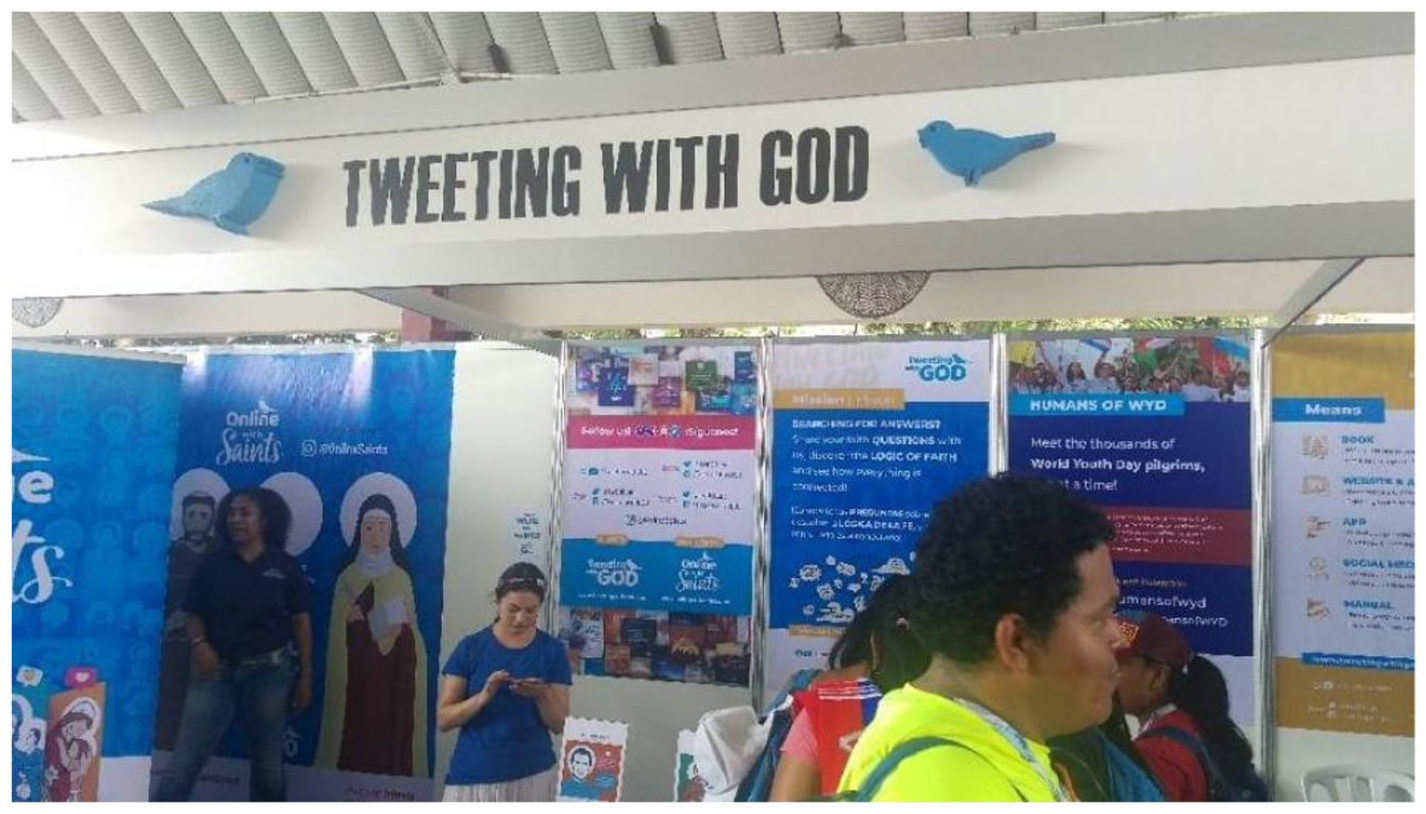
Tweeting with God.
The participating orders, congregations and communities (officially called ‘exhibitors’, Vocations Fair, 2019a) also competed for the best booths, which, again, depended on the financial resources of the particular community. Packages in the categories of A to D were offered, with the cheapest option being two communities sharing 3 × 3 metres with one table and two chairs for US$350. The luxury package contained two tables and four chairs with Internet access for US$1250. That financial burden was then shared with the participants on a voluntary basis as they were often offered the possibility to give a donation or become a permanent sponsor of the organization, and were also provided with leaflets with bank account numbers. Importantly, the organizers were fully aware that they employed a market-based approach and they used the corresponding vocabulary – exhibitors, offers, luxury packages and so on.
The other omnipresent form of market appropriation was the direct engagement of local as well as transnational businesses. On the macro-level, this strategy focussed on gaining donations and support from sponsors. Paradoxically, although financial institutions (along with the ‘false idol of money’, Francis, 2018) are among the main targets of the Pope’s criticism of the global economy, four out of the five most important sponsors were large banking institutions. Among the other main sponsors were supermarket and fast-food chains (such as Subway), but also other internationally well-known companies such as Canon, Travelex or Hyundai (JMJ Panamá, 2019). From the point of view of the participants, the most visible consequence was the alliance the WYD organizers forged with businesses in Panama City, in particular, restaurant and fast-food chains. A system of patronage emerged in which around 1000 businesses were expected to get involved. These included local and international chains, fast-food establishments as well as more traditional restaurants. After the registration, the pilgrims received a booklet with food vouchers which could be used for breakfast, lunch and dinner on 22–27 January.
One additional element interlinking the religious and profit-making dimension of the event was the way the organizers tried to attract businesses to take part. The organizers prepared a presentation that combined the estimates of the numbers of the faithful taking part in holy masses, catecheses, prayers or other events in the vicinity, and the potential numbers of guests each establishment may subsequently receive. The involved companies were also encouraged to prepare special ‘Pilgrim Menus’ tailor-made to meet the needs of the pilgrims (A Thousand Restaurants, n.d., see Figures 2 and 3). Many of them did so and, subsequently, the city was flooded with Pilgrim Menu posters from different companies. Paradoxically, the Pilgrim Menu advertisements were so ubiquitous that they became one of the most prominent features of the entire WYD. For ordinary participants, but even non-participating Panamanians, the WYD was thus visually linked to transnational companies such as Subway, KFC and Pizza Hut. The latter two companies even used the slogan of ‘I am WYD. And you?’ (Panamanian Franchises, 2018).
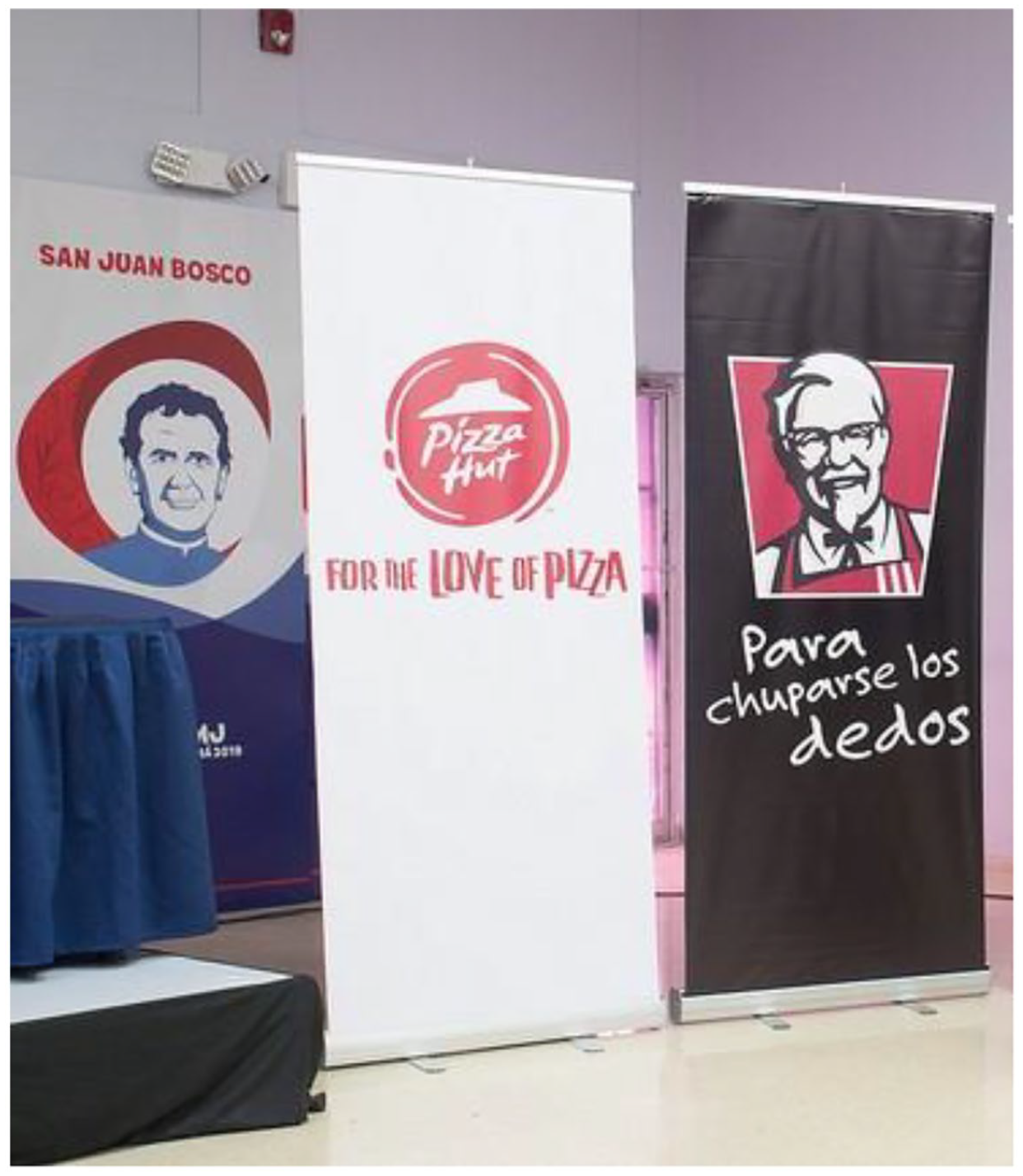
PizzaHut at the WYD.
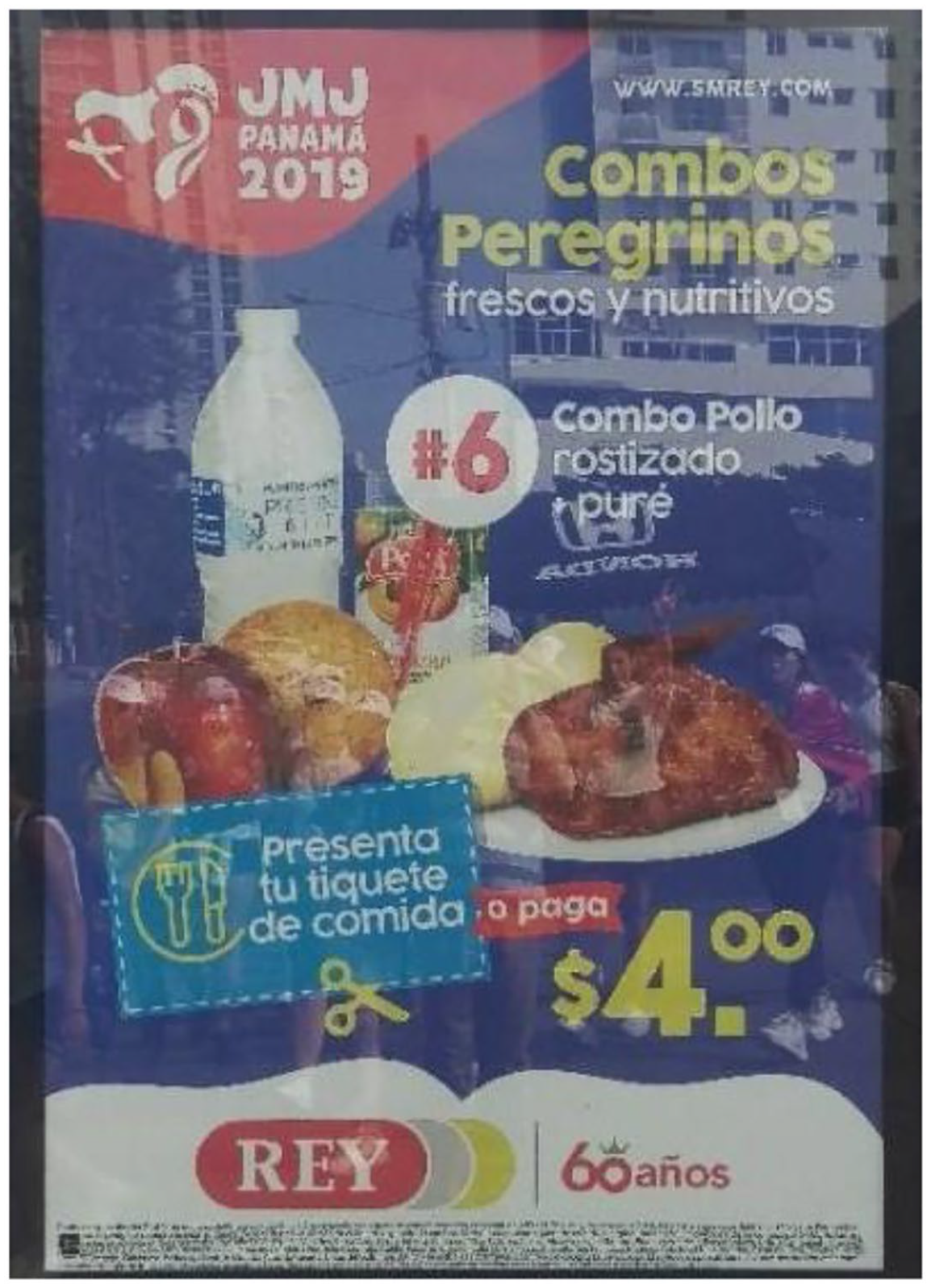
A typical Pigrim Menu.
The framing of the alliance between the church and the businesses was particularly interesting. The businesses, for their part, never mentioned profit as the main reason for their involvement in the WYD sponsorship programme. Instead, they argued that their aim was to ‘support World Youth Day’ as ‘it will be an incredible event, young people from all countries will come and it is super important to support this initiative’ (Global Bank, n.d.). Similarly, the large supermarket chain Melo argued that they supported the event out of pure charity: ‘As an entirely Panamanian company, at Empresas Melo we feel a sense of obligation to give it all for Panama’ (Chains 2018). Other companies argued more openly that their support for the WYD would help them ‘connect with the community and young people’ (Chains, 2018).
This mixture of profit-making and corporate values in the companies’ public relations is not surprising as it is entirely in line with common marketing practices. What is striking, however, is that the local Church leaders adopted a similar argument in which they blended economic calculation with sacrifice for the WYD on the part of the participating businesses. The paradoxical stress on profit and the simultaneous rejection of profit was present throughout the official materials as well as in the speeches of the organizers. As the President of the Local Organizing Committee claimed, ‘more and more companies . . . will strengthen their businesses through WYD’ (Chains, 2018). At the same time, though, these companies were expected to ‘make a difference by setting aside their commercial interests, in favor of their drive to contribute to the youth of the world’ (Chains, 2018).
As with Pope Francis’ critique of financial institutions and the sponsorship by the very same institutions, the two positions (profit-making vs giving up profit) were never challenged as contradictory and simply co-existed even within the same press releases, speeches or other WYD texts. In this context, the slogans used by the companies on their Pilgrim Menu billboards gained an entirely different dimension. In the discourse of the local organizers (such as Archbishop Mendieta), the companies which ‘gave it all’ ceased to fulfil the role of profit-making enterprises and their activities were spiritualized and, ultimately, described by the organizers in the same manner as the activities of the organizers themselves. Sacrifice became the central unifying term through which both the organizers and the participating corporations were identified.
Temples of consumption and consumerist spirituality
The church’s emulation of the market and the businesses’ attempts to underline their Christian or altruistic commitments meet in a surprisingly original assemblage of partially religious and partially consumerist elements. The World Youth Day did not become fully colonized by the market and the businesses went out of their way to remodel not only their language but also their premises to make them recognizable as spiritual. The organizers, however, imported a number of market-related features into their language, the spatial organization of the event and even the technologies they used. The borderline between the market and the religious was attacked from both sides and the hybridization was enthusiastically supported by both as well.
Hence, the booths of the religious orders at the Vocation Fair emulated personnel hiring practices of global corporations, but they were also organized in ways that often resembled Catholic chapels, with a centrally placed altar-like poster or image (Figure 4).

A stand at the Vocation Fair.
But the food courts of the shopping malls underwent a similar transformation. Christian spiritual music was often used by the businesses instead of ordinary radio music and the food courts were ornamented with banners welcoming pilgrims and offering them their specially made menus. For many pilgrims, food courts and fast-food outlets became central meeting areas where group prayers were held and where the chant of ‘JMJ’ (i.e. the abbreviation for World Youth Day in Spanish) could be heard any time of the day. Suzanne Kaufman’s fascinating account of how trains became moving chapels for the pilgrims travelling to Lourdes (Kaufman, 2018) thus found its counterpart at the WYD: shopping malls’ food courts turned into pilgrim shrines.
As fascinating as the hybridization of these spaces was, what I found most striking was the reactions of the WYD participants. Not in a single interview I conducted was the blurred borderline between the market and the religious sphere seen as controversial or inherently unstable. To the contrary, the experience was repeatedly described to me not only as enjoyable, but as how things should be from a Christian perspective.
Even the bodies of the participants confirmed the acceptance of the sacred-market synthesis. The T-shirts each participant received at registration bore spiritual messages (such as the Marian theme of the WYD ‘Behold the handmaid of the Lord; be it done unto me according to thy word’.). But many T-shirts, the production of which was sponsored by Global Bank (n.d.), also bore the logo of the bank at the bottom. The resulting imagery that could be encountered at every larger WYD gathering created the impression that the biblical passage was part of the advertising message of the sponsoring financial institution or, conversely, that the advertisement was somehow biblical. The merger of the spiritual messages and marketing slogans also pertained to other venues such as Omar Recreational Park, where many WYD activities were organized. Nike’s ‘Go far’ message, which I mentioned at the introduction of the article and which was accompanied by a message asking ‘Would you like to talk about the meaning of your life?’ (Figure 5), was not an exception but rather a rule. Pepsi Cola’s ‘Vive hoy’ (Live for today) slogan also perfectly matched the spiritual slogans that surrounded it. And even though the individual combinations could be seen, at first glance, as accidental, the frequency and omnipresence of these merged slogans gave an unequivocal picture of the harmonious symbiosis of the two.

A typical poster arrangement at one of the WYD venues.
Technologies used at the WYD also substantially helped in erasing the distinction between the market and the religious, which in the end entirely disappeared across a number of different dimensions. A vivid example of this merger was the official WYD mobile phone application Panamá 2019, in which the locations of the official programme, churches, the Vocation Fair, entertainment areas and restaurants all turned into identical lines in a list of WYD activities and services (Rome Reports, 2019). These technologies brought people to the locales of the businesses which offered the Pilgrim Menu, which in turn further eroded the distinction between the religious and the profit-making. The application was not only widely used but also appreciated as serving the participants with all the information they needed (Rome Reports, 2019). While one central notion, that of sacrifice, was borrowed by the businesses from the church, ‘need’ turned into another central element that helped bridge the ‘spiritual needs’ with the consumerist ones.
Concluding remarks: stability of the sacred-market network
The sacred-market network that emerged during the WYD in Panama exhibited a surprising level of stability. In spite of the explicit attention dedicated to poverty and socio-economic inequalities, the network achieved an extraordinary success in shifting all the contradictions, ranging from racial issues to economic justice, to the margins of the meeting. This shift sometimes took on a spatial character, as was the case with the World Indigenous Youth Gathering, which took place on the side-line of the WYD, not in Panama City, but in a remote comarca indígena (Vatican News, 2019). In other contexts, the shift was temporal, as was the case with the allusions to racial and socio-economic inequalities in the past.
The WYD could thus be recast as a utopia where the contradictions between altruism and profit-making disappeared and where consumption became a natural part of the spiritual experience. This utopia was joyously welcomed and enthusiastically supported both by the organizers and by the participants. The embracement was not limited to the discursive level and in fact, the discursive level did not constitute its basis as, thanks to the papal interventions, the discourses on Catholic political economy contained a critical element as well. Instead, the longed-for harmony was primarily constructed through practices and through the re-organization of the material milieu of the WYD.
This construction of the utopia ranged from the highest level to the everyday micro practices. On the macro-level, the organization of the event in the global South and at the time of the main school holiday in many ‘Southern’ (but very few ‘Northern’) countries was aimed at re-balancing the overall numbers of participants away from the richer segments of the global Catholic Church. Although affluent North American, European, Asian and African Catholics did arrive, the strong regional presence made the inclusiveness argument believable and it was readily accepted by the participants. This was re-enforced by the stress on additional sponsorship programmes and donations. Although these sponsorships were entirely marginal in terms of their share in the total number of participants, the visibility of these programmes made the narrative of the successful overcoming of the religious-market dichotomy even more convincing.
Contrary to my expectations, the Catholic political economy of the WYD did not result in a one-sided colonization of the event by market forces. Rather, the logic of the market and religious deontology ceased to serve their roles as irreconcilable, mutually exclusive forces. The other’s ‘best practices’ were eagerly emulated by both sides, and both sides explained this emulation non-instrumentally, simply as the best way to make sure that things work as they should. While doubts may still persist about the intentions of the involved actors (both ecclesial and business), the extent to which each side tried to accommodate the other was almost exactly symmetrical. This symmetry and the inclusion of the practices and language of the other as well as their physical manifestations in one’s own milieu led to a striking convergence. The language which combined utilitarian and non-utilitarian aspects, the sacred rituals in consumerist spaces and the market competitiveness at work in vocation discernment are all examples of this convergence.
The network was continuously stabilized through discursive interventions by the organizers, and by technological means such as the WYD application which erased the difference between the market and the religious. This synergy was repeatedly re-affirmed discursively and the ceaseless flow of the participants from one venue to another blurred the difference between supposedly functionally different settings. The network’s ability to cope with the disturbances of the sacred-market symphony was truly phenomenal. The question remains, however, whether this stability was achieved by a temporal and spatial suppression of those elements which would render the network prone to collapse. The exclusion of the poorest Catholic believers, who could not participate in the event, the removal of racial and social injustices from the present to the past, and the spatial marginalization of the Indigenous Catholic communities can thus be seen as the sacrifice the WYD had to make for this stability to be achieved. The Church was prepared to pay this price and the result was appreciated by both businesses and participating Catholics. However, it is to be seen whether the church-market alliance that appeared to be so successful at the WYD will be an acceptable strategy for the Catholic Church in other, broader settings as well.
Footnotes
Funding
The author(s) disclosed receipt of the following financial support for the research, authorship, and/or publication of this article: This work was supported by the Grantová Agentura České Republiky [GA19-10969S].
