




Abstract
Recent geopolitical developments have placed Nordic cooperation on the agenda. As an important institution of Nordic cooperation, the Nordic Council has historically been outperformed by the EU and NATO in matters of hard power (e.g. economic and military cooperation), and has instead prioritized influence through soft power (e.g. cultural diplomacy). The article demonstrates how the Nordic Council, through what we call regional soft power, promotes cohesion through the awarding of prizes. The power, legitimacy, and reach of the organization reside in its ability to engage new recipients and connect the prizes to ideas about Nordicness. Analyzing transcribed speeches from prize-givers and recipients from fifty years of award ceremonies (1962–2012), our findings highlight history, language, and nature as important reference points for the idea of Nordicness. Over time, the award ceremony as a space for deeper political discourse diminishes in favor of ceremonial and performative expressions of unity. We argue that the use of culture for political purposes, through the repeated acts of giving and accepting prizes, functions as a mechanism of soft power. This exchange represents a symbolic unity within the Nordic region, which is intended to facilitate further cooperation and international influence.
Introduction
The “Nordic” has become a powerful brand on the international stage, encompassing several ideas and elements, from the Nordic welfare state and Nordic peace (Browning, 2007), to the global popularity of Nordic noir in films and literature (Saunders, 2021). One significant organization shaping and leveraging this “Nordic” identity as a political region on an international political arena is the Nordic Council (NC). Comprising five small states—Denmark, Finland, Iceland, Norway, and Sweden—as well as the autonomous regions of the Faroe Islands, Greenland, and Åland, the Nordic Council fosters inter-parliamentary cooperation in the Nordic region. Established in 1952, the organization began with initiatives such as the Nordic Passport Union, opening the Nordic borders decades before the Schengen agreement came into existence.
There have been signs of a renewal of Nordic security cooperation in the last decade, not least following the new security landscape after the Russian annexation of Crimea in 2014 (Bengtsson, 2020), and more recently due to the full-scale invasion of Ukraine in 2022, and Finland and Sweden becoming members of NATO (Brommesson et al., 2024; Wrange et al., 2024). 1 However, the Nordic Council (and Nordic Council of Ministers) has historically shifted its focus away from security and defense issues, as not all members were members of NATO, 2 while the EU membership of some redirected economic policy cooperation to the EU (Strang, 2016). With “hard power” issues in effect removed from the agenda of Nordic cooperation, it has been argued that cultural cooperation was used “to compensate for the lack of significant results in other spheres” (Kharkina, 2013: 74). Moreover, previous research has often pointed to Nordic cooperation as characterized by weak institutional settings, given that the Nordic Council and Nordic Council of Ministers lack supranational decision-making powers or administrative power, and thus have remained secondary to other institutions such as the EU and NATO (Etzold, 2020; Haugevik and Sending, 2020; Stie and Trondal, 2020).
However, the Nordic Council has been more successful in its promotion of “soft power.” Soft power is the ability of a state to achieve its objectives through cultural attraction or persuasion, in contrast to hard power, which relies on coercion or payment (e.g. military or economic resources) as a means of achieving political goals (Nye, 2004). Through cultural assets, such as music, art, and film, states can promote their values and ideas abroad, and when others appreciate and adopt elements of a state’s culture, it can be said to have used its soft power. Previous research has identified the primary role of the Nordic Council as an engine of soft power, contributing to the “Nordification” of political discourse in the Nordic region (Olesen and Strang, 2015: 29). As the Nordic countries have had 200 years of peace among themselves, Bengtsson (2020: 106), identifies them as a good example of “a regional security community or zone of stable peace,” which requires a level of “we-feeling” that has emerged from below rather than through formal organization or harmonization. As others have argued, the capacity for security cooperation increases with overlapping identities and repeated interactions that reinforce shared values (Wrange et al., 2024: 515). Thus, cultural cooperation through the Nordic Council can serve as a soft power tool to lay the groundwork for more extensive Nordic cooperation, by fostering a sense of the Nordic countries as a culturally integrated region.
Drawing on recent developments in the literature on the use of prizes as a tool of governance (e.g. Foret and Calligaro, 2019), this article analyzes the Nordic Council Prizes as a soft power tool for promoting regional integration. Given the characterization of the Nordic Council in previous research, with limited administrative capacity and formal authority, the Nordic Council Prizes, beginning with the Nordic Council Literature Prize in 1962 and subsequently expanded with prizes in music, film, environmental achievements, and children’s literature, stand out as a particularly successful institutionalized element of Nordic regional cooperation.
We contribute to existing research by addressing how the awarding of Nordic Council Prizes has promoted Nordic integration over time through cultural narratives, persuasion, and cultural appeal. Specifically, we focus on the Nordic Council Prize ceremonies as recurring sites where these accounts are articulated, shared, and contested. By zooming in on the speeches delivered by the presidents of the Nordic Council, as representatives of the prize-giving actor, and the acceptance speeches of the recipients, as prize-receiving actors, we explore how they serve as spokespersons, articulating the relationship between culture and politics and conveying a conception of Nordic cooperation. Furthermore, we zoom out to consider the broader implications of these ceremonies for the Nordic project, regional soft power, and the geopolitical community. Previous research often focuses on the Nordic element of the foreign policies of individual Nordic states (e.g. Brommesson, 2018a; Brommesson et al., 2024; Haugevik and Sending, 2020), or on Nordic cooperation to promote shared values in international organizations (e.g. Ingebritsen, 2002; Tuominen, 2025). In contrast, we focus on the Nordic Council Prize ceremonies as an event of internal communication among the Nordics that reinforce ideas of “Nordicness” and foster cooperation between member states, ultimately asserting the influence of the Nordic region on the global stage.
The Nordic Council Prize ceremonies bring together political representatives from across the Nordic region, serving not only as a celebration of cultural achievements in literature, music, film, and environmental work but also, we argue, as a mechanism for the (re-)production of a Nordic identity. Already at its inception, the explicit purpose of the literature prize was to strengthen the Nordic cultural community and thereby strengthen the international position of the Nordic countries. As argued by one of the initiators, Norwegian Liberal Party representative Helge Seip, the authors who receive this prize will, in fact, come to stand as representatives of the Nordic spirit and Nordic cultural life, also outwardly toward the world. I believe it is important that we try to inspire our authors to do their utmost to assert the position of the Nordic countries in world literature also in the future. (Nordic Council, 1961: 136)
Through the rituals of these ceremonies, including the giving and receiving of awards, ideas of a Nordic community are continuously narrated and reinforced. Analyzing an extensive and unique material of 50 years of award ceremony speeches, we ask what ideas of “the Nordic” that are communicated through these Nordic Council Prize ceremonies. Our findings show that ideas of Nordicness, rooted in nature, history, valuation of culture, and narratives situating the Nordic in a global context, all contribute to, and negotiate, the construction of a shared idea of “the Nordic.” The acceptance speeches play a crucial role in establishing the cultural production of Nordic creators as distinctly Nordic expressions. Accepting an award is not a neutral act. Rather, receiving an award means accepting what it stands for, which makes the act of acceptance and the acceptance speech just as important as the speeches by politicians in giving meaning to the award. Hence, recipients also accept to contribute to the broader Nordic narrative, while also sometimes challenging it in their speeches. The awarding and acceptance of prizes thus reflect the transformation of culture into politics, elevating the Nordic region’s cultural production to the status of a political project. In this way, the awards function as a soft power strategy employed by the Nordic Council to integrate the region internally and situate it within a broader international context. We define this process as a distinct form of soft power: regional soft power. Through these ceremonies, the Nordic Council seeks to strengthen the geopolitical community of Nordic countries and assert the region’s position on the global stage.
Previous research
Nordicness and Nordic foreign policy
Previous research on Nordic cooperation has noted an increasing interest in “the Nordic” and “a return to the Nordic in the foreign and security policy of the Nordic states” in the last decade (Brommesson, 2018a: 355). Brommesson (2018a) argues that this is visible in different ways, both formal and informal, such as “a more widespread reference to the Nordic in official statements and policies” of the Nordic states (studied in the same issue by Brommesson, 2018b; Ojanen and Raunio, 2018; Wivel, 2018). Despite being commonly understood as a regional security community (Browning, 2007), previous research has noted different meanings of Nordicness among the Nordic states (Wrange et al., 2024). The idea of Nordic unity has been criticized from the post-imperial perspective of Iceland, Greenland, Åland and the Faroe Islands (Adler-Nissen and Gad, 2014), and different levels of support for Nordic security cooperation among the Nordic populations has been identified (Bengtsson and Brommesson, 2024). Previous studies have identified references to shared history, norms, and practices (Brommesson, 2018a), authenticity, ancestry, and liberal democracy (Hoad and Whiting, 2017), as well as peace, solidarity, and the welfare state (Browning, 2007) as elements of Nordicness in branding and identity construction. Although we are likely to find similar ideas in our material, the ideas communicated in the Nordic Council Prize ceremonies are not necessarily the same as the “Nordic brand” projected onto the international arena by the Nordic states. In contrast to previous research on Nordic ideas in the foreign policies of Nordic states, we are here primarily interested in Nordicness as part of the regional soft power exercised through the Nordic Council Prizes.
Other international competitions, such as the Nobel Prize (Sneis and Spoerhase, 2023), the Olympic Games (Boykoff, 2022), or the Eurovision Song Contest (Baker, 2017), have often been studied from an International Relations perspective, as sites of nation-branding, “sportswashing” and political competition. However, previous studies of the Nordic Council Prizes have primarily focused on literary themes in the prize discourse, showing that books awarded often deal with topics such as tensions within modernization, history in the Nordics, and relations between the individual and society (Hiller, 2019; Hjelmervik, 1998; Mai, 2015). Case studies and examples of some awarded books show that these themes appear in prize motivations (Hjelmervik, 1998) and the books themselves (Mai, 2015), indicating that common themes of “Nordicness” are reflected in the aesthetic valuation of prizes. Research on the literary prize nominations has not found a common Nordic criteria for the selection of books, but rather, the books become Nordic by being selected for a Nordic prize (Hiller, 2019: 110). Previous studies of the Nordic Council Prizes have not been in the field of International Relations and have been limited to the prize in literature and case studies of specific winners. This article thus adds to previous studies of the Nordic Council Prizes by covering all of the Nordic Council Prizes 3 between 1962 and 2012 in the analysis and by shifting focus to the political, rather than aesthetic, dimension of prize-giving.
Soft power and prizes
Soft power, understood as the role of culture as a means for states to achieve their objectives and gain political influence, has been studied in a variety of empirical contexts following Nye’s (1990) original analysis of the cultural influence of the United States abroad. Translations of African literature into Chinese have for example been connected to the cultivation of political high-level relations (Batchelor, 2019); and strategies of nation-branding through pop-culture exports have been analyzed in the cases of Japan (Iwabuchi, 2015) and South Korea (Levitt and Shim, 2022; Nye and Kim, 2019). But the concept of soft power has also been used to describe more internal processes of nation-building, such as in the case of sports events in South Africa after apartheid (Nygård and Gates, 2013), or the use of museums to construct shared identity in China’s “museum boom” (Zhang and Courty, 2021). In these cases, soft power is understood as a state’s strategic use of cultural appeal to create a sense of unity or “we-feeling” among a (previously divided) domestic community.
The present article contributes to the study of soft power by continuing a recent development of studies focused on understanding how political organizations, engaged in international relations, can employ the awarding of prizes as a soft power policy instrument (Codina Solà and McMartin, 2022; Foret and Calligaro, 2019; Foret and Vargovčíková, 2021). These authors study how regional organizations, such as the European Union, uses prizes as “instruments of soft power, where (foreign) policy goals are achieved through the prizing of a certain set of aesthetic, political and commercial values associated with the European integration process,” by “actively shap[ing] the linguistic, cultural, and political boundaries of European literature and identity” (Codina Solà and McMartin, 2022: 344). These studies are connected to a growing body of literature that identifies the societal relevance of prizes and awards and their role in consecrating artistic value (Best, 2008; English, 2005; Frey and Gallus, 2017; Harrison and Jepsen, 2015). Following previous literature that has applied the soft power concept to regional organizations’ use of prizes to create internal integration, we conceptualize this as regional soft power, which we now turn to below.
Theory
Regional soft power
Soft power, usually defined as the ability to reach one’s objectives through attraction (as opposed to coercion), has been widely debated (e.g. Nye, 1990, 2004, 2021, Rothman, 2011; Solomon, 2014). Critics often emphasize the difficulty of evaluating the impact of soft power on political outcomes, as it “depends on the minds of target audiences” and the extent to which they embrace the ideas communicated by the sender (Nye, 2021: 201). Despite this, we argue that soft power is a valuable concept for understanding the practice at hand: the awarding of cultural (and environmental) prizes by the Nordic Council, the associated cultural narratives, and the communication of these awards to political representatives and audiences of Nordic states and autonomous regions. While the original concept of soft power is rooted in methodological nationalism, focusing on the influence of one state over another, this article argues that soft power also can be exercised by international organizations such as the Nordic Council. We therefore employ the concept of regional soft power, to describe the Nordic Council’s influence in the Nordic region. In this context, regional soft power is co-constructed by Nordic national representatives as they address each other within the Nordic Council setting. Thus, regional soft power refers to the unique form of soft power exercised by an international political organization within a distinct geographic and cultural region, aimed at gaining influence through appeal.
Prizes as tools for soft power
Prizes awarded by political actors or institutions are designed to guide action through their appeal. In the context of international politics, prizes can therefore be understood as tools for soft power. In their study of prizes instituted by the EU, Foret and Calligaro (2019) call this practice “governance by prizes” (p. 1335), highlighting that the prize-giving actor uses prizes as a tool of power, through which it strives to achieve a political impact. Foret and Calligaro identify several ways in which prizes function as tools of governance: prizes emphasize the authority of the prize-giver and legitimize the value for which the prize is awarded, they create incentives of compliance, and they can also work as a way to identify and solve social problems (Foret and Calligaro, 2019: 1337). They write, In giving a prize, an institution arrogates for itself the right to consecrate social, political or cultural value. It is a mise-en-scene to publicly declare “what is worthy.” The dimension of publicity is pivotal in the award-giving process to display the authority at work. (Foret and Calligaro, 2019: 1339)
Thus, through their symbolic power, prizes—seen as something worth striving for—can make potential recipients adapt to the wishes of the prize-giver, and simultaneously give audiences a measure of what is valued, thus signaling shared norms. In this way, prizes have historically worked as a nation-building tool that channels loyalties toward the center, but this dynamic can also be applied to international institutions such as the EU or the Nordic Council.
One way to explain how cultural prizes work as tools of soft power is through the concept of capital intraconversion. While addressing what we here call soft power, English (2005: 10, italics in original), drawing on the work of Pierre Bourdieu, writes that prizes “are the single best instrument for negotiating transactions between cultural and economic, cultural and social, or cultural and political capital—which is to say that they are our most effective institutional agents of capital intraconversion.” Thus, prizes awarded by political organizations, such as the Nordic Council, serve to convert cultural capital—signified by awards in literature, film, music, and similar fields—into political capital. This transformation leverages soft power to promote Nordic cultural values and interests to a political audience, thereby strengthening the organization’s standing, both among its own members and in the international arena. Within this power dynamic, dominant players—such as large, influential political organizations or prominent artists—exert their influence and determine the relative value of different forms of capital. To exercise soft power, they have the capacity to transform existing capitals, converting cultural capital into political capital, while some artists also seize the opportunity to convert cultural capital into political capital. Thus, the effectiveness of prizes as tools of soft power lies in their ability to connect the realms of culture (artists, artworks, styles, etc.) and politics (states, politicians, etc.) to create shared meaning. Thus, in the context of the Nordic Council prizes, the prize ceremonies, where prize-givers (political organization) and prize-receivers (e.g. authors, composers) meet, is an arena where this relationship between culture and politics is negotiated, and such shared meanings can develop.
Prizes as relational rituals of power
In studies of soft power, capturing the relational dynamics between the agent and the target audience often presents challenges, leading most analyses to focus primarily on the intentions or strategic narratives (Miskimmon et al., 2013) of the soft power actor. However, the case of the Nordic Council prizes provides a unique opportunity to examine both sides of this interaction: prize-givers and prize-recipients. Through the speeches of both the Nordic Council and the prize recipients, we can analyze whether the narratives of Nordicness conveyed by the prize-giver are embraced or contested by those who receive the awards.
We argue that this relational dynamic is important to the Nordic Council, as the awards function as ritual gifts, with annual ceremonies serving as repeated rituals that, when successful, enhance organizational power. Such ceremonies embody acts of giving and receiving that extend beyond mere economic transactions (English, 2005), where the act of prize-giving exerts social influence and compels recipients to reciprocate (Mauss, 1954). While the speeches of the prize-giver thus can function as strategic narratives about what “the Nordic” is or should be, the symbolic acceptance of awards indicates the recipients’ consent to participate in the political project, often without full awareness of the broader political implications. The acceptance speech is the completion of a long process of deliberations and agreements, where the awardees not only are awarded but also invited, and accepting to be part of a Nordic political project as initiated by the Nordic Council through the Nordic Prizes.
Summing up our theoretical argument, the Nordic countries, through the Nordic Council, have an overarching objective to increase or maintain Nordic political cooperation, as this in turn can strengthen the Nordic countries’ international position at the macro level. To achieve this objective, the Nordic Council has often focused on soft power tools, of which the Nordic Council Prizes stand out as particularly institutionalized. At the micro level, prizes work as instruments of soft power by signaling the values promoted by the prize-giver (the NC, represented by its presidents), and achieving legitimacy by the acceptance of prizes by the prize-recipients (e.g. authors). When this exchange is completed and repeated at regular intervals, the values—for example “Nordic unity”—are confirmed and the cultural capital of recipients strengthens the political capital of the prize-giver. Thus, prizes promote certain values, which in turn are reproduced and strengthened by prize-winners acceptance of prizes. In addition, these ceremonies also present an opportunity for the Nordic countries, through their NC representatives, to express their ideas about what the Nordic is and should be. In the context of Nordic cooperation, it therefore becomes of particular interest to analyze the values and ideas about the Nordic that are expressed by the prize-giver, and whether these are reproduced and/or challenged by the prize-winners.
Method and material
In order to answer the question of what ideas about the Nordic region that are conveyed through the Nordic Council Prize award ceremonies, the analysis captures narratives on Nordicness as communicated both by the Nordic Council and by the prize recipients. For this purpose, we analyze material covering a 50 year period, focusing on the speeches of the NC presidents and the acceptance speeches of the winners (i.e. the prize giver and recipient). We study the official transcripts from the award ceremonies of all Nordic Council prizes from the inauguration of the first prize in literature in 1962 until 2012. As of 2013 there are no official transcriptions of the award ceremonies. Instead there is an award ceremony that takes the form of a televised gala that is broadcasted in the Nordic countries. As the televised gala reaches the national public audiences of the member states in a more direct way and through another medium than the previous prize ceremonies, these have been analyzed separately in an article focusing on the audio-visual elements of the gala (Fürst and Pettersson Fürst, 2025).
During the period 1962–2012, several additional prizes were established: the music prize (1965–), the environment prize (1995–), and the film prize (permanently 2005–). The award ceremonies take place in conjunction with the Nordic Council annual meetings and are hosted in the different member states at regular intervals. A few months before each ceremony, juries comprising practitioners and experts within the respective fields of the prizes convene to select the winners. The juries are not elected by the Nordic Council but consist of practitioners and experts within the respective fields of the prizes. Nominations are provided by the Nordic countries and votes are made in the juries to decide upon the winners.
The ceremonies are usually situated in grand venues such as concert- or city halls, and are commonly attended by national political representatives (e.g. members of parliament, prime ministers, ministers of culture) from each member of the Nordic Council, as well as cultural sector representatives such as winners, and local politicians (e.g. mayors of the city hosting the ceremony). The transcripts of the award ceremonies are published in the “Nordisk Råds Blå bog” (1962–2012), available in public libraries, and made available online by the administration of the Nordic Council of Ministers in 2022 (https://norden.diva-portal.org). During most of the studied time period, all speeches during the ceremony are transcribed in full in our material. The transcripts include speeches given by the president of the Nordic Council, sometimes speeches by local politicians in the host country, motivation speeches from the prize committees, and acceptance speeches by the recipients. Following the theoretical reasoning laid out in the previous section, we focus our analysis on the speeches by the NC president and the prize recipients, as representatives of the price-giver and receiver, i.e. as the soft power agent and its (primary) target audience. In particular, as “governing by prizes” includes the prize recipients’ acceptance of the prize, and thus exemplifies part of a soft power-relation, we pay equal attention to both types of speeches.
Following our understanding of soft power as a process of communication, aimed at affective engagement around shared ideas, where construction of shared history, values, and ambitions are important, the overarching question; what idea of the Nordic region is communicated through the Nordic Council Prize ceremonies? was broken down into several sub-questions to identify central themes in the material. We ask: what story about the Nordic region is being told by the Nordic Council? What are the values, images of history/the past, and visions for the future communicated? Is the narrative consistent over time, or does it change? To what extent do the recipients’ acceptance speeches reflect or challenge the Nordic narrative presented by the NC presidents? What alternative values or shared understandings are found among the prize recipients?
By using these guiding questions and comparing speeches across different years and actors, the aim is to elucidate the meanings within the ceremony through the framing of issues, the emphasis on certain values, and the construction of ideas that mobilize support or justify actions related to Nordicness. In doing so, we followed an empirical phenomenological approach, using the guiding questions to explore the material and uncover its inherent meaning structures. These structures were distilled through coding and we revisited the material and developed our central conceptualization laid out above based on the identified meanings of the utterances (Aspers, 2009). This process resulted in further categorizations of the codes. This iterative approach allowed us to understand the dynamics of the speeches and their content more deeply.
The material was thereby coded and analyzed in two waves in ATLAS.ti. More specifically, codes were created successively as different meaning structures emerged in the texts. In the first wave we identified codes that included the year and country of ceremony, overarching topics of speeches, concepts used (specifically the “Nordic”), debates within and between speeches, whom speakers address (e.g. whom the recipients address and thank), and values expressed (e.g. aesthetic values, Nordic identity). In the second wave, we returned and focused on the Nordic themes in the codes and specifically studied the expressions of agreement and contestation of what the Nordic is, has been, and can be throughout the codes from the first wave. As we did this, we also developed the idea of regional soft power and the understanding of the dynamic of prize-giver and recipient. This second wave of combining coding and theoretical analysis resulted in overarching categories that have been used to present the results of the analysis of speeches below. In presenting our results, we have organized the categories with the time periods in which they are especially prominent, but because the periods sometimes overlap, the categories do not follow a strict sequence.
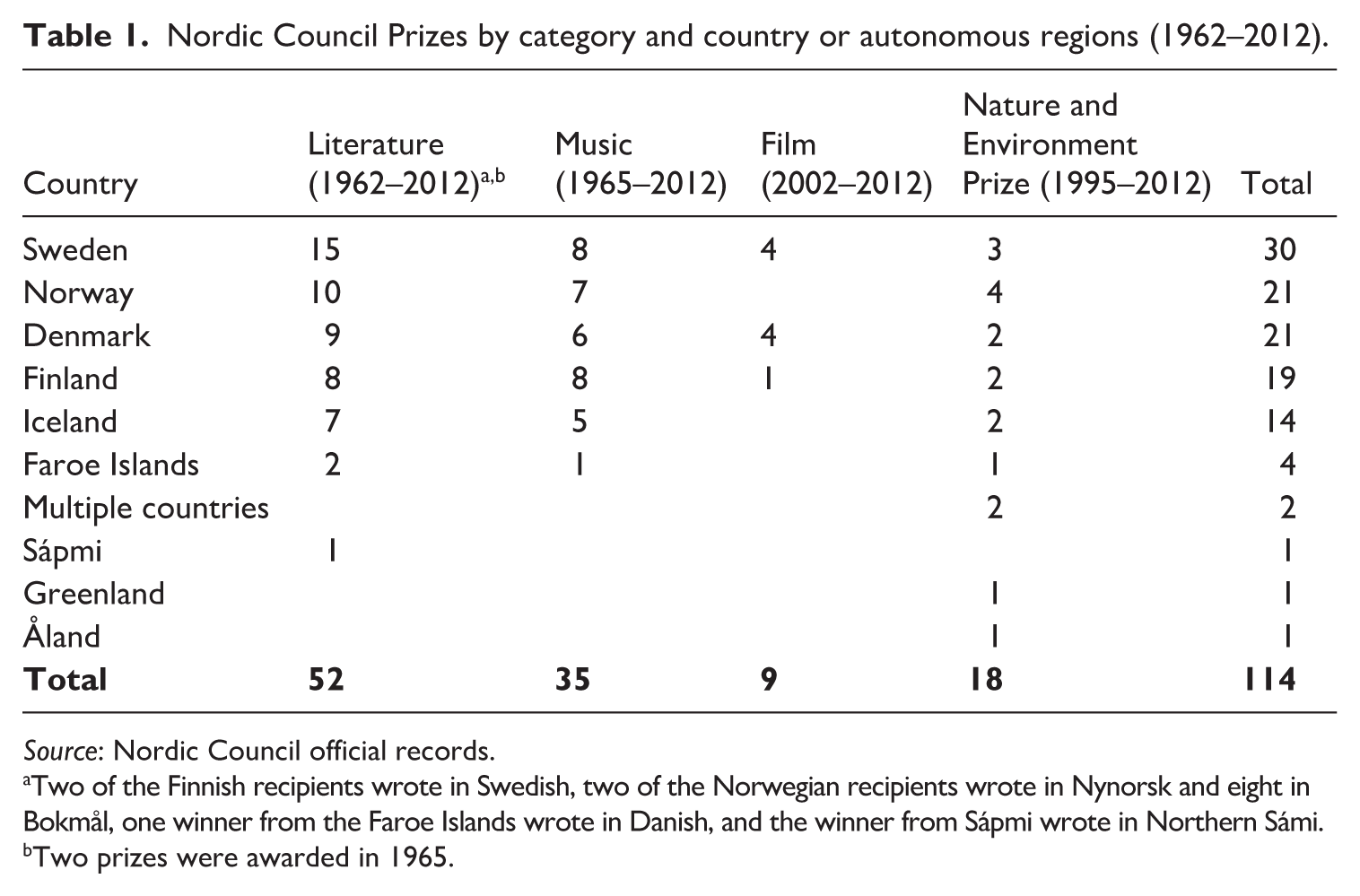
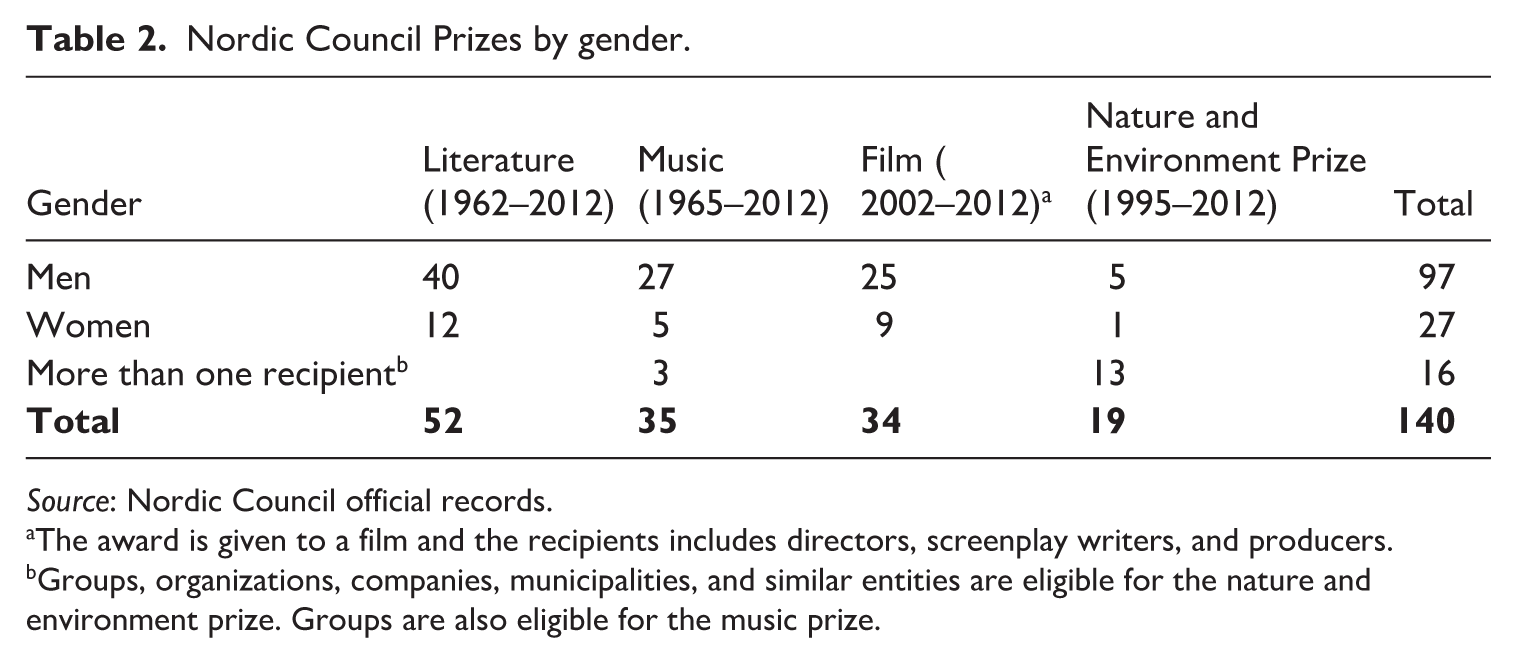
To give a background to our result section, we will present the distribution of all winners of each award (1962–2012) by country or autonomous regions and gender in Tables 1 and 2.
Nordic Council Prizes by category and country or autonomous regions (1962–2012).
Source: Nordic Council official records.
Two of the Finnish recipients wrote in Swedish, two of the Norwegian recipients wrote in Nynorsk and eight in Bokmål, one winner from the Faroe Islands wrote in Danish, and the winner from Sápmi wrote in Northern Sámi.
Two prizes were awarded in 1965.
Nordic Council Prizes by gender.
Source: Nordic Council official records.
The award is given to a film and the recipients includes directors, screenplay writers, and producers.
Groups, organizations, companies, municipalities, and similar entities are eligible for the nature and environment prize. Groups are also eligible for the music prize.
Table 1 shows that the prizes with the largest sample, literature and music, are dominated by Sweden, Norway, Denmark, Finland, and Iceland. 4 While films that have only been awarded nine times have a strong presence of awardees representing Sweden and Denmark. The nature and environment prize has a stronger presence in the autonomous regions Faroe Islands, Greenland, and Åland, while Sápmi is represented by Nils-Aslak Valkeapää’s literary award in 1991.
Table 2 illustrates a significant predominance of men among the awardees. The issue of male dominance was raised concerning the literary prize in 1978 by Finnish liberal-conservative politician Elsi Hetemäki-Olander from the culture committee, particularly in light of 1975 being the International Women’s Year (Nordic Council, 1978: 211). However, the primary objective was not to award the prize to a woman, but rather to a children’s book author. This consideration of the gender imbalance was not discussed further nor was it part of the suggestions from the culture committee. Nonetheless, the first prize to a woman was given two years later to Sara Lidman. At the end of the studied period, the distribution of awards became more equal for literature. However, the other prizes have a predominance of male winners through the entire studied period.
Results
In the analysis below, we examine the Nordic Council Prize award ceremonies as key venues where cultural narratives are articulated to convey the meaning of Nordicness. We present the results of the analysis first for the NC presidents’ speeches and then for the recipients’ speeches. The analysis is organized thematically and chronologically to highlight the most important findings and changes over time.
The prize givers’ speeches, 1962–2012
Constructing the Nordic shared identity through culture and history (1962–1981)
In the early years of the Nordic Council Prize (awarded in literature since 1962 and in music every other year starting in 1965), the NC presidents’ welcoming speeches often clearly express the role of culture for the Nordic region. This is illustrated by quotes such as: For the poets of our countries, it [the literature prize] should be an expression of the council’s recognition of the central importance of literature for the cultural community, which is the basis of our popular and political cooperation, and be a modest repayment of the debt we all owe to the past and today’s great writers and poets in the Nordic countries. (Harald Nielsen, Danmark, 1966)
5
Literature has had great significance for the creation and development of the common culture of the Nordic peoples. The works of the great Nordic writers of the last century were the common property of all the Nordic peoples. (Eino Sirén, Finland, 1967)
In these speeches, culture is portrayed as a shared historical experience, which shapes a common Nordic identity. Cultural collaboration is explicitly understood as the foundation upon which other (political) cooperation can be built. References to the late 1800’s romanticism of Scandinavia as a unit with a shared culture, language, and territory, now extended to the Nordic countries, are made. Culture is seen as a unifying force, and also distinctly as a goal in itself, something to be valued and prioritized with the resources that material prosperity creates. This view of culture is different from later conceptions, where culture is legitimized as a means to create economic benefits. Still, in the early days, culture, particularly literature, is highly valued, as illustrated in the idea of owing a debt to historic Nordic writers, and rewarding artists thusly: Our forefathers appeared before kings and earls and recited poetry. Then the poets received good weapons and beautiful valuables as a reward for their poems. Here, authors and composers are recognized in Danish kroner from the legislative assemblies of the Nordic countries. This is how the old custom lives, the esteem for art and for our people’s spiritual chieftains. Today’s democracy will not be outdone by the autocrats of a bygone era regarding the valuation of poetry, prose and music. (Sigurður Bjarnason, Iceland, 1970)
In this narrative, the speaker thus makes a connection between the historic valuation of artists and the current Nordic Council prizes, as a way to emphasize the status of the prize. In the second decade of the Nordic Council prize ceremonies (1972–1981), the presidents’ welcoming speeches continue to make references to a shared Nordic history. The common past is portrayed both as an undefined historical period, and as specific periods or artifacts such as the Viking Age and the Edda texts. Compared to the 1960s, when references to the 19th-century literary scene also occurred, during this period there is a more consistent reach further back in time. Notably, references to later periods of intra-Nordic wars and colonization are absent from the historical narratives.
Another recurring theme is the importance of a shared Nordic culture, in particular as it is described as linked to, and a facilitator of, other types of cooperation: The Nordic peoples have a common cultural heritage with origins far back in prehistoric times. I hardly think that there is any other country group in the world that has so much in common in the field of culture both as a historical heritage and as a living reality in the present. In ethical values and social conditions, in music, literature and visual arts, the Nordic peoples have so much kinship that we can in reality speak of our countries as a unified cultural sphere in our part of the Western world. Our relatively uniform culture is the foundation on which Nordic cooperation in modern times has developed. The common view of the Nordic peoples in terms of essential cultural values has facilitated the construction of contemporary cooperation in the social and economic field. (Johannes Antonsson, Sweden, 1974, our italics)
In the above quote, several recurring elements are united: reference to distant past, the shared values and appreciation for the arts, the Nordic countries as a cultural-identity region, and the importance of shared cultural values as a foundation for cooperation in other spheres. In addition, words such as essential, kinship, and uniform serve to emphasize similarity among the Nordics. In 1977, when the Nordic Council celebrated its 25th anniversary in connection with the prize ceremony, the speech given by the president at this time, V.J. Sukselainen (Finland), is particularly interesting, as it is very explicit about the intention and motivations of the Nordic cooperation: After a demanding working day, we have managed to reserve a couple of hours to celebrate the slow work that five sovereign states have done over a quarter of a century, when they have built a modern Nordic community . . . We have not renounced our national right to self-determination. We have not started to change our borders. We have, at the parliamentary and government level, begun the construction of a collaboration, the purpose of which is to teach the members of five small nations how to eliminate the disadvantages that borders bring in a permanent and effective way. . . . How did the Nordic Council come about? . . . We remember how we sat at the Nordic Interparliamentary Union’s meeting in Stockholm City Hall. We remember how Hans Hedtoft stood up and spoke, how he presented his case with warmth and eloquence and immediately took us with him. When he had finished, we were obliged to admit that something had now been proposed, which must take place, and which, in fact, was something which each of us felt we had sometimes thought within ourselves. . . . We thank fate that during these 25 years we have been able to take part in consolidating the Nordic sense of belonging . . . (1977, our italics)
Here, in a narrative about the history of the making of the Nordic Council, its creation is almost spoken of as an inevitable force, something that was as driven by a need within the people who were part of making it happen. The benefits of the cooperation are praised, but it is also emphasized that the national sovereignty of each member remains intact, that the Nordic Council is a collaboration of equals. The ambition to “teach its members” to cooperate across borders speaks directly to the soft power strategy of regional integration through cultural cooperation.
Introducing the idea of unity in diversity and independence (1982-onwards)
In the 1982 to 1991 period, some changes occur in the narrative of Nordicness. While the previous emphasis on common history and culture is still present, in statements such as “[t]he Nordic cultural community is far older than organized Nordic cooperation. The sense of community is, of course, the prerequisite for cooperation in other areas” (Karin Söder, Sweden, 1988), it is less consistently prominent than before. Instead, there is a new focus on the distinctiveness and independence of the different members of the Nordic region. Iceland emphasizes the Edda, Finland’s linguistic position is discussed,
6
and the first Faroese and Sami awardees are remarked upon. This can be illustrated with this quote about the importance of the first winner from the Saami language area: All those who love literature know that literature in our mother tongue gives our own language community its identity and its self-respect, and it does not matter whether it is a large or a small language community. And when we [. . .] read and become acquainted with the literature of the neighboring languages, we actually get both an experience and something to know about how in that language society one understands one’s own surroundings and oneself and perhaps also ourselves. (Anker Jørgensen, Denmark, 1991)
Thus, rather than a story about Nordic commonalities, a narrative about the ambition of the prize to spread knowledge and familiarity about culture and language among the Nordic neighbors is in focus. Anker Jørgensen phrases this as “although we are Nordic, we are also a bit nationalist!” (Denmark, 1986), in the sense that one is particularly happy if someone from one’s country wins. Overall, the third decade of speeches thus introduces a slight shift from a narrative that emphasizes shared Nordic history and essential similarities, to a narrative of cooperation that maintains and rewards differences, uniqueness, and independence.
Placing Norden in the world and depoliticizing the award ceremony (1990—onwards)
In the 90’s, some new themes emerge in the speeches opening the awards ceremonies. First, there is a slight change in the structure of speeches: they are much shorter, and it is not always the President of the Nordic Council who delivers the welcome address. This results in less elaboration on the idea of the Nordic compared to previous years, and can be seen as a depoliticization of the ceremony. The most distinctive new themes in this period are the introduction of the environmental prize and references to politics in the rest of the world, taking note of the end of the Cold War and the entry of Nordic states into the EU. The latter theme brings with it a focus on the importance of strengthening Nordic regional unity outward, which can be seen in references to how awardees have been successful in representing the Nordic region internationally, or in this quote about the importance of shared identity for the Nordic countries in external relations: The Nordic cultural community has often, and rightly, been said to be a fundamental prerequisite for other forms of Nordic cooperation. Through the efforts of the Nordic Council, cultural identity has become a central part of the work we are now conducting between our countries. Our own national and Nordic identity is also an important factor in European integration. A strong Nordic community provides us with good conditions to actively participate in European cooperation, to promote Nordic alternatives, and to maintain a cultural climate in the Nordic region that is receptive to outside influences. (Ilkka Suominen, Finland, 1992)
In the final decade studied (2002–2012), it is more common for the leader of the delegation from the hosting country to deliver the speech than the NC president. As in the 90’s, the speeches are short, and references to Nordic collaboration are usually a variation of the phrase “The prizes are an expression of the importance of culture and the environment in Nordic cooperation” (Gabriel Romanus, Sweden, 2004). In the few speeches by NC presidents, we again see themes that have been consistent throughout all the studied years, namely the idea of a shared culture as “the flagship of Nordic cooperation” (Outi Ojala, Finland, 2002), functioning as the basis for cooperation in other areas. In this period, formulations about challenges from the outside world are reoccurring, in the form of references to globalization, as are references to the environment: “Our greatest task as politicians is to combat climate change and to protect biodiversity and the natural capital we have” (Helgi Hjørvar, Iceland, 2010). References to the support from Nordic citizens are made in on some occasions: in 2006, an opinion poll has been conducted by the NC to examine support for cooperation in the cultural and environmental areas, which “shows that there is strong popular support for creating focus, attention, and results in Nordic cooperation” (Ole Stavad, Denmark, 2006).
To sum up this analysis of the idea of the Nordic in the Nordic Council presidents’ speeches, three main points can be made: First, ideas of a shared culture and a common historical past are very prevalent, and historical narratives are used to construct the (imagined) Nordic community, particularly in the first three decades of the awards. Culture is seen as a foundation and precondition upon which other types of collaboration can be created. Second, from the 90s onwards, elements of challenges from outside, such as international competition, emerge. Finally, about halfway through the period, there is a slight shift in emphasis from a focus on what the Nordics have in common to a focus on internal diversity and what can be learned from collaboration and cross-border exchanges with one another.
The prize winners’ speeches, 1962–2012
The Nordic idea in a world of war and conflict (1960s–1970s)
The presence of the “Nordic” is salient in winners’ speeches during the first decade of prize ceremonies, showcasing a strong idea of the Nordic region in an international arena as united by a shared culture. The first recipient of the Nordic Council Prize in Literature was Swedish author Eyvind Johnson, awarded in 1962. Like several other authors during this period, he reflects on international tensions, in the aftermath of the Second World War, highlighting Nordic cooperation as exemplary for the entire world: We dream of a community, and suddenly, for a moment, for a time, it is there, and in it is Europe, and in the end we may dream of the free community which, for a moment, we may dream of a community which can become the community of the whole world. We in the Nordic countries have a common history, a common culture and cultural protection and, I would add, a largely common view of society.
Perhaps even more explicit about the exemplary and imagined role of the Nordic in the world is the Swedish author Olof Lagercrantz (Sweden, 1965): I fervently hope that on the way to a United States of the World there is a stage called the political union of the Nordic countries. What would it take to create such a Nordic state? Wise statesmen braving wintry seas—we already have them. Good laws, common ideals—we have them. Common roots and fathers who mixed blood, though not always so peacefully. A vast common source of words far away, but still steaming hot; we have it in the Icelandic sagas.
Others, such as author Tarjei Vesaas (Norway, 1964), call the Nordic their home, refer to themselves as Nordic citizens, like composer Joonas Kokkonen (Finland, 1968), and see themselves as part of a Nordic cultural tradition, like author Gunnar Ekelöf (Sweden, 1966). These speeches highlight the value community of the Nordics as something for the rest of the world to emulate. The shared history, marked by wars but ultimately overcome, and the cultural heritage of written sagas, have forged bonds of brotherhood among the Nordic peoples. The winners thus, to a great extent, share and continue to build on the idea of the Nordic and the role of culture that is presented in the NC presidents’ speeches. Yet, they do so with a clearly international outlook, for example, Ekelöf (Sweden, 1966) hopes for something good and innocent in a world marred by wars and racial hatred. Or, as author Johan Borgen (Norway, 1967) notes, an author needs to write for a better world: “For every time the meaninglessness of life seems to manifest in the current situation, it is our human right to stifle despair. Everyone’s duty. Including that of the writer.”
While there is agreement on the role of culture, the romantic shimmer of Nordicness and its strong association with the award is sometimes challenged, as by author Per Olov Enquist (Sweden, 1969), who states that not everything in the Nordic region is positive, especially not in politics: “In the face of this illustrious political assembly, I dare to assert that many people constantly feel helpless in the world of politics.” Similarly to Enquist, Klaus Rifbjerg (Denmark, 1970) also critiques the idealized image of the Nordic in world politics. He argues that authors in the Nordics struggle to conform to the international perception of the Nordic region as a form of utopia, highlighting the ongoing rivalry and competition between countries and their influence, as shown below.
Nordic center-periphery dilemmas (1960s-onwards)
Starting with the first time the music prize was awarded, some winners have addressed Finland’s peripheral position in Nordic cooperation. This becomes clear in how significant it is for Finnish recipients to win on behalf of Finland. Composer Joonas Kokkonen (Finland, 1968) emphasized that Finland had triumphed when he won, while author Tua Forsström (Finland, 1998) remarked that the prize is viewed as a national team match in Finland, and expressed her happiness in representing Finland and contributing to its victory. In 1973, author Veijo Meri addressed the language barrier that may contribute to Finland’s marginalization, stating, “I believe that this prize, especially in Finland, feels important. We find ourselves behind the language barrier, which surrounds us from all sides.”
This theme also resonates with Iceland that needs to “fight for one’s existence” (Antti Tuuri, Finland, 1985). Composer Atli Heimir Sveinsson (Iceland, 1976) discusses the significant role of the prize for Iceland and its marginal position: We, who live there, sometimes have the feeling that we live behind the world. Precisely for this reason, the ever-growing Nordic cooperation has had very positive effects in Iceland. I dare say that cultural cooperation in music has already had a very stimulating influence on Iceland’s musical life.
This is especially important during a time when Iceland was engaged in the Cod Wars with the United Kingdom (aided by West Germany). In this context, author Ólafur Jóhann Sigurðsson (Iceland, 1976) argues that the prize could work as a force to solidify Iceland’s connection with the Nordic region and the world beyond, in opposition to the United Kingdom: “After all, I am optimistic enough to believe that many poetic works by contemporary Icelandic authors are capable of promoting a genuinely friendly attitude towards a small nation that struggles against overwhelming forces.”
Winners from Nordic autonomous regions and minorities also relate to a peripheral position. To be in the periphery is also to speak from what otherwise would be silence, as expressed by a Faroese awardee, Rói Patursson (Faroe Islands, 1986). Author Bo Carpelan (Finland, 1977), who belongs to the Swedish-speaking population of Finland, also addresses silence and says, “I could mention much about the struggles of the minority — about a limited readership, small publishers, about the ignorance and lack of interest that Finland-Swedish literature has encountered and continues to encounter in Nordic contexts.” Further, criticizing the prize-givers and highlighting the issue of marginalization, author Nils-Aslak Valkeapää (Finland, 1991) addresses the fact that the Sámi, as an indigenous people, are not represented in the Nordic Council, calling it a “shame.” He ties the Sámi flag around the microphone as a reminder of their existence and their political interests within the Nordic political community. He states, “It would be more important if the rights of indigenous peoples, including rights to land and water, were recognized and clearly defined in agreements.” Although he accepts and thanks them for the award—thereby fulfilling the ritual—he uses the opportunity to voice his political concerns and contest the meaning of both the award and its ceremony.
Speaking to politicians about cultural politics: the problems of mass consumer society (1970s-1980s)
In contrast to earlier speeches, during the 1970s and 1980s, recipients grew increasingly concerned about the political power and autonomy of culture. Through their remarks, they critically engage with political actors, emphasizing how culture has been subordinated to economic interests. Over time, the balance between giver and receiver shifts. From a belief in culture’s power to inspire political imagination to a view of culture as something requiring support in the face of mass consumer society.
Author Snorri Hjartarson (Iceland, 1981) argues that poetry reveals what is beautiful and ugly, right and wrong, but it can no longer change the world. He connects this with the challenges faced by small states: “And this can be a support in the fight for the ancient culture of small nations, which now must fight for survival against the aggression of international media.” The threat of international media, mass culture, and “bestsellerism,” is a recurring theme during this decade. While culture needs to defend itself, as argued by author Veijo Meri (Finland, 1973), others, such as composer Aulis Sallinen (Finland, 1978) see the Nordic Council prizes as “tangible proof” of politicians’ will to defend culture. The strongest condemnation is found in the speech by author Sara Lidman (Sweden, 1980), the first female winner, who calls for Nordic aid to avert a crisis in Swedish literature: . . . fiction is in such a life-threatening situation in Sweden that you, dear siblings on the other side of mountains and water, must come to our aid! Our literature is being suffocated under the multinational pulp fiction publishing (“kioskvälde”). And our cultural authorities refuse to understand what the matter is about.
Music prize winners also share this problem. Composer Pelle Gudmundsen-Holmgreen (Denmark, 1980) sounds the “alarm bells,” noting that music is threatened by “mass-produced background music” akin to “American hot dogs.” In one of the most political speeches, composer Olav Anton Thommessen (Norway, 1990) criticizes commercialism, arguing that we need to learn about what was part of overthrowing the Soviet Union: “Artists, who have been so crucial in the struggle for democratization, will be pushed to the margins of society and attain the same insignificant status as their colleagues in the West.” Thommesson warns that another type of artistic value is favored in the West: marketability and entertainment. After several years of very short speeches or no speeches at all from musicians, Rolf Wallin (Norway, 1998) refers back to Thommessen. Wallin states that the situation has worsened beyond Thommessen’s fears, not in terms of culture, but regarding freedom of expression and market capitalism: “The seemingly obvious correlation between complete freedom of the market and complete freedom of expression is beginning to show serious cracks.” Perhaps the speech was too political, as the next speech from a musician happens four years later. In 2006, musician Natasha Barrett (Norway) talks about freedom from the “commercial forces” and “political dictatorship” as “the hallmarks of a great civilization.” Similarly, author Sofi Oksanen (Finland, 2010) refers to censorship in Soviet and Russia and says, “I thank the Nordic region for the good freedom of speech, for the freedom to write.”
In later decades, the speeches shift toward expressing gratitude for existing support systems, as cultural forms are not always self-evident in the public sphere or easily eligible for public funding. Film prize winners, for example, express concerns about the risks to Nordic films if they do not receive adequate funding. The Nordic Council Prize is thus viewed as a counterbalance to the pressure on cultural actors to conform to capitalism’s market demands, standing in stark contrast to culture’s inherent power to foster political imagination.
Nordic unity and similarity in difference (1980s-1990s)
Echoing the presidents’ speeches, the theme of Nordic unity in the 80’s and 90’s relates to similarity through diversity. Author Göran Tunström (Sweden, 1984) remembers the Second World War and the border between Sweden and Norway, fascinated with the now open borders between the Nordic countries. This openness is not only a “reminder of the possibility of peaceful coexistence, it is an invitation to transcendence. To another country, another world, that offers its uniqueness to enrich and expand one’s personality, making us greater and more aware of the adventure a human can be.” Author Sven Delblanc (Sweden, 1982) comments on the idea of such a shared Nordic identity: A Nordic connection is often spoken of during these solemn occasions, and often—and rightly so—our community and mutual similarity are invoked. With all due respect for our kinship, it is rather our fruitful differences that I wish to speak of at this moment. It is never from identity but from the union of opposites that new life is created. Five first violins do not make a string quintet—no, it is five distinctly different instruments, each with its own sound, that bring life and harmony to the Nordic concert.
Thus, it is through this Nordicness that the countries can contribute to Europe and the world. It can also be the shared cultural heritage, as argued by composer Åke Hermanson (Sweden, 1982), that is brought forward that may express Nordicness as a “utopia.” It can be specific literary works, like Eddan, that are a shared cultural heritage, as argued by composer Haukur Tómasson (Iceland, 2004). Bringing these small nations together is a force to be reckoned with in the world, according to Peter Seeberg (Denmark, 1982). Eva Ström (Sweden, 2003) adds that the prizes are peace prizes, in light of the dramatic history (including wars) in the Nordic region: “It is when borders and minds are open that we can partake in the culture, music, and literature of our neighboring countries.” Author Tua Forsström (Finland, 1998) also notes the combination of familiarity and difference, to be at home and away, that brings a special kind of feeling.
While several of the winners thus refer to a shared cultural heritage that also celebrates differences in the Nordics that echoes the ideas expressed in the presidents’ speeches, where unity in diversity is an important theme, this line of reasoning indicates a slight uneasiness among winners with being drawn into the political project of the Nordic community.
Globalization, individualism, and the role of nature (1990s-2000s)
As with the presidents’ speeches, the speeches become shorter in the 1990s. Similarly, the role of the EU and of the Nordics in the world emerges as an important theme. After being awarded the prize, the author Peer Hultberg (Denmark, 1993) realized that he needed to reflect on his own relationship with the Nordic region, finding that he feels more Danish and European. Hultberg indirectly addresses individualism and the difficulty of seeing oneself in the broader political context and feeling a sense of belonging, especially in the “postmodern” and fragmented state that prevails today, where there are no longer any simple narratives.
Some winners try to get a sense of “the Nordic” by taking an international outsider perspective. Dorrit Willumsen (Denmark, 1997) says that she can feel Nordic in this new fragmented world; when one is on the outside, feeling uncertain, one feels Nordic, as “we live in a world where everything is connected and nothing is whole.” The European Union is present in the speech by Einar Már Guðmundsson (Iceland, 1995), but he returns to the shared cultural heritage. Nordic storytelling has ancient roots, which are important to remember.
Nature emerges as a clear theme in the 1990s. Authors Tomas Tranströmer (Sweden 1990) talks about the breathtaking Icelandic nature and Nils-Aslak Valkeapää (Finland, 1991) about the arctic nature. Kerstin Ekman (Sweden, 1994) is critical of the Nordic myths about nature, not only for how they were used to foster a sense of commonality during the Second World War, but also for her belief that nature should be the driving force behind artistic renewal in a new urban world, stating: . . . as we wait for the renewal, we can’t be at all sure that it is in snowy light and coniferous forest scent that it emerges. It may be suburban gray, or very hot colors. It may come with a metropolitan, metal-flavored language infused with doom, death and trash—a Nordic experience fused with the alien and the ravaged. It will take place deep inside the structures we see as national and distinctive. It will change them.
The theme of nature is particularly explicit with the introduction of the Nordic Council Nature and Environment Prize (today named the Nordic Council Environment Prize). Interestingly enough, winners, while accepting the prize, also several times include a critique of the Nordic countries’ inability to do what is needed to protect the environment. The inaugural recipient, representing Artdatabanken, spoke about Nordic nature and emphasized that the North is renowned for its natural beauty, which must be preserved (Torleif Ingelög, Sweden, 1995). He also addressed politicians, stating, “It is unacceptable and undignified that forests with endangered species are being cut down in our countries.” Other winners speak about the urgency of political action to save the earth, and that it lies in the nature of the Nordic Council and the idea of the Nordic, to be proactive in these matters (Bogi Hansen, Faeroe Islands, 2006). Thus, to some extent, the environment prize winners confirm the Nordic community while critiquing its politics. However, while the prize is also awarded to organizations, the focus has gradually shifted toward recognizing commercial enterprises and individuals’ actions, which stands in stark contrast to the collectivism and critique of commercialism expressed by many artists in earlier decades.
Discussion
This article contributes to the ongoing debate in soft power scholarship by expanding the conceptualization of how political organizations can leverage the awarding of prizes as instruments of soft power (Codina Solà and McMartin, 2022; Foret and Calligaro, 2019; Foret and Vargovčíková, 2021). While previous research has extensively examined soft power in various contexts—including narratives, nation-branding, and internal processes of nation-building (Iwabuchi, 2015; Nygård and Gates, 2013; Roselle et al., 2014)—we enhance the literature by elucidating the role of prizes within International Relations. Our analysis demonstrates how the prize operates at the intersection of culture and politics, highlighting the relationship and tension between the two in constructing the idea of a shared Nordic cultural identity. Through the awarding of prizes and the ritual of repeated interaction between prize-giver and prize-winners, the Nordic Council aims to foster regional cultural and political integration, but also to position the Nordic region on the international stage, through the generation of what we call regional soft power.
In our analysis of the presidents’ speeches, as spokespersons for the Nordic Council, we identified meaning structures that emphasize shared culture and a common historical past, utilizing historical narratives about what it means to be Nordic to construct an imagined Nordic community of relevance to create a shared conception of Nordic identity. This idea is characterized by values such as unity, cultural heritage, and cultural cooperation. Importantly, cultural cooperation and shared Nordic culture is seen by the Nordic Council representatives as the foundation for other kinds of collaboration in the political and economic spheres. While these themes are visible throughout the five decades studied, they are not static. In the first decades, speeches often emphasize the shared past, while speeches during the 1990s become more aware of external challenges, such as geopolitical change, globalization, and competition from other regional organizations such as the EU, in which membership divides the Nordic states. In the 1990s and 2000s, there was also a noticeable shift from a focus on establishing Nordic commonalities in history or values, to an emphasis on cooperation while maintaining diversity and national sovereignty among the Nordics. This shift can be seen in light of Browning’s (2007: 44) observation that the “distinct Nordic profile in international affairs” was undermined by diverging positions in the foreign policies of the Nordic states after the end of the Cold War, and parallels Laatikainen’s and Smith’s (2025) recent analysis of the silence of the “Nordic voice” in the UN during the two decades that followed.
While the ideas of Nordicness represented by the Nordic Council presidents are generally consistent over time, emphasizing the evolution of Nordic identity and the importance of cooperation, the acceptance speeches from the prize recipients both reflect and challenge these ideas. Recipients embrace their roles within the ceremony, accept their awards, and become part of the Nordic project, but they also introduce alternative values and shared understandings. While some recipients highlight the importance of cultural achievements, others voice political stances that address the role of the Nordic in the world, or acknowledge marginalized voices within Nordic cooperation, for example challenging the exclusion of the Samì from representation in the Nordic council. Thus, the post-Cold War period focus on Nordic integration while respecting internal diversity can be seen as a problematization of what Adler-Nissen and Gad (2014) have called the “myth” of Nordic homogeneity.
As the speeches evolve over time, Nordicness and the role of culture increasingly becomes associated with economic issues. The environment prize exemplifies this trend, where the Nordic is linked to “Nature” while simultaneously portraying environmental achievements as beneficial for economic progress. This increasing emphasis on economic utility, is in line with previous research that have noted the shift toward “a more neo-liberal agenda” among the Nordic political elites in the post-Cold War period (Browning, 2007: 42; Kharkina, 2013).
As we have argued in this article, the Nordic Council’s Prizes serve as an instrument of soft power through repeated interaction between prize-giver and recipients, recruiting winners to the Nordic project. While the speeches of both politicians and winners continue to blend culture and politics throughout the studied period, their format shifts, becoming shorter and less elaborate, often reduced to expressions of gratitude for the award’s existence as a form of cultural politics, rather than speakers’ engaging as political actors addressing broader issues. This indicates that the political project remains on a formal, repetitive, performative, and ceremonial level, continually attaching artists and their work to the Nordic political agenda, while the space for political statements diminishes. This diminished space for exchange of political ideas during the prize ceremonies interestingly coincides with what previously has been found about the Nordic Council debates, namely that the 1990’s was a turning point “marked by a sense of marginalisation of ‘the Nordic’” vis-à-vis European integration (Strang, 2021: 127). Ultimately, while the specifics of what a shared Nordic identity means thus become less explicit, the ongoing reproduction of the Nordic idea through the awarding of prizes and annual prize ceremonies, still maintains the Nordic Council’s ambition of internal cultural cooperation through regional soft power, even in times where Nordic cooperation is wavering in other contexts.
Conclusion
In this article, we have argued for the significance of prizes as soft power instruments. We posited that speeches delivered by prize-giver and prize-winners during award ceremonies serve as valuable means of examining the shared meaning structures of their time and highlighting the intricate connections between politics and culture. In particular, the idea that culture is a foundation on which other types of political cooperation can be built, stands out as important for the Nordic Council, and as an explicit idea about the role of soft power. Our analysis revealed that the formal aspects of award ceremonies—characterized by repetition and performance—play a crucial role in establishing soft power. However, we also emphasized the importance of the content and meaning of Nordicness as it was articulated and negotiated during ceremonies, including the recipients’ acceptance of the awards and engagement with the idea of a Nordic cultural community. Over time, we observed that the formal aspects of the awards increasingly overshadowed the substantive political concerns voiced by the recipients, making it more challenging for them to express their political viewpoints effectively.
The implications of these findings extend our understanding of how prizes function as a soft power strategy. Through the lens of soft power, we explore how regional organizations like the Nordic Council can leverage cultural initiatives to bolster regional integration, i.e. through regional soft power. This approach underscores the role of culture in shaping political dynamics and regional identity. Our research highlights the intricate relationship between culture and politics as mediated through prize-giving, suggesting that awards can serve as both symbolic and practical instruments of influence. Future studies could build upon our findings to further explore the impact of these soft power strategies in a changing geopolitical landscape. Finally, while the fact that all member states are now NATO members may shift the Nordic Council’s focus toward more defense and hard security issues, it should not be forgotten that its main strength has historically been its emphasis on culture and soft power as the foundation of Nordic regional cooperation.
Footnotes
Ethical considerations
N/A.
Consent to participate
N/A.
Funding
The authors received no financial support for the research, authorship, and/or publication of this article.
Declaration of conflicting interests
The authors declared no potential conflicts of interest with respect to the research, authorship, and/or publication of this article.
1
For example, the annual Theme Session of the Nordic Council in 2024 had the topic “security, peace and preparedness” (Nordic Council, 2024).
2
As of 2024 all member states of the Nordic Council are part of NATO. We will discuss this new situation in the conclusion.
3
The prize in children’s and young adults’ literature was first awarded in 2013 and is therefore outside the studied period (see Authors, 2025).
4
Drawing on source material from  : 166–169), it is evident that the majority of books awarded between 1962 and 2012 are available in the Scandinavian languages of Swedish (92%), Norwegian (81%), and Danish (85%), regardless of their original language. Notably, most non-translated books fall within the poetry genre. A smaller proportion of these books have been translated into German (52%), English in the UK (33%), or French (48%) (Hiller, 2019: 166–169). In his analysis, Hiller (2019: 41) divides the data from 1962 to 2018 into three periods, observing that the average age of recipients consistently remains around 52 or 53 years.
5
All quotes are translated from the Scandinavian languages to English by the authors. All quotes come from the prize ceremony transcripts published annually as supplements to the Nordisk Råds Blå bog. In the references here, we indicate the country of the speaker and the publication year, for example (Harald Nielsen, Danmark, 1966).
6
Finland’s linguistic position in the Nordic countries is important, as Finnish belongs to the Ugrian languages and thus differs greatly from the other large Nordic languages. Even though Finland also has Swedish as one of its official languages, far from all Finns speak Swedish. Swedish language also belongs to a part of Finland’s history of Swedish dominance between the 12th century and 1809. Interestingly, the role of a shared language is often emphasized in these speeches, sometimes in the sense that “we share a language” and sometimes in the sense that “it is a pity we no longer share the same language (referencing old norse)”.