



Abstract
How does inter-institutional competition emerging from the creation of new multilateral development banks (MDBs) affect the performance of existing institutions? Since newly established MDBs can deprive incumbents of vital resources, existing banks have strong incentives to respond. Using a large dataset of 30 MDBs across 144 countries from 1946 to 2013, we first demonstrate that existing MDBs respond to the establishment of a new competitor by increasing assistance to countries eligible for lending from both the incumbent and the new MDB. Using project performance evaluation data from up to 12,116 projects between 1961 and 2017, we then show for the World Bank that competitive entry increases the performance of new projects, but not ongoing ones. We explain these results as follows: when faced with a new competitor, the World Bank prioritizes the development of high-quality projects that better match borrower demand. In contrast, ongoing projects are “locked in” and receive less staff attention, limiting opportunities for performance improvement. Importantly, these dynamics do not extend to other legacy MDBs. This underscores the World Bank’s unique position as a major institution capable of expanding its operations without compromising project quality in response to new competition.
Keywords
Introduction
In the current multilateral development finance architecture, multilateral development banks (MDBs) are more central to international stability than ever before, with new lending reaching $114 billion in 2024 to tackle escalating development challenges (Desmet and Kessler, 2026). However, the institutional environment in which they operate has shifted dramatically; since 1945, the number of MDBs has increased at a remarkably steady rate, with a new institution emerging approximately every 3 years (Humphrey, 2022; Kellerman, 2019; Peitz, 2022). This proliferation has turned a formerly exclusive domain into a crowded and competitive landscape, as new entrants like the Asian Infrastructure Investment Bank (AIIB) challenge the long-standing dominance of legacy institutions (Humphrey and Michaelowa, 2019; Qian et al., 2023; Reisen, 2015). While this growth provides developing nations with a broader array of financing options, it also raises a critical, yet under-researched, question: how does heightened competition affect the internal performance of the banks themselves? If newly established MDBs threaten to lure away the most promising projects and vital resources, the survival and performance of established banks may depend on their ability to adapt their operational quality in the face of rival pressure.
In this article, we address this knowledge gap by examining how the entry of new MDBs shapes the lending behavior and project performance of incumbent institutions. To analyze lending behavior, we draw on inter-organizational relations and resource dependency theory to develop a threefold typology of strategic responses by legacy MDBs to competitive entry (Biermann and Koops, 2017; Daßler et al., 2026; Faude and Reinsberg, 2026; Pfeffer and Salancik, 2003). To assess performance, we build on the literature on international organizations (IOs), which has recently shifted toward institution-specific determinants of performance such as funding structures, organizational culture, staff autonomy, and executive leadership (Heinzel et al., 2023; Honig, 2019; Lall, 2017; Weaver, 2007). We extend this research by considering the institutional diversity within the multilateral development finance regime, moving beyond a one-size-fits-all approach to assessing MDB performance. Existing literature overlooks that, since the turn of the millennium, not only MDBs but also various types of non-MDBs (such as trust funds and independent global funds) have proliferated, transmuting the incumbent regime complex for development finance (which consisted only of MDBs) into a Hybrid Institutional Complex (HIC). A HIC is defined as a governance complex composed of heterogeneous types of global governance institutions (Abbott and Faude, 2022); in this study, it includes both MDBs and non-MDBs. Although both institutional types are multilateral development finance institutions (MDFIs), we expect them to interact differently. Accordingly, we distinguish between the entry of an MDB into the development finance HIC (MDB entry) and the entry of a non-MDB (non-MDB entry).
From the perspective of existing MDBs, the creation of a new MDB constitutes an instance of “competitive entry,” as the newcomer challenges the turf of the incumbent by competing for a limited pool of “bankable projects” in a given borrowing country (Faude and Reinsberg, 2026). We argue that existing MDBs can respond to competitive entry by confronting or evading the newly created MDB. Confrontation occurs when a legacy MDB responds by undertaking (additional) projects in countries that fall within the geographical scope of the new entrant. Evasion occurs when the legacy MDB directs its operations toward countries that are outside the eligibility scope of the new MDB (Zeitz, 2021). 1 A third possibility is that legacy MDBs and new MDBs engage in cooperation, particularly through co-financed loan operations (Clark, 2021; Daßler et al., 2026; Zaccaria, 2024). In contrast to MDB entry, non-MDB entry does not unleash competitive dynamics as non-MDBs typically expand on the traditional operations carried out by MDBs. Specifically, global funds complement MDB operations by providing grant funding targeted at particular thematic development challenges. Similarly, private-sector lending arms complement the public-sector lending operations of legacy MDBs without inducing competitive pressures.
Our ultimate interest is in the effect of competitive entry on MDB performance at the project level. We argue that competitive entry by a new MDB incentivizes the staff of the legacy MDB to focus on developing new high-quality projects that meet the needs of those borrowing countries that can also be served by the new MDB. Accordingly, we expect competitive entry by a new MDB to enhance the quality of newly initiated projects in those countries, while having little effect on ongoing projects. Ongoing projects are unlikely to benefit from competitive pressures for two closely related reasons. First, ongoing projects are difficult to adjust, as their disbursement schedules and associated activities have already been approved. Thus, path dependence constrains any potential performance gains from competitive entry. Second, because MDB staff time is limited, designing new high-quality projects may come at the expense of effectively managing ongoing projects. Put differently, there is a trade-off between designing new high-quality projects and effectively managing ongoing projects. Unlike new projects, which can be designed to reflect current realities on the ground, modifying an ongoing project to improve its performance is considerably more difficult.
To examine the impact of competitive entry on MDB performance, we utilize multiple data sources and perform regression analyses at both the country and project levels. 2 Our country-level analysis is based on the IEG Project Evaluation Database, covering average evaluation ratings of World Bank projects in 109 countries between 1994 and 2013. Accounting for within-country temporal variation in project performance, we find that World Bank project performance was significantly higher for newly approved projects during years of competitive entry compared to non-entry years, corresponding to an increase of approximately 0.21 points on the 1 to 6 scale (p < 0.1). At the project level, we analyze a sample of 12,116 World Bank projects approved between 1961 and 2017 (Clark, 2024) and show that competitive entry at the time of approval is significantly positively related to project success, whereas entry during project implementation is not. Specifically, we find that projects approved during periods of competitive entry, otherwise comparable to other projects, are rated up to 0.18 points higher on the 1 to 6 scale (p < 0.05). These results withstand several robustness tests. We also conduct placebo checks for non-competitive entry, which confirm that our findings are specific to the competitive entry of new MDBs into the HIC. Finally, to assess whether our findings extend beyond the World Bank, we turn to the Project Performance Data (Honig et al., 2022). We find no comparable performance effects for the three other MDBs with available evaluation data, suggesting that the dynamics we uncover are specific to the World Bank.
Our article makes novel contributions to two strands of the literature. In particular, studies on regime complexity have established that states intentionally create overlapping institutions to seize forum-shopping opportunities (Alter and Meunier, 2009; Clark and Powell, 2025; Panke and Stapel, 2023; Renckens and Elliott, 2026). However, despite extensive debate, systematic evidence on whether institutional overlap enhances or undermines IO performance and effectiveness remains limited (Gehring and Faude, 2014; Pratt, 2018; Reinsberg, 2025). We address this gap specifically for the multilateral development finance HIC, showing that competition generates significant performance differences across projects within the same organization. By emphasizing inter-institutional competition as a driver of performance, we also contribute to the extensive literature on IO performance, which has hitherto focused primarily on institution-specific factors (Lall, 2017; Lundgren et al., 2023; Panke et al., 2022).
Furthermore, we advance the literature on multilateral development finance in two ways. First, whereas prior research has extensively examined the causes of MDB proliferation (Kellerman, 2019; Lipscy, 2017; Pratt, 2018), we shift the focus to its consequences for MDB performance. We conceptualize MDBs as agentic actors capable of strategic adaptation, rather than as passive bystanders. Second, we expand the empirical focus beyond the extensively studied interaction between the AIIB and the World Bank. The literature has comprehensively explored the strategies of the newly created AIIB (Ella, 2021; Kaya et al., 2021; Vieira, 2018; Wang, 2025) and how the World Bank reacted to its establishment (Hernandez, 2017; Qian et al., 2023; Zeitz, 2021). Hence, we examine MDB responses to competitive entry and their effects on MDB performance across a larger sample than previous studies, enabling us to identify previously unobserved variation in response patterns. Moreover, we explicitly account for the establishment of non-MDBs, which helps mitigate omitted-variable bias and provides a fruitful opportunity for falsification tests, given that such entry is less shaped by competitive dynamics.
MDB responses to competitive entry and its effects on MDB performance
MDBs are international financial institutions which play a critical role in promoting pro-poor development and the green transformation (ADB, 2015; Humphrey, 2022; Marois, 2021). Their number has considerably increased in the past decade, giving rise to a dense institutional landscape on multilateral development financing which comprises more than 30 MDBs (Humphrey, 2022; Kellerman, 2019; Peitz, 2022). MDBs enable borrowing countries to finance development projects through low-cost loans and offer non-borrowing member states a cost-effective way of supporting development abroad. They also give wealthier states an instrument for exerting political influence (Clark and Dolan, 2021; Dreher et al., 2009; Kaya et al., 2022; Kilby, 2013). Against this backdrop, the evolution of multilateral development finance—as introduced below—is characterized by both substantial institutional growth and increasing institutional diversity.
Multilateral development finance: a hybrid institutional complex
In 1944, the International Bank for Reconstruction and Development (IBRD) was established at the Bretton Woods conference to support the reconstruction of war-torn Europe and subsequently to finance infrastructure projects in developing countries (Clemens and Kremer, 2017; Kapur et al., 1997; Pincus and Winters, 2002). Initially the only institution of its kind, the World Bank witnessed the emergence of a regime complex for multilateral development finance in subsequent years. In 1960, member states established the International Development Association (IDA), a concessional fund managed by the World Bank, to provide access to concessional finance for low-income countries. At the same time, regional development banks (RDBs), such as the African Development Bank (AfDB), the Asian Development Bank (AsDB), and the Inter-American Development Bank (IDB), opened their doors. These RDBs soon established their own concessional windows to support development activities in their least developed members (Humphrey, 2022). Together, these developments gave rise to a regime complex for multilateral development finance, comprised of a growing number of MDBs.
In the 1970s, the oil crisis and the end of the Bretton Woods era made states more reluctant to make large capital subscriptions available. Thus, the proliferation of MDBs slowed down considerably. In line with the rising tide of neoliberalism, the 1980s witnessed the breakthrough of private-sector lending arms, including IDB Invest, the Nordic Development Fund (NDF), and later the Islamic Corporation for Development of the Private Sector (ICD). The only exception was the World Bank, which had established its International Finance Corporation (IFC) already in 1956. Private-sector lending institutions can fulfill a catalytic role by attracting private investors that are hesitant to lend due to perceived risks (Conceição-Heldt and Dörfler, 2022; Gabor, 2021; Mawdsley, 2018).
After the debt crisis was contained and the Cold War had ended, new MDBs were again being created. Specifically, to support political integration projects in world regions previously held back by the bipolar structure of the international system, numerous smaller MDBs were established. A notable example is the European Bank for Reconstruction and Development (EBRD), which was created in 1991 to mobilize funding for the modernization of former Soviet economies.
Around the turn of the Millennium, states then started to create trust funds and independent global funds. Legally, the distinction between these instruments is that trust funds are created under the institutional law of a host MDB, whereas global funds are established as independent multilateral institutions (Droesse, 2011; Reinsberg, 2017; Sridhar and Woods, 2013). Prominent examples of global funds include the Global Environment Facility (GEF), the Global Fund to Fight Aids, Tuberculosis and Malaria, and the Global Partnership on Education. By creating these non-MDBs, states aimed to tackle burgeoning development challenges by enhancing the capacity of MDBs to address long-term development issues that require instruments beyond traditional loans.
A key development in the following decade was the establishment of new MDBs, most notably the New Development Bank (NDB) and the AIIB. The NDB, established in 2014 by the BRICS countries (Brazil, Russia, India, China, and South Africa), was designed to mobilize resources for infrastructure and sustainable development, emphasizing equitable governance and complementarity with existing institutions. Similarly, the China-led AIIB, launched in 2016, was established to address the vast infrastructure financing gap in Asia. The creation of both banks was driven by sponsoring states’ desire to address perceived shortcomings and governance imbalances within the traditional Western-dominated MDBs, enhance their influence in global financial governance, and more effectively respond to the specific development needs of emerging and developing economies (Ella, 2021; Reisen, 2015; Vieira, 2018; Zaccaria, 2024).
Although much of the research on the multilateral development finance governance complex emphasizes the emergence of new MDBs, the earlier creation of non-MDBs was equally consequential. It transmuted the regime complex for development finance (which consisted exclusively of MDBs) into a HIC which consists of MDBs and non-MDBs alike. Importantly, non-MDBs often expand on the traditional operations carried out by MDBs. Specifically, non-MDBs often focus on providing financing, whereas MDBs contribute technical expertise and organizational capacity, resulting in a clear functional differentiation between the two types of institutions. Nevertheless, multilateral development finance remains largely reliant on MDBs, with the World Bank serving as the focal organization in the HIC (Heldt and Schmidtke, 2020). Relative to issue areas with high institutional diversity, such as environmental or health governance, multilateral development finance therefore exhibits a comparatively low level of hybrid institutional complexity (HIC-ness).
The two structural features of a HIC (functional differentiation and informal hierarchy) lead us to expect that competition occurs primarily among institutions of the same type (Abbott and Faude, 2022: 270–273). Accordingly, since non-MDBs employ financial instruments distinct from those used by MDBs, the HIC framework predicts competition among MDBs, but not between MDBs and non-MDBs. To assess the impact of competition on performance, we therefore focus on how existing (legacy) MDBs respond to the entry of a new MDB. In this way, our analysis targets a specific, yet highly consequential, component of the development finance HIC.
Explaining MDB responses to competitive entry
MDBs may respond to competitive entry through confrontation, evasion, or cooperation. Here, competitive entry refers to the entry of a new MDB into the HIC in which its set of eligible borrowers overlaps with that of an existing MDB. Confrontation occurs when a legacy MDB opts to provide assistance to countries that fall within the geographical remit of the newly created MDB. Evasion occurs when an existing MDB avoids competition by scaling back its activities in countries that fall within the geographical scope of a newly established MDB, or by withdrawing from them entirely. Cooperation involves the deliberate coordination of activities, resources, and standards between MDBs to pursue shared development objectives. The most common form of cooperation is co-financing, in which two MDBs jointly provide loans to a single project.
We contend that legacy MDBs generally prefer confrontation over evasion or cooperation. This preference reflects both the inherent resource dependencies of MDBs and the distinctive structure of the development finance market. Similar to other IOs, MDBs rely on material resources (capital subscriptions from donor states) and ideational resources (the legitimacy conferred by borrowers) to sustain their operations (Clark, 2022; Humphrey, 2022; Pfeffer and Salancik, 2003; Weaver, 2007). However, the development finance sector is characterized by low entry barriers and weak network effects (Lipscy, 2017), which makes it relatively easy for borrowing countries to “forum-shop” or bypass traditional lenders such as the World Bank (Humphrey and Michaelowa, 2013). Because borrowers are not exclusively tied to any single institution, they strategically select MDBs that offer the most favorable combination of financing costs and policy conditions. To maintain their relevance and functionality, legacy MDBs must compete to ensure that borrowing countries continue to select them over emerging alternatives (Humphrey, 2022).
The entry of a new competitor is particularly threatening because it directly challenges the incumbent’s market share. Although new MDBs may initially lack institutional experience, they frequently leverage co-financing arrangements with established banks to rapidly develop their own internal capacity and expertise (Daßler et al., 2026). For the legacy MDB, co-financing is generally a less-preferred option. To be sure, co-financing allows MDBs to pool capital, share financial risks, and fund large projects that might exceed their individual lending capacities. Nevertheless, excessive reliance on co-financing can inadvertently empower a competitor. 3 Since the number of “bankable” projects is finite and the lending frontier does not always expand to accommodate new entrants, the arrival of a competitor often results in a zero-sum contest for these projects. This is illustrated by the entry of the AIIB, which led its founding members to reduce their participation in World Bank infrastructure programs by approximately 22% during the bank’s initial years of operation (Qian et al., 2023: 231–232). As one former advisor explained: “There is turf war . . . especially in private sector projects. There aren’t just as many bankable projects, so the MDBs compete for that.” 4
Ultimately, the potential loss of market share and erosion of influence incentivize legacy MDBs to defend their institutional territory. In an environment where borrowing countries have finite capacity to take on debt, the number of lenders makes it more difficult for MDB staff to secure viable projects. 5 To avoid displacement by new rivals seeking to disrupt established lending patterns, legacy MDBs are incentivized to reinforce their presence at the country level. This competitive pressure leads us to hypothesize that incumbent MDBs will favor confrontation—defending their lending volume and existing relationships within the geographical scope of the entrant—to maintain their dominance in the development finance HIC. Our first hypothesis thus reads as follows:
Hypothesis 1. Competitive entry increases the likelihood that an existing MDB will make new loan commitments to a borrowing country.
Competitive entry and MDB performance
Before examining how competitive entry influences MDB performance, it is necessary to establish a clear definition of the concept. Building on the existing literature on IO performance, we concentrate on the outcome dimension, specifically assessing success at the level of individual projects. Based on this metric, we advance a theoretical argument predicting that while competitive entry enhances the performance of new projects, it does not produce the same improvements for ongoing projects within legacy MDBs.
We define MDB performance as the extent to which MDBs accomplish the objectives laid out in their formal mandates in an efficient and responsive manner. This definition draws on foundational work in the literature, which conceptualizes effectiveness as problem-solving capacity (Underdal, 1992) while distinguishing performance as the specific contribution of international organizations to problem solving (Gutner and Thompson, 2010). Another crucial distinction is between outputs (such as organizational policies and loan agreements), outcomes (behavioral changes in relevant target actors), and impact (ultimate long-term effects on the underlying development problems) (Easton, 1965; Gutner and Thompson, 2010; Tallberg et al., 2016; Underdal, 1992). Scholars debate whether an objective measure of performance is feasible, with many noting that effectiveness often lies in the “eye of the beholder” (Gutner and Thompson, 2010: 233). This inherent subjectivity allows researchers to assess organizations by surveying elite perceptions of their effectiveness (Panke et al., 2022). Alternatively, financial contributions can serve as an indirect proxy for performance, since donor funding levels are frequently shaped by perceived organizational success (Lall, 2021; Reinsberg et al., 2024; Stapel et al., 2023).
Because development finance institutions organize their work around discrete interventions, we assess performance at the project level, with particular emphasis on the outcome dimension (Ashton et al., 2023; Eilers et al., 2026; Gutner and Thompson, 2010; Heinzel et al., 2023). This approach is advantageous given the growing availability of standardized project evaluation data and the fact that such evaluations enable consistent comparisons across projects within the same organization (Kilby and Michaelowa, 2019). Evaluation ratings also serve as reasonable proxies for ultimate development impact (Metzger and Guenther, 2015). However, the use of project evaluations is not without limitations. Since they focus on outcomes rather than impacts, project evaluations do not capture the extent to which organizations achieve goals beyond individual projects, a limitation commonly referred as the “micro-macro paradox” (Mosley, 1986). Moreover, evaluation data are available only for a limited number of MDBs (Honig et al., 2022). Despite these limitations, we focus on project-level performance as MDBs that perform well at this level are better positioned to generate broader development impacts on the ground.
We contend that competitive entry produces differential performance effects depending on the type of project. For new projects, we expect a performance-enhancing effect as the incentive structure encourages MDB staff to expand their lending to limit the growth of the new entrant. The entry of a new competitor gives borrowing countries the ability to choose among lenders, forcing legacy MDBs to compete for “bankable” projects. To retain their borrower base and protect their market share, staff at legacy institutions are incentivized to design high-quality projects that closely align with the specific needs and preferences of borrowing countries. This competitive pressure serves as a catalyst for innovation and rigor during the project design phase, leading to a measurable improvement in the projected success and overall quality of new interventions within the overlapping geographical scope. 6
However, this performance-enhancing effect is unlikely to apply to projects already under implementation, primarily due to institutional path dependency and the diversion of staff resources. As MDB staff devote greater time and effort to designing new high-quality projects to counter competitive pressures, their capacity to manage ongoing projects may decline, potentially undermining the outcomes of these existing initiatives. Moreover, ongoing projects are constrained by existing contracts, established workflows, and predetermined design choices, which are difficult to modify once implementation is underway. In contrast to new projects, which can be designed from the ground up to respond to competitive pressures, ongoing projects are constrained by path-dependent effects, making them less adaptable to external changes and limiting the performance benefits of competitive entry to new initiatives.
Hypothesis 2. Competitive entry enhances the performance of newly approved projects but does not similarly affect ongoing projects which were initiated prior to the entry of the competitor.
Mapping multilateral development finance institutions and competitive entry
Mapping multilateral development finance institutions
Since the Bretton Woods conference took place in July 1944, the institutional landscape of multilateral development finance has expanded substantially. It currently comprises 46 institutions, including 30 MDBs (Humphrey, 2022; Kellerman, 2019; Peitz, 2022). In addition, the development finance HIC includes 12 concessional windows and trust funds. The latter can be further subdivided into special-purpose trust funds established under the legal framework of a host MDB, and global funds constituted as independent multilateral institutions. The HIC also encompasses four private-sector arms of MDBs. These non-MDBs complement, rather than compete with, MDBs operations and therefore do not face the same competitive pressures. From a methodological perspective, this makes them well suited for placebo tests.
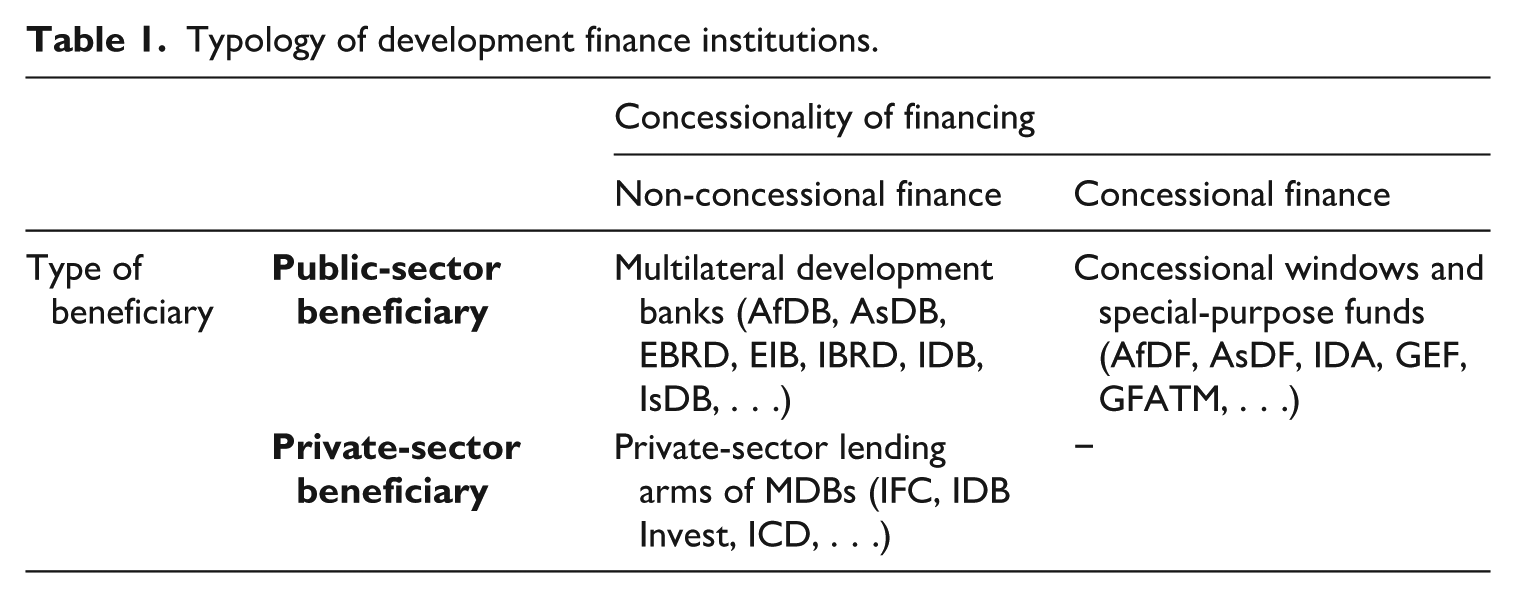
Table 1 categorizes all types of institutions that are part of the development finance HIC, distinguishing, first, between those serving public- and private-sector entities, and second, between institutions that provide loans and those that provide grants. Table A1 in the Supplemental Appendix lists all institutions included in the complex.
Typology of development finance institutions.
Types of entry into the development finance HIC
We distinguish types of entry into the development finance HIC along two dimensions. First, by institutional form, we differentiate between entry by MDBs and by non-MDBs. Second, by scope, we distinguish between country-level entry (where the entrant can serve the same borrowing countries as the legacy MDB) and regime-level entry, which does not create overlap in eligible recipients. Table 2 visualizes the four possible types of entries. The remainder of our analysis is focused on competitive entry, that is, MDB entry at country level.
Typology of entry.

We identify instances of country-level entry by comparing overlap in eligible beneficiaries between the legacy MDB and the newly established MDB. We focus on eligible rather than actual borrowers for two reasons. First, even if a newly established MDB initially has few or no projects, the legacy MDBs is likely to anticipate future competition once the entrant becomes fully operational. Second, relying on eligibility rather than realized lending mitigates concerns about endogeneity.
Accordingly, we base our coding on the geographical scope specified in each organization’s mandate. Where mandates are aspirational and specify that an organization is “open to all developing countries,” we operationalize eligibility as all countries not designated as high income by the World Bank. For membership-based organizations that provide tangible benefits only to members, we capture the latest membership information from the COW IGO dataset and official online sources. An alternative would be to consider the members at the time the organization was established. However, this would imply that policymakers could not form rational expectations about future organizational growth, which we consider unlikely. Table A2 in the Supplemental Appendix shows our coding decisions for the sets of eligible beneficiaries for each MDB.
Using our coding of eligible borrowers, we can identify, for each MDB in each country and at each point in time, whether an entry has occurred and what type of entry it was. Our key independent variable, competitive entry, is binary, denoting the country-level entry of a new MDB. We label an entry as “competitive” if the new MDB can serve at least one beneficiary who is already served by the legacy MDB. In such cases, MDBs may compete for the same loans. Therefore, we directly measure the potential for competition among MDBs in implementing projects within a given country. In addition, non-competitive entry denotes the entry of a concessional window, trust fund, or private-sector lending arm in a country, offering support through financial instruments not employed by MDBs. Finally, we create regime-level indicators for MDB and non-MDB entry. Because these variables do not vary across the beneficiary countries of a legacy MDB, they are irrelevant for in-country competition and can only be used in regressions without country-fixed effects.
MDB responses to competitive entry at country level
Our key interest is to examine how competitive entry affects MDB performance. As a first step, we therefore need to analyze how existing MDBs respond to the entry of new MDBs into the development finance HIC. To this end, we construct an unbalanced panel dataset in which each MDB is observed annually from its year of establishment for each eligible country. The triadic panel covers up to 30 MDBs operating in up to 144 developing countries from 1946 to 2013. Since MDBs enter the HIC at different points in time, and due to missing data in key variables, the panel used for estimating purposes is smaller.
To analyze evasion and confrontation, we measure whether an MDB makes any new commitment in a given country. To capture these MDB responses, we draw on the AidData Core Research Release (version 3.1)—the most comprehensive dataset of multilateral development finance commitments covering 96 donors from 1947 to 2013 (Tierney et al., 2011). While our main indicator for country engagement is binary, we also quantify the commitment amount in constant 2011 US$. Commitments are preferred over disbursements, as they provide a clean(er) measure of an MDB’s decision to support a given country. To remove skewness, we take the natural logarithm after adding a constant to avoid creating missing values.
To analyze cooperation through co-financing, we leverage a new dataset on World Bank co-financed projects (Clark, 2024). We aggregate the project information to the country-year level. This allows us to estimate how competitive entry affects the annual commitments for both co-financing and self-financed loans. Because the data are not dyadic, we cannot examine co-financing between the World Bank and specific entrant MDBs. To mitigate confounders, we use linear regression with country-fixed effects and year-fixed effects and control for non-competitive entry and institutional-level covariates.
Using our triadic panel, we analyze how legacy MDBs respond to competitive entry at the country level. Figure 1 presents our main results from an event-study design, including dummies for the year of competitive entry as well as the preceding and following years. We find that when a legacy MDB faces a new MDB at the country level, it is more likely to assist that country. The response appears to be instantaneous and persists only for a short period of time. Indeed, legacy MDBs seem to anticipate competitive entry, substantially increasing their country engagement in the year preceding entry. In substantive terms, competitive entry is related to at most a five percentage-point increase in the likelihood of MDB assistance (p < 0.01). This is an economically sizable effect, as the mean likelihood of MDB assistance is 30%.
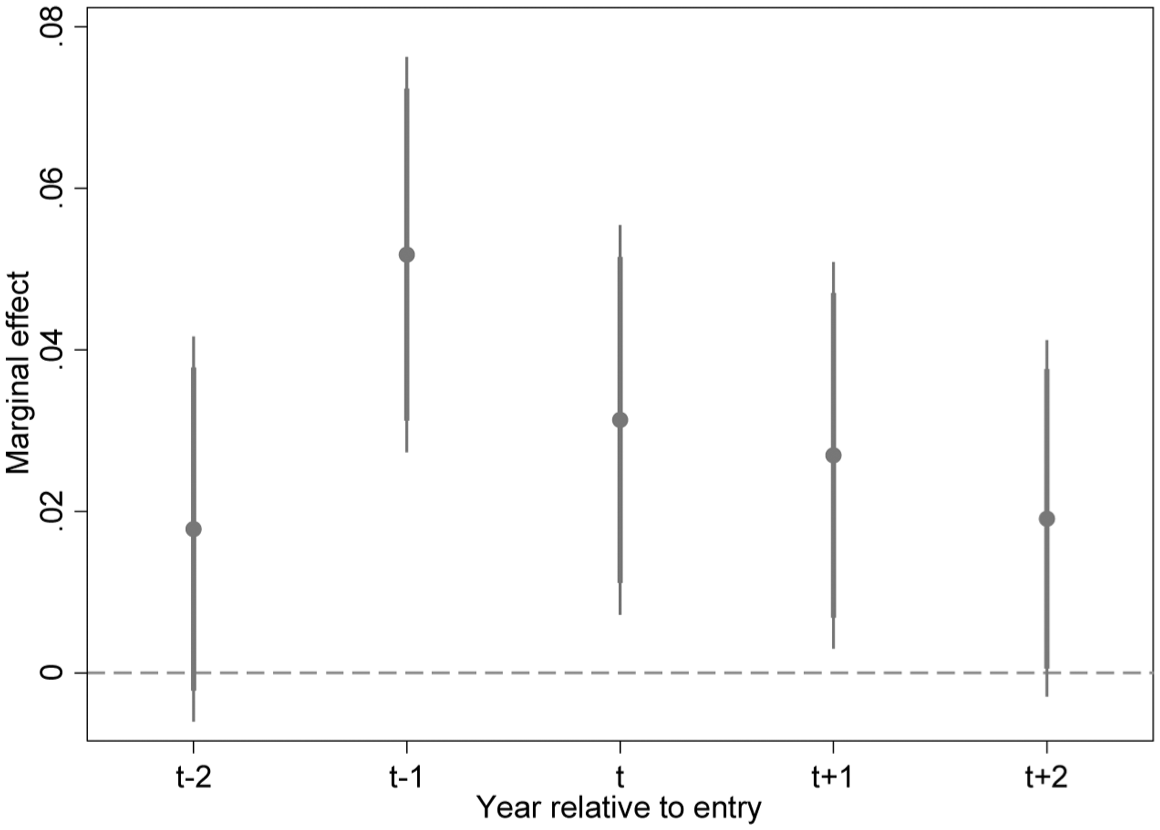
Dynamic response to country-level MDB entry.
For subsequent regression analysis, we create a dummy that equals one in the year of entry and the year before, capturing the period of strongest MDB response. Similarly, we construct a binary indicator for non-MDB entry at the country level. This allows us to examine both entry events in a joint model while keeping the model output legible. 7 A joint model is advantageous as it includes a placebo test: we anticipate competitive dynamics for MDB entry at the country level, but not for non-MDB entry at the country level. Table 3 confirms this expectation. Across different model specifications, we find that MDB entry at the country level has a significant positive effect on the likelihood of MDB support for the country. The average effect size in each year when the dummy equals one is estimated at approximately 4 percentage points (95% confidence interval (CI): 2.1–6.1). In contrast, non-MDB entry at the country level is not statistically different from zero.
MDB responses to different types of entry events.
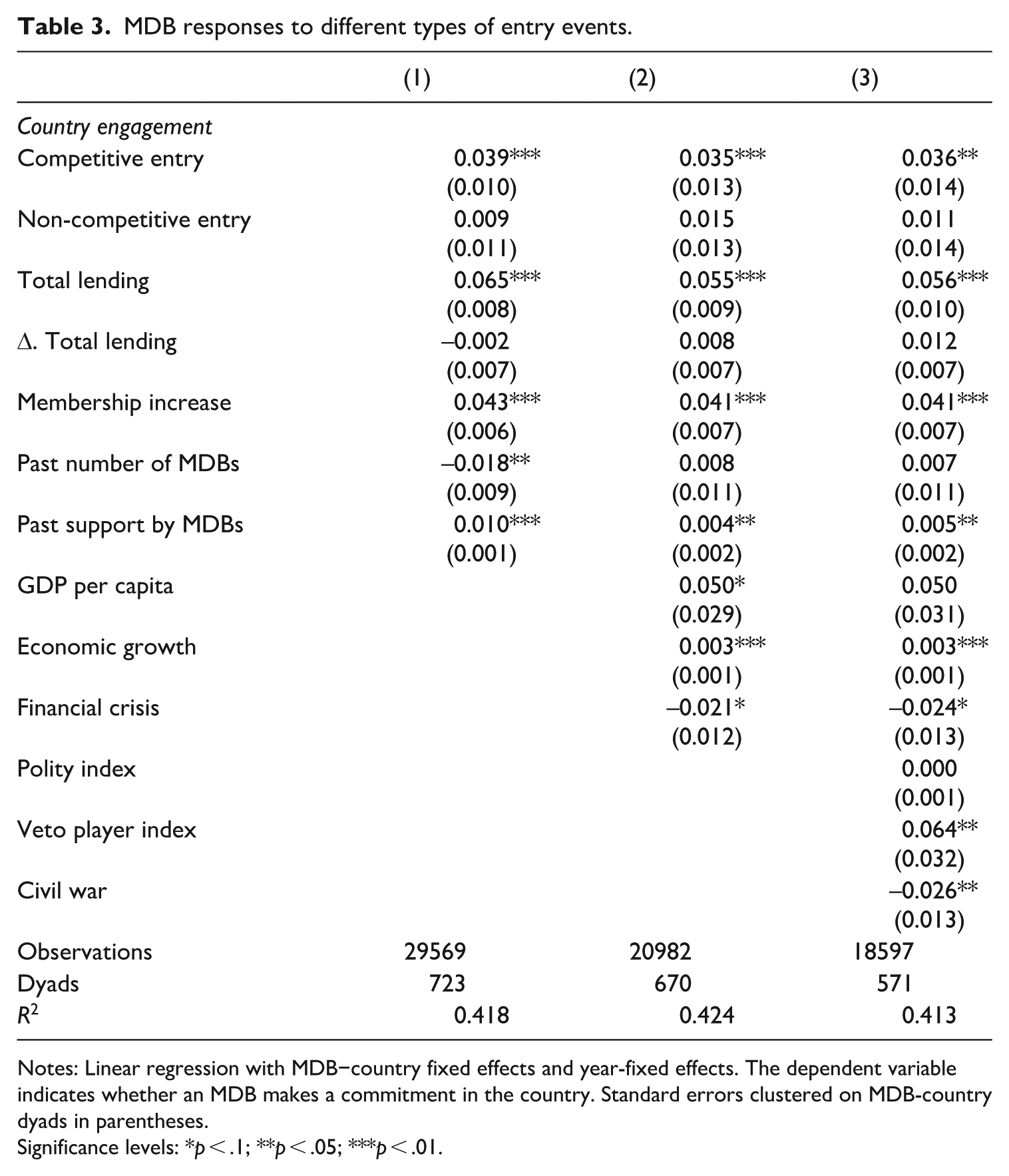
Notes: Linear regression with MDB−country fixed effects and year-fixed effects. The dependent variable indicates whether an MDB makes a commitment in the country. Standard errors clustered on MDB-country dyads in parentheses.
Significance levels: *p < .1; **p < .05; ***p < .01.
Robustness checks consistently confirm a positive relationship between competitive entry and MDB country engagement. First, we affirm this relationship using an alternative dependent variable—logged commitment amounts—and a pseudo-Poisson model (Table A4). Second, the relationship remains statistically significant even when subjected to more stringent fixed-effects specifications (Table A5). Furthermore, we address the methodological challenges inherent in repeated treatments by employing a two-step counterfactual estimator which indicates that competitive entry substantially increases the instantaneous likelihood of new country commitments (Figure A1). This suggests that MDBs, likely constrained by sunk costs in field offices and specialized knowledge, primarily adjust their lending volume rather than reallocating funds to new recipients when facing competition.
Although our initial findings indicate that MDBs confront new competitors, they may instead be seeking cooperation through increased co-financing to enhance collective impact. To test these competing interpretations, we use the co-financing dataset on the World Bank to compare commitments for co-financed loans versus self-financed loans following competitive entry. A two-way fixed effects analysis reveals that the World Bank significantly reduces its co-financing commitments following competitive entry in a country, compared with non-competitive entry. Conversely, the World Bank simultaneously increases its lending without co-financing partners. This contrasting pattern—reducing cooperative loans while expanding independent lending—strongly indicates a confrontational response by the World Bank to new competitors (Table A6).
Competitive entry and MDB performance: data and methods
We now study how competitive entry affects MDB performance. For this analysis, we focus on the World Bank as a pilot case, given its prominence in the development finance HIC and the lack of available data for most other MDBs. To ensure the robustness of our findings, we conduct the analysis using three distinct methodological approaches and datasets. First, we mirror our primary analysis by using a recipient-year panel that separately tracks the performance of both new and ongoing projects, aligning with our core theoretical claim. Second, we shift to a project-level analysis, which allows us to more effectively control for confounding factors. Finally, we employ another project-level dataset to extend the analysis across a longer time period and to a broader range of MDBs.
Measuring performance
Across all our analyses, we measure performance based on the numerical evaluation ratings available from MDB evaluation departments such as the Independent Evaluation Group (IEG) at the World Bank. While the sample of projects in the IEG Project Evaluation Database is not random, we have no reason to believe that project selection is systematically related to the entry of new institutions into the development finance HIC. Each project is evaluated on several dimensions on a 6-point ordinal scale, ranging from “highly unsatisfactory” to “highly satisfactory.” Besides an overall IEG rating, the data includes assessments of project difficulty, Bank quality, supervision quality, and quality of monitoring and supervision.
In the country-year panel dataset, we aggregate IEG performance ratings across relevant sets of projects. Specifically, for each recipient in any given year, we identify all projects newly approved that year, as well as ongoing projects that have not yet been legally closed. Because the IEG database uses fiscal years (FY), we consider projects as new for year t when they are approved in FY t or FY t + 1. 8 We then compute the simple average of IEG performance ratings across these two project sets for each country-year, resulting in non-missing data for 109 countries between 1994 and 2013. The sample period aligns with our previous analysis of MDB responses, but it does not allow us to assess the performance effects of the AIIB’s entry.
At the project level, we draw on the available IEG project performance rating in each database. Our main project-level dataset covers 12,116 World Bank projects approved between 1961 and 2017 (Clark, 2024). In robustness tests, we also use the Project Performance Dataset (Honig et al., 2022), which includes 12,837 projects from five MDBs approved between 1956 and 2016. While ratings are harmonized to ensure comparability over time for the same organization, they are not comparable across organizations. Therefore, any cross-organizational performance analysis must include MDB fixed effects.
We considered other measures but ultimately discarded them on conceptual grounds. Given that many MDBs aim to alleviate poverty, the share of the resources they commit to low-income countries (LICs) is prima facie a plausible measure of performance. However, assessing MDB performance based on non-concessional lending would ultimately be misleading: many MDBs established concessional windows with the explicit purpose of channeling more resources to LICs. The idea was that these concessional windows would offer grants and loans to LICs that might not qualify for non-concessional loans, whereas MDBs would focus on non-concessional lending to non-LICs. In addition, the LICs’ share is a numerical measure which focuses on financial outputs but neglects qualitative differences between projects.
A different measure of MDB performance is the contribution of MDB projects to economic growth. The appeal of this measure is its close alignment with MDB mandates, although economic growth is no longer their sole objective. However, directly comparing economic growth in borrowing countries with that in eligible countries that did not receive MDB loans is prone to endogeneity challenges (Clemens et al., 2012; Dreher and Langlotz, 2020; Galiani et al., 2017).
Competitive entry
The key predictor of MDB performance is competitive MDB entry at the country level, which is operationalized in slightly different ways depending on the unit of analysis. In the country-year panel, competitive entry is defined straightforwardly, indicating whether a new MDB with a mandate to assist a given country entered the development finance HIC in a given year.
Our project-level analysis tracks competitive entry across the project cycle, distinguishing between entry at project launch and entry during the implementation phase. To identify the launch year of a project, we primarily consider its approval year, or its start year when approval data are unavailable. We consider competitive entry to occur at project launch when it coincides with the approval year or its 1-year lead. This operationalization aligns with our findings on the timing of MDB responses to competitive entry, which showed that responses typically occur 1 year in advance. The implementation phase is defined simply as the active years between the first full year of a project and its closure.
Estimation approach
In the country-year panel, we estimate two-way fixed effects models, including country-fixed effects and year effects, to mitigate confounding influences. We also control for the average project difficulty, based on subjective assessments by World Bank staff of the underlying context conditions, as reported in the IEG Evaluation Database. In subsequent models, we control for the average share of IDA financing, the share of projects that were eligible for IDA funding, and the share of blended finance. We also account for the proportion of projects falling into the highest volume category (above $100 million). The most comprehensive models additionally control for the proportion of investment projects, the share of projects across three broad sector categories, and the fraction of projects supported by external financing. For inference purposes, we cluster the standard errors at the country level.
In project-level analysis, we rely on expanding sets of high-order fixed effects for inferential leverage, given the limited available data for most potential control variables. Across all specifications, we control for country-fixed effects and year-fixed effects. We subsequently control for sector-fixed effects, which ensures that our comparisons across projects are within the same sector. Finally, we also include fixed effects for evaluation years as well as the type of evaluation. Substantive control variables, depending on the data source used, encompass a binary indicator of whether the project is co-financed with other MDBs (Clark, 2024), and the natural logarithm of the total project amount as well as the project duration. We again cluster standard errors at the country level.
Results
Country-year panel
We proceed by examining the performance implications of competitive entry at the country level, distinguishing between new projects and ongoing projects through a multiplicative interaction term. Table 4 shows the results. We find that competitive entry is associated with a 0.21 point higher average IEG rating on the scale from 1 to 6 for new projects compared to ongoing projects. While competitive entry is associated with an increase in the average IEG rating of 0.14 points among new projects, it is related to 0.08-point decrease for ongoing projects. The findings are consistent with the notion that Bank staff focus their efforts on improving the quality of new projects. Moreover, this increased attention to new projects does not appear to significantly reduce the quality of ongoing projects.
Panel data analysis of competitive entry and World Bank project performance.

Notes: Two-way fixed-effects regression with recipient-fixed effects and year-fixed effects. Standard errors clustered on recipients in parentheses.
Significance levels: *p < .1; **p < .05; ***p < .01.
Probing these initial results further, we first temporally isolate the effect by estimating a set of distributed lags and leads. We continue to find a significantly positive association between the 1-year lead of competitive entry and project performance for new projects. Other leads and lags are statistically insignificant. For ongoing projects, the average project rating appears to increase in the year after competitive entry, but not otherwise (Table A7). Also, we would expect to see the results to show up in at least one of the rating dimensions. Indeed, we find that the supervision quality of new projects increases, and so does overall Bank quality, even if the respective coefficient is only weakly statistically significant (Table A8). This suggests that World Bank staff allocate more time and effort in supervising these projects. Importantly, we do not find consistent evidence that competitive entry differentially affects the quality of monitoring and evaluation, suggesting that our findings are unrelated to changes in how project quality is monitored or evaluated. Finally, we verify that MDB entry—rather than non-MDB entry—at country level evokes the positive association with IEG project ratings for new projects relative to ongoing projects. The interaction coefficient between new projects and non-MDB entry is not statistically significant and about four times smaller than the interaction term between new projects and competitive MDB entry (Table A9).
Project-level analysis
A key concern with our analysis is that the results may be driven by project-level differences not accounted for by our control variables. While we have sought to capture these differences by including averages for a staff estimate of project difficulty and several other project characteristics, we concede that averages may not fully capture the set of factors that could confound our results. 9 To address this challenge, we therefore seek to replicate our analysis on project-level data. This has the advantage of allowing us to control for discrete project-specific characteristics rather than distributional differences across groups of projects.
Table 5 shows the results at the project level, indicating a significantly positive relationship between competitive entry at project start. Importantly, competitive entry during project implementation has no significant relationship with the IEG rating. In substantive terms, a project approved during the entry of a new competitor into the development finance HIC is rated up to 0.19 points more successful (95% CI: 0.04–0.34). By contrast, if competitive entry takes place during an ongoing project, the effect on performance is negative but not statistically significant. These patterns remain highly robust, as we control for arbitrary baseline difference in performance across borrowing countries, approval years, evaluation years, evaluation types, and project sectors. The differences in performance can also not be attributed to whether new projects are co-financed, or to variations in project duration or total size.
Project-level analysis of competitive entry and World Bank project performance.

Notes: Linear regression with varying sets of fixed effects as shown. Standard errors clustered on recipients in parentheses.
Significance levels: *p < .1; **p < .05; ***p < .01.
In the Supplemental Appendix, we demonstrate the validity of our results by conducting placebo tests. To confirm that performance gains for new projects are driven by MDB entry rather than non-MDB entry, we extend the model to include indicators of non-competitive entry at the country level. While the coefficients for competitive MDB entry are virtually unchanged, we find that non-MDB entry at project start is unrelated to project performance. In some specifications, however, non-MDB entry during project implementation is significantly negatively related to performance (Table A11).
Taken together, the results indicate that competitive pressure emanating from the entry of new MDBs at the country level improves World Bank performance for new projects. Although the substantial effort staff devote to preparing new projects could, in theory, reduce the quality of ongoing projects, we find little evidence of such substitution effects.
Generalizability beyond the World Bank
Thus far, our analysis has focused on the World Bank, given its focality in the multilateral development finance HIC and the availability of detailed data. In the remainder of the article, we examine whether these findings can be generalized to other MDBs.
We draw on the Project Performance Database which includes the success ratings of 12,837 projects from five MDBs approved between 1956 and 2016. Coverage includes the World Bank, the AfDB, the AsDB, the Caribbean Development Bank, and the International Fund for Agricultural Development. However, since only a small number of projects have been evaluated, there is limited overlap between the years in which institutions faced competitive entry and the years in which projects were approved. In fact, none of the evaluated projects for the Caribbean Development Bank were approved during years of competitive entry. As a result, these projects must be entirely excluded from the analysis.
To establish the equivalence of the Project Performance Database with the IEG dataset, we first replicate our earlier project-level results for the World Bank for the most recent period (1988–2013). Table 6 reports a significantly positive relationship between competitive entry at project start and IEG performance ratings across four models, with coefficient magnitudes similar to those in our earlier analysis. As in previous analyses, competitive entry at project start is related to an about 0.19 points higher IEG rating, whereas competitive entry during project implementation corresponds to a 0.04 points lower rating.
Project-level analysis of competitive entry and World Bank project performance.
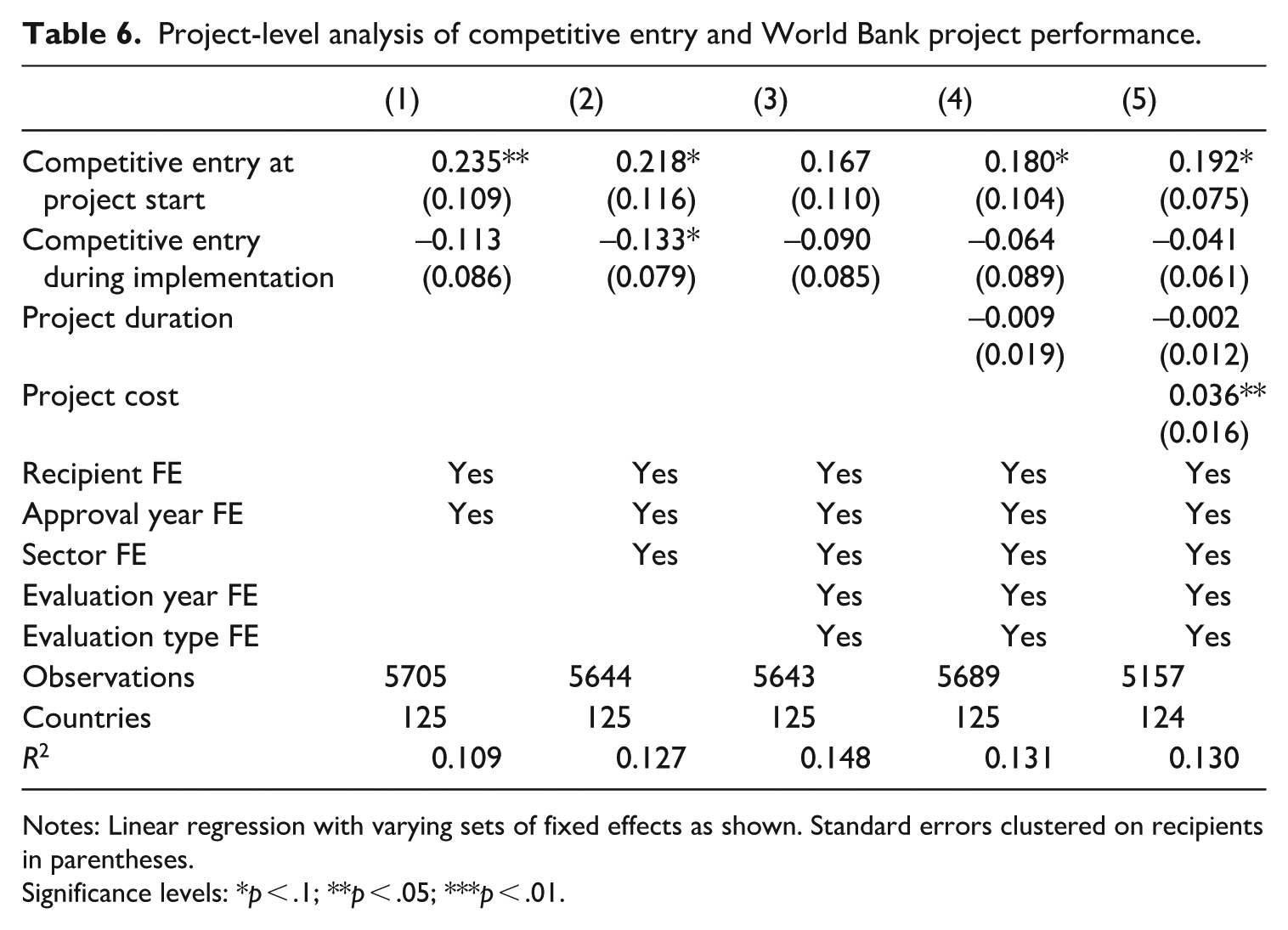
Notes: Linear regression with varying sets of fixed effects as shown. Standard errors clustered on recipients in parentheses.
Significance levels: *p < .1; **p < .05; ***p < .01.
As the PPD allows us to considerably extend the sample period, we probe whether the findings for the World Bank extend to a longer period that also includes periods without competitive entry (1961–2013). Surprisingly, competitive entry at project start remains statistically significant only in one model but loses significance in the others. Although we remain cautious about over-interpreting these results due to data limitations, they can be interpreted as evidence that the World Bank has begun enhancing project quality in response to competitive entry only as the development finance HIC became relatively saturated (Table A12).
Finally, we explore the extent to which our results may generalize beyond the World Bank, recognizing that the analysis is limited to three additional MDBs with available data. The results show a consistently negative association between competitive entry and project performance for these other MDBs. The negative coefficient persists regardless of when new competitors enter the project cycle, though it is less pronounced during the implementation phase. These results cautiously indicate that, for MDBs other than the World Bank, projects initiated in response to competition are generally of lower quality than those approved in non-competitive periods (Table A13).
Conclusion
This study explored a fundamental question: How does the entry of new MDBs influence the performance of legacy institutions? We argued that competitive dynamics—where new MDBs can target the same beneficiaries with similar financial instruments—make it essential to first understand how legacy MDBs respond strategically. These institutions have three options: confrontation, by increasing engagement in countries served by the competitor; evasion, by reducing country engagement or withdrawing; or cooperation, through co-financing. Analyzing 30 MDBs and 16 multilateral institutions across 144 beneficiary countries between 1949 and 2013, we found that the average legacy MDB predominantly chooses the strategy of confrontation, increasing its presence in countries where it faces a new competitor. This preemptive response is strongest in the year preceding the creation of a new MDB and persists into the year of its official entry.
To examine the implications for performance, we then theorized that competitive MDB entry incentivizes the staff of the legacy MDB to focus on developing new high-quality projects that meet the needs of borrowing countries also targeted by the new entrant. Given the disciplining effect of competition, we expected competitive MDB entry to enhance the quality of new projects in those countries. We did not anticipate similar effects for ongoing projects, as redesigning already approved projects is challenging.
Our empirical analysis using World Bank data and different research designs confirmed these expectations. Country-level analysis established that World Bank performance was significantly higher for newly approved projects in years of competitive entry compared to both non-entry years and ongoing projects during entry years. To guard against project-level confounders, we verified these results at the project level. We found that, all else equal, projects approved at the time of competitive entry were rated as more successful than those for which entry occurred during implementation. We further employed placebo checks for non-competitive entry, which corroborated that our findings only hold for the competitive entry of new MDBs into the development finance HIC. Finally, we probed these dynamics for other legacy MDBs beyond the World Bank. We did not find similar performance effects for the three other MDBs for which performance evaluation data was available, suggesting that the dynamics we uncovered are confined to the World Bank. 10
We note the limitations of our article: first, due to restricted data availability, our analysis ends in 2013. It therefore does not cover recent cases such as the entry of the AIIB into the HIC. However, there is abundant research on how the AIIB has affected the behavior of legacy MDBs, notably that of the World Bank (Clark, 2021; Qian et al., 2023 Reisen, 2015). Our goal is therefore to complement existing research on interactions between the World Bank and the AIIB, as well as other dyadic interactions between incumbent and new MDBs, with a large-N analysis of general patterns characterizing the development finance HIC over an extended period. Second, we chose to study the interactions between MDBs from the perspective of legacy MDBs because the data quality for new entrants is poor, not least as the latter carry out only few projects in the first years of their existence. To mitigate endogeneity, we captured potential interactions between the established and the newly created MDB rather than actual interactions. Future research could complement our work by focusing on the strategic behavior of the new entrant and its consequences.
Our findings offer critical insights into inter-organizational dynamics and international development policy (Biermann and Koops, 2017; Clark, 2021; Staeger, 2023). Most importantly, they demonstrate that the proliferation of MDBs and the resulting competition for “bankable” projects generate heterogeneous performance effects, even within a single institution. For the World Bank, we confirmed that increased competition generally benefits borrowers by providing a wider choice of lenders and incentivizing MDBs to pursue high-quality projects. For the World Bank, the improved performance of new projects does not come at the expense of ongoing projects. Yet, competition does not necessarily produce these favorable outcomes: for the other legacy MDBs, the performance effects of competitive entry were negative across both types of projects. These results suggest that when less resourceful MDBs attempt to confront new entrants by aggressively pursuing new projects, their internal resources are often stretched thin. Indeed, as one senior MDB expert noted, many borrower-led institutions simply lack the capacity to scale lending rapidly. 11
From a systemic perspective, the proliferation of MDBs may ultimately backfire. Without a parallel increase in the capacity to handle growing demands, the overall quality of development projects may decline significantly. These findings are particularly relevant to current proposals to increase “lending headspace.” To ensure MDBs remain the most efficient vehicles for development finance, expanding lending capacity must be matched by investments in human resources and technical expertise. Financial capital alone is insufficient if the institution lacks the personnel to deploy it effectively. Moreover, member states should support MDB effectiveness by being more selective about where and when they create new entities. Rather than allowing for duplicative overlap, new institutional designs should focus on filling specific gaps in the global financial architecture.
Importantly, given that competitive dynamics are largely confined to MDBs themselves, the expansion of auxiliary instruments can be highly beneficial. Over time, the global governance of development finance has evolved into a more institutionally diverse and functionally differentiated complex, increasing its capacity to provide solutions beyond traditional sovereign loans. In particular, concessional windows—such as the IDA—and multi-donor trust funds are essential for reaching a broader set of countries. These instruments are attractive to developing nations due to their favorable terms and can also catalyze additional MDB lending at the country level. Strengthening these concessional resources is therefore crucial for the international community to address the increasingly complex and multifaceted development challenges of our time.
Supplemental Material
sj-pdf-1-cac-10.1177_00108367261442413 – Supplemental material for How does inter-institutional competition affect the performance of multilateral development finance institutions?
Supplemental material, sj-pdf-1-cac-10.1177_00108367261442413 for How does inter-institutional competition affect the performance of multilateral development finance institutions? by Bernhard Reinsberg and Benjamin Faude in Cooperation and Conflict
Footnotes
Acknowledgements
We thank the participants of the workshop “The evolution of international regime complexes: exogenous and endogenous transformation” at TU Munich (14–16 December 2023 and 28–29 June 2024), the Global Political Economy Research Network at the University of Glasgow (11 March 2024), the Global Policy North workshops at Queen’s University Belfast (21–22 March 2024) and the University of Edinburgh (3–4 July 2025), the Global Transformations and Governance Challenges (GTGC) Conference in The Hague (5–7 June 2024), the Workshop on International Financial Institutions (WIFI) at Villanova University (27–29 September 2024), the anonymous reviewers and the editor of Cooperation & Conflict for helpful comments.
Funding
The authors disclosed receipt of the following financial support for the research, authorship, and/or publication of this article: Bernhard Reinsberg acknowledges funding support from UK Research & Innovation (Future Leaders Fellowship – MR/V022148/1).
Declaration of conflicting interests
The authors declared no potential conflicts of interest with respect to the research, authorship, and publication of this article.
Data availability statement
Supplemental material
Supplemental material for this article is available online.
1.
We use the terms existing MDB and legacy MDB interchangeably.
2.
We conducted three key informant interviews to bolster critical assumptions and theoretical mechanisms underlying our argument. Interviews were anonymous. Interviewees were deliberately chosen to maximize the diversity of stakeholders, including MDB staff, a (former) Executive Director, and an independent MDB expert (see appendix box A1).
3.
In the words of an MDB staffer, “competition for bankable projects is overall more relevant than co-financing loans” (Interview 3).
4.
Interview 1.
5.
Interview 2.
6.
As a staff member said, “if there is a new entrant, you are looking whether your offer is still competitive or if you need to improve it” (Interview 3). A theoretical alternative is that evaluation agencies strategically the project rating, even if project quality is unchanged. However, we deem this mechanism implausible as evaluation ratings are not known until after projects are completed and evaluation offices enjoy considerable independence from operational departments. A staff member also said that “gaming evaluations” is extremely unlikely (Interview 3).
7.
8.
This should correctly identify new projects as the World Bank fiscal years leads the calendar year by 6 months. For example, FY 2011 runs from 1 July 2010 to 30 June 2011.
9.
In the appendix, we examine if new projects are substantively different from ongoing projects using t-tests. We find that new projects are less likely to assist Sub-Saharan countries and physical investments but their size is larger. There is no difference in the recency of evaluation, whether the Bank had prior loans, or whether the project was in an IDA-only country or supported sustainable development ( ).
).
10.
We can only speculate why this is the case. In addition to the staff size, the World Bank may also benefit from more experienced staff regarding the management of projects. Another explanation may be different scaling strategies across different MDBs: new banks may be less selective regarding the projects they take up in order to build a sizeable portfolio of projects and thus establish themselves in the HIC. We thank an anonymous reviewer for highlighting this point.
11.
Interview 3.
Author biographies
References
Supplementary Material
Please find the following supplemental material available below.
For Open Access articles published under a Creative Commons License, all supplemental material carries the same license as the article it is associated with.
For non-Open Access articles published, all supplemental material carries a non-exclusive license, and permission requests for re-use of supplemental material or any part of supplemental material shall be sent directly to the copyright owner as specified in the copyright notice associated with the article.
