



Abstract
Although only a portion of Latina/o adolescents in the United States are undocumented, the social perception of legal status may influence Latina/o youth living in immigrant communities more broadly. This perception has implications not only for how Latina/o youth understand themselves but also for how they construct their aspirations. Qualitative interviews and consensual qualitative research protocols were utilized to understand how perceptions of legal status might change images of possible selves for 14 Latina/o adolescents in an emerging immigrant community. Students described their hopes and worries for themselves as well as the prospects for a “typical” Latina/o peer and an undocumented Latina/o peer. Themes show more hopefulness for students’ own sense of self, a mixed opinion on the possibilities for a “typical” peer, and a hopeless view of the future for an undocumented youth. Implications for promoting hopeful possible selves within the constraints of the social context are offered.
Undocumented immigrants come to the United States from almost every part of the world (Passel & Cohn, 2009), with current estimates placing the population at 11.3 million individuals (Passel, Cohn, Krogstad, & Gonzalez-Barrera, 2014). Census data document that 16.7% of the total U.S. population are Latina/o and that almost two thirds of those individuals were U.S. citizens by birth (Motel & Pattern, 2011). Thus, the majority of Latina/o individuals living in this country are legal citizens. However, the recent social climate for immigrants in the United States includes contentious political discourse about foreign-born workers taking jobs or community resources away from U.S. citizens, accusations about violence and terrorism, fears about a population explosion, and overt discrimination based on ethnicity, language, and social class (Chi-Ying Chung, Bemak, & Grabowsky, 2011; May et al., 2015; Yakushko, 2009). Recent arrivals to the United States who speak English with a nonnative accent may be subject to stereotypes and assumptions about their legal status (Kao, 2000). In emerging immigrant communities in the South and Midwest, where the receiving culture tends to be fairly traditional and conservative, these stereotypes may be more likely to lead to negative interactions (May et al., 2015; Potochnick, Perreira, & Fuligni, 2012).
A complicated or mixed-status receiving community like an emerging immigrant context creates particular challenges for youth as they are imagining their possible future selves (May et al., 2015). Adolescents in immigrant families must navigate the challenges of identity development while also absorbing the anxiety, frustration, and fear of a community that may include undocumented members. The possible self is defined in this study as a projection, including both hoped for and feared versions, and encompases both personal and professional roles (Kao, 2000; Yowell, 2000). As described by Markus and Nurius (1986), An individual is free to create any variety of possible selves, yet the pool of possible selves derives from the categories made salient by the individual’s particular sociocultural and historical context and from the models, images, and symbols provided by the media and by the individual’s immediate social experiences. Possible selves thus have the potential to reveal the inventive and constructive nature of the self but they also reflect the extent to which the self is socially determined and constrained. (p. 954)
For Latino/a youth in rural or emerging immigrant communities, the backdrop might be characterized by lack of integration, limited educational and occupational opportunities, limited resources for language acquisition, limited transportation, limited social networks, and some negative attitudes toward newcomers (May et al., 2015). Other researchers have described the content and function of possible selves of Latino/a adolescents, including aspirations for educational attainment, stereotypes of being future manual laborers, and global fears about future well-being (Kao, 2000; Oyserman & Fryberg, 2006; Yowell, 2000). However, the connection between undocumented status and possible selves has not been described. Thus, our study sought to contribute to the literature by describing how Latino/a adolescents in an emerging immigrant community would describe their possible selves and future aspirations of typical peers amid a social context that included the influence of undocumented status.
Undocumented or Mixed-Status Families
Although not all adult immigrants are undocumented, nearly half of the households that do include an undocumented adult are families with children. Of note, 73% of those children are U.S. citizens (Passel & Cohn, 2009). Thus, immigrant families may have mixed documentation status, with some members possessing legal documentation, some in the process of applying for adjustment of status, some possessing expired documentation, and others not eligible under current laws (Suárez-Orozco, Yoshikawa, Teranishi, & Suárez-Orozco, 2011). This can lead to painful family separations in the case of deportations of undocumented members or siblings who have very different prospects for legal participation in the U.S. educational or occupational systems (Mangual Figueroa, 2012; Suárez-Orozco et al., 2011). However, having a dual frame of reference between the stressors of the home country and the struggles of the host country, many adult immigrants still have resilient attitudes about the circumstances they face in the United States and maintain their optimism about the future here (Suárez-Orozco & Suárez-Orozco, 2001).
Undocumented Youth and Mixed-Status Communities
Immigrant youth who were brought to the United States as very young children (1.5 generation) have all of their memories, experiences, and support networks in this country, and thus are confused and distressed when they are told they are “not American” or may be deported to a homeland that they barely know (Abrego & Gonzales, 2010). Researchers have found heightened levels of anxiety in undocumented Latina/o youth as compared with their documented peers (Potochnick & Perreira, 2010) and signs of both externalizing and internalizing behaviors in undocumented adolescents (Gonzales, Suárez-Orozco, & Dedios-Sanguineti, 2013). Even documented children who were born in the United States to undocumented immigrant parents are likely to sense the anxiety and fear that is present in their families (Suárez-Orozco et al., 2011). The aspirations that are communicated from parent to child or among children when members of the family are undocumented may be tempered in a way that limits the possible selves imagined by the child or focuses on feared outcomes rather than hoped for outcomes (Halfond, Corona, & Moon, 2013; Mangual Figueroa, 2012).
For adolescents who are undocumented immigrants, there are specific challenges in the tasks of exploring possible selves and creating goals. There is only one federal policy supporting undocumented youth who meet inclusion criteria, which is the Deferred Action for Childhood Arrivals, also known as DACA (Napolitano, 2012). DACA provides temporary relief from the threat of deportation to those who qualify, but does not confer legal status or directly open doors to postsecondary education as the DREAM Act would. Identity and sense of possible selves are difficult to develop or sustain when there are few straightforward options for legal participation in civic life (Gonzales et al., 2013). The social context for undocumented students is full of messages about what is possible for “boys like me,” or “girls like me,” and those messages are shared among peers in immigrant communities (Oyserman & Fryberg, 2006).
The transition from late adolescence into early adulthood is difficult for many individuals, but has particular challenges for undocumented youth. In the transition from high school, where access to public education is guaranteed, to work or higher education, young adults would be required to show a driver’s license or prove their legal status to participate fully (Gonzales, 2010). Indeed, for many students in the 16- to 18-year range, their first discovery of their undocumented status is connected to attempts to obtain a license or complete applications that require social security numbers (Gonzales, 2011). For students who are undocumented, college choice is complicated by the high cost of out-of-state tuition, as they often cannot be considered as residents of their state (P. A. Pérez, 2010). There are also structural barriers to entering the labor market; even undocumented students with a college degree are limited to jobs where they do not need a driver’s license or a social security number (Abrego & Gonzales, 2010). Social comparisons between undocumented youth and their documented counterparts also exact an emotional toll, as youth see more restrictions to their future options or more difficulty capitalizing on their past achievements (Abrego, 2006; Mangual Figueroa, 2012). To reiterate a conclusion from a study of the concerns of undocumented youth, Taken together, this hostile social and political climate, the cumulative stress from increased responsibilities to contribute to their families, decreased options to participate as full members of society, and daily fear and anxiety resulting from the ever-present fear of deportation as well as stigmatized identities can serve to take a toll on youth mental and emotional health. (Gonzales et al., 2013, p. 1178)
It is also possible to consider the experience of youth in mixed-status communities, where a significant portion of their peers do not have documents and thus have circumscribed options for the future. Scholars have described a gray area where all children of immigrants can claim legal belonging in the public school system, but some also experience exclusion in other contexts (Abrego, 2006; Gonzales, 2011). Thus, there is a complicated set of boundaries in mixed-status communities whereby some have access to opportunities and others do not. A recent study documented the types of conversations that occur among siblings in mixed-status families (Mangual Figueroa, 2012), but those same comparative discourses are likely to exist among neighbors in mixed-status communities (e.g., “I can go visit my grandparents in Mexico, but he cannot.” “I can be licensed as a nurse after I graduate, but she cannot.”). There could be a psychological cost to the peer community of seeing plentiful opportunities for one set of youth and restricted opportunities for another set, which has not been explored in the literature.
Even though these experiences of blocked pathways to the future are stressful, many undocumented youth and advocates have found ways to move forward, maintaining a resilient attitude and creating meaning out of the challenges (Enriquez, 2011; Gonzales, 2010). Two studies based on the West coast have described the experiences of undocumented students (high school and college) who did achieve academic success (Contreras, 2009; W. Pérez, Espinoza, Ramos, Coronado, & Cortes, 2009). Most of their success was ascribed to having resilient attitudes, a strong value for education, and determination to keep going (i.e., personal protective resources), but with a few key supporters as well (i.e., environmental protective resources). Students with more psychosocial stressors, such as being from a family with lower income or less educational legacy, did tend to have lower achievement profiles. In emerging immigrant or rural communities, those stressors could also include the lack of supportive infrastructure or opportunity that might be present in traditional immigrant communities (May et al., 2015).
Goals of the Current Study
Most existing studies of undocumented immigrant youth were based on qualitative interviews with individuals who disclosed their legal status and discussed its direct influence on their lives. No studies have focused on the role of legal documentation in the image of possible selves, however. Therefore, our study can make a preliminary contribution to the literature in describing the way the stigma associated with undocumented status can influence perceptions of possible selves in an emerging immigrant community. The literature on possible selves brings focus to the social context in which adolescents are speculating about the future and making meaning of their lives, so we seek to describe youth perceptions in an environment where undocumented immigration is a contentious issue that forms part of the background. Our research question was as follows: How do children from immigrant families in an emerging community describe possible selves for themselves, for typical peers, and for undocumented peers?
Method
Consensual qualitative research (CQR) was selected due to the open nature of the research question and the sparse literature on Latina/o adolescents in emerging immigrant communities (C. E. Hill, 2012; C. E. Hill et al., 2005; C. E. Hill, Thompson, & Williams, 1997). We wanted to centralize the voices and perceptions of immigrant Latina/o adolescents who may or may not be undocumented themselves but were likely to have undocumented peers or have thoughts and feelings about undocumented status due to the polarized context in which they lived. This approach falls within the qualitative traditions that view reality as being co-constructed by participant and researcher (Hays & Wood, 2011). CQR creates a framework that allows a team of researchers to describe the participants’ subjective “truth” from these interviews by integrating multiple viewpoints on what is being shared by the participants (C. E. Hill et al., 1997). In particular, the use of a research team and consensus meetings allow researchers to elicit diverse perspectives and share responsibility for meaning making (Hays & Wood, 2011).
Participants
The research team received institutional review board (IRB) approval to offer Latina/o 10th-grade students enrolled at one high school (with approximately 38% Latina/o students) in the rural southeast, the opportunity to participate in a research interview over the telephone about their hopes and fears about the future. During the recruitment phase, all 10th-grade students who had parental consent to participate (n = 46) were also asked for their assent. Seventeen students assented and 14 completed the interview. Of the participating students, eight were female and six were male. The mean age was 15.5 years. Eight of the students were born in the United States and six were born in other countries; documentation status was not asked as part of the research protocol per IRB. Thus, the participant group included both immigrant and first generation U.S. American adolescents. Only one participant’s parent was born in the United States; all other parents were born in Mexico.
Researchers
The CQR coding team consisted of one female faculty member (non-Latina White, U.S.-born, bilingual), two male doctoral research assistants (one non-Latino White, U.S.-born, English speaking, and one Latino, foreign born, bilingual), and one female undergraduate research assistant (Latina, foreign born, multilingual). An external auditor (Latina, foreign born, bilingual faculty member with previous experience in CQR) was selected. A master’s level research assistant (Native American, English speaking) completed qualitative interview training and supervised practice, then conducted all data collection over the phone.
Interview Protocol
The two faculty members developed the interview protocol (available by request from first author) by reviewing the literature related to future aspirations, possible selves, and desired outcomes for Latina/o adolescents in immigrant families (Fuligni & Pedersen, 2002; N. E. Hill & Torres, 2010; Kao, 2000; Kao & Tienda, 1998; McWhirter & McWhirter, 2008; McWhirter, Torres, Salgado, & Valdez, 2007; Oyserman, Bybee, & Terry, 2006; Yowell, 2000). An initial study was completed with Latina/o adolescents in a different location, focusing on identification of academic and career goals, barriers to achieving them, and supports available in the family or school contexts (Gonzalez, Stein, Shannonhouse, & Prinstein, 2012). In those initial findings, we noticed the discrepancy between participants’ career aspirations for themselves and for a “typical” Latina/o student. We had not explored that dynamic sufficiently to be able to understand or explain it, and we were becoming more aware of the contextual influence of being in an emerging immigrant community.
Thus, a revised interview was created to include more questions inviting reflections on sense of self, and awareness of how the self compared with “typical” Latina/o peers and peers with undocumented status. The revised interview protocol included unstructured questions designed to elicit descriptive responses without any shaping or guidance and structured follow-up prompts. For example, an unstructured question was “What do you hope for yourself in the future?” and follow-up prompts included “In terms of a job? In terms of how much school you finish? In terms of your family life?” Participants were asked to reflect next on the future prospects of both a “typical” Latina/o boy and girl (e.g., “Tell me about a typical Latino boy—what do you expect his future to be like?”). Follow-up questions included “What do you expect his job to be like?”, “How much school do you expect he will have finished?”, “What will his family life be like?”, and “Is there anything that could get in his way as he tries to achieve his future dreams?” Finally, students were asked “What would be different if that typical student was not born in the United States and was undocumented?” The same set of questions was repeated for typical Latina girls.
Procedures
Participants were offered a $15 gift card as compensation for participating in a 45- to 60-min recorded telephone interview. All interviews were conducted in English as requested by the participants. One interviewer was used to increase consistency of data collection. Both the sample size and the telephone interview methodology fall within suggested practices for CQR (C. E. Hill et al., 1997). Research case numbers were assigned and names were removed, and the recordings were transcribed and double-checked by undergraduate researchers supervised by the principal investigators. Faculty co-investigators reviewed the transcripts after the first two interviews to provide constructive feedback to the interviewer.
Before reading any transcripts, coding team members wrote about their preconceived notions about the study and participants. Themes that emerged were discussed among team members throughout the coding process to limit the influence of our preexisting assumptions. Bracketed biases included the possibility of over- or underidentifying with an immigrant adolescent’s life story (based on the coder’s nativity), the assumption that students might have unrealistic pictures of their future options or a limited set of role models, the awareness of possible differences in socioeconomic status between the university research team and the adolescents’ families, the acknowledgment that research team members had absorbed cultural stereotypes about the migration experience of undocumented individuals, and the assumption that bilingual students would also be bicultural to a degree.
Research team members read all 14 transcripts independently (in groups of 3-4 transcripts between consensus meetings) and coding proceeded in several steps. During consensus meetings, each member presented one transcript and proposed what domains (or major themes) they believed to be present. The team then debated until agreement on the domains was reached, and the core ideas (specific exemplars in the participants’ words) constituting the domain were abstracted (C. E. Hill et al., 1997). The person who presented the transcript then created a case summary. The final set of full transcripts and case summaries then were forwarded to the auditor, who reviewed them to ensure that no important themes had been overlooked or misinterpreted. The auditor’s suggestions were mostly related to scope and clarity, such as dividing one large domain into smaller domains. This left seven domains, which were (a) Relationship to Family; (b) View of Future Education/career; (c) Use of Resources at School; (d) View of Possible Self, including hopes and worries; (e) Undocumented Status; (f) View of a “Typical” Latino/a Peer’s Future (both male and female); and (g) View of an Undocumented Latina/o Peer’s Future (both male and female). The coding team then met to complete the cross analysis, whereby each domain was examined across all 14 cases to identify logical clusters or categories among the core ideas. The auditor reviewed the cross analysis to ensure consistency of ideas within each category across all participants. Constructs will be defined in the Findings section.
The auditor and the leader of the coding team agreed that domains (a) to (c) were similar to what had been described in the initial study (Gonzalez et al., 2012). That is, family was of central importance to both sets of participants and was seen as emotionally encouraging but perhaps less able to provide financial support toward future goals. Students in both studies were aspiring to complete some level of postsecondary education and have a good job, yet were also uncomfortably aware of the “dead-end” jobs that some peers had accepted instead. Finally, students in both studies mentioned some resources they were aware of in their schools, but few had accessed those resources. Domains (d) through (g) were the most novel in terms of further contributing to the literature and likely emerged from the new interview prompts which were focused on perceptions of legal status; thus, those four domains are the focus of the current article. Per C. E. Hill et al. (2005), “Authors do not need to report all of their data, but they should note in their article whether data were collected but not reported” (p. 204).
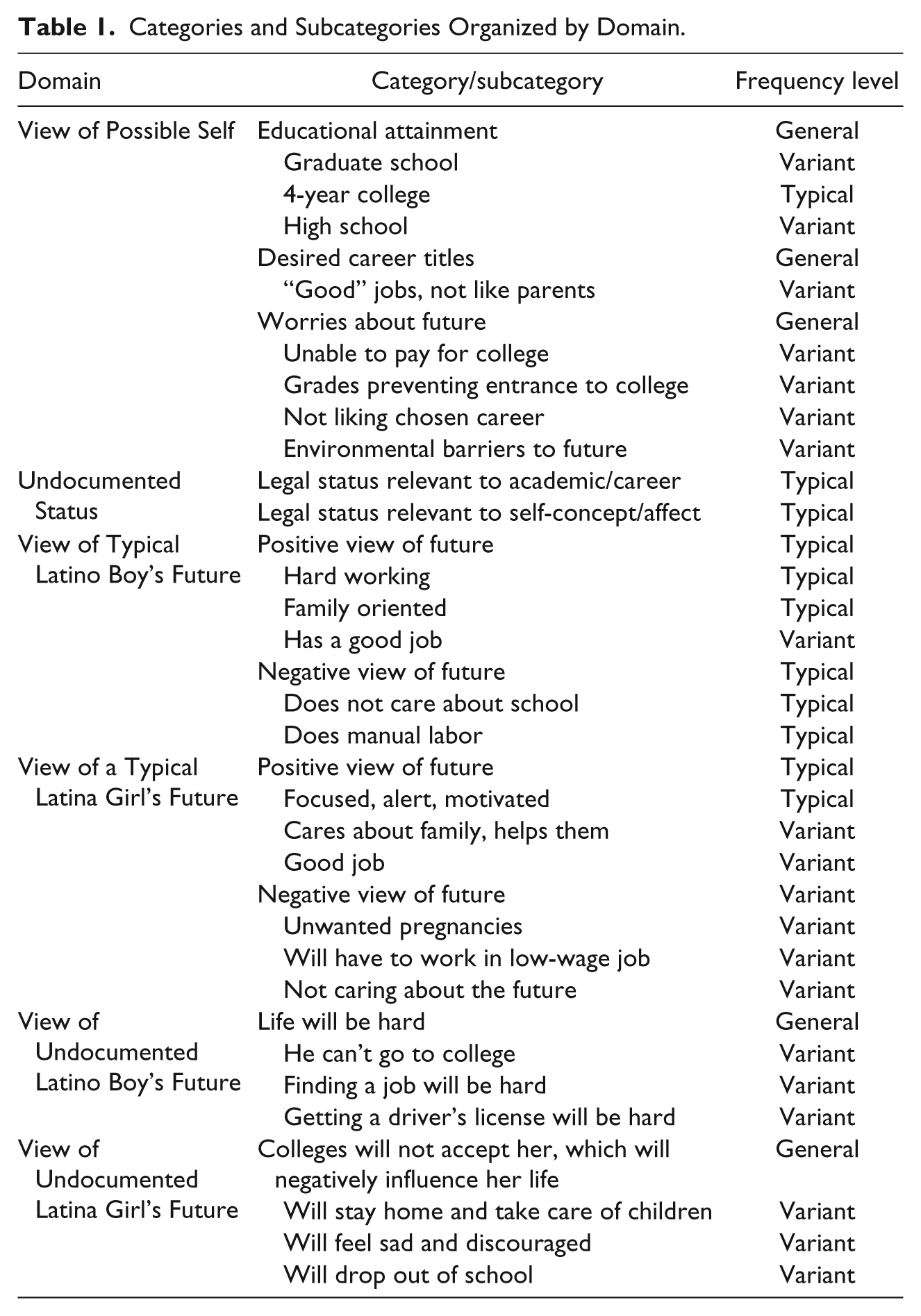
C. E. Hill et al. (1997) suggested several validation strategies to increase trustworthiness in the CQR process. These included being transparent in describing the method, using one interviewer for consistency, describing the consensus building process, and using an auditor. They also recommended showing coherence in the findings. That is done in the current study by including direct quotes from participants and indicating the frequency with which themes appeared in the data (see Table 1). As recommended in CQR (C. E. Hill et al., 2005), the categories identified in the cross analysis are described as general (present in 90% of cases), typical (present in 50% or more of the cases), or variant (present in less than 50% of cases).
Categories and Subcategories Organized by Domain.
Findings
As a preliminary step, the transcripts were scrutinized for any trends in the response patterns relating to nativity; we found both positive and negative statements about typical Latino/a peers being made by U.S.-born participants and by foreign-born participants. Thus, nativity did not seem influential, and findings will be presented with all participants in aggregate.
View of the Possible Self
Under this domain, all students reflected on both hopes and worries for their future education/career (general theme). In terms of their own future aspirations, five students indicated they hoped to complete a graduate degree some day, seven stated they wanted to complete a 4-year degree, and two hoped to graduate from high school. The students mentioned many different careers titles that they were interested in pursuing, including business person, computer engineer, cosmetologist, nurse, chef, psychologist, pediatric doctor, and actor. Students wanted to be financially stable, describing a good job as one “that lets you earn enough to take care of yourself.” There were comparisons with the low-wage jobs their parents had, with statements like “I see other better jobs that people went to school for, like, they just boss themselves and make their own money” or “I don’t want my life to be like my parents—they’re always busy, they go to their job and get off late, and they don’t have time for us that much.”
Students also mentioned worries about their futures. Five students said that they were worried about finances and not being able to pay for college, with statements such as “If for some case I can’t pay for school, that would worry me—then I wouldn’t be able to do what I want.” Others mentioned academic or career obstacles, such as not having the grades to be accepted into college or not liking their chosen career (n = 4). Others talked about environmental pressures that could prevent them from attending college (n = 5), such as being undocumented, having kids too early, or needing to help a family member, “if my mom and dad they can’t, like, if they end up quitting their job or something.” One student mentioned the fear that “one bad decision could take me away from my goal.”
Undocumented Status
In this study, undocumented legal status was a topic of inquiry, but not part of the demographic form nor criteria for participation. Although we did not ask the participants directly whether they had legal documents or not, nine of them broached the topic independently, often in response to a general question about barriers or challenges. Thus, it was a typical theme that legal status was relevant in some way to these students, even though the majority had been born in the United States. For example, when asked about what made him worry that he might not get to go to college, one student said, “Um, probably not having papers.” Another student described in detail the situation faced by his friends who were undocumented: Cause I have a lot of friends who don’t have papers and they just don’t care about high school years. They are like “Well, I am not going to do anything anyways,” or “They don’t want me here so why should I even try?” They probably wouldn’t even go to college. There are a few that would actually try to fight and try really hard . . . I see more they just, either they get out of school and work or they just stay at school just to have fun, but not really take it serious, just work like their parents did.
Another student looked for any path forward, stating, Because, I mean, I [have] seen and heard about like, colleges that would take you without your U.S. citizenship, I mean, and you just work for it or like go to school in another country in your native country or stuff like that. I mean nothing stops you unless you get stopped.
In addition to the academic and career implications of undocumented status, some students discussed the way status could influence one’s sense of self-concept. One student stated, “People don’t expect as much as you know you’re capable of . . . Also, people automatically assume that you are not from the States, even if you are.” Another participant added, “But sometimes, there are just times when you see things in the news that just make you feel like ‘What are we doing here?’ Um, we shouldn’t be here, obviously, they don’t want us here, why are we here?” Some of the participants also reflected in a meaningful way the anxiety that is present when one’s caregivers are undocumented: Um, you constantly think, if you have parents who don’t have papers, you are constantly thinking “Um, what if one day they have to leave?” If they have a house, worrying about their house. Um, and they don’t have papers, they do not have a license. So you are always thinking, “my dad works far away, ah, he might get a ticket.” And probably this is one thing that worries you that, um, you might lose your family.
View of a Typical Latino Boy’s Future
The idea of the typical boy or girl was presented to explore whether there would be stereotypes or ideas about peers in the Latina/o immigrant community that would emerge. We did not define “typical” for the participants, but allowed them to do so themselves. When asked to describe a typical Latino boy’s future prospects, the participant responses were split (i.e., two typical themes). Seven students described a boy who was hard working, would do well in school, and go on to college. “He will have a good future if he puts effort in,” one student commented. They also were in agreement (n = 7) that this boy would be a provider for his future family, with responses such as “He will take care of his family, he will do anything for them.” In the words of one student, being a typical boy means “having the perfect job that he wanted, that he probably accomplished his goal—something that he will like, that he will never regret working, like in an office, just helping people and all that.” Overall, the consensus was that a typical boy “could do great things with his life. His parents would encourage him that they came here in order to get a better life, that he should do well.”
The other seven participants said that a typical Latino boy does not want to be in school at all, cares little about his future, and would probably end up having multiple minimum-wage jobs. “It’s rare to know a Latino boy that cares about the future. He would probably finish high school, or maybe drop out and work in the factory,” one participant remarked. A slightly less critical response indicated “All Latino boys want to do when they get to the U.S. is work. If his parents push him to achieve, he might go to college, but otherwise he will just get lost working.” Work was often framed as a way to help parents or provide for one’s family, but not as an easy path toward the future. Another participant said, It depends if he has papers or not. If he does, he could go to community college, but if he doesn’t, he will most likely just work in a factory, and that is pretty much what he will be doing for the rest of his life.
View of a Typical Latina Girl’s Future
Similarly, the group described two versions of the possible futures of typical Latina girls, apart from their own possible selves. The hopeful tale included finishing a college degree, making “good decisions, having a dream job and a good family life.” The participants described this girl as “focused and alert”; “caring about her education and her family”; and “smart, carefree, independent, and proud of where she came from.” They expected that she would “work hard and try to do everything well,” and have “no problems, she will have whatever she wants in life.” Participants identified career options for the typical Latina female as owning her own business, being a nurse, a teacher, or a fashion designer. The students who espoused this typical theme (n = 8) tended to believe that girls were more motivated in school than boys, and that they could experience academic success as long as they avoided the problem of “early pregnancies.” The typical Latina girl was often described as “being a great mom someday,” but waiting until she was ready for a family. They were also confident that the parents of this girl would provide support, “helping her achieve her dreams and stay on task.”
The more difficult version of a typical Latina girl’s future (n = 6) included having a baby before graduating from high school and having her educational progress halted. Several students expressed the feeling that “she will struggle a lot if she has a baby and did not focus in school, she will probably not achieve her dreams.” Several respondents thought that this young woman would have to work in a factory or restaurant unless her husband had a good job and she could stay home with family. An important insight came from a student who said, “Some girls don’t care about their future, but if it comes to that, it’s because something is not letting you to try.”
View of an Undocumented Boy’s Future
Whereas the participants were split in their perception of a typical Latino boy’s future, they were more united in their opinions about how an undocumented boy’s future would look (i.e., general theme). They described a person who would face many barriers and would become discouraged. They anticipated everything would be much harder for an undocumented boy, from communicating in English to getting a driver’s license to finding a job. They expressed the possibility that the police could cause problems for him as well. Most of them stated flatly that undocumented students “can’t go to college, colleges don’t accept them.” Only two students thought that undocumented status could provide extra motivation, such as one student who said, “Oh, I am gonna get further because I am, like, undocumented and I gotta do better than the rest.” Other students could see the ways that the barriers facing undocumented students could become internalized, with statements like “Oh, I am not from this country, since I am not from this country why not just drop out.” One student summarized this bleak future as, “Not much a person can do without papers.” They did express some empathy for the difficulties of this situation, whether it was their own or their peers’. One student said, “It’s not their fault, like their status in America. They don’t have any other choice.” Another student reflected on undocumented peers and the defeat of the DREAM Act, and said “they’ll be like, ‘you know, my chances are over. I can’t go on with my dreams.’ Like you know, they’d be crushed by it.”
View of an Undocumented Girl’s Future
Most participants (n = 12) endorsed the general theme that an undocumented girl would stay home and raise children, largely because colleges would not accept her. Two participants thought that staying home could be a consolation for a young woman, a way to be happy with an important role in her home. Others saw being a housewife as a disappointing contrast to her original goals (n = 5), endorsing the variant theme that undocumented girls would feel sad and discouraged “because they can’t get what they want, they can’t reach it.” The contrast between wanting and not having seemed especially salient in this quote: If they are undocumented it’s hard for them because they’ll see other people have achieved their own goals and they look at themselves and they see that they haven’t. And they would maybe wish that they could be like them, they see that they have a good job, a good family, enough money, those good things and they don’t have because it has been hard for them to get there.
As they reflected on this version of the future, a few students (n = 3) concluded that undocumented girls might leave school because they could not identify a reason to continue or to sustain a hopeful attitude. However, one student expressed a different variant theme, noting, I have seen a lot of my girlfriends who don’t have papers to be more like hard workers. I have seen a lot of them get the hardest class, the best grades. They know that they do not have papers, but they know that they have some kind of plan. They are thinking of what to do constantly, to get papers, cause they like it here, and they do not want to go back. I think that most guys, they would not mind going back. But, for girls, once you are in America, you just don’t want to go back. ’Cause, you are just so used to this life that going back would be too hard. So, hopefully someone would see that she is a bright student and that they need her here in America and might get her papers.
Discussion
In the current study, we saw a contrast in the findings among participants’ views of possible selves, views of a typical Latina/o student, and views of an undocumented student. The youthful or immigrant optimism was present in the description of the possible selves, without differing meaningfully by nativity status. The socially influenced portrait of the plight of the undocumented student was also present, with consensus on the difficulty of that life circumstance. Of interest, the greatest variation was present in the descriptions of the typical Latina/o peer, which perhaps illustrates the confusion of trying to discern the possibilities for oneself and one’s peers in a mixed-status emerging immigrant community. When separated from the vision of the possible self, the image of Latina/o peers became more complicated and conflicting. There are parallels with the literature that has described Latina/o adolescents’ hoped for and feared versions of self. For example, Kao (2000) connected the feared possible selves to stereotypes about Latina/o adults as manual laborers who need not bother with education, whereas Yowell (2000) identified high rates of optimism among her Latina/o participants. As Yowell noted, both the hoped for and the feared self can be motivating, but for different reasons. With a split sense of what the future held for a typical Latina/o peer, adolescents would perhaps find it more difficult to commit to a hoped for self or generate a vision to guide their goal-directed behaviors.
The contribution in this study was the additional component of reflecting on perceptions of typical others (including undocumented others) within the Latina/o immigrant mixed-status peer community. Although the idea of balancing hoped for and feared possible selves was originally meant to be intraindividual (Oyserman & Fryberg, 2006), it is interesting to consider the balance of hoped for and feared possible selves within the social context as well. Participants’ image of what would be possible for a typical Latina/o student was split down the middle, with half of them believing it was hopeful and half believing it was hopeless. Thus, the emerging portrait is of a fractured community, where one portion can afford to be optimistic about their possible selves and one portion cannot. Given that our participants had a mean age of 15.5, it is also possible that some of them could be moving into the age of full discovery of their legal status, and thus experiencing a shift in their sense of possible selves from “a distorted sense of self that was once hopeful and successful, but now was stigmatized and labeled as ‘illegal’” (Gonzales et al., 2013, p. 1183).
Our participants could clearly describe the hopelessness of undocumented status, whether or not it was true for them personally. Students (regardless of nativity) used words like “crushed,” “disappointing,” “hard,” “struggle,” and “discouraged” to describe the sense of future for an undocumented peer. The participants internalized cultural misinformation about legal status by stating with conviction that undocumented students had no educational options. They had seen some of their undocumented peers leave high school early to work or start a family, which could be a form of role modeling or vicarious learning that dampens motivation. That is to say, the trend in the findings is that the message that “there is no hope for undocumented students” was heard and internalized to some degree by these participants regardless of their own situation. In this way, Latino students in mixed-status communities may be deprived of an important source of social capital from peer support and encouragement for future goals.
This risk may be especially difficult for youth in mixed-status families. As Abrego (2006) noted in her qualitative study of undocumented youth, “For students who saw older siblings excel in school and then be stuck in undesirable jobs with few options, the biggest fear is that they will have the same fate” (p. 219). In the context of reception presented by an emerging immigrant community, optimism about the “American dream” and fears about undocumented status might collide with discrimination and negative perceptions of the local residents (Potochnick et al., 2012). For documented youth in mixed-status families or communities, hopefulness for possible self and future goals could shift when faced with examples that counter those hopes (Gonzalez et al., 2012). There can be at least two responses to such examples. As stated eloquently in another study, We have two extremes. Many kids give up studying and going to school. They feel completely frustrated. On the other hand, we have students who continue persevering. They work very hard and they fight for the DREAM Act. In reality, there are these two extremes. They either work very hard or simply give up. (Chavez, Lopez, Englebrecht, & Anguiano, 2012, p. 645)
For counseling psychologists and other helping professionals, the critical question is: What could help tilt this perception of possible self (individual or collective) and the subsequent behavioral response toward the hopeful image? Suggestions can be provided based on previous literature and the current study. First, the resilient attitudes that were seen as individual students described their possible selves can be encouraged and cultivated. Immigrant optimism and aspirations should be seen as strengths and cultivated through activities that elaborate on the hoped for possible self. Focusing on the link between possible selves and behavioral strategies to achieve them can also make the hoped for self more tangible. Interventions which increase the salience and specificity of the possible self can be useful (Oyserman & Fryberg, 2006). Programs can also be put in place to diminish the link between feared possible selves and behaviors, such as focusing on teen pregnancy prevention in a community where that outcome is identified as possible and problematic (Halfond, Corona, & Moon, 2013).
At the level of social context, adults who are in a position to shape the environments of Latina/o youth can focus on the promotive aspects of those contexts (e.g., positive role models, accurate understanding of or advocacy for laws/policies). Local examples of students who stayed on track to high school graduation, entered college, or achieved their goals are the best models for behavior. These peer role models help to form a new perception of possible selves that becomes part of the social context. In this way, both documented and undocumented youth can be supported simultaneously. Involvement in advocacy has also been shown to be meaningful in generating hope in communities where there are concerns about documentation (Gonzales et al., 2013). For example, undocumented youth in Los Angeles shared strategies with each other about applying to college without legal status, thus piecing together a network of information and support that was not provided to them by schools (Enriquez, 2011). It is useful to generate new examples of possible selves within the adolescent peer group, so that the level of commitment to the hopeful version of the future can be sustained when challenges are faced. This is not to dismiss the challenges of the inhibitive aspects of the legal environment for undocumented or mixed-status communities, but to provide a more effective counterbalance.
Limitations of the current study include IRB guidelines not to ask directly about legal status, lack of member checking, and potential limits to building rapport via telephone interviews. Thus, the authors only described the phenomenon of undocumented status indirectly and were not able to confirm the trustworthiness of the findings via participant feedback. We also acknowledge that the participants could have been distracted while being interviewed in their home setting via telephone and perhaps not as fully engaged as in a face-to-face interview. Future research could utilize Suárez-Orozco et al.’s (2011) developmental model to provide more empirical evidence of the influence of mixed-status peer communities on development (i.e., socioemotional, cognitive, educational, health, and wellness). Researchers also could take a participatory action stance and involve undocumented youth in identifying the educational solutions that are both realistic and useful to them. The experiences of youth in mixed-status communities in emerging contexts are still in need of fuller exploration.
Footnotes
Declaration of Conflicting Interests
The author(s) declared no potential conflicts of interest with respect to the research, authorship, and/or publication of this article.
Funding
The author(s) received the following financial support for the research, authorship, and/or publication of this article: The authors wish to acknowledge an internal research grant from University of North Carolina (UNC) at Greensboro that supported this study.