



Abstract
This study investigated how gender, racial, and nationality discrimination were related to the life satisfaction of female Asian international students directly and indirectly through loneliness, as well as how these pathways differed as a function of gender, racial, and nationality in-group solidarity. Participants were 216 female Asian international students from two public universities. Results demonstrated that all three types of discrimination predicted decreased life satisfaction. Loneliness mediated the relationship between perceived discrimination and life satisfaction. In addition, these mediation pathways differed as a function of in-group solidarity (e.g., sense of attachment to one’s racial group), providing evidence for conditional mediation effects. Gender solidarity was a protective factor that mitigated feelings of loneliness when experiencing gender discrimination, whereas racial and nationality solidarity were risk factors for decreased life satisfaction when experiencing loneliness. We provide research implications for international student scholars and clinical implications for university staff and clinicians.
When I was in my master’s program, a friend of mine from China was also pursuing a master’s degree. After she finished her degree, she applied to several prestigious universities and was accepted by an Ivy League university for another master’s degree. When she shared this piece of good news with her advisor, the advisor unexpectedly told my friend, “So you are done with school here, why don’t you go back to your own country?” Looking for an opportunity to celebrate her academic success with her advisor, my friend instead experienced rejection because of her foreign status.
International students are vital to higher education and to the economy in the United States. According to the Open Doors report (Institute of International Education, 2014), 764,495 international students enrolled in the United States in 2011-2012 and contributed $22.7 billion to the U.S. economy. As described in the aforementioned story narrated by the first author of this article as well as in previous research, international students experience blatant as well as subtle discrimination both on and off campus (J. J. Lee & Rice, 2007). However, international students’ experiences of discrimination differ based on their country and culture of origin. One study found that students from Asia reported more discrimination than those from Europe, Canada, and New Zealand (J. J. Lee & Rice, 2007). Asian international students experience a broad range of stereotypes directed at different social identities, including gender (Green & Kim, 2005), race (Houshmand, Spanierman, & Tafarodi, 2014), and country of origin (J. J. Lee & Rice, 2007).
In the current study, we build on the existing body of literature by focusing on the link between discrimination and life satisfaction among female Asian international students. Specifically, we explore the types of discrimination, the pathways from perceived discrimination to life satisfaction, and the contexts of these pathways.
Types of Discrimination
We focused on female Asian international students in this study because they occupy triple minority statuses as women, racial minorities, and foreigners and are thus exposed to varying degrees of sexism, racism, and xenophobia (hereafter known as gender, racial, and nationality discrimination, respectively). However, not all forms of discrimination have been given equal attention by researchers. Asian international students’ experiences of gender discrimination have not been well studied. For example, in the United States, Asian females have been perceived as sexual objects and submissive partners (Hune, 1997). In a qualitative study (Green & Kim, 2005), Korean female international students experienced stereotypes that are specific to their gender, for example, being perceived as “cute Asian little girls.” A large body of research has shown that, in general, women’s experiences of sexism are related to poorer psychological and physical health (Pascoe & Richman, 2009; Schmitt, Branscombe, Postmes, & Garcia, 2014). However, to our knowledge, there has been no published quantitative empirical study on perceived sexism among Asian international female students.
Previous studies on international students’ experiences of discrimination have focused mainly on racial aspects. Several studies have shown that perceived racial discrimination among international students was related to a range of increased psychological problems (Wei, Wang, Heppner, & Du, 2012; Wong, Tsai, Liu, Zhu, & Wei, 2014) and decreased life satisfaction (Barnes & Lightsey, 2005).
In contrast, nationality discrimination has not been given as much attention as racial discrimination. In addition to exposure to racial discrimination, Asian international students often experience prejudice related to their foreign national status (J. J. Lee & Rice, 2007; Lin & Flores, 2013; C. Yang & Lin, 2012). For example, some Asian international students may experience discrimination based on their accent or English language abilities, resulting in the denial of campus employment opportunities (Wei, Wang, & Ku, 2012). In addition to the shared experience of unfairness based on Asian foreign status, students from certain countries may experience unique stereotypes. For example, studies have shown that Chinese international students were stereotyped as oblivious, loud, and intrusive on personal space (Ruble & Zhang, 2013), whereas Japanese students were stereotyped as being good at making small things (Bonazzo & Wong, 2007). Moreover, one study found that the effect of nationality discrimination on Asian Indian international students’ psychological distress was significant even after controlling for hardiness, social support, and acculturation (Atri, Sharma, & Cottrell, 2006).
In some studies, perceived discrimination was assessed by a measure that did not differentiate between racial discrimination and nationality discrimination. For example, studies using the Perceived Discrimination subscale of the Acculturative Stress Scale for International Students (Jung, Hecht, & Wadsworth, 2007; Sandhu & Asrabadi, 1994; Wei, Ku, Russell, Mallinckrodt, & Liao, 2008) and Questionnaire for International Comparative Study of Ethnocultural Adolescents (Berry et al., 1994; Sam, 2001) asked students about their experiences of racism and nationality discrimination in the same measure. Thus, it was difficult to disentangle the effects of racial discrimination and nationality discrimination on psychological well-being. Accordingly, we argue that it is important to study Asian international students’ experiences of racial discrimination separately from nationality discrimination.
In brief, previous studies on international students’ perceived discrimination have mainly focused on racial discrimination and have not given enough attention to gender discrimination. In addition, previous research has not distinguished between the constructs of racial discrimination and nationality discrimination to allow for the separate examination of their contribution to the life satisfaction of international students. To address these gaps in the literature, the current study examined all three types of discrimination.
Pathways From Perceived Discrimination to Life Satisfaction
Across different types of discrimination, one common feature is that discrimination implies rejection or exclusion of the targeted group and its members (Wirth & Williams, 2009). Individuals who are subject to discrimination often feel ostracized and alienated (Schmitt & Branscombe, 2002). These feelings of ostracism and alienation are best characterized as loneliness, defined as an “unpleasant experience that occurs when a person’s network of social relationships is significantly deficient in either quality or quantity” (Henderson, Byrne, & Duncan-Jones, 1981, p. 15). It is not surprising that research has demonstrated that perceived discrimination predicted feelings of loneliness among immigrants (Neto & Barros, 2000).
Research has shown that loneliness is a particularly salient experience for Asian international students. Asian students often experience difficulties developing a sense of connection with other students. Due to the stressors of language difficulties and cultural gaps, Asian international students face greater challenges in making friends with domestic students, when compared with those from other countries (Fritz, Chin, & DeMarinis, 2008). For instance, Asian international students may have difficulties interacting with domestic students, who value individualism, assertiveness, and self-sufficiency over collectivism and interdependence (Z. Zhang & Brunton, 2007).
One particular consequence of discrimination and loneliness is decreased satisfaction with life. In one study that focused on international students’ life satisfaction, the researcher reported that among international students from different regions, Asian international students reported the least satisfaction with life (Sam, 2001). In addition, the negative relationship between perceived discrimination and life satisfaction was stronger for Asian international students than for European international students from developed countries (Sam, 2001), possibly due to the greater visibility of their racial and nationality minority statuses.
In short, research has documented the saliency of discrimination, loneliness, and low levels of life satisfaction as perceived by Asian international students. Given that perceived discrimination predicted greater loneliness and lower life satisfaction, as well as the link between loneliness and life satisfaction (Mellor, Stokes, Firth, Hayashi, & Cummins, 2008), it is reasonable to speculate that loneliness could be a mediator between female Asian international students’ perceived discrimination and life satisfaction. Because no study has tested this mediation hypothesis, we sought to address this gap in the literature on Asian international students’ perceived discrimination, loneliness, and life satisfaction.
Contexts of the Mediation Pathway
In addition to exploring the mediation pathway from perceived discrimination to life satisfaction, it is important to understand the context of this mediating relationship. Specifically, we sought to examine the conditional effects of female Asian international students’ in-group identification on the relationships among discrimination, loneliness, and life satisfaction. Previous studies have shown conflicting results on whether in-group identification is a risk or protective factor for experiences of discrimination. For example, ethnic identity was found to buffer the effects of discrimination on depressive symptoms and social connectedness among Korean American college students (R. M. Lee, 2005). However, other researchers have found that stronger identification with one’s gender group may increase one’s sensitivity and vigilance to discrimination and thus exacerbate its harmful effects on well-being (Wong, Tsai, et al., 2014).
It is possible that various dimensions of in-group identification have diverse protective or exacerbating effects. To illustrate, one study demonstrated that different aspects of racial identity had differential effects on psychological distress among African Americans (Seller & Shelton, 2003). Specifically, the relationship between perceived racial discrimination and psychological distress was stronger for those who perceived higher racial public regard (feeling that other groups held positive attitudes toward their own racial group). However, higher levels of nationalist ideology (perceived uniqueness of being African American) buffered the impact of perceived discrimination on psychological distress.
Given the conflicting findings, it is important for researchers to specify the particular component of in-group identification that is assessed. Indeed, empirical research supported the multidimensionality of in-group identification, which includes dimensions such as satisfaction with one’s in-group, solidarity with in-group members, and the centrality of one’s in-group membership (Leach, Zomeren, Zebel, Vliek, & Ouwerkerk, 2008). One component of in-group identification that is particularly relevant to our study is in-group solidarity, which refers to “a sense of belonging, psychological attachment to the group, and coordination with other group members” (Leach et al., 2008, p. 147). This component is also known as attachment to one’s in-group (Ashmore, Deaux, & McLaughlin-Volpe, 2004). In-group solidarity has been shown to be uniquely associated with seeing oneself as a good member of a social group, thus predicting higher levels of group integration (Leach et al., 2008). Given the link between in-group solidarity and one’s sense of belonging, this dimension of in-group identification may be particularly relevant to influences on loneliness and its effect on life satisfaction. Therefore, it is reasonable to speculate that the mediating role of loneliness in the relationship between perceived discrimination and life satisfaction may depend on the levels of female Asian international students’ solidarity with their in-groups. Nevertheless, to date, the construct of in-group solidarity has not been applied to Asian international students’ experience of discrimination or loneliness.
Age and Length of Stay
In addition to the foregoing factors, age and length of stay in the United States may influence international students’ well-being. Age and length of residence in the United States have been some of the most commonly studied predictors of international students’ psychosocial functioning (J. Zhang & Goodson, 2011). Individuals tend to perceive higher levels of life satisfaction (Hong & Giannakopoulos, 1994) and racial discrimination (Ye, 2005) as they age. Furthermore, for immigrants, a longer duration in the United States has been shown to be associated with greater risk for mental health problems, such as suicidality (Wong, Vaughan, Liu, & Chang, 2014). Thus, the effects of age and length of stay in the United States were added as control variables in this study to identify the unique effects of discrimination.
Purpose of the Study
Based on the existing literature review, we aimed to test conditional mediation models involving perceived discrimination and in-group solidarity based on gender, race, and nationality, loneliness, and life satisfaction among female Asian international students. We examined direct effects, mediating effects, conditional mediation effects, and moderation effects. The following hypotheses related to these effects were tested:
Hypothesis 1: Perceived discrimination based on gender, race, and nationality would each be negatively associated with life satisfaction among female Asian international students (direct effects).
Hypothesis 2: Loneliness would mediate the relationships between perceived discrimination and life satisfaction (mediation effects). That is, greater perceived gender, racial, and nationality discrimination would each be related to increased loneliness, which would in turn be associated with lower life satisfaction.
Hypothesis 3: The mediation effects of loneliness on the relationship between gender, racial, and national discrimination and life satisfaction would differ as a function of gender, racial, and nationality in-group solidarity (conditional mediation effects). We further predicted that the pathway from perceived discrimination to loneliness, as well as the pathway from loneliness to life satisfaction, would both be moderated by participants’ solidarity with their gender, racial, and national in-groups (moderation effects, see Figure 1). No directional hypothesis was provided due to the conflicting findings on the moderating effects of in-group identification in previous research.
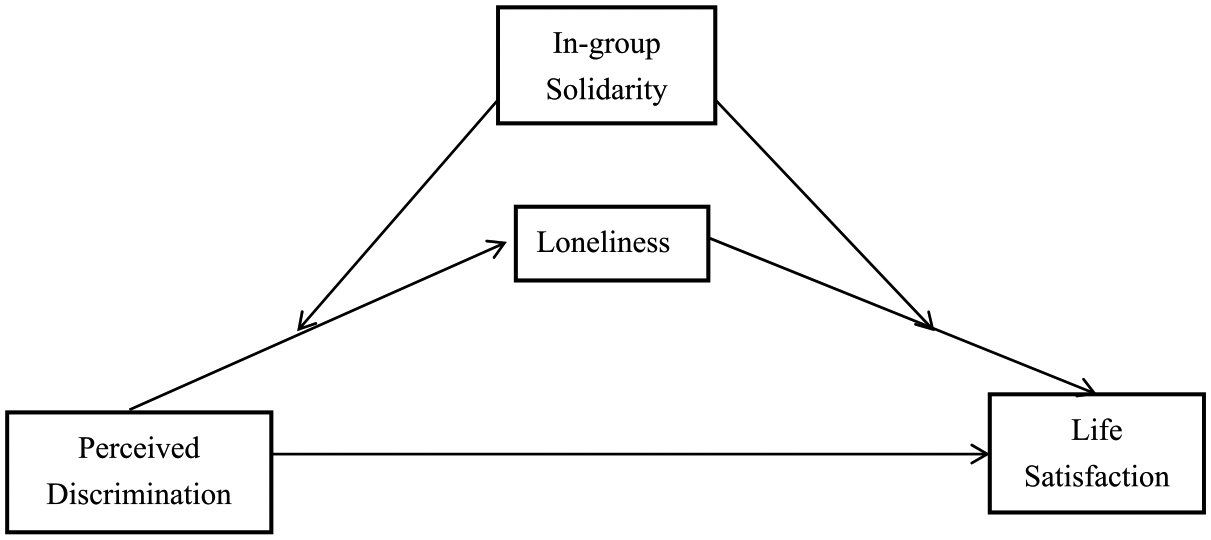
Path Diagram for Hypothesized Conditional Mediation Model
Following the recommendations of Frazier, Tix, and Barron (2004) to test alternative, plausible models in mediation research, we also examined an alternative model in which loneliness was specified as the dependent variable and life satisfaction was specified as the mediator. We examined this alternative model because it is theoretically possible that perceived discrimination might reduce satisfaction with life, including satisfaction with interpersonal relationships (Blai, 1989), which in turn would predict greater loneliness.
Method
Sample and Procedure
Participants were recruited from two large Midwestern universities through their respective offices serving international students. After obtaining institutional review board approval from both institutions, we requested that the office of international services contact the sample pool of Asian international students via email. In the email, female international students from Asian countries were introduced to the purpose of the study and provided with the link to an online survey created using Qualtrics. Participants filled out the survey in English. In the beginning of the survey, we asked participants for their gender to ensure that only female students were answering the survey. Using the Instructional Manipulation Check method (Oppenheimer, Meyvis, & Davidenko, 2009), the survey included one question to assess whether participants were attentive when completing the survey: “This is a validity check question. Please click on the option ‘Strongly Agree.’” After eliminating data from participants who failed this validity check question (n = 19), our final sample size was 216. We also investigated whether any participant engaged in straight-line responding (i.e., consistently choosing the same response for every item in a scale), but found no clear evidence of this response style.
The average age of participants was 24.18 years (SD = 5.41). The number of years that participants had lived in the United States ranged from 0 to 13 (M = 2.91, SD = 2.29, Mode = 1.00). Participants were from 17 countries of origin, China being the country with the greatest number of participants (51.5%), followed by India (12.0%), Malaysia (9.7%), South Korea (9.3%), and Taiwan (5.1%). The rest of the participants (12.4%) were from 12 other countries. About half (52.2%) of the participants were graduate students, with undergraduates evenly represented (freshman 9.6%, sophomore 13.4%, junior 11.9%, senior 11.4%), and a small percentage of non-degree-seeking (0.5%) and recently graduated (1.0%) students. Almost half of participants were single (52.0%), and the rest were dating (32.0%), married (15.5%), or separated from their partners (0.5%). More participants from one institution (58.3%) completed the survey than those from the other.
Measures
Gender discrimination
Participants’ experiences of gender discrimination were measured using the Schedule of Sexist Events (SSE; Klonoff &Landrine, 1995). Participants reported their levels of agreement with 20 items on a 1- to 6-point scale (1 = never happened to 6 = happened almost all of the time). These items assessed participants’ experiences of gender discrimination in the past year. One item reads, “How many times have you been treated unfairly by teachers or professors because you are a woman?” The mean score for the items was used in the analyses, with higher scores indicating greater levels of perceived gender discrimination. Studies have shown that the SSE was associated with increased psychiatric symptoms among women compared to men (Klonoff, Landrine, & Campbell, 2000). The authors of the SSE (Klonoff & Landrine, 1995) reported high internal consistency reliability (.90), good split-half reliability (.83), and acceptable test–retest reliability (.63). For the current sample, Cronbach’s alpha coefficient was .93.
Racial discrimination
Perceived racial discrimination was assessed using the Measure of Out-Group Rejection (Postmes & Branscombe, 2002). On a scale from 1 (strongly disagree) to 7 (strongly agree), participants were asked to rate the extent to which they agreed with eight statements constructed to capture their perception of being negatively treated by others because of their race. For example, one item reads “I consider myself a person who has been deprived of opportunities because of my race.” The mean score was used in the analyses, with higher scores indicating greater levels of perceived racial discrimination. Studies using this scale have shown that perceived racial discrimination was related to lower levels of psychological well-being among African Americans (Postmes & Branscombe, 2002; Seaton & Yip, 2009). The Measure of Out-Group Rejection has shown good reliability, evidenced by a Cronbach’s alpha of .83. For the current sample, internal consistency was good (α = .89).
Nationality discrimination
Perceived discrimination due to nationality status was assessed by the Perceived Prejudice subscale of the Minority–Majority Relations Scale (MMRS; Sodowsky & Plake, 1991). The MMRS was designed as an instrument to understand the experiences of individuals from different countries living in the United States. The Perceived Prejudice subscale contains 20 items related to participants’ experiences of stereotypes, discrimination, and social isolation from the hosting country’s dominant culture. On a scale from 1 (disagree strongly) to 6 (agree strongly), participants responded to statements that described their experiences of discrimination based on their status as international students. For example, one item reads, “I feel I am not fully accepted in organizations which have a majority of American members.” The MMRS has been used with a wide range of populations, such as Asian Indians, South Asians, and Asian international students (Frey & Roysircar, 2006). Sodowsky and Lai’s (1997) study showed that among Asian immigrants, perceived discrimination was related to greater cultural adjustment difficulties. The Perceived Prejudice subscale was shown to have good reliability, evidenced by a coefficient alpha of .88. For the current sample, Cronbach’s alpha was .92.
In-group solidarity
The three-item Solidarity subscale of the In-Group Identification Scale (Leach et al., 2008) was used to assess participants’ solidarity with in-groups based on gender, race, and nationality. On a scale from 1 (strongly disagree) to 7 (strongly agree), respondents reported their level of agreement with three items that described their solidarity with their gender in-group. With appropriate modifications, the same items were used to assess racial and national in-group solidarity. In other words, each in-group solidarity construct was assessed by three items. Sample statements are “I feel a bond with females” (for gender solidarity), “I feel a bond with Asians” (for racial solidarity), and “I feel a bond with [my nationality]” (for nationality solidarity). The following instructions were given for the items pertaining to nationality solidarity: “In the following questions, [my nationality] refers to the people of the country you are from as well as your national identity. For example, if you are from Mongolia, [my nationality] refers to Mongolians and your identity as a Mongolian.” The mean score of the three items was calculated for each solidarity construct, with higher scores indicating greater levels of solidarity with in-groups. The Solidarity subscale was shown to have good construct validity, evidenced by its high correlations with established measures of group membership commitment and belonging (Leach et al., 2008). In a sample of male Asian international college students in the United States, the Gender Solidarity subscale was positively related to life satisfaction (r = .24) and exhibited a coefficient alpha of .78 (Y. J. Wong, personal communication, December 1, 2014). The Solidarity subscale also demonstrated good reliability ranging from .88 to .90 in Dutch-speaking college student samples in the Netherlands (Leach et al., 2008). For the current sample, coefficient alphas were good for all three measures of in-group solidarity, with gender solidarity = .84, racial solidarity = .83, and national solidarity = .86.
Loneliness
The simplified version of the UCLA (University of California, Los Angeles) Loneliness Scale (Version 3) was used to assess loneliness (Russell, 1996). This assessment contains 10 items measuring participants’ experiences of feeling lonely. Participants were asked to rate their experiences on a scale from 1 (never) to 4 (often). A sample question is “How often do you feel as if nobody really understands you?” The mean score of the 10 items was used in the analyses, with higher scores indicating higher levels of loneliness. This scale was positively associated with the New York University Loneliness Scale and the Differential Loneliness Scale in college student samples (Russell, 1996). The UCLA Loneliness Scale has been widely used and has been found to be associated with depression (Hsu, Hailey, & Range, 1987; Sümer, Poyrazli, & Grahame, 2008) and anxiety (Sümer et al., 2008) among international students. Allen and Oshagan (1995) found support for the factorial invariance of a brief version of the UCLA Loneliness Scale across diverse racial groups. Validity evidence for this scale has been demonstrated in an Asian international college sample in the United States as well as in a sample of college students in China (B. Yang & Clum, 1994; Zhou, Sedikides, Wildschut, & Gao, 2008). The UCLA Loneliness Scale has demonstrated good to high reliability (.89 to .94) across different samples (Russell, 1996). Cronbach’s alpha was .93 for the current sample.
Life satisfaction
The Satisfaction with Life Scale (SWLS; Diener, Emmons, Larsen, & Griffin, 1985) was used to assess global life satisfaction. Participants rated five items that assessed satisfaction with their current life situations. Each item was scored on a 7-point Likert-type scale (1 = strongly disagree and 7 = strongly agree). The mean score of all the items was used in the analysis, with higher scores indicating higher levels of life satisfaction. The SWLS scale has exhibited good reliability and validity, evidenced by a Cronbach’s alpha of .83 and a negative association with race-related stress among Asian Americans (Yoo & Lee, 2005). For the current sample, the coefficient alpha was .85.
Analyses
We used the SPSS computational tool PROCESS to test our hypotheses. PROCESS uses ordinary least squares regression and bias-corrected bootstrapping to examine conditional mediation effects (Hayes, 2013). Specifically, PROCESS utilizes conditional process analysis, which integrates both moderation and mediation analyses to examine how a variable transmits its effect on another variable as well as the conditions of this mechanism (Hayes, 2012). Since its debut, this computational tool has been used in a large number of social studies (e.g., Berndt et al., 2013; Kurtz, Olfson, & Rose, 2013; Marshal, Burton, Chisolm, Sucato, & Friedman, 2013).
In each model, the dependent variable (life satisfaction) was predicted by the independent variable (gender discrimination, racial discrimination, or nationality discrimination) through the mediator (loneliness). Both the first stage and second stage of the mediation were also hypothesized to be moderated by gender solidarity, racial solidarity, or nationality solidarity. To test Hypothesis 1, the direct effect of the independent variable on the dependent variable was examined. To test the mediation effect in Hypothesis 2, we used bias-corrected bootstrapping by creating 5,000 bootstrap samples using random sampling with replacement. We identified significant mediation effects if the 95% confidence intervals (CIs) of the mediation effects did not include zero. To test the presence of conditional mediation effects in Hypothesis 3, we examined the significance of the mediation effects involving loneliness at five different levels of gender, racial and national solidarity: very low (10th percentile), low (25th percentile), moderate (50th percentile), high (75th percentile), and very high (90th percentile). For all analyses, predictors were standardized as z scores to facilitate the interpretation of the moderation effects.
Results
Preliminary Analyses
A series of t tests revealed no significant differences between participants from the two institutions on any of the main variables used in this study (ps > .05). We also investigated potential differences in our study measures as a function of participants’ nationality. Because our sample was quite diverse with regard to this variable, we focused on comparing students from China (the largest national group, which composed about half the sample) with students from other countries. A series of t tests indicated that Chinese students did not differ significantly from the other students on any of the main measures used in this study (ps > .05). Correlation analyses (see Table 1) showed that our covariates, age and length of stay in the United States (expressed in terms of number of years), were significantly correlated with some independent variables (e.g., gender discrimination) and the mediator, loneliness. Correlation analyses also revealed substantial shared variance between racial and nationality solidarity as well as between racial and nationality discrimination. Despite these high correlations, we decided to retain both sets of variables in our analyses because they exhibited different correlations with other variables. For example, nationality discrimination, but not racial discrimination, was negatively correlated with age. Racial solidarity, but not nationality solidarity, was negatively correlated with age. Nationality solidarity, but not racial solidarity, was positively correlated with life satisfaction. These different correlation patterns indicate that racial and nationality discrimination, as well as racial and nationality solidarity, represent different constructs for participants.
Correlations, Means, and Standard Deviations for the Main Measures
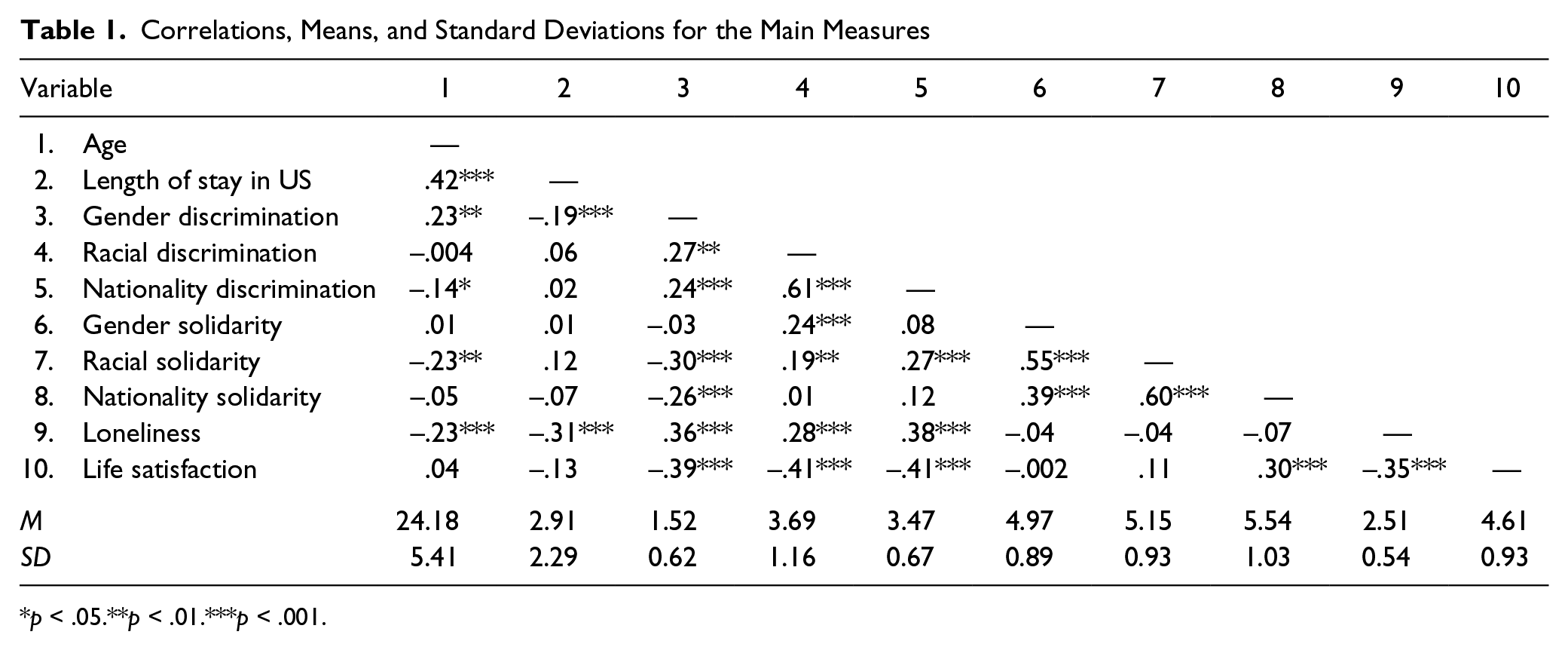
p < .05.**p < .01.***p < .001.
Because of the high levels of correlations between racial and national solidarity and between perceived racial and nationality discrimination, we tested the possibility of multicollinearity in the regression analysis. When all the independent, moderating, and mediating variables were entered in the same regression model, we detected variance inflation factor values above 2.50 (range = 1.55 to 2.79) and tolerance scores below .40 for racial identity and nationality solidarity (range = .36 to .65), indicating the presence of multicollinearity (Grewal, Cote, & Baumgartner, 2004). To resolve this issue, we tested our hypotheses in three different models with gender discrimination and gender solidarity in one model, racial discrimination and racial solidarity in a second model, and national discrimination and national solidarity in a third model. In the separate models, the variance inflation factor values dropped below 2.50 (range = 1.00–1.49) and tolerance scores were all above .60 (range = .67–1.00), indicating a reduction in multicollinearity.
Direct Effects of Discrimination
After controlling for the effects of covariates in the models, gender, racial, and national discrimination remained significant negative predictors of life satisfaction, providing support for our first hypothesis examining the direct effects of discrimination (see Figures 2 -4). The total effect from discrimination to life satisfaction was also significant for gender discrimination (B = –.50, SE = .06, p < .001), racial discrimination (B = –.38, SE = .06, p < .001), and nationality discrimination (B = –.39, SE = .06, p < .001).
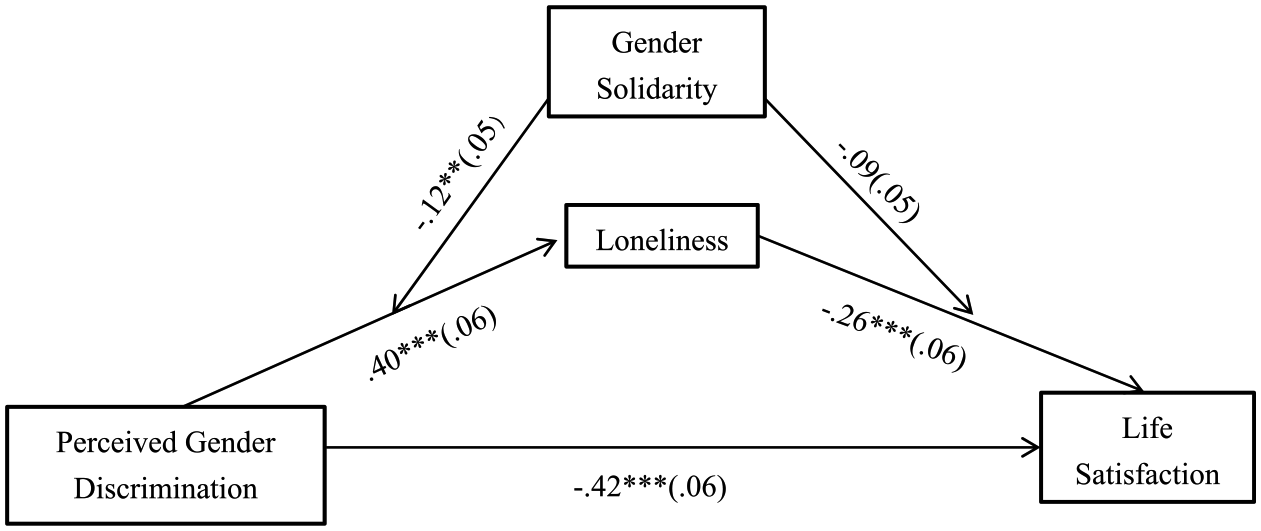
Conditional Mediation Model of Perceived Gender Discrimination Predicting Life Satisfaction
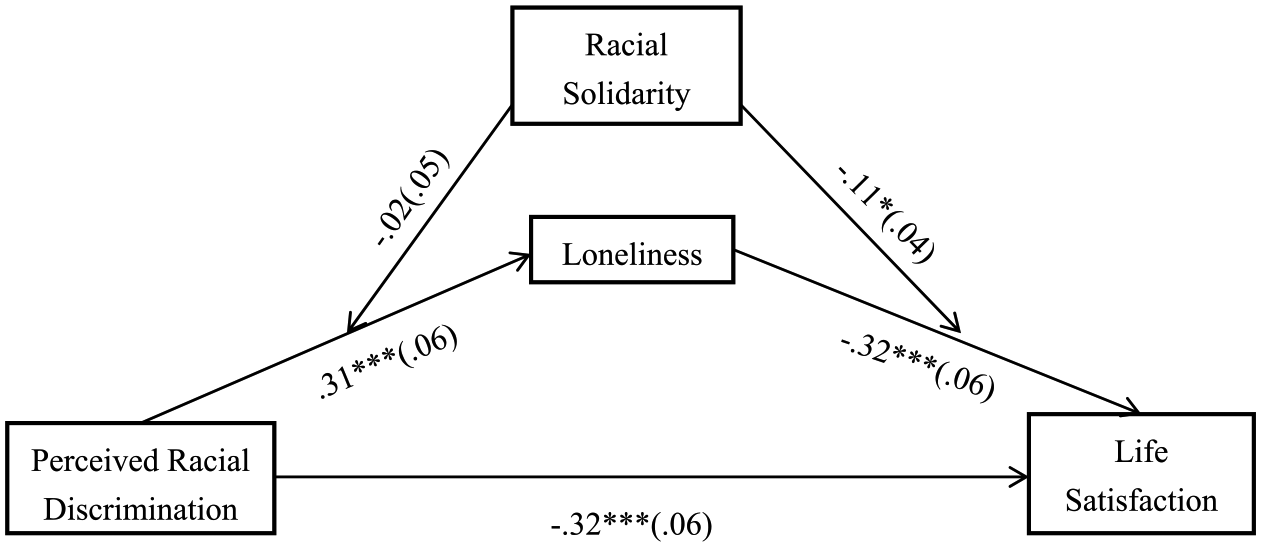
Conditional Mediation Model of Perceived Racial Discrimination Predicting Life Satisfaction

Conditional Mediation Model of Perceived Nationality Discrimination Predicting Life Satisfaction
Mediation Effects of Loneliness
The second hypothesis examining the mediation effect of loneliness in the pathways from three types of discrimination to life satisfaction was also supported. The bootstrapping method showed that the indirect effect of gender discrimination on life satisfaction through loneliness was significant (B = –.10, SE = .05, 95% CI = [–.21, –.02]). Moreover, gender discrimination significantly and positively predicted greater loneliness, and loneliness significantly and negatively predicted life satisfaction. Similarly, the indirect effect of racial discrimination through loneliness on life satisfaction was significant (B = –.04, SE = .04, 95% CI = [–.19, –.04]). The model results showed that racial discrimination significantly predicted greater loneliness, and loneliness significantly predicted decreased life satisfaction. The indirect effect of nationality discrimination through loneliness was also significant (B = –.10, SE = .05, 95% CI = [–.21, –.02]). Perceived nationality discrimination predicted greater loneliness, and loneliness significantly predicted decreased life satisfaction.
Moderation and Conditional Mediation Effects of In-group Solidarity
Our third hypothesis addressed moderation and conditional mediation effects. Testing for the moderation effects of gender solidarity showed that the interaction of gender solidarity with gender discrimination on loneliness was significant (p < .01; see Figure 2). Both at 1 SD below and above the mean of gender solidarity, perceived gender discrimination was related to higher levels of loneliness. However, the negative effect of gender discrimination on life satisfaction was stronger when gender solidarity was low (B = .50, SE = .07, p <.001) than when gender solidarity was high (B = .28, SE = .08, p < .001; see Figure 5). The interaction between loneliness and gender solidarity did not significantly predict life satisfaction. There was also evidence that the mediation effect differed as a function of gender solidarity. Loneliness only significantly mediated the pathway from gender discrimination to life satisfaction when gender solidarity was very high (B = –.10, SE = .09, 95% CI = [–.31, –.01]), high (B = –.10, SE = .06, 95% CI = [–.22, –.01]), moderate (B = –.10, SE = .05, 95% CI = [–.20, –.01]), and low (B = –.10, SE = .05, 95% CI = [–.19, –.01]), but not when gender solidarity was very low (B = –.09, SE = .06, 95% CI = [–.20, .02]).
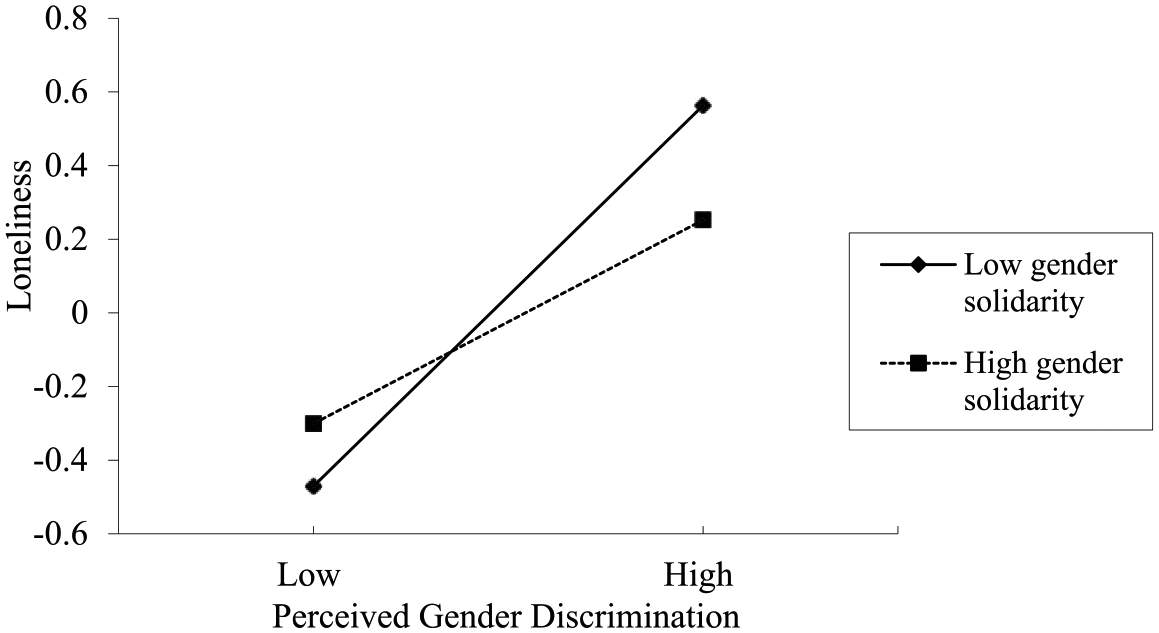
Interaction Between Perceived Gender Discrimination and Gender Solidarity as a Function of Loneliness
Several moderation effects were also found in the model on racial discrimination. Racial solidarity did not significantly moderate the pathway from racial discrimination to loneliness. However, it significantly moderated the pathway from loneliness to life satisfaction (p < .05; see Figure 3). Both at 1 SD below and above the mean of racial solidarity, loneliness was negatively related to life satisfaction. However, at 1 SD above the mean of racial solidarity, the negative effect of loneliness on life satisfaction was greater (B = –.43, SE = .08, 95% CI = [–.59, –.26]) than at 1 SD below the mean of racial solidarity (B = –.23, SE = .07, 95% CI = [–.35, –.10]; see Figure 6). There was also evidence that the mediation effect involving loneliness differed as a function of racial solidarity. Loneliness significantly mediated the relationship between racial discrimination and life satisfaction when racial solidarity was very high (B = –.12, SE = .05, 95% CI = [–.25, –.05]), high (B = –.11, SE = .04, 95% CI = [–.21, –.04]), moderate (B = –.10, SE = .04, 95% CI = [–.19, –.04]), and low (B = –.10, SE = .04, 95% CI = [–.18, –.04]), but not when racial solidarity was very low (B = –.07, SE = .05, 95% CI = [–.18, .001]).
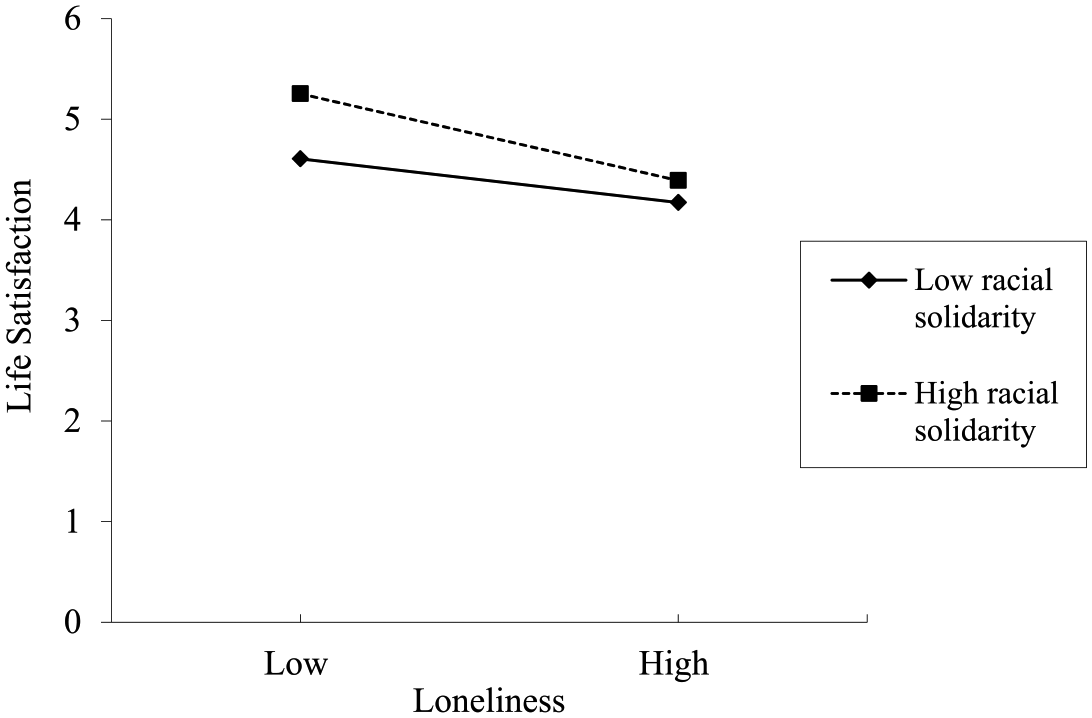
Interaction Between Loneliness and Racial Solidarity as a Function of Life Satisfaction
Nationality solidarity did not significantly moderate the relationship between nationality discrimination and loneliness; however, it significantly moderated the pathway from loneliness to life satisfaction (p < .05; see Figure 4). At 1 SD above the mean of nationality solidarity, loneliness was negatively related to life satisfaction (B = –.33, SE = .07, 95% CI = [–.48, –.19]). At 1 SD below the mean of nationality solidarity, loneliness was not significantly related to life satisfaction (B = –.14, SE = .07, 95% CI = [–.28, .01]; see Figure 7). There was also evidence that the mediation effect differed at varying levels of nationality solidarity. Loneliness significantly mediated the relationship between nationality discrimination and life satisfaction only when nationality solidarity was very high (B = –.14, SE = .07, 95% CI = [–.31, –.04]), high (B = –.11, SE = .05, 95% CI = [–.26, –.03]), moderate (B = –.10, SE = .05, 95% CI = [–.24, –.02]), low (B = –.09, SE = .06, 95% CI = [–.23, –.01]), but not when it was very low (B = –.05, SE = .07, 95% CI = [–.23, .03]).
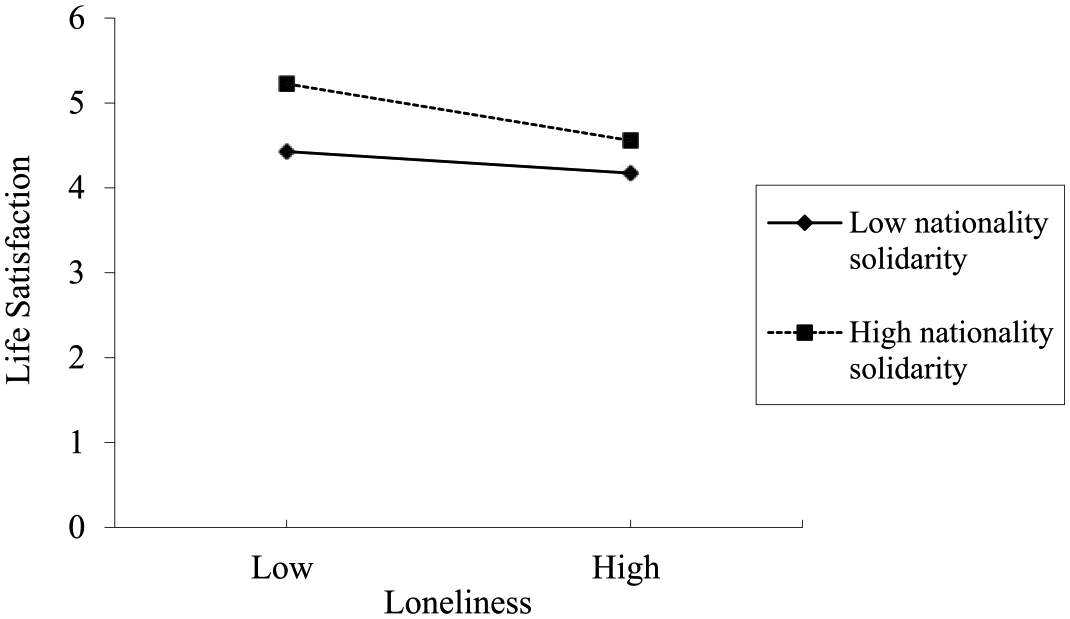
Interaction Between Loneliness and Nationality Solidarity as a Function of Life Satisfaction
Findings for Alternative Models
To test our alternative models, we used loneliness as the dependent variable and life satisfaction as the mediating variable and found similar results as reported in the earlier section. Life satisfaction significantly mediated the relationship between discrimination and loneliness in all three models: gender discrimination (B = .08, SE = .03, 95% CI = [.02, .14]), racial discrimination (B = .08, SE = .03, 95% CI = [.03, .13]), and nationality discrimination (B = .07, SE = .03, 95% CI = [.02, .13]). With regard to conditional mediation effects, life satisfaction significantly mediated the effect of racial discrimination on loneliness only when racial solidarity was very high (B = .08, SE = .03, 95% CI = [.03, .15]), high (B = .08, SE = .03, 95% CI = [.04, .14]), moderate (B = .08, SE = .03, 95% CI = [.03, .13]), and low (B = .08, SE = .03, 95% CI = [.03, .14]), but not when it was very low (B = .07, SE = .05, 95% CI = [–.001, .17]). The same pattern held true for the model on national discrimination. The mediation effects for life satisfaction on the relationship between nationality discrimination and loneliness was only present when nationality solidarity was very high (B = .10, SE = .04, 95% CI = [.04, .20]), high (B = .08, SE = .03, 95% CI = [.03, .14]), moderate (B = .07, SE = .03, 95% CI = [.02, .13]), and low (B = .06, SE = .03, 95% CI = [.01, .12]), but not when it was very low (B = .04, SE = .03, 95% CI = [–.02, .11]). In contrast, we found that life satisfaction significantly mediated the effects of gender discrimination on loneliness at all five levels of gender solidarity: very high (B = .09, SE = .05, 95% CI = [.01, .19]), high (B = .08, SE = .03, 95% CI = [.01, .14]), moderate (B = .08, SE = .03, 95% CI = [.02, .14]), low (B = .08, SE = .03, 95% CI = [.02, .14]), and very low (B = .07, SE = .04, 95% CI = [.01, .16]). Because we found conditional mediation effects across all our hypothesized models, but only in two of the three alternative models, overall our findings provide slightly more support for our hypothesized conditional mediation models than for our alternative models.
Discussion
This study investigated how perceived gender, racial, and nationality discrimination was related to the life satisfaction of female Asian international students, directly and indirectly through the association with loneliness. In addition, we also examined how these indirect pathways differed as a function of gender, racial, and nationality in-group solidarity. Results demonstrated that all three types of discrimination predicted decreased life satisfaction both directly and indirectly through heightened loneliness. Loneliness mediated the relationship between gender, racial, and nationality discrimination and life satisfaction. Perceived discrimination was associated with elevated levels of loneliness, which was in turn associated with decreased life satisfaction. These findings are consistent with previous research showing that gender, racial, nationality discrimination, and loneliness have deleterious effects on well-being (e.g., Juang & Alvarez, 2010). Perceived discrimination may cause international students to feel disconnected from the mainstream culture and undermine their sociocultural adjustment (O’Reilly, Ryan, & Hickey, 2010). This experience of loneliness may, in turn, foster decreased life satisfaction.
In addition, the mediation pathways differed as a function of gender, racial, and nationality in-group solidarity. Because solidarity addresses the perceived connections among members within a social group (Leach et al., 2008), it affects the link among experiences of discrimination, loneliness, and individuals’ satisfaction with life. Findings from this study showed that solidarity could either be a risk or a protective factor, depending on the type of discrimination and the specific pathway. Specifically, gender solidarity was a protective factor that weakened the deleterious link between gender discrimination and loneliness. In contrast, racial and nationality solidarity were risk factors that exacerbated the negative association between loneliness and life satisfaction.
It is not entirely clear why gender solidarity was the only in-group identification variable that buffered the relationship between perceived discrimination and loneliness. One possible reason is that female Asian international students may have been better able to utilize their gender in-group identification as a positive coping strategy relative to their racial and national in-group identification. Before coming to the United States, female international students may have already learned how to build connections with other females, as being female may have been a more salient social identity than being a member of their racial and nationality group in their country of origin. Thus, those with high levels of gender solidarity were able to utilize their experience of connection with other women as a tool to cope with gender discrimination. However, because the average number of years that our participants lived in the United States was less than 3 years, it is possible that participants have had less experience reflecting on their racial and national in-group identification. For instance, prior to moving to the United States, a Korean woman living in Korea might have many opportunities to reflect on her identity as a woman but not on her identity as a Korean or as an Asian. Thus, female Asian international students in our sample may have been less able to utilize their racial and nationality in-group identifications as coping resources. Another possible explanation is that women’s gender in-group constitutes the most prominent of the three in-groups (gender, race, and nationality) addressed in our study. That is, a much larger proportion of students on campus are female than are Asian and international students. Thus, forming alliances with other women may be more feasible than seeking support from other Asian or international students. Accordingly, students may be more adept at using gender in-group solidarity as a resource to cope with discrimination than using racial or nationality solidarity.
Another important finding of the study is our test of conditional mediation effects. We found that across three models, loneliness only mediated the pathway from perceived discrimination to life satisfaction when in-group solidarity was very high, high, moderate, and low, but not when it was very low. Participants who reported very low levels of in-group solidarity probably did not have strong attachments to an in-group (Ashmore et al., 2004), which may, ironically, buffer against disappointment arising from experiencing loneliness; accordingly, the indirect effects from discrimination to loneliness to life satisfaction was weaker for such participants.
Results from our alternative models showed that only two of the three conditional moderation models were significant. The mediating effects of life satisfaction on the relationship between racial discrimination and loneliness were conditional on racial solidarity. The same pattern held true for nationality discrimination, but not for gender discrimination. In contrast, conditional moderation effects were present for all three types of discrimination in our hypothesized models. Thus, the results provided more support for our hypothesized models with loneliness as the mediation between perceived discrimination and life satisfaction. Discrimination may be more proximal to the experience of loneliness than to life satisfaction because discrimination and loneliness are both associated with rejection, lack of support, and disconnection with others.
Strengths of the Study
This study contributed to the literature on Asian international students in several ways. To our knowledge, it is the first study to examine gender, racial, and nationality discrimination, as well as in-group identification, in a sample of international students. Using a sample of female Asian international students, we were able to examine perceived discrimination based on three salient identities: gender, race, and nationality. Previous studies typically focused only on one type of discrimination, usually racial discrimination (Chen, Mallinckrodt, & Mobley, 2002; Rahman & Rollock, 2004; Sam, 2001; Wei, Wang, Heppner, et al., 2012; Wong, Tsai, et al., 2014). Because our study focused on three types of discrimination, it provided a more comprehensive understanding of perceived discrimination among international students than previous studies.
In addition, to our knowledge, our study was the first to examine the mediating role of loneliness in the relationship between perceived discrimination and life satisfaction for international students. The identification of mediators in the relationship between Asian international students’ experience of discrimination and life satisfaction is important because it provides researchers with insights into the mechanism through which Asian international female students’ life satisfaction is compromised by discrimination.
A third strength of our study is our focus on diverse forms of in-group identification: gender, racial, and nationality solidarity. Our study clarified the direction of their effects on life satisfaction. Previous studies on social identities have produced mixed findings, with some studies showing that they exert a protective role on psychological well-being (R. M. Lee, 2005), and others finding they are risk factors on mental health (Eliezer, Major, & Mendes, 2010). The results from our conditional mediation models may provide a framework that explains the conditions under which solidarity with one’s in-group may act as a risk or protective factor. High solidarity with one’s in-group may intensify the sting of discrimination-induced loneliness by emphasizing one’s differences from the dominant culture and by escalating the stress associated with having a minority status. Thus, in the presence of high levels of loneliness, high in-group solidarity may prevent individuals from taking actions or seeking help to cope with discrimination, which may result in decreased life satisfaction. However, high solidarity with one’s in-group may also protect individuals from feeling lonely by motivating them to be engaged with other in-group members, from which they can obtain social support to process their experiences of discrimination. In sum, our findings may help us understand the conditions under which female Asian international students develop resiliency, defined as “a dynamic process encompassing positive adaptation within the context of significant adversity” (Luthar, Cicchetti, & Becker, 2000, p. 543). In particular, our results suggest that gender in-group solidarity may be a source of resiliency for female Asian international students who experience gender discrimination.
A fourth strength of our study is our focus on the solidarity dimension of in-group identification. Previous studies in the field of counseling psychology have not paid sufficient attention to this dimension of in-group identification. Leach et al. (2008) observed that in most measures of in-group identification, items on solidarity are mixed with items from other dimensions. For example, the Affirmation and Belonging subscale of the Multigroup Ethnic Identity Measure (Phinney, 1992) contains items on belongingness, pride, and personal regard. Similarly, Sellers, Rowley, Chavous, Shelton, and Smith’s (1997) Centrality subscale of the Multidimensional Inventory of Black Identity mixes items on solidarity (“I have a strong attachment to other Black people”) with items on the centrality of one’s social identity (“Being Black is an important reflection of who I am”). As argued by Leach et al., these measures conflate solidarity with other dimensions of in-group identification. Given that solidarity focuses on one’s sense of attachment and belongingness to an in-group, this dimension of in-group identification might be particularly relevant to cultural groups from collectivistic societies. We therefore encourage counseling psychology researchers to consider how in-group solidarity can be a source of strength or stress for individuals from diverse cultural groups.
Limitations of the Study and Implications for Future Research
This study is limited in a few ways. First, we used a cross-sectional design in which all constructs were measured at the same time point. Thus, our findings do not guarantee that experience of discrimination preceded or caused the participants’ experience of loneliness and decreased life satisfaction. Future researchers could use a longitudinal design to measure discrimination and mental health at different time points to investigate changes over time. Second, we did not examine whether students from diverse regions of Asia experience discrimination differently. Asia is a heterogeneous continent, and the experiences of discrimination by Asian students from diverse countries might not be the same. Due to the small sample size, such an analysis was not feasible because of limited statistical power. It is possible that by analyzing data in the aggregate, important patterns of results may be masked. For example, it is possible that the deleterious impact of racial or nationality discrimination on life satisfaction might be weaker among Asian students from countries where English is an official language (e.g., the Philippines) compared to students from non-English-speaking countries. Future researchers utilizing large sample sizes are encouraged to examine whether the relationship between discrimination and life satisfaction differs across Asian national groups.
Third, the measures of in-group solidarity contain only three items. Compared to instruments assessing other constructs in this study, in-group solidarity was assessed using fewer items. In addition, there is limited validity evidence for the Solidarity Subscale of the In-Group Identification Scale. Fourth, although we examined both racial and nationality discrimination, the results showed substantive overlap between the two measures of these constructs. To provide a clearer delineation between racial and nationality discrimination, we propose that future research could focus on measuring aspects of racial discrimination that are relatively distinct from nationality discrimination (e.g., discrimination based on students’ visa status). Finally, the study was administered in English, rather than in participants’ native languages due to the logistical difficulty of providing our survey in the languages of 17 different countries. It is possible that participants’ responses may have been different if they had responded to the survey in their native languages.
Practical Implications
Our findings present a few implications for clinicians, administrators, advisors, and other university staff who work with female Asian international students. First, we encourage those working with female Asian international students to inquire about the experiences of diverse types of discrimination and how these experiences might adversely affect their satisfaction with life and cultural adjustment (Rahman & Rollock, 2004; Wong, Tsai, et al., 2014). Second, clinicians can explore how discrimination might influence clients’ struggles with loneliness. Because loneliness is proximally related to discrimination, clinicians could help clients who have experienced discrimination to explore their feelings of isolation, rejection, marginalization, and disconnection from others. In addition, university staff who work with international students can help them learn strategies to cope with social isolation and solicit social support. However, practitioners should also be mindful that solidarity with people from one’s in-group may either buffer or exacerbate the effects of discrimination and loneliness. Thus, it is wise to help female Asian international students gain insight into the conditions under which their experience of solidarity with in-groups (e.g., members from the same nationality) is a source of strength or challenge in helping them cope with discrimination and loneliness. Third, a specific implication of this study is that helping professionals can assist female Asian students to strengthen their in-group solidarity to cope with sexism. Counselors can encourage Asian international female clients to strengthen their bonds with other women, discuss experiences of sexism with each other, and to gain social support from their female friends. College counseling centers can offer support groups for female Asian international students in which they can form alliances with other women from the same nationality or racial backgrounds. Last but not least, our study provides implications for educating clinicians about multicultural competency. Because of the model minority myth concerning Asians and Asian Americans (Green &Kim, 2005), clinicians may not be aware of Asian international students’ experiences of discrimination and the mechanism through which it permeates their lives. Accordingly, clinicians should strengthen their multicultural competence by learning about the psychological processes of being exposed to discrimination and how it undermines Asian international students’ satisfaction with life.
Conclusion
In conclusion, we found that female Asian international students’ perceived gender discrimination, racial discrimination, and nationality discrimination were associated with elevated levels of loneliness, which was in turn associated with decreased life satisfaction. However, these pathways differed as a function of gender, racial, and nationality in-group solidarity. Specifically, gender solidarity was a protective factor for the link between perceived discrimination and loneliness, whereas racial solidarity and nationality solidarity were risk factors for the relation between loneliness and life satisfaction. These results present several practical implications for counselors, advisors, and administrative staff who work with female Asian international students. Perhaps the most critical take-home message from our study is the importance of assessing female Asian international students’ solidarity with their in-groups to understand the contexts in which it serves as a risk or protective factor for their satisfaction with life. In sum, we urge researchers and helping professionals to explore how intersecting connections among gender, race, nationality, and in-group identification impact life satisfaction.
Footnotes
Declaration of Conflicting Interests
The authors declared no potential conflicts of interest with respect to the research, authorship, and/or publication of this article.
Funding
The authors received no financial support for the research, authorship, and/or publication of this article.