




Abstract
Each year, approximately 71% of new early career psychologists are women, yet no empirical research has examined the unique career adjustment needs and experiences of women early career psychologists. This study presents the constructivist grounded theory analysis of 22 in-depth interviews with women early career psychologists regarding their experiences of developing a career in psychology. Three primary spheres of influence on career adjustment emerged from the data: identity-based influences, experiential-focused influences, and outcome-oriented influences. These major spheres of influence are further refined into themes and subthemes that play a role in the career experiences of women early career psychologists. The impact of these themes on the women’s career trajectory is explored, and implications for research, training, policy, and practice are presented.
There is a need to understand career adjustment issues for psychologists across the professional life span (Smith et al., 2012), which has resulted in an increased focus on psychologists who have recently completed their doctoral training programs and entered the workforce, also referred to as early career psychologists (ECPs). The American Psychological Association’s (APA; 2008) Committee on ECPs defined an ECP as an individual who has received a doctoral degree in psychology within the past 7 years. This definition was recently expanded to include individuals who are within 10 years of graduation (APA, 2013), as it was noted that many ECPs might still be settling into their careers at the 7-year mark. Women have represented a growing majority of graduates from doctoral programs in psychology; in 2009, 71% of graduates identified as women (APA, 2011). Despite women representing a numerical majority of individuals with doctorates in psychology, women early career psychologists (WECPs) report a median salary $8,000 lower than male ECPs (APA, 2011). We use the term WECP in contrast to female ECP to be inclusive of all who identify as a woman regardless of their relationship to the gender binary (APA, 2015). Women are also overrepresented at lower levels of career hierarchies (e.g., lecturer or in nontenured faculty positions) with fewer women holding the rank of full professor or senior administrator (Halpern, 2008; Hollenshead, 2003). Despite these persistent disparities and women composing a larger percentage of the current ECP population, little research has focused on the specific career development experiences of WECPs.
As the number of ECPs in the workforce continues to grow, the relative representation of ECPs in APA and the Society of Counseling Psychology membership has not kept pace (Smith et al., 2012). The need for the field to understand issues and barriers to recruitment, retention, and advancement that particularly influence ECPs is a critical area for investigation (O’Shaughnessy & Burnes, 2014). Although there is growing information about ECPs in the form of theoretical literature (e.g., Green & Hawley, 2009; Sanders, Breland-Noble, King, & Cubic, 2010), the need for more empirical investigations about their specific experiences is clear. APA’s Center for Workforce Studies (2010) noted that there is a particular need for understanding stressors (e.g., student loan burdens, the Great Recession, internship match imbalance) that may influence ECP career adjustment. In a survey of 160 ECPs, Butt, Forsythe, Portnoy, Heffner, and Weinstein (2011) noted that particular concerns include time management, professional identity, networking and connectedness, licensing and credentialing, mentoring, personal finances, grants/funding, skills training, practice business, and the job search process. In addition, Good, Keeley, Leder, Afful, and Stiegler-Balfour (2013) found that building work–life balance was the primary concern of the 85 ECPs they surveyed.
Concurrently with the increased attention on ECPs, more individuals from marginalized and traditionally unrepresented groups are entering the workforce in fields such as psychology (U.S. Census Bureau, 2009). Consequently, increasing recruitment and retention of ECPs from diverse backgrounds is a primary task of APA (Butt et al., 2011). Although there is some existing literature related to the unique experiences and stressors of ECPs, the writings utilize a framework that assumes all ECPs have similar experiences and have only peripherally suggested specific investigations of the influence of cultural identities on ECPs (e.g., Good et al., 2013). As scholars have noted (e.g., Alvarez, Blume, Cervantes, & Thomas, 2009), it is essential to examine the experiences of psychologists from culturally marginalized backgrounds, yet issues that impact diverse ECPs within the field of psychology when entering academic and practice-oriented environments is an area that has received little attention.
Experiences of diverse ECPs have been documented in the psychological literature using almost exclusively theoretical writing. Specific groups of ECPs who have experienced marginalization based on intersecting identities may face different dilemmas that have not been present for ECPs from majority cultural groups. For WECPs, identities related to gender and sex have been theorized to influence their professional experiences (Clark, Rudolph, Zhdanova, Michel, & Baltes, 2015; van Anders, 2004). Specifically, sexism at various ecological levels has a structural influence on WECPs’ development in terms of access to resources and barriers to achieving professional goals and career advancement (Riley, Frith, Archer, & Veseley, 2006).
Many authors have theorized about the unique concerns facing women in general career adjustment, with a growing literature supporting the continued existence of a “glass ceiling,” or “limits to women’s advancement identifiable by the unstated barriers that females face in advancing to the pinnacle of the profession” (Samble, 2008, p. 56). Expanding on the notion of a glass ceiling, several scholars have begun to discuss the concept of a “maternal wall” (Crosby, Williams, & Biernat, 2004; Hirakata & Daniluk, 2009; Williams, 2005), noting that navigating motherhood and family responsibilities within existing hierarchical systems (e.g., tenure and promotion processes) leads to what at times feels like insurmountable challenges to career advancement for women. Given these challenges, it is clear that understanding the unique needs of WECPs is essential.
In response to these calls, we (O’Shaughnessy & Burnes, 2014) synthesized existing theoretical literature related to WECPs’ professional wellness and noted that it clustered around three distinct ideas related to women’s career adjustment as psychologists: (a) general new career adjustment issues, (b) unique women’s concerns, and (c) macro-environmental factors. Furthermore, we suspected that WECPs’ social location, identity, and resources were likely critical factors in understanding WECP career development. As we developed this synthesis of the literature, we recognized that given the lack of empirical investigations, WECP voices were largely missing from the existing professional discourse. Therefore, we designed a qualitative study to examine three questions: (a) What are the subjective career development experiences of WECPs? (b) How do social and cultural identities influence WECPs’ career trajectories? and (c) What are common obstacles, strengths, and supports for WECPs? The goal of this investigation was to provide empirical data that would further the field’s understanding about the career adjustment experiences for WECPs and allow us to build theory that centers WECPs’ voices.
Method
In determining which qualitative method to use for this inquiry, we noted that because the extant theoretical work did not include the voices of this population, attempting to confirm prior theories might lead us to disregard important influences that arise from a more emergent and open approach (Charmaz, 2014). To guard against this error, we selected a constructivist grounded theory inquiry to work toward a theory of WECP career adjustment that prioritizes how participants describe their experiences as WECPs (Miles, Huberman, & Saldana, 2013) while also acknowledging that “social reality is multiple, processual, and constructed and we must take the researchers’ position” as holders of knowledge about this topic into account (Charmaz, 2014, p. 13). In constructivist grounded theory, the researchers engage in an inductive approach that allows them to become heavily immersed in the data with the intention of building theory (rather than verifying existing theory) related to unresearched phenomena (Charmaz, 2008; Maxwell, 2012). This consistent engagement with the data allowed us to engage in a recursive, ongoing process of data analysis in which we were able to more accurately describe a subjective experience of career development for WECPs. Morrow (2005) described the phenomenon of “trustworthiness” as standards of credibility for qualitative research that emerge from the data and the research itself, and are not based on quantitative methods. Standards of trustworthiness are accounted for at various stages of the research process as described throughout this section.
Researcher Assumptions and Biases
The research team was composed of two professional psychologists who hold multiple professional appointments in the areas of academia (primary appointment for both authors) and clinical service delivery (secondary appointment for both authors). T. O. identifies as a White, bisexual woman, currently middle class and raised working class, who identifies as being assigned female at birth. T. R. B. identifies as a queer White man, currently upper middle class and raised working class, who identifies as being assigned male at birth. Both researchers had experience with qualitative research methodologies and were ECPs at the time of data collection (i.e., T. O.: 4 years postdoctorate; T. R. B.: 7 years postdoctorate). Both authors are active members in local and national psychology communities as activists, practitioners, and researchers. The researchers also employed two research assistants.
A grounded theory method guides researchers to identify their assumptions about the topic of inquiry and integrate these biases as part of the data collection and analysis (Maxwell, 2012). Furthermore, motivated by standards of trustworthiness, the researchers recognized that their reflexivity, or “self-awareness and agency within that self-awareness” (Rennie, 2004, p. 200), was necessary to learn about the construct under investigation. These reflections included the assumption that participants would identify societal barriers (e.g., racism, sexism) to ECPs’ experiences of career development within professional psychology. In addition, the researchers were active members in the movement within counseling and psychology to take a strengths-based approach to understanding ECPs, and thus they had biases that they would see both strengths and challenges emerge from the participant narratives.
Participants
Participants for this analysis were 22 women who held doctoral degrees (PhD, n = 14; PsyD, n = 8) in clinical (n = 11), counseling (n = 10), or combined (clinical, counseling, and school; n = 1) psychology. Participants ranged in age from 29 to 41 (M = 32.9, SD = 3.32), and all identified as women. All participants graduated between 2006 and 2012, and identified their race and/or ethnicity as Asian (9.1%; n = 2), multiracial Latina or mixed race Asian and Latina (13.7%; n = 3), White or “Caucasian” (72.7%; n = 16), and declined to specify (4.5%; n = 1).The participants identified their sexual orientation as heterosexual/straight (n = 12), bisexual (n = 3), queer (n = 2), mostly straight (n = 1), lesbian (n = 1), fluid (n = 1), heteroflexible (n = 1), and declined to state (n = 1). Participants self-identified their social class as one of the following: working class (six as children, zero currently), lower middle class (three as a child, four currently), middle class (four as a child, 10 currently), upper middle class (five as a child, four currently), and upper class (one as a child, one currently). Participants’ places of employment included clinical settings (n = 13), academic settings (n = 2), clinical and academic (n = 4), unemployed (n = 2), and declined to state (n = 1).
Instruments
At the beginning of each participant’s interview, the researcher–interviewer administered a brief oral open-ended demographic questionnaire that assessed age, gender, sexual orientation, race and ethnicity, social class (currently and as a child), doctoral degree that was earned, and current job title(s) and settings. Next, T. O. (n = 15) or T. R. B. (n = 7) interviewed each participant using a semistructured format (see Figure 1) to explore participants’ subjective experiences of the phenomenon (Maxwell, 2012). We derived the semistructured interview protocol from a review of relevant literature to capture participants’ experiences of their career development and their identity as an ECP. We edited the protocol based on emergent design flexibility after interviewing two participants to capture more completely the essence of the phenomenon under investigation. Specifically, the social class demographic question was expanded to ask for class as a child and currently, and potential follow-up prompts were discussed for participants struggling with the open-ended nature of the first question. Participants described their feelings of career development, their experiences of being a woman within their respective discipline of professional psychology, and changes in emotions, behaviors, thoughts, and social engagement. They were also prompted to talk about the ease and/or difficulty they experienced in defining their ECP identities for themselves. Interviews were 45 to 60 minutes in length and were transcribed by two research assistants. To preserve confidentiality, aliases were assigned to each participant.
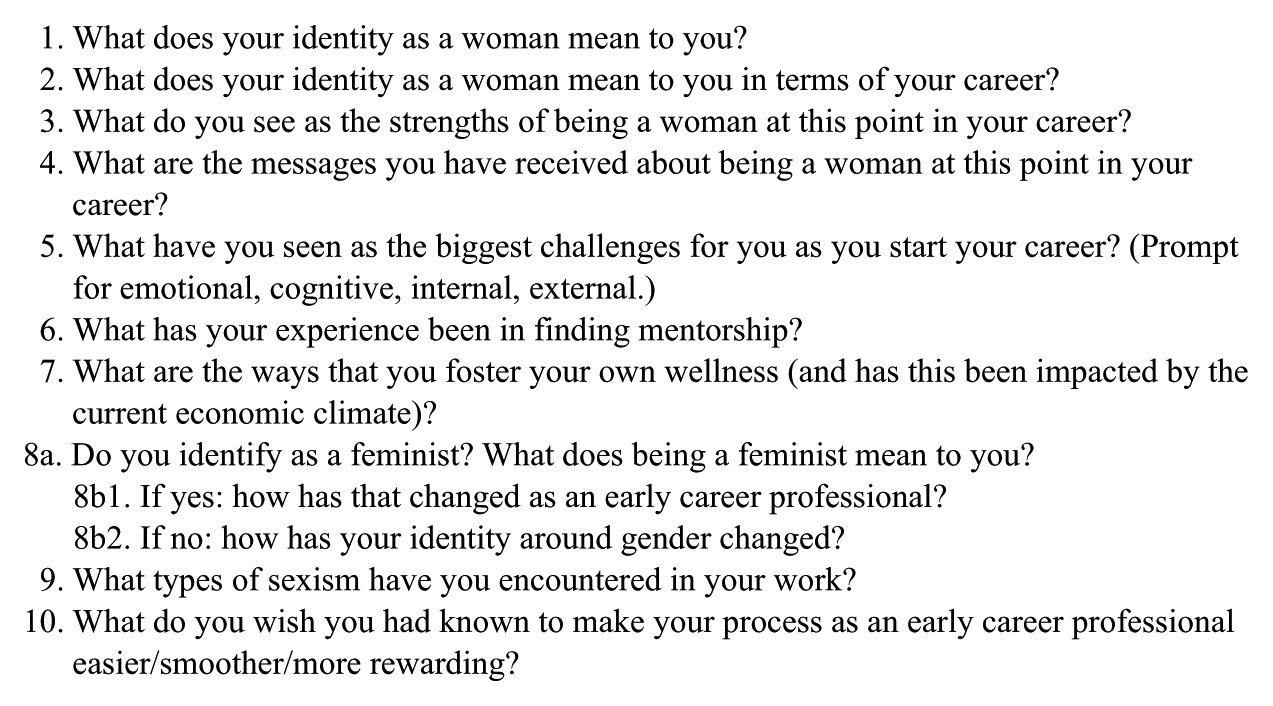
Interview guide.
Procedure
Participants were recruited online (e.g., professional listservs, Facebook) and in person (e.g., fliers distributed at ECP-focused programming at national psychology conferences, word of mouth). Participants visited a secure website to complete an informed consent process and provide contact information. The researchers contacted each participant, assessed eligibility for participation, and scheduled an individual interview if applicable. In total, 38 individuals accessed the secure recruitment website, 33 completed the informed consent and provided contact information, and 22 responded to follow-up contacts to schedule an individual interview. All interviews were conducted via telephone. All participants were entered into a raffle for one of two $50 gift cards as an incentive for participation. Standards of trustworthiness for qualitative research and grounded theory both call for the use of purposeful sampling to ensure that participants sampled have a rich experience of the phenomenon of inquiry (Patton, 2014), thus we intentionally recruited from APA Divisions 12, 17, 35, 44, 45, and the Association for Women in Psychology. Criteria for participation included that each participant self-identified as a woman and had graduated with a doctoral degree in psychology within the past 7 years (the APA definition of ECP at the time of data collection).
Data Collection and Analysis
Within the standards of trustworthiness, Morrow (2005) identified the criterion of “adequate amounts of evidence” (p. 255) that strengthens qualitative research by recognizing that an ample amount of data is necessary to capture the richness of the phenomenon under investigation. In the first step of data analysis, we revisited our assumptions about the topic. We then coded the data using an open coding method (Miles et al., 2013) in which we examined the transcripts and identified categories based on frequency of words, phrases, or ideas. This coding method allowed the language of the participants to guide the development of category, subcategory, and coding labels. This method was supplemented with a line-by-line coding method in which we examined two- to three-paragraph passages from each interview and coded them line by line (versus looking for frequency of words or phrase) to create coding and category labels.
Thus, in the second step, we used an open coding process whereby we each analyzed the same interview to identify multiple potential codes and themes for each line of text. We came to a consensus on these codes and themes, and developed a coding grid of categories and subcategories from this process, which guided future coding of subsequent interviews (Miles et al., 2013). This code grid was continually refined throughout the data analysis process. Furthermore, we met weekly to talk about and reflect on our own biases related to gender and career development, and to discuss discrepancies within coding processes of various interviews.
In the third step of data analysis, we used axial coding to identify subcategories in the data and their interrelationships (Maxwell, 2012). We took categories and their subcategories and made connections among them by applying these categories to the data to confirm the existence of these relationships. By making these connections, we were able to identify and explain different components of the phenomenon under investigation. For example, we identified whether categories and subcategories were a causal condition that influenced the phenomenon of early career psychology for women, a contextual condition that was a characteristic of the participants’ specific time and place during investigation, or a strategic action that depicted how participants handled, reacted to, or interacted with the phenomenon as they encountered it.
In a fourth step, we moved to selective coding, a process in which each interview was analyzed to investigate common and divergent themes across the interviews (Corbin & Strauss, 2008, as cited in Charmaz, 2014). This process involved emergent analytic strategies, constant comparison, and consensus-making on the selective codes that both researchers identified (Charmaz, 2014). This process also concurrently resulted in T. O. auditing T. R. B.’s coding and vice versa (another method of obtaining research rigor as outlined by the standard of trustworthiness; Morrow, 2005) and checking themes across different participants as a group. In the fifth step, we examined the themes and subthemes that had emerged and identified a parsimonious model of identity and career experiences for WECPs for the 22 participants (see Figure 2). This model represents the standard of trustworthiness of “adequacy of interpretation” (Morrow, 2005, p. 256) and made us aware of our biases as we worked with the data in finding connections and relationships within the data collected.
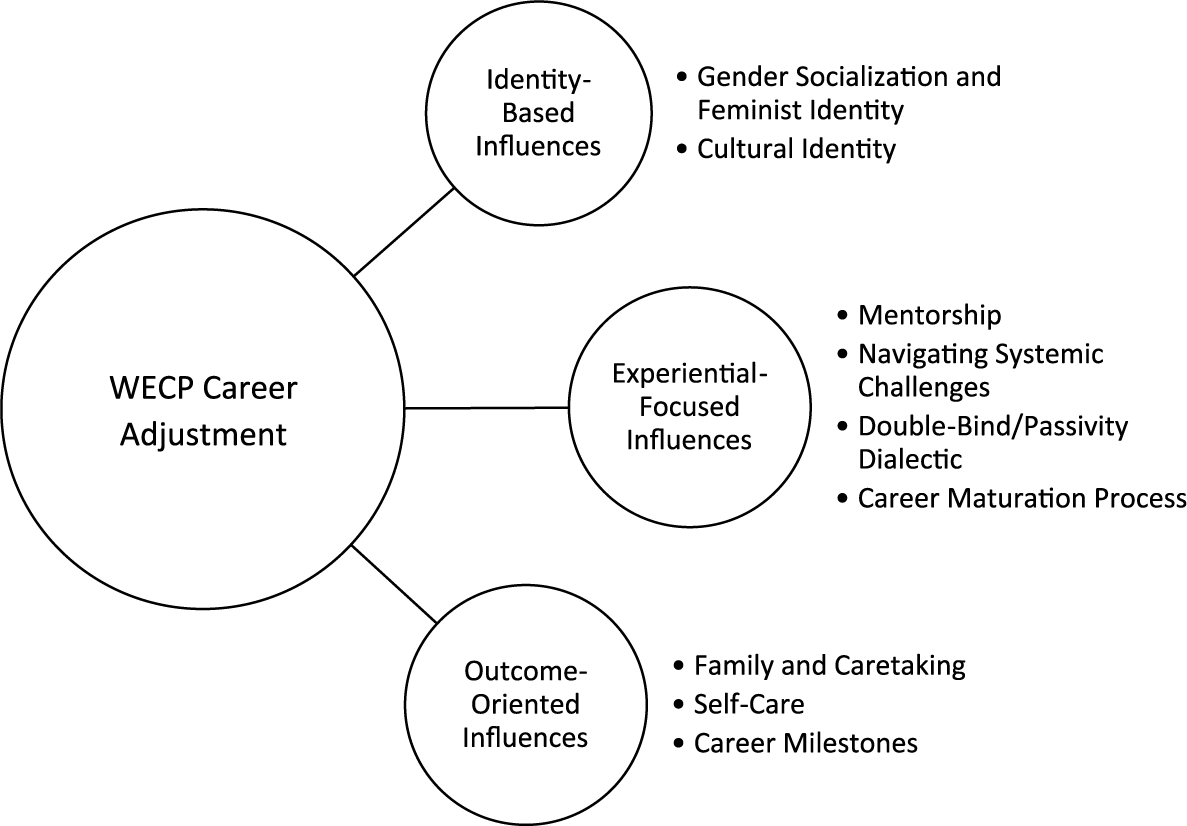
Theory of influences on women early career psychologists’ career adjustment.
To strengthen the trustworthiness of the study, we conducted an internal audit where we reanalyzed all 22 interviews to ensure that every interpretive level of the theory was essential and that there was not data negating the theory and/or data not accounted for. The audit involved rereading each interview and revisiting the code lists to check for coding consistency. We also accounted for trustworthiness through adequacy of interpretation by memo writing, in which we wrote a series of thoughts, hunches, and interpretations about how we felt codes connected to each other, and what preliminary hypotheses we had about the theory as it emerged from the axial coding process.
Results
As we analyzed the way participants articulated their experiences in the field and their sense of how their gender influenced their career trajectories, a theory began to emerge as the data clustered into three primary spheres of influence on career adjustment: identity-based, experiential-focused, and outcome-oriented (Figure 2). These three spheres of influence captured the complex prism of developmental influences on WECPs’ career adjustment. This developmental narrative began with the first sphere of identity-based influences (i.e., the participants’ experiences relevant to their lived experience as women and cultural beings). The narrative continued with the second sphere of experiential-focused influences (i.e., how participants are navigating their career path as ECPs and learning to be productive, negotiate, and embody the cognitive shift into being a psychologist). The narrative continued with the third sphere of outcome-oriented influences (i.e., career aspirations, figuring out which road to take, and sometimes accepting that the trajectory was not exactly what they had envisioned). These three spheres provided an organizing structure for the specific themes that are presented next in detail.
Identity-Based Influences
This sphere of influence contains the two overarching themes of (a) Gender Socialization and Feminist Identity, and (b) Cultural Identity. The identity-based influences theme captures the complex ways that the participants discussed gender, race, social class, privilege, and experiences of oppression, and ultimately how these identity experiences reportedly influenced their career trajectories.
Gender Socialization and Feminist Identity
This theme reflects the participants’ experiences of themselves as women and the ways in which they understood how their gender influenced their career paths. When prompted to explore what their identity as a woman means to them, many participants initially expressed uncertainty about how to capture such a wide and integral aspect of their identity. Erica noted that “being a woman means to me that I’m sort of on a hierarchy implicated in issues of power and privilege” speaking to this complexity. Ryann shared, “I don’t see any strength to being a woman in my career in terms of . . . I want to be in administration, and I think [being a woman] it’s not a strength at all.” This theme also encompasses the ways in which participants engaged with or identified with a feminist identity. The theme was coded into five subthemes expanded on below.
Lived experience of gender
Participants spoke of concepts such as gender flexibility, restrictive gender roles, gender as a continuum, and assumptions made by others based on gender. Several women spoke of a relational pull as part of their lived experience of gender. Kim spoke to this explicitly when she discussed:
Embracing my femininity in kind of a broad context—across contexts. So both at home in my . . . personal relationships and then also at work . . . my strong sense of connectedness to others and that desire to connect to others, I think that’s a big part of my identity as a woman.
Some participants spoke of women’s abilities to “build relationships in multidisciplinary care teams” because of their relational abilities and attention to power as key features of their career experiences. Participants also noted that gender influenced power dynamics in relationships in the workplace with colleagues, and for clinically oriented participants, with clients. For example, Sue noted that she needed to pay particular attention to the ways that gender and power might play out in her relationships such as when a “father/daughter dynamic gets activated” with older male clients.
Women’s experiences contrasted with those of men
There was a tendency for participants to define their experiences as a contrast to what men are perceived to experience. For example, both Erica and Ann spoke to the realization that women in their departments were expected to do more “service work” than their male counterparts. Tanya noted that “women have to present, in a way, more professionally than men do in order to get the same level of respect. I think we have to be more articulate. I think we have to be actually less emotional.” Similarly, Erica noted “faculty who are male are rare within psychology too, so they’re looking for those role models for male students and . . . these assumptions that men are more qualified . . . professional and more competent . . . in the workplace than women might be.” Ann noted that a message she has received is that “in order to fit in, you need to play the game like the boys,” and this influences the way she comports herself in the field.
Experiences of sexism
Every participant noted either witnessing or experiencing sexism. These ranged from “blatant sexism” such as being told that “women who work with athletes, their role is to work with female athletes and their eating disorder issues, but not necessarily that we could contribute to working with male teams and their performance” (Sasha) to more subtle forms of sexism such as a “director [that] doesn’t challenge women the way that he challenges men . . . like he was being more kid glove with us because we’re women” (Tanya). In addition, several participants spoke to a general feeling of institutional sexism via the underrepresentation of women in leadership positions. Issues of sexism were apparent to several participants around issues of motherhood and pregnancy; Adena noted that colleagues regularly state “don’t drink the water because it seems like everyone gets pregnant . . . what I hear about career and women is that they cost the company money.” Similarly, Ann shared that she received the direct advice not to have “too many children” because maternity leave could harm her career.
Dynamics of feminist identities
Of the 22 participants, 21 self-identified as feminist. Each participant had a unique, subjective, and personal understanding of what feminism meant to her, and those definitions did not always overlap. Erica noted, “feminism has become less about women and more about gender nonconforming expressions as well as antiracist activism.” Tina’s conceptualization of feminism included “being an advocate for women and women’s rights and equality across domains.” However, Kia’s definition was a slight variation of that concept: “it’s not about women’s rights necessarily, but it’s just about equal rights.” Sasha’s understanding of feminism was more behaviorally based: “women have the option to do what they want to do . . . you don’t have to be told what to do or get permission.” Feminism existed on a spectrum for our participants. Early feminist awakenings were often connected with a mentor (e.g., mother, sister, aunt, teacher, or friend) and several participants mentioned a “mellowing,” “passivity,” or “less intense” approach to feminism as they “aged.” For example, Roberta shared that she “identified as a feminist since I was about 10 years old,” whereas Tanya spoke of having “this I’m a postfeminist thing, you know, I’m a humanist. But then I realized, no, the truth is I really am a feminist.” Similarly, Kia noted, “When I was in college, I was probably more of like this radical lesbian feminist thing. And it’s like now I just feel like I’ve grown up . . . I think just in general I’ve mellowed out.” Speaking explicitly of the influence of career on feminist identity, Sarah noted “I’ve become more and more of a feminist . . . in building a business. . . . There was something that felt really empowering . . . and really feminist about it . . . it just made me feel maybe the opposite of what a woman is taught.”
For many participants, feminism was used as a lens for self-examination in graduate school and on to day-to-day career experiences. Feminism was a way to understand their own professional-developmental context. As Molly noted,
As a feminist and as a feminist psychologist, that’s my lens for approaching my work and . . . it’s a gift. . . . I can step back and say, okay, what role or what place do these gender role restrictions play and what am I experiencing right now?
Kelsey also articulated this self-analysis sentiment when she stated,
I really didn’t know why I felt the way I felt and what that meant in terms of society but then I took . . . gender studies classes . . . and that has informed a lot of my research and clinical placements.
Internalized antifeminism
Nearly all of the participants, regardless of the duration, strength, or conviction of their feminist identity, engaged in a defensive explanation of their identity. Their feminist identity needed to be contrasted with an almost mythical “bad feminist” identity. There was frequently a sense of apology for being a feminist, an internalized awareness of backlash, and/or a need to distinguish one’s own feminist identity from “those kinds of feminists.” Liz noted, “[before graduate school] I had very stereotypical views of feminists that were not flattering and made it not something that I wanted to identify with.” Reilly articulated this well when she noted, “Where I grew up, there’s not a lot of people . . . positively using the word feminist. . . . I have to struggle a lot in this world, because there are all these negative ideas about what feminism is and that it’s a bad word.” Connecting this more explicitly to career, Erica noted how this antifeminist reaction is a consideration in clinical work when stating, “there’s such a history to that term [feminist] that it can be off-putting for a number of reasons for clients.”
Cultural Identity
This theme captures codes from participants that presented the ways that their race, ethnicity, class, values, and experiences of privilege and oppression, have influenced their career experiences.
Race and ethnicity
Several participants spoke about the ways they noticed their race, and the intersection of race with other aspects of their identity, influencing their career outcomes. For example, Alexis spoke of the intersection between her racial identity and gender when she noted “in terms of stereotypes, I think that it is a lot easier for me as a Latina woman to have been successful, because the stereotypes on Latina women are different than the stereotypes on Latino men.” She also felt that her identity as a biracial woman subtly influenced how she was perceived by colleagues and clients. Sasha noted that her racial background was a source of strength in being able to connect with diverse clients:
I also think that being a person of color, because if you look at certain sports and just in the demographics of first generation college students as well, it’s primarily minorities in certain areas and I think that gives me an “in” as well—that I’m going to be able to understand what they’re going through a little bit better than with a European American female.
In contrast, Reilly noted difficulties with the “overrepresentation” of White women in the field: “I’m just another White woman amongst a million other White women . . . do I think personally what I offer in the room can be very special and unique . . . yes I do, but . . . you can’t market that to a client very easily.”
Class and SES
A majority of our participants identified as coming from middle to upper middle class backgrounds. Those participants who came from working class backgrounds mentioned the influence of class and SES throughout their interview. The influence of social class and SES on our participants’ career trajectories was varied. Adena described her educational attainment as prized by family:
Where I’m at now, I’m the first in my family . . . to go to grad school and to hold a doctorate degree, and being called “Dr. X” is something that my parents and my whole family is just quite proud of. It’s not simply myself who has made these accomplishments—it’s more of the whole family.
In contrast, Kelsey described class-related adjustment as one of her primary challenges:
Being a first generation college student and not really having anyone in my family understand what it even means to be educated . . . [it’s] very difficult in terms of the transition in social class identity in remaining connected to my family. . . . It’s kind of like you don’t fit in anywhere.
Cultural privilege and oppression
This final subtheme captured the codes regarding participants’ upbringing and their internalization of cultural values, expectations, and the need to navigate multiple roles. Concepts such as “bilingualism,” the need to “code-shift,” and family expectations around accomplishments influenced career experiences. Furthermore, some participants spoke about a commitment to advocacy that is consistent with their work in the field but that was born from the values instilled at home. Adena spoke to being “really aware of the differences in privilege and power, not only within my family, but also within the community and society at large.” Several participants shared experiences of oppression ranging from “subtle looks and comments” (Sasha) about their targeted identities to hearing overt statements such as “you just got hired because they needed diversity” (Kelsey). Kia shared an example of experiencing a series of “microaggressions” at her place of employment by a single, nonsupportive, more senior colleague and noted that the experience left her feeling “so marginalized.” Molly noted that although she had “been very privileged in terms of class and race,” she was able to connect with her clients around her own experiences of harassment and oppression as a woman.
Experiential-Focused Influences
The second major sphere of influence on career adjustment that emerged, experiential-focused influences, encompasses the influences that were less identity oriented and more reflective of the participants’ interactions with the professional world around them. This included a focus on mentorship, a description of the major challenges encountered, the professional roles that participants had undertaken, the expectations of behavior based on gender constraints, and the career development process.
Mentorship
Mentorship was a major topic discussed by the participants. They reported a wide range of sources, types, and experiences of mentorship. In terms of finding mentorship, some participants identified this to be quite straightforward, whereas others struggled to find “influential mentors.” The more traditional sources of mentorship included assigned graduate advisors, consultants, dissertation chairs, and formal mentoring programs. Some relationships were described as “organic” and “natural” whereas others spoke of “piecing together mentors” through involvement in psychological associations, listservs, and through peer mentoring. Sasha outlined a multifaceted approach to obtaining mentorship when she stated, “anybody can teach me something.” Geographic constraints (e.g., being in a rural area, being new to a community) were reported as challenges to finding mentorship. Furthermore, Tanya noted that she wished she “had been more intentional earlier in my academic career with getting a mentor, realizing I was going to need one, because it’s made all the difference in the world for me.”
Several participants spoke of perceived distinctions between male and female mentors. Gia shared, “[I’ve] been really fortunate in not having a problem in finding strong female mentors,” implying the central importance of finding a female mentor. Roberta noted, “It’s been challenging for me to find female mentors, which is what I would really appreciate at this point in my career.” Ryann noted, “The women mentors that I have, have been mentors in very emotional ways . . . [they have] been really, really important to my development . . . they’ve been more like teaching me and . . . made some emotional changes and differences for me.” Molly spoke of a sense of frustration at having “wonderful mentors that were feminist” while she worked in academic settings, but not finding that feminist and/or woman-centered mentorship transferred easily into her clinically focused career.
Consistent with their individual needs, the content of mentoring relationships varied greatly across participants. Participants noted that sometimes mentorship was needed on “practical stuff and logistics,” and in these situations, supervisors who helped manage day-to-day challenges were seen as mentors. Mentoring relationships also served as a sounding board and a place to obtain support, positive feedback, and praise. Some participants also described very specific content in their mentoring relationships such as receiving guidance on licensure, being mentored into a specialty, being advised of when to send a CV or apply for a position, and being connected to resources.
Several participants reported feeling “fortunate” to have had access to supportive mentors and role models who helped them navigate their career journeys. They described mentors as “fighting for me” and advocating for their success. However, other participants noted having some difficulties when supervisors whom they also viewed as mentors struggled with setting clear boundaries or promoted approaches to work that were inconsistent with their own value system. Roberta shared her experience of having mentors who were out of alignment with her goals such that “female professors like, try to dissuade me and other female graduate students from going into more practice oriented work-clinical work. And felt that that was sort of selling ourselves short or something.”
Navigating Systemic Challenges
Participants shared an array of struggles that influenced their career adjustment process. These clustered well within an ecological framework, with struggles emanating from individual–internal, interpersonal, organizational, community, and macrosystemic locations.
Individual–internal
Sue spoke clearly to one of the most common sources of internal challenges experienced by our participants when she stated “feeling self-doubt and questioning your own competency, that was a big one.” Additional individual or internal challenges noted included coping with mental health and physical health issues, self-esteem, transitioning, “work addiction,” and balancing new opportunities. Adena, Gia, and Kia noted that they moved into leadership roles earlier than expected postgraduation, and although they were taking on these roles, they did not necessarily feel prepared or properly trained for them. Gia shared, “reading up on leadership and trying to feel comfortable in taking that role has been something I’ve been doing a lot of thought on [sic] and I think it’s going to be a giant growth experience . . . and big learning curve.”
Interpersonal
At the interpersonal level, participants noted that conflict with colleagues, not being taken seriously, and feeling patronized were difficulties. Sasha noted,
The biggest challenge is being new in the field and gaining respect from those that are older. Like I have a lot of innovative ways of seeing and doing things . . . and then working with people who were pretty complacent and kind of not buying into the complacency and also continuing to challenge them.
In addition, some of the interpersonal challenges that participants navigated were with their relationship partners. Conflicts in relationships and discussing competing career goals were a significant part of the interpersonal challenges that the participants shared.
Organizational
Organizational issues such as the existence of “pecking orders” and difficulties navigating “covert rules” and “organizational politics” were also noted as challenges. Ann spoke to this when she stated “certainly a challenge has been in kind of learning the inside scoop and balancing the different roles.” In addition, a sense of isolation emerged in terms of entering organizations where one might be the only woman, sexual minority, or ECP. Liz spoke to the challenges of being the only ECP when she stated,
The most challenging aspect of [my current position] is that I don’t have peers that are in the same point of their career that I can have relationships with. It’s really the first point in my career in psychology that I don’t have people around that are at the same [place].
For participants in academic positions, learning to navigate departmental politics was described as particularly challenging. Erica suggested,
My department gets along pretty well and yet there’s a lot that’s unspoken . . . and a lot of dynamics that are kind of hush-hush . . . I feel like there’s all these secrets so figuring those out over time and just feeling like you can’t entirely trust anyone, and also feeling like there’s a lot of competition at the horizontal level among assistant professors.
Community/mesosystemic
Challenges at the community level discussed by the participants related more specifically to the wider professional community in psychology. Several participants spoke to a disappointment or disillusionment with the other psychologists they began to interact with upon entering the field. Molly reflected, “I wish I had known that not all psychologists are good people. I loved school and school is great, but not all psychologists are good people, not all psychologists mean well.” Several participants spoke of challenges connecting with the larger psychology community given their financial constraints and the high fees to be a member in a professional organization, or the high cost to attend a conference without financial support.
Macrosystemic/public policy
Many of our participants graduated during the height of the Great Recession; thus, the economic climate presented challenges in terms of access to higher paying jobs. Sarah noted,
You get this idea that it’s this upward linear path and then when I realized that—the economy crashed right as I was finishing my postdoc, and then they weren’t hiring anyone, and I was unemployed for 6 months, and I was just so shocked that one could have a doctorate and be unemployed.
In addition, increased reliance on student loans to fund higher education also was identified as a challenge for some of our participants. Adena outlined this clearly when she stated,
Just the sheer amount of student loans and how hard it will be to pay it off, to even make a dent. There was this fantasy of mine that once I graduate I’m going to be rolling in millions of dollars, right? [laughs] A lot of our future plans and our financial planning revolves around our student loan debt.
Double-Bind/Passivity Dialectic
Another important experiential influence that emerged is what we have termed the double-bind/passivity dialectic. This dialectic, identified by several of our participants, is the struggle that women encounter around being told they need to “lean in” or “self-advocate” and then receiving feedback that they are “bitchy” or “too aggressive.” This dialectic encompassed participants’ experiences of receiving disempowering or mixed messages from others, the internalization of this conflict, and sometimes a rejection of expectations. Erica spoke to receiving messages that “women being empowered [is] somewhat threatening, or that women’s accomplishments should be kept under wraps or else you’re seen as . . . self-aggrandizing.” Similarly, Kelsey shared, “if a woman has a strong opinion, but we have been told—me and a couple of my colleagues—that we’re just being emotional, even though we have valid points.”
At times the messages our participants received around this concept felt a bit muddled. Alexis shared:
I had one particular supervisor a couple years back, a man, who one of the things that he believed to be my growth edge was learning how to be more assertive in the room. Sort of whatever he thought was assertive, which to me looked a little more aggressive—or passive-aggressive.
Erica further outlined the dialectic when she stated,
So I think sometimes . . . especially among men or people with these internalized sort of limited notions of womanhood in the workplace . . . [they] have these binary ways of thinking about women in the workplace either being the type that are going to cry or [be] tough and cut-throat.
Tanya noted that she is working on “learning to own my voice and not scream too loud” in response to some of the feedback she has received around either being too quiet or being “too aggressive.” Gia reported, “kind of down selling myself” in interviews as a natural reaction she’s had to trying to avoid seeming self-promoting. Sue also spoke of becoming “more passive” in how she deals with instances of sexism and “sort of picking your battles” as a strategy. Some participants noted that this idea of women not self-promoting or asserting was present, but they responded by intentionally rejecting these expectations. For example, Kia stated, “you need to know how to fight for it, because you deserve it.” Similarly, Reilly was proud of her “blunt” approaches to interactions with colleagues and noted, “I feel like a strong woman who definitely stands up and speaks for herself a lot.”
Career Maturation Process
A developmental career maturation process also surfaced within the participants’ narratives. This maturation process included codes related to initial doubts and uncertainty, developing competency and autonomy, and an increasing sense of ownership of career as time progressed. The concepts of imposter syndrome (i.e., “feeling like a fraud among colleagues and waiting to be detected as such”; Cohen, Morgan, DiLillo, & Flores, 2003, p. 90) and not feeling quite ready to step into the role of psychologist were identified by many participants. Roberta encapsulated this well when she stated,
I think sometimes I do experience some of those imposter syndrome feelings especially with all the newness. Even though there’s a part of me that feels like yeah, you know, I’m intelligent. I’m strong. I have all these strengths. . . . Because I’m sort of putting on all these different hats and, and trying on these different roles, I might sometimes doubt myself.
Feelings such as uneasiness, uncertainty, and self-doubt were common as participants described this aspect of their career development. Within this theme, participants also noted the importance of developing competency and autonomy; specifically, “using your voice” and “mastering clinical skills” were helpful to building a sense of competency and autonomy. Finally, participants spoke to an increasing sense of ownership of their career. Tanya spoke of figuring out which professional roads to take, and several participants reported striking out in directions that were very different from what they had planned or anticipated but that were ultimately a good fit for their own unique needs.
Outcome-Oriented Influences
The third major sphere of influence on WECP career adjustment we identified in the data denoted the influences that the participants found were products, or outcomes, of their career trajectory. These outcomes could be small outcomes (or milestones) that had already happened at various points along their career trajectory or outcomes that participants had not yet reached but were working toward and saw as future goals.
Family and Caretaking
Participants reported that family and relational concerns, regardless of the choices that the woman made around parenthood and relationships, were a looming influence over career and were often an outcome that was consistently reevaluated during participants’ career trajectory. Participants noted that outcomes related to family started early in their career. Liz noted “In terms of more practical aspects of my career . . . even as an undergraduate, I saw a career in psychology as one where I would have some flexibility where it came to the years where I would have young children.” Kim noted, “By the time you graduate from school and you go on from undergraduate, you’re kind of in the prime of child rearing years and most of the time that conflicts with getting yourself established as a psychologist.” In addition, Erica noted:
It’s really problematic that women are afraid . . . to tell our supervisors about this and it’s not something that’s taken for granted that . . . women have bodies that sometimes produce children and there are certain accommodations that need to happen in the workforce as a result of that. So knowing that I’m still kind of scared about . . . being in the workforce . . . I will have to be very strategic in terms of how I negotiate that as part of my working role.
Building on this theme, Karina shared, “breaking in as an ECP, for most of us, if you’ve put off starting a family until you’re done with graduate school and you haven’t had any job for longer than a year . . . you don’t qualify for [family medical leave].” Several women spoke to career choices that were made due to the needs of a spouse or significant other’s career needs over her own. The influence of relational career influences was illustrated well by Kelsey, who stated “I was fortunate enough, right out of school, to get a job in academia and then my husband is military, and so we had to move, and so I was fortunate to get this [current] job.”
Self-Care
In addition to outcomes related to family, participants noted outcomes related to greater self-care, and described how self-care moved from being a peripheral, process-focused part of their career development to an outcome-focused, central part of their career development. Furthermore, participants noted numerous types of self-care in which they engaged, including both adding positive health habits (Molly: “So I sleep a lot, like more than I think the average person. I go to bed every day at 9:30 and I wake up at 6:30 so I get my 9 hours in every night”) and removing negative health habits (Adena: “One healthy habit, getting rid of cable, it had a ripple effect [on my self-care]”). Notably, a number of participants discussed the importance of relationships with both family and friends as a form of self-care. For example, Alexis noted “I remain in daily contact with relatives—whether it’s my mom or my brother or my sister or just I’m constantly, I think, engaging in social contact and it’s just a way to help me with my sanity.”
Career Milestones
Data in this theme revealed that individuals found milestones to be a critical part of their career trajectory, their arrival into their identities as ECPs, and their future career goals. Participants’ data consistently documented that milestones were systematized into their doctoral programs and that participants engaged frequently with this system, including their predoctoral supervised professional experience, to equate milestones with positive outcomes for their career. For example, Reilly noted “I was on internship and I was doing good and great and really happy and thinking, yes I picked the right career.” Other participants noted that after they had left their formalized education, they engaged in the creation, maintenance, and achievement of their own milestones.
Participants discussed feeling supported in their doctoral program, but feeling a loss of support as they moved beyond internship and toward licensure or first jobs. Sarah noted,
When I was in graduate school I was actually pretty naïve about . . . how difficult it would be to be in this field. . . . I think that all through graduate school you’re getting so much validation and encouragement as you just get through these hurdles . . . and you feel like people are cheering you on and you get this idea that it’s this upward linear path.
The process of obtaining licensure was a significant milestone for the majority of participants with some balancing licensure demands with other career paths simultaneously (e.g., both licensure and an academic position). Overwhelmingly, codes clustered in this subtheme highlighted the absence of mentorship related to the process of licensure. Karina noted, “after I graduated there was like this huge gap of professional ‘limboism’—there were not a lot of resources or support for things like EPPP [national licensure exam] or learning about credentialing or mobility issues.”
A final milestone that emerged was related to financial outcomes, including the cost of repaying student loans and the amount of money that they were making as an ECP (e.g., Jane: “I’m not really making a lot of money”). Alexis spoke very clearly about a financial influence on career adjustment:
To have accumulated so much debt in graduate school and wanting to go back and help my community, but realizing I could never pay back all the loans that I’ve taken out with the income that I make . . . a big social justice piece [is] about being able to go back and work with the particular population that I work with and also I realize that there’s a big sacrifice in being able to do so in the long-term for myself. . . . I’m constantly grappling with it . . . and even to this day, and I have no plans on going anywhere or changing my mind about what population I primarily want to serve.
Discussion
Our participants’ narratives provided insight into the complex, and at times contradictory, ways that ECPs experience being a woman in the field of psychology. Consistent with prior research (e.g., Butt et al., 2011; Smith et al., 2012) our participants described a variety of internal (e.g., self-doubt) and external barriers (e.g., experiences of sexism, challenges to authority, difficulties accessing mentorship) to career adjustment. Our participants’ experiences clustered well into a theory of three major spheres of influence on career adjustment (Figure 2): identity-based, experiential-focused, and outcome-oriented. Considering these three broad spheres, it becomes clear that any plan to help facilitate career adjustment for WECPs will need to be multifaceted. Each ECP will have a unique cultural identity and experience with gender socialization (identity-based) that will influence that ECP’s career trajectory. Similarly, ECPs’ experiences with mentorship, navigating systemic challenges, coping with the double-bind/passivity dialectic, and experiencing a maturation process will influence adjustment. Finally, the outcome-oriented experiences such as family and caretaking needs, self-care processes, and importance and attainment of milestones may vary widely.
As noted previously, women represent an increasing majority of graduates from psychology doctoral programs (APA, 2011), and these results help to paint a clearer picture of the obstacles, strengths, and supports for WECPs. Many of the themes that emerged are consistent with prior theoretical work on the common challenges that exist for women when embarking on a new career (e.g., Fouad & Carter, 1992; Green & Hawley, 2009). Specifically, challenges around family, relational career decision making, self-promotion backlash (Moss-Racusin & Rudman, 2010), and the maternal wall (Crosby et al., 2004; Hirakata & Daniluk, 2009; O’Shaughnessy & Burnes, 2014; Samble, 2008; Williams, 2005) were present and are likely important considerations for recruitment and retention of WECPs.
Our participants found it particularly challenging to adjust to the work setting when they were the only representative of some aspect of their identity. This included a range of identities from being the only ECP, woman, person of color, or person from their particular specialty in psychology. For agencies attempting to diversify or become more interdisciplinary, this speaks to the importance of potentially hiring in teams or cohorts (Urban Universities for Health, 2015) to reduce the sense of isolation. Alternately, facilitating external mentorship for employees, and encouraging multifaceted mentoring, or recognizing that one may need multiple mentors who can speak to the various identities and experiences of an ECP may be a useful strategy. Furthermore, the themes that emerged in this study empirically support suggestions from existing theoretical literature (O’Shaughnessy & Burnes, 2014) and, exemplifying grounded theory, present a theory that begins to describe the relationships between the multiple influences on WECPs’ professional development. Given the theory that emerged, we contend that implementing any strategies to enhance adjustment in the experiential focused sphere should also consider the impact of the identity-based and outcome-oriented spheres of influence to increase the likelihood of success.
Although mentorship has been identified as a key strategy for facilitating career adjustment (Burney et al., 2009), our participants’ experiences in finding mentorship were mixed, with many finding it relatively easy and others struggling significantly. Although not specifically prompted to discuss gender in terms of seeking mentorship, the majority of our participants spoke to their relative ease or difficulty in finding or connecting with female mentors. These findings are consistent with prior research (August & Waltman, 2004); the challenge may be connected to a tendency for mentors to select protégés similar to themselves (Allen, Poteet, Russell, & Dobbins, 1997). The participants who did find female mentors reported that these women had a range from positive to negative reactions both to their identities as women and to the development of their various life roles. Although some career development literature (e.g., Lent, Brown, & Hackett, 2002; Super, 1990) has documented the importance of understanding how one’s various life roles influence career trajectory, data from the participants in this study noted that their identities as women and their respective mentors’ views of women in psychology may provide contrary perspectives. Concurrently, some participants noted seeing mostly women in leadership, whereas others noted seeing few women in leadership. These mixed perspectives highlight how the identity as a WECP can be seen as both a strength and a challenge simultaneously, and there is a need to have multiple women leaders and mentors in professional spaces where WECPs work.
A unique finding in our study was that many of our participants found having a feminist and holistic understanding of the way power and systems of oppression operate helped them to make sense of their experiences. It was surprising that 95% of the participants identified as feminist, in contrast to general population estimates of around 18% to 23% of women identifying as such (Vox, 2015; YouGov, 2013). This identification seemed essential in allowing many of the participants to make sense of their experiences and formulate plans for navigating barriers.
A notable refrain from several participants was a sense that there were some key expectations in their current roles, such as engaging in leadership, business management, and supervision, that they felt inadequately prepared for from their graduate program. Scott, Ingram, Vitanza, and Smith (2000) addressed this issue concerning the need for stronger supervision training in graduate programs. As our field grows and we move further away from the historical apprenticeship model to a more outcomes/competency-based training style (Ladany & Inman, 2012), ECPs may be missing some of the critical lessons needed to become successful in the field. In addition, the literature noting that it may be more difficult for women to access appropriate mentorship (e.g., August & Waltman, 2004) indicates that infusing leadership training into graduate level coursework could be a useful strategy to enhance preparedness for leadership in WECPs.
Limitations
Although this sample was diverse in terms of employment type and social class background, it was less diverse in terms of race or ethnicity, with 72% of respondents identifying as non-Latina White. APA’s Center for Workforce Studies (2010) reported that 24% of recipients of doctoral degrees in psychology were people of color. Although the present sample does reflect the racial and ethnic distribution in the field, the unique experiences of women of color in the field warrant additional exploration. Furthermore, the researchers did not investigate the participants’ experiences of SES and social class in depth, and although several participants made references to income and student loans, they did not speak to specific amounts, which may have added to ambiguity regarding SES and class data. Future studies should explore WECPs’ experiences of SES and social class in more depth to understand the influence of these identities on career development. Similarly, recruiting a more diverse sample in terms of sexual orientation may help to uncover how the intersection of that aspect of identity influences career adjustment. Moreover, we did not explicitly ask our participants about their plans regarding relationships or motherhood, or about challenges they experience “as a woman,” thus asking more directly about these issues might have led to deeper disclosure around these critical themes. In examining the experiences of WECPs as a group, we did not focus on differences by field or specialty; future larger-scale research should examine whether field of psychological study (e.g., clinical, counseling, school) affects career adjustment. Another limitation of this study centers around our eighth question in the interview guide. Despite our use of a constructivist methodology, the phrasing of this question assumes that some change has taken place among the participants in our sample. Specifically, we did not construct this question to take into account that change may not have taken place, and therefore this inadvertent wording could have potentially biased responses.
Implications
This study has a variety of implications for future research in counseling psychology. It is important to note that women’s career identity as ECPs is a distinct identity that has multiple intersections. The model demonstrates the importance of attending to issues of intersectionality among individuals’ various privileged and marginalized identities. Furthermore, these participants noted the importance of acknowledging the pressures of outcome-oriented career trajectories and deconstructing these trajectories, as they are only part of one’s development. Thus, these participants noted the importance of not placing outcome, work-centered goals in place of their own needs but rather celebrating their own personal and professional milestones in addition to celebrating deliverable, work-related output.
This study illustrates the need for more qualitative work using longitudinal designs to understand how WECPs’ identities as women influence their experiences at different points of their trajectories. There is also a need to replicate this study with specific subgroups of women (e.g., African American women, lesbian women, international students returning to their home country to practice) for counseling psychologists to fully understand the unique impact of intersecting identities on career trajectory for WECPs.
This study has several implications for how we advocate for WECPs. As advocacy for women’s career development in multiple social scientific disciplines continues to be important (Evers & Sieverding, 2014), the need for consciousness raising about unequal compensation and mentoring of women within the field of psychology continues to exist with increasing relevance. Specifically, advocacy efforts at various ecological levels of psychology can help to bring an understanding of the unique issues related to WECPs who continue to feel marginalized based on their gender. Furthermore, the need for psychologists at all levels of the professional life span to understand how women’s multiple identities within and outside of their career influence their career adjustment is a critical focal point for counseling psychologists as we work for systemic change.
Finally, the results of this study have particular implications for psychological practice. Many of the participants in this study spoke about seeing clients and struggling with issues such as licensure (and lack of mentorship), navigating gender role dynamics, and limited pay for work in mental health service delivery centers serving marginalized communities. These themes highlight the need for midcareer and late career psychologists to understand the unique mentoring needs for WECPs who are also practitioners. The limited existing empirical literature about ECPs still primarily focuses on academic psychologists; thus, having more information on the experiences of ECPs who are practitioners will help supervisors and mentors learn about the unique needs facing practitioners starting their careers.
Footnotes
Authors’ Note
An earlier version of this article was presented at the American Psychological Association convention, Toronto, Ontario, Canada (2015).
Declaration of Conflicting Interests
The authors declared no potential conflicts of interest with respect to the research, authorship, and/or publication of this article.
Funding
The authors received no financial support for the research, authorship, and/or publication of this article.