




Abstract
This community-based action research study aimed to better understand the dialogical process underlying deep canvassing (Denizet-Lewis, 2016), a social justice intervention technique for engaging in nonconfrontational discussions designed to constructively challenge prejudicial attitudes. Previously, it has been suggested, but not demonstrated, that cognitive dissonance and perspective taking may serve as the mechanisms of change that facilitate shifts in the process of these dialogues. In the current study, 15 anti-racist deep canvassing conversations with White individuals were facilitated by White canvassers working with Showing Up for Racial Justice New York City. A dialogical approach was used to address the question of what intrapsychic and interpersonal processes occurred in these conversations on the topic of reparations. Themes included Interpersonal Agreement, Intervoice Dynamics, Authoring the Self and the Other, and Bringing in Personal Experience. We discuss the results and implications for future action research with prejudice reduction interventions.
Keywords
The results of this study describe some of the interpersonal processes that occur within conversations that aim to reduce racial prejudicial attitudes as part of a social justice intervention known as deep canvassing. These results make a contribution to our understanding of how to more effectively reduce racial prejudice through this and other conversation-based approaches.Significance of the Scholarship to the Public
Racial prejudicial attitudes remain an entrenched social concern in the United States and often lead to discriminatory behaviors towards minority racial and ethnic groups (Habtegiorgis et al., 2014). Researchers in counseling psychology have demonstrated that exposure to racial prejudicial attitudes and discriminatory behavior correlate negatively with psychological well-being and positively with psychological distress and other adverse outcomes (Atari & Han, 2018; Velez et al., 2019). In particular, anti-Black racial prejudice remains a pernicious problem, belying the myth of a “post-racial America” (Helms, 2015) and resulting in negative mental health outcomes for Black Americans (Carter, 2007; Chou et al., 2012; Himle et al., 2009). Increased dialogue about racial prejudicial attitudes has been put forth as an important means of addressing this insidious social problem (Sue, 2013; Sue et al., 2009).
Deep canvassing is a social justice intervention technique that involves knocking on randomly chosen doors and engaging with individuals in nonconfrontational discussions on a social justice topic that invites them to identify, explore, and reconsider any prejudicial attitudes they may hold. It was developed by The Leadership Lab, a program of the Los Angeles LGBT Center, as a tool in the fight to defend marriage equality in California in 2008 (Denizet-Lewis, 2016) and has since been used to challenge transphobic and racist attitudes in other cities. Deep canvassing has since been adopted by organizations doing other forms of activist work, such as anti-racist organizing (Showing Up for Racial Justice, 2016) and work that aims to change the party allegiance of voters in contested districts (Changing the Conversation Together, 2017).
A deep canvassing conversation is characterized by its eschewing of hard facts and argumentation in favor of a vulnerable, bidirectional exchange of personal stories between canvasser and participant (Changing the Conversation Together, 2017). After a preliminary exploration of the participant’s beliefs and attitudes on a given issue, the canvasser shares an emotionally-charged account of an experience that has shaped their own relationship to the issue. The participant is then asked to share the story of their relationship to the topic, and the conversation continues on a personal level. The theory behind deep canvassing, as developed by The Leadership Lab, holds that attitudinal change is best facilitated at this level of sharing stories rather than through a process of pitting competing facts against each other.
The Leadership Lab has honed the deep canvassing method through years of intensive, in-house analysis of their work (Denizet-Lewis, 2016). Broockman and Kalla (2016) assessed the impact of the method on reducing participants’ prejudiced attitudes. In this study, 56 canvassers went door to door to conduct, with 501 voters, perspective-taking conversations (approximately 10 min each) targeting anti-transgender prejudice. A randomized trial showed a substantial 3-month sustained shift away from prejudicial, transphobic attitudes toward increased support for a nondiscrimination law protecting transgender people’s rights in the workplace. Thus, the results of the study by Broockman and Kalla (2016) provide promising evidence of the effectiveness of deep canvassing conversations for prejudice reduction.
In the current study, we empirically investigated the question of how deep canvassing conversations may facilitate these attitudinal changes. Although The Leadership Lab explored this question in their field-work process, they did not conduct this work in a formally empirical fashion. The Leadership Lab tried a number of different scripts representing a number of different approaches to shifting attitudes and underwent an intensive process of internal review of recorded conversations to arrive at the approach they believed to be most effective (Fleischer, 2017). They suggested that the underlying cognitive-affective processes most responsible for the impact of deep canvassing are active processing, self-persuasion, cognitive dissonance, and perspective-taking. The term active processing highlights that the participant is actively laboring to develop their position on the issue throughout the conversation. The term self-persuasion is used to refer to the idea that the decision to change one’s mind cannot be forced by anyone else. Cognitive dissonance and perspective-taking are more well-defined cognitive phenomena that have received a good deal of attention from researchers in the fields of social and personality psychology (Cooper, 2019; McGrath, 2017; Todd & Galinsky, 2014). In the context of deep canvassing, cognitive dissonance refers to the inner tension created in participants when they express an ungenerous stance towards a group of marginalized people that conflicts with a more deeply held prosocial personal value, such as an allegiance to the ideal of justice, in the same conversation (Fleischer, 2017). The hope is that the participant would then resolve this tension by shifting toward being more congruent with the prosocial value, since it is a more foundational, stable part of the person’s sense of self in comparison to the other, more weakly held stance (Aronson, 2004). Perspective-taking in deep canvassing, and in the current study, refers to the use of canvassers’ personal stories about the experiences that inspired them to take part in racial justice advocacy work. The aim in telling these stories is to inspire participants to consider their own relationship to race and privilege from a new vantage point and, in doing so, potentially shift themselves away from prejudiced attitudes.
It is reasonable to posit that cognitive dissonance and perspective-taking processes are crucial elements in a deep canvassing conversation because of their demonstrated efficacy as prejudice reduction interventions. For example, research has shown that individuals asked to write an essay that advocates for a pro-Black policy that was dissonant with their previously-held attitudes later exhibited positive shifts in their attitudes toward both the policy and toward Black people in general (Eisenstadt & Leippe, 2005; Eisenstadt et al., 2003). The researchers interpreted this effect as a consequence of the participants reducing the cognitive dissonance that the task inspired in them by shifting their attitudes to be more congruent with the pro-Black position they were urged to adopt through writing the essay. Another line of research on perspective-taking interventions, in which participants imagine themselves in the role of a fictional outgroup member, has also been shown to reduce racial prejudice (Dovidio et al., 2004; Galinsky & Moskowitz, 2000; Shih et al., 2013; Vescio et al., 2003). Thus, in the current study, we expected that cognitive dissonance and perspective taking might be core elements of the process in deep canvassing conversations for examining how participants might shift in their racial prejudicial attitudes.
The current study was conducted using a dialogical analysis to address the central research question of what occurs during the process of anti-racist deep canvassing conversations (P. Sullivan, 2012). The aim was to contribute to the knowledge of what interpersonal processes arise within anti-racist deep canvassing conversations and, in turn, advance the understanding of the cognitive-affective bases of prejudice and the process of how individuals respond to the intervention. By applying an action research approach with a real-world, anti-racist intervention, we contend this study also responds to the call made by many counseling psychologists (Ali & Lees, 2013; Fox, 2003; Palmer & Parish, 2008; Vera & Speight, 2003) to expand our role and bring the discipline’s unique blend of clinical wisdom and rigorous research competencies to bear on social justice issues outside the therapy room.
Method
Research Design
A novel method of inquiry was used to examine the process and content of anti-racist deep canvassing conversations, P. Sullivan’s (2012) dialogical approach. Drawing from the work of Russian literary critic Bakhtin (1986, 1993), this approach views dialogue as a process in which two individuals discussing a topic are also implicitly constructing an understanding of themselves and others. In these acts of “authoring” the self and the other, a speaker engages with the imagined responses of present and nonpresent others. P. Sullivan’s approach differs from more traditional forms of phenomenological research or discourse analysis in that it considers the participant as neither an uncomplicated actor whose meanings are to be taken at face value nor a strategic actor whose speech is to be understood as an attempt to seize power. Instead, this dialogical approach views the participant as an imperfect narrator who is genuinely trying to articulate their lived experience and does so in a way that inadvertently reveals important information about their life and their world.
P. Sullivan’s (2012) approach was chosen for this study for several reasons. First, this methodology allowed for sufficient flexibility to simultaneously analyze both the content and process of anti-racist deep canvassing conversations. It also provided a rich conceptual framework for assessing the interpersonal and intrapersonal dynamics in these conversations through the use of Bahktin’s (1993) framework for understanding the implicit elements of speech. Bahktin’s conception of dialogue centers on the idea that each speaker is constituting themselves through the act of responding to the other. This recognizes the fundamental interdependence of interpersonal contact and self-definition, which fits well with the core idea of deep canvassing, that participants develop their attitudes through a self-persuasive process that is informed by putting their experiences in dialogue with those of others.
Action Research and Source of Data
This study was initiated as part of the deep canvassing efforts of Showing Up for Racial Justice New York City (SURJ-NYC), an activist organization in NYC that organizes White people for racial justice causes. For 2 years prior to the outset of this study, the SURJ-NYC deep canvassing team, including the principal investigator, had been iteratively developing and employing the script structure that was used in this study. Its focus was on reparations, the idea of making amends to Black communities in the United States as redress for the enduring transgenerational effects of slavery, segregation, and other forms of systemic discrimination and oppression. In order to ensure that SURJ-NYC’s deep canvassing efforts were driven by the needs and priorities of activist groups led by People of Color, the choice of the topic of reparations was inspired by direction received from such groups who act as SURJ-NYC’s accountability partners. The definition of reparations used by SURJ-NYC in this study was drawn from the Movement for Black Lives’ core platform of demands (Newkirk, 2016).
The script developed by SURJ-NYC asks participants to reconsider their perspective on reparations, which often requires them to reconsider their positions on other race-related topics, such as White privilege, structural inequality, and stereotypes they hold about Black people. The structure of the script hewed very closely to the structure of the deep canvassing scripts developed by The Leadership Lab (see Figure 1). Script structure used to guide SURJ-NYC deep canvassing conversations on reparations.
The choice in this study to examine the process of anti-racist deep canvassing on the topic of reparations with SURJ-NYC was in line with community-engaged social justice action research insofar as it emphasized stakeholder authority by allowing the development of the study to be directed in large part by a community group engaging in the work that they have deemed most important (Guiffrida et al., 2011). A primary aim of the study was to better understand the deep canvassing method in order to inform and empower the efforts of SURJ-NYC and other social justice organizations that might adopt the method in the future.
In sum, this study was undertaken to further develop an understanding of what occurs in an anti-racist deep canvassing conversation by applying a novel qualitative, dialogical methodology to analyze canvassing interactions that followed a script that had been shaped and polished through extensive use in ongoing racial justice efforts. The conversational elements uncovered were expected to add to our understanding of the cognitive and interpersonal processes at play with White people responding to this anti-racist intervention.
Researchers’ Backgrounds and Initial Perspectives
Since this study was partially grounded in a constructivist paradigm in qualitative research (Ponterotto, 2005), the personal characteristics and experiences of the researchers are considered influential in the process of data collection and analysis. Bill Brennan, the principal investigator (PI), first author, and primary canvasser (Canvasser A) is a 35-year old cis-gender White man, born and raised in a middle-class family. At the time of the data collection, he was in his second year of study in a counseling psychology PhD program. He had begun deep canvassing with SURJ-NYC 2 years prior, in the summer of 2016, and has co-led 15 deep canvassing trainings. He is supportive of the notion that Black communities should receive race-specific resources as redress for the generational effects of the poverty brought on by slavery, segregation, and other forms of institutionalized racism. However, he was also open to more race-neutral proposals, such as universal basic income, toward attaining the same goals.
The second canvasser in the study (Canvasser B) is a 30-year old cis-gender White woman with a bachelor’s degree from an upper middle-class background who grew up in Brooklyn. Like Canvasser A, she began canvassing in the summer of 2016. She soon thereafter became the leader of the deep canvassing team due to her leadership abilities; she devoted 20+ hours per week to the project and has co-led approximately 20 trainings. She strongly believes in race-specific reparations in line with the Movement for Black Lives platform (Newkirk, 2016) and thus felt fully able to go into canvassing conversations intent on convincing people to endorse reparations.
The third canvasser (Canvasser C) is a 28-year old cis-gender White man with a college degree from a middle-class background who began canvassing in the winter of 2017. He was drawn to SURJ-NYC by an interest in racial justice. He got involved with the deep canvassing leadership team due to a desire to become more skilled at having conversations about race with relatives and friends. He believed fully in reparations for Black communities.
Margo A. Jackson, the second author and a professor of counseling psychology, served as a faculty research advisor to Bill Brennan. Her research, teaching, and service are grounded in social justice advocacy and focus on methods to assess and constructively address hidden biases and strengths through ethical training in multicultural counseling and vocational psychology. She is a middle-class White American woman, married to a Black American man, who raised two biracial daughters. Open to considering reparation strategies, she aimed to continue learning how to honestly and constructively explore personal biases and ways to promote social justice.
The three deep canvassers who collected data for this study were members of the SURJ-NYC deep canvassing leadership team, with advanced levels of experience with the method and depth of understanding of its techniques. Their initial day-long training, prerequisite to knocking on doors, included didactic learning about SURJ’s mission, the purpose and background of the specific script being used, and the presumed cognitive-affective processes at play in deep canvassing, as well as role-playing with the script. All three canvassers subsequently completed another day-long training that taught them how to train new canvassers and attended monthly canvasses.
Participants
The three White deep canvassers knocked on doors in neighborhoods selected for their high concentration of White residents and engaged in recorded conversations with any consenting, phenotypically-White residents using the aforementioned script. The focus on White participants was both to keep in line with SURJ-NYC’s mission to organize White people for racial justice and to avoid any ethically problematic scenario in which a White canvasser would seek to shift the point of view of a Person of Color on the topic of reparations.
Neighborhoods, Presumed Demographic Information, and Canvasser(s) of Participants
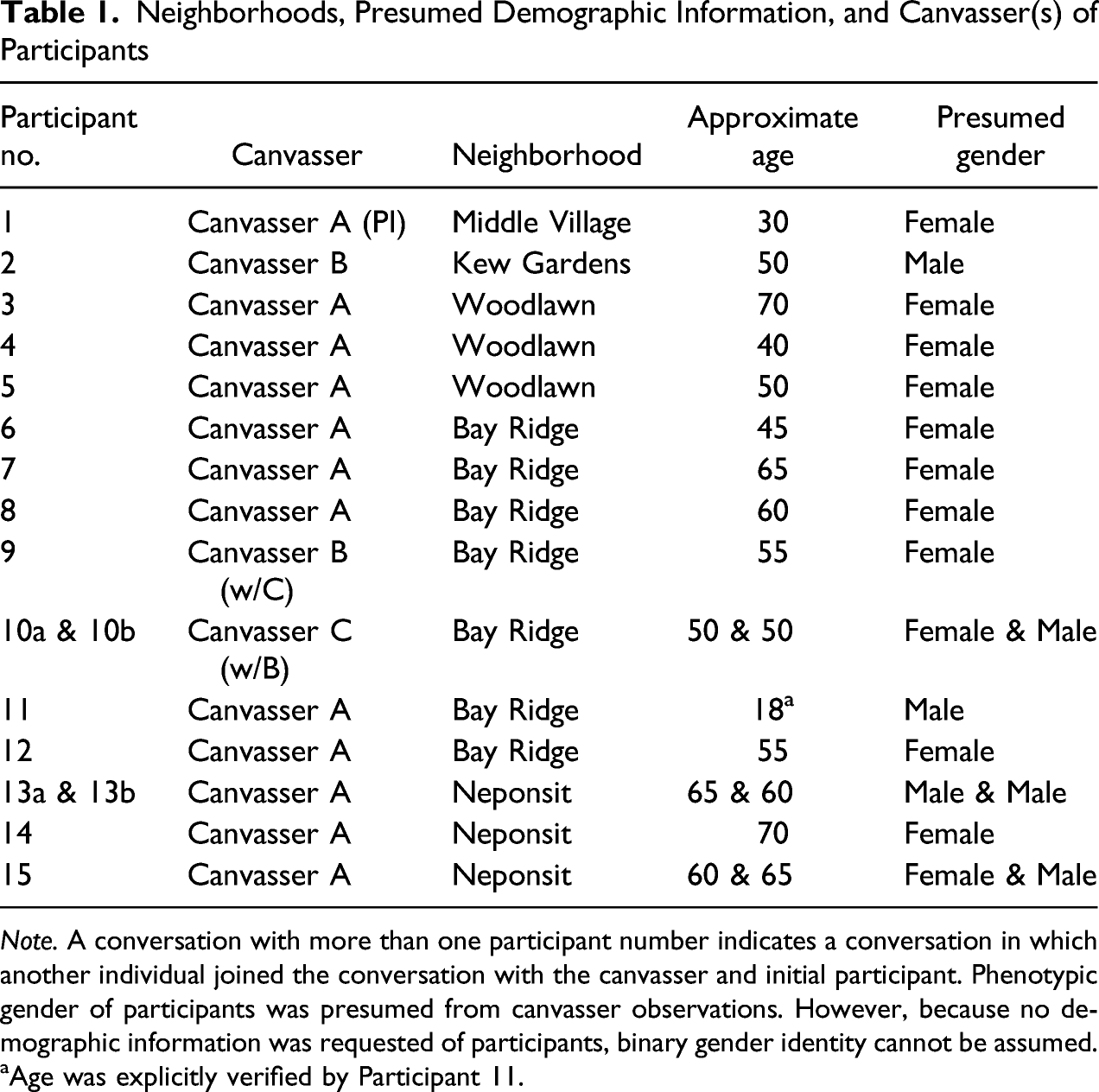
Note. A conversation with more than one participant number indicates a conversation in which another individual joined the conversation with the canvasser and initial participant. Phenotypic gender of participants was presumed from canvasser observations. However, because no demographic information was requested of participants, binary gender identity cannot be assumed.
aAge was explicitly verified by Participant 11.
Procedure
At the outset of each conversation, canvassers provided participants with a brief description of what the conversation would be about, along with the canvasser’s affiliations to SURJ-NYC and this study. Participants’ verbal consent to be recorded was then requested and documented on an audio recording device. Institutional review board approval was obtained for this method of acquiring consent, as well as for the explanatory materials provided at the end of each interaction. The first two canvassing outings used a video camera to record, but this approach was subsequently scuttled in favor of audio recording due to the prohibitively low number of people willing to consent to being video recorded. Thirteen of the 15 conversations were facilitated by a canvasser working alone, while two were facilitated by a duo of canvassers. Both approaches are commonly used by organizations engaging in deep canvassing.
An initial sample size of 15 was selected with the intention of collecting more if saturation was not attained, per qualitative research standards (Levitt et al., 2018). Following recommendations set forth by Hennink et al. (2017), code saturation, or the point at which no additional themes could be identified, was attained after the first nine conversations, and meaning saturation, or the point at which themes were sufficiently understood, was reached by the fifteenth.
Each canvassing conversation was conducted in a semi-structured way that followed an initial script (see Figure 1). After introductions were made and consent for participation and recording was obtained, the participant was then asked to take a stance on the idea of reparations. If helpful, they were encouraged to use a numerical scale (0–10) to assess their stance, although this scale was not used as a source of meaningful data for this study. If they seemed to have mixed feelings, a brief counterargument against reparations was then presented by the canvasser as a way to test how secure the participant was in their initial self-assessment. At this point in the conversation, before an effort was made to shift the participant towards a pro-racial justice perspective, the introduction of anti-racial justice ideas (a counterargument against reparations) is a deep canvassing technique that aims to help inoculate participants against being persuaded by these ideas in the future. Beyond this point, the conversation became more free-form, yet within the guidelines of soliciting the participant’s personal experiences that have informed their beliefs about reparations and other racial justice topics. The only instructions provided to canvassers for this portion of the interaction were that they avoid fact-based discussions and keep the conversation at the personal level through the canvasser’s use of their own stories and active listening skills.
Data Analysis
In addition to the 15 conversations entered into the analysis, two more conversations were lost to equipment malfunctions. Another nine were excluded due to not meeting the criteria of a validity check that assessed the presence of several key deep canvassing script components, including: sharing of at least one canvasser personal anecdote, an attempt to solicit personal stories from the participant, a minimum of ten minutes in duration, and the employment of at least one active listening skill, such as open-ended questions, reflections, or summarizing. The mean duration of the conversations was 20.7 min, with a range from 10.5 min to 35.5 min. All 15 conversations were transcribed by the PI and examined by both authors. The PI conducted the data analysis iteratively in consultation with the other two canvassers and with the second author through multiple meetings to examine and discuss evolving dialogical process themes and consider interpretations.
In the first step of the analysis, the PI listened to each recorded conversation while taking notes on the corresponding transcript. To organize the data for analysis, each utterance by both parties was assigned its own row in a spreadsheet, juxtaposed with vertical columns that referred to several aspects of speech that P. Sullivan (2012) suggested as foci of analysis, including general notes, voices present, rhetorical features, genre, discourse, and emotional intonation. The PI entered notes into one or more of these columns whenever an utterance was deemed to contain significant content that pertained to the heading. General notes referred to any aspects of what the PI, upon relistening, perceived in the dialogue that did not fit under the other headings, such as “canvasser redirects participant to the personal level” or “participant denies the importance of race.” This column often functioned similarly to the “transformation” column of Giorgi et al.’s (2017) phenomenological approach in that it was used to abstract the psychological meaning from raw utterances. Entries in the voices present column focused on the intrapersonal or interpersonal dynamics that the participants used to express themselves, such as “authorship of a nonpresent other,” which indicated that the participant gave voice to a nonpresent person (e.g., “Sometimes I hear people say...”). The rhetorical features column was used to capture a range of phenomena delineated by Bahktin (1993), such as “word with a sideward glance,” an utterance that suggested the participant was fearful of the judgment of others (e.g., “People don't like it when I say this, but...”), or “parody,” the repetition of another’s words with the intent of disagreeing with them (e.g., “She was like, ‘Oh, you have to be sensitive to what they’ve been through’ and all that”). Genre referred to the speech genre (Bahktin, 1986) that a participant employed, such as “epic,” a monological type of speech that recognizes a single truth. The discourse column was used to note any cultural discourses the participant used, such as “the virtue of work.” The emotional intonation column was used to capture nonverbal information about the participant’s speech.
In the next stage of analysis, common themes were gleaned from the entries in these columns through repeated rereading. Although the presence, or nonpresence, of cognitive dissonance and perspective taking were attended to throughout the analysis, an exploratory approach was chosen in order to consider a broader range of possible interpretations of the deep canvassing process and to allow themes to develop descriptively from the data. A list of commonly found themes was compiled and consolidated. In this process, a separation between content and process was made, as some themes captured specific content of utterances (mostly from the general notes and discourse columns) and others referred to more latent dynamics (mostly from the voices present column, informed by entries in the remaining columns). Both types of themes were drawn from the data simultaneously. Once preliminary themes had been developed from the first nine transcripts, the remaining six were analyzed, leading to saturation and finalization of the themes. Throughout the data analysis process, the PI consulted with Margo Jackson about potential biases with an aim for cultivating trustworthiness (Morrow, 2005). These consultations provided a constructive check on the analysis in the interpretive process and the adequacy of the data by including in-depth discussions about how themes were drawn from the specific data.
In the interest of space, only the process themes are presented in this article, as they pertain to our focus of dialogically examining the process of conversations using the anti-racist deep canvassing method. The content themes will be presented in a subsequent report that will describe and explore the explicit substance of the White American participants’ reactions within their conversations about reparations. Briefly, these excluded results found five common themes in participants’ responses: Defensive Reframing of Reparations, Reference to Cultural Discourses as Grounds for Rejecting Reparations, Rejection of Reparations for Nonracist Reasons, Problematizing Suggested Solutions to Inequality, and a Recognition of Inequality. It is important to note that the participants’ responses included a variety of forms of rejecting reparations, as this overall context of rejection likely influenced the process of their ambivalence while engaging in deep canvassing conversations.
Results
Process Themes and Subthemes and Their Prevalence in Anti-Racist Deep Canvassing Conversations
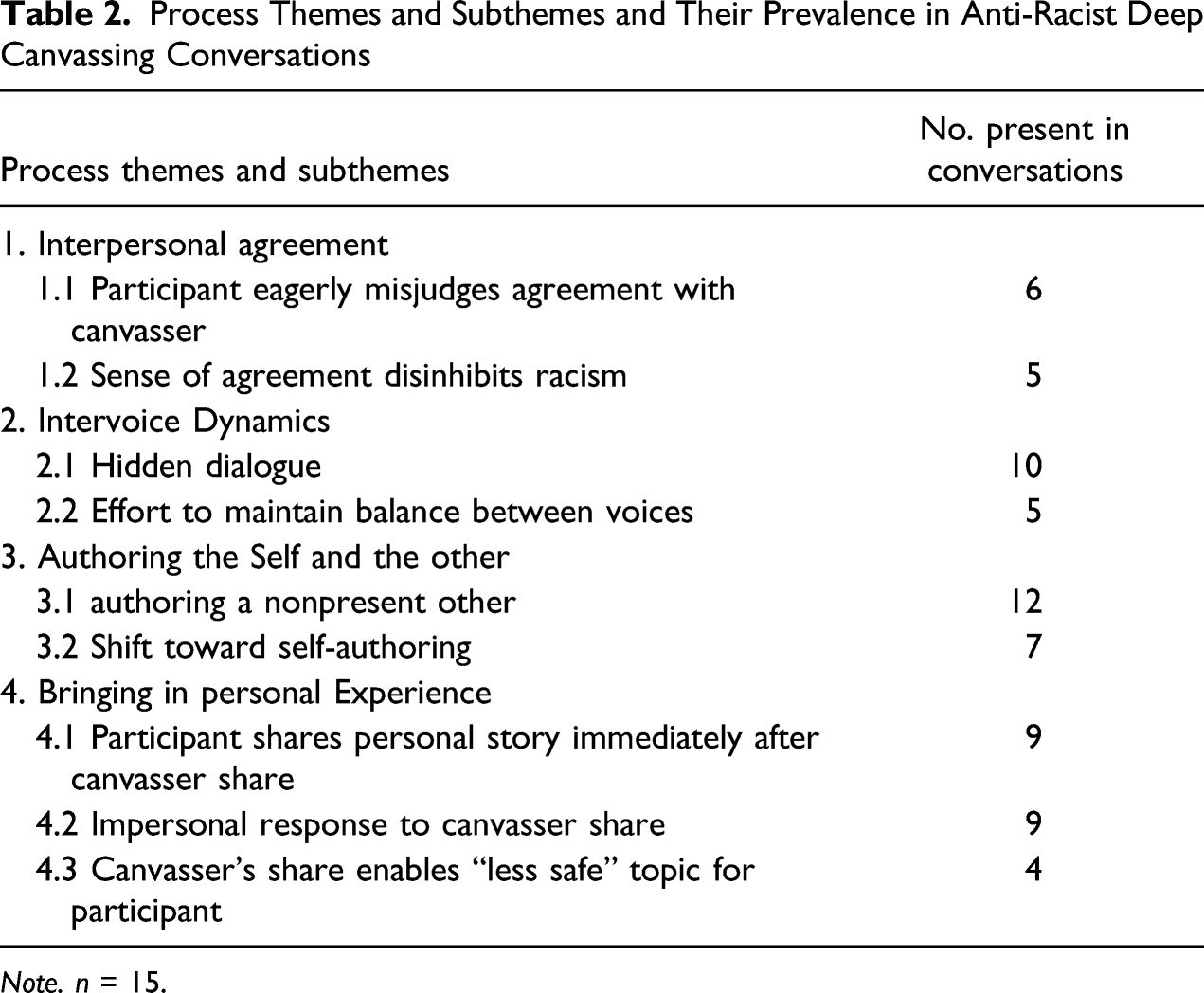
Note. n = 15.
Process Theme 1: Interpersonal Agreement
Developing a shared understanding is a key component of any deep canvassing conversation. To cite every example of an attempt to find agreement throughout the course of each conversation would be prohibitive. Instead, the subthemes under this heading represent the dynamics in which a sense of agreement between canvasser and participant seems to play an observably important role in the unfolding self-authorship of the latter; i.e., in the participant’s implicit construction of an understanding of themselves relevant to the topic of dialogue, reparations.
Process Subtheme 1.1: Participant Eagerly Misjudges Agreement With Canvasser
Many participants entered into enthusiastic agreement with the canvasser when the canvasser was attempting to make a point that differed significantly from what the participant had recently expressed. This often occurred towards the end of conversations, suggesting that this phenomenon may have been due to one or more cumulative factors, such as confusion resulting from mental exhaustion or a desire to ameliorate mounting inner tension (i.e., from cognitive dissonance). Importantly, this subtheme does not imply that participants’ confusion was completely unwarranted, since canvassers are not always clear and the topics under discussion are complex. Instead, the eagerness of the participant in misjudging agreement is the feature being highlighted in this theme. This dynamic most commonly arose when the canvasser was trying to reflect back the implicit understanding of the transgenerational impact of structural racism in something a participant said, and the participant received this reflection differently, as seen in this example. Canv: A lot of my clients who are, you know, formerly homeless Black people, people living in a supportive housing facility, people who never went to [college], people who never really made it financially. A lot of them say that their parents didn’t value school too. They tell me that’s because their parents’ parents couldn't go to school. P3: You’re right! Canv: It’s a generational thing. P3: Yes, you’re right. Mmm hmm. Canv: So, to me, that seemed like a really hard thing to get out of because it was, like, something from the past that’s still affecting them today. P3: Oh sure, “why should I [go to school] when I could get a check from the government?” That’s the mindset you get back. Why work when you can get money from the government?
Even though the perspectives shared by the canvasser and participant differed on the cause attributed to this transgenerational impact (structural racism vs. a racial stereotype on personal irresponsibility, respectively), the participant seized on a superficial trace of resemblance between her point of view and that of the canvasser to energetically assume they had reached common ground.
Process Subtheme 1.2: Sense of Agreement Disinhibits Racism
At other times, a participant’s sense that they were in agreement with the canvasser led to a notable increase in their expressing more overtly racist perspectives (i.e., as counter-arguments to reparations for racial justice). The following example occurred approximately a minute and a half after P8 made a very tentative statement about the current existence of reparations-style support programs. Here, she begins with a similarly uncertain tone but ends up making a much stronger, exclamatory statement about extant programs after the canvasser’s reflections give her a sense that they are in agreement. P8: Sometimes, I feel like there have been ways for it to work, but people didn’t take advantage or... I don’t know! But that’s what it seems to me. And I don’t think personally, just being Black or minority should be the factor. It should be like... poverty level or... financial across the board... Canv: Just somebody who needs something. P8: Somebody who needs something. Right. Canv: Yeah. P8: I don’t think because you check a box on an application… I think that there’s equally people of all race and colors and creeds that have had a problem with, because they come from a poverty level or no education or whatever, so... Canv: Like you said, you’ve seen some of these programs in place and you feel like they’re, uh... like they haven’t really worked. P8: Well... I mean they’ve been in place a long time, so why didn’t they work?!
Process Theme 2: Intervoice Dynamics
In P. Sullivan’s (2012) framework, dialogue occurs on many levels. The outer voices of the two individuals are in dialogue with each other, as are numerous voices within each individual. This theme refers to phenomena observed in which dialogical events at the intrapersonal level appeared to impact the interpersonal dialogue.
Process Subtheme 2.1: Hidden Dialogue
This phenomenon is a key feature of P. Sullivan’s (2012) framework for understanding dialogue. It refers to “a discourse full of sideward glances and anticipation of different viewpoints [that] continually clashes with the anticipations of alternative judgments and evaluations” (P. Sullivan, 2012, p. 56). P6 provided an example when, in her wrestling with the justifiability of reparations, she anticipated the perspective of a hypothetical other who responds to her attempts to problematize the idea. P6: What about the Jews? And their, you know, families that were killed? What about... OK, fine that didn’t happen here. But, you know... then are we gonna go and pay everybody for every wrongdoing that’s happened to anybody in the past? What about, what about Native Americans?
Hidden dialogues also tended to occur when participants were considering the logistical hurdles that a reparations initiative would face, as P2 does in the following example. He responded to imagined voices of hypothetical others asking “how?” and “by whom?” P2: I think that reparations should probably take the form of, say, um um maybe state universities granting scholarships to, uh, Students of Color who might not otherwise go to school, uh, maybe, uh, providing additional tuition assistance for Students of Color, something akin to affirmative action with school enrollment. Money? How do you do it? If we’re talking about reparations to say um, well, you know, I always compare it to um Jewish families who lost art during the Holocaust. If that’s, you know, you find a painting, then get the painting and return it. That’s easy. Um, but, you know, how do you provide reparations to People of Color for something, for acts that have taken place over the course of many years? And last but not least, reparations by whom? The United States? Well, that would be for people who were brought here, enslaved, but what about recent arrivals from Africa? You know, how do you go back, how do you document it?
Hidden dialogue often belies participants’ efforts to appear authoritative and singular in their self-authorship by revealing that they are in fact ambivalent and grappling with an inner split. In this excerpt, P3 responds to her own internal critique of the logic she uses to author the experiences and perspectives of her Black former co-workers in a way that solidifies her anti-reparations attitudinal position. Canv: So, you think that a lot of the guards that you worked with, some of the guards who were Black, they wouldn’t want to see any kind of reparations? P3: I would not think so. And the reason I’m saying that is because that never came up. And if it was that important, it would have come up. Mmm hmm. Yeah.
Process Subtheme 2.2: Effort to Maintain Balance Between Voices
The idea of self-persuasion in deep canvassing shares aspects of collaborative therapeutic change with the model of motivational interviewing (Miller & Rollnick, 2013). In both frameworks, an ambivalent individual is one who is actively responding to two opposing parts of themselves. Any direct attempt to deny the truth of one of these parts leads to its defensive resurgence, as occurred in this interaction with P2. This excerpt picks up after his hidden dialogue about the logistics of reparations (quoted in Process Subtheme 2.1). He was asked to “leave aside” his doubts, and he responded by reiterating with a more forceful, declarative form of doubt than before. Canv: Can you say more about why you are in favor, even like sorta leaving aside the implementation for a minute. What do you think reparations should do? And why? P2: Well, ideally what should reparations do, put the person whole. Impossible! You can’t quantify the harm. Impossible!
Within this striving for balance, from a deep canvassing perspective (Fleischer, 2017) it is often more effective to raise the person’s change-oriented voice, not by directly suppressing its opposite but by encouraging them to give it more voice (Miller & Rollnick, 2013). The canvasser does exactly this immediately after the quote above, and P2 responds with an enthusiastic elaboration of the pro-reparations sentiments that already exist within him. Canv: Yeah, so just the question of like, why do you think reparations is justified? I think you mentioned that. P2: Because, you know, these are people who were, generations who were lost. People who, you know, may have done wonderful things but they weren’t given the opportunity to have families, they weren’t given the opportunity. Um, you know, to own things and to build things, they weren’t given the opportunity, so it’s like a generation, you know hundreds of years of Black American history are just like you know torn away.
Process Theme 3: Authoring the Self and the Other
As discussed earlier, Bahktin’s (1986) notion of authorship is another key element of P. Sullivan’s (2012) framework that refers to the elaboration of an understanding of who someone is. For example, self-authoring statements are those that either begin with statements such as “I am,” “I think,” “I feel,” or otherwise provide information to their audience about whom the speaker thinks they are. Authorship of others refers to statements that put words in someone else’s mouth—an entity that may be real or imaginary, present in the dialogue or not present, concrete (e.g., “my sister thinks...”), or abstract (e.g., “people say...”). Bahktin (1986) stresses that these statements that author others are to be seen as meaningful statements about the person who has uttered them, like a self-authorship by proxy. Since a deep canvassing conversation asks for the experiences and opinions of an individual, it is likely to be replete with instances of self-authorship and authorship of others who are involved in the topic at hand. This theme refers to commonly observed forms of authorship that seem particularly relevant to the process of elucidating and shifting one’s attitude that deep canvassing attempts to bring about.
Process Subtheme 3.1: Authoring a Nonpresent Other
This subtheme refers to participants’ efforts to author a hypothetical individual in a tactical way. One common reason for doing so is to create a straw-man proposition with a point of view that is extreme and/or ignorant, against which participants can defensively position themselves to appear wiser or more reasonable. Most often, the participant represents the straw-man as a fully hypothetical person: P2: I think that you know one has to really approach this in an even-handed way. Because if you say ‘listen you dumb White cracker, pay reparations because you know, a slave owner,’ you know, I’ve come to the realization that, as much as I hate it, you can’t attack, because if you attack, then you get a counterattack and there’s no dialogue.
Other times, the straw-man is a caricature of a real individual or set of individuals. For example, P9 gives voice to shopkeepers in her neighborhood to position herself as less racist: P9: I’ve gone into some of the stores here where the owners say, “Oh, [Muslims] come in here, they buy things and then they use them and then they bring them back and then put them on the racks!!” I mean that might be true of a few people! P4 similarly positions herself in contrast to the racists she alleges live elsewhere—a tactic that S. Sullivan (2014) cites as common in attempts to portray oneself as a “good White person.” P4: I mean, they’re... White supremists [sic], in a way... I mean, a little bit racist, you know, not understanding [inaudible]. They just grew up in a certain environment or community and, you know... further upstate New York and whatever where they don’t see Black people or other cultures, you know what I mean?
Another form of authoring the other can be observed in participants’ attempts to project their feelings about reparations onto a nonpresent other. The content of these projections are often held in contrast to the content of the participant’s self-authorship, i.e., the perspective that they claimed to hold themselves. In this excerpt, P7 spends some time discussing how other people would feel about the idea of reparations before later revealing that these feelings are hers. P7: Ummmmm... to be honest, I don’t necessarily know when, if giving it out what people would really consider it... reparations, or just something to further and help them along... Because if you, if you phrase it as reparations, I think most people aren’t gonna be interested in doing it.
Finally, it bears mentioning that many participants showed great comfort in authoring a nonpresent other who is very central to the topic of reparations: Black people. Participants made a number of statements about the values, hopes, desires, and pains of Black people while admitting that they have had minimal contact with this group in their own personal experiences: Canv: OK. So you feel like [generational poverty] is an ambition question, too? P12: Mmm hmm. They’re comfortable. Canv: Have you uh, have you worked in a field where you got a chance to meet people who live in the projects? P12: I know people that live in the projects. Canv: Oh you do? P12: Yeah, down by um [name of] Hospital and everything, [name of] Ave. You know, they just have no desire to get out. Canv: Yeah. And have they given you a sense as to why they’re so comfortable? P12: Oh, it’s too much money, why should I pay that much rent, when I’m getting this, when I’m getting that!
Process Subtheme 3.2: Shift Towards Self-Authoring
As hinted at in the previous subtheme, some participants who began expressing themselves by way of authoring nonpresent others eventually moved into more confident self-authorship. For example, the following excerpt from P1 finds her attributing a point of view to herself that she had previously espoused when authoring nonpresent others. P1: That attitude will also... what about the people who didn’t partake in slavery? Reparations is hand-in-hand with slavery, right? Canv: Yeah, right, that’s how the playing field got so screwed up in the first place. P1: Yeah, which I acknowledge, that, like, my family didn’t own slaves we’re from immigrants that came well after that. So, like how could you validate that idea?
It is not clear if this more confident form of assertion built gradually and/or if it was a result of the moment of agreement with the canvasser. The following continuation of P7’s conversation, which picks up after her excerpt from the Process Subtheme 3.1 (“I think most people aren’t gonna be interested”), shows a similar movement. Canv: And it sounds like you would be in favor of supporting anybody who demonstrates any kind of need whether they’re Black or White or... P7: Ummm, yes. Any Hispanic, any any any [yeah] kind of immigrant that... Canv: OK. Would you favor just... I can see that notion of support for everybody, regardless of race. Do you think that African Americans deserve any kind of additional consideration because of what they’ve been through in the history of this country? P7: [Pause] Again, it would depend on... I’m not, like, to be honest, I’m not really sure at this point whether... I would call it reparations.
She moves from worrying about what other people will think about the term reparations to saying that she would not use the term. We wondered if she felt more comfortable discarding the term after having a chance to state her alternative, deracialized proposal and have it reflected back to her, securing her status as a “good White person.” It is unclear. But this shift from authoring others to self-authoring appeared to be a common phenomenon in our data analysis of process themes.
Process Theme 4: Bringing in Personal Experience
As noted above, one of the key elements of a deep canvassing interaction is the solicitation of the participant’s personal stories that relate them to the topic under discussion. Canvassers are trained to use their own personal stories to model the kind of vulnerability that doing so would require of the participant. The subthemes discussed next detail the most common dynamics observed around this sharing.
Process Subtheme 4.1: Participant Shares Personal Story Immediately After Canvasser Share
Following is one of many examples; in this instance the canvasser had just shared a story about growing up in a racially diverse neighborhood. P9: Hmmmm. Interesting. Well, I was raised in a very conservative part of New York City, [name of the area], and my parents were very loving people, and they taught us to love. OK, so I got a great gift. In life. However! There weren’t really very many Black people in my area umm, you know, it was a pretty White community…
Process Subtheme 4.2: Impersonal Response to Canvasser’s Share
Participants would often respond with impersonal content after the canvasser shared a personal story. This runs counter to the expectations of the deep canvassing methodology. In the following example the canvasser tells a story about his friend’s emotional challenges working as a teacher in an underfunded NYC school in a Black neighborhood. P6 responded, “Right. Well, actually, you know, that brings up a good point. I have seen, and I don’t remember, I don’t remember, probably on 60 Minutes, there are programs [that support children from underfunded schools]...”
Sometimes, it appears that the impersonal content is being employed as a way to defend against the content of the canvasser’s story. For instance, the following excerpt is from a conversation with a couple in which the canvasser was hardly allowed to share anything due to one participant’s insistence on lecturing him about American history. The following exchange occurred around the 10-min point and marks the first instance of the canvasser being able to share an uncomfortably different point of view with the participants. Canv: [Shares a story about traveling abroad in Africa] In [name of African country], I’m still carrying around... I still get, if anything, more respect as a White person there... P10b: People in [name of the country in Africa] are generally very nice people. Canv: Very nice, but especially to White people, I think, in the, in the same way that like White people generally command a lot of authority and respect in the U.S. I think that’s pretty universal, like almost anywhere in the world that I’ve gone, I’ve felt that to a certain extent. So, I wonder… when we think about division between races, I think that is a problem, and I think in addition to acknowledging that problem, there’s a power imbalance, right? Like I think, in many ways, White people, even if there are lots of White people who are suffering… P10a: [interrupting] Can I bring you a glass of ice water?
Process Subtheme 4.3: Canvasser’s Share Enables “Less Safe” Topic for Participant
Many times, after the canvasser shared their story, participants were seen moving into areas of conversation that seemed riskier than anything previously covered. The participant’s focus shifted to expressing more personally and openly the more controversial justifications for their perspectives against reparations that could be judged as racist. In the following example the canvasser had just shared a story about a gifted former therapy client, a Black man, who lost career opportunities and became homeless due to his family’s inability to send him to college. P8: Well, let’s just say, um, just gonna say education say... like um... like you said, this fellow was a very bright guy. Sometimes, I feel like the way applications go for schools or stuff that, it’s um kinda skewed to help [Black people] get an education now. And... um... almost a hindrance to somebody who maybe, say like from... say, my kids.
P8, who had been very guarded about saying anything controversial before the canvasser shared his personal story, then discussed her own children and claimed that they had been discriminated against. It seems that the moment of canvasser vulnerability had a disinhibiting effect on her, perhaps by giving her a sense that she was able to speak more freely without fear of reprisal.
Taken together, these themes capture the most common interpersonal events that arose when participants were invited to reconsider their attitudes about reparations and other topics pertaining to racial justice in the process of a deep canvassing conversation. They represent an important step towards further understanding and developing this method of dialogue for more effective use in creating attitudinal change toward racial justice goals. More broadly, these dialogical process themes may have implications for the understanding of racial prejudice attitude change and other social psychological phenomena underlying constructive racial justice action interventions.
Discussion
The common elements of the dialogical process found in anti-racist deep canvassing conversations facilitated by this study’s canvassers represent a substantive, although not exhaustive, compendium of ways in which 15 White individuals responded to attempts to consider and explore the racial justice topic of reparations. In the process of considering justifications for or against reparations, the themes that were derived highlight some key intrapsychic and interpersonal patterns participants appeared to use when they defended their perspectives supporting racial injustice, as well as when they became open to changing their perspectives to supporting racial justice. These patterns represent an empirical answer to the central research question of what occurs during the process of anti-racist deep canvassing conversations.
The results also provide some evidence to support the prior suggestions (Fleischer, 2017) discussed in the introduction that cognitive dissonance plays a role in deep canvassing conversations. For instance, participants’ misuse of agreement, detailed in Process Subtheme 1.1 (participant eagerly misjudges agreement with canvasser), may be interpreted as a response to the presence of cognitive dissonance. This interpretation is corroborated by previous findings in conflict management research that indicate that false agreement is a common way to avoid interpersonal conflict (Hample & Hample, 2019; Oetzel et al., 2000; Sillars & Wilmot, 1994). This desire to withdraw from conflict often evidences uncertainty about one’s attitudinal position that may indicate the presence of cognitive dissonance (Roloff & Wright, 2009). Considered in light of these previous findings, this subtheme may represent a kind of interpersonal “escape hatch” from such dissonance. This false agreement often arose later in conversations after enough time had elapsed for some participant’s core personal values to come into conflict with incongruent positions on racial justice topics. If participants could then use this false agreement to convince themselves that they were on the same page as the canvasser, it may have lent them a feeling of congruence with the canvasser that compensated for the growing sense of disharmony within themselves. Thus, identifying this process theme in deep canvassing conversations provides some empirical support for the importance previously ascribed to cognitive dissonance by The Leadership Lab (Fleischer, 2017).
Process Subtheme 2.1 (hidden dialogue) might also be interpreted as evidence that deep canvassing participants are responding internally to cognitive dissonance elicited by the conversation. These hidden dialogues bear a strong resemblance to the “retesting the validity of undesired attributes” of an attitudinal position that Maio and Thomas (2007) cite as a common tactic of deliberate self-persuasion. Consistent with Maio and Thomas’ (2007) model, this tactic tends to be used by individuals who engage in epistemic approaches to self-persuasion, or approaches that strive to form a new attitude in a truth-seeking way that is motivated by a search for internal congruence and dissonance reduction. An epistemic approach is viewed as nonavoidant and capable of producing more change to one’s self-construct. The discovery of this theme and its linkages to Maio and Thomas’ (2007) model of self-persuasion gives deep canvassing more empirical traction as an intervention with the capacity to induce the lasting attitudinal change it purports to bring about.
There is also support in these findings for the role of perspective-taking, specifically in Process Theme 4 (Bringing in Personal Experience). It may be that a participant who responds to a canvasser’s story with their own personal sharing (Process Subtheme 4.1) does so because they have looked through the novel lens provided by the canvasser’s story and felt an empathic resonance between what they saw and their own life experiences. More speculatively, it may be that some of the more impersonal responses to canvassers’ disclosures (Process Subtheme 4.2) were defenses against feelings of empathy that this perspective taking elicited. In either case, the results provide evidence for the assertion that perspective taking is a cornerstone of the deep canvassing method. Furthermore, the variability of responses to canvasser sharing suggests fertile ground for future research on perspective taking that might elucidate its role in prejudice reduction interventions.
Although the discovery of evidence that cognitive dissonance and perspective taking may indeed be at play in deep canvassing conversations, and is an important outcome of the current study, the study’s approach was more exploratory than confirmatory. The results thus also provide an experience-near, empirically-grounded assessment of deep canvassing that does not rely on preexisting theories. In addition to evidence for the presence of previously hypothesized elements of deep canvassing, the picture of the methodology painted by the results also diverged in important ways.
One such divergence was the higher degree of complex interpersonal motivations found in the canvassing conversations recorded in this study, in comparison to previous ideas of how deep canvassing works. The interpersonal importance of the role of the canvasser is often framed as simply being a nonjudgmental presence who models vulnerability and encourages participants to share their personal stories (Fleischer, 2017). However, the results of the current study suggest that there is a much richer interaction going on between the canvasser and the participant that must be attended to. One example of interpersonal complexity affecting canvassing conversations is the currently unexplained diversity of responses to canvasser shares, captured by Process Theme 4 (Bringing in Personal Experience) and its subthemes.
Another example is Process Subtheme 1.1 (participant eagerly misjudges agreement with canvasser), which suggests that a participant may place a great deal of importance on being on good terms with the canvasser. Taken further, this may imply that the attitude shifts observed in deep canvassing conversations are, in part, a form of impression management. Reductions in racial prejudicial attitudes that are motivated by a desire to portray oneself favorably to others often represent real attitudinal shifts (Leippe & Eisenstadt, 1994), so organizations using deep canvassing need not worry. However, they may benefit from recognizing that the social pressure exerted by the gaze of the canvasser may be an important element for further study and development as the method is improved upon. More generally, future deep canvassing research and practice would be well-served by the application of a more psychologically-informed lens.
Another surprising finding that diverged from other presentations of deep canvassing was the complete lack of overt, verbal acknowledgment of an attitude shift in any of the participants. In exemplar videos used in deep canvassing trainings (e.g., Fleischer, 2017; LA LGBT Center, 2016), participants can be seen shifting their attitudes by the end of the conversation. In the results of the current study, participants were instead seen responding to cognitive dissonance by either ending the conversation without resolving it (Process Theme 2: Intervoice Dynamics) or, as discussed previously, attempting to resolve the associated tension by positing a false interpersonal congruence (Process Subtheme 1.1: participant eagerly misjudges agreement with canvasser). Furthermore, several participants showed no evidence of cognitive dissonance at all.
There are many possible reasons for this difference. One may be a differential between the skill levels of the canvassers in this study and those who took part in developing the deep canvassing method with The Leadership Lab over the course of nearly a decade. Another may be the fact that the exemplar conversations that the Leadership Lab uses for training and presenting the method publicly are exactly that—exemplary—and thus, do not represent the typical deep canvassing conversation. A third reason may be cultural differences in attitude strength and durability found between New York City, where the current study took place, and Los Angeles and Miami, where two cited exemplar conversations were recorded. Another reason still may be the fact that both example videos featured canvassers who were members of the social group whose rights were being advocated for in the conversation, which may have introduced a form of social pressure that was not present in the current study, which had White canvassers advocating for reparations for Black Americans. Finally, the difference may also be due to the relative strength of White Americans’ attitudes about race, which serve a variety of psychological functions for them (Altman, 2006), in comparison to their attitudes on the topics discussed in the example videos (marriage equality and workplace protections for transgender people).
The lack of clear resolution about the cognitive dissonance seen in the current study’s participants and the broad array of variables that may potentially explain it, underscore the need for future research on deep canvassing to be empirically-grounded and sensitive to the context in which it takes place. Social justice organizations that use the method in the future should do so with scripts that address a variety of social injustices, in a variety of cultural contexts, with a staff of volunteers of varying levels of skill, experience, and personal connection to the issue at hand. The results of the present study and all future action research on deep canvassing projects should be interpreted in light of these real-world, on-the-ground factors in order to be of greatest value to prejudice reduction efforts.
Implications for Advocacy, Practice, Education/Training, and Research
Advocacy
The discovery-oriented nature of the study generated results that have successfully grown understanding of the deep canvasing method. As more social justice organizations incorporate deep canvassing into their work, they can draw from the themes and subthemes of the current study to enhance their canvasser trainings and their internal processes of iteratively improving their approach to canvassing. Discussions about what happens in deep canvassing conversations—either in hindsight, as canvassers debrief, or prognostically, in the training of new canvassers—are now able to have considerably more structure due to the discovery of these common conversational elements. From this more structured place, new canvassers can begin with more confidence and skill, and experienced canvassers can explore how to use these newly identified elements to their favor in future outings.
For example, in past deep canvassing trainings led by the PI, it has been common to hear questions from trainees about how to appropriately express their acceptance of the participant when they speak freely about their prejudiced attitudes. If the deep canvassing approach uses connection to invite this kind of vulnerability, where does one draw the line between doing this in a way that draws out prejudiced attitudes in order to change them and doing so in a way that provides intersubjective validation of them? To date, it has been hard for trainers to respond to these questions, and new canvassers often state in debriefing sessions that they feel like they might have reinforced a prejudiced attitude.
Process Subtheme 1.2 (sense of agreement disinhibits racism) speaks directly to this challenging question. This finding represents a phenomenon in which a participant assumed (often mistakenly) that they and the canvasser were in agreement on an issue, and this seemed to enable the participant to reveal a racist attitude. This is congruent with how acceptance and empathy are meant to function in deep canvassing conversations. Similarly, process subtheme 4.3 (canvasser’s share enables “less safe” topic for participant) highlights a phenomenon in which a canvasser’s vulnerable sharing about an experience with race they have had as a White person, enables the participant to more readily share controversial beliefs. This is also the kind of modeling of vulnerability that fits within the ethos of deep canvassing. However, Process Subtheme 1.1 (participant eagerly misjudges agreement with canvasser) speaks to a way in which a participant can seek out an illusory sense of agreement that diffuses productive tension between themselves and the canvasser, and may lead to reinforcement of a prejudiced attitude. Distinguishing these phenomena in deep canvassing trainings would reduce the aforementioned confusion of first-time deep canvassers and greatly increase their effectiveness.
The discovery of Process Theme 2.2 (effort to maintain balance between voices) suggests another implication for advocacy: the possible application of motivational interviewing (MI; Miller & Rollnick, 2013) skills in the facilitation of anti-racist attitudinal change through deep canvassing or other prejudice reduction interventions. Deep canvassing trainers could fruitfully adopt some MI language and tactics, such as evoking change-talk or strengthening commitment, and thereby draw on the wealth of training materials available on the MI approach. In the PI’s experience as a deep canvassing trainer, trainees often ask for more concrete skills training. The results of this study suggest that the introduction of MI elements might fruitfully meet this need.
More broadly, this discovery of a synergy between a psychotherapeutic methodology (MI) and a social justice methodology makes a valuable contribution to the goal of counseling psychology to expand its capacity for providing evidence-based interventions in the service of social justice action (e.g., Fox, 2003; Vera & Speight, 2003). By providing a new bridge between these two worlds, the current study further enables counseling psychologists to contribute to iteratively developing, informing, and effectively using prejudice-reducing interventions such as anti-racist deep canvassing methods in real-world contexts as advocates for groups they serve. These efforts may contribute to effecting broader social change.
Practice
The similarities between deep canvassing and clinical work are such that the results of the current study also contribute to clinicians’ ability to address racist prejudicial beliefs in their clients in an inviting and nonaggressive way. Holding racist prejudicial beliefs is often deleterious to the holder in a way that warrants clinical intervention (Thompson & Neville, 1999). The results of the current study provide a clinically-relevant sense of how a White therapy client might respond when these attitudes are called into question in dialogue with a therapist. Process Theme 2 (Intervoice Dynamics) and its associated subthemes are particularly relevant in that they provide insight into how a client might manage a conflict between various self-states when reconsidering a prejudicial belief. Process Theme 3 (Authoring the Self and Other) and its subthemes are similarly helpful in that they could be used to inform a clinician’s sense of how this process of reconsideration impacts a client’s self-concept. The themes discovered in the current study thus enhance clinicians’ ability to frame and confront racist prejudicial attitudes as part of their clients' clinical concerns.
Education/Training
The results of the current study may also contribute to the training of new counseling psychologists. Counseling psychology has increasingly recognized the need for structural competency training in the education and supervision of early career clinicians (Ali & Sichel, 2014). A number of authors have suggested the importance of facilitating the supervisee’s awareness of their own place within systems of oppression and privilege (Chang et al., 2009; Glosoff & Durham, 2010), often through the supervisor’s use of vulnerable self-disclosure (Fernando & Herlihy, 2010) or modeling of self-reflection (Asakura & Maurer, 2018). These approaches are likely to elicit a dialogical reconsideration of White supervisees’ ideas about societal racial dynamics, and their place within them, that share much in common with the deep canvassing conversations examined in the current study. Supervisors and educators could thus use elements of the deep canvassing approach informed by the results of this study to guide their efforts to elicit, understand, and work with any prejudicial attitudes that may impede supervisees’ development into structurally competent counselors.
Furthermore, it is not only supervisees but also educators and supervisors who face challenges in their critical consciousness of structural inequities influencing therapeutic processes, particularly in examining their own intersecting identities of power and oppression in interactions with supervisees and clients (Jackson & Mathew, 2017). Counseling psychology trainers and practitioners might consider elements of the deep canvassing conversations documented in this study as a way to examine interpersonal processes that may reduce racial prejudicial attitudes, facilitate structural understanding, and increase perspective taking.
Research
The results of the current study offer several implications for future research. First and foremost, it represents a leap forward in our understanding of how deep canvassing conversations function that could facilitate the formation of hypotheses about how the method functions. For instance, a future study that aims to correlate an outcome measure of attitude shift with several potentially causal conversational elements now has a list of such elements that can be used to develop hypotheses. The elements represented by the results of the current study would be more suitable than the previously hypothesized elements (cognitive dissonance and perspective taking) in that they are empirically derived from specific conversational moments, which makes them more precise and suitable to be operationalized in future studies.
Additionally, the current study opens up new avenues for research on cognitive factors that have previously been known to play a role in prejudice. For example, Process Subtheme 1.2 (sense of agreement disinhibits racism) may speak to an updated understanding of the effects of racial entitativity, or the sense that one’s racial group has a coherent group identity. This subtheme corroborates the previous findings that individuals feel less inhibited in making racist prejudicial statements when they have a heightened experience of racial entitativity (Effron & Knowles, 2015), as it often arises when the White participant feels themselves to be “on the same page” as the White canvasser when it comes to attitudes towards Black people. At first glance, this may seem like an undesirable outcome. However, taken with a previous finding (McFarland et al., 1984) that individuals who feel they do not need to present themselves in a way that is counter to their attitude about a topic under discussion are more likely to reconsider this attitude in a lasting way, it may point to an important new facilitative factor in deep canvassing and other prejudice reduction interventions. Future research could experimentally manipulate this and other conversational elements uncovered by the current study in the service of advancing our knowledge of how prejudice functions, and toward enhancing our interventions against it.
Furthermore, the application of Bahktin’s (1986, 1993) framework for dialogical analysis provided an innovative lens on prejudicial attitudes and outlined several novel cognitive factors that may represent fruitful new avenues of research. Perhaps the most significant of these can be found in Process Theme 3 (Authoring the Self and Other). This theme and its associated subthemes are predicated on Bahktin’s (1986, 1993) notion of self-definition as a process of authoring oneself and others through dialogue. As noted above, it remains unclear what participants’ reasons for engaging in these forms of authorship were, their preference for one over the other, and their decision to shift between the two over the course of the dialogue. Yet, the prevalence of these dialogical events in the 15 conversations analyzed (see Table 2) speaks to their centrality in the process of responding to a request to reconsider one’s prejudicial attitudes. An extensive literature search for previous work on this phenomenon turned up nothing of note to date. Bahktin’s notion of authorship thus remains a rich, underutilized concept that could be used for framing future research on psychological processes present in dialogues that promote anti-racist attitude change.
A second Bahktanian concept that may represent a useful lens for future research on prejudice is that of hidden dialogue (Process Subtheme 2.1). This term captured an important element of participants’ self-persuasive process that has been understudied to date, other than the aforementioned similarity to aspects of Maio and Thomas’ (2007) model of self-persuasion. Future research can use the lens of hidden dialogue and other associated ideas within Bahktin’s work (1986, 1993) to elucidate the intrapsychic cognitive processes of self-persuasion in greater detail than ever before.
Finally, the current study represents one of the first peer-reviewed uses of P. Sullivan’s (2012) method of dialogical analysis. The results demonstrate the ability of the method to go beyond the content of the speech of each individual in the dialogue and bring attention instead to dialogical events that transcend the words spoken. The potential applications of this analytic framework are too numerous to mention. Any line of research that seeks to understand how individuals come to define or redefine themselves in dialogue with others could put this methodology to productive use. Most germane to the current study, it is clear that this framework would be valuable to future research on the interpersonal processes at play in dialogues aimed at changing prejudicial attitudes.
Limitations
One limitation of the current study was that the same canvasser facilitated 12 of the 15 conversations used in the analysis. The particular biases and strengths of the canvasser are likely to have influenced the process and outcomes of the data collection and analyses in this study. Although this canvasser reflected and consulted on possible biases during the study, future research is needed to further examine the influence of the canvasser on the intervention.
As another limitation, at minimum for describing participants, no demographic data were collected in this study so as to not disturb the conversations any more than necessary. Future research that examines differences in demographic status characteristics of both canvassers and participants in anti-racist deep canvassing conversations might find meaningful differences in participant responses across factors such as age or gender. For instance, the PI’s experience as a canvasser has suggested that male participants may show a greater level of rejection of governmental intervention in addressing inequality, firmer commitments to ideologies that prevent them from responding vulnerably to canvassers’ stories, and more aggressive approaches to seeking agreement with the canvasser.
Another limitation was the homogenous age distribution of participants in this study. The average estimated age of participants is 53.2 years, with a standard deviation of 13.7 years and a skew toward the advanced middle aged. This likely reflects the skew in individuals who are most likely to be home on a weekend and willing to have lengthy conversations with strangers. Although this skew could not be avoided due to the procedure of knocking on random doors, it is likely to limit any generalizations drawn from the results, as responses to attitude change interventions are highly variable across age groups (Visser & Krosnick, 1998). Notably, the one 18-year old in the study was the only participant to respond to a canvasser question in a way that verbally acknowledged that it had made him reconsider his position (“That uh, that’s a great question… I [as a White person] never would have noticed [bias in college admissions] if it did exist”).
The contributions made by the current study to our understanding of the deep canvassing method were also limited by the fact that the results are drawn exclusively from conversations about reparations and racial justice. Although any individual deep canvassing conversation must by necessity focus on one topic, the method itself is applicable to many. Still, it remains to be seen whether the results drawn from deep canvassing conversations on one topic will be applicable to conversations on others. To overcome this limitation, future research and development of the method would be well-served by not viewing deep canvassing as a monolithic entity and allowing it to function differently in different arenas of social justice work.
The study was also limited insofar as it was the study canvassers’ first experience with the process of recording conversations for later playback and iterative learning, despite their ample experience with the method. When these conversations were played back to them, the three canvassers were able to spot ways in which they did not fully adhere to the deep canvassing approach. Of course, it is unlikely that any canvasser will ever facilitate a perfect deep canvassing conversation. However, the current study’s results should be seen as reflecting conversations that occur at a prefeedback stage of skill development. This limitation should also serve to underscore the value of having canvassers record their conversations and participating in iterative learning to continue building their skills.
A final limitation was the lack of data collected about the body language used by participants in these conversations. Consent to record video was only obtained for P1; the rest of the participants were either asked to consent to video but only consented to audio (P2, P9, P10a, and P10b) or were only asked to consent to audio (all others). Had there been a greater number of canvassers or a longer window for data collection, the high decline rate could have been endured, and video collection could have been kept as the standard for the study. As it stands, the current study draws its results only from verbal and tonal aspects of participants’ voices.
Footnotes
Acknowledgment
The authors extend many thanks to Leah Thompson and Cory Hargus for their participation as canvassers in the current study. We thank Joseph Ponterotto, Leah Thompson, Tom Weinrich, and Kristen Brock-Petroshius for their expert consultation in the formulation, analysis, and feedback on initial drafts of the study. We thank Jennifer Hadlock, Katie Unger, and Chris Akel for developing the SURJ-NYC’s Deep Canvassing method and reparations script, and for training the principal investigator in the method.
Declaration of Conflicting Interests
The author(s) declared no potential conflicts of interest with respect to the research, authorship, and/or publication of this article.
Funding
The author(s) received no financial support for the research, authorship, and/or publication of this article.
