




Abstract
Despite the call to internationalize counseling psychology and calls for improved mentoring to Asian international students enrolled in counseling psychology training programs, there is a dearth of literature to help trainers understand this population’s clinical training experiences. The present study explored the practicum experiences of Asian international students (N = 10) in counseling psychology programs using the consensual qualitative research method. Data analysis yielded five domains: Learning Outcomes, Challenges, Resources, Behavioral Strategies, and Suggestions. Participants described how they navigated their cross-cultural practicum training in the face of unique challenges and how they adapted, as well as relied on support systems. As our participants reflected on their cross-cultural clinical training experiences, they shared the lessons they learned and provided suggestions for current and future international students, supervisors, and programs. Scholarly and practical implications for this population are discussed.
Keywords
International counseling psychology students have played a critical role in the broadening of counseling psychology across countries. The present study provides an overview of Asian international counseling doctoral students’ practicum training experiences in U.S. programs. Participants shared unique challenges as international counseling trainees and offered strategies to navigate their cross-cultural practicum training experiences. Findings from this study provide practical implications for training, practice, advocacy, and research.Significance of the Scholarship to the Public
In light of the steady increase in international trainees seeking counseling psychology degrees in the United States, there has been a gradual effort to internationalize, or promote the development of international perspectives in, counseling psychology over the past few decades (Wang & Heppner, 2015). As part of the remarkable effort of many counseling psychologists to internationalize counseling psychology, the International Section of Division 17 (the American Psychological Association’s Society of Counseling Psychology) was launched in 2007 and international issues were recommended for inclusion in counseling psychology curricula (Marsella & Pedersen, 2004). Since that time, U.S.-based international psychology networks such as the Taiwan Psychology Network and Korean Psychology Network were started (Wang & Heppner, 2015). According to 2018 data from the American Psychological Association (APA), approximately 5% of professional trainees in counseling and clinical psychology programs were international students (APA, n.d.).
The movement toward internationalization has shaped the content of scholarly publications in the International Forum of The Counseling Psychologist (TCP; Kwan & Gerstein, 2008). Wang and Heppner (2015) identified three major themes of international counseling psychology articles in TCP: training models in other countries, promoting the internationalization of counseling psychology, and mental health issues of non-U.S. individuals. Other authors have noted that international students play an essential role in the internationalization of counseling psychology and they have highlighted the importance of effective training of international students (Turner-Essel & Waehler, 2009).
Although multicultural training issues are an important part of counseling psychology, the counseling community has paid less attention to the educational and clinical aspects of international trainees’ experiences than to those of Euro-American and ethnic minority trainees in the United States (Mori et al., 2009). The literature suggests that international counseling trainees differ from U.S.-born racial minority trainees in many respects, such as acculturation level, language concerns, and cultural norms (Bernard & Luke, 2015; Ng & Smith, 2009; Nilsson & Wang, 2008; Mittal & Wieling, 2006). Lau and Ng (2012) found that international counseling graduate students reported that they experienced a discrepancy between programs’ emphasis on multiculturalism and an absence of multicultural dialogues and trainings for them in clinical practice. More attention needs to be paid to the international population in the counseling psychology community. Next, we address some of the key issues.
The Role of Acculturation
The counseling psychology literature indicates that acculturation is a critical factor in understanding the clinical experiences of international counseling students (Mori et al., 2009). According to Berry and Sam’s (1997) model, psychological acculturation and adaptation refer to the psychological process in which an individual adopts, acquires, and adjusts to a changed cultural context. Scholars who have examined acculturation in clinical settings have reported that international counseling trainees with higher levels of acculturation are more likely to experience higher levels of clinical supervisory working alliance (Ng & Smith, 2012; Nilsson & Anderson, 2004). In addition, high acculturation and strong clinical supervisory working alliances improve self-efficacy and the effectiveness of clinical supervision (Nilsson & Anderson, 2004).
However, in the process of adjusting to a changed cultural context, individuals experience acculturative stress (Chavajay & Skowronek, 2008). In a study of international counseling students providing counseling services to U.S.-born clients, researchers highlighted that international counseling trainees experienced emotional distress, ranging from anxiety and increased cognitive load to internalized stereotype threat in their daily lives as counseling trainees, and the researchers pointed to the potential impact these stressors could have on other aspects of their educational experience (Pérez-Rojas & Gelso, 2020). Other studies suggest that trainees may experience discomfort with asserting their concerns or needs with their supervisors and faculty due to cultural proscriptions against “talking back” to people in authority (Mittal & Wieling, 2006; Ng & Smith, 2012). These experiences likely affect the emotional and cognitive functioning of international counseling trainees at an individual level and in social interactions with their peers, supervisors, and faculty (Smith & Khawaja, 2011).
Berry (2006) also discussed acculturative stress and coping. For example, he explained that individuals who use adaptive coping are more likely to experience low acculturative stress. However, only a few previous studies have examined coping strategies of international trainees in clinical settings (Chen, 2004; Mittal & Wieling, 2006; Woo et al., 2015). One study (Woo et al., 2015) examined coping strategies employed by international doctoral supervisors in counselor education programs. Other research teams also examined the cross-cultural transition experiences of counselor trainees in Canada from non-Western cultures (Chen, 2004) and general training experiences of international trainees in marriage and family therapy programs (Mittal & Wieling, 2006). The researchers addressed coping strategies in their findings such as enhancing interpersonal communication skills, networking, and self-directed approaches. However, given the high engagement of practicum training in APA-accredited programs, further studies are needed to explore psychological processes and detail-oriented coping related to cross-cultural challenges in practicum experiences with clients, supervisors, and faculty.
Building on existing acculturation work, Miller et al. (2013) explained that acculturation is a multidimensional process. His research team found Asian American college students use different acculturation strategies (e.g., separated, assimilated) in different contexts. Miller et al. (2013) suggested that more studies are needed to extend acculturation research to contextual (e.g., geographic location, community cultural climates) and individual (e.g., demographic backgrounds, personal characteristics) factors. From this perspective, further studies are needed to explore practicum training domain specific acculturation strategies with consideration of contextual and individual factors (e.g., adaptive traits, social supports, contextual barriers).
Contextual Barriers and Supports
Scholars have addressed the broad range of internal and external barriers related to international counseling trainees such as cultural adjustment problems, social and/or interpersonal problems with supervisors, and language concerns in prior studies. For example, some studies of international counseling trainees have reported cultural adjustment concerns (Chen, 2004; Mittal & Wieling, 2006; Pérez-Rojas & Gelso, 2020). In particular, international counseling trainees may face cultural concerns when interacting with U.S.-born clients in understanding their clients’ cultural norms, nonverbal norms, and subtle underlying cultural clues (Nilsson & Anderson, 2004). In one study, researchers stated, international trainees need to “learn a new way of being, talking, and thinking to adapt to their new cultural context” (Mittal & Wieling, 2006, p. 378).
In terms of supervision, international students from hierarchical cultures in Asian countries may experience confusion in U.S. training settings, as they experience less hierarchical relationships with their supervisors or practicum instructors (Park-Saltzman et al., 2012). Additionally, many Asian international counseling trainees from homogenous cultural contexts may face challenges in multicultural clinical training settings (Qi et al., 2019). Cultural differences, including verbal and nonverbal communication, may cause ambiguity, dissatisfaction with their supervision, and the possibility of being misunderstood by their supervisors (Qi et al., 2019).
Concerns related to language have been highlighted in previous literature as well (A. Lee, 2018; K. C. G. Lee, 2013). International counseling trainees experience greater communication difficulties with clients than do their U.S.-born peers with respect to understanding the cultural nuances of English, which fosters feelings of insecurity in clinical settings (Park-Saltzman et al., 2012). Also, international counseling trainees are more likely to have negative experiences related to their accents because clients with lower levels of multicultural awareness may consider counselors who have different accents from a “standard” accent as less trustworthy and less expert (Wedding et al., 2009).
It is important to note that culturally responsive training environments could help international counseling trainees navigate these challenges. Several previous studies have highlighted the importance of multicultural discussions in clinical supervision (Lau & Ng, 2012; Mori et al., 2009) and culturally competent supervisors (A. Lee, 2018; Sangganjanavanich & Black, 2009). These researchers have emphasized that multicultural discussions may start with culturally responsive supervisors simply asking questions about cultural differences and how these differences impact their training experiences, valuing diversity, and challenging any internalized cultural stereotypes (A. Lee, 2018; Sangganjanavanich & Black, 2009).
Systemic supports were also highlighted in these studies. The multiple levels of systems beyond the individual level, such as universities or departments, may indirectly impact international counseling trainees’ clinical experiences (Lau & Ng, 2012). One article suggested that educators can support international counseling trainees by collaborating to establish a culturally welcoming educational climate within the department, international student offices, and professional organizations (A. Lee, 2018). Chen (2004) suggested that supportive training environments are important for international counseling trainees to adapt to new learning contexts by listening to trainees’ special needs. Further empirical research is needed to examine the perceptions of international counseling trainees regarding barriers and supports that impact their practicum training experiences.
The Present Study
The primary purpose of this study was to qualitatively explore the practicum training experiences of Asian international counseling students in APA-accredited counseling psychology programs with three main aims. First, most prior studies have focused on multicultural supervision training of international counseling trainees (A. Lee, 2018; Qi et al., 2019; Woo et al., 2015) and there have been very few empirical studies focusing on the practicum training experiences of international counseling psychology students. However, given the complicated characteristics of practicum training, international trainees’ practicum experiences need to be understood through more than supervision. Practicum training experiences explored in the current study encompassed various experiences including supervision, working with clients, practicum class, and social interaction with others related to their clinical training. Second, according to the literature, Asian international students face more challenges in terms of language and acculturation than do Western international students (Park-Saltzman et al., 2012). Thus, our target sample was Asian international students who had clinical work under supervision for at least one semester in an APA-accredited counseling psychology doctoral program in the United States. Third, we aimed to add to the literature by providing practical insights or guidelines for future Asian international students, educators, clinical trainers, and programs from a balanced view including not only difficulties but also adaptive factors.
Method
This was a cross-sectional qualitative study. Data were collected during single-session interviews with Asian international counseling students. We chose the CQR method (Hill, 2012) because it allows researchers to rigorously explore multifaceted interpersonal dynamics between people in multiple roles (e.g., clinicians, clients, trainees) in a variety of spaces (e.g., training, clinical, educational) from the perspectives of key stakeholders. CQR is commonly used in psychology research to identify dynamic (e.g., interpersonal and clinical) phenomena. CQR enabled us to identify unique, shared patterns in the experiences of Asian international counseling students, a marginalized and under-researched population. We received institutional review board approval prior to conducting the study.
Participants
Participants were 10 self-identified Asian international doctoral students (9 women, 1 man) enrolled in APA-accredited counseling psychology programs in the United States. Five originally came from South Korea, two were from Taiwan, two were from China, and one was a Canadian immigrant who self-identified as Asian. Participants’ ages ranged from 24 to 32 years, with a mean age of 29 years old. Most participants reported that they received their training in predominantly White institutions located in Southern and Eastern areas of the United States. Participants’ training backgrounds were varied. Some participants reported that they had practicum training experiences before coming to the United States. In terms of year in their program, three were in the first year, two were in the second year, two were in the third year, two were in the fourth year, and one was in the fifth year of their programs. The length of practicum training in the United States ranged from 1 to 4 years.
Researchers
The research team consisted of five culturally diverse researchers (two men and three women): a faculty member with an international background, two White doctoral students, one Native American doctoral student, and one multiracial master’s student. In the beginning stages of the project, each team member reflected on and noted their own cultural assumptions and how they could manage their own cultural biases in the research process. On the basis of our knowledge of the literature and personal experiences with international counseling trainees, we assumed that participants’ clinical training experiences may be different from U.S.-born counseling trainees. Collective researchers’ biases that emerged included interest in international issues, and the assumption that international counseling trainees experience additional challenges and difficulties in work with their clients related to different training systems from their home countries. Throughout the entire research process, research team members self-monitored their cultural assumptions and checked other research team members’ biases through discussion to ensure that the researchers’ assumptions or biases were minimized.
Auditing
An external auditor, who was not involved in any of the coding process, was invited to provide objective feedback and perspective on the data analysis process. The auditor was a White woman faculty member who served as training director of an APA-accredited counseling psychology doctoral program with deep insight into counseling psychology training issues. In addition, the auditor had cross-cultural experiences as an exchange student and Fulbright Specialist. The auditor had expertise in qualitative studies including CQR with her research experiences. The auditor thoroughly reviewed the initial domains, core ideas, and cross-analysis by providing two rounds of feedback.
Interview Protocol
A semi-structured interview protocol was developed based on the previous literature related to international counseling trainees in the United States (A. Lee, 2018; Park-Saltzman et al., 2012; Woo et al., 2015). Sample interview questions were “From your experience, how would you describe your clinical experiences as an international counseling trainee in your program?” and “What are some of the difficulties you encountered as an international counseling trainee?”
The interview protocol was pilot tested with an international trainee in an APA-accredited counseling psychology program. The pilot interviewee was in the second year of her doctoral program. After the pilot interview, the interview questions were modified and refined. The final semi-structured interview included questions about participants’ perceived clinical training experiences such as in practicum sites, supervision, and professional interactions. Prior to conducting the interviews, participants completed an informed consent form, a demographic questionnaire, and scheduled the interview via an online survey. The average length of the interviews was 1.5 hr.
Recruitment and Interviewing
Participants in this study were recruited via the APA Division 17, Counseling Psychology International Section email listserv and national professional psychology network group listservs (e.g., Taiwanese Psychology Network, Korean Psychology Network). Additional recruitment efforts included a snowball approach by word-of-mouth and personal contacts. When participants volunteered and expressed their interest in participating in the 90-min semi-structured interview, they received the brief online survey link including the informed consent form and brief demographic questionnaires. Participants also provided their available times and their preferred video conferencing platform in a Qualtrics online survey. All participants were offered a $40 gift card incentive to participate in the study. All interviews were audio-recorded and conducted by one or two research team members. All interviews were uploaded to a secure, online folder. Research team members and research assistants transcribed the recorded interviews. Participants were assigned pseudonyms for coding.
Data Analysis
We analyzed the data using the CQR method (Hill, 2012). Prior to coding the interview data, one member of the research team, who had previous CQR research experience, conducted training for other team members. The CQR training consisted of reading Hill’s (2012) CQR text along with published articles and studying several examples for each coding step (e.g., developing domains, core ideas, categories) via several meetings. Consistent with CQR (Hill, 2012), we discussed our expectations and potential biases, committed to identify and confront each other’s biases during the research process, and engaged in the consensual coding process so that the resulting codes did not represent a single researcher’s perspective and/or expectations. The main three steps, (a) developing domains, (b) core ideas, and (c) cross-analysis, were followed. Creating and refining a domain list is an inductive process during which researchers identify common themes in the data, construct labels for those themes, and apply the labels to chunks of data that are consistent with the identified theme.
Domains
Domains are identified and applied during the first stage of the coding process and they are constructed inductively from the raw data sets or transcribed interviews. We began by individually generating domain lists based on literature and interview transcripts. Then we met and finalized the domain list through group discussion. The initial domain list started with 11 domains: personal backgrounds, cross-cultural experience, recommendations, characteristics, differences, challenges, diversity in training, U.S. training experiences, non-U.S. training experiences, supports, and growth. Next, the research team chose one case and each member independently coded the data into domains. Then, we met as a group to intensively engage in consensual discussion, during which we debated the meaning of domains, altered domain titles, and reached consensus about content associated with each domain. Consistent with CQR guidelines (Hill, 2012), a minimum of three group members attended each coding meeting, but different combinations of researchers coded different cases depending on researcher availability throughout the coding process. As we analyzed each subsequent case, the domain lists were continuously modified by adding, combining, dropping, or changing the names of domains. The auditor reviewed the domain list and provided comments. The comments from the auditor were discussed among the primary researchers and the feedback was incorporated into the final domain list.
Core Ideas
Core ideas are concise summaries of the data that have been organized by domain and they are established during the second stage of the coding process (Hill, 2012). After the data from all cases was coded into domains, the team refreshed their training on how to develop core ideas using several examples from other studies and foundation CQR literature. Constructing core ideas is a process by which researchers revisit each chunk of text that was associated with a domain label and they try to distill that text into a brief, concise statement. All research team members individually generated core ideas across nine interview cases within each domain and met as a group to gain consensus on core ideas.
Cross-Analysis
Cross-analysis occurs at the third stage of data analysis and is a process by which core ideas are further grouped and summarized under category labels. For the final step, cross-analysis is completed by considering the core ideas within each domain and by identifying labels that further describe dynamics in the data. After the categories have been constructed, researchers count the frequency of categories across cases and assign them a frequency label. Our research team individually brainstormed categories based on the core ideas for each domain and held regular meetings as a team to reach consensus on coding data into categories. In the cross-analysis stage, we assigned labels based on the frequency of the categories (Hill, 2012). General represented all, or all but one, cases (9–10), typical represented 6–8 cases, and variant represented 2–5 cases. An external auditor provided comments on all stages of the data analysis to maintain objectivity as recommended by the CQR method (Hill, 2012).
Trustworthiness Strategies
The trustworthiness of the findings was achieved via thorough and rigorous methods (Morrow, 2005). First, the transferability was demonstrated by a rich and thick description of our results and quotes from our participants. Second, the credibility of our findings was established by using peer debriefing among research team members and member checks. The peer debriefing process included all members thoroughly reviewing interview transcripts and engaging in ongoing discussion to reach consensus during the entire coding process. For member checks, we asked the participants if the interview transcripts accurately reflected their interviews. Third, dependability and reflexivity were enhanced through bracketing and reflective notes. Lastly, the last interview case that had not been previously coded was analyzed using the final list of domains and categories to check data saturation and stability of the final thematic structure.
Results
Summary of Domains, Categories, Frequencies, and Coding Criteria
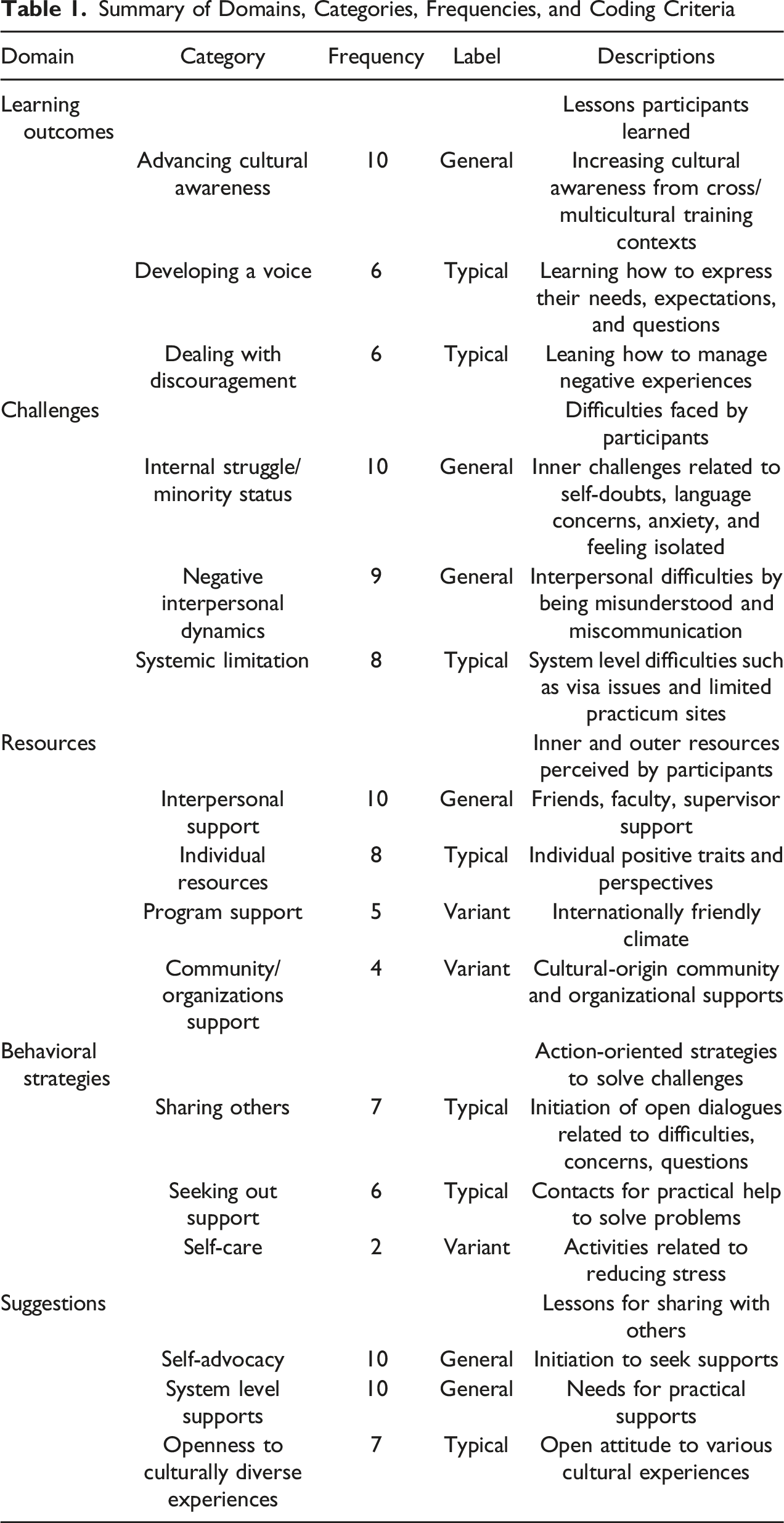
Learning Outcomes
Participants described what they had learned from their cross-cultural practicum training experiences, especially in regard to their professional growth. Due to their changed cultural context from their home country, participants were exposed to various learning aspects in their practicum trainings. Data within this domain exhibited themes of cross-cultural and multicultural awareness, various lessons impacting their clinical work, and how to respond to discouraging comments or uncertainty. One general category (advancing cultural awareness) and two typical categories (developing a voice and dealing with discouragement) emerged.
Advancing Cultural Awareness
Participants generally (N = 10) reported that they engaged in multicultural counseling training, which increased their cultural awareness. The multicultural training experiences in the United States included clinical training settings, culturally diverse clients, and supervisors. They indicated that their cross-cultural experiences and multicultural clinical training led them to ponder their own cultural identities when they worked with their clients. For example, our participants described how their counseling experience in the United States enhanced their own cultural awareness, as shown in this quote from Participant 8: Counseling experiences here make me think about my own culture identity because working with, as I work with my clients, my culture identity become more salient than before when I was in Korea so I think I was able to think about my culture identity and think about how to integrate my culture identity into the counseling session more effectively.
In addition, they felt that they became empathic counselors due to a broader perspective from their cross-cultural experiences. For example, one participant stated that the cross-cultural experiences enhanced his counseling awareness of social justice, racial and/or ethnic, and gender issues when he conducted counseling sessions with clients: But that sort of got me more interested in the counseling awareness piece of the social justice issue and various mental health implications that People of Color face because of these (cross-cultural) experiences… So I’m continuing to develop my multi-cultural counseling skills. (Participant 9)
Developing a Voice
Participants (n = 6) typically reported that they learned to advocate for their needs in their training experiences. They reported that it was very difficult for them to express their training expectations or needs to their supervisors or training director at first. Some participants indicated that they had been expected to be calm and quiet in their home country rather than articulating their needs when they received training. However, participants shared that they learned their educators expected them to develop their own voice in the United States through their training experiences and expressed appreciation for this, as shown by Participant 1: I feel like that really taught me the importance of self-advocate or also appreciate when my supervisor or other people try to empower me in that process. So I was able to use that in my work with clients and help them to be self-advocate or try to empower for them.
Dealing With Discouragement
Participants (n = 6) shared how they learned to deal with discouragement and uncertainty in their practicum training experience. Participants reported that they internalized the drop-out or cancellation of their sessions by their clients as their own fault or problem and felt discouraged. However, they added that they learned not to internalize everything as their fault and not to feel overwhelmed by the discouraging experiences. This example shows participants’ learning related to managing discouragement from no-shows. Sometimes clients do not come back with no reasons, so some clients did not come back after one session but, it was very discouraging experience at the beginning but now it’s manageable. I mean I don’t feel horrible about that. (Participant 7)
Challenges
Participants discussed their perceived internal and external difficulties with regard to their cross-cultural practicum training experiences. Participants described their challenging training experiences as international counseling trainees who were experiencing new learning environments and cultural contexts. Data clustered in this domain spoke to participants’ consistent exposure to new cultural norms, language barriers, opposing forces, and systemic limitations. Participants commonly reported that they felt emotional distress in the cross-cultural training process. Also, participants described interpersonal difficulties like being misunderstood and having miscommunications with supervisors or clients. Two general categories (internal struggle and negative interpersonal dynamics) and one typical category (systemic limitation) were identified.
Internal Struggles
Participants (N = 10) described that they experienced feelings of doubt, internalized stereotyped messages, and felt isolation and loneliness as minorities in the program. Participants stated that they felt isolated and lonely because of being far away from their family and because of their minority status in the program. They reported that their family members at home and domestic friends in the program could not fully understand their cross-cultural training experiences. Participants reported they experienced feelings of self-doubt. Even though most practicum trainees experienced clients who “dropped out” of counseling, participants had a tendency to internalize the drop-out as their fault or problem. These internal challenges are reflected in the following quote: I’m very sensitive about the dropout. Like if the client had two sessions, and they didn’t appear for the third session or they didn’t want to come again. I just like question myself like hey is that related to my culture background or if so how could I make it better. (Participant 4)
Generally, participants reported that they sometimes felt anxious due to their language barriers in their practicum. Participants indicated that they experienced language concerns because the unfamiliar clinical terms and manners of expression were different from their home country, even though they had previous clinical training experience in their home country or had previous education in the United States prior to doctoral training. For example, one participant said: As an international student, and with the language barrier, and I feel like I am kind of disabled person. So it was much more when I was in my first year, I feel little better than that but still I have a lot of difficulties as well too. (Participant 5)
Negative Interpersonal Dynamics
This category reflects participants’ negative interactions or experiences with their clinical supervisors, clients, and others. This category includes cultural insensitivity, feeling not trusted, and invalidation. Participants reported that they sometimes did not feel trusted by clinical supervisors and clients or that their challenging experiences were not validated by their clinical supervisors or peers. One participant shared the negative interpersonal dynamics with her clinical supervisors’ comments. Before I take the multicultural counseling course, those experience with the supervisor who gave me the negative comments, I think I internalized it as my deficit so that was not really helpful or when I already know that I am using not really appropriate expression or incorrect expressions, but I get comments about that constantly, every time when I meet with the supervisor. I feel intimidated, particularly in my first-year practicum. (Participant 5)
Related to cultural concerns, some participants stated that they felt anxious when they discussed cultural issues with their clients or supervisors because they were uncertain about cultural norms or references that might be different from those of their home culture. Some participants reported that they sometimes felt misunderstood by supervisors due to humble presenting styles of their own cultural norms in the evaluation process. They also reported that they sometimes felt disconnected from their clients due to their different accents and appearances.
Systemic Limitations
Participants described limitations due to immigration status and lack of professional resources for international trainees. Participants reported that they experienced difficulties due to the limitations of their immigration status in applying to certain practicum sites and receiving financial support. Some participants reported that they had limited work hours for their clinical assistantships or limited places to work due to their immigration status. They also reported that several practicum training sites did not allow international students to apply, which was a discouraging experience for them. One participant described the unique challenge of finding the practicum site requirements for their clinical training sites. International student are not allowed to work off campus. Whenever the practicum site is off campus, we need to apply for the CPT (curriculum practicum training). I think that was just one extra step and when I first mentioned this to my advisor and training director it was kind of new to them so they were also adjusting to me but they tried their best to support me but I feel like that sometimes it was just frustrating to deal with these visa requirement. (Participant 1)
Participants reported a lack of professional resources related to visa issues, the internship application process, and professional role models. They shared that they needed to make additional efforts to navigate their training process on their own without enough informational resources in the system. Their challenges related to these systemic limitations are exemplified in the following statements: I think, in practicum experiences, in terms of a lot of times, when I was in the early years, I was trying to, pick and choose my practicum experiences, and then there’s lack of information from my program, just relating to what type of settings I could work in versus couldn’t [due to my visa status]. And I feel like that was, I just didn’t find anyone who could answer for that. (Participant 3) And there’s really no kind of role model for Asians, I really haven’t seen any professors who used to be international students. It’s really rare. So unless I see them, you know, it’s really hard for me to picture myself being in that position or clinical staff like that. Maybe we need more role models. (Participant 6)
Resources
Participants reported being able to rely on various support systems or individual resources to navigate their training in the United States. Data in this domain captured stories about personal positive characteristics, interpersonal support, empowerment, and forward movement enabled by advocates and institutional and/or program assets. The participants described various levels of resources from individuals, professional organizations, programs, and communities. The emotional and social supports for international counseling trainees were often cited as critical sources of helping international counseling trainees to persist in their training. Also, adaptive personal traits and practical supports from their departments or professional organizations were shared. The one general category (interpersonal support), one typical category (individual resources) and two variant categories (program supports and community and organizational support) are addressed in further detail in the following sections.
Interpersonal Support
Interpersonal support included various aids from family, friends, supervisors, and faculty. All participants (N = 10) reported that the support they received from their faculty, supervisors, and friends was critical to navigating their cross-cultural clinical experience in the United States. They stated that psychological and practical support from their advisors, clinical faculty, and supervisors was very helpful for them in adjusting to the challenges of clinical training. Participants reported that empowering comments from their advisors and supervisors helped them to persist in their clinical training and increased their confidence in their counseling skills, as shown in this quote: My supervisor is—he’s a White American man. And still he was really advocating to me. And he’d say, “You did your best. If someone is asking about or questioning about your abilities I can talk with that person because I’m so confident about what you’re doing.” And he also told me that he can supervise me until I can finish all of my requirements. (Participant 10)
Also, participants described the support they received from other international friends around them. They reported that it was helpful for them to share common challenges as international students. Participants stated that they received psychological and practical support by learning together. For example, Participant 8 stated: There is another Korean international student. We studied a book, which is named Therapeutic Communication Skills, which has all the script in it so that we can learn about clinical language. They really helped me as well.
Individual Resources
Participants discussed individual resources that enabled them to navigate practicum training issues and unique cross-cultural challenges that they faced. Participants utilized their individual attributes (e.g., personalities, characteristics, and perspectives) to accomplish their clinical training goals. Participants indicated that their resilience, persistence, optimism, and flexibility were helpful in adapting to the clinical training in their program. For example, Participant 6 said: I think I am resilient. . . I used to say I’m a really positive person. Not anymore, but I’m definitely, resilient, and I think, just like sit with it for a moment and then. . . Let's try again. I think that’s a really. . . good, you know, personal characteristic of me.
Some participants described a positive point of view was helpful in navigating their clinical training when they felt challenged or frustrated. Participants shared how a positive mindset and perceiving difficult experiences as a learning opportunity allowed them to grow and persist in their clinical training. One participant stated: There are things that difficult is not always bad. Just we can learn from any experience and I always try to appreciate that even though it is hard, it will affect me in a good way as, for example, being as an international student I now am much more aware about minority issues or even if I go back to Korea, I will be probably a more understanding, more identified to the people who are in minority status, so I try to see all the situation in a positive way. (Participant 5)
Program Support
Participants (n = 5) described the importance of program support for them to persist in their clinical training. Program support included an internationally-friendly program climate that provided psychological safety for international counseling trainees and culturally responsive training directors who could provide more systemic support to international counseling trainees. Participant 7 gave this example: I sometimes cried in the group and I was okay about it because I knew that this would really meaningful, helpful, and rewarding for me to get over it. So I think our program has a very safe place for international students in general.
Community and Organizations Support
Practical support from participants’ cultural origin community and professional organizations merged in this domain. Participants (n = 4) described feeling connected with their own cultural identity through the support of their cultural origin communities. Some participants highlighted that professional organizational online or offline meetings were helpful for them to make connections and learn useful resources. For example: Asian American Psychology Association, and Taiwan Psychology Network, and I started meeting up with, and that has been something that was validating. I could feel like, someone else is going through same thing, and I’m not so alone, those were like external, environmental support I found. (Participant 3)
Behavioral Strategies
Participants talked about action-oriented strategies that they used to solve challenges in their cross-cultural clinical training. Data in this domain shared a common emphasis on adaptive, creative, and dynamic problem-solving approaches to the myriad of cross-cultural adjustments that participants were compelled to make. On the whole, participants described how they practiced effective strategies to cope with difficulties. Two typical categories (sharing with others and seeking out support) and one variant category (self-care) emerged.
Sharing with Others
This category refers to participants’ active reaching out to others and expressing their unique challenges. Participants (n = 7) typically noted that sharing their difficulties with others was helpful to manage their stressors. In order to initiate the conversation about their difficulties, they explained that “being vulnerable” or “being open about their mistakes or questions” first was important. Some of our participants reported that it was very helpful for them to share their difficulties with friends, their cohorts, and faculty, for example: I think it also comes back to vulnerability, being vulnerable with others, the mistakes I’ve made, and I think being able to tell, like find a voice, in a different sense. That was really empowering. I just feel like that kept me going. . . and I wanted to share that with other international students. (Participant 3)
Some participants reported that it was helpful for them to share their struggles related to clients who did not return for counseling with their cohort in group supervision. By sharing their concerns or self-doubts, they felt validated by their peers who experienced similar issues.
Seeking Out Support
This category refers to requesting practical help from supervisors or advisors, or other professionals based on trainees’ needs. Some participants (n = 6) reported that they were actively or proactively seeking out support to manage their difficulties and stressors in the training process. In terms of managing their difficulties, a proactive, action-oriented approach was a useful strategy. One participant stated that most Asian students were reluctant to actively seek help because they did not want to be perceived as less confident by others. However, she could cope better with her challenges when she actively sought out support: I am more open to seeking help. There are some expectation about Asian international students, which is they may be very passive in terms of seeking help, but I’m not that kind of person so, I’ve been always assertive in seeking help. (Participant 8)
Other participants stated that they were more satisfied with their experiences when they proactively sought support instead of waiting for others’ help. In order to cope better, they tried to proactively seek out help for themselves. Participant 4 said: I see my first client and I talk to my group supervisor, my peer supervisors, and my supervisors off site and I invited them to role play with me for how to how to greeting my American client, I did a lot of role-play, I think, the first semester.
Self-Care
Self-care refers to various activities trainees’ used to cope with their emotional distress from difficulties related to their cross-cultural training. A couple of participants (n = 2) reported that it was useful for them to reduce their emotional distress by practicing self-care activities. When they felt anxious or depressed due to client drop-outs or misunderstandings with their supervisors, they tried to release their stressors by journaling or exercising. For example: I also wrote some journal at night too. Because that was very meaningful experience. Some mistake I’d made or some discouraging experience, I wanted to reflect it so I kind of wrote some journal diary was helpful. I also did like regular self-care things. Like workout regularly as usual, I didn’t want to dwell on what happened, so I just went out. I just went to gym as usual. (Participant 7)
Suggestions
Participants provided recommendations and bits of wisdom for other international students, clinical supervisors, and faculty. Data in this domain were based on insights drawn from participants’ lived cross-cultural clinical training experiences and observations. Participants described suggestions not only at the individual level, but also practical support from programs and organizations. Two general categories (self-advocacy and system level supports) and one typical category (openness to culturally diverse experience) were identified.
Self-Advocacy
All participants (N = 10) highlighted the importance of self-advocacy because their unique training experiences would not be fully understood by others if they did not explicitly explain them. Participants recommended that future international counseling trainees express their unique needs and expectations to their supervisors or practicum instructors. This was exemplified in the following statement: To offer for other international students, definitely self-advocate because I think in Asian cultures if you wanted to respect the different hierarchy so you don’t really speak out or speak up that much. I feel like here it’s really encouraged to self-advocate and I believe I was so based on my previous experience I feel those are reinforced positively. (Participant 1)
System Level Support
The system level support category included practical support and multicultural trainings, including international student issues. All participants (N = 10) suggested that practical support on the system level, such as mentorship programs, would be helpful for international students’ clinical training in the United States. Other participants recommended that practical forms of support targeting international counseling trainees or informative resources on cultural adjustment and internships could be useful: Some manual or like more resources information about what kind of cultural adjustment Asian international students go through. That would be very helpful in general. And. . . clinical language training. Some recommendations about some counseling books or articles that we can kind of use in terms of adapting clinical language. (Participant 7)
Participants also recommended that multicultural trainings, including international students’ issues, are needed for both trainers and trainees in counseling programs. Participants stated that they received multicultural training through classes and practicum sites; however, such training was mainly focused on such multicultural issues as race, ethnicity, sexual orientation, and gender diversity. They stated that there was a lack of multicultural training that included international students’ issues for both trainers and trainees. For example, one participant suggested that international students’ issues in counseling psychology should be more widely discussed among international counseling trainees, supervisors, and trainers than in the past: When you look at Asian international or international students, or trainee, that those facets were not as highlighted. And it’s something that, that I’m starting to thinking a lot more about what would that look like. . . trainers and supervisors, should be encouraging us to think about. (Participant 3)
Openness to Culturally Diverse Experiences
Participants (n = 7) typically recommended that an attitude of openness to new experiences and cultures would be helpful for international counseling trainees to be successful in their practicum training. Openness to culturally diverse experiences included the appreciation of other cultures and their home cultures as well. Participants suggested that appreciation of various cultural values could be an important attitude to be a culturally competent counselor. For example, one participant shared that openness to various cultures could be helpful to reduce stereotypes and increase their understanding of diversity in the United States: Get to know more about not just American culture but also students from other cultures as well. . . ’cause that kind of experience really helped me to get rid of my, some of my stereotypical impression and get to be more culturally aware. (Participant 4)
Discussion
The present study qualitatively investigated Asian international counseling trainees’ cross-cultural practicum experiences. The results of the current study provide supervisors and educators an in-depth understanding of international counseling trainees’ cross-cultural clinical experiences by sharing their vivid voices using CQR methodology. Our study identified five prominent domains: Learning Outcomes, Challenges, Resources, Behavioral Strategies, and Suggestions. This study expands the existing literature by capturing the inner process and agentic roles of international counseling trainees, an underrepresented and marginalized group whose experiences have not been fully explored yet in counseling psychology programs. We highlight the major findings of our study below.
As in prior studies (Lau & Ng, 2012; Mittal & Wieling, 2006), our findings support that international counseling trainees perceived differences related to the cultural context. Based on our findings, the clinical training of international counseling trainees includes not only counseling or supervision, but also highly multicultural educational aspects because of the cross-cultural transition. Most participants grew up and were educated in relatively homogenous home cultures, and they were exposed to multicultural learning contexts after coming to the United States. They experienced a new cultural context and became more aware of cultural influences on their practicum training. Being a minority as an international student was an eye-opening experience for our participants in predominantly White-oriented practicum training settings, implying that participants had to navigate multiple complex cultural layers between clients and supervisors as well as counseling and supervision itself.
In addition, our findings expanded upon various challenges faced by international counseling trainees. Earlier studies also reported language barriers (A. Lee, 2018; Ng & Smith, 2012; Wedding et al., 2009), a sense of inferiority or deficiency (Mittal & Wieling, 2006), social isolation or feelings of being an “outsider” (Lau & Ng, 2012), and difficulties adjusting to training systems in the United States (Nilsson & Anderson, 2004) as major challenges. Based on prior findings, our findings expand the understanding of international counseling trainees’ internal, interpersonal, system level, and cultural reference related challenges in a more detailed manner. Our findings indicate that our sample of international counseling trainees experienced multi-layered challenges in clinical training systems in the United States.
Apart from challenging experiences, our findings contribute to the understanding of context specific protective factors and acculturation strategies in multidimensional aspects that international counseling trainees may use to navigate cross-cultural challenges, as highlighted in previous literature (A. Lee, 2018; Miller et al., 2013). Most participants in our sample stated that they had experienced support from various resources during their clinical training. Our findings are consistent with previous studies and scholarly texts (Mori et al., 2009; Ng & Smith, 2012; Qi et al., 2019) asserting the importance of supervisors’ support for international counseling trainees. However, prior studies related to international counseling trainees have mainly focused on the supports of supervisors using multicultural dialogues. The current study extends the existing literature by giving information on more detail-oriented support systems for this group. Our findings revealed various interpersonal and system-level supports. Interpersonal supports included psychological and practical support from faculty, friends, cohorts, and other international students. International counseling trainees shared that support from their advisors or faculties were highly empowering and encouraged them to navigate challenging cross-cultural training experiences. Additionally, our findings addressed the importance of program supports, including international-friendly climates and supports from professional organizations and community that were not fully explored in prior studies.
Our findings highlight that participants played an active role in navigating their unique challenges and cross-cultural training experiences using self-directed and behavioral strategies. Thus far, there has been little attention paid to how international counseling trainees manage their unique challenges or difficulties in general clinical training experiences by exerting agency in their training. Given this limited information, the current study adds to the literature by revealing detailed behavioral approaches. The findings imply that international counseling trainees made an effort to cope with the issues they faced in the practicum training process by taking proactive actions or a behaviorally oriented approach. Additionally, our findings reveal individual psychological assets, such as adaptive traits and positive perspectives that have received nearly no attention in the prior literature. By being agents in navigating their cross-cultural clinical training, participants reported that their resilience, persistence, and positive perspectives were buffering factors that helped them pursue their training.
Finally, participants shared suggestions for clinical supervisors, educators, and future international counseling trainees based on their lived cross-cultural training experiences and observations. Our participants addressed that they learned how to cope with discouragement experiences and highlighted the importance of self-advocacy in clearly communicating their unique experiences and needs. Most of the participants also suggested practical support from programs such as mentoring and matching trainees with international friendly supportive practicum placements. In addition, participants recommended providing cross-cultural trainings or seminars related to international students’ experiences for faculty, supervisors, and international students in order to foster cross-culturally friendly learning environments for everyone. According to a prior study (Marsella & Pedersen, 2004), educators may cultivate a culturally welcoming atmosphere through various cross-cultural case examples and encourage domestic students to gain cross-cultural experiences inside or outside the classroom. These studies highlight the importance of collaborative engagements not only with international counseling trainees, but also educators, other students, and clinical training programs.
Implications for Research, Practice, Advocacy, Education, and Training
In terms of scholarly implications, the current study expands the current counseling psychology literature by providing insight into the unique, individualized processes by which international counseling trainees navigate cross-cultural clinical training in the United States. Our findings both replicate and supplement results in a previous study (Chen, 2004), specifically in that they capture various individual attributes and adaptive strategies accessed by the students we interviewed. Beyond providing awareness about the resilience and creativity of the students in our sample, our results provide novel insight into international counseling trainees’ invisible psychological processes as well as current suggestions to improve cross-cultural training design and implementation. Additional studies are needed to examine the trainers’ perspectives as well, including trainers’ needs and expectations for counseling programs, practicum sites, and the counseling psychology community in order to provide culturally responsive clinical training to international counseling trainees. More specific training strategies or resources that could enhance international counseling trainees’ learning in clinical training contexts from trainers’ perspectives would be a strong addition to the counseling psychology literature.
In terms of practical implications, the findings of this study may help educators, clinical supervisors, and training directors who are working with international counseling trainees. Based on the current finding that trainees access various resources as they complete their practicum training, supervisors could provide practical support for them at multiple systemic levels. First of all, most of our participants reported that interpersonal support from their supervisors or trainers helped them to increase their confidence in clinical training. Consistent with micro-affirmation research (Koch et al., 2020), supervisors could use micro-affirming and encouraging comments to empower international counseling trainees who struggle with unique cross-cultural challenges. Micro-affirming comments could include recognizing and respecting international counseling trainees’ different cultural values or identity. Additionally, reaching out to and becoming involved with international populations as a way to learn about the unique identities and needs of international students, rather than asking supervisees to bear the burden of educating supervisors, creates an affirming environment without singling out supervisees or tokenizing experiences.
In addition, program supports and organizational supports were highlighted in our findings. At those levels, supervisors may help international counseling trainees to be connected with professional communities and mentoring programs (e.g., International Mentoring and Orientation Committee of International Section). Also, it could be useful for trainers to learn about visa issues related to clinical training. Lastly, at the program level, supervisors may make an effort to foster international-friendly climates through dialogues in supervision or encouraging international counseling trainees to express their unique needs or expectations. Our findings suggest that international counseling trainees may have the power to initiate cultural conversations to make their clinical training experiences more culturally responsive under international-friendly training climates.
Limitations and Future Research
The findings of the present study should be interpreted in light of its limitations. First, we recruited our sample from the APA Division 17 International Section email listserv and national professional psychology group listservs. Due to the very small number of international students in APA-accredited counseling psychology doctoral programs, our participants were broad in range from the first year to fifth year and we were unable to account for differences in acculturation. Even though we asked about their perceptions of their training experiences in their practicum experiences before applying to internship, they may have perceived their experiences differently based on their years in the program. Future studies could recruit trainees in specific years of their doctoral training. Also, most of our sample identified as female students. However, as there might be gender differences in international counseling trainees’ practicum experiences, future research should explore gender differences in samples with male identified students. Third, our findings may be limited because our participants’ backgrounds were relatively heterogeneous in terms of acculturation backgrounds, training experience prior to starting their doctoral program, and country of origin. Further studies are needed to consider the potential differences based on participants’ demographic and training information.
Conclusion
Counseling psychology has significantly contributed to planting the seeds of human-centered values, diversity, and social justice, not only in the local but the global community. With culturally responsive training for international counseling trainees from all over the world, the counseling psychology community can be connected with these strong core values and work together to solve common problems in the global context. As a scholarly endeavor, this study showed that international counseling trainees made professional and personal growth through self-directed agency, navigating challenges, systemic supports, and lessons they learned from their training experiences. Based on these findings, we expect that, educators and supervisors in the counseling psychology community may gain deeper understanding of international counseling trainees’ cross-cultural training experiences in the United States and eventually could contribute to strengthening the core values of counseling psychology in training settings and in the global context.
Footnotes
Declaration of Conflicting Interests
The author(s) declared no potential conflicts of interest with respect to the research, authorship, and/or publication of this article.
Funding
The author(s) disclosed receipt of the following financial support for the research, authorship, and/or publication of this article: This paper was supported by Konkuk University in 2019.
