




Abstract
Although many states have adopted sentencing guidelines, questions remain about whether guidelines achieve one of their primary goals—reducing disparities that arise from such extralegal factors as race and ethnicity. To date, research has not taken a cross-state approach to testing for racial or ethnic disparity in sentences imposed in guideline and nonguideline states or to examining whether less disparity exists in states with voluntary or presumptive guidelines. To address this research gap and inform sentencing scholarship, data from the State Court Processing Statistics program are used to determine whether offenders’ race or ethnicity affects incarceration and sentence length decisions in jurisdictions with different types of sentencing systems. Implications of the findings for theory, research, and policy are discussed.
In the past three decades, sentencing guidelines have emerged as one of the most prominent policy innovations in criminal justice. Guidelines have been justified largely on the notion that they can reduce judicial discretion in sentencing and, in particular, that they can reduce unwarranted disparities regarding such legally irrelevant factors as race, ethnicity, and sex (Brennan & Spohn, 2008; Frase, 2005; Hartley, Maddan, & Spohn, 2007; Hofer, 2007; Mears, 1998; Moore & Miethe, 1986; Spohn, 2000; Wilkins & Steer, 1993). Despite the fact that many states have implemented sentencing guidelines, only a small body of independent research has assessed their effectiveness in reducing sentencing disparities (e.g., Blackwell, Holleran, & Finn, 2008; Griffin & Wooldredge, 2006; Koons-Witt, 2002; Moore & Miethe, 1986; Stolzenberg & D’Alessio, 1994). This work has focused almost exclusively on how the effects of race, ethnicity, and sex vary before and after adoption of guidelines within a particular state. Notably, only a small number of states (Minnesota, Ohio, and Pennsylvania) have been included in this type of preintervention and postintervention analysis. Regardless, the studies suggest that sentencing guidelines appear to be effective in reducing disparities involving defendants’ extralegal characteristics. That assessment, in turn, has provided some support to legislatures that have enacted, or are considering enacting, guidelines (Frase, 2005, p. 1192).
Although research conducted to date has advanced scholarship on sentencing guidelines, two critical sets of questions remain. First, does less unwarranted sentencing disparity exist in states that have implemented guidelines compared with states that have not, and does less disparity exist in states with presumptive rather than voluntary sentencing guidelines? The comparison between presumptive guidelines and voluntary guidelines stems from the enforceability between the two systems—that is, whereas presumptive guidelines have the legally binding power, the compliance with voluntary guidelines is “voluntary” (Tonry, 1988, 1996). A focus on different sentencing systems is important because, as Hunt (2007, p. 487) has argued, assessment of the “sentencing guideline experiment” has been, to date, “incomplete and flawed.” Echoing a similar theme, Bushway and Piehl (2007, p. 463) recently emphasized that there have been no published attempts to examine “how the cross-jurisdictional differences in sentencing procedure affect the extent of disparity.” The exclusive focus on within-jurisdiction analyses is especially problematic. As Koons-Witt (2002, p. 321) has cautioned, the findings in a particular state are not necessarily generalizable to other states. Research thus is needed that systematically investigates cross-state differences in sentencing that may arise from guidelines (Hunt, 2007, p. 489) and examines whether, by extension, variation exists in the effects of presumptive versus voluntary guidelines (Bushway and Piehl, 2007, p. 463).
Second, do race and ethnicity exert differential effects on whether convicted felons receive prison or jail sentences and, among those incarcerated, on the length of sentence received, and do these effects vary depending on the type of sentencing system? Existing research on the effectiveness of guidelines has combined jail and noncustodial sanctions and then examined whether defendants are sentenced to prison versus either jail or a noncustodial sanction (e.g., Griffin & Wooldredge, 2006; Koons-Witt, 2002; Moore & Miethe, 1986; see, however, Blackwell et al., 2008). The inattention to jail sanctions as a distinct outcome stems in part from the fact that most guidelines only regulate judicial decisions about the imposition and duration of prison sentences (Frase, 2005, p. 1200). Even so, the oversight bears remedying because jail sentences differ from noncustodial sanctions and because the presence of guidelines may provide the equivalent of a trickle-down effect—that is, they may not only reduce disparity in prison sentences but also contribute to a sentencing context or culture that reduces disparities in jail sentences. A large body of sentencing research has established that unwarranted disparities exist in jail sentences (e.g., Blackwell et al., 2008; Harrington & Spohn, 2007; Holleran & Spohn, 2004; Moore & Miethe, 1986). However, given that “no existing guidelines system regulates intermediate sanctions [such as jail] to the same degree that it regulates prison terms” (Frase, 2005, p. 1200), guidelines may exert no effect on unwarranted jail sentence disparities or exert a lesser effect as compared with prison sentences.
The goal of this article is to advance scholarship on sentencing by determining whether unwarranted sentencing disparities in incarceration and sentence length decisions vary by type of sentencing system. Specifically, this study uses data from the State Court Processing Statistics program to investigate whether the race or ethnicity of offenders exerts differential effects on judges’ sentencing decisions in nonguideline states, states with presumptive guidelines, and states with voluntary guidelines. In so doing, we heed calls by researchers to conduct cross-state studies to investigate the effects of guidelines systems, especially presumptive versus voluntary guidelines (Bushway & Piehl, 2007; Hunt, 2007), to model prison and jail sentences separately (Harrington & Spohn, 2007; Holleran & Spohn, 2004), and to investigate guideline effects on jail sentencing disparity (Piehl & Bushway, 2007; Tonry, 1988).
We begin first by discussing sentencing guidelines systems and prior sentencing research on the effects of guidelines. Next, we develop a series of hypotheses about the differential effects of the defendant’s race and ethnicity on sentence outcomes in jurisdictions with different sentencing systems. We then describe the data and methods and present the findings. Finally, we conclude by discussing the study’s implications for theory, research, and policy.
Background
Sentencing Guidelines and Presumptive Versus Voluntary Guidelines
At least 18 states and the District of Columbia have adopted sentencing guidelines (Frase, 2005). Some differences exist across these different systems, especially the specifics concerning recommended or mandated sanctions for particular offenses, but many commonalities exist as well (Piquero, 2007). The most prominent similarity involves a focus on increasing uniformity and reducing disparity (Hofer, 2007). As Frase (2005, p. 1202) has emphasized, the adoption and enactment of guidelines systems have been motivated in large part by “a desire to make sentencing more uniform and to eliminate disparities.”
Despite the popularity of guidelines systems, relatively few assessments of their impact on sentencing disparity exist. Extant research has almost exclusively focused on within-jurisdiction analysis by comparing sentencing disparities before and after the implementation of state sentencing guidelines. Reviews undertaken by sentencing commissions in virtually all states that adopted sentencing guidelines have concluded that the guidelines increased consistency and reduced racial and gender disparities (Piehl & Bushway, 2007; Tonry, 1996). Independent reviews also have established that sentencing guidelines reduce disparity to some degree (Blackwell et al., 2008; Griffin & Wooldredge, 2006; Koons-Witt, 2002; Miethe & Moore, 1986; Moore & Miethe, 1986; Stolzenberg & D’Alessio, 1994). For example, Moore and Miethe (1986) evaluated the degree of sentencing uniformity and neutrality achieved under regulated and unregulated sentencing decisions in Minnesota; they found that regulated sentencing practices were significantly more predictable and neutral than unregulated practices.
Juxtaposed against this body of research stands a paucity of studies that systematically and directly compare sentencing practices in the two most prominent types of guidelines systems—presumptive and voluntary (Frase, 2005). In voluntary guidelines systems, the guidelines are “voluntary” because judges are not required to comply with them (Tonry, 1988, p. 276). More specifically, “nothing happens if a judge ignores the guidelines altogether or imposes a sentence not specified in the applicable guidelines. The guidelines lack statutory force or mandate and generally are not adopted as court rules” (Tonry, 1988, p. 276). For this reason, we might anticipate that sentencing disparities would persist under voluntary guidelines. However, as Moore and Miethe (1986, p. 274) have emphasized, a voluntary guideline system may be less likely to “incur resistance from judges and other criminal justice officials and thus, in its own way, actually facilitate the process of sentencing reform.”
Even so, an argument can be made that sentencing disparities should be smaller in presumptive guidelines systems than in voluntary guidelines (Frase, 2005; Reitz, 2005a, 2005b; Tonry, 1988, 1996). For example, compared with voluntary guidelines, presumptive sentencing guidelines give more weight to the objective of eliminating unwarranted disparity (Frase, 2005, p. 1202). As importantly, presumptive guidelines “carry the weight of law” (Moore & Miethe, 1986, p. 257). Although departures from recommended sentences are allowed, they are regulated by legal standards and must be justified. To illustrate, the specific legal standards in Minnesota include a list of offense attributes that judges may legitimately use in departure decisions as well as a list of case and offender attributes (e.g., race and ethnicity) that judges may not use in justifying a departure. In addition, all other departures must be justified by the general standard of “substantial and compelling” reasons, and any sentencing outcome based on a proscribed contemplation must be appealed (see Moore & Miethe, 1986). Judges—especially those likely to impose sentences that differ sharply from court norms—are more likely to comply with guidelines when faced with the threat of appellate review (Hunt, 2007, p. 488).
These differences aside, it is far from a certainty that racial and ethnic disparities will be smaller in jurisdictions that use presumptive rather than voluntary guidelines. Perhaps the most prominent reason stems from the fact that under presumptive guidelines systems, judges still retain at least some discretion in assigning the type and the severity of sanctions (Frase, 2005; Reitz, 2005a). In addition, poor implementation of presumptive guidelines may hinder any potentially greater effect that one might expect on theoretical or logical grounds. As Tonry (1988, p. 269) has emphasized, “Presumptive sentencing guidelines systems can by and large achieve their goals [but that] does not mean that they will: More sentencing commissions have failed in their efforts to develop and implement presumptive guidelines than have succeeded.”
The few existing studies suggest that presumptive guidelines reduce sentencing disparities (Engen & Gainey, 2000; Moore & Miethe, 1986) and that voluntary guidelines systems do not (Bushway & Piehl, 2001; Tonry, 1988; Ulmer, 2000). Unfortunately, these studies suffer from methodological limitations, most notably the failure to incorporate comparisons with other states. Indeed, to date, no study has directly and systematically compared sentencing disparities in presumptive sentencing guidelines systems to those in jurisdictions operating under voluntary guidelines systems. That situation has prompted scholars to advocate for cross-jurisdiction research to systematically examine how these two types of guidelines systems affect the extent of unwarranted disparity (Bushway & Piehl, 2007; Hunt, 2007).
Racial and Ethnic Sentencing Disparity and the Focal Concerns Perspective
A primary goal of those who have championed sentencing guidelines is the elimination—or at least the reduction—of unwarranted sentencing disparities. Racial and ethnic disparities have constituted an especially critical area of concern at the federal and state levels. Thus, evidence that guidelines reduce such disparities has been a cause for optimism among policymakers. Two concerns exist, however. First, as emphasized above, there have been relatively few studies of sentencing guidelines that compare different states and types of guidelines systems. Second, a considerable body of research underscores the continuing salience of race and ethnicity in the criminal justice system and, by extension, the possibility that guidelines systems cannot effectively eliminate the myriad ways in which race and ethnicity may influence sentencing decisions (Mitchell, 2005; Spohn, 2000). As Griffin and Wooldredge (2006, p. 895) have argued, “The effects of sentencing reforms on reducing extralegal disparities in court disposition could be limited when judges are motivated to maneuver around restrictions placed on their discretion.”
The focal concerns perspective, articulated by Steffensmeier (1980; see also, Steffensmeier, Ulmer, & Kramer, 1998), provides a theoretical rationale for the contention that race and ethnicity may have enduring effects on sentencing decisions, even in the face of guidelines systems, whether presumptive or voluntary. According to this perspective, judges’ sentencing decisions reflect their assessments of the blameworthiness or culpability of offenders, their desire to protect the community by incapacitating dangerous offenders or deterring potential offenders, and their concerns about the practical consequences, or social costs, of sentencing decisions. Because judges rarely operate with enough information to accurately determine a defendant’s dangerousness or threat, they develop a “perceptual shorthand” (Hawkins, 1981, p. 230; see also Bridges & Steen, 1998) based on stereotypes and attributions that are themselves linked to offender characteristics such as race, sex, and age. Thus, “race, age, and gender will interact to influence sentencing because of images or attributions relating these statuses to membership in social groups thought to be dangerous and crime prone” (Steffensmeier et al., 1998, p. 768).
Research consistently documents that Blacks and Hispanics tend to be objects of crime-related fear and are perceived as particularly threatening in the contemporary United States (Britt, 2000; Chiricos, Welch, & Gertz, 2004; Spohn, 2000; Spohn & Holleran, 2000; Steffensmeier et al., 1998). As such, they constitute offenders who readily comport with the focal concerns that courts are held to use when deciding cases. That is, racial and ethnic minorities may appear to courtroom actors to be more blameworthy and to pose a greater threat to community safety. This perception, when coupled with a compelling need to process large volumes of cases rapidly, may generate racial and ethnic sentencing disparities that persist even in the face of guidelines.
Prison Versus Jail Sentences
Most prior research that evaluates sentencing guidelines has combined jail and noncustodial sanctions; little attention has been paid to jail sentencing disparity. For several reasons, this issue is especially relevant to assessing the differential effects of race and ethnicity in jurisdictions with different sentencing procedures. First, guidelines typically govern prison sentences, not jail sentences. Second, the focal concerns perspective suggests that race and ethnicity considerations strongly influence courtroom actors and thus, logically, that efforts to inhibit such considerations in prison sentences might result in displacement of them to other decisions, such as jail sentencing. Third, studies that fail to separate jail sentences from noncustodial sanctions are unable to detect when disparities exist for jail but not prison sentences (Piehl & Bushway, 2007, p. 110; also see Holleran & Spohn, 2004). Combining the two types of outcomes is especially problematic given evidence that racial and ethnic disparities are concentrated in sentencing decisions for less serious offenses (Blumstein, Cohen, Martin, & Tonry, 1983; Spohn & Cederblom, 1991), which have a greater likelihood of receiving jail rather than prison sentences.
What grounds exist for anticipating that racial and ethnic disparities in jail sentences will be smaller in jurisdictions with guidelines—especially presumptive guidelines—than in jurisdictions without guidelines? The basic argument centers on the notion that guidelines should foster a general culture within the courtroom community that prioritizes and values uniformity and consistency in sentencing. From this perspective, guidelines that govern only prison sentences may create an environment in which courtroom actors seek to apply a similar decision calculus to jail sentences. Prior research, however, suggests that the opposite may occur—that is, there may be more disparity in judges’ decisions regarding jail than in judges’ decisions regarding prison. For example, D’Alessio and Stolzenberg (1995) reported that judges increased their use of jail sentences after imposition of Minnesota’s sentencing guidelines, especially when prisons became crowded, and Moore and Miethe’s (1986) postguideline analysis of sentencing within the first year of Minnesota’s reform revealed greater disparities in “unregulated decisions” (e.g., jail sentences) not governed by the guidelines. Moore and Miethe suggested that judges might have used jail as a condition of probation to avoid presumptive sentences when they believed incarceration was justified but not applicable under the guidelines. In a related line of investigation, Frase (2005) has argued that judicial discretion likely is greater for jail sentences precisely because guidelines do not regulate them.
Hypotheses
This review of the prior literature gives rise to three main hypotheses. Hypothesis 1 is that there will be no racial or ethnic disparity in the likelihood of a prison sentence and the length of a prison sentence in presumptive guideline states; by contrast, there will be some racial and ethnic disparity in voluntary guideline states and nonguideline states, and the disparity will be more pronounced in nonguideline states than in voluntary guideline states. This hypothesis stems from three observations. First, one of the explicit goals of state sentencing guidelines is to reduce unwarranted disparities. Second, sentencing guidelines regulate the type of sentence and the duration of prison sentences. Third, because presumptive guidelines “carry the weight of law,” there should be more uniformity—and less disparity—in sentences imposed by judges in states with presumptive as opposed to voluntary guidelines.
Second, drawing on prior literature, we propose two competing hypotheses about racial and ethnic disparity in jail sentences. Hypothesis 2a contemplates that there will be no racial or ethnic disparity in the likelihood of receiving a jail sentence and the length of a jail sentence imposed in presumptive guideline states; by contrast, there will be racial and ethnic disparity in voluntary guideline states and nonguideline states, and the disparity will be greater in nonguideline states than voluntary guideline states. The argument is that guidelines foster a local legal culture that emphasizes uniformity and proportionality in sentencing and that this culture influences not only prison sentences but also jail sentences. Hypothesis 2b, which finds more support in prior research (D’Alessio & Stolzenberg, 1995; Moore & Miethe, 1986), argues that there will be greater racial and ethnic disparity in jail sentences in guideline states, especially presumptive guideline states, compared with nonguideline states. This counterhypothesis stems from the argument that judges, when constrained in assigning prison sentences, may seek opportunities to expand their discretion. Guidelines systems typically dictate decisions about prison sentences and, in particular, the length of a prison term. They do not typically regulate jail terms. For this reason, judges in guidelines systems, especially in presumptive guideline contexts, may be more inclined to exercise discretion in meting out jail terms. To the extent that a focal concerns perspective informs their decision making, judges can be expected to assign racial and ethnic minorities to jail terms rather than to various types of noncustodial sanctions more than they would for Whites.
Hypothesis 3 states that any observed racial and ethnic disparity in jail sentences will be greater than in prison sentences in states with guidelines. This hypothesis stems from the reasoning that no existing guidelines regulate intermediate sanctions, including jail and noncustodial sanctions, as closely as prison sentences (Frase, 2005; Tonry, 1988). Therefore, a more pronounced disparity, if any exists, should be observed with jail sentences than with prison sentences in guideline states.
Methods
Data
To assess the differential effects of race and ethnicity on sentence outcomes in jurisdictions with different types of sentencing systems, this study uses the State Court Processing Statistics (SCPS) 1998, 2000, and 2002 data. The 3-year data include 46,071 felony defendants processed in 60 large urban counties across 23 states (Bureau of Justice Statistics, 2006). In this study, we focus on felons because most state sentencing guidelines regulate only felony crimes (Frase, 2005; Tonry, 1988). In addition, we examine the effectiveness of guidelines only on convicted felons because “state systems . . . base recommended sentences much more closely on the conviction offense(s)” (Frase, 2005, p. 1208, emphasis added; see also Frase, 2007, p. 425).
The SCPS data have several strengths relevant for this study. For example, the data contain rich information regarding defendants’ demographic and prior criminal history variables. The most important aspect of the SCPS data is that they provide sentencing cases across a large number of states, including states without guidelines and states with presumptive or voluntary guidelines. The data thus afford us a unique opportunity to examine whether racial and ethnic disparities vary in states with different types of sentencing systems. 1
Approximately 18% of the SCPS cases were missing at least one variable included in this study. To address this issue, we follow the lead of other researchers who have analyzed the data (e.g., Demuth & Steffensmeier, 2004a, 2004b; Steffensmeier & Demuth, 2006) and use multiple imputation. Compared with other approaches for addressing missing data (e.g., list-wise deletion), multiple imputation has several advantages. It generates approximately unbiased estimates of all parameters, produces good estimates of standard errors, and can be used with any kind of data and analysis (Allison, 2000, pp. 301-302; see also Acock, 2005; Brown & Kros, 2003). For these reasons, it is considered to be “one of the most attractive methods for general-purpose handling of missing data in multivariate analysis” (Allison, 2000, p. 301).
In the SCPS data, 27,019 (71%) of the 46,071 defendants were convicted, of whom 25,340 received a valid sentence, including a prison, jail, or noncustodial sentence. After we eliminated defendants who were convicted of misdemeanor offenses or unknown felonies, 20,692 defendants remained and were used for the multiple imputation. After assigning zero values to jail or prison incarceration length for those defendants who received noncustodial sanctions and removing incarcerated felons who did not have valid jail or prison incarceration lengths, we were left with 20,516 cases that were used for the multiple imputation of sentence-length decisions.
We performed 10 imputations using Patrick Royston’s Imputation using Chained Equation (ICE) program, which is implemented in Stata (see Horton & Kleinman, 2007). In addition to being simple to use, the ICE program does not require the multivariate joint distribution assumption, thus allowing the program to impute different types of variables (e.g., binary and categorical variables) together. The variables used in this study are primarily binary or categorical in nature, so the use of the ICE program for multiple imputation is especially appropriate. In the multiple imputation process, we followed Acock’s (2005, p. 1026) recommendation and included the following variables in addition to those used for the subsequent analyses: prior misdemeanor arrest (1 = yes, 0 = no), prior misdemeanor conviction (1 = yes, 0 = no), a dummy variable indicating whether the most serious arrest charge was classified as “attempted” (1 = yes, 0 = no), and the most serious arrest charge (a series of dummy variables that reflect the most serious offense for which a defendant was arrested). Given our focus, we included only defendants who were White, Black, or Hispanic and excluded defendants who were younger than age 13 at arrest. Each imputed data set contained, on average, 20,181 convicted felons for the analysis of incarceration decisions. For the analysis of sentence length decisions, we focused only on defendants who received a term of incarceration (N = 15,114).
To identify states with sentencing guidelines, we relied on Frase’s (2005, p. 1196) classification, which in turn was based on “the National Association of Sentencing Commission (NASC) website and its references, previous state guidelines surveys which were conducted by legal scholars, and various published and unpublished state-specific reports.” Among the 23 states, 10 were classified as having sentencing guidelines, with 5 classified as having presumptive guidelines and the other 5 as having voluntary guidelines. 2 States that have presumptive guidelines include Florida, Michigan, Ohio, Tennessee, and Washington. States that have voluntary guidelines include Maryland, Missouri, Pennsylvania, Utah, and Virginia. 3 Below, we describe each variable in the study.
Dependent Variables
Since Wheeler, Weisburd, and Bode (1982), sentencing research has broken down the sentencing decision into two distinct but related stages: the decision to incarcerate and the decision regarding length of sentence if incarcerated (e.g., Britt, 2000; Johnson, 2006; Ulmer & Johnson, 2004). We follow this practice, not least because previous research has established that the presence of state sentencing guidelines has differential effects on incarceration versus sentence length decisions (e.g., Britt, 2000; Griffin & Wooldredge, 2006; Ulmer & Johnson, 2004). In addition, at both sentencing stages, we separate prison sentences from jail sentences because we hypothesize that racial and ethnic disparity will differ in prison sentencing from that in jail sentencing in jurisdictions with different types of sentencing systems.
The decision to incarcerate has three categories: prison (if the convicted felon was sentenced to any length of confinement in a state prison), jail (if the convicted felon was sentenced to any length of confinement in a county jail), and noncustodial sanction (if the convicted felon was sentenced to any combination of nonincarceration options, such as probation, restitution, fine, or other sentence). Noncustodial sanction serves as the omitted outcome category in the models analyzing the effect of race and ethnicity on the decision to incarcerate. For those incarcerated, the sentence-length variables were coded as the months of incarceration in a county jail or in a state prison, respectively. We take the natural log of jail and prison incarceration lengths due to extreme skew. 4
Independent Variables
The main focus of this study is to examine racial and ethnic disparity across different sentencing contexts. For all of the analyses, the offender’s race is coded as a dummy variable (1 = Black, 0 = White) and so, too, is ethnicity (1 = Hispanic, 0 = White). Across all models, we estimate whether statistically significant race or ethnicity effects emerge net of other factors.
We introduce as controls variables commonly used in sentencing studies. Besides the offender’s race and ethnicity, other extralegal variables in the analyses include the offender’s age at arrest (in years) and the offender’s sex (1 = male, 0 = female). We include a squared term of age because previous research has identified a significant nonlinear relationship between age and sentencing severity (see, e.g., Steffensmeier, Kramer, & Ulmer, 1995).
We control for a number of legally relevant variables, including the offender’s prior criminal history and offense seriousness. We have three variables to measure the offender’s prior criminal history. The first is the offender’s prior official criminal record, which is the sum of four dummy variables, including prior felony arrest, prior felony conviction, prior jail incarceration, and prior prison incarceration (Cronbach’s alpha = .80). This indicator reflects the defendant’s prior contact with the criminal justice system, with a higher score indicating a more extensive official criminal record. The second variable is the offender’s criminal justice status at arrest, which indicates whether the offender was on probation or parole or in custody at the time of arrest (Steffensmeier & Demuth, 2006, p. 249). The third variable is a dummy variable reflecting whether the offender ever failed to appear in court (1 = yes, 0 = no). Offense seriousness is measured by the most serious offense that the convicted felon was convicted for and whether multiple arrest charges occurred (1 = yes, 0 = no). Consistent with other sentencing research (e.g., Bushway & Piehl, 2007; Fearn, 2005; Harrington & Spohn, 2007; Johnson, 2005, 2006), we include three dummy variables that capture the most serious offense type for which the defendant was convicted: violent offense, property offense, and drug offense, holding public order offense as the reference category.
We also control for the type of disposition in the case and for the offender’s pretrial status, given prior research showing that these factors may affect sentence severity (Albonetti, 1986; Fearn, 2005; Ulmer & Bradley, 2006; Ulmer & Johnson, 2004; Wooldredge, 2007). The type of disposition is a dummy variable (1 = guilty plea, 0 = trial). Pretrial status also is operationalized as a dummy variable (1 = detained prior to trial, 0 = released prior to trial). We introduce two dummy variables for the years 1998 and 2000 to address the possibility that there might be differences in sentencing stemming from year-specific changes in laws, policies, or court practices. Year 2002 serves as the reference year in all the models.
Finally, we introduce dummy variables for states because states may differ in whether they have guidelines systems (presumptive vs. voluntary vs. nonguideline). They also may differ in their political, economic, and social contexts, and incorporation of the dummies takes this likelihood into account, thus producing more robust estimates for the effects of race and ethnicity in states with different types of sentencing systems.
Analytic Strategy
We use multinomial logistic regression for the analysis of the decision to incarcerate because this variable consists of three categories (noncustodial sanctions, jail, and prison). For sentence length decisions, we use ordinary least squares regression. We use Stata’s MIM command (a module designed to analyze multiply imputed data sets) to analyze the 10 imputed data sets. This command, as Carlin, Galati, and Royston (2008, p. 49) stated, can “validly fit most of the regression models available in Stata to multiply imputed datasets, giving parameter estimates and confidence intervals computed according to Rubin’s results for multiple imputation inference.” We report model estimates with robust standard errors that account for the clustering of cases within counties. At each sentencing stage, we estimate a model in states without sentencing guidelines, in states with voluntary guidelines, and in states with presumptive guidelines. In assessing our hypotheses, we first determine whether racial and ethnic disparity is present in each type of sentencing systems. Then, we perform a z test to investigate whether the effect of race and ethnicity is greater in one type of sentencing systems than the other (as indicated by the specific hypothesis). We use the formula that Clogg, Petkova, and Haritou (1995) developed and Brame, Paternoster, Mazerolle, and Piquero (1998) demonstrated to be applicable for maximum-likelihood regression coefficients. Although not shown in the tables, all the models include state dummies. The variance inflation factors were all less than 4; thus, the multicollinearity diagnostics did not reveal any problems (Hair, Anderson, Tatham, & Black, 1998).
Findings
Decision to Incarcerate
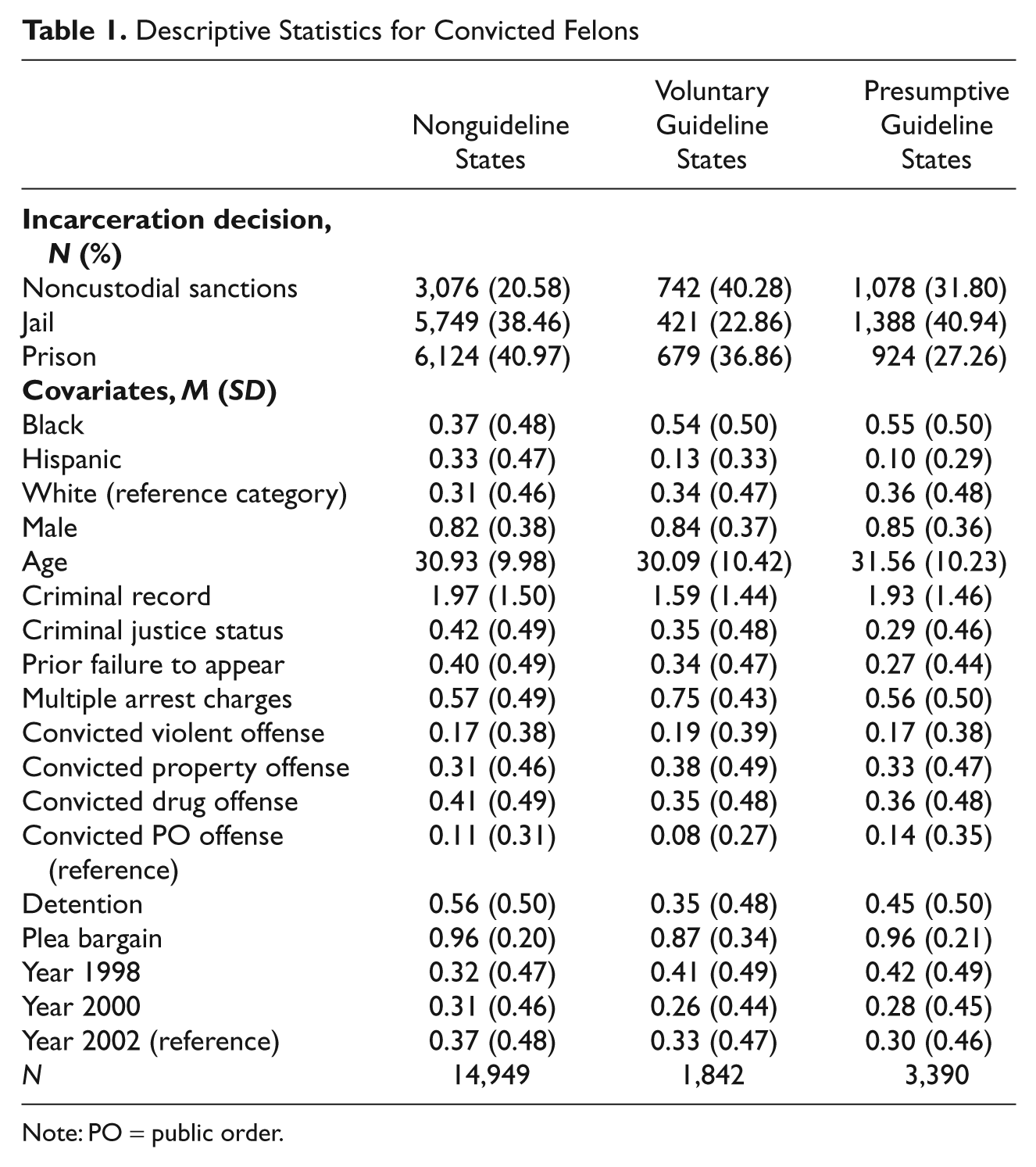
Table 1 presents the descriptive statistics for convicted felons in nonguideline, voluntary guideline, and presumptive guideline states, respectively. As reflected in the table, judges in nonguideline states impose prison sentences (41%) somewhat more often than do judges in voluntary guideline states (37%) and substantially more often than do judges in presumptive guideline states (27%). There are more noncustodial sentences in voluntary guideline states (40%) than in presumptive guideline states (32%) or nonguideline states (21%). In addition, when compared with presumptive and voluntary guideline states, judges in nonguideline states sentenced fewer Black offenders and a larger percentage of Hispanic offenders. 5 To assess whether the variation in the use of prison sentences across nonguideline and guideline states can be explained by differences in caseload or the types of offenders adjudicated and sentenced, we turn to the multivariate analyses.
Descriptive Statistics for Convicted Felons
Note: PO = public order.
Table 2 presents results from the multinomial logistic regression models of incarceration decisions in states without guidelines, in states with voluntary guidelines, and in states with presumptive guidelines, respectively. In support of the first hypothesis, we find that, in presumptive guideline states, the effects of race and ethnicity are not statistically significant after controlling for legal and extralegal factors. By contrast, in voluntary guideline states and especially nonguideline states, the likelihood of a prison sentence is significantly greater for ethnic minority offenders. Further, the z test demonstrates an absence of a statistically significant difference of the effects of race (z = .24, p > .05) and ethnicity (z = .76, p > .05) between voluntary guideline states and nonguideline states. Here, then, we find mixed support for the first hypothesis. On one hand, neither racial nor ethnic disparities emerge in the likelihood of a prison sentence in states with presumptive guidelines; on the other hand, racial and ethnic disparities still remain in voluntary guideline states and nonguideline states (with the exception of racial disparity in voluntary guideline states), but the level of disparity is not significantly different between states without guidelines and states with voluntary guidelines.
Multinomial Logistic Regression of Decision to Incarcerate Convicted Felons on Race and Ethnicity

Note: FTA = failure to appear in court. We used multinomial logistic regression because the dependent variable—the decision to incarcerate—consists of three categories (noncustodial sanctions, jail, and prison sentences). Because individual felons are nested in counties, we used Stata’s cluster command for robust standard errors. In the models above, we used noncustodial sanction as the omitted outcome category. Although not shown here, the models include state dummies.
p < .05. **p < .01.
Next, we investigate the second hypothesis, which focused on jail sentences. As can be seen in Table 2, in presumptive guideline states, racial and ethnic disparities in the likelihood of a jail sentence are absent; in nonguideline and voluntary guideline states, however, both Blacks and Hispanics are more likely to receive a jail sentence than their White counterparts. Although the effect of race on the likelihood of a jail sentence in these two types of jurisdictions is similar (z = .06, p > .05), the effect of ethnicity is significantly greater in voluntary guideline states than in nonguideline states (z = 3.33, p < .01). Thus, we find some support for Hypothesis 2a—that is, there is no racial and ethnic disparity in the likelihood of a jail sentence in presumptive guideline states; by contrast, there is racial and ethnic disparity in the likelihood of a jail sentence in voluntary guideline states and nonguideline states. Because the effect of the offender’s ethnicity on the likelihood of a jail sentence is significantly greater in states with voluntary guidelines than in states without guidelines, we also find partial support for Hypothesis 2b, which anticipated that there would be greater jail sentencing disparity in guideline states than nonguideline states.
Finally, regarding Hypothesis 3, we find that in voluntary guideline states where racial and ethnic disparity is observed in the likelihood of a prison and jail sentence, the effect of ethnicity, but not race, is significantly greater in predicting the likelihood of a jail sentence than the likelihood of a prison sentence (χ2 = 11.61, df = 1, p < .01). We thus find some support for our third hypothesis when ethnic disparity is concerned; the observed ethnic disparity in voluntary guideline states is more pronounced in jail sentences than prison sentences.
Sentence Length Decision
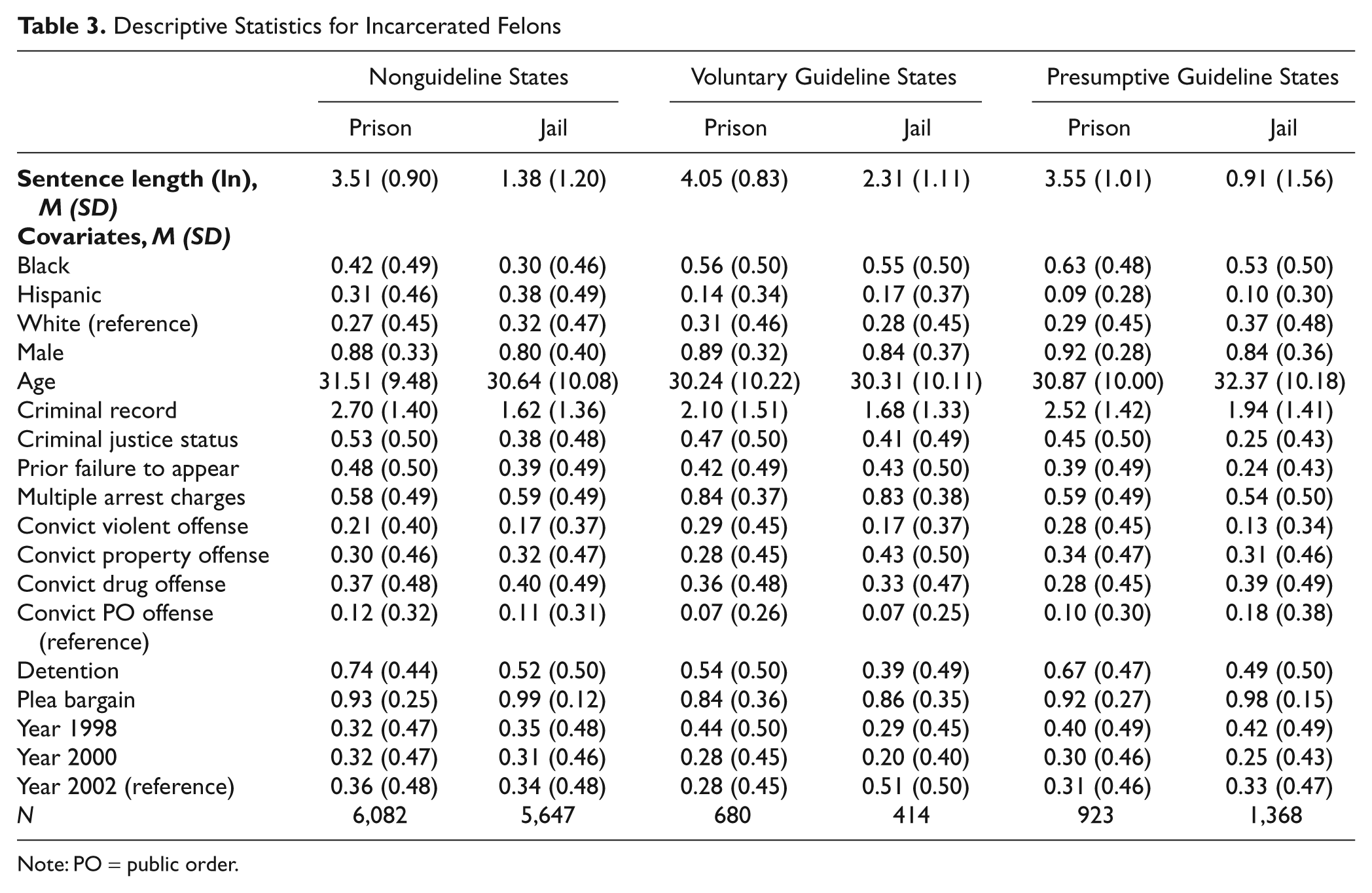
The above analyses focused on the decision to incarcerate. Here, we revisit the hypotheses and test them by focusing on sentence length decisions. Table 3 presents the descriptive statistics for incarcerated felons in each of the three state sentencing contexts (nonguideline, voluntary guideline, and presumptive guideline). As one would expect, the average prison incarceration length is longer than jail incarceration length in all three types of sentencing systems. Notably, the mean prison incarceration and jail incarceration lengths are somewhat longer in voluntary guideline states than nonguideline states, and no difference in prison incarceration length exists when comparing nonguideline and presumptive guideline states. Table 3 also demonstrates that incarcerated felons who received prison sentences have a more extensive criminal record than those who received jail sentences, lending support to the view that prison and jail sentences are applied to different groups of offenders (Harrington & Spohn, 2007; Holleran & Spohn, 2004) and so should be modeled separately from one another.
Descriptive Statistics for Incarcerated Felons
Note: PO = public order.
The sentence length analyses, shown in Table 4, can be readily summarized—specifically, no evidence of racial or ethnic disparity is evident in any of the three state sentencing systems. Put differently, it appears that, once individual- and state-level controls are introduced, there is no evidence of racial or ethnic sentence length disparity in nonguideline states and in states with presumptive or voluntary guidelines. This general pattern accords with prior research, which indicates that fewer disparities emerge in sentence length decisions compared with incarceration decisions (Chiricos & Crawford, 1995; Spohn, 2000). In short, we find no evidence in support of the hypotheses when the focus is on sentence length rather than the decision to incarcerate.
Ordinary Least Squares Regression of Sentence Length among Incarcerated Felons on Race and Ethnicity

Note: FTA = failure to appear in court. We used ordinary least squares regression to predict logged prison length and jail length separately. Because individual felons are nested in counties, we used Stata’s cluster command for robust standard errors. Although not shown here, the models include state dummies.
p < .05. **p < .01.
Discussion and Conclusion
The goal of this study was to determine whether offenders’ race and ethnicity differentially affect sanctioning in jurisdictions with different types of sentencing systems. In conducting this study, we respond to calls to perform cross-jurisdictional analyses (Bushway & Piehl, 2007; Hunt, 2007), to examine sentencing disparities in voluntary versus presumptive guidelines systems, and to investigate racial and ethnic disparity in jail sentencing in guidelines systems (Bushway & Piehl, 2007; Tonry, 1988). To this end, we used the State Court Processing Statistics data to investigate racial and ethnic disparity in prison versus jail sentences in states without guidelines, in states with voluntary guidelines systems, and in states with presumptive guidelines systems.
Table 5 summarizes the results of our hypothesis tests. First, in support of our first hypothesis, we found that in presumptive guideline states, there was no evidence of racial disparity in the likelihood of receiving a prison sentence. However, contrary to what we hypothesized, there was no racial disparity in voluntary guideline states. Furthermore, and again in accordance with we predicted, racial disparity was present in nonguideline states—that is, convicted Blacks were more likely than Whites to receive prison sentences. When we turn to ethnic disparity, the results were the same except for one notable exception. Specifically, there was, as we hypothesized, evidence of ethnic disparity in the probability of receiving a prison sentence in voluntary guideline states. Finally, racial and ethnic disparity was not statistically different in voluntary guideline states versus nonguideline states.
Results of Hypothesis Tests, by Race and Ethnicity

Note: NA = not applicable.
We provided two competing hypotheses regarding differential effects of race and ethnicity in jail sentencing under different sentencing systems in the text (Hypothesis 2a and Hypothesis 2b). Here, for the sake of parsimony, we only summarized the test results of Hypothesis 2a.
Hypothesis 3 was assessed only when incarceration decision was examined in voluntary guideline states because no racial or ethnic disparity was observed in presumptive guideline states and no such disparity emerged when incarceration length decision was concerned in voluntary guideline states.
Second, we identified racial and ethnic disparity in the likelihood of a jail sentence in voluntary guideline states and nonguideline states; ethnic disparity in the likelihood of a jail sentence was greater in voluntary guideline states than in nonguideline states; and racial disparity was similar in voluntary guideline states and nonguideline states. By contrast, we found no racial or ethnic disparity in the likelihood of a jail sentence in presumptive guideline states. Third, in voluntary guideline states where racial and ethnic disparities were observed, we found that, as expected, ethnic disparity was greater in the likelihood of a jail sentence than the likelihood of a prison sentence. Fourth, the sentence length analyses revealed no evidence of racial or ethnic disparities in any of the three state sentencing contexts.
These results suggest that presumptive guidelines may be more effective in eliminating racial and ethnic disparities. As argued by a number of scholars (e.g., Frase, 2005, 2007; Moore & Miethe, 1986; Reitz, 2005a, 2000b; Tonry, 1988, 1996), the effects of presumptive guidelines systems on eliminating racial and ethnic disparity may stem from their legally binding power. This cross-jurisdiction analysis thus adds empirical evidence to the existing literature by lending support to the view that presumptive guidelines systems may be more effective than voluntary guidelines systems in eliminating unwarranted disparity.
The findings also suggest that there is greater disparity in the sentencing of Hispanics in voluntary guideline states as compared with nonguideline states. We lack the data necessary for explaining this difference. However, we speculate that in courts where there are fewer Hispanic defendants—a situation that characterizes voluntary guideline states more so than nonguideline states—Hispanics may be perceived as more threatening. According to the minority threat perspective, as the relative size of a racial or ethnic minority group increases, the majority group may perceive them as a growing threat and take actions to reduce this threat (Blalock, 1967; Liska, 1992). A court community largely devoid of a particular minority group—in this case, Hispanics—may be especially reactive to that group. For example, they may perceive Hispanic offenders as a potentially growing threat. Thus, in states where the guidelines are not restrictive (e.g., where compliance is voluntary), there may be more leeway for courtroom actors to impose jail sentences consistent with this perceived threat.
An important limitation of this study should be emphasized. Specifically, because of data limitations, we were unable to use preguideline and postguideline analyses, and so we cannot determine whether the guidelines, especially presumptive guidelines, reduce unwarranted disparity. To illustrate, in the presumptive guideline states that we examined, few to no racial and ethnic disparities may have existed prior to the guidelines being adopted. Although possible, such a pattern would run counter to prior research, which has found that in states with presumptive guidelines systems, disparities existed prior to the adoption of guidelines and were reduced thereafter (Koons-Witt, 2002; Moore & Miethe, 1986; Stolzenberg & D’Alessio, 1994).
The present study reinforces Holleran and Spohn’s (2004) argument that prison and jail sentences should be modeled separately (see also Blumstein et al., 1983; Harrington & Spohn, 2007) and, in a related vein, Bushway and Piehl’s (2007) and Tonry’s (1988) argument that disparities in jail sentences should be studied. The risk lies in the fact that by only examining disparities in prison sentences, unwarranted disparity in jail sentences may go undetected. At the same time, the potential effects of offenders’ race and ethnicity on sentencing severity may be obscured or, should such effects exist, go undetected.
The study also draws attention to the need to examine race and ethnicity effects in a more nuanced way. Here, for example, we examined jail and prison decisions separately. An additional, and important, next step is to examine how unwarranted disparities may arise at earlier stages of the sentencing process. For example, Bushway and Piehl (2007) have argued that “stricter sentencing structures are more likely to have discretion in sentencing take place before the point at which researchers generally assess discretion with conviction data” (p. 121; cf. Miethe, 1987). Thus, a possible negative consequence of presumptive guidelines is the hydraulic displacement of discretion—that is, discretion is more likely to be displaced to earlier-in-process decisions in presumptive guideline states (Bushway & Piehl, 2007; Piehl & Bushway, 2007). In short, presumptive sentencing guidelines may reduce unwarranted disparities related to jail and prison sentence decisions but have little to no or amplifying effect on prosecutorial charging decisions. This possibility bears investigation in future sentencing studies.
One potential policy implication of the findings here and in prior research bears mention. Recent Supreme Court decisions, including Blakely v. Washington [542 U.S. 296 (2004)] and United States v. Booker [543 U.S. 220 (2005)], have been viewed as threatening the existence and current operations of sentencing guidelines at both the state and federal levels (Piquero, 2007, p. 494). The decisions have led legal scholars to argue that “the U.S. Supreme Court may have taken us backward to indeterminate sentencing, by complicating the guideline movement” (Hunt, 2007, p. 485). The analyses here and elsewhere suggest that the Supreme Court decisions may be more likely to exert a greater effect on presumptive guidelines systems. Specifically, the possibility exists that the decisions may lead to increased unwarranted disparity in sentencing decisions in states that have presumptive sentencing guidelines (see Frase, 2007). That is, the potential disparity-reducing effects of presumptive guidelines may be reversed. Only future research, of course, will be able to assess whether such an effect in fact will occur.
Footnotes
Acknowledgements
Data for this study were provided by the Inter-university Consortium for Political and Social Research. The authors thank the anonymous reviewers for their helpful comments and suggestions.
Declaration of Conflicting Interests
The authors declared no potential conflicts of interests with respect to the authorship and/or publication of this article.
Funding
The authors received no financial support for the research and/or authorship of this article.