




Abstract
Utilizing a sample of homeless street youth, the authors apply Wikström’s situational action theory (SAT) to explaining drug use. The article examines the assertion that morality is the most important factor in explaining crime and that self-control and deterrence are key factors in understanding criminal behavior only at moderate levels of morality. Results reveal that morality has a strong effect on hard but not soft drug use, whereas the impact of deterrence on both forms of behavior is stronger than self-control. The proposed conditioning effects outlined in SAT do not have significant associations with drug use. Implications for the theory and avenues for future research are offered.
The influence of morality, self-control, and deterrence on deviant behavior has been of interest to criminologists for decades. However, Wikström (2006) has recently proposed the first criminological theory that takes morality as the main explanatory variable in his situational action theory of crime causation (SAT; Wikström & Treiber, 2007). Although too new to have been extensively tested, the limited available work suggests that SAT “should be taken seriously” (Antonaccio & Tittle, 2008, p. 479). The current study provides the first explicit test of SAT in North America. It applies the theory for the first time to drug use and extends the work by utilizing a street sample to explore the explanatory framework. It presents the initial examination of the role that all three of the central variables in the theory, morality, self-control, and deterrence, play in the generation of crime and establishes the explanatory power of the perspective by incorporating variables that have been found to explain drug use in this population.
SAT
SAT focuses on acts that breach moral rules defined by law (Wikström & Treiber, 2007). Although acknowledging issues regarding the political definitions, and cultural variations in definitions, of crime, the theory keys in on explaining why people violate laws (or break moral rules) regardless of what those laws are. Wikström outlines morality as the rules that delineate what is right or wrong to do or not do in a given situation. Those who hold moral beliefs that are consistent with the moral rules of a situation are thought to have stronger morality and will exhibit a degree of shame or guilt if they violate a moral rule or demonstrate some satisfaction by abiding by a moral rule. Contained within morality can also be moral habits where people come to abide by the moral rules of settings automatically out of custom, routine, or habit. Antonaccio and Tittle (2008) contend that “although general morality is a stable and sometimes even habitual property of individuals, moral rules are specifically oriented and guide human behavior in particular circumstances” (p. 482).
SAT outlines that an individual’s choice of action is dependent on action alternatives in any given situation (Wikström, 2006; Wikström & Treiber, 2007). In a situation conducive to deviant behavior, morality is the main factor that differentiates whether an individual will choose deviant or conventional action. Morality, it is argued, determines what action alternative the individual will perceive to be the best. When an individual has high levels of morality (including moral beliefs and moral habits), deviant behavior is not considered to be an action alternative. Therefore, individuals with high morality are likely to behave in a nondeviant manner. Conversely, where the individual does not consider the act to be morally wrong, an individual may habitually engage in deviance and not consider alternative actions.
SAT outlines that self-control is not likely to influence choices between action alternatives for those with high and low levels of morality because these individuals are not considering action alternatives. When confronted with a situation in which deviant behavior is possible, an individual with high levels of morality will not perceive deviance as a possible course of action and therefore will not engage in deviance regardless of how much or little self-control he or she possesses. A person with low morality might react to a similar situation with deviance out of habit, and therefore self-control will again have no influence on behavior as deviant behavior is engaged in with no forethought.
The common theme in the lack of association between self-control and deviance at both low and high levels of morality is that the action taken is not a product of deliberation. Wikström and Treiber (2007) state that “it is only when an individual deliberates over action alternatives that he/she makes a ‘rational choice,’ meaning he/she chooses what he/she considers the best action alternative amongst those he/she perceives” (p. 246). However, Wikström contends that on the rare occasion when individual morality and criminal motivation conflict, self-control is a determining factor between conventional or deviant behavior. This renders self-control operative when an individual with moderate levels of morality encounters a situational desire to engage in deviant behavior.
Similar to the influence of self-control, Wikström states that deterrence is an effective hindrance only when an individual deliberates over action alternatives. When an individual does not consider engaging in deviant behavior (i.e., at high levels of morality), potential consequences of deviance are irrelevant. When deviance is habitual (i.e., at low levels of morality), there is again no consideration of consequences. “It is only when he sees crime as an action alternative and he deliberates over whether to commit the crime or not (makes a moral judgment) that the fear of consequences may affect his choice” (Wikström, 2006, p. 102). Therefore, both self-control and deterrence are thought to have an influence on deviant behavior only at moderate levels of morality.
Wikström and Treiber (2007) also suggest an interactive effect where individuals with lower levels of self-control must have stronger deterrent cues to reduce the likelihood of deviant behavior. This suggests that, among those who perceive deviance as an action alternative, a balance exists whereby the criminogenic effect of low self-control can be offset by the restraining effect of high levels of deterrence. Therefore, it is suggested that there must be a deterrence tipping point above which a person with low self-control who is contemplating a deviant action does not engage in deviance but below which he or she will.
Morality, Self-Control, Deterrence, and Crime
The importance of morality (e.g., Etzioni, 1988) to crime prediction has long been recognized. Despite being measured in a variety of ways and its predictive position being conceptualized in an array of fashions (i.e., as a main, control, mediating, and moderating variable), it is generally agreed that morality does play a role in the prediction of deviance (Bachman, Paternoster, & Ward, 1992; Burkett & Ward, 1993; Grasmick & Bursik, 1990; Grasmick & Green, 1981; Hindelang, 1974; Mears, Ploeger, & Warr, 1998; Paternoster & Simpson, 1996; Rogers, Smoak, & Liu, 2006). However, as a result of the assortment of operationalizations, its role and importance relative to other important criminological predictors remain underresearched (Antonaccio & Tittle, 2008, provide an excellent overview of this issue).
Similarly, most research shows that low self-control is related to deviance. Pratt and Cullen’s (2000) meta-analysis showed that low self-control is related to deviant behavior regardless of the type of self-control measure (behavioral or attitudinal) and across samples. More recent work supports Gottfredson and Hirschi’s (1990) claim to generality by finding support for the effect of low self-control on crime in a variety of settings (Kerley, Xu, & Sirisunyaluck, 2008; Tittle & Botchkovar, 2005; Vazsonyi, Clifford Wittekind, Belliston, & Van Loh, 2004; Vazsonyi, Pickering, Junger, & Hessing, 2001) and across levels of socioeconomic status (Vazsonyi & Klanjšek, 2008). However, contrary to Gottfredson and Hirschi’s claim that the inclusion of self-control is likely to render all other variables insignificant, Pratt and Cullen indicate that self-control is not the only variable related to deviance.
Deterrence has also generated a substantial body of literature. Reviews of the deterrence literature suggest that the overall effect of perceived certainty and severity of punishment on behavior is weak particularly relative to other criminological perspectives (Paternoster, 1987; Pratt & Cullen, 2005; Pratt, Cullen, Blevins, Daigle, & Madensen, 2006). However, Pratt et al. (2006) suggest that although the overall effect of sanction threat on individual behavior is not great, it is important to specify the conditions under which deterrence is influential. SAT, as described above, suggests a potential route through which deterrence may exert influence over the deviance of certain people (i.e., those who must resolve a conflict between morality and deviant motivation through deliberation).
Despite the centrality of these three explanations in criminology, very little work has considered morality, deterrence, and self-control in the same analysis. Some studies have examined the interactive effects between morality and deterrence. Grasmick and Green (1981) and Jensen, Erickson, and Gibbs (1978) both found that deterrence was not conditioned by morality. Bachman et al. (1992), however, found that deterrence was effective only among those with low morality on intentions to commit sexual assault. Burkett and Ward (1993) found that deterrence was irrelevant among those with the strongest “religiously based moral condemnation” of marijuana use (i.e., those who believed it was a sin), though deterrence did hinder the marijuana use of those who did not strongly believe that marijuana use was a sin. Similarly, Paternoster and Simpson (1996), using a sample of business students, found that deterrence had stronger effects on intentions to commit corporate crime among those with lower moral inhibitions than those with higher inhibitions.
A number of studies have attempted to specify the relationship between self-control and morality on deviance. In a study that examines a number of important SAT variables, Schoepfer and Piquero (2006), using a university sample, examined the hypothesis that the influence of self-control was dependent on one’s level of morality. They suggested that low self-control was likely to have an effect only at low levels of morality. They found that low self-control was significantly associated with intentions to steal only among those with low levels of morality. They also found that low self-control predicted intentions to fight among those with both low and high levels of morality, though the effect was significantly stronger among those with low morality.
Piquero and Tibbetts (1996) found that morality and low self-control both had independent effects on intentions to drive drunk and intentions to shoplift. Contrary to SAT, they also examined the mediating, not the interactive, effects of deterrence and found that deterrence mediated the effect of low self-control and morality on intentions to drive drunk. Therefore, in their analysis self-control and morality had both direct and indirect effects on intended deviance. Longshore, Chang, Hsieh, and Messina (2004) tested a different relationship between morality and self-control on deviance (drug use). They found that the effect of self-control on drug use was completely mediated by moral beliefs and substance-using peers.
Certain research has examined how the influence of deterrence is dependent on one’s level of self-control. Wright, Caspi, Moffitt, and Paternoster (2004) found that deterrence had the greatest effect among those with low self-control. Cochran, Aleksa, and Sanders (2008) found that deterrence had an inconsistent main effect and that the effect was not influenced by level of self-control. They also found that low self-control had a consistent main effect on their outcome (academic dishonesty). Tittle and Botchkovar (2005) found that self-control and deterrence tended to be related to deviance independently (i.e., did not interact), but the effects of these variables were dwarfed by the influence of a measure of criminal attraction. Furthermore, they found that the influence of self-control and deterrence disappeared with the inclusion of criminal attraction.
There have only been two studies that are direct tests of SAT, and neither of these account for the influence of deterrence (Antonaccio & Tittle, 2008; Wikström & Svensson, 2008). Wikström and Svensson (2008) attempted to explain differences in rates of youth violence between England and Sweden by using elements of SAT. Although they examined the key SAT concept of morality, self-control and deterrence were not addressed. Using school samples of 14- and 15-year-olds, they found that morality-based criminal propensity and risky lifestyles accounted for cross-national differences in rates of youth violence.
Antonaccio and Tittle (2008) provide the most complete test of SAT to date. Using a household sample of Ukrainian adults and youth, they tested the independent and interactive effects of morality and self-control on a general measure of crime, property offending, and violent offending. They also tested the effect of self-control at low, medium, and high levels of morality. They found that both morality and self-control influenced criminal offending, though morality had a consistently stronger effect. In addition, the influence of self-control was reduced when morality was added to the models. The findings also showed that high levels of morality interacted with high levels of self-control to reduce participation in crime. However, there was no support for the argument outlined in SAT that self-control would influence action only at moderate levels of morality. This study, like the other research, did not account for the effect of deterrence.
It is evident that self-control, morality, and deterrence are important predictors of deviant behavior and that these predictors may interact. SAT attempts to address how these variables interact with one another to influence deviance, and previous SAT literature has shown tentative evidence for some of the assertions of this relatively new theory (Antonaccio & Tittle, 2008; Wikström & Svensson, 2008). These studies, however, have been incomplete as they have not accounted for deterrence. None of these studies address drug use, and all use conventional samples (though it should be noted that Antonaccio and Tittle’s Ukrainian sample, although drawn from households, is more violent on average than most similar Western samples). Furthermore, of the two explicit tests of SAT (Antonaccio & Tittle, 2008; Wikström & Svensson, 2008), neither used North American samples.
Sample
To test the generality of SAT beyond conventional school and household samples, we utilize a sample of street youth, a population that is more likely to be involved in criminal behavior (Hagan & McCarthy, 1997). The data were collected in Toronto, Canada, between June 2005 and January 2006. The full sample consisted of 313 youth, of whom 300 completed the survey. The analysis is restricted to these 300 youth. Potential participants were approached by one of the authors, who solicited participation. The eligibility requirements outlined by Baron (2003, 2004) were used to screen potential participants. These criteria stated that all individuals had to be at least 16 years old but not older than 24, had to not be presently attending school and not employed, and had to self-report being without a fixed address (living on the street or in a shelter) during the past 12 months. The minimum age of 16 corresponds with legal statutes requiring social service agencies and police to return street and runaway youth younger than the age of 16 to their legal guardian. This operationalization ensured that the focal population was youth “of” the street (i.e., embedded in street life, disrupted family ties, often involved in illegal activities) and not simply “on” the street (Campos et al., 1994). Interviews were conducted in shelters and drop-in centers throughout the city as well as on the streets and in the alleys, parks, and businesses of the city core. Participants received a $10 honorarium (in food coupons) at the conclusion of the interview.
The sample is 65% male, and the mean age is 19.9 years. The mean length of time spent living on the street is 6.5 months out of the previous 12. These values are very similar to those found in Baron’s (2003, 2004) sample of street youth in Vancouver, Canada. The sample is 55.3% White, 18.0% African Canadian, 9.7% Native Canadian, and 17.0% Asian Canadian, Indo Canadian, Hispanic, Biracial or Multiracial, or Other. This is dichotomized into White and non-White as race is not a focus of the study.
Measures
Dependent Variables
Because there is evidence to suggest that the predictors of hard and soft drug use differ (e.g., Kandel, Kessler, & Margulies, 1978), this article tests SAT’s applicability to understanding both hard and soft drug use. The hard drug use measure consists of a summation of eight drug use items (cocaine or crack, heroin or other narcotics, amphetamines, tranquilizers, barbiturates, LSD or other psychedelics, inhalants, angel dust or PCP). Original coding for these items was on a 1 to 7 scale measuring frequency in the past year (1 = never, 2 = once a month, 3 = 2–3 times a month, 4 = once a week, 5 = 2–3 times a week, 6 = 4–6 times a week, 7 = daily). Before summing, this was recoded into a 0 to 6 scale to ensure that scores of zero indicate no drug use on the summed scale. Soft drug use is a single item measuring past year marijuana or hashish use. This item is structured the same as the individual hard drug use items.
Independent Variables
Morality
The morality measure was created from three items: “How wrong do you think it is to break the law?” (1 = very wrong to 5 = nothing wrong at all), “People should obey the law even if it doesn’t serve their interests,” and “It’s okay to break the law if you can get away with it” (1 = strongly agree to 4 = strongly disagree). The first two items were reverse coded such that higher scores equal higher morality for all items, and then z scores were calculated for all three items. The morality measure is a summation of the z scores of these three items. This is a generalized measure that closely matches Wikström’s (2006; Wikström & Treiber, 2007) conception of crime as moral rule breaking. A principal components factor analysis revealed that these items loaded on a single factor (eigenvalue = 1.865, all factor loadings 0.768 or higher), and reliability was found to be adequate (α = .695).
Self-control
To measure self-control, respondents were asked 22 items from the Grasmick, Tittle, Bursik, and Arneklev (1993) scale (excluding the item “I sometimes find it exciting to do things for which I might get in trouble”; see the appendix). Many previous studies have used all or part of the Grasmick et al. scale (e.g., Antonaccio & Tittle, 2008; Baron, 2003; Kerley et al., 2008; Longshore et al., 2004; Piquero & Tibbetts, 1996; Schoepfer & Piquero, 2006; Tittle & Botchkovar, 2005; Vazsonyi et al., 2001; Vazsonyi et al., 2004; Vazsonyi & Klanjšek, 2008). Like much work (e.g., Antonaccio & Tittle, 2008; Grasmick et al., 1993), a principal components factor analysis indicated that there was evidence for multidimensionality, as a number of factors had eigenvalues greater than 1. But a discontinuity in the scree plot after the first factor clearly indicated that a one-factor solution was appropriate (Nunnally & Bernstein, 1994; differences in eigenvalues between factors, starting with the difference between the first and second, are 1.776, 0.161, 0.351, 0.411, 0.263). Therefore, like this previous work (Antonaccio & Tittle, 2008; Grasmick et al., 1993), having determined the suitability of a one-factor solution, we summed the z scores of the individual items to create the scale. Reliability of this scale was found to be good (α = .775). All items were (re)coded such that higher scores on the self-control scale indicate greater levels of self-control.
Deterrence
A single-item, outcome-specific measure of deterrence was used. This item asked, “On a scale from 0 to 10, how many times do you think you would get caught if you used drugs on 10 different days.” Higher scores indicate greater levels of deterrence. Although single items are not ideal, the specificity of the measure in relation to the outcome variables makes it highly appropriate. A context-specific measure is preferable to more general measures of deterrence as it measures respondents’ perceptions of the certainty of punishment for the behavior in which we are interested.
Control Variables
Street youth often have a host of potentially criminogenic factors working against them. They are often involved in nondrug criminal behavior, have been subjected to criminal models, have minimal supervision and contact with positive role models, come from backgrounds of abuse, and live in an environment where there is easy access to illegal drugs. Past work suggests a number of factors are associated with street youth drug use, including homelessness, delinquent peers, abuse, and various criminal activities that assist in funding drug use (Baron, 1999, 2003, 2004; Baron & Hartnagel, 2002). With the large number of possible confounding variables, we control for what other research suggests are the most salient risk factors for street youth drug use: delinquent peers, various forms of abuse, (emotional, physical, sexual abuse), and criminal behavior (property crime, robbery, drug dealing).
Delinquent peers
Our measure of delinquent peers is a 12-item scale that is a summation of 6 items regarding the number of friends who had engaged in specific criminal acts and the number of friends who had been arrested for each of the six offenses (α = .901). The six offenses were shoplifting, stealing a car, breaking into a place to steal something, hitting someone in a fight, using drugs, and selling drugs (all scored 1 = none to 5 = all).
Abuse
Fifteen items measuring physical, emotional, and sexual abuse (each item measured on a scale ranging from 1 = never to 5 = very often) were drawn from the Childhood Trauma Questionnaire (Scher, Stein, Asmundson, McCreary, & Forde, 2001) and entered into a principal components analysis. These were found to break cleanly into separate factors. Therefore, three forms of abuse (all five items summed) were included: physical abuse (e.g., “getting hit or beaten so badly that it was noticed by a teacher/neighbor/doctor”; α = .904), emotional abuse (e.g., “people in your family said hurtful or insulting things”; α = .841), and sexual abuse (e.g., “someone tried to touch you, or make you touch them, in a sexual way”; α = .940; see Scher et al., 2001, for exact items and wording).
Crime
This study controls for three different types of crime that have been found to be related to drug use in the street population. Property crime was measured through a summation of nine past-year frequency items. These items asked how many times in the past year respondents had broken into a car, broken into a building, damaged or destroyed someone else’s property, taken something worth less than $50 that did not belong to them, taken something worth more than $50 that did not belong to them, broken into a structure to sleep, stolen food because of hunger, taken a car that did not belong to them or their family, and set fire to someone else’s property on purpose. Robbery was measured by asking how often in the past year they had used physical force to get money or things from someone. Drug dealing was measured by asking how often in the past year they had sold marijuana or other nonprescription drugs.
Months on the street was measured by asking the respondents the number of months in the past year they had spent living in a shelter or having no fixed address. It is possible that the length of time spent living on the streets can increase an individual’s exposure to people and situations conducive to drug use. By controlling for its effect, the effect of crime and peers, and the impact of background abuse variables, we can be confident that significant findings of the focal variables are not simply a product of increased time spent immersed in street life. Finally, we control for age, gender (0 = male, 1 = female), and race (0 = non-White, 1 = White).
Analysis Plan
For hard and soft drug use separately, a series of ordinary least squares (OLS) regression models are examined. The first model tests associations between drug use and self-control, morality, and deterrence. In addition, a series of bivariate models were run to test associations between drug use and self-control, morality, and deterrence separately. No substantive differences between Model 1 and the bivariate regressions were noted, and therefore the bivariate models are not presented. Model 2 tests associations between drug use and self-control, morality, and deterrence while adding in the control variables (age, gender, race, length of time on the streets, property crime, robbery, drug dealing, delinquent peers, and physical, emotional, and sexual abuse). This approach is taken to be able to establish baseline associations between the variables of interest (morality, self-control, and deterrence) and the outcome and to see how these variables withstand the inclusion of other important control variables. Model 3 adds three interaction terms (between each two-variable combination of self-control, morality, and deterrence). This was done to test whether there are overall interaction effects before testing the more specific conditioning effects stated by SAT. Additional models were run where each interaction term was added separately, but no differences in the effect of the interactions were noted, and therefore we present only the model in which all three interactions are entered simultaneously. The interaction terms were created by first centering and then multiplying the component variables (Aiken & West, 1991). Next, additional models are examined to provide a further test of the hypothesized conditional effects specified by Wikström (2006; Wikström & Treiber, 2007). To the test the assertion that self-control and deterrence are operative at only moderate levels of morality, the file is split as close as possible to equal proportions into low (33.0%), medium (35.3%), and high (31.7%) morality groups. The full model without morality or interaction terms is then run on hard and soft drug use at each level of morality. Last, the file is split at the midpoint into low and high levels of self-control to check the hypothesized effect that greater levels of deterrence are required to hinder the deviance of those with low self-control. The full model without self-control or interaction terms is used. For the split-file regressions, coefficient comparison tests are employed to test for significant changes in regression coefficients that would signal an interaction effect (Paternoster, Brame, Mazerolle, & Piquero, 1998).
The soft drug use outcome variable is a categorical measure, and therefore the use of OLS models is questionable. However, preliminary examinations revealed that ordered logistic models frequently violated the proportional odds assumption (test of parallel lines p < .05). As the underlying behavior is continuous (i.e., frequency of drug use can theoretically range from zero to an infinite number of times in a given period) and it was measured with a sufficiently large number of categories (seven), OLS models are considered appropriate. Diagnostic analyses (results not shown) indicated that OLS models adequately fit the data. There is precedence in the criminological literature for analyzing multiple-level categorical dependent variables with linear models (e.g., Baron & Hartnagel, 2002; Crosnoe, Erickson, & Dornbusch, 2002; Ploeger, 1997). Neither multicollinearity (variance inflation factors all less than 2.0) nor influential outliers (Cook’s D all less than 1.0) are a problem.
Missing values were an issue for some variables, in particular scales that consisted of numerous items. Four measures (hard drug use, self-control, morality, and delinquent peers) had more than 5% missing. A missing values analysis was performed, and it was found that imputing missing values through expectation-maximization methods was appropriate as the missing data were found to be missing completely at random (Little’s MCAR test p = .178; Tabachnick & Fidell, 2007).
We attempted multivariate normality (all independent and dependent variables displaying distributions as close as possible to normal) to improve model fit. For this reason, both outcome variables and a number of independent variables were transformed. After testing a large number of possible normalizing transformations, the most appropriate were chosen, and these are indicated in Table 1. Although these transformations resulted in improved model fit (and therefore confidence in our results), interpretation of the resulting unstandardized regression coefficients becomes difficult. Therefore, associated standardized coefficients are reported.
Descriptive Statistics of Transformed Variables.
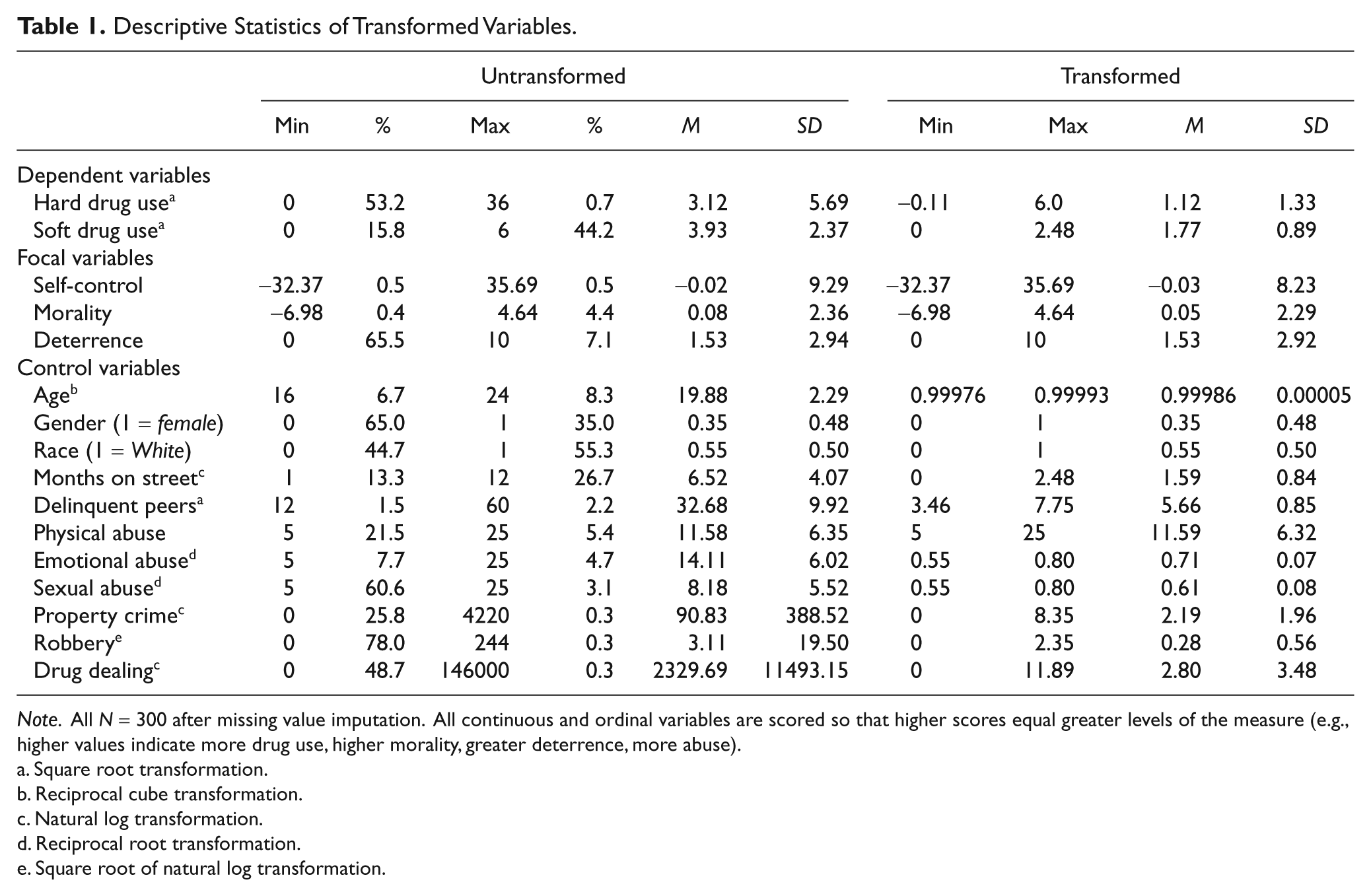
Note. All N = 300 after missing value imputation. All continuous and ordinal variables are scored so that higher scores equal greater levels of the measure (e.g., higher values indicate more drug use, higher morality, greater deterrence, more abuse).
Square root transformation.
Reciprocal cube transformation.
Natural log transformation.
Reciprocal root transformation.
Square root of natural log transformation.
Results
Table 2 displays the hard drug use regressions. Model 1 shows that low self-control, low morality, and low levels of deterrence are independently associated with higher levels of hard drug use, with morality showing the largest impact. According to Model 2, morality and deterrence remain significant when all the control variables are entered, although the effect of low self-control is reduced to nonsignificance. In Model 3, morality remains significant when the interaction terms are added to the model, but the effect of deterrence is reduced to nonsignificance. Therefore, of the three central variables, only low morality has a consistent effect on hard drug use, and its effect is strongest of all the variables contained in the models. None of the interaction terms between these three variables explored in Model 3, however, are significant.
Hard Drug Use Regression Models.

Note. N = 300 for all models.
p < .05. **p < .01.
Table 2 also shows that higher levels of physical abuse, being White, greater involvement in property crime and drug dealing, and lower levels of robbery are related to increased hard drug use. Delinquent peers is not significant in either Model 2 or Model 3, though it does approach significance in both models (p = .071 and .075).
Table 3 presents the results for soft drug use. In Model 1, low self-control, morality, and deterrence are all independently associated with higher levels of soft drug use. Self-control and morality are the strongest predictors of the three. However, with the addition of the control variables in Model 2, low deterrence is the only one of the three central variables to maintain a significant association with soft drug use. The effect of deterrence is reduced to nonsignificance with the addition of the interaction terms in Model 3. Therefore, none of the main variables are consistently related to soft drug use. Similar to hard drug use, there are no significant associations between the interaction terms and soft drug use. 1 Furthermore, being more involved in all types of criminal behavior and being White are also associated with greater soft drug use.
Soft Drug Use Regression Models.

Note. N = 300 for all models.
p < .05. **p < .01.
Although none of the interaction effects displayed in Tables 2 and 3 are significant, SAT outlines relationships that might not be captured by the type of analysis presented there. In particular the theory details that self-control and deterrence will be important only at moderate levels of morality. Additional analysis with files split at three levels of morality revealed that the impacts of low self-control and deterrence were mostly independent of morality. Coefficient comparison tests between self-control and deterrence regression coefficients at low, moderate, and high morality revealed only one significant result. The results showed that low deterrence was related to soft drug use at high (B = −0.072, β = −.259, p = .006) but not low levels of morality (B = 0.011, β = .039, p = .714; z score = 2.091). This does not support the “moderate morality” hypothesis. Similarly, coefficient comparison tests confirm that the effect of deterrence was not dependent on low or high levels of self-control. Further tests were conducted to examine the self-control by deterrence interaction only among those with moderate levels of morality. First, the multiplicative interaction term was found to be insignificant for both hard and soft drug use. Finally, those with moderate morality were split into high and low self-control groups. For both hard and soft drug use, coefficient comparison tests showed no difference in the effect of deterrence at low and high self-control. Although splitting the sample into moderate morality and then into low versus high self-control produces potentially problematic sample sizes for regression analyses (each n = 53), these results simply support earlier findings that show a lack of conditioning effects among combinations of morality, self-control, and deterrence.
Discussion
This study set out to test the assertions of Wikström’s (2006; Wikström & Treiber, 2007) SAT using a population (street youth) and outcome (hard and soft drug use) that had previously not been examined in the limited SAT literature. For hard, but not soft, drug use, support was found for the basic premise that morality is the strongest predictor of deviance and that self-control has no direct lower order effects on crime. Support, however, was not found for the conditioning effects proposed in SAT. The theory takes the position that self-control and deterrence are likely to influence criminal behavior only at moderate levels of morality. Aside from one minor exception (those with high levels of morality will be less likely to use soft drugs when faced with higher deterrence levels), we found that neither low self-control nor low levels of deterrence had an effect on hard or soft drug use that varied across levels of morality. The lack of consistent effect of morality, self-control, or deterrence on soft drug use was unexpected. It is possible that soft drug use is routine for a substantial proportion of this population and therefore has become a moral habit that is not influenced by moral beliefs, self-control, or deterrence. The high levels of marijuana use reported by this sample add a degree a plausibility to this explanation, though this is certainly an idea that would benefit from systematic examination.
The effect of deterrence on drug use appears to be of some importance. For both hard and soft drug use, deterrence is significant in Models 1 and 2. The effect of deterrence, however, was not found to be significantly different among those with lower self-control or among those with moderate morality as predicted by the theory. The fact that deterrence is not found to be influenced by self-control supports the first of the four hypotheses outlined by Wright et al. (2004) that individuals’ rationality (i.e., their susceptibility to deterrence) is not altered by self-control. Though this finding supports some previous work to varying degrees (e.g., Cochran et al., 2008; Tittle & Botchkovar, 2005), consensus has not been reached on this particular issue.
Like some previous work (Grasmick & Green, 1981; Jensen et al., 1978), morality and deterrence were generally found to operate independently of each other. However, one specific finding (the effect of deterrence on soft drug use is stronger for those with higher morality) offers very tentative support for some previous research that suggests that the influence of deterrence depends on one’s level of morality (e.g., Bachman et al., 1992; Burkett & Ward, 1993; Paternoster & Simpson, 1996). This remains an issue for future work to explore.
Although morality has the strongest effect on hard drug use, the fact remains that other important variables, including physical abuse, property offending, and drug distribution, maintain significance, which suggests that there may be other factors beyond morality that need to be examined in the use of drugs in this population. There may be issues regarding past trauma that lead one to self-medicate and to live in an environment where crime and drugs are interconnected. All of these factors can lead to an increase in hard and soft drug use. It may also be the case that the measures of crime are proxies for low self-control (see Gottfredson & Hirschi, 1990). This would suggest, like previous work, that self-control continues to have a main effect on deviance even when controlling for morality and is not necessarily influenced by levels of morality. If these variables continue to maintain significance in subsequent studies, a case will be made for theoretical integration to account for these other important factors. It is, however, much too early to call for anything more than theoretical refinement as much work still needs to be done testing SAT in different populations and with different outcomes. At this stage, it seems reasonable to suggest that morality has an effect on hard drug use that is not influenced by self-control or deterrence. It may be that morality is the primary factor that influences the likelihood of deviance and that the roles of self-control and deterrence are relatively inconsequential.
There are a number of limitations of this study. As with any cross-sectional study, the direction of causality cannot be statistically determined. It is possible that drug use may affect an individual’s perceptions of wrongness and the likelihood of getting caught. It is also possible that the long-term physiological effects of drug use may reduce an individual’s capacity to exercise self-control. However, the longstanding role of these variables in criminological analyses suggests that our hypothesized directions of causality are likely to be correct. Furthermore, the use of some single-item measures is not ideal. However, productive interview time with a street youth population is limited, and we were therefore constrained in terms of the length of the instrument that could be utilized. Even so, the estimates of this analysis are likely to be conservative with this particular population, as those more heavily involved in drug use are likely underestimated because of their inability to complete the survey. Finally, this study used nonprobability sampling, and, as such, generalizations beyond the street youth population based on this study should be made with caution. This is not considered to be particularly problematic as one of the primary goals of this analysis was to extend SAT to populations that have not yet been examined.
In sum, this study extends SAT to an at-risk, North American population that has not yet been examined and finds support for the basic assertions of SAT (i.e., morality has the strongest influence of any variable). However, doubt is cast on Wikström’s argument regarding the proposed conditioning effects. This study, then, provides a point of departure for future SAT work.
Footnotes
Appendix
Self-Control Items
| Item | Coding |
|---|---|
| I often act on impulse (spur of the moment) without stopping to think. a | 1 = SD to 4 = SA |
| I often devote much thought and effort to preparing for the future. | 1 = SD to 4 = SA |
| I often do whatever brings me pleasure here and now, even at the cost of some distant goal. a | 1 = SD to 4 = SA |
| I’m more concerned with what happens to me in the short run than in the long run. a | 1 = SD to 4 = SA |
| I frequently try to avoid projects that I know will be difficult. a | 1 = SD to 4 = SA |
| When things get complicated, I tend to quit or withdraw. a | 1 = SD to 4 = SA |
| The things in life that are easiest to do bring me the most pleasure. a | 1 = SD to 4 = SA |
| I dislike really hard tasks that stretch my abilities to the limit. a | 1 = SD to 4 = SA |
| I like to test myself every now and then by doing something a little risky. | 1 = SA to 4 = SD |
| Sometimes I will take a risk just for the fun of it. | 1 = SA to 4 = SD |
| Excitement and adventure are more important to me than security. | 1 = SA to 4 = SD |
| If I had a choice, I would always do something physical rather than something mental. | 1 = SA to 4 = SD |
| I almost always feel better when I am on the move than when I am sitting and thinking. a | 1 = SD to 4 = SA |
| I would rather go out and do things than sit at home and read. a | 1 = SD to 4 = SA |
| I try to look out for myself first (even if it means making things difficult for other people). a | 1 = SD to 4 = SA |
| I’m not very sympathetic to other people even when they are having problems. | 1 = SA to 4 = SD |
| If things I do upset people, it’s their problem not mine. | 1 = SA to 4 = SD |
| I will try to get the things I want even when I know it’s causing problems for other people. | 1 = SA to 4 = SD |
| I lose my temper pretty easily. | 1 = SA to 4 = SD |
| Often, when I’m angry at people I feel more like hurting them than talking to them about why I am angry. | 1 = SA to 4 = SD |
| When I’m really angry, other people better stay away from me. | 1 = SA to 4 = SD |
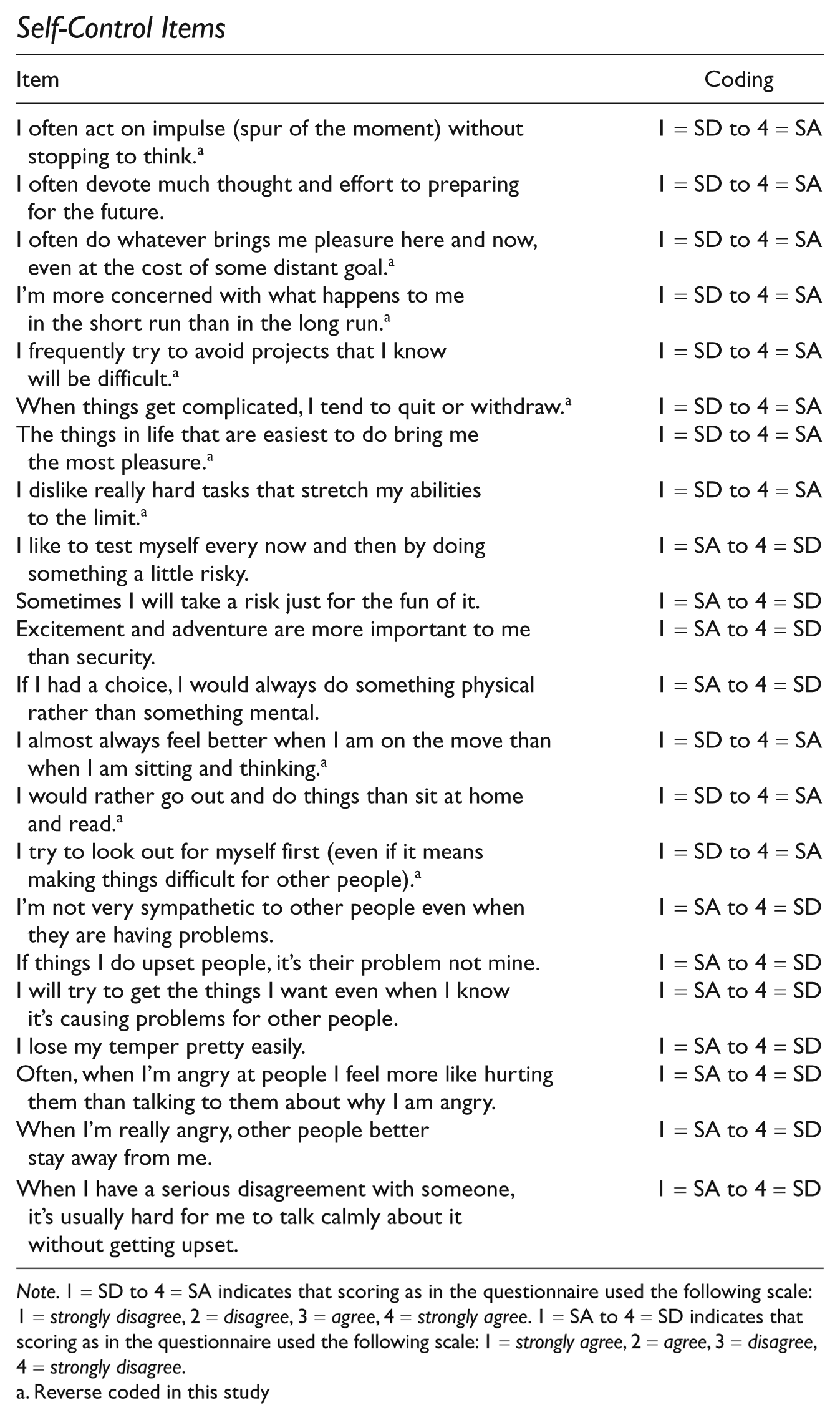
Note. 1 = SD to 4 = SA indicates that scoring as in the questionnaire used the following scale: 1 = strongly disagree, 2 = disagree, 3 = agree, 4 = strongly agree. 1 = SA to 4 = SD indicates that scoring as in the questionnaire used the following scale: 1 = strongly agree, 2 = agree, 3 = disagree, 4 = strongly disagree.
Reverse coded in this study
Declaration of Conflicting Interests
The author(s) declared no potential conflicts of interest with respect to the authorship and/or publication of this article.
Funding
The author(s) disclosed receipt of the following financial support for the research and/or authorship of this article: The authors would like to acknowledge the financial support of the Queen’s University Chancellor’s Research Award and the Social Sciences and Humanities Research Council.