




Abstract
Research indicates that men and women commonly express different amounts of fear about crime. This article explores the sex difference in fear of crime levels by assessing differences in fear of crime in relation to urban environments. Using data from the Bureau of Justice Statistics Criminal Victimization and Perceptions of Community Safety, the present analysis employs multinomial logistic regressions to examine gradations in two measures of fear of crime. Some aspects of the neighborhood environment do differentially influence men and women’s fear of crime levels, including serious crime in the neighborhood, physical and social disorder. Findings highlight that women’s greater fear of crime is partially due to higher perceived risks through signals of neighborhood conditions.
One of the best documented findings in fear of crime research is that women report greater fear of crime than men. Abundant research has confirmed this observation (e.g., Ferraro, 1995; Fisher & May, 2009; Fox, 2009; Franklin & Franklin, 2009), but we still do not fully understand the underlying mechanisms that drive the observed differences in fear of crime. The topic is of consequence—fear of crime is associated with constrained behavior (Ferraro, 1995; Liska, Sanchirico, & Reed, 1988), and many argue that fear of crime’s restrictive consequences are greater for women (Gordon & Riger, 1989; Madriz, 1997; Rader, Cossman, & Allison, 2009; Scott, 2003; Stanko, 1992). Thus, fear of crime has implications for quality of life and use of urban space, which differentially affect women (Pain, 2001). Moreover, fear of crime for oneself may be related to fear of crime for others (Snedker, 2006; Warr & Ellison, 2000). Nevertheless, little attention has been directed to assessing differences in perceived neighborhood conditions (see Fisher & May, 2009, for exception). This article takes a new look at the gender disparity to examine why women have higher levels of fear of crime than men. Although existing research has argued that women are more likely to fear crime than men because of their vulnerability, this article examines how perceived neighborhood conditions, which influence risk assessments, differ for men and women and help to explain sex differences in fear of crime.
The effect of local variation in neighborhood histories and conditions on assessments of danger and neighborhood life has been well discussed (Merry, 1981; Suttles, 1968). Interest in the impact of neighborhood context—measured both objectively and subjectively—is burgeoning. However, beyond objective characteristics, it matters how one perceives environmental conditions. Research indicates that fear and safety are more related to subjective perceptions of neighborhood environment than objective measures of danger (Schafer, Huebner, & Bynum, 2006). Moreover, Covington and Taylor (1991) report that even when objective incivilities were controlled for, subjective incivilities were positively related to fear of crime. However, others find no independent effects of perceived community crime risk once neighborhood crime is controlled for (Wilcox, Quisenberry, & Jones, 2003).
Ecological features of the neighborhood appear not only to affect levels of fear of crime but influence gender differences in fear of crime as well (Cobbina, Miller, & Brunson, 2008; Loewen, Steel, & Suedfeld, 1993; Smith & Torstensson, 1997). Previous research suggests that there are some gender differences in how certain features of the environment are perceived, which may increase the sense of risk of harm and contribute to fear. How do men and women’s perceptions of neighborhood risks translate into fear of crime? Despite the importance of neighborhood context, fear of crime research has yet to address fully how perceived neighborhood conditions influence men and women’s fear of crime similarly and differently.
To address these questions, this article reconsiders the relationship between sex and perceived risk in the neighborhood. This article advances the empirical study of fear of crime in two ways. The influence of perceived neighborhood conditions—serious crime in the neighborhood, physical and social disorder, and police dissatisfaction—is assessed on fear of crime. Second, interactions between sex and four perceived neighborhood conditions are estimated to examine whether the effects of perceived neighborhood risks on fear of crime vary by sex while controlling for key individual and city-level characteristics.
Sex and Vulnerability
The paradox that women report higher fear despite lower objective risk of victimization is well established in the literature (Bennet & Flavin, 1994; LaGrange & Ferraro, 1989; Lane & Fisher, 2009; Moore & Shepherd, 2007; Reid & Konrad, 2004; Skogan & Maxfield, 1981; Stafford & Galle, 1984). The explanations given for this discrepancy by researchers range from the importance of underreported crimes, particularly by known offenders (Stanko, 1992), to women’s greater vulnerability to sexual offenses (Riger, Gordon, & LeBailly, 1978; Young, 1992). The leading explanation for women’s higher fear of crime levels understands rape as a “master offense” that increases women’s fear of victimization, which, in turn, heightens general fear of crime (Ferraro, 1995, 1996; Fisher & Sloan, 2003; Lane & Meeker, 2003). More specifically, fear of rape has been thought of as a “perceptually contemporaneous offense” associated with other serious offenses (Warr, 1984, 1985) and increasing fear of harm (Gordon & Riger, 1989).
Perceived risk, as a distinct construct, has been shown to be a powerful predictor of fear of crime (Ferraro, 1995; Warr & Stafford, 1983), and women express higher perceived risk than men (Ferraro, 1995, 1996; Fisher & Sloan, 2003; LaGrange & Ferraro, 1989). Although sex is clearly part of the explanation, at the center of the relationship between sex, fear of crime, and perceived risk are issues of vulnerability. Different dimensions of vulnerability as by gender, age, and income are central to understanding fear of crime (Killias & Clerici, 2000; Pantazis, 2000). Women have greater perceived vulnerability, which makes them more afraid (Killias, 1990; Riger at al., 1978; Skogan & Maxfield, 1981). At the micro level, gender differences in vulnerability have been linked to individual physical conditions (Killias & Clerici, 2000; Madriz, 1997; Stafford & Galle, 1984; Warr, 1984) and social psychological factors (Farrall, Bannister, Ditton, & Gilchrist, 2000). In addition, environmental contextual conditions signal to individuals something about perceived safety or danger that influences pacts risk assessments and hence fear of crime. But as they assess their vulnerability, do similar neighborhood conditions cause men and women to feel unsafe in different magnitudes?
Neighborhood Risks
Urban context has long informed fear of crime studies (Bannister & Fyfe, 2001; Ferraro, 1995, 1996; Merry, 1981; Pain, 2001; Skogan & Maxfield, 1981). Urban areas plagued by higher crime rates than nonurban areas, coupled with a weakened sense of solidarity (Simmel, 1971; Wirth, 1938), may consequently be characterized by more fearful behavior and attitudes. Research documents that urban residents have greater fear or crime than nonurban residents (Belyea & Zingraff, 1988), and within urban environments fear of crime increases with city size (Clemente & Kleiman, 1977). As a part of the risk assessment process, individuals scan the city and neighborhood context for signs of danger or threatening cues. In her classic ethnographic work Urban Danger, Merry (1981) describes this process as it relates to urban life: “[C]ues are structured into spatial, temporal, and personal cognitive maps that define places, times, and categories of persons who are likely to be safe or dangerous” (p. 11).
There is evidence for both similarities and differences in men and women’s fear of crime (Lane & Fisher, 2009), and the role of perceived environmental context sheds light on the sources of similarity and difference. Research suggests that ecological contexts are gendered, which impact perceived risk and fear of crime. Smith and Torstensson (1997) conclude that women’s greater fear of crime is partially driven by their greater “ecological vulnerability,” whereby women perceive more risk in their local areas making them more fearful in response to specific environmental contexts (Spark, 1982). Conditions in the environment, especially in one’s immediate environment, may increase fear through particular cues or in a constellation of related cues. In an urban setting, individuals are navigating both in their own neighborhoods and through other urban spaces. It may be more precarious for women traveling through the city (such as traveling to work, shopping) than for men, as women may prefer familiar zones that offer reassurance and protection from harm. Alternatively, women may feel safer in the larger urban landscape if they perceive that it is their own neighborhood that poses more risks.
Physical and social environments give off clues or signals that individuals incorporate in their assessments of risk. Disorder or incivilities can be considered visible “signs of crime” (Ferraro, 1996; LaGrange, Ferraro, & Supancic, 1992; Skogan & Maxfield, 1981), indicating that dangerous elements are present and social control mechanisms within the neighborhood have broken down (Skogan, 1990; Wilson & Kelling, 1982). In general, weakening social controls can also increase feelings of vulnerability to crime (Bennett & Flavin, 1994; Covington & Taylor, 1991; Taylor & Covington, 1993). Police presence and community-related interactions with the police has also been found to reduce fear of crime (Skogan & Hartnett, 1997).
In a recent study of African American youth residing in urban disadvantaged neighborhoods, Cobbina and colleagues (2008) report gendered perceptions of neighborhood risk. For male youth, risks were associated with gangs, respect, and territoriality and congregating with other Black male youth in public spaces. Although women were largely insulated from those risks, their perceived risks were associated with predatory male behavior and their perceived weakness or incapacity for self-protection. Ironically, male youth attempt to lower their risks by traveling in groups, but this behavior was a source of enhanced perception of risk for female youth. In another study of youth, May (2001) finds that adolescents, particularly female adolescents, who perceive incivilities or disorder in the immediate environment had higher risk assessments and higher fear of crime, of both sexual and nonsexual offenses. In a Switzerland study, Killias and Clerici (2000) find that fear of crime in the streets and at night are higher for women and among residents in neighborhoods with reported disorder. However, they did not examine if the effects of perceiving neighborhood disorder on fear of crime differed by sex. Another study found that, while controlling for reported crime, perceptions of neighborhood disorder and dissatisfaction with one’s neighborhood influence perceptions of safety and noted gender differences in the resulting fears reported by residents (Schafer et al., 2006).
Not all research finds gender-specific differences. Relying on a sample of university students in a campus context, Fisher and May (2009) explore fear-provoking cues drawing on a cognitive maps framework. The authors find that both male and female students report that things like lighting and loiterers are fear provoking. Although women’s fear of crime appeared to be more responsive to fear provoking cues, there were no significant differences across sexes in impact of these cues on fear of assault (simple or aggravated) or fear of larceny. Similarly, a multicity survey in Eastern Washington conducted by Franklin and Franklin (2009) report that disorder positively impacts worry of victimization for both men and women, but there was no difference in the slopes of the relationship. Although women perceived significantly more disorder than men, the resulting impact on fear of victimization did not differ by sex.
Given that women typically express higher perceived risk than men, a differential impact of neighborhood conditions for women may reveal part of the sex difference. This article specifically explores serious crime in the neighborhood, physical and social disorder, and police dissatisfaction on fear of crime and the interactions between the sex and these perceived neighborhood conditions. Both individual-level and local environment and institutional conditions influence perceptions of risk and resulting assessments of vulnerability. Does accounting for how perceived neighborhood risks differentially influence men and women get us any closer to understanding the gender gap? Understanding the ways in which urban environment influences fear of crime is enabled by a data set on residents from 12 American cities where two measures of fear of crime are reported. Measures that separate fear of crime by different contexts offer something unique to fear of crime research and are of direct interest to those concerned about fear of crime in urban environments as they offer comparisons of local and broader urban contexts of fear of crime. In the analysis, predictors of neighborhood fear—experienced in the immediate social environment—and city fear—experienced as part of the broader social environment—are expected to operate differently for men and for women.
Data and Method
Data
Data for this study come from the Bureau of Justice Statistics “Criminal Victimization and Perceptions of Community Safety in 12 United States Cities” (CVPCS). The 12 cities include the following: Chicago, IL; Kansas City, MO; Knoxville, TN; Los Angeles, CA; Madison, WI; New York, NY; San Diego, CA; Savannah, GA; Spokane, WA; Springfield, MA; Tucson, AZ; and Washington, DC. In 1998, the Bureau of Justice Statistics conducted a study to collect city-level information on criminal victimization, perceptions, and satisfaction with police. To date, no multicity study or study of this magnitude has been conducted. Questions were added to the preexisting questionnaire from the National Crime Victimization Survey (NCVS). However, these city surveys, different from the NCVS, used random digit dialing (RDD) to contact households. The individual-level data were analyzed. The sample includes 12,549 individuals in 12 U.S. cities. Detailed descriptive statistics are shown in Table 1.
Descriptive Statistics for Reported Levels of Fear of Crime and Demographics by Sex.

The other race category includes respondents who report being American Indian, Eskimo, or other.
The not married category includes respondents who report being widowed, divorced, never married, or separated.
The prior victimization category includes respondents who report being a victim or attempted victim of theft, robbery, assault, or sexual assault.
Measures
Fear of crime
The dependent variable is comprised of two estimates of fear of crime: fear of crime in the neighborhood and fear of crime in the city in which one resides. Two questions were asked to tap fear of crime, “How fearful are you of crime in your neighborhood?” and “How fearful are you of crime in your city?” Four responses that included “not at all fearful,” “not very fearful,” “somewhat fearful,” and “very fearful” were given.
All of following neighborhood variables are of interest in predicting fear of crime, particularly through interactions with sex.
Serious crime in the neighborhood
This measure captures whether a respondent perceived there to be any serious crime in his or her neighborhood. Approximately, a third of the sample (33%) reported serious crime in the neighborhood. Men and women reported similar percentages of perceiving serious crime in the neighborhood.
Physical and social disorder
Respondents were asked about a series of conditions separately and whether it was present in their neighborhood. Perceptions about neighborhood disorder are composite variables (summed across a number of variables) with one unit representing an additional disorder item reported. The variable perceived physical disorder reflects a scale ranging from 0 to 6, including the following items: abandoned cars and/or buildings, rundown/neglected buildings, poor lighting, overgrown shrubs/trees, trash, and empty lots (α = .73). The variable perceived social disorder reflects a cumulative scale ranging from 0 to 7 including the following items: public drinking/public drug use, public drug sales, vandalism or graffiti, prostitution, panhandling/begging, loitering/hanging out, and transients/homeless sleeping on the streets (α = .81). In the sample, the mean is 1.23 and 1.43 for physical disorder and social disorder, respectively.
Police dissatisfaction
Respondents were asked to categorize their satisfaction with the neighborhood police as very satisfied, satisfied, dissatisfied, or very dissatisfied. This measure was collapsed to reflect dissatisfaction compared with satisfaction. The level of dissatisfaction with the performance of neighborhood police, includes respondents who are both very dissatisfied and dissatisfied, is measured either affirmatively or negatively, with 13% of the sample reporting not being satisfied with his/her neighborhood police.
Sex
Sex is measured dichotomously and the sample includes 55% women and 45% men.
Controls
A number of other variables—at both the individual and city level—are included in the model as controls based on previous research. City characteristics 1 include violent crime rate per 100,000 people, 2 percentage poverty, 3 and percentage unemployed. 4 Individual variables include demographics and experiences with crime. Age is measured in year intervals. Education level is used as a proxy for socioeconomic status and is measured as a continuous variable measured in years of education completed. Race is captured as a series of dummy variables, including White (reference group), Black, Asian, and other. The ethnicity measure reflects the comparison between Hispanics and non-Hispanics. Marital status compares currently married to unmarried (including separated, divorced, widowed, and never married). Prior victimization measures whether the respondent had been a victim or attempted victim of robbery, theft, assault, or sexual assault. How informed respondents consider themselves about crime in their neighborhood is measured dichotomously comparing well informed to not well informed.
Data Limitations
The analyses presented here are limited by the data, as is the case in all empirical research. The two measures used in the analysis—fear of crime in the neighborhood and fear of crime in the city—are not entirely consistent with or directly comparable to all measures used in previous research. Several researchers note that there are significant problems with a single-item measure of fear of crime (LaGrange & Ferraro, 1989; Warr & Stafford, 1983). Although previous research has often relied on multidimensional measures of fear of crime (Ferraro, 1995; Warr & Stafford, 1983), it is still useful to “study general fear, because people’s thoughts about crime are likely to combine elements of many different offenses” (Stafford & Galle, 1984, p. 178). Moreover, the authors of a recent analysis on fear of gangs conclude that “a generalized fear of personal harm may be the more important predictor [of fear of gang crimes] rather than a specific fear of rape” (Lane & Meeker, 2003, p. 366). In addition, recent research on fear of crime on college campuses measures fear of crime generally as opposed to using more specific measures (Fox, 2009). Using data from the British Crime Survey, Moore and Shepherd (2007) suggest that nonspecific global measures of fear of crime are most associated with fear of physical harm where substantial gender differences were found (as opposed to property crime). Measures used in this study are of direct interest to those concerned about fear of crime in urban environments. The proposed analysis moves us closer to understanding the role that neighborhood context plays in men and women’s fear of crime by offering a new way to capture dangers that people face in urban environments.
Model Estimation
The model estimation is based on a sample of 12,549 respondents. To account for the possible selection bias of not reporting on the depending variable, models using a Heckman selection procedure (Heckman, 1976) were estimated. Using the entire sample, sex, age, age squared, and the 11 city dummy variables were used in the selection model. The inverse Mills ratio (hazard of nonselection) was calculated and used in the multinomial logistic regression analyses to correct for the selection bias. The model controlling for the hazard of nonselection is reported. Regression-imputation was used in the case of remaining missing values for the independent variables. A regression model with sociodemographic variables, including age, sex, race, ethnicity, education, and marital status generated predicted values that were input for the missing values. A final sample weight 5 was used to adjust for survey design factors. Models estimated are nested models with individual observations that are not independent as they are clustered in cities. Standard errors are adjusted for clustering on city.
Given the ordered nature of the dependent variable—ranked from low to high—ordinal logistic regression seemed appropriate. Yet, the data violated the parallel regression assumption (p <. 0001)—that coefficients for all variables are simultaneously equal (Long & Freese, 2001) making ordinal logistic regression inappropriate for this analysis (assessed by both the Wald test and an approximate likelihood-ratio [LR] test). Long (1997) claims that “models for nominal outcomes are often used when the dependent variable is ordinal” and despite a loss of efficiency—as information is being ignored—this is “out-weighted by avoiding potential bias” (p. 148-149). Thus, this analysis employs multinomial logistic regression.
This “extension of the binary logit model” involves multiple comparisons. In this analysis, there are four categories equivalent to estimating six binary logits comparing outcomes 1 to 2, 1 to 3, 1 to 4, 2 to 3, 2 to 4, and 3 to 4. Although all gradations of fear are of interest, one category serves as the reference. The not very fearful comparison allows for a contrast between lower levels of fear to higher ones—somewhat and very fearful—an approach that might reveal the most about the process that drives fear of crime. Those who are not fearful or are unwilling to express fear may be somewhat distinct from those who express some level of fear.
Two analyses—multinomial logistic regression—on the two different measures of the dependent variable, fear of crime in the neighborhood and fear of crime in the city, were estimated. Interactions of sex and four perceived neighborhood conditions on fear of crime using individual-level data, including sociodemographic variables and controls, were assessed. This assesses if the effects of neighborhood conditions on fear of crime are the same for men and for women. Thus, Model 1 represents the baseline model with individual-level variables and perceptions of neighborhood context. For fear of crime in the city, controls also include city-level characteristics. The models for fear of crime in the city use generalized linear latent and mixed models (GLLAMM) estimations. Model 1 is evaluated and then compared to a model that includes interaction terms of sex and neighborhood conditions (Model 2). Unstandardized beta coefficients are reported in the tables.
Results
The frequency for fear of crime for men and women is reported in Table 2. It is evident that women reported more fear of crime in both the neighborhood and the city than men. In response to fear of crime in the neighborhood, approximately 70% of male respondents reported little or no fear compared to 58% of women. The sex gap is greatest for being not at all fearful, 30% of men compared with 20% of women reporting. The percentage of men and women falling into the not very fearful category was comparable, but more men expressed being not at all fearful. As fear of crime levels increase so do the percentage of women reporting. A greater percentage of female respondents fell into the higher two categories of fear. Less than one third of men (30%) expressed fear at the two highest levels compared to 42% of women. Only a small percentage endorsed the highest level for fear of crime in the neighborhood, of which there were proportionally more women (6%).
Frequency of Fear of Crime by Sex.
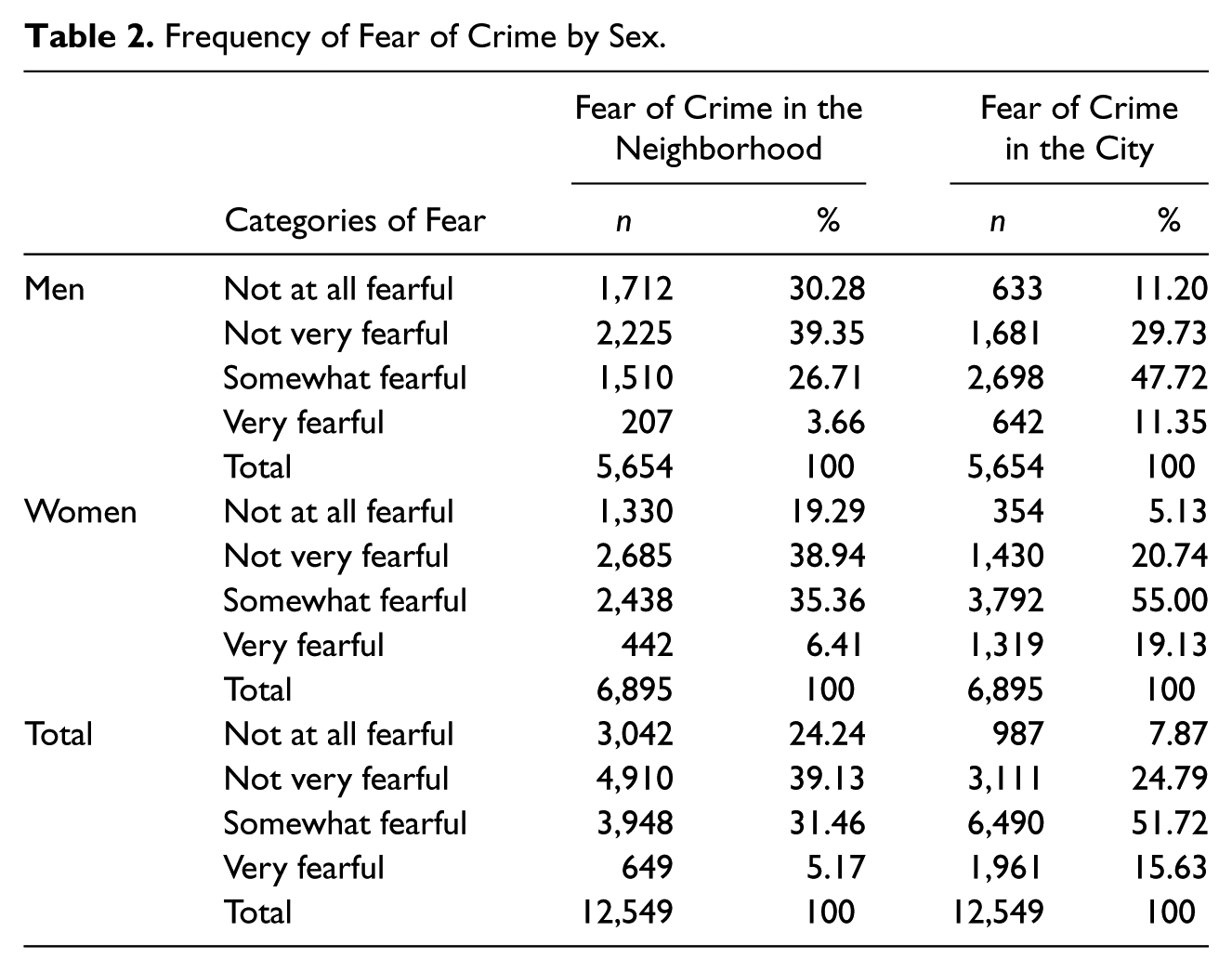
For fear of crime in the city, both men and women expressed higher levels of fear. The sex gap was less striking across fear of crime levels. The modal category of fear of crime for men and women was the not very fearful category for fear of crime in the neighborhood and somewhat fearful for fear of crime in the city. Consistent with fear of crime in the neighborhood, a greater percentage of women expressed being somewhat fearful (55%) and very fearful (19%) of crime in the city compared to men (48% and 11%, respectively). A much smaller fraction of the sample was willing to report not at all fearful for the fear of crime in the city measure.
Before discussing the regression results, it is worth briefly describing the raw differences in reported levels of neighborhood risks for men and women (see Table 1). In the case of perceiving serious crime in the neighborhood, men and women reported similar percentages. For the physical disorder scale, men and women had similar mean scores. However, men reported a statistically significant higher mean for social disorder than women (F = 31.48, p < .001). There was no significant sex difference in police dissatisfaction. Thus, there is some evidence that men and women may perceive conditions similarly, except in the case of social disorder where men reported a higher level. It is the reaction to those perceptions that may differ.
Neighborhood Fear of Crime
Tables 3 and 4 present parameter estimates for a multinomial logistic regression of fear of crime in the neighborhood and city. Not surprisingly, in the multinomial logistic regression analysis of the baseline model (Model 1, Table 3), sex is an extremely powerful variable for fear of crime in the neighborhood. In comparison with the not very fearful category, the odds of being in the somewhat fearful category are 1.38 times greater (antilog of .323) for women compared to men. This escalates to 1.73 times greater for women being in the very fearful category. In Model 1, the neighborhood conditions operate in the expected direction in most comparisons. Consistent with prior research, both indicators of disorder are associated with more fear of crime. Respondent who reported serious crime in the neighborhood have higher odds when comparing the not very fearful to somewhat fearful. However, reporting serious crime in the neighborhood has an insignificant impact in the very fearful category. Reporting dissatisfaction with the local police significantly increased the odds of being fearful of crime. Individual-level demographic characteristics reflect that older, married, non-Whites (Blacks, Asians and others) and Hispanics were associated with one or two of the higher fear categories while education was associated with lower fear categories. As expected, prior victimization was associated with more fear and informed about crime with less fear.
Multinomial Logistic Regression of Fear of Crime in the Neighborhood With Sex-Specific Interactions.
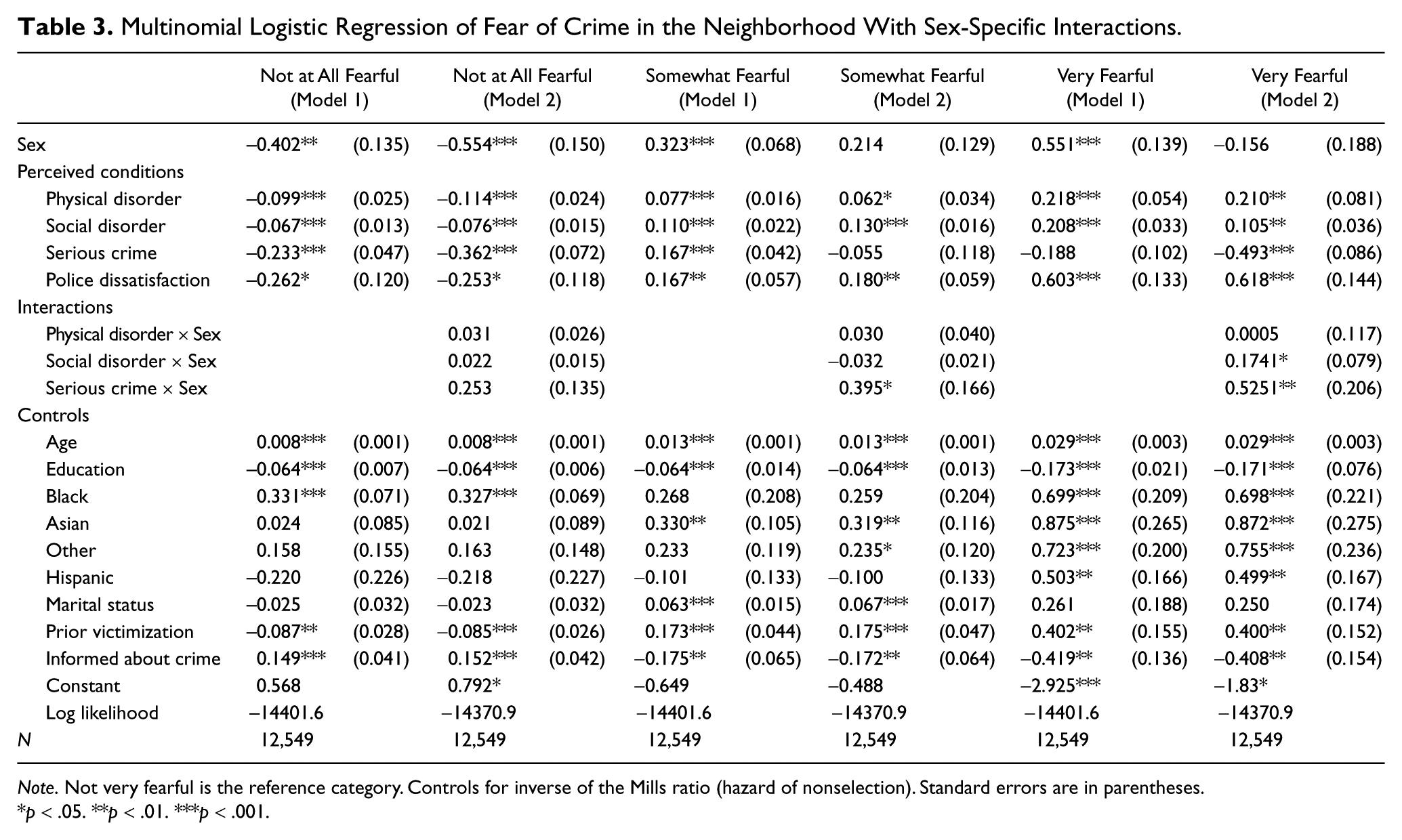
Note. Not very fearful is the reference category. Controls for inverse of the Mills ratio (hazard of nonselection). Standard errors are in parentheses.
p < .05. **p < .01. ***p < .001.
Multinomial Logistic Regression of Fear of Crime in the City With Sex-specific Interactions and City Characteristics.
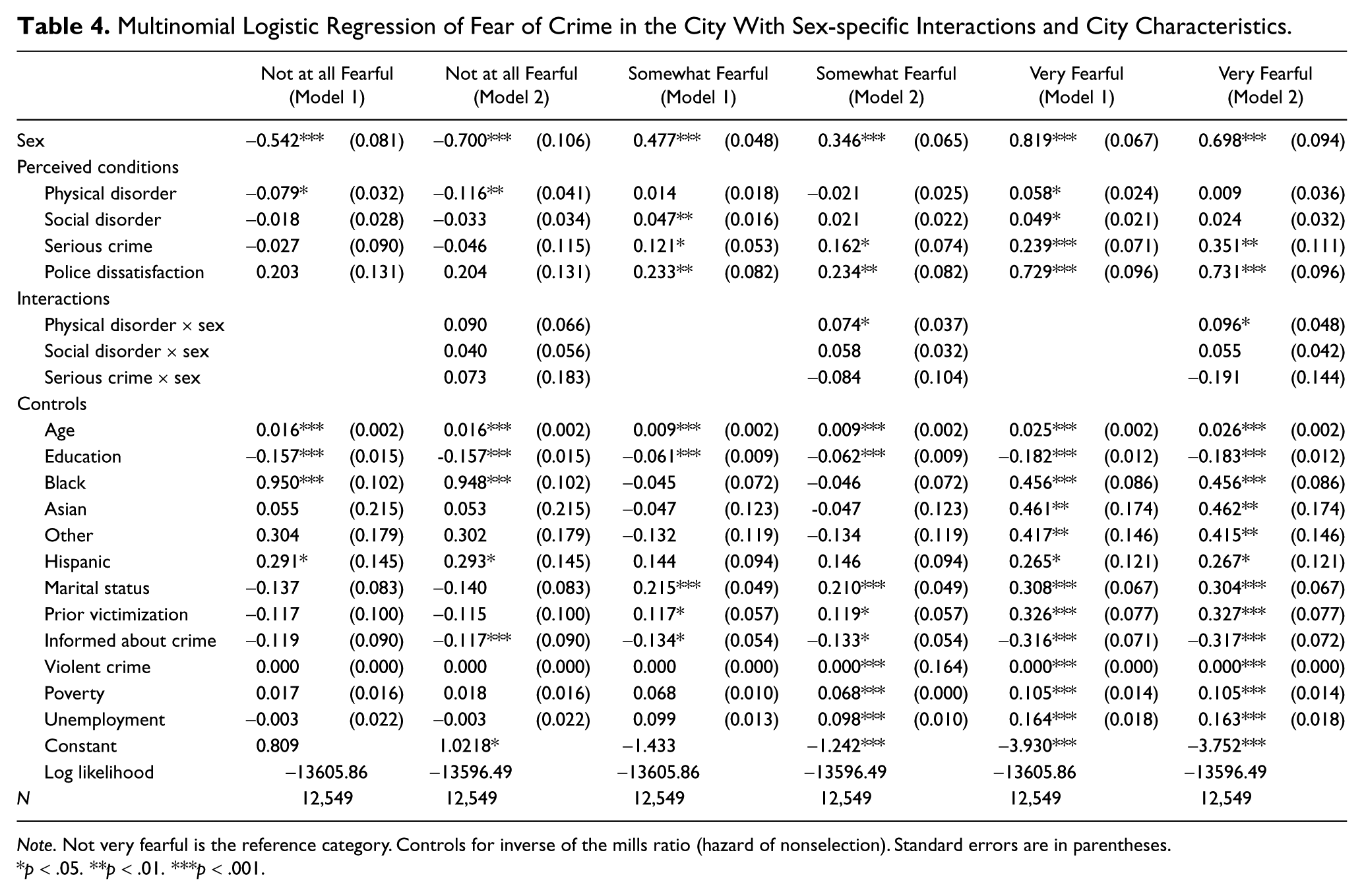
Note. Not very fearful is the reference category. Controls for inverse of the mills ratio (hazard of nonselection). Standard errors are in parentheses.
p < .05. **p < .01. ***p < .001.
Although all interactions between sex and neighborhood conditions were assessed, only two variables significantly improved the fit of the model. The increase by adding the interaction between sex and social disorder and sex and serious crime to the baseline model with no interactions reflects a significant change in the goodness of fit (log-likelihood χ2 = 60.25, p < .001). Although a model with these two interactions is the best-fitting model, the model with three interaction terms also provides a better fit than the baseline model (log-likelihood χ2 = 61.34, p < .001). There is no significant increase in fitness between the model with two and three interactions. However, for ease of presentation and comparability across the two measures of fear of crime, results include the three interactions (Model 2) compared to baseline (Model 1).
In an examination of the interactive models, several distinct differences emerge. The interaction between sex and social disorder (Model 2) is significant and indicates that the effect of perceiving social disorder differs by sex. The multiplicative effect of each additional increase of social disorder on fear of crime in the neighborhood is greater for women than men, as evidenced by the significant interaction term between sex and social disorder. The mere presence of social disorder is significant for both men and women. Interestingly, the sex effect disappears in the not very fearful to very fearful comparison. This is the contrast where the interaction term is highly significant. The mere presence of social disorder is significant for both men and women, but for women there is a 32% increase in being in the very fearful category compared to the not very fearful one with each additional unit of social disorder.
The interaction between sex and serious crime (Model 2) is significant and indicates that the effect of perceiving serious crime in the neighborhood differs by sex for somewhat fearful and very fearful compared to not very fearful. When there is serious crime in the neighborhood, the effect is greater for women compared to men in increasing the odds of being fearful for some categorizations of fear of crime. The perceived presence of serious crime in the neighborhood differs significantly by sex in the comparisons of the two highest categories of fear. For women, a one-unit change from no serious crime to serious crime in the neighborhood increases the odds 1.40 times from being not very fearful to somewhat fearful. Interestingly, in the comparison between not very fearful and very fearful, the effect of serious crime in the neighborhood is negative and the impact of the sex variable is insignificant. It is only for women when perceiving serious crime in the neighborhood that there is the expected, albeit slight, increase in the higher fear of crime level.
The significance of the interaction term leads to the conclusion that sex and serious crime have additive and interactive effects on fear of neighborhood crime, especially for the somewhat fearful category. To assess the impact of perceived neighborhood serious crime on sex, predicted probabilities were generated. Figure 1 visually reports the differential impact that serious crime in one’s environment has on fear of crime for men and women. This figure shows the magnitude of the differences in a way that is not as easily identified from the regression coefficients. The comparison shows that female respondents who perceive high risk in the neighborhood are more likely to fear crime than all others, and male respondents who do not perceive high risk in the neighborhood are least likely to fear crime. Perceiving crime in the neighborhood appears to be a good indicator of perceived risk. The differential impact that serious crime in one’s environment has on fear of crime does help to explain part of the gender gap in fear of crime.
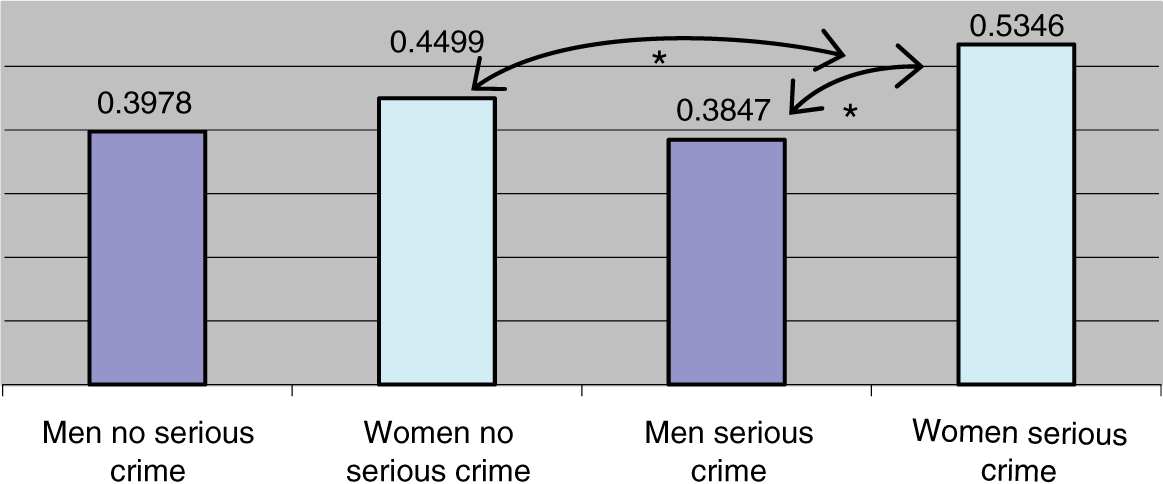
Predicted probability of fear of crime in the neighborhood.
Fear of Crime in the City
The results are similar for fear of crime in the city. The baseline model (Model 1, Table 4) sex continues to be an extremely powerful influence on fear of crime in the city. In comparison with the not very fearful category, the odds of being in the somewhat fearful category are 1.61 times greater for women compared with men. The odds of being in the most fearful category (very fearful) compared with not very fearful category are 2.27 times as great for women compared to men for fear of crime in city. However, the direct influence of the neighborhood conditions on fear of crime in the city is weaker and less consistent. The minimal significance of these terms probably reflects that the measure is at the neighborhood level—a measure of local risk—and not the city level. It is noteworthy that any aspect of perceived neighborhood risks carries over to the city even when controlling for key city-level characteristics knowm to be associated with crime and fear of crime. For instance, social disorder and serious crime in the neighborhood increase the odds of being somewhat fearful compared to not very fearful while both types of disorder, serious crime in the neighborhood and police dissatisfaction, increase the odds of being very fearful compared to not very fearful.
Despite the weaker direct effects of neighborhood conditions on fear of crime in the city, more interactions between sex and neighborhood conditions significantly improved the fit of the model. The overall impact of three interactions, physical disorder, social disorder, and serious crime in the neighborhood, did improve the model fitness compared to Model 1 (log-likelihood χ2 = 18.74, p < .001). This means that some of the coefficients are different for men and women.
In the model with no city-level characteristics (results available on request), three interactions are significant in at least one comparison. However, when city characteristics are included, the interaction between physical disorder and sex remains in the highest two fear categories. The inclusion of interaction terms washes out some of the effects for perceived neighborhood condition—specifically physical and social disorder—independently on fear of crime. This suggests that the impact of additional units of disorder only significantly increases the odds of movement from the not very fearful category to the somewhat fearful category for women. An additional unit change in physical and social disorder is significant, and for women it increases the odds of being in the somewhat fearful category compared to the not very fearful category by 5% and 11%, respectively. Interestingly, perceived serious crime in the neighborhood and police dissatisfaction continue to increase fear of crime, but there is no sex difference in these effects. All three of the city characteristics—violent crime, poverty, and unemployment—served to increase fear of crime levels. All of the individual-level factors were significant in the most fearful category in the anticipated directions consistent with prior research and the model for fear of crime in the neighborhood.
Discussion
This article analyzed possible contextual sources of sex differences in fear of crime by estimating multinomial logistic regressions. This procedure reveals some interesting findings regarding the gradations between the different categories of fear. The interactive effects of sex and physical disorder, social disorder, serious crime in the neighborhood, and police dissatisfaction on fear of crime were examined. Two neighborhood conditions—social disorder and serious crime in the neighborhood—help to explain the greater level of fear of crime in the neighborhood reported by women. In the case of fear of crime in the city, one neighborhood condition—physical disorder—helps to explain the greater level of fear of crime in the neighborhood reported by women when city characteristics were included. The general finding is that women who perceive greater neighborhood risks are more likely to fall in higher fear of crime categories. Thus, the differential impact of neighborhood conditions on fear of crime does help to explain part of the gender gap in fear of crime.
The finding that environmental conditions impact women’s fear of crime more than men’s is consistent with other research (Cobbina et al., 2008; Loewen et al., 1993; May, 2000; Moore & Shepherd, 2007; Smith & Torstensson, 1997). Studies that report no differences between men or women’s perception of the neighborhood risks or relationship to fear of crime tend to be on specific populations such as college students (Fisher & May, 2009) or teenagers (Lane, 2009). The perceived serious crime and disorder findings are related to research on how other environmental conditions impact fears and sense of danger in public spaces. Loewen and colleagues (1993) argue that lighting (light), prospect (open spaces), and refuge (a place where a criminal would not harm a potential victim or where nonthreatening people are present) are also related to perceived safety in urban context. Areas with perceived disorder or crime might also have these conditions, heightening one’s fear. In this Canadian study of university students, men rated most places as safer than women with lighting as the most important cue. However, there was no sex difference for refuge. A field experiment of German university students explored lighting, prospect, and probability of escape and found that perceived danger in urban public spaces was related to perceptions on entrapment with a modest sex interaction effect—increasing the impact for women—even while controlling for measures of femininity/masculinity (Blöbaum & Hunecke, 2005).
Likewise, Brownlow (2005) explores vision, seclusion, and escape on male and female student’s perceptions of safety of a Philadelphia public park (located on the edge of an almost exclusively Black neighborhood). He found gender differences in how men and women negotiated fear in public spaces and reports that for women all three features impact perceived safety of a place, but for men only the perceived ability to flee a risky situation (escape) impacts perceived safety. Brownlow concludes that environmental indicators are largely irrelevant for judging a public park as safe or dangerous among this male college sample. Future research can do more to identify the relationship between lighting, openness, and refuge and people’s perceptions about serious crime and disorder (physical and social).
This analysis demonstrates that both men and women rely on environmental conditions to signal certain risks. However, it seems to be the case that women and men interpret those signals differently, and perceived risk has a greater impact on fear of crime for women than for men. The lesser impact of neighborhood conditions on men’s fear of crime resonates with Brownlow’s (2005) argument that men have a more abstract fear of crime. This finding of significant differences in fear-provoking cues is largely inconsistent with Fisher and May (2009). Yet, other perceived neighborhood conditions (e.g., police) did not affect men and women differently for any measure. Interestingly, some perceptions about the neighborhood context carry over to fear of crime in the city, and the presence of perceived neighborhood physical disorder differently affects men and women’s fear of crime in the city. The significance of perceived neighborhood conditions is in line with previous research that suggests the processes behind fear of crime seems to be at the neighborhood level (Covington & Taylor, 1991) with some clear sex effects.
The reasons behind why perceived risky conditions impact men and women differently are multifaceted. Research suggests that social desirability factors influence reported sex differences in fear of crime, and when social pressures not to disclose fear are accounted for, sex differences disappear (Sutton & Farrall, 2005). However, recent qualitative data suggests consistent gender differences in the impact of perceived neighborhood context increasing women’s fear of crime. Smith and Torstensson (1997) argue that differential socialization processes lead to women to be more astute observers of disorder than men in similar situations. It may also be that women are more revealing about sources of fear in their feelings of fear than their male counterparts when surveyed (Stanko 1990). Disorder may awaken feelings of heightened vulnerability and perceive risk for women. It may be that men and women are worried about different crimes when they assess perceived risk in the neighborhood.
Reid and Konrad (2004) report that perceived risk, measured by how safe respondents feel when they are doing certain activities in the neighborhood, has more of an effect on men’s fear of crime for robbery than for women’s fear of robbery, but no sex difference was observable in fear of burglary. LaGrange and Ferraro (1989) argue that “perceived risk of personal crime is often more strongly correlated with fear than is perceived risk of property crime” (p. 704), and they find that women believe that they are more likely to be a victim of personal crime. If women are more concerned about personal victimization than men and this is more strongly associated with fear of crime, then the disparity may be produced by relative fear of personal attack. The findings presented here suggest that women’s greater fear of crime might be partially due to higher perceived risks through signals of neighborhood condition. The data used in this analysis cannot directly test this relationship, but future analysis that includes both a measure of individual perceived risk and neighborhood perceived risks would help clarify the association.
Experimental research suggests that differences in spatial orientation may also explain why some conditions impact women’s fear of crime more acutely than men. Sholl, Acacio, Makar, and Leon (2000) find that women report less confidence in spatial orientation and sense of direction than men. This influences the degree of orientation to distal landmarks in unfamiliar environments. Women’s lower scores for both confidence and sense of direction undermine their sense of spatial orientation, which may increase risk perceptions. If women feel more at risk in unfamiliar areas, then it may be because their perceptions are colored by spatial disorientation.
However, the greater influence of perceived neighborhood risk on women’s fear of crime may reflect that women are more aware of their environment or more accurate in their assessments of danger. Contrary to the assertion that women’s fear of crime is out of line with their risk of victimization, women may have higher levels of fear of crime because of higher perceived risks informed by signals of local conditions. These environmental assessments may translate into higher assessment of personal vulnerability. This is consistent with a recent study where male youth perceived their own neighborhoods as safer than female youth, who were especially aware of neighborhood risks associated with physical and sexual vulnerability (Cobbina et al., 2008). Rather than suffering from a generalized and unspecified fear of rape, astute perceptions that there is serious crime in the place where one lives may trigger fear among women that they faced enhanced risk of personal victimization. In addition to awareness, women are more likely than men to use environmental cues to alter their judgments of a situation as dangerous or safe (Brownlow, 2005). With greater reported fear of crime and perhaps broader evaluations of vulnerability, women may have greater awareness of danger or what Stanko (1997) calls “safekeeping.” Smith and Torstensson (1997) suggest that women react to the same levels of risk with more fear than men and that women are not only more sensitive to risk but also perceptive than men. Men may be prone to underestimating their own risks.
The analysis presented here cannot explore the accuracy of assessments of vulnerability by men and women. This analysis has only demonstrated that perceived disorder and serious crime in the neighborhood influence men and women’s fear of crime differently. Future work should continue to unpack the cognitive process by which men and women perceive themselves at risk. Future research might investigate how men and women come to decisions about risk and probable victimization. As suggested by the strong interactions between sex and serious crime in the neighborhood and measures of disorder in this analysis, women may perceive their neighborhood risks differently. Reid and Konrad (2004) find that the effect of sex and perceived risk on fear of crime is not uniform across types of crimes. In fact, the effect of perceived risk varies for men and women by the offense producing the fear.
In addition to including different measures of perceived risk, future research should explore the impact of perceived neighborhood conditions on crime-specific fears, especially fear of rape, given recent research suggesting that fear of rape may not be as sex specific as previously thought and may be contextually or situationally specific (Lane & Meeker, 2003; May, 2001). Other perceived neighborhood characteristics need to be explored further in relation to sex differences. For example, Chiricos, McEntire, and Gertz (2001) report that perceived racial and ethnic composition of the neighborhood impacts perceived risk of criminal victimization. Future research should also compare contexts as perceptions from rural and suburban residents may differ. Finally, exploring how social changes, such as technology and communication advances (e.g., cell phones), affect urban fear of crime is an important avenue of study.
In closing, the evidence presented by this analysis suggests that the relative effects of neighborhood conditions on fear of crime in the neighborhood and city operate differently by sex. Men and women may perceive neighborhood risks—especially serious crime and disorder—differently. Clearly, the urban environment is an important influence on respondent’s perception of risk and vulnerability, with differing implications for fear of crime between men and women and between the immediate neighborhood and broader urban contexts.
Footnotes
Acknowledgements
The author would like to thank Steven Pfaff, Becky Pettit, David Greenberg, Elaine Thompson, and Jerald Herting for helpful comments on earlier drafts of this manuscript.
Declaration of Conflicting Interests
The author(s) declared no potential conflicts of interests with respect to the authorship and/or publication of this article.
Funding
The author(s) received no financial support for the research and/or authorship of this article.