



Abstract
This article examines the relationship between gun possession and the nature of an offender’s involvement in drug markets. The analyses are based on data obtained from drug offenders who participated in the 1997 Survey of Inmates of State and Federal Correctional Facilities. The authors find that participants in crack-cocaine markets are more likely to possess guns than participants in powdered-cocaine, opiate, and marijuana markets, particularly if they are street-level crack dealers. However, participants in barbiturates and amphetamine markets also have high rates of gun possession. The authors also find relatively high levels of gun possession among traffickers who handle stashes of moderately large market value, who have central roles in the trade, and who are members of drug organizations. Finally, offenders who are young, female, African American, and from lower economic status are more likely to traffic in crack cocaine than in other drugs.
It is well known that trading in illegal drugs is a dangerous business. Goldstein (1985) referred to violence related to the drug trade as “systemic violence.” Systemic violence can result from disputes between rival drug dealers or disputes over drugs and drug paraphernalia. In addition, participants in the drug trade may use violence to punish those who serve as informants, sell adulterated or phony drugs, fail to pay debts, or otherwise violate normative codes (Goldstein, 1985; Goldstein, Brownstein, & Ryan, 1992; Goldstein, Brownstein, Ryan, & Bellucci, 1989; Tardiff, Gross, & Messner, 1986; Taylor, 2007; White & Gorman, 2000). They settle disputes themselves, in part, because their involvement in illegal activity prevents them from going to the police (Black, 1983; Bourgois, 1995; Taylor, 2007).
In this research, we examine variation in gun possession among drug offenders to determine which markets and what roles in those markets are particularly likely to involve violence. We are particularly interested in the crack-cocaine market as it has been suggested that it is particularly violent (e.g., Blumstein, 1995). 1 We also examine whether participants in the crack market have different social demographic characteristics than participants in other markets, and whether that affects the level of violence in crack markets. Finally, we examine whether systemic violence changed over the time period when crack markets were having an impact.
Crack Cocaine and Changes in Violent Crime
The well-documented rise in lethal violence among young men during the 1980s and early 1990s has been attributed, in part, to violence surrounding the illicit drug trade (e.g., Cook & Laub, 2002; Messner, Deane, Anselin, & Pearson-Nelson, 2005; Ousey & Lee, 2002). It is argued that the emergence of crack-cocaine markets in the late 1980s produced a substantial increase in violent crime rates in the United States (e.g., Baumer, Lauritsen, Rosenfeld, & Wright, 1998; Grogger & Willis, 2000; Hamid, 1990). According to Blumstein (1995), the growth in crack-cocaine use during the early 1980s corresponded with the recruitment of young minority males to serve as drug dealers (see Hamid, 1990). To protect themselves from rival dealers and the potential for robbery, crack dealers arm themselves with handguns. Blumstein (1995) suggested that gun carrying increased among street-level dealers of crack cocaine during the late 1980s. The carrying of guns diffused through the community as other young males also acquired guns for self-defense. This “arms-race” thesis suggests that violence became more lethal as young males increasingly carried weapons to protect themselves from dealers and the police, and that the violence diffused from large urban areas to other communities. Macro-level studies of the relationship between drug use and changes in violent crime rates have generally supported Blumstein’s hypothesis (Cork, 1999; Grogger & Willis, 2000; Ousey & Lee, 2002).
Crack-Cocaine Versus Other Drug Markets
A number of scholars have suggested that crack markets are more dangerous than other drug markets, regardless of who participates in them. Hamid (1990) suggested that crack markets were more dangerous than marijuana markets because they were more likely to be small localized markets involving repeat sales from a small number of users. These markets increased the competition among traffickers. Crack markets were also more likely to generate conflict because they were conducted outdoors with a large number of participants playing different roles. Similarly, Mieczkowski (1990) suggested that crack markets were more dangerous than heroin markets because outdoor selling involved more contact with strangers. Riley (1997) suggested that purchasers of crack were more likely than purchasers of powdered cocaine to carry guns because they make more frequent purchases and because they buy from a large network of dealers. One would expect that multiple purchases from different dealers increase exposure to risk for sellers as well as the buyers. Finally, dealers in the crack drug trade often use the drugs themselves, and crack may have a psychopharmacological effect on violence (Mieczkowski, 1990).
Only a few studies have compared the level of violence in crack markets to other drug markets and they have produced mixed results. Inciardi and Pottieger (1991) found that youth involved in the crack trade were more likely to commit violent crimes than youth participating in other drug markets (see also Hamid, 1990). Fagan and Chin (1990) produced a similar finding, but they also found evidence that it was not due to the nature of crack markets. Participants in crack markets were just as violent outside the drug business as inside, suggesting that the relationship between crack markets and violence was due to the types of offenders who participated in these markets. Finally, Riley (1997) found a different pattern among drug users/purchasers. Those who purchased powdered cocaine were more likely to carry guns than those who purchased crack or heroin. He suggested that powdered cocaine users might be more likely to carry guns because they buy larger quantities requiring more cash and because they were more likely to purchase drugs indoors and outside their neighborhoods. These factors increased the risk of attack from traffickers.
In sum, although it is often stated that crack-cocaine markets are particularly dangerous, the statistical evidence is limited and the findings are mixed. One limitation of the existing research is that it is based on bivariate statistics. It may be that participants in the crack-cocaine market are different from participants in other drug markets, and that the relationship between violence and involvement in different drug markets is spurious. It is important to control for the characteristics of participants in a multivariate analysis to examine whether participation in particular types of drug markets increases the likelihood of violence.
Roles in the Drug Trade
Some roles in the drug trade may be more dangerous than others, regardless of the drug involved. Those in more central roles may be more likely to arm themselves than those who engage in marginal roles because they engage in more frequent transactions or encounter more dangerous drug offenders. Occasional or marginal participants may not see the need for a gun. Inciardi and Pottieger (1991) found that young crack dealers who were involved in manufacturing, smuggling, or wholesaling were more likely to be involved in major felonies than those who were involved in retail sale.
Perhaps it is not the roles that offenders occupy in the drug trade that affects whether they have guns or engage in violence but a correlated factor: the market value of the drugs they typically handle (see Riley, 1997). For example, wholesalers may be more likely to have guns than retailers because they handle more expensive stashes. Offenders who handle large amounts of drugs or money may be more likely to have guns as they are at greater risk of attack and their losses are likely to be greater if they are victimized. Thus, Johnson, Golub, and Fagan (1995) found that dealers who sold greater quantities of crack experienced greater risk of violence and victimization.
It may also be that those offenders who are involved in gangs and other criminal organizations are more likely to have guns. Studies have found a strong relationship between gang membership and illegal gun use as well as between drug trafficking and gun use (Decker, 1996; Sanders, 1994). Johnson et al. (1995) found that violence and victimization were more frequent among crack sellers who sell in groups.
Current Study
In this study, we examine whether characteristics of drug markets and traffickers predict whether participants in drug markets possessed a gun at the time of their offense. We think it is useful to focus on firearms because they are a key factor in the discussion of systemic effects in crack-cocaine markets. We assume that the possession of guns among drug offenders reveals a willingness to use or threaten to use violence. Offenders may use guns for offensive or defensive purposes. They may display them, use them for attack, or carry them in case they are attacked (Taylor, 2007). Of course, some may have guns for reasons having nothing to do with drug trade. However, these motivations should not bias our coefficients representing relationships between gun possession and variables associated with drug-market activities. Our analyses focus on systemic effects on violence and whether gun possession is related to the offender’s position in that “system.”
Before examining effects on gun possession, we determine whether participants in crack markets have different social-demographic characteristics than participants in other types of drug markets. It is generally assumed that Black drug traffickers are more likely than White drug traffickers to participate in crack-cocaine markets (e.g., Blumstein, 1995). The only data we could find that addressed this issue were published by the U.S. Sentencing Commission (2003). The earliest data published (2002) showed the expected race difference among federal inmates. It may be, however, that race differences reflect the effects of socioeconomic status, which is associated with race (see Lillie-Blanton, Anthony, & Schuster, 1993). Because crack is relatively inexpensive and tends to be sold in small amounts, it appeals to users who have less money. The literature also implies that traffickers in crack cocaine tend to be younger than traffickers in other drugs and that the age of participants in crack markets helps explain the high level of violence (e.g., Blumstein, 1995). We were not, however, able to find any studies that compared the age of offenders in different markets. Finally, we examine whether women are more or less likely to participate in crack markets than other markets. A number of studies have focused on the role of women in crack and other drug markets (e.g., Fagan, 1994; Inciardi et al., 1993; Maher, 2001; Maher & Daly, 1996). The only comparisons of men and women’s participation rates in different drug markets, to our knowledge, are reports on federal inmates in 2002 and later. They suggest that female drug offenders are less likely than male drug offenders to participate in crack markets (e.g., U.S. Sentencing Commission, 2003).
In the main analysis, we examine whether gun possession is associated with the type of drug market, the offender’s role in that market, and the offender’s social-demographic characteristics. We control for the offender’s prior violent conviction record to address selection factors. The most violent offenders may be more likely to possess guns and more likely to be deeply involved in the drug trade or in the crack trade.
We hypothesize that participants in crack-cocaine markets are more likely than participants in other drug markets to arm themselves, based on arguments that crack-cocaine markets are particularly dangerous. We expect that street-level crack dealers are particularly likely to have guns, given discussions of the retail market described earlier (Blumstein, 1995). Support for this hypothesis will be indicated by a statistical interaction between involvement in the crack market and street-level dealing.
In addition, we examine whether offenders with more central roles in the drug market are more likely to have guns than those with more peripheral roles. Wholesalers, manufacturers, and growers may be more likely to have guns than retailers because they encounter more dangerous adversaries or are involved in the drug business on a more regular basis. For the same reasons, offenders who are involved in gangs and other criminal organizations may be more likely to have guns. Finally, brokers interact with a wide variety of people whom they often do not know, and they frequently carry drugs and cash (Johnson et al. 1995). As a result, they have good reasons to carry guns to protect themselves, their cash, and their stash.
We also hypothesize that offenders involved in sales of high value are more likely to have guns, regardless of the role they occupy or their involvement in organizations. The greater the market value of the drugs handled, the greater the risk of a violent encounter and the greater the need for a weapon. One might also expect that this relationship is curvilinear, if the top traffickers rely on armed underlings and are not armed themselves (see Johnson, 2003). The value of drug sales may also mediate the relationship between type of drug market, the role in that market, and gun possession. It may be that the crack offenders are less likely to use guns because their sales tend to involve relatively low value. This characteristic of crack markets may offset its other effects on gun possession. In addition, retailers and low-level traffickers may be less likely than wholesaler and high-level traffickers to be armed because they handle sales of lower value. A multivariate analysis is necessary to disentangle these effects.
A propensity to use violence may also reflect the age and socioeconomic status of those who participate in different drug markets and different roles. However, it is not clear whether one should predict age differences in gun possession. On one hand, if younger offenders tend to be more violent than older offenders, they may be more likely to have guns. On the other hand, it may also be that traffickers of any age are more likely to have guns if they are working in drug markets with many young participants. Gun use tends to be “contagious” as offenders are likely to arm themselves when potential adversaries are armed (e.g., Blumstein, 1995). If age has only a contextual effect, due to diffusion, then the age of individual offenders may not be associated with gun possession.2 Age should, however, be associated with involvement in crack markets.
Socioeconomic status may also be related to gun possession, although it is not clear whether the relationship should be positive or negative. On the one hand, socioeconomic status is negatively associated with violent behavior in the general population (e.g., Ousey, 1999). On the other hand, income is positively associated with gun possession, probably reflecting the greater ability of wealthier people to afford guns (e.g., Wright, Rossi, & Daly, 1983). Note that controlling for income addresses the possibility that offenders in higher positions in the drug business are better able to afford a gun.
Finally, we look at time trends in gun possession in the crack market by examining when the offense occurred. We examine the hypothesis that traffickers of crack cocaine during the late 1980s and early 1990s were more likely to have guns than traffickers of crack cocaine in other periods (Blumstein, 1995). However, it may be that the crack market did not become more violent but rather that the increase in gun violence during this period was due to an increase in the number of people involved in the trade. In that case, we should find no effect of year of the offense on gun possession.
Based on the literature, we make the following hypotheses:
Hypothesis 1: Participants in crack markets are more likely than participants in other drug markets to be young, African American, and from lower socioeconomic status.
Hypothesis 2: Participants in crack-cocaine markets, particularly street-level crack dealers, are more likely to possess guns than participants in other drug markets.
Hypothesis 3: Participants in drug markets are more likely to possess guns if they occupy central roles in the market, if they are involved in gangs and other criminal organizations, and if they are involved in sales of moderately high market value.
Hypothesis 4: Gun possession increased among participants in crack-cocaine markets during the late 1980s and early 1990s.
Method
We base our analyses on a nationally representative sample of inmates from the 1997 Survey of Inmates of State and Federal Correctional Facilities (U.S. Department of Justice, 2000). We chose this survey, rather than a more recent survey, because it allows us to examine drug markets the late 1980s and early 1990s. This is the period that has been associated with the emergence of crack markets and the increase in violence associated with those markets (e.g., Blumstein, 1995). Our sample involves inmates whose primary offense involved drugs, as they were the only inmates asked specific questions about their involvement in drug trafficking (N = 4,861). In cases where offenders had been charged with multiple offenses, the most serious offense was treated as the primary offense. The surveys had high response rates: 90.2% for federal inmates and 92.2% for state inmates.
An inmate sample is useful because it permits an examination of the drug trade using a large number of offenders. We can think of no other practical way to study a large number of offenders involved in the drug trade. A large sample is required to examine a variety of market and individual characteristics in a multivariate framework. However, one must always be concerned about the representativeness of data from inmate samples. Drug traffickers who have not been incarcerated or who have been incarcerated for other crimes may be different. Inmate samples are more likely to include inept, opportunistic, or frequent offenders (e.g., Chaiken & Chaiken, 1990). It may be that crack traffickers are oversampled because of more strenuous prosecution and more severe sentences or because they are more likely to operate in public settings than traffickers in other markets. Race or class effects on vulnerability to stop and search procedures or sentencing may also bias the sample. We think it is unlikely, however, that the selection problem affects estimates of the relationships we examine. In other words, we do not think such factors affect the independent and dependent variables and therefore produce systematic error. For example, there is no compelling reason to believe that the police are more likely to target street-level crack dealers who possess guns than street-level dealers in powdered cocaine who possess guns. Nevertheless, we must acknowledge that the generalizability of our results to drug traffickers generally is unknown.
The sample design for the survey involved a stratified two-stage selection. First, prisons were selected from a universe of all state and federal prisons. The second stage involved selecting inmates from each of the sampled prisons. Based on computer-assisted personal interviews (CAPI) that were conducted by staff from the U.S. Bureau of the Census, inmates provided information about their current offense, criminal history, and family background and demographic characteristics. Each inmate was assured that all responses during the interview were voluntary and strictly confidential. 3
Gun possession, our dependent variable, is based on the response to the following question: “Did you use, carry, or possess a weapon when the offense occurred?” Note that the weapon was not necessarily on their person when they committed the drug offense. However, while measurement error on the dependent variable can influence the intercept or increase the size of standard errors, it does not bias parameter estimates (Alwin, 2007). Of the offenders who had a weapon, 92% reported that the weapon was a gun. We included the few offenders who had other weapons (knives) in the category because they also indicate preparation and a willingness to use violence. There were too few cases to examine them separately.
Offenders who committed a drug offense were asked the following: “What drugs were involved?” We created dummy variables based on the following mutually exclusive categories: marijuana (the reference category), crack cocaine, powdered cocaine, opiates (including heroin and methadone), amphetamines (including methamphetamines), barbiturates (including methaqualone and tranquilizers), other drugs (e.g., phencyclidine, lysergic acid diethylamide, other hallucinogens), and multiple drugs. We grouped the other drugs together because there were insufficient cases for analyses.
To determine market value, we used information from the U.S. Drug Enforcement Administration’s System to Retrieve Information from Drug Evidence (STRIDE; Office of National Drug Control Policy, 2004). The STRIDE data report retail prices for particular quantities of crack cocaine, powdered cocaine, opiates, and methamphetamines from 1981 to 2003. According to Arkes et al. (2008), the STRIDE data provide reasonable estimates of drug prices for the types of analyses we are performing. Still, given variation in prices across locations, our estimates are likely to be conservative.
We used drug prices from 1994, the median year of arrest for inmates. Actually, choice of year does not matter much as, in general, the relative price of these drugs did not change much during this period. 4 We computed the price (in U.S. dollars) of a pure gram for each drug. We then created a series of dummy variable based on the quintile price categories (US$0-US$132.9; US$133-US$783; US$784-US$5,306; US$5,307-US$86,835; US$86,836 and more), using the lowest quintile as the reference group. We also included a dummy variable for the large number of missing cases (25% of the sample).
The respondents also indicated what activities they performed in the drug trade at the time of the arrest. Respondents were asked whether they were involved with (a) importing or helping others import illegal drugs into the United States; (b) illegally manufacturing, growing, or helping others manufacture or grow drugs; (c) laundering drug money; (d) distributing or helping to distribute drugs to dealers; or (e) selling or helping to sell drugs to others for their use. Respondents who reported selling or helping sell drugs to others for their use, or using or possessing illegal drugs were asked whether they were (a) a street-level dealer; (b) a dealer above street level; (c) a bodyguard, strongman, or debt collector; (d) a go-between or broker; (e) a money runner; or (f) a courier, mule, or loader. If someone played more than one role, they were coded “one” on each of those roles. Approximately 8% reported that they occupied more than one role. Our analysis will reveal whether someone who performs a particular role is more likely to possess a gun than someone who does not perform that role, regardless of what other roles they occupied. 5
Note that the drug roles described in this survey have similar names and functions as those identified by Johnson, Dunlap, and Tourigny (2000) in their description of crack markets. These researchers also mention the importance of the “middleman” in the crack market, particularly in the 1990s, because of increased policing. Both buyers and sellers needed a reliable person to transport money and drugs between them to avoid detection by the police.
Some of the drug offenders did not respond affirmatively to any of the questions about their role in the drug market (n = 803). It may be that these offenders served some other role than the ones that were listed or that their participation was brief or intermittent. It is also possible that some of these offenders were apprehended with large quantities of drugs but were not involved in trafficking. Finally, it is possible that they refused to acknowledge their role in the drug trade. In analyses not presented, we excluded these respondents from our analysis and found results similar to those we present.
The social-demographic variables include gender, race, the age at the time of arrest, and socioeconomic background of the offender. Race is a dummy variable coded as African American, Hispanic, White, and other, with White as the reference group. Age at the time of arrest is a dummy variable coded as below 21 (the reference group), 21 to 25, and above 25 years. Socioeconomic status is measured by years of education prior to the offense and monthly income (legal and illegal) prior to the offense (in thousands of dollars). For the age and income measures, we include dummy variables for those with missing data.
Prior violent felony convictions are based on self-reported information on the number of prior conviction for a violent crime. Offenders were asked how many times they had ever been convicted, as an adult or a juvenile, before the most current offense. These offenses could have resulted in incarceration or probation. The reference group for this binary variable comprised of inmates with no prior violent felony convictions.
Year of arrest is represented by dummy variables reflecting three time periods: prior to 1989 (reference group), 1989 to 1992, and 1993 to 1997. The choice of time periods was based on a preliminary bivariate analysis of crack arrests from the early 1980s to 1997. We also include a dummy variable for those with missing data.
Our measure of membership in a criminal organization is based on the following question: “In the year before your arrest . . . were you a part of any group or organization that engaged in drug manufacturing, importing, distribution, or selling?” It is not clear whether inmates considered their drug organization a gang. Perhaps the younger offenders would use this term. The label should not matter as a gang is usually defined as a criminal organization.
An important methodological issue relates to our reliance on self-reports. Perhaps some inmates were not convinced that the survey was truly anonymous. It is possible that some offenders attempted to give socially desirable responses by denying gun ownership and denying a high position in the drug trade. As it is also possible that some offenders claim a higher position than they really held, it is not clear whether misreporting should inflate or deflate relationships between role and gun ownership. It seems less likely that offenders misreport the type of drug market or the quantity of drugs as these are based on questions about the charges against them, not private information unknown to authorities.
Evidence suggests that drug users are surprisingly truthful and accurate when interviewed under nonthreatening conditions (Ball, 1972; Bonito, Nurco, & Shaffer, 1976). Self-reports are widely used in the study of drug use, and their reliability and validity are generally accepted (e.g., Elliott, Huizinga, & Menard, 1989; Martin & Bryant, 2001; White & Gorman, 2000). In addition, evidence suggests that the CAPI that are used on our surveys increase the validity of self-reported substance abuse (Dawson, 1998). We cannot be certain whether this evidence generalizes to self-reports about participation in drug trafficking, however.
Results
We present the descriptive statistics in Table 1. Only about 7% of drug offenders possessed a gun. In comparison, analyses of the total sample (not presented) show that 30% of the offenders incarcerated for violent offenses and 5% of offenders incarcerated for property offenses had guns. The most common drug offenses involve crack and powdered cocaine. Offenses involving opiates, marijuana, and amphetamines are much less frequent, and offenses involving barbiturates and other drugs are quite rare. A sizable number of offenses involved more than one drug. The most common roles are wholesale distributors and above street-level dealers. Most offenders are not members of an organization.
Descriptive Statistics (N = 4,861).

Our sample of drug offenders includes a higher proportion of women and minorities than the general population of offenders in this data set. In our sample, 29.3% of offenders are women compared with 17.6% of the offenders not in our sample. In addition, 76.1% of these offenders are Black or Hispanic compared with 57.6% of the other offenders.
In Table 2, we present results from a logistic regression where we predict involvement in the crack trade. We observe substantial differences in the social-demographic characteristics of offenders who are involved in crack-cocaine markets. The results support the argument that participants in crack markets are more likely to be young, African Americans, and of lower socioeconomic status. Younger offenders (below 21) are more likely to be involved in crack cocaine than older offenders (above 25). The difference between offenders below 21 and those from 21 to 25 was not statistically significant, but it was in the predicted direction. We observe an extremely strong effect for race. The odds of a Black drug offender participating in the crack-cocaine market (vs. other markets) are more than 10 times the odds of a White offender participating. Finally, drug offenders who are less educated and have low or medium income are more likely to participate in the crack market. 6
Logistic Regression Model Predicting Involvement in Crack Market (n = 4,721).

Note: Regression equation included a missing values category for income, age, and year arrested variables.
p < .05. **p < .01. ***p < .001
Table 2 shows that female drug offenders are more likely to be involved in crack cocaine than male drug offenders. This pattern is not consistent with a government report, cited earlier, that found greater male participation (U.S. Sentencing Commission, 2003). However, that government report was based on federal inmates in more recent years and only examined the bivariate relationship between gender and drug type. When we performed a bivariate analysis of federal inmates alone, we did not find a significant gender difference in participation in the crack market (19.5% vs. 22.1%; p = .26).
Table 2 also shows that traffickers in crack cocaine are more likely to have a prior conviction for a violent felony than other traffickers. This effect suggests that either the crack market attracts more violent offenders or that participation in that market resulted in the prior conviction.
Finally, consistent with the literature, we observe a strong effect of year of arrest. The more recent the arrest, the more likely it involved crack cocaine. The odds that a drug arrest involved crack cocaine are almost three times higher in 1989 to 1992 as before 1989. It is more than four times higher after 1992.
In Table 3, we present results from a logistic regression predicting gun possession. 7 Model 1 is an additive model, whereas Model 2 includes the interaction term for street-level crack dealers. The additive model reveals that traffickers in amphetamines, barbiturates, other drugs, and multiple drugs are most likely to possess guns. Traffickers in marijuana, opiates, and powdered cocaine are least likely to possess guns. Traffickers in crack cocaine are somewhere in the middle. Analyses not presented show that traffickers in crack cocaine are significantly different from traffickers in powered cocaine (p = .02) and barbiturates (p = .04) in their gun possession.
Logistic Regression Models Predicting Gun Possession (n = 4,112).

Note: Regression equation included a missing values category for income, age, year arrested, and market value variables.
p < .05. **p < .01. ***p < .001.
Model 2 reveals a statistically significant interaction between crack and street-level dealing. The interaction is depicted in Figure 1. 8 The results suggest that street-level crack dealers are particularly likely to possess guns. The figure masks the fact that participants in amphetamine, barbiturate, other drug markets, and multiple markets are also relatively likely to have guns. However, relatively few offenders are involved in these markets.
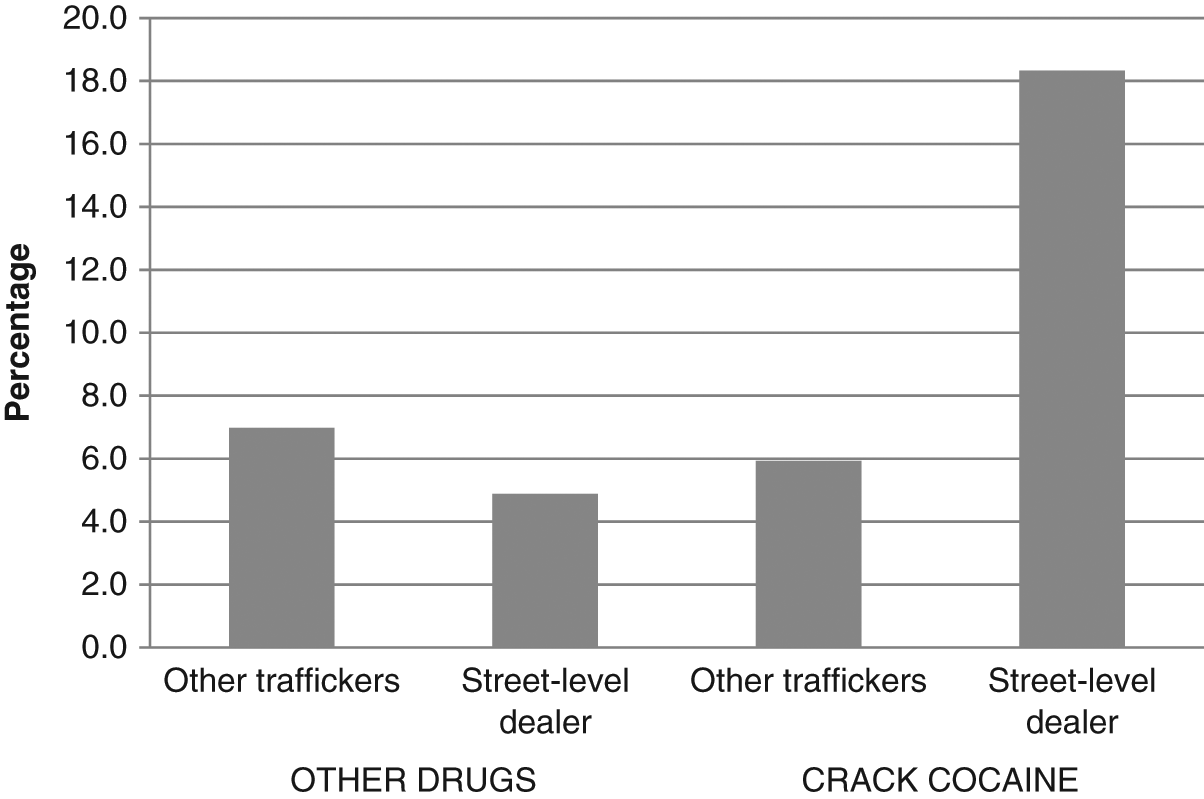
Percentage of different types of drug offenders reporting gun possession at time of offense.
The results in Table 3 generally support the hypothesis that offenders with central roles in the drug market are more likely than those with more peripheral roles to have guns. Manufacturers/growers, brokers, and distributors are more likely to have guns than drug offenders not occupying these roles. Street-level dealers, however, are much less likely to have guns (with the exception of street-level crack dealers). Surprisingly, bodyguards are not significantly more likely to have a gun, although the relationship is in the predicted direction.
We see strong evidence supporting our hypothesis that market value and gun possession have a curvilinear relationship. Gun possession increases as the market value of the drugs increase until the amount reaches the highest quintile (above $87,000) and then it declines. The decline from the second highest value category to the highest value category is statistically significant (z = 2.77; p < .01).
Table 3 also shows that offenders with prior convictions for violent crime are more likely to have guns. To some extent, having guns reflects individual differences in a propensity to use violence. Among the social-demographic variables, we observe effects for gender and income that are consistent with patterns observed in the general population: Men are more likely than women to have guns, and offenders with high relative income are more likely than offenders with lower income to have guns. The effects of age, race, and education, however, are all statistically insignificant. Finally, the effects of year of arrest are statistically insignificant. The results suggest that variation in sentence length and variation in when the offense occurred are not affecting our analyses of gun possession.
We restricted our analyses to crack offenders to test our hypothesis about changes over time in gun possession in the crack trade. We found no evidence that gun possession increased among crack offenders during the late 1980s and early 1990s. The coefficient for the 1989-1992 period (compared with the earlier period) was not statistically significant (b = .251; p = .445). The coefficient for the 1993-1997 period was negative and insignificant (b = –.392; p = .224). Finally, the bivariate relationship between year of arrest and gun use revealed no evidence of systematic change for either crack offenders or offenders generally.
Discussion
Our research shows that characteristics of drug markets and trafficking activity predict gun ownership, an indicator of an offender’s anticipation of and willingness to use violence. It supports the idea that drug markets have systemic effects on violence but shows that systemic effects are greater in some markets than others. In some cases, our results confirm conventional wisdom but provide the first statistical evidence for the validity of that wisdom.
We find that street-level dealers in crack-cocaine markets have particularly high rates of gun possession. Traffickers in amphetamines and barbiturates also have high rates. However, relatively few offenders are trafficking in amphetamines and barbiturates during this particular time period. Future research might examine these markets using the more recent version of the inmate survey we used.
The tendency for street-level dealers in crack cocaine to possess guns is observed in spite of the fact that street-level crack transactions are more likely to occur under circumstances that expose participants to law enforcement risks (Riley, 1997). It is also observed in spite of the fact that the police might specifically target crack dealers and, by casting a wider net, arrest fewer violent offenders. Finally, it is observed in spite of the relatively large number of women participating in the crack market. Female drug offenders are more likely to participate in crack markets than other markets, but they are much less likely than male drug offenders to possess guns. Guns might be even more prevalent in crack-cocaine markets were it not for female participation.
We also examined race, age, and socioeconomic differences in participation in the crack markets. The literature implies that drug offenders who participate in crack markets are more likely to be young, African American, and poor, but we could not find empirical documentation, except a report by the U.S. Sentencing Commission on race differences in more recent years. Our results supported the idea that the crack market attracted these groups. The race effect is particularly strong. The finding creates a dilemma for law enforcement. On one hand, one could argue that law enforcement focus their attention on more dangerous markets, such as crack cocaine. On the other hand, such an approach increases incarceration rates of African American youth of lower socioeconomic status.
While age and race affect involvement in crack markets, they do not have effects on gun possession. Rather, the effects of age and race on gun possession are indirect. The participation of young African Americans in crack-cocaine markets contributes to their involvement in gun violence, particularly if they are street-level dealers. Their use of guns reflects their participation in a relatively dangerous market rather than age and race differences in the propensity to use guns. Involvement in crack markets may help explain the high rates of gun violence among African American youth and high rates of victimization (Felson, Deane, & Armstrong, 2008).
Our evidence supports past research in showing that participation in crack-cocaine markets increased dramatically in the late 1980s. Not surprisingly, the increase in arrests for crack occurred a few years later than the increases in crack use identified by Johnson et al. (1995). They report the “expansion phase” of crack beginning in approximately 1984, the “plateau phase” beginning in 1987, and the “decline phase” around 1989. According to our data, the proportion of incarcerated drug offenders who had been involved in crack continued to increase after the decline phase. Presumably, the increased attention of the legal system to crack contributed to increases in the incarceration of offenders who were African American, youthful, and poor.
We see no evidence that drug markets became more violent from the 1970s to the 1990s. Gun possession did not increase over this time period. Nor was there an increase in gun possession among crack offenders. The results suggest any increase in gun violence attributable to the crack market was not due to changes in the nature of that market. It may be that the crack market did not become more violent but rather that the increase in gun violence during this period was due to an increase in the number of people involved in the trade.
The strongest predictor of whether drug offenders possess guns is the market value of the drugs they handle. Our estimate of the strength of the effect is probably conservative, given the likelihood of measurement error when using national estimates of market value. The evidence suggests that the incentives for violence are much greater when market value is high and that participants who handle large amounts arm themselves to address the greater risk. The evidence also suggests that interdiction strategies that increase the price of drugs are also likely to increase the likelihood of gun violence. The relationship between gun possession and market value is, however, curvilinear: Gun possession declines among offenders involved in the biggest deals. We suspect that this is because “kingpins” rely on underlings for protection (Johnson, 2003).
We also found evidence that offenders with central roles in the drug market are more likely than those with more peripheral roles to have guns. Distributors, manufacturers/growers, and brokers are more likely to have guns, whereas street-level dealers (outside the crack market) are much less likely to have guns. The strongest coefficient was observed for brokers. Following Johnson et al. (2000), we suggested that brokers may have guns because they interact with a wide variety of strangers, and frequently carry drugs and cash.
However, dealers who operate above street level are also likely to have guns. It is possible that above-street-level dealers are involved in more transactions than street-level dealers and therefore are more likely to see the need for a gun. It is also possible that street-level dealers avoid guns because they anticipate being searched by the police. Sellers who operate in open outdoor markets probably have a greater risk of police contact. Street-level crack dealers tend to have guns in spite of these risks.
Two other findings also support the idea that offenders who have greater involvement in drug markets are more likely to possess guns. First, offenders involved in multiple drug markets were more likely to have guns. Second, offenders involved in drug organizations were much more likely to have guns. 9 This evidence is consistent with evidence suggesting that membership in gangs increases the likelihood of crime (Thornberry, Krohn, Lizotte, & Chard-Wierschem, 1993).
We acknowledged the limitations of self-reports but argued that the error in our measure is likely to be random and therefore unlikely to affect our estimates. For example, some inmates may misreport gun possession, but it is unlikely that street-level dealers in crack are special in this respect. In addition, we recognized that there might be skepticism about the generalizability of our results to drug traffickers outside of prison. We argued, however, that it was unlikely that some selection process can explain the patterns we observe. We also pointed out the difficulty in analyzing variation across markets and roles without a large sample of drug traffickers; an inmate sample seems like the only practical choice. Furthermore, one could argue that our ability to address issues of internal validity offset any limitations in external validity. We were able to include extensive controls for individual differences, market role, and market characteristics.
In particular, our measure of prior record allowed us to analyze the data using a quasi-longitudinal design. By controlling for prior violent convictions, we could address the possibility that the relationship between gun possession and the type of involvement in drug markets is spurious because of the type of offenders who participate. We found evidence that offenders with prior violent convictions were more likely to be involved in crack markets This effect suggests the possibility that crack markets are more likely than other drug markets to attract violent offenders. However, our results suggest that the character of crack markets also has an impact, controlling for these individual differences.
In sum, we find that the systemic effects of drug markets on gun use are stronger for those with greater involvement in the system. Those who handle moderately large amounts of drugs, occupy central roles in drug markets, or participate in drug organizations are more likely to have guns. Those who traffic in crack market are more likely to have guns than those who traffic in powdered cocaine, opiates, and marijuana, particularly if they are street-level crack dealers. As young, impoverished African Americans are more likely to participate in the crack market, they are exposed to greater risks. Our results suggest that the effect of drug markets on gun ownership and violence depends on the types of situations participants encounter. Although all illegal drug markets are dangerous, some markets and some roles in those markets are more dangerous than others.
Footnotes
Declaration of Conflicting Interests
The author(s) declared no potential conflicts of interests with respect to the authorship and/or publication of this article.
Funding
The author(s) received no financial support for the research and/or authorship of this article.