



Abstract
In recent decades, researchers have identified many programs that successfully reduce juvenile delinquency. Evaluations of these programs generally do not, however, assess the mediating variables that intervene between program participation and reduced delinquency. Thus, although much insight has been gained on which programs are effective, the question of why they are effective is often neglected. This study addresses this issue by considering the risk factors that mediate the effects of a comprehensive intervention on juvenile offending. This was considered with data from the Children at Risk program, a 2-year multimodal intervention with random assignment that has been shown to reduce delinquency among high-risk early adolescents.
In recent decades, the myth that “nothing works” in the area of delinquency prevention and rehabilitation has been replaced by a view that many programs reduce delinquency (Howell, 2009; Van Voorhis, Braswell, & Lester, 2004). This includes programs that emphasize such things as community mentoring (Grossman & Tierney, 1998), cognitive behavioral treatment (Landenberger & Lipsey, 2005), and parent management training (Piquero, Farrington, Welsh, Tremblay, & Jennings, 2009). Moreover, integrated “multimodal” approaches based on a wide array of strategies are also effective, with multisystemic therapy (Henggeler, Schoenwald, Borduin, Rowland, & Cunningham, 1998) and the Seattle Social Development Project (Hawkins, Kostermann, Catalano, Hill, & Abbott, 2005) often cited as key illustrations. The success of these programs and others has reduced the harmful costs of crime in our society, and it has also significantly affected criminological discourse on this topic: Just one generation removed from the dire interpretations of the Martinson (1974) report, there now is widespread acceptance for assertions like “rejecting rehabilitation was a mistake” (Cullen, 2007, p. 718) and “treatment clearly works” (Lipsey, 1995, p. 78).
There still, however, is much to learn about interventions that seek to reduce delinquency. One neglected issue involves the question of why these programs are successful. In short, what specific changes do they induce to reduce juveniles’ risk for later delinquency? This question draws attention to the variables that mediate—and therefore “explain”—the effects of program participation on delinquency. By and large, we lack firm conclusions on this issue because program evaluations often do not consider mediating variables. Thus, although many studies assess program effects on delinquency (and many meta-analyses summarize their findings), analyses of the mediating variables that explain their effects are in short supply (for a recent exception, see Gottfredson, Kearley, Najaka, & Rocha, 2007).
This study addresses this void by focusing on mediating variables in our examination of the Children at Risk program (see Harrell, Cavanagh, & Sridharan, 2000). Typically referred to by its acronym CAR, this national intervention targeted early adolescents at high risk for delinquency. CAR assigned a case manager who worked closely with school and community officials to provide individualized services designed to minimize key risk factors for delinquency. Case managers took a multimodal approach that relied on such things as family counseling, after-school activities, and mentoring. As we elaborate below, the CAR program is for several reasons important to consider in a study such as this one. First, it was evaluated with a strong research design that included random assignment and repeated surveys of participants. Also, initial evaluations indicate that it reduced many forms of delinquency (see Harrell, Cavanagh, & Sridharan, 1999). Last, the program still operates in more than 50 U.S. cities, and its service-delivery model—one in which a case manager coordinates integrated services to target multiple risks—is pervasive (Healey, 1999).
In the next section, we describe the program in greater detail, including preliminary indications of its success. We then highlight the insights to be gained from understanding the precise mechanisms by which it may have affected delinquency before moving to a discussion of the CAR data and our analysis.
Overview of CAR
Description of the Program
The CAR program is a delinquency and drug-use reduction program developed, funded, and monitored by the National Center on Addiction and Substance Abuse (Harrell et al., 1999). The program was designed to prevent the onset of chronic, serious offending among high-risk, early adolescents, many of whom already demonstrated some degree of problem behavior. To be eligible, youths had to be 11 to 13 years old and had to reside in one of the economically distressed, high-crime neighborhoods targeted by the program. Moreover, eligible youths were those who had been deemed at high risk for delinquency based on risk criteria assessed by school, court, and social service officials.
The program designed for these youths was based on an integrated, risk-factor perspective that was theoretically agnostic. Program developers drew from prior research on a wide array of theories to conclude that individual involvement in delinquency is affected by key features of (a) families, (b) schools, (c) peer groups, and (d) personal characteristics (including temperament, values, and emotions). This view of delinquency causation required a “multimodal” approach (see Farrington & Welsh, 2007) that could target the variety of risk factors. Six substantive services became part of the CAR intervention: family services (including therapy, skills training, and advocacy with other agencies), after-school and summer activities, educational services (including tutoring and homework assistance), mentoring, a system of behavioral incentives, and community policing activities in CAR neighborhoods and with CAR families.
In addition, because of the recognition that each participant would face a unique blend of risks, these services were delivered in an individualized fashion. Case managers were the linchpin for this aspect of the program—an assigned case manager assessed the needs of youths and their families, developed a service plan, coordinated service delivery, and collaborated with other agencies, including justice authorities when necessary. With respect to educational services, for example, case managers were responsible for assessing key risks, referring youths to special services (including testing, special education, and tutoring), and monitoring their participation. To facilitate the case manager’s success, CAR caseloads were kept small (15 to 18 families). Not surprisingly, case managers often developed strong relationships with the youths and their families, and their involvement often was intense, especially in the wake of negative events like a family crisis or an arrest.
The Evaluation of CAR
An especially strong research design was used to evaluate the program’s effects. Sites from five cities were selected. (Each city received funds for at least 3 years, which corresponded roughly to the period of the evaluation.) Prior to receiving services, eligible participants were randomly assigned to the treatment group (which received program services for 2 years) or to a control group of participants who lived in the targeted neighborhoods but received no direct services. For both groups, data were collected with face-to-face interviews with the adolescent at three points in time: at baseline (between random assignment and the start of the program), at the end of the program (2 years after the program started), and at follow-up (1 year after program completion). These data from the child were supplemented with survey data from a parent and with official records regarding school attendance and promotion and contacts with the criminal justice system. Also, each wave of survey data included validated, multiple-item measures for the key family, school, peer, and personal risk factors targeted by the program.
To date, evaluations of the CAR program have not appeared in the peer-reviewed literature. However, a report prepared by the evaluation’s principal investigators (Harrell et al., 1999) suggests the value of the program. For example, CAR youths made use of many of the program services. Moreover, compared with the control group, both CAR youths and their caregivers participated in more positive social activities, including religious, community, and recreational activities. Evidence also emerged that the program was effective at reducing many forms of delinquency. To be clear, at the end of the 2-year program, there were essentially no differences in delinquency between the control and treatment groups. However, at the follow-up 1 year after program completion (when participants were roughly 15 years old), a number of significant differences emerged. Specifically, those in the treatment group were less involved in such things as violent attacks on others, illegal substance use, and the sale of drugs. Some of these differences were far from trivial. Drug selling in the prior month, for example, was 42% lower among CAR youths, whereas prevalence levels for violence and illegal drug use were roughly 20% lower for the treatment group.
With these results, CAR has become widely recognized as a program that can reduce delinquency. Indeed, its success has been lauded by many agencies—including the U.S. Department of Education, the U.S. Surgeon General’s Office, and the University of Colorado’s Center for the Study and Prevention of Violence—that track the effectiveness of various interventions. Under a new name (Striving Together to Achieve Rewarding Tomorrows [CASASTART]), this program continues to operate in more than 120 sites spanning 50 U.S. cities and counties. 1
Explaining the Effects of CAR
A key question about the CAR program remains: Why was it successful? There are two ways to approach this question, and the first involves a consideration of the CAR program’s design and implementation. Simply stated, the CAR program may have succeeded by virtue of the close correspondence between its approach to treatment and the principles of effective programming documented in prior evaluation research (see, for example, Andrews & Bonta, 2003, and Howell, 2009). The research reveals that interventions proven to be successful tend to be those that direct services to high-risk individuals, conduct needs assessments for participants, provide best practices treatment based on proven strategies, and provide an appropriate dose of services. Although a process evaluation of the CAR program’s design and implementation is not the focus of our analysis, this is an important issue to consider because in many respects the CAR program adheres to these principles of effective rehabilitation. Most notably, the program focused on those individuals deemed at high risk for offending. Moreover, the case management model was devoted to assessing the needs of participants, crafting a plan that provides an appropriate dosage of services, and when necessary, adjusting both the nature and dosage of treatment to respond to participant’s changing circumstances. CAR case managers also took advantage of proven treatments (including functional family therapy and the Big Brothers/Big Sisters mentoring program) wherever possible (Harrell et al., 1999).
An alternative and complementary way to approach the question “Why has CAR worked?” involves the consideration of mediating variables. Specifically, researchers can empirically evaluate the possibility that CAR was successful because of its ability to alter the risk factors for offending that were targeted by its treatment. If so, this would indicate that CAR had indirect effects on later offending by virtue of its effects on risk factors associated with the family, school, peer group, and personal characteristics. Considering this possibility will be the focus of our analysis, and this issue has been neglected to date—no study has considered whether the beneficial effects of the program are explained by its effects on some or all of these different risk factors that were targeted.
Indeed, this issue of mediating variables has received minimal attention not just with respect to the CAR program but also in assessments of other programs (see Gottfredson et al., 2007, for a recent exception). A consideration of mediating variables is necessary, however, to truly understand a program’s effects. This is a recurrent theme in the program-evaluation literature, with prominent manuals emphasizing the need to understand not simply a program’s effects on a given outcome but also its effects on “the intervening variables on which the outcome may depend” (Rossi, Lipsey, & Freeman, 2004, p. 165; also see Chen, 1990). In short, if we lack insight on the precise mechanisms by which a program reduces delinquency, then efforts to build on its strengths, replicate it elsewhere, and use it to inform public policy are necessarily hindered.
In an effort to evaluate these intervening processes, the CAR program is useful to consider for a number of reasons. Most notably, its success has been documented with a rigorous evaluation with random assignment, and variations of the program continue to operate in many U.S. cities and counties. Moreover, the CAR program is not an unusual or aberrant program but instead is illustrative of a common model—one in which case management is used to deliver integrated, multimodal services that target a range of risk factors (see Healey, 1999). Notable examples of this approach include multisystemic therapy (Henggeler et al., 1998), the Treatment Alternatives to Street Crime intervention for drug offenders (Anglin, Longshore, & Turner, 1999), and intensive supervision of juvenile offenders, which sometimes is used as an alternative to incarceration (Wiebush, 1993). Each of these programs provides its own unique approach that merits its own evaluations; however, assessments of any of them and other related programs—including CAR—provide insight on the case management approach and the process by which it can curtail problem behavior.
The Present Study
This study examines the factors that may explain the effects of the CAR program on later delinquency. In doing so, we focus on mediating variables relevant to the risk-factor areas targeted by the CAR program: (a) the family environment, (b) school commitment and performance, (c) the peer group, and (d) personal characteristics. The central hypothesis considered in this study is that membership in the CAR program’s treatment group will have effects on delinquency that are mediated by some or all of these four types of risk factors. Because the CAR program’s developers were agnostic on the question of whether some risk factors should be more important than others, we avoid a priori predictions on that issue.
Data
Because a rigorous evaluation of every CAR site across the nation was not feasible, the evaluation targeted five cities in particular: Austin, Texas; Bridgeport, Connecticut; Memphis, Tennessee; Savannah, Georgia; and Seattle, Washington. These were competitively selected (based on their proposed implementation models) to receive CAR funding and participate in the large-scale evaluation. These cities’ programs targeted small geographic areas with the highest rates of crime, drug use, and poverty. And within these areas, the program targeted those who were assessed by school, court, and social service officials as at high risk for delinquency.
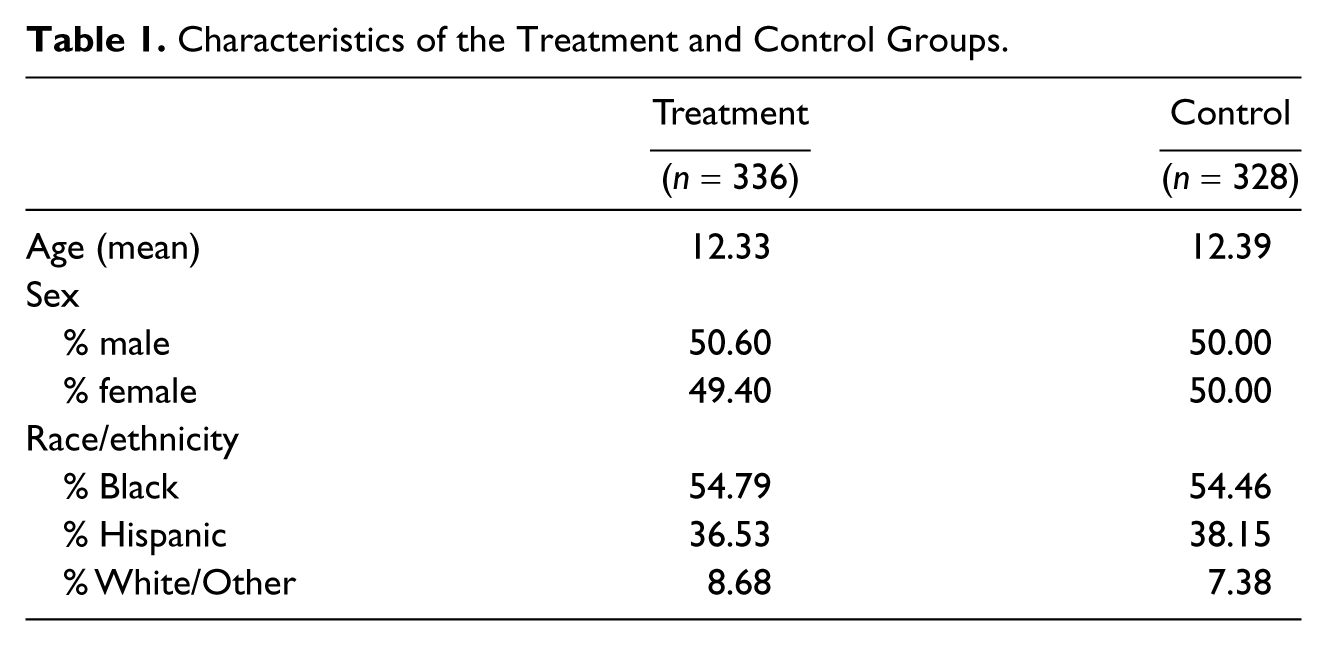
This screening procedure produced a pool of nearly 700 youths who were randomly assigned to treatment and control groups. For both groups, data were collected with face-to-face interviews with the adolescents, with the first interviews occurring during a baseline period between random assignment and the start of the program. In all, 98% agreed to participate in the study. This produced a sample of 664, with sample sizes of 336 and 328 for the treatment and control groups, respectively. Table 1 reveals the sample characteristics for the two groups in the baseline data; as expected, randomization produced groups that were nearly identical on key variables. In both groups, respondents were roughly 12 years old at the beginning of the program, and both samples were evenly divided between males and females and had a heavy concentration of racial and ethnic minorities, with Black and Hispanic participants representing approximately 55% and 35% of both samples.
Characteristics of the Treatment and Control Groups.
Both groups were reinterviewed at two later points: Wave 2 data were collected at the end of the program 2 years later (when participants were about 14 years old), and Wave 3 data were collected 1 year after that (when participants were about 15 years old). The response rates were relatively high, with participation gained from 77% of participants at the end of the program and 76% at the follow-up (see Harrell et al., 2000). Moreover, the attrition that occurred did not appear to be selective—comparisons of means between retained cases and those lost to attrition produced no significant differences for any variable considered, including age, sex, Black, and Hispanic.
In examining the effects of the program on delinquency, we focus on the Wave 3 data because, as noted earlier, this is the point at which the benefits of the CAR program became evident. Indeed, this is the case not just with respect to involvement in delinquency but also with respect to the key risk factors for delinquency that were targeted by the CAR program. In the words of Harrell and her colleagues (1999), “One of the most revealing findings from the CAR evaluation was that the positive effects of the program on drug use, crime, and risk factors were not . . . observed at the end of the program” (p. 9). Given that the Wave 3 period is the first point at which the control and treatment groups diverged from one another, this was the appropriate wave of data for measuring the mediating and dependent variables. Admittedly, this focus on contemporaneous relationships between our mediating variables and delinquency means that causal order cannot be firmly specified.
Measures
Delinquency
The Wave 3 CAR data include 23 standard self-reported delinquency items that measure the frequency of involvement in a wide range of delinquent offenses, including violent, property, substance, and status offenses. The adolescents themselves, who chose from ordinal response categories, answered all items. For most items, participants were asked about offending during the prior year and selected from responses of “never,” “1-2 times,” “3-4 times,” and “5 or more times.” For substance offenses, our focus was on items inquiring about behavior in the prior 30 days, given the challenges associated with estimating annual incidence for acts that are highly frequent. For these items, participants selected from answers ranging from 0 (never) to 7 (40 or more times).
Given our focus on discovering the variables that explain the program’s effects on delinquency, our first task was to identify those delinquent acts that were in fact significantly reduced by CAR treatment. These acts will be used to construct our delinquency measures because they represent the only acts in which there is an effect of the CAR program that can be statistically explained. To be as inclusive as possible in selecting these acts, we chose items in which the bivariate effect on delinquency of being in the CAR treatment group had a p value of .10 or less for a one-tailed test. Of the 23 acts, we unexpectedly found one—a very serious one (forcing or trying to force someone to do sexual acts)—that was more frequent among the CAR treatment youths. The more common pattern, however, was that offending was lower in the treatment group, and these differences were statistically significant for 9 different acts.
These nine offenses were the focus of our analysis for the reasons described above. Five of the nine involved substance offending, including the use of alcohol, marijuana, and prescription drugs for nonmedical reasons, as well as the self-reported frequency both of helping with drug sales and making direct sales of drugs. Rather than assessing each of these acts separately, we created a five-item substance offending scale that has an alpha of .74. 2 The remaining four items involved a mix of violent and property offenses during the prior year, including buying stolen goods, damaging someone else’s property, attacking others with an intention of hurting them, and carrying a weapon. These were used to create a four-item scale for predatory offending with an alpha of .77.
Mediating variables
The CAR surveys produced extensive data on a wide range of mediating variables. Our approach to selecting variables was guided by three considerations. First, we were interested in mediating variables that were logically relevant to the services offered by the program and the risk factors that were targeted. Second, we prioritized variables shown in prior research to be significant predictors of delinquency. And third, we gave priority to variables for which strong measures similar to those used in prior research were available. We identified a total of 11 mediating variables to consider. As we note below, these variables often are closely associated with specific theories of offending, although many are relevant to multiple theories. The measures used and the wording for their items are shown in Table 2, but they also are briefly summarized below.
Mediating Variables and Items.

Response categories have been reversed so all items are in the same direction and descriptive of the variable name.
Exposure to risk in the family environment was measured with two variables: family warmth and family conflict. The former should be negatively associated with offending and is closely associated with social control theory’s emphasis on family bonds (Hirschi, 1969), whereas the latter should be positively related to offending and is most closely associated with the general strain theory (Agnew, 1992) argument that aversive, negative family events are an important source of crime-generating strain. Family warmth was measured with six items (α = .75) in which high scorers indicate that family members get along with one another, are supportive, and have strong feelings of togetherness. Family conflict, however, is a four-item scale (α = .72) with high scorers indicating that their family life is marked by frequent arguments that involve screaming, threatening, and hitting.
We include two measures of school risk, both of which reflect the social control theory argument that strong school bonds and performance create stakes in conformity that reduce offending (Hirschi, 1969). School commitment was measured with a seven-item scale (α = .67) in which high scorers indicate that they like school, try hard to do well, and see doing well as worthwhile. School promotion was created from official data collected from participants’ schools during each year of the study. Scores for this variable ranged from 0 (for those who were “held back” from the next grade during each year of the study) to 3 (for those who were promoted to the next grade during each year of the study).
Peer group characteristics were measured with three different variables that capture the various aspects of peer influence emphasized in prior theory and research, especially those dealing with social learning theory (Akers, 1998; Haynie & Osgood, 2005). From the perspective of that theory, peers are important because of the reinforcements and punishments they provide for crime, and also because of the easy opportunities for crime that are sometimes associated with peer activities. Our first peer variable assesses exposure to prosocial peers with a six-item scale (α = .71) in which high scorers report that their friends are good students, are honest and obey the rules, and are involved in such things as community, religious, and athletic activities. Deviant peer pressure is a seven-item scale (α = .79) in which high scorers indicate that their friends are involved in various deviant activities (e.g., shoplifting, fighting, and substance use) and pressure participants to commit the same acts. And last, unstructured socializing is a four-item scale (α = .66) in which high scorers spend time with peers in unstructured activities that are free of adult supervision, including riding around in a car or motorcycle for fun, getting together with friends, going to parties, and going out at night without an adult.
The final set of intervening variables pertains to personal characteristics targeted by the CAR program. These variables follow from a variety of theories that emphasize personal predispositions, values, or emotions that should influence behavior. We assess four variables in particular. Risk seeking is a 2-item scale (α = .74) in which high scorers indicate that they like doing things that are a little dangerous and like to test themselves by doing things that are risky. Negative self-concept is a 10-item scale (α = .78) in which high scorers indicate, for example, that they do not have much to be proud of, wish they could have more self-respect, and see themselves as a failure. A related concept of sadness is measured with a 4-item scale (α = .65) in which high scorers feel that they do not enjoy life, life often has no meaning, and the future often seems hopeless. And last, negative perceptions of police is measured with a 6-item scale (α = .71) in which high scorers see the police as ineffective, unfair, and impolite.
Additional variables
To assess the effects of the CAR program, we used an “intent-to-treat” approach in which each participant’s value on the treatment variable was based not on the extent of services received but instead on whether he or she had been randomly assigned to the treatment or control group. Thus, with this variable, we are examining whether those who were provided access to program services fared better than those who were not. This is a common approach in evaluations of case management programs, given that the extent of services will naturally vary for reasons relating to the varying circumstances across participants (e.g., Kolbasovsky, Reich, & Meyerkopf, 2010). The process evaluation conducted by Harrell et al. (1999) revealed that this clearly was the case for the CAR program—those receiving the most services tended to be those exhibiting the greatest needs during the period of treatment. Thus, to assess the effects of access to CAR treatment, we used a dichotomous treatment variable coded as 1 for those assigned to the treatment group and 0 for those assigned to the control group. Also, to protect against spuriousness in considering the effects of the mediating variables, several control variables were used, including age (measured in years), sex (males are coded as the high category), and race and ethnicity (with dummy variables for the categories of Black, Hispanic, and White/Other).
Analytical Approach
As Baron and Kenny (1986) noted, three conditions must be met to establish that a given variable mediates the effects of an independent variable on an outcome. First, the independent variable (CAR treatment, in our case) must be associated with the outcome (offending). Second, the mediating variables must be associated with both the independent variable and outcomes. And third, the mediating variables must at least partially account for the relationship between the independent and outcome variables—controlling for the mediators should reduce the effects of the independent variable.
Our analysis used structural equation modeling (SEM) with Mplus 5 to determine if these conditions are met for the mediating variables that we consider. When compared with ordinary least squares (OLS) regression, SEM is appealing in two key ways for our particular study. First, SEM provides tests of significance for each indirect effect under scrutiny. Second, unlike OLS, SEM allows us to estimate relationships with measurement models that account for differing levels of measurement error across our different mediating variables (Baron & Kenny, 1986; Simons, Simons Chen, Brody, & Lin, 2007). According to Baron and Kenny (1986), the multiple indicator approach to estimating mediation paths by latent-variable structural modeling methods is especially recommended. This follows from the fact that measurement error in a mediating variable can inhibit researchers from totally controlling for it when measuring the effects of the independent variable on the dependent variable.
Given that all the indicators composing the latent variables in this study were categorical in nature, the use of Mplus to perform SEM was especially appropriate because of its capability to accommodate nonnormality without reliance on large samples (Kaplan, 2000; B. O. Muthén, du Toit, & Spisic, 1997). In addition, we used WLSMV—which refers to estimating the weighted least square parameter estimates using a diagonal weight matrix with robust standard errors and mean- and variance-adjusted chi-square test statistic—to estimate each structural equation model because this is the recommended procedure in models with categorical endogenous variables in Mplus (L. K. Muthén & Muthén, 1998-2007). We thus evaluated model fit by examining the mean- and variance-adjusted chi-square goodness-of-fit test statistic provided by WLSMV estimation, the comparative fit index (CFI), Tucker–Lewis index (TLI), and the root mean square error of approximation (RMSEA; Helstrom, Bryan, Hutchison, Riggs, & Blechman, 2004).
Results
Following the recommendations of Anderson and Gerbing (1988), we estimated the measurement model prior to the simultaneous estimation of the measurement and structural models. In this study, the two outcome variables and all the mediating variables—except school promotion—were latent constructs based on multiple indicators. We estimated the measurement model (not shown) for all of these latent variables. Although the chi-square goodness-of-fit test failed to suggest a good model fit, χ2 = 413.109, df = 231, p =.00, other model fit indices showed a good fit of the measurement model: CFI = .941, TLI = .961, RMSEA = .039 (Hu & Bentler, 1999). In addition, the constituent indicators for each latent variable all load significantly (all loadings are significant at a level of p < .01).
The next step in the analysis was to consider the baseline effects of CAR treatment on predatory and substance offending. Table 3 provides the results for an SEM that regressed these two outcomes on the dummy variable for CAR treatment, along with controls for age, sex, and race and ethnicity (with the dummy variable for Black serving as the omitted category). As expected, this model revealed a statistically significant effect of CAR treatment on both outcomes. Specifically, being in the CAR treatment group was associated with reductions in predatory and substance offending of .293 and .321 standard deviation units. 3
Standardized Regression Coefficients (n = 502).

Note: CFI = comparative fit index; TLI = Tucker–Lewis index; RMSEA = root mean square error of approximation.
p < .05. **p < .01 (two-tailed test).
Attention then turned to considering the mediating variables that may explain these effects. Rather than estimating a full SEM with all 11 mediating variables, we began by estimating four partial models—one for each set of mediators (family, school, peer, and personal characteristics). These models provide initial insight into whether any of the four sets of mediators are especially useful for explaining the program’s effects.
Table 4 shows the results for the family and school models, and Table 5 shows results for the peer and personal-characteristics models. All four models achieved adequate fit (as indicated by a standard set of fit indices), suggesting the potential importance of each set of mediators. With that said, however, evidence of strong indirect effects was missing in three of the four models. Specifically, across the four models, although we found a number of mediating variables that were significantly or near significantly affected by CAR treatment, and we found many others that were significantly related to offending, variables that satisfied both of these conditions were rare. In the family model (left panel of Table 4), for example, family conflict had a significant effect on both types of offending (with βs of .385 and .239), but it was unrelated to CAR treatment. Also, family warmth was neither related to CAR treatment nor offending. Based on these patterns, there is no evidence to suggest that CAR succeeded by virtue of its impact on the family environment (at least not with respect to these two key aspects of family life). This null finding was confirmed by the tests for the significance of indirect effects provided by Mplus.
Standardized Regression Coefficients Relating Predatory and Substance Crime to the Exogenous and Mediating Variables (Family and School Models).

Note: CFI = comparative fit index; TLI = Tucker–Lewis index; RMSEA = root mean square error of approximation.
p < .05. **p < .01 (two-tailed test).
Standardized Regression Coefficients Relating Predatory and Substance Crime to the Exogenous and Mediating Variables (Peer and Personal-Characteristics Models).

Note: CFI = comparative fit index; TLI = Tucker–Lewis index; RMSEA = root mean square error of approximation.
p < .05. **p < .01 (two-tailed test).
Similar but marginally more supportive patterns were observed in the school and personal-characteristics models. In the school model (right panel of Table 4), school commitment and promotion to the next grade significantly reduced predatory offending, substance offending, or both. However, although the effects of treatment on both of these variables were in the predicted direction, they fell just short of being statistically significant. Similarly, in the personal-characteristics model (with these results shown in the right panel of Table 5), the personal characteristics that significantly affected offending (risk seeking and negative views of police) were not affected by treatment. However, two risk factors that were reduced by treatment (negative self-concept and feelings of sadness) had insignificant effects on offending.
In contrast to those results, the peers model (left panel, Table 5) provided significant evidence of mediated effects. Deviant peer pressure was significantly reduced by CAR treatment (β = –.374), and it in turn had strong, significant effects on both predatory and substance offending (with βs of .577 and .354). Moreover, the indirect effect of treatment through deviant peer pressure was statistically significant on both predatory and substance offending (p < .01 for both). Last, the direct effect of CAR treatment on predatory and substance offending that was observed in the baseline model (Table 3) was reduced to insignificance for both outcomes.
These results suggest that the CAR program reduced offending most notably by discouraging participants from associating with peers who pressure them to engage in deviant acts. However, before reaching a conclusion on this issue, we estimated an alternative SEM that included mediating variables from several of the reduced models just estimated. This allows us to consider whether the indirect effect of treatment through deviant peer pressure is maintained even after accounting for mediating variables from the family, school, and personal characteristics models. Rather than including all 11 mediating variables, we eliminated those revealed in the prior analyses to have no reasonable chance of mediating the effects of the CAR program; specifically, we removed those that were not affected by CAR treatment and did not affect (in the predicted direction) at least one of the offending variables. To avoid being too exclusive, we set a t-value of 1.5 as the threshold for removing these variables. This resulted in a model that included—in addition to the control variables—5 possible mediating variables: school promotion, prosocial peers, deviant peer pressure, negative self-concept, and sadness. A diagram of the resulting model is provided in Figure 1. Overall, the most notable result for this model is its confirmation of the important mediating role of deviant peer pressure. Consistent with the results presented thus far, treatment was associated with significant reductions in deviant peer pressure (β = –.374); in turn, deviant peer pressure was significantly associated with predatory offending (β = .668) and substance offending (β = .486). This produced a statistically significant indirect effect of treatment on both outcomes (p < .01).

Estimated path model.
Discussion and Conclusion
When there is evidence that a program successfully reduces offending, much can be gained from considering precisely why it is successful. This was considered by examining the variables that mediate the effects on delinquency of the CAR intervention, which was designed to prevent the onset of serious behavior problems among high-risk youth. Several patterns emerged in the analysis. We elaborate on these below and then discuss the study’s limitations as well as implications for delinquency-reduction programming and future evaluation research.
Our first key conclusion is that in line with one prior evaluation of CAR (Harrell et al., 1999), we identified a number of illegal acts that were significantly lower in the CAR treatment group (relative to the control group) 1 year after program completion. Specifically, out of 23 standard measures of self-reported offending, 9 were marked by lower offending in the CAR treatment group, and these acts pertained to substance, property, and violent forms of delinquency. Thus, our analysis confirms the conclusion from an earlier evaluation (Harrell et al., 1999): Across-the-board reductions in delinquency were not achieved, but reductions occurred for many offenses. Moreover, our multivariate analyses with scaled measures of offending indicated that the reductions were not trivial—CAR treatment was associated with reductions in offending of approximately 0.30 standard deviation units. This pattern is consistent with evaluations of other case management programs with youths (e.g., Rhodes & Gross, 1997; Wiebush, 1993), although exceptions certainly exist (Brank, Lane, Turner, Fain, & Sehgal, 2008).
Our second key conclusion relates to what mediates these observed effects. Consistent evidence revealed that the effects of CAR treatment were explained in large part by the variable deviant peer pressure—CAR treatment reduced association with peers who engaged in deviance and pressured them to do so as well. This lowered involvement in both predatory and substance offending, given that deviant peer pressure was a strong predictor of both. Indeed, in SEMs that included deviant peer pressure as a mediating variable, the previously observed “direct” effects of CAR treatment were reduced to nonsignificance.
There were a few other mediating variables for which slight evidence of a mediating role emerged. For example, feelings of both sadness and negative self-concept were reduced by CAR treatment, and sadness in turn had effects on offending that were nearly significant. Also, school promotion was inversely related to substance offending, and CAR treatment had an effect on it that was significant at the p < .10 level. These narrow misses are mentioned, however, only to protect against the risk of Type II error, which takes on special significance when discussing real-world programs that address pressing social problems (see Langbein & Felbinger, 2006). Taken as a whole, compelling evidence of a mediating role emerged only for deviant peer pressure.
This pattern of results should be looked at in reference to CAR’s impact theory. Simply stated, the CAR program had slight to nonexistent effects on key risk factors related to the family, school, and personal characteristics—risk factors that were expected to respond to CAR treatment. And yet, something about the program still led juveniles to spend less time associating with peers who encourage deviance. We see two possible explanations for this. First, it may be that case managers used program services and their role as counselors to increase youths’ participation in prosocial activities; this, in turn, may have minimized time spent with peers—deviant or otherwise—in unstructured activities that lack adult supervision. We should emphasize, however, that although our model did not include a measure of time spent in prosocial activities, it did include a measure of time spent with peers in the types of unstructured, unsupervised activities (e.g., going out a night without an adult) that are catalysts for deviant peer pressure (Osgood, Wilson, O’Malley, Bachman, & Johnston, 1996). We found that CAR treatment did nothing to reduce involvement in these peer activities.
Thus, we see a second possibility as more likely: Rather than leading youths to spend less time with peers in general, CAR treatment led them to spend less time with deviant peers in particular. The explanation for why this would be true is unclear, and the CAR surveys unfortunately did not inquire about the factors that youths took into account in forming peer associations. However, a pattern of homophily in which individuals “befriend people like themselves” is well established in research on adolescent peer associations (Warr, 2002, p. 27). Thus, unmeasured shifts in values or priorities that resulted from CAR treatment may have led youths to gravitate toward peer networks that were less encouraging of deviance; this, in turn, should have decreased opportunities and reinforcements for offending. This line of reasoning is consistent with the extensive scholarship on social learning theory that has documented important effects of peer associations on delinquency. The research finds that key individual characteristics or experiences affect one’s involvement in deviant peer associations, and these in turn affect subsequent delinquency (e.g., Chapple, 2005; Haynie & Osgood, 2005; Wright, Caspi, Moffitt, & Silva, 1999). Our findings support the idea that participation in a comprehensive intervention like the CAR program can be one such experience for individuals that reduces exposure to deviant peers who encourage delinquency.
When taken as a whole, these results have significant implications for delinquency-reduction programming. Most notably, they provide further evidence that the CAR program produced positive outcomes and that a case management approach with high-risk early adolescents can be successful. Notably, however, our results suggest that the mechanisms that explain these effects are not as straightforward as most program-impact theories suggest. Our analysis—a rare test that has considered mediating variables—suggests that many of the risk factors targeted by these programs may be unresponsive to program services. Perhaps the etiology of problems in the family environment, school performance, and personal characteristics are sufficiently complex to require more intensive, targeted programmatic efforts (such as intensive family therapy or cognitive behavioral therapy). However, one important choice made by adolescents—the choice of which peers to spend time with—may be more malleable, and therefore, may be an appropriate target for case managers. Indeed, our results suggest that changes in deviant peer association are possible even in the absence of transformations in such things as family functioning and commitment to school success.
These findings and their implications should be viewed in the context of limitations of the analysis, the first of which involves the mediating variables that were considered. Although the CAR data included strong measures for various features of the family environment, schools, and peer groups, a stronger set of measures for personal characteristics certainly was possible. For example, although the study included a measure of risk seeking, a more elaborate measure of self-control—one of the strongest predictors of offending (Pratt & Cullen, 2000)—was preferred. In addition, much research points to the effects on crime of externalizing negative emotions (especially anger and anxiety) as well as deviant values (e.g., social learning theory’s delinquent definitions), neither of which could be measured with CAR data. Thus, although we were able to consider a large set of relevant mediating variables, by no means was our list ideal or exhaustive.
An additional limitation relates to an inherent complication of case management programs that emphasize individualized treatment: Because services vary according to participants’ needs and experiences, each participant receives—by design—a different version of the program. This unquestionably was true for the CAR program. In their process evaluation, Harrell and her colleagues (1999) found significant variability in the receipt of services, and these differences were often linked to differences in the struggles faced by participants during the study period: “CAR services often were intensified following crises [such as] school suspension, arrest, or observed drug use” (p. 9), and the youths who received the most services were often those who reported the most problem behaviors. This differential receipt of services—although expected—complicates efforts to consider that program effects may have varied on the basis of whether a participant received a high-quality implementation of the program. Thus, some of the variation in services could reflect differences between case managers with respect to the quality of implementation, and this could affect the results that emerge in evaluations of this program. To better understand the precise effects of the CAR program, further research is needed on the causes and consequences of differences in its implementation.
In concluding, we can note that the principal conclusion of this analysis is that the CAR program was effective by virtue of its ability to influence participants’ peer associations. A key question is whether evaluations of other similar programs will confirm the responsiveness of deviant peer association to programmatic efforts. Answering this question requires that researchers devote greater attention to mediating variables in future evaluations. Others have called attention to this need as well. For example, in their classic text on program evaluation, Rossi et al. (2004) criticized the typical evaluation in which an “assessment of outcomes is made without much insight into what is causing those outcomes” (p. 165). Similarly, Chen and Rossi (1980) cautioned that “all program treatments must operate through a set of intervening mechanisms” (p. 116). Our suggestion is that many insights can be gained from evaluations that devote greater attention to understanding these causal sequences.
Footnotes
Declaration of Conflicting Interests
The author(s) declared no potential conflicts of interests with respect to the authorship and/or publication of this article.
Funding
The author(s) received no financial support for the research and/or authorship of this article.