




Abstract
Although the September 11 attacks have drawn much law enforcement attention to Arab Americans, research on Arab Americans’ perceptions of police is almost nonexistent. Using survey data collected from 850 Arab Americans who resided in the Detroit metropolitan area, this study empirically examined the effects of demographic characteristics, personal experience, social attitudes and values, and social trust, of confidence in local police. The results indicated that the majority of Arab Americans had a great deal or a lot of confidence in police. Arab Americans’ confidence in police was significantly related to their social attitudes and trust, such as conservative outlook, confidence in the legal system, respect for authority, and trust in neighbors. Arab Americans’ background characteristics and experience had a weak effect on their confidence in police. More empirical research is warranted to assess Arab Americans’ evaluations of local police along more indicators of police performance.
Introduction
The September 11, 2001, terrorist attacks have had a substantial impact on many segments in American society. Two of the social groups that have been deeply affected are Arab Americans and law enforcement communities. The aftermath of the events, such as the war on terrorism, the heightened public suspicion of Arab Americans as terrorists, the political and economic backlash and hate crimes against Arab Americans and their community organizations, and the increased role of local police agencies in intelligence gathering and immigration law enforcement, has generated a “special relationship” between Arab Americans, law enforcement agencies, and the media (Howell & Jamal, 2009a, p. 69). When immigration status intersects with ethnicity and nationality when it comes to national security, Arab Americans and police departments have to overcome extra barriers to construct positive relationships.
The focus of this study is Arab Americans’ confidence in local police. Although the September 11 events have drawn much law enforcement attention to Arab Americans, academic research on Arab Americans’ perceptions of police is almost nonexistent. A large number of studies have examined the effects of the 9/11 attacks and the subsequent “war on terror” on many aspects of Arab Americans’ lives and their communities (Ayers, 2007; Bakalian & Bozorgmehr, 2005; Bryan, 2005; Detroit Arab American Study Team, 2009; el-Aswad, 2006; Hendricks, Oritz, Sugie, & Miller, 2007; Howell & Shryock, 2003; Jamal & Naber, 2008; Naber, 2009; L. Peek, 2005). Less than a handful of studies have touched the relationship between police and Arab American community (Henderson, Ortiz, Sugie, & Miller, 2006; Ramirez, O’Connell, & Zafar, 2004; Thacher, 2005). However, both lines of inquiry contain very limited information on Arab Americans’ attitudes toward local police.
The investigation of Arab Americans’ perceptions of police has theoretical and practical values. Theoretically, understanding Arab Americans’ attitudes toward police fills a gap in the literature of minority groups’ evaluations of police, which has focused predominately on African Americans and, to a lesser degree, Hispanics. The findings from this study advance the theoretical development of public opinion of police by shedding light on whether various factors found in previous research to be predictive of other racial/ethnic groups’ perceptions of police can be applied to Arab Americans and immigrants. Practically, information about Arab Americans’ attitudes toward police provides important baseline evidence that police departments can draw on for implementing policies and practices suitable for Arab American communities.
Using survey data collected from 850 Arab Americans residing in the metro-Detroit area, this study assesses Arab Americans’ attitudes toward police in an area that has the largest, highly concentrated, and mostly visible Arab population in the nation. This study adopts a range of predictors, including personal characteristics, experience with crime, social attitudes and values, and social trust on Arab Americans’ confidence in their local police. In short, this study aims at answering two research questions:
Research Question 1: What is the general pattern of Arab Americans’ confidence in police? and
Research Question 2: What are the significant predictors of Arab Americans’ confidence in police?
Arab Americans and Police
Arab Americans have been in the United States for more than 140 years. The first wave of Arab immigrants came to the United States between 1870s and 1920s mainly from what are now Lebanon and Syria. They were primarily Christians and endured a great deal of pressure to assimilate into the American mainstream (Sandoval & Jendrksik, 1993). The second wave of Arab immigrants, which started after the World War II, and the third wave, which began after the 1967 Mid-East War, showed noticeable distinctions from the first wave in demographic composition. The majority of the second- and third-wave immigrants were Muslims from a greater breadth of the Arab world with higher levels of education and skills (Sandoval & Jendrksik, 1993). Today, Arab immigrants arrive from 22 Arab-speaking countries with diverse physical appearance, lifestyles, religious affiliation, immigrant status, and patterns and levels of assimilation (Henderson et al., 2006). According to data from the 2000 Census, there were at least 3.5 millions of Americans of Arab descent in this nation.
Similar to other immigrant groups, Arab Americans are subjected to some misconceptions and stereotypes. For example, although media portrays often link Arab Americans with Islam, about two thirds of Arab Americans are Christian (Henderson et al., 2006). Although a substantial portion of Arab Americans are recent immigrants, the majority (nearly 60%) are native born rather than foreign born. Although belonging to White/Caucasian in the U.S. racial/ethnic classification system and popularly portrayed as a monolithic group by the media, Arab Americans are not entirely homogeneous in their cultural backgrounds and racial identities (Naber, 2000). For instance, some Arab Americans chose both ethnic (i.e., Arabs) and White identities, whereas others accepted a White identity and distanced themselves from the umbrella label of “Arab American” (Ajrouch & Jamal, 2007). Another common myth attached to Muslim Arab women is that they are forced to wear the hijab (Islamic headscarf). The truth is that Muslim women observe the hijab to maintain their religious traditions, and the covers signal their identity as a Muslim with a good moral character (Bryan, 2005).
The 9/11 events have transformed popular discourse on Arab Americans from “invisible citizens” to “visible subjects” (Jamal & Naber, 2008). Perhaps, this change is most evident in the post-9/11 law enforcement investigation that targeted immigrants in general and Arab Americans in particular. Immediately after the attacks, the Federal Bureau of Investigation (FBI) and local law enforcement authorities questioned and arrested hundreds of Arab men mainly for expired visitor or student visas (Bryan, 2005). Attorney General Ashcroft ordered the FBI to interview 5,000 Arab and/or Muslim men, who were in the country on temporary visas, to gather possibly useful information for the war on terror. The intrusive nature of the questions asked made the voluntary nature of these interviews widely questioned. Some law enforcement officials expressed their concerns about the negative effect of these information-gathering interviews on the relationship between police departments and minority immigrant groups (Ratner, 2002).
The impact of the 9/11 attacks and law enforcement investigations reached far beyond the lives of young Arab or Muslim men. In Michigan, Dearborn’s Arab American neighborhoods were depicted as “ghettos” and “enclaves,” and Arab Americans were addressed as “you people” by their non-Arab neighbors (Howell & Shryock, 2003). About 15% of Arab Americans in the Detroit area reported having a negative experience after the attacks, involving mainly verbal insults and threats (Howell & Jamal, 2009a). In New Jersey, Jersey City was labeled as a “Terror Town,” where dozens of Arab homes and businesses were raided and several local mosques were surveyed (Bryan, 2005). Muslim women in the city endured terrifying ordeals ranging from children and teenagers throwing rocks and beer cans at them to teenagers punching them “in the face while attempting to rip off their clothes and tear their veils” (Bryan, 2005, p. 143). However, victimization was underreported because Arab Americans and Muslims, especially those who lacked proper immigration documents and had overstayed their visas, were afraid of making waves or being labeled as troublemakers (Bryan, 2005). A study found that Arab community leaders expressed higher levels of perceived hate crime than local police officers and FBI agents (Hendricks et al., 2007). Underreporting of crime might partially explain these differential perceptions.
Despite of the growing Arab population in the United States and the 9/11 attacks, research on police–Arab community relationships remains scarce. One of the exceptions is Thacher’s (2005) case study of the role of local police departments in homeland security, which provided some information on police–Arab community relationships in Dearborn, Michigan, before and after the 9/11 attacks. The researcher documented that the relationship between Dearborn’s Arab community and police department was shaky in the early 1990s, plagued primarily by an openly segregationist mayor, police harassment toward Arab residents and businessmen and abuse of Arab students, and litigations filed by Arab officers against the department for a hostile work environment. A better relationship was observed starting the mid-1990s through the employment of more Arab officers, collaborative work with community event organizers, and establishment of a police substation in the predominately Arab community (Thacher, 2005). In 2000, community leaders and local, state, and federal law enforcement agencies formed an organization called Advocates and Leaders for Police and Community Trust (ALPACT) to work together on problematic issues, such as racial profiling, that influenced police–community relationships (Ramirez et al., 2004). In 2008, Dearborn, the city that has the largest concentration of Arab population in the metro-Detroit area, had its first Arab American police chief. The city also had an Arab American as the head of its fire department (The Arab American News, 2008).
City officials’ efforts to improve police–community relationships, including community policing initiatives, paid off as most Dearborn Arabs no longer considered police as their enemies (Thacher, 2005). Most important, an improved relationship and enhanced trust between Arabs and local police mitigated some strain between the two groups after the 9/11 attacks and prevented a serious crisis of police–community relationships in Dearborn. The police department quickly beefed up its protection of and patrol around Arab institutions and neighborhoods after 9/11 in response to Arabs’ concerns about retaliation and hate crimes (Ramirez et al., 2004). The city government and police department handled the Justice Department’s request to interview recent immigrants cautiously, agreeing to assist federal agents in locating the interviewees and in some cases serving as translators but declining to conduct the interviews themselves (Thacher, 2005).
One study that examined Arab Americans’ attitudes toward police is the work by Henderson et al. (2006) on law enforcement and Arab American community relationships after 9/11. On the basis of telephone interviews, in-person interviews, and focus group interviews with community leaders, police personnel, and FBI agents in multiple jurisdictions, they found that Arab Americans rated their local police positively even in jurisdictions where there was little interaction between the two. However, Arab Americans’ perceptions of federal law enforcement were less favorable. The central role played by federal agencies in fighting terrorists and enforcing immigration laws may contribute to a higher level of fear and suspicion of federal law enforcement among Arab Americans and immigrants.
Determinants of Citizen Evaluation of Police
A number of variables have been considered in assessing public attitudes toward police. This study focuses on four groups of predictors: background characteristics, personal experience, social attitudes and values, and social trust.
Background Characteristics
The most commonly investigated variables are demographic characteristics, including race, gender, age, and socioeconomic status (SES) or class. Studies conducted in the United States showed that racial minorities, African Americans and Hispanics in particular, were more likely than Whites to express less favorable attitudes toward police (Brown & Benedict, 2002; Decker, 1981). Researchers suggest that this difference exists because of the differential treatment of Whites and Blacks by police, in reality or by respondents’ perceptions. For example, Weitzer (2000) examined citizens’ perceptions of racialized policing and found that there was a shared belief across White and Black communities that police treated Whites and Blacks differently. However, a small number of studies have found that race has a weak or nil effect on citizens’ evaluations of police. Jesilow, Meyer, and Namazzi (1995), for instance, found that ethnicity is not a good predictor of attitudes toward police. Frank, Brandl, Cullen, and Stichman (1996) actually found that African Americans in Detroit held more favorable views of the police than did White residents.
The impact of Arab Americans’ race/ethnicity on their evaluations of local police is largely unknown. Arab Americans as a group are classified as Whites by the U.S. Census system. However, some Arab immigrants choose a “non-White” or “people of color” identity. Others do not phenotypically pass as Whites (e.g., darker skin; Naber, 2000). Still others may subscribe to a pan-ethnic “Arab American” label (Ajrouch & Jamal, 2007). Thus, the complexity of racial/ethnic identity among Arab Americans is better captured through multiple categories, such as Whites versus non-Whites and Arab Americans versus non-Arab Americans (i.e., those who are Arabs according to their country of origin but do not choose Arab Americans as their identities).
Age is another strong predictor, with young people holding less favorable views than older people (Brown & Benedict, 2002). Less consistent results were found regarding the effects of class and gender, although the predictive power of class was generally stronger than that of gender. People of higher SES, often measured by income, educational attainment, and employment status, tended to think more positively of police than do their lower SES counterparts (Cao, Frank, & Cullen, 1996; Sampson & Jeglum-Bartusch, 1998). With respect to gender, some studies found that males had less favorable attitudes toward police than females (Apple & O’Brien, 1983; Taylor, Turner, Esbensen, & Winfree, 2001; Weitzer & Tuch, 2002), whereas others showed that males displayed more favorable attitudes (Correia, Reisig, & Lovrich, 1996; Hurst & Frank, 2000).
Two theoretically relevant and important factors, place/country of birth and religion, received very little attention in empirical research. Foreign-born immigrants and native-born Americans may have distinct understandings and expectations of police services because immigrants have a “double experience” (Menjivar & Bejarano, 2004), that is, immigrants may use their experience with social institutions in their home country as a reference to interpret their experiences in a new country (Suarez-Orozco, 1990). A recent study found that foreign-born immigrants rendered more favorable ratings than native-born Americans on measures of satisfaction with police, police effectiveness, and misconduct (Davis & Hendricks, 2007). Another recent study conducted with Latino immigrants in Reno, Nevada, also found that immigrants held more favorable views of police in various evaluative areas of fairness, honesty, and equal treatments than did nonimmigrants (Correia, 2010). One may speculate that foreign-born Arab immigrants are more likely than U.S.-born Arab Americans to have positive evaluations of local police.
One may also expect that religion is related to Arab Americans’ perceptions of police. Muslim Arab Americans are subject to heightened law enforcement attention after the 9/11 attacks and may accordingly rate police differently from Christian Arab Americans. Studies have shown that Muslim Americans were more likely than their Christian counterparts to experience discrimination and feel vulnerable and disrespected after 9/11 (Howell & Jamal, 2009b; Read, 2008). However, whether Muslims’ negative experience would influence their evaluations of police is unclear. Previous research that examined the effects of religiosity (usually measured by the frequency of church attendance and self-identification of being a religious person) on perceptions of police did not address this issue (Correia, 2010). On the basis of Gallup Poll results, an early study found that Protestants and non-Protestants did not differ in their attitudes toward local police (C. Peek, Lowe, & Alston, 1981). Despite the lack of empirical evidence on the effect of religion on Arab Americans’ confidence in police, it seems reasonable to speculate that Muslim Arab Americans are more critical of police than their Christian counterparts due to the higher level of discrimination they experienced after 9/11.
Personal and Vicarious Experience
The effect of personal experience with crime and criminal justice on public evaluations of police has been examined in some studies. Empirical evidence on the relationship between victimization and satisfaction with police is less than conclusive. Early studies showed that neither recent experience as a victim (Biderman, Louise, Jennie, & Adrianne, 1967; Smith & Hawkins, 1973) nor threat of criminal victimization, either property or personal (Smith & Hawkins, 1973), affected public attitudes toward police. However, later studies revealed that victimization experience increased unfavorable perceptions of police (Homant, Kennedy, & Fleming, 1984; Koenig, 1980). Another study discovered that recent victimization experience and fear of crime had a larger impact on citizens’ confidence in police than any of the demographic variables used in this study (Cao et al., 1996, but see Jackson & Sunshine, 2006). Others reported that the influence of victimization on attitudes toward police was conditional on race. For example, victimization was found inversely associated with perceptions of police for Whites but not for Blacks (Apple & O’Brien, 1983).
Personal and vicarious experience became highly relevant for Arab Americans after 9/11. Arab Americans who had a bad experience after 9/11 expressed a slightly lower level of confidence in police than those who had no such experience (Shryock & Lin, 2009). Although there is no consistent evidence showing that Arab Americans were subject to hate-motivated violent crime after the attacks, various forms of verbal insults and threats have been reported (Bryan, 2005). It would be of interest to investigate the effects of negative experience in general and crime victimization in particular on Arab Americans’ attitudes toward police.
Social Attitudes and Values
Conservative political outlook has often been found to positively affect confidence in police (Cao & Stack, 2005; Cao, Stack, & Sun, 1998; Cao & Zhao, 2005; Huang & Vaughn, 1996; Zamble & Annesley, 1987). People who were more conservative tend to have greater support for traditional social institutions, including police. On the basis of multilevel data from 15 countries, Jang, Joo, and Zhao (2010) confirmed that, after controlling for country-level predictors of homicide rates and levels of democracy, individuals who self-reported as more politically conservative still had more confidence in police than their more liberal counterparts. In a study of New York City residents, Reitzel and Piquero (2006) found that political ideology did not affect residents’ belief that racial profiling was widespread, but residents who were more conservative were more likely to believe that racial profiling was justified than those more liberal.
Confidence in the legal system is also expected to be linked to confidence in police. Police agencies are not isolated institutions. It is unreasonable to estimate perceptions of one part of the government while totally disregarding public views of other parts of the government (Ivkovic, 2008). Indeed, a strong relationship has long been observed between public attitudes toward police and other parts of the government (Albrecht & Green, 1977; Goldstein, 1977). On the basis of data from 28 countries, Ivkovic (2008) found that a significant determinant of public support for police was their thoughts about other state institutions, including the armed forces, Parliament, and legal system. After controlling for country-level variables such as police size and structure and crime rate, individuals who had greater confidence in the legal system persisted to have greater confidence in police. Another international study reached a similar finding that trust in the political system, composing of governmental agencies such as political parties, the armed forces, parliament, and legal system, was the most salient predictor for individuals’ confidence in police (Cao & Zhao, 2005).
Related to confidence in the legal system is respect for authority, which is expected to be positively connected to perceptions of police. Police officers in any society are among the most visible authoritative figures. Although there is no direct evidence in the literature on the connection between respect for authority and confidence in police, research on procedural justice provides some indirect evidence on the link. Specifically, citizens’ perceptions of local authorities, including the police, are heavily influenced by whether they perceive these authorities as fair and equitable in the procedures for making decisions and the outcomes of the decisions (Tyler, 1990; Tyler & Degoey, 1995). Citizens are more likely to obey the law and accept police decisions when they feel that the system is just in its procedures, and accordingly legal authorities are more respectable (Engel, 2005; Gau & Brunson, 2010). Applying the same reasoning to this study, it is predicted that higher levels of respect for authority are associated with higher levels of confidence in police among Arab Americans.
Social Trust
Social trust, or interpersonal trust, has been proposed to contribute to citizens’ institutional trust, including trust in police, or at least exist with the latter in a reciprocal relationship. First, interpersonal trust serves as a key part of social capital along with civic activity, which can counteract distrust and cynicism and generate respect for political institutions (Brehm & Rahn, 1997; Keele, 2007; Putnam, 2000). Preliminary evidence has shown a connection between interpersonal trust and trust in governmental institutions (Cook & Gronke, 2005; Rahn & Rudolph, 2005). The quality of relationships can shape individuals’ attitudes toward various social institutions, including the police.
Second, trust in neighbors may specifically have an impact on perceptions of police via social ties within the neighborhood. When residents of a neighborhood have higher trust in one another, the neighborhood has a higher level of cohesion and collective security, which leads to greater power to secure police service. Therefore, enhanced informal security breeds positive feelings of formal security (Cao et al., 1996; McDowall & Loftin, 1983). Ivkovic’s (2008) cross-national analysis found that trust in community, measured by a question that asked whether or not the respondents would ask a neighbor or another caretaker to watch their residence if they were out of town for a day or two, was not a significant predictor. However, Wu, Sun, and Smith (2011) found that Chinese immigrants in the United States who lived in neighborhoods with higher levels of collective efficacy also had greater satisfaction with local police. More research is clearly needed to untangle the relationship between levels of social trust and perceptions of police.
Method
Data Source and Sample
Data used in this study were collected as part of the project Detroit Arab American Study (DAAS) conducted in 2003 (Detroit Arab American Study Team, 2009). The main purpose of the project was to assess the impact of September 11, 2001, on Arab Americans in the Detroit metropolitan area. The data, accessible through the Interuniversity Consortium for Political and Social Research (ICPSR), contained information on Arab Detroiters’ opinion of their experiences after September 11, 2001, social trust and capital, confidence in formal institutions, intercultural relationships, attachment to transnational communities, and community needs as well as respondents’ background characteristics.
The Detroit area provides an excellent site for studying Arab Americans. It has one of the largest, oldest, and most diverse Arab American communities in North America. According to the U.S. Census, the Michigan Arab American population grew by 40% between 1990 and 2000 and more than doubled since 1980 (de la Cruz & Brittingham, 2003). The majority (80%) of Arab Americans in Michigan live in the metro-Detroit area. In the city of Dearborn, one third of the city residents have Arab heritage (de la Cruz & Brittingham, 2003). The large number of businesses, churches, mosques, and community-based organizations shows the economically and culturally prominent position that Arab Americans hold collectively in the area.
Between July and December 2003, trained staff from the Survey Research Center of the University of Michigan conducted face-to-face interviews with approximately 1,000 adults of Arabic or Chaldean descent who were 18 years and older and resided in households at the Detroit’s tricounty area (Wayne, Oakland, and Macomb county), which is the home to more than 200,000 Arab Americans. Interviewees were selected through a complex, dual-frame sampling design. First, an area probability frame was used to select area segments from 60 census tracts in which 10% or more of residents self-classified as of Arab American or Chaldean American ancestry in the 2000 Census, followed by a second step of sampling of housing units within area segments and a third step of random selection of one eligible adult respondent in each household. Second, a list frame was used to identify household addresses from mailing and membership lists of 13 Arab American and Chaldean American organizations. These addresses were then matched against the list of census tracts that comprised the DAAS area probability sample domain, and matching addresses were removed from the list database. A random selection of individual addresses and qualified adults living in these housing units were chosen for interviews. Cases with missing values (mainly due to answers to the responding category—do not know and refuse) were dropped from the analysis. The final study sample included 850 Arab Americans.
Variables
The dependent variable, confidence in police, was measured by a single item asking the respondents how much confidence they have in local police. The original response categories included a great deal (1), a lot (2), not very much (3), and none at all (4). Responses were reverse coded, so that a higher score reflected a higher level of confidence in local police.
The independent variables were divided into four groups: background characteristics, personal and vicarious experience, social attitudes and values, and social trust. Background characteristics included gender, age, educational attainment, employment, place of birth, and religion. All these variables were coded as dummy variables with 1 representing females, young adults (younger than or equal to 35 years), high school and lower education, employed, foreign born, and Muslim. 1 It should be noted that the variable “income” was not included in the analysis because it has a large number of missing values (more than 100 cases) and the preliminary analysis showed that the variable was not a significant predictor of confidence in police. Two additional dummy variables were used to represent those respondents who identified themselves as “Whites” and “Arab Americans,” respectively.
Personal and vicarious experience was measured by asking respondents, “In the last 2 years, have you personally, or anyone in your household, experienced the following due to your race, ethnicity, or religion?” Two dummy variables were constructed to represent respondents who personally or vicariously experienced “verbal insults/abuse or threatening words or gestures” and “physical attack or vandalism or destruction of property.”
Three variables were used to measure social attitudes and values. The first one, conservative outlook, was measured by a single item asking, “Thinking politically and socially, how would you describe your own general outlook?” Response categories included very liberal (1), moderately liberal (2), middle of the road (3), moderately conservative (4), and very conservative (5). The second variable, trust of the legal system, was derived from a single item asking how much confidence the respondent had in the U.S. legal system. Response categories ranged from a great deal (1) to none at all (4). The responses were reverse coded, so that a higher value indicted a greater level of confidence in the legal system. The last variable, respect for authority, was measured by a question asking the respondents whether they thought that “greater respect for authority” was a good thing, bad thing, or did not mind. It was recoded into a dummy variable with 1 representing those who believed that respect for authority was a good thing.
The final group, social trust, consisted of two variables, general trust and trust of neighbors. The former was measured by asking the respondents, “Generally speaking, would you say that most people can be trusted or that you can’t be too careful in dealing with people?” Response categories included people can be trusted (1), you cannot be too careful (2), and depends (3). A dummy variable was created with 1 representing “people can be trusted.” Trust of neighbors was also based on a single item asking, “First, think about people in your neighborhood. Generally speaking, would you say that you can trust them a lot, some, only a little, or not at all?” The responses were reverse coded, so that a higher value indicated a higher level of trust in neighbors.
Table 1 shows the descriptive statistics for all variables used in the analysis. Possible multicollinearity problems were checked by examining the matrix of two-variable correlations among all independent variables. The highest correlation between two variables was .31, which was acceptable. The small magnitude of the correlations was confirmed by examining variance inflation factors (VIFs), all of which are well below the generally accepted limit of 10 (Neter, Kutner, Nachtsheim, & Wasserman, 1996).
Descriptive Statistics for Variables (N = 850).

Analysis
Data analysis served two purposes: to display the general pattern of Arab Americans’ confidence in police and to identify factors that influence Arab Americans’ confidence in police. The former was achieved through the report of percentage distribution across the four response categories of the dependent variable, confidence in police. The latter was addressed using multivariate regression analysis. Ordinal logistic regression was the primary regression procedure used because the dependent variable was an ordered categorical variable. The assumption of parallel lines for ordinal logistic regression was met. Each of the four groups of predictors entered the regression equation one by one, with Model 1 being the baseline model and Model 4 being the full model.
Results
What is the general pattern of Arab Americans’ confidence in their local police? The percentage distribution of responses to the dependent variable showed that the majority of Arab Americans expressed favorable opinions on their local police. Specifically, among the 850 respondents, 40.1% and 45.4% of them said they had “a great deal” and “a lot” confidence in local police, whereas 11.1% and 3.4% reported that they had “not very much” and “none at all” confidence in local police. Adding the first two categories together, 85.5% of Arab Americans displayed positive ratings on local police.
Table 2 summarizes the results from a multivariate regression analysis. Starting with Model 1, two of the background characteristics, educational attainment and place of birth, exerted a significant effect on confidence in police. Arab Americans who had a high school diploma or lower educational attainment and who were foreign born were more likely to have higher levels of confidence in police. Model 2 included background characteristics and personal and vicarious experience. Educational attainment and foreign-born status remained statistically significant predictors of confidence in police. One of the two experiential variables was also significantly related to confidence in police. Arab Americans who experienced verbal insults and threats tended to express lower levels of confidence in police.
Multiple Regression Summary for Confidence in Police (N = 850).
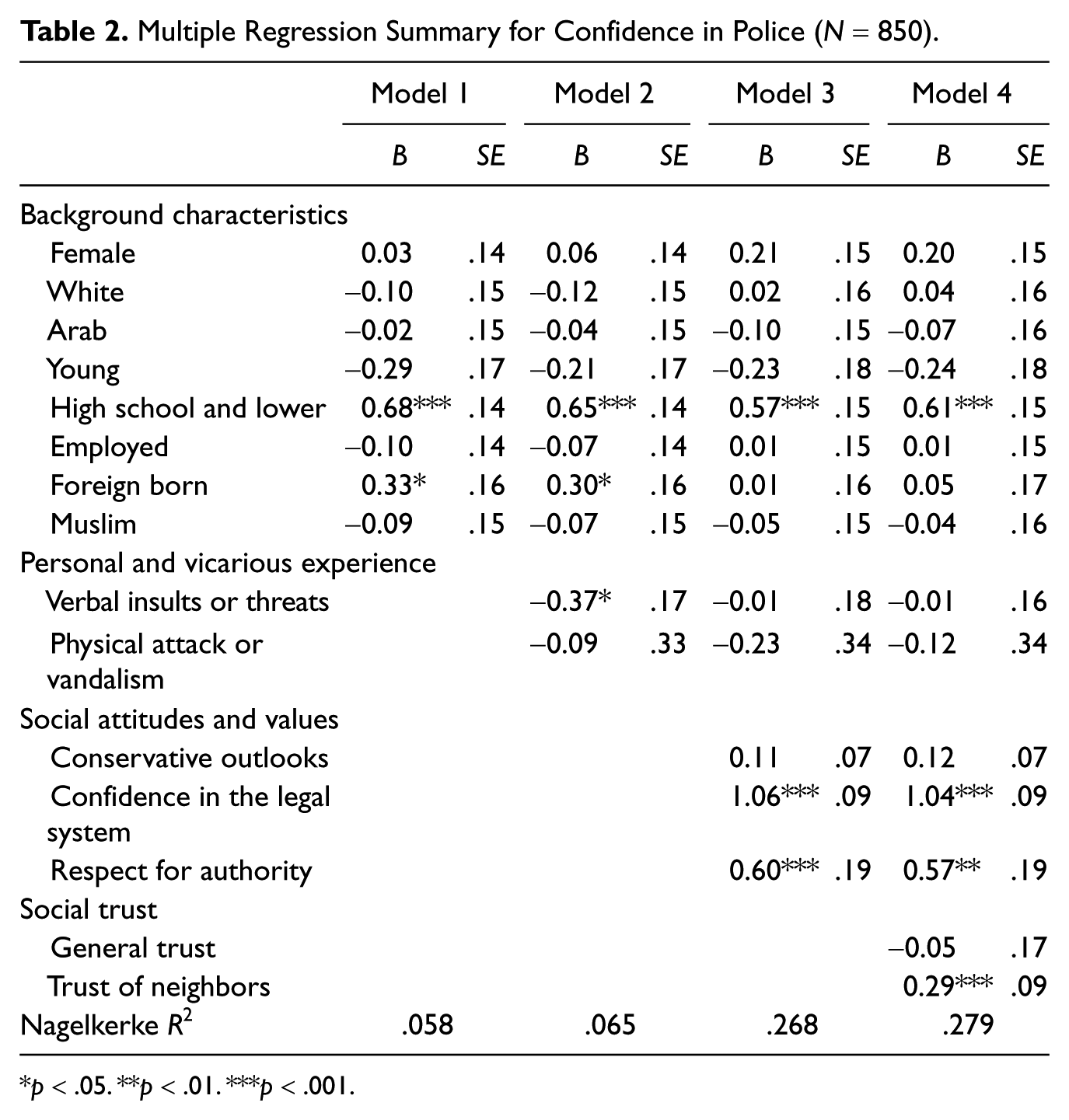
p < .05. **p < .01. ***p < .001.
When adding measures of social attitudes and values into the regression in Model 3, the significant effect of two variables, foreign born and verbal insults and threats, disappeared, suggesting that their influences may be spurious or indirect through some mediating factors. The significant connection between education and confidence in police stayed unchanged. Two attitudinal variables, confidence in the legal system and respect for authority, exerted a significant and strong impact on confidence in police. Higher levels of confidence in the U.S. legal system and respect for authority were associated with higher levels of confidence in police. As shown in Model 4, the full model, Arab Americans’ levels of confidence in police were significantly related to their educational attainment, confidence in the legal system, and respect for authority. In addition, Arab Americans who reported that they trusted people in their neighborhoods tended to have higher levels of confidence in their local police. The regression results clearly suggested that Arab Americans’ opinion of local police was largely a function of social attitudes and trust.
Discussion
The September 11 tragedy brought law enforcement and Arab American communities closer than many would have thought. In the wake of the war on terror, Arab Americans’ perceptions of local police represent critical information for law enforcement agencies because such evaluations can directly or indirectly shape the way Arab Americans respond to police, the political support and cooperation they render to police, and their willingness to participate in police and community anticrime programs and efforts. Several major findings emerged from our analysis of large-scale survey data collected from Arab Americans in the Detroit area. First, the majority of Arab Americans expressed confidence in their local police. Despite the backlash against Arab immigrants after 9/11, Arab Americans’ levels of confidence in local police remained high and were similar to those of the general population. For example, the 2004 U.S. national data showed that approximately 90% of Americans reported having a great deal or some confidence in police (Maguire & Pastore, 2010). Looking specifically at the Detroit area, the general population actually had a lower level of confidence (71%) in police, compared with Arab Americans (Shryock & Lin, 2009).
It is apparent that Arab Americans’ immigrant and ethnic status does not necessarily result in a lower level of confidence in social control agencies such as police. This finding is in line with the results from recent studies on other immigrant groups, such as Latino, Chinese, and Vietnamese (Chu, Song, & Dombrink, 2005; Correia, 2010; Menjivar & Bejarano, 2004; Song, Vidales, & Dombrink, 2008). It also echoes the results from research showing that African Americans in Detroit displayed more favorable attitudes toward police than did White residents (Frank et al., 1996). Although these empirical results generated after 9/11 did not show a noticeable decline of positive evaluations of police among immigrant and minority groups, including Arab Americans, a recent study found that Latino residents’ attitudes toward the Costa Mesa, California, police were consistently more negative after local police’s involvement in enforcing federal immigration law (Vidales, Day, & Powe, 2009). The effects of the war on terror and the increasing involvement of local police in immigration enforcement on immigrants’ evaluations of police apparently deserve more research attention.
There are some possible explanations for the very positive views of local police among Arab Detroiters during the post-9/11 era. Arab communities in the greater Detroit area are highly institutionalized with effective community organizations, political prominence, and general support from benefactors. Some of these features are similar to the ethnoracial political transition experienced by Blacks in Detroit, which may account for the higher level of satisfaction with police among African Americans (Frank et al., 1996). In addition, Detroit Arab Americans’ historical experiences of discipline (e.g., being watched, doubted, and asked to prove the loyalties) and inclusion (i.e., being incorporated, recognized, and rewarded for participation in the American mainstream system) made them resilient and highly adaptive to crisis and subsequently fared much better than those in other cities after the 9/11 attacks (Shryock & Lin, 2009). Local police departments’ efforts to establish solid rapport with Arab communities, proactive patrol strategies to protect Arabs and their neighborhoods right after the 9/11 attacks, and cautious decision to avoid active involvement in federal investigation of terrorists may have paid off in terms of maintaining high levels of confidence in police. These speculations need to be further tested in future research.
Second, Arab Americans’ social attitudes and trust are predictive of their confidence in police. It is obvious that Arab Americans’ confidence in local police does not stand alone but intertwine with their political and social attitudes. Although this line of predictors are still underresearched, our findings echo the results from previous studies that highlighted the importance of social and political attitudes in predicting public perceptions of police (Cao et al., 1996). Trust in neighbors, in particular, has shown a significant impact on Arab Americans’ confidence in police. When neighborhood residents have higher levels of mutual trust, they may create an immediate living environment of greater cohesion and collective security, which contributes to not only enhanced sense of informal security but also greater satisfaction with formal security (Cao et al., 1996; McDowall & Loftin, 1983). Thus, our findings provide some indirect support for recent studies showing that neighborhood organizational characteristics mattered in shaping residents’ evaluations of police (Reisig & Parks, 2000; Sampson & Jeglum-Bartusch, 1998; Wu et al., 2011; Wu, Sun, & Triplett, 2009). Future research should continue to assess the effects of theoretically related social attitudes, values, and trust on public evaluations of police.
Finally, personal characteristics and experience bear a very weak link to Arab Americans’ confidence in local police. The only significant predictor was educational background, with lower attainment leading to higher levels of confidence in police. This finding is inconsistent with the results from previous studies (Chu et al., 2005; Davis & Hendricks, 2007; Reisig & Parks, 2000; Weitzer & Tuch, 2005) and warrants more future research. None of the other personal and experiential predictors were found to be significant predictors, which is unexpected given that several of them, such as race and age, have shown relatively consistent effects on attitudes toward police among the public. Looking at race/ethnicity specifically, although Arab Americans have multidimensional identities (Ajrouch & Jamal, 2007; Naber, 2000), their self-classified categories (e.g., White vs. non-White and Arab American vs. non-Arab American) play a marginal role in influencing perceptions of police. The majority–minority division in perception of police commonly found in the population may not be applied to Arab American groups with different racial/ethnic identities. Future studies may be able to treat Arab Americans as a single group and compare their attitudes toward police with those of other racial/ethnic groups.
The nonsignificant effects of personal and vicarious experience with race/ethnicity-based or religion-based bias crimes are not completely unexpected. Evidence on the effects of recent experience as a victim on attitudes toward the police has been mixed (Wu et al., 2009). In addition, it appears that how the police handle victimization cases and treat victims of crime play critical roles in victims’ perceptions of the police. A study conducted in New Zealand showed that when “the police were seen as not having done enough” and “the police appeared uninterested,” victims of crime are more likely to be dissatisfied with the police (Morris, Reilly, Berry, & Ransom, 2003, p. 24). Unfortunately, as data in this study do not contain such information as whether or not Arab victims reported their victimization incidents to the police or how the police handled these reports, we cannot verify the possible effects of police behavior during the disposing of these incidents on Arab Americans’ confidence in police. Nonetheless, as aforementioned, the local police in the metro-Detroit area had made great efforts to protect Arab Americans and their communities after the 9/11 terrorist attacks, which helped to build solid rapport with Arab communities and accordingly may prevent Arab victims of bias crime from blaming the police for failing to protect them from bias crime.
The weak effects of group-specific factors, such as place of birth (foreign vs. U.S. born) and religion (Muslim vs. Christian), are unforeseen. It seems that immigrant and Muslim status did not exert much influence over Arab Americans’ evaluations of police. One possible explanation of this finding is that Arab immigrants and Americans may have a high degree of assimilation into the U.S. society. According to Gordon’s (1964) theory of assimilation, one may speculate that Arab Americans, including Muslims and Christians, are culturally assimilated into values, beliefs, customs, dress, and language commonly shared by the dominant groups and structurally incorporated into the major institutions of the American society, which, in turn, led to similar patterns of attitudes toward police with the dominant population as well as among Arab Americans. However, it would be premature to conclude that personal characteristics and experience are not predictive of Arab Americans’ attitudes toward police. Nevertheless, the findings signal the inadequacy of using demographic and experiential factors only in accounting for Arab Americans’ evaluations of police.
Before discussing implications for future research and policy, three limitations and their associated directions for future research should be discussed. First, the dependent variable, confidence in police, was measured by a single item. Although the variable seems to have good validity and was used in previous studies (Cao et al., 1998; Cao & Hou, 2001; Cao & Zhao, 2005), it may not adequately reflect the various dimensions embedded in the concept of citizen evaluation of police. Thus, future studies should use global (e.g., satisfaction with and trust in police) and specific measures (e.g., perceptions of integrity, effectiveness, and demeanor of police) of public’s attitudes toward police. Second, because of the constraint of using secondary data, this research was unable to incorporate some factors that were highly likely to be predictive of Arab Americans’ confidence in police. For example, future research should take into account Arab Americans’ personal and vicarious experience with police, such as their direct contacts with police and indirect experience with police through family members and the media. Finally, the findings of this study may not be generalized to Arab population in other U.S. cities. One of the reasons is that Arab Americans in other areas may experience greater levels of backlash and even hate crimes because of a lack of strong social and political organizations and representation. Their confidence in various U.S. institutions, including local police, may accordingly be lower than that in the greater Detroit area. Future research needs to sample Arab Americans in different areas to verify the findings of this study.
Several implications for policy can be derived from the findings. First, police departments should continue to reach out to Arab communities, which have become important clients in the post-9/11 era of policing. Our findings are encouraging for police departments that have worked tirelessly with immigrant communities. As the experience of Dearborn Police Department indicates, strong rapport with immigrant communities and trust in police are unlikely to be established overnight. Enthusiastic managers, devoted rank and files, and community policing initiatives become the key. Police administrators and community policing officers can hold neighborhood meetings inviting immigrant residents to ask questions, debunking any myths associated with the U.S. police, encouraging calling the police for service, and giving attention to specific problems and concerns that immigrants might have in this country.
Taking a step further, to enhance the political confidence in police, law enforcement agencies should avoid overly aggressive activities or behaviors that target immigrants and/or Arab communities. For example, local police need to be cautious in enforcing aggressive federal and state immigration laws, such as Arizona’s Support Our Law Enforcement and Safe Neighborhoods Act (SB 1070), because they will risk losing the hard-won trust and cooperation from the immigrant communities (Harris, 2006). Police departments should continue to reach out to immigrant communities and reaffirm police commitments to due process and equal protection.
Second, this study found that both White and Arab American identities were only weakly associated with Arab immigrants’ trust in local police. This finding refuted our earlier speculations that Arab Americans of different racial/ethnic identities may have different attitudes toward police. It suggests that the U.S. police can be less concerned about delivering varied services to different groups of Arab Americans but concentrate on improving the quality of services provided to Arab Americans as one group. Similar implications can be made with respect to immigration status and religion, both of which were not significantly related to trust in police. Thus, police departments can be optimistic about their relationships with Muslim Arab Americans, who did not display more critical attitudes toward local police than their Christian counterparts. In an optimistic spirit, this might suggest that police have done a good job in being sensitive about Arab Americans’ immigration status and religion. Police departments should keep seeking out and approaching new immigrants and informing them about local law enforcement. It is hoped that these efforts will lead to enhanced police legitimacy and positive relationships with immigrant communities.
Finally, Arab Americans’ trust in police is shaped primarily by their social attitudes and trust. This implies that policy makers need to recognize the limitation of relying solely on police for establishing a solid relationship with Arab communities. Collective efforts to enhance the legitimacy of the entire legal system and gain reasonable respect from the citizens are positive ways to improve Arab Americans’ perceptions of police. Meanwhile, local police can also take proactive initiatives to engage in community-building activities. They can mobilize and rely on existing community-based organizations to shoulder important responsibilities of promoting community networks, increasing residents’ mutual trust and cohesion, decreasing social disorganization and disorder, and attracting external capital building institutions. In return, strong Arab communities benefit not only local law enforcement but also the entire U.S. society.
Footnotes
Declaration of Conflicting Interests
The author(s) declared no potential conflicts of interest with respect to the research, authorship, and/or publication of this article.
Funding
The author(s) received no financial support for the research, authorship, and/or publication of this article.