




Abstract
Hirschi argues that self-control has not been properly measured or conceptualized in previous research. He insists that personality-based notions of self-control should be replaced with inhibitors/social bonds as the key construct, which in turn influence whether an individual considers the full range of costs associated with an antisocial behavior. This analysis supplements a small literature exploring this new conceptualization of self-control, specifically by examining substance use. The findings indicate that inhibitors/bonds do exert an effect on substance use but are not mediated by perceived costs. Furthermore, different variants of impulsivity continue to exert independent influences, with some mediated by perceived costs. Finally, perceived rewards not only influenced substance use directly but were also the most consistent mediator of inhibitors/bonds and impulsivity.
Introduction
Gottfredson and Hirschi’s (1990) general theory of crime and its central theoretical construct of self-control have played an influential role in criminology. Although the theory has been subject to much critique (Goode, 2008), there has been a significant amount of research conducted on self-control, and evidence indicates that self-control is routinely a consistent predictor of offending and analogous behaviors and that failure to consider its influence is likely to yield a misspecified model (Pratt & Cullen, 2000).
Despite this impressive accumulation of literature and support, one specific methodological issue that has not received much attention is the measurement of self-control. Originally, the theorists did little to articulate the protocol for operationalizing and measuring self-control, suggesting that only self-control be measured using a count of behavioral measures akin to acts that resemble poor self-control (Hirschi & Gottfredson, 1993, 1995). Several studies have sought to operationalize self-control, attitudinally and behaviorally (Grasmick, Tittle, Bursik, & Arneklev, 1993; Piquero, MacIntosh, & Hickman, 2000; Tittle, Ward, & Grasmick, 2003).
Recently, Hirschi (2004) has raised concerns about the construct of self-control in general and its conceptualization and measurement in particular. Although much of the prior research taps into personality-based notions of self-control (Cauffman, Steinberg, & Piquero, 2005; Grasmick et al., 1993), Hirschi argued that social bonds are more appropriate indicators of what inhibits offending and that personality traits are not relevant. Moreover, he indicates that social bonds influence the calculation of costs associated with offending. This reconceptualization has important theoretical implications, yet there is little empirical research to substantiate or refute these claims(for an exception see Piquero & Bouffard, 2007).
This study examines Hirschi’s (2004) reconceptualization of self-control. First, the influence of social bonds is compared with personality-based notions of self-control in various substance use outcomes. Second, the perceived costs and benefits are included to ascertain whether either mediates the effects of social bonds and/or personality traits, as has been suggested and found in previous research linking rational choice and individual difference explanations (Nagin & Paternoster, 1993; Piquero & Tibbetts, 1996). On this score, Hirschi suggests that perceived costs should mediate the effect of bonds on offending, whereas perceived rewards should play little (if any) role. When combined, these analyses will shed light on Hirschi’s reconceptualization of self-control and thus supplement a very small literature. Finally, these issues will be addressed with a community sample of adults, which is an important advance of previous assessments of Hirschi’s reconceptualization that have made use of student-based samples responding to hypothetical vignettes.
Background
As originally articulated by Gottfredson and Hirschi (1990), self-control is the ability to consider the long-term consequences of actions that provide immediate rewards. Similar to all control theories, the underlying assumption is that the rewards of offending are apparent to all. What remains to be explained is why some individuals avoid the temptation to offend. On the basis of the theory’s original explication, individuals readily perceive the benefits of offending, but individuals with high self-control also perceive, and weight more heavily, the costs associated with immediate gratification. Conversely, those with low self-control place more weight on the “here and now” and fail to consider or appreciate the long-term costs associated with satisfying one’s hedonistic impulses.
In an effort to delineate clearly the notion of self-control, Gottfredson and Hirschi listed six aspects of low self-control: impulsivity, risk seeking, a preference for physical (as opposed to mental) activities, opting for simple tasks (compared with challenging ones), temper, and insensitivity to others. Drawing directly from these components, Grasmick et al. (1993) created a measure of self-control that tapped into each of these six dimensions. This measure has been widely used (Cheung & Cheung, 2008; Piquero et al., 2000; Welch, Tittle, Yonkoski, Meidinger, & Grasmick, 2008) and has demonstrated some psychometric support (e.g., unidimensionality, convergent validity, and internal reliability; Cochran, Wood, Sellers, Wilkerson, & Chamlin, 1998). However, several concerns with the scale have been raised. For instance, some have proffered that the impulsivity and sensation-seeking components of self-control are the most essential elements (Arneklev, Grasmick, Tittle, & Bursik, 1993; Longshore, Turner, & Stein, 1996). As such, it may be the case that a simpler, more focused measure that includes these personality traits is all that is warranted. On the basis of item response theory (IRT) analyses, Piquero et al. (2000) have argued that the scale of Grasmick et al. (a) is not unidimensional, (b) evinces that those with low self-control respond differentially to some of the items, and (c) contains items that could be dropped from the scale. They concluded, as have others (Keane, Maxim, & Teevan, 1993), that observed behavioral measures of self-control might be preferable to self-report measures.
Hirschi (2004) has added another set of concerns with this scale that are consistent with his more general critiques regarding personality-based measures of self-control. Although Hirschi and Gottfredson acknowledge that they may have contributed to the misunderstandings, Hirschi (2004) notes four major concerns about the conceptualization and measurement of self-control that have become common:
[The conceptualization and measurement] suggest differences among offenders in motives for crime, contrary to the explicit assumptions of the theory that offenders do not specialize and that motives are irrelevant.
Both contradict our explicit assertion (and firm belief) that personality traits (other than self-control) have proved to be of little value in the explanation of crime.
Both fail to explain—in a manner consistent with the theory—how self-control operates. Instead, both suggest that offenders act as they do because they are what they are (impulsive, hot-headed, selfish, physical risk-takers), whereas nonoffenders are, well, none of these. When measures based on this exercise are interpreted in a manner consistent with self-control theory, they suggest that potential offenders (a) calculate a factor score based on a linear combination of numerous self-characterizations gleaned from a variety of sources and (b) act accordingly.
As would be expected from item 3, and most telling, this exercise fails to produce a measure of self-control in which more is better than less, in which the effects of the individual traits on criminal behavior are cumulative. Single traits (impulsivity, risk taking) predict criminal behavior as effectively as does an all inclusive self-control scale. (p. 542)
To circumvent these problems, Hirschi (2004) offers what he perceives as a superior strategy to assess self-control. In his move away from personality-based measures of self-control, he suggests a return to social bonds. He specifically underscores the importance of the opinions of others, such as family members and teachers. Moreover, Hirschi suggests that these social bonds are the primary inhibitors one considers before engaging in offending. The inhibitors, in turn, affect the cognitive evaluation of all potential costs in committing an antisocial act. He also indicates that these inhibitors can vary in their number and salience. Thus, the greater the number of prosocial bonds one has, as well as the importance one ascribes to those bonds, the greater weight one places on the costs (immediate and long-term) of offending.
In an effort to provide an initial test of some of these ideas, Hirschi (2004) reexamined the Richmond and Fayetteville delinquency data. Instead of measuring bonds in the more traditional manner (i.e., scales), he conceptualizes bonds as either strong (or prosocial) or not (the bond is weak or nonexistent). To operationalize the inhibitors, Hirschi used bonds to school, teachers, and mothers. Although substantively similar to his original control theory, instead of relying on attachment, commitment, involvement, and belief, he focused on dichotomizing whether one of these bonds existed and then summed them. Consistent with predictions, the likelihood of delinquency decreased as the number of inhibitors present increased. Unfortunately, several questions were unanswered in this initial test. First, no measures of personality were included; therefore, it could not be determined whether such traits were better or worse correlates of delinquency than inhibitors (i.e., bonds). Second, Hirschi did not assess whether perceived costs mediated the relationship between inhibitors and delinquency. These initial analyses, in large part, were unable to establish whether the reconceptualized self-control theory was superior to the original formulation.
Piquero and Bouffard (2007) extended Hirschi’s initial attempt to test the reconceptualized self-control by asking undergraduates to read a hypothetical scenario and list the costs associated with engaging in the offenses as well as salience of those costs. They conceptualized inhibitors as the costs listed by the participants and multiplied those costs by the average salience (ranging from 0 to 100). They found that the significant relationship between the Grasmick et al. (1993) scale and intentions to offend was rendered nonsignificant after including their measure of inhibitors (i.e., costs times salience), and concluded that there was support for Hirschi’s reconceptualization of self-control.
The only other study to assess the new measure of self-control was conducted by Higgins, Wolfe, and Marcum (2008). Following the lead of Piquero and Bouffard, they asked undergraduates to read a hypothetical scenario and to indicate the likelihood of engaging in offending. They used the Grasmicket al. (1993) scale and measured inhibitors as the perceived costs multiplied by the salience. Although they did find that the effect of the Grasmick et al. scale was reduced after inclusion of the inhibitors, the reduction was trivial and the Grasmick et al. scale remained a significant predictor.
Current Focus
On the basis of the few empirical investigations that have assessed the new version of self-control, several unanswered questions remain. First, the two studies arrived at different conclusions regarding the influence of personality-based measures of self-control. Additional research will offer some clarity to the conflicting findings. A second and more substantive concern arises from how inhibitors were operationalized. Both studies measured inhibitors as the perceived costs multiplied by the salience of those costs. According to Hirschi (2004), the key inhibitors are the social bonds (with an emphasis on familial and school attachment and commitment). The mechanism by which these bonds influence offending is the costs multiplied by the salience; that is, if a person believes engaging in an antisocial behavior will threaten a prosocial bond, and the person places a high value on that bond, she or he will not be as likely to perform an antisocial act. Both studies did include a measure of social bonds; however, those bonds were not significant in one analysis (Piquero & Bouffard, 2007) but were in the other (Higgins et al., 2008). Furthermore, in neither study was there evidence that the social bonds were mediated by the costs multiplied by the salience. Finally, neither of those investigations measured bonds dichotomously, as Hirschi did and suggested. As such, it remains equivocal whether Hirschi’s new conceptualization of self-control is in accord with the empirical data.
This study addresses these—and other—issues in several ways. First, key familial bonds are included and measured dichotomously. Second, two well-validated personality constructs are used: Lack of Premeditation (LoP) and Thrill and Adventure Seeking (TAS). These two variants of impulsivity are robustly related to offending (Lynam & Miller, 2004) and are key components of the original description of self-control. Third, a variety of specific costs are included to assess whether they mediate the inhibitors (i.e., bonds) and/or types of impulsivity. Although control theories generally, and the new conceptualization specifically, focus on the mediating role of perceived costs, there is, at best, weak support for this explanatory model (Wright, Caspi, Moffitt, & Silva, 1999). Tittle and Botchkovar (2005) failed to find that perceived costs mediated the relationship between self-control and offending. Although there was some inconsistent evidence that the effect of self-control decreased, in no instance was it rendered nonsignificant after the inclusion of perceived costs. Another important finding from this study was that perceived rewards not only exerted a strong effect but often rendered the effect of self-control as nonsignificant. This latter finding underscores two important points: (a) Contrary to the assumptions of control theories, not all individuals perceived the rewards of offending similarly and (b) self-control may influence the weight one assigns to rewards instead of altering their perception of the costs. To further understand these issues, this analysis includes perceived rewards. Control theories explicitly indicate that the perceived rewards are universal. However crucial this assumption is, it may be incorrect. Furthermore, the potential mediating effect of perceived benefits is also examined. Finally, this analysis is based on young adults and their self-reported offending. This approach circumvents any potential issues associated with vignettes and intentions to offend. On the basis of this analysis, most of the key arguments advanced by Hirschi (2004) can be empirically assessed.
Method
Data
The data used in this study were derived from a larger sample (N = 2,071) that was designed to explore the effects of the Drug Abuse Resistance Education (DARE) program. The original sample was composed of 23 randomly selected schools in Lexington, Kentucky, that were participating in the DARE program as well as 8 schools that did not participate in the DARE program (Clayton, Cattarello, & Johnstone, 1996). A follow-up study was conducted that targeted participants who completed at least three previous survey administrations(n = 1,429). These individuals were mailed surveys that included questions pertaining to family relationships, personality, drug and alcohol use, and various attitudinal measures. As reported elsewhere (Lynam et al., 1999), attrition analyses indicated that only 3 of 15 variables were related to not returning the survey: Older male participants with a history of cigarette use were less likely to respond. The final sample consisted of 571 women and 431 men (N = 1,002) who completed the survey, aged between 19 and 21 years (M = 20.1 years, SD = .78 years). There were 748 (75.1%) White, 204 (20.4%) African American, and 44 (4.4%) “Other race” participants included in this study. Because of the small number of participants in the “Other” category, only Caucasian (coded as 0) and African American (coded as 1) were included in the analyses.
Measures
Substance use
Several related outcomes were assessed. First, participants were asked how many tobacco cigarettes they smoked, how many alcoholic drinks they consumed, and the number of times they used marijuana within the past month. The primary reason for measuring tobacco, alcohol, and marijuana use separately was because the perceived costs and benefits (detailed below) were specific to these substances. Examining these substances singly provides the most direct test of whether perceived costs and benefits are uniquely related to these outcomes, and whether they mediate the effects of personality-based self-control and/or inhibitors (i.e., bonds). Furthermore, because the distributions were skewed, the log (+1) of each of these variables was used. Although such a short time frame allows for much less variation, the 30-day period was used because it better represents recent use than a lifetime use measure. A variety scale of lifetime drug use (not including tobacco, alcohol, or marijuana) was also examined.
Beyond minor substance use, a variety scale of more serious substance use (e.g., cocaine) was included. This outcome was used to explore whether the results pertaining to the relatively minor substance use generalized to other, more serious substance use. Although the perceived costs and benefits are not specific to these more serious forms of substance use, there is reason to suspect that any costs or rewards associated with minor substance use might generalize to more severe forms. To the extent this is not the case, the mediation analyses should be substantively different from those involving cigarettes, alcohol, and marijuana. Beyond the mediation analyses, comparing the independent effects of personality-based measures related to self-control on serious substance use with those of inhibitors (i.e., bonds) still provides an empirical assessment of Hirschi’s claim that inhibitors, and not personality, serve as the key factors related to an antisocial behavior.
Inhibitors/familial bonds
As noted earlier, Hirschi suggested that personality-based measures of self-control are not valid and instead recommended a return to bonds, and identified the family in particular. He indicated that a greater number of such bonds should lead to less involvement in antisocial behaviors. In this analysis, there were seven items in the survey related to one’s familial attachment and commitment (e.g., “We share similar beliefs and values as a family”). 1 Although the original coding was a Likert-type scale (ranging from 1 to 5), each item was dichotomized in the manner Hirschi recommended: Responses of 1 to 3 were recoded to 0 and indicated that the item was not an inhibitor/bond, whereas responses of 4 and 5 were coded as 1 and indicated that the item was an inhibitor/bond. 2 Although not designed to specifically capture Hirschi’s notions of familial attachment, the items possess strong face validity and were internally consistent when summed (α = .87).
Perceived costs
Control theories suggest that all individuals perceive the benefits of engaging in antisocial behavior; the key difference lies in perceived costs. In his reformulation, Hirschi (2004) suggests that it is not simply the long-term costs that influence one’s actions but all potential costs. In this analysis, five specific costs (e.g., losing friends, makes a person do poorly at schoolwork) were assessed for each of the substances: cigarettes, alcohol, and marijuana. The items assess costs in various domains and the scales were internally consistent (cigarettes, α = .76; alcohol, α = .82; marijuana, α = .84). Hirschi explicitly indicates that the number of inhibitors/bonds one has will influence the costs; that is, the number of inhibitors/bonds will affect the cognitive calculation in which one engages. Thus, inhibitors/bonds should be mediated by perceived costs.
Perceived rewards
As mentioned previously, control theories assume that the benefits or rewards of engaging in antisocial behavior are universal, that is, motivation is a constant and requires no explanation. As crucial as this underlying assumption is, it is more prudent to measure perceived rewards and empirically assess whether they vary across individuals and exert some influence on antisocial behavior. Similar to the perceived costs measure, three scales were created, one each for cigarettes, alcohol, and marijuana. Each scale contained eight items that assess the rewarding potential of using these substances (e.g., get away from problems, be more popular). Similar to perceived costs, a variety of different rewards were included, and the scales were internally consistent (cigarettes, α = .86; alcohol, α = .90; marijuana, α = .93).
Personality links to impulsive behavior
Two of the most important components identified in the original conceptualization of self-control are impulsivity and risk seeking (Longshore et al., 1996). Lynam and colleagues have suggested that there are distinct traits underlying impulsive behavior (Whiteside & Lynam, 2001); two of these traits, LoP and sensation seeking, are robustly related to antisocial behaviors (Lynam & Miller, 2004). Although self-control (as originally conceptualized) includes other components, some have not been found to be important (physical activities and simple tasks; Arneklevet al., 1993; Arneklev, Grasmick, & Bursik, 1999). Although LoP and TAS are key components of the original conceptualization of self-control, they should be viewed in this analysis simply as specific variants of impulsivity.
LoP refers to a consideration of the consequences before acting and was measured using a “narrow” impulsivity scale (Eysenck & Eysenck, 1978) consisting of 13 items (α = .81). Sensation seeking was measured by Zuckerman’s (1994) TAS scale (10 items; α = .81), which is an acceptable measure of sensation seeking (D. J. Miller, Lynam, Kelly, & Bardo, 2007). This scale assesses desires to participate in risky physical activities (e.g., skydiving). Both of these constructs overlap substantially with the broader construct of self-control.
Analytic Plan
The theoretical notions being tested call for a mediation analysis, and two mediators are included—perceived costs and rewards. There are a variety of ways for testing mediation, with the approach described by Baron and Kenny (1986) being a common example. However, this method, referred to as a causal step approach, is limited. For instance, this approach fails to yield point estimates and standard errors, and relies on a set of individual paths (e.g., the independent variable to the mediator and the mediator to the dependent variable), instead of specific indirect effects (i.e., the product of the paths). More germane to this analysis, the causal steps approach does not directly test whether the effect of the independent variable on the dependent variable is significantly reduced with the inclusion of the mediators. Instead, mediation is assumed only when the effect of the independent variable is reduced to nonsignificance. These limitations are amplified in the case where multiple mediators are involved.
To circumvent these issues, Preacher and Hayes (2008) suggest a superior strategy that involves bootstrapping, which generates point estimates and standard errors that allow for direct significance testing of indirect effects. Furthermore, this approach can directly test whether the reduction in the effect of the independent variable after the inclusion of the mediator is statistically significant. If this indirect effect is significant, one can conclude that the independent variable operates through the mediator (regardless of whether the direct effect of the independent variable remains significant or not). Moreover, assumptions of normality are not necessary as the distribution of indirect effects is derived from the sample (as opposed to a reference to a normal distribution). In addition, this approach yields lower Type I error rates and more power. On the basis of this bootstrapping method, Preacher and Hayes provide an SPSS macro that calculates the total reduction in the total effect of a variable (i.e., how well a set of mediators explains the relationship between the independent and dependent variables) as well as the reductions provided by a specific mediator (i.e., how well a specific mediator explains the relationship between the independent and dependent variables).
Results
Cigarette Use
Results from the baseline model in which substance use is regressed on age, sex, race, inhibitors, LoP, and TAS, absent any mediators, are presented in Table 1. 3 This model accounted for a significant amount of variation (F = 17.393, p < .001; adjusted R2 = .098). Individuals who reported more inhibitors were less likely to smoke cigarettes, whereas those who scored higher on LoP and TAS were more likely to smoke. In addition, older and White participants were more likely to have smoked cigarettes, although men and women did not evince any difference on this outcome.
The Effects of Inhibitors, Impulsivity, and Perceived Costs and Rewards on Cigarette Use.
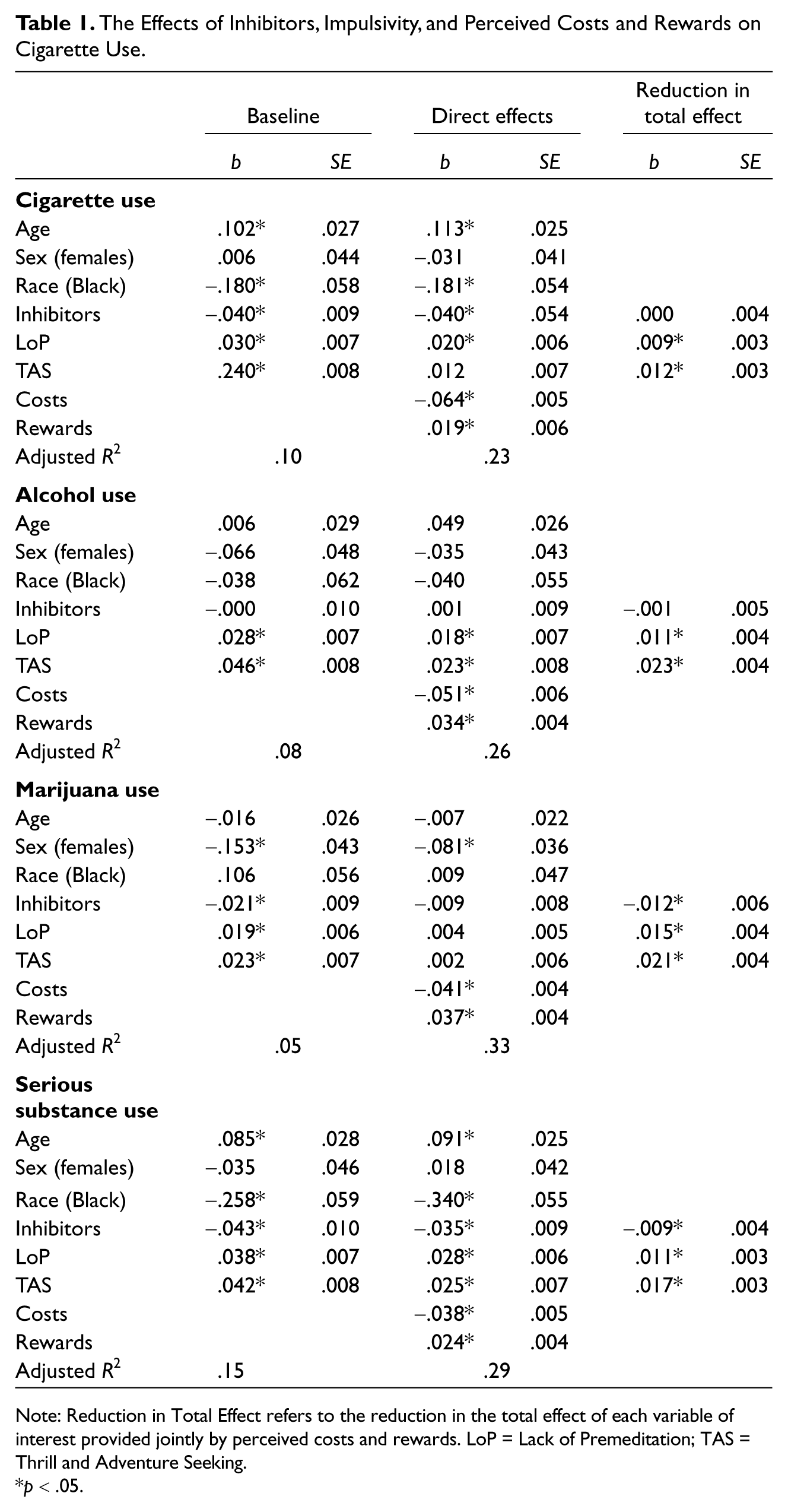
Note: Reduction in Total Effect refers to the reduction in the total effect of each variable of interest provided jointly by perceived costs and rewards. LoP = Lack of Premeditation; TAS = Thrill and Adventure Seeking.
p < .05.
The second model added costs and rewards as potential mediators. To the extent that the effects for inhibitors, LoP, and TAS are significantly reduced from the baseline model, costs and rewards can be said to be mediators of these relationships. In the second model, perceived costs (t = −11.730, p < .05) and rewards (t = 3.080, p < .05) were significantly related to cigarette use (see Table 1); those who reported greater costs and fewer rewards of smoking were less likely to engage in this behavior. After inclusion of the mediators, the explained variance increased to 23%. With the introduction of these mediators, the effect of inhibitors was unchanged (t = 0.025, p > .05), whereas the effects of LoP and TAS were significantly reduced (t = 3.48,p < .05 and t = 3.84, p < .05, respectively). In fact, the effect of TAS was reduced to nonsignificance. A more specific parsing of the mediation revealed that LoP was significantly mediated by perceived costs (t = 2.96, p < .05) and perceived rewards (t = 2.00, p < .05). An additional test revealed that perceived costs were a stronger mediator than perceived rewards (t = 2.00, p < .05). Similarly, the effect of TAS on cigarette use was significantly mediated by perceived costs (t = 3.448, p < .05) and rewards (t = 1.900, p < .05), with perceived costs exerting a significantly stronger mediation effect (t = 2.794, p < .05).
Alcohol Use
Results from the baseline model, absent perceived costs and rewards, are presented in the second section of Table 1. This model accounted for a significant amount of variation (F = 13.268, p < .001; adjusted R2 = .075). LoP and TAS were the only significant correlates in this model, both indicating that those who scored higher on these traits are more likely to use alcohol. Inhibitors were not significantly related to alcohol use.
The second model added the potential mediators, both of which were significant, and this model accounted for 26% of the variance (see Table 1). Those who perceived more costs were less likely to use alcohol (t = −9.35,p < .05), whereas those who perceived more rewards were more likely to use alcohol (t = 8.33, p < .05). After including these mediators, the effect of inhibitors was unchanged (t = −0.12, p > .05), whereas the effects of LoP and TAS were significantly reduced (t = 2.94, p < .05, t = 6.00, p < .05, respectively). Further examination of the mediation indicated that the effect of LoP on alcohol use was mediated primarily through perceived rewards (t = 2.96, p < .05) but not perceived costs (t = −0.182, p > .05). The difference in the effects of these mediators was significant (t = −3.93, p < .05). However, the effect of TAS was reduced through perceived costs (t = 5.704, p < .05) and perceived rewards (t = 3.042, p < .05) with the reduction provided by costs being significantly stronger (t = 2.382, p < .05). LoP and TAS continued to exert significant direct effects in the final model.
Marijuana Use
Results from the baseline model, without any mediators, are presented in the third section of Table 1. This model accounted for a significant amount of variation (F = 8.062, p < .001; adjusted R2 = .048). Females and those with more inhibitors were less likely to use marijuana; those who scored higher on the traits of LoP and TAS were more likely to engage in marijuana use.
The second model included costs and rewards as potential mediators. In the second model, perceived costs (t = −9.200, p < .05) and rewards (t = 10.257, p < .05) were significantly related to marijuana use (see Table 1); those who reported greater costs and fewer rewards were less likely to use marijuana. The model with the mediators explained 33% of variance in marijuana use. With the introduction of these mediators, the effects of inhibitors (t = −2.071, p < .05), LoP (t = 3.921, p < .05), and TAS (t = 4.971, p < .05) were significantly reduced. In fact, the effects of each of these variables were reduced to nonsignificance. A more specific parsing of the mediation revealed that the effects of inhibitors (t = −2.134, p < .05) and LoP (t = 4.308, p < .05) were significantly mediated by perceived rewards. In addition, the mediating effect of rewards on the LoP–marijuana use relationship was stronger than the mediating effect of perceived costs (t = 2.923, p < .05). In contrast, perceived costs (t = 4.333, p < .05) and rewards (t = 3.179, p < .05) accounted for a significant portion of the relationship between TAS and marijuana use.
Serious Substance Use
Results from the baseline model, absent perceived costs and rewards, are presented in the last section of Table 1. This model accounted for a significant amount of variation (F = 28.451, p < .001; adjusted R2 = .153). Every variable was significantly related to serious substance use with the exception of sex. Black and younger respondents were less likely to engage in serious substance use, as were those scoring higher on inhibitors. Those who scored higher on the traits of LoP and TAS were more likely to use serious substances.
The second model added the potential mediators, both of which were significant, and this model accounted for 29% of the variance (see Table 1). Those who perceived more costs (of marijuana use) were less likely to report serious substance use (t = −7.371, p < .05), whereas those who perceived more rewards (of marijuana use) were more likely to use serious substances (t = 5.680, p < .05). After including these mediators, the effects of inhibitors (t = −2.024, p < .05), LoP (t = 3.212, p < .05), and TAS (t = 4.882, p < .05) were significantly reduced. Further examination of the mediation indicated that inhibitors (t = −2.083, p < .05), LoP (t = 3.273, p < .05), and TAS (t = 2.900, p < .05) were all significantly mediated by perceived rewards. The effect of TAS on serious substance use was also mediated by perceived costs (t = 4.000, p < .05). Inhibitors, LoP, and TAS continued to exert significant direct effects in the final model.
Discussion
The purpose of this study was to assess some of the key claims advanced in Hirschi’s (2004) reconceptualization of self-control. Consistent with his predictions, inhibitors/bonds demonstrated significant effects on cigarette and marijuana use as well as variety of more serious substance use. However, several other findings failed to support Hirschi’s reconceptualization. First, inhibitors/bonds were not related to alcohol use. Second, there was no evidence that inhibitors/bonds were mediated by perceived costs. Third, LoP and TAS—both sharing conceptual overlap with the original notion of self-control described by Gottfredson and Hirschi—demonstrated consistent effects net of inhibitors/bonds. The results stemming from this analysis speak directly to some of the key arguments made by Hirschi and yield important insights.
The current findings have several theoretical implications for Hirschi’s (2004) reconceptualization of self-control. First, inhibitors/bonds did exert some influence on substance use. Specifically, they were related to cigarette, marijuana, and more serious substance use. However, inhibitors/bonds were not related to alcohol. Although this pattern of findings indicates that inhibitors/bonds are important factors to consider, by the same token, this is not surprising as they are essentially the same variables used in studies of social bonding theory and have been found to be related to substance use in previous research (Bahr, Hoffmann, & Yang, 2005; Kim, Kwak, & Yun, 2010; Melby, Conger, Conger, & Lorenz, 1993).
Although Hirschi expressed discontent with the use of personality traits as a means of operationalizing self-control, this study, along with several others (Lynam & Miller, 2004; J. D. Miller, Lynam, & Jones, 2008; Zuckerman & Kuhlman, 2000), has found that LoP and TAS are related to substance use. This raises the question of whether these constructs should be incorporated within control theories and, if so, how. Conceptually, impulsivity represents the tendency to act without regard for, or in the face of, potential negative consequences. This is consistent with original notions of self-control (Gottfredson & Hirschi, 1990) as well as basic tenets of control theories in general. These theories suggest that all persons are likely to perceive the momentary advantages of an antisocial behavior, but what differentiates those who engage in such behaviors from those who do not is the ability or willingness to forsake immediate rewards. Although social controls, such as strong attachments to parents or commitments to one’s education, do operate to inhibit antisocial behaviors, there seem to be endogenous individual differences in the ability or willingness to do so as well. In fact, others have found that self-control and social control exert independent influences (Longshore, Chang, Hsieh, & Messina, 2004; Wright, Caspi, Moffitt, & Silva, 2001). Hirschi (2004) argues that social and self-control are one in the same, but the empirical evidence suggests that they are related but distinct constructs. Given the theoretical logic and empirical findings, perhaps integrating these various levels of control is more sensible (Jones & Lynam, 2009).
Another important theoretical finding stemming from this analysis is the role of putative mediators. Hirschi (2004) states “that self-control involves [a] cognitive evaluation of competing interests . . . [and] the theory requires an explanatory mechanism that retains elements of cognizance and rational choice” (p. 542). He further suggests that perceived costs provide this explanatory mechanism; that is, whatever the nature of self-control (whether it be bound in one’s social relationships or inherent in the individual), it affects how one perceives the costs associated with a behavior. This view finds little support in our data. There was no evidence that the effects of inhibitors or bonds were mediated by perceived costs. Even the measures of impulsivity-related traits did not uniformly operate through perceived costs. Across all four outcomes, TAS was mediated by perceived costs. However, LoP was mediated by costs only for cigarette use. Others have found similar patterns (Higgins et al., 2008; Tittle & Botchkovar, 2005).
Perhaps part of the problem with this argument is that other factors are involved in the decision-making process that entail more than evaluations of the costs. For instance, in our analysis, rewards were a more consistent mediator of inhibitors, LoP, and TAS. The effect of inhibitors on marijuana and more serious substance was mediated by rewards. The effects of LoP and TAS on each substance use outcome were mediated by perceived rewards. Just as importantly, perceptions of rewards exerted a consistent effect on each of the outcomes. However, it may be the case that individuals who are lower in inhibitors/bonds, LoP, and TAS more readily anticipate the rewards of substance use than those individuals who scored higher on these factors. To be sure, control theories assume that all individuals perceive the rewards of antisocial behavior. However, there is not universal support for this underlying assumption, as our results show that individuals varied in this perception. Similar to the suggestion mentioned previously, we may have reached a point empirically where assumptions regarding the universality of perceived rewards cannot be justified. Instead, individuals seem to possess independent, unique perceptions of costs and rewards. Thus, any decision-making model should use both in an effort to more fully explain the outcome and be in accord with empirical observations (see Nagin & Paternoster, 1993; Piquero & Tibbetts, 1996). Models of decision making might also usefully allow for individual differences in the process of decision making as well. Premeditation, called Decision Time or Deliberation in other models, is conceptualized as reflecting the tendency to spend time weighing the advantages and disadvantages of a course of action. Some individuals are careful decision makers, whereas others are rash; for the latter individuals, the decision process may be more influenced by the situation than by any analysis of costs or benefits (see Fagan & Piquero, 2007). This may help to explain why a direct effect for LoP on cigarette and hard drug use remained even after controlling for costs and benefits.
Although this study sheds light on some important issues, it is not without limitations. First, we were unable to consider all of the potentially relevant costs. Hirschi (2004) indicates that “the full range of potential costs of a particular act” (p. 543) should be considered. Although we did not necessarily cover the gamut, there were several costs included and each was specific to the substance being examined (with the exception of the more serious substance use–dependent variable). Still, there could have been other costs that were not measured that may have altered the findings. Second, we did not use perceived costs as the measure of self-control. Instead, we explored inhibitors/bonds (consistent with Hirschi’s analyses) and measures of personality (consistent with previous research), and used perceived costs as a potential mediator. We recognize that others have conceptualized costs (times salience) as a measure of self-control (see Higgins et al., 2008; Piquero & Bouffard, 2007). However, an alternative reading is that costs are the mechanism through which the dimensions of self-control operate (Nagin & Paternoster, 1993; Piquero & Tibbetts, 1996). Moreover, Hirschi clearly states that the dimensions affecting this calculus are inhibitors/bonds. Even in the event that costs are the most appropriate measure of self-control, our findings indicate that personality traits and familial bonds often continue to exert an effect on the outcomes. At the very least, then, our findings show that there are multiple factors relevant in the explanation of substance use. Third, our measurement protocol and datasource did not contain individual estimates associated with the salience of the bonds/costs that Hirschi has identified as being a part of the reconceptualization of self-control. Subsequent research should consider how to best operationalize and measure this salience characteristic. Fourth, we did not use the most common attitudinal self-control measure, that is, the Grasmick et al. scale. Instead, we relied on types of impulsivity that share conceptual overlap with the (original) conceptualization of self-control. However, others have used self-control measures (Higgins et al., 2008) and arrived at similar conclusions (Piquero & Bouffard, 2007). Finally, the data are cross-sectional and preclude assessing causal order. Although the theoretical model suggests that perceived costs occur before substance use, costs are likely influenced by previous substance use as well.
Despite these limitations, the current findings do offer some insight into Hirschi’s reconceptualized version of self-control. Given the influence of the General Theory of Crime (and self-control) over the past two decades (Cohn & Farrington, 2008), it is likely that the reconceptualization will also receive interest among criminologists. We encourage others to assess these relationships with different measures and samples in an effort to provide additional evidence and perhaps devise potential modifications as warranted. As suggested earlier, the role of rewards should be considered, as they seem to have some effect. In addition, more analyses should involve the meditational component of the reconceptualization and control theories in general. Such research will produce greater theoretical refinements.
Footnotes
Declaration of Conflicting Interests
The author(s) declared no potential conflicts of interests with respect to the research, authorship, and/or publication of this article.
Funding
The author(s) declared the following potential conflicts of interest with respect to the research, authorship, and/or publication of this article: This research was supported by Grant DA05312-10 from National Institute on Drug Abuse.