




Abstract
Public opinion research shows that the general public tends to perceive noncustodial sanctions, such as suspended sentences, as too lenient while being largely ignorant about their nature. In two studies among representative samples of the Dutch population, the authors examine public opinion about and knowledge of suspended sentences in the Netherlands. Findings suggest that knowledge of suspended sentences is positively related to their perceived punitiveness and beliefs in their effectiveness. Furthermore, opinions about suspended sentences are related to general penal attitudes. More punitive attitudes translate into less favorable opinions. Finally, providing information about suspended sentences can lead to more positive attitudes and greater belief in their effectiveness.
In the early 1980s, Sherman and Hawkins (1981) noted that “our knowledge of public opinion about breakfast food is far deeper than our knowledge of public opinion about criminal justice” (p. 46). Much research has been undertaken since to even the score. Although most of it is about relatively punitive policies (Cullen, Fisher, & Applegate, 2000), there is also considerable research on noncustodial sanctions, which has greatly increased our knowledge of how the public views them (e.g., Roberts, 2002, 2005). However, there is still much to be learned about public attitudes toward punishment (Stalans, 2002). One issue, as Maruna and King (2004) observed, is that research often tends to describe what the public says it wants without providing information about what underlies their preference. Another issue is that few studies have examined the extent of public knowledge on community penalties (Roberts, 2002). The present research addresses both issues with respect to suspended sentences. Opinions about suspended sentences will be related to people’s knowledge of this type of sanction and their general penal attitudes. We do so in two studies among representative samples of the Dutch population. We start out by providing information about the Dutch context with respect to suspended sentences.
Suspended Sentences in the Netherlands
Article 14 of the Dutch Penal Code states that judges can suspend a sentence partially or entirely. 1 This implies that the sentence is imposed but does not have to be served on the condition that during a specified period of time an offender abstains from committing criminal acts. Were he or she to commit a new criminal act, not only is he or she sentenced for the new act but the suspended part of the sentence is also executed. This so-called “general condition” is often accompanied by one or more “special conditions” that are supervised by the Probation Service. These can be aimed at influencing the offender’s behavior and have a more rehabilitative and reintegrative nature, such as participation in a drug-treatment program or a behavioral-skills training. They may also entail restrictions such as a restraining order, house arrest, curfews, (intensive) supervision, or urine tests. In other words, punitive conditions that do not have rehabilitative or reintegrative purposes may also be imposed. Noncompliance with either the general condition or one or more of the special conditions may lead to a (partial or complete) revocation of the sentence or a change in the conditions attached to it.
Although the suspended sentence entered the Dutch Penal Code almost a century ago, it recently became a centerpiece of criminal justice policy. In an attempt to reduce the prison population and recidivism, this policy has moved away from the imposition of (short) prison sentences in favor of suspended sentences. The underlying rationale is that, due to the variety and combinations of special conditions that can be imposed, sanctions are “tailored” to suit the needs of the offender, which, coupled with the threat of revocation in case of noncompliance, is believed to be more effective in reducing recidivism than a prison sentence (Directoraat-Generaal Preventie, Jeugd en Sancties, 2008).
Public Opinion Research in Criminology
One of the most established findings of public opinion research in criminology is that the public generally does not have much knowledge of the criminal justice system or crime rates (Hough, 1996; Hough & Park, 2002; Maruna & King, 2004). Unsurprisingly, one of the main findings in research on noncustodial penalties is that the general public is largely unfamiliar with them (Hough & Roberts, 1998). Another main finding is that the general public is rather punitive and has a preoccupation with absolute severity of punishment (Tonry, 1996). 2 Furthermore, sentencing policy is generally regarded as too lenient (Roberts & Hough, 2005). Research by the Netherlands Institute for Social Research since 1970, for example, has consistently shown that at least four out of five respondents agree with the statement that “In the Netherlands, punishments for crime are generally not severe enough,” in spite of the fact that average sanction severity has increased significantly since then (Sociaal en Cultureel Planbureau [SCP], 2009, p.78).
However, as Roberts (2004) noted, people become less punitive when given sufficient information on which to base their opinion (see also Durham, 1993; Thomson & Ragona, 1987). Provided with minimal information, the public responds rather punitively; when given the opportunity to consider issues in more depth, or when provided with more information, people are less likely to demand harsh punishment and more inclined to accept community-based sanctions, such as suspended sentences (Roberts, 2004). Furthermore, a study by Lane (1997) showed that a corrections course had a significant effect on punishment choices made by students. Hough (1996) found that when given the opportunity to consider specific cases, sentences that people themselves advocate are more in line with sentencing practice. The effect of information on punitiveness and choice of sanctions has also been demonstrated in Dutch research (De Keijser & Elffers, 2009; De Keijser, Van Koppen, & Elffers, 2007; Van der Laan, 1993).
The Importance of Researching Public Opinion on Suspended Sentences
Roberts and colleagues (Roberts, 2004; Roberts, Doob, & Marinos, 1999; Roberts & Hough, 2005; Sanders & Roberts, 2000) argued that the views of the public are critical to the issue of suspended sentences for two reasons. First, they argued that a fundamental purpose of sentencing in general is to confirm objective norms and thereby foster respect for the law. If the public are opposed to suspended sentences, the widespread use of such sanctions may undermine public respect for the law and confidence in the criminal justice system (Sanders & Roberts, 2000; see also Hough, 1996; Maruna & King, 2004; Roberts, 2002). In addition, Robinson and Darley (1995) noted that consistency with the values and opinions of the public promotes perceptions of legitimacy and, ultimately, compliance with the law.
Second, there is research evidence from England and Canada that, when sentencing offenders, professional judges are not entirely impervious to the force of public opinion (Roberts & Hough, 2005). Although research on public opinion in the Netherlands has shown that the Dutch public does not clamor for judges to be too responsive to public opinion, there is likely to be a threshold of what the public is prepared to consider acceptable (De Keijser & Elffers, 2009). According to Roberts (2002), it is particularly in the area of community penalties that judges are most likely to be apprehensive of public hostility. In other words, if the public is (perceived to be) strongly opposed to suspended sentences, then over the course of time, they may fall into disfavor with the judiciary as well. Flanagan (1996) even suggested that perceived public opinion is the greatest obstacle to the success of community-based penalties such as the suspended sentence. Indeed, according to Roberts (2004), public opinion played a critical role in the demise of the suspended sentence in England and Wales: “The disposition came to be regarded as a ‘let off’: all the offender had to do was stay out of trouble and punishment was waived, or so it appeared to the public eye” (p. 134).
Knowledge, Attitudes, and Discrepancies
There is some evidence that providing information can alter perceptions and attitudes of suspended sentences. Sanders and Roberts (2000) found, in a study executed 3 years after its introduction in Canada, that public knowledge of this sanction type was low. In their study, they showed that if the optional, punitive, conditions that can be attached to the sanction (e.g., obey a curfew, report to authorities, make a restitution) were made clear, support increased significantly. Hence, the authors argued that if knowledge was increased, it would attract more support from the community, and judges would feel more confident in imposing this type of sanction. They concluded that only then could the underlying purpose be fulfilled, that is, reducing the number of admissions to correctional institutions (Sanders & Roberts, 2000).
There is also reason to expect public opinion about the various functions and goals of punishment in general, that is, “penal attitudes,” to affect their particular opinion of suspended sentences. More punitively oriented individuals are likely to have a less favorable opinion of suspended sentences, which they see as “getting away easy.” People leaning more toward rehabilitation, however, are more likely to believe in the effectiveness of suspended sentences. A comparison between judges in Dutch criminal courts and a sample from the Dutch public has shown that general penal attitudes diverge between these groups (De Keijser, Elffers, & Hessing, 2002; see also Hough, 1996). Although the public places more emphasis on punitive penal goals (such as deterrence, incapacitation, and desert), judges have a neutral general preference for these goals, which are not substantively more or less preferred than rehabilitation or reparation (De Keijser et al., 2002).
General penal attitudes of the Dutch public are best characterized as punitive. As a punitive attitude has been shown to be a strong predictor for a preference of severe punitive interventions, such as capital punishment (Hessing, De Keijser, & Elffers, 2003), it is important to measure such attitudes in conjunction with opinions about suspended sentences. This way, we gain a clearer understanding as to what underlies people’s preferences and attitudes with respect to suspended sentences, an understanding that thus far has not received much attention in literature.
Research Aims and Hypotheses
In the present research, we link people’s penal attitudes to their opinions on and attitudes toward suspended sentences, which we hypothesize to be related. We expect individuals with a more punitive penal attitude to have more negative opinions on suspended sentences, whereas those with a more rehabilitative and restorative orientation are expected to have more favorable opinions. We further hypothesize that opinions on suspended sentences have a two-dimensional nature, similar to the structure underlying general penal attitudes (to be explained later)—one of the dimensions being the perceived punitiveness of this sanction and the other dimension being the belief in its effectiveness. Belief in effectiveness (BIEFS) and perceived punitiveness are expected to be positively related to people’s general attitude toward suspended sentences (GASS).
Second, we relate knowledge of suspended sentences to opinions on and attitudes toward them, and experimentally examine what kind of information has most effect in influencing those opinions. Studies have shown that the general public commonly believes the sentencing process to be too lenient and underestimates the severity of current court practices (Roberts & Hough, 2005). In addition, the public may not be as punitive as it is often taken to be by sentencers, public officials, and politicians (Cullen, Vose, Lero, & Unnever, 2007; Maruna & King, 2004; Piquero, Cullen, Unnever, Piquero, & Gordon, 2010). To date, however, little is known about how knowledge of suspended sentences relates to opinions about this type of sentencing. We hypothesize that people with more knowledge of suspended sentences also hold more favorable opinions about and attitudes toward them than those with less knowledge. Sanders and Roberts (2000) noted that the public may oppose this type of sanction without actually knowing much about it. If this is correct, it is interesting to examine whether opinions of suspended sentences can be changed by providing more information—that is, increasing knowledge—about what they precisely imply. We hypothesize this to be the case.
Study 1: Knowledge and Opinions
In this study, we examine public knowledge of suspended sentences in the Dutch population and the relationship between this knowledge and opinions on and attitudes toward suspended sentences and general penal attitudes. Furthermore, we examine how general penal attitudes relate to opinions on and attitudes about suspended sentences.
Method
Respondents and Procedure
Respondents were 409 Dutch-speaking people randomly drawn from the Longitudinal Internet Studies for the Social sciences (LISS) panel. The LISS panel consists of approximately 9,000 individuals in 5,000 households and is based on a true probability sample of households drawn from the population register by Statistics Netherlands. The panel is representative of the Dutch-speaking population in terms of gender, age, education level, province, ethnic background, household size, income, and various other background characteristics. Panel members receive monetary compensation in exchange for their participation in online surveys.
Respondents (50.4% female) were between 16 and 88 years of age (M = 50.3, SD = 17.56) and permanently residing in the Netherlands. Average gross monthly household income was €4162,63 (SD = €2345,94), and education levels ranged from primary education (9.8%), lower level secondary education (23.1%), higher level secondary education (11.5%), lower level tertiary education (23.3%), higher level tertiary education (22.6%), to university-level education (9.6%). Data were gathered in October 2010.
Materials
Knowledge test
To measure respondents’ knowledge of suspended sentences, they were presented six dichotomous (correct–incorrect) items. The items contained factual statements about suspended sentences in the Netherlands; for example, “A suspended sentence always refers to a prison sentence, never community service or a fine” (for the remaining items, see appendix). Correct responses were given a score of 1 and summed, resulting in a scale that could range from 0 to 6. The mean score for the six-item scale was 4.35 (SD = 1.15), which is significantly higher than chance, that is, a score of 3 (t = 23.67, df = 408, p < .001).
Penal Attitudes Scale
To measure respondents’ penal attitudes, we used the general Penal Attitudes Scale by De Keijser (2000). 3 This scale consists of 21 items measuring five goals and justifications of punishment, namely, deterrence, (just) desert, incapacitation, rehabilitation, and restorative justice. Each goal is measured by a subscale consisting of four items. 4 The items were presented in randomized order and scored on 5-point (completely disagree-completely agree) scales. Means and reliabilities are shown in Table 1.
Factor Loadings on Penal Attitudes Scales After Varimax Rotation, Scale Descriptives, and Reliabilities (N = 409).
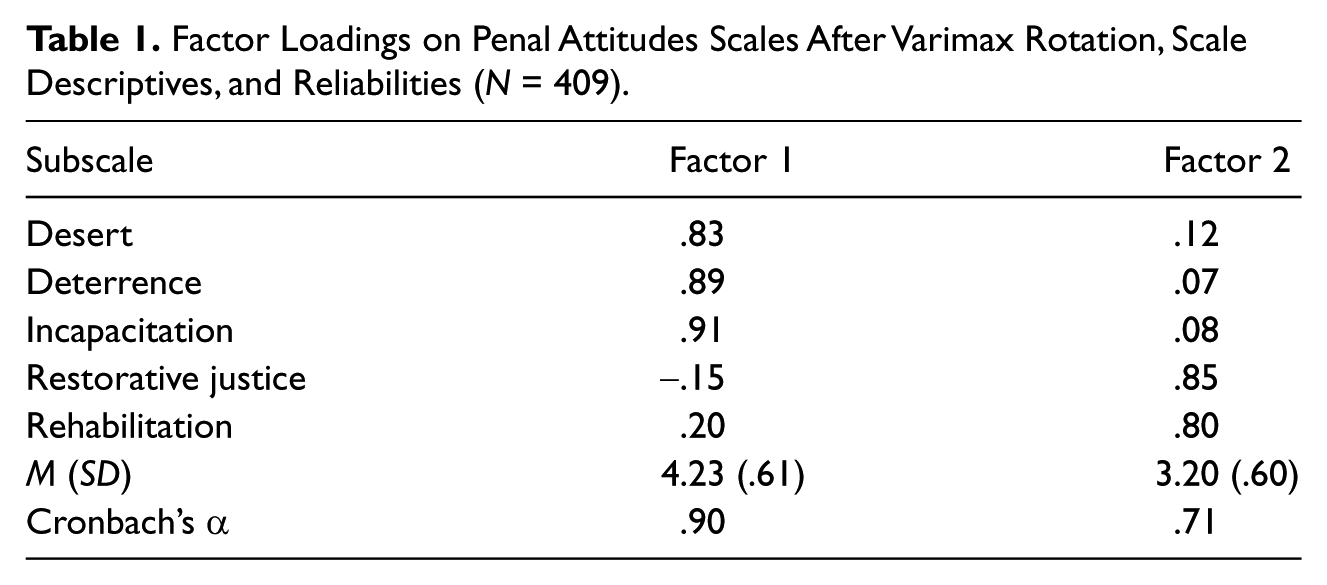
Earlier studies found that two main dimensions underlie the five goals and justifications of punishment (De Keijser, 2000). These two dimensions reflect the degree to which harsh treatment is preferred, that is, through deterrence, desert, and incapacitation, and the degree to which a socially constructive outcome of the penal process is desired, and through restorative justice and rehabilitation (De Keijser, 2000). To examine whether the two-dimensional structure could be replicated in this study, we conducted a principal components analysis on the five subscales. This was the case. The analysis yielded two clear factors with an eigenvalue >1, with a clear break after the second factor, and the highest loadings on the intended factors (Table 1). Together, the two factors explained 73.6% of the total variance explained by the model.
Based on this two-dimensional structure, we constructed two scales based on the mean scores of the items and termed them Punitiveness (composed of deterrence, desert, and incapacitation) and Restorative and Rehabilitative Orientation (composed of restorative justice and rehabilitation). Higher scores on these scales are indicative of more punitive attitudes and more restorative and rehabilitative attitudes, respectively.
Opinions on Suspended Sentences Scales
A total of 10 items, presented in randomized order and scored on 5-point (completely disagree-completely agree) scales, inquired about people’s opinions regarding suspended sentences. Among them, 5 items were intended to measure the degree to which individuals perceived suspended sentences to be punitive. The other 5 items inquired about respondent’s beliefs in the effectiveness of suspended sentences. The items and item descriptives are presented in Table 2. 5
Factor Loadings Suspended Sentences Items After Varimax Rotation and Scale Descriptives (N = 409).
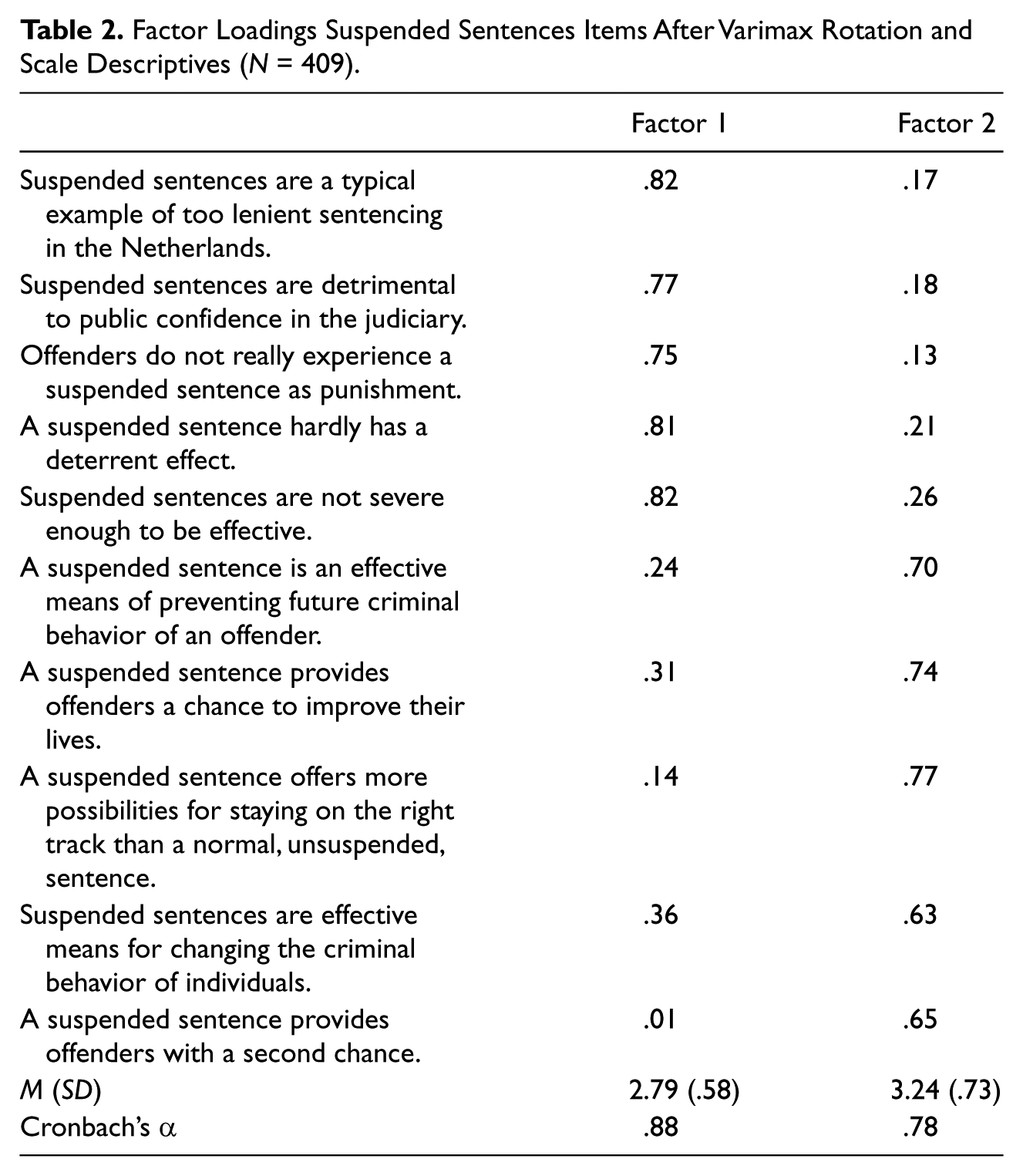
A principal components analysis performed on these items provided support for the hypothesized two-dimensional nature of opinions about suspended sentences. The analysis yielded two separate factors with eigenvalues >1, with a clear break after the second factor and the highest loadings on the intended factors. Together, the factors explained 61.07% of the variance. Items intended to measure perceived punitiveness of suspended sentences (PPS), for example, “Suspended sentences are a typical example of too lenient sentencing in the Netherlands,” loaded high on the first factor and low on the second. We termed this scale, which had a Cronbach’s α of .88, “Perceived Punitiveness of Suspended Sentences.” Higher scores on this scale reflect higher perceived punitiveness. Another five items inquired about individuals’ beliefs in the effectiveness of suspended sentences, for example, “Suspended sentences are effective means for changing the criminal behavior of individuals.” As expected, these items loaded high on the second factor and low on the first one. This scale had a Cronbach’s α of = .78 and was termed “Belief in Effectiveness.” A high score on this scale reflects a strong belief in its effectiveness as a sanction.
Finally, one item, also scored on a 5-point (completely disagree-completely agree) scale, measured people’s GASS: “All in all, I am in favor of suspended sentences.” Higher scores on this scale are reflective of more positive attitudes.
Results
Table 3 shows the correlations between the variables knowledge of suspended sentences, penal attitudes, opinion about suspended sentences, age, and household income. As can be seen, and in line with our hypothesis, knowledge of suspended sentences correlates positively with PPS and BIEFS (p < .05). People with more knowledge of suspended sentences tend to perceive them as more punitive while also believing more in their effectiveness. However, knowledge of suspended sentences did not significantly correlate with people’s general attitude toward them.
Correlations Between Knowledge of Suspended Sentences, Penal Attitudes (Punitiveness and Restorative and Rehabilitative Orientation), Opinions About Suspended Sentences (PPS, BIEFS, GASS), Age, and Household Income (N = 409).
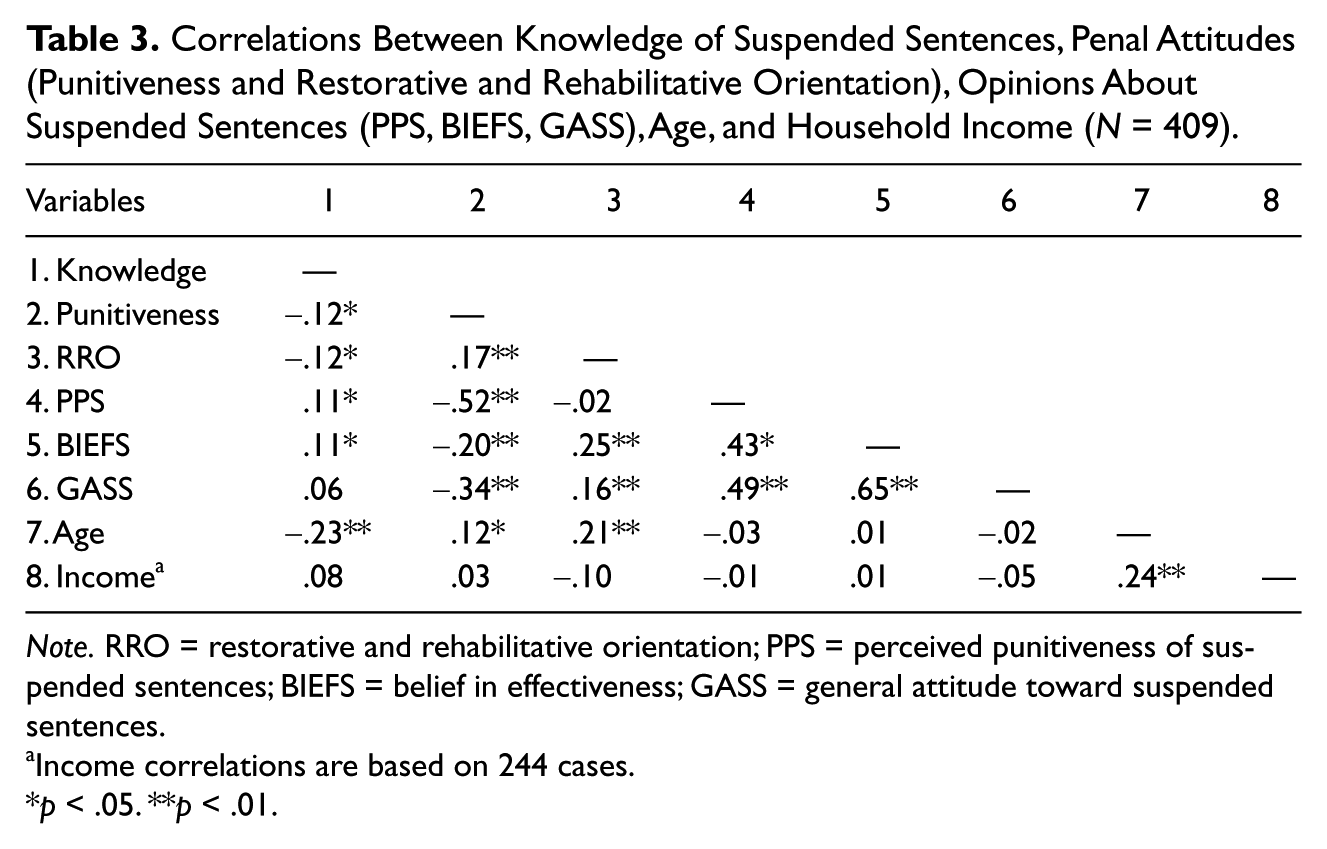
Note. RRO = restorative and rehabilitative orientation; PPS = perceived punitiveness of suspended sentences; BIEFS = belief in effectiveness; GASS = general attitude toward suspended sentences.
Income correlations are based on 244 cases.
p < .05. **p < .01.
Furthermore, as was also expected, general penal attitudes correlate with opinions regarding suspended sentences. Punitiveness correlates negatively with PPS and BIEFS (p < .01), whereas restorative and rehabilitative orientation correlates positively with BIEFS (p < .01). That is, people with a more punitive attitude perceive suspended sentences to be less punitive and believe less in their effectiveness. People with a more restorative and rehabilitative orientation believe more strongly in the effectiveness of suspended sentences. Punitiveness correlates negatively with people’s GASS (p < .01), whereas restorative and rehabilitative orientation correlates positively with it (p < .01). Finally, age correlated negatively with knowledge and positively with both punitiveness and restorative and rehabilitative orientation. There were no significant differences between men and women.
As a final step in the analysis, we further examined the relationship between penal attitudes, opinions regarding suspended sentences, and GASS. In particular, we examined whether PPS and BIEFS mediated the relationship between punitiveness and GASS. The goal of mediation analysis is identifying the mechanism that underlies a relationship between two variables through a third explanatory variable, the mediator variable. A mediation model assumes that (a) the predictor (punitiveness) is significantly correlated with the outcome variable (GASS), (b) the mediator (PPS and BIEFS) is positively correlated with the predictor variable, and (c) the mediator is significantly correlated with the outcome variable. A variable is said to mediate the effect between the two other variables if it is no longer significant or reduced substantially when controlling for the mediator (Baron & Kenny, 1986).
As can be seen in the top part of Figure 1, the direct path from punitiveness to GASS is reduced from β = −.34** to β = −.12*, when PPS is included as a mediator in the equation. Results of a Sobel test (MacKinnon, Lockwood, Hoffman, West, & Sheets, 2002) indicate that this reduction is significant, z = −2.88, p < .01. A similar effect is found for BIEFS. As shown in the bottom part of Figure 1, the direct path from punitiveness to GASS is reduced from β = −.34** to β = −.22*, when BIEFS is included as a mediator. Here too, the results of a Sobel test indicate significant partial mediation, z = −4.12, p < .01.
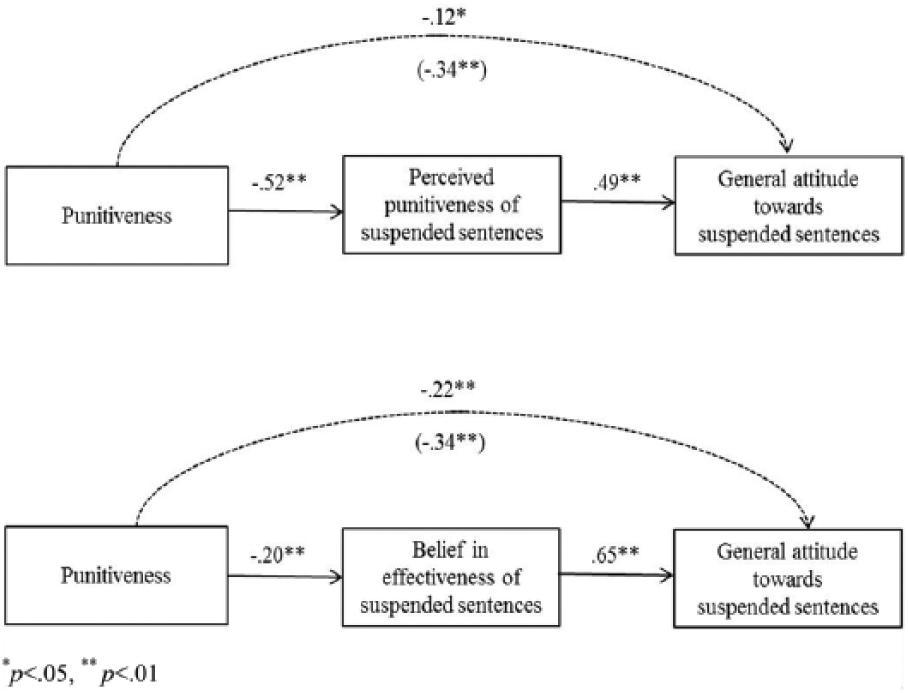
Mediation by perceived punitiveness of suspended sentences and belief in effectiveness of suspended sentences of the punitiveness–general attitude toward suspended sentences relationship.
The results of Study 1 shed some initial light on what determines people’s opinions on, and attitudes toward, suspended sentences. Although knowledge of suspended sentences is positively related to the perceived punitiveness of this type of sanctioning and people’s beliefs in its effectiveness, we found no direct relationship between knowledge and people’s attitude toward it. In contrast, the degree to which people are punitive is a far stronger (and negative) correlate of their GASS. However, the strong correlations between PPS and belief in its effectiveness, on one hand, and general attitude toward this type of sanction on the other, indicate that increasing knowledge about certain aspects of this sanction, such as its assumed operational mechanisms, may lead to more positive attitudes. Some initial support for this assumption is provided by the results of the mediation analysis, which indicate that the effect of punitiveness on general attitudes toward suspended sentences is partially explained by the PPS and people’s beliefs in their effectiveness as a sanction. To further examine these relationships, in the next study we examine to what extent increasing individuals’ knowledge about suspended sentences influences their attitudes and beliefs in effectiveness.
Study 2: Changing Opinion by Increasing Knowledge
In this study, we provide respondents with short descriptions of suspended sentences, describing their goals and how they are supposed to work, their punitive elements, or both. We subsequently measure the influence of this information (and hence, knowledge) on the PPS, BIEFS, and people’s attitude toward suspended sentences, while again also considering the penal attitudes of respondents.
Respondents
For this study, a new sample was drawn from the LISS panel that was described in Study 1. In total, 376 Dutch-speaking citizens permanently residing in the Netherlands were randomly selected from this panel. 6 Background characteristics were highly similar to the sample of Study 1. Respondents (55.3% female) were between 16 and 90 years of age (M = 49.2, SD = 17.2). Average gross household income was €4078,23 (SD = €2268,56), and education levels ranged from primary education (12.0%), lower level secondary education (28.2%), higher level secondary education (10.7%), lower level tertiary education (20.7%), higher level tertiary education (23.2%), to university-level education (5.2%).
Materials
Penal Attitudes Scale and Opinions on Suspended Sentences Scale
The same scales for measuring penal attitudes and opinions on suspended sentences were used, as in Study 1. The properties of the scales coincide with the ones found in Study 1. Principal components analyses yielded highly similar two-factor structures and loadings for the Penal Attitudes Scales and Opinions on Suspended Sentences Scales. Scale descriptives and reliabilities were also highly similar to the ones reported in Study 1. The mean score of the Punitiveness Scale was 4.35 (SD = 0.58), and the scale had a Cronbach’s α of .90. The mean score of the Restorative and Rehabilitative Orientation Scale was 3.25 (SD = 0.55) and its Cronbach’s α = .64. The mean score of the PPS scale was 2.68 (SD = 0.59) and its Cronbach’s α = .87. The BIEFS scale had a mean score of 3.08 (SD = 0.80) and a reliability of alpha = .81.
Experimental Manipulation
Respondents were randomly assigned to one of four conditions containing information about suspended sentences. To set a baseline level of knowledge, participants in all conditions read a short general description about suspended sentences:
A judge can decide to suspend a sentence partially or entirely. A suspended sentence is a sanction that is not executed if the offender complies with certain conditions. When the offender commits a new offence or fails to comply with the special conditions of a probation period of up to 3 years, the sentence will in principle be executed. Examples of special conditions are a contact or site ban, entering a rehabilitation program or behavioral training, treatment in a facility, or supervision by the Probation Service.
Depending on the experimental condition, respondents were presented additional information about suspended sentences. We manipulated goal-related information by providing additional information about what the suspended sentence aims to achieve and how it is expected to work:
An important goal of the suspended sentence is contributing to behavioral change. By imposing special conditions, the criminal justice system actively aims to improve the behavior of offenders. The criminal justice system also attempts to impose sentences specifically tailored to suit the offender and the offence. The suspended sentence is therefore an individualized sanction aimed at reducing future criminal behavior.
We manipulated the punitive elements of the sanction by providing information about its threatening character and referring to the conditions that may be imposed:
Because noncompliance with either the general condition or one or more of the special conditions leads to a revocation of the sentence, the suspended sentence has a threatening character. The impact of the special conditions that are frequently imposed can be profound and are supervised (by the Probation Service) to monitor compliance. In addition, when the offender commits a new crime (during his probation period), he will also be sentenced for this new act. The suspended sentence therefore retains its punitive character.
This resulted in a 2 (goal) × 2 (punitive elements) factorial design, with PPS, BIEFS, and GASS as dependent variables.
Results
Correlations between penal attitudes, opinions of suspended sentences, perceived effectiveness, age, and income of respondents are shown in Table 4. The results of the correlational analysis largely coincide with the findings of Study 1 in terms of direction and strength. Punitiveness correlates negatively with PPS and BIEFS (p < .01) and positively with age (p < .05). Restorative and rehabilitative orientation correlates positively with BIEFS and age (p < .01). PPS and BIEFS are positively correlated (p < .01), as are punitiveness and restorative and rehabilitative orientation (p < .05). GASS, finally, correlates negatively with punitiveness (p < .01), positively with restorative and rehabilitative orientation (p < .05), and again strongly positively with both PPS and BIEFS (p < .01). As in Study 1, there were no gender differences in these variables.
Correlations Between Penal Attitudes (Punitiveness and Restorative and Rehabilitative Orientation), Opinions About Suspended Sentences (PPS, BIEFS, GASS), Age, and Household Income (N = 376).
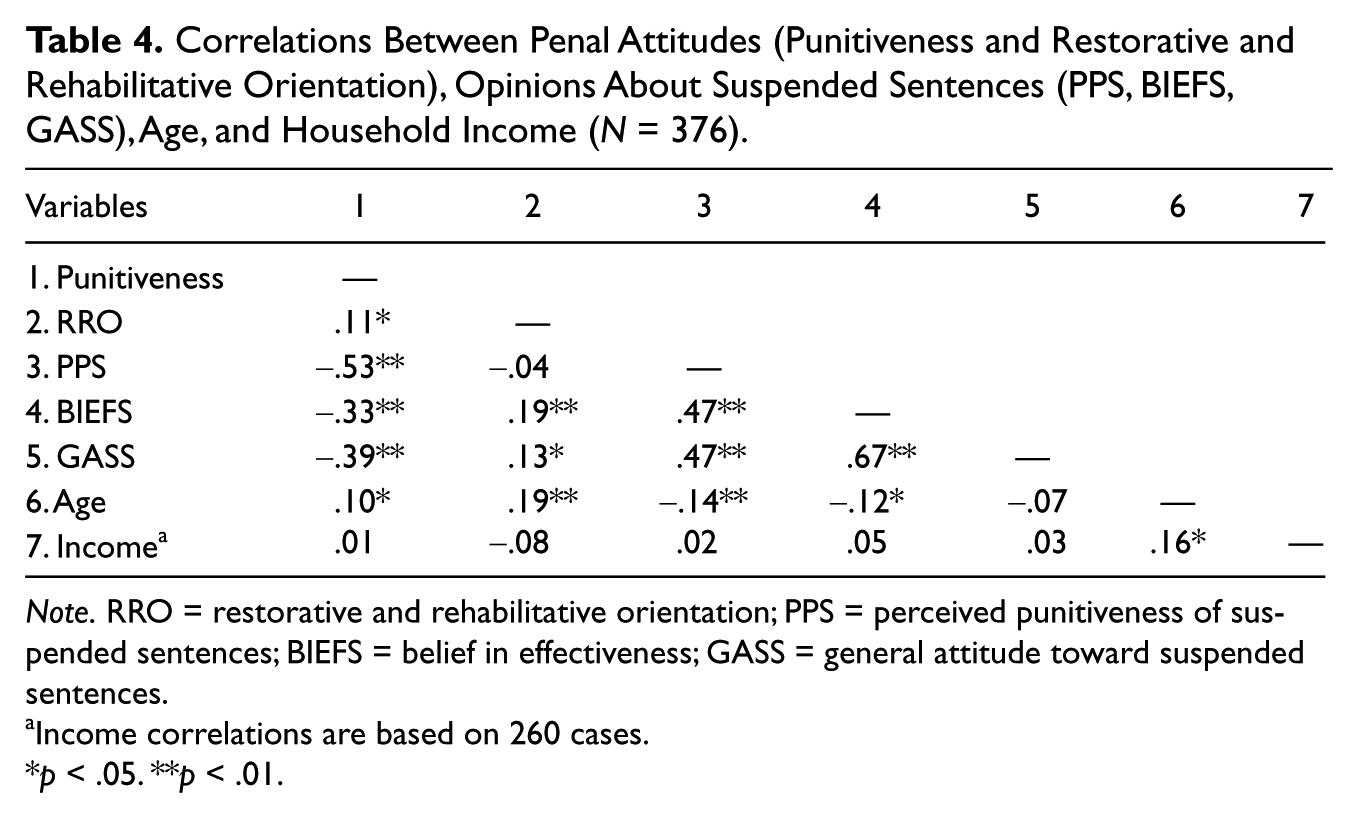
Note. RRO = restorative and rehabilitative orientation; PPS = perceived punitiveness of suspended sentences; BIEFS = belief in effectiveness; GASS = general attitude toward suspended sentences.
Income correlations are based on 260 cases.
p < .05. **p < .01.
To test the hypothesis that providing information influences people’s opinions on suspended sentences, we used ANOVA (Table 5). The results indicate no significant effect for the influence of either type of information, that is, goal or punitive elements, on perceived punitiveness, F(1, 372) = 1.342, p = ns, and F(1, 372) = 0.111, p = ns. In other words, providing information about suspended sentences, either stressing the punitive elements or their goal, does not alter peoples’ perceptions of their punitiveness.
Means and standard deviations for perceived punitiveness of suspended sentences (PPS), belief in effectiveness of suspended sentences (BIEFS), and general attitude towards suspended sentences (GASS) (N=376).
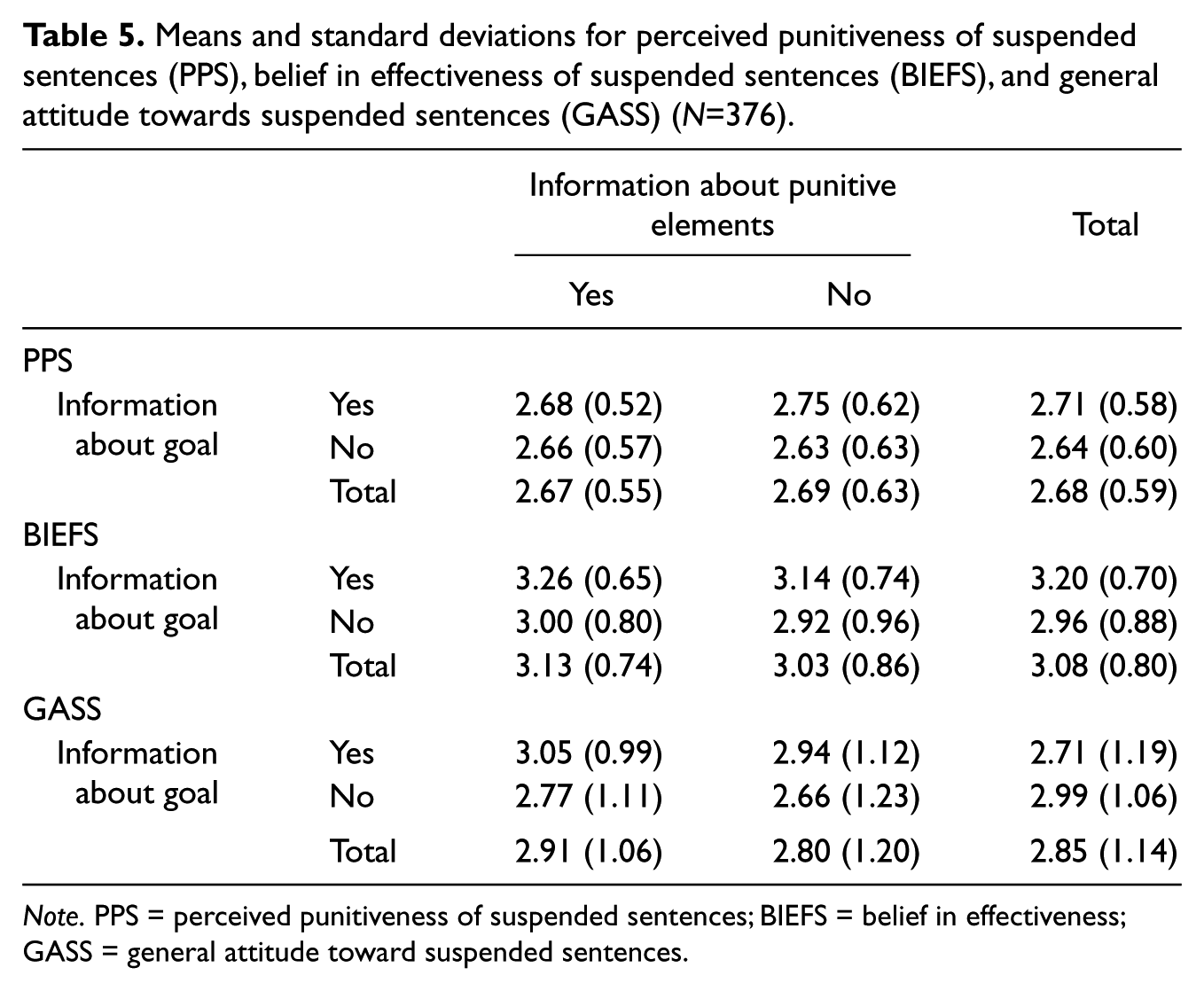
Note. PPS = perceived punitiveness of suspended sentences; BIEFS = belief in effectiveness; GASS = general attitude toward suspended sentences.
There was a significant effect, however, for the influence of goal information on BIEFS, F(1, 372) = 8.443, p < .01. People who received information about the goal of suspended sentences believed suspended sentences to be more effective than people who did not receive this information. Furthermore, there was a significant effect for the influence of goal information on GASS. People who were made aware of the goal of suspended sentences had a more positive attitude toward this sanction than those who were not made aware of this, F(1, 372) = 5.922, p < .05. No effect was found for punitive elements. That is, reading information about the punitive character of suspended sentences did not lead to differences in opinion or attitude.
General Discussion and Conclusion
In this article, we examined the relationships between opinions on, attitudes toward, and knowledge of suspended sentences and general penal attitudes. As was hypothesized, people with more knowledge of suspended sentences were found to also have a stronger belief in their effectiveness and to perceive them as more punitive than less knowledgeable people. Furthermore, as was also hypothesized, individuals with more punitive penal attitudes had more negative attitudes toward suspended sentences, while the reverse was true for people with a more rehabilitative and restorative orientation. It was also found that the relationship between general penal attitudes and attitudes toward suspended sentences was mediated by people’s opinions on suspended sentences. That is, the negative relationship between punitiveness and attitude toward suspended sentences is partially explained by the perceived punitiveness and BIEFS of suspended sentences. Based on these results, we experimentally examined whether and to what extent increasing individuals’ knowledge of suspended sentences influences their opinions and attitudes regarding this type of sanction. It was found that providing information about the punitive elements of suspended sentences did not lead to changes in either opinion or attitude. However, providing information about the goals of suspended sentences did lead to stronger beliefs in the effectiveness of suspended sentences and also to more positive attitudes.
The effect of information about the goals of suspended sentences on BIEFS and general attitudes was significant, but modest. One explanation for the fact that no larger effects were found is that all conditions received baseline information about suspended sentences, which may have generated an effect of itself. We thought it necessary to provide baseline information to ensure that participants had a general idea of what the research was about and to avoid differential interpretation. Furthermore, the modest effect size may have also been the consequence of the limited amount of information that was provided. That is, providing more information creates the opportunity to consider issues in more depth and, hence, can lead to a more significant change in opinion. 7
The results extend previous research in various ways. Earlier studies using data from national samples have often used one-question polls (Cullen et al., 2000). As noted by Hough (1996), these can be rather blunt instruments, and survey researchers can get the answers they want simply by changing the way in which they ask their questions (Hough, 1996). By using reliable composite scales, we were able to further understand the opinions and attitudes of the public with respect to this type of sanctioning. Importantly, we showed that public opinion about suspended sentences is not a one-dimensional issue and that research should, at least, distinguish the perceived punitiveness of the sanction from people’s belief in its effectiveness, which are related, but nevertheless distinct, variables. Future research should therefore adhere to the distinction suggested in this study and possibly extend it.
In addition, as was noted by Maruna and King (2004), research often tends to describe what the public says it wants without providing information about what underlies their preference. Our study addressed this weakness of previous research by linking opinions about suspended sentences to general penal attitudes and knowledge and showing how they are related, which generates a more encompassing view of what underlies attitudes toward suspended sentences.
Confidence in the criminal justice system and its sanctioning apparatus are of great importance to generate compliance among the public with the law (Sunshine & Tyler, 2003). To maintain or increase public confidence in the criminal justice system, governments should provide information about (important changes in) their sanctioning policies. This study, and various studies preceding it, has shown that a lack of familiarity with sanctions can indeed make them “unloved” by the general public. Their complex and paradoxical nature makes suspended sentences less visible to the public compared with other types of sanctions, and the gap between the views of officials and those of the public is also likely to be greater here. As Freiberg and Moore (2009) argued, “while judicial officers may regard suspended sentences as a significant penalty, in the public mind the offender awarded such a sentence is regarded as ‘getting off’, ‘walking free’, or as having received a ‘slap on the wrist’” (p. 109). It is therefore all the more important that government informs the public particularly about this sanction in its different forms and degrees of punitiveness and effectiveness.
Furthermore, it is important to have a notion of the actual knowledge of the public because entrenched convictions are harder to change compared with less firmly established beliefs. Policy would be ill advised to try to alter a negative public opinion to muster public support through campaigns in these cases as they are unlikely to generate much effect. Furthermore, campaigns informing the public about sentencing policy will be limited in the amount of information that can be communicated. Therefore, research on how to best present information about criminal policy to the public to increase their knowledge is a logical next step for criminological research to take.
Footnotes
Appendix
| Knowledge of Suspended Sentences Items
A suspended sentence is a sentence that is only executed when an offender does not meet certain conditions. ( A suspended sentence can only be imposed with people who have never been convicted for a crime. (correct– A suspended sentence can only be imposed for relatively non-serious crimes such as drunk and disorderly conduct or vandalism, but not for serious offences such as abuse (assault and battery) or robbery accompanied with violence. (correct– Someone who commits another offence during the probation period of his suspended sentence must in principle still be committed to custody. ( A possible condition that can be imposed is supervision by the probation services. ( A suspended sentence always concerns a prison sentence, never community service or a fine. (correct– |
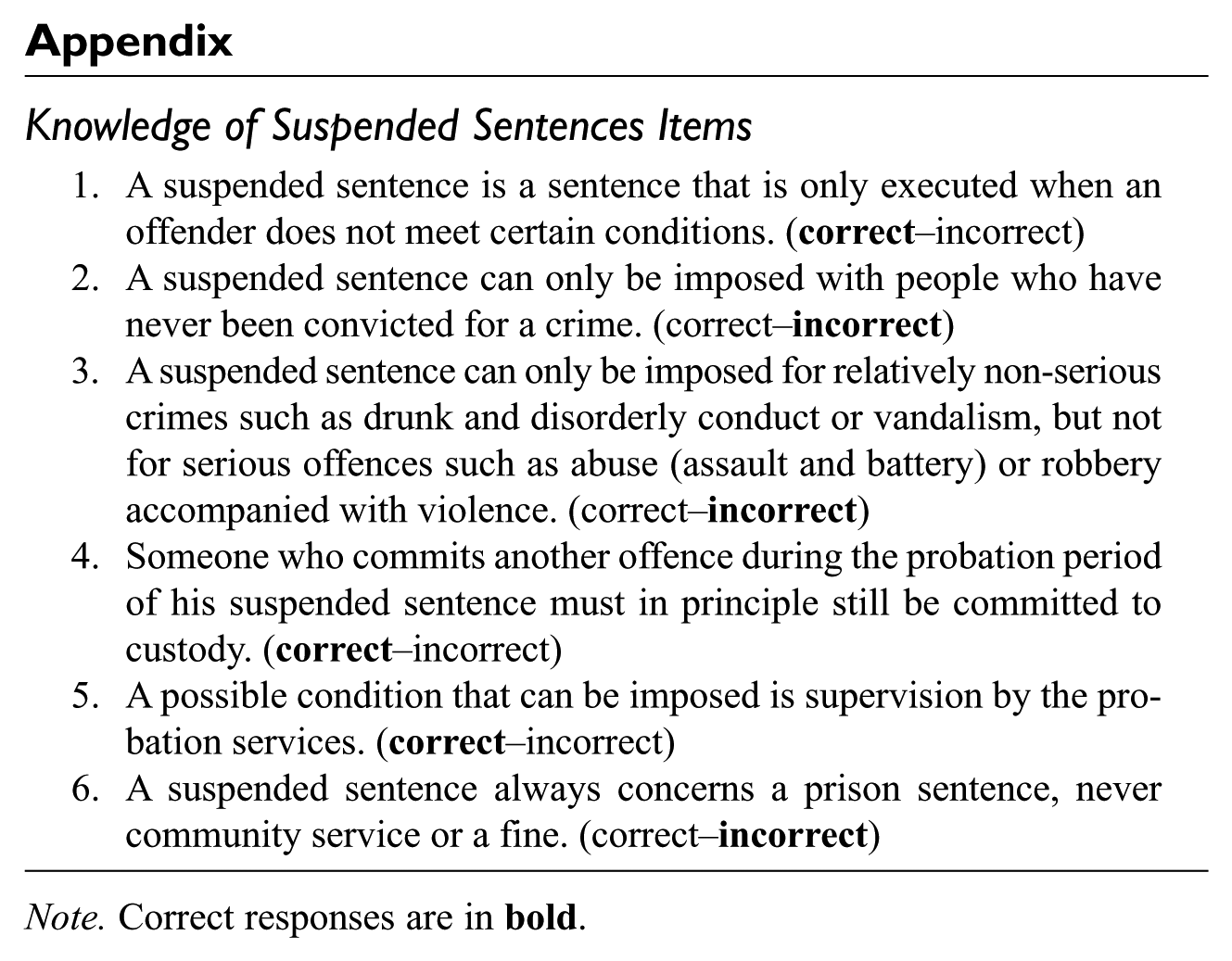
Note. Correct responses are in
Declaration of Conflicting Interests
The author(s) declared no potential conflicts of interest with respect to the research, authorship, and/or publication of this article.
Funding
The author(s) received no financial support for the research, authorship, and/or publication of this article.
1.
Note that not all sentences can be suspended. Article 14 of the Dutch penal code mentions a number of restrictions in this respect. For example, only prison sentences of less than 2 years can be entirely suspended, prison sentences between 2 and 4 years can only be partially suspended, and prison sentences of more than 4 years cannot be suspended at all. Furthermore, suspended sentences can involve different types of sentences, for example, community service, not only prison sentences.
2.
However, recent research has shown that the public can also support a more rehabilitative approach to crime control. Especially with respect to at-risk youth and juvenile delinquency, opinion polls indicate more support for early intervention and treatment (Cullen, Vose, Lero, & Unnever, 2007). Piquero and colleagues (Piquero, Cullen, Unnever, Piquero, & Gordon, 2010) found a public belief that juveniles well beyond their teenage years can change and, therefore, a broad consensus of juvenile rehabilitation.
3.
Some modifications in item formulation were made.
4.
With the exception of restorative justice, which is measured by five items.
5.
Earlier versions of this scale were pretested in two pilot studies among undergraduate students.
6.
Note that none of the participants in this study had also participated in the previous study and vice versa.
7.
Relatedly, the information provided to the respondents differs from the type of information they would normally receive, for example, from government sources or the media. This study provided general substantive information. In contrast, the media provide the public with stories and case studies about crime and punishment that make popular news items (Roberts, 2004). The public may therefore be more inclined to form opinions when suspended sentences are linked to real-life situations. More detailed information or providing cases can result in a greater effect and may counterbalance the largely negative hype-oriented influence of popular media.