




Abstract
The reading complexity of a sample of Canadian police youth waiver forms was assessed, and the oral comprehension of a waiver form was examined. In Study 1, the complexity of 31 unique waiver forms was assessed using five readability measures (i.e., waiver length, Flesch–Kincaid grade level, Grammatik sentence complexity, word difficulty, and word frequency). Results showed that the waivers are lengthy, are written at a relatively high grade level, contain complex sentences, and contain difficult and infrequent words. In Study 2, high school students (N = 32) were presented orally with one youth waiver form and asked to explain its meaning. Results showed that participants understood approximately 40% of the information contained in the waiver form. The likelihood of the rights of Canadian youths being protected and the need to create a standardized and comprehensible waiver form are discussed.
The Canadian Youth Criminal Justice Act (YCJA, 2002) legislates that police officers must take the specific needs of youths into consideration when providing legal rights before an interrogation is conducted. Recent Canadian case law has reinforced this legislation through rulings that all legal rights must be explained clearly to youths and that any waiver of legal rights will only be valid if it can be demonstrated by the police officer that the youth understood the rights and the consequences of waiving them (R. v. L.T.H., 2008). Historically, the police cautions used to administer legal rights to adults were also used to administer rights to youths. The aforementioned legal developments, however, have essentially acknowledged more formally that youths are a vulnerable population that must be given enhanced protections during a police interrogation. One step that has been taken by police organizations to meet the demands for clarity and comprehension has been the development and implementation of waiver forms. To date, no research has examined the extent to which these waiver forms are providing the intended legal safeguards to Canadian youths.
As mentioned, one of the central purposes of the YCJA was to provide youths facing a police interrogation with enhanced legal protections. Part of these protections—outlined in Section 146 of the YCJA—requires police officers to first explain to the youth that (a) they are not obligated to provide a statement, (b) any statement given may be used as evidence against them in court proceedings, (c) they can consult with counsel and a parent/adult relative/appropriate adult, and (d) any statement that is given must be in the presence of counsel or a parent/adult relative/appropriate adult, unless the youth desire otherwise. Similar rights exist for youths in the United States as well (In re Gault, 1967; Miranda v. Arizona, 1966).
Section 146 also requires that legal rights be explained to a young person “clearly . . . in language appropriate to his or her age and understanding.” A failure to meet this requirement can lead to any subsequent statements taken from the youth being ruled inadmissible. As clarified in a recent ruling by the Supreme Court of Canada,
Where a trial judge is not satisfied that the young person understood his or her right to consult counsel and a parent and to have those people present during the statement, or, is not satisfied that the young person appreciated the consequences of waiving those rights, the statement should not be admitted. (R. v. L.T.H., 2008)
As a consequence, police interviewers are encouraged to ensure that the youths understand their rights fully before proceeding with their questions. Legal rulings in the United States have also decreed that juveniles must be informed fully of their rights before any statement is deemed admissible (see Rogers, Hazelwood, Sewell, Shuman, & Blackwood, 2008, for extensive discussions of legal rulings involving juveniles).
Research in the United States showed that youths failed to understand their legal rights fully (e.g., Grisso, 1981; Peterson-Badali, Abramovitch, Koegl, & Ruck, 1999). In one of the first studies of youth caution comprehension conducted in the United States, Grisso (1981) found that only 21% of juveniles fully understood the Miranda warning that was presented to them. Subsequent studies of Miranda comprehension in juveniles have found similarly low levels of understanding legal rights and the consequences of waiving those rights (e.g., Goldstein, Condie, Kalbeitzer, Osman, & Geier, 2003; McLachlan, Roesch, & Douglas, 2011; Viljoen, Zapf, & Roesch, 2007).
Studies assessing comprehension of legal rights among Canadian youths—conducted prior to the enactment of the YCJA and the development of waiver forms—generally showed low levels of understanding as well. In a study by Abramovitch, Higgins-Biss, and Biss (1993), comprehension of right-to-silence and right-to-legal counsel cautions among juveniles was examined by first reading each caution aloud and then presenting juveniles with a written version. After the cautions were presented in the two formats, participants were asked to repeat each caution in their own words. Their results showed that 88% of participants had full or partial understanding of the right-to-silence caution and 53% had full or partial understanding of the right-to-legal counsel caution. In a study that reduced the right-to-silence caution into a single sentence and right-to-legal counsel caution into a single sentence and read each sentence aloud to a sample of juveniles, it was found that 67% and 57% of juveniles fully understood the right-to-silence and right-to-legal counsel cautions, respectively (Abramovitch, Peterson-Badali, & Rohan, 1995).
One explanation for the lack of comprehension of legal rights by youths has been the complex nature of the documents used to make them aware of their rights. To test this explanation, Rogers et al. (2008b) collected and examined 122 juvenile Miranda warnings from across the United States. They found that the warnings varied in length from 64 to 1,020 words, while the reading grade level needed to understand the warnings ranged from Grade 2 to postsecondary education. The warnings also contained a number of difficult legalistic terms (e.g., appointed, waive) that further added to the complexity of the cautions. More recently, Rogers et al. (2012) examined the complexity of 249 unique juvenile Miranda warnings using a range of readability measures. They found that juvenile Miranda warnings are lengthy and over half require at least an eighth-grade education. Given that most youths in the juvenile justice system have less well-developed brain, cognitive, and psychosocial capacities than adults and nondelinquent peers (Goldstein et al., 2003; Grisso, 1981; Steinberg, 2009; Viljoen & Roesch, 2005), it is clear that juveniles are a vulnerable population who are unlikely to understand their constitutional rights as presented in such complex warnings.
Canadian youths facing a police interrogation are no longer made aware of their legal rights through police cautions that are used with adults. Youths are now made aware of their rights through waiver forms, written passages of text that outline all the rights afforded to youths, and are delivered to youths whenever they face an interrogation. The development of the waiver form is generally the responsibility of each organization’s legal department, whereby a lawyer would interpret Section 146 of the YCJA and relevant case law to decide on the content and wording of the waiver form.
The way in which a waiver form is administered to youths is left up to the discretion of the interviewing officer. For instance, the interviewer can choose to read the form aloud to the youth (which may or may not include attempts to simplify the wording of the form by the interviewer), have the youth read along while the interviewer is reading the form aloud, or have the youth read the form themself. 1 In a typical interview, the officer is required to have the youth verify that they were given their rights and understood them by getting them to sign the form. In addition, officers must also decide how much effort to put into ensuring that the youths understand their rights. It is up to the discretion of the officer to encourage the youth to ask questions or attempt to get the youth to recite back their understanding of the waiver forms. In essence, the way in which police officers administer the youth waiver form is not standardized.
The Current Study
Despite the extensive use of youth waiver forms and the importance of ensuring that youths understand their rights, no research assessing the reading complexity or the comprehension of these forms has been conducted. In Study 1, we collected youth waiver forms from police organizations across Canada and analyzed their complexity according to various readability measures. To test the comprehensibility of the waiver forms directly, in Study 2, we conducted an exploratory study examining high school students’ understanding of a youth waiver form used by local police organizations.
Study 1
Method
Sample of youth waiver forms
Police organizations in Canada were contacted and asked to provide a copy of their youth waiver form. A total of 50 English versions of waiver forms were obtained. The sample consisted of 11 forms from the Royal Canadian Mounted Police (RCMP; Canada’s only federal police organization). A total of 4 forms were obtained from British Columbia (BC), 6 from Alberta (AB), 5 from Saskatchewan (SK), 4 from Manitoba (MB), 16 from Ontario (ON), 2 from Quebec (QC), 2 from Prince Edward Island (PE), 2 from New Brunswick (NB), 4 from Nova Scotia (NS), 2 from Newfoundland and Labrador (NL), and 1 form each from Nunavut (NU), Northwest Territories (NT), and the Yukon (YT). Based on the 2006 census information from Statistics Canada, we estimated that more than 90% of Canada’s population are serviced by the organizations represented in our sample of youth waiver forms. A total of 31 of the 50 waiver forms (62.00%) were unique, and subsequent analyses were conducted on the unique cautions.
Procedure
All waiver forms were typed into a word processor and prepared for analysis. The transcription of the waivers was first checked to ensure that they were verbatim representations of the original forms. Any information that did not pertain to a specific legal right was removed from the transcribed waiver form (e.g., questions pertaining to the youth’s understanding of the waiver, instructions for the officer on how to deliver the waiver). In 24 of the 31 waivers (77.42%), there was a blank space for a police officer to insert the type of criminal charge or reason for the detention. To ensure a conservative measure of complexity, the blank space was replaced with the one syllable word “a.” The telephone numbers that were included in 16 of the 31 forms (51.61%) were converted from numbers to words. When conditional terms were present in a waiver form (e.g., you are/may/will be charged with), the shortest version possible was used to ensure a conservative estimate of complexity. Waiver forms are typically three to four pages in length, and structured into a series of sections, with comprehension being checked after each of those sections (e.g., via a closed yes/no question about whether the youth understood the preceding legal rights). For the purpose of the current study, we defined a section as any passage of text that preceded a check of comprehension.
Complexity measures
As mentioned, the way that Canadian police officers tend to administer youth waiver forms has not been documented, but there are some indications that they are typically delivered orally. 1 Given that we are unaware of any metrics that directly captures oral complexity, we rely on measures that are more related to reading complexity. Reading complexity measures have been used in past research on the comprehension of legal rights (e.g., Rogers et al., 2012), and there is some research indicating that listening and reading comprehension are moderately correlated (see Savage, 2001). The following complexity measures were used:
Length analysis: Youth waiver forms tend to be branching in nature, whereby the specific type of charge or how youths respond to a set of questions dictates the sequences of questions and statements that they are required to understand. In other words, the amount of information that a youth would have to understand depends on the situation faced by the youth and how he or she responds to the various questions posed to them. For the purpose of the current study, we analyzed two versions of each form that a youth could potentially be required to comprehend. The first version was the least amount of information that the youth would be asked to comprehend (i.e., shortest version). The second version was the most amount of information that the youth would be asked to comprehend (i.e., longest version). The total number of words was calculated using Microsoft Word, and the number of sections, average words per section, and minimum and maximum number of words per section were tallied. For comparative purposes, Rogers, Harrison, Shuman, Sewell, and Hazelwood (2007) recommended that the length of the passage of text that anyone is asked to comprehend at any given time should not exceed 75 words (see also Baddeley, 1994).
Flesch–Kincaid (FK) grade level (FK score): The FK formula estimates the grade level needed for comprehension of a passage of text (Flesch, 1950). The formula, which uses sentence length and average number of syllables per word, predicts the grade level at which individuals in that grade would understand 75% of the information in a particular passage of text (see DuBay, 2004). For example, a FK score of 6 for a passage of text indicates that individuals with a sixth-grade reading ability should be able to comprehend at least 75% of the information contained in that passage of text. It should be noted that all FK scores greater than 12 correspond to a postsecondary education reading level. The FK measure has been deemed a reliable measure of reading comprehension (see Paasche-Orlow, Taylor, & Brancati, 2003), and is used widely in the empirical research on the complexity of police warnings (see Rogers et al., 2012). For each waiver, a FK score was calculated using all the text comprising the waiver, and was also calculated for each section within a waiver.
Grammatik sentence complexity: Grammatik is a program contained in Corel WordPerfect that provides a measure of sentence complexity. The complexity score is derived from the number of words and clauses in sentences (see Rogers, Hazelwood, Sewell, Harrison, & Shuman, 2008). Scores can range from 0 to 100, with increasing scores corresponding to increasing sentence complexity. As a benchmark, Corel WordPerfect X4 provided a Grammatik score of 27 for the instructions provided by the American Internal Revenue Service for completing Form 1040EZ and a score of 75 for the Gettysburg address. For each waiver, a Grammatik score was calculated for all the text comprising the waiver and for each of the sections within a waiver.
Word analysis: The word analysis consisted of analyzing the (a) difficulty level of each unique word contained in the waivers and (b) frequency level of each unique word contained in the waivers. The difficulty level was determined by calculating the approximate grade level needed to understand each unique word (see Dale & O’Rourke, 1981, for details on estimating word difficulty). A word was classified as difficult if it required more than a Grade 7 (which generally corresponds to an age of 12 years) level of education to understand, as the YCJA deals with young people who are between 12 and 17 years of age. For words with more than one definition, the grade level that corresponded to the definition of the word contained in the caution was used. For example, for the word “right,” the definition pertaining to legal guarantees was used, as opposed to other definitions referring to directionality, being correct, and so on. The frequency level of each word was determined by using a word frequency guide from the United States and can be obtained from http://subtlexus.lexique.org (Brysbaert & New, 2009). A word was classified as infrequent if the guide indicated that the word was used less than once in every million words.
Results
The word length analysis for the shortest and longest possible versions of the waivers is shown in Table 1. The average word length of the shortest versions of the waivers was 427.13 (SD = 128.03, 95% confidence interval [CI] = [380.17, 474.09]), and ranged from 239 words (York) to 714 words (RCMP-YT). On average, the shortest versions contained 9.39 sections (SD = 4.02, 95% CI = [7.92, 10.86]), and ranged from 1 (Montreal and Gatineau) to 17 (Ottawa) sections. The average number of words per section ranged from 27 (RCMP-MB et al.) to 128 (RCMP-AB et al.). The minimum number of words comprising a section ranged from 5 (Barrie, Hamilton, Greater Sudbury, Toronto, and Brandon) to 270 (Montreal and Gatineau). The maximum number of words comprising a section ranged from 46 (Ottawa) to 410 (RCMP-AB et al.). In all, 22 (70.97%) of the youth waivers (for the shortest possible versions) had at least 1 section that contains more than 75 words.
The Total Number of Words, Number of Sections, Mean Words per Section, and the Minimum and Maximum Words for the Longest and Shortest Possible Versions of the Youth Waiver Forms.
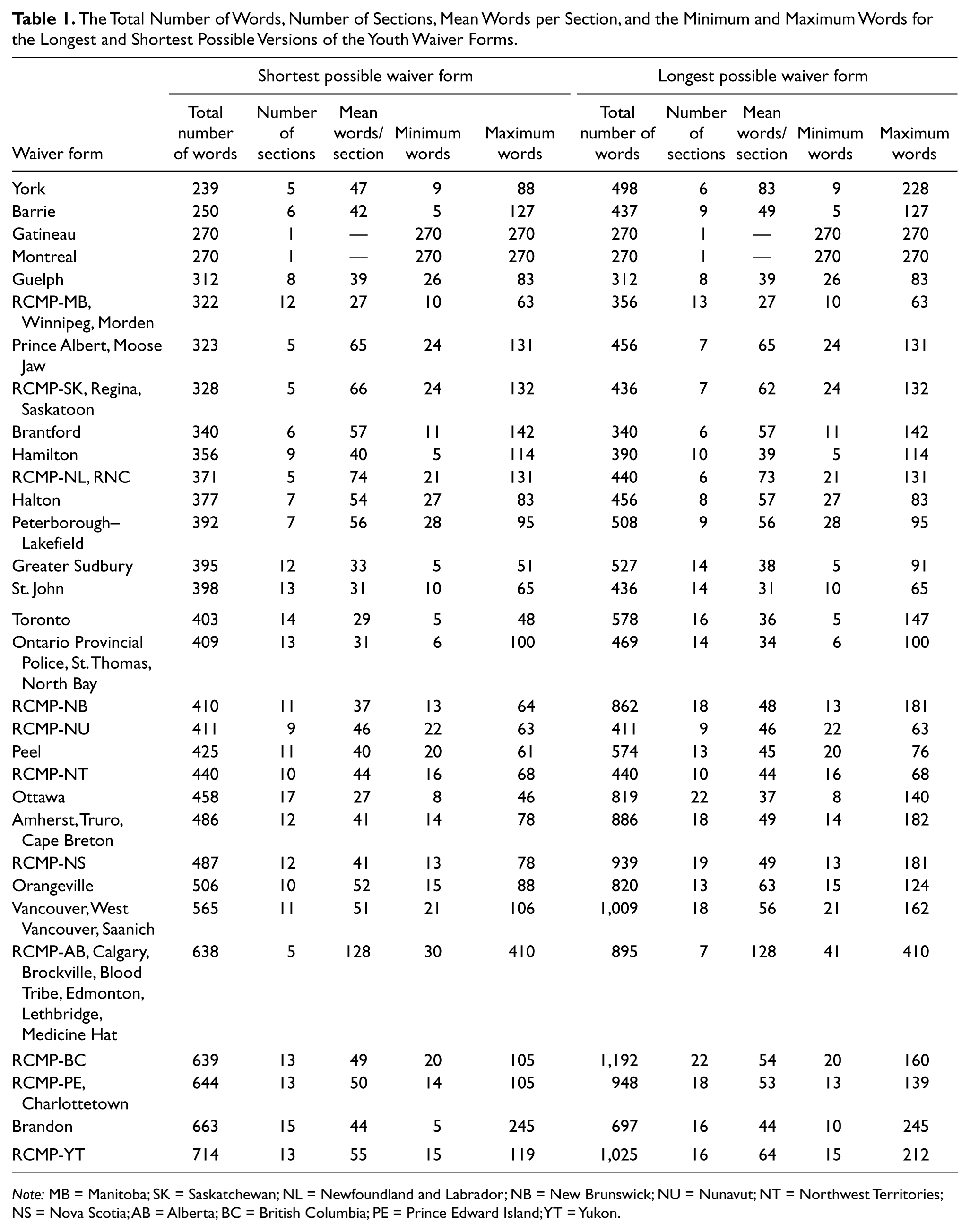
Note: MB = Manitoba; SK = Saskatchewan; NL = Newfoundland and Labrador; NB = New Brunswick; NU = Nunavut; NT = Northwest Territories; NS = Nova Scotia; AB = Alberta; BC = British Columbia; PE = Prince Edward Island; YT = Yukon.
The average word length of the longest versions of the waivers was 603.10 (SD = 258.24, 95% CI = [508.38, 697.82]), and ranged from 270 (Montreal and Gatineau) to 1,192 (RCMP-BC). On average, the longest versions contained 11.97 sections (SD = 5.62, 95% CI = [9.81, 13.93]), and ranged from 1 (Montreal and Gatineau) to 22 (Ottawa and RCMP-BC) sections. The average number of words per section ranged from 27 (RCMP-MB et al.) to 128 (RCMP-AB et al.). The minimum number of words comprising a section ranged from 5 (Barrie, Hamilton, Greater Sudbury, and Toronto) to 270 (Montreal and Gatineau). The maximum number of words comprising a section ranged from 63 (RCMP-MB et al. and RCMP-NU) to 410 (RCMP-AB et al.). For the longest possible versions, all but 4 (87.10%) of the youth waivers had at least 1 section with more than 75 words.
The results of the FK grade level analysis are shown in Table 2. The average of the overall FK scores was 8.94 (SD = 1.45, 95% CI = [8.40, 9.47]), and ranged from 5.9 (RCMP-PE et al.) to 12 (Orangeville). As mentioned, FK scores were also calculated for each of the individual sections within each of the waivers—yielding, for each waiver, one section with the lowest FK score (i.e., minimum) and one section with the highest FK score (i.e., maximum). The average for the minimum FK scores was 4.42 (SD = 2.18, 95% CI = [3.62, 5.22]), and ranged from 0.5 (Brantford) to 10.8 (Gatineau). Three of the waivers (9.68%) did not contain any sections that were below a Grade 7 education level. The average for the maximum FK scores was 16.19 (SD = 4.01, 95% CI = [14.72, 17.66]), and ranged from 8.8 (Montreal) to 27.2 (Orangeville). All the waivers had at least one section that exceeded a Grade 7 education level and 25 (80.65%) of the waivers had at least one section that required a postsecondary education level.
The Overall FK Score, Minimum and Maximum FK Scores, Overall Grammatik Score, and the Minimum and Maximum Grammatik Scores for the Youth Waiver Forms.

Note: FK = Flesch–Kincaid; PE = Prince Edward Island; YT = Yukon; NT = Northwest Territories; SK = Saskatchewan; BC = British Columbia; NB = New Brunswick; NU = Nunavut; NL = Newfoundland and Labrador; NS = Nova Scotia; MB = Manitoba; AB = Alberta.
Table 2 also contains the results of the sentence complexity analyses. The average of the overall Grammatik scores was 67.74 (SD = 14.29, 95% CI = [62.50, 72.98]), and ranged from 38 (RCMP-PE et al.) to 89 (Brantford). In total, 12 (38.71%) of the waivers had an overall Grammatik score above 75. Grammatik scores were also calculated for each of the individual sections within the waivers—yielding, for each waiver, one section with the lowest Grammatik score (i.e., minimum) and one section with the highest Grammatik score (i.e., maximum). The average for the minimum Grammatik scores was 14.74 (SD = 16.96, 95% CI = [8.52, 20.96]), and ranged from a low of 0 (for 10 waivers) to a high of 57 (Montreal and Gatineau). The average for the maximum Grammatik scores was 78.13 (SD = 9.71, 95% CI = [74.57, 81.69]), and ranged from 57 (Montreal and Gatineau) to 94 (Orangeville). In all, 24 (77.41%) of the waivers contained at least one section that had a Grammatik score equal to or higher than 75.
Table 3 contains the results of the vocabulary analysis. There were 74 words that were difficult (i.e., required more than a 7th-grade education level) and/or infrequent (i.e., occurred < one million). Specifically, there were 67 unique difficult words. In total, 45 of the difficult words (60.81%) required an 8th-grade level of education, 10 (13.51%) required a 10th-grade level, 13 (17.57%) required a 12th-grade level, and 4 (5.41%) required more than a Grade 12 education level (i.e., postsecondary education). In all, 8 of the difficult words (10.81%) were present at least once in more than 50% of the youth waivers and 24 (32.43%) of the difficult words occurred, on average, just over once in a youth waiver. There were a total of 19 unique infrequent words. All but 1 of the infrequent words (i.e., offenses) was present in less than 20% of the youth waivers. A total of 13 words (17.57%) were considered both difficult and infrequent.
Youth Waiver Form Vocabulary Analysis.

Note: Any word that appears in parentheses was used to obtain the grade level because the preceding word was unavailable in the word difficulty guide. A word was included in the table if it were deemed either infrequent or difficult.
Every youth waiver contained a difficult word, and the average number of difficult words per waiver was 23.16 words (SD = 8.53, 95% CI = [20.03, 26.29]), and ranged from 9 (Gatineau) to 40 (Orangeville) difficult words. In all, 16 (51.61%) of the waivers contained an infrequent word. The average number of infrequent words per waiver was 1.16 (SD = 1.66, 95% CI = [0.55, 1.77]), and ranged from 0 to 6 (Ottawa) infrequent words.
Discussion
The purpose of developing youth waiver forms was to help ensure that Canadian youths are able to understand the legal rights afforded to them before being interrogated by the police (and to be able to invoke their rights throughout the interview process). Our analysis of the reading complexity of these forms suggests that they are unlikely to be accomplishing that goal. Our findings showed that the waivers are lengthy, contain complex sentences, require a relatively high level of reading ability, and contain difficult and infrequent words. These results are consistent with previous research on the complexity of juvenile Miranda warnings (Rogers et al., 2008b, 2012), and also highlight the need for the youth waiver forms to be rewritten at a level that requires a relatively low level of reading ability.
Our findings show that youth waiver forms are complex in terms of a range of readability measures. For instance, the majority of the waiver forms analyzed in this study contained a least one section with more than 75 words—which researchers have argued exceeds the recommended amount of information that one could process in working memory (Rogers et al., 2007). In addition, the vast majority of the waivers contained at least one section that requires postsecondary education reading ability, and all the waivers contained at least one section that contained more complex sentence structure than what is typically found in introductory college textbook on financial accounting (approximately 55; see Davidson, 2005). Moreover, three quarters of the waivers contained sentences that were more complex than sentences comprising the Gettysburg address. The youth waiver forms also contained some words that youths would struggle to understand because they require a relatively high level of education to grasp and are used rarely in everyday language.
It is imperative that youths, who are considered a vulnerable population, are given the information necessary to understand and exercise their legal protections. The fact that the reading complexity of the waiver forms is relatively high suggests that it is likely that these forms are not aiding in the provision of these protections. In fact, as the waiver forms are currently written, many sections are more complex than the police cautions delivered to Canadian adults (Eastwood, Snook, & Chaulk, 2010). Thus, waiver forms may be detracting from the goal of increasing comprehension by providing an illusion that youths are fully aware of their rights as long as the information contained on the form is read by the youth or read aloud to them. As a consequence, we suggest that all waiver forms be revised to take into consideration the wide ranging levels of education and other individual differences represented by youths—especially given the limited verbal and academic abilities demonstrated by many young offenders (Grisso, 1981; Steinberg, 2009).
Although our analysis suggests that Canadian youths presented with these waiver forms would not be able to comprehend all the rights contained in those forms, empirical research on this issue has yet to be conducted. The goal of Study 2 was to conduct a preliminary test of youths’ ability to comprehend the rights comprised in such waiver forms. We chose to study how well a sample of youths could understand a waiver that was read aloud to them as opposed to asking the youth to read the waiver form. Although an arbitrary decision, we decided to use an oral form of delivery because of our knowledge that Canadian police officers almost always read police cautions to adults and almost never ask adult interviewees to read those cautions 1 (see Snook, Eastwood, & MacDonald, 2010).
Study 2
Method
Sample
Participants (N = 32) were students recruited from four high schools in the greater St. John’s area, Newfoundland and Labrador, Canada. The sample consisted of 15 boys and 17 girls, aged 15 to 17 years (Mage = 16.03, SD = 0.65) from Grades 10 to 12 (Mgrade = 10.97, SD = 0.54).
Materials
A youth waiver form used by both local police organizations (i.e., RCMP-NL, Royal Newfoundland Constabulary; RNC) was used in the current study. This waiver form contains six discrete sections describing the relevant legal rights (see the appendix). Participants were assigned randomly to one of two conditions; a different computer program was designed for each condition using Visual Basic 5.0 software. The first program, used for participants in the No-Section Check Condition, consisted of 17 forms. The first form provided instructions regarding how to complete the program. Forms 2 to 13 consisted of a series of six videos of the second author reading each of the sections from the waiver at a moderate pace (Forms 2, 4, 6, 8, 10, 12), with each video being followed by a form with the question “Do you understand?” and a clickable yes or no response option (Forms 3, 5, 7, 9, 11, 13). Form 14 requested the participant to describe, by typing their free recall answer into a text box, their understanding of the entire waiver in as much detail as possible. For Form 15, participants were asked to rate their confidence in their comprehension of the entire waiver on a 10-point scale (where 1 = no confidence and 10 = complete confidence). Form 16 asked participants to indicate, by typing their answer in a text box, all the advice they would give a close friend who had just been arrested. The responses obtained from Forms 14 and 16 were combined to obtain a single measure of comprehension (i.e., Final Comprehension Check). Form 17 thanked the participants, and instructed them to let the researcher know that they had finished the study.
The second program, used for participants in the Section Check Condition, was identical to the first program with the exception of an additional six forms. After each of the six forms asking whether participants understood the information/rights in the video that they had just heard (e.g., Forms 3, 5, 7, 9, 11, 13 in the No-Section Check Condition), participants were presented with another form that instructed them to type their understanding of the rights they heard into a text box. The responses to the six questions were scored to obtain a single measure of comprehension from across the sections (i.e., Section Comprehension Check), in addition to the Final Comprehension Check. All responses provided by participants were saved automatically into a Microsoft Word document. Other materials included a letter to the parents, parental consent form, participant consent form, prize draw form, demographics form, two laptops, and two sets of headphones.
Procedure
On approval from the Interdisciplinary Committee on Ethics in Human Research (ICEHR) and the Eastern School District, high school principals from seven high schools were approached. One high school declined to participate in the study. Recruitment packages (containing a letter to the student, a letter to the parent/guardian, and a parental permission form) were distributed to the remaining six schools. The number of recruitment packages distributed to each school varied, depending on the mode of distribution agreed on with the school principal. Response rates were low, ranging from 0% to 8.5%.
Participants were tested two at a time on separate laptops. Before the experiment began, participants were given an informed consent form to read and sign, and the experiment was then explained to them verbally. The participants were then assigned randomly to one of the two testing conditions, provided with a set of headphones, and worked through the computer program. After completing the task, participants were asked to provide demographic information including age, gender, and grade level, and were provided with a debriefing form.
Coding participants’ answers
Participants’ answers were coded by the first author using a guide constructed to measure comprehension of each of the six sections. Within those six sections, 26 pieces of discrete information were present. Participants were awarded a point for each of the points that were mentioned correctly. The 26 points, as a function of section, included the following:
Section 1 (3 points):
(1a) you do not have to say anything;
(1b) you do not have to make a statement;
(1c) anything said/any statement made could be used as evidence in court.
Section 2 (2 points):
(2a) even if you have talked to the police/someone else;
(2b) you do not have to make a statement now.
Section 3 (5 points):
(3a) if you are found guilty;
(3b) you could be sentenced as an adult;
(3c) unless you/lawyer can convince the court you should get a youth sentence;
(3d) adult sentence depends on the offense you are convicted of;
(3e) the most severe adult sentence is life in prison.
Section 4 (8 points):
(4a) you can hire a lawyer;
(4b) you can talk to any lawyer;
(4c) you can talk to the lawyer in private;
(4d) you can talk to a lawyer immediately;
(4e) you can access legal advice;
(4f) you can access legal advice for free;
(4g) access telephone for free;
(4h) phone numbers will be provided.
Section 5 (5 points):
(5a) you can talk to parent/relative/adult;
(5b) you can do this (5a) in private;
(5c) you can do this (5a and 5b) before proceeding;
(5d) a telephone will be provided;
(5e) telephone numbers will be provided.
Section 6 (3 points):
(6a) you can have a lawyer here with you;
(6b) you can have an adult here with you;
(6c) you will have a reasonable chance to have them with you.
Scores out of 26 were then converted to percentages. In both conditions, participants completed two free recall measures after hearing the entire waiver. These two measures were combined to obtain an overall measure of comprehension—referred to as the Final Comprehension Check. For the Section Check Condition, participants also completed a free recall measure after each section of the waiver was presented. These comprehension scores were combined to obtain an overall measure of comprehension across the sections—referred to as the Section Comprehension Check.
Interrater reliability analysis
Agreement of the coding was assessed by having a research assistant code all the answers independently. The research assistant was provided with a 1-hr training session that covered the practical aspects of coding the answers and the content of the 26-point coding guide. Any confusions pertaining to the task were resolved before the interrater reliability commenced. The reliability of coding was measured using Cohen’s Kappa (Cohen, 1960) and percentage agreement for the answers provided after the entire waiver was presented (Final Comprehension Check, N = 32) and for the answers provided after each of the six sections associated with the Section Condition (Section Comprehension Check, n = 16). The Kappa and percentage agreement (in parentheses) for the Final Comprehension Check was .87 (94%) for Section 1, 1.00 (100%) for Section 2, .89 (95%) for Section 3, .81 (92%) for Section 4, .69 (86%) for Section 5, and .81 (91%) for Section 6. The average Kappa across all answers was .83 (92%). The Kappa and percentage agreement (in parentheses) for the Section Comprehension Check was .87 (94%) for Section 1, .67 (84%) for Section 2, .75 (88%) for Section 3, .87 (95%) for Section 4, .95 (98%) for Section 5, and .87 (94%) for Section 6. The average Kappa across all answers was .86 (93%). These values suggest excellent agreement between the coders (Fleiss, 1981; Landis & Koch, 1977).
Results
The average percentage comprehension for the Final Comprehension Check for the No-Section Check Condition was 37.26 (SD = 16.24, 95% CI = [28.61, 45.91]) and was 40.63 (SD = 23.20, 95% CI = [28.26, 52.99]) for the Section Check Condition. An independent-samples t test failed to reveal a statistically significant difference in comprehension between the two conditions, t(30) = −0.475, p = .64, and the effect size was small, d = 0.17. Collapsing the Final Comprehension Check scores across the two conditions showed that, on average, participants understood 38.94% (SD = 19.78, 95% CI = [31.81, 46.07]) of the information contained in the waiver. No participant comprehended more than 85% of the information presented in the waiver, and only seven participants (22%) comprehended more than 50% of the waiver information.
The average percentage comprehension for the Section Comprehension Check for the Section Condition was 51.44 (SD = 22.38, 95% CI = [39.51, 63.37]). A repeated-measures t test confirmed that checking comprehension after each section resulted in significantly higher comprehension than when checked after all information was delivered, t(15) = 2.834, p = .01, d = 1.06. An independent-samples t test also confirmed that comprehension of information was significantly greater when checked after each section versus when comprehension was checked only at the end (i.e., the Final Comprehension Check for the No-Section Condition), t(30) = 2.052, p = .05, and the effect size was large, d = 0.75.
Given the lack of difference on the Final Comprehension Check between the two conditions, they were collapsed for an analysis of component comprehension. Figure 1 shows the average comprehension score for each of the 26 components comprising the youth waiver form. As can be seen, 7 of the components (26.92%) were understood by at least 50% of the participants. Nearly 40% of the components (i.e., 10 of 26) were misunderstood by 75% or more of the participants. No component was understood by all the participants. Participants struggled mostly with Section 2 which pertained to their right to remain silent regardless of whether they had spoken to an officer previously about the event in question, and with Section 4 which dealt with the youth’s right to contact and consult with legal counsel. Participants had the best understanding of Sections 1 and 6, which pertained to their right to remain silent and their right to have a lawyer or adult present during questioning, respectively.
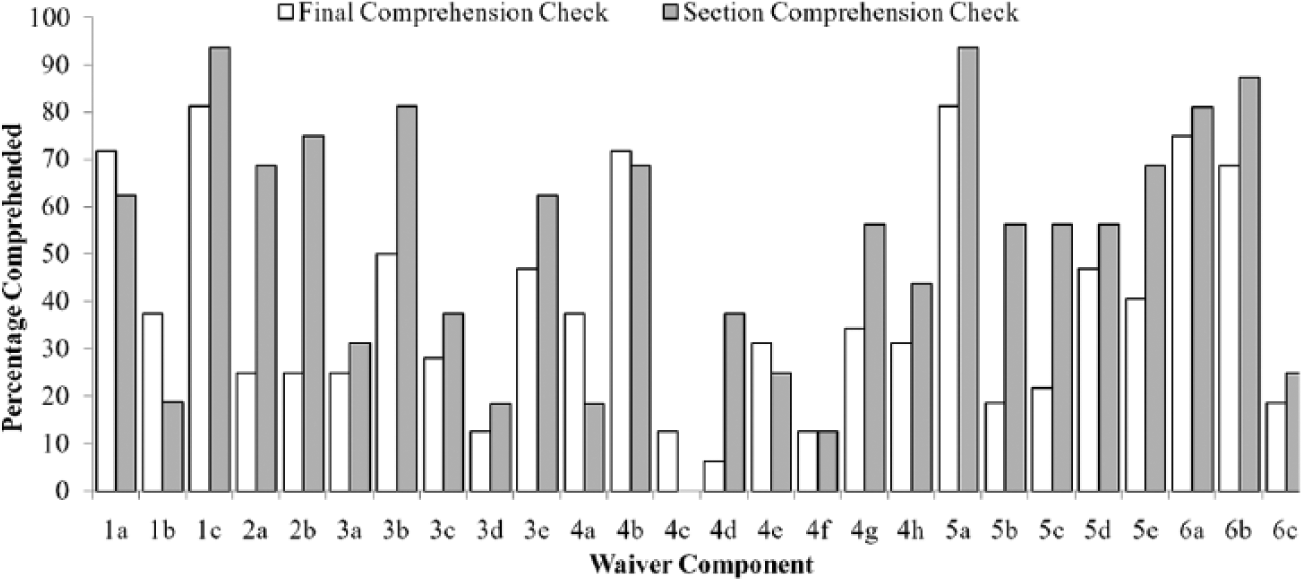
Percentage of participants who understood each of the 26 components comprising the six sections of the youth waiver form.
The results from the Section Comprehension Check are also shown in Figure 1. It can be seen that 15 of the components (57.69%) were understood by more than 50% of the participants. In all, 7 of the components (26.92%) were misunderstood by more than 75% of the participants and no component was understood by all the participants. Participants struggled the most with Sections 3 and 4, which pertained to the potential for an adult sentence and the right to contact and consult with legal counsel, respectively. Participants had the best understanding of their right to remain silent regardless of whether they had spoken to an officer previously about the criminal event (Section 2).
Despite the low levels of comprehension across the six sections, all but 9 of the 192 instances (95.31%) where participants were asked whether they comprehended the legal rights presented in a particular section of the waiver responded that they understood the information. Five of those nine instances where participants indicated that they did not understand pertained to Section 2 and four of the nine pertained to Section 4; these were the two least well-understood sections. There was no correlation between how confident participants were about their knowledge of their legal rights and their actual level of comprehension, r = −.03, p = .86.
Discussion
Our exploratory test of youth comprehension of a youth waiver form, which had a medium level of complexity relative to other waiver forms, showed that the participants understood less than half of the rights contained in that waiver form. These findings are also consistent with previous tests of how well youths and adults comprehend the legal rights contained in police cautions and warnings (e.g., Davis, Fitzsimmons, & Moore, 2011; Eastwood & Snook, 2009; Grisso, 1981; McLachlan et al., 2011). In general, the observed low level of comprehension begs the question of whether youths facing police interrogations are receiving an adequate level of protection.
Our results also showed, however, that checking comprehension after each of the sections contained in a waiver form can increase understanding compared with what can be achieved by simply checking comprehension once after all sections have been presented. It therefore seems to be good practice to check comprehension on each section, as a youth will be given the opportunity to exercise the rights contained in that section before moving through the next set of rights. It should be noted that eight of the waiver forms (30%) from Study 1 explicitly requested that the youth explain to the police officer what the right means to them after each section—which is a practice that may also lead to increases in comprehension for youths.
Having said this, the advantage of checking comprehension after each section appears to have a limited effect. The results from the second comprehension check showed that the level of understanding was as low as that observed with the group that did not receive multiple checks on comprehension. That is, when completing the final check of comprehension, the youths failed to mention all the information they mentioned correctly during the section checks, thereby opening up questions about whether they have a grasp of all the rights they need as the interrogation proceeds. We suspect that the difference in comprehension between the two checks was due to the sheer amount of relatively complex information they had to retain. It is likely that, on being asked to recall all the information in the waiver form, the participants attempted to recount the gist of the information but were unable to retain the specific details pertaining to each of the rights. Regardless, our results show that youths are able to illustrate more comprehension when being asked to comprehend smaller chunks of information.
Also of importance was the fact that participants reported high levels of confidence in how much they understood and almost always confirmed that they understood the rights that were presented—despite the overall low levels of comprehension. This finding suggests that simply asking youths whether they understood the rights is not a useful procedure for ensuring that youths actually understand their rights. A scan of the waiver forms shows that the vast majority of them (70%) measure a youth’s comprehension exclusively through the use of the closed yes/no question, “Do you understand?” The use of such a question has the potential to result in acquiescence, which creates an invalid measure of youth comprehension. Furthermore, our findings support legal rulings that state that measuring comprehension through repeatedly asking youths “Do you understand?” will fall short of satisfying statutory requirements (R. v. B.S.M., 1995).
There are five potential limitations in Study 2 that require some discussion. The first pertains to the limited generalizability of our results because we were only able to recruit and test a small sample of youths that may be representative of all youths who would be exposed the caution used in this study. A second potential limitation is the use of free recall to gauge comprehension. Although free recall is a commonly accepted way of measuring comprehension in a range of domains, such as law and medicine (e.g., Charrow & Charrow, 1979; Crane, 1996), we advocate the use of other methods to test comprehension, such as recognition-based tests (e.g., multiple choice, true/false; but these also have their own unique limitations, see Eastwood & Snook, 2012). The setting for the study is a third potential limitation because real-life police interrogation scenarios may involve much more stress for interviewees than was present in our study. When faced with the stressful circumstances of a police interrogation, youths may have an even greater deficit in waiver comprehension and recall of the information presented (see Milne & Bull, 1999). A fourth potential limitation is that comprehension was tested using a single waiver form. Having said this, the waiver form that was used was in the middle of the pack in terms of reading complexity, which provides some indication of how a waiver form with an average level of complexity (relative to other waiver forms) is understood by youths. Although additional waiver forms should be tested to get a more reliable measure of youth waiver comprehension in Canada, it can be argued that similar results will be found across multiple waiver forms because nearly all waiver forms are considered complex, thus opening up concerns about a floor effect (see the section “Results” of Study 1). A fifth potential limitation pertains to the lack of interaction between the interviewer and the youth (i.e., we restricted the ability of the youths to ask questions or seek clarification). It is possible that giving the youths the opportunity to ask questions may have facilitated better comprehension; however, this is an empirical question that requires testing.
We encourage replication of our study using a larger sample of participants. The consequential nature of this aspect of the administration of justice demands that much more research on this topic be conducted. Future researchers should consider examining the extent to which youths are able to comprehend their legal rights when given the opportunity to read the waiver forms. Past research has shown that presenting legal information in written format leads to an increase in comprehension over what is achieved via the oral delivery of such information (see Eastwood & Snook, 2009). Other research questions that need to be examined include (a) whether it is possible to modify youth waiver forms using readability measures or concepts pertaining to listenability to make rights understood more easily; (b) the effect of real-life conditions, such as stress, on comprehension; (c) the benefits of allowing youths to ask questions while the waiver forms are being administered; (d) the ability of officers to sufficiently answer the questions posed by the youths about aspects of the waiver; (e) the extent to which officers are able to increase comprehension by tailoring their language to match the officers’ estimated cognitive abilities of youths; (f) the relationship between the reading complexity of the waivers and comprehension levels; and (g) whether other measures of comprehension, such as multiple choice tests, result in similar or different estimates of comprehension levels compared with when free recall measures are used.
Concluding Remarks
The goal of the current research was to measure the reading complexity of youth waiver forms employed by Canadian police organizations, and test the oral comprehension of one form used in Canada. Despite the laudable objective of creating youth waiver forms to ensure that the rights of youths are protected before and during police interrogations, our results lead to the provisional conclusion that the achievement of that objective is in doubt. The fact that youth waiver forms require a high level of reading ability and that a sample of youths were unable to comprehend one waiver form suggests that renewed efforts are required to develop and test waiver forms that ensure youths understand their rights fully.
We advocate that all modifications made to waiver forms (and how waivers are delivered) ought to take into account what developmental science tells us about adolescent brain (e.g., risk taking), cognitive (e.g., information comprehension, reasoning), and psychosocial (e.g., resistance to authority, future orientation) development (see Steinberg, 2009, for a comprehension review of adolescent development). The need to consider developmental science when modifying waiver forms is particularly important as most youths facing interrogations are often more developmentally vulnerable than their nondelinquent peer group (e.g., Coalition for Juvenile Justice, 2001). In addition to ensuring that youths understand their rights, we also advocate for a standardized waiver form that is used by all organizations. Until such a developmentally appropriate and standardized waiver form exists, the forms used currently by police organizations to deliver rights may be creating an illusion of protection.
Canadian case law has provided guidance to police officers on how to ensure that youths are able to understand their legal rights. Rather than simply reviewing the waiver form as is written, officers are encouraged to consider taking an individualized approach to the delivery of rights. Officers are encouraged to have a conversation with the youth as a means of assessing their level of sophistication, and then to tailor their language in delivery of the waiver form to ensure that the officer is matching the youth’s age and level of understanding. The officers are also encouraged to prove the youth’s understanding by, for example, getting the youth to explain in their own words what the waiver form means to them. The primary assumption here is that officers are able to act as de facto clinical developmental psychologists (but without the same training or access to assessment tools) and are able to estimate accurately the youth’s level of brain, cognitive, and psychosocial capacities. Although the recommendations from case law are admirable, the extent to which officers are able to conduct such assessments within the context of an interrogation (e.g., limited time, pressure) and adjust their language appropriately is a very important empirical question that requires investigation. Given these aforementioned concerns, it seems that the best way to ensure that the youths understand their rights is to create a waiver form that is comprehensible to the widest range of youths possible, thereby removing the need for officers to perform assessments of youths and to attempt to tailor their administration of the waiver to match their assessments.
Footnotes
Appendix
Acknowledgements
We would like to thank Amy Dowden for assisting with the procurement of the youth waiver forms and recruitment of participants; Kellie Lynch for assistance in data preparation; John Tedeschini, Todd Barron, Sean Deans, and Bill Marshall for assisting with the procurement of youth waiver forms; and all the police organizations that provided us with a copy of their waiver forms.
Authors’ Note
Research support was provided by the Social Sciences and Humanities Research Council of Canada to the first and second authors.
Declaration of Conflicting Interests
The author(s) declared no potential conflicts of interest with respect to the research, authorship, and/or publication of this article.
Funding
The author(s) received no financial support for the research, authorship, and/or publication of this article.