



Abstract
We examined records of males incarcerated in a large southern state to assess the risk technical violators would pose to public safety by exploring their likelihood of engaging in prison misconduct. Data from official prison records provided by a large southern state’s primary corrections agency were examined using multiple counterfactual analytic techniques. Based on the official disciplinary records from male inmates readmitted to prison for technical violations and new offenses, technical violators were found to be significantly less likely to engage in any form of prison misconduct. Implications for research and policy are discussed, including the potential for recidivism research and prison reduction policies.
The last 40 years have seen a dramatic shift in criminal justice policy. Beginning in the 1970s, increases in “tough-on-crime” policies in the United States solidified the prominence of a crime control model of punishment. Between 1970 and 2008, incarceration rates grew exponentially, resulting in a fourfold increase in the incarcerated population (Greene & Mauer, 2010). With more than 1.6 million incarcerated offenders currently serving sentences under state and federal jurisdiction (West & Sabol, 2010) and more than 12 million ex-felons living in the community (Pager, 2003), current and ex-offenders comprise a larger proportion of American society than ever before.
At the end of 2009, there were 819,308 parolees in the United States (Glaze & Bonczar, 2010).Almost a quarter of those who exited parole supervision that year did so through a revocation based on a technical violation, rather than for a new criminal offense, and were subsequently returned to prison (Glaze & Bonczar, 2010).The large volume of parole revocations has significant implications for prison management. Offenders incarcerated in state prisons for a technical violation consume a significant portion of public revenue. According to a Pew Center on the States (2009) report, states spent an average of US$70 per inmate per day with nearly 139,000 parolees returning to prison by way of parole revocation, nationwide. More than US$4 billion was spent incarcerating these offenders in 2009 alone. 1 However, little is known regarding the behavior of technical violators after parole revocation and subsequent prison readmission. The current study begins to fill this void by examining the institutional behavior of offenders returning to prison, based on prison readmission type.
Using data collected from the primary corrections agency of a large southern state, we used multiple counterfactual models, which approximate the conditions of a controlled experiment, to explore the effect of returning to prison for a technical violation versus a new offense on the probability of engaging in varying forms of prison misconduct (i.e., crime and deviance committed while incarcerated). With the recent growth of research examining correlates of prison misconduct (for example, see Blackburn & Trulson, 2010; Cunningham, Sorensen, Vigen, & Woods, 2010; Drury & DeLisi, 2010, 2011; Morris & Worrall, 2010; Ruddell & Gottschall, 2011; Sorensen, Cunningham, Vigen, & Woods, 2011; Worrall & Morris, 2011) and the positive association found between prison misconduct and recidivism (DeLisi, 2003; Huebner & Berg, 2011; Matsueda, Gartner, Piliavin, & Polakowski, 1992; Trulson, DeLisi, & Marquart, 2011; Trulson, Haerle, DeLisi, & Marquart, 2011), this study is especially pertinent when situated within the context of prison reduction policies and their possible effect on reentry outcomes. This study represents the first attempt to examine whether technical violators pose a safety threat by examining their behavior upon returning to prison.
Differences in institutional misconduct by the mechanisms through which a parolee returns to prison have largely been ignored, yet it is reasonable to assume that offenders returning to prison due to a technical violation are, on average, significantly different from those who return for a new offense. Some of the ways these groups are different from each other may be correlated with prison misconduct, our outcome of interest. The importation model of prisoner misconduct posits that behavior in prison is based on preincarceration characteristics that are “imported” into the institution (Irwin & Cressey, 1962). It suggests that inmate behavior is shaped by preincarceration characteristics, including attitudes and experiences that are “imported” into the institution (Camp, Gaes, Langan, & Saylor, 2003; Cao, Zhao, & Van Dine, 1997; Drury & DeLisi, 2010, 2011; Harer & Steffensmeier, 1996; Irwin & Cressey, 1962; Tasca, Griffin, & Rodriguez, 2010).
It is important to note that a deprivation theory of prison misconduct that focuses on the criminogenic prison culture and “pains of imprisonment” has also found empirical support (Clemmer, 1940; Goodstein & Wright, 1989; Sykes, 1958). This perspective emphasizes how the structure and environment of the prison experience alters an inmate’s personal beliefs, values, norms, attitudes, and subsequent behavior (Goodstein & Wright, 1989). This is controlled for in our model through the nesting of inmates within the prisons. In an experiment, randomization of treatment assignment balances these background characteristics that are of importance for estimation of causal effects, resulting in the ability to attribute any observed differences in the outcome to the treatment (Apel & Sweeten, 2010).
Because our experimental treatment is the return to prison for a technical violation, there is no plausible or ethical way to randomly assign offenders to different types of prison readmission. Alternative methods must then be used to control for potential selection problems. This study utilizes analytical techniques that effectively approximate an experimental design. By doing so, we create a foundation for a better understanding of the differences between groups of offenders who are returned to prison based on their behavior upon reincarceration. As scholars continue to identify links between misconduct and recidivism, greater importance is placed on identifying correlates of prison behavior.
Parole Revocation
In 2010, by year-end, there were 1.6 million prisoners in state and federal institutions (Guerino, Harrison, & Sabol, 2011), and more than 93% of these inmates will eventually be released (Petersilia, 2003). Subsequently, the number of inmates returning to society is now 4 times greater than it was 20 years ago (Harrison & Karberg, 2003; Travis & Visher, 2005). Studies have consistently shown that outcomes for released prisoners are not positive; roughly 30% of released inmates are rearrested within 6 months postrelease (Petersilia, 2003), two thirds of inmates are rearrested within 3 years, half reconvicted (P. A. Langan & Levin, 2002), and as many as 40% of inmates return to prison within 3 years (Pager, 2003).
Unfortunately, little is known about parolees who return to prison for parole revocations. The readmission of parolees to prison has been identified as a significant channel in spurring mass incarceration (Clear, 2007; Mauer, 2005, Petersilia, 2003; Simon, 2000). Parolees return to prison through two mechanisms: either through the commission of a new offense or revocation of parole due to violating a technical condition of parole. The number of prison admissions for parole violations has increased at a much faster rate than the increase in admissions for new offenses. Between 1980 and 2000, state prisons experienced a sevenfold increase in the number of prison admissions for parole violations (Travis & Lawrence, 2002). Travis and Lawrence (2002) note that the number of prison admissions for parole violations in 2000 was roughly equal to the total admissions to state prisons in 1980. However, currently there is a dearth of information about the behavior of individuals after returning to incarceration (Petersilia, 2003; Travis, 2007), as research focusing on technical violators is very limited (Travis, 2007; see Lin, Grattet, & Petersilia, 2010; Steen & Opsal, 2007). Understanding the differences in behavior between these two groups of prisoners is relevant for informing prison operations and parole decisions.
Method
Data and Sample
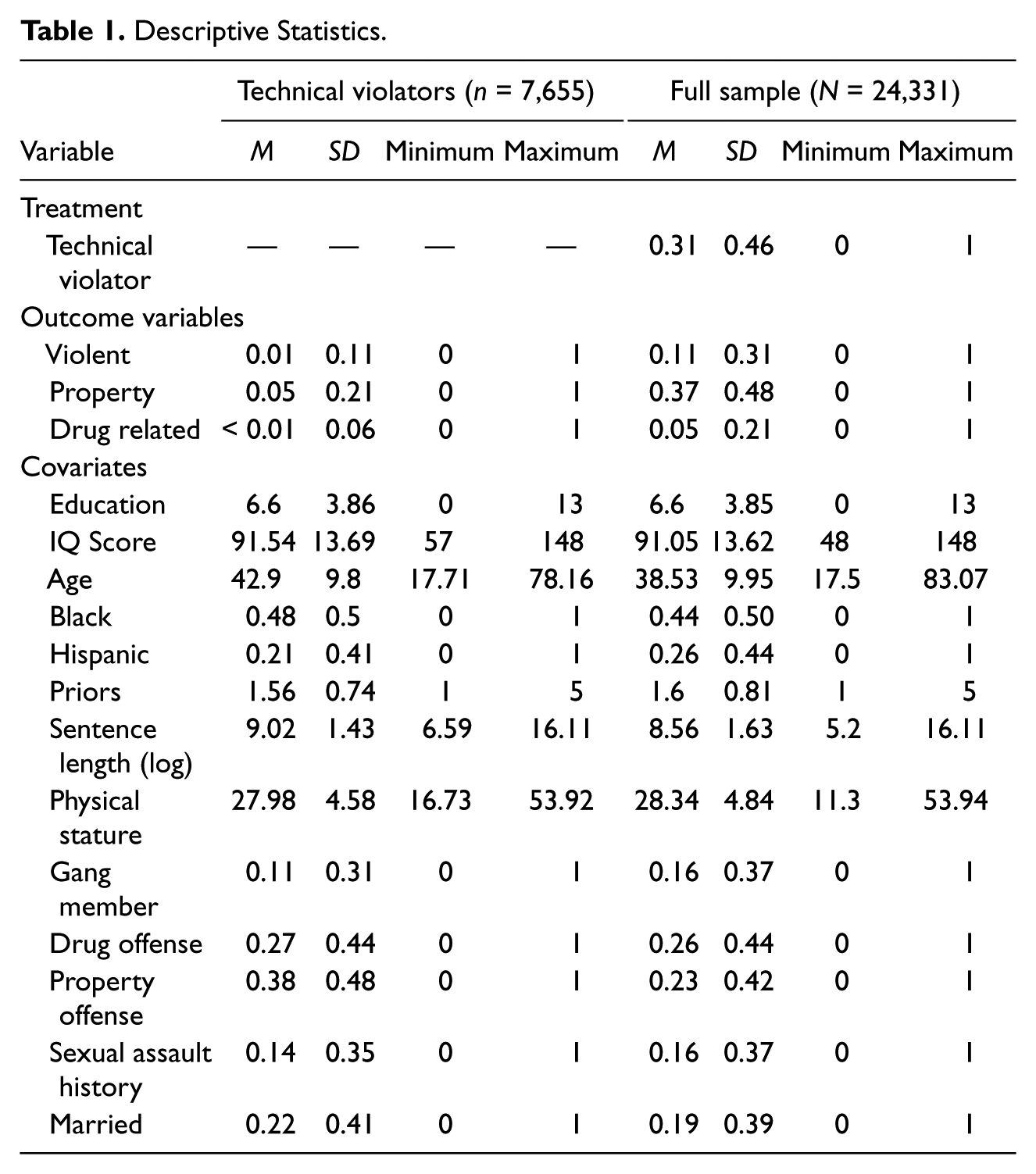
The data utilized for the present study stem from official prison records provided by a large southern state’s primary corrections agency. The data included information on offender and current offense characteristics, complete disciplinary histories while incarcerated, and information on past convictions. We limited the analysis to male inmates returning to prison for at least the second time (new inmates were excluded as they are a qualitatively different group, so this was important to our study to aid in better aligning treatment and control groups) and who returned to prison between May 1, 2004, and May 31, 2006, and who were still incarcerated on August 15, 2009. 2 This approach allowed for us to observe inmate behavior, via official disciplinary records, over a complete 3 years of incarceration beginning with each inmate’s specific entry date; the period for which misconduct is most likely to occur (see Adams, 1992; Flanagan, 1983; Griffin & Hepburn, 2006; Morris & Worrall, 2010). Inmates from the sample were each assigned to 1 of 47 general population prison units in the state. In this particular state, units are not mutually exclusive in terms of security level. Inmates housed in state jails, transfer facilities, private prisons, and substance abuse treatment facilities were excluded from the analysis. Also excluded were inmates sentenced to capital punishment or life without parole. This strategy resulted in a total of 24,331 inmates eligible for analysis. 3 Descriptive statistics are presented in Table 1.
Descriptive Statistics.
Measures
Treatment
The treatment variable focused upon here is whether an inmate returned to prison (on the most recent return) for a technical violation (1) or for a new conviction/offense (0). The treatment reflects the code given to each inmate indicating the reason for each occurrence of admittance to prison (e.g., new offense, technical violation, etc.).
In the present study, any offender released from prison into some form of community supervision was under the custody of the State’s Parole Division, and all release decisions, conditions of parole, and revocation decisions were made by the state’s parole board. In FY 2009, the state reported releasing 79% of those in prison to some form of parole/mandatory supervision. The other 21% reached the expiration of their sentence and were discharged. Any offender under a form of community supervision is at risk for a technical violation and potential revocation to be readmitted to prison.
Within the state, there are four mechanisms for release from prison: outright discharge, mandatory release, discretionary mandatory release, and parole. Mandatory supervision release is the automatic release from prison for those offers sentenced to particular offenses when their time served minus good time credits is achieved. In 1996, the state changed procedures to possible release to discretionary mandatory supervision, where the parole board has discretionary power for determination of release. The state also has a traditional parole release for all other eligible offenders and special cases. An offender’s eligibility for any of these release mechanisms is determined by the offense of conviction and sentence, and the law in effect on the date of the offense. All released offenders who are not discharged outright are under the supervision of the parole division for the remainder of their sentence.
Outcome measures
Three outcome measures are used in the present study, each involving a different context of inmate misconduct. Following the work of Steiner and Wooldredge (2009), who suggested that misconduct could be adequately characterized into three strata, we compiled specific infraction codes into violent, property, and drug-related misconduct. 4 Violent misconduct involves all forms of physical and nonphysical assault on other inmates or on prison staff. Property misconduct is characterized by all nonphysical rule violations excluding drug-related forms, which is represented by the third and final strata, drug-related offenses. Following convention, we dichotomized each outcome where (1) equals at least one reported instance of misconduct over the observation period and (0) equals no misconduct reported by officials over the first 3 years of incarceration.
Control variables
The data provided for several important legal and extralegal inmate attributes to be accounted for. Specifically, we control for an inmate’s education, IQ score (Wechsler Adult Intelligence Scale–Revised [WAIS-R]), age, ethnicity, criminal history, sentence length, physical stature, gang involvement, the offense of record type, sex offender status, and inmate marital status. The control variables included were based on findings of previous prison misconduct studies providing support for factors associated with the importation model (see Cao et al., 1997; Craddock, 1996; Gendreau, Goggin, & Law, 1997; Gover, Perez, & Jennings, 2008; Sorensen & Cunningham, 2009; Wooldredge, Griffin, & Pratt, 2001).
The majority of this information is collected from inmates during the first few weeks of their incarceration. During this period, inmates are evaluated and an inventory of personal information is collected. Education is based on a score from an educational equivalency exam with values ranging from 0 to 13, with higher values representing more education. IQ score is continuous indicator representing each inmate’s score on the intelligence quotient exam. Age is measured in years and represents the age of the inmate at the time of incarceration for the offense of record. Ethnicity is measured through two dummy variables, Black and Hispanic; White is the reference category. Criminal history is operationalized through the number of previous incarcerations on record. Sentence length (for the offense of record) in months was logged to correct for skew. Physical stature is a continuous indicator of each inmate’s body mass index (BMI) score—Imperial formula. Gang involvement is a binary indicator where (1) equals confirmed prison gang member and (0) equals no official gang affiliation; suspected gang affiliation was treated as no gang affiliation. Offense of record type reflects the type of offense for which an inmate was currently incarcerated and is measured via two dummy variables, property offense and drug-related offense; violent offense was the references category. Sex offender status is a binary variable representing whether in inmate has ever been classified as a sex offender (1) or not (0). Finally, marital status at the time of prison entry for the offense of record is also defined via a binary variable where (1) equals married and (0) equals not married.
Analysis Plan
The goal of our analysis was to assess the effect of returning to prison for a technicality, versus a new crime, on the probability of engaging in three types of inmate misconduct (violent, property, and drug-related infractions). To address our research goals, we utilize multiple counterfactual methods. In counterfactual analysis, estimates of an outcome are produced for cases receiving some form of treatment compared with a matched group of cases (i.e., near-equivalent probability of receiving the treatment) that did not receive the treatment (Guo & Fraser, 2010). In other words, the counterfactual is what “would” have happened had a matched individual self-selected into treatment. Each step of the counterfactual analyses is outlined below and it should be noted that similar approaches have been outlined in recent studies (e.g., Barnes, Beaver, & Miller, 2010; Morris & Piquero, 2013). Each step below was carried out separately for each outcome.
The first approach is a procedure known as propensity score matching (PSM). The initial step of the PSM approach involves t tests that are carried out to ascertain whether significant differences exist between technical violators and new crime inmates on the prevalence of each misconduct type, respectively. The next step involves the estimation of propensity scores for the treatment effect (i.e., the probability of receiving the treatment, regardless of whether it was actually received). This is accomplished via a logistic regression model with the treatment as the outcome and remaining variables (excluding misconduct in this case due to temporal order) as predictors. It is important to note that all covariates at this phase account for a period of time before the treatment, thus the time order of the model is appropriately accounted for. This results in estimated probabilities for belonging to the treatment group.
Using these propensity scores, the nearest-neighbor matching algorithm (without replacement) is used to match technical violators with new crime inmates. Using the standard caliper of .05, this process aligns treated inmates with a nontreated match whose probability of receiving the treatment is within .05 of the treated match. While not all treated cases may end up with a match, the matched inmates approximate an experimental research design where an equal number of treated and nontreated inmates have a near-equal probability of receiving the treatment. Ultimately, this step parses out any variation in the outcome (misconduct) stemming from the predictor variables and it ensures that the distributions of the included covariates are similar across groups. The third step involves estimating a second round of t-test comparisons on each predictor between the matched and unmatched samples. The matching process should remove all significant differences on included covariates between matched treated and untreated cases and standardized bias statistics should be less than absolute value of 20 (Rosenbaum & Rubin, 1985). Step 4 involves the estimation of a final t test between the treated and untreated cases, before and after matching on each outcome variable. The results for the matched group represent the treatment effect (technical violation), net of covariate effects. In other words, this step reflects the probability of misconduct (i.e., mean rate of prevalence) for technical violators had they returned to prison for a new crime and not a technical violation.
In addition to the PSM approach, we carried out a counterfactual analysis known as inverse probability of treatment weighting (IPTW) regression. This approach is used to help corroborate the results from the PSM approach and allowed us to account for between-prison effects in misconduct. IPTW “consistently estimates the causal effect of a time-dependent treatment when all relevant confounding factors have been measured” (Guo & Fraser, 2010, p. 331). IPTW involves using the inverse of the estimated propensity scores generated from Step 2 above as treatment weights in a subsequent regression model where the weighted propensity for treatment is the sole predictor variable. Thus, unlike matching based on near-equivalent probabilities, IPTW weights all available cases and produces a weighted treatment effect (see Sampson, Laub, & Wimer, 2006). Because our data include inmates nested within prison units, and misconduct may be influenced by elements of particular prison unit assignment, we relied on a multilevel logistic IPTW model to produce the IPTW estimates. From these results, we were able to calculate predicted probabilities of misconduct between each group of returning inmates, which are easily interpretable. This was carried out using the GLLAMM package available for Stata Version 11. Sensitivity analyses (discussed below) were carried out to ensure that relevant predictors were adequately accounted for in the estimation of the propensity scores (i.e., that the propensity scores are robust against hidden bias). 5
Results
As noted, the first step involved the estimation of t tests between technical violators and new crime inmates among the raw (unmatched) sample. These results are presented under the “Unmatched” heading of Table 2. The results demonstrate that every covariate’s mean value, aside from education, is significantly different between the unmatched treatment and control groups. Because we find such differences, we now have strong evidence suggesting that we need to match nontechnical violators to technical violators who had very similar (near equivalent) probabilities of returning to prison on a technical violation. The estimates from the logistic regression model, using the treatment indicator as the outcome to establish propensity of treatment scores (i.e., predicted probabilities of treatment), were used to match technical violators (one-to-one, without replacement) to a nontechnical violator who had a near-equivalent probability of self-selecting into the treatment (caliper = .05). Ultimately, 6,563 of 7,595 (86.4%) technical violators were successfully matched to 6,920 nontechnical violators. In Table 2 are t test statistics for each covariate after matching showing that all covariate differences prematching were eliminated via the matching process. These results allow us to preliminarily assume that the matched groups are equivalent (i.e., balanced) regarding the propensity for being a technical violator. Furthermore, standardized bias statistics for each covariate were reduced to below 20, thus corroborating the evidence that we were successful in matching inmates.
Balance Statistics Among Technical and New Crime Inmates, Pre/Postmatching t-Tests (Nearest-Neighbor Method).
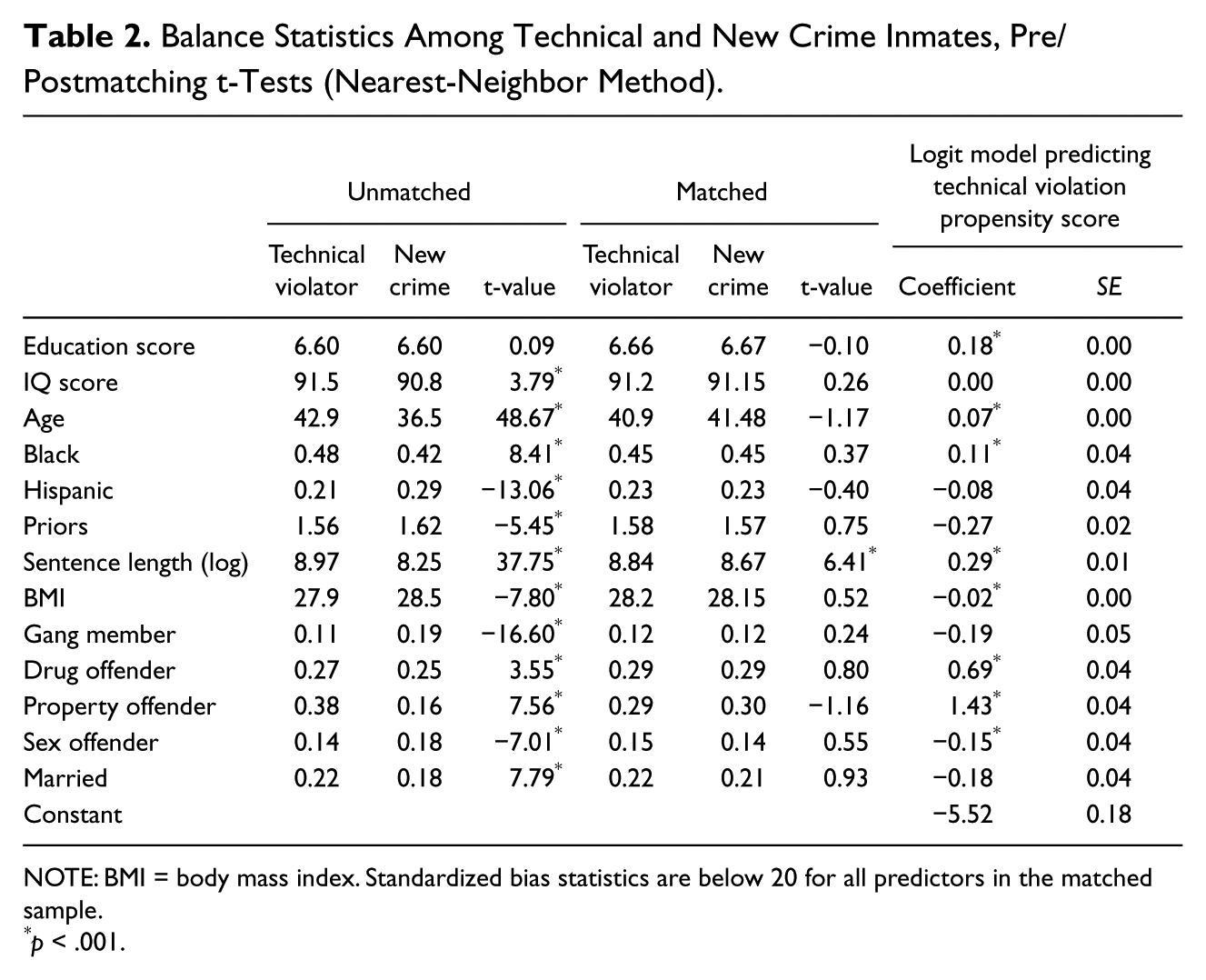
NOTE: BMI = body mass index. Standardized bias statistics are below 20 for all predictors in the matched sample.
*p < .001.
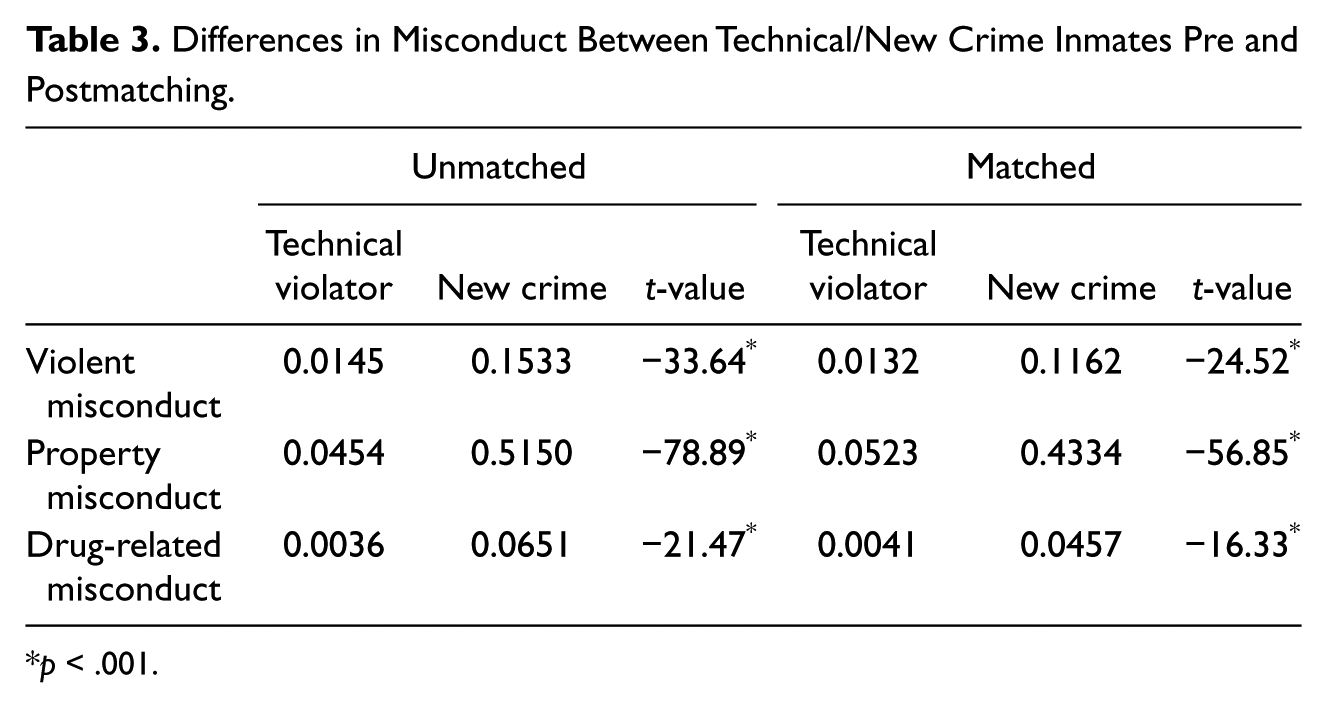
Presented in Table 3 are our postmatched group t-test statistics across each of the three outcome variables (violent, property, and drug-related inmate misconduct). As shown, the mean probability of each form of misconduct for both matched and unmatched groups is significantly higher for nontechnical violators (i.e., recidivists). Inmates who return to prison for a new offense appear to be significantly more likely to engage in violent, property, and drug-related misconduct compared with inmates who return to prison on a technical violation, all else constant.
Differences in Misconduct Between Technical/New Crime Inmates Pre and Postmatching.
p < .001.
To determine whether propensity scores may be biased due to the influence of an unmeasured covariate/s (i.e., hidden bias), we conducted the sensitively assessment protocol recommended by Rosenbaum (2002), and demonstrated by Guo and Fraser (2010; see also Becker & Caliendo, 2007). Put simply, the approach provides estimates (γ) of the magnitude for which an omitted covariate would need to render the PSM results nonsignificant. In short, the test estimates how powerful an omitted covariate must be to potentially invalidate the results of the analysis. As noted by Becker and Caliendo (2007), gamma values near 1.0 suggest that a PSM analysis is highly sensitive to hidden bias. The further from 1.0 that gamma is, the less sensitive the model is to unmeasured influences on the probability of treatment. The sensitivity analysis was carried out for each outcome. Significant gamma estimates were 8.5, 15.5, and 9.0 for violence, property, and drug-related outcomes, respectively. Contextually, for example, this means that an unmeasured covariate would have to increase the odds of being a technical violator by 8.5 times to render the analysis for the violence outcome nonsignificant. Overall, the results of the sensitivity analysis suggest that propensity scores for each outcome were highly robust to hidden bias.
The final step in our analysis was the IPTW regression analysis. Because the outcomes were binary and the data nested, we estimated multilevel logistic regression (aka HGLM [hierarchical generalized linear models]) models where the sole predictor was the weighted treatment effect. The results (omitted to save space) overwhelmingly suggest that returning to prison via a technical violation markedly reduces an inmate’s probability of engaging in any form of misconduct. However, differences relative to the type of misconduct were found. Such differences are clearly visualized in Figure 1, which presents the predicted probabilities stemming from the multilevel IPTW model results. As shown, differences in expected participation in property-related types of misconduct are the greatest, followed by violence and then drug-related misconduct. Nontechnical violators are substantially more likely to engage in any type of misconduct, as defined here, compared with technical violators.
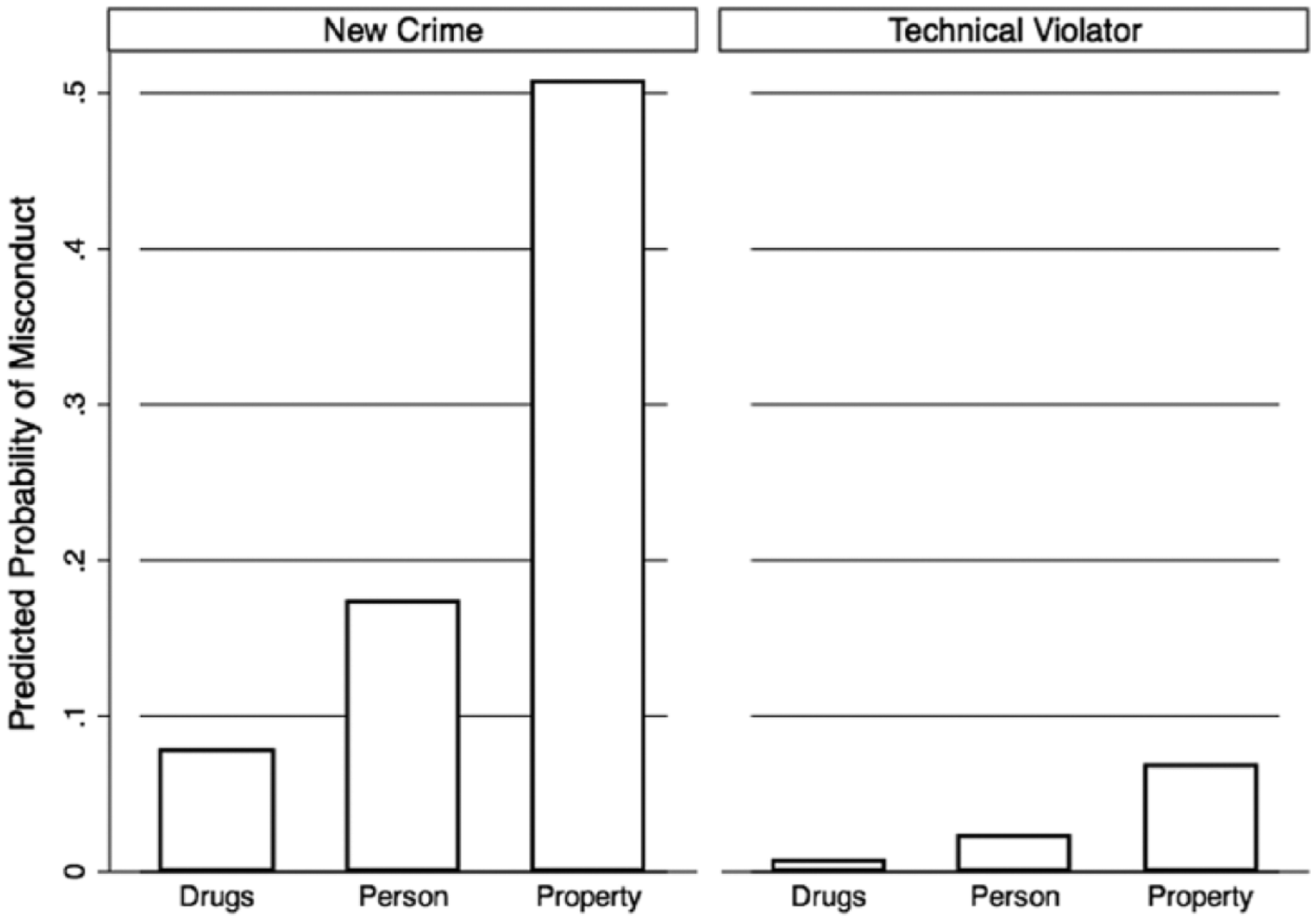
Predicted probabilities of misconduct between matched treatment and control groups.
In sum, the results presented here were based on a thorough and multitiered counterfactual analysis and were demonstrated to be highly robust to hidden bias. Moreover, we were able to match almost 7,000 pairs of inmates from a complete inmate population on the treatment variable who returned to prison over a specific period of time, thereby reducing the influence of possible cohort effects. It is clear that returning inmates who are technical violators, as opposed to new crime violators, are at a much lower risk of misconduct. In the following section, we provide a discussion of how these findings may apply to theory, policy, and future research on prison offender management.
Discussion
To date, there has been very limited empirical research addressing behavioral differences between groups of individuals returned to prison postrelease. Furthermore, within the realm of literature addressing prison misconduct, no other known study has examined the differences based on mechanism of return to prison. In furthering the understanding of these behavioral differences, the current study benefited from the use of statistical techniques that controlled for bias in the effect of returning to prison for a technicality versus a new crime. Based on the official disciplinary records from male inmates serving a sentence in the prison system of a large southern state after readmission, the findings presented here suggest that technical violators are significantly less likely to engage in any form of prison misconduct. These differences varied by type, with the largest differences in property-related misconduct, followed by violence, then drug-related misconduct. Again, due to the use of the PSM, these results are net of any selection bias and were reinforced by the results from the IPTW regression analysis.
The differential variation observed in the predicted probabilities for misconduct type between technical violators and new offenders is a finding that suggests the need for future research in this area. Further examination of the reasons for these differences was not possible based on data limitations and capacity of this study. As it is unknown what the exact parole violation was, it is impossible to assess any relationship between type of violation and type of misconduct.
The findings presented here not only have implications for prison management but also for parole revocation decisions. Empirical studies on recidivism that have included institutional misconduct have reported a significant positive association both for rates of reoffending and early failure (DeLisi, 2003; Huebner & Berg, 2011; Matsueda et al., 1992; Trulson, DeLisi, et al., 2011; Trulson, Haerle, et al., 2011). Situated within the context of a positive correlation between prison misconduct and future criminal offending, these results have implications for policy makers and prison and parole administrators in enacting policies and making decisions on best practices for reducing prison populations.
Although it was beyond the scope of this article to provide a test of the mechanisms that may be at work in the relationship between prison misconduct and future criminal offending, the available theoretical perspectives provide a framework for espousing a positive relationship. The link between misconduct and propensity for reoffending is based on the logical continuation of a criminal career framework and life-course theory in the explanation of criminal trajectories and desistance (DeLisi, Trulson, Marquart, Drury, & Kosloski, 2011; Sorensen & Davis, 2011; Trulson, DeLisi, Caudill, Belshaw, & Marquart, 2010; see also Bushway, Piquero, Broidy, Cauffman, & Mazerolle, 2001; Laub & Sampson, 2003; Piquero, Farrington, & Blumstein, 2003; Sampson & Laub, 1997, 2003). Empirical evidence supports the positive relationship between prior criminal activity or incident reports and future prison misconduct (Camp et al., 2003; Cunningham & Sorensen, 2007; Gendreau et al., 1997; Walters, 2007) and suggests that prison misconduct is associated with recidivism (Camp & Gaes, 2005; DeLisi, 2003; Heil, Harrison, English, & Ahlmeyer, 2009; Huebner & Berg, 2011; N. P. Langan, Camp, William, & Saylor, 2004; Trulson, DeLisi, et al., 2011; Trulson, Haerle, et al., 2011). This begins to underscore the relevant impact that prison misconduct has on predicting future recidivism. Indeed, to the extent that prison has a criminogenic effect on behavior, it is possible to speculate that returning parole violators to prison may enhance their likelihood of engaging in prison misconduct and therefore increase the risk of future offending. 6
As the issues surrounding prisoner reentry and prison population reduction continue to gain momentum, it may be necessary to view prisoner misconduct outside of the framework of adaptation to incarceration and place it in the context of entire criminal careers. Understanding patterns of misconduct within and between types of inmates promotes identification of offenders who may pose less of a risk to public safety. Incarceration, while commonly viewed from the standpoint of incapacitation, and therefore as a break in criminal offending, is often anything but.
One of the main issues with this line of logic is the claim that not all forms of prison misconduct are considered to be “real” crimes. If many of the behaviors eligible for disciplinary infractions are committed outside the prison environment, they would not be subject to criminal justice intervention. Restrictions on personal property, not complying with grooming standards, being out of place, as well as rules about contact with visitors or communication with the outside world are enforced, and violations can result in disciplinary action while incarcerated. However, there are a number of forms of misconduct that would be considered criminal, including various forms of assault, drug possession and trade, and murder. These distinctions have led to the questioning of the theoretical relevance of prison misconduct on future behavior and whether it is based on the same criminal propensity for general offending, as it is possible that criminal behavior and institutional misconduct may have differing causal origins.
The available empirical evidence, however, has not supported this claim. Even though all misconduct is not criminal, studies have found evidence to suggest that all forms of misconduct can be indicative of a propensity toward criminal behavior (Camp et al., 2003; DeLisi et al., 2011; Sorensen & Davis, 2011). Camp and Gaes (2005) concluded that prison misconduct and criminal behavior are positively correlated, based on findings that criminal behavior and prison misconduct are both predicted by prior criminality. Furthermore, they reasoned that this conclusion is logical when working within a life-course framework. In addition, findings presented by French and Gendreau (2006), in their meta-analysis of the impact of correctional treatment programs on reducing misconduct, signified that inmate misconduct and criminal behavior share common predictors. Results showed that the most effective prison programs in reducing institutional misconducts were also able to produce a reduction in recidivism rates, leading to the assertion that “[this result] reinforces the view that prison misconduct behavior is a reasonable proxy for antisocial behavior in the community” (French & Gendreau, 2006, p. 210).
Recently, some have called for research following the life-course perspective that focuses mainly on criminal behavior occurring in the community to be integrated with research on antisocial behavior in prison under a life-course importation model of inmate behavior (DeLisi et al., 2011; Sorensen & Davis, 2011). DeLisi et al. (2011) argued that the same criminogenic processes and traits that are at work in influencing delinquency remain when those same individuals are incarcerated. Results from negative binomial regression models of 2,520 institutionalized juvenile males, indicating that youths with lengthier and more serious delinquent careers were more involved in misconduct, supported their importation model hypothesis. Also finding support for a behavioral continuity thesis, Sorensen and Davis (2011) found some degree of significant relationship between crime of conviction and one’s propensity to commit violent misconduct in prison in their study of inmates from the Texas Department of Criminal Justice.
While it is understood that no guarantees can be made regarding future human behavior, our results, we suggest, identify a group of inmates who are less likely to pose a serious risk to safety. Failure of some individuals who have committed technical violations to remain crime-free would be expected; however, as a whole, this group of offenders is still far less likely to commit misconduct than those who were readmitted for a new offense. It is important to keep in mind that an overwhelming majority of these offenders will be released from prison at some point; so basing release or readmission decisions on likelihood of short-term criminal propensity is a logical choice. The public and policy makers, when forced to reduce the prison population, need to weigh the risks of those offenders who may be committing technical violations versus those who have committed crimes that may justify their imprisonment. Using up prison resources and space on parole violators does not appear to be the most prudent choice.
As with other studies, ours is not without other potential limitations. The data used in the analysis were from a single, yet populous, southern state. Without replication from different state inmate populations, caution should be used in generalizing the findings presented here. Furthermore, only males were included in the sample and so conclusions regarding the behavior of female inmates cannot be drawn. The findings were also based on an analysis of official disciplinary infractions. The use of official data comes with its own set of limitations, and this study is not exempt. It is possible that these official reports are biased and do not reflect all misconduct that occurs in prison. However, there is reason to believe that official misconduct records are reflective of actual misconduct. Daggett and Camp (2009), in their analysis of official misconduct records and inmate survey data, concluded that official records are representative of inmate reporting and perceptions of prison safety. Furthermore, our data did not capture misconduct reported during prison sentences occurring prior to the offense of record (i.e., the start of our observation period). Thus, we must assume that the probability of misconduct resets upon entry to prison for a subsequent term, net of the effects of our control variables. It is important to note that although a substantial assumption, the attributes we do control for are strongly correlated to misconduct, past, present, and future, which does help to limit this concern, and our strong sensitivity analysis go a long way to support the robustness of our findings. 7 Nonetheless, this component will indeed vary across inmates and should be the topic of future research (i.e., does the probability of misconduct reset upon reentry to prison, in and of itself).
The use of any incarcerated population is also a function of official intervention and processing. Evidence has shown that judges continue to exercise discretion in their decisions on who to return to prison for parole violations (Lin et al., 2010).Therefore, the possibility exists that the included sample is not representative of all technical violators, only those who get caught, are reported, have their parole revoked and are returned to prison. To the extent that judges and parole officers’ decisions not to report or send parole violators to prison is based on their opinion that those parolees do not pose as significant of a risk, we feel our results are enhanced as strong significant results were found even among those who were deemed a greater threat and subsequently readmitted.
Conclusion
The use of prisons in the United States has a valid purpose and place, and it is likely that their use and significance will not diminish. The large numbers of individuals who continue to be cycled through the prison system underscore the need to better understand their behavior in and out of prison, and the relationship in between. The operation of the criminal justice system, in general, and the correctional system, specifically, is a costly endeavor. Therefore, it behooves policy makers and correctional administrator to reserve the use of prison for those who most warrant the use of this sanction. As prison administration and management continues to be an increasingly costly endeavor, risk prediction becomes increasingly important in making in/out decisions. Our findings show that technical violators exhibit far less problematic behavior when reincarcerated, suggesting that the reduction or elimination of returning technical violators to prison may be an effective way to reduce the prison population without increasing the risk posed to the community. This is not to say that technical violations should be ignored or not face some form of penalty. The implication would be that greater use of alternative punishments that keep offenders in the community should be used.
Footnotes
Acknowledgements
The authors would like to thank John Worrall, Lynne Vieraitis, and Alex Piquero for helpful comments on earlier drafts of this paper.
Authors’ Note
An earlier version of this paper was presented at the 2011 Academy of Criminal Justice Sciences (ACJS) Annual Meeting and received the 2012 William L. Simon/Anderson Publishing Outstanding Paper Award for the outstanding paper presented at the meeting.
Declaration of Conflicting Interests
The authors declared no potential conflicts of interest with respect to the research, authorship, and/or publication of this article.
Funding
The authors received no financial support for the research, authorship, and/or publication of this article.