



Abstract
The intermittency, or time gaps between criminal events, has received very little theoretical and empirical attention in developmental/life-course criminology. Several reasons account for lack of research on intermittency, including limited data sources containing information on the time between events and the prioritization of persistence—and especially desistance—in developmental/life-course criminology. This article sets out to provide a descriptive portrait of intermittency and in so doing aims to understand and explain intermittency within and between individuals, how it varies with age over the life course, and how it covaries with the seriousness of offending. Longer intermittency is characteristic of offenders with earlier onset as well as those who offend less frequently, whereas high-frequency/early-onset offenders have less intermittency. Findings suggest that intermittent gaps between offenses relate to offense seriousness. As offenders age, the gaps between offenses increase. Each of these effects is disaggregated among chronic and nonchronic (recidivist) offenders to demonstrate the intermittent patterns of different criminal careers. Implications for theoretical and empirical research on intermittency are highlighted.
Introduction
Criminological—and especially developmental/life course—theories focus on the onset, persistence, and desistance of criminal offending over the life course (Farrington, 2003a). These theories and ensuing research have also started to examine in greater detail how offending waxes and wanes in shorter time periods, as well as the factors that relate to such transitions in offending. For example, Laub and Sampson’s (2003) informal social control theory has been a case exemplar in noting that changes in social controls—especially, marriage—turn offenders away from crime even in short time durations. Empirical research by Horney, Osgood, and Marshall (1995) confirms this finding when examining month-to-month variation in criminal offending among Nebraska felons. Piquero, Brame, Mazerolle, and Haapanen (2002) reported similar conclusions using year-to-year changes in informal social controls (such as marriage) and criminal offending among California parolees. McGloin, Sullivan, Piquero, and Pratt (2007) found that the processes implicated in explaining the association between turning points and the decline in offense frequency also account for within-individual shifts in offending versatility.
Still, theory and empirical research has paid less attention to a key component of offending over the life course, intermittency, that is, the brief lapses and sporadic episodes of crime that occur at sometimes unpredictable intervals (Piquero, 2004). Across these theories, intermittency can be construed as the time between periods of met and unmet expectations, present in the gaps between acquisition and loss of social capital, sporadic for less chronic offenders but consistent for chronic offenders, and dependent on the individual’s ability and opportunity to offend and the presence or absence of fear of punishment (Agnew, 1992; Laub & Sampson, 1993, 2003; Moffitt, 1993, 1994; Stafford & Warr, 1993). Theories that refrain from considering that individuals do not constantly offend cannot be considered complete accounts of the longitudinal patterning of criminal behavior. Consider Maruna’s (2001) point in this regard: Unfortunately, the career metaphor misses a fundamental fact about criminal behavior pointed out by Matza and Glaser: It is sporadic (Luckenbill & Best, 1981). Therefore, “termination” takes place all of the time. For example, a person can steal a purse on a Tuesday morning, then terminate criminal participation for the rest of the day. Is that desistance? Is it desistance if the person does not steal another purse for a week? A month? A year? Farrington (1986) warned that “even a five-year or ten-year crime-free period is no guarantee that offending has terminated” (p. 201). Most researchers who use terms like cessation or termination seem to imply that this is a permanent change. Yet, such permanence can only be determined retrospectively (Frazier, 1976)—presumably after the ex-offender is deceased. (p. 23, emphasis in original)
In short, and as is the case with knowledge concerning the longitudinal variation of individual offending frequency (Farrington, 2003b), time gaps between offenses have garnered little theoretical and empirical attention.
Intermittency of events is not a new or novel concept in the social sciences, and its relevance has been noted in several areas, including the intermittency of employment and its effect on wages (Hotchkiss & Pitts, 2003). In criminology, a handful of works have considered the intermittency of offending (Barnett, Blumstein, & Farrington, 1989; Bushway, Thornberry, & Krohn, 2003; D’Unger, Land, McCall, & Nagin, 1998; Frazier, 1976; Glaser, 1964; Horney et al., 1995; Meisenhelder, 1977; Nagin & Land, 1993; Piquero, 2004; Piquero, Farrington, & Blumstein, 2007; Raskin, 1987) but have not yet developed an operationalization of intermittency. Efforts to measure the concept have focused primarily on describing the phenomenon or modeling the effects of intermittency as a statistical parameter of trajectory models. This absence of testable measures has led scholars to emphasize the need for studying intermittency and to suggest the need for more elaborate models of intermittency (Barnett et al., 1989; Bushway, Piquero, Broidy, Cauffman, & Mazerolle, 2001; Piquero, 2004; Piquero et al., 2007).
This study uses data from the 1958 Philadelphia Birth Cohort Study (Tracy & Kempf-Leonard, 1996; Tracy, Wolfgang, & Figlio, 1990; Figlio, Tracy, & Wolfgang, 1994) to explore the nature of offending intermittency, its relation to offense seriousness, as well as the correlates of intermittency. An important feature of our work is its initial attempt at mapping the age/intermittency curve. This article is designed to present descriptive information on the intermittency of criminal careers, devise a preliminary approach at assessing intermittency, and outline an agenda for theoretical and empirical research on this often-neglected aspect of the criminal career.
Evidentiary Background on Intermittency
The impetus behind studying intermittency owes a debt of gratitude to the pioneering work on stochastic models pursued by the investigators associated with the 1945 and 1958 Philadelphia Birth Cohort Studies. Beginning with the work of Wolfgang, Figlio, and Sellin (1972), who examined pivotal criminal career dimensions associated with onset, prevalence, and frequency as well as specialization, offense switching, and shifts in the qualitative dimensions of offending, continuing with the original (Tracy et al., 1990) and subsequent follow-up (Tracy & Kempf-Leonard, 1996) studies of the 1958 Philadelphia Birth Cohort Study, that included a criminal career comparison with the original cohort as well as explored issues associated with continuity/discontinuity in offending into early adulthood, respectively, these early efforts set the standard for criminal career research efforts that investigated offending over the life course as well as the transitions between and across criminal events and states.
Empirically, intermittency is generally operationalized as the time between offenses, a change in offending, or an estimated parameter within larger models of criminal careers. Barnett et al. (1989) were one of the first to identify intermittency within offending careers as the time between offenses. According to their model, “frequents” had a 1 in 320 daily chance of offending and a 10% chance of terminating their criminal career, whereas “occasionals” had a 1 in 913 daily chance of offending and a 33% chance of terminating their offending. In gauging the accuracy of this model in predicting offending between 25 and 30 years of age, they identified five frequent offenders who followed a particular pattern of intermittent behavior. This intermittent group started offending at about 16 years of age, had several convictions in a short period, seemed to end their careers at about 20 years of age, and then proceeded to be reconvicted 7 to 10 years later at an average age of 27, with three of the five offenders obtaining another conviction at about 29 years of age as well.
Further analyses of time between offenses using cohort data, including data from the Philadelphia Birth Cohort Studies, have revealed consistent patterns like the one above within time periods. Frequent or high-rate offenders generally experience gaps in reoffending that are characterized by relatively short time intervals (Barnett et al., 1989; Piquero et al., 2007). The average time between offenses continues to decrease with an increasing number of events, meaning the first transition has the longest time between arrests, whereas the fifth or sixth transition has the shortest time between events (see Raskin, 1987). For instance, Raskin (1987) measured the time span between arrest transitions (through the sixth transition) for a 10% sample of the original 1945 Philadelphia Birth Cohort followed to age 30. His findings showed that the longest time between offenses (~36 months) was observed between the first and second offense transitions, the shortest (~8 months) was obtained for the fifth transition, and there was more “rapid and less protracted ‘burnout’ periods for the third through the sixth transitions, whereas the earlier transitions experienced slower and longer survival times” (Raskin, 1987, p. 65). These results show that with increasing transitions (and the third in particular in Raskin’s analysis), the recidivism probabilities level off (see also Blumstein et al., 1986; Piquero et al., 2007), implying that the first 6 months after a prior arrest, or the period with the heaviest concentration of delinquency, is the most desirable from an intervention/policy perspective.
As an alternative to time between offenses, scholars have analyzed intermittency in the form of change in offending. Kempf (1989) investigated the extent to which juvenile offenders in the 1958 Philadelphia Birth Cohort Study that stopped offending as a juvenile reemerged as offenders in early adulthood. She found that delinquency dropouts were less likely to be adult offenders than individuals with more stable delinquent careers. Further elaborating on offending patterns, Horney et al. (1995) explored predictors of change in offending over time. Using month-by-month accounts of criminal offenses and local life circumstances from Nebraska felons, they computed the odds of starting and stopping criminal behavior and found that changes in offending depended on changes in local life circumstances. The odds of change in criminal behavior were doubled, or halved, following a change in local life circumstances such as marriage, employment, or drug use. McGloin et al. (2007) extended this earlier study to focus on the nature of offending to include specialization/versatility, finding that changes in local life circumstances (i.e., changes in state from nonmarriage to marriage) were related to a narrowing of the range/type of criminal offenses.
For a different approach of assessing intermittent behavior, Nagin and Land (1993) and D’Unger et al. (1998) incorporated an intermittency parameter within their models to control for periods of activity or inactivity in offending. Nagin and Land (1993) used the intermittency parameter to replace the typical controls for onset and desistance to capture a “key point of controversy in the criminal career paradigm—discontinuous jumps from a state of zero criminal potential to positive criminal potential” (p. 334). Individuals were assumed to have a probability of activity or inactivity at all times. Their specification of intermittency allowed the same individual characteristics that determine an individual’s rate of offending to determine intermittency, and included a dichotomous variable indicating whether an individual committed one or more offenses in the prior period (meant to remedy the implication of random movements between activity and inactivity). They found intermittency to be a single peaked age trajectory, with different parameter estimates than the Poisson rate, that varied across individuals in relation to observable characteristics and prior offending. There was also “substantial interdependency across periods in the probability of being active” (Nagin & Land, 1993, p. 345). As the models that incorporated the intermittency parameter fit the data better, they concluded that the intermittency parameter adds greater explanatory power to their models.
The Importance of Intermittency Within the Criminal Career
There are three fundamental parameters that represent the criminal career framework: the age of initiation or onset, the mean number of crimes committed per year while active (involves both the frequency and seriousness of these crimes), and the age of termination or desistance (Blumstein & Cohen, 1987). Certain conclusions within the literature have been drawn about each of these parameters (Blumstein, Cohen, Roth, & Visher, 1986; Piquero, Farrington, & Blumstein, 2003). Individuals with an early age of onset have longer criminal careers, a greater likelihood of persistence in adulthood, and commit more serious and frequent offenses (Greenwood & Zimring, 1985; Laub & Sampson, 2001; McCord, 1980; Piquero et al., 2007; Wolfgang et al., 1972). Frequent or chronic offenders have longer criminal careers, have a later age at last conviction, exhibit an early onset, are more likely to commit a violent offense, and accumulate many more violent convictions (Piquero et al., 2007; Wolfgang et al., 1972).
Desistance encompasses two components: (a) a change from offending to nonoffending and (b) arrival at a permanent state of nonoffending (Bushway et al., 2001). Desistance can be identified as an arbitrary cutoff point, such as 2 or 3 years, or a process by which criminality, or the propensity to offend, changes with age (Brame, Bushway, & Paternoster, 2003; Bushway et al., 2001; Bushway et al., 2003). The literature suggests that there are multiple pathways to desistance, including marriage, stable employment, transformation of personal identity, and the aging process (Laub & Sampson, 2001; Shover & Thompson, 1992). Desistance has also been linked to multiple social bonding and differential association factors (Ayers et al., 1999; Loeber, Stouthamer-Loeber, Van Kammen, & Farrington, 1991; Smith, Visher, Jarjoura, & O’Leary, 1991).
Each of these parameters is identified by Farrington (2003) as a contentious issue within developmental/life-course criminology. Intermittency, as a dimension of the criminal career, occupies a key place within these contentious issues, with some suggesting that intermittency is closely tied to desistance (Laub & Sampson, 2001). When identified as a process, desistance takes into account both the frequency of offending and the potential intermittent periods of offending. Using offending trajectories, Bushway et al. (2003) modeled desistance as a process and identified seven different groups of “desistors,” one of which they labeled as intermittent offenders. This intermittent group started with more than 10 offenses every 6 months from age 13 to 15, declined to almost 0 by age 18, remained at about 0 for 3 years, and then started offending again. 1 Although they are obviously interrelated, intermittency does not involve a permanent state of nonoffending, as does (eventual) desistance. Thus, intermittency is separate from desistance and should be considered as a distinct aspect of the criminal career and developmental/life-course criminology.
As a way of linking intermittency to desistance, intermittency can be identified as a unique criminal career parameter that is both a predictor and an outcome of the other criminal career parameters identified above. For instance, age of onset and frequency of offending could predict periods of intermittency among offenders, whereas intermittency could predict offense seriousness and maybe even desistance. Based on what is known descriptively about offense transitions and time between offenses (Barnett et al., 1989; Raskin, 1987), offense frequency is expected to predict shorter time gaps between offenses, and as individuals with an earlier age of onset commit more frequent offenses, early onsetters would also be expected to have shorter intermittency. If the frequency and seriousness of offending are in fact related, as suggested by the literature (Piquero et al., 2007; Wolfgang et al., 1972), then intermittency should be related to seriousness as well, whereby shorter gaps between offenses predict greater offense seriousness. Because these relationships involving intermittency are predicted based on what is known about offending frequency, it would further be expected that intermittency as both an outcome and predictor would vary across low- and high-frequency offenders.
As an essential part of explaining both the duration and length of criminal careers and criminal behavior over the life course, it is important to describe and understand the patterning of intermittency within the criminal career framework. 2 In an effort to advance this area of research, the current study acknowledges potential intermittent behavior across different groups of offenders and goes beyond the notion of intermittency as a control parameter to explore the pattern of intermittency with age over the life course, the correlates of intermittency, and the effect of intermittency on offense seriousness. The following questions are explored: “What is the patterning of intermittency over the life course?” “What are the predictors of intermittency?” “Does intermittency relate to offense seriousness?” and “Do these effects vary between offenders with different offending frequency?”
Data and Method
This study uses data from the 1958 Philadelphia Birth Cohort Study (Tracy et al., 1990; Tracy & Kempf-Leonard, 1996). All individuals born in the city of Philadelphia in 1958 were tracked from birth until the final date of data collection (January 1986), when most individuals were of age 26. For the current analysis, only police contacts occurring after the age of 7 were included, 3 as 7 is generally considered to be the minimum age at which individuals may be held accountable for their actions (Bernard, 1992; Farrington & Welsh, 2007; Tanenhaus, 2004; Zimring, 2005). Specifically, police contact data were drawn from “rap sheets”: “The [Philadelphia] police maintain records of these contacts which result in ‘remedial,’ or informal, handling of the youth by an officer whereby youth are generally remanded to the custody of their parents” (Tracy & Kempf-Leonard, 1996, p. 65). According to Tracy and Kempf-Leonard (1996), the police contact data represent “a much better record of official delinquency than data that were based solely on arrest information” (p. 65). It is also important to note that up through age 18, police contact data were used. According to Tracy and Kempf-Leonard (1996), after the cohort reached the legislatively imposed adult status of age 18, “court files included police reports, so data on adult crime are comparable to that for delinquency. The exception, of course, is that no official ‘remedial’ report exists for adults who encountered police, but who were not arrested” (p. 65).
Following previous investigations with the Philadelphia Birth Cohort Studies (Tracy et al., 1990; Tracy & Kempf-Leonard, 1996; Wolfgang et al., 1972), we parceled the sample into three offending groups: one-timers, recidivists (two-four offenses), and chronic offenders (five or more offenses). 4 The recidivist and chronic offender groups are not intended to embody Moffitt’s (1993) adolescence-limited/life-course-persistent offender typology, considering that our groups are based solely on the number of offenses committed and not when the offenses were committed (i.e., adolescence or throughout the life course). In this sense, the current analyses using groups are intended to address intermittency within multiple facets of developmental/life-course criminology noted by Farrington (2003), and implicated by various theories of criminology, while considering variation by offending frequency.
As noted above, intermittency denotes a gap of time between offenses. For intermittency to be measured, there must be more than one offense; thus, one-time offenders are excluded from the measures of intermittency. Similarly, the first contact with the police (t1) is not included in measures of intermittency as there is no gap between Offense 0 and Offense 1 that is meaningful within the conceptualization of intermittency. 5 However, the first offense was included in the measurement of change in offense seriousness. Random effect models were conducted on the full complement of offenders (with more than one offense) and then disaggregated based on offender type (recidivist/chronic).
A key feature of random effect models is that they allow for the analysis of nested data. In the current study, multiple time points are nested within the same individuals. Calculating separate coefficients for each event (for instance, using ordinary least squares [OLS]) and failing to account for the shared characteristics of the events (in this case, the same individual committing separate offenses) would result in inefficiently estimated standard errors. The use of random effect models allows for the examination of change within and between individuals and the multiple events. Random effect models also enable researchers to control for time-invariant factors (race, sex, socioeconomic status [SES]) as well as time-varying factors (age; see McGloin et al., 2007). 6
Variables
To explore the predictors of intermittency and to measure the effect of intermittency on offense seriousness, eight variables were used: intermittency, offense seriousness, number of offenses, age, age at onset, SES, race, and sex. Intermittency is measured as the number of months between police contacts. 7 Offense seriousness is a score developed by Sellin and Wolfgang (1964) to assess the gravity of offenses and has been used in previous studies with the Philadelphia Birth Cohort as a measure of seriousness (Turner, 1978; Wellford & Wiatrowski, 1975). The number of offenses is a count of the number of police contacts from ages 7 to 26. Age is measured in years. 8 Following prior research (Patterson, Crosby, & Vuchinich, 1992; Piquero et al., 2007; Tibbetts & Piquero, 1999), age of onset is a dichotomous variable coded as early onset (1) for offenders with an onset age before 14 years and late onset (0) for offenders with an onset age of 14 years or older. 9 SES, race, and sex are also measured dichotomously as high (1) and low (0) SES, 10 White (1) and non-White (0), and male (1) and female (0).
Table 1 displays the descriptive statistics. For illustrative purposes, data with and without the one-time offenders and the first offense are included and presented. Excluding the one-timers and the first offense, there are 20,079 police contacts among 4,441 individuals. The average intermittency or gap between offenses is 14 months, and the average police contact received a seriousness score of 7.08. About half of the individuals began offending before 14 years of age and the average individual, excluding one-timers and the first offense, committed about 12 offenses. The majority of offenses were committed by individuals who were non-White, approximately 17 years old, of low SES, and male.
Descriptive Statistics.
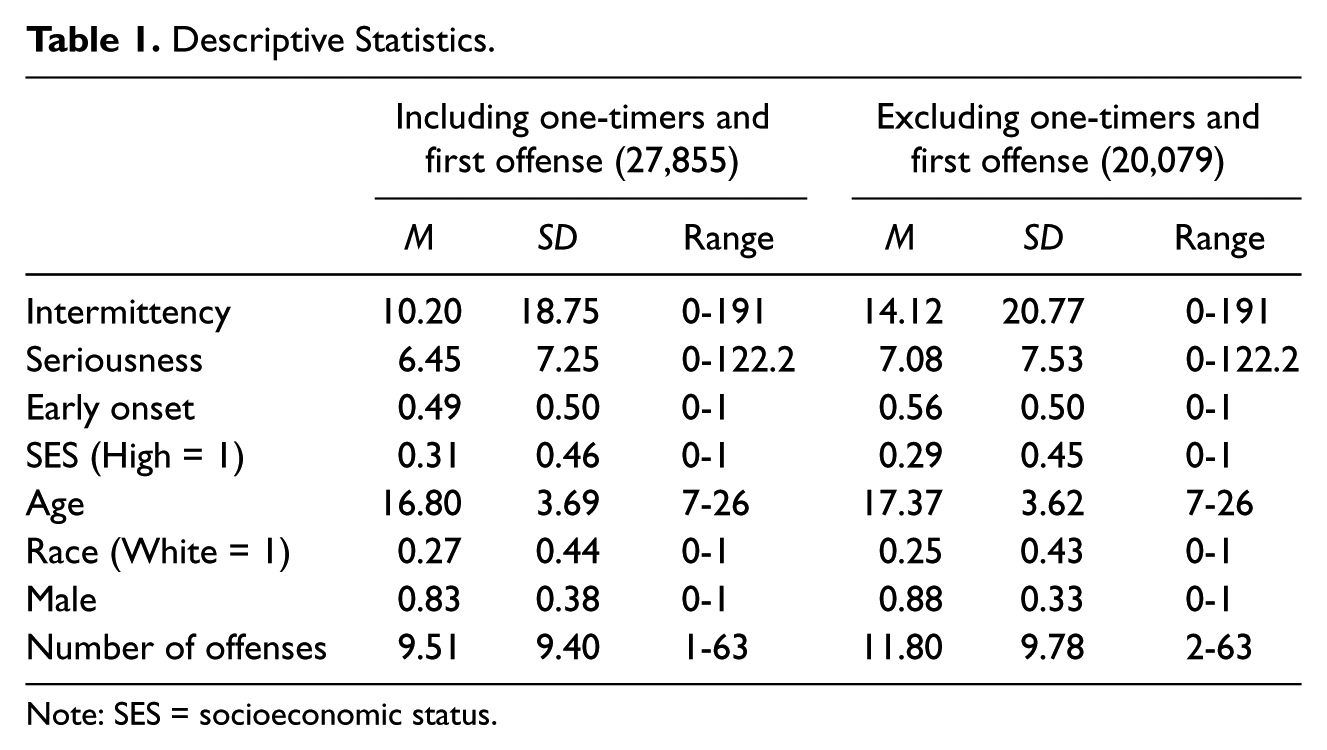
Note: SES = socioeconomic status.
Results
The average level of intermittency of offenses through age 26 is presented in Figure 1. The aggregated (denoted as average intermittency) and disaggregated (denoted as recidivist and chronic offender) age/intermittency curves show the increasing gaps between offenses as individuals age. Only at age 7 is the gap between offenses for recidivists shorter than it is for chronics, but at age 8, the time interval between offenses for recidivists increases, whereas the time interval for chronics remains steady from age 11 to 17. By age 18, the average intermittency of offending for recidivists is 2 years, whereas chronics do not reach this gap in offending until age 25. Thus, between ages 17 and 25, the average intermittency is higher for recidivists, perhaps indicating that the increase in gaps is beginning to signal a trending toward desistance (e.g., Fagan, 1989), but the same pattern is not observed among chronic offenders.
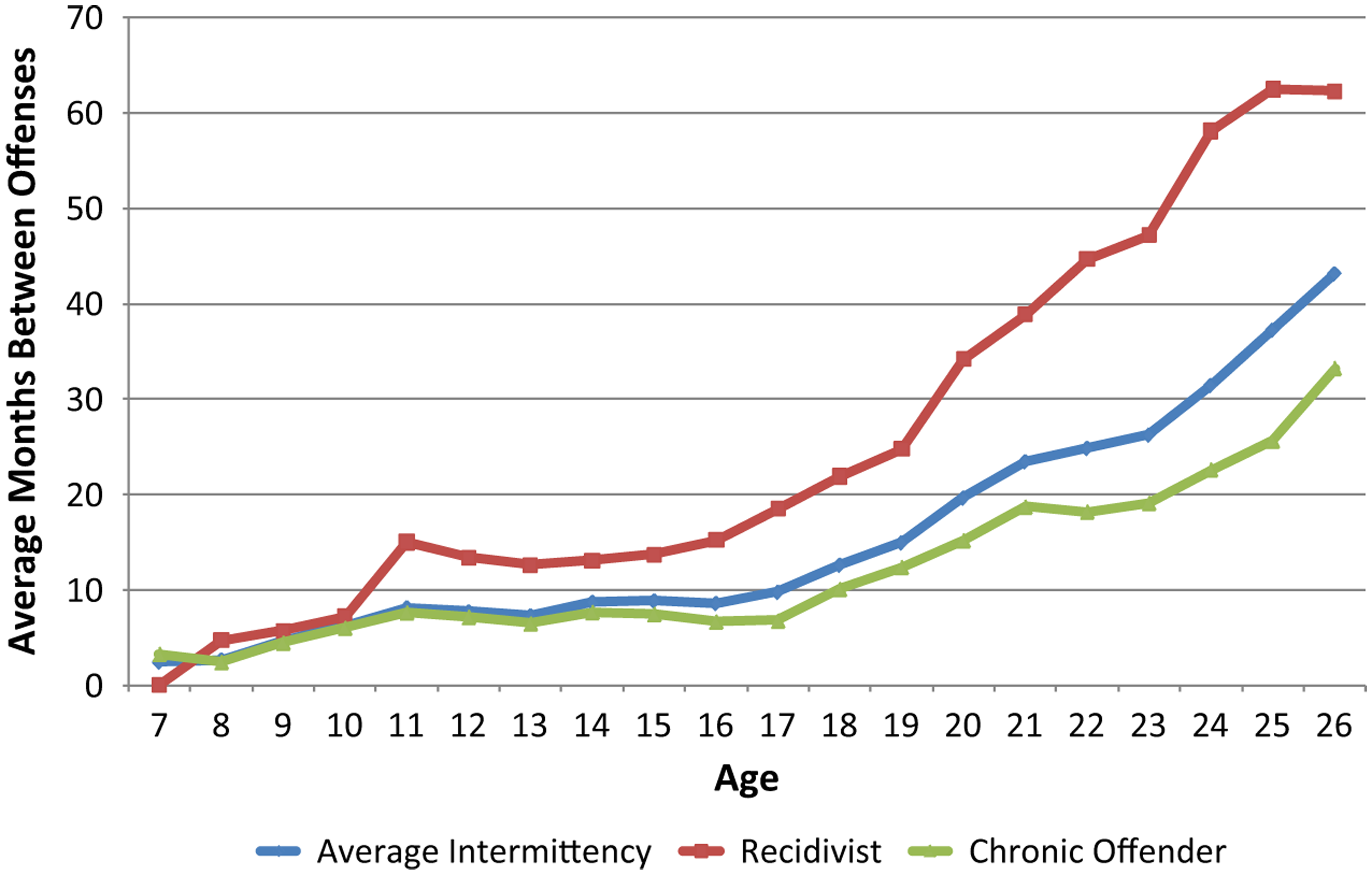
Average intermittency by age.
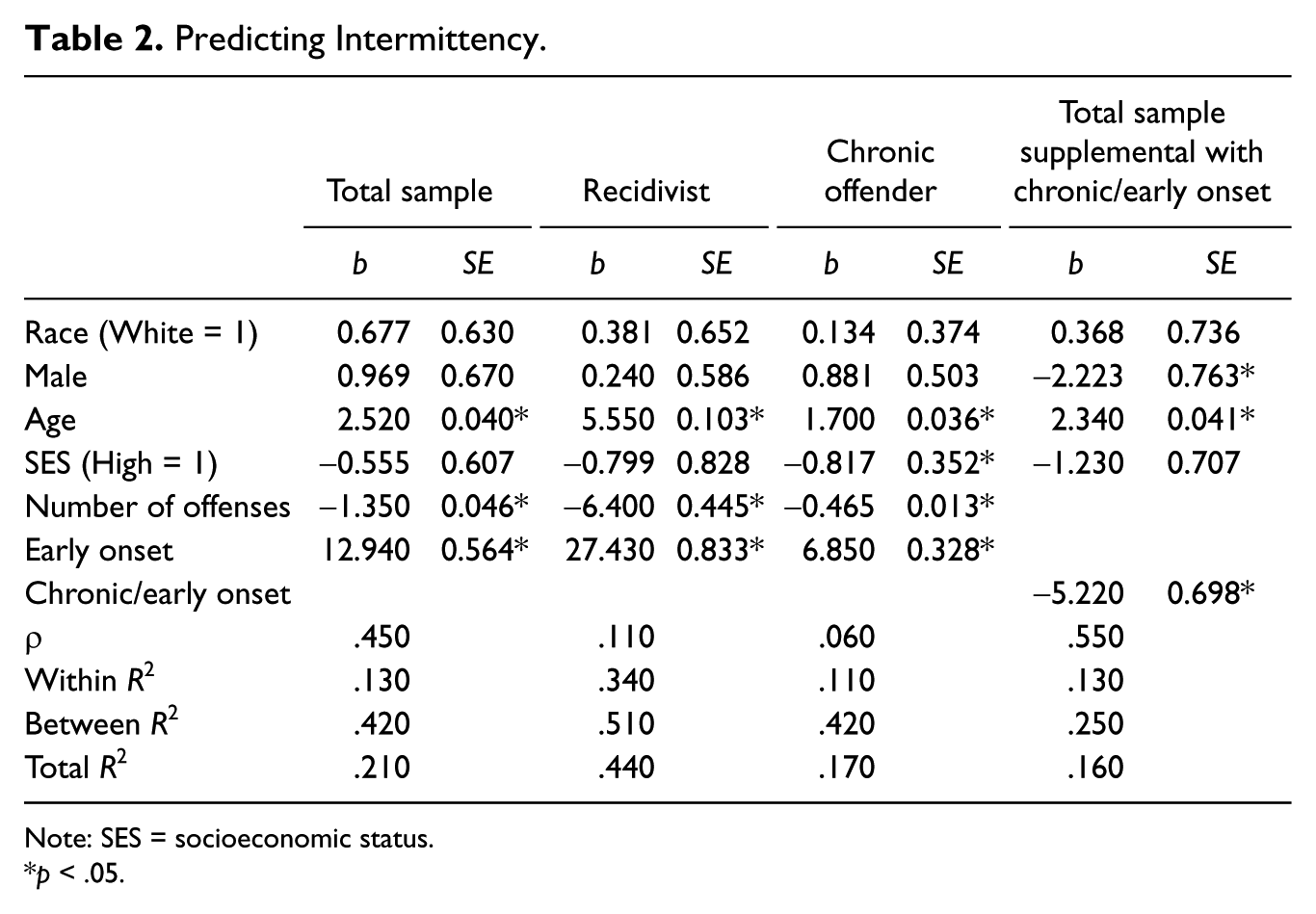
Next, we use several variables (age, age of onset, offense frequency, and demographics) to predict intermittency. 11 Random effect models presented in Table 2 indicate that intermittency is predicted by age, early onset, and offense frequency when aggregated and disaggregated for recidivist and chronic offenders. 12 For recidivists, the model predicts 34% of the variance of intermittency within individuals and 51% of the variance between them, indicating that age, age of onset, and offense frequency explain a good amount of the intermittency among recidivists to age 26. For chronics however, explaining the intermittency within individuals may be related to other factors, as only about 11% of the variance in intermittency is explained within individuals. 13
Predicting Intermittency.
Note: SES = socioeconomic status.
p < .05.
At first glance, the positive relationship between early onset and intermittency appears counterintuitive; that is, early onsetters have longer gaps between offenses. This finding may be because late onsetters have less time within the data set to commit many offenses and thus must offend with shorter intervals to fall into the chronic category. A cross-tab between the number of offenses and age of onset showed that none of the individuals who began offending at or after age 16 had more than 21 offenses, at or after age 18 more than 17 offenses, and at or after age 20 more than 13 offenses. Furthermore, although early onsetters are more likely to be chronic (offend more than 4 times), this does not necessarily imply they should offend at shorter time intervals. That said, because of the relationship between onset age and offense frequency, we investigated how the interplay of onset age and offender group related to intermittency, and found that chronic/early-onset offenders had a significantly shorter average gap between offenses compared with all other offenders (10.5 months vs. 17.7 months, p < .05). As a result, we reestimated the full sample model from Table 2 with a new dichotomous measure indicating membership in the chronic/early-onset group (1), all others (0), in place of the separate onset age and offense frequency measures, and all other variables included as before. Results shown in the final column of Table 2 indicate that, as expected, chronic/early-onset offenders have significantly shorter gaps between offenses and that males have significantly shorter gaps between offenses compared to females. Taken together, all of these findings suggest that the interrelationships between chronicity, frequency, and time duration are more complex than may have been previously considered (Piquero, Sullivan, & Farrington, 2010). 14
Figure 2 illustrates the relationship between the intermittency of offending and offense seriousness by offense number for all offenders. The more offenses committed and the shorter the gap between offenses, the greater the seriousness of offenses. Figure 3 shows that when disaggregated by offender type, the relationship remains for chronics but not recidivists.
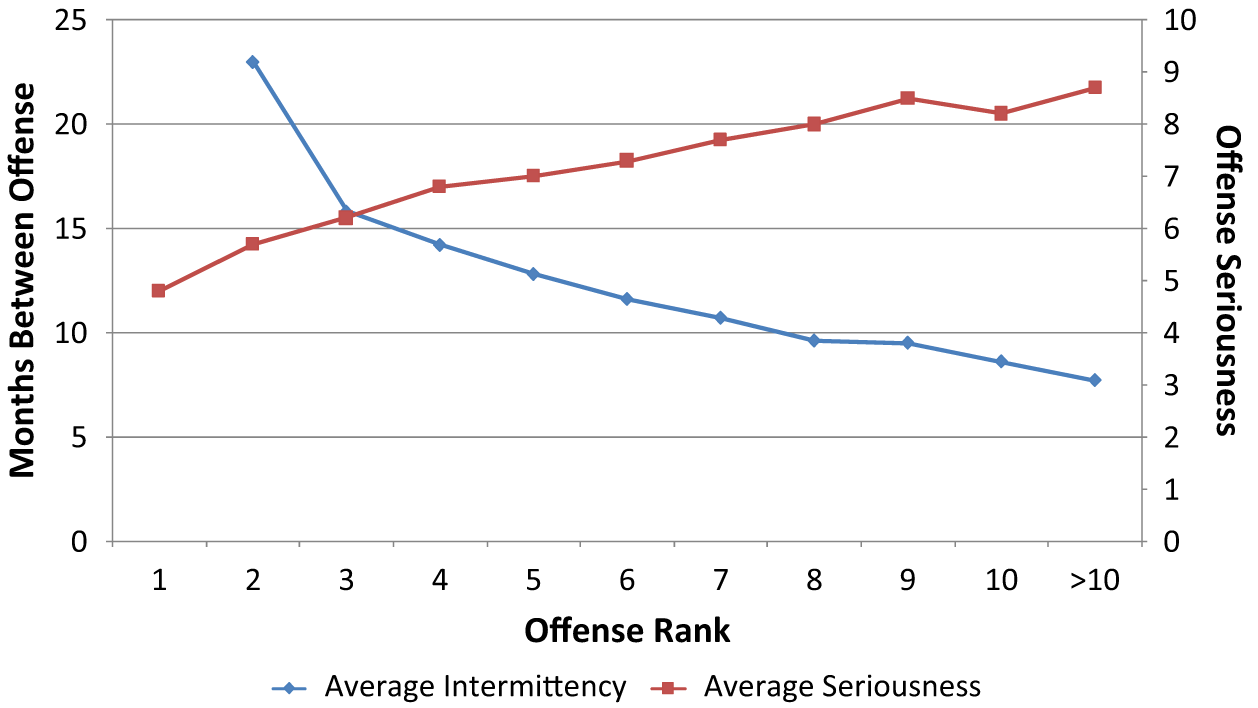
Intermittency and offense seriousness (total sample).
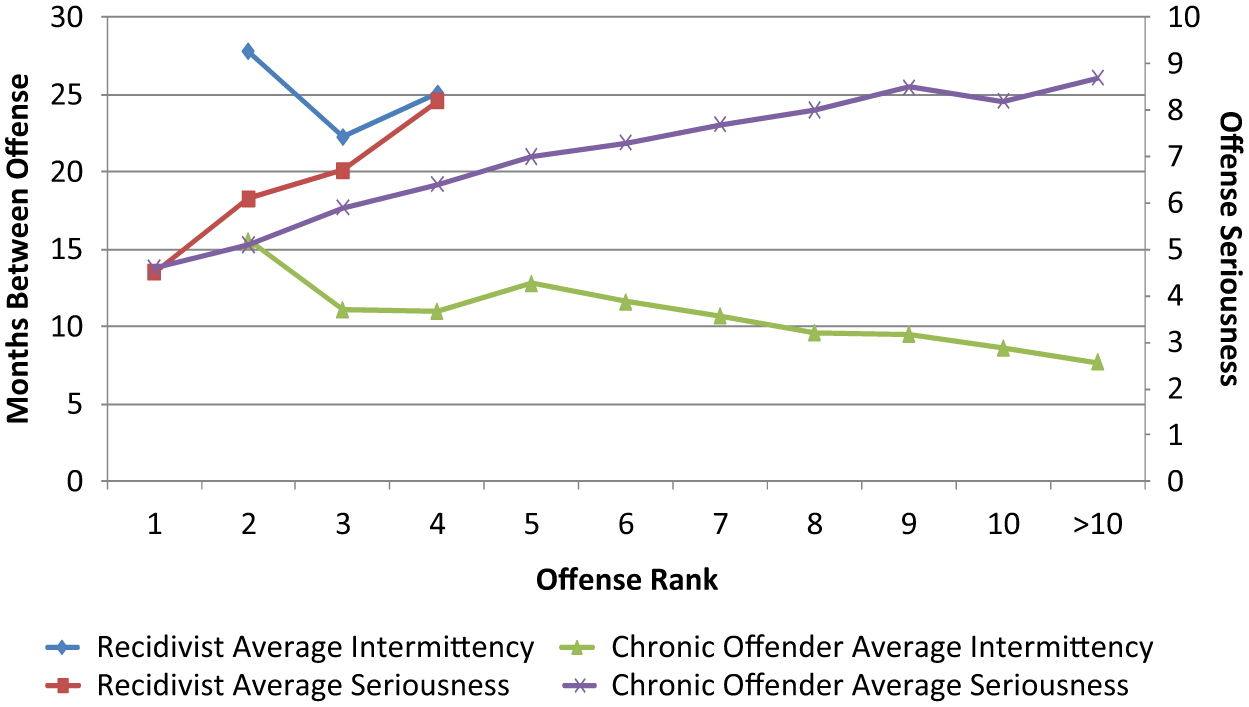
Intermittency and offense seriousness by offender type.
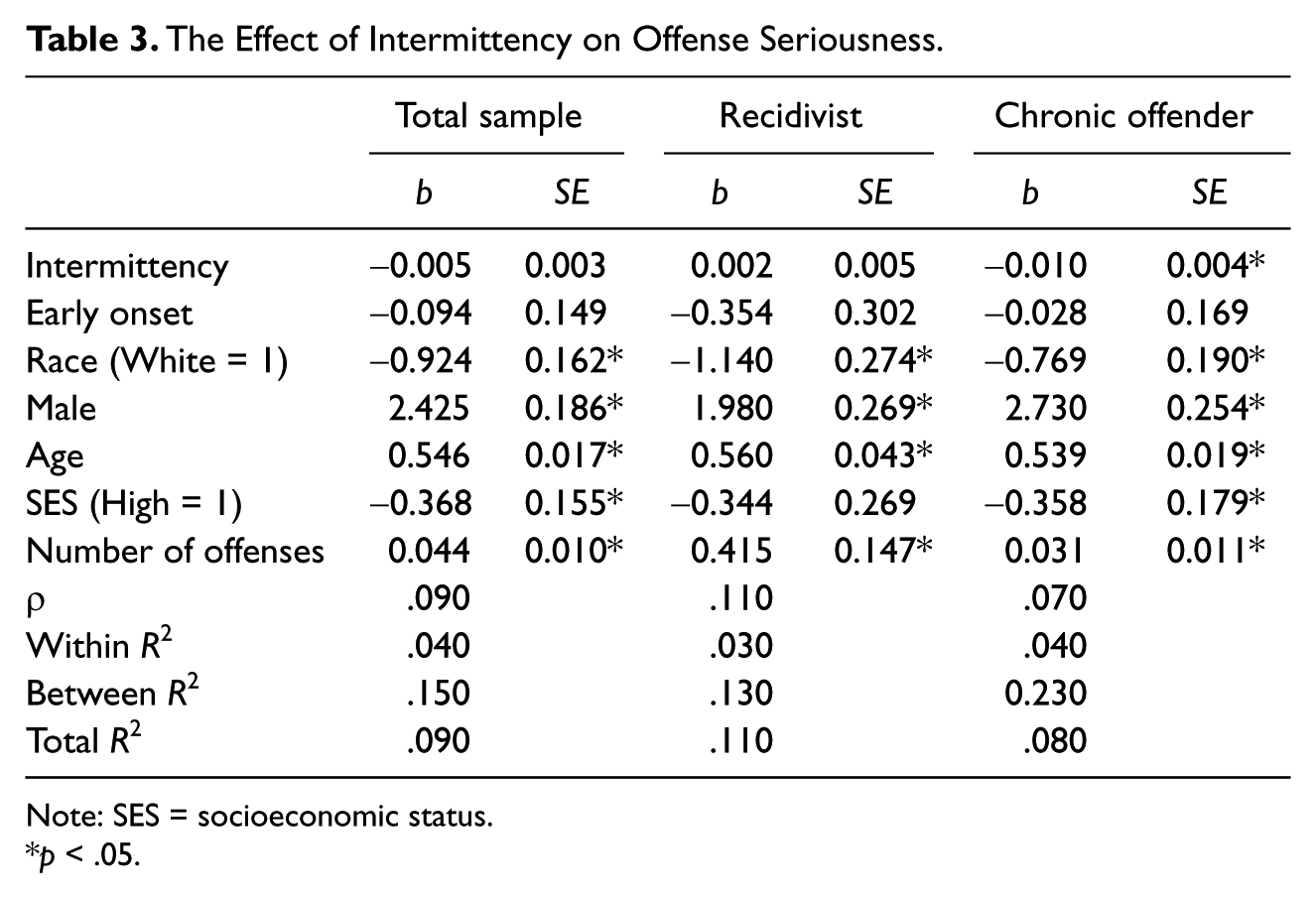
Table 3 presents the random effect models using intermittency to predict offense seriousness. In the full model, age, race, sex, SES, and the number of offenses are significant predictors of offense seriousness. The time gap between offenses and age of first offense are not significantly related to offense seriousness. These results hold true for recidivists as well, though SES is not significant. Among chronic offenders, the results are quite different. All variables, except age of onset, significantly predict offense seriousness. 15 These results provide support for Moffitt’s (1994) assertions: Recidivists are sporadic offenders and the gaps between their offenses do not influence the seriousness of their offending, whereas chronics are more regular in their offending and the periodicity of their offending predicts their offense seriousness. 16
The Effect of Intermittency on Offense Seriousness.
Note: SES = socioeconomic status.
p < .05.
Discussion
Revisiting the descriptive, foundational criminal careers research emerging from the Philadelphia Birth Cohort Studies (Tracy et al., 1990; Tracy & Kempf-Leonard, 1996; Wolfgang et al., 1972), the National Academy of Sciences Report on criminal careers (Blumstein et al., 1986), and the more recent developmental/life-course/criminal career contributions of Farrington (2003) and Piquero et al. (2007), we set out in this article to provide a descriptive portrait of the intermittency within criminal careers. Results demonstrate the relevance of intermittency within the criminal career framework as both a predictor of offense seriousness and an outcome of age of onset and frequency of offending.
Several conclusions can be drawn regarding the relationship between intermittency and offense seriousness, intermittency over the life course and across age, the types of offenders more or less likely to exhibit intermittent periods in offending, and within- and between-individual differences in intermittency. For example, among recidivists, the amount of time between offenses did not influence the seriousness of their offending over time. For chronic offenders, however, shorter periods between offenses resulted in more serious offending, perhaps because chronic offenders offend more, offend more while active, and engage in a wide variety of offenses—including person-oriented offenses (Dean, Brame, & Piquero, 1996) that are likely to increase their offending seriousness. This suggests that individuals who offend for a longer period over their life course and offend often with short gaps between their offenses are committing the most serious crimes. Consistent with Moffitt (1994), chronics commit the most crimes, the most serious crimes, and commit them in shorter intervals. More generally, these results relate well to the building blocks of empirical criminal career research on longitudinal patterns of offending (see Blumstein et al., 1986; Raskin, 1987; Tracy et al., 1990; Tracy & Kempf-Leonard, 1996; Wolfgang et al., 1972). Our investigation took an important step forward by exploring an issue that has not received much attention: “the factors associated with intermittent spurts of high-rate and low-rate offending” (Blumstein et al., 1986, p. 10).
Although the above findings add to the body of developmental/life-course research, an especially interesting finding was of the age/intermittency curve. At the aggregate, a relationship emerged demonstrating that as individuals age, the gaps between their offenses grow. When disaggregated and explored in relation to offender type, the age/intermittency curve became more illustrative. Although both recidivist and chronic offenders appeared to have longer periods of intermittency as they age, recidivists exhibited this characteristic much sooner in the life course, abstaining from crime for longer periods much earlier than chronics whose gaps between offenses did not approach the gaps of recidivists. Even as both groups age into their early and middle 20s, the recidivists who were still offending did so with much greater gaps in offenses than did chronics. At age 26, there was a significant difference between recidivists’ average intermittency (62 months) and chronics’ average intermittency (33 months). Similar to findings of the age/co-offending curve (Piquero et al., 2007), the age/intermittency curve provides further illumination of the more general age/crime relationship.
Multiple within- and between-individual differences in intermittency also emerged. Age of onset, offense frequency, and their interaction were significant predictors of intermittency. In general, with increasing age, offenders experienced longer gaps between offenses. Race, sex, and SES were not found to be significant predictors of intermittency, which could be due to the restricted variability in these variables because most of the chronics comprised Black males of low SES. 17
Although the current study did not test a specific theory, it does bear relevance for theoretical research. Specifically, although it is likely that intermittency is presumed to exist in one’s criminal career, most criminological theories rarely discuss or explicitly test for it. Nevertheless, unlike the conventional image of the term career, criminal careers—whether recidivist or chronic—are marked by brief lapses and sporadic episodes of crime occurring at sometimes unpredictable intervals (Piquero, 2004). This addition to the traditional view of the criminal career requires potential respecification of existing theories, especially as they are considered developmentally. More generally, this addition reinforces the view that descriptive empirical portraits of criminal careers made prominent by Wolfgang, Tracy, Farrington, Blumstein, and others are critical for a “descriptive quantitative criminology,” one that centers on providing basic information about the “nature of crime and the characteristics of offenders and victims” (Laub, 2010, p. 423).
The present study is an initial step in studying intermittency, and thus there lies a healthy theoretical and empirical research agenda ahead. First, as a descriptive study, our effort was not designed to test theoretical hypotheses of intermittency—of which there are currently very few. Criminologists need to develop expectations for intermittency and assess these expectations generally, and consider how such findings compare across other criminal career parameters. Our investigation, along with past research (Blumstein et al., 1986; Kempf, 1989; Piquero et al., 2007; Raskin, 1987; Tracy et al., 1990; Tracy & Kempf-Leonard, 1996; Wolfgang et al., 1972), recognizes patterns of criminal behavior, especially those involving gaps between offenses or change in offending, whereby increases in offense frequency are related to decreases in intermittency, increases in age are related to increases in intermittency, and decreases in intermittency are related to greater offense seriousness. Based on the relevance of intermittency in offending patterns, several questions remain to be answered by developmental/life-course theories: “Are the gaps between offenses sporadic for adolescent-limited offenders and regular for life-course-persistent offenders?” “Does the level of goal attainment buffer future bouts of strain, or will any new unmet expectations create enough strain to immediately promote a relapse in offending?” and “How do the gaps between met and unmet goals affect the likelihood or rate of future offending?”
Several issues related to the study of intermittency and not necessarily tied to any one specific theory need further exploration. Intermittency can be analyzed in relation to offense type, the influence of drug use and abuse, correctional and police responses to offenses, and the influence of treatment and intervention programs (Piquero, 2004). For example, drug use and abuse would expect to contribute to short periods of intermittency because drug use often facilitates criminal behavior. It could be predicted that remedial sanctions increase the gaps between offenses. It would also be interesting to explore how treatment and intervention programs, to the extent that they are effective, could increase intermittent periods. Each of these would have implications for policy, because the lengthening of gaps between offenses can lead to decreases in the severity of offending and eventual desistance (Raskin, 1987).
Another important set of opportunities exist for further methodological and empirical work on measuring intermittency. For example, aside from being operationalized as the gap between offenses, intermittency can also be consolidated into a score, as has been the case in the employment literature. For example, Hotchkiss and Pitts (2003) created an intermittency index that captures both the frequency of intermittent gaps and the duration of these gaps to determine the magnitude of the penalty given to women absent from the labor force. Co-offending is another important aspect of offending that should be examined in relation to intermittency. If individuals shift between deviant and nondeviant peer groups and drift in and out of offending (Matza, 1964), tests of intermittent criminal behavior should be able to directly assess this. Future research should also explore more objective measures of the chronicity of offending. Identifying offenders with five or more offenses as chronic is arbitrary. It may be more appropriate to explore the nature of intermittency across unique offending trajectories, examining different intermittent patterns of offending among multiple groups of offenders. Several different options are available for examining the effects of intermittency on offending, including growth curves, fixed effects, and other techniques that should be explored.
Relatedly, our attempt to account for possible incarceration stints for a portion of the data analyzed may espouse greater confidence if we had more complete measures of time on the street for a larger portion of the sample. Unfortunately, like most longitudinal data sources, the 1958 Philadelphia Birth Cohort Study (Tracy et al., 1990; Tracy & Kempf-Leonard, 1996) does not contain incarceration time data. In addition, the data are based on official records (offenses known to police) and only span a portion of the life course (age 7-26). Although this likely captures most of the age span where offenders commit the majority of their offenses, a longer time horizon would be illustrative for the examination of chronic offenders and late onsetting recidivists. It would also help in differentiating between intermittency and actual desistance, and whether similar variables relate equally to each outcome. It is also true that the use of official records to identify the boundaries of gaps in offending is limiting because official records do not capture all instances of offending that do not come to the attention of the police. It is also the case that self-report data do not routinely contain dates for each specific delinquency/crime committed by each person in a data source, and no longitudinal data source that we are aware of contains this level of information over the age range found in the 1958 Philadelphia Birth Cohort Study. In fact, most longitudinal studies that have self-report data only indicate the number of times in the previous year that specific crimes occurred. Thus, at this time, the limiting nature of official record data is the only means available to researchers interested in studying the intermittency issue, and the 1958 Philadelphia Birth Cohort Study data are among the premier data sources available that permit such an investigation. Clearly, future research should attempt to collect the level of detail needed to study the intermittency issue, and one potential example is the use of the life-event calendar method, which has (retrospectively) covered a 36-month age span (cf. Horney et al., 1995) but not yet a 26-year age span as undertaken with official records in the current study. Future research using self-report data with a longer time span could provide a better understanding of the true intermittent nature of offending, as arrest data are not always an accurate reflection of the number of offenses an individual commits. As an anonymous reviewer observed, although intermittency may be conceptually distinct from desistance, in terms of operational definitions, the difference may be an artifact of the data. Further operationalization of the two criminal career parameters and empirical investigation of their distribution and correlates will permit closer inspection of this possibility.
Footnotes
Declaration of Conflicting Interests
The authors declared no potential conflicts of interest with respect to the research, authorship, and/or publication of this article.
Funding
The authors received no financial support for the research, authorship, and/or publication of this article.