



Abstract
Employee organizational commitment provides positive outcomes for any organization, including law enforcement agencies. Although organizational characteristics such as supervisor feedback and organizational support have a strong influence on increasing organizational commitment in other sorts of organizations, the police organizational environment is unique and can hamper the facilitation of these characteristics. The present study used a sample of police officers to test the influence of supervisor feedback and perceived organizational support on officer organizational commitment, net the influence of other organizational, job characteristic, and officer personal characteristic influences. The findings revealed that, in spite of the barriers faced by police managers, these characteristics and other organizational-level characteristics were strong predictors of officer organizational commitment.
Keywords
Research in organizational psychology has long ago demonstrated that the attitudinal construct of organizational commitment is correlated with several desirable employee outcomes. Higher levels of organizational commitment have been empirically linked with lower rates of employee turnover and absenteeism (Mowday, Porter, & Steers, 1982; Price, & Mueller, 1986; Randall, 1990), more ethical decision making (McConkey, Huon, & Frank, 1996), and higher levels of job performance (Mathieu & Zajac, 1990). Fostering organizational commitment in employees, however, can sometimes be difficult. Fortunately for employers, many of the strongest correlates of organizational commitment are organizational-level characteristics that are often under the control of management, such as the degree of supervisor feedback, the level of perceived organizational support, and the extent of employee cohesion (Mathieu & Zajac, 1990).
Little attention, however, has been placed on organizational commitment within the policing research. Perhaps this is because in law enforcement organizations these conditions are far more difficult to create. The law enforcement organizational environment is very unique. Providing useful feedback to police officers, especially patrol officers, is complicated by three major issues. First, determining appropriate employee performance is a very subjective endeavor (Bittner, 1970; Brehm & Gates, 1994; Manning, 1977). The work of the patrol officer is extremely complex, requiring the flexibility to apply different responses to almost every citizen problem that officers encounter (Bittner, 1970; Lipsky, 1980; Manning, 1977). This makes determining the correct way of handling any given incident very situation based; what was the right thing to do in one situation may be a very inappropriate way to have handled another situation. This work task ambiguity, therefore, makes it difficult for supervisors to provide consistent feedback about what was good and poor performance in all but the most extreme cases.
Second, police work involves a constant interplay between conflicting goals (Bittner, 1970; Lipsky, 1980; Manning, 1977). Police officers are expected to gather evidence against criminal offenders while also protecting the constitutional rights of these same individuals. Police officers are expected to patrol aggressively in high crime neighborhoods—frequently stopping and searching citizens—while also fostering positive relations with the citizens of these neighborhoods. Police officers are not only expected to protect lives and property but also granted the authority to take lives and property in the performance of their duties. The contradictory nature of police work complicates efforts to provide officers specific guidance on how to perform their jobs.
Third, especially with regard to patrol personnel, it is very difficult to directly supervise officers at work (Brehm & Gates, 1994). While a supervisor in a factory often can look down on the assembly line workers from his or her office window, police field supervisors do not have that luxury. A typical sergeant in the patrol division of a law enforcement agency must supervise a squad of patrol officers who are deployed across many square miles of territory in motor vehicles. The sergeant’s subordinates are free to roam around their patrol beats and act proactively while not handling calls for service. Even if the sergeant is out in the field, responding to calls to observe officers while they work, he or she can only see a small portion of the work activities conducted by his or her subordinates at any point in time. The sergeant cannot attend every call and proactive stop in the district. Field supervisors, therefore, have little firsthand knowledge of the performance of their officers, limiting their ability to offer constructive feedback on the majority of work their officers perform.
There are also barriers within police work to fostering a sense among the officers that they truly have organizational support. Wilson (1968) suggested that the focus of patrol officers is on protecting themselves and fighting crime, whereas the focus of police administrators is on risk management and protecting the reputation of the agency. These different orientations often result in conflict between police officers and police managers. Policing scholars have documented the relationship between “street cops” and “management cops” as one marked by cynicism and suspicion on the part of patrol officers (Crank, 1998; Manning, 1977; Reuss-Ianni, 1983; Van Maanen, 1974, 1975; Waddington, 1999; Wilson, 1968). Most police officers have a profound distrust of management, suspecting that supervisors look out for their own best interests at best or are out to get them at worst. Studies of police officer stress have revealed that the perceived lack of support from management is one of the leading job stressors reported by officers (Blum, 2000; Crank & Caldero, 1991; Seltzer, Alone, & Howard, 1996). Fostering feelings of organizational support within law enforcement agencies, therefore, appears daunting.
Fostering organizational commitment among police officers, however, remains an extremely important task as low organizational commitment leads to poor officer performance, lower ethical standards, and higher turnover (McConkey et al., 1996; Mowday et al., 1982; Price, & Mueller, 1986; Randall, 1990). Determining what organizational characteristics can increase officer organizational commitment is of benefit to scholars of policing and organizational psychology. It would advance the policing literature by expanding our knowledge of police organizations and officer work attitudes. It would also expand the organizational psychology literature by testing previous findings in the very unique environment of a law enforcement agency. The present study, therefore, sought to determine whether supervisor feedback and perceived organizational support could make a significant contribution to the organizational commitment of police patrol officers. Using previously collected survey data from a sample of police officers assigned to uniformed patrol duties (Haar, 2003), a multivariate linear regression model was tested. It included measures of supervisor feedback, perceived organizational support, peer group cohesion, officer personal characteristics, and officer job task characteristics to determine whether they were significantly correlated with organizational commitment in a law enforcement agency environment.
Literature Review
Organizational commitment has been well researched in organizations outside of government service. Organizational commitment refers to the bond of the employee to the organization, or loyalty to, and identification with, the organization (Mowday, Steers, & Porter, 1979; Steers, 1977). In a meta-analysis of studies on organizational commitment, Mathieu and Zajac (1990) found evidence that employees with higher levels of organizational commitment displayed lower levels of absenteeism and job turnover. They also displayed higher rates of work productivity. In another study, McConkey and associates (1996) revealed that higher levels of organizational commitment were correlated with higher levels of ethical decision making. Clearly, high levels of organizational commitment are beneficial to public organizations in general and law enforcement agencies specifically.
Correlates of Organizational Commitment
Correlates of organizational commitment exist in three levels in the research literature: individual employee demographic characteristics, job-specific characteristics, and organizational characteristics (Kristof-Brown, Zimmerman, & Johnson, 2005; Mathieu & Zajac, 1990; Mowday et al., 1982; Steers, 1977). Individual employee characteristics include sex, age, race, education, tenure, and supervisory status. All of these characteristics have been found to be associated with organizational commitment inconsistently, and their overall impact appears to be small in comparison with the impact of job and organizational characteristics (Kristof-Brown et al., 2005; Mathieu & Zajac, 1990). Job characteristics refer to the factors that comprise the overall work situation for the employee and include job variety, job autonomy, job stress, and cognitive dissonance from role strain (Hackman & Lawler, 1971; Price & Mueller, 1986). These job characteristics generally reveal a moderate influence on employee organizational commitment with higher levels of job variety and autonomy increasing organizational commitment, and higher levels of job stress and role dissonance decreasing organizational commitment (Kristof-Brown et al., 2005; Mathieu & Zajac, 1990).
Many organizational-level characteristics have been investigated for their relationship to organizational commitment. These organizational characteristics have included level of formalization, centralization, fairness of outcomes and procedures, promotional opportunities, and organization size (Bluedorn, 1982; Kristof-Brown et al., 2005; Lincoln & Kalleberg, 1990; Mathieu & Zajac, 1990). The most influential organizational characteristics associated with organizational commitment, however, include the communication of feedback from supervisors, perceived organizational support from management, and a cohesive employee culture (Kristof-Brown et al., 2005; Mathieu & Zajac, 1990; Steers, 1977).
Supervisor feedback helps reduce role and performance ambiguity among employees, allowing them to correct deficiencies and modify their performance to meet the expectations communicated by their supervisors (Agho, Mueller, & Price, 1993; Hutchison & Garstka, 1996; Komaki, 1986). When employees feel less ambiguity in their performance expectations, they tend to experience higher levels of satisfaction with their supervisor and their organization. Feelings of organizational support also increase attachment to the organization. The perception by employees that management supports them and cares about their personal and professional welfare helps endear the employee to the organization (Eisenberger, Fasolo, & Davis-LaMastro, 1990; Hutchison & Garstka, 1996; Wayne, Shore, & Liden, 1997). In addition, when employees bond with their coworkers and feel supported by them, they tend to increase their organizational citizenship behavior and support for the organization as a whole (Andrews, Kacmar, Blakely, & Bucklew, 2008; Odom, Boxx, & Dunn, 1990; Wech, Mossholder, Steel, & Bennett, 1998).
The Police Officer Work Environment
Fostering effective supervisor feedback and perceived organizational support among employees is often difficult in government organizations in general and law enforcement agencies in particular. The work environment found of policing in particular makes achieving these characteristics exceptionally difficult. Providing useful feedback to patrol officers is complicated by work task ambiguity, conflicting work goals, and the difficulty in directly observing officers at work (Bittner, 1970; Brehm & Gates, 1994; Lipsky, 1980; Manning, 1977). Research literature on how police supervisors actually communicate behavioral expectations to subordinates is limited. Van Maanen (1983, 1985) noted, after conducted ethnographic research with field supervisors on one large, urban police department, that patrol sergeants utilized informal rewards and punishments to guide officer behavior. When a patrol officer’s behavior was in accordance with the sergeant’s wishes, the sergeant granted the patrol officer small favors, such as a choice beat assignment or partner. When an officer’s behavior did not meet the sergeant’s expectations, the sergeant would withhold such favors as punishment (Van Maanen (1983, 1985).
The efficiency of such a strategy is questionable, especially when not accompanied by any specific instruction or overt feedback from the supervisor. Furthermore, being based on qualitative data, there is a lack of empirical evidence that the officers actually perceive the feedback the supervisors suggest that they are providing. In another study, for example, Engel (2000, 2001) identified different police supervisors’ leadership styles but found only weak empirical evidence that style had any influence on actual officer work behavior. Only the active style, which tended to model expected patrol officer behavior, seemed to have any influence on officer arrest productivity, community problem solving, and officer use of force, and these influences were statistically small (Engel, 2000).
In a small survey of patrol officers on one sheriff department, Johnson (2008a) asked officers to rank the effectiveness of various methods of communicating performance expectations. Rewarding officers in informal ways for good performance ranked the highest, thus giving credence to feedback strategy revealed by Van Maanen (1983, 1985). After informal rewards, the officers ranked providing written or verbal feedback to officers on their performance, modeling appropriate behavior by one’s supervisor (like Engel’s active style supervisor), and providing written policies and procedures. Another study found that supervisor modeling and supervisor monitoring of officers in the field influenced the officers’ degree traffic enforcement (Johnson, 2011) and involvement personal business they conducted while on duty (Johnson, 2008b). Finally, Engel and Worden (2003) found that the amount of time patrol officer spent on community problem solving was correlated with officer’s perceptions that his or her supervisor expected this behavior and that this behavior would be included as part of his or her performance evaluation. The question remains, however, of whether the feedback officers currently receive is sufficient to influence their level of organizational commitment.
There are also barriers to fostering a sense among officers that they truly have organizational support, due to differences in orientations and subcultures between supervisory officers and patrol officers (Crank, 1998; Manning, 1977; Reuss-Ianni, 1983; Van Maanen, 1974, 1975; Waddington, 1999; Wilson, 1968).
Fostering organizational commitment among police officers also remains an extremely difficult task. Wilson (1968) revealed that the focus of patrol officers is on protecting themselves and fighting crime, whereas the focus of police administrators is on risk management and protecting the reputation of the agency. These different orientations result in conflict between police officers and police managers. Policing scholars have documented the relationship between street cops and management cops as one marked by cynicism and suspicion on the part of patrol officers (Crank, 1998; Manning, 1977; Reuss-Ianni, 1983; Van Maanen, 1974, 1975; Waddington, 1999; Wilson, 1968). Most police officers have a profound distrust of management, suspecting that supervisors look out for their own best interests at best, or are out to get them at worst. Studies of police officer stress have revealed that the perceived lack of support from management is one of the leading job stressors reported by officers (Blum, 2000; Crank & Caldero, 1991; Seltzer, Alone, & Howard, 1996). It is unknown whether the limited feelings of organizational support officers experience have any influence on their levels of organizational commitment.
Peer group cohesion, however, does not appear to be a serious problem in the policing field as police officers have a strong and well-documented subculture (Crank, 1998; Skolnick, 1966; Waddington, 1999). Police officers depend on each other for their very safety. They also share common beliefs and attitudes about themselves and their work, resulting in close occupational solidarity among officers. This does not mean that all police officers are the same. Variation in officer attitudes has been found across agencies and units (Wilson, 1968), and duty assignments (Sun, 2002). Several variations in work orientations have also been found across officers on the same department, unit, and job assignment (Paoline, 2004). In spite of these differences in work orientations or agency cultures, most police officers still share social bonds with other officers that resemble clannish affiliations (Crank, 1998; Paoline, 2004; Skolnick, 1966; Waddington, 1999; Wilson, 1968). To what extent this officer peer cohesion influences officer organizational commitment, however, remains untested.
Although supervisor feedback and perceived organizational support are two of the strongest predictors of organizational commitment within private industry (Mathieu & Zajac, 1990), the distinctive work environment of policing may weaken or nullify the influences of these two elements. This possibility suggests one of the following research hypotheses is true:
Hypothesis 1: Supervisor feedback and perceived organizational support have only a weak influence on the organizational commitment of police patrol officers.
Hypothesis 2: Supervisor feedback and perceived organizational support have a strong influence on the organizational commitment of police patrol officers.
Obviously, the null hypothesis would be that supervisor feedback and perceived organizational support have no influence on officer organizational commitment. The present study sought to test these hypotheses with a sample of police patrol officers while simultaneously controlling for other salient employee, job task, and organizational-level correlates.
Method
This study used data gathered by Robin Haar (2003) as part of a longitudinal analysis of the evolution of police officer attitudes throughout their academy training and socialization process in the field. 1 Haar surveyed officers when they began their training at a regional police academy in Arizona, at the end of their academy training, at the end of their field-training period, and after they had successfully completed their probationary year on their respective departments. Only the final wave of data was used as, in this wave, all of the respondents were experienced police officers with at least 1 year of experience on the street. This wave consisted of 292 respondents employed by 11 different law enforcement agencies around the Phoenix metro area. These data were appropriate for the present study because they contained survey items that specifically measured many of the variables of interest in the study and survey items that could be fashioned into appropriate proxy measures of the remaining variables of interest. Although not recent data, these data were collected long after the most recent changes in policing in America, specifically the unionization of police forces, and the adoption of community and problem-oriented policing strategies (Langworthy & Travis, 2003).
Consistent with national statistics on police officer demographics (Hickman & Reaves, 2006), the sample of officers was overwhelmingly male (90%) and mostly White (81%). A total of 42% of the officers held a baccalaureate degree, and 52% were married. Although all of these officers had only been employed with their current agency for just over 1 year, many came to their present department with many years of police experience. The number of years of police experience ranged from 1 to 14, with a mean of 2.87 years.
Dependent Measure
Using the work of Mowday and associates (1982) as a guide, the dependent variable, organizational commitment, was created with five survey items that measured allegiance to, preference for, and appreciation of the officers’ employing agencies. The survey items used were as follows: “The law enforcement agency I am employed by is one of the best in the country,” “The law enforcement agency I am employed by is open to suggestions for change,” “I have confidence that the command staff picks the most qualified person for the best job,” “My department’s training is adequate,” and “My department is very interested in its subordinates.” The items were answered using a 5-point Likert-type scale of strongly disagree (1), disagree (2), uncertain (3), agree (4), and strongly agree (5). These five items were summed together to form an additive index. Although not perfect measures of organizational commitment as characterized by Mowday and associates, they did produce a Cronbach’s alpha reliability coefficient of .77.
Independent Measures
The two key organizational-level independent variables in this study were supervisor feedback and perceived organizational support. Supervisor feedback was based on three survey items (i.e., “My supervisors let me know how well I am doing on the job,” “My supervisors often let me know how well I am performing,” and “I always know what my immediate supervisor expects of me in terms of my performance”), which were consistent with feedback measures previously used by Komaki (1986). The questions were answered using a 5-point Likert-type scale ranging from strongly disagree (1) to strongly agree (5). These three items were summed together to form an additive index that had a Cronbach’s alpha reliability coefficient of .79.
Perceived organizational support was measured using three items that tapped into typical officer concerns about upper management, such as political favoritism on the part of upper management, and the perception that management is willing to hang officers out to dry just to please disgruntled citizens (Crank & Caldero, 1991; Manning, 1977; Reuss-Ianni, 1983). These survey items were as follows: “The average departmental complaint is the result of pressure from top administrators for supervisors to give out complaints [reverse coded]”; “The majority of special assignments on the department depend on who you know, not merit [reverse coded]”; and “When a police officer is the focus on an internal affairs investigation, he will be presumed guilty even when he can prove otherwise [reverse coded].” These three items were summed together to form an additive index that had an alpha value of .63.
Out of concern that the dependent variable and organizational support measures may be tapping the same attitudinal construct, a factor analysis was conducted on all eight items to investigate the reliability of one or two clusters. This analysis confirmed the appropriateness of the variables as constructed. On Factor 1 of the rotated factor matrix, the five variables used to create the dependent variable all loaded higher than 0.7, whereas the three remaining variables used to create the organizational support independent variable all loaded at less than 0.40. On Factor 2 of the matrix, this pattern was reversed. This test confirmed the validity of the measures used.
Other organizational characteristics have been correlates of organizational commitment, such as employee peer cohesion and organization size (Andrews et al., 2008; Odom et al., 1990; Wech et al., 1998). To control for these influences, a measure of peer cohesion was constructed with two survey items (i.e., “I like the employees I work with a great deal” and “The example my fellow employees set encourages me to work hard”). These two items were summed together to form an additive index that had an alpha value of .72. A measure of agency size was created using the total number of personnel employed by each respondent’s agency. As the Phoenix Police Department and the Maricopa County Sheriff Department are very large agencies, and the nine other agencies in the study were small suburban agencies, this measure was highly positively skewed. To allow a linear analysis, therefore, the natural log of this variable was calculated and used in the analyses.
The literature has revealed that job characteristics also have a consistent, yet weaker, influence on organizational commitment (Mathieu & Zajac, 1990). The influences of these characteristics, therefore, needed to be controlled. One such characteristic is job variety: the degree of variation, or lack of routinization, in one’s work (Price & Mueller, 1986). Hackman and Lawler (1971) revealed that job variety was positively correlated with organizational commitment. Job variety was measured here with two survey items (i.e., “My job is arranged so that I do not have the chance to do an entire piece of work from beginning to end” and “My job assignment requires me to use a number of complex and high-level skills”), similar to survey questions used by Curry, Wakefield, Price, and Mueller (1986) and Price and Mueller (1986). These two items were summed together to form an additive index that had an alpha value of .72.
Job autonomy refers to the freedom to exercise professional discretion and operate independently within the organization (Mathieu & Zajac, 1990). In recent years, with the expansion of community problem-solving policing strategies, there has been greater emphasis on officer autonomy (Adams, Rohe, & Arcury, 2002; Ford, Weissbein, & Plamondon, 2003). A measure of job autonomy was created with four survey items similar to those used by Ford and associates (2003). These survey questions were as follows: “My job assignment permits me to decide on my own how to do the job,” “My job gives me considerable opportunity for independence and freedom in how I do my work,” “I feel I have enough authority in my job,” and “I have enough discretion in my job to make effective decisions.” These four items were summed together to form an additive index that had an alpha value of .79.
Job stress is another common correlate of organizational commitment (Mathieu & Zajac, 1990). Job stress can be defined as feelings of job-related tension, anxiety, and exhaustion. A job stress measure was created based on three items (i.e., “I am dissatisfied with the amount of work I am expected to do,” “The amount of work I am expected to do makes it difficult for me to do my job well,” and “My workload is seldom too heavy” [reverse coded]), which were summed together to form an additive index that had a Cronbach’s alpha reliability coefficient of .72.
The final job characteristic was employee role dissonance: the feeling of psychological discomfort when the behaviors required for a given job are inconsistent with the employee’s beliefs or attitudes (Rizzo, House, & Lirtzman, 1970; Schaible & Gecas, 2010). No clear measure could be constructed to calculate this job characteristic; however, two proxy measures were created. The first was a measure of negative attitudes toward citizens. Dealing with citizens and helping them with their problems is the crux of police work, so it was assumed that officers who held negative attitudes toward citizens would experience role conflict in having to deal with them. The measure of negative attitude toward citizens consisted of five items (i.e., “Most people do not respect the police,” “The relationship between the police and the public is very good [reverse coded],” “Citizens will never trust police enough to work together effectively,” “The public shows a lot of respect for law enforcement officers [reverse coded],” and “The public is more apt to obstruct law enforcement than to cooperate”) that were summed together in an additive index that had an alpha coefficient of .79.
The second proxy measure of role dissonance was the degree to which the officer embraced a legalistic enforcement philosophy. Persons who lack authoritarian personality traits tend to find it more difficult to impose rules on others (Frankel-Brunswick, Levinson, & Adorno, 1993). Police work routinely involves the stopping, questioning, searching, and arresting of people. It also occasionally involves using physical force. Officers who by nature are uncomfortable with strictly and aggressively enforcing the law may experience role conflict in their jobs. This measure was created using two survey items (i.e., “All laws should be enforced at all times, otherwise citizens lose respect for the law [reverse coded]” and “Police officers should remember that enforcing the law is their most important responsibility [reverse coded]”), which were summed together in an additive index that had a modest alpha coefficient of .55.
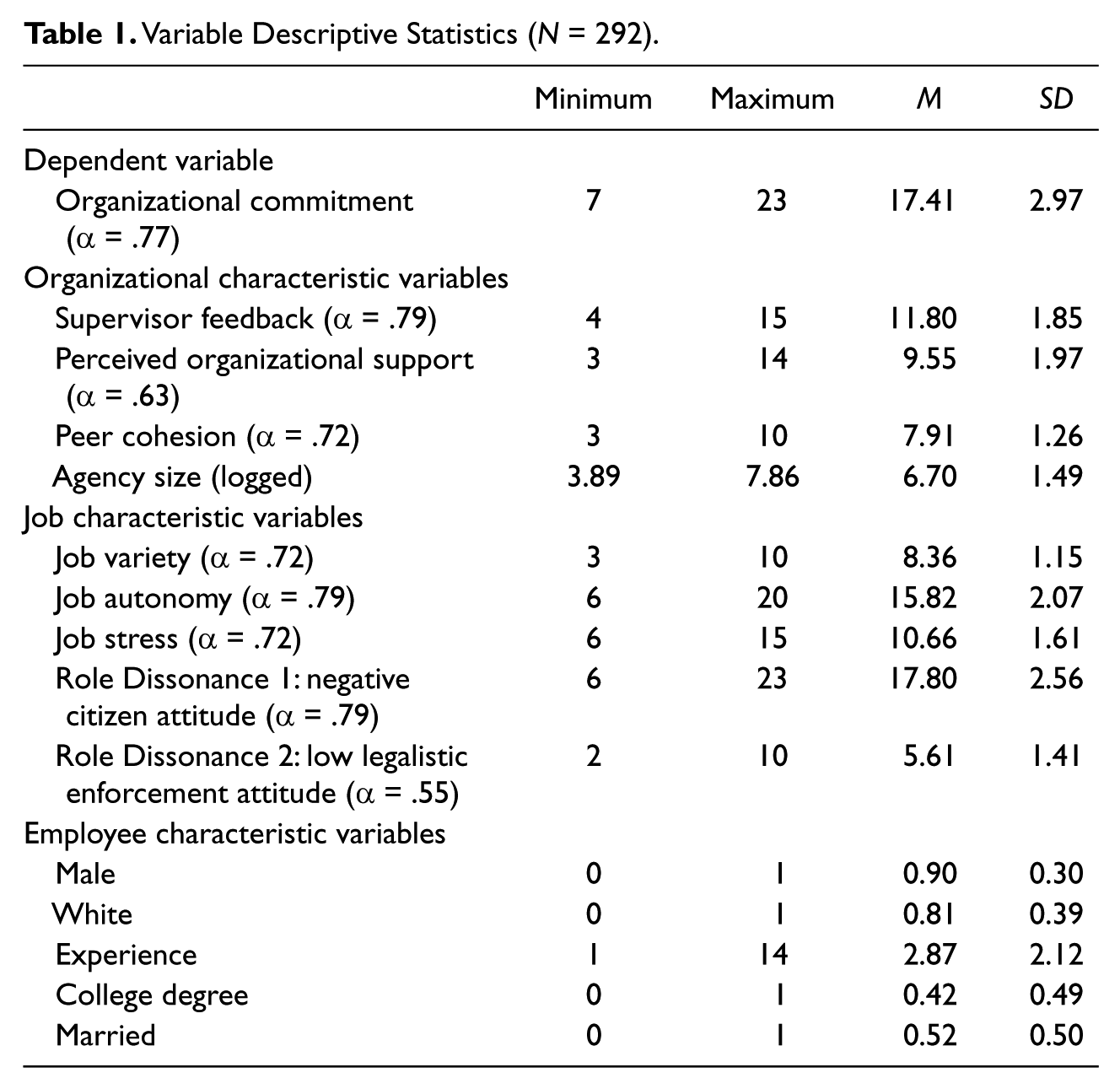
Measures of gender (male = 1, female = 0), race (White = 1, non-White = 0), years of police experience, education (baccalaureate degree = 1, no degree = 0), and marital status (married = 1, not married = 0) were included as officer demographic characteristic variables. These demographic characteristics have all been associated with organizational commitment at times (Mathieu & Zajac, 1990) and are often included as variables when examining police officer attitudes. The descriptive statistics for the dependent variable, and all of the independent variables, are reported in Table 1.
Variable Descriptive Statistics (N = 292).
Results
As Table 1 demonstrates, there was considerable variation in both the dependent and independent variables, and the variables appeared to be fairly normally distributed. All the indices, except one, had a Cronbach’s alpha value higher than .60, a reliability level that is generally viewed as acceptable (Gronlund, 1981). The one index that scored below .60 was only one of two proxy measures of the same construct, and its alpha value, at .55, was just below the threshold normally used.
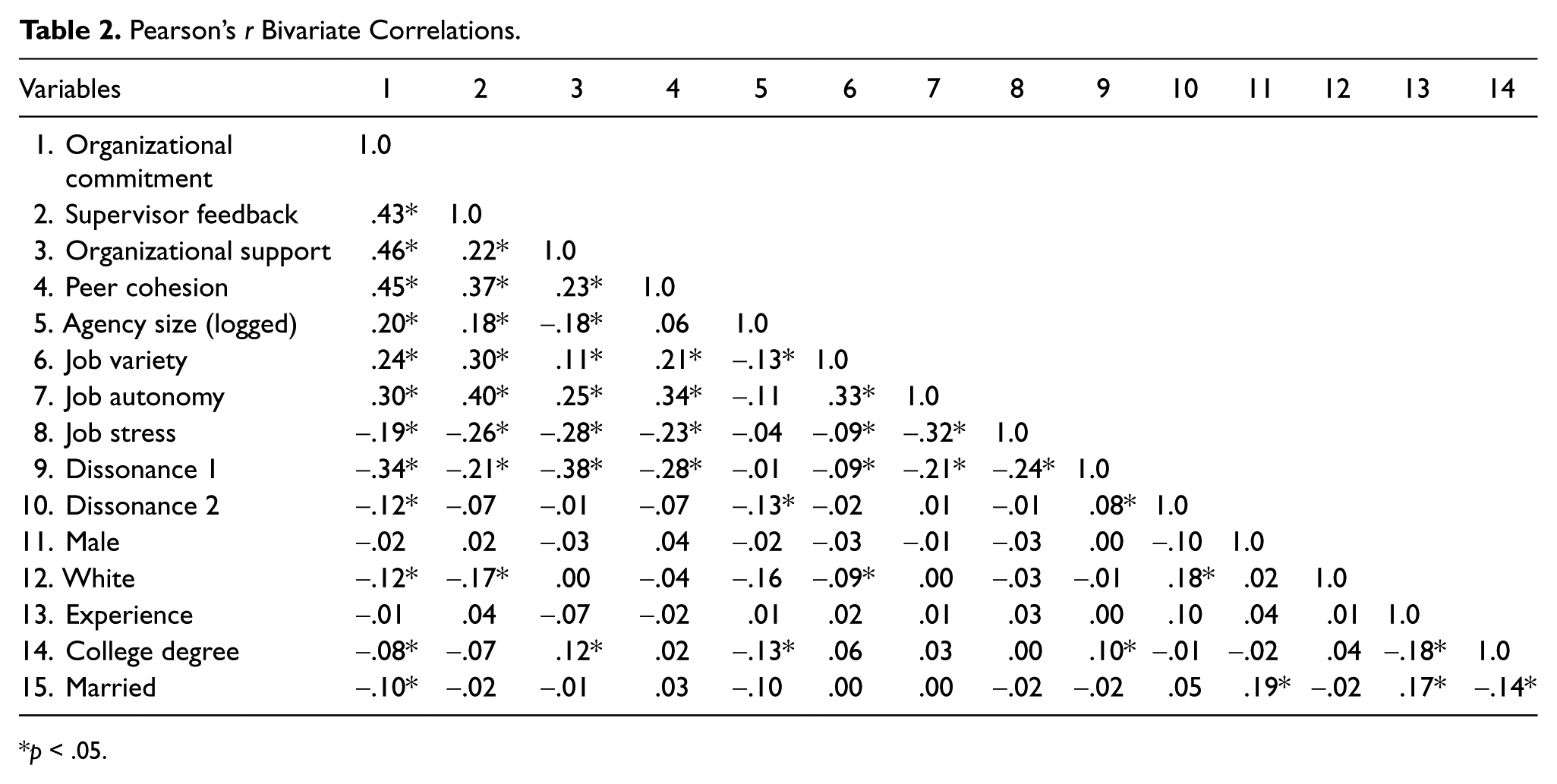
Bivariate Pearson’s r correlation coefficients were calculated, and the results are presented in Table 2. In examining the correlations between independent variables and organizational commitment, it was revealed that all the organizational and job characteristic indices had significant correlations with organizational commitment. Specifically, supervisor feedback, perceived organizational support, peer cohesion, organizational size, job variety, and job autonomy had positive correlations with organizational commitment, whereas job stress, negative attitudes toward citizens, and attitudes of low legalistic enforcement had negative correlations. Three of the five demographic characteristic variables (race, education, and marital status) were also statistically, and negatively, correlated with organizational commitment. White officers, college educated officers, and married officers generally reported lower levels of organizational commitment. The sizes of the correlation coefficients of all the independent variables were consistent with the previous literature in that the organizational characteristics were largest, followed by the job characteristics, and then the individual officer demographic characteristics.
Pearson’s r Bivariate Correlations.
p < .05.
The correlation matrix in Table 2 also suggested that there was no issue with colinearity as none of the independent variables were correlated with each other at a coefficient greater than 0.50. This was further confirmed by the variance inflation factors (VIFs) later calculated in the multivariate analyses. The VIF values of the independent variables ranged from 1.10 to 1.74, all well below the conservative conventional threshold of 5.0. These two test methods confirmed the lack of colinearity among the independent variables.
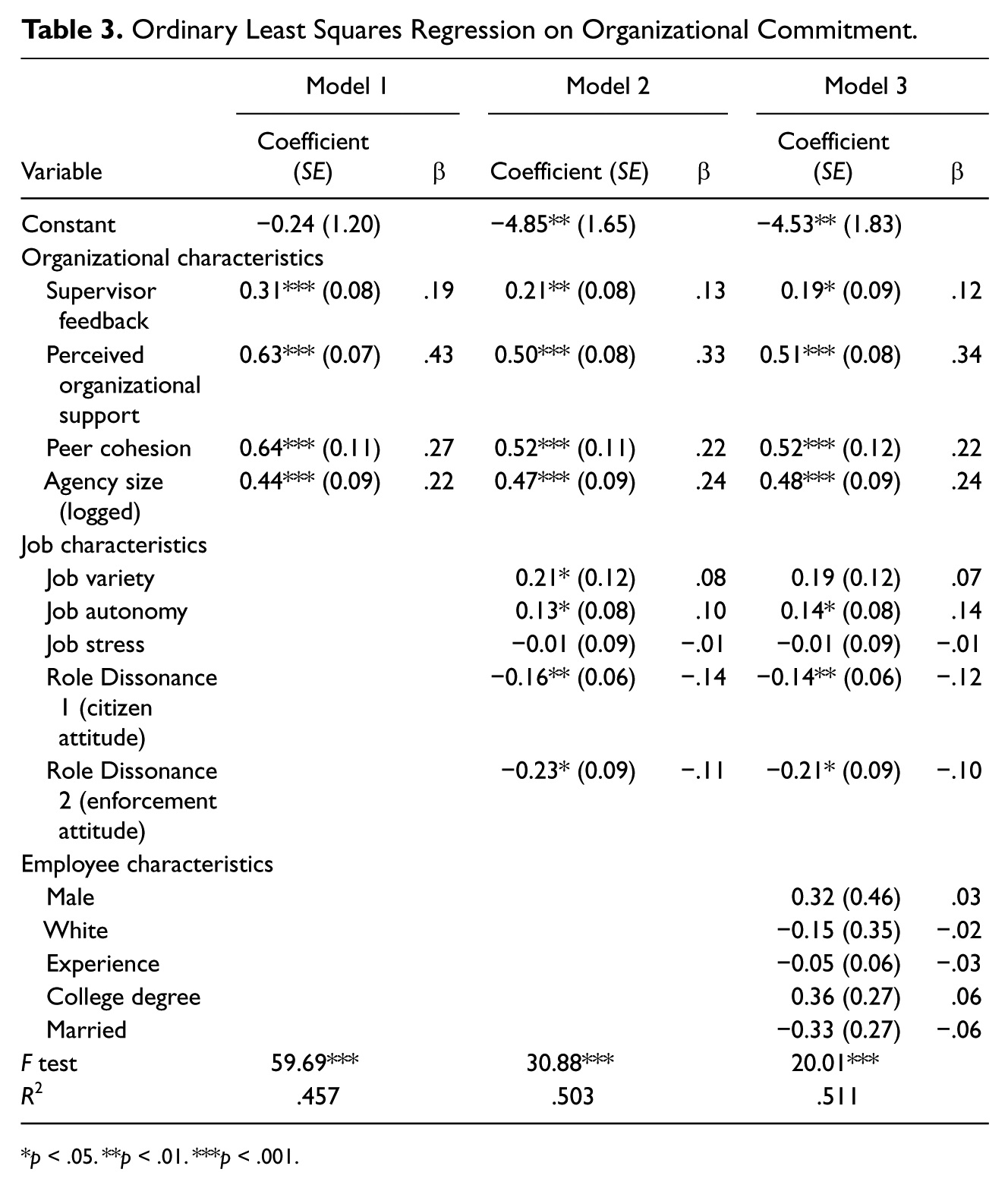
Ordinary least squares (OLS) regression equations were then computed with the organizational commitment indices as the dependent variable. The equations were computed in a stepwise progression with the first model using the organizational characteristics, the second adding the job characteristics, and the third adding the officer demographic characteristics. The results of the OLS regression analyses are reported in Table 3. The first OLS regression model, using only the organizational characteristics as independent variables, accounted for an impressive 46% of the observed variance in organizational commitment. All four of the organizational characteristic indices had a statistically significant impact on organizational commitment. As supervisor feedback, perceived organizational support, peer cohesion, and agency size increased, so did organizational commitment. Beta standardized regression coefficients were used to compare the magnitude of the impact of each of the independent variables on the dependent variable. As these standardized regression coefficients represent standardized units, they can be easily compared with one another (Long, 1997). Among the organizational variables, perceived organizational support had the largest effect, followed by peer cohesion, agency size, and supervisor feedback.
Ordinary Least Squares Regression on Organizational Commitment.
p < .05. **p < .01. ***p < .001.
The second OLS equation was calculated incorporating the four organizational independent variables and the five job characteristic independent variables. As can been seen in Table 3, the addition of the job characteristic variables increased the amount of variance explained over the first model. The second model explained approximately 50% of the variance in officer organizational commitment, and all but one of the variables proved to be a statistically significant predictor of the dependent variable. Among the job characteristic indices, three measures had effects that were statistically significant. Job autonomy was positively correlated with organizational commitment, and the two measures of role dissonance had negative effects on organizational commitment. As officers have more autonomy in their job duties, their organizational commitment increases. As psychological role conflict from officer dislike of citizens increased, organizational commitment decreased. As cognitive dissonance from officer discomfort with law enforcement increased, organizational commitment decreased.
After controlling for the influence of the job characteristics, the four organizational characteristic variables remained significant, and their betas did not change appreciably. The two forms of officer role dissonance and officer job autonomy were the only job characteristics with beta values worth noting, and all three of these variables had beta values weaker than the betas produced by the organizational characteristics. This suggested that, even after controlling for officer job characteristics, the characteristics of the police organization appear to hold the greatest influence on individual officer organizational commitment.
Finally, the final OLS model added the five employee demographic characteristics. None of these officer demographic characteristic variables had a statistically significant impact on organizational commitment when controlling for the shared effects of the other variables. Furthermore, the amount of variance in organizational commitment explained by the addition of these variables was less than 1%. Officer personal characteristics appeared to have little influence on organizational commitment. When comparing the beta values in the full model (Model 3), perceived organizational support had the largest effect, followed by agency size, peer cohesion, job autonomy, supervisor feedback, negative attitude toward citizen dissonance, and low enforcement attitude dissonance. The effect sizes of most of the organizational characteristics were much larger than that of the remaining significant variables. 2
Discussion and Conclusion
Four major conclusions can be drawn from these findings. First, in spite of the obstructions to fostering supervisor feedback and perceived organizational support found in police agencies, these variables were still important elements in shaping police officer organizational commitment. Both supervisor feedback and perceived organizational support, however diminished within police organizations, were statistically significant predictors of officer organizational commitment. The null hypothesis that supervisor feedback and perceived organizational support would have no measurable influence on officer organizational commitment was rejected. Second, consistent with the previous literature from other fields, organizational characteristics appear to be more important than job characteristics and employee demographic characteristics in helping shape police officer organizational commitment. The three strongest influences on officer organizational commitment in the models tested were organizational-level characteristics. Furthermore, perceived organizational support was the strongest predictor in the model. The first research hypothesis, therefore, was also rejected, leaving the second research hypothesis to be accepted.
The third major conclusion was that the environment of the police organization produced unique results with regard to the influence job characteristics have on employee organizational commitment. Meta-analyses of studies done in other settings have found certain job characteristics to be consistently correlated with organizational commitment (Kristof-Brown et al., 2005; Mathieu & Zajac, 1990). Although their explanatory power is generally weaker than that of organizational-level characteristics, job variety, job autonomy, job stress, and role strain dissonance generally reveal a moderate influence on employee organizational commitment (Mathieu & Zajac, 1990). In the present study, however, job variety and job stress were not statistically significant predictors of organizational commitment. In a police work environment, job variety and stress may not be as influential in the development of employee organizational commitment. Perhaps the individuals volunteering for service as law enforcement officers enter the field anticipating high levels of stress and a paramilitary organizational structure that limits job variety.
Fourth, the organizational-level variable of peer cohesion was a strong predictor of organizational commitment in the models. Although it has been implied by some that the police officer culture presents negative features such as cynicism, opposition to management control, brutality, and covering up for corrupt officers (Manning, 1977; Skolnick, 1966), the findings here suggested that a strong officer culture actually increases support for the organization. Strong peer cohesion also did not conflict with attitudes toward management. In fact, bivariate correlations indicated that peer cohesion was positively correlated with both supervisor feedback and perceived organizational support, suggesting that peer cohesion coexists with both good relations with management and organizational support.
Although it has been suggested that police officers’ organizational commitment is lower than that of employees of other career fields (Jermier & Berkes, 1979; Savery, Soutar, & Weaver, 1991; Zhao & Thurman, 1999), the present study offers hope for police administrators that organizational changes can have a substantive impact on employee organizational commitment. As was previously discussed, the nature of police work, and especially the work of patrol officers, creates barriers for supervisors seeking to provide officers with consistent feedback on their work performance. What limited feedback police supervisors do provide their officers, however, still appears to pay off in increased officer organizational commitment. It was possible that because good police work is so vague and difficult to define, officers appreciate any concrete information they received on how well they were doing. A supervisor who helped illuminate the boundaries of expected performance, even to a small degree, may have increased the officer’s appreciation for his or her workplace.
Police supervisors can improve the organizational commitment of their officers if they work toward consistently letting their subordinates know how they are doing on the job and telling them what is expected of them in terms of performance. Empirical literature on how to effectively communicate behavioral expectations to subordinates in a law enforcement agency setting is admittedly very scarce. In one small survey of patrol officers on one sheriff department, Johnson (2008a) asked officers to rank the effectiveness of various methods of communicating performance expectations. Rewarding officers in informal ways for good performance ranked the highest. This was followed by providing written or verbal feedback to officers on their performance, the modeling of appropriate behavior by one’s supervisor, and providing written policies and procedures. Two other studies found that supervisor modeling and supervisor monitoring of officers in the field influenced the officers’ degree of involvement in community problem solving (Engel, 2000) and the amount of personal business they conducted while on duty (Johnson, 2008b). Although further study is desperately needed, these studies can at least serve as a starting point.
Considering the negative and cynical views that police officers hold toward their managers (Crank & Caldero, 1991; Manning, 1977; Reuss-Ianni, 1983), it would seem that nurturing feelings of organizational support would be even harder than providing consistent and productive feedback. Nevertheless, the variation between officers in perceived organizational support had the strongest influence on officer organizational commitment. This finding demonstrated that even within the hostile, adversarial relationship between street cops and management cops, small gains toward appeasing officer desires for support could result in major improvements in officer organizational attitudes. Perceived organizational support was operationalized here with the statements, “The average departmental complaint is the result of pressure from top administrators for supervisors to give out complaints”; “The majority of special assignments on the department depend on who you know, not merit”; and “When a police officer is the focus on an internal affairs investigation, he will be presumed guilty even when he can prove otherwise.” The common theme across all three of these statements was procedural fairness, or lack thereof, on the part of top administrators.
Obviously, investigating allegations of complaints of misconduct among officers is a right and duty of police administrators. It is also the prerogative of police executives to assign officers to specific duty positions. What was clearly the issue here was the officers’ perceptions about the procedural fairness of these actions. One literature review of the effects of procedural and substantive fairness on employee organizational citizenship suggested that procedural fairness had a more significant impact on organizational commitment than substantive fairness (Organ & Moorman, 1993). Employees appear to care more about how fairly decisions were made than they do about the final outcome; that fair procedures were followed to get to that decision is what matters most. Although none of the studies reviewed by Organ and Moorman (1993) involved police officers, the findings may be equally applicable to law enforcement organizations. If so, then the fair, impartial, and transparent administration of personnel decisions and misconduct investigations may help police managers increase the organizational commitment of their officers.
As with all studies, this analysis had limitations. First, it involved secondary analyses of data collected for another purpose. One artifact of this was that the length of tenure of the officers involved was truncated. While some of the officers surveyed had as much as 14 years of experience as a police officer, the vast majority had less than 2 years of total police experience, and all had served with their current employing agency for not much more than a year. This poses an issue that must be considered when generalizing the findings to other officers or even these officers later in their careers. Evidence exists to suggest that police officers’ work attitudes change over their careers.
Qualitative studies provide the greatest evidence of these attitude changes. Van Maanen (1973, 1974) chronicled the attitude transformations big city police officers experience as they complete their academy training, work with a field-training officer, and begin working on their own on the streets. As officers progress through these experiences, their idealism fades, they become more cynical, and they generally adopt a “lay low” attitude to stay out of trouble with peers, management, and citizens (Van Maanen, 1973, 1974). Barker (1999), who spent 18 years conducting ethnographic research with officers at all stages of their career, suggested that at about 5 years of experience, police officers reach an attitudinal turning point. At this stage, they start to experience burnout and adapt their occupational attitudes to cope. These coping attitudes can include trying to recommit to one’s career and agency, just trying to endure until retirement, withdrawing emotionally and trying to do as little as possible, and focusing one’s energies on a hobby or identity outside of police work (Barker, 1999).
The empirical evidence about longitudinal changes in officer attitudes is less consistent. Van Maanen’s (1975) longitudinal survey of officers in the early stages of their careers supported his qualitative research findings, finding that officers’ attitudes about their work change significantly during the 1st year, or so, on the job. Surveying a cohort of police officers, Garner (2005) found that they had experienced considerable change in their key attitudes about police work after 1 year working as an officer. Two other empirical cohort studies, however, found that attitudes about becoming a police officer remained stable over 6 years (White, Cooper, Saunders, & Raganella, 2010) or over two decades (Foley, Guameri, & Kelly, 2008). Nevertheless, the influence of length on tenure on officer attitudes may have played an influence on the present study, and its findings must be taken into consideration. Future studies should include samples of officers with a broader range of tenure lengths.
Second, and on a related note, numerous studies have found that officers adapt differently to the pressures of the job and management by developing different “working personalities” that can also be considered constellations of attitudes. Early studies simply created 4 × 4 typologies (Broderick, 1977; Brown, 1988; Muir, 1977, Walsh, 1977), whereas recent studies used sophisticated techniques, such as K-cluster analysis (Engel, 2001; Jermier, Slocum, Fry, & Gaines, 1991; Paoline, 2001). In spite of the fact that only limited empirical evidence exists that these different working personalities actually influence officer work behavior (Engel, 2000), these working personalities are measures of officer attitude clusters. Therefore, they may influence such attitudes as organizational commitment, perceived organizational support, peer cohesion, or job task dissonance. As the present study constrained by the data, and unable to develop measures of officer working personalities, it cannot be determined what influence these working personalities may have played. Future studies should include measures that can be used to determine the respondents’ various work orientations.
Third, additional components of the occupational environment were not explored, such as formalization, centralization, and promotional opportunities. The same is true for other officer internal characteristics. For example, in their 5-year ethnographic study of college athletes, Adler and Adler (1988) suggested that intense commitment to the team involved more than economic rewards, established authority, and satisfaction with the sport. Intense loyalty among these athletes developed when the team (and its coaching staff) dominated their lives, their identities became interwoven with that of the team, they voluntarily chose to commit to the team/sport, they were accepted and integrated into the team “family,” and they aligned their goals and attitudes with that of the team. Other characteristics such as these should be included in future research to provide a more accurate picture of police officer organizational commitment.
Fourth, many of the concepts measured by indices were measured using only a handful of items. How a concept is measured might influence the results and raise the issue of validity and reliability. Further study, therefore, should test multiple measures of organizational commitment. Mowday and associates (1982), for example, suggested three specific components exist in organizational commitment: acceptance of the organization’s goals and values, willingness to exert effort for the organization, and a desire to maintain membership in the organization. Each of these should be tested separately in future research.
In conclusion, it is important to study the forces that shape the organizational commitment of employees in all criminal justice agencies, and police agencies in particular. The findings here suggested that organizational characteristics are related to police officer attitudes toward organizational commitment. Contradictory to the previous research, it was found that officer demographic and job characteristics were generally unrelated to organizational commitment attitudes. This suggested that the organizational environment has direct effects for organizational commitment.
Footnotes
Declaration of Conflicting Interests
The author(s) declared no potential conflicts of interest with respect to the research, authorship, and/or publication of this article.
Funding
The author(s) received no financial support for the research, authorship, and/or publication of this article.