



Abstract
Routine activity theory and lifestyle-exposure theory propose that victimization rates differ across demographic groups because individuals in these groups engage in different activities. This implies that routine activities mediate the relationships between demographic characteristics and victimization. Although this core assumption underlies both theories, few researchers have attempted to test its validity, and the tests that do exist have relied primarily on cross-sectional, nongeneralizable data. The current study examines how routine activities mediate the associations between four demographic characteristics (gender, age, marital status, and household income) and violent victimization and theft using a longitudinal data set created from the National Crime Victimization Survey. We combine a multivariate ordered logistic model with a general structural equation model to examine direct and indirect paths. Results indicate that the effects of gender, income, and marital status on victimization are each at least partially mediated by routine activities, suggesting the applicability of lifestyle theories to the study of victimization.
Lifestyle-exposure theory and routine activity theory have had significant influence on the study of criminal victimization since their introduction in the 1970s (Cohen & Felson, 1979; Hindelang, Gottfredson, & Garofalo, 1978). A basic premise of these related approaches is that victimization risk is determined by the extent to which daily activities bring one into contact with motivated offenders in the absence of capable guardians. This means that individuals whose daily activities take them away from home face increased victimization risk, and the risk is elevated further for those whose daily activities occur in places where there are large numbers of potential offenders. Research findings generally support lifestyle-routine activity theory predictions (e.g., Fisher, Sloan, Cullen, & Lu, 1998; Kennedy & Forde, 1990; Lynch, 1987; Miethe, Stafford, & Long, 1987; Mustaine & Tewksbury, 1998; Sampson & Wooldredge, 1987). As a result, the lifestyle-routine activity approach is now broadly applied to a variety of issues related to victimization, from the effects of deviant lifestyles on school victimization (Nofziger, 2009) to hot spots of juvenile crime (Weisburd, Morris, & Groff, 2009).
Despite the influence of the lifestyle-routine activity approach on our understanding of victimization, there are central predictions of the theory that are understudied. At its core, this perspective argues that demographic variation in victimization is a result of variation in daily activities across demographic groups (Cohen & Felson, 1979; Hindelang et al., 1978). In fact, the assumption that demographics are associated with particular lifestyles is so taken for granted that many researchers have used demographic characteristics as proxies for routine activities (e.g., Cohen & Cantor, 1980; Cohen, Kluegel, & Land, 1981; Hindelang, 1976; Hindelang et al., 1978; Messner & Tardiff, 1985). The lack of independent lifestyle measures in these early studies, however, produces findings that are vulnerable to alternative theoretical explanations.
Recognizing the importance of this issue, a few studies have attempted to test the prediction that lifestyles mediate the relationship between demographic characteristics and criminal victimization or included variables that would allow for such a test. However, most previous research has utilized cross-sectional data (e.g., Corrado, Roesch, Glackman, Evans, & Ledger, 1980; Messner, Lu, Zhang, & Liu, 2007; Miethe et al., 1987; Pratt, Holtfreter, & Reisig, 2010; for exception, see Lauritsen, Sampson, & Laub, 1991). The use of cross-sectional data is problematic in tests of mediation, because mediation requires the establishment of time order, and time order cannot be firmly established in cross-sectional analyses. This issue is particularly important here due to the “victimization effect,” in which victims may change their activities and take more precautions in response to being victimized (Mayhew, 1984). For instance, an individual in a cross-sectional study who reported never going out at night and yet also reported being assaulted could, indeed, have been victimized despite participating in low-risk activities, or she could have been victimized and then changed her routine activities to avoid a future assault. Because cross-sectional studies conflate these two situations, their findings regarding the effects of routine activities on victimization are biased toward the null. Thus, longitudinal data are necessary to test the mediation predictions of lifestyle-routine activity theory. Unfortunately, the limited research that has used longitudinal data to test these predictions has been narrow in scope, failing to provide a comprehensive test of hypotheses (Lauritsen et al., 1991).
Here, we address the limitations of previous research by using a longitudinal, nationally representative data set to test whether routine activities mediate the effects of a wide range of demographic characteristics on victimization. The use of longitudinal data allows us to construct a more properly specified model of mediation that takes into account the chronological sequencing of behavior. Unlike previous research, we also use a structural path modeling approach. This approach allows us to examine the strength and statistical significance of the mediating effects. Our results will, therefore, provide a much-needed test of the mechanisms implicit in lifestyle theories. We begin with a discussion of lifestyle-routine activity theory and the relevant empirical literature.
Lifestyle Theories of Victimization
The dominant lifestyle theories are lifestyle-exposure theory and routine activity theory. Lifestyle-exposure theory was developed by Hindelang et al. (1978) to explain the unequal distribution of violent crime risk, although the theory has since been extended to explain variation in risk of property crime (Miethe & Meier, 1994). According to this theory, certain demographic characteristics are associated with role expectations and constraints, which lead to lifestyle variation across demographic groups. These lifestyles, in turn, affect exposure to victimization. For example, familial ties and responsibilities cause married people to spend considerable time with family members in the home, whereas single people lack these expectations and constraints and so are more likely than married persons to engage in activities outside of the home with nonfamily members (Hindelang et al., 1978). These contrasting lifestyles result in different levels of exposure to crime, resulting in differences in victimization between married and single individuals. Hindelang et al. constructed similar arguments to explain the relationship between other demographic characteristics and victimization risk.
Routine activity theory, developed by Cohen and Felson (1979), shares much in common with lifestyle-exposure theory, although it focuses on the circumstances in which a crime takes place rather than on victim characteristics. According to the theory, for a crime to occur, three elements must converge in space and time: (a) motivated offenders, (b) suitable targets, and (c) the absence of capable guardians against a violation. The theory was originally developed to explain changes in U.S. property crime rates across time. Cohen and Felson argued that macrolevel changes in routine activities beginning in the 1960s led to increased availability of suitable targets and a decrease in the presence of capable guardians, which led to higher crime rates. The theory has since been utilized to explain individual-level victimization risk (e.g., Fisher et al., 1998; Kennedy & Forde 1990; Miethe et al., 1987; Mustaine & Tewksbury 1998). Applied on the individual level, routine activity theory contends that an individual’s daily activities affect the degree to which an individual and his or her property is a suitable target for victimization and whether either possesses capable guardians.
Research is generally supportive of the lifestyle-routine activity perspective. Studies of hot spots find that areas characterized by a large concentration of motivated offenders and suitable targets but lacking capable guardians have a high concentration of crime (e.g., Roncek & Maier, 1991; Sherman, Gartin, & Buerger, 1989). On the individual level, patterns of routine activities predict risk of both violent victimization (Pizarro, Corsaro, & Yu, 2007; Schwartz & Pitts, 1995; Tita & Griffiths, 2005) and property victimization (Mustaine & Tewksbury, 1998; Pratt et al., 2010). The lifestyle-routine activity perspective has also been expanded to explain patterns of delinquency (Haynie & Osgood, 2005; Osgood, Wilson, O’Malley, Bachman, & Johnston, 1996). Together, these findings suggest the veracity of the theory.
There is less certainty, however, regarding the prediction that routine activities mediate the relationship between demographic characteristics and victimization. The use of cross-sectional data in much of the existing research has meant that results are inconclusive regarding this fundamental lifestyle-routine activity theory prediction. Below, we discuss these predictions and detail previous findings.
Routine Activities as Mediating Variables
Lifestyle theories predict that routine activities mediate the relationship between the demographic variables known to be associated with victimization and actual instances of criminal victimization. The demographic characteristics most clearly associated with victimization risk are age, gender, income, and marital status. 1
Data indicate that young people have higher rates of both violent victimization and theft than do older individuals (Macmillan, 2001; Rand, 2009; Rennison, 2000), and lifestyle-routine activity theory attributes this variation to different lifestyles led by the old and the young. Specifically, higher rates of youth victimization are the result of youth’s greater participation in routine activities that bring them, unguarded, into contact with motivated offenders. There is evidence to support the logic of this hypothesis: Young people are less fearful of crime and are more impulsive and risk taking (Hindelang et al., 1978; Skogan & Maxfield, 1981). They also have fewer responsibilities than older individuals and possess more leisure time, allowing them to spend more time outside of the home.
Similarly, lifestyle-routine activity theory attributes males’ higher rates of violent victimization (Rand, 2009; Rennison, 2000) to their engagement in high-risk activities. Consistent with this argument is research finding that males are less fearful of crime and more likely to take risks than are females, as well as more approving of aggressive behavior (Ferraro, 1995, 1996; Pakaslahti & Keltikangas-Jarvinen, 1997; Warr, 1985, 1994). Furthermore, role expectations may encourage males to become involved in potentially violent confrontations while discouraging females from doing so (Huesmann, 1994).
The relationship between routine activities, income, and criminal victimization is less straightforward. Research generally finds that poorer individuals experience higher rates of violent victimization and household property crimes, whereas wealthier individuals face a greater risk of personal theft (Catalano, 2006; Rennison, 2000). 2 These empirical findings appear to pose a problem for lifestyle-routine activity theory, because it seems unlikely that factors that increase risk of theft victimization also decrease risk of violent victimization. To date, studies have not teased out these relationships, and we attempt to do so here.
Finally, lifestyle theories predict that single people have higher rates of victimization due to their routine activities. Research consistently finds that people who have never been married are more likely than married people to suffer both violent victimization and theft (Catalano, 2006; Rennison, 2000). Research also suggests that single people and married people have different lifestyles. Single individuals lack familial obligations that can restrict the amount of leisure time spent outside of the home. They go out socially more frequently than married individuals and are much more likely than married individuals to choose bars and night clubs for entertainment (Cargan, 2007). Thus, the lifestyles of the never married may result in greater exposure to risky environments.
As this discussion indicates, lifestyle-routine activity theory makes the general prediction that the effect of demographic characteristics on victimization risk is mediated by routine activities. The only comprehensive tests of this prediction, however, have used cross-sectional data (Corrado, Roesch, Glackman, Evans, & Leger, 1980; Messner et al., 2007; Miethe et al., 1987; Pratt et al., 2010). Because mediating effects can only be evaluated when time order can be clearly established, the results of studies using cross-sectional data are best seen as studies of association between demographics, routine activities, and victimization.
Corrado et al. (1980) found associations between three demographic characteristics (age, gender, and marital status) and violent victimization. They also found that the frequency of nighttime activity had a direct effect on violent victimization. Their results indicated that routine activities did not mediate the relationship between demographics and violent victimization, although the use of cross-sectional data limits the reliability of this conclusion. In addition, using cross-sectional data, Miethe et al. (1987) reported that routine activities mediated the effect of gender on property victimization, but, like Corrado et al., they reported no mediating effects for violent victimization (see also Kennedy & Forde, 1990). Messner et al. (2007) reported that an individual’s perceived level of self-defense and alertness of personal security, the frequency of travel outside the city for leisure, and the frequency of travel outside the city for work mediated the effects of age on having been swindled. However, the authors acknowledge the difficulties involved in determining causation in their sample, given that victimization included incidents over the past 5 years, whereas routine activities were measured at the time of the survey. Most recently, Pratt and colleagues (2010) suggested that the effects of age and education on the risk of being targeted by Internet fraud are entirely mediated by an individual’s routine activities online; however, this study utilized cross-sectional data, as well. Thus, although each of these studies purports to examine mediating effects, mediation cannot be established conclusively because these studies record victimization events and routine activities occurring during the same time period.
Unlike other studies that attempt to test whether routine activities mediate the relationship between demographic characteristics and victimization, Lauritsen et al.’s (1991) study is longitudinal. Because the authors’ primary goal was to examine the influence of offending on victimization and how delinquency is related to demographic differences in victimization, they only present the mediating effects of one lifestyle characteristic: delinquency. They found evidence suggesting that previous delinquency and current delinquency mediated the effects of family income on assault, the effects of gender on robbery, and the effects of race on robbery. This finding is consistent with lifestyle-routine activity theory predictions, suggesting that routine activities are an important link in the relationship between demographic characteristics and victimization. There are a few shortcomings associated with this study. Because current delinquency and previous delinquency were not added to the models separately, it is impossible to determine which is mediating these relationships. This raises the issues of time order associated with cross-sectional studies. In addition, although their findings suggest mediating effects, the authors did not perform tests of mediation. Finally, Lauritsen et al. did not consider the mediating effects of nonillicit lifestyle behaviors.
As this review suggests, research has failed to demonstrate a clear relationship between routine activities, demographics, and either property or violent victimization. Most previous research has either failed to test for mediating effects or has relied on cross-sectional data. The study by Lauritsen et al. (1991) is an exception, but this study examined delinquency as the sole lifestyle variable and did not directly test for mediation. None of the previous studies have used path modeling, which provides the most thorough assessment of mediation.
Current Research
In this study, we examine the question, “To what extent do routine activities mediate the effects of demographics on violent and property victimization?” As discussed earlier, the lifestyle theories make the following predictions regarding the relationship between age, gender, income, marital status, routine activities, and victimization.
Hypothesis 1: The relationship between age and both violent victimization and theft victimization will be mediated by routine activities indicative of a high-exposure lifestyle.
Hypothesis 2: The relationship between gender and violent victimization will be mediated by routine activities indicative of a high-exposure lifestyle.
Hypothesis 3a: The negative relationship between income and violent victimization will be mediated by involvement in routine activities indicative of a high-exposure lifestyle.
Hypothesis 3b: The positive relationship between income and theft victimization will be mediated by routine activities indicative of a high-exposure lifestyle. 3
Hypothesis 4: Single people have higher rates of victimization due to their participation in routine activities indicative of a high-exposure lifestyle.
Here, we offer a comprehensive analysis of the role of routine activities in mediating the relationship between demographic characteristics and both property and violent victimization, testing the mechanisms implicit in lifestyle theories. We improve on previous studies by examining a full range of demographic characteristics in longitudinal, nationally representative data. We also focus on nondelinquent routine activities. Finally, unlike any previous research, we examine the statistical significance of these mediating relationships.
Method
Sample
The data for this study are drawn from two waves of the 1999 National Crime Victimization Survey (NCVS). In 2000, several questions regarding routine activities were dropped from the survey; therefore, the 1999 NCVS provides the most recent relevant data. The NCVS interviews a nationally representative sample of approximately 50,000 households every 6 months and has an average response rate of 90%.
The NCVS uses a stratified, multistage cluster sample design to select a sample of housing units from the United States and the District of Columbia drawn from the most recent decennial census (United States Department of Justice, Bureau of Justice Statistics, 1999). We utilize a subset of the 1999 NCVS person-level files. First, we exclude individuals who are under 18 years of age, because the types of routine activities associated with personal victimization among adults are not as applicable to adolescent victimization. We also limit the sample to individuals who were interviewed twice during 1999 because two interviews are required to establish time order. 4
We use weighted data in our multivariate models to account for the stratified, multicluster sample design of the NCVS. The NCVS data set includes several weights that adjust “for unequal probabilities of selection and observation, and for known age, sex, and race ratios based on the 1990 Adjusted Decennial Census Population Totals” (United States Department of Justice, Bureau of Justice Statistics, 1999, p. xxxiv). We use the person weight, a variable that is derived from six component weights: the base weight, the weighting factor control, the household noninterview adjustment, the within-household noninterview adjustment, the first-stage ratio estimates factor, and the second-stage estimate factor (United States Department of Justice, Bureau of Justice Statistics, 1999). 5
Measures
Victimization
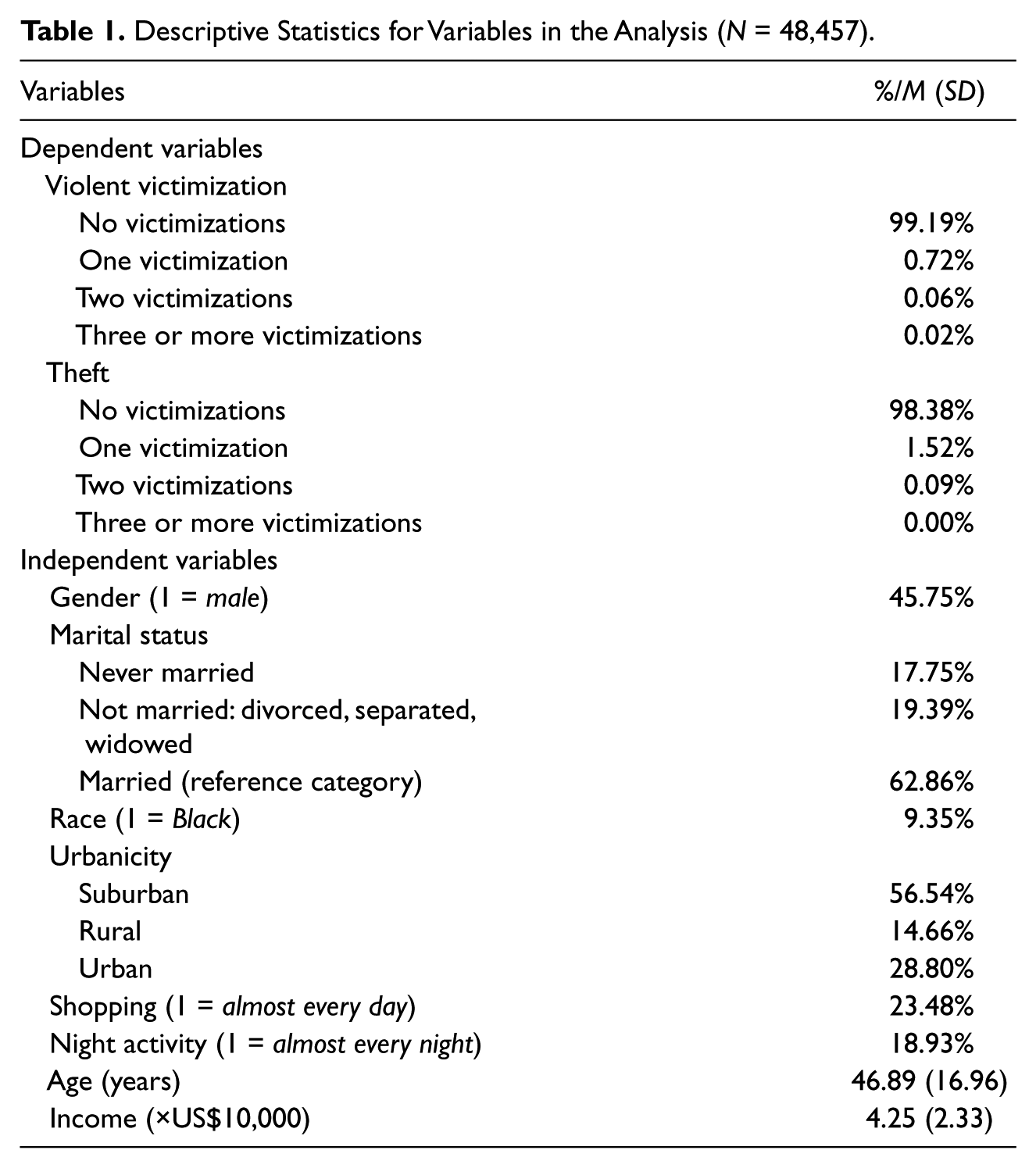
Table 1 presents the descriptive statistics for the variables used in this study. The dependent variables are count variables measuring the number of victimizations experienced by the respondent, ranging from 0 to 3 or more. We include measures of both violent and personal property victimization because lifestyle-routine activity theory focuses on both of these crime categories. Violent victimization includes completed, attempted, or threatened assault or sexual assault, as well as completed or attempted robbery. Theft measures the number of personal thefts experienced by the respondent, which in the NCVS are categorized as completed pocket picking, personal larceny, and completed or attempted purse snatching. The dependent variables are measured at Time 2.
Descriptive Statistics for Variables in the Analysis (N = 48,457).
Demographics
The demographic measures are age, gender, income, and marital status. Age is a continuous variable. Gender is coded such that male = 1. Income measures reported household income. The NCVS household income variable is divided into 14 intervals. We coded each respondent at the midpoint of his or her income interval and divided this dollar amount by 10,000, to ease interpretation. Marital status is measured as a set of categorical dummy-coded variables comparing individuals who have never been married (never married) and individuals who are separated, widowed, or divorced (not married) to married individuals (the reference category). 6
Routine activities
There are two measures of routine activities: going out at night and shopping. 7 Both routine activity variables are dichotomous and are measured at Time 1. 8 Research and theory suggest that activities that take an individual outside of the home, particularly at night, increase the risk of victimization. Going out at night has frequently been used as a measure of routine activities (e.g., Averdijk, 2011; Corrado et al., 1980; Miethe et al., 1987). Recently, researchers have begun to include frequency of shopping as a measure of risky activity because, like night activity, shopping involves leaving the safety of home, thus increasing exposure to motivated offenders (e.g., Averdijk, 2011). Carrying newly purchased goods also makes one an attractive target. Night activity is coded “1” for respondents’ who spent the evening away from home almost every night over the past 6 months. Shopping is coded “1” if respondents report having gone shopping almost every day over the past 6 months. Respondents who shopped less frequently are coded “0.”
Control variables
We control for race and urbanicity. Race is a dichotomous variable comparing Blacks (race = 1) to non-Blacks (race = 0). Urbanicity is a set of categorical dummy-coded variables dealing with the location of the housing unit: urban, suburban, or rural. As previously discussed, some lifestyles heighten an individual’s risk of victimization because they involve large amounts of time spent outside of the home, increasing the individual’s exposure to crime. Urban areas have higher crime rates, implying a larger number of motivated offenders. In line with other research, we control for urbanicity to take into account the amount of crime in an area (e.g., Dugan & Apel, 2005). 9 We include a set of dummy-coded variables that compares individuals living in suburban areas (suburban = 1) and rural areas (rural = 1) with individuals living in urban areas (the reference category).
Analytic Strategy
To examine how routine activities mediate the relationship between demographics and victimization, we use a multivariate ordered logistic model (MOLM), which is an extension of the simple binary logistic model. This model can take into account the ordered categorical variable in which the distances between categories are unequal (Long, 1997). Given the nature of our two dependent variables, MOLM is more appropriate than the general linear model or other nonlinear models because the dependent variables of violent victimization and theft had four ordered categories and the distances between the categories are unequal. See Table 1 for descriptive statistics.
The current study uses not only MOLM but also a general structural model. Combining a MOLM with a structural path model (Muthén & Muthén, 2010), our model is constructed to compare and test the direct and indirect effects of demographic variables and two routine activities on victimization. To assess goodness-of-fit, Steiger’s root mean square error of approximation (RMSEA; Browne & Cudeck, 1992), the comparative fit index (CFI; Bentler, 1990), and the chi-square divided by its degrees of freedom (fit ratio) are used.
Our use of structural path modeling allows us to determine whether the mediating paths are statistically significant, which was not possible using methods used in previous studies. In this method, all direct and indirect paths are simultaneously included in the model, and we can accurately estimate and test all direct and indirect effects. We use the bootstrapping method option in Mplus Version 6.0 to test mediating effects (Muthén & Muthén, 2010; see Cheung & Lau, 2008; Mallinckrodt, Abraham, Wei, & Russell, 2006).
Results
Our MOLM contains variables measured at different time points: Demographics and routine activities are measured at Time 1, whereas victimization is measured at Time 2. Paths are estimated simultaneously from each demographic characteristic to both routine activities and both forms of victimization. We also estimated direct paths from routine activities to victimization. Both types of victimization—violent victimization and theft—are correlated. Finally, the model controls for the effects of race and urbanicity. The results of this model are displayed in Figure 1. 10
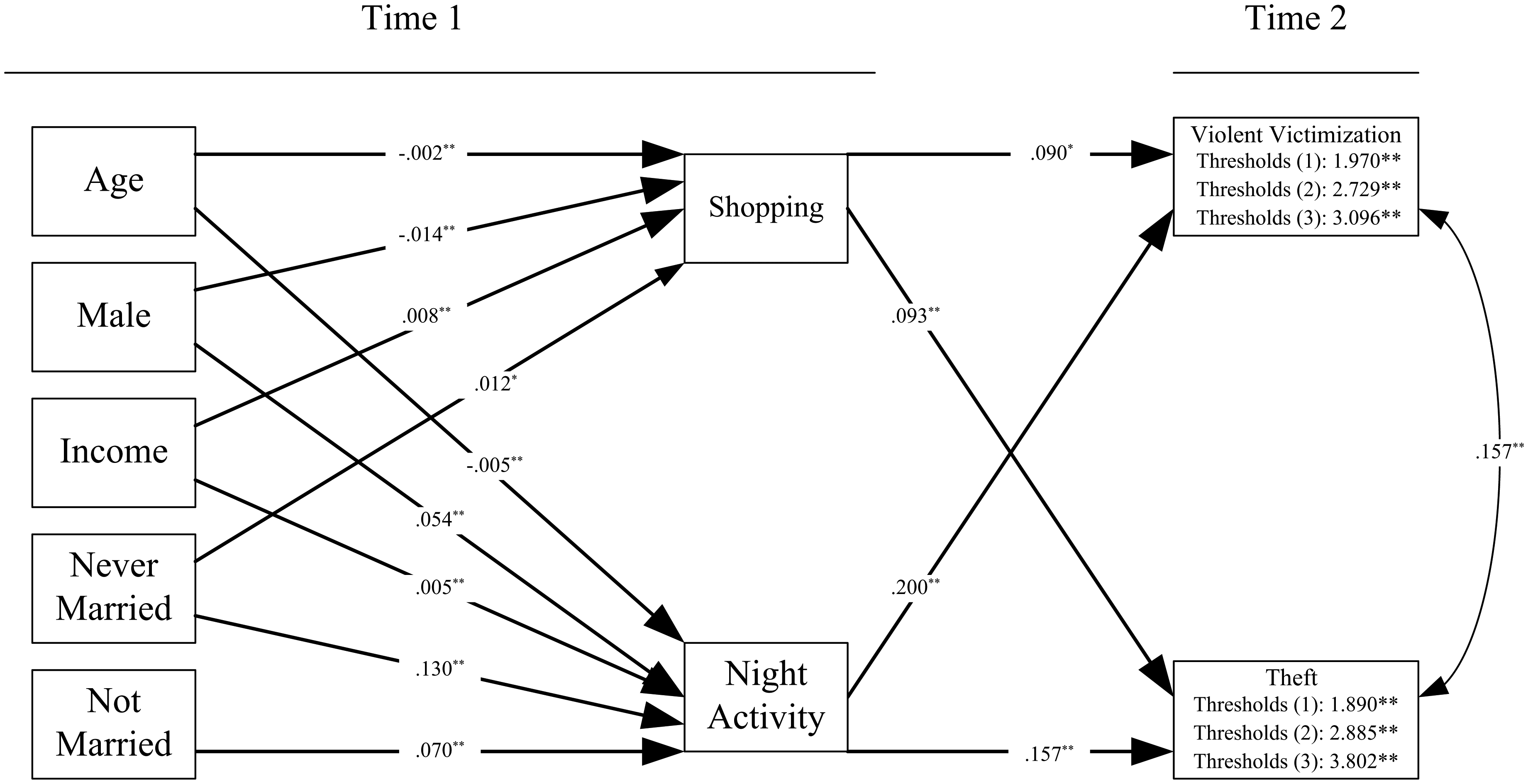
Multivariate ordered logistic regression of crime victimization on demographics and routine activities (N = 48,457).
The overall fit of the model was good. Although χ2(109.769, df = 6) was significant (p = .00), the RMSEA was 0.02, which was well below the value of 0.08 suggested by Hu and Bentler (1999), indicating good model fit. In addition, the CFI (0.94) approaches the cutoff value of 0.95 recommended by Hu and Bentler (1999). Taken together, these data indicate that the model fits the data well.
Only statistically significant paths are shown in Figure 1, and the significant mediating relationships are denoted by bold paths. The path from each demographic variable to shopping is significant except the path from not married to shopping, whereas all the paths from demographics to night activity are statistically significant. Regarding demographics and victimization, the paths from age, male, income, never married, and not married to violent victimization are significant, whereas the paths from age, income, never married, and not married to theft are significant. Both shopping and night activity are significantly related to both types of victimization. Finally, the thresholds for both victimization variables are significant, demonstrating that these dependent variables fit ordinal data. We will now turn to the mediating relationships in the path model. Table 2 displays the indirect effects of each demographic variable through routine activities on both violent victimization and theft. We will discuss these results as they relate to lifestyle-routine activity theory hypotheses.
Significance of the Indirect Effects in the Theoretical Models (N = 48,457).
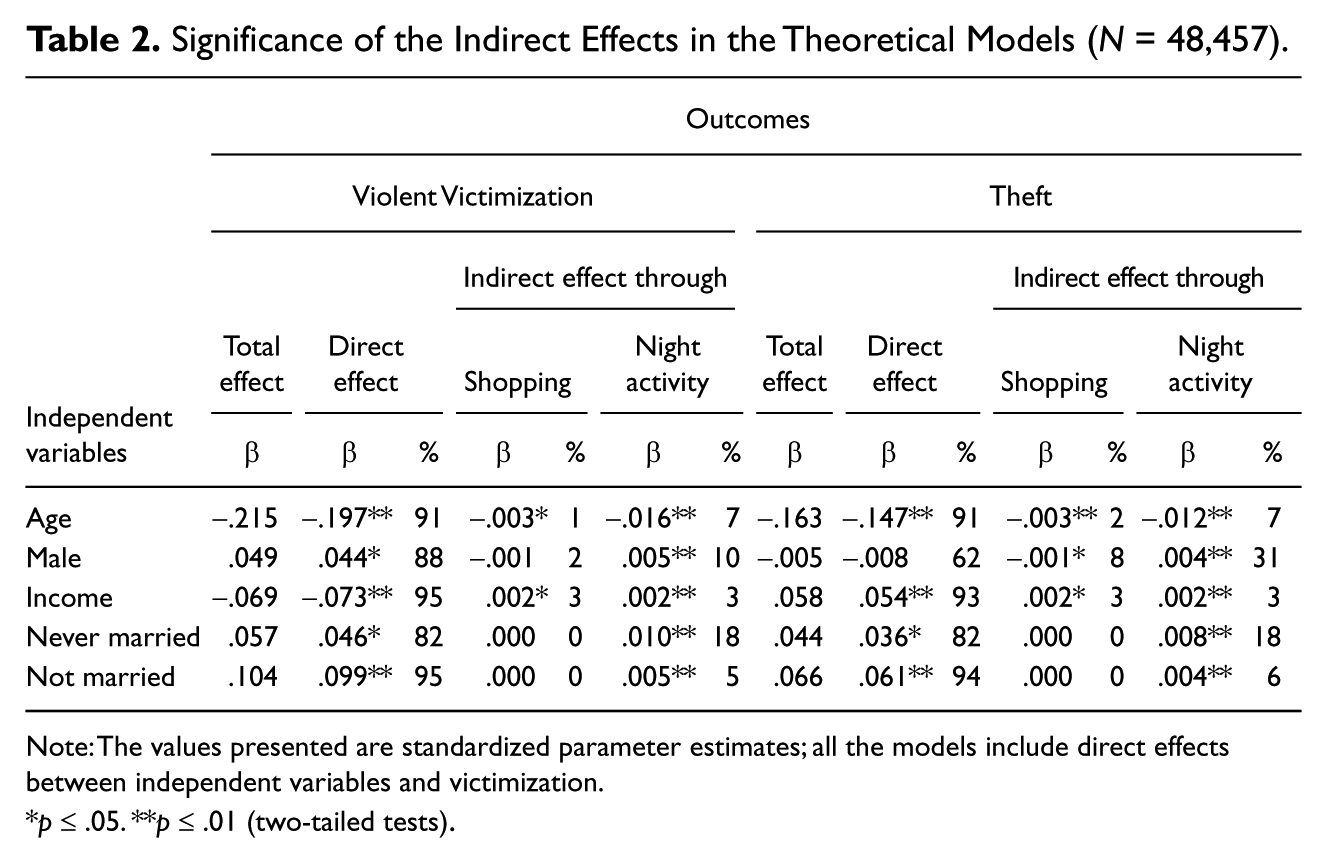
Note: The values presented are standardized parameter estimates; all the models include direct effects between independent variables and victimization.
p ≤ .05. **p ≤ .01 (two-tailed tests).
The results in Table 2 indicate that the effects of age on violent victimization and theft are partially mediated through routine activities. Regarding violent victimization, age has a statistically significant indirect effect through shopping that accounts for 1% of age’s total effect and a significant indirect effect through night activity that accounts for 7% of age’s total effect. Similarly, the effects of age on theft are partially mediated through routine activities. Age has a significant indirect effect on theft through shopping, accounting for 2% of its total effect, and a significant indirect effect through night activity, accounting for 7% of its total effect. These findings suggest that some of the effects of age on violent victimization and theft are mediated by routine activities indicative of a high-exposure lifestyle, providing partial support for theoretical predictions.
The relationship between gender and violent victimization is also partially mediated through routine activities. The indirect effect of male through night activity on violent victimization is statistically and substantively significant, accounting for 10% of male’s total effect. These results indicate that males experience more violent victimizations than females, in part, because they are more likely than women to go out at night, an activity that increases their exposure to victimization. Males had a very small but significantly higher risk of theft victimization than did women. This weak relationship was entirely accounted for by routine activities: Although women increased their relative risk of theft by going shopping every day, men experienced higher levels of overall risk because they were more likely to go out every night, an activity whose effects overwhelmed the effects of shopping.
The effects of income on victimization are partially mediated through routine activities. Poor individuals experience higher levels of violent victimization, whereas wealthy individuals experience higher levels of theft victimization. In addition, wealthy individuals are more likely to engage in the routine activities we examined. As seen in Table 2, income has a significant indirect effect on violent victimization through shopping that accounts for 3% of income’s total effect and a significant indirect effect through night activity that also accounts for 3% of the total effect. This suggests that wealthy individuals increase their risk of violent victimization by shopping and going out at night; however, poor individuals still experience an overall higher risk of violent victimization because other factors overwhelm the effects of these routine activities. This is inconsistent with theoretical predictions from lifestyle theory, because the higher rates of victimization experienced by poor people are not due to the lifestyle factors we examined. Regarding theft, income has a significant indirect effect through shopping that accounts for 3% of income’s total effect and a significant indirect effect through night activity that accounts for 3% of income’s total effect. These findings are consistent with theoretical predictions.
Finally, the effects of marital status on victimization are also partially mediated through routine activities (see Table 2). The indirect effect of never married through night activity on violent victimization is significant and substantive, accounting for 18% of the total effect of never married. Regarding theft, the indirect effect of never married through night activity is significant and accounts for 18% of the effect of never married on theft. These findings indicate that never married individuals suffer more violent victimization and thefts than married individuals, in part, because they go out at night more frequently. 11
Discussion
These results generally support lifestyle theory hypotheses, yet they also indicate that there is insufficient evidence to justify the use of demographic characteristics as proxies for lifestyles. We found that all of our demographic variables—age, gender, income, and marital status—had significant indirect effects on victimization through routine activities. However, contrary to theoretical predictions, in only one instance did routine activities entirely explain the relationship between demographics and victimization: The minor effects of gender on theft were completely mediated through routine activities. Yet, the routine activities we examined are limited in scope and should not be expected to account for all variation in victimization risk. The fact that these two activities partially mediated the effects of demographics on victimization suggests that the core assumptions of lifestyle-routine activity theory are valid.
Age
Of the demographic characteristics we examined in this study, age had the most pronounced effects on both violent victimization and theft. Therefore, although going out at night and shopping explained a relatively small percentage of these effects, the degree of risk mediated through these activities was substantial. Logically, younger people lack the responsibilities that accrue with age, allowing them to go out at night and shop more frequently than older individuals; these lifestyle differences are responsible for some of the age–victimization gap.
Gender
The relationship between gender and violent victimization is one of the most established empirical findings in the victimization literature. Therefore, it is noteworthy that night activity explains a portion of the gender variation in violent victimization risk. It is also notable that the slight but statistically significant gender difference in theft victimization is completely explained by the routine activities included in our model. Although women increased their risk of theft by going shopping every day, men experienced higher levels of overall risk because they were more likely to go out every night. The effects of night activity overwhelmed the effects of shopping, explaining the seemingly contradictory finding that women engage in higher levels of shopping than men yet experience fewer incidents of victimization. As posited by lifestyle-routine activity theory, males and females are socialized into very different roles, and they face quite different structural constraints. In addition, this perspective claims that individuals develop adaptations—consisting of skills and attitudes—to deal with their role expectations and structural constraints (Hindelang et al., 1978). These results suggest, consistent with lifestyle approaches, that a by-product of women’s adaptation to role constraints is decreased exposure to certain forms of victimization.
Income
Household income is negatively related to violent victimization, but the routine activities included in this study did not mediate the effects of income on violent victimization. Interestingly, although wealthy individuals were more likely to go out at night and to go shopping, these activities did not increase their overall level of risk. Perhaps, the heightened risk of violent victimization for poorer people is related to the fact that poor people are more likely to live in high crime areas. As a result, they face greater cumulative risk from participation in a low level of activity outside the home than wealthy people do from a larger number of exposures. A more fine-grained measure of income, in addition to data regarding the income of the community, would be necessary to test this explanation.
Household income is positively related to rates of theft, and the results suggest that a portion of this difference is due to differences in routine activities. Specifically, persons residing in high income households are more likely to go shopping and to go out at night, which increases risk of personal theft. This is logical because leaving the safety of one’s home increases one’s exposure to theft. Having a higher income also makes individuals more attractive targets for theft. Offenders—especially in instances of property crime—choose targets they perceive as likely to yield the greatest reward (Clarke & Cornish, 1985; Cohen et al., 1981; Cornish & Clarke, 1986; Garofalo, 1987; Hough, 1987; Miller, 1998).
Marital Status
Our findings with regard to marital status are particularly interesting. The relationship between marital status and victimization is often overlooked, although it is well established (e.g., Catalano, 2006; Rennison, 2000). In many ways, the underlying theoretical arguments of lifestyle theories are particularly relevant here, as there are clear role expectations and structural constraints associated with marital status. Never-married people often desire companionship or a mate, which involves spending time around strangers, or at least nonfamily members, both of which are associated with victimization (Hindelang et al., 1978). They also lack familial ties that may result from previous marriage. Although the NCVS does not contain information on dating patterns or on whether the respondent has children, it would be interesting to pursue these issues in future research to specify even more clearly the mechanisms through which never-married status increases risk of victimization.
Our findings also highlight the importance of examining multiple categories of marital status. Often, studies simply differentiate between married and unmarried individuals, obscuring the important distinctions between the never married and the not currently married (e.g., Kennedy & Forde 1990; Miethe et al. 1987). 12 This is clearly problematic, given that the NCVS shows that never-married individuals suffer personal victimization at much higher rates than do persons in other unmarried categories (Catalano, 2006; Rennison, 2000). Our results show that although the elevated victimization risk for the never married can be explained by routine activities, routine activities did little to explain why those who were previously married are victimized at higher rates than are married people. This suggests that other theories may be needed to explain high rates of victimization among this group. It is possible, though, that routine activity theory does have an explanation, but one that lies outside the scope of this article: The elevated risk of victimization among the divorced/widowed/separated may stem from reduced guardianship as a result of an increased likelihood of living alone. Such an explanation is consistent with the extant literature and worthy of independent study at the microlevel (e.g., Cohen & Felson, 1979). It would also be interesting to examine the effects of nonmarital cohabitation on routine activities and subsequent risk. Unfortunately, this variable does not exist in the NCVS, so we were unable to address that question here.
Limitations and Future Research
Although our study provides the most comprehensive test to date of the mediation hypotheses of lifestyle-routine activity theory, it is not without limitations. One limitation of our research is the lack of nuanced measures of routine activities. Although the NCVS provides arguably the best data regarding victimization in the United States, the survey’s measures of routine activities are somewhat limited. The use of these types of routine activity measures, however, is fairly typical. Although a few studies have used more detailed measures of routine activities (Fisher et al., 1998; Kennedy & Forde, 1990; Mustaine & Tewksbury, 1998), most of the literature measures routine activities as only the frequency of night activity and/or the major daily activity (e.g., working outside the home). We expanded on past studies by including a relatively overlooked activity, shopping, which is another life activity occurring outside the home (e.g., Corrado et al., 1980; Miethe et al., 1987). In addition, it should be noted that all of the demographic–victimization relationships we examined were at least partially mediated by the routine activities included in this study. So although it is likely that more sensitive routine activities measures would explain larger proportions of the demographic–victimization relationships, the measures included in the NCVS were sufficient to explain partially the relationships under study.
Conclusion
Ultimately, our study demonstrates both the utility of lifestyle theories of victimization as well as the need for ongoing research. We found that age, gender, income, and marital status each had significant indirect effects on victimization through routine activities. However, there was little evidence that routine activities fully mediated the relationships between demographics and victimization: The effects of gender on theft victimization were entirely mediated through routine activities. The fact that we found evidence of even partial mediation using the limited routine activities measures in the NCVS suggests that the basic causal processes that underlie lifestyle theories have at least some validity. Our data are nationally representative, unlike most previous studies (e.g., Corrado et al., 1980; Messner et al., 2007; Miethe et al., 1987; Pratt et al., 2010), suggesting that the results reported here are generalizable. We also use structural path modeling, which offers improved tests of mediation that allow for the determination of statistical significance. Finally, and most importantly, our study uses longitudinal data, which allow us to establish the direction of effects and reduce the influence of a victimization effect on statistical models.
Our study, as well as future longitudinal tests of these mediating hypotheses, can also inform policy. Evidence that certain demographic characteristics predict participation in risky routine activities and subsequent higher crime risk can be used to construct targeted crime prevention programs. For example, our findings with regard to age indicate that increased monitoring of locations where young people gather at night could reduce the age gap in victimization. Similarly, better nighttime lighting of parking and walking areas outside entertainment districts would certainly be beneficial to all residents, but our results suggest this may be particularly effective in reducing men’s risk of victimization, given their tendency to be out at night more frequently than women.
In sum, our research findings suggest the general veracity of the lifestyle-routine activity theory hypothesis that routine activities mediate the relationship that demographic characteristics and victimization risk. The strength of the effects, however, is far from uniform across demographic characteristics or across all routine activities. We hope that future research will be able to tease out some of this variation through the use of more refined lifestyle variables and more discrete measures of demographic characteristics.
Footnotes
Authors’ Note
A previous version of this article was presented at the 2008 meetings of the American Society of Criminology in St. Louis, Missouri. Data used in this study were obtained from the Inter-University Consortium for Political and Social Research (ICPSR).
Declaration of Conflicting Interests
The author(s) declared no potential conflicts of interest with respect to the research, authorship, and/or publication of this article.
Funding
The author(s) received no financial support for the research, authorship, and/or publication of this article.