



Abstract
The handling of rape by the criminal justice system may be intimately intertwined with the gender inequality found in patriarchal communities. The present study examined the empirical relationship between female sociopolitical power and the rape rates and rape case clearance rates of 105 counties in an agrarian state with a reputation for patriarchal culture. The results suggested that, after controlling for contextual variables, counties with higher levels of female sociopolitical power also experienced higher rates of rape, and lower proportions of rape cases cleared by an arrest. The findings suggested that women in patriarchal communities experience a backlash effect as they achieve progress toward gender equality.
Group conflict theory suggests that within-society subgroups of people with similar characteristics develop bonds and engage in intergroup competition to preserve in-group solidarity and justify their exploitation of out-groups (Brewer, 1997; Sumner, 1906). The intensity of this competition usually increases when the subgroups compete for scarce resources and political power (Levine & Campbell, 1972; Sherif, 1966). An outgrowth of group conflict theory has been the racial threat hypothesis, which has seen much use in criminology (Crawford, Chiricos, & Kleck, 1998; Holmes, Smith, Freng, & Munoz, 2008; Parker, Stults, & Rice, 2005; Stolzenberg, D’Alessio, & Eitle, 2004).
While the use of group conflict theory has been applied to racial conflict within the criminal justice literature, the conflict for gender equality in society is an equally valid example of intergroup conflict. Applying the subgroup threat hypothesis as a framework for conflict over gender equality would create the expectation that as women begin to make progress toward sociopolitical equality, men would react through increases in formal and informal means of social control to curtail the perceived rising threat to their sociopolitical superiority. One informal method of social control that has historically been used by men to control women has been rape (Donat & D’Emilio, 1992; Tomaselli & Porter, 1986).
The commission of rape, and a lax reaction by the criminal justice system to these rapes, may serve as an example of social control over women in a community. As sociopolitical power increases among the women in a community, for example, the dominant male population may commit more rapes against women. The male-dominated criminal justice system may also exert less effort in handling rape cases in an effort to maintain male superiority. The present study attempted to test a gender threat hypothesis by investigating the rape reporting rates, and rape case clearance rates, at the county level in a midwestern state with a strong patriarchal and conservative political culture. It was hypothesized that counties with higher levels of progress toward gender equality would experience higher rates of rape and lower rates of rape case clearances through arrest than counties with lower levels of female sociopolitical power.
Literature Review
Group conflict theories hold that societies comprise different interest groups and that conflict between these groups is an inevitable process (Coser, 1956; Simmel, 1908). Groups form in complex societies when peoples share common interests, needs, and characteristics that can best be furthered through collective action. Intergroup conflict occurs when the interests of different groups are perceived as competitive. At that point, the opposing groups join into conflict with each other (Blumer, 1958; Coser, 1956; Simmel, 1908). It has been argued that a considerable part of this conflict involves violence, and history supports this assertion (Holmes & Smith, 2008; Vold, 1958).
While the use of group conflict theory has historically been applied to issues of race within the criminal justice literature (Holmes et al., 2008; Holmes & Smith, 2008), the original macrosociological theories of intergroup conflict were not limited to differences of racial identity. Early studies found that intergroup conflict could be created among research participants randomly assigned to groups, where group identity was entirely contrived by the researcher (Billig, 1976; Tajfel, 1978). Mere knowledge of one’s group membership was often sufficient to trigger psychological association with one’s own group. Therefore, the propositions associated with the racial threat hypothesis should be equally applicable to any clearly delineated social groups in competition for a monopoly on sociopolitical power. The conflict for gender equality in society is also an example of intergroup conflict and the threat hypothesis.
Rape has been one method used in this conflict as research has suggested that rape is less about sexual gratification and more about control and dominance. Groth (1979) described the most common type of rape as a power rape, characterized by the rapist wanting to possess and dominate the victim. Scully (1988, 1990) suggested that most male rapists tend to view women as social opponents, to be reduced to abject powerlessness. The rapist’s perspective is that women control access to certain highly valued commodities, such as their love, affection, sex, and obedience. Obtaining these commodities from women is a competitive process whereby the males must not only compete against each other but also expend great efforts to attract and woo the woman. The male’s efforts, no matter how extensive, still may not be enough to entice a specific woman to share these commodities. Therefore, the rapist prefers to take the commodities by force to win the “game” and beat his “opponent” (Scully, 1988, 1990).
A common theme among rapists is the focus on dominating the victim, rather than simply seeking sexual gratification. It has also been suggested that rape, and the threat of rape, even have sociopolitical motives at the macrosociological level. Rape, the threat of rape, and the social domination of women have a long history of being linked to strongly patriarchal societies. In the late 18th century, the danger of rape was used to justify women’s place in the home, using fear of rape as an excuse to restrict women from working or traveling unescorted outside the home (Brownmiller, 1975; Clark, 1987). The fear induced by the threat of rape led societies to adopt safety precautions that severely restricted women’s freedom, such as never going out alone, never traveling to certain parts of town, and remaining in the company of only women and “trustworthy” men. This fear was used to coerce women to be passive and modest for fear that they would be thought to be provoking a rape (Brownmiller, 1975; Riger & Gordon, 1981).
Russell (1984) argued that rape, and other violence against women by men, is a consequence of the sociopolitical power disparity between the sexes in society. One example of this is the use of rape as a weapon in war. Throughout history, there have been numerous examples of rape being used as a means to conquer, control, and destroy another nation or ethnic group (Epp, 1997; Seifert, 1996). Recent uses of rape have been documented in the former Yugoslavia (Mrsevic & Hughes, 1997; Nikolic-Ristanovic, 1999), Rwanda (Donovan, 2002), and Sierra Leone (Richards, 2002). In these situations, the use of rape was systematized as a formal tool of social control by one national or ethnic group against another, again confirming that rape against women is often a consequence of the sociopolitical power disparities in society.
The intensity of competition between subgroups in any population usually increases when the subgroups compete for scarce resources and political power (Brewer, 1997; Levine & Campbell, 1972; Sherif, 1966). An outgrowth of group conflict theory that has seen considerable application in the criminological literature is threat hypothesis (see, for example, Crawford et al., 1998; Holmes et al., 2008; Stolzenberg et al., 2004). The threat hypothesis proposes that as the relative sociopolitical strength of a marginalized group increases in power in a community, formal and informal means of social control are increased against it by the dominant group. The dominant group seeks to hold on to their sociopolitical superiority and curtail the rising threat they perceive. The increased use of formal social control methods, it is hypothesized, results in increases in stops, searches, arrests, convictions, and sentence lengths targeted at members of the less-dominant group.
Applying the threat hypothesis as a framework for conflict over gender equality would create the expectation that as women begin to make notable progress toward pursuing sociopolitical gender equality, men would react through increasing formal and informal means of social control against women to curtail the perceived rising threat to their sociopolitical superiority. As has been discussed above, one informal method of social control that has historically been used by men to control and frighten women has been rape (Donat & D’Emilio, 1992; Tomaselli & Porter, 1986). Rape not only forces the individual victim into male submission. As news of the rape spreads, other women are reminded of their vulnerability to male aggression and their need to rely upon men for protection (Brownmiller, 1975). The result is often that women are more likely to curtail any personal activities that may be seen as provocative, or potentially put them at risk for victimization, such as going out alone, going to certain parts of town, speaking out publicly, or sometimes even seeking employment (Brownmiller, 1975; Clark, 1987; Riger & Gordon, 1981). Rape may be seen, therefore, as a method of informal social control of women, intended to negate feminist success toward gender equality (Smart & Smart, 1978).
While rape itself may be more easily classified as an informal method of social control in American society, the reaction to these rapes by the criminal justice system may serve as an example of formal social control. Failure to properly investigate rape cases, or arrest perpetrators when evidence exists to do so, increases the impact of these rapes. Rapes generally present a greater degree of forensic and eyewitness evidence than many other felony offenses, such as robbery (M. F. Brown, 2001). Nevertheless, as a backlash to the growth of feminist power, the (mostly male) police who handle these cases may be less sympathetic toward female rape victims. Furthermore, if those who hold significant power over the police and the courts espouse opposition to gender equality, then it can be anticipated that the criminal justice system in general, will be unsupportive of victims of rape.
Previous empirical research on the relationship between female sociopolitical power and rape has yielded inconsistent findings. While three macro-level studies found gains in the sociopolitical power of women decreased the incidence of rape (Baron & Straus, 1987, 1989; Sanday, 1981), three others found it increased the incidence of rape (Austin & Kim, 2000; Baron & Straus, 1984; Ellis & Beattie, 1983). Three of these studies used nations as their unit of analysis (Austin & Kim, 2000; Ellis & Beattie, 1983; Sanday, 1981), while the other three used states (Baron & Straus, 1984, 1987, 1989). Perhaps these inconsistent findings were due, in part, by significant variation in feminist power and rape reporting across such large units of analyses. Conceivably, less variation would exist across cities or counties within the same state or nation, allowing each case to be more internally homogeneous.
The present study, therefore, used county-level data, in a state steeped in patriarchal culture, to study the influence of female sociopolitical power on rape. Specifically, this study tested the predictive strength of female sociopolitical power on rape rates, and rape clearance rates, at the county level in one politically conservative, mostly agrarian state. Assuming that in none of the counties did women dominate in sociopolitical power, it was hypothesized that counties with higher levels of female sociopolitical power would have higher rates of rape than counties with lesser levels of feminist power. Furthermore, it was hypothesized that counties with higher levels of female sociopolitical power would also have lower rates of rape cases cleared by arrest than counties with lesser levels of feminist power.
Method
This study used county-level data on rape, and community characteristics, in all 105 counties in Kansas. This state was chosen based on data availability and its reputation for a strong culture of patriarchy. The vast majority of the state was rural and sparsely populated, agriculture was the primary industry, and small farming towns were the modal communities within in the state. Kansas is also a bastion of political and social conservatism. Almost all the state senators and representatives for the past 100 years have been conservative Republicans. The state has been carried by every Republican presidential candidate since Dwight D. Eisenhower in 1954. Voters in all but the most urban counties of Kansas have consistently opposed political policies in their best financial interests because the bills were introduced by liberals (R. M. Brown, 2002; Frank, 2005; Lowenthal, 2008). This ultraconservative and agrarian culture has caused some to suggest that Kansas has a high level of patriarchy, especially within its rural farming communities (R. M. Brown, 2002; Lowenthal, 2008; Rymph, 2006). Because of this culture, intergroup conflict for political power between women and men may be most evident in an analysis of this state.
This appears to be the case when looking at the state’s crime statistics for rape. In comparison with the rest of the nation, Kansas has a slightly lower-than-average violent crime rate at 452 violent Part I crimes per 100,000 people for the period 2006 through 2010. The national average that 5-year period was 467 violent Part I crimes per 100,000 persons (Federal Bureau of Investigation, 2011). Kansas, however, suffers a much higher-than-average rate of rape, with 44.3 rapes reported per 100,000 population, while the national average was only 30.0 rapes per 100,000 persons (Federal Bureau of Investigation, 2008).
Crime and clearance data were obtained from the Uniform Crime Reports (UCR) published by the Kansas Bureau of Investigation for the 3 years, 2004 through 2006. County demographic data were also obtained from the Kansas Bureau of Investigation, the official State of Kansas website, and the U.S. Bureau of Census.
Counties were chosen as the unit of analysis primarily because of the availability of data at this level. While rape data were available by each reporting agency, and the rapes handled by specific city and town police agencies could be identified, the community location of rapes handled by the sheriff department for the county could not be determined in this aggregate form. While sheriff deputies may investigate rapes in unincorporated areas of the county, they also handle cases within incorporated communities, especially in rural counties. Aggregating up to the county level corrected for this weakness. Furthermore, in rural areas, U.S. Census data are more accessible and complete at the county level. Limiting analysis to one state also carried the benefit of ensuring uniformity in the statutory definitions and case law interpretations of rape, and the evidentiary standards needed for the making of arrests in rape cases.
Dependent Variables
Two dependent measures were used: the average annual number of rapes reported per 1,000 persons in the county and the percentage of these rapes that were cleared by an arrest. The data on reported rapes were collected from the state UCR statistics. Although the data utilized covered the 3-year period of 2004 through 2006, these data were aggregated and treated as cross-sectional in nature for two reasons. First, the reporting of rape occurred very infrequently in many of the state’s most sparsely populated counties. Aggregating the data over time reduced the influence an abnormal event could have on a small county’s crime statistics. Second, not all the data used to calculate the independent variables (such as U.S. Census data) were available for each year of the study, and therefore would lack variability across time, thus preventing longitudinal analysis. While less rigorous than longitudinal data (Campbell & Stanley, 1963), cross-sectional data can provide an accurate picture of associations that existed between variables in the sample at the time of their measurement (Babbie, 1995; Lieberson, 1985). Table 1 provides the descriptive statistics for the two endogenous variables. The rape rate was calculated as the number of rapes reported to the police per 1,000 persons in the population. The percentage of rape cases cleared by arrest appeared to be skewed positively, with a skewness coefficient of 1.41. This measure, therefore, was transformed by its natural logarithm to achieve a normal distribution.
Variable Descriptive Statistics (N = 105).
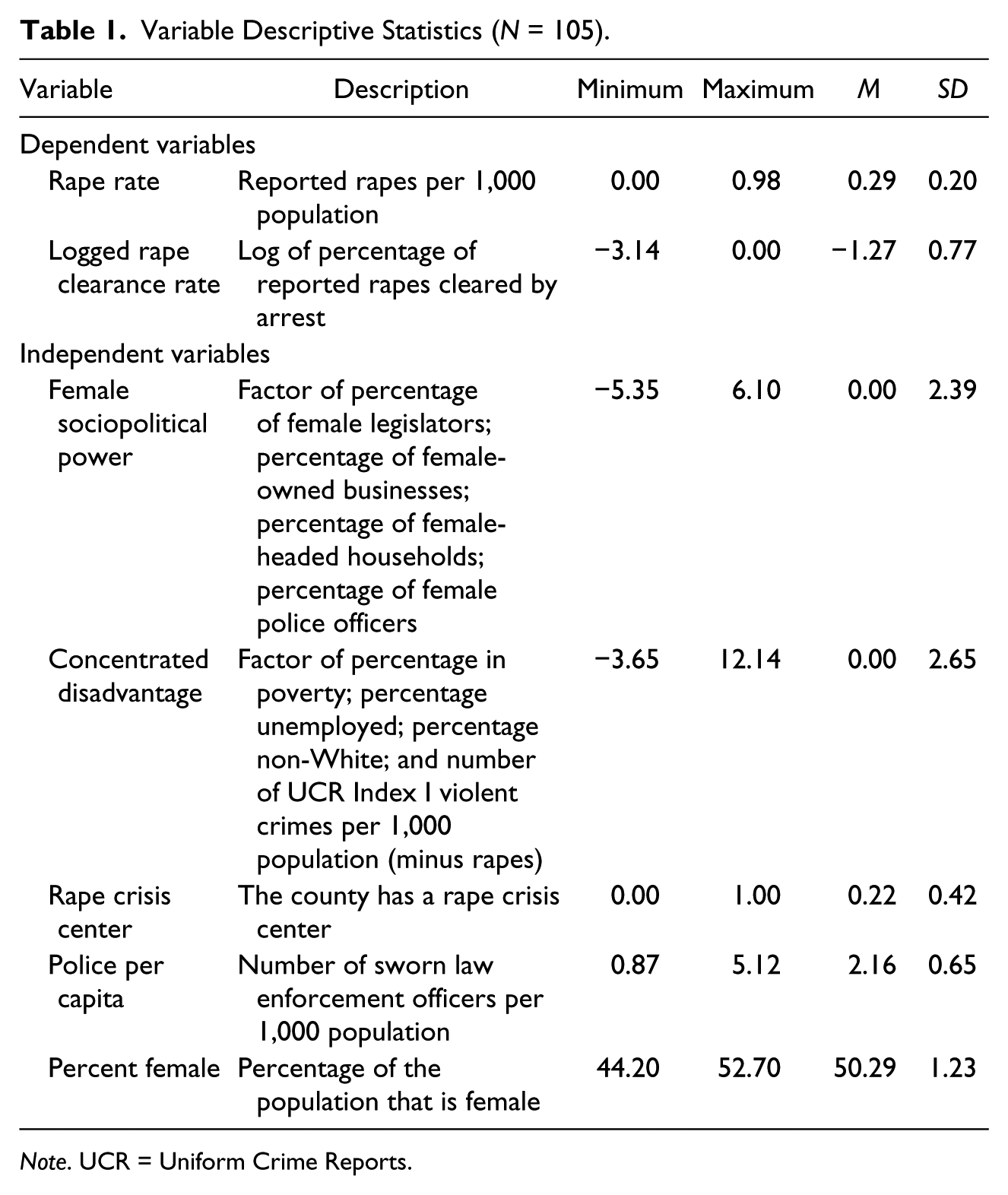
Note. UCR = Uniform Crime Reports.
Independent Variables
The primary exogenous variable of interest to this study was the degree of sociopolitical power women held in each county. Four items were used in the development of this construct for each county: the percentage of female state legislative representatives, the percentage of female-owned businesses, the percentage of female-headed households, and the percentage of law enforcement officers in each county who were female. These items were standardized and summed to create an index. It was assumed that each of these items measured a different dimension of female sociopolitical power, and, in fact, they had a Cronbach’s alpha value of .77. The strength of the Cronbach’s alpha value validated the belief that these items all measured a similar concept, that of female sociopolitical power.
It was also necessary to control for variables that could reasonably be expected to influence the rape reporting and clearance rates in each county. It has been demonstrated that concentrated disadvantage was a strong correlate of violent crime (Krivo & Peterson, 2000; Sampson & Groves, 1989), rape rates (Baron & Straus, 1987, 1989; Berger, Neuman, & Searles, 1994), and rape clearance rates (Berger et al., 1994; Roberts, 2008). A measure of concentrated disadvantage, therefore, was created and included in the model. Following the precedent of previous scholars (Sampson & Bartusch, 1998; Sampson & Groves, 1989), concentrated disadvantage was operationalized as an index measure of percentage in poverty, percentage unemployed, percentage non-White, and the violent crime rate (minus rapes) for each county. These items, mostly obtained from U.S. Census statistics from the 2000 census, were standardized and summed to create the index.
The presence of a rape crisis center in the county may encourage more victims to report rapes, in which case the rape rate could increase merely because of a higher reporting rate. This is critical because of the generally low reporting rate for rape. The presence of a rape crisis center, therefore, was added as a control variable, and only 22% of the counties had such a center.
Berger and associates (1994) reported that the number of police officers per capita had a positive, though weak, correlation with the clearance rate for rape cases. Data on the number of sworn law enforcement officers employed in each county were obtained from the Kansas Bureau of Investigation for the years 2004 through 2006. The number of officers per 1,000 persons was then averaged across the 3 years of data.
Finally, the last control measure was the percentage of the county population in the 2000 Census that was female. This variable had not been included in the measure of feminist power because it lacked a significant correlation to the other variables used to make that index measure. (The inclusion of percentage female dropped its Cronbach’s alpha value to .32.) This variable was thus included as an independent measure of opportunity, on the assumption that a higher ratio of men to women could result in a higher likelihood of rape due to fewer opportunities to mate through legitimate means (Ghiglieri, 1999; McKibbin, Shackelford, Goetz, & Starratt, 2008; Thornhill & Palmer, 2000).
Results
The first step in the analysis was the testing of bivariate relationships among the variables. Table 2 reveals the Pearson’s r coefficients in a bivariate correlation matrix of all the variables in the study. As can be seen in this table, a strong, statistically significant, and positive correlation existed between county rape rate and female sociopolitical power. This suggested that as female power increased, the rate of rape also increased. A strong, statistically significant, and negative correlation existed between rape clearance rate and female sociopolitical power, suggesting that as female power increased, proportionately fewer arrests were made in rape cases. At least at the bivariate level, then, both research hypotheses of this study were supported.
Pearson’s r Bivariate Correlations.
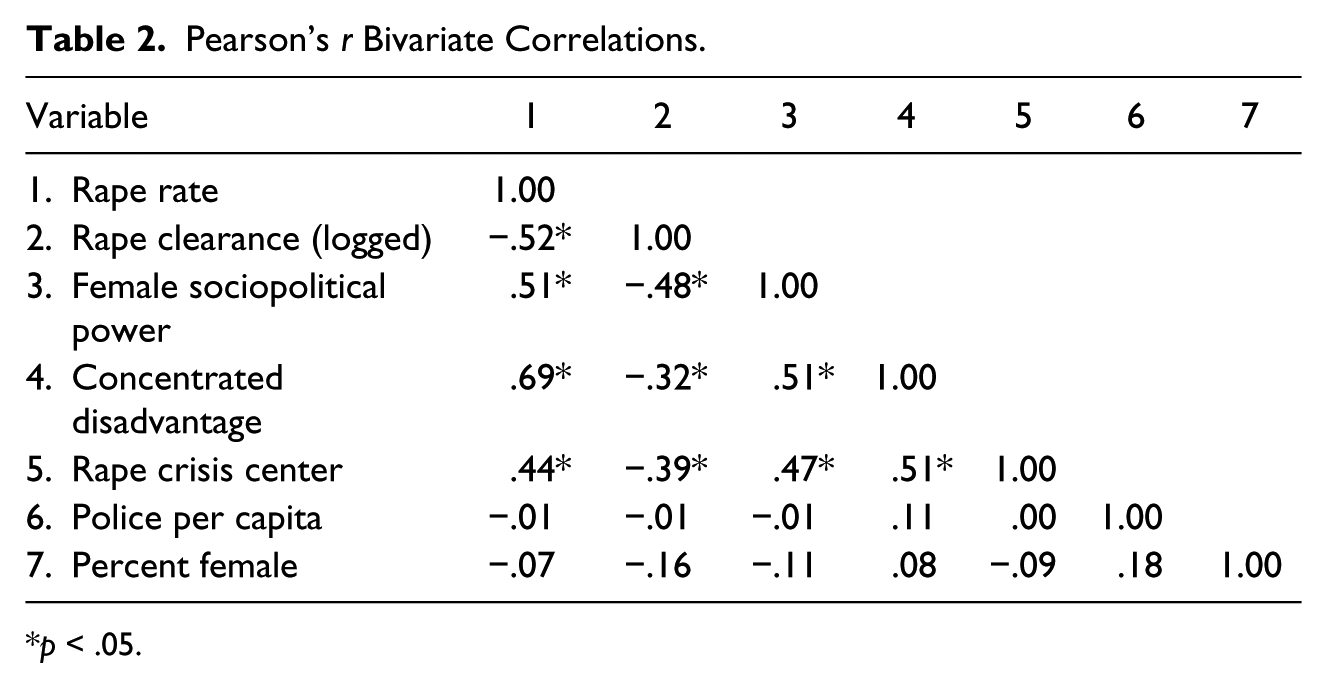
p < .05.
Table 2 also revealed that two of the other independent variables were correlated with each of the dependent variables. Concentrated disadvantage and rape crisis center were positively correlated with rape rate and negatively correlated with rape clearance rate. In addition, a strong, negative correlation was revealed between the two dependent variables. As the rape rate increased, the rape case clearance rate decreased. This finding suggested that rape rate needed to be included as a control variable when predicting rape clearance rates.
In the bivariate matrix, little evidence of multicollinearity existed among the independent variables. Only the two strongest Pearson’s r coefficients obtained between the independent variables were of any concern. These were the relationship between female sociopolitical power and concentrated disadvantage (r = .51), and between concentrated disadvantage and rape crisis center (also r = .51). Further exploration, therefore, was conducted by calculating the variance inflation factors (VIF) for the multivariate models. The VIF values of the independent variables all ranged from 1.078 to 1.623, all well below the conservative conventional threshold of 5.0. These methods confirmed the lack of collinearity among the independent variables.
The next step in the analysis was to explore the multivariate effects of the exogenous variables on the logged reported rape rate of each county. This was estimated using ordinary least squares (OLS) regression, and the results are presented in Table 3. As can be seen by the R2 value in this table, this model explains a moderate amount of variance in rape reporting rates. The five independent variables in the model explain more than 36% of the variance in this dependent variable. Nevertheless, only two of these independent variables were statistically significant predictors, at the p < .05 level, of rape rates. Most notably was female sociopolitical power. This variable was not only a statistically significant predictor of rape rate, and associated in the hypothesized direction, its standardized coefficient (β) revealed that it was the second strongest predictor in the model. Another OLS regression model estimate (not displayed here in tabular form) using female sociopolitical power as the only independent variable produced an R2 value of .29, revealing the great explanatory power this variable had on rape rate. These findings supported the first research hypothesis, as female sociopolitical power increased, rape rate increased.
Ordinary Least Squares Estimates for Rape Rates (N = 105).
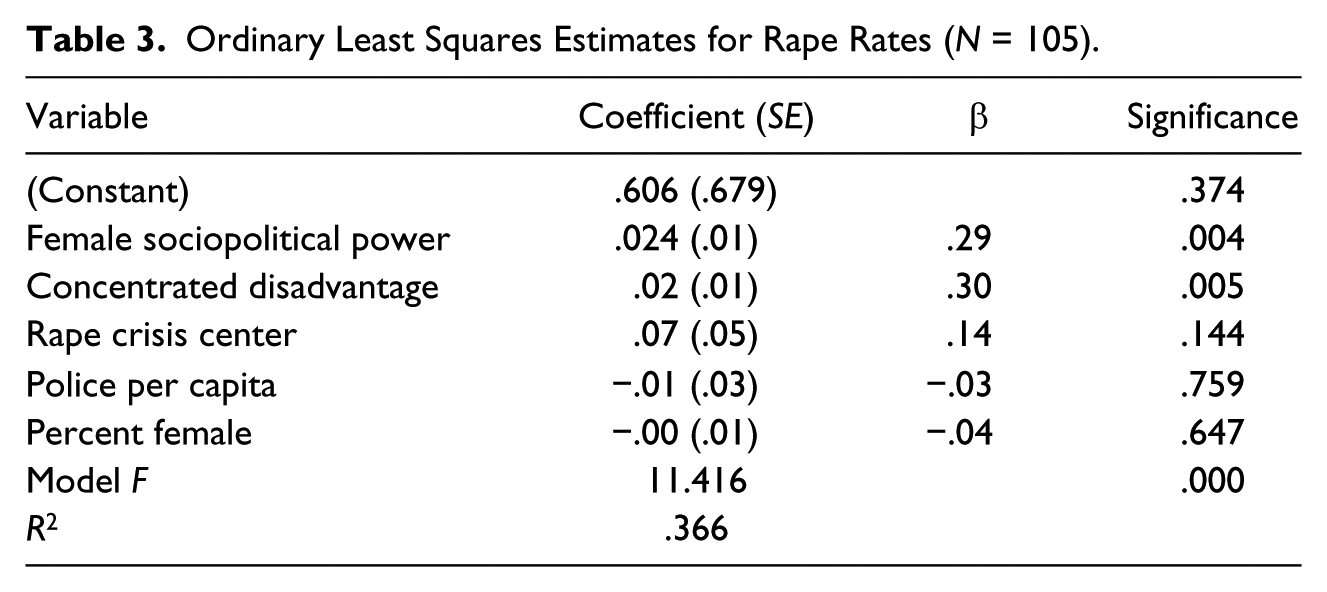
The other independent variable in the model to reach statistical significance at the p < .05 level was concentrated disadvantage, which possessed the strongest beta value in the model. As concentrated disadvantage increased, proportionately more rapes were reported as well. Despite their contributions to the model’s explanatory power, the remaining three independent variables—rape crisis center, police per capita, and percentage female—did not rise to the level of statistical significance.
The third step in the analysis was to explore the multivariate effects of the exogenous variables on the rape case clearance rate of each county. This was also estimated using OLS regression, and the results are presented in Table 4. In this model, however, an additional independent variable was added. Because of the strong negative correlation revealed between rape rate and rape clearance rate in the bivariate analysis, the logged county rape rate was included as an independent variable within the multivariate analysis for rape clearance rates. The model in Table 4 revealed a moderate level of explained variance as the model R2 value was .414, slightly higher than the model for rape rates.
Ordinary Least Squares Estimates for Rape Clearance Rates (N = 105).
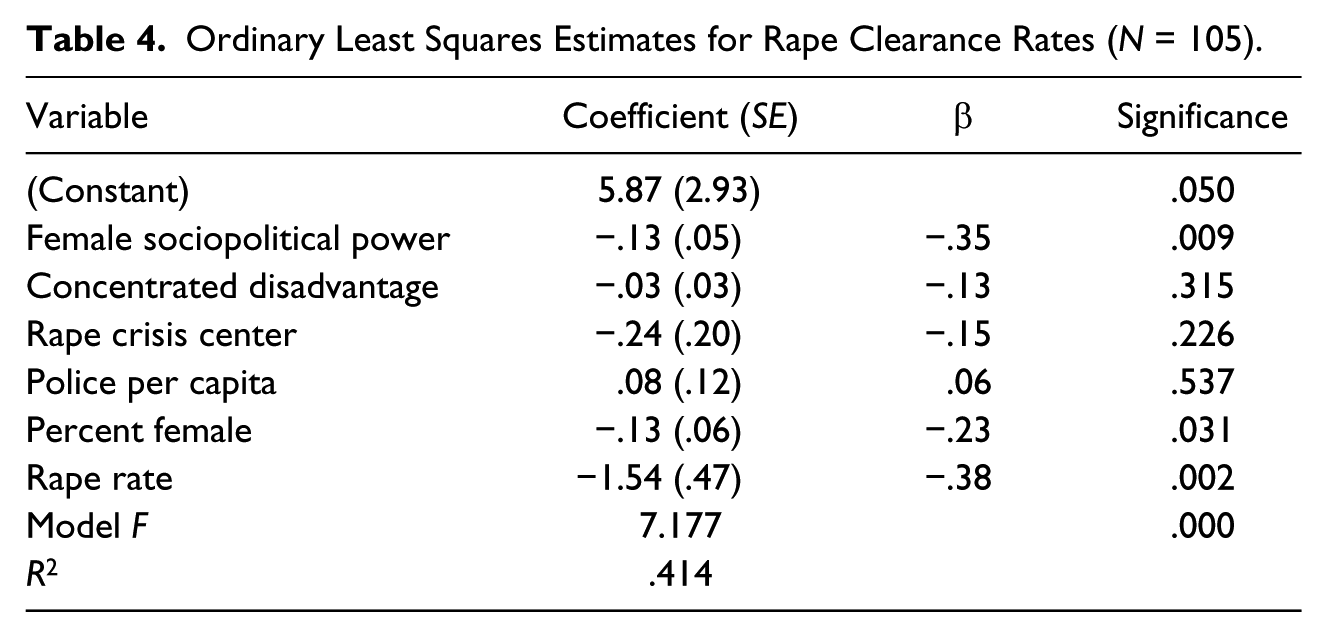
Unlike the model for the first dependent variable, in the OLS regression model estimated for rape case clearance rates, three of the six independent variables were statistically significant predictors. Female sociopolitical power, percent female, and rape rate were found to be statistically significant predictors of rape clearance rate at the p < .05 level. As female sociopolitical power increased, the proportion of reported rape cases that were cleared by an arrest declined, thus supporting the second research hypothesis. In addition, increases in the percentage of females in the population and the reported rape rate each corresponded to decreases in rape clearance rates.
The standardized coefficients in the model revealed that the strongest predictor in the model was the county reported rape rate, suggesting that as the proportion of rapes reported to the police increase, there is a strain on resources, making arrests less likely (Geerken & Gove, 1977). The percentage of females in the population was the third strongest predictor, demonstrating that as the proportion of women in the population increases, the proportion of rape cases cleared by arrest decreases, distantly related to the female sociopolitical power issue. Finally, even after controlling for the potential drain on police resources, female sociopolitical power was still statistically significant, and the second strongest predictor in the model. Another OLS regression model estimate (not displayed here in tabular form) using female sociopolitical power as the only independent variable produced an R2 value of .26, again revealing the explanatory power this single variable had on logged rape clearance rate.
Discussion
The purpose of this study was to explore the influence of female sociopolitical power on rape and rape clearance rates in a state argued to possess a culture of patriarchy. Using intergroup conflict theory (Coser, 1956; Simmel, 1908; Sumner, 1906) as a framework, it was hypothesized that as female sociopolitical power increased, a backlash effect would be detected in the form of an increased rape rate and a decreased rape clearance rate. Previous tests of the rape rate hypothesis, comparing nations (Austin & Kim, 2000; Ellis & Beattie, 1983; Sanday, 1981) and states (Baron & Straus, 1984, 1987, 1989), produced mixed findings. The present study, however, found support for both the rape rate, and rape clearance rate, hypotheses with county-level data.
Regarding reported rape rate, counties with higher levels of female sociopolitical power also tended to experience higher rates of rape. The previous literature identified other factors that also predicted community rape reporting rates, such as concentrated disadvantage (Berger et al., 1994; Roberts, 2008) and police officers per capita (Berger et al., 1994). One of these correlates—concentrated disadvantage—proved significant in the present analysis. Concentrated disadvantage was positively correlated with rape rate in the bivariate analysis. It remained a statistically significant predictor in the multivariate analysis. After controlling for other potential correlates, however, female sociopolitical power remained a statistically significant predictor of rape rate, and the second strongest predictor in the multivariate model tested. When tested alone, female sociopolitical power explained more than a quarter of the variance in rape rates between counties.
One would assume that the urban counties of the Kansas City, Wichita, and Topeka metropolitan areas, with their higher proportions of police officers, rape crisis centers, concentrated disadvantage and violent crime, would also have higher levels of female sociopolitical power and higher rates of rape. Cosmopolitan, urban areas could be assumed to have higher levels of male–female equality than smaller, rural, farming, and ranching towns. Due to the effects of the control variables, the findings of the present study, however, suggest that even in the sparsely populated, rural counties, with low crime rates, more female sociopolitical power is associated with higher rates of rape, and vice versa. Increases in the proportion of female-headed households, female-owned businesses, female politicians, and female police officers appeared to motivate more rapes in the county, regardless of its urban or rural nature, or overall violent crime rate.
In the case of rape clearance rates, counties with higher levels of female sociopolitical power tended to experience a lower proportion of rape cases cleared by an arrest. As with rape rates, the previous literature identified other factors that also predicted rape clearance rates; some of these correlates, in fact, proved significant in the present analysis. At the bivariate level, reported rape rate, concentrated disadvantage, and rape crisis center all held statistically significant, inverse relationships with rape clearance rates. In the multivariate analysis, reported rape rate and concentrated disadvantage remained statistically significant predictors of rape clearance rate. After controlling for the influences of these other correlates, however, female sociopolitical power remained a key predictor of rape clearance rate. It was the second strongest predictor in the model and explained roughly a quarter of the variance in rape clearance rates between counties.
These findings suggested that one explanation for rape rates, and rape clearance rates, is gender conflict over sociopolitical power. One can easily imagine that in sparsely populated, rural farming and ranching counties, the sociopolitical power growth of women would be highly visible. In rural communities, where there is little anonymity (Weisheit, Falcone, & Wells, 1999), the presence of female business owners, politicians, police officers, and heads of households would be very evident. It would also be easy to assume that as a community experienced increases of women in positions of authority, their influence in the community would deter rapes of women for fear of the power they wield. It could likewise be easy to assume that when rapes do occur in such an environment, where few strangers exist and perpetrators are far more easily identified, that most rapes would result in at least an arrest, if not prosecution. After all, in rural communities where women are increasingly involved in legal, political, economic, and familial leadership, it would be expected that they would exert pressure on the criminal justice system to identify, apprehend, and punish perpetrators of rapes against women. Yet the findings here did not support any of these assumptions.
As female involvement increased in the areas of legal, political, economic, and familial leadership in these communities, they actually experienced higher rates of rape. Furthermore, when these rapes occurred, the male perpetrators were decreasingly arrested for their offenses. How can this be? One explanation is that the maximum levels of sociopolitical power women have attained in these communities fall far below any level needed to exert significant influence on the criminal justice system or the norms of the community. For example, among the 95 nonmetropolitan counties in Kansas, the mean percentage of female-headed households was only 4.8%, the mean percentage of female-owned businesses was 14.7%, and the mean percentage of female police officers was 4.6%. The percentage of female legislators in the nonmetropolitan counties was less than 50%.
These generally low percentages of representation in leadership suggest that the female sociopolitical power achieved thus far in rural Kansas is far from the level needed for significant political influence. At present, it only poses a threat to the dominant patriarchal culture. Perhaps if the degree of female sociopolitical power were to increase beyond a potential “tipping point,” where the influence of feminist power begins to be felt in the community, reductions in rapes and increases in rape case clearances would be detected. This may also explain the inconsistent findings of the previous literature. The relationship between female sociopolitical power and rape is likely curvilinear. As the power of women in a patriarchal society begins to increase, it starts to pose a threat to male society. Males, who dominate the power within the community, use formal and informal methods of social control (including the act of rape and the neglect of rape cases) to counter the growing threat posed by women. When the women in the community are able to gain and exceed a substantial foothold of economic and political power, this may result in a gradual decline in the ability of males to wield formal and informal methods of social control against them. One way to test for this curvilinear effect, and identify a “tipping point” along the curve, would be by using longitudinal data, which brings us to a discussion of the limitations of the present study.
Like all the similar studies before it (Austin & Kim, 2000; Baron & Straus, 1984, 1987, 1989; Ellis & Beattie, 1983; Sanday, 1981), the present study involved a cross-sectional analysis. The use of cross-sectional data severely limits the ability to detect trends that occur over time (Babbie, 1995). Cross-sectional data also create difficulty in determining temporal order between the independent and dependent variables, thus restricting a researcher’s ability to prove causation from mere correlation (Babbie, 1995). Future research on female socioeconomic power and rape needs to be conducted longitudinally, to observe for the development of a linear or curvilinear relationship.
A second limitation of the present study was that it only involved one state. Although the purpose for doing so was to illustrate the struggle for power and protection of women in a patriarchal environment, this decision also ran the risk of being influenced by cultural peculiarities limited to that state. The sample size was also limited as a by-product, but the strengths of the correlations between the primary variables of interest were so great that they still easily reached statistical significance. Future research, however, should not only be longitudinal but also involve a diverse sample of communities that include strongly patriarchal cultures and openly liberal cultures.
A third limitation was the necessary reliance on official statistics. While this was less of an issue with regard to rape clearance rates, there is abundant evidence that rapes themselves are one of the most underreported crimes (Brownmiller, 1975; Lizotte, 1985). The strongest empirical predictor of the likelihood of reporting a rape and the seriousness of the victim’s injuries (Bachman, 1998; Clay-Warner & Burt, 2005; Du Mont, Miller, & Myhr, 2003) are assumed to be randomly distributed across the counties in this study. No evidence existed to suggest that seriousness of victim injury was associated with community-level features. The official statistics also did not differentiate between rapes of women and rapes of men. There is strong evidence, however, that men are raped far less often and are much less likely than women to report their victimization (Elliott, Mok, & Briere, 2004; Monk-Turner & Light, 2010).
In summation, the gender conflict theoretical assumption developed here to explain the differences between counties in rape and rape clearance rates provided a remarkably proper fit with the data. In spite of the methodological limitations of using cross-sectional data, a fundamental cause of rape, especially in areas of high degrees of patriarchy, is sociopolitical gender conflict. Research and social policy designed to reduce rape should focus greater attention on the underlying causes of violence against women, including social, political, and economic gender inequality.
Footnotes
Declaration of Conflicting Interests
The author(s) declared no potential conflicts of interest with respect to the research, authorship, and/or publication of this article.
Funding
The author(s) received no financial support for the research, authorship, and/or publication of this article.