




Abstract
This study tests Osgood, Wilson, O’Malley, Bachman, and Johnston’s extension of the routine activity theory of individual deviant behavior by considering adolescent time spent socializing with peers in virtual settings in relation to estimates of delinquency and substance use. The growth in digital communication has significantly changed the ways that youth commonly communicate with one another, and such changes may therefore provide a specification of newly emerging situational inducements that precipitate antisocial behavior during adolescence. Using data from a school-based survey of adolescents, the analyses reveal that the amount of virtual time adolescents spend socializing with peers is positively related to the frequency of alcohol use, marijuana use, and a variety index of delinquent behavior. Less support was found for an association between virtual time spent with peers and individually separated property/violent offending behaviors. The implications of these findings are discussed.
Introduction
The work by Osgood, Wilson, O’Malley, Bachman, and Johnston (1996) represents a significant contribution to our understanding of the role that spending time with peers plays in the etiology of delinquency and crime. Drawing on the routine activities perspective (Cohen & Felson, 1979) and the lifestyles explanation of criminal behavior (Hindelang, Gottfredson, & Garofalo, 1978), Osgood and colleagues contend that unstructured socializing with peers away from capable guardians during adolescence and young adulthood creates situational inducements for deviance. In support of Osgood et al.’s claims, a number of studies find that adolescents and young adults who spend greater time socializing with peers in unstructured settings are more likely to engage in a variety of deviant behaviors (e.g., Anderson & Hughes, 2009; Augustyn & McGloin, 2013; Barnes, Hoffman, Welte, Farrell, & Dintcheff, 2007; Haynie & Osgood, 2005; Maimon & Browning, 2010; Osgood & Anderson, 2004), and that such peers do not have to be deviant to induce delinquency (Haynie & Osgood, 2005; Meldrum, Young, & Weerman, 2009).
While research provides evidence that unstructured socializing with peers has a delinquency-facilitating effect, there are a number of ways in which this area of research should be advanced. Pertinent for present considerations, it is important to recognize that youth now spend a considerable amount of time socializing with one another over the Internet, on cell phones, and via text-messaging applications. Such “virtual” forms of socializing are now widespread. For instance, a nationally representative study conducted in 2009 by the Pew Research Center found that 72% of all U.S. teenagers between the ages of 12 and 17 text-message or “instant-message” others (Lenhart, Ling, Campbell, & Purcell, 2010). Furthermore, this study also found that, whereas in 2006 only 27% of teens reported text-messaging others on a daily basis, by 2009 this figure had risen to 54% of all teens.
Given the increasing prevalence of virtual forms of socializing with peers by today’s youth, an important issue to consider is the extent to which this form of unstructured socializing may generate opportunities and inducements for delinquency and substance use. As Osgood et al. (1996) noted, This classification of activities [time spent in informal, unsupervised socializing with peers] is sufficiently general to be applicable across time and across social groups, providing the possibility for assessing whether social change or cross-cultural differences in time spent this way translates to differences in rates of deviance. (pp. 637-638, italics added)
Virtual time spent socializing with peers among today’s youth represents a significant social change within the past two decades that has altered the way in which youth now commonly socialize with one another. Indeed, Warr (2002) has stated that “[t]echnological developments have greatly increased opportunities for communication among adolescents” and “[t]oday the internet offers round-the-clock communication with friends and few geographic boundaries” (pp. 86-87). Moreover, virtual forms of socializing can be instant, discreet, and carried out away from the watchful eyes of parents and teachers, which may serve to increase the possibility that this kind of socializing could be related to delinquent behavior and substance use.
This study is the first of its kind to focus on virtual time spent in unstructured socializing during adolescence in relation to delinquency and substance use. The data used are uniquely suited to investigating the relationships of interest in that they contain items intended to directly measure virtual time spent socializing with peers. Furthermore, it accounts for a number of demographic and theoretically relevant control variables to better isolate the influence of virtual time spent socializing with peers on the outcomes of interest. Prior to describing the present study, readers will be provided with a more thorough understanding of the theoretical and empirical research on time spent socializing with peers in relation to delinquency. Next, attention is given to the increasing role that virtual time spent socializing with peers plays in the lives of today’s youth, and reasons are presented as to why it should be expected that this specific form of socializing should be related to delinquency and substance use.
Routine Activities Theory and Unstructured Socializing With Peers
The routine activities perspective developed by Cohen and Felson (1979) emphasizes the role that daily routine activities play in the distribution of the opportunities to commit crime and potential exposure to victimization. According to Cohen and Felson (1979), crime should be more likely to take place in situations where a motivated offender locates suitable targets in the absence of capable guardians that would discourage criminal offending. While this theory has been used to explain patterns of victimization and aggregate crime rates (e.g., Cohen, Cantor, & Kluegel, 1981; Kennedy & Forde, 1990; Messner & Tardiff, 1985), it was not until Osgood and Colleagues’ (1996) reformulation of the theory that individual patterns of offending became a focus of the routine activities perspective.
Osgood and colleagues’ (1996) perspective emphasizes the immediate opportunities presented by specific situations as the primary source of individual criminal offending. According to Osgood et al., three factors make the situation of unstructured time with peers in the absence of authority figures more conducive to delinquency. First, Osgood and colleagues posited that in the presence of peers, deviant acts become easier and more rewarding. Delinquent acts become easier because companions can serve as useful resources in the commission of acts. For example, companions can act as a lookout or provide an extra set of hands in the commission of a theft, as an avenue to illicit markets, or as a source of backup or protection in a fight. Furthermore, Osgood and colleagues argue that deviant acts are more rewarding in the presence of peers given the “symbolic rewards of enhanced status and reputation.” The authors further state, “[d]eviant exploits bolster a social identity as brave, adventuresome, or tough only when they come to the attention of others. The presence of friends may not be required to garner status, but it enhances credibility” (p. 639). Thus, delinquent acts are rewarding not just for the pleasure or gain from the act itself, but also to the extent that it enhances reputation or creates admirations among peers.
Osgood and colleagues’ (1996) specific focus on the social rewards of delinquency in peer groups would seem to suggest that the theory may not be viewed as wholly incompatible with other theoretical perspectives that argue normative influence processes explain why associating with peers should be related to delinquent behavior (Akers, 2009; Sutherland, 1947). For example, Augustyn and McGloin (2013) argue that situational context can both immediately promote delinquency as well as shape attitude and beliefs toward future offending to be in greater congruence with one’s peers. The role of peers in the creation of social status and identity suggest that the rewards of delinquency reside, in part, beyond the time frame or situational confines of unstructured socialization. Instead, these “social rewards” of delinquent behaviors indicate that youth are embedded in existing social networks. Moreover, Osgood and colleagues’ perspective does not assume that everyone is equally receptive to the temptations of situations conducive to deviance. Indeed, situational inducements may be attenuated by other individual and structural characteristics.
The second factor that Osgood and colleagues (1996) identify as critical to marking unstructured socializing as conducive to delinquency is the absence of authority figures, which reduces the potential for social control responses. Osgood and colleagues refer to authority figures as someone whose role it is to exert social control in response to deviance, such as a parent, police officer, teacher, or store clerk. Thus, the absence of someone to exert control or limits on delinquent behaviors naturally makes such acts more likely. Osgood and colleagues theorize that the social control function resides in the authority figure’s role obligations within a situational context, not in the social bond between the potential offender and the agent of control.
Third, Osgood and colleagues (1996) posit that unstructured time spent with peers provides a time frame in which delinquent acts may be committed. The lack of structure leaves time available for deviant behavior. Thus, the time spent in delinquent acts is part of the unstructured time spent with peers. For example, Snyder and Sickmund (2006) found that the time after school (between 3 p.m. and 6 p.m.), which is often characterized as unstructured time that youth spend in the company of one another, is also the peak time for violent offending and victimization for youths between the ages of 12 and 17.
For the reasons discussed above, Osgood et al. (1996) view unstructured socializing with peers in the absence of authority figures as a situation conducive to delinquency. Similar to Gold’s (1970) analogy of group delinquency to a “pickup game” of basketball, Osgood and colleagues emphasize that deviance is often spontaneous and opportunistic. Moreover, individuals who spend more time in criminally conducive situations have higher deviance rates. In support of these claims, a growing body of research provides evidence that unstructured, unsupervised socializing with peers is related to a variety of deviant behaviors, including violent and nonviolent forms of delinquency and crime (Anderson & Hughes, 2009; Maimon & Browning, 2010; Meldrum et al., 2009; Osgood & Anderson, 2004), substance use (Augustyn & McGloin, 2013; Greene & Banerjee, 2009), dangerous driving (Osgood et al., 1996), and sexual activity (Barnes et al., 2007). Importantly, this line of research finds such effects to be independent of a number of competing theoretical variables. For example, using data from The Netherlands, Meldrum et al. (2009) found that unstructured socializing with peers was a strong predictor of delinquency, independent of self-control, parental attachment, attachment and commitment to school, and peer-reported measures of delinquency. Thus, the theoretical and substantive significance of unstructured socializing with peers appears to be well established.
Virtual Time Spent in Unstructured Socializing
Despite the growing body of evidence in support of Osgood et al.’s (1996) reformulation and application of routine activity theory to individual patterns of offending, research to date has neglected to consider the full range of contexts in which adolescents and young adults spend time with one another in today’s society (Weerman, Bernasco, Bruinsma, & Pauwels, 2013). Specific to the present study, an argument can be made that unstructured socializing that takes place in virtual spaces may have effects on deviant behavior that are similar to those found in the literature previously discussed. The advent and widespread adoption of the Internet, mobile “smart” phones, e-mail, and social-networking websites has shifted the way in which adolescents now socialize with one another, and the utilization of such technologies may be related to deviant behavior.
Several recent studies reveal the growing use of technologies that facilitate virtual time spent socializing with peers. For example, a recent nationally representative study found that nearly 75% of all teens utilize “instant-messaging” programs, and more than half do so daily (Lenhart et al., 2010). Another recent study further illustrates the prevalence of socializing in virtual spaces: 7th- to 12th-grade students who have access to instant-messaging technologies spend an average of an hour and a half a day text-messaging others (Rideout, Foehr, & Roberts, 2010). This same study also found that 85% of 15- to 18-year-olds have their own cell phone and that 69% of 11- to 14-year-olds have their own cell phone. With regard to time spent engaged in social-networking, Rideout et al. (2010) report that adolescents spend more time engaging in social-networking while using a computer than any other computer activity (e.g., playing games, visiting video websites, etc.). Importantly, a common theme emanating from this line of research is that these forms of virtual socializing are becoming more and more common, which only increases the importance of focusing upon the influence that virtual socializing with peers may have on deviant behavior.
There is a good reason to suspect that virtual time spent socializing with peers could be related to delinquent behavior and substance use in particular. Just as unstructured socializing with peers on a street corner or in a park might create situational inducements for delinquency, so too may time spent socializing with peers on the phone, via text-messaging, or on social-networking websites. This should be particularly true because individuals can communicate with others discreetly and without the knowledge of guardians or handlers. For example, consider the ease with which an adolescent can discreetly text-message a friend from the back seat of his parent’s car and make plans to meet up with that friend to smoke, drink, or engage in other deviant behavior. On this point, one recent study that analyzed the content of adolescent text-messages found several examples where study participants openly discussed deviant behavior in text-messages with friends, including things like drug-related behavior (Underwood, Rosen, More, Ehrenreich, & Gentsh, 2012). Similar examples could emerge from conversations held between friends on sites such as Facebook, AOL’s Instant Messenger program, or Skype. The point to emphasize is that the Internet, smart phones, and instant-messaging services make planning potentially deviant activities with friends easier, and make it more difficult for potential guardians and handlers to exert social control responses.
The association between virtual time spent socializing with peers and delinquent behavior is particularly well suited to examine specific factors of situational inducements presented in Osgood et al.’s (1996) framework. Virtual peer association resembles face-to-face unstructured association in many fundamental ways; such as the absence of authority figures in both forms of association may contribute to delinquency. However, counter to Osgood et al.’s conception of unstructured socialization as an available time frame in which delinquent acts may occur, time spent with peers in virtual communication does not offer the same immediate opportunities. For example, it is relatively easy for youths in face-to-face socializing with peers to smoke marijuana together, commit acts of vandalism, start a fight, or shoplift. However, youth in virtual communication may be limited by geographical proximity to peers, thus tempering the spontaneous nature of delinquent acts as well as limiting the opportunity of youth to engage in meaningful assistance or support in commission of crimes. Thus, in contrast to Osgood et al.’s conception of situations conducive to delinquent behaviors as immediate, extemporaneous, and ephemeral, time spent with peers in virtual communication may be conducive to delinquency simply because it lacks the presence of authority figures. Furthermore, virtual peer association creates a social space where youth can engage in the planning of delinquent behaviors more easily and/or express values and beliefs favorable toward delinquency (e.g., via text-messages, Twitter feeds, Facebook wall posts, or blogging websites). We do acknowledge that some forms of delinquent and antisocial behavior take place in “virtual space,” such as cyber bullying (Agatston, Kowalski, & Limber, 2007; Hay & Meldrum, 2010), media piracy (Higgins, 2005), and sexting (Lenhart, 2009). However, the focus of our analysis is on behaviors that are relatively common and have been examined in prior research on situational inducements.
To date, only one study that we are aware of has explicitly examined the relationship between virtual time spent with peers and delinquency. Weerman and colleagues (2013) recently utilized space–time budget data to examine the relationship between time spent with peers and delinquency in a variety of contexts, one of which included the number of hours participants spent making phone calls or using web-based social interaction software (e.g., chatting, using Skype, or Facebook). Their analyses revealed positive and statistically significant bivariate, but not multivariate, associations between virtual time spent with peers and delinquency. Yet, outside of this single study, little is known about the potential relationship between virtual time spent with peers and both substance use and delinquency.
Present Study
The implications of unstructured socializing in the physical presence of peers has received significant attention and points to a positive relationship with various forms of delinquency and crime (Augustyn & McGloin, 2013; Haynie & Osgood, 2005; Maimon & Browning, 2010; Meldrum et al., 2009; Osgood et al., 1996). However, virtual time spent socializing with peers has not been adequately examined as a correlate of substance use, delinquency, or crime. It is important to address this issue given the now ubiquitous use of the Internet, instant-messaging, and “smart” phones by youth. As a result of these technologies, adolescents have almost unlimited, unsupervised access to quick and discrete communication with peers that may foster opportunities to commit delinquent acts or engage in substance use. This possibility, however, has heretofore been unexamined by researchers. In light of this, the purpose of the present study is to extend Osgood et al.’s (1996) individual-level routine activities theory to virtual forms of unstructured socializing. Based on the aforementioned reasons as to why virtual time spent socializing with peers could hold implications for deviant behavior, we hypothesize that this form of unstructured socializing during adolescence should be positively related to estimates of substance use and delinquency.
Method
Participants
Participating in the study were 426 adolescents who attended one of two selected schools, one middle school and one high school, in a rural, relatively poor county of a southeastern state during the spring of 2008. The average age of participants was 15. The sample was split evenly between males and females. Non-Hispanic Whites were the most represented racial/ethnic group (70% of the sample). In addition, family disruption was common in the sample—only 51% of participants reported living in a household with their mother and father.
Procedure
Participants were recruited because of their attendance at two schools that were participating in a large-scale funded project concerned with improving the quality of data collection and reporting of problem behavior in the school setting by public schools in the state. Using the standards set by the school district, a passive consent procedure was followed. Permission forms were distributed to all students 1 week prior to the survey administration, and students were excluded from the study if parents returned the form asking that their child be excluded. Overall, this procedure allowed for a near complete census of the two schools’ populations, with 93% of attending students participating in the study. Each participating student then completed an anonymous, self-administered, pencil-and-paper questionnaire during normal school hours. The survey could be completed in approximately 30 min, was limited to closed-ended questions (most of which had ordinal or nominal response categories), and used optical scanning technology that allowed for machine coding. Each subject was given a small incentive (a candy bar) for completing the survey.
Measures
Substance use and delinquency
Seven dependent variables were considered for the present analysis. The first two pertain to substance use and measure how often respondents reported they used marijuana and alcohol in the previous 12 months. Never (=1), rarely (=2), sometimes (=3), and often (=4) were offered as potential responses. The five remaining variables pertain to delinquent behavior and measure how often respondents reported engaging in petty theft (<$50), major theft (>$50), vandalism (with destroying property or spraying graffiti offered as examples), using violence toward others (hitting or kicking someone with the intent of harming them), and trespassing (entering into a structure without the owner’s permission). Once again, never (=1), rarely (=2), sometimes (=3), and often (=4) were offered as potential responses. In addition to considering each of the seven items separately for the analyses, we also constructed a variety index based upon these items. To construct this measure, we first recoded each of the seven items so that a response of never was coded as 0, whereas a response of rarely, sometimes, or often was coded as 1. We then summed across the seven items to create the variety index (α = .79).
Virtual time spent socializing with peers
The independent variable of interest for the present analysis is a three-item measure (α = .74) that taps into the amount of time respondents spend socializing with their peers in virtual settings. Participants were asked to indicate on a typical Saturday how many hours they spend talking on the phone with friends, text-messaging with friends, or e-mailing with friends. For each of the three items, response categories ranged from zero hours to five or more hours. The variable presented in the analysis was created by taking the average of the three items, with higher scores indicating greater virtual time spent socializing with peers.
Traditional time spent with peers
We account for traditional time spent in unstructured socializing with peers given that the association between virtual time spent with peers and the deviant behaviors considered could be an artifact of traditional time spent socializing with peers. Traditional time spent with peers was measured with a two-item scale (α = .72) in which participants were asked to indicate on a typical Saturday how many hours they spend with friends (a) when no adults are present and (b) at a public place. For each of the two items, response categories ranged from zero hours to five or more hours. The variable presented in the analysis was created by taking the average of the two items, with higher scores indicating greater time spent socializing with peers.
Parental social control
Parental social control was measured with a 10-item scale (α = .92) in which participants were asked to indicate their agreement (strongly disagree, disagree, agree, strongly agree) with various statements about their social interaction with parents. These items are quite similar to those found in other studies that have examined the effects of parenting on delinquent behavior (Burt, Simons, & Simons, 2006; Hay, 2001) and they pertain to such things as the consistency of rule-setting and supervision (e.g., “She/he knows where I am when I am not at home”), and the use of discipline that is fair and well explained (e.g., “the punishments I receive are fair”). The 10 items were averaged together, with higher scores indicative of higher quality parenting.
Time spent with parents
In addition to accounting for parental social control we also included a two-item measure (α = .77) that taps into the amount of time respondents spend with their parents. Participants were asked to indicate on a typical Saturday how many hours they “spend with their parent or guardian” and “how many hours they spend doing something fun with their parent or guardian.” For each of the items, response categories ranged from zero hours to five or more hours. The variable presented in the analysis was created by taking the average of the two items, with higher scores indicating greater time spent with parents.
Self-control
Given that prior work indicates a consistent, negative effect of self-control on deviant and delinquent behavior, and that failing to include self-control in empirical models may result in model misspecification (Pratt & Cullen, 2000), an eight-item measure (α = .85) was included that is drawn from Grasmick, Tittle, Bursik, and Arneklev (1993). Specifically, the survey questionnaire included eight items pertaining to the impulsivity and risk-seeking subscales in light of prior research indicating the importance of these two elements of low self-control (see Longshore, Turner, & Stein, 1996; Piquero & Rosay, 1998). These items asked respondents to indicate how much they agree (strongly disagree, disagree, agree, strongly agree) that they prioritize the short run over the long run, do things at the spur of the moment, neglect thoughts about preparing for the future, emphasize pleasure in the here and now, enjoy testing oneself with things that are risky, take risks just for the fun of it, find it exciting to do things that can create trouble, and prioritize excitement and adventure over security. Before scale construction, all items were recoded so that higher values indicate greater self-control, and the final measure was constructed by taking the average of the eight items.
Control variables
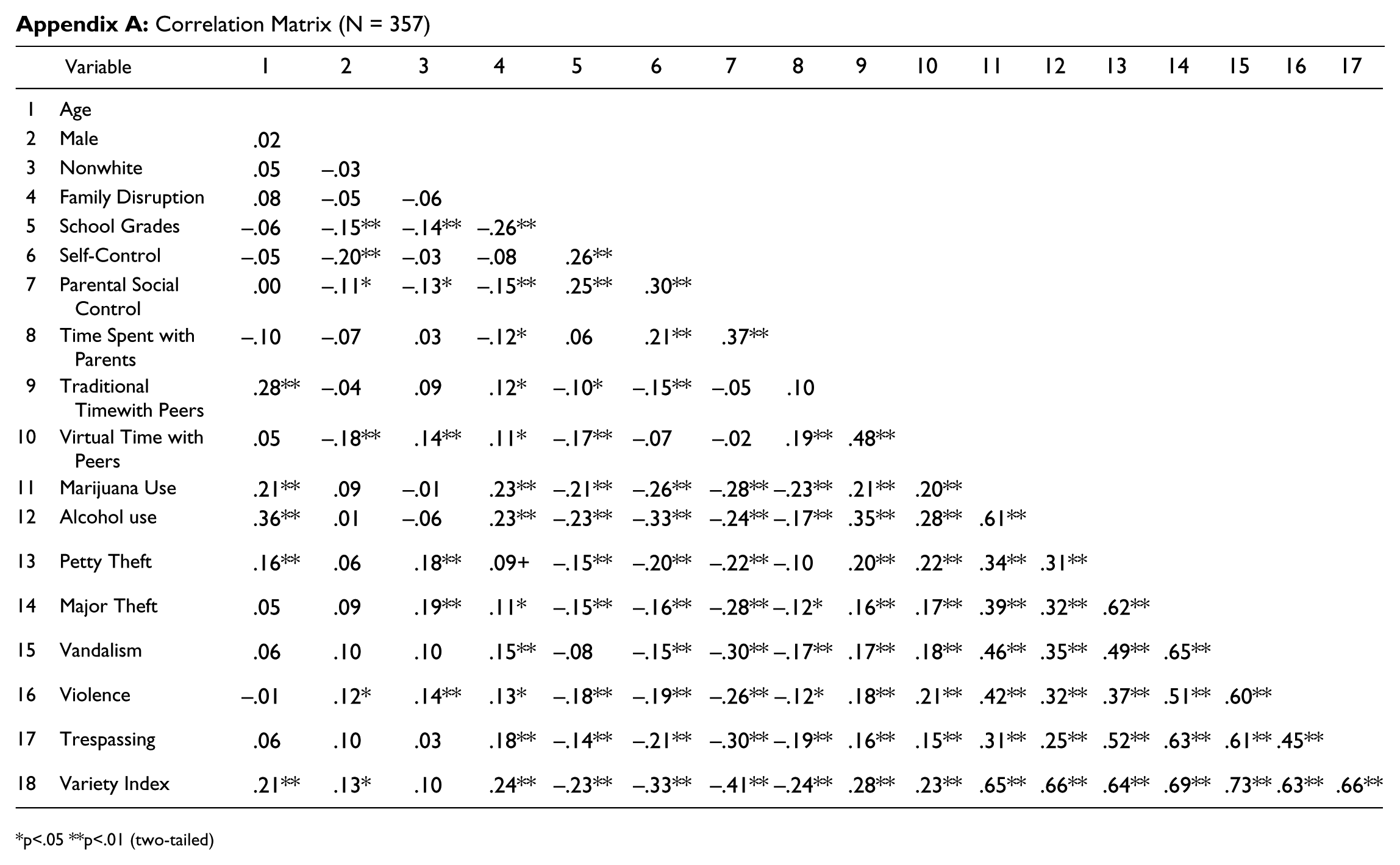
Four demographic control variables were included: age (measured in years), sex (male = 1), race (non-Hispanic White = 0, all others = 1), and family disruption (living with mother and father = 0, all others = 1). Last, to capture school commitment, a measure of self-reported school grades from the last report card (1 = mostly Fs, 2 = mostly Ds, 3 = mostly Cs, 4 = mostly Bs, 5 = mostly As) was included. Of the 426 individuals who participated in the study, full information on all variables included in the analysis was available for 357 students. A series of t tests were conducted to determine whether or not individuals with data missing on each of the analysis variables were substantively different from those without missing data. These analyses suggested that eliminating respondents with missing data is not problematic; all t-values were less than 1.00. Table 1 provides the descriptive statistics for the sample of study participants with complete data on all variables, while Appendix A provides the correlation matrix.
Descriptive Statistics (N = 357).

Prior to presenting the results, it is important to note that a decision was made not to include in the analyses controls for perceptual indicators of peer delinquency and substance use in the previous 30 days, which were available in the data set. Following Osgood and Anderson’s (2004) logic, including these items is inappropriate because these items are conceptually more proximal to delinquency, suggesting that these indicators may mediate the effect of time spent with peers (see, for example Greene & Banerjee, 2009). Thus, controlling for such indicators could remove the true effects of time spent with peers measures. In addition, from a measurement standpoint, research provides evidence that perceptual indicators of peer behavior partially reflect processes beyond normative influence, such as projection (Kandel, 1996; Young, Barnes, Meldrum, & Weerman, 2011), and that the use of perceptual measures of peer behavior downwardly biases estimates of individual-level theoretical variables (Haynie & Osgood, 2005; Meldrum et al., 2009). Unfortunately, the design of the study did not allow for the collection of social-networking data, which has been utilized in previous studies to obtain direct indicators of peer delinquency that are free of projection mechanisms. Importantly, however, this line of research indicates that physical time spent with peer measures predict involvement in different forms of deviance regardless of whether direct peer delinquency measures are included in the analyses (Augustyn & McGloin, 2013; Haynie & Osgood, 2005; McGloin & Shermer, 2009).
Analytic Method
As is common in the delinquency literature (see Osgood, Finken, & McMorris, 2002), the distribution of responses for each of the items used to measure substance use and delinquency was highly skewed, with the majority of respondents reporting that they never engaged in each of the behaviors under consideration within the last 12 months. As a further consideration, we cannot say with any degree of certainty that the difference between each of the response categories for the dependent variables is equal (never, rarely, sometimes, or often). Given these conditions, for the portion of the analysis where each of the seven dependent variables is considered separately, we use ordered logistic regression. For the portion of the analysis that examines the relationship between the variety index of substance use/delinquent behavior and virtual time spent with peers, we use negative binomial regression for two reasons. First, the variance for the variety index is greater than its mean. Second, 46% of respondents reported they did not engage in any of the seven behaviors included in the variety index.
Results
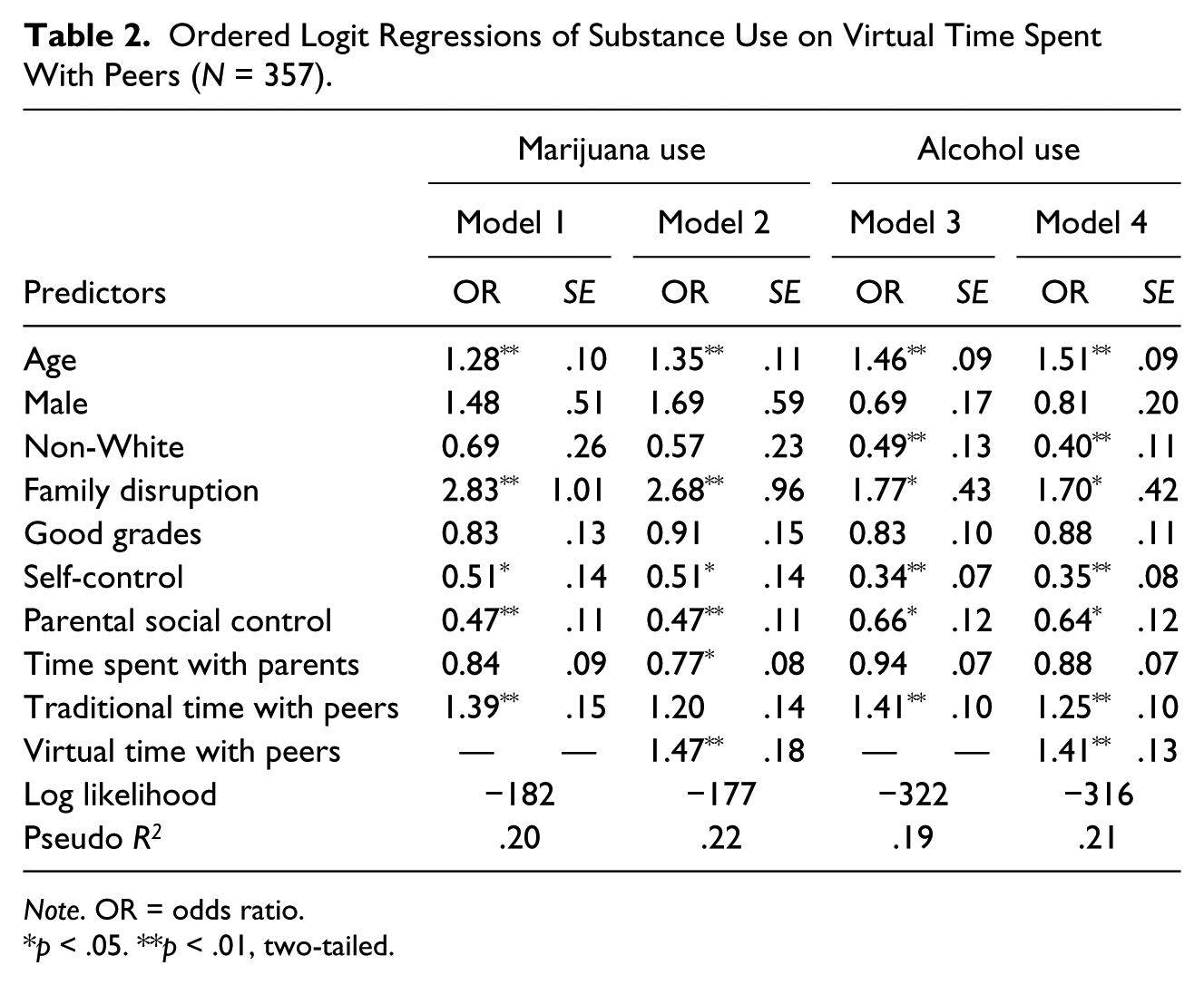
The analysis began by considering the relationship between virtual time spent socializing with peers and substance use. To examine this possibility, four ordered logistic regression equations were estimated, with the first two pertaining to marijuana use and the latter two pertaining to alcohol use. The results for these equations are shown in Table 2. Model 1 excludes the measure for virtual time spent socializing with peers and indicates that respondents who are older (odds ratio [OR] = 1.28; p < .01), who experience family disruption (OR = 2.83; p < .01), and who spend greater time traditionally socializing with peers (OR = 1.39; p < .01) report an increase in the frequency of marijuana use. Model 1 also reveals negative effects for self-control (OR = 0.51; p < .01) and parental social control (OR = 0.47; p < .01).
Ordered Logit Regressions of Substance Use on Virtual Time Spent With Peers (N = 357).
Note. OR = odds ratio.
p < .05. **p < .01, two-tailed.
Model 2 adds the measure for virtual time spent socializing with peers, and provides initial support for the hypothesis that spending greater amounts of time virtually socializing with peers is related to substance use. In particular, net of all other variables, the OR for virtual time spent with peers predicting marijuana use is 1.47 (p < .01). Model 2 also reveals that parental social control and self-control continue to exhibit significant, negative effects on the frequency of marijuana use, while age and family disruption continue to exhibit significant, positive effects.
Turning attention to alcohol use, Model 3 indicates that individuals who are older (OR = 1.46; p < .01), who experience family disruption (OR = 1.77; p < .05), and who spend greater traditional time socializing with peers (OR = 1.41; p < .01) report an increase in the frequency of alcohol use in the previous 12 months, while individuals who are non-White (OR = 0.49; p < .01), have higher self-control (OR = 0.34; p < .01), and who experience greater parental social control (OR = 0.66; p < .05) report a decrease in the frequency of alcohol use. Model 4 adds the measure for virtual time spent socializing with peers and provides further support for the contention that virtual time spent socializing with peers is related to the frequency of substance use. Specifically, the odds ratio for virtual time spent with peers is 1.41 (p < .01). It is also worth noting that the effect for traditional time spent with peers remains statistically significant in this model (OR = 1.25; p < .01). Taken together, the results reported in Table 2 indicate that virtual time spent socializing with peers during adolescence is related to an increase in the frequency of both marijuana and alcohol use, even after taking into account a number of competing theoretical variables and a traditional measure of time spent with peers.
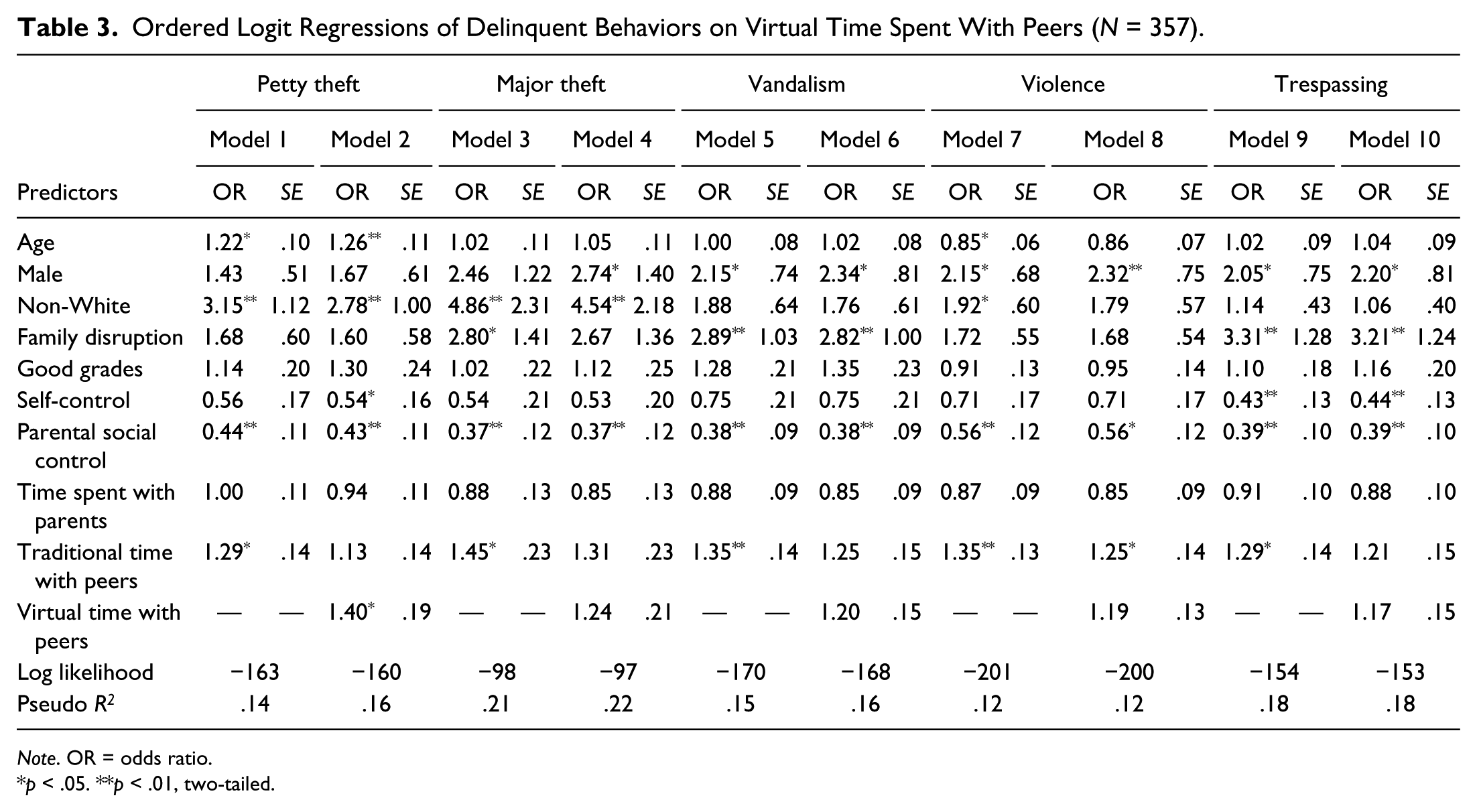
We next considered the relationship between virtual time spent socializing with peers and delinquency. To examine this possibility, 10 ordered logistic regression equations were estimated. The results of these equations are presented in Table 3. Models 1 and 2 pertain to petty theft; Models 3 and 4 pertain to major theft; Models 5 and 6 pertain to vandalism; Models 7 and 8 pertain to violence; Models 9 and 10 pertain to trespassing. Regarding the effects of variables other than virtual time spent socializing with peers, some general patterns emerged across the different models. First, across all models, parental social control was consistently and negatively related to the frequency of delinquent behavior. Second, self-control was negatively related to each of the outcomes of interest across all models, but the effect only reached conventional levels of statistical significance in 3 out of 10 models. Third, family disruption, race, and sex were positively related to an increased likelihood of delinquency across each of the models, but the effects only reached statistical significance in a limited number of models. Finally, consistent with prior research, a traditional measure of time spent socializing with peers was positively related with each of the deviant behaviors, but the effect only reached conventional levels of statistical significance in 6 out of the 10 models.
Ordered Logit Regressions of Delinquent Behaviors on Virtual Time Spent With Peers (N = 357).
Note. OR = odds ratio.
p < .05. **p < .01, two-tailed.
Turning attention to the effect of virtual time spent socializing with peers on each of the five delinquent behaviors considered, there is only qualified support for what was hypothesized. To be sure, the odds ratios for virtual time spent with peers in each of the five models that included the measure were in the predicted direction. However, only in the model predicting petty theft (Model 2) did the effect of virtual time spent with peers reach conventional levels of statistical significance (OR = 1.40; p < .05). Thus, in these data, virtual time spent with peers is significantly related to the frequency of substance use, net of traditional measures of time spent with peers and a variety of controls, but this relationship is far less pronounced when delinquent behavior is the focus.
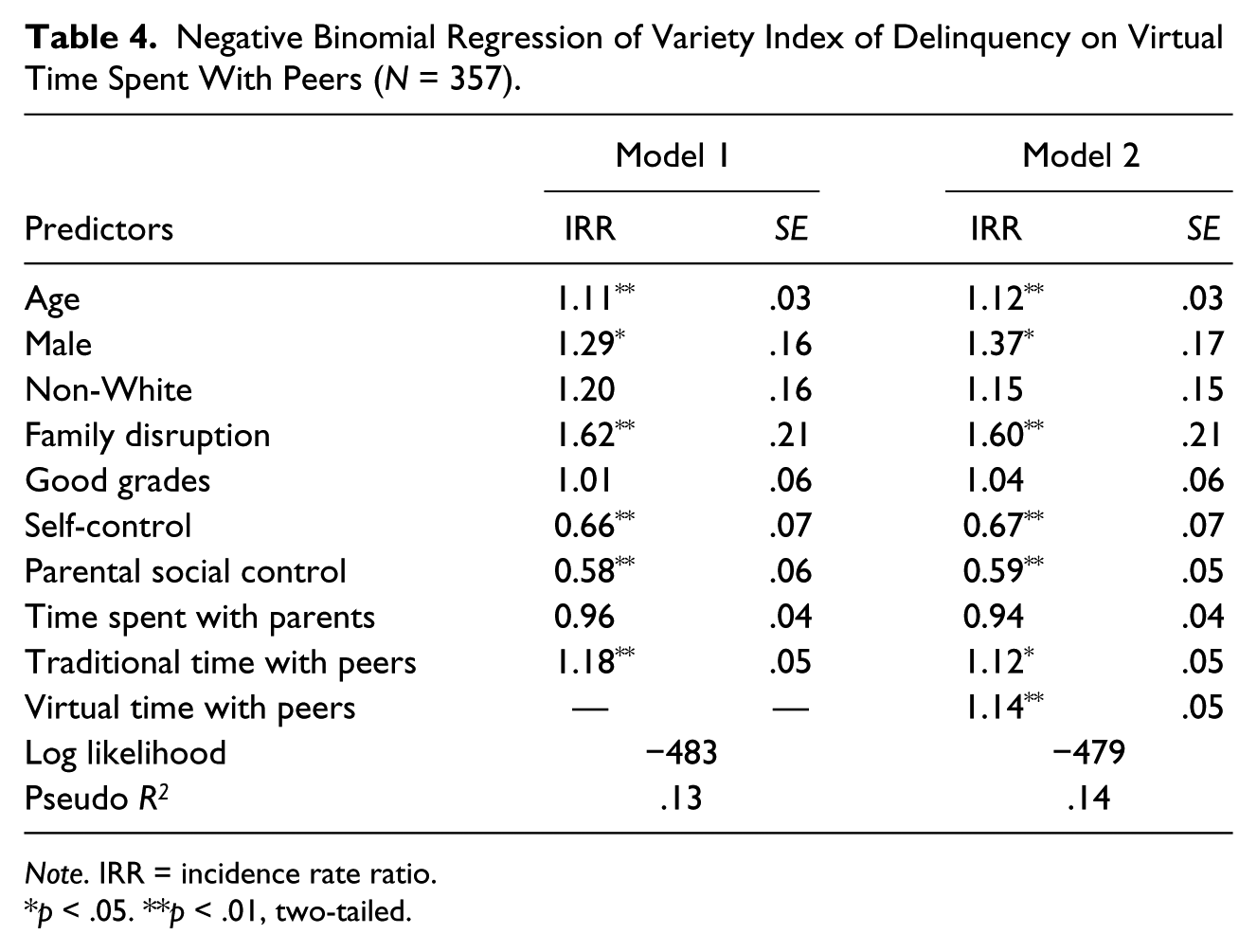
As a check of the robustness of the results reported in Tables 2 and 3, we conducted additional analyses. First, we recoded each of the dependent variables into dichotomous measures, where a response of “never” was treated as a value of 0 and any other response (rarely, sometimes, or often) was treated as a value of 1, and estimated a series of logistic regressions. Informatively, these results (available on request) were substantively the same as the results that have been presented and discussed. Second, we estimated two negative binomial regression models where the dependent variable was the variety index of substance use and delinquent behavior described in the data section. The results of these equations are reported in Table 4. We discuss the results in terms of the incidence rate ratios (IRRs), where estimates greater than 1.00 indicate a positive effect of a predictor variable on the dependent variable and estimates smaller than 1.00 indicate a negative effect of a predictor variable on the dependent variable.
Negative Binomial Regression of Variety Index of Delinquency on Virtual Time Spent With Peers (N = 357).
Note. IRR = incidence rate ratio.
p < .05. **p < .01, two-tailed.
Model 1 excludes the measure for virtual time spent with peers and indicates that older individuals (IRR = 1.11; p < .01), males (IRR = 1.29; p < .05), those experiencing family disruption (IRR = 1.62; p < .01), and those who spend more traditional time with peers (IRR = 1.18; p < .01) are more likely to engage in a variety of deviant behaviors. Conversely, individuals with higher self-control (IRR = 0.66; p < .01) and who experience greater parental social control (IRR = 0.58; p < .01) are less likely to engage in a variety of deviant behaviors. Model 2 adds the measure of virtual time spent with peers. Age, sex, family disruption, time spent with peers, self-control, and parental social control each remain significant predictors in the model. Consistent with what was hypothesized, Model 2 reveals that spending greater amounts of time virtually socializing with peers is a significant, positive predictor of engaging in a variety of deviant behaviors (IRR = 1.14; p < .01).
Discussion
Adolescent use of the Internet, smart phones, and instant-messaging programs to spend time virtually socializing with peers is ubiquitous in today’s society. This reality calls for attention to potential negative outcomes associated with this form of unstructured socializing. Drawing from Osgood and colleagues’ (1996) version of routine activities theory, this study tested the hypothesis that time spent in virtual socialization with peers increases youths’ involvement in delinquent behaviors and substance use. The study findings will be elaborated upon and their theoretical implications will be discussed. The limitations and associated avenues for future research are then addressed.
The primary finding of this study is that virtual time spent socializing with peers is positively associated with delinquency and substance use. This was found to be particularly true in the prediction of substance use, but was far less pronounced for delinquency. It is informative to note that the effect for virtual time spent with peers in each of the models predicting delinquency was statistically significant when the traditional measure for time spent with peers was excluded (models available on request). Given this, there are at least two possibilities that could explain why the effect for virtual time spent with peers was reduced to nonsignificance with the traditional measure included in the models. First, the effect of virtual time with peers on delinquent behavior could be mediated by traditional time spent with peers. Alternatively, the relationship between virtual time spent with peers and delinquency could be spurious due to traditional time spent with peers driving both virtual time spent and participation in delinquency. Still, the significant effect of virtual time spent with peers on the variety index discussed at the end of the “Results” section (which included a control for traditional time spent with peers) does tend to lend support to the overall conclusion that virtual time spent with peers has significant implications for involvement in deviant behaviors during adolescence (but see Weerman et al., 2013). This finding therefore supports Osgood et al.’s (1996) prediction that unstructured socializing with peers has an important relationship with deviant behavior, even when the socializing is through non-face-to-face interactions, as is virtual time spent socializing.
Having found this, the analysis of virtual time spent socializing with peers does raise an interesting question regarding the specific situational elements that Osgood and colleagues’ (1996) identify as key mechanisms of inducements. Particularly, to what extent is group delinquency ad hoc or extemporaneous verses organized and planned? While Osgood et al. suggest that delinquent acts spontaneously occur during times of unstructured socializing, the very nature of virtual socialization suggests that geographical separations exist between peers and spontaneous acts of delinquency are unlikely to occur in “real time.” Instead, the significant relationship between time spent in virtual socialization with peers and delinquent acts seems to indicate a more deliberative process, involving some level of planning or discussion. Thus, in the context of virtual socialization, delinquency might be more analogous to an informal happy hour or flash mob than the pickup game of basketball described by Gold (1970). For example, youth may use virtual communication to make arrangements to meet at a specific time and location to smoke marijuana or provide assistance in a theft. While this study cannot directly address the question about the degree of spontaneity in group offending, it does suggest the possibility that some level of planning or organization occurs.
The implications of the findings of this study should be viewed in the context of limitations, each of which point to important priorities for future research. First, the analyses were based on cross-sectional data gathered at one point in time. Thus, rather than assessing involvement in delinquency and substance use that necessarily followed virtual time spent socializing with peers, the temporal ordering of the variables of interest is ambiguous. As such, future studies should consider the key relationships examined using prospective data. Related to this, we cannot say with certainty that the associations revealed are causal, in part because we were unable to account for previous substance use and delinquent behavior that could explain the reports of these behaviors included in the analyses. A second limitation involves the sample, which included students from just two schools in a non-metropolitan, relatively poor county of a southeastern state. Different results could emerge with samples that are more representative of the national population of adolescents or with samples of students from more diverse economic backgrounds. Third, we were only able to consider a limited set of deviant behaviors in the present analysis. Future research focused on a more diverse set of behaviors, particularly those that may be carried out in virtual space itself (e.g., media piracy), would help to further illuminate the substantive importance of virtual time spent socializing with peers.
The study also was limited by its reliance on data that came exclusively from one source (the adolescents). This may have contributed to the strong relationships observed between many of the variables. As others have noted (Larzelere & Patterson, 1990), alternative measurement sources for key variables should be used when possible, but it was not possible with these data. Attention should also be called to the fact that the measures used to assess virtual time spent in unstructured socializing were limited. In particular, respondents were asked to reference “a typical Saturday.” Thus, this study was only able to capture a small portion of virtual time spent in unstructured socializing. However, to the extent that virtual time spent socializing with peers does influence deviant behavior, this test might be viewed as conservative. Future research should employ more comprehensive indicators of time spent with peers, as well as consider alternative methods for measuring time spent with peers, such as those which can be obtained through time diaries (see Zick, 2010).
Conclusion
The finding of a relationship between virtual time spent socializing with peers and deviant behavior informs not just research on the adequacy of Osgood et al.’s (1996) version of routine activities theory, but also suggests that there is a need to carefully consider how emergent technologies adopted by youth can influence socialization processes related to delinquency. While far from serving as the definitive study on the topic addressed, it is hoped that this study energizes the research community to give greater consideration to the intersection between technology and peers and the role that each plays in the etiology of delinquency, substance use, and other maladaptive behaviors.
Footnotes
Appendix
Correlation Matrix (N = 357)
| Variable | 1 | 2 | 3 | 4 | 5 | 6 | 7 | 8 | 9 | 10 | 11 | 12 | 13 | 14 | 15 | 16 | 17 | |
|---|---|---|---|---|---|---|---|---|---|---|---|---|---|---|---|---|---|---|
| 1 | Age | |||||||||||||||||
| 2 | Male | .02 | ||||||||||||||||
| 3 | Nonwhite | .05 | −.03 | |||||||||||||||
| 4 | Family Disruption | .08 | −.05 | −.06 | ||||||||||||||
| 5 | School Grades | −.06 | −.15** | −.14** | −.26** | |||||||||||||
| 6 | Self-Control | −.05 | −.20** | −.03 | −.08 | .26** | ||||||||||||
| 7 | Parental Social Control | .00 | −.11* | −.13* | −.15** | .25** | .30** | |||||||||||
| 8 | Time Spent with Parents | −.10 | −.07 | .03 | −.12* | .06 | .21** | .37** | ||||||||||
| 9 | Traditional Timewith Peers | .28** | −.04 | .09 | .12* | −.10* | −.15** | −.05 | .10 | |||||||||
| 10 | Virtual Time with Peers | .05 | −.18** | .14** | .11* | −.17** | −.07 | −.02 | .19** | .48** | ||||||||
| 11 | Marijuana Use | .21** | .09 | −.01 | .23** | −.21** | −.26** | −.28** | −.23** | .21** | .20** | |||||||
| 12 | Alcohol use | .36** | .01 | −.06 | .23** | −.23** | −.33** | −.24** | −.17** | .35** | .28** | .61** | ||||||
| 13 | Petty Theft | .16** | .06 | .18** | .09+ | −.15** | −.20** | −.22** | −.10 | .20** | .22** | .34** | .31** | |||||
| 14 | Major Theft | .05 | .09 | .19** | .11* | −.15** | −.16** | −.28** | −.12* | .16** | .17** | .39** | .32** | .62** | ||||
| 15 | Vandalism | .06 | .10 | .10 | .15** | −.08 | −.15** | −.30** | −.17** | .17** | .18** | .46** | .35** | .49** | .65** | |||
| 16 | Violence | −.01 | .12* | .14** | .13* | −.18** | −.19** | −.26** | −.12* | .18** | .21** | .42** | .32** | .37** | .51** | .60** | ||
| 17 | Trespassing | .06 | .10 | .03 | .18** | −.14** | −.21** | −.30** | −.19** | .16** | .15** | .31** | .25** | .52** | .63** | .61** | .45** | |
| 18 | Variety Index | .21** | .13* | .10 | .24** | −.23** | −.33** | −.41** | −.24** | .28** | .23** | .65** | .66** | .64** | .69** | .73** | .63** | .66** |
p<.05 **p<.01 (two-tailed)
Declaration of Conflicting Interests
The author(s) declared no potential conflicts of interest with respect to the research, authorship, and/or publication of this article.
Funding
The author(s) received no financial support for the research, authorship, and/or publication of this article.