



Abstract
Fast-track programs allow prosecutors in authorized jurisdictions to expedite case processing for offenders charged with immigration violations. We explore whether disparities from fast-track usage exist by utilizing multilevel modeling techniques to analyze 2008 United States Sentencing Commission data on the federal sentencing of illegal entry defendants. Results indicate that the use of fast-track programs, the amount of sentence reduction applied in fast-track cases, and the overall sentence length is differentially impacted by various legal, extralegal, case processing, and district-level variables. These findings suggest some support for previous theoretical explanations for decision-making, but also indicate that these processes may differ slightly in the context of fast-track programs.
Introduction
Immigration cases currently account for approximately 30% of the federal criminal caseload each year, or about 20,000 cases annually (United States Sentencing Commission, 2009). The significant and recent rise in the number of these cases 1 has strained prosecutorial and judicial resources and increased pressure on prosecutors and judges to efficiently manage their caseloads. Fast-track programs were introduced by Congress as a mechanism to assist in the processing of these cases in selected jurisdictions. These programs offer prosecutors discretion to expedite cases that meet specific requirements to alleviate backlogs and save valuable resources. Critics argue that these departure programs have created sentencing disparities for federal immigration cases; in effect, offenders may receive differential treatment simply based on the district of adjudication (Siegler, 2009; White, 2011). Others argue that although disparities may result from fast-track programs, they are warranted and justified because they are consistent with the purposes of sentencing as set forth by Congress and the United States Sentencing Commission (USSC; Cho, 2010; White, 2011).
This study explores the use of fast-track programs by empirically examining the correlates of fast-track departures, the sentence discount given to defendants processed using fast-track departures, and the impact of a fast-track departure on sentence length. These issues are particularly salient due to concerns of uniformity and fairness in sentencing, evidence of disparities in sentencing length for immigration cases (Hartley & Tillyer, 2012), and fast-track departure-based disparities in sentencing outcomes (Siegler, 2009; White, 2011). Moreover, recent policy changes by the Department of Justice now allow prosecutors in all districts the option of using a fast-track departure to process cases. 2 The degree to which the fast-track policy is effectively meeting its stated goal of caseload reduction and ensuring the effective use of resources is also of particular interest for this study given the current high-profile nature of immigration issues and the increased scrutiny on federal spending.
To address these goals, we initially summarize the creation of fast-track programs and the rules defining their use and then proceed to locate our study within the focal concerns’ perspective and attribution theory. Thereafter, we test several hypotheses regarding fast-track departures by estimating a series of multilevel models using data from federal cases adjudicated in the post-Booker era (fiscal year 2008). We conclude with a discussion of our findings and their theoretical and practical implications.
Fast-Track Programs
Fast-track programs were originally implemented by U.S. Attorney’s Offices to target the increasing number of immigration cases prosecuted by the federal government (Gorman, 2009). In the early 1990s, immigration cases numbered slightly more than 2,000, but by 2008, over 21,000 immigration cases were prosecuted and adjudicated within the federal criminal justice system (USSC, 2009). Fast-track programs, which allow a sentence reduction below the floor of the Guidelines, received official approval from Congress under the Prosecutorial Remedies and Other Tools to End the Exploitation of Children Today Act (PROTECT Act) in 2003. The impetus for this legislation was generated by the concern that courts had the freedom to modify a sentence upward or downward based on aggravating or mitigating circumstances, and this discretion was leading to disparities in sentence length (Gorman, 2009). Interdistrict variation in sentence length was identified as particularly problematic and inconsistent with the principles and goals of the Sentencing Reform Act of 1984. Defendants sentenced under judicial downward departures were receiving shorter sentences compared with defendants sentenced in districts where judges were not exercising discretion to reduce sentences.
In essence, the development of fast-track programs was a response to concerns about case efficiency and limited resources in some districts with large and increasing volumes of cases. These programs were also an attempt to reduce judicial discretion (i.e., fewer downward departures), increase prosecutorial discretion, and equalize sentence lengths across jurisdictions. As a result, a judge could still initiate a downward departure, but the fast-track option represented a specific departure available to prosecutors, thereby moving some sentencing discretion from the judge to the prosecutor.
Fast-track programs were also authorized to assist in pursuing the goal of equality for “similarly situated” defendants. To be authorized to use fast-track programs, jurisdictions have to meet several requirements including (a) documenting the large number of cases in the jurisdiction that strain prosecutorial resources, (b) demonstrating an inability to utilize the state’s prosecutorial system to address these cases, (c) providing evidence that all cases have similar fact patterns, and (d) ensuring that the crime was not violent (Gorman, 2009). Once these elements are satisfied, fast-track programs require that the defendant plead guilty, that the information in the plea agreement is factually accurate, and that the defendant waive all due process and appellate rights. In exchange, the prosecutor may offer the defendant a sentence reduction of not more than four levels below the guideline range (PROTECT Act, 2003).
Since receiving Congressional approval, fast-track programs have been authorized in several jurisdictions facing a large number of immigration cases. Jurisdictions have flexibility to construct and utilize fast-track programs according to their own needs provided they conform to federal guidelines. In 2008, 39 programs were authorized across 20 districts (Gorman, 2009), but this program has recently been extended to all federal districts. The majority of these programs exist within jurisdictions that prosecute a high percentage of immigration cases, many with proximity to the southwestern border (e.g., Arizona, California, New Mexico, and Texas).
To date, limited research has been conducted on the use of fast-track departures. Prior to the actual creation of fast-track programs under the PROTECT Act (2003), Maxfield and Burchfield (2002) reported that departure rates and sentence length varied across three districts (i.e., Arizona, California South, and Texas West), and that prosecutors in some districts were using “alternative” departures to trump the statutory maximum sentence. More recently, White (2011) reported not only an increase in the use of fast-track departures in these districts, but also noticeable variation in their use across jurisdictions. For example, in 2008, roughly half of all defendants in Arizona received a fast-track departure, while only 1 in 10 cases were processed using fast-track programs in New Mexico and South Texas. Hartley and Tillyer (2012) also reported that fast-track departure effects varied in strength and direction depending on the type of immigration offense committed and the adjudicating district. Finally, Ulmer, Light, and Kramer (2011) indicated that departures (i.e., fast-tracks) were applied disproportionately to certain groups in immigration cases.
Despite the limited amount of empirical research on fast-track departures, the inconsistency in use and effect across districts suggests that courtroom workgroups (i.e., prosecutors and judges) may construct their own legal rationalities to alter sentencing outcomes as a strategy to dispose of large caseloads (Ulmer, 2005). White (2011) further speculated the variation in fast-track usage may reflect a charge-bargaining process in some districts in which prosecutors charge a lesser offense rather than offer a fast-track departure to the defendant. We further contribute to the discussion by exploring the potential for the focal concerns perspective and attribution theory to explain the use and effect of fast-track departures.
A Theoretical Explanation for Federal Sentencing Practices
The focal concerns perspective is often used as a theoretical framework to explain sentencing outcomes, in particular, the influence of extralegal factors (Kramer & Ulmer, 2002). This perspective is premised on three central factors which guide decision-making: the blameworthiness of the defendant, which reflects the degree of harm caused by the offense and the offender’s culpability; protection of the community, which encapsulates consideration of future dangerousness of the offender; and organizational and practical constraints, which constitute local obstacles to case processing and guideline implementation such as caseload and political and normative practices (Ulmer, 2012). These foci have been used to explain discretionary decisions of prosecutors and judges (Johnson, van Wingerden, & Nieuwbeerta, 2010). In effect, courtroom actors consider legal factors when making decisions, but in an environment that is rife with complexity, decisions are also influenced by attributes of defendants and subjective assessments of blame, risk, and situational constraints (Anderson & Spohn, 2010; Johnson, Ulmer, & Kramer, 2008).
Albonetti (1991) further argues that decisions are often made under conditions of limited time and information, and defendant attributes are therefore used as a mechanism to assist in decision-making. Under these conditions, prosecutors and judges may resort to a “perceptual shorthand” to make decisions about the dangerousness and risk of recidivism of an offender (Steffensmeier, Ulmer, & Kramer, 1998). To be clear, legal factors are likely to be most important in decision-making, but extralegal and district-level factors including caseload pressure will also influence outcomes (Feldmeyer & Ulmer, 2011). As such, race, ethnicity, gender, and age influence court decisions because prosecutors and judges attribute the focal concerns to “membership in social groups thought to be dangerous and crime prone” (Steffensmeier et al., 1998, p. 768).
Prosecutors, like judges, consider the seriousness of the offense, the harm to society, and defendant culpability, but are also attentive to the practical constraints and consequences of their decision-making (Steffensmeier et al., 1998); as a result, the focal concerns that prosecutors utilize may be somewhat different from those of judges (Spohn & Holleran, 2001). Prosecutor’s practical concerns generally focus on the probability of conviction rather than constraints of punishment, as in the case of judges. As such, they are concerned about other courtroom actors’ (judge and/or jury) subsequent assessments of the defendant and the crime. These “downstream orientations” (Frohmann, 1997) are sometimes unpredictable and prosecutors therefore also develop a perceptual shorthand that includes stereotypes related to serious crimes and dangerous defendants. Prosecutors also might consider the background and character of the defendant in their decision-making practices. Researchers note that prosecutors use their discretion to guarantee that dangerous offenders receive harsh punishment, but also perhaps to mitigate the harshness of sentences for sympathetic or salvageable offenders (Spohn & Sample, 2013). If these attributes of sympathy and nondangerousness are linked to extralegal factors, prosecutor-initiated departures could potentially be a mechanism introducing unwarranted disparity into federal sentencing.
Although the focal concerns of prosecutors and judges are somewhat distinct (Hartley, Maddan, & Spohn, 2007), we argue that this perspective may be particularly relevant for decision-making in immigration cases and in districts where courtroom actors are “situationally bound” by district pressures such as caseload. Increases in the immigration caseload coupled with continuing budget constraints may force prosecutors to make decisions based on a focal concern related to practical and organizational limitations of the district (Ulmer, 2012; Ulmer, Eisenstein, & Johnson, 2010), the subjective assessments of which defendants are sympathetic or salvageable (Nagel & Shulhofer, 1992; Spohn & Sample, 2013), and whether these defendants are worthy of a fast-track departure. We couple this approach with the extensive literature on nonimmigration sentence outcomes, briefly summarized below, to derive specific testable hypotheses.
The Present Study
Previous research has identified legal, extralegal, and case-processing factors and their influence on courtroom judicial decision-making (for extensive reviews, see Doerner & Demuth, 2010; Johnson & Betsinger, 2009; Spohn, 2000; Spohn & DeLone, 2000; The Sentencing Project, 2005; Ulmer, 2012). With respect to sentencing outcomes, the most consistent finding is that legal factors, in particular, offense seriousness and criminal history, are the strongest predictors of sentence length (Spohn, 2009; Steffensmeier & Demuth, 2000; Tillyer & Hartley, 2010), while defendant race/ethnicity, gender, and age are also key determinants (Hartley et al., 2007; Johnson & Betsinger, 2009; Kautt & Spohn, 2002; Spohn & Beichner, 2000; Steffensmeier & Demuth, 2001, 2000; Steffensmeier et al., 1998). Case-processing factors, including departures, also consistently demonstrate an effect on sentencing decisions with the use and influence of departure decisions increasing in the post-Booker era (Ulmer et al., 2011; USSC, 2010). Importantly, legally relevant variables (i.e., offense seriousness and criminal history) and extralegal factors (i.e., defendant race/ethnicity and gender) also significantly predict receipt of a departure (Albonetti, 1997; Hartley et al., 2007; Maxfield & Kramer, 1998; Mustard, 2001).
Other research, albeit limited in comparison, has attempted to study decision-making practices in the federal system at stages prior to sentencing (i.e., prosecutorial discretion; see, for instance, Albonetti, 1987; Hartley et al., 2007; Johnson et al., 2008; Langan, 1996; Nagel & Schulhofer, 1992; Secunda, 1997; Shermer & Johnson, 2010; Spohn & Fornango, 2009; Wilmot & Spohn, 2004). Collectively, these and other studies (Maxfield & Kramer, 1998; Mustard, 2001; Ulmer & Miller, 2002) indicate that extralegal factors are related to prosecutorial decision-making and that prosecutorial decisions are highly influential of outcomes, yet largely discretionary and often unreviewable. More recently, research has also shown prosecutorial charging decisions to be related to racial (Starr & Rehavi, 2012) and gender (Starr, 2012) disparities in sentencing, with scholars concluding that disparate sentencing outcomes are at least partially influenced by prosecutorial decision-making (Fischman & Schanzenbach, 2012; Starr, 2012). The findings from these studies exemplify past criticisms that prosecutorial discretion may impede the guidelines’ ability to achieve the goals of consistency and uniformity in federal sentencing (Stith & Cabranes, 1998). To date, little is known and far less is understood regarding the factors that influence federal prosecutorial decisions regarding fast-track use, specifically, or the effect of these decisions, more broadly.
We aim to bolster our understanding of this issue by using 2008 USSC data to estimate a series of multilevel models and test three specific hypotheses. Building on past research regarding sentencing outcomes, we hypothesize that prosecutorial decisions regarding fast-track departures and judicial decisions on the subsequent magnitude of sentence discount will be primarily influenced by legal and case-processing factors, but also by extralegal defendant characteristics and district-level factors. Recent research demonstrates the influence of district-level variables on decision-making (Johnson, 2005, 2006; Johnson et al., 2008; Ulmer, 2005; Ulmer & Johnson, 2004) and other scholars indicate that efficient case processing is a primary goal of most courts (Engen & Steen, 2000). Given these considerations, we specifically consider the impact of caseload pressure on such decisions given the recent increase in the number of immigration cases (Ulmer, 2012). Thus, we formally hypothesize:
We also examine the impact of fast-track programs on sentence length across the 20 fast-track authorized districts, while considering legal, extralegal, case processing, and other district-level factors. We expect a direct, negative effect of fast-track departures on sentence length, and districts with higher rates of fast-track usage to have lower sentence lengths, net other relevant factors. If accurate, such a result would demonstrate compositional and contextual effects of fast-track programs. We formally hypothesize:
Method
Data were drawn from all federal immigration cases recorded by the USSC for fiscal year 2008 (October 1, 2007 to September 30, 2008). Immigration cases were determined by using the specific criminal statute associated with immigration offenses. For the purposes of our analyses, however, we examine illegal entry and illegal reentry cases only (hereafter referred to as illegal entry), as they comprise the majority of all immigration offenses, and fast-track departures are authorized specifically for use in these types of cases. 3
Measures
Three dependent variables were examined in the analysis. The first dependent variable reflects prosecutorial discretion as measured dichotomously based on whether or not a fast-track departure was granted. 4 Our second dependent variable, sentence discount, is a continuous measure of judicial discretion. It ranges from 0 to 100 and reflects the percentage of sentence length discount applied by the judge as a result of the fast track departure; it was created by subtracting the defendant’s actual sentence from the presumptive sentence score under the Guidelines, dividing by the presumptive sentence, and multiplying by 100. 5 Higher values indicate a greater sentence discount. Finally, sentence length is a continuous variable and logged to address non-normality. The logged measure of sentence length requires that all model coefficients be exponentiated and interpreted as a percent change. One concern raised about modeling sentence length is the potential for bias to be introduced when moving from the in/out decision to the sentence length decision (e.g., see Bushway, Johnson, & Slocum, 2007; Feldmeyer & Ulmer, 2011; Stolzenberg & Relles, 1997); however, this issue is not relevant here as all of the convicted illegal reentry offenders received a sentence of imprisonment.
Independent, Level 1 variables were categorized into legal, extralegal, and case-processing factors. Legal variables include the presumptive minimum score and the criminal history of the defendant. Although the presumptive minimum score is based on sentencing guidelines and considers a wide range of factors including criminal history score, several scholars have argued for the inclusion of a separate measure of criminal history (Doerner & Demuth, 2010; Johnson & Betsinger, 2009; Ulmer et al., 2010; Ulmer et al., 2011), and previous research has demonstrated its independent relationship with sentencing outcomes for immigration cases (Hartley & Tillyer, 2012; also see Ulmer & Light, 2009). As a result, both measures were included in the analytic models. Extralegal variables captured defendant demographic characteristics. Defendant gender and race/ethnicity were dichotomized to reflect male, White, and Hispanic defendants, respectively. 6 Defendant age was dichotomized at the age of 30; this cutoff was determined by an examination of the variable’s distribution. 7 Case-processing variables included whether the defendant was held in custody prior to trial, and whether the sentence imposed was within range or if the defendant received a departure. All case-processing variables were dichotomous with separate categories created for upward, downward, fast-track, and other government-sponsored departures. 8
We also created three district-level variables. 9 Prosecutorial caseload was created by dividing the total number of cases in the district (including nonimmigration cases) by the number of Assistant United States Attorneys (AUSA) assigned to the district. 10 Judicial caseload was developed similar to that in previous research (Feldmeyer & Ulmer, 2011) by dividing the total number of cases in the district by the number of federal district judges. 11 Finally, a measure of fast-track usage was calculated by dividing the total number of fast-track departures by the total number of immigration cases in the district.
Analytic Technique
Testing of the research hypotheses required the estimation of three multilevel models. Multilevel modeling techniques are appropriate for examining USSC data, as they allow for a partitioning of residual variance into individual-level (Level 1) and district-level (Level 2) units. They also account for the nested nature of sentencing data (Ulmer et al., 2011), thereby producing unbiased estimates at Levels 1 and 2 (Raudenbush & Bryk, 2002). Finally, multilevel models are particularly appropriate for testing our research hypotheses that suggest decision-making is influenced by individual-level factors and district-level contextual effects.
All independent variables were tested for multicollinearity; results indicated no significant collinearity problems with all variance inflation scores residing within an acceptable level (VIFs < 1.6). The dichotomous dependent variable (i.e., fast-track departure) was modeled using a hierarchical nonlinear (Bernoulli) approach and the continuous dependent variables (i.e., sentence discount and sentence length) were examined with a hierarchical linear model. Case-level variables were fixed and grand-mean centered to enable an assessment of interdistrict variation in sentence length, while adjusting for case-level factors. All models use nonrobust standard errors as a result of the small sample size at Level 2 (Raudenbush & Bryk, 2002).
Unconditional models (i.e., no predictors) were estimated for all models to examine if the dependent variable varied across districts. Thereafter, case-level variables were added to assess their impact on the dependent variable (without Level 2 variables). Finally, district-level variables were included to test the aforementioned hypotheses (i.e., full model). We only report the full model for each hypothesis in the tables due to space limitations.
Results
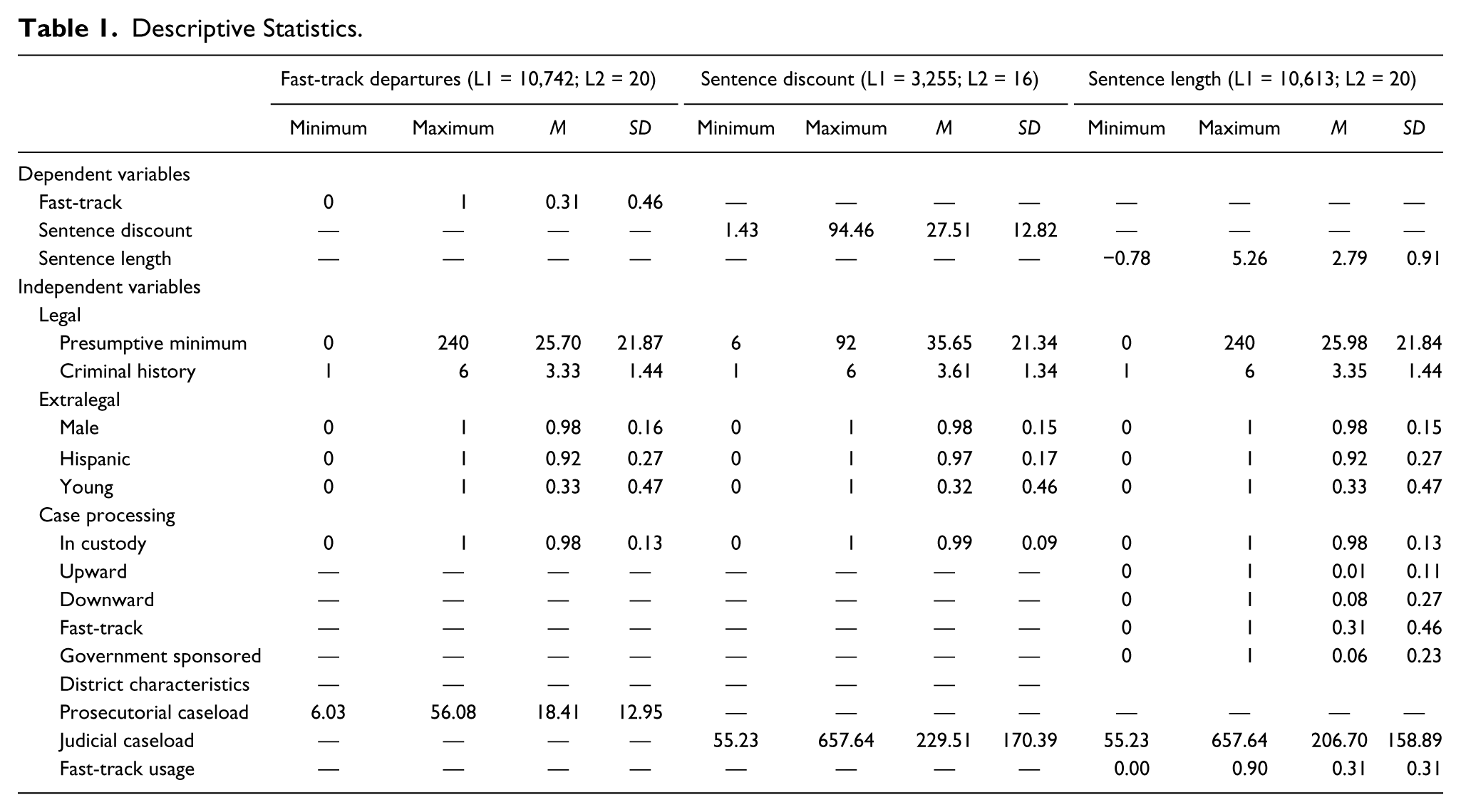
The minimum, maximum, mean, and standard deviation for all variables across the three models are reported in Table 1. Examination of the 10,742 illegal entry cases adjudicated across 20 fast-track eligible districts in 2008 revealed that roughly one third (31%) of all illegal entry cases involved a fast-track departure. Descriptive statistics indicate that males, Hispanics, and defendants over the age of 30 comprised the majority of offenders in these cases; the overwhelming majority of defendants were also retained in custody prior to sentencing. Prosecutorial caseload ranged between 6 and 56 cases with an average of roughly 20 cases per prosecutor across districts (18.41).
Descriptive Statistics.
The first hypothesis suggested that legal and case-processing factors would be primary determinants of the use of a fast-track departure, but that extralegal and district-level factors would also be influential. The unconditional model 12 (χ2 = 3,538.36, p < .001, df = 19) indicated that the variation in the log-odds of a fast-track departure varied across districts. As expected and summarized in Table 2, legal factors were influential in the receipt of a fast-track departure, as defendants with higher presumptive minimum scores and lower criminal history scores were more likely to receive a fast-track departure. The significant, but inverse, effects of these factors demonstrate evidence for the importance of including both variables in analyses. It appears that prosecutors are sympathizing with defendants possessing higher presumptive scores, but not those who have a track record of criminality. Interestingly, no extralegal factors were associated with the prosecutor’s decision to initiate this type of departure. Finally, and not surprising given the rules governing the use of fast-track departures, defendants retained in custody were more likely to receive a fast-track departure. The district-level measure of prosecutorial caseload was not related to the likelihood of a fast-track departure; in other words, districts with varying prosecutorial caseloads were not more or less likely to make use of a fast-track departure to process their caseloads. This result is discussed in detail in the following section.
Multi-level Models.
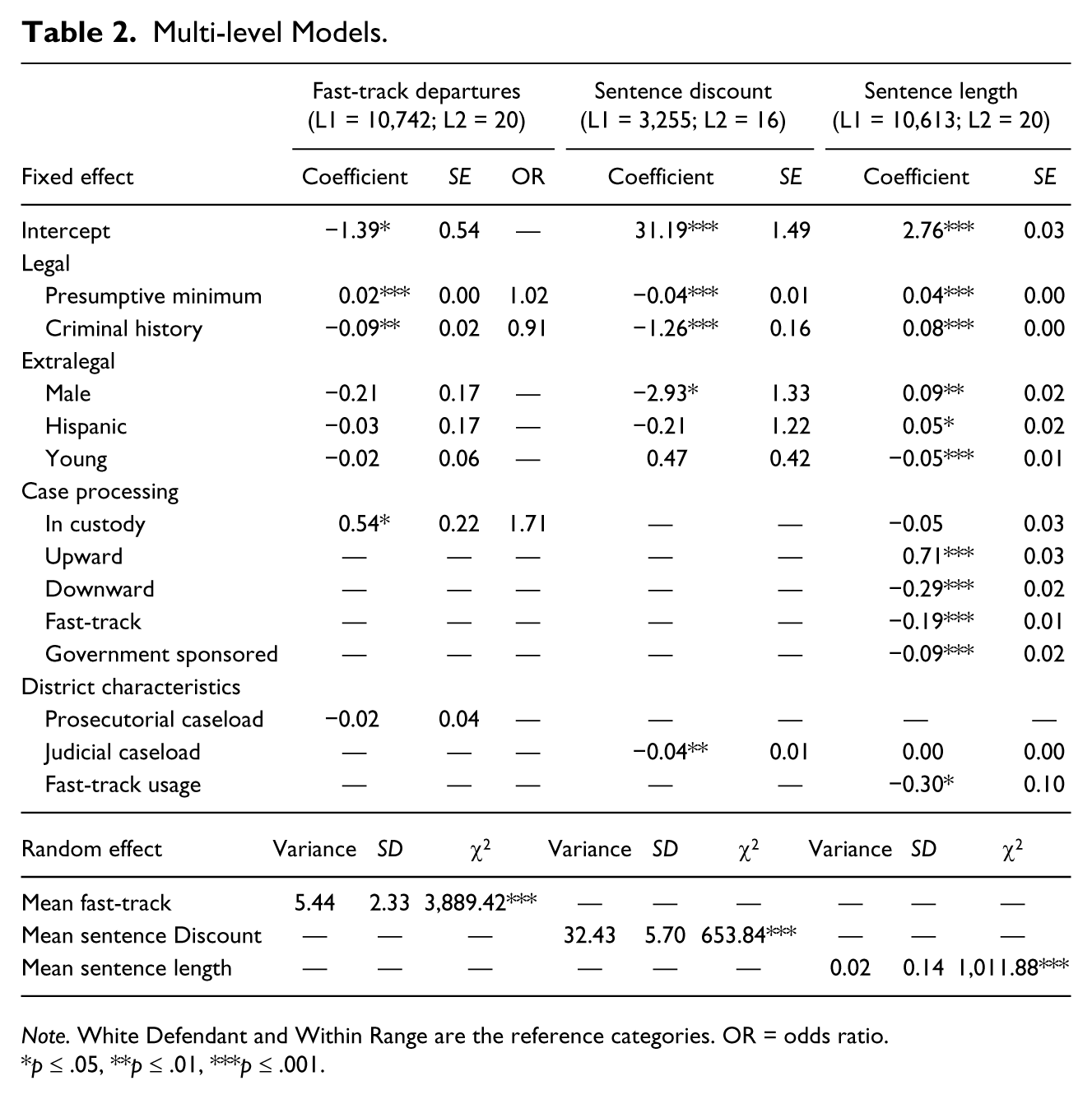
Note. White Defendant and Within Range are the reference categories. OR = odds ratio.
p ≤ .05, **p ≤ .01, ***p ≤ .001.
The second hypothesis predicted that variation in sentence discount would be largely explained by legal and case-processing factors and partially by extralegal factors and judicial caseload. As reported in Table 1 (Sentence Discount model), illegal entry cases sentenced under a fast-track departure (N = 3,255) consisted of mostly males, Hispanics, and defendants over the age of 30. Defendants were almost exclusively held in custody prior to sentencing. 13 Across the 16 districts in which fast-track departures were issued, judges carried an average of 230 cases on their docket. This ranged from a low of 55 cases to a high of 658 cases.
The unconditional model (χ2 = 1,401.36, p < .001, df = 15) for sentence discount demonstrated significant variation across districts. Defendants with lower presumptive minimum scores, lower criminal history scores, and females all received greater sentence discounts (see Table 2). Contrary to the fast-track departures model, those with lower presumptive minimums were rewarded with larger sentence discounts; roughly 4% for each unit decrease in presumptive minimum. Females received discounts that were on average almost 300% greater than those for males, which is likely a product of the limited number of cases involving female defendants. Defendant race/ethnicity and age were not related to the amount of sentence discount. Finally, the measure of judicial caseload revealed that the sentence discount was greater in districts where judges had lower caseloads. This seems contrary to the original purpose of fast-track departures, to alleviate heavy caseloads, and we offer some explanation for this finding in the following discussion.
Our third model examined sentence length across all fast-track eligible districts. Examination of the 10,613 illegal entry cases adjudicated across 20 fast-track eligible districts in 2008 revealed that the majority of defendants were male, Hispanic, and approximately one third of defendants aged 30 or younger. The large majority of defendants were also held in custody prior to sentencing (98%) and sentenced within guideline range (54%). Fast-track departures were applied in approximately 31% of all illegal entry cases across these districts. Finally, at the district level, judges carried an average of 207 cases on their docket and judicial caseload ranged from a low of 55 cases to a high of 658 cases. Fast-track usage varied considerably from a low of 0% to a high of 90%, with an average usage rate of 31%. All descriptive statistics are reported in Table 1 (Sentence Length model), and as expected, these statistics are largely unchanged from the Fast-track Departures model. 14
The third hypothesis predicted that the application of a fast-track would have a negative impact on sentence length in specific cases, and that a higher rate of fast-track usage would also reduce sentence length, net of other factors. The unconditional model (χ2 = 2,273.50, p < .001, df = 19) indicates significant variation in sentence length across the districts and supports the estimation of a multilevel model. As reported in Table 2, the full model indicates defendants with greater presumptive minimum and criminal history scores received longer sentences. Male defendants, Hispanics, and those over the age of 30 also received longer sentences in these districts. As expected, a series of case-processing variables were also related to sentence length; upward departures increased the length of sentence for defendants, while downward and other government-sponsored departures reduced sentence length. Of particular interest, cases processed using a fast-track departure had a roughly 21% (e0.19 = 1.209) reduction in sentence length. Importantly, the variation in sentence length across districts was also influenced by the percentage of fast-track usage in the district, but not by judicial caseload. 15 Potential explanations for these results and implications for theories of decision-making in the federal court system are offered in the following discussion.
Discussion
Fast-track departures offer a unique mechanism to process the burgeoning immigration caseload, but also fuel concerns that this mechanism may generate sentencing disparities within the federal criminal justice system. We addressed this issue by testing three specific hypotheses regarding fast-track departures using 2008 federal sentencing data. Models testing our first hypothesis demonstrated mixed support. Legal and case-processing variables were predictive of fast-track usage, but extralegal factors and prosecutorial caseload were not significantly related to receipt of a fast-track departure. These results suggest that prosecutors use fast-track departures to mitigate lengthy guideline sentences, as defendants with higher presumptive minimums were more likely to receive this departure, while also considering dangerousness and risk as demonstrated by the negative relationship between criminal history scores and receipt of a fast-track departure. It may also be that prosecutors use fast tracks to modify sentences of those they believe would be treated too harshly by the guidelines.
As suggested by Spohn and Sample (2013), perhaps certain defendants are viewed as more sympathetic or salvageable offenders, thereby receiving differential treatment by prosecutors. Importantly, the lack of statistical significance for extralegal factors suggests that receipt of a fast-track is not overtly biased; however, the potential impact of these variables may be partially constricted by the homogeneity of the sample (e.g., largely male, Hispanic). Finally, the nonsignificance of prosecutorial caseload suggests that fast-track programs may not be the intended “release value” for caseload pressure. Alternatively, it may be that prosecutors are unconcerned with caseload pressure, or as suggested by White (2011), prosecutors use charge bargaining as a tool to process immigration cases instead of the fast-track departure. Lacking specific measures of the autonomous nature of these decisions by prosecutors or defendants, and whether they may vary by the nature of the case (Johnson & DiPietro, 2012), leaves these possibilities open to future examination. Clearly, improved quantitative and qualitative data at the individual and district levels regarding the decision-making processes of prosecutors would be helpful in understanding the correlates of fast-track departures and the focal concerns that may influence their usage.
Our second hypothesis also received partial support and is consistent with the focal concerns perspective. Larger sentence discounts were applied to defendants considered to be a lower risk (i.e., lower presumptive minimum and criminal history scores), less blameworthy (i.e., females), and presumably at decreased risk of reoffending (also see Hartley et al., 2007). The results also demonstrate that judges do consider the defendant’s prior criminal history above and beyond the presumptive minimum sentence, which is similar to those of Ulmer et al. (2010) and Ulmer and Light (2009). Contrary to expectations, however, judicial caseload was inversely related to sentence discount—greater discounts were applied in jurisdictions with lower caseloads. Importantly, the measurement of courtroom factors and district-level idiosyncrasies are limited in these data; thus, conclusions should be drawn with caution. It is possible, however, that judges in districts with lower caseloads may have greater time to review cases, assess the merits of the case, and decide on the magnitude of discount compared with judges in jurisdictions with higher caseloads that may develop a “going rate” for fast-track discounts to expedite case processing. This explanation reflects the influence of the courtroom workgroup processes hypothesized to effect decision-making (Eisenstein & Jacob, 1977). In this sense, in districts with high caseloads, immigration offenses may represent “normal crimes” (Sudnow, 1965) and these defendants, therefore, might be processed more quickly via local routinized procedures and organizational practices that result in lengthier sentences. Related, judges, in districts with higher immigration caseloads, may also view these offenses as more serious and offer less of a discount as a form of deterrence to future immigration offending in the district.
Our third hypothesis examined the impact of fast-track usage in fast-track eligible districts. Results are generally consistent with expectations as legal, extralegal, case processing, and district-level variables influenced sentence length in a manner consistent with previous research and theory (Johnson & Betsinger, 2009; Spohn, 2009; Steffensmeier et al., 1998; Ulmer et al., 2011). Departures exerted a predictable impact on sentence length; in particular, defendants receiving a fast-track departure had a sentence reduction of roughly 21% (Gorman, 2010). Male and Hispanic defendants received longer sentences suggesting that they reflect the stereotypical immigration offender, and judges attribute culpability, blameworthiness, and reoffending risk to individuals with these characteristics. Alternatively, longer sentences for Hispanic immigration offenders might be explained from a deterrence perspective; judges may be attempting to discourage undocumented immigrants from entering the United States by handing out longer sentences to Hispanic defendants.
Of particular interest, at the district level, fast-track usage was negatively related to sentence length. This result suggests a compositional and contextual effect of fast-track programs. Compositionally, sentence length is reduced when a defendant is processed using this mechanism; contextually, sentence lengths are shorter in districts with greater fast-track usage. In effect, a case processed with a fast-track departure receives a shorter sentence, but also, a defendant sentenced in a district with a higher rate of fast-track usage is more likely to receive a lower sentence even if they do not specifically receive a fast-track. A couple of explanations for this finding are plausible. Judges in districts that use fast-tracks more frequently may have developed a “going rate” for immigration sentences regardless of fast-track usage in a specific case. Thus, all defendants benefit from the presence and use of fast-track departures regardless of whether they specifically receive this departure. Similarly, judges in fast-track districts may be aware of disparate sentence lengths for defendants who receive a fast-track departure and are attempting to compensate for any disparity by reducing sentences for all defendants regardless of whether a fast-track departure was applied. These explanations are not mutually exclusive and could be simultaneously influencing sentence length decisions.
Judicial caseload, however, does not significantly influence sentence length. This would seem to suggest that perhaps fast-track usage and lower sentence lengths are not necessarily the result of high caseloads constraining resources. Rather these findings suggest a district-specific effect on sentence length as some districts take advantage of their authority to grant fast-track departures and others decide against sentence mitigation via these programs. This may be evidence of the fact that districts still retain local autonomy to process cases according to localized ideologies and/or priorities (Ulmer, 2005).
The results also possess implications for future research, theorizing, and policy. More research is needed to explore the relevance and impact of district-level factors on prosecutorial and judicial decision-making practices. For example, the inconsistent effects of caseload pressure suggests that better measures are needed to reflect courts as distinct localized communities, capture district-level variation, and improve our understanding of fast-tracks (Baumer, 2013; Ulmer, 2012). It may also be the case that a reciprocal relationship exists between caseload and fast-track usage that is not evident when examining the impact of caseload on fast-track usage, such that the use of fast-track departures affects the caseload pressure felt by prosecutors. These issues may become especially salient areas of inquiry since the Department of Justice has recently authorized all districts to make use of fast-track departures in immigration cases, yet the immigration caseload varies widely across the 94 federal districts. Future research should assess the extent to which districts take advantage of this opportunity and if this impacts sentencing decisions and sentence lengths across all federal districts.
Theoretically, the appropriateness of the focal concerns perspective for understanding decision-making in immigration cases is not clear. While the legal and case-processing factors operated in a manner that was consistent with this approach, the extralegal factors were not influential in applying a fast-track departure or in the sentence discount (with the exception of female defendants). This raises questions of whether immigration cases are unique and require a different explanation or if the homogeneity of the sample stifles any variation and removes the need for a “perceptual shorthand” to be applied in immigration cases. Alternatively, defendant blameworthiness and culpability may be more important focal concerns with respect to decisions about sentence modification in immigration cases. This may be evidence that the focal concerns perspective as an interpretive framework may be more or less appropriate depending on the culture and organization of the court community under examination (Hartley & Tillyer, 2012). Conversely, the results of the sentence length model are consistent with previous research and the focal concerns perspective. Finally, community safety as a focal concern may be less important in these cases, as the majority of defendants are noncitizens, held in custody, and will be deported once their sentence is served. Future work needs to better operationalize the constructs of the focal concerns perspective to allow for an exploration of these issues.
On the other hand, the results do offer considerable support for the courts as communities perspective in which federal district courts are viewed as localized communities that make decisions based on a constellation of factors related to their own “social worlds” (Eisenstein, Fleming, & Nardulli, 1988; Ulmer, 2012). Substantial interdistrict variation in fast-track usage and sentence length was left unexplained by our models. Similar to the processes in other crime types, it may be that districts adopt their own unique culture and formal and informal case-processing rules for addressing immigration cases.
From a policy perspective, the failure of prosecutorial caseload to influence the likelihood of a fast-track departure suggests that the original intent of the fast-track programs to alleviate case-processing pressures is not being fully achieved (at least in some jurisdictions). Importantly, prosecutors have considerable discretion and exercise that flexibility in their decision to grant fast-tracks resulting in significant interdistrict variability of fast-track usage. For example, in 2008, fast-track usage in the Southern border districts varied from a low of 5% to a high of 66% (Hartley & Tillyer, 2012). Broadly, this finding underscores concerns that policy development is, at times, disconnected from actual implementation and may not reflect empirical realities. While our results do not definitively conclude that fast-track programs are not meeting their original goal, they do suggest that fast-track programs are used in varying degrees across jurisdictions and their use is not linked to caseload pressure. The variability in usage also raises questions about whether disparities in treatment or outcomes can be avoided when substantial discretion is available in policy implementation. It will be interesting to observe how the expansion of fast-track programs to all districts will impact this relationship in future years.
Moreover, fast track departures may inadvertently introduce disparities (i.e., differences) in subsequent procedural and appellate rights of convicted defendants. Those accepting a fast-track departure must waive several due process rights. In this sense, the authorization and use of fast-track programs may effectively reduce or alleviate future caseload pressure for federal appellate courts. Furthermore, given that most persons convicted on illegal entry charges are noncitizens, explicit congressional, and attorney general approval of these programs and implicit prosecutorial (i.e., via fast-tracks) and judicial approval (i.e., via sentence discounts) may also achieve the latent function of denying due process rights to defendants whom the legislative, executive, and judicial branches of government believe are not as deserving of these rights. Thus, fast-track programs could be a covert mechanism by which to forego the provision of due process and appellate rights to certain noncitizen defendants who will ultimately be deported after their sentence has been served.
Philosophically, the aforementioned issues are particularly salient given the substantial increase in federal criminal justice caseload resulting from immigration cases and the sensitive nature of the current political and social debate regarding immigration policy. Claims that fast-track departures introduce disparities in federal sentencing are valid; however, the more difficult question of whether those disparities are warranted remains a controversial issue. Federal courts are split on whether judges should be allowed to modify sentence length disparities created through the use of these departures. The first Circuit Court has confirmed this position by mandating that sentencing courts can consider fast-track disparities when deciding to grant a below-guideline sentence, because fast-track disparities were not “explicitly” warranted under the PROTECT Act (Cho, 2010; Siegler, 2009). Conversely, the 5th, 9th, and 11th Circuits have concluded that sentencing courts cannot mitigate any sentence disparities that stem from a fast-track disparity (Cho, 2010; Gorman, 2009). Collectively, they argue Congress has addressed disparity and therefore it cannot be considered “unwarranted” (Siegler, 2009, p. 300). This debate is far from settled and will likely require the Supreme Court to provide further guidance on the Constitutionality of sentencing guidelines and disparities. At minimum, our results provide empirical evidence regarding the use and effect of fast-track departures and offer an initial view into the case-processing habits of the federal court system as they confront an increasing number of immigration cases.
Footnotes
Declaration of Conflicting Interests
The author(s) declared no potential conflicts of interest with respect to the research, authorship, and/or publication of this article.
Funding
The author(s) received no financial support for the research, authorship, and/or publication of this article.