




Abstract
Deterrence researchers have long considered the extent to which perceived certainty and severity inhibit offending. More recently, scholars have encouraged more specific investigations about the conditions under which sanction threats may deter offending. This study contributes to and extends this line of research by exploring whether morality conditions this relationship among a large sample of incarcerated felons. Results show that while certainty and morality are independently associated with a lower likelihood of offending, perceived certainty relates to offending only among those persons with high—but not low—moral beliefs.
Introduction
There are several individual barriers that stand between the person and the decision to offend. In this article, we focus on two of these: deterrence, or the perceived threat of sanctions, and morality, or the rules of conduct that guide a person’s action (see Wikström, 2007, 2010). Both of these perspectives presume that without the fear of punishment or without moral constraints, individuals will exhibit a higher likelihood of offending in a given circumstance. There has been much research exploring the extent to which these two crime inhibitors act to lessen the risk of offending, the results of which indicate some marginally prohibitive effects for deterrence (especially the certainty of offending) and some stronger preventive effects for morality (see reviews in Bottoms, 2002; Nagin, 1998; Pratt, Cullen, Blevins, Daigle, & Madensen, 2006; Wikström, 2010).
A recent line of theoretical and empirical research has started to specify and explore the various conditions under which perceived sanction threats relate to offending (Jacobs & Piquero, 2013; Matthews & Agnew, 2008; Piquero, Paternoster, Pogarsky, & Loughran, 2011; Pogarsky, 2007; Schoepfer & Piquero, 2006; Worrall, Els, Piquero, & TenEyck, 2014; Wright, Caspi, Moffitt, & Paternoster, 2004), including the extent to which deterrence and morality interact in explaining delinquency and criminal activity. More specifically, research is conflicted regarding whether deterrence is more effective among individuals with low morality or among individuals with high morality. Interestingly, the analyses of this question have been considered via diverging hypotheses.
First, some scholars contend that deterrence would be a relevant inhibitor among those persons with high moral beliefs because they are able to envision the long-term costs of crime (e.g., Nagin & Paternoster, 1994), and high morality and high deterrence work in tandem to inhibit criminal activity. Second, other scholars hypothesize that deterrence will have a greater preventive effect on offending among individuals with low moral beliefs because deterrence is relevant for offending only when an individual sees crime as an action alternative (i.e., has a low level of morality; Wikström, 2006, p. 102) and/or because high moral condemnation may prevent individuals from considering instrumental concerns of costs and the possibility of offending more generally (Bachman, Paternoster, & Ward, 1992). Regarding this latter hypothesis, it is important to point out that in general, deterrence should be irrelevant for persons with strong moral beliefs. For those with weak moral beliefs (who do not care much about the rules of conduct stated in law), deterrence will be an important consideration when they see crime as an action alternative. However, if they commit crime out of habit, deterrence will be less relevant (because they do not actively deliberate over their actions). Nevertheless, one would expect a preventive influence from effective deterrence (i.e., deterrent measures that are relevant and strong enough to cause fear) for those whose own morality encourages the commission of a particular crime. 1 As this second hypothesis expressly considers the interplay between morality and sanction threats, both of which are key aspects of Wikström’s situational action theory (SAT), it is useful to provide a brief overview of SAT as it may help to serve as a guiding theoretical approach to this study.
Combining individual and environmental perspectives, SAT is offered as a general theory of moral action and crime whose main theoretical premise lies within the theory of action, which specifies the causal mechanisms that link individuals and environments to action (Wikström & Treiber, 2007, p. 244). According to Wikström and Treiber (2007), the main questions posed by SAT are “(i) what moves people to break moral rules (or commit acts of crime), and (ii) how do individual and environmental features interact in this process?” (p. 245, emphasis in original). In SAT, individuals are moved to commit particular actions to the extent that they see them as viable alternatives, and then decide to act (Wikström, 2010; Wikström & Treiber, 2007). Most pertinent to this study, SAT proposes that the primary individual characteristic that influences what action alternatives an individual perceives is “his/her moral categories (expressed in the making of moral judgments or in the execution of moral habits); the key individual characteristic influencing an individual’s process of choice is his/her executive capabilities (expressed in the ability to exercise self-control)” (Wikström & Treiber, 2007, p. 245, emphasis in original). 2 Furthermore, SAT pays close attention to the influence of the environment, arguing that settings also influence individuals and their decision making. Thus, an “individual’s morality is expressed in the making of moral judgments or in the execution of moral habits in response to the particularities of a setting” (Wikström & Treiber, 2007, p. 245). In this regard, SAT considers that moral rules may apply differentially to different settings, or moral context.
This is the location in the theory where the role of deterrence emerges, as settings will also vary in their deterrent qualities: If the individual perceived monitoring to be effective and sanctions to be severe, this may create deterrence, i.e., fear of consequences, which may be a factor in any deliberation over whether or not to act upon a motivation and breach a moral rule or law (Wikström 2006b). (Wikström & Treiber, 2007, pp. 245-246)
Finally, SAT joins the roles of morality and deterrence. As noted by Svensson (2015), if an individual does not see crime as an action alternative [has a high level of morality] . . ., or he commits an act of crime out of habit . . ., deterrence does not enter as a factor influencing his choice of actions . . . It is only when he sees crime as an action alternative [has a low level of morality] and he deliberates over whether to commit the crime or not . . . that the fear of consequences may affect his choice (Wikström, 2006, p. 102). (p. 3, emphasis in original)
In sum, SAT offers a unique theoretical prediction regarding the interaction between morality and deterrence, whereby “deterrence would be expected to have a greater effect on offending for individuals with low levels of morality than for individuals with high levels of morality” (Svensson, 2015, p. 3). 3
With this theoretical backdrop in hand, we observe that the results from the small number of studies that have examined the different morality/sanction threat hypotheses (both before and after the development of SAT) have yielded conflicting conclusions. For example, some studies fail to find any sort of interaction effect between morality and deterrence (Grasmick & Green, 1981; Jensen, Erickson, & Gibbs, 1978), other studies report that deterrence inhibits offending among persons with low morals (Bachman et al., 1992; Paternoster & Simpson, 1996; Wikström, Tseloni, & Karlis, 2011), and still others find limited evidence that deterrence is related to specific offenses among persons with high morality (Gallupe & Baron, 2014; Pauwels, Weerman, Bruinsma, & Bernasco, 2011).
These (and related) studies have been helpful in further illuminating the interrelationships between morality and sanction threats and how they relate to offending. For example, Paternoster and Simpson (1996) were able to examine these relationships in a unique sample of MBA students in the context of corporate offending, while Bachman and her colleagues (1992) investigated this effect for sexual assault. Furthermore, two of the studies examined the international generalizability of the morality/sanction threat interaction (Pauwels et al., 2011; Svensson, 2015). In addition, in a unique attempt to deal with the causal order issue, Grasmick and Green (1981) measured not only subjects’ prior offending but also their anticipated future criminal involvement (see also Bachman et al., 1992; Paternoster & Simpson, 1996).
At the same time, several data and measurement issues limit the contributions of these studies. For example, most of these studies were cross-sectional/retrospective and were unable to address temporal order as they measured current perceptions of sanction threats and morality but used measures of prior behaviors (Jensen et al., 1978; Pauwels et al., 2011; Svensson, 2015; Wikström et al., 2011). Other concerns regard the use of certain variables, or lack thereof. For example, Wikström et al. (2011) did not include a direct measure of morality in their study. They considered the question through the lens of SAT and reported that sanction certainty was stronger for persons with a higher propensity to offend—operationalized as the amount of temptation an individual experiences with respect to a specific crime. In addition, with some exceptions (Paternoster & Simpson, 1996), several studies only measured perceived costs and did not control for a range of other variables, including individual characteristics such as self-control (cf. Bachman et al., 1992). All of these constraints limit the field’s understanding of how morality and sanction threats interrelate in the offender decision-making context.
In the most recent study on this issue published in this journal, Svensson (2015) tested one of the key assumptions of Wikström’s SAT model that perceived certainty would have a greater deterrent effect on offending for persons with low but not high morality. Using data from a sample of students who were finishing their final year of compulsory education (age ~15 years), he found that (1) both morality and certainty had significant, crime-inhibiting effects on overall offending; (2) morality and deterrence interacted to produce a positive effect on overall offending, and (3) the crime-inhibiting effect of deterrence, though significant for both low and high levels of morality (split at the median), was stronger among persons with lower levels of morality. Thus, morality moderated the effect of deterrence on offending such that deterrence had a greater effect on offending when morality was low. Svensson’s study adds to the conflicting set of findings, largely because deterrence inhibited offending among persons with both low and high morality (albeit the effect was stronger among those lower in morality). Still, the generalizability of his findings is limited because of the use of a student sample, while the validity of the results may be somewhat compromised by the use of current measures of morality and deterrence to predict past-year offending, thereby creating temporal order concerns.
Current Focus
Although the field has only recently started to consider the moderating effects of morality on deterrence perceptions, several limitations preclude firmer summary statements. With respect to prior research, all but one of the investigations used nonoffender samples (e.g., high school students, general population samples; the exception being Gallupe & Baron’s street youth sample), thereby precluding analysis of whether morality may condition the deterrent effect on subsequent offending among active or incarcerated offenders—a highly policy-relevant sample (Apospori, Alpert, & Paternoster, 1992; Decker, Wright, & Logie, 1993; Jacobs, 1996; Loughran, Piquero, Fagan, & Mulvey, 2012; Zimring & Hawkins, 1973). Furthermore, other studies were cross-sectional and retrospective in nature, such that current perceptions were used to explain prior behavior (Pauwels et al., 2011; Svensson, 2015). This article seeks to overcome these limitations by examining the extent to which morality conditions the relationship between deterrence and offending among a large sample of incarcerated state felons from the Southwestern United States.
Data and Methods
A sample of 1,013 (819 males and 194 females) incarcerated, felony-level offenders were surveyed during the first part of 2011. Subjects were solicited during an orientation class that all inmates are required to complete during their first week at the facility. Inmates stay in these intake facilities for as long as 14 days prior to their transfer to another correctional facility where they will serve out their sentence. At the men’s facility, orientation classes occur every day, while at the women’s prison, they occur 1 or 2 times a week. Paper-and-pencil surveys were distributed to inmates in 35 men’s orientation classes and 9 women’s classes. Surveyed classes were selected based on researchers’ availability to conduct the surveys. In the men’s prison, approximately two classes were surveyed per week while in the female prison surveys were distributed about once every 2 weeks (due to extended travel times to this prison). The survey was read aloud to inmates to assist those who had reading difficulties and a Spanish language version was also available. A small number of surveys completed in Spanish (n = 37) were translated into English prior to data entry. The response rate was 83% (1,013 of 1,223 offenders). The surveys were anonymous, and participants were informed that their decision whether to participate would not affect their standing with the correctional agency. 4
Because these inmates were selected from separate male and female prisons, the demographic information in Table 1 is presented separately for each sex to show how well each sample represents its respective prison population. Generally, both samples represented their respective prison populations fairly closely (e.g., in age, race, and current offense type) with the exception of some undersampling of White males (about 42% in the male sample, 59% in the men’s prison). Overall, the sample had an average age of 32 years (Table 1), with about 47% self-described as White. The sample also contains a wide range of current offense types, including drug and driving while intoxicated (DWI) offenses, property offenses (e.g., burglary), and crimes of violence (e.g., robbery, aggravated assault, homicide). These offenses also reflect the range of offenses seen in each prison’s inmate population. The full sample of male and female inmates, which is used in all analyses, had an average of seven prior adult arrests. 5
Characteristics of the Sample.
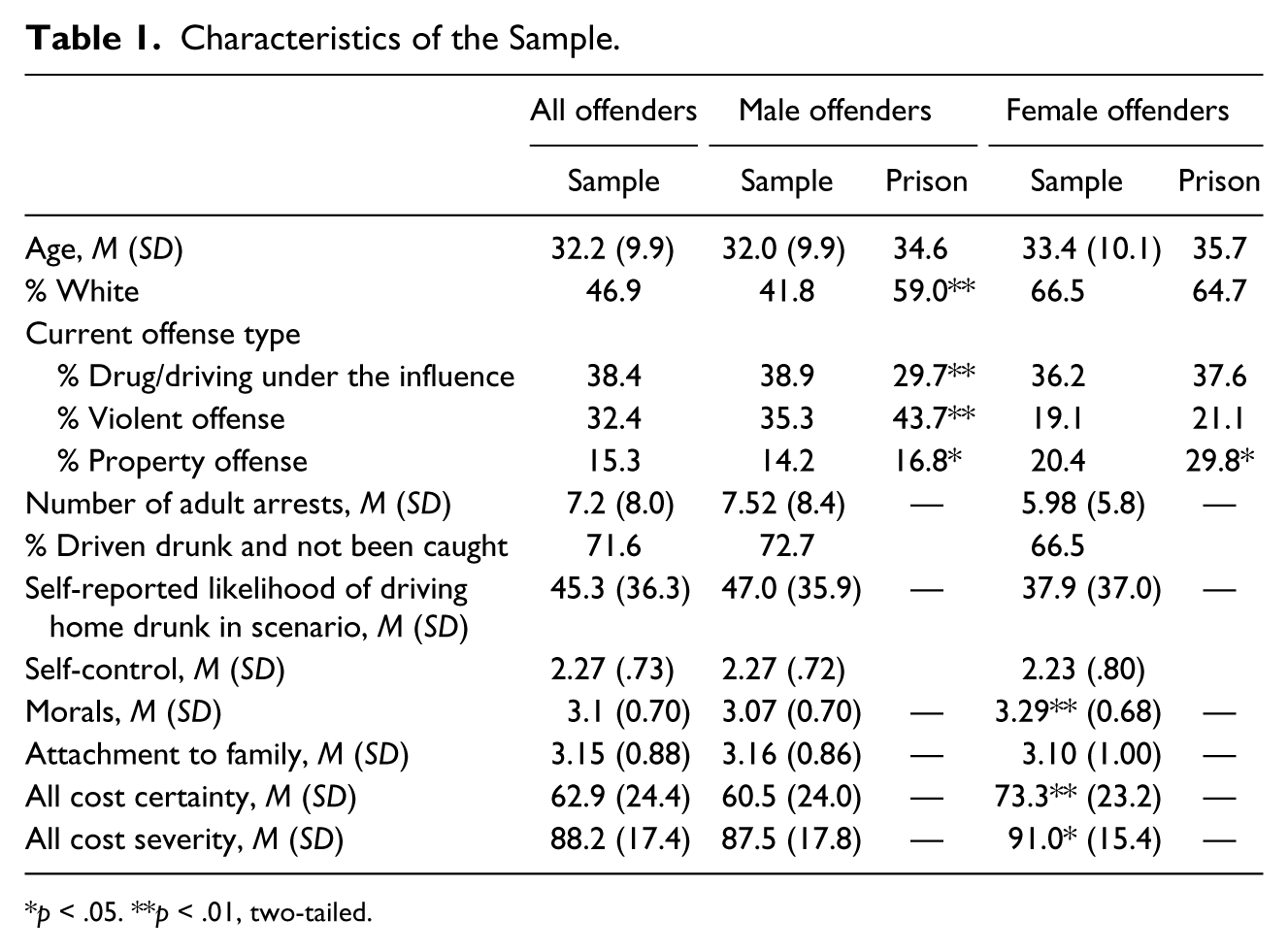
p < .05. **p < .01, two-tailed.
Measures
Drunk driving likelihood
The dependent variable is the subject’s self-reported likelihood that they would drive drunk and was solicited from a vignette that is similar to that used in previous research (Bouffard, 2002; Loewenstein, Nagin, & Paternoster, 1997; Nagin & Paternoster, 1993; Nagin & Pogarsky, 2001, 2003; Piquero & Tibbetts, 1996). 6 The scenario (see Appendix) describes an individual who needs to get home after being out drinking at a party but also recognizes that she or he needs the car for an appointment in the morning. Participants were instructed to read the story as if they were in the scenario and to answer a series of additional questions related to it. Inmates were asked how realistic they thought this scenario was on a 0% (not at all) to 100% (very) scale, with an average realism rating of 92%.
Subjects were asked to rate their likelihood of driving home on a scale ranging from not at all likely (0%) to very likely (100%) even though they suspect they are over the legal limit for driving under the influence. A little over 1% of the respondents did not provide a likelihood estimate and were excluded from the analyses, resulting in a final sample of 1,000 inmates. The average hypothetical likelihood of driving drunk was about 45%; however, 75% of inmates reported a nonzero likelihood of drunk driving.
Perceived consequences
After providing responses to the drunk driving likelihood question, inmates were asked to list up to seven negative consequences (i.e., “bad things”) that might occur if they drove home drunk, using the subject-generated consequences (SGC) method (see Bouffard, 2002). On average, subjects reported about 3.4 (SD = 1.7) total cost items. A small number (n = 43, 4.2%) of inmates recorded no costs for drunk driving, and these cases were excluded from later analyses, because they had no scores for the cost certainty variable. 7 Next, they indicated how likely each of the consequences was to happen (perceived certainty) and to rate how bad it would be if each listed consequence did happen (perceived severity). Both of the perceived certainty and severity variables were rated using a similar scale (0% = not at all to 100% = very likely). The variables used to represent perceived costs in this study are the average certainty scores for all reported costs and the average severity scores for all reported costs, respectively. 8
Morality
Our measure of “morality” includes four questions about the respondent’s endorsement of conventional values, each answered on a 5-point Likert scale, from 0 (strongly agree) to 4 (strongly disagree). This set of items included (a) “many things called crime do not really hurt anyone,” (b) “when parents set down a rule, children should obey,” (c) “it is ok to sneak into a ballgame or movie without paying,” and (d) “even though it is against the law, it is ok to sell alcohol to minors” (originally used by Longshore, Chang, Hsieh, & Messina, 2004, to measure social control theory). To be consistent with the other three items on this scale, the “children should obey” item was reverse coded. In addition, participants were asked “how important is religion in your life?” and this question was also answered using a 5-point Likert scale (0 = not important to 4 = very important). The variable representing one’s level of morality used in later analyses is the mean score on these five items (conventional values and religious importance). Subjects provided relatively high levels of endorsement of these conventional values items (mean of 3.1 out of 4).
Family bond
Following Svensson’s (2015) inclusion of a measure of one’s bond with the family, three questions served as indicators of attachment to one’s family members. Each of these three items began with “When you are around other members of your family, how often is there . . . ” (a) “a feeling of cooperation?” (b) “enjoyment in being together?” and (c) “an interest in listening and helping each other?” Each item was rated using a 5-point Likert scale, from 0 (never) to 4 (always) (Longshore et al., 2004). In the analysis to follow, the family attachment variable is the mean score on these three items. Overall, inmates reported a relatively high average level of family attachment (mean of 3.15 out of 4). Cronbach’s alpha for the family attachment scale was .826, indicating good internal consistency. 9
Other covariates
The last series of questions dealt with the respondent’s demographic characteristics (e.g., age, sex, race/ethnicity), the number of years of school completed, and the number of times the inmate had been arrested as an adult. Participants also completed the 24-item self-control scale developed by Grasmick, Tittle, Bursik, and Arneklev (1993). Cronbach’s alpha for the self-control scale was very good (.884). Finally, they also reported whether they had ever driven drunk in the past without being caught (0 = No, 1 = Yes). This question was used to represent the “experiential effect” described by Paternoster, Saltzman, Waldo, and Chiricos (1983), whereby the individual’s experience with offending and getting away with it has been found to negatively influence subsequent assessments of cost certainty. About 72% of the sample reported that they had driven drunk in the past without being caught.
Results
Bivariate results (Table 2) reveal that both moral beliefs (r = −.205, p < .01) and all cost certainty (r = −.192, p < .01) are significantly correlated with lower intentions to drive drunk; however, cost severity is not related to drunk driving likelihood (r = −.040). All cost certainty is also positively correlated with morality (r = .112, p < .01); however, severity is only marginally correlated with morality (r = .064, p < .10). Other variables such as age (r = −.070, p < .05), self-control (r = −.297, p < .01), and family attachment (r = −.080, p < .05) are also negatively related to drunk driving, while the number of prior adult arrests is positively related to intentions to drive drunk (r = .182, p < .01). Endorsement of moral values was higher among older individuals (r = .215, p < .01), those with more self-control (r = .315, p < .01), and those with stronger family bonds (r = .188, p < .01).
Correlations Between Variables of Interest.
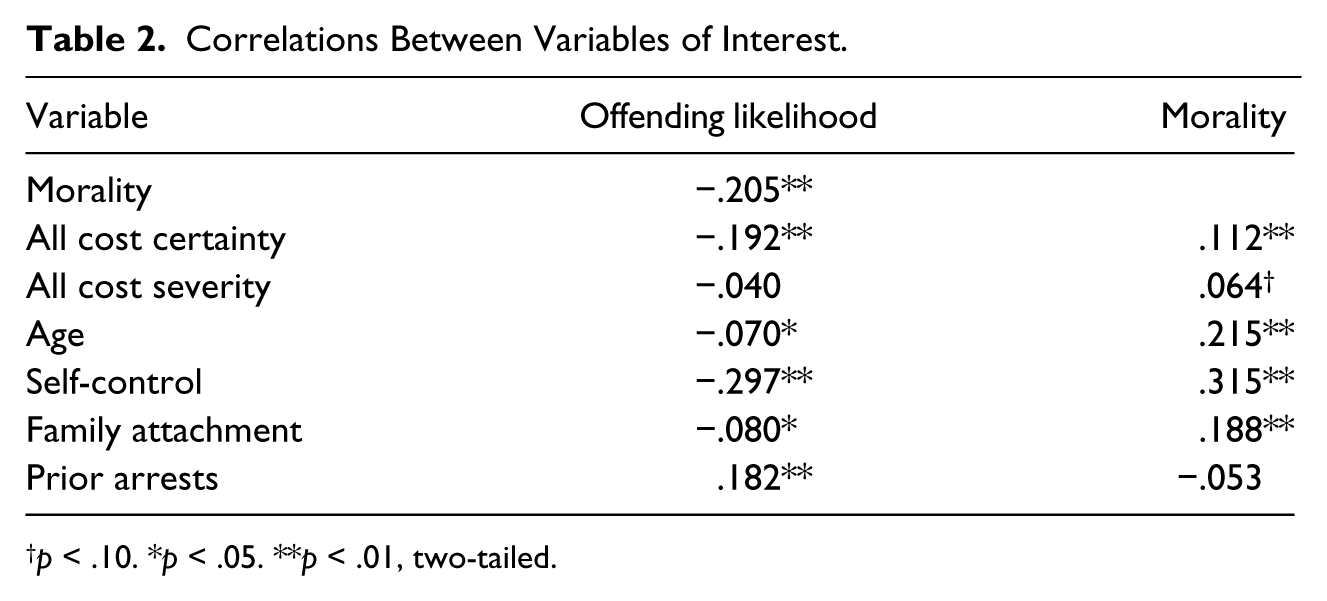
p < .10. *p < .05. **p < .01, two-tailed.
Next, we examine how morality and cost perceptions each influence the likelihood of drunk driving (see Table 3) in an ordinary least squares (OLS) regression (Model 2), and whether those relationships maintain when other control variables are included (Model 3). 10 First, Model 1 is a baseline model containing individual-level predictors of drunk driving likelihood, including age, minority group status (0 = White), sex (0 = Female), years of school completed, prior drunk driving without being apprehended (i.e., the experiential effect; 0 = No), self-control, number of prior adult arrests, and family bonds. As can be seen, males, those with more prior arrests, and those who have previously driven drunk without being caught reported higher drunk driving likelihood. Inmates with more self-control were less likely to say they would drive drunk, while age, minority group status, and educational level were not related to drunk driving.
OLS Models Predicting Drunk Driving Likelihood.
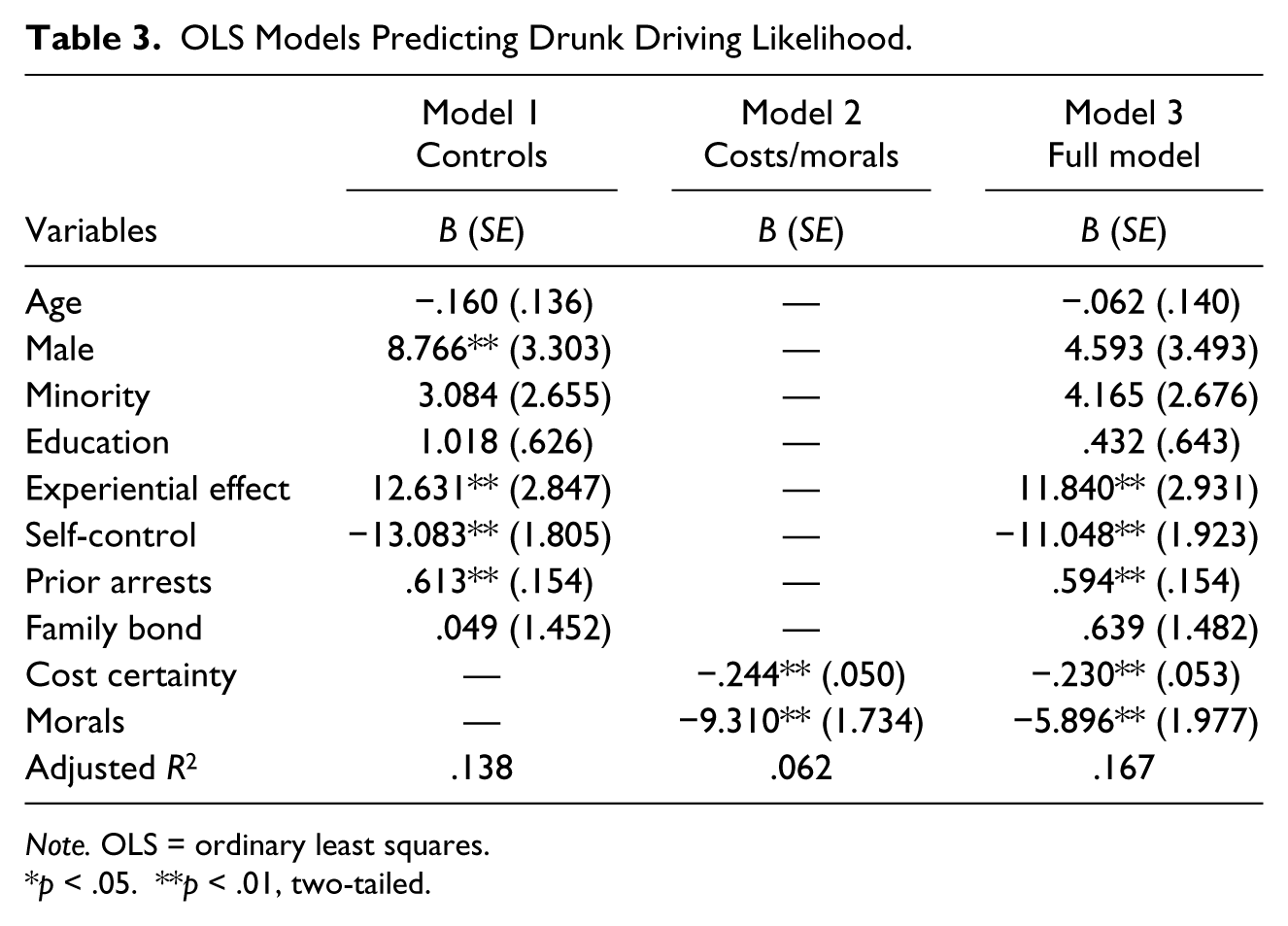
Note. OLS = ordinary least squares.
p < .05. **p < .01, two-tailed.
Model 2 shows that both the average all cost certainty scores and moral beliefs independently predict drunk driving likelihood independent of one another, and these results demonstrate that each is negatively and significantly related to drunk driving likelihood. Model 3 examines whether these two significant effects maintain once other control variables are entered in the model and this is the case. Cost certainty exhibited a similar negative relationship to drunk driving, while moral beliefs also exhibited a significant, though somewhat smaller, effect on drunk driving once other controls were added. Furthermore, the experiential effect and number of prior arrests continue to predict drunk driving, while self-control had a negative relationship. 11
Morality as Moderator
Last, we examine the extent to which morality conditions the relationship between deterrence and offending likelihood utilizing a split-sample procedure to determine whether the deterrent impact of cost perceptions is conditioned by level of morality (see Table 4). The average score on the overall moral beliefs scale was 3.1 (SD = .73). Approximately one third of the sample reported morality scores above 3.5 (n = 315), and about 28% of the inmates reported morality scores below 2.7 (n = 266). To examine the possibility of differential deterrent effects for cost certainty among high and low morality groups, the sample was split into two groups (above 3.5 = high morality, below 2.7 = low morality) based on these naturally occurring breaks in morality scores. This splitting strategy allowed for the models to be estimated on these two specific subsamples with relatively large numbers of cases available for analysis. 12
OLS Models Predicting Drunk Driving for Subsamples of Low Versus High Morality Scores.
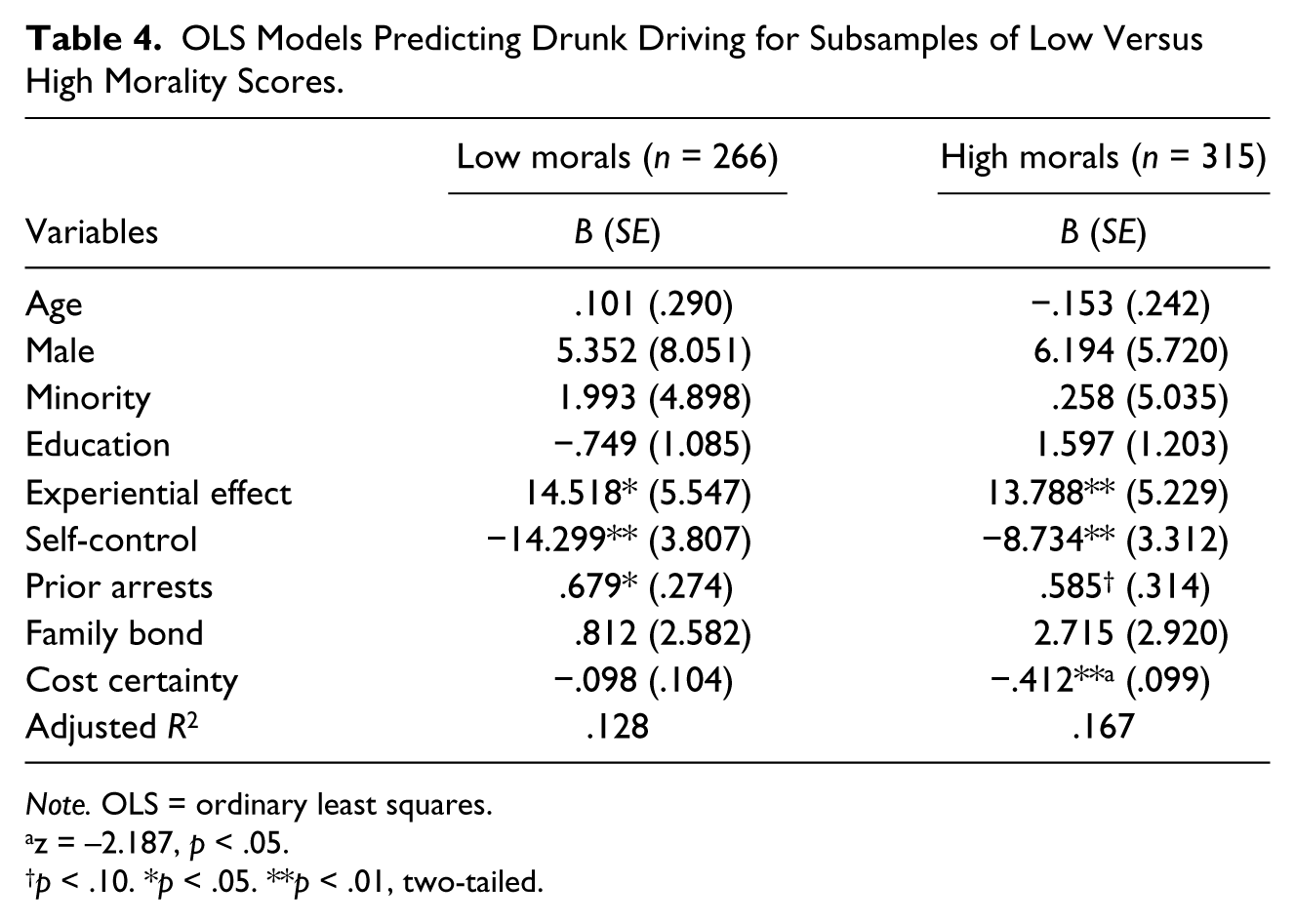
Note. OLS = ordinary least squares.
z = −2.187, p < .05.
p < .10. *p < .05. **p < .01, two-tailed.
Results presented in Table 4 show that among the 315 cases in the high morality subsample, cost certainty exhibits a significant deterrent relationship with drunk driving likelihood, while among the low morality subsample cost certainty is not significantly related to drunk driving intentions. A coefficient comparison test (Paternoster, Brame, Mazerolle, & Piquero, 1998) revealed that the relationship between certainty and drunk driving among the high moral group was significantly different from the effect in the low moral group (Z = −2.187). The other control variables contained in Model 3 generally operate in a similar manner across subsamples. For instance, the experiential effect is positive and significant for each subsample, higher self-control is related to lower drunk driving intentions for both groups, while the number of prior arrests is related to higher drunk driving likelihood in each sample. 13
Discussion
One of the more recent foci of deterrence research has centered on the conditions under which perceived sanction threats influence criminal decision making (Piquero et al., 2011; Pratt et al., 2006). More specifically, this line of work has explored the various individual and situational variables that may condition the effect of deterrence-related variables on offending, such as self-control, peers, and moral beliefs. In this article, we followed recommendations by Matthews and Agnew (2008, p. 94), among others, that the field further examines these conditioning effects by expanding the range of variables, as well as moving beyond student and general population samples. Accordingly, this article addressed these issues and improved upon some specific limitations in the research that has considered the conditioning effects of morality.
Specifically, we used data from a large sample of incarcerated felons in a large southwestern state to examine how morality conditioned the effect of perceived certainty on the likelihood of drunk driving. Results showed that while deterrence and morality had significant, independent, and crime-inhibiting effects on drunk driving intentions, the key moderation analysis showed that deterrence was related to drunk driving only among those persons with high, but not low, levels of morality. This finding is consistent with a few of the previous studies on this question (Gallupe & Baron, 2014; Pauwels et al., 2011) but contradicts some of the others which report that deterrence is relevant among those persons with low morals. Although it is possible that our results are due to the use of a sample of incarcerated prisoners—a sample not used in prior research—they are consistent with those of a related study that explored the conditioning effect of delinquent peers. Matthews and Agnew (2008) found that the perceived certainty of punishment deterred subsequent offending only among those persons with no or some delinquent peers but failed to do so among those with a high proportion of delinquent peers. If we were to hypothesize that persons with high morality would also report less association with delinquent peers, then our findings would resonate well with those from Matthews and Agnew. That said, there remains a need to replicate our study with other incarcerated offender samples, especially because our study is the only one in this area of research to use such a sampling frame.
One of the key contributions of this study was its use of an incarcerated offender sample to assess the interrelationships between morality and sanction threats, and then how they combine to relate to offending. To date, the only other study that has not used some form of general population sample is Gallupe and Baron’s (2014) study, which involved a sample of 300 street youth. Those authors found mixed support for SAT. Specifically, respondents’ morality was the strongest predictor of hard drug use, but neither a low perception of sanction certainty nor low levels of self-control affected either hard or soft drug use across different morality levels, as would have been predicted by the SAT. There are some interesting similarities and differences between our study and that of Gallupe and Baron. While both used nongeneral population samples, Gallupe and Baron’s sample is different from ours in that their street youths were much younger than our inmates (average age of ~20 years relative to ~32 years). In addition, their youth were from Canada and had been homeless for on average 6.5 months. While both studies included the Grasmick et al. self-control scale, there are other distinctions between the design and measures utilized. Gallupe and Baron’s study was retrospective and thus faced temporal ordering constraints, while the current study solicited future offending intentions to help overcome this temporal ordering issue. Different criminal behaviors were also measured, though both were related to substance use. Furthermore, Gallupe and Baron used a specific offense-based deterrence measure while the current research utilized the SGC method to measure sanction threats. Aside from these methodological differences, both studies reported a finding that was inconsistent with SAT in that higher perceived sanction risk predicted offending only among those with high morals (but this was only true for soft, not hard, drug use in Gallupe and Baron’s study).
The results presented here tend to support the notion that deterrence works best for those who also report higher morality, at least among this sample of incarcerated felons and using this particular measure of morality. While this pattern of results is at odds with the suggestions of SAT (as noted by Svensson), it is consistent with previous deterrence-based research. For instance, Sherman, Smith, Schmidt, and Rogan (1992) describe the “conditional hypothesis” in which deterrence through formal penalties is only effective among those “sufficiently tied to conventional society,” what they described as having “stakes in conformity” (p. 681). Likewise, Nagin’s (1998) review of several decades of deterrence research concluded that for formal costs to be effective deterrents, they needed to be accompanied by social stigma, such that social connections (belief in conventional moral values among them) may be needed to condition the effectiveness of deterrence.
To be sure however, several studies have supported the contention of SAT that deterrent effects are stronger among those with lower morality; yet, because so little of the research on SAT has involved known offenders, it is important for future research to further examine how morality may condition deterrence among different groups. Our results suggest that among known offenders, relatively higher morality may make deterrence more effective; however among the general population the predictions of SAT may hold much better, if only those who consider an action morally plausible then proceed to evaluate its potential costs. The current results highlight the importance of continued research into the factors that may condition the effectiveness of sanctions, including morality and other forms of social connection.
While these results reflect but one study, if additional research replicates these findings, it will be important for crime control policies to incorporate attempts not only to increase the perceived certainty of sanctions but also to focus on improving individuals’ connections to society, specifically the extent to which they endorse conventional moral beliefs about what constitutes acceptable behavior (cf. Tyler, 1990). While it may be that members of the general population only consider criminal activity if they have relatively low levels of morality (as SAT predicts), the current results from a sample of incarcerated felony offenders suggest that attempts to improve known offenders’ belief in conventional morality may serve to reduce their likelihood of recidivism, not only by improving cognitive processes but also by increasing their perception of the costs of crime. A number of studies have supported the effectiveness of rehabilitation programs aimed at improving offenders’ moral reasoning (Palmer, 2003; Tong & Farrington, 2006).
Our study was limited in a few respects. For example, although we were able to overcome several limitations found in previous research (use of an incarcerated offender sample and better temporal order), subsequent research should be longitudinally-based so as to measure perceptions at one time period and offending at a future time period as well as changes in both perceptions and offending over time. Of course, this must be buttressed against the fact that perceptions may be situationally dependent, as noted in both deterrence and SAT, and thus should be considered as close in real time as possible to criminal activity. Another limitation concerned the deterrence and morality measures. There are different ways of measuring these two constructs, and data collection efforts should be expanded on these fronts. Although our measures were well within the mainstream and operated as hypothesized, the morality measure had low reliability. In addition, we were unable to explore the relationship between procedural justice and morality and the extent to which this relationship may further condition any deterrent-based effect. Both Tyler (1990) and Sherman (1993) have discussed the interrelationships between legitimacy, morality, deterrence, and offending, and empirical investigations are needed to better specify the underlying theoretical processes. Finally, while the use of a large sample of incarcerated felons is an improvement over previous, often nonoffender samples, there are possible limitations among this group as well. For instance, these offenders have already engaged in serious felony-level offenses, which may signal their previous willingness to disregard both formal sanction threats and potential moral inhibitions. In effect then, our sample may contain individuals from a restricted range of morality and deterrability, possibly limiting the generalizability of our results (though in the opposite direction from most of the existing research which has likely undersampled serious offenders). At the same time, even among these serious (and potentially less moral, less deterrable) offenders, it is clear that some are inhibited by moral considerations and deterred by hypothetical sanctions.
We close with the observation made over 20 years ago by Bachman et al. (1992), who noted that
if [their] results [we]re corroborated by others, it would suggest that a deterrence/rational choice model cannot stand alone. A complete understanding of persons’ decisions to commit a criminal offense would have to include normative considerations along with considerations of cost and reward.” (p. 367)
Although we obtained different results regarding for which morality group deterrence was prohibitive of offending, our findings reinforce their sentiment that the role of moral factors should continue to be the subject of deterrence and SAT-related research, as should the lessons gleaned from other strands of work regarding the importance of individual differences (i.e., self-control, impulsivity) and situational factors (i.e., peers, environment), to build a more complete model of offender decision making (see also Piquero & Tibbetts, 1996; Wikström, Oberwittler, Treiber, & Hardie, 2012).
Footnotes
Appendix
Declaration of Conflicting Interests
The author(s) declared no potential conflicts of interest with respect to the research, authorship, and/or publication of this article.
Funding
The author(s) received no financial support for the research, authorship, and/or publication of this article.