



Abstract
Relationships between correctional officers and prisoners are crucial to life in prison, and affect prison order and prisoners’ well-being. Research on factors influencing staff–prisoner relationships is scarce and has not included the design of prison buildings. This study examined the association between prison architecture and prisoners’ perceptions of their relationships with officers. Data were used from the Prison Project, a large-scale study in which 1,715 prisoners held in 117 units in 32 Dutch remand centers were surveyed. Multilevel analyses showed that prison layout was related to officer–prisoner relationships: Prisoners in panopticon layouts were less positive than prisoners in other layouts. In addition, prisoners housed in older units and in units with more double cells were less positive about officer–prisoner interactions.
Introduction
Relationships between correctional officers and prisoners are at the heart of prison life. Interpersonal relationships are a central aspect of human life in general and are, therefore, also an essential part of life in prison (Liebling, 2011; Liebling & Price, 2001). There is widespread recognition of the importance of staff–prisoner relationships to prison order (Bottoms, 1999; Sparks, Hay, & Bottoms, 1996). Prison safety not only depends on “passive security,” resulting from bars, high walls and electronic devices, but also requires “dynamic security,” which is based on positive interactions and constructive relationships between staff and prisoners, with mutual respect and trust (art. 51.2 European Prison Rules 2006; Snacken, 2005; Sparks et al., 1996). Research has, indeed, shown that prisoners display less misconduct when staff treat them in a humane and respectful manner (Reisig & Mesko, 2009; Sparks & Bottoms, 1995). Besides prison order, staff–prisoner relationships seem important for prisoners’ well-being. Levels of psychological distress appear to be related to the way prisoners experience their interactions and relationships with correctional officers (e.g., Biggam & Power, 1997; Liebling, Durie, Stiles, & Tait, 2005; Slotboom, Kruttschnitt, Bijleveld, & Menting, 2011). Therefore, good and supportive relationships between staff and prisoners seem vital to life in prison.
Theoretical insights from environmental psychology suggest that the design of a building can facilitate or hinder social interaction among its users (e.g., Gifford, 2007; Sommer, 1969). Based on these theoretical ideas, it can be hypothesized that the design of a prison can affect levels of social interaction between staff and prisoners. Several prison scholars have indeed presumed that prison architecture influences the way staff and prisoners interact (Beyens, Gilbert, & Devresse, 2012; Fairweather, 2000; Hancock & Jewkes, 2011; Jewkes & Johnston, 2007; Shefer & Liebling, 2008; Tait, 2011; Wener, 2000). Woolf (1991), when investigating the causes of the major riots and disturbances in several British prisons in the 1990s, argued that the physical state of a prison and the way in which the building is designed significantly affects the atmosphere in prisons. Woolf acknowledged that a poor prison design is not a necessary or sufficient explanation for poor staff–prisoner relationships and that the quality and characteristics of staff are also important. Nevertheless, he argued that the design of a prison building shapes staff–prisoner interactions.
Despite the widespread belief that prison architecture influences the relationships between staff and prisoners, empirical studies examining this association are scarce. Although several studies have explored how (aspects of) prison architecture affected prisoners’ adjustment (e.g., Atlas, 1989; Grant & Memmott, 2008; Molleman, 2011; Morris & Worral, 2010; Schaeffer, Baum, Paulus, & Gaes, 1988; Wener & Olsen, 1980), few empirical studies have focused on the effects of prison architecture on staff–prisoner relationships. This is regretful, as some authors have suggested that the association between prison architecture and prisoner outcomes (e.g., misconduct and suicide attempts) was mediated by these relationships (e.g., Atlas, 1989; Wener, 2000). To our knowledge, only two empirical studies directly explored the effect of prison architecture on staff–prisoner interactions. One study investigated the effect of prison size on staff–prisoner relationships in Norwegian prisons (Johnsen, Granheim, & Helgesen, 2011). The other study examined the effect of double bunking on staff–prisoner interactions in the Netherlands (Inspectie voor de Sanctietoepassing, 2011). However, both these studies focused on only one aspect of the prison design and ignored the effects of other important design characteristics, like unit size and age of the building. More importantly, these studies failed to examine the effects of differences in the overall layout of prisons (e.g., panopticum and courtyard) on staff–prisoner relationships.
This study aims to fill this gap in knowledge by examining the effect of prison architecture on prisoners’ perceptions of officer–prisoner relationships. Two research questions were addressed:
To answer these questions, data were used from the Prison Project, a large-scale nationwide panel study in which prisoners held in all Dutch remand centers were interviewed. By means of site visits to all correctional facilities, detailed data on prison architecture of the remand centers were collected.
Prison Architecture in the Netherlands
Correctional facilities currently in use in the Netherlands were built between the mid-19th and early 21st century. The construction of the current Dutch prisons can be roughly divided into three periods: 1850-1901, 1975-1980, and 1985-2005 (Dubbeld, 2001). 1 Each of the periods was characterized by different penal philosophies, which were associated with different prison layouts. These developments in penal policies and prison architecture in the Netherlands have been quite similar to developments in other Western countries, such as the United States and Britain (Dubbeld, 2001; Fairweather, 1975; Franke, 1995; Jewkes & Johnston, 2007; Johnston, 2000). To provide some background information on the Dutch context, we briefly characterize these three time frames and describe the six different prison layouts currently in use in the Netherlands (Figure 1).
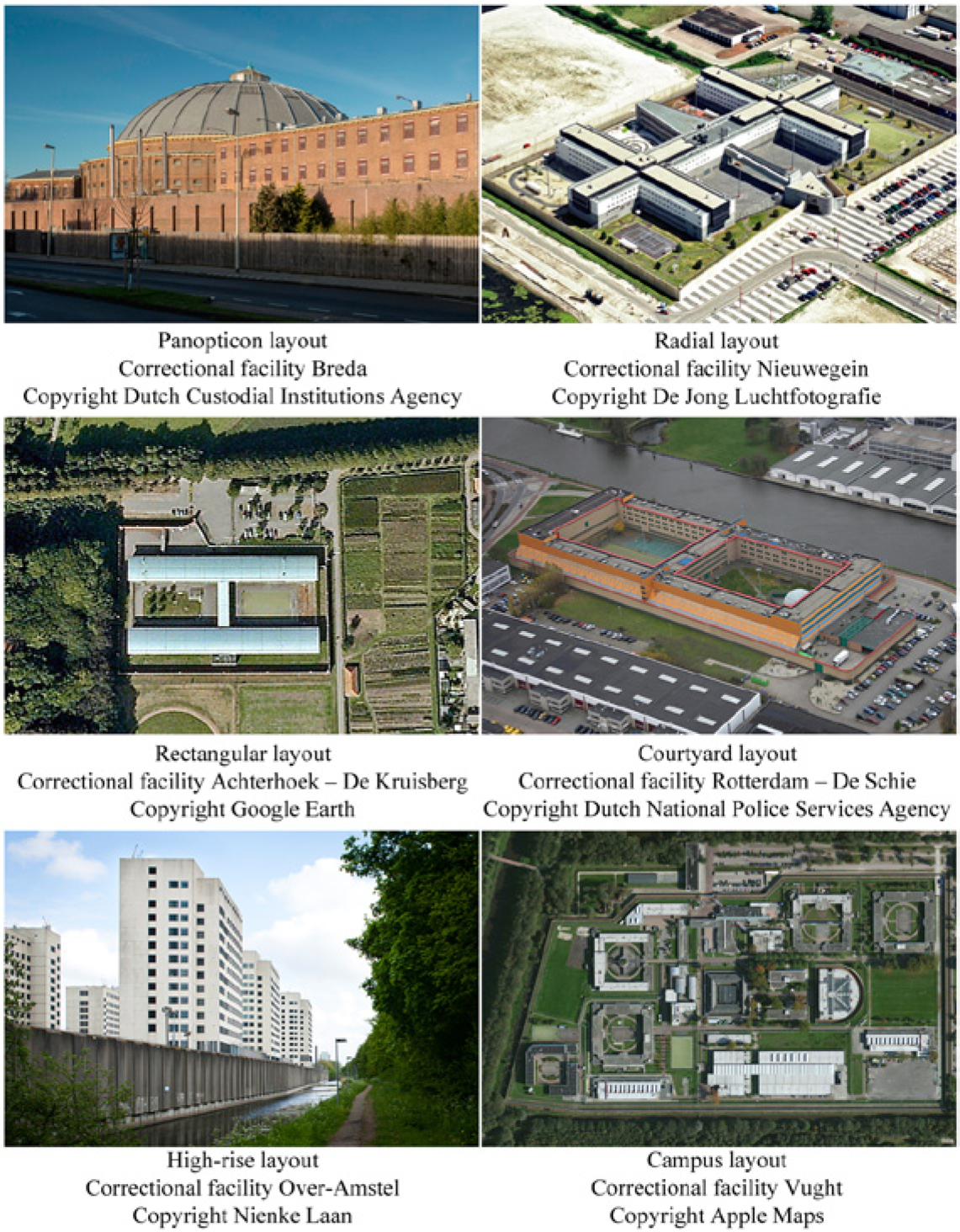
Layout types of Dutch correctional facilities.
In the first construction period, 1850-1901, prison architecture was influenced by two penal philosophies: (a) surveillance and control of the prisoners was used to accomplish discipline, and (b) prisoners were held in solitary confinement to accomplish moral elevation and self-reflection among prisoners (Dubbeld, 2001; Johnston, 2000). These philosophies resulted in the construction of two types of prison layouts. First, in the Netherlands several correctional facilities with a panopticon layout were constructed in the second half of the 19th century. The panopticon prison was originally developed by the English philosopher and criminal-law reformer Jeremy Bentham during a period in which penal philosophies emphasized prisoner surveillance, control, and discipline (Bentham, 1995). The panopticon prison consists of a circular structure with a domed roof and cells arranged in tiers on the circumference of the circle. The center of the building contains the “inspection house,” from which the staff are able to watch the prisoners. Originally, this design allowed staff to observe all prisoners of the facility without prisoners knowing whether they were being watched (i.e., seeing without being seen). Although Dutch panopticon prisons were based on Bentham’s idea, a significant change was made, that is, the walls and doors of the cells are solid, so that a complete inspection as envisioned by Bentham is not possible (Johnston, 2000).
Second, several correctional facilities with a radial layout were constructed in the second half of the 19th century under the influence of the so-called Pennsylvania system (Dubbeld, 2001; Franke, 1995; Johnston, 2000). This system was grounded on the principle of keeping prisoners in solitary confinement. Separating prisoners and preventing prisoners from communicating with each other was thought to lead to self-reflection and remorse and, ultimately, to moral elevation. To accomplish this, radial prisons (with a central inspection center) appeared to be well suited. A radial layout is any arrangement of cell buildings that converge on a center. The design was intended to permit surveillance and control over the activities of prisoners, as guards were able to visually inspect the wings from the central vantage point.
In the second construction period, 1975-1980, penal policy in the Netherlands was dominated by an emphasis on prisoners’ rehabilitation and reintegration, which was the case in most Western countries (Dubbeld, 2001; Johnston, 2000). In the Netherlands, this penal philosophy resulted in the construction of some high-rise prisons, which consist of multiple small stacked pavilions that form a multistory building. Each pavilion consists of 24 single cells and communal living rooms. These correctional facilities were constructed with a specific emphasis on small units, communal activities and a “homely” atmosphere. Prisoners needed to be treated as “humans” and learn social and acceptable behavior through group activities (Dubbeld, 2001).
In the third construction period, 1985-2005, the Dutch rehabilitation ideal was replaced by an emphasis on security and incapacitation. A sharp increase in the number of prisoners led the Dutch Ministry of Justice to start a far-reaching program of prison construction in the mid-1980s (Dubbeld, 2001; Johnston, 2000). First, as a response to several successful escapes from Dutch prisons, some correctional facilities with a courtyard layout were built. The courtyard prison, consisting of a rectangular building with one or more inner courtyards, was assumed to discourage prisoners’ escapes (Dubbeld, 2001). Courtyard layouts were, however, expensive to construct and to maintain. Therefore, in the second part of the construction program, the government started to build facilities with radial layouts (most often a cross or double cross). These radial layouts were considered to be a practical and efficient architectural design as the security post in the center of the facility made securing prisoners straightforward (Dubbeld, 2001). It became the leading prison layout in the Netherlands at the end of the 20th century.
Besides panopticon, radial, high-rise, and courtyard prisons, two other types of prisons were constructed in the Netherlands: facilities with a rectangular and a campus layout. Both layouts are less clearly linked to a specific construction period and/or penal philosophy. Dutch rectangular correctional facilities consist of one rectangular building or two parallel rectangular cell buildings connected by a passageway. The cell buildings are often multi-tiered and, following the prevalent Pennsylvania system in Europe, the cells are aligned in rows facing a central corridor (contrary to the United States, which adopted the Auburn system in which cells were placed back to back in the middle of the cell building, facing the outside walls; Dubbeld, 2001; Johnston, 2000). Correctional facilities with a campus layout consist of freestanding pavilions arranged in a large open space. Although Dutch campus facilities are not similar to American “new generation prisons” with their specific focus on small units, direct supervision and staff–prisoner interactions, Dutch campus facilities are characterized by small prisoner living units that operate semi-autonomously.
The massive prison construction in the last decades of the 20th century resulted in a huge expansion of the number of cells in the Netherlands, with 13,000 cells in 2011 (Dubbeld, 2001; Linckens & De Looff, 2012). At the time of the current study, there were 58 correctional facilities regionally divided across the Netherlands, of which 32 were employed (partly) as a remand center. Over 80% of all prisoners released in the Netherlands are confined for a maximum of 6 months. The median period of incarceration is 1 month and the average period of incarceration is 3.6 months (109 days; Linckens & De Looff, 2012). Although budget cuts and a growing punitive climate in the past three decades resulted in more restricted prison regimes and conditions, the Netherlands is still regarded as having a relatively mild prison policy (Downes & Van Swaaningen, 2007; Kelk, 2008; Kruttschnitt & Dirkzwager, 2011). For example, Dutch prisons do not face major overcrowding or understaffing, prisoners do not have to wear a prison uniform, and officer–prisoner relationships are generally characterized as informal and supportive.
Theoretical Framework and Prior Research
Insights from environmental psychology suggest that the architecture of a building affects people’s behavior and experiences. Several scholars have outlined how and why architecture influences individuals (Gifford, 2007; Sommer, 1969). While architects and designers traditionally tend to focus on the esthetic dimension of architecture, these scholars emphasized the functional value of a building. For instance, Sommer (1969) argued that, as humans are malleable and adapt to almost any setting, the question should not be what sort of environment we want, but what sort of man we want. By focusing on human spatial needs when designing a building, architects can stimulate certain desired behavior among its users.
More specifically, scholars have suggested that the design of a building can affect levels of social interaction between its users (Gifford, 2007; Sommer, 1969; Ulrich, 1991). For example, Gifford (2007) outlined six goals for designers, including “the design should encourage cooperation, assistance and social support among its occupants” (p. 529). Furthermore, Ulrich’s (1991) Theory of Supportive Design, developed for the design of health care facilities, presumes that a building can reduce stress and promote wellness among the users when the building is designed to facilitate social interaction. Floor layouts and furniture arrangements, for instance, are expected to influence levels of social interaction among users.
The theoretical notion that the design of a building can affect the social interaction between its users also applies to prisons (Fairweather, 2000; Sommer, 1969, 1971). Inspired by Fairweather’s (2000) overview of prison design characteristics that may influence the behavior and feelings of prisoners and staff, we expect, first, that the overall prison layout will affect officer–prisoner relationships and, second, that several specific prison design characteristics will influence officer–prisoner relationships. Below, we formulate specific hypotheses regarding these associations and summarize the results of prior research.
Prison Layout and Staff–Prisoner Relationships
Already in the 18th and 19th century, penal philosophies were translated into specific types of layouts to accomplish the goals of imprisonment in that era (e.g., panopticon layout to facilitate discipline). As outlined above, the layouts of Dutch correctional facilities (panopticon, radial, rectangular, courtyard, high-rise, and campus) were also aimed to achieve certain goals of imprisonment. Whereas some layouts were intended to stimulate staff–prisoner interactions, others were (certainly) not.
Two Dutch prison layouts can be considered to discourage staff–prisoner interactions: panopticon and radial layouts. First, panopticon prisons were constructed with a focus on prisoner surveillance, as staff could observe all prisoners of the facility from the center of the building (Bentham, 1995; Johnston, 2000). This physical distance between staff and prisoners is likely to result in more detached and distant officer–prisoner relationships. Other characteristics of the panopticon may also contribute to distant relationships: (a) the large size and scale of the panopticon may increase anonymity and result in more impersonal and less frequent officer–prisoner interactions and (b) the old age of panopticon prisons with their gloomy appearance and less up-to-date prison conditions may negatively affect the atmosphere in prison and negatively influence officer–prisoner interactions. Second, Dutch radial prisons were built either to minimalize staff–prisoner interactions (when prisoners were kept in solitary confinement) or to increase security. Radial prisons today still focus on surveillance and control over the activities of prisoners, as guards are able to visually inspect the wings from the central vantage point (Dubbeld, 2001). This focus on surveillance may result in more distant officer–prisoner relationships.
In contrast, two Dutch prison layouts can be considered to encourage officer–prisoner interactions: high-rise and campus layouts. Dutch high-rise prisons, consisting of small pavilions with a “homely” atmosphere and emphasizing communal activities and a humane treatment of prisoners, aimed to rehabilitate prisoners. The design was expected to encourage close staff–prisoner relationships (Dubbeld, 2001). Dutch campus prisons are also characterized by small living units, which may facilitate more and more personal staff–prisoner interactions.
For courtyard and rectangular layouts, it is less clear how the layout affects officer–prisoner relationships. Both designs are largely based on older forms of 18th century jails and earlier church buildings, and a clear penal philosophy underlying these layouts is lacking (Johnston, 2000). Both designs have been criticized in the past for (a) inadequate opportunities to properly separate prisoners and (b) the inability for officers to observe prisoners adequately. In the present study, we expect that these two layouts will not affect officer–prisoner relationship in either a clearly positive or negative way.
Based on the above, we formulated two hypotheses regarding the effect of prison layout:
The association between prison layout and officer–prisoner relationships has not been empirically tested. However, a Belgian qualitative study on architectural needs of prison users showed that both professional and non-professional prison users (e.g., prisoners, staff, prison visitors, prison directors, researchers, and architects) plea for prisons with “small pavilions” in which close staff–prisoner relationships can develop (Beyens et al., 2012).
In addition, some empirical studies examined the effects of prison layout on prisoners’ adjustment. This research has reported mixed results. For example, older linear prisons (e.g., rectangular layout) with indirect supervision and less contact between staff and prisoners are associated with more suicide attempts (Atlas, 1989). In addition, “new generation prisons” with non-institutional designs (e.g., bright colors, no bars, and soft materials) and good visibility showed less vandalism (Wener & Olsen, 1980). However, Morris and Worral (2010) showed that prisoners in older telephone pole layouts displayed less misconduct than prisoners in modern campus layouts. The authors suggested that campus layouts provide more opportunities for prisoners to misbehave as well as more opportunities for officers to discover misconduct. A Dutch study revealed that more violent assaults were registered in panopticon, radial, and high-rise layouts than in rectangular layouts. In line with Morris and Worral’s account, good visual access and exposure in these three prison layouts was mentioned as a potential explanation (Molleman, 2011).
Finally, some case studies suggest that prison architecture is not so important for prisoner misconduct. In the case study of Rikers Island prison, Useem and Goldstone (2002) argued that the declining rate of prisoner violence was not a result of changes in prison architecture, but was caused by administration measures, like smoothing administration–staff relationships and implementing clear and fair rules for prisoners. In addition, Dilulio (1987) did not found support for the effect of prison layout on prisoner violence in his case study; however, he noted that officers uniformly agree that architecture matters a great deal and is central to the daily operation of prisons.
Specific Prison Design Characteristics and Staff–Prisoner Relationships
Besides the overall prison layout, several specific prison design characteristics may affect officer–prisoner interactions. In the current study, we formulated hypotheses on five characteristics. The first two characteristics refer to the scale of a correctional facility: facility size and unit size. There is a widespread belief among researchers and criminal justice employees that smaller prisons with fewer prisoners are more desirable than large prisons housing many prisoners (Farrington & Nuttall, 1980). Fairweather (2000) argued that extremely large prisons and units can overwhelm and intimidate prisoners and staff. Small prisons and small units should allow for more personal relationships between prisoners and officers. A third characteristic expected to influence officer–prisoner interactions is the year of construction. It is assumed that older facilities are less able to meet today’s needs and demands. Older buildings can, for example, differ from newer prisons in spatiality, routing, light, thermal comfort and noise. It has been suggested that prison conditions for prisoners and working conditions for staff are worse in older prisons, which may negatively affect the interactions between staff and prisoners (Molleman, 2011; Shefer & Liebling, 2008). A fourth feature of the prison design that may affect officer–prisoner relationships is sight lines. When officers have a good view on a unit and the amount of space that is out of sight and hearing of staff is limited, the distance between staff and prisoners may be diminished and officer–prisoner interactions may be encouraged. Staff may have better knowledge about what is going on in the living unit (Wener, 2000). Fifth, and last, the use of double bunking may negatively impact officer–prisoner relations. For instance, it has been suggested that officers working in units with many double cells have less time to interact with prisoners. In addition, double cells may reinforce division between prisoners and officers (i.e., us vs. them; Inspectie voor de Sanctietoepassing, 2011).
Based on the above, we formulated the following hypothesis regarding the effects of specific prison design characteristics:
Unfortunately, the hypotheses on specific prison design characteristics and officer–prisoner relationships have been empirically tested in only a few studies. First, Norwegian research on facility size indicated, in line with our hypothesis, that both staff and prisoners in small prisons experienced their relationships with each other more positively than staff and prisoners in medium-sized and large prisons (Johnsen et al., 2011). Second, a Dutch study supports our hypothesis on double bunking and showed that prisoners in double cells evaluated their contacts with staff less positively, and that staff working in units with many double cells reported fewer contacts with prisoners (Inspectie voor de Sanctietoepassing, 2011).
In addition, our hypotheses find some indirect grounding in studies on the link between prison design characteristics and prisoners’ behavior, well-being, and preferences. With respect to facility and unit size, Belgian research has shown that prison users prefer smaller prisons and units. The respondents associated large facilities and large units with a cold atmosphere and with detached and distant interactions (Beyens et al., 2012). Furthermore, a Belgian study on violence indicated less violence in smaller units (Snacken, 2005). However, other studies found no or a reversed effect in which rule violations were more frequent in smaller prisons (Farrington & Nuttall, 1980; Huebner, 2003; Jiang & Winfree, 2006). As a possible explanation, it was suggested that offenses were more likely to be observed and recorded in smaller prisons. With regard to the year of construction of the prison building, research by Morris and Worral (2010) showed that more property and drug infractions were reported in older prison buildings. With reference to sight lines, prisons with good visual access have been linked to fewer suicide attempts and less vandalism (Atlas, 1989; Wener & Olsen, 1980), but also to more (discovered) prisoner misconduct (Molleman, 2011; Morris & Worral, 2010). Finally, with respect to double bunking, research has shown that double bunking is related to negative mood states among prisoners, less perceived privacy, higher levels of experienced crowding, more health problems, and more misconduct (e.g., Cox, Paulus, & McCain, 1984; Grant & Memmott, 2008; Schaeffer et al., 1988; Wener & Olsen, 1980). In addition, research has shown that the majority of prisoners prefers singles over doubles (Cox et al., 1984) and both professional and non-professional prison users believe that an ideal prison should contain single cells only (Beyens et al., 2012).
Method
Sample
To examine the relation between prison architecture and officer–prisoner relationships, data of the Prison Project were used. In this project, a representative sample of 1,909 prisoners is followed for several years, both during and after their incarceration. The sample consists of male prisoners aged 18 to 65 years, who were born in the Netherlands, who had no significant psychiatric problems, who entered one of the Dutch remand centers between October 2010 and April 2011, and who were held in pre-trial detention for at least 3 weeks. Employees of the project approached and informed all eligible prisoners in their first weeks of pre-trial detention. Participation was voluntary, and the prisoners were ensured confidentiality. All participants signed an informed consent declaration.
The present study used data of the first wave of the Prison Project that was held when the pre-trial prisoners were detained for about 3 weeks. This first measurement consisted of a structured interview and a self-administered questionnaire. Between October 2010 and April 2011, 2,945 prisoners meeting the selection criteria entered the remand centers in the Netherlands. Of this group, 170 prisoners could not be approached (mainly because they were already released or were not allowed contact with others during the police investigation). Of the 2,775 prisoners who were approached, 1,909 prisoners (69%) participated in the interview and 1,764 prisoners (64%) also completed the questionnaire. 2 For the present study, it was essential to know in which facility and in which unit the prisoner was housed during the measurement. Due to transfers during the measurement and missing values on the unit, the final sample in the present study consisted of 1,715 prisoners, who were housed in 117 units that belonged to 32 facilities. 3
Measures
Dependent variable: Prisoners’ perceptions of officer–prisoner relationships (inmate level)
The dependent variable in this study was prisoners’ perceptions of their relationships with officers. In the survey, several statements about officer–prisoner relationships were presented to the prisoners and on a 5-point scale prisoners indicated to what extent they agreed with the statements (1 = very much disagree, 5 = very much agree). Negatively formulated items were recoded; therefore, a low score indicated a negative judgment about the relationships with officers, and a high score indicated a positive judgment. The items and scale were derived from two existing instruments: the Dutch Prisoner Survey (Mol & Henneken-Hordijk, 2008) and the Measurement of Quality of Prison Life (Liebling, 2004). The “Relationships With Officers” scale consisted of five items, like “The prison officers are nice to me” and “I receive support from correctional officers when I need it.” The Cronbach’s alpha of the scale was good (α = .87).
Independent variables: Prison architecture characteristics (facility and unit level)
The independent variables in this study were related to prison architecture. Employees of the Prison Project visited all Dutch remand centers to determine (a) the prison layout and (b) five specific prison design characteristics.
As described above, Dutch correctional facilities can be divided into six prison layouts: panopticon, radial, rectangular, courtyard, high-rise, and campus (Figure 1). The layout was assessed on unit level as opposed to facility level, as Dutch correctional facilities sometimes consist of several buildings with different layouts. For example, the remand center Haarlem consists of two buildings, a large panopticon and a smaller rectangular building.
Table 1 shows the frequency of each prison layout. Half of the units had a radial layout and one-fifth a rectangular layout. The other layouts were less common (high-rise 11.2%, panopticon 8.5%, courtyard 5.1%, and campus 4.3%). Although the layout was not measured on facility level as some facilities consisted of two layout types, it is relevant to know in how many facilities the different layouts were present. The radial layout was most common and was present in 17 facilities, the rectangular layout exists in nine facilities, and the panopticon and high-rise layouts were each present in three different facilities. The other two layouts were less common: Two facilities had a courtyard layout and one facility a campus layout (numbers not shown in table).
Prison Architecture Characteristics.
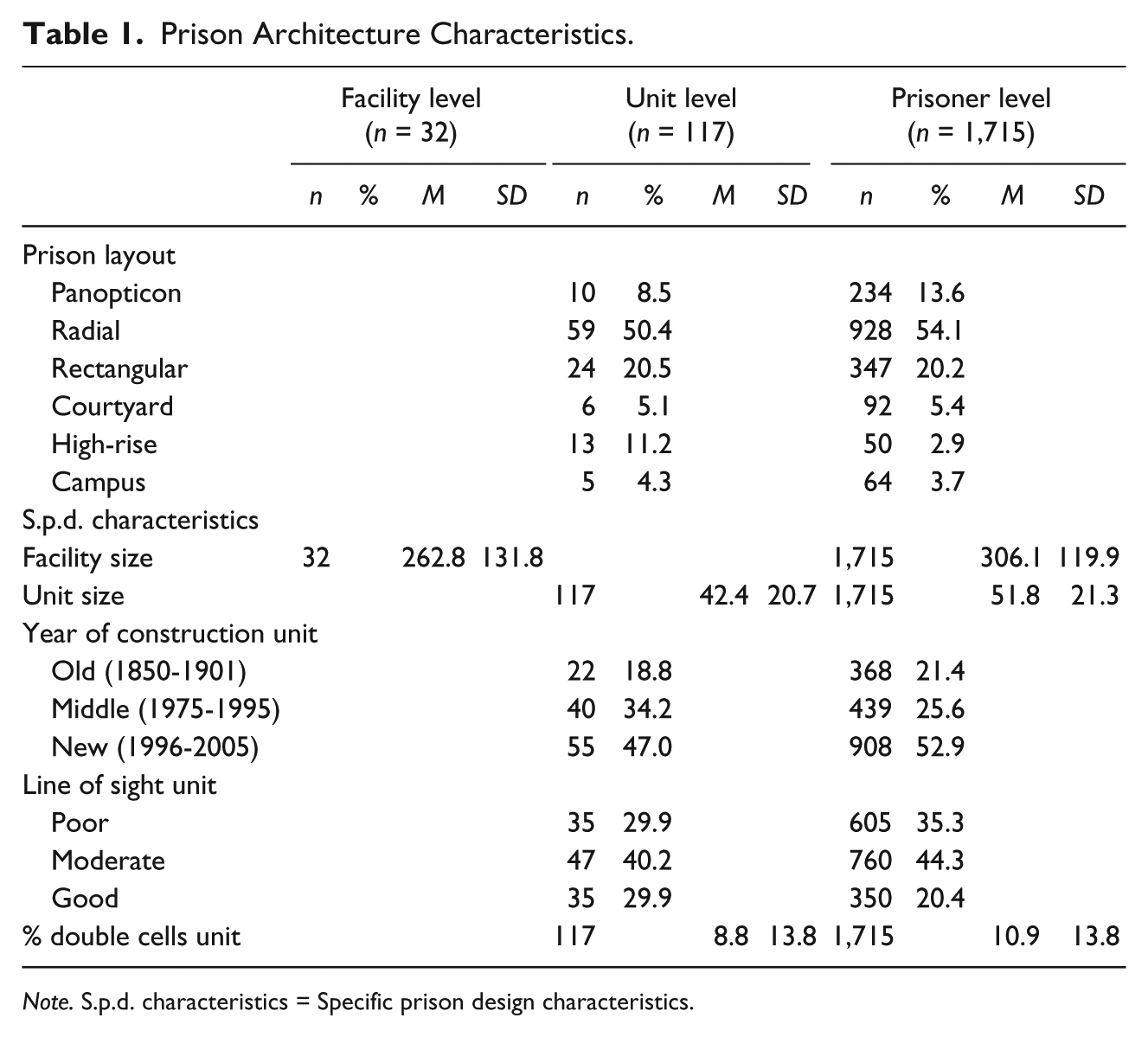
Note. S.p.d. characteristics = Specific prison design characteristics.
In addition, five specific prison design characteristics were examined. Facility size and unit size were determined by the maximum number of prisoners a facility or unit can house. Year of construction can differ within a facility and was therefore measured on unit level. For a long period (1901-1975) no remand centers were built in the Netherlands, therefore, year of construction was not measured as a continuous variable. Instead, the variable was divided into three categories: old (1850-1901), middle (1975-1995), and new (1996-2005). 4 Degree of view from the staffroom on the unit was scored by employees of the Prison Project, who visited every unit (1 = a poor line of sight, 2 = a moderate line of sight, and 3 = a clear line of sight). The presence of double bunking was determined by the percentage of double cells in a unit.
Table 1 shows the descriptive statistics of the specific prison design characteristics. On average, a facility could house 263 prisoners and a unit could house 42 prisoners. Most of the units (47%) were relatively new and built between 1996 and 2005. Nearly 19% of the units were considered old and built in the 19th century. In 30% of the units, the staff had a good view on the unit from the staffroom, while in a similar amount of units (30%) the staff had a poor view. Last, on average 8.8% of the cells in a unit was a double cell (range = 0%-67%).
Control variables: Prisoners’ background and unit characteristics (inmate and unit level)
This study controlled for several background characteristics of prisoners. First, demographic characteristics of the prisoners were included, like age upon arrival in the remand center, ethnicity (0 = Dutch background; 1 = one or both parents born outside the Netherlands), having an intimate relationship at the time of their arrest that lasted at least 3 months (0 = no; 1 = yes), and educational level. The educational level of the prisoners was divided into three categories: low (primary school or intermediate secondary education), middle (higher secondary education or intermediate vocational education), and high (higher vocational education or university education). Second, we controlled for the personality of the prisoners, which was measured with the Dutch Big Five Inventory (BFI; Denissen, Geenen, Van Aken, Gosling, & Potter, 2008). In this questionnaire, several traits are presented and respondents have to indicate to what extent these traits apply to them. The inventory distinguishes five scales: Neuroticism, Extraversion, Openness to New Experiences, Agreeableness, and Conscientiousness. The Dutch BFI has been validated and showed good psychometric qualities (Denissen et al., 2008). In the present study, the five personality factors had a reasonable to good internal consistency, with Cronbach’s alpha ranging from .63 (agreeableness) to .79 (neuroticism). Third, we controlled for prisoners’ criminal history using three variables based on official records of the Dutch Prison Service: the total number of prior prison spells, the number of prior convictions in the past 5 years prior to this incarceration, and the type of offence the prisoner was suspected of (property, violent, drugs, and other offences).
The descriptive statistics on prisoners’ background characteristics showed that, on average, the prisoners were aged 30 years (SD = 10.7) and almost 40% of the prisoners had at least one parent who was not born in the Netherlands. About 55% of the prisoners had an intimate relationship at the time of their arrest. Two thirds of the sample had finished a low educational level and 5% a high educational level. On average, prisoners had been incarcerated previously 3.3 times (SD = 6.4; range = 0-81) and had been convicted 2.8 times (SD = 2.9; range = 0-34) in the past 5 years. Most of the prisoners were suspected of a violent offence (46%) or a property offence (24%).
In addition, this study controlled for two characteristics of the units in which the prisoners were housed. First, type of unit was taken into account. Besides standard units, there were “entry” units for prisoners who just entered the facility and “care” units for vulnerable prisoners or prisoners with psychological problems. Correctional officers in a care unit might approach prisoners differently than officers in other units. Second, officer-to-inmate ratio was included, as this ratio is likely to influence officer–prisoner interactions and differs per layout type. Per unit, the total number of employed officers was divided by the maximum number of prisoners in the unit.
The descriptive statistics on the unit characteristics demonstrated that of the 117 units 61% were standard units, 20% were entry units, and 19% were care units. The average officer-to-inmate ratio was .26 (SD = 0.1), meaning that, on average, there was one correctional officer for every four prisoners. In some units, there was one officer for every eight prisoners, while other units showed a ratio of 1:2. 5
Analytical Strategy
Multilevel linear regression analyses were conducted to determine the extent to which (a) prison layout and (b) specific prison design characteristics are related to prisoners’ perceptions of their relationships with correctional officers. 6 Multilevel analyses were used to account for the hierarchical structure of the data: The prisoners were nested within units, which were nested within facilities. Ignoring the hierarchical structure and the dependence across observations from the same unit or correctional facility would lead to an underestimation of the standard errors, possibly leading to wrong conclusions about non-existent relations (Hox, 2010; Snijders & Bosker, 1999). The estimation method used was Maximum Likelihood, and all continuous predictors were (grand mean) centered. The intraclass correlation (ICC) at Levels 2 and 3 in the empty model was 5.3%, meaning that 5.3% of the variance in prisoners’ perceptions of their relationships with officers is due to the unit and facility in which prisoners are incarcerated.
Results
Prison Layout and Staff–Prisoner Relationships
To answer our first research question, multilevel regression analyses were performed testing the association between prison layout and prisoners’ perceptions of their relationships with officers. Two sets of multilevel analyses were performed to test our hypotheses, one with panopticon layout as reference category, and one with radial layout as reference category. We hypothesized that prisoners in panopticon and radial layouts experience their relationships with officers as being more distant (with the least positive perceptions in panopticons), whereas prisoners in high-rise and campus layouts evaluate their relationships with officers as being more personal. In general, the results support our hypotheses.
First, two multilevel regression analyses were used using panopticon layout as reference category (Models 1 and 2 in Table 2). In Model 1, we examined the effect of prison layout bivariately. Prisoners in panopticon layouts were least positive about their relationships with officers. Prisoners in radial, courtyard, rectangular, and high-rise layouts had an increasingly positive judgment about officer–prisoner relationships. When compared with prisoners in panopticon layouts, prisoners in campus layouts were most positive about these relationships. In Model 2, we controlled for various prisoner and unit characteristics. Prisoners in panopticon layouts still perceived their relationships with officers more negatively than prisoners in other prison layouts. The order of the other five layout types shifted slightly: Prisoners in radial, rectangular, courtyard, high-rise, and campus layouts had an increasingly positive judgment regarding officer–prisoner relationships (B = 0.201, 0.216, 0.239, 0.279, and 0.542; p < .05). All effects decreased somewhat, especially the effects of the high-rise and rectangular layout. This was mainly the result of the inclusion of officer-to-inmate ratio. As can be seen in Table 2, prisoners in units where there is a higher officer-to-inmate ratio experienced their relationships with officers more positively (B = 0.927; p < .01). Additional analyses (not shown here) showed that officer-to-inmate ratio was significantly higher in high-rise (M = 0.35) and rectangular layouts (M = 0.26) than in the other layouts (M = 0.21). Therefore, the (initial) positive effects of the high-rise and rectangular layouts on staff–prisoner relationships were partly explained by officer-to-inmate ratio.
Multilevel Linear Regression Analyses for Prison Layout on Prisoners’ Perceptions of Their Relationships With Officers (NLevel1 = 1,685 [Models 1 and 3] and 1,674 [Models 2 and 4]; NLevel2 = 117; NLevel3 = 32).
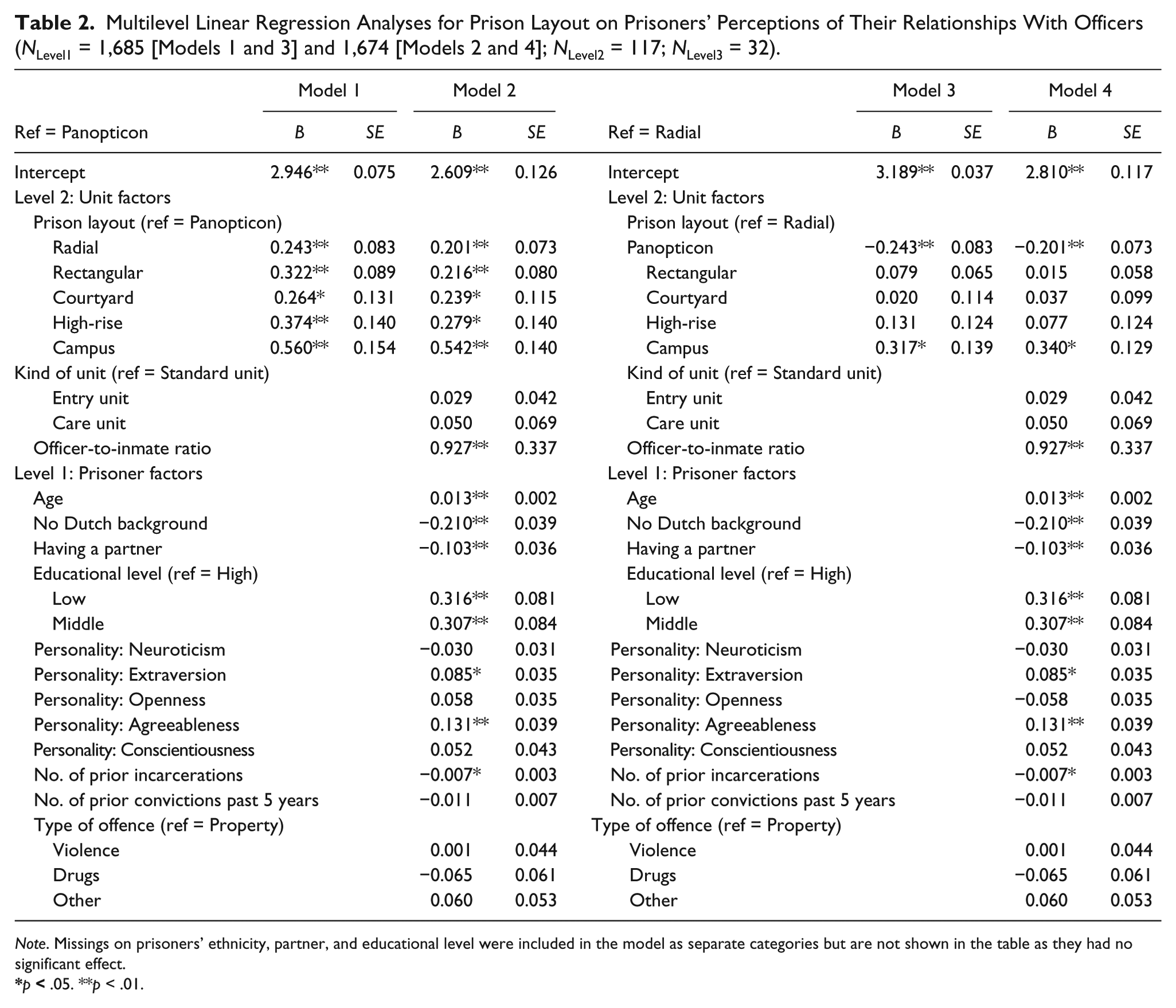
Note. Missings on prisoners’ ethnicity, partner, and educational level were included in the model as separate categories but are not shown in the table as they had no significant effect.
p < .05. **p < .01.
Second, two multilevel regression analyses were performed using radial layout as reference category (Models 3 and 4 in Table 2). Again, we first examined the effect of prison layout bivariately (Model 3). Prisoners in radial layouts were more positive about their relationships with officers than prisoners in panopticon layouts. In addition, prisoners in radial layouts evaluated their relationships with officers more negatively than prisoners in campus layouts. Contrary to our hypothesis, prisoners in radial layouts did not differ from prisoners in high-rise facilities with respect to their perceptions of staff–prisoner relationships. In Model 4 we controlled for several prisoner and unit characteristics. Results remained the same: Prisoners in radial layouts perceived their relationships with officers more positively than prisoners in panopticon layouts (B = −0.201; p < .01) and more negatively than prisoners in campus layouts (B = 0.340; p < .05).
Furthermore, the analyses showed that several background characteristics of prisoners were significantly associated with their perceptions of their relationships with officers (Models 2 and 4). Older prisoners, prisoners with a Dutch background, prisoners with no partner, and prisoners with a lower educational level evaluated their relationships with officers more positively. In addition, personality affected how prisoners perceived relationships with officers: Prisoners with a higher score on extraversion and agreeableness reported better relationships with officers. Finally, prisoners with a lower number of prior incarcerations perceived their interactions with officers more positively.
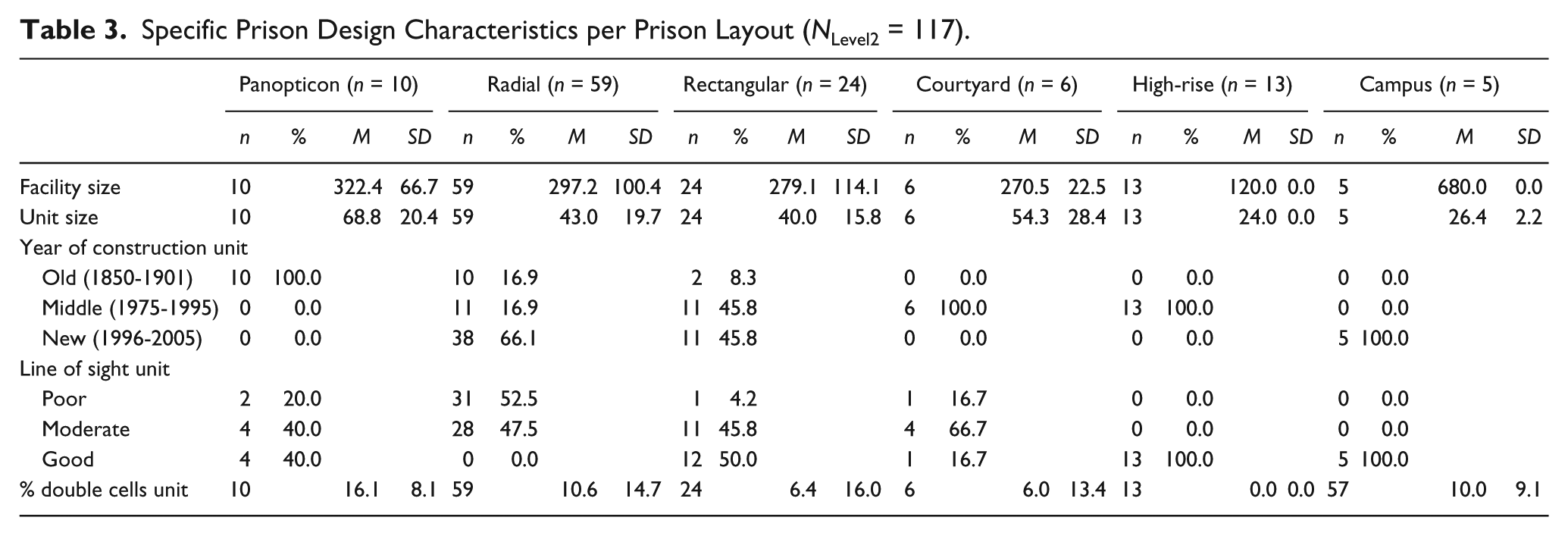
Before turning to the second research question, it is useful to see how the different prison layouts relate to the specific prison design characteristics. Table 3 presents a profile of each of the six prison layouts based on the five specific prison design features. Overall, campus and panopticon facilities were the largest facilities and could house on average 680 and 322 prisoners, respectively. The high-rise facilities were the smallest facilities and could house on average only 120 prisoners. The largest units were found in facilities with a panopticon layout (on average 69 prisoners), whereas the smallest units were found in high-rise and campus facilities (on average 24 and 26 prisoners, respectively). Units in a panopticon facility were always built in the 19th century. Units in a courtyard or high-rise facility were always built between 1975 and 1995, and units within a campus facility were built after 1995. In all units within a high-rise and campus layout, staff had a good view on the unit and cellblocks. In most units with other layouts, officers had either a reasonable or a good view from the staffroom. One exception was the radial layout; in most units within a radial design (53%), the officers had a poor view on the unit from the staffroom. The average percentage double bunking in a unit was highest in panopticon units (16%), whereas all units within a high-rise layout consisted of single cells only.
Specific Prison Design Characteristics per Prison Layout (NLevel2 = 117).
Specific Prison Design Characteristics and Staff–Prisoner Relationships
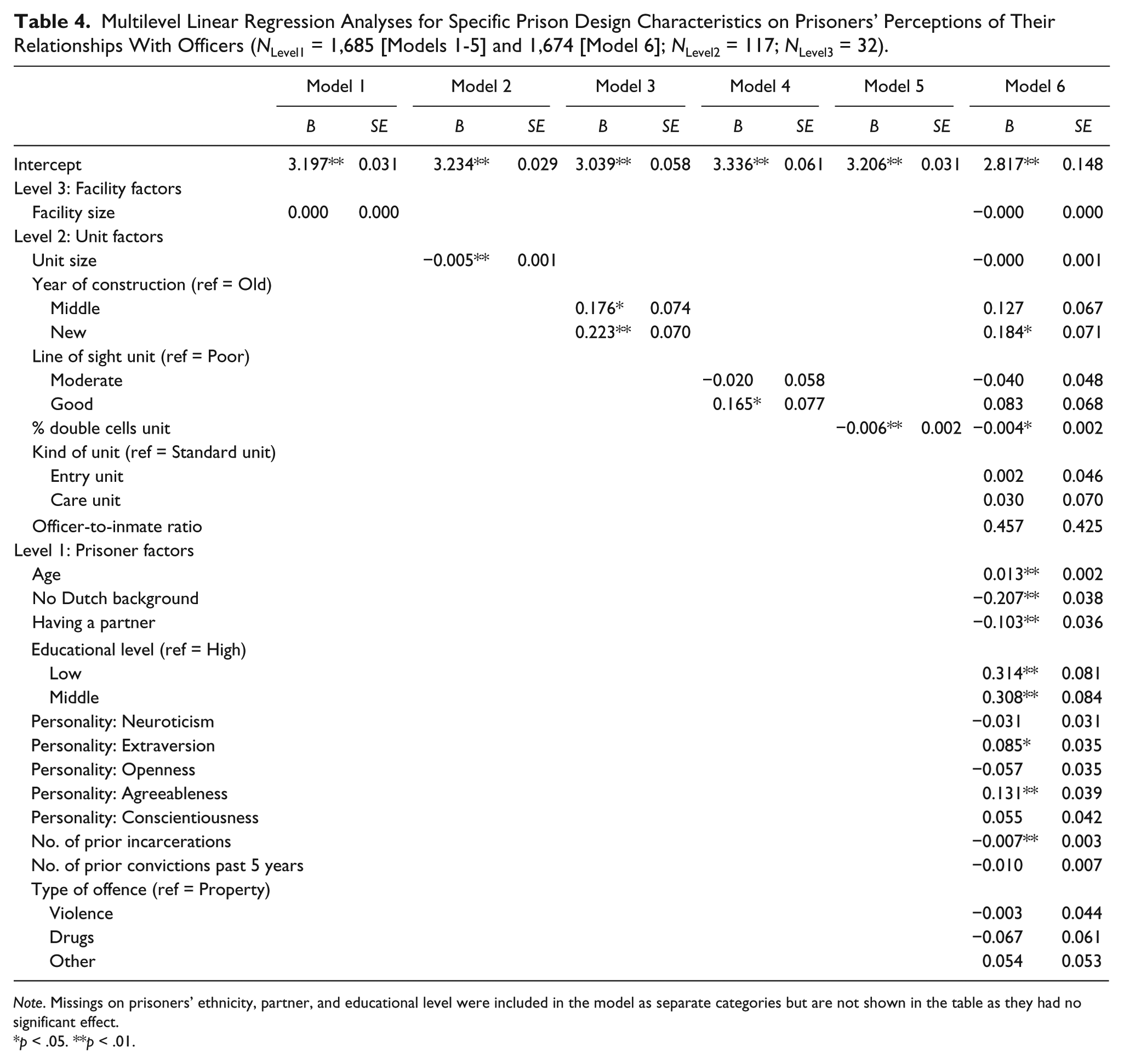
To answer our second research question, multilevel regression analyses were conducted testing the association between the five specific prison design characteristics and prisoners’ perceptions of their relationships with officers (Table 4). We hypothesized that prisoners experience their relationships with officers more positively in smaller facilities, in smaller units, in newer units, in units where officers have a good view on the unit, and in units with less double bunking. The results partly support our hypotheses.
Multilevel Linear Regression Analyses for Specific Prison Design Characteristics on Prisoners’ Perceptions of Their Relationships With Officers (NLevel1 = 1,685 [Models 1-5] and 1,674 [Model 6]; NLevel2 = 117; NLevel3 = 32).
Note. Missings on prisoners’ ethnicity, partner, and educational level were included in the model as separate categories but are not shown in the table as they had no significant effect.
p < .05. **p < .01.
First, five multilevel analyses were used testing the effects of each specific prison design characteristics separately (Models 1-5). Except for facility size, all other characteristics were significantly associated with officer–prisoner relationships. Prisoners judged more positive about their relationships with officers in smaller units, in newer units, in units where officers had a good view on the unit, and in units with fewer double cells. Second, we conducted a multilevel analysis, which included all specific prison design characteristics simultaneously, as well as the control variables (Model 6). The effects for year of construction and double bunking remained statistically significant. Prisoners experienced their relationships with officers more positively in newer units and in units with a lower percentage of double cells. After controlling for the other design characteristics and the control variables, the effects for unit size and sight lines disappeared.
Prison Layout Versus Year of Construction
The above presented findings raised another question. Tables 2 and 4 revealed that prison layout and year of construction are both related to officer–prisoner relationships, and Table 3 indicated that prison layout and year of construction are strongly related. This raises the question whether it is prison layout or year of construction that is most strongly related to officer–prisoner relationships. As radial prisons were built in a significant number both in the late 19th century and in the late 20th century, it provided us with the opportunity to compare similar prison layouts built in different time periods (i.e., 19th century radial and 20th century radial layout). If prisoners in 19th and 20th century radial layouts differ with respect to their perceptions of officer–prisoner relationships, this could suggest that year of construction is more important than prison layout. A t test, however, showed that prisoners in 19th century radial layouts and prisoners in 20th century radial layouts did not significantly differ in their judgment of their relationships with officers, M19th radial = 3.10 versus M20th radial = 3.21; T(907) = −1.459; p > .05. This bivariate result was confirmed in a multilevel regression analysis using 19th century radial layouts as reference category.
Discussion
The aim of the present study was to explore the association between prison architecture and prisoners’ perceptions of their relationships with officers. For this, data were used from a large-scale, nationwide study in which prisoners in all Dutch remand centers were interviewed during their first few weeks of pre-trial detention. By means of site visits to all correctional facilities, detailed data on prison architecture of the Dutch remand centers were collected.
The findings of the present study suggest that prison architecture does affect officer–prisoner relationships. Controlled for several prisoner and unit characteristics, prisoners in panopticon layouts evaluated their relationships with officers less positively than prisoners in the other layouts. Prisoners housed in campus layouts were most positive about these relationships. In addition, controlled for other design and prisoner characteristics, year of construction and double bunking were related to officer–prisoner relationships. Prisoners in older units and in units with a higher percentage of double cells were less positive about their relationships with officers. Old units and high levels of double bunking are especially present in panopticon layouts.
In general, our findings align with theoretical insights from environmental psychology suggesting that the architecture of a building affects people’s behavior and experiences and, more specifically, affects levels of social interaction between its users (Gifford, 2007; Sommer, 1969; Ulrich, 1991). Our results concerning the effects of prison layout largely confirmed our hypotheses. Prisoners housed in prison layouts based on penal philosophies promoting distance between staff and prisoners (like panopticon and radial facilities) indeed experienced their interactions with officers most negatively. Especially in panopticon layouts, which are old buildings and intended to encourage prisoner control, prisoners were less satisfied with staff–prisoner relations. In contrast, prisoners in prison layouts based on penal philosophies stimulating staff–prisoner interactions (like campus and high-rise facilities) indeed had the most positive judgment of their relations with officers. These results seem to corroborate the philosophy of American “new generation prisons,” which argues that correctional facilities with a campus layout consisting of small units with a direct line of sight can have a positive impact on staff–prisoner relationships (Fairweather, 2000; Johnston, 2000; Wener, 2000). In addition, our results correspond with the findings of Beyens et al. (2012) that penitentiary institutions containing small pavilions are preferable, as these prisons facilitate staff–prisoner interactions.
The findings regarding specific prison design characteristics were partly in accordance with our hypotheses. In line with our expectations, prisoners in older units evaluated their relationships with officers less positively. Although prior research is lacking, it has been suggested that new and modern correctional facilities could have a positive effect on the atmosphere in prison (Molleman, 2011; Shefer & Liebling, 2008). The finding that double bunking negatively affects officer–prisoner relationships is consistent with prior research. Double bunking has been associated with more distant and less frequent staff–prisoner interactions (Inspectie voor de Sanctietoepassing, 2011), as well as with less perceived privacy, more health problems, and more prisoner misconduct (e.g., Cox et al., 1984; Grant & Memmott, 2008).
In an attempt to examine the relative importance of prison layout and year of construction on officer–prisoner relationships, 19th century radial layouts were compared with 20th century radial layouts. Prisoners in 19th and 20th century radial layouts did not differ significantly with respect to how they experienced their relationships with officers. Although this finding might suggest that prison layout is more strongly related to officer–prisoner relationships than year of construction, some caution is necessary because it was only a first and explorative attempt to examine the effects of prison layout versus year of construction.
Contrary to our hypotheses, three other specific prison design characteristics (facility size, unit size, and sight lines) did not have a significant effect. This seems remarkable, especially with regard to facility and unit size, as prior Norwegian research indicated that staff and prisoners in small prisons experienced their relationships with each other more positively than staff and prisoners in medium-sized and large prisons (Johnsen et al., 2011). However, this difference is partly explained by the fact that Johnsen et al. did not control for other variables. In the present study, when tested bivariately, unit size also had a significant negative effect on prisoners’ perceptions of officer–prisoner relationships. However, after controlling for the other design characteristics and for several prisoner and unit control variables, this effect disappeared. This underlines the importance of controlling for other factors that may have an impact on prisoners’ perceptions of officer–prisoner relationships. Ignoring the effects of these factors on prisoner’s perceptions of their relations with officers could bias the estimates of the effects of prison architecture characteristics.
Before discussing the implications of our study, some limitations need to be addressed. First, the results of the high-rise and campus layout need to be considered. Although several units with these layouts were included in the present study, in fact they each belonged to one “establishment.” In the Netherlands, correctional facilities are clustered into establishments. Generally, the facilities within an establishment are at different locations with distinctive architecture. However, the high-rise remand facilities are an exception. The 13 high-rise units belong to three different facilities, but these facilities are all located on the same site and clustered into one establishment with a central management team. Furthermore, there is only one remand center for male prisoners with a campus layout in the Netherlands. Therefore, in the present study, all five units with a campus layout belong to one and the same facility. As a consequence, it is possible that in both the high-rise and campus layout factors other than the prison layout may have influenced officer–prisoner relationships, such as the management style, staff characteristics or geographical area. In addition, the data collection in the high-rise establishment followed a divergent procedure due to the requirements of the facility. Therefore, fewer prisoners could be approached by the researchers, which may have resulted in a selection of prisoners in the high-rise layout. The results of both the high-rise and campus layout should, therefore, be interpreted with caution.
Second, the present study was based on prisoners held in penitentiary institutions in the Netherlands. Although some changes occurred in recent years, the Netherlands is still known for having a relatively mild prison policy (Kruttschnitt & Dirkzwager, 2011). When compared with many other countries, prison conditions in the Netherlands are rather liberal and decent. In addition, the current study was based on prisoners who were detained in remand centers and who were still awaiting their trial; prisons (with convicted prisoners) were not included in the study. Therefore, we cannot be certain that the findings are generalizable to convicted prisoners or other countries with different prison architecture. Replication of our findings using data from other prison populations and prison layouts beyond those used in the Netherlands is needed.
Third, although the present study used a broad and detailed measure of prison architecture, other aspects of prison architecture that were not included may have had an effect on staff–prisoner relationships. It is suggested that characteristics such as color use, amount of daylight and lighting, noise, use of bars, cell size, the use of hard versus soft materials, and the design of visiting rooms may affect the atmosphere in prison and staff–prisoner interactions (Farbstein & Wener, 1982; Moore & Arch, 1981; Moran, 2013; Sommer, 1971; Wener & Olsen, 1980). Future research should, therefore, consider incorporating these other prison design characteristics.
Finally, it is important to recognize that prisoners’ perceptions of staff–prisoner relationships do not exist in a vacuum but exist within the context of other aspects of prison life and the prison regime, like prisoners’ perceptions of other prison conditions (e.g., safety, contact with fellow inmates, and autonomy) and staff attitudes and perceptions of surveillance and control. Such perceptions may influence how prisoners perceive their relationships with prison officers as well. Future research may, therefore, include these other perceptions into the analyses.
Notwithstanding the limitations, we feel that the present study has generated important new knowledge regarding the effects of prison architecture on officer–prisoner relationships. To date, few studies have examined the association between prison architecture and officer–prisoner relationships. Moreover, prior studies focused on only one small aspect of the prison design (e.g., facility size and double bunking). The current study made progress by conducting site visits to all remand centers, exploring prison architecture in more detail and using multilevel models. The conclusion of this study, that is, prison architecture does affect staff–prisoner relationships, is relevant for prison policy. First, the results could be significant to prison construction, as one layout type might be more desirable in terms of staff–prisoner relationships than other layouts. Second, such knowledge may be helpful to prison remodeling, for example, when decisions need to be made about double bunking in existing facilities. Last, the results show that, when comparing correctional facilities, it makes sense to take prison architecture into account. Comparing performances of prisons makes more sense when factors that the management has no control over, like prison architecture, are controlled for.
Finally, it is important to realize that the current study focused on (prisoners’ perceptions of) officer–prisoner relationships. This research did not aim to draw any conclusions about what the “best” prison design might be. In determining the “best” prison design, other factors also play a role, including the behavior and well-being of prisoners, the working conditions of staff, and efficiency considerations from a management perspective. For a more overall judgment about an optimal prison design, all these aspects should be taken into account.
Footnotes
Declaration of Conflicting Interests
The author(s) declared no potential conflicts of interest with respect to the research, authorship, and/or publication of this article.
Funding
The author(s) disclosed receipt of the following financial support for the research, authorship, and/or publication of this article: The Prison Project is financially supported by Leiden University, the Netherlands Institute for the Study of Crime and Law Enforcement (NSCR), the Netherlands Organization for Scientific Research (NWO), and Utrecht University.