



Abstract
Organized crime and drug cartel violence are major problems in some Latin American countries. This study examines the relationship between fear of crime and daily routines. It fills a gap in the international literature by testing the mediating effect of the war on organized crime (WOC) in Mexico. Integrating conventional individual and neighborhood characteristics with a local context variable, such as the intensity of the WOC and drug violence, provides a more complete view for understanding fear of crime in this country. Based on a national victimization survey, it was found that respondents in areas gravely affected by the WOC and drug violence were also more negatively affected in their daily routines after controlling for a set of classic correlates of fear of crime and perceived risk of victimization. However, no evidence was found to support that the current WOC mediates the relationship of fear of crime and perceived risk of victimization with daily routines.
Introduction
When Mexican president Felipe Calderon (2006-2012) announced the beginning of the war on organized crime (WOC) in December of 2006, he warned the Mexican public that it would be a long and a hard fight. But nobody thought it would be so long, so hard, and so damaging to the nation’s morale, reputation, and quality of life. After 6 years and almost 60,000 deaths associated with the WOC and drug cartel violence, about half of the Mexican population (54.0%) believes this war has been lost and only 18.0% think the government has won it. 1 Feelings of irritation and frustration with the current WOC are logical as 38.7% of households nationwide feel unsafe in their neighborhood, 75.3% perceive risk of criminal victimization, and 54.4% have stopped going out in the night due to risk of victimization. 2
To date, very few studies have studied the impact of fear of crime and perceived risk of victimization on the daily routines (Kail & Kleinman, 1985; Kelly & DeKeseredy, 1994; Mesch, 2000). Building on the fear of crime and perceived risk of victimization literature in general, this study analyses the relationship of fear of crime and perceived risk of victimization with daily routines. Going out in the night is the daily routine analyzed in this study. This routine was chosen as it was the most frequently mentioned by survey respondents. 3 Approximately thirty-five million Mexican adults reported to have stopped going out in the night in 2011 due to their perceived risk of victimization (Victimization and Public Security Perception Survey [ENVIPE], 2011).
This study also tests if the WOC mediates the previous relationship. There are two reasons to expect a mediating effect. First, prior research in different countries has documented that the local context affects fear of crime and perceived risk of victimization (Brunton-Smith & Sturgis, 2011; Hunter, 1978; Kohm, 2009; Vilalta, 2011, 2012; Williamson, Ashby, & Webber, 2006; Kelling & Wilson, 1982). Previous studies consistently show that individuals living in areas with signs of incivility perceive a higher risk of criminal victimization. The premise here is that the WOC and drug cartel violence can be equated to a state of incivility, more particularly if the military is patrolling the streets, as it is the case in several Mexican cities today. Second, the WOC and drug cartel violence are expected to influence behavior through changes in protective behaviors to alleviate fear and reduce risk of victimization. One example is the actual displacement of Mexican families from areas affected by the WOC (Vilalta, 2013a). Another example is, precisely, changing a daily routine such as stopping going out in the night due to a perceived risk of victimization.
This study was divided into four parts. First, a review of theories was carried out. The second part presents the data and methods. It is divided into four sections: Dependent variable, independent variables, control variables, and data analysis. The third part presents the data analysis results. The fourth part contains a discussion of the findings and suggestions for policy and future research.
Theoretical Framework
Daily routines are fundamental aspects of our lives. Whether conscious or unconscious, daily routines give a sense of order. Furthermore, daily routines reflect uncertainties and fears as they also reflect protective patterns of behavior. For example, fear of crime impacts our behaviors by constraining our social and territorial mobility (Fishman & Mesch, 1996; Garofalo, 1979, 1981; Skogan, 1986).
Daily routines can be any habit of behavior such as going out in the night, shopping, visit relatives or friends, and so on. Routines are activities that people engage in on a frequent, if not in a daily, basis, including vocational and leisure activities (Hindelang, Gottfredson, & Garofalo, 1978; Robinson, 1999). In theory, daily routines can be equated to lifestyles as routines originate from people’s lifestyles (Robinson, 1999). Naturally, some routines and lifestyles expose individuals to more criminal risk than others.
The relationship between fear of crime and perceived risk of victimization with daily routines has not been explored extensively in the literature. However, a handful of studies can be found focusing in these matters (Kail & Kleinman, 1985; Kelly & DeKeseredy, 1994; Mesch, 2000). All of these studies prove that the higher the fear or perceived risk, the less likely is the individual to either engage in a new routine or to continue with a daily routine. Likewise, these studies argue that fear of crime and perceived risk of victimization are objectively based; that is, these feelings are based on actual previous experiences such as direct victimization. Some point out that fear is so intense that some individuals arrange their lives such that they never go out in the night (Kail & Kleinman, 1985; Mesch, 2000). Doing the latter undoubtedly reduces the risk of victimization but also reduces the quality of life (Vilalta, 2011).
The perception of crime risk plays an important role in shaping our daily routines. Rountree and Land (1996) have argued that individuals base their choice of activities on their risk perceptions and fear of criminal victimization. The preceding contributions have found that the experience of direct victimization is associated with higher levels of perceived crime risk (Kail & Kleinman, 1985; Kelly & DeKeseredy, 1994; Mesch, 2000).
The preceding contributions on the relationship between fear of crime and perceived risk of victimization with daily routines, either explicitly or implicitly, are based on two theories: lifestyle and routine-activity theories of crime. These theories are considered opportunity crime theories and share common theoretical assumptions. Both theories imply that (a) crime victimization is a function of the daily routines of victims and offenders (Cohen & Felson, 1979; Hindelang et al., 1978) and (b) criminal opportunities exist as part of everyday life (Felson, 2002; Felson & Clarke, 1998; Wilcox, Quisenberry, & Jones, 2003). However, one important distinction between the two theories is that lifestyle theory focuses on individual-level risk factors whereas routine-activities theory focuses on macro-level risk factors (Felson, 2008).
Lifestyle theory explains that the observed patterns of crime victimization across sociodemographic groups (e.g., sex, age, occupation) are the result of differences in their lifestyles (Hindelang et al., 1978). 4 The basic idea is that sociodemographic groups have varying levels of exposure to crime risk. For instance, as women participate in more home-based activities than men, they are exposed to fewer risky situations. Likewise, as younger people go out more often than older people, they are more exposed to greater risks of victimization (Fisher, Sloan, Cullen & Lu, 1998). Also, fear of crime and victimization seems to be higher among those who travel longer distances to work or to study and spend more time away from their home (Kennedy & Forde, 1990; Vilalta, 2011). Therefore, sociodemographic characteristics are predictors of crime risk, and also serve as starting point for determining which daily routines may be affected by fear of crime and perceived risk of victimization.
Routine-activities theory predicts that people’s routine activities mediate between social structure change and crime opportunities (Cohen & Felson, 1979). Past studies on routine-activities theory have shown that if people spend more time outside their houses, both they and their households are more likely to be victimized (Koenig, 1987). Central to this theory is the idea that crime opportunity depends on the spatio-temporal convergence of three components: suitable targets, motivated offenders, and the absence of capable guardians (Cohen & Felson, 1979). The basic premise is that changes in the social structure will affect people’s routine activities, some helping create more criminal opportunities by changing the amount of the convergence of the previous components. For example, Cohen and Felson’s original thesis was that an increase in married women participating in the United States labor force between the 1960s and the 1970s led to more unattended houses which, in turn, increased the number of suitable targets, the lack of capable guardians, and motivated offenders (Cohen & Felson, 1979, cited by Lin, 2010). Naturally, these components do not contribute equally to the creation of criminal opportunities (Wilcox et al., 2003). Criminal activity will always be low when the supply of motivated offenders is also low, regardless of the supply of suitable targets and the availability of capable guardianship.
Both theories supplement each other. Lifestyle theory attempts to explain why individuals become crime victims whereas routine-activities theory focuses on the circumstances that create criminal opportunities. As such, it is clear that the study of victim behavior is as important as the study of offender behavior.
The preceding contributions on the relationship of fear of crime and perceived risk of victimization with daily routines are based either on one city (i.e., Haifa, New York City) or one country (i.e., Canada, Israel, or the USA) in isolation from what might be going on elsewhere. 5 This limits our interpretation or explanation of the role of the local context in shaping our fears. This also limits the creation of new knowledge when confronted with additional empirical evidence.
In this sense, it is important to introduce a few other ad hoc elements into analysis of the Mexican case. Crime in Mexico is now almost automatically interpreted, inside and outside the country, through the filter of the WOC. For example, a quick analysis of a major Mexican national newspaper shows that the term “Organized Crime” was present in 54.9% of the notes related to crime. 6 In fact, prior to the beginning of the presidency of President Calderon (2006-2012), the proportion was 41.0%, which one could think was already high.
Now, while the impact of the WOC may be unusual to the fear of crime scholars, its analysis is necessary. The point to be made is that comparative studies on the impact of fear of crime require to partially break from the typical U.S. or U.K. classic assumptions to engage in a constructive dialogue with the world. People’s fears are function of the beliefs and values to which they are exposed in their social networks. It would be quite difficult if not impossible to argue that fear is molded in a social vacuum and that social networks are not a function of place. Precisely, one distinctive feature of Mexican places nowadays is the WOC. The WOC is not geographically uniform but shows substantive spatial variation (Vilalta, 2014). Thus, the current importance of the WOC and its spatial variation points clearly to the expectation that fear of crime must affect similar population groups depending on their level of contact with the war. For this reason I hypothesized that the level of contact with the WOC would mediate the relationship between fear of crime and daily routines.
Below I submit all these assumptions to empirical testing. I turn now to the description of the data and methods before presenting the results of the statistical analysis.
Data and Methods
This study is based on the 2011 ENVIPE conducted by the National Institute of Statistics and Geography (INEGI) in Mexico between March and April of 2011. This survey is based on a random sample of 78,179 adults nationwide. Households and individuals were selected randomly from a stratified sample in each of the selected primary sampling units, in this case, states (N = 32). Only one adult respondent was selected per household. Data are related to criminological events and perceptions for 2010, but it also contains information on public perception for 2011.
Dependent Variable
The daily routine analyzed in this study was “to stop going out in the night” due to fear of crime victimization. Survey respondents were asked, “During 2010, due to being afraid of becoming a crime victim (theft, assault, kidnapping, etc.) you stopped doing . . . ?” A list of 15 different response options was presented to the respondent and multiple option responses were permitted. The “going out in the night” routine was selected as it was the most frequently reported by the respondents (51.5%). Possible answers to the question were “yes” (1), “no” (2), “does not apply” (3), “does not respond” (8), and “does not know” (9). Only yes/no answers were analyzed.
Independent Variables
It is my expectation that individuals feeling afraid of crime will have been more inclined to have stopped going out in the night. In this study I do not wish to enter into the classic debate of what is fear of crime exactly (Warr, 2000) and/or how it should be measured (Sacco, 2005), but I think it is safe to think that the sense of safety in the neighborhood and the perceived risk of victimization can very well capture individual’s fear of crime. I argue that operationalizing fear of crime based on two independent variables rather than one variable (or factor) helps to better depict one’s sense of fear, and better yet, its impact on our daily routines. This argument is in accordance with the research tradition in the fear of crime field that fear possesses emotional (e.g., being afraid) and cognitive (e.g., risk perception) elements that require separate theoretical and empirical analysis (Rountree, 1998).
Furthermore, one benefit is that the data in this study actually permit a comparison of this two independent-variable approach with other previous studies as similar measures have already been employed (Vilalta, 2011). Thus, if a simultaneous relationship between both independent variables and the dependent variable was to be detected, this would suggest that both variables give a clearer indication of which variables of the perceived reality actually impacts our protective behavioral preferences and patterns, such as, changing our daily routines, and what can we do with each of these elements. Naturally, to verify whether these two variables had each an independent effect, the model included a variety of control variables. Results show that after including these controls, both variables did have a significant impact. As such, we can be more certain that each is a different concept and both have a real impact.
Therefore, the two independent variables in this study were the reported sense of safety in the neighborhood or locality 7 (x1) and the perceived risk of criminal victimization (x2). The former was assessed with the following question: “You consider that living in this neighborhood/locality is . . . ?” Possible answers were “yes” (1), “no” (2), “does not respond” (8), and “does not know” (9). The latter was assessed in the following manner: “For what is left of 2011, do you think you can be . . . ?” A list of seven different crimes was mentioned to the respondent (i.e., assault, car theft, burglary, fraud, threat extortion, kidnapping, and/or other). The respondent was obviously given the choice of answering any combination of crimes or “none” (8), “does not respond” (88), and “does not know” (99). In this study, this variable was transformed into a dichotomous variable (yes/no). While both variables significantly correlate (φ = 0.203, p < .001), this correlation is not strong enough to lead to a danger of multicollinearity in our regression analysis.
Mediating Variable
I draw on the 2010 Presidential database of death counts associated with the WOC. 8 This database presents the total number of death counts by municipality in a monthly series between December of 2006 and December of 2010. The Presidency reported a total of 34,612 deaths associated with this war. It must be noticed the spatial variation (Vilalta, 2014) in the intensity of the WOC. This variable was reconstructed on the basis of averages and standard deviations. Respondents who resided in urban areas with death counts below three standard deviations (SD = 211.6) from the mean (M = 29.7) were coded “1” while otherwise were coded “2.” In other words, the sample was split into two groups: Those living in areas gravely affected by the WOC and the rest. As a result, survey respondents residing in Ciudad Juarez, Culiacan, Tijuana, Chihuahua, and Acapulco were coded “2.”
Control Variables
Based on previous studies, several correlates of fear of crime were included as control variables in the model. As such, models controlled for a number of possible confounding variables that have already been found to be associated with fear of crime. Thus, gender, age group, level of schooling, signs of incivility (i.e., the report of fights between neighbors, vandalism, and/or alcohol or drug use in the streets), direct and indirect victimization, and trust in local police were incorporated into the models.
Data Analysis
The analysis began with use of descriptive statistics. Later on, because of the dichotomous characteristics of most variables, data were analyzed through Pearson chi-squared test, Phi correlation coefficients, and binary logistic regression (BLR). BLR was used to estimate the likelihood of having stopped going out in the night from perceptions of fear of crime in the neighborhood and risk of criminal victimization, controlling for demographic and socioeconomic characteristics and other circumstances such as the factual experience of victimization and local context (urban geographic location). Two models were tested: First excluding the mediating place-effects variable, and later including it. The Forward-Wald stepwise method was used to select variables into the test of the model. This method starts with the estimation of the constant and proceeds by adding variables into the equation one at a time based strictly on its Wald Statistic value. Significance level was set at p < .01 for all tests and all analyses were conducted with SPSS version 18.
Data Analysis
A total of 60,457 individuals gave an answer to the question whether during 2010, due to being afraid of becoming a crime victim, had they stopped going out in the night. A total of 32,886 (54.4%) individuals responded “yes” (see Table 1).
Descriptive Statistics.
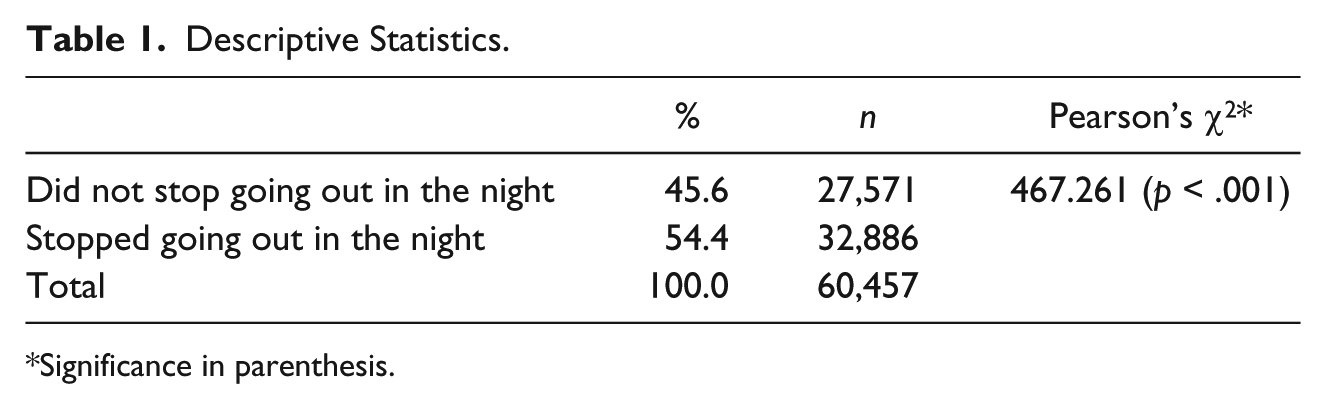
Significance in parenthesis.
Of these, the majority (69.3%) reported to feel unsafe in their neighborhood and also (61.1%) perceived some risk of criminal victimization for what was left of the year (see Table 2). Female and middle-aged individuals reported to have stopped going out in the night due to fear of possible criminal victimization. Level of schooling correlated positively with changing their daily routing of going out in the night. Individuals with higher levels of schooling (e.g., undergraduate and graduate degrees) differed significantly (p < .001) from their counterparts with lower levels of schooling, showing in this case to have a higher propensity to avoid going out in the night. Likewise respondents who had worked during the previous week to the survey also differed significantly (p < .001) from those who did not. Signs of incivilities in the neighborhood were associated with the likelihood of avoiding going out in the night (p < .001). Equally, individuals with lower levels of trust in local police preferred not to go out in the night compared with those with higher levels of trust (p < .001). Compared with not victims of crime, direct and indirect victims of crime differed significantly (p < .001) in that they also stopped going out in the night in higher proportions. Likewise, residents in areas gravely affected by the WOC also differed from their counterparts in other areas of the country (p < .001). Time of residence in the house was not associated with the dependent variable (p = .933).
Tests of Difference.

Source. Own calculations based on ENVIPE (2011).
Note. WOC = war on organized crime.
The sum of each variable category is roughly equal to n = 60,457. Not all respondents gave answers to all the questions.
Significance in parentheses.
Both independent variables significantly correlated with the mediator variable, that is, the effect of place as measured as the areas significantly affected by the WOC. However, correlations were not very strong (see Table 3).
Phi Coefficient Correlations.
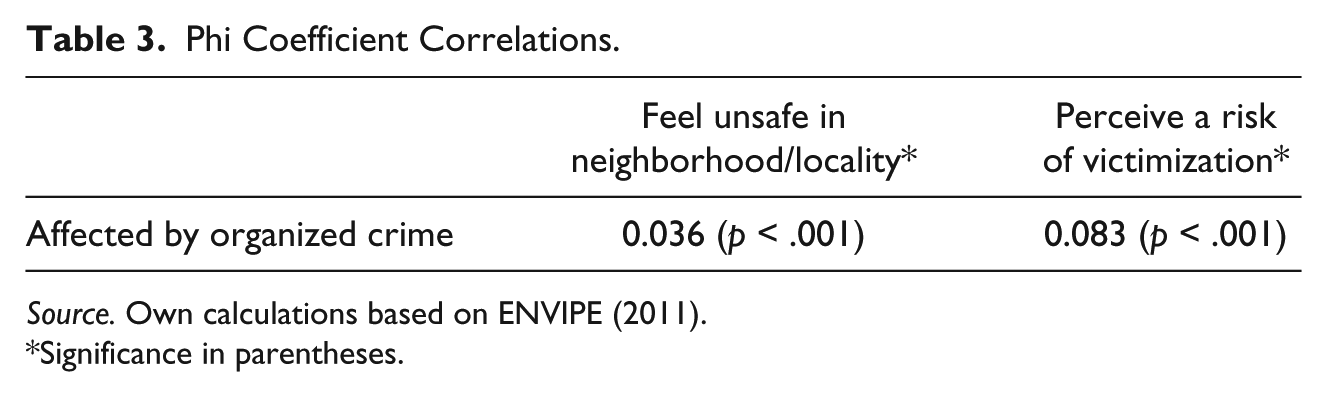
Source. Own calculations based on ENVIPE (2011).
Significance in parentheses.
Next, BLR was used to account for predictors of having stopped going about in the night due to fear of crime (Model 1) and to test the mediation hypothesis that fear of crime is conditional on place (Model 2). As expected, those who felt unsafe in their neighborhood/locality and perceived risk of criminal victimization were indeed (much) more likely to have stopped going out in the night. In addition, those who were also more likely to have changed this routine were female, older people, and individuals with less schooling (see Table 4). Likewise, we found a positive relationship between this change of daily routine with having low levels of trust in local police, the experience of indirect and direct victimization, and signs of incivilities in the neighborhood/locality. Yet there was no correlation with the report of having had worked in the previous week to the survey. 9 The inclusion of this variable did not increase the explanatory power, thus it was excluded from both models.
Model 1: Estimated Net Effects of Feeling Unsafe and Perceived Risk of Victimization on Stopping Going Out Due to Fear of Victimization.
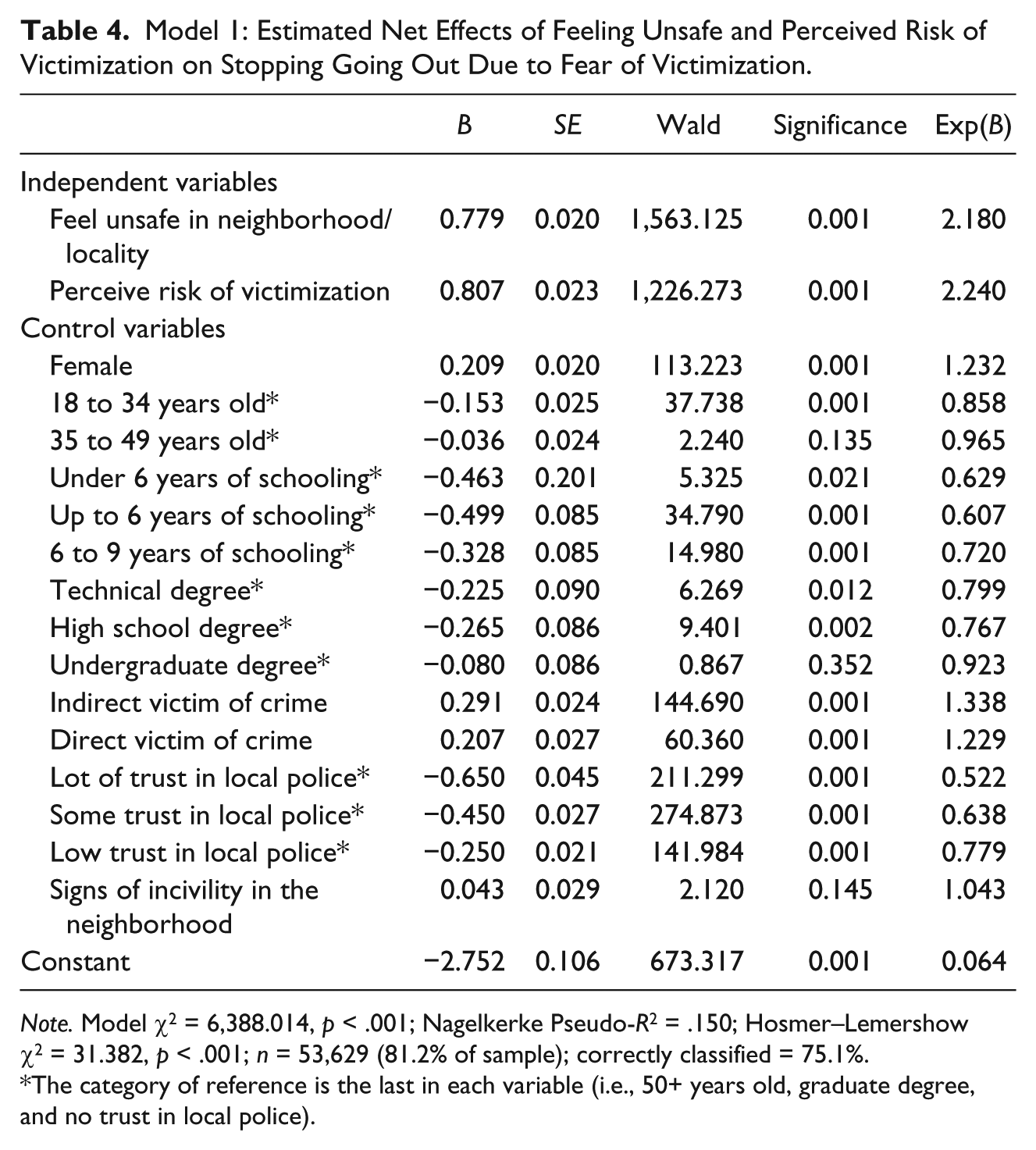
Note. Model χ2 = 6,388.014, p < .001; Nagelkerke Pseudo-R2 = .150; Hosmer–Lemershow χ2 = 31.382, p < .001; n = 53,629 (81.2% of sample); correctly classified = 75.1%.
The category of reference is the last in each variable (i.e., 50+ years old, graduate degree, and no trust in local police).
Place was important but not essential to predict a change in daily routines (See Model 2 in Table 5). Residents in urban areas critically affected by the WOC had much higher odds of stopping going out in the night (odds ratio [OR] = 1.860). However, place did not mediate the relationship between fear of crime and the change in daily routine. Still, very importantly, places gravely affected by the WOC had a significant and quite strong effect just by themselves, reinforcing the importance of the sense of place in crime analysis (Vilalta, 2013b).
Model 2: Estimated Net Effects of Feeling Unsafe and Perceived Risk of Victimization on Stopping Going Out Due to Fear of Victimization With WOC as Mediating Variable.
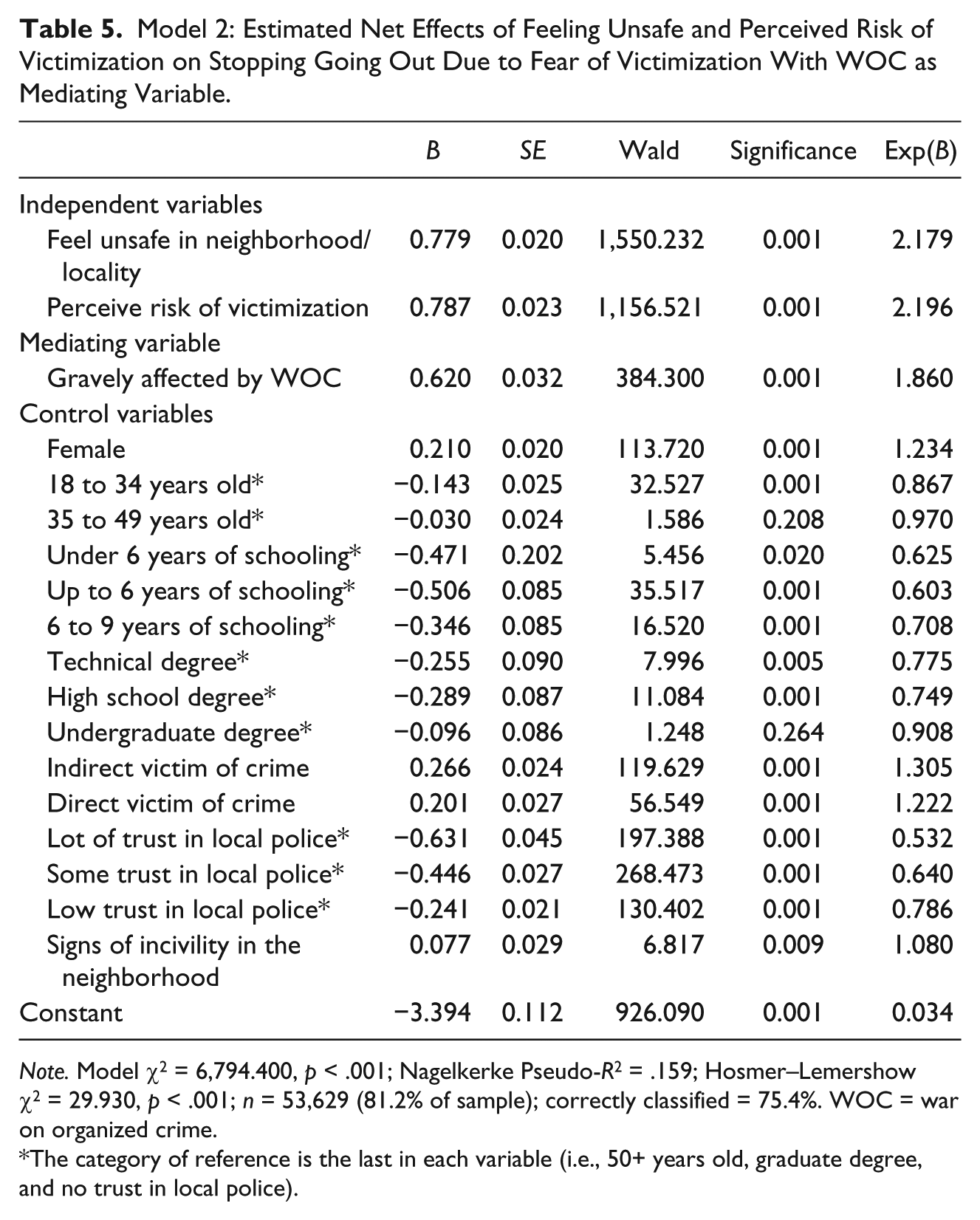
Note. Model χ2 = 6,794.400, p < .001; Nagelkerke Pseudo-R2 = .159; Hosmer–Lemershow χ2 = 29.930, p < .001; n = 53,629 (81.2% of sample); correctly classified = 75.4%. WOC = war on organized crime.
The category of reference is the last in each variable (i.e., 50+ years old, graduate degree, and no trust in local police).
Both models are highly statistically significant with a moderate level of explanatory power. None seems to adequately fit the data as indicated by the Hosmer–Lemershow tests. Yet it must be considered that this test of fit is strongly affected by the sample size. In this case, we have a sample of more than 53,000, thus even the minimal discrepancy of the model from the data set will have to be statistically significant.
Discussion
It is rare in the social sciences to find fundamental relationships understudied. For long it has been said that fear of crime impacts quality of life by limiting our daily routines (Kail & Kleinman, 1985). Yet, in spite of its fundamental importance, this relationship has not received much attention in criminology.
Daily routines are fundamental in our lives. Daily routines depict individual behaviors for which regularity and dependability are central. This study has sought to expand the fear of crime literature using daily routines as the object of study and Mexico as a test case. Bringing the impact of the WOC into analysis helped reveal that place matters as it significantly influences changes in daily routines. Although the non-experimental nature of this study impeded to infer causal mechanisms in the relationships tested, the test of the model expounded a few valuable findings for researchers and policy makers.
For researchers, it will be valuable to know that the impacts of (a) being unsafe in the neighborhood and (b) perceived risk of victimization on changes in daily routines were independent from each other, were the strongest among a set of correlates, and persisted in the presence of a mediating variable, that was in this study, the place-effects of the WOC. It must be added that the latter was the next strongest correlation (two times higher than the next higher correlate, this being mistrust in local police). Because both perceptual variables are conceptually different yet closely connected, I expected similar impacts on changes in stopping going out in the night due to fear of crime victimization. The analysis verified this expectation. Thus, keeping the tradition of separating feeling of safety from perceived risk of victimization rather than combining both into a factor, reinforced the notion that each has its own value as each has an impact on daily routines. It seems then that both perceptual measures of fear of crime altogether with the role of place or the local context significantly shape daily routines (and quality of life) in fundamental yet still understudied ways.
In addition, the analysis showed that the influence of public trust in local police is real and considerable as well—even more than the experience of crime victimization. In this respect, policy makers seeking to implement criminal policies in Latin America normally face basic troubles that have not been well addressed, among them: to develop policy actions based on scientific evidence and to distinguish between crime control policies and fear of crime reduction policies. In all fairness, it is certainly the case that crime rates and fear of crime levels are conceptually connected, but are not co-integrated, that is, crime and fear of crime are different concepts as both have different theoretical and empirical grounds. One piece of evidence from this study is that direct and indirect crime victimization had an independent impact each on changes in our daily routines aside from the sense of safety in the neighborhood and the perceived risk of victimization. But given the limited amount of resources available for crime policies, it makes sense that policy makers have attempted to reduce fear of crime focusing solely on attacking crime activity. However, for policy makers, here is one finding of obvious value: Mistrust in local police was among the main factors that differentiated those who changed their routines from those who did not. More precisely, lower levels of trust in local police increased the odds of stopping going out in the night due to fear of crime victimization. This calls for policy actions directed to improve police reputation perhaps through a better communication with the community sharing their work and achievements.
To sum up, this study is part of a trend of studies interested in how place affects fear of crime and how this relationship in turn affects typical behaviors such as our daily routines. This type of research is important because it provides a way to understand how similar demographic and socioeconomic groups in different places may react differently depending on their local context. What this means is that crime policy cannot operate without a clear understanding of place or locality. This study demonstrated that the intensity of the WOC in Mexico affected large groups of people independently of other factors, attesting the value of incorporating place and/or local ad hoc circumstances in future comparative fear of crime research.
Footnotes
Declaration of Conflicting Interests
The author(s) declared no potential conflicts of interest with respect to the research, authorship, and/or publication of this article.
Funding
The author(s) received no financial support for the research, authorship, and/or publication of this article.