



Abstract
Separate studies have shown that a variety of postrelease housing placements for returning prisoners can significantly influence recidivism. Research has also found that contextual factors such as economic disadvantage can also significantly predict recidivism. This study combines those lines of research by examining the effects of five categories of postrelease housing placements as well as contextual measures of economic disadvantage on recidivism for newly released Minnesota state prisoners. Using multilevel analysis techniques, this research found that with one exception, certain postrelease housing situations, along with several other individual-level control variables, were more robust predictors of recidivism than contextual measures of disadvantage and poverty. This study highlights the significant impact that postrelease housing placements can have on the reentry process.
Introduction
Releases from state and federal prisons outpaced admissions for the fourth consecutive year in 2012, while prison populations continued to shrink nationally (Carson & Golinelli, 2013). After decades of growth, this reversal in trends is welcome news to states struggling with the high cost of incarceration (Pew Center on the States, 2012). However, the transition from prison to the community remains difficult for offenders. One of the many reentry hurdles that returning prisoners face is securing stable housing (Roman & Travis, 2004). Housing restrictions for convicted felons, financial hardships, as well as compromised personal relationships all contribute to the housing difficulties faced by returning felons (Metraux, Roman, & Cho, 2007; Roman & Travis, 2004). Moreover, many offenders come from and return to disadvantaged communities (e.g., Clear, 2007; LaVigne, Kachnowski, Travis, Naser, & Visher, 2003; Lynch & Sabol, 2001; Massoglia, Firebaugh, & Warner, 2013; Visher, LaVigne, & Travis, 2004), which are often the same communities that increase the risk of recidivism (Kirk, 2012; Kubrin & Stewart, 2006; Mears, Xia, Hay, & Bales, 2008).
Much of the literature on prisoner reentry and recidivism has focused on specific interventions, such as cognitive-behavioral programming (e.g., Lowenkamp, Hubbard, Makarios, & Latessa, 2009; Tong & Farrington, 2006; Walters, 2005), job training and employment (e.g., Bohmert & Duwe, 2012; Callan & Gardner, 2005; Duwe, 2012a), and substance abuse treatment (e.g., Duwe, 2010; Pelissier et al., 2002). Several qualitative studies have examined the housing placements of returning offenders and how these placements influence reoffending (e.g., LaVigne et al., 2003; Visher, 2007; Visher & Farrell, 2005; Visher et al., 2004), while other researchers have quantitatively assessed how specific types of housing placements influence reoffending (e.g., Bell et al., 2013; Lowenkamp & Latessa, 2002; Lutze, Rosky, & Hamilton, 2013). These studies have shown that postrelease housing situations can have an impact on recidivism.
Other recent reentry scholarship has moved beyond how individual characteristics and interventions influence recidivism, and has instead focused on whether and how community-level attributes influence recidivism (Kubrin & Stewart, 2006; Mears et al., 2008; Stahler et al., 2013). These studies have shown that contextual factors such as economic disadvantage, racial segregation, and proximity to other recidivists can all influence individual recidivism. However, these studies included only a limited number of individual-level control variables.
The present study looks at both postrelease housing placements as well as the communities that those placements were located within Minnesota, a state where the number of annual releases from prison more than doubled in the past 15 years (Minnesota Department of Corrections, 1999; 2013). Rather than focusing exclusively on one type of postrelease housing placement or placing greater emphasis on potential contextual effects on recidivism, this research looks both at an array of postrelease housing placements (e.g., homeless shelters, transitional housing, treatment facilities) as well as the neighborhoods that these living situations are nested within. The present study employs a rich data set that includes detailed offender characteristics, multiple measures of housing placements, as well as community-level indicators of urbanization, poverty, and disadvantage.
This research makes two significant contributions to the prisoner reentry literature. First, prior studies that examined the effects of community context on prisoner reentry may have mistakenly concluded that contextual factors influence recidivism without controlling for an adequate number of individual-level measures, such as housing placements. Second, by highlighting what effect, if any, certain housing placements have on successful reentry, this study could inform the release planning process conducted by criminal justice practitioners.
In the following sections, we review previous research on prisoner reentry, with a specific focus on postrelease housing and community-level factors that influence reentry. This review of the literature is followed by a description of the data and methods used in this study, the results of the analyses, and a summary of the results and how they relate to prior research.
Prisoner Reentry and Housing
Securing stable housing is one of the first and most critical obstacles faced by returning prisoners (LaVigne et al., 2003; Nelson, Deess, & Allen, 1999; Roman & Travis, 2004). The Urban Institute’s Returning Home series of pre- and postrelease interviews with prisoners from Maryland, Illinois, Ohio, and Texas (Baer et al., 2006) revealed that a majority of newly released prisoners relied on family and friends for housing immediately on release. Many of the prisoners in these studies believed that stable housing was the key to not returning to prison. Indeed, stable housing provides the foundation for successful reintegration by allowing offenders the ability to focus on employment and treatment, while maintaining compliance with the conditions of his or her supervision (Fontaine & Biess, 2012; Shaw, 2004). More recent research has demonstrated a link between homelessness and housing instability and increased rates of recidivism (Lutze et al., 2013; Metraux & Culhane, 2004; Steiner, Makarios, & Travis, 2011).
Independent living situations are difficult for offenders to obtain due to their troubled backgrounds as well as financial limitations. Private landlords usually have basic requirements that are difficult for returning prisoners to meet, including security deposits and advance rent payments, stable employment, and references from prior landlords (Travis, Solomon, & Waul, 2001). Private landlords are also able to prohibit convicted felons from living in their rental units. Public housing is difficult to obtain due to limited supply and high demand, along with similar rules barring certain types of offenders from access (Petersilia, 2003; Roman & Travis, 2004). When returning prisoners are unable to live with family and friends or secure their own housing, they might rely on halfway houses, work release centers, or they may be forced into homelessness. A small number of offenders are also able to go directly from prison to treatment facilities. Each of these types of living situations are described in more detail below.
Halfway Houses
Family conflict, legal restrictions, treatment needs, and official conditions of release force some offenders to pursue housing options apart from family and friends or on their own (Fontaine & Biess, 2012; Roman & Travis, 2004). One alternative is correctional-based housing, such as transitional housing (“halfway houses”). Halfway houses vary greatly in terms of clientele, size, rules, and program offerings, but they all tend to be low-security residential facilities that offer newly released offenders the opportunity to work, receive vocational training, and/or attend treatment programming under close supervision in the community.
In Minnesota, placement in a halfway house is sometimes required for high-risk offenders, especially sexual offenders under intense supervision. Staff from local community corrections agencies and the Minnesota Department of Corrections (MnDOC) jointly decide on whether or not to place an offender in transitional housing, using considerations such as the offenders’ risks and needs and capacity at local facilities. Halfway house placement may also be the best option for offenders who have no other housing prospects. Although policies and enforcement may vary from facility to facility, most halfway houses in Minnesota closely track the movements of offenders. Offenders are required to register with staff when they leave and reenter the facility, have a valid and approved purpose for leaving the facility, and check in with staff by phone when they are away from the facility for more than a few hours. Outside visitors and guests to the facilities are closely regulated, and the residents may be subject to drug and alcohol use monitoring at regular and random intervals. Minnesota halfway houses are privately owned and operated, but MnDOC contracts with facilities that meet their standards. Newly released offenders from MnDOC usually have up to 60 days to stay in the facility.
Research on the effects of halfway house placement on recidivism has been mixed, with studies finding that halfway house residents have higher, lower, and similar rates of recidivism compared with offenders placed in other types of housing (e.g., Bell et al., 2013; Latessa, Lovins, & Smith, 2010; Latessa & Travis, 1991; Lowenkamp, Latessa, & Holsinger, 2006; Lowenkamp, Latessa, & Smith, 2006). These mixed results likely reflect the wide variability in halfway houses in terms of staff competency and turnover, clientele, program offerings, and many other variables across facilities and jurisdictions. A recent report from the Pennsylvania Department of Corrections (Bell et al., 2013) found that offenders paroled to “the streets” (i.e., private homes or noncorrectional housing) had lower rates of reincarceration than offenders paroled to Community Corrections Centers (CCCs) after 1, 2, and 3 years of follow-up time. Pennsylvania’s CCCs are a mixture of publicly operated and privately contracted halfway houses that offer a range programming services, including chemical dependency (CD) treatment and vocational training. As the authors of the report note, the higher recidivism rates observed among CCC residents may be due to the close monitoring they receive and are not necessarily a direct result of living in a CCC.
Whereas Bell et al.’s (2013) report showed higher recidivism rates among halfway house residents, other evaluations have found lower recidivism rates. An evaluation of Reno, Nevada’s Ridge House, a highly structured spiritually based transitional house that includes CD treatment and employment skills training, found that residents who completed all of the programming components had the best recidivism outcomes (Willison, Roman, Wolff, Correa, & Knight, 2010). That is, Ridge House program completers had lower likelihoods of arrest and more time out of prison before arrest.
Ohio’s privately run halfway houses serve offenders released from state institutions, offenders referred to them by the courts, as well as offenders being held for violations of community supervision. Lowenkamp and Latessa’s (2002) evaluation of Ohio’s halfway houses found that halfway house residents had lower rates of rearrest and reincarceration than offenders released to other types of placements. This treatment effect was even stronger for offenders rated as moderate or high risk to reoffend based on actuarial risk assessment scores. In fact, offenders rated as low risk to reoffend placed in halfway houses sometimes had higher rates of recidivism than low-risk offenders not placed in halfway houses.
Work Release Centers
Work release centers are another form of correctional-based housing. In Minnesota, work release is an early-release program for state prisoners who meet several qualifications, including having few institutional disciplinary issues, a demonstrated need for transitional services, and assessed as low to medium risk to reoffend based on prior criminal involvement and actuarial assessment scores (Minnesota Department of Corrections, 2014). Offenders can apply to enter this program once they have served at least half of their terms of imprisonment and are within 8 months of their earliest possible release date. 1 Applicants approved by the Work Release unit at MnDOC are placed in contracted local jails and community corrections residential centers, which sometimes double as halfway houses for non–work release offenders. 2
Once offenders are placed in work release facilities, they are required to quickly obtain employment or attend approved vocational training. Offenders with histories of CD issues are required to participate in treatment, including attending 12-step programs or outpatient treatment. Similar to halfway houses, the movements of work release offenders are closely tracked and they are routinely screened for drugs and alcohol. Work release placements generally last from 2 to 8 months, with an average of about 4 months (Duwe, 2014).
A recent evaluation of Minnesota’s work release program matched nearly 1,800 work release participants released between 2007 and 2010 to a similar group of offenders who would have been eligible for work release and were released during the same period of time (Duwe, 2014). This study found that work release significantly increased the likelihood of returning to prison for a technical violation of release, but it significantly decreased the likelihood of rearrest, reconviction, and new offense reincarceration. While work release participation did not have a significant impact on the hourly wages of work release offenders relative to the comparison group, it did significantly increase the odds of obtaining employment as well as the total number of hours worked and total wages earned. Moreover, work release allows MnDOC to avoid about US$1.25 million in costs every year.
Earlier research on work release programs have found that these programs can ease prison overcrowding (Turner & Petersilia, 1996). Consistent with Duwe’s (2014) evaluation, prior evaluations of work release programs have found that such programs can significantly reduce recidivism (Drake, 2007; LeClair & Guarino-Ghezzi, 1991; Rudoff & Esselstyn, 1973), whereas other evaluations found no significant effects on recidivism (Lamb & Goertzel, 1974; Waldo & Chiricos, 1977). Similar to Lowenkamp and Latessa’s (2002) finding that moderate and high-risk offenders were better served by Ohio’s halfway houses, Jeffery and Woolpert (1974) found that work release reduced recidivism among offenders with more extensive criminal records but not offenders who had only a few prior offenses.
Emergency Shelters and Homelessness
When private homes and correctional-based housing are not available, offenders may have no choice but to live in short-term emergency housing, such as homeless shelters, motels, or on the streets. Given their involvement in the criminal justice system, CD and mental health issues, as well as the economic disadvantage that is common in this population, felons have significantly higher rates of homelessness than the general U.S. population. Anywhere from 8% to 82% of homeless populations report being previously incarcerated, depending on the study being looked at (Metraux & Culhane, 2006; Schlay & Rossi, 1992). Greenberg and Rosenheck’s (2008) analysis of national survey data from adults housed in state and federal prisons revealed that 9% of inmates experienced a bout of homelessness in the year prior to their incarceration. This rate is 4 to 6 times higher than the rate observed in the adult U.S. population. In their analysis of longitudinal data from urban families, Geller and Curtis (2011) found that formerly incarcerated men had double the odds of housing insecurity than men who had never been incarcerated, net of several demographic and socioeconomic variables. Metraux and Culhane (2004) found that nearly 12% of prisoners released from New York state prisons spent time in a homeless shelter at some point during the 2 years following release. Most of the prisoners who stayed in shelters did so during the first month after release.
Homelessness has obvious implications for increased risk of recidivism given that it could disrupt an individual’s ability to follow the conditions of his or her release, including maintaining contact with a supervision agent or registering a verifiable home address. Homelessness itself is a crime in some municipalities in the form of loitering and other public nuisance offenses (Geller & Curtis, 2011; Roman & Travis, 2006). Multiple studies have linked homelessness and housing instability among returning prisoners to recidivism. Using a small sample of 49 ex-prisoners returning to New York City, Nelson et al. (1999) found that parolees released to homeless shelters were 7 times more likely than offenders who did not go to homeless shelters to abscond from supervision. Meredith, Speir, Johnson, and Hull (2003) found that each change in home address was associated with a 25% increase in the odds of rearrest among a sample of Georgia parolees. In the course of an evaluation of a Washington state housing assistance program for high-risk offenders, Lutze et al. (2013) found that bouts of homelessness more than doubled the risk of reconvictions, supervision revocations, and prison readmissions both among the group that received housing assistance as well as a matched control group.
Treatment Facilities
Dependence on drugs and alcohol is one of the strongest predictors of reoffending (e.g., Bonta, Law, & Hanson, 1998; Dowden & Brown, 2002). Several studies have demonstrated that prison-based CD and sexual offending treatment can reduce recidivism (e.g., Lösel & Schmucker, 2005; Mitchell, Wilson, & MacKenzie, 2007). Some studies have also shown that programs of all types that follow offenders from the prison into the community are the most effective at reducing recidivism (e.g., Duwe & King, 2012; Kurlychek & Kempinen, 2006). For example, Duwe’s (2012b) evaluation of the Minnesota Comprehensive Offender Reentry Plan (MCORP) program found that study participants who received CD treatment both in the facility and in the community had the lowest likelihood of recidivism. Granted, most of the studies mentioned above did not involve inpatient treatment in the community, but the results suggest that continuing treatment after release from prison results in improved recidivism outcomes.
In the present study, approximately 6% of the offenders released in 2009 went directly from prison to various inpatient treatment facilities. Most prisoners do not have the financial means to pay for treatment, but some released prisoners qualify for CD treatment paid for by Minnesota’s Consolidated Chemical Dependency Treatment Fund. Individuals who qualify as chemically dependent through a special assessment and meet certain household size and income thresholds can receive treatment paid for by this fund, which sometimes includes inpatient treatment.
The inpatient treatment received by newly released prisoners is usually provided by a nonprofit agency and lasts for 30 days. Exceptions include military veterans who may receive treatment from federally funded Veterans Affairs facilities. There are also a small number of state-owned facilities. Newly released prisoners in treatment are still subject to community supervision requirements, including check-ins with their supervision agents. Individuals in inpatient treatment usually have limited access to the community. That is, they cannot freely leave and return to treatment facilities. They are also generally subject to close monitoring by facility staff, including random drug and alcohol tests.
Communities and Reentry
Just as individual-level factors (e.g., family structure, CD) influence an individual’s criminality or conformity, neighborhood-level variables can also influence criminal behaviors. Decades of research has demonstrated that community-level characteristics influence aggregate crime rates (e.g., Morenoff, Sampson, & Raudenbush, 2001; Sampson & Groves, 1989; Shaw & McKay, 1942), individual offending (Anderson, 2002; Oberwittler, 2004), and individual victimization (Miethe & McDowall, 1993; Sampson & Lauritsen, 1990). Thus, it seems intuitive that community-level characteristics could influence the risk of recidivism.
Research within the last decade has demonstrated that community-level variables can significantly influence recidivism. In one such study, Kubrin and Stewart (2006) followed 5,000 ex-prisoners returning to Multnomah County, Oregon (Portland area) who were under supervision. Using data from the 2000 Census to construct neighborhood-level (census tract) scales, the authors found that contextual effects explained a considerable amount of the variance in recidivism among offenders net of individual-level factors. Neighborhood Disadvantage—a scale of receipt of public assistance, unemployment, poverty, and household income—significantly increased the odds of rearrest. Conversely, living in a neighborhood with more affluent households than poor households decreased the odds of recidivism.
In another study, Mears et al. (2008) examined a large sample (N = 49,420) of newly released offenders in Florida. The authors found that county-level resource deprivation (a measure similar to Kubrin and Stewart’s, 2006, Neighborhood Disadvantage scale) and county-level racial segregation (i.e., concentrated populations of minority residents) increased the likelihood of a new felony conviction within 2 years of release.
In a more recent study, Stahler et al. (2013) found that proximity to other offenders who recidivated, and not neighborhood disadvantage or high residential turnover, increased the individual risk of reincarceration within 3 years of release. The authors looked at more than 5,300 offenders sentenced in and released to Philadelphia County, Pennsylvania. Using geographic information systems (GIS) data, the authors measured each offender’s proximity to other ex-offenders who reoffended within 3 years of release. This “social contagion” variable is a proportion: the number of ex-prisoners within 1 mile who were reincarcerated within 3 years of release divided by the total number of ex-offenders within the same search radius (Stahler et al., 2013). Controlling for a limited number of individual-level characteristics, the authors found that social contagion (an individual-level measure) was a salient factor in predicting recidivism, but census tract–level measures of neighborhood disadvantage and residential mobility were not.
Both Kubrin and Stewart (2006) and Stahler et al. (2013) examined neighborhood-level effects based on census tracts, as the present does as well. Unlike the present study, both of these previous studies limited their analyses to one county in each state. In both cases, these were the largest and most populous counties in Oregon and Pennsylvania, respectively. The present study examines neighborhoods across the entire state of Minnesota. Thus, this study is likely to capture a wider range of rural and urban neighborhoods.
Present Study
The present study follows offenders released to correctional supervision from all adult Minnesota state correctional facilities in calendar year 2009. While previous studies have either focused on postrelease housing situations or community-level characteristics, this study combines both. Moreover, this study does not examine the effects of a single type of postrelease housing placement in comparison with all others. Rather, we have created multiple measures of postrelease housing placements to capture the range of situations to which offenders are released. Also, instead of focusing exclusively on the largest and most populous county in a single state as previous contextual studies have done (Kubrin & Stewart, 2006; Stahler et al., 2013), this research examines all neighborhoods across the state of Minnesota to which offenders returned. We were able to include several individual-level control variables that have been linked to recidivism in past research, including basic demographic information (e.g., gender, age, race, and ethnicity), offense information, prior criminal record, prison-based programming participation, and actuarial risk assessment scores (e.g., Duwe, 2014; Gray, Fields, & Maxwell, 2001; Morgan, 1994). All of these measures are used to predict two types of recidivism: rearrest and returns to prison for supervision revocations.
Based on the literature and prior research, private residential addresses, either with family and friends or independently, appear to be the optimal postrelease housing option in relation to recidivism. Family and friends provide crucial support for newly released offenders, and independent living situations could be an indicator of stability and financial well-being. Given the wide variability in halfway houses in Minnesota in terms of program offerings and recidivism, transitional housing placements could either increase or decrease recidivism. However, it seems likely that halfway houses could increase rates of supervision revocations given that residents are likely monitored more closely than they are at private residential addresses. Recent research (Duwe, 2014) that also used data from Minnesota suggests that work release placement is likely to decrease incidents of rearrest but increase supervision revocations for the same reasons that transitional housing might have higher revocation rates. Because the link between homelessness and higher rates of recidivism seems self-evident and has been demonstrated in multiple studies, we expect postrelease housing placements in emergency shelters to increase rearrests and supervision revocations. Going directly from prison to inpatient treatment appears likely to decrease recidivism given that the continuum of treatment from prison to the community is optimal for offenders. However, just as offenders in transitional housing and work release centers are watched more closely than offenders in private residences, postrelease inpatient treatment may increase incidents of supervision revocations. Finally, community-level measures of disadvantage and concentrated poverty have a well-documented relationship with an array of criminal behaviors, including recidivism. Thus, we would expect neighborhood-level poverty to increase recidivism in this study.
Data and Method
The data for this research were initially derived from the 7,994 releases from Minnesota state prisons in calendar year 2009. Some offenders are released multiple times from prison in a given year, so we limited our data to each offender’s first release in 2009. Limiting the data to only one release per offender in 2009 left us with a pool of 5,904 released inmates. We subsequently eliminated 1,207 offenders from this pool for the following six reasons: The offender (a) was released to a different state; (b) had a detainer in a Minnesota county, a different state, or with the Federal Bureau of Prisons; (c) had a U.S. Immigration and Customs hold; (d) either did not have a listed address or only listed a supervision agent’s office address; (e) was referred to the Minnesota Sex Offender Program for civil commitment; and (f) was discharged without supervision. Eliminating these offenders from the data left us with a total sample of 4,697 released inmates.
One of the key variables included in this study is each offender’s Level of Service Inventory–Revised (LSI-R) score. The LSI-R is a risk and needs assessment tool used by many correctional agencies, including MnDOC. Despite efforts to administer the LSI-R to all adult offenders in Minnesota state prisons during each term of confinement, not all of the 4,697 prisoners had an LSI-R score. Given this tool’s long-standing demonstrated ability to predict recidivism (e.g., Andrews, 1982; Andrews & Bonta, 1995), this study included only those offenders who were assessed with the LSI-R prior to the release from prison captured in this research. About 7% of the potential pool of offenders (340 offenders) did not have an LSI-R score and were eliminated from the study. A total of 4,357 offenders met all of the criteria to be included in this research.
We collected each offender’s first valid address from the Reentry Plan module in MnDOC’s Correctional Operations Management System (COMS). COMS is the main database used by MnDOC to track offender information and status while offenders are under state correctional control. Prior to release from a state institution, each offender develops a reentry plan with his or her institutional case manager, which includes the address that the offender plans to reside at on release. Case managers work with community supervision agents to ensure that the desired address is suitable for the offender and is consistent with the conditions of his or her release. For example, an offender cannot reside with someone who currently has an order for protection against the offender. The address must be approved by the case manager, the community supervision agent, and MnDOC’s Hearings and Releases Unit.
Dependent Variables
Recidivism, the outcome variable in this study, is measured in two ways: (a) rearrest and (b) a return to prison for a release violation (supervision revocation). Data on rearrests were obtained from the Minnesota Bureau of Criminal Apprehension (BCA), and supervision revocation data were derived from COMS. Because they were both drawn from Minnesota state databases, a limitation with these data is that they measure only rearrests and revocations that took place in Minnesota. Also, official criminal history data likely underestimate the actual extent to which individuals reoffended as official records do not include recidivism events not detected by law enforcement.
Not all rearrests result in convictions or necessarily reflect guilt, but rearrests usually come as the result of evidence of lawbreaking behavior. Employing supervision revocations as a measure of recidivism results in a less restrictive measure of recidivism than arrest because revocations can come as the result of rule-breaking and not lawbreaking behaviors (e.g., breaking curfew, failure to contact supervision agent).
Individual-Level Variables
One of the central independent variables in this study is the type of housing each offender was released to. To categorize housing types we examined each of the 4,357 addresses offenders were released to. We converted these addresses into five categories based on the following definitions:
Private Residential: Single-family homes, apartments, or townhouses unaffiliated with any community providers or correctional agencies. 3
Transitional: Halfway houses or short-term housing either provided by correctional agencies or noncorrectional community agencies.
Work Release Center: MnDOC-leased housing provided to offenders who were on work release status at the time of release.
Shelter: Short-term emergency-based housing, including homeless shelters and motels.
Treatment: Inpatient treatment facilities, including facilities that provide CD and sex offender treatment.
These housing type categories are dummy variables, with private residential addresses serving as the reference category.
Offenders who either did not have an address listed or had the supervision agent’s office address listed in the COMS release plan were removed from the sample. A total of 122 offenders were removed for this reason. Although some offenders who did not have a valid address listed in COMS may have been homeless, not all of these offenders were. Rather, institutional case managers may have purposefully or mistakenly omitted the address from COMS, or the address information may have been stored elsewhere (e.g., in written communications with community supervision agents, in separate databases). As for all of the addresses used in this study, it is important to note that some of them may have been incorrect or phony. For example, some offenders may have felt pressured to provide a valid address for the sake of being released. Thus, an offender may have listed an address that was consistent with the conditions of release, but the offender may have actually resided at an address that would not have been approved.
In addition to first housing types, several other theoretically relevant individual-level control variables were included in the analyses. Most of the following measures were gathered from COMS, except where noted:
Male: Offender’s sex dichotomized, male (1) or female (0);
Minority: Offender’s race and ethnicity dichotomized, minority (1) or White/non-Hispanic (0);
Age at Release: Offender’s age at the time of release, measured in years;
Prior Supervision Failures: Number of prior supervised release or probation revocations;
Prior Convictions: Number of prior felony convictions, provided by the BCA;
LSI-R Score: Offender’s most recent prior to release LSI-R score;
New Commitment: Dichotomized indicator of whether the offender’s most recent commitment to prison was for a new offense, new offense (1) or release violation (0);
Length of Stay: Length of offender’s most recent incarceration measured in months;
Discipline: Number of disciplinary convictions in prison during most recent confinement;
General Educational Development (GED) or High School (HS) Diploma: Binary indicator of whether offender has at least a GED or HS diploma at the time of release, GED or HS degree (1) or no degree (0);
Completed CD Tx: Dichotomous measure of whether offender completed CD treatment during most recent incarceration period, completed treatment (1) or did not complete treatment (0);
Prison Visitation: Binary indicator of whether offender received any prison visits during most recent period of incarceration, any visits (1) or no visits (0);
Type of Offense: Five dummy variables that measure whether the offender’s offense was a property, drug, criminal sexual conduct (CSC), felony driving while intoxicated (DWI), or other type of offense; person (violent) offenses serve as the reference category;
Supervision Type: Two dummy variables that measure whether the offender was on intensive supervised release (ISR) or challenge incarceration program 4 (CIP) supervision on release; standard supervision and work release supervision grouped together serve as the reference category.
Neighborhood-Level Variables
We included three census tract–level measures 5 derived from the U.S. Census Bureau’s 2010 American Communities Survey. A total of 952 Level 2 units (census tracts) were included in this study. The first measure is urbanization, which reflects the percentage of residents in a census tract that lived in an urbanized cluster.
The second measure, Neighborhood Disadvantage, is a factor score comprised of each neighborhood’s proportion of households living under the poverty line, proportion of households receiving public assistance, proportion of households with children younger than 18 years old headed by single females, proportion of households that are rented, and the proportion of the population that is Black. All of these measures together loaded strongly on a single factor (eigenvalue = 3.158) with factor loadings ranging between 0.70 and 0.90. Based on previous research that used similar data and measures (Kubrin & Stewart, 2006; Mears et al., 2008), we would expect an increase in neighborhood disadvantage to result in an increase in individual recidivism.
Because it is just as important to control for the protective effects of proximity to affluence as well as the deleterious effects of concentrated poverty (Kubrin & Stewart, 2006; Morenoff et al., 2001), this study also included Massey’s (2001) Index of Concentrated Extremes (ICE) measure. The ICE measure captures the degree to which various levels of socioeconomic status are present in a certain geographic area, which in this case is a census tract (Kubrin & Stewart, 2006). This measure is computed using the following formula (Massey, 2001): (number of affluent families) − (number of poor families) / total number of families. In the present study, the affluent families are ones that make US$75,000 per year or more, and poor families are families that live below the poverty line according the U.S. Census. The ICE measure ranges from −1 (which indicates that all of the families in a census tract are poor) to + 1 (which indicates that all of the families in a census tract are affluent). A score of 0 indicates that there are an equal number of affluent and poor families living in the census tract. We expect that an increase in the ICE measure (indicative of more affluence) would correspond to a decrease in individual recidivism.
Analytic Strategy
Because we are interested in whether and how individual-level and community-level factors influence recidivism, a binary outcome, this research uses multilevel logistic regression. Specifically, we used the multilevel mixed-effects logistic regression (xtmelogit) function in Stata 12. Multilevel modeling is a statistical technique that recognizes the nested structure of data such as these and corrects for violations of assumptions that other approaches would violate (Raudenbush & Bryk, 2002). In this study’s data, offenders are nested within census tracts. Offenders released to the same census tracts may be more similar to one another than offenders in other census tracts, including similarities on unmeasured variables. These unmeasured similarities are absorbed into the error term, resulting in correlated error terms and violating the assumption of independent error terms. Multilevel modeling produces separate equations for each level of data, and each equation has its own error term. In this research, the census-level error term absorbs all of the unique variation from ex-prisoners in the same neighborhoods, allowing individual-level error terms to be uncorrelated.
By correcting for dependence issues that occur in nested data, multilevel modeling does not produce substantively different results than we would expect using standard regression techniques in terms of the size or direction of coefficients. Rather, multilevel modeling provides more accurate tests of significance. Furthermore, the addition of equations at each level of data allows us to partition variance into within- and between-group components. Thus, we can estimate the amount of variance explained by each level of data, allowing us to examine community-level effects.
In all of the multilevel models, the individual-level measures are grand mean centered. The models are fixed-slope with random intercepts so that we can estimate how much recidivism varies across neighborhoods net of the housing types offenders reside in and other individual-level characteristics. In the following section, we first present basic descriptive statistics, along with correlations between the primary independent variables and recidivism. Next, we describe the results from two separate sets of multilevel models predicting rearrests and supervision revocations.
Results
Descriptive Statistics and Bivariate Relationships
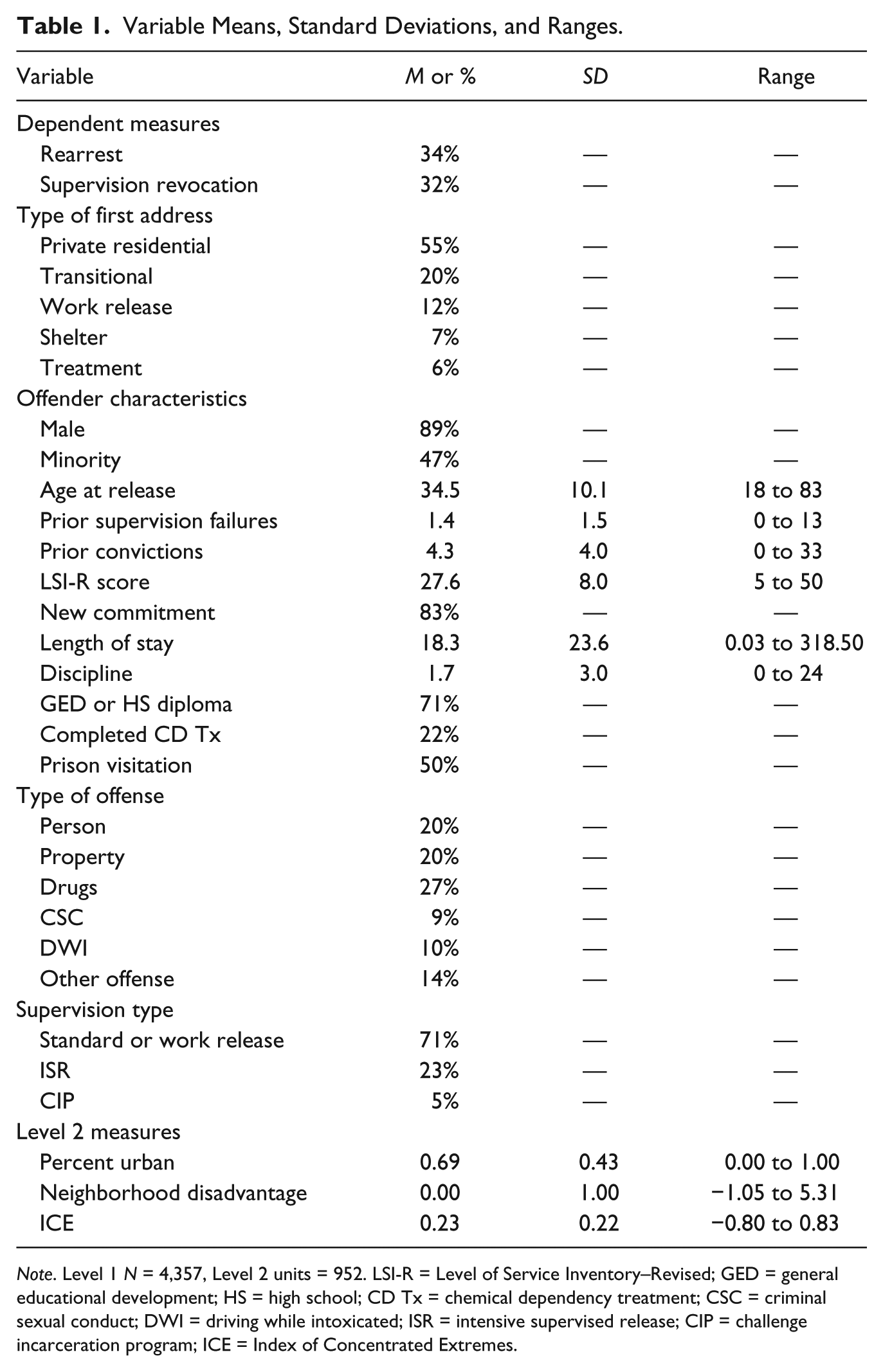
Table 1 contains the means, standard deviations, and ranges for all of the dependent and independent variables. We found that 34% of the total sample were rearrested within the first year of release, and 32% were revoked from supervision during the same time frame. A slight majority (55%) of these released offenders returned to private residential addresses immediately on release, while 20% returned to transitional housing. Of the remaining offenders, 12% went from prison to work release centers, 7% were placed in temporary emergency shelters, and 6% went directly to inpatient treatment facilities.
Variable Means, Standard Deviations, and Ranges.
Note. Level 1 N = 4,357, Level 2 units = 952. LSI-R = Level of Service Inventory–Revised; GED = general educational development; HS = high school; CD Tx = chemical dependency treatment; CSC = criminal sexual conduct; DWI = driving while intoxicated; ISR = intensive supervised release; CIP = challenge incarceration program; ICE = Index of Concentrated Extremes.
A large majority of the offenders in this sample were male (89%), just under half were racial or ethnic minorities (47%), and they had an average age of nearly 35 years. On average, these offenders had one prior supervision revocation and about four prior felony-level convictions.
Because the type of housing offenders are first released to might be indicative of how much social support they have, we also controlled for whether or not the offenders received any visits while they were incarcerated. That is, offenders released to transitional housing or emergency shelters, for example, may have lacked the social support that would have enabled them to live with family, friends, or independently. Recent research has shown that visits in prison can reduce recidivism, and prison visitation may be a proxy measure for social support (Bales & Mears, 2008; Duwe & Clark, 2013; Mears et al., 2012). Half of the offenders in this sample received at least one visit while in prison.
As for neighborhood-level measures, the ex-prisoners in this study returned to census tracts that were more urban than rural, with an average of 69% of residents in the census tracts included living in urbanized clusters. Because the neighborhood disadvantage measure was a factor score, the average level of economic disadvantage across the neighborhoods was 0 with a standard deviation of 1. The ICE measure ranged from −0.80 to 0.83, and averaged at 0.23, indicating slightly higher levels of affluence relative to poverty in neighborhoods on average.
Figure 1 displays the rates of rearrest and supervision revocation across the five categories of housing used in this study. This graph reveals that rates of rearrest were highest among offenders released to emergency shelters (45%), while revocation rates were highest among offenders released to transitional housing (50%). Rearrest rates were lowest for offenders housed in work release centers (26%), and revocation rates were lowest for offenders released to private residential addresses (25%).

Recidivism rates by housing types.
The correlations in Table 2 show that placement in private residential addresses is negatively and significantly correlated with supervision revocations. The correlation with rearrests is also negative but not significant and very weak. Transitional housing is positively and significantly correlated with both rearrests and supervision revocations. Work release centers have a significant negative correlation with rearrests, whereas shelters are positively correlated with this measure. Neither has a significant correlation with revocations. Inpatient treatment centers share a weak yet significant positive correlation with revocations.
Correlations Between Recidivism, Housing Types, and Neighborhood-Level Characteristics.

Note. ND = neighborhood disadvantage; ICE = Index of Concentrated Extremes.
p < .05. **p < .01.
Table 2 reveals that urbanization and neighborhood-level economic disadvantage are positively and significantly correlated with both rearrests and revocations. Increased levels of concentrated poverty are significantly associated with increased recidivism. Conversely, ICE is negatively and significantly associated with rearrest, as we would expect. While these tables indicate some relationships between housing types, neighborhood-level economic indicators, and recidivism, the following subsection will examine these relationships more closely while controlling for several other important variables.
Multilevel Analyses—Rearrest
The results from the multivariate analyses are presented in Tables 3 and 4. 6 Table 3 displays four multilevel logistic models predicting rearrest within the first year of release from prison. The grand mean intercept from the unconditional model, Model 1, tells us that the mean level of risk of rearrest across all of the census tracts in Minnesota is 0.47, exp(−0.75), p value < .001. Perhaps more interestingly, the significant random effects variance component at the bottom of Model 1 in Table 3 (σ2 = 0.210, χ2 = 56.77, p value < .001) demonstrates that the risk of rearrest varies significantly statewide across neighborhoods.
Multilevel Logistic Models Predicting Rearrest Within First Year of Release.

Note. Level 1 N = 4,357, Level 2 units = 952. SFs = supervision failures; LSI-R = Level of Service Inventory–Revised; GED = general educational development; HS = high school; CD Tx = chemical dependency treatment; CSC = criminal sexual conduct; DWI = driving while intoxicated; ISR = intensive supervised release; CIP = challenge incarceration program; ND = neighborhood disadvantage; ICE = Index of Concentrated Extremes.
p < .05. **p < .01. ***p < .001.
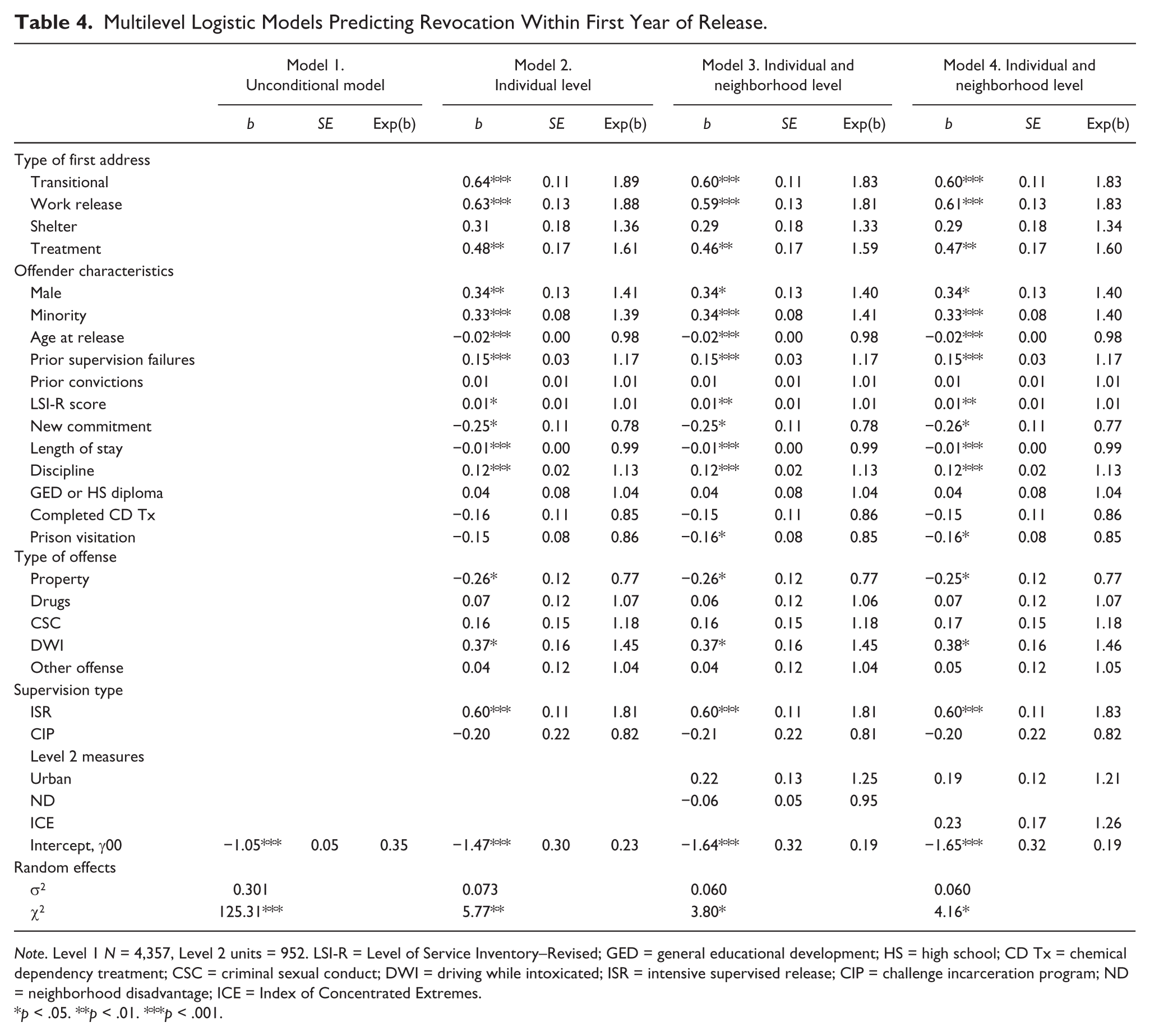
Multilevel Logistic Models Predicting Revocation Within First Year of Release.
Note. Level 1 N = 4,357, Level 2 units = 952. LSI-R = Level of Service Inventory–Revised; GED = general educational development; HS = high school; CD Tx = chemical dependency treatment; CSC = criminal sexual conduct; DWI = driving while intoxicated; ISR = intensive supervised release; CIP = challenge incarceration program; ND = neighborhood disadvantage; ICE = Index of Concentrated Extremes.
p < .05. **p < .01. ***p < .001.
In Model 2, all of the grand mean centered individual-level measures are added, including the housing types to which offenders were released. Being released to a work release center rather than a private residential address significantly decreased the odds of rearrest by 21%, 0.79 = exp(−0.24), p value < .05, which is consistent with recent research on the Minnesota work release program (Duwe, 2014). Conversely, going directly from prison to an emergency shelter (e.g., homeless shelter, motel) increased the odds of rearrest by 34%, 1.34 = exp(0.29), p value < .05, which is also in line with prior research (Lutze et al., 2013; Nelson et al., 1999). Compared with going directly from prison into a private residential address, the trip from prison to transitional housing slightly increased the risk while treatment centers decreased the risk of rearrest, but these relationships were not statistically significant.
Several of the other individual-level control variables were significantly associated with the risk of rearrest and were all consistent with expectations. Being male, from a minority racial or ethnic group, having an increased number of prior supervision failures and convictions, a higher LSI-R score, and more disciplinary infractions all significantly increased the risk of rearrest. At first glance, it may seem odd that the relationship between the LSI-R score, calculated using an instrument designed to predict multiple types of recidivism, was very weak. However, it is important to note that several other factors included in the LSI-R instrument are included in the analyses (e.g., prior record, education), which may diminish its direct effect on rearrest.
Model 2 also reveals that an increase in age and the length of stay in prison, being newly committed to prison (as opposed to being committed as a release violator), and receiving at least one visit while in prison were all significantly and negatively associated with the risk of rearrest. In addition, sex offenders and felony DWI offenders compared with person (violent) offenders had a lower risk of rearrest, as did offenders under ISR and postrelease CIP supervision (compared with standard and work release supervision).
The change in the random effects variance components from Model 1 to Model 2 in Table 3 reveals that the inclusion of the individual-level variables in Model 2 accounted for most of variance (94%) in rearrests within census tracts, (0.210 − 0.012) / 0.210 = 0.94. Although the significant variance component in the first model indicated that recidivism risk significantly varied across neighborhoods statewide, the nonsignificant variance component from Model 2 indicates that most of the differences in risk of rearrest across neighborhoods can be attributed to individual-level differences in the offenders residing in those neighborhoods.
Because other studies have found that community-level measures can significantly influence the risk of recidivism (Mears et al., 2008; Kubrin & Stewart, 2006), the urbanization measure and Neighborhood Disadvantage scale are added in Model 3 and the urbanization and ICE measures are added in Model 4. The degree to which a neighborhood is urban does not appear to influence recidivism as the coefficients for this measure are very small and nonsignificant in Models 3 and 4.
Just as Kubrin and Stewart (2006) found a significant relationship between a similar disadvantage scale and recidivism, neighborhood disadvantage is positively and significantly associated with the risk of rearrest in Model 3. A one-unit increase in the Neighborhood Disadvantage scale is associated with a 9% increase in the odds of rearrest, exp(0.09), p value < .05. Although Kubrin and Stewart (2006) found that the neighborhood-level ICE measure significantly reduced recidivism in one county in Oregon, this same measure did not have a significant effect on the recidivism likelihood of Minnesota state offenders (Model 4). The coefficient in our study was negative, as we would expect, but not significant.
Also notice that in Models 3 and 4 among the individual-level measures, emergency shelters shrink in size and become nonsignificant in models that include neighborhood-level measures. This finding may be due to the fact that homeless shelters and low-cost motels tend to be in more economically disadvantaged areas, which the neighborhood disadvantage measure appears to account for. In Model 3, the coefficient for treatment facilities slightly increases in size compared with the same coefficient in Model 2, and it becomes statistically significant. Based on Model 3, going directly from prison to an inpatient treatment facility rather than a private residential address decreases the odds of rearrest by 28%, exp(−0.33), p value < .05.
Multilevel Analyses—Supervision Revocation
The four models presented in Table 4 are similar to the models in Table 3, only the outcome measure in these models is supervision revocation within 1 year of release from prison. The grand mean intercept from the unconditional model reveals that the mean level of risk of supervision revocation across census tracts is slightly higher than the risk of rearrest at 0.35, exp(−1.05), p value < .001. Once again, the significant random effects variance component in Model 1 indicates that the risk of revocation varies significantly across neighborhoods (σ2 = 0.301, χ2 = 125.31, p value < .001).
In Model 2, from Table 4, we observe that the types of housing to which offenders were released have different relationships with risk of revocation compared with the risk of rearrest. Relative to being released to a private residential address, going from prison to transitional housing, a work release center, and a treatment center all increased the risk of revocation. Being released to transitional housing increased the odds of revocation by 89%, exp(0.64), p value < .001; work release centers by 88%, exp(0.63), p value < .001; and treatment centers by 61%, exp(0.63), p value < .01. That work release centers increased the risk of revocation is consistent with the recent evaluation of MnDOC’s work release program (Duwe, 2014). Just as Bell et al. (2013) found that offenders released to CCCs had higher reincarceration rates than offenders released to the streets, the fact that offenders released to transitional housing, work release centers, and treatment facilities have higher risks of revocation could be attributed to close monitoring. That is, the routine behaviors of offenders in correctional-based housing and treatment centers are observed much more closely than offenders in private residential addresses. Simple infractions of release conditions (e.g., breaking curfew, imbibing alcohol) are more likely to be detected in correctional-based housing than in private residential settings. Notice that offenders released to transitional housing and work release centers were not more likely to be arrested after release, but they are at a great risk of supervision revocation. The relationship between emergency shelters and revocation was positive, but not significant.
Most of the other individual-level control variables influence the risk of revocation in expected ways. That is, being male, from a minority racial or ethnic group, having prior supervision failures, an increase in the offender’s LSI-R score, as well as an increase in institutional disciplinary infractions all increase the risk of revocation. An increase in age and the length of stay in prison, being newly committed to prison, and receiving at least one visit while in prison were all significantly and negatively associated with the risk of revocation. Property offenders have a lower risk of supervision revocation compared with person offenders, whereas felony DWI offenders have an increased risk. Not surprisingly, offenders under ISR, which involves close supervision and rigid conditions in the first few months of release, have an increased risk of supervision revocation compared with offenders under standard or work release supervision. Surprisingly, an increase in prior supervision failures does not have a strong or significant relationship with subsequent supervision revocations.
A comparison of the random effects variance components from Model 1 to Model 2 in Table 4 shows us that once again the inclusion of individual-level measures accounted for most of variance (76%) in revocations within neighborhoods, (0.301 − 0.073) / 0.301 = 0.76, but not as much variance as was observed in models predicting rearrest. Unlike the models predicting rearrest, the variance components in the second model predicting the risk of revocation remains significant (σ2 = 0.073, χ2 = 5.77, p value < .01), suggesting that a significant amount of variation in revocation is left unexplained and other factors, such as neighborhood-level measures, may influence risk of revocation.
The same neighborhood-level measures that appeared in Table 3 were also added to Models 3 and 4 in Table 4. Models 3 and 4 reveal that urbanization—the percentage of residents in a neighborhood living an urbanized cluster—is only moderately and not significantly associated with the risk of revocation.
Just as Stahler et al. (2013) did not find a relationship between neighborhood-level measures of disadvantage and recidivism, neither the Neighborhood Disadvantage scale nor the ICE measure significantly influenced the risk of revocation. The variance components changed very little from Model 2 to Models 3 and 4; however, they remain significant, suggesting that a significant portion of the variance in risk of revocation across neighborhoods has been left unexplained. It should also be noted that several other neighborhood-level measures (including both scales and lone economic indicators and measures of population density) were tested in models predicting rearrest and revocation (not displayed). None of these other tested measures significantly influenced the risk of revocation or accounted for a significant portion of the variance in recidivism across neighborhoods.
As noted earlier, using a similar sample population (newly released prisoners) and the same levels of analysis (individual and census tract level), Kubrin and Stewart (2006) found that both neighborhood disadvantage and the ICE measure significantly influenced recidivism and significant variations in risk of rearrest across neighborhoods persisted even after controlling for individual-level factors. So why did the present research produce null relationships between neighborhood measures and recidivism in three out of four models, as well as no significant variations in rearrest once individual-level factors were controlled for? One notable difference between these studies is that the present research looked at recidivism across an entire state, whereas Kubrin and Stewart (2006) focused on one urban county. Previous research has found that community-level factors can operate differently in rural areas compared with urban areas (Osgood & Chambers, 2000). To test whether this difference in geographic focus accounted for the different results, models were run using only releases to Hennepin (Minneapolis) and Ramsey (St. Paul) counties, the two most populous and urban counties in Minnesota (38% of the total sample). These analyses produced similar results to the models presented in Tables 3 and 4. In fact, one of the only differences in results was that neither of the neighborhood-level measures significantly influenced rearrest or revocation.
Discussion
This study examined the types of housing that offenders were released to, as well as the communities they resided in, and how these factors influenced recidivism. In line with prior studies, this research found that certain postrelease housing placements, such as correctional-based housing and emergency shelters, significantly influenced recidivism. Unlike recent contextual studies of recidivism, neighborhood-level measures of poverty and disadvantage were not as salient in predicting recidivism once several individual-level characteristics were controlled for. Also, these results varied depending on the measure of recidivism being looked at.
Both work release center placements and inpatient treatment centers significantly decreased the odds of rearrest, whereas emergency shelters increased the odds of rearrest. Neighborhood disadvantage slightly increased the individual-level risk of rearrest, but concentrated extremes of poverty and affluence did not significantly influence this outcome one way or another. Most important, individual-level characteristics, including postrelease housing placements, accounted for most of the variance in risk of rearrest across neighborhoods. Once these individual characteristics and housing placements were controlled for, risk of rearrest did not significantly vary across neighborhoods statewide. Prior studies have found that neighborhood- and community-level features, such as poverty and economic segregation are important factors in explaining recidivism along with individual-level controls (Kubrin & Stewart, 2006; Mears et al., 2008). The implication has been that resource-deprived areas leave few opportunities for offenders to successfully reintegrate and more opportunities to reoffend. This research found that, at least when it comes to rearrest, housing placements and individual-level characteristics are more robust factors in predicting reoffending than community factors.
When looking at supervision revocation, which is a much looser measure of recidivism than rearrest, the results varied. The fact that some measures included in the models had different relationships with rearrests versus supervision revocation demonstrates the importance of examining multiple types of recidivism outcomes. The positive effects of correctional-based housing and treatment facility placements on supervision revocations suggests that being more closely monitored increases the risk of supervision failure. Offenders who reside with family and friends or independently likely do not have curfews and are probably not tested for drugs and alcohol as often as offenders in halfway houses, work release centers, or treatment facilities. The fact that these offenders placed outside of private residences are more likely to fail on supervision could suggest that offenders placed in private residential addresses have more social support. Social support networks could provide both encouragement and material support that enable offenders to succeed on supervision. Prior research has shown that offenders are less likely to reoffend when residing with parents or spouses (Steiner et al., 2011).
In the analyses predicting supervision revocations, neither of the neighborhood-level measures of disadvantage and poverty significantly influenced the outcome. Just as Stahler et al. (2013) found a null relationship between neighborhood indicators of disadvantage and social disorganization, so did the present study. However, the significant variance component that persisted in all four models indicated that there was still a significant amount of variance across neighborhoods left unexplained. As stated previously, this research tested several indicators of poverty, relative disadvantage, and urbanization. The results suggest that there are other factors left unmeasured that could explain this variation in supervision failures across neighborhoods.
Besides the present study’s geographic focus on an entire state rather than a single urban county as other similar recidivism studies have done, another factor that could account for the mostly null relationships between community-level factors and individual recidivism is that this study employed a larger array of individual-level control variables. For example, similar to the present study, Kubrin and Stewart (2006) included measures for gender, race and ethnicity, age, postrelease supervision, offense type, and prior record. Unlike Kubrin and Stewart, the present study also included postrelease housing situations, risk and needs assessment scores, prison-based programming participation, and prison visitation. All of these factors together proved significant in explaining recidivism, especially for rearrest.
One limitation of this research is that we were able to look only at each offender’s first postrelease address, which is why we limited the follow-up time to 1 year. Prior research indicates that newly released prisoners are likely to change addresses within the first few years of release (Fontaine & Biess, 2012; Steiner et al., 2011; Visher & Courtney, 2007). For example, released prisoners in Lutze et al.’s (2013) research changed addresses at least once with an average of 2 times within 1 to 3 years of follow-up time. This research was limited to each offender’s first address because subsequent addresses are not consistently tracked in COMS. Instead, postrelease addresses are tracked by several community corrections agencies. Subsequent address changes are updated in COMS for a small number of offenders, but not consistently for all released prisoners. 7
This study conceptualized first postrelease addresses as “landing spots” (Fontaine & Biess, 2012) that could set the tenor of each offender’s reentry process. That is, the addresses categories that prisoners were first released to could be indicative of their overall readiness for reentry and the amount of support that they had. For example, an offender released to a halfway house may have been assessed as higher risk and needed more assistance to ease back into the community, while an offender released to an emergency shelter likely had few social supports or resources to secure permanent housing.
Another limitation with research is that we looked at only two recidivism outcomes. Although we did examine more recidivism outcomes than similar previous research, we ideally would have looked at felony reconvictions and new offense reincarcerations as well. However, there were not enough reconvictions (17%) or new offense reincarcerations (6%) in the first year of release in this sample to allow for stable multivariate multilevel analyses. The fact that our analyses produced different results based on the outcome that we were examining highlights the importance of using multiple measures of recidivism outcomes.
One major element that is missing from this research is availability of community support networks in the form of government assistance or private organizations. What percentage of these returning offenders received government assistance, such as social security benefits or housing assistance? How many private organizations geared toward helping offenders were embedded in each community? Future studies could benefit from incorporating these elements. Further research should also disaggregate the “private residential addresses” measure used in this study to measure whether offenders lived independently or with family and friends.
After the Pennsylvania Department of Corrections found that parolees released to correctional-based postrelease housing had higher rates of rearrest than parolees released to the streets (Bell et al., 2013), legislative leaders in both Pennsylvania and New Jersey concluded that halfway houses were failing (Dolnick, 2013). The fact that correctional-based housing significantly increased the risk of supervision revocation in the present study does not mean that this type of housing should not be used for newly released prisoners for two reasons. First, not only did transitional housing have a relatively small and nonsignificant relationship with rearrest but also work release placements significantly reduced the risk of rearrest compared with private residential placements. Thus, some types of correctional-based housing may be beneficial to released prisoners depending on the programs being offered and the type of recidivism being measured. Second, transitional housing practices in Minnesota, and other states, can vary from location to location. Before concluding that certain housing placements are failing, prison administrators must carefully examine each venue and whether or not evidence-based practices are being followed. Recidivism cannot be the lone measuring stick of successful programs.
In line with other studies that have examined the postrelease living situations of former prisoners (e.g., Lutze et al., 2013; Steiner et al., 2011; Visher, 2007), this study highlights the impact that postrelease housing placements can have on reentry. Institutional case managers and community corrections staff often have limited control over where offenders can be placed. Financial limitations, availability of certain types of housing, and restrictions on where certain types of offenders can live leave corrections staff with few housing options. Policy makers should work to ensure that correctional agencies have the resources needed to fit offenders to the most appropriate placements.
Footnotes
Declaration of Conflicting Interests
The author(s) declared no potential conflicts of interest with respect to the research, authorship, and/or publication of this article.
Funding
The author(s) received no financial support for the research and/or authorship of this article