



Abstract
The current study investigates the decision by victims to report the crime to the police following identity theft victimization. Potential influences on the reporting decision are framed around two criminal justice theories—focal concerns theory and Gottfredson and Gottfredson’s theory of criminal justice decision making. The data used to examine this decision were collected from a nationally representative sample of U.S. adults as a supplement to the 2012 National Crime Victimization Survey. Results suggest that the decision to contact law enforcement is based on the seriousness of the offense, the victim’s knowledge of who committed the crime and how it was perpetrated, as well as practical considerations. These findings parallel other research into victim decision making generally, while also highlighting factors that may be unique to identity theft, notably the effects of income. The results also support the use of criminal justice theory to study and understand victim decision making.
Introduction
Estimates of the incidence of identity-related victimizations indicate that they not only affect a significant number of individuals but also have grown in scope over the last several years (Langton, 2011). For example, the most recent estimates from the National Crime Victimization Survey (NCVS) suggest that 7% of individuals 16 and older in the United States were victims of identity theft in 2012 (Harrell & Langton, 2013). Furthermore, NCVS data also have revealed an increase in victimization rates over time, with identity theft affecting 5% of U.S. households in 2005 and 7% of households in 2010 (Langton, 2011). Of these victims, the vast majority (85%) experienced fraudulent use of an existing account, such as credit card or bank accounts (Harrell & Langton, 2013). Despite being widespread and growing in extent, these types of identity-related offenses have largely failed to attract the attention of criminologists and victimologists relative to other types of crimes. In particular, one uncharted research area with respect to identity theft victimization is its aftermath.
Following a criminal event, victims possess a level of discretion unmatched by most criminal justice system actors. For this reason, Gottfredson and Gottfredson (1988) have referred to crime victims as the “gatekeepers” (p. 16) of the criminal justice process. Although crime victims affect the functioning of the criminal justice system in a number of ways, it is the decision to invoke the criminal justice process by reporting the crime to law enforcement that arguably has the greatest impact on the system. To this point, NCVS estimates suggest that identity theft is grossly underreported with only one in 10 victims deciding to report the incident to law enforcement (Harrell & Langton, 2013). By way of comparison, other property crimes included in the NCVS are reported at higher rates, including burglary (57%), motor vehicle theft (75%), and theft (28%; Truman & Langton, 2014). While victim reporting behaviors have been investigated empirically by researchers studying a variety of types of criminal victimization, research has yet to examine this discretionary decision within the context of identity theft victimization.
The current study bridges these presently separate bodies of research into identity theft victimization and victim decision making by addressing three voids in the empirical record. First, studies exploring the victim’s decision to contact law enforcement have mostly been based on data from victims of personal crimes, particularly sexual victimization and intimate partner violence (e.g., Felson & Paré, 2005; Fisher, Daigle, Cullen, & Turner, 2003; Reyns & Englebrecht, 2010). Second and relatedly, as yet, there have been no studies undertaken to determine the circumstances affecting reporting decisions of victims of identity-related crimes. Thus, not only have factors driving the reporting decisions of victims of property offenses remained mostly unidentified, but predictors of behavior unique to identity theft victimization also are unknown. The current focus may also provide insights into potential determinants of reporting of white-collar victimizations—a related victimization experience that has so far remained largely unexplored in empirical research. Third, much prior research into victim decision making has been atheoretical, making interpretation of findings somewhat difficult.
The present research addresses these three gaps in the research knowledge base by identifying determinants of the identity theft victim’s decision to formally report their victimization to law enforcement. Furthermore, while the present study does not claim to offer a full test of a formal theory of victim decision making, theoretically relevant variables from the larger body of research into criminal justice actor decision making are included in the analyses. Specifically, theoretical concepts from focal concerns theory (Steffensmeier, Ulmer, & Kramer, 1998) and Gottfredson and Gottfredson’s (1988) theory of criminal justice decision making were utilized as possible theoretical explanations. To do so, data from the 2012 NCVS were analyzed, which consists of a large nationally representative sample of residents of the United States.
Reporting Victimization to Law Enforcement
The victim’s decision to report the criminal event to law enforcement is a critically important step in the criminal justice process. Indeed, many times, it is this discretionary decision on the part of the crime victim that determines whether the system is invoked to respond to criminal behavior (Black, 1971; Gottfredson & Gottfredson, 1988; Skogan, 1984). Despite the importance of victim reporting to the efficiency and effectiveness of the criminal justice system, NCVS data indicate that a majority of crime victims in the United States do not contact the police post victimization. Considered categorically, recent NCVS reports suggest that 44% of violent crimes, 54% of serious violent crimes, and only 34% of property crimes were reported to police in 2012 (Truman, Langton, & Planty, 2013). Descriptive research has revealed that many victims do not contact the police because they believe the police would not or could not help, it was not important enough to the victim, or they dealt with the matter in some other way (Harrell & Langton, 2013).
While it is important to understand the forces at work behind non-reporting decisions, there is also a body of research extending back to the first administrations of the National Crime Survey (NCS) that has examined the victim’s decision to contact the police for help (e.g., Gottfredson & Hindelang, 1979; Hindelang, 1974; Skogan, 1976). This early scholarship as well as studies by subsequent researchers highlights the role of situational and victim characteristics in determining the likelihood of victim reporting (e.g., Baumer & Lauritsen, 2010; Berg, Slocum, & Loeber, 2013; Clay-Warner & McMahon-Howard, 2009; Felson, Messner, & Hoskin, 1999; Zhang, Messner, & Liu, 2007). For example, Gottfredson and Hindelang’s (1979) famous test of Black’s theory of the behavior of law singled out the seriousness of the offense as the most consistent predictor of the victim’s decision to report. Likewise, Skogan (1976) concluded that dimensions of offense seriousness were “powerful predictors of the decision by victims to report their experiences to the police,” (p. 546) noting the significance of the degree of financial loss, weapons usage, and whether the incident occurred in or around the home.
In more recent research, Baumer and Lauritsen (2010) used the NCS (the predecessor to the current NCVS) and NCVS to identity long-term trends in the reporting behaviors of crime victims. Regarding property victimizations between 1973 and 2005, they reported that incident characteristics (e.g., personal contact, financial loss) and household characteristics (e.g., urban area, household income) were positively related to victim reporting decisions. In another study using the NCVS, Reyns and Englebrecht (2014) examined the determinants of reporting among victims of stalking. Once again, the importance of offense seriousness was noted, along with other situational factors such as whether the victim acknowledged his or her experience as stalking and whether he or she felt fear during the course of the offender’s pursuit. Similarly, Tarling and Morris (2010) analyzed data from the British Crime Survey and found that seriousness of the offense and the degree of emotional harm experienced by the victim were among the most salient predictors of crime reporting behaviors for both household and violent victimizations. Thus, even for disparate types of offenses, and across time periods and countries, seriousness has persistently been linked to victim reporting decisions. As well, other dimensions of the offense, such as the emotional response of the victim, seem to exert an influence on the reporting decision when they are considered in empirical research (e.g., Greenberg & Beach, 2004; Posick, 2014).
With respect to victim characteristics, research has often focused on three attributes: sex, race, and age. While there is variation from study to study, overall, the patterns that emerge suggest that females, racial minorities, and older persons are more likely to contact the police following a criminal victimization than are their counterparts (Langton, Berzofsky, Krebs, & Smiley-McDonald, 2012; Skogan, 1984). For example, in a recent study to utilize NCVS data, Xie (2014) analyzed crime reporting patterns in the 40 largest metropolitan statistical areas in the United States from 1979 to 2004. She reported that female victims were more likely than males to contact the police for violent and property offense categories, as well as for the specific offenses of robbery, aggravated assault, simple assault, burglary, motor vehicle theft, and theft. This finding also has been reported in earlier studies across types of victimization (e.g., Baumer & Lauritsen, 2010; Bosick, Rennison, Gover, & Dodge, 2012; Felson et al., 1999; Kuo, Cuvelier, Sheu, & Chang, 2011; Reyns & Englebrecht, 2014; Skogan, 1976).
Race, although a less reliable predictor of reporting behaviors, also reportedly affects the decision to notify the police of the crime, with Black/African Americans being slightly more likely than persons of other races to contact the police (Langton et al., 2012; Skogan, 1984). However, it is also apparent that the relationship between race and reporting behaviors is complex and cannot necessarily be understood apart from crime type and other situational factors. For example, in Baumer and Lauritsen’s (2010) study, it was found that Black victims were significantly more likely to report burglaries and motor vehicle thefts, but less likely to contact the police in cases of larceny. Conversely, the results of Xie, Pogarsky, Lynch, and McDowall’s (2006) study of police notification decisions involving personal or household victimization suggested that White victims were more likely than other victims to notify the police, but only for household crimes. Similar crime-dependent race effects have also been reported in other studies, highlighting the need for research examining decisions by victims of specific crimes such as identity theft (e.g., Akers & Kaukinen, 2009; Felson et al., 1999; Fisher et al., 2003; Rennison et al., 2011).
Research has also found that older persons contact law enforcement at higher rates than younger persons following a criminal event (Langton et al., 2012). Indeed, a recent study by Bosick and colleagues (2012) based on the NCVS compared reporting behaviors for different age groups and found that not only do rates of reporting vary across life stages, but also that predictors of reporting varied by age group. For example, older persons had higher rates of reporting that younger persons; and, certain situational factors (e.g., the presence of a firearm during the crime) affected the likelihood of reporting for some victims (i.e., 50- to 64-year-olds) but not others (i.e., 16- to 19-year-olds). The finding that age positively influences reporting to the police has been uncovered in other studies as well (e.g., Baumer & Lauritsen, 2010; Berg et al., 2013; Tarling & Morris, 2010; Xie, 2014; Xie et al., 2006).
Conceptual Frameworks on the Decision to Report
Although there are many theories that speak to the functioning of the criminal justice system (see Bernard & Engel, 2001), two particular criminal justice theories provide insights and possible explanations regarding the influence of situational and victim characteristics in the post-victimization decision-making process of crime victims. First, focal concerns theory, which was developed and utilized by Steffensmeier and colleagues (1998) to account for sentencing outcomes, explains that there are three concerns that guide the discretionary sentencing decisions of judges: the blameworthiness of the offender, protection of the community, and practical constraints and consequences (see also Steffensmeier, 1980; Steffensmeier & Demuth, 2000; Steffensmeier, Kramer, & Streifel, 1993). Theoretically, in the case of the sentencing decision, a more blameworthy offender, who is likely to reoffend, and for whom there is not a compelling reason to do otherwise (e.g., overcrowding, disruption to the lives of children) will be sentenced more harshly than someone who does not fulfill these criteria. Generally, research has supported a focal concerns perspective on sentencing (e.g., Hartley, Maddan, & Spohn, 2007; Steffensmeier & Demuth, 2000; Steffensmeier et al., 1998), parole (Huebner & Bynum, 2006), and police search decisions (Higgins, Vito, & Grossi, 2012), but this perspective has yet to be applied to victim decision making.
The second theoretical framework from the field of criminal justice that is useful in understanding the victim’s decision to initiate the criminal justice process was developed by Gottfredson and Gottfredson (1988) as a general theory of criminal justice decision making. Having surveyed the components of the criminal justice system, Gottfredson and Gottfredson synthesized the existing body of research surrounding actor decision making, and likewise identified three factors that persistently affected decisions across the system: the seriousness of the offense, the offender’s prior criminal record, and the relationship between the victim and the offender. According to Gottfredson and Gottfredson, these three factors heavily affect every decision in the criminal justice process, with more serious offenses, committed by repeat offenders, against strangers, being those most likely to elicit a response from the criminal justice system (e.g., reporting, arrest, charging). So far, this theory has been used to explain victim decision making in only one other study. Reyns and Englebrecht (2010) used the Supplemental Victimization Survey to the NCVS, which assessed the extent and nature of stalking against adults in the United States, to examine the effects of event seriousness, the offender’s prior record, and the victim–offender relationship upon the decision to report stalking victimization to the police. In support of the theory, they found that each of these theoretical concepts was tied to reporting decisions. For example, incidents in which the victim’s property was damaged, the victim was threatened, or in which the victim knew that the offender had a prior criminal record were all more likely to come to the attention of police through victim reporting.
Conceptually, there is some overlap between these two theoretical perspectives. That is, they both underscore the importance of seriousness of the offense (and blameworthiness) in affecting criminal justice decision making (see also Skogan, 1984). Likewise, while the two concepts are not exactly the same, protection of the community and the offender’s criminal history are clearly connected because one of the considerations in determining danger to the community is the offender’s prior record. Where the two perspectives diverge somewhat is in their respective third concepts: practical constraints and consequences and the victim–offender relationship. Although the relationship between the victim and the offender has been identified as a correlate of reporting in numerous studies (e.g., Felson et al., 1999; Felson, Messner, Hoskin, & Deane, 2002; Fisher et al., 2003; Gartner & Macmillan, 1995), the concept of practical constraints and consequences has been more loosely defined and has been operationalized differently across studies (e.g., Johnson, 2006; Spohn & Holleran, 2000; Steffensmeier, 1980). Specifically, in Steffensmeier and colleagues’ (1998) work, practical constraints referred to organizational concerns (e.g., case flow), whereas practical consequences were offender-based (e.g., special needs, health conditions).
Many of these theoretical concepts find reasonably close counterparts when the theories are adapted to the victim’s decision to contact law enforcement. For example, the victim might judge the seriousness of the offense and the blameworthiness of the offender according to how much harm they suffered as a result of the crime (e.g., physically, financially, emotionally). Furthermore, like other actors within the criminal justice system, victims will also likely take into account practical considerations when making the reporting decision, such as whether the issue has already been resolved or whether they know anything about how their personal information was obtained. From a victimization perspective, other theoretical concepts, especially those that are offender-based, are not as straightforward in their application. The offender’s prior record and the danger he or she poses to the community, for example, will not be known to the victim unless the two parties have some sort of relationship. Overall, however, these conceptual frameworks provide a theoretical lens through which the victim’s decision to notify law enforcement of his or her victimization can be better understood and contextualized as a decision within the criminal justice system. Yet, by and large, these theories have yet to be utilized in this way to understand victim decision making.
Current Focus
The primary purpose of the current study is to identify determinants of reporting decisions among victims of identity theft. Using prior research and existing theory as a guide, three primary hypotheses were developed and tested using data from a recent administration of the NCVS. First, it is hypothesized that victims will be more likely to contact law enforcement for crimes characterized as serious as compared with those defined as less serious. Second, it is hypothesized that victims who have some information about the offender will be more likely to report their victimization as compared with those who have no information about the offender. Third, it is hypothesized that victims will be more likely to contact the police in instances in which there is a compelling practical consideration or reason to do so. For example, if the problem was resolved without police involvement, the victim may determine that police notification is unnecessary. By testing these three hypotheses, the present study contributes to the victimization research base by providing the first empirical results related to reporting decisions among victims of identity theft, and framing the results within existing theories of criminal justice decision making.
Method
Data
The data for the present study were collected by the Bureau of the Census in partnership with the Bureau of Justice Statistics in 2012 as part of a supplement to the NCVS. The NCVS is an ongoing self-report rotating panel survey designed to measure the extent and nature of criminal victimization within the United States. Data are collected semi-annually at 6-month intervals from a representative sample of residents aged 12 years and older, excluding persons residing in institutions (e.g., nursing homes, prisons), members of the military living in military barracks, and individuals who are crews of vessels. The response rate to the 2012 NCVS was 87%.
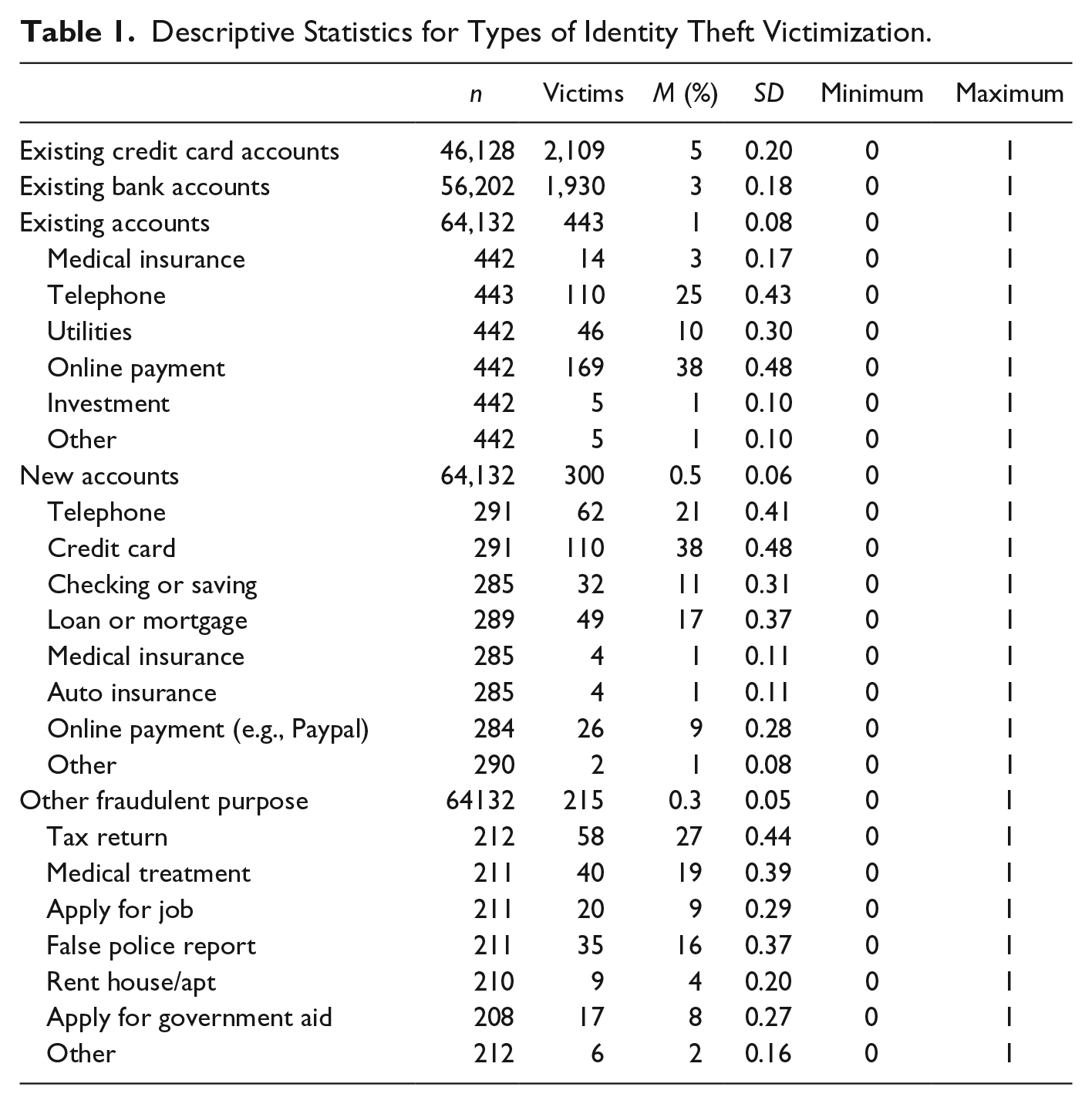
Respondents to the NCVS were selected for inclusion in the present study if they were identified as victims of an identity-related fraud victimization. In doing so, four dimensions of victimization were examined. 1 First, of the 46,128 persons participating in the NCVS who had a credit card at the time of the survey, 2,109 were identified as victims of credit card fraud. 2 Second, 56,202 respondents indicated that they possessed a bank account, and of these, 1,930 experienced bank fraud on this account. Third, we identified victims of fraud for any type of existing account. This measure includes victims of existing credit card and bank frauds, as well as frauds involving other types of existing accounts (e.g., medical insurance, telephone, utilities). Fourth, the reporting behaviors of individuals whose personal information was used to create a new account (e.g., online payment account, credit card, loans) and perpetrate a fraud were also identified. Table 1 provides descriptive statistics for these four dimensions of identity theft victimization as they were reported in the NCVS. From these respective pools of victims, cases with missing data were omitted from the analyses through listwise deletion.
Descriptive Statistics for Types of Identity Theft Victimization.
Measures
Victim reporting to law enforcement
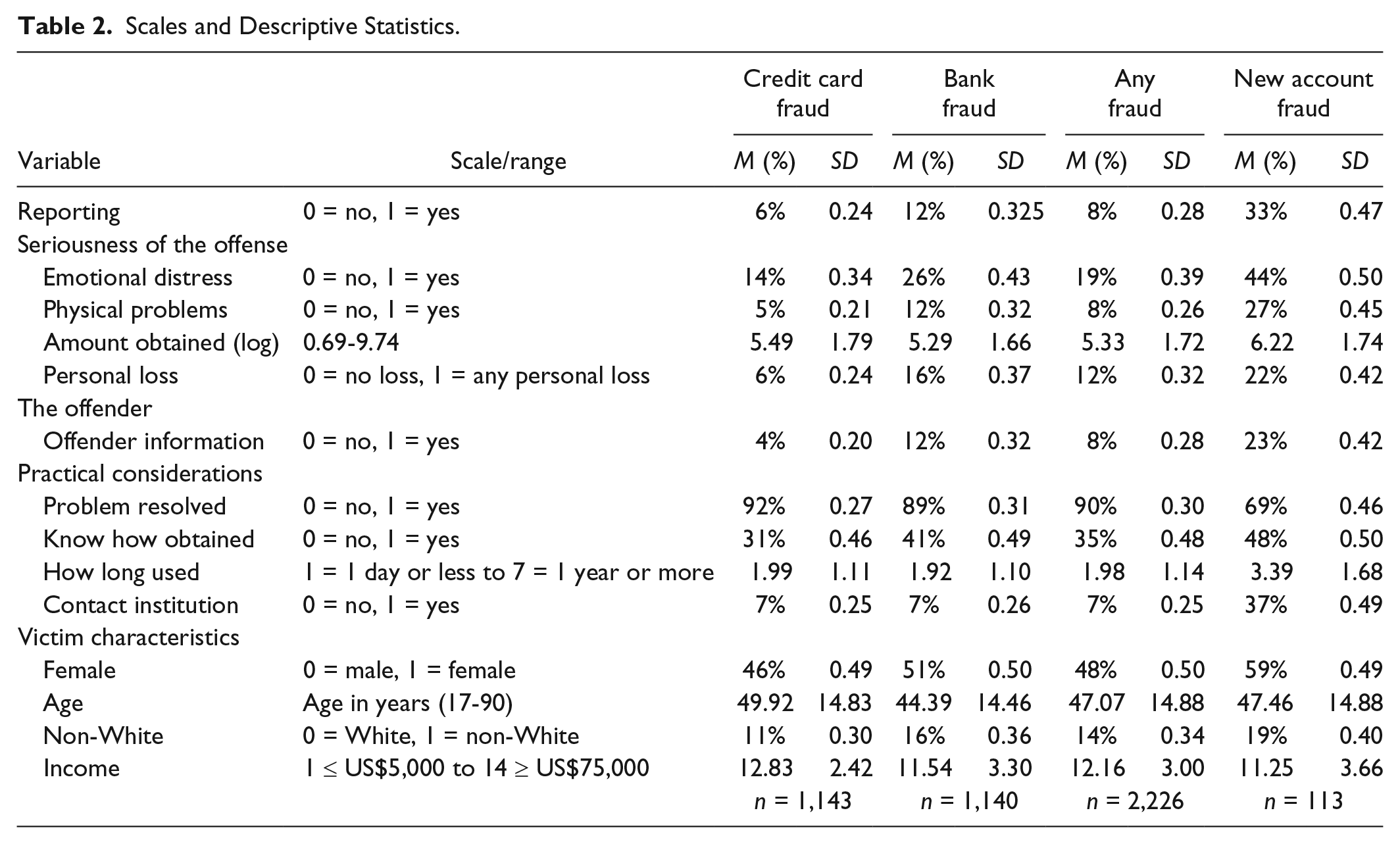
The dependent variable in the current analyses was victim reporting to law enforcement, which was measured with a single survey item asking victims the following: “Did you contact any law enforcement agencies, such as the local police, a sheriff or a federal law enforcement agency, to report [the/the most recent] misuse or attempted misuse of your personal information?” Answers to this question were coded dichotomously (0 = no, 1 = yes). Table 2 indicates that victim reporting varied by type of identity theft, ranging from 6% of victims reporting to 33%.
Scales and Descriptive Statistics.
Seriousness of the offense
While it has so far been an open empirical question, it is likely that the factors that influence victim reporting decisions generally also specifically drive the reporting decisions of victims of identity theft victimization. Across types of victimization, prior research has examined several dimensions of offense seriousness, such as injury to the victim, emotional distress of the victim, the financial cost to the victim, and whether the offender used a weapon during the course of the crime (e.g., Bachman, 1998; Clay-Warner & McMahon-Howard, 2009; Englebrecht & Reyns, 2011; Greenberg & Beach, 2004; Greenberg, Ruback, & Westcott, 1982; Posick, 2014; Reyns & Englebrecht, 2014).
The present study includes four dimensions of offense seriousness in the analyses that are analogous to measures of seriousness used in other studies, but adapted to identity theft victimization: emotional distress, physical problems, the amount of money obtained by the offender, and the amount of money the victim actually lost as a consequence of the crime (i.e., that which was not reimbursed). A measure of emotional distress was created from a survey item reading, “Still thinking about your distress associated with [the/the most recent] misuse of your personal information did you feel any of the following ways for A MONTH OR MORE?” Respondents who indicated they were sad, depressed, worried, or anxious were identified as suffering emotional distress as a consequence of their victimization (0 = no, 1 = yes). As Table 2 indicates, a significant portion of victims felt distress over their victimization, but again, this varied by type of identity theft.
To measure physical problems, a composite measure (0 = no, 1 = yes) was created based on the following survey item: “Did you experience any of the following physical problems associated with [the/the most recent] misuse or attempted misuse of your personal information for A MONTH OR MORE?” Those who indicated they had experienced headaches, trouble sleeping, changes to eating or drinking habits, upset stomach, fatigue, high blood pressure, muscle tension or back pain, or heart problems were considered to have suffered physical effects due to their victimization. As Table 2 illustrates, as many as 27% of victims (new account fraud) experienced at least one of these physical problems, with other offenses resulting in a lower prevalence of physical harm.
The remaining two dimensions of offense seriousness reflect the amount of money involved in the identity theft. First, victims were asked to approximate the total dollar value that the offender obtained in the most recent misuse of their personal information, with values reportedly reaching up to US$17,000. However, because this distribution was skewed, the variable included in the analyses represents the logged amount obtained by the offender. Second, as a follow-up, victims were asked to estimate the amount that they personally lost as a result of the crime; that is, the amount of money that was not covered by the credit card, bank, insurance companies, or other entities. This variable was coded dichotomously to reflect no personal loss to the victim (coded 0) or any personal loss to the victim (coded 1). The descriptive statistics in Table 2 suggest that the average victim of identity theft incurred no out of pocket costs as a result of the crime.
The offender
The present study also considers how the victim’s knowledge about the offender might affect their likelihood of notifying law enforcement of their victimization. Characteristics of the offender factored heavily into the previously discussed theoretical perspectives, including considerations of the offender’s prior record, whether they are a danger to the community, and the relationship between the victim and the offender. However, in the context of identity theft victimization, much of this information will be unknown to the victim, principally because they may not know who the offender is, and therefore have no knowledge of their criminal past or how much of a danger they might be to the community. In the present study, then, a measure of the victim’s knowledge of the offender was used to capture offender characteristics. Specifically, victims were asked, “Do you know, or have you learned, anything at all about [the/the most recent] person or persons who misused or attempted to misuse your personal information?” Responses were coded dichotomously (0 = no, 1 = yes). Admittedly, more detailed information about the offender would be preferable in evaluating the salience of the theoretical perspectives; however, it was not possible to craft such measures using the current data. At the very least, it can be assumed that those who had no information about the offender were not in a position to evaluate their dangerousness or prior criminal history. Having information about the offender varied by type of identity theft victimization (see Table 2).
Practical considerations
Within the proposed theoretical frameworks, practical constraints and consequences have been purported to factor into actor decision making. These concepts can be adapted to the crime victim’s viewpoint to reflect practical considerations in the decision to report. Four items were used to measure practical considerations that might affect a victim’s decision to contact law enforcement. First, victims may feel that it is unnecessary or less urgent to notify law enforcement of the crime if it has already been resolved. Therefore, whether the problem was resolved was included in the present analysis and measured by asking respondents if they had been successful in clearing up all of the financial and credit problems associated with the misuse of their personal information. 3 Responses were coded dichotomously (0 = no, 1 = yes), and as Table 2 illustrates, a large majority of victims reported that their situation had been resolved. Second, a measure based on whether the victim knew how the offender obtained their information was included. Victims may believe that the police will be more receptive to their situation, or more effective at helping them resolve it, if they possess useful information about how it was perpetrated. To capture this, a dichotomous measure (0 = no, 1 = yes) was created indicating whether the victim had any idea how his or her information was obtained, even if he or she was not completely certain. A majority of victims across types of identity theft did not know how the offender obtained their information (see Table 2).
Third, victims were asked how long their information had been misused before they discovered it. While speculative, perhaps shorter periods of misuse are perceived as needing a more immediate resolution, which would include contacting law enforcement. Victims’ responses to this survey item were recoded on a scale of one to seven, with lower values indicating a shorter period of misuse (1 = one day or less; 2 = more than a day, but less than a week; 3 = at least a week, but less than 1 month; 4 = 1 month to less than 3 months; 5 = 3 months to less than 6 months; 6 = 6 months to less than 1 year, 7 = 1 year or more). Table 2 suggests that the average length of time victim information was misused was more than 1 day but less than 1 week for all types of victimization except new account fraud. Fourth, a measure based on whether the victim had been in contact with anyone at his or her credit, bank, or other financial institution regarding his or her victimization was created (0 = no, 1 = yes). These institutions might suggest or offer information about how to report the incident to law enforcement, thus eliminating some of the potential barriers to victim reporting. Approximately 7% of the victims were in contact with their respective institution regarding the crime, except for victims of new account fraud (37%; see Table 2).
Victim characteristics
Focal concerns theory emphasizes that decisions are often made utilizing a perceptual shorthand in which situations are evaluated on the basis of situational characteristics; the meaning ascribed to certain combinations of such characteristics can affect how decisions are made (Hawkins, 1981). For example, Steffensmeier et al. (1993, Steffensmeier et al., 1998) explained how some judges’ perceptions of a defendant’s race might affect their assessment of that individual’s dangerousness or blameworthiness. Although this idea has not been fully developed as it applies to victim decision making, victims with certain personal characteristics may also interpret their situation in light of their characteristics. For example, individuals with high incomes may be less concerned if their credit card is misused, as compared with individuals with lower incomes. Of course, the difference here is that judges are tasked with making many such routine decisions every day, whereas for most individuals, victimization is a rare event.
As a means of exploring the possibility of a victim-based perceptual shorthand in which victim characteristics affect decision making, the present study includes four victim characteristics in the analyses: sex, age, race, and income. Sex and race are dichotomous variables, reflecting female (coded 1) and non-White (coded 1) attributes, and as Table 2 indicates, the majority of victims were White, while gender varied by type of identity theft. Age is measured in years, 4 with the average victim age being 50 years old. Finally, income reflects annual household income and is measured categorically (1 = <US$5,000, 2 = US$5,000-US$7,499, 3 = US$7,500-US$9,999, 4 = US$10,000-US$12,499, 5 = US$12,500-US$14,999, 6 = US$15,000-US$17,499, 7 = US$17,500-US$19,999, 8 = US$20,000-US$24,999, 9 = US$25,000-US$29,999, 10 = US$0,000-US$34,999, 11 = US$35,000-US$39,999, 12 = US$40,000-US$49,999, 13 = US$50,000-US$74,999, 14 = >US$75,000). The average victim of identity theft in the present study was in the US$35,000 to US$49,999 range.
Analytic Strategy
Prior to testing the study hypotheses, some preliminary analyses were conducted. First, variance inflation factor statistics were calculated to determine whether multicollinearity between the independent variables might threaten the validity of the results. While there are no universal thresholds for interpreting these statistics, the resulting tolerance values were below the commonly used level of 2.5, suggesting that multicollinearity is not a statistical threat to the results. Next, four binary logistic regression models 5 were estimated to examine the effects of the independent variables upon victim reporting decisions across types of identity theft victimization. Binary logistic regression is the most appropriate statistical technique in this instance given the dichotomous nature of the dependent variables. Results of these analyses are discussed below.
Results
Credit Card Fraud
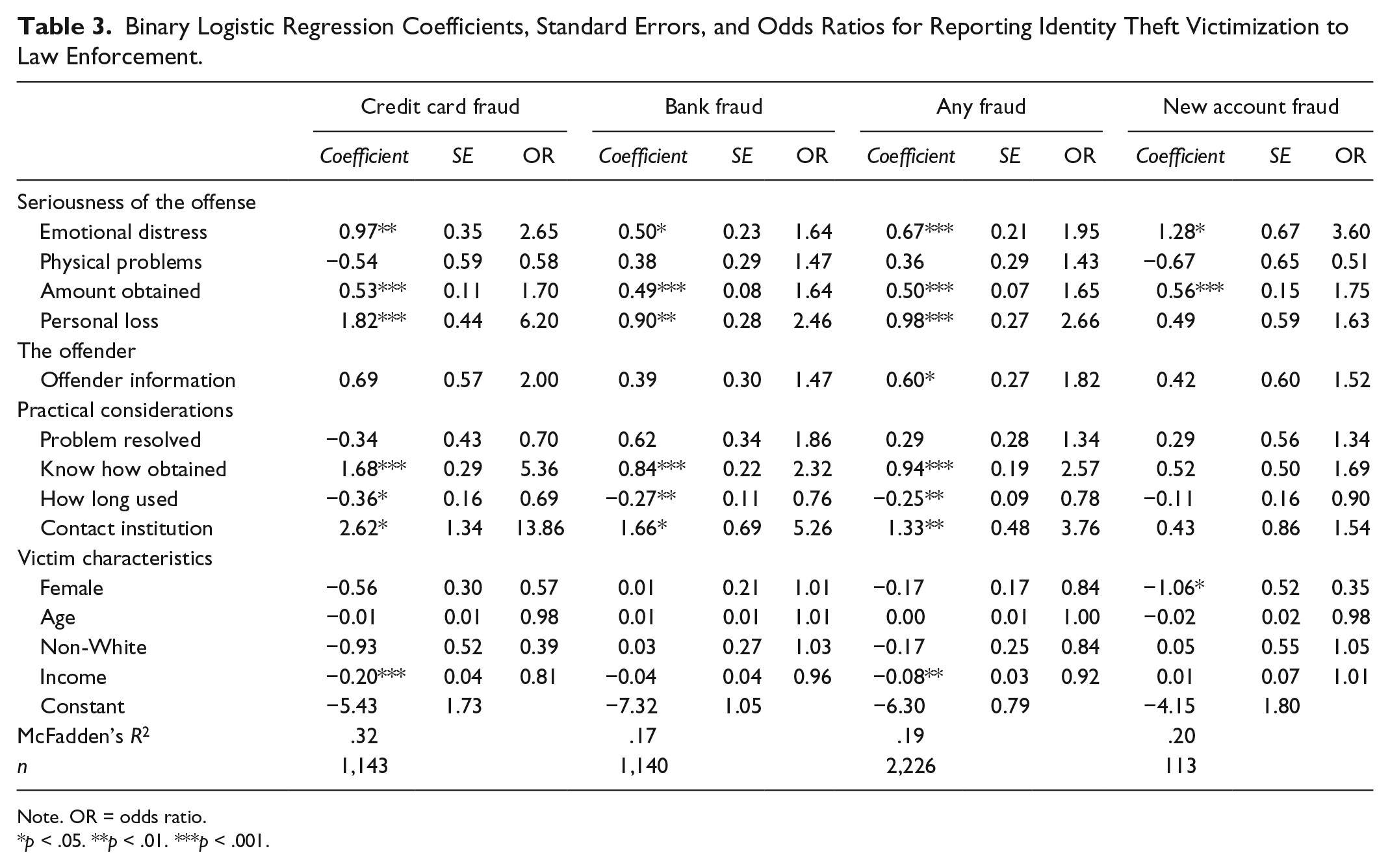
Table 3 identifies seven independent variables as important predictors of the victim’s decision to notify law enforcement of credit card fraud victimization. First, emotional distress suffered by the victim, the amount obtained by the offender, and whether the victim suffered a personal financial loss—dimensions of offense seriousness—exhibited positive and significant relationships with the reporting decision. Second, regarding practical considerations and their effects upon reporting decisions, three variables produced statistically significant effects. Those who knew how the offender obtained their credit card information or who contacted their financial institution were at an increased likelihood of deciding to contact law enforcement. Conversely, individuals whose information was used for longer periods of time were less likely to contact law enforcement. Finally, the only victim characteristic linked with the reporting decision was income, suggesting that those with higher incomes were less likely to report their victimization to the police.
Binary Logistic Regression Coefficients, Standard Errors, and Odds Ratios for Reporting Identity Theft Victimization to Law Enforcement.
Note. OR = odds ratio.
p < .05. **p < .01. ***p < .001.
Bank Fraud
Several of the previously discussed findings were replicated with respect to victims of bank account fraud. In particular, offense seriousness and practical considerations appeared to be influential in the victim’s decision to notify law enforcement of the crime. Specifically, emotional distress, the amount obtained by the offender, and whether the victim personally lost money as a consequence of the crime were positive and significant influences on victim reporting decisions. Furthermore, individuals who knew how the offender obtained their information and those who contacted their financial institution were also at a higher likelihood of contacting law enforcement. Once again, the duration of the incident was negatively related to the reporting decision.
Any Existing Account Fraud
The model including the composite measure of identity theft victimization—indicating any type of existing account fraud—produced very similar findings to the two previously discussed models. Seriousness of the offense, offender information, practical considerations, and victim characteristics all affected the identity theft victim’s decision to contact law enforcement. Again, emotional distress, the amount obtained, and sustaining a personal loss each positively affected the notification decision. Notably, victims who possessed some sort of information about the offender were significantly more likely to contact the police regarding their victimization—a finding unique to this model. With respect to practical considerations, knowing how the information was obtained and communicating with a financial institution were positive predictors of reporting, whereas longer periods of misuse of information were negatively related to notification. Last, victims with higher incomes were at decreased odds of contacting law enforcement following identity theft.
New Account Fraud
The final model in Table 3 includes findings related to the reporting decisions of victims of new account frauds. New account fraud is less common than existing account fraud (see Table 1), but it appears that the factors affecting victim reporting decisions are not entirely disparate. That is, variables measuring offense seriousness were significant predictors of victim reporting. In particular, victims who were emotionally distressed and those who lost larger sums of money to the offender were more likely to contact law enforcement. Furthermore, males were significantly more likely to contact the police in cases of new account fraud in comparison with females. These variable effects, as well as those reported for victims of existing account frauds, are discussed below.
Discussion and Conclusion
Summary and Discussion of Findings
The purpose of the present study was to address gaps in the existing body of research into victim decision making by identifying determinants of the decision to report among victims of identity-related crimes. In the process, three hypotheses derived from focal concerns theory and Gottfredson and Gottfredson’s theory of criminal justice decision making also were tested and supported. The results provide insights into the factors that influence this important victim decision, while also supporting the expansion of these two theoretical frameworks into the field of victimology as a means of understanding victim decision making. However, these three hypotheses warrant additional discussion, as does the influence of victim characteristics upon reporting decisions.
First, based on Gottfredson and Gottfredson’s theory, it was hypothesized that more serious incidents—characterized by the impact the crime had upon the victim—would be reported to law enforcement. As stated, findings related to seriousness were as expected, with the exception of physical problems, which had no impact upon notification decisions. However, focal concerns theory also emphasizes the importance of the related concept of offender blameworthiness. This concept essentially reflects the likelihood that the offender carried out the crime. Establishing offender blameworthiness from a victimization perspective becomes somewhat tenuous in cases of identity theft, because it is a crime that is often perpetrated remotely by the offender. That is, the victim and offender may never have a face to face encounter. Thus, the victim may not know who the offender is, how the crime was perpetrated, or indeed, that he or she has been victimized until some later time. This issue speaks to the second theoretical concept from Gottfredson and Gottfredson’s theory—the victim–offender relationship.
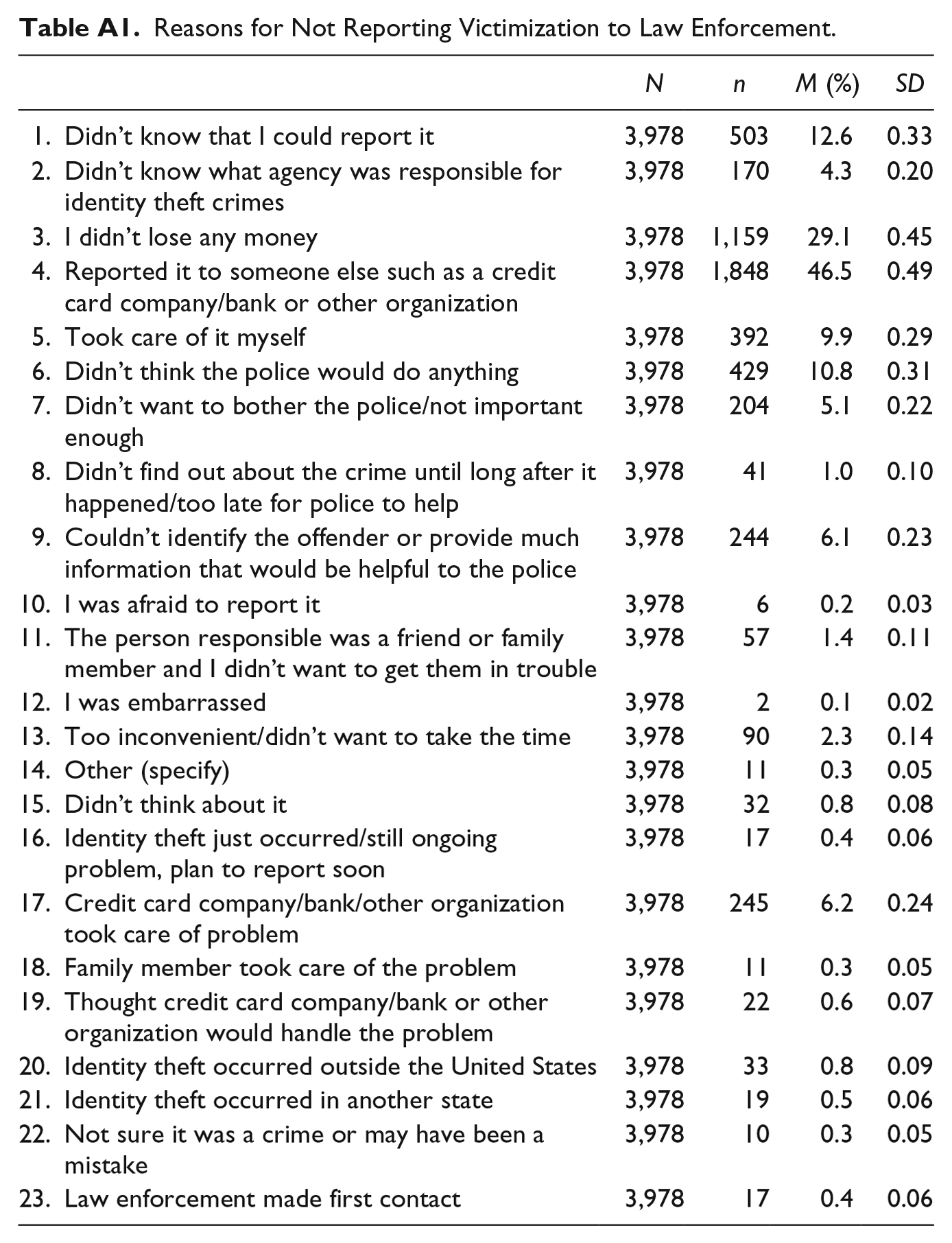
Second, due to data limitations, a proxy measure of the victim–offender relationship was utilized, measured as whether the victim possessed any information about the offender (or offenders). In cases of existing account fraud, it was twice as likely that victims would contact law enforcement if they had information about the offender than if they had no such information. This suggests that a further exploration into how the victim’s knowledge of the offender affects their decision making is warranted. Appendix Table A1 provides descriptive information related to why victims decided not to report the crime to law enforcement. While it appears that most victims decided not to report for practical reasons, 7% said that they did not contact law enforcement either because they could not identify the offender or because it was a friend or family member. While speculative, this may also account for why the duration of the incident was negatively related to reporting. That is, if someone known to the victim was misusing his or her information, he or she may be hesitant to contact the authorities. However, it may also be that the situation seems less urgent, especially if it has already been resolved. Altogether, a continued focus on the victim–offender relationship is needed to better understand how victims of identity theft make decisions following the crime.
Third, practical considerations affected the reporting decision—notably, whether the victim knew how their information was obtained and being in contact with the relevant financial institution. In the case of the former, there may be a parallel to the sexual victimization literature in that previous research indicates victims of sexual assault are less likely to report their victimization to the police when they are concerned that they lack proof that the incident happened (e.g., Fisher et al., 2003). So too, victims of identity theft may feel essentially that if they have nothing helpful to tell the police that will aid in the apprehension of the offender, then there is no reason to notify them of the crime. Relatedly, persons who have contacted their credit card company, bank, or other organization may see no reason to also contact law enforcement—a position supported by the data in Appendix Table A1. Overall, within the context of focal concerns theory, it appears that victims consider the practical purpose or end result of their reporting behaviors, and if the problem has already been addressed or they have insufficient information to aid the police in responding to the crime, then reporting is viewed as unnecessary.
Finally, while victim characteristics have featured prominently in the victim decision-making literature, gender, age, and race did not influence victim reporting decisions related to identity theft victimization. Instead, income emerged as the most important victim characteristic affecting decision making. Specifically, persons with lower incomes were more likely to contact the police and initiate the criminal justice process as compared with those with higher incomes. Perhaps income is one of the criteria victims include in their perceptual shorthand when evaluating their situation and deciding whether or not to call the police. The potential for additional research into the effects of income is discussed further below.
Limitations and Recommendations for Future Research
Although the present study addressed several questions from the field related to victim reporting behaviors following identity theft victimization, and utilized two notable theories from criminal justice to interpret the results, the findings should nevertheless be considered in light of the study’s limitations. These limitations also highlight possible areas of inquiry for future research. Namely, while the NCVS provides a rich and robust source of secondary data, using such data can create challenges with respect to measuring theoretical concepts. In particular, the effects of concepts relevant to the victim–offender relationship, and the blameworthiness and dangerousness of the offender could not be assessed. To fully test these two theoretical perspectives, original data will need to be collected to serve this purpose. A related issue involves the types of identity theft included in the present analyses. The focus of the current study centered on forms of identity theft involving account frauds, and while these are the most common forms of identity theft according to the NCVS, future research should focus on other types of fraud involving misuse of personal information (e.g., driver’s license, social security) and associated reporting behaviors.
Furthermore, as previously mentioned, income may be a key factor in a victim’s perceptual shorthand. Specifically, income could be one of the metrics by which victims evaluate and/or perceive their situation, interacting with other correlates of decision making to ultimately determine whether victims contact the police. For example, perhaps individuals with lower incomes are more likely to know the perpetrator. It may also be that individuals with higher incomes do not judge their situation to be as serious because they can afford to wait for the credit card company, bank, or other organization to resolve the problem. In addition, given that most individuals do not ultimately incur out of pocket costs as a result of the forms of identity theft included in the current study, it would also be interesting to explore whether and under what circumstances these organizations are in contact with law enforcement. In many cases, it is ultimately these entities that suffer a financial loss following the crime.
Last, contextual factors, such as the jurisdiction in which the offense occurred or would be reported might also represent a practical consideration that guides the victim’s decision to report (e.g., Higgins, Hughes, Ricketts, & Wolfe, 2008; Lane & Sui, 2010). State laws vary, and victims may be uncertain as to the appropriate agency to contact, especially if their information is being misused in another state. Although only a small number of victims in Appendix Table A1 spoke to the jurisdiction of the offense by indicating that the crime occurred in another state or outside the United States, those who revealed that they did not know what agency to contact or that they did not know they could contact the authorities might have been affected by these jurisdictional considerations. This possibility represents one of the ways that future research can elaborate upon the present study, but again, this will require original data.
All told, the present study advances several areas in both criminal justice scholarship and within the field of victimology by exploring situational and victim characteristics affecting reporting of identity theft to law enforcement and expanding existing criminal justice theories into previously unexplored territory to better understand this decision. This initial exploratory effort is imperfect, but continued examination into victim decision making generally, and especially following identity-related crimes, is needed. Such inquiries are important because if researchers can identify the reasons behind reporting and non-reporting behaviors, perhaps policy makers can encourage police notification when appropriate, 6 participation in the criminal justice process by victims when necessary, and ultimately, a more efficient and effective means of responding to identity-related criminal threats.
Footnotes
Appendix
Reasons for Not Reporting Victimization to Law Enforcement.
| N | n | M (%) | SD | |
|---|---|---|---|---|
| 1. Didn’t know that I could report it | 3,978 | 503 | 12.6 | 0.33 |
| 2. Didn’t know what agency was responsible for identity theft crimes | 3,978 | 170 | 4.3 | 0.20 |
| 3. I didn’t lose any money | 3,978 | 1,159 | 29.1 | 0.45 |
| 4. Reported it to someone else such as a credit card company/bank or other organization | 3,978 | 1,848 | 46.5 | 0.49 |
| 5. Took care of it myself | 3,978 | 392 | 9.9 | 0.29 |
| 6. Didn’t think the police would do anything | 3,978 | 429 | 10.8 | 0.31 |
| 7. Didn’t want to bother the police/not important enough | 3,978 | 204 | 5.1 | 0.22 |
| 8. Didn’t find out about the crime until long after it happened/too late for police to help | 3,978 | 41 | 1.0 | 0.10 |
| 9. Couldn’t identify the offender or provide much information that would be helpful to the police | 3,978 | 244 | 6.1 | 0.23 |
| 10. I was afraid to report it | 3,978 | 6 | 0.2 | 0.03 |
| 11. The person responsible was a friend or family member and I didn’t want to get them in trouble | 3,978 | 57 | 1.4 | 0.11 |
| 12. I was embarrassed | 3,978 | 2 | 0.1 | 0.02 |
| 13. Too inconvenient/didn’t want to take the time | 3,978 | 90 | 2.3 | 0.14 |
| 14. Other (specify) | 3,978 | 11 | 0.3 | 0.05 |
| 15. Didn’t think about it | 3,978 | 32 | 0.8 | 0.08 |
| 16. Identity theft just occurred/still ongoing problem, plan to report soon | 3,978 | 17 | 0.4 | 0.06 |
| 17. Credit card company/bank/other organization took care of problem | 3,978 | 245 | 6.2 | 0.24 |
| 18. Family member took care of the problem | 3,978 | 11 | 0.3 | 0.05 |
| 19. Thought credit card company/bank or other organization would handle the problem | 3,978 | 22 | 0.6 | 0.07 |
| 20. Identity theft occurred outside the United States | 3,978 | 33 | 0.8 | 0.09 |
| 21. Identity theft occurred in another state | 3,978 | 19 | 0.5 | 0.06 |
| 22. Not sure it was a crime or may have been a mistake | 3,978 | 10 | 0.3 | 0.05 |
| 23. Law enforcement made first contact | 3,978 | 17 | 0.4 | 0.06 |
Declaration of Conflicting Interests
The author(s) declared no potential conflicts of interest with respect to the research, authorship, and/or publication of this article.
Funding
The author(s) received no financial support for the research, authorship, and/or publication of this article.