



Abstract
Participation in risky lifestyles is a well-established predictor of victimization. Several variables have been identified as key predictors of risky activities (e.g., low self-control) but there may be additional sources not considered in the literature to date. We argue that perceptions of procedural unfairness represent a break in social control, thereby opening the door for participation in risky lifestyles that are conducive to victimization. Using three waves of data from the Gang Resistance Education and Training (GREAT) program, we demonstrated that police procedural injustice was positively associated with risky lifestyles, which partially mediated the relationship between procedural injustice and violent victimization. This study advances the literature by demonstrating that our understanding of victimization is enhanced by including procedural injustice into its explanation.
People who engage in risky behaviors such as using drugs, hanging out with deviant peers, and breaking the law tend to experience negative consequences (Turanovic & Pratt, 2015). The increased likelihood of being victimized is one of the most well-documented outcomes associated with participation in risky lifestyles because, among other reasons, these kinds of behaviors tend to place people in close proximity to motivated offenders (Hindelang, Gottfredson, & Garofalo, 1978; Pratt & Turanovic, 2015). In the victimization literature, lack of self-control has been identified as the primary reason why people choose to engage in behaviors that ultimately put them at risk to be victimized (Pratt, Turanovic, Fox, & Wright, 2014; Schreck, Stewart, & Fisher, 2006). After all, those with lower levels of self-control find risky behaviors to be a lot of fun. There is plenty of research to support this compelling explanation (Holtfreter, Reisig, & Pratt, 2008; Stewart, Elifson, & Sterk, 2004; Turanovic & Pratt, 2013, 2014; Turanovic, Reisig, & Pratt, 2015).
Still, the sources of participation in risky behaviors are likely more complex. In addition to a latent trait like self-control, there is possibly a more social-psychological component underlying willingness to engage in risky lifestyles. Tyler’s (1990) procedural justice theory provides such an explanation. Research has consistently revealed that when individuals perceive actors within the legal system—especially police officers—as being procedurally fair, they are more likely to view such authority figures as legitimate, accept their decisions regardless of outcome favorability, cooperate with police, and obey the law (Jackson, Bradford, Hough, et al., 2012; Murphy & Cherney, 2011, 2012; Nix, Wolfe, Rojek, & Kaminski, 2015; Sargeant, Murphy, & Cherney, 2014; Tyler, 1990; Tyler & Huo, 2002). Such procedurally fair policing helps strengthen the ties individuals have with formal social control agents and the law because it supports society’s normative expectations concerning authority figure behavior. This bond cultivates social control and leads to positive outcomes such as compliance with the law. On the contrary, procedural injustice is an attitudinal manifestation of suspended social control, making risky behavior more likely. Procedurally unfair police actions fail to exert social control over individual behavior because it dissolves the bond people could have with such authority figures. Procedural injustice as a weakened social control mechanism, in turn, may increase participation in risky behaviors that lead to violent victimization exposure. This potential relationship has important theoretical and policy implications but has yet to be examined in the literature to date.
Accordingly, the present study examines whether procedural injustice has a link with violent victimization by way of its influence on risky lifestyles using data from the Gang Resistance Education and Training (GREAT) study (Esbensen, 2003). In doing so, we provide a theoretical foundation for the connection between procedural injustice, risky lifestyles, and violent victimization. In short, viewing procedural injustice as a disruption in social control helps explain why some individuals, beyond variation in their self-control, engage in risky behaviors which place them at risk to be victimized. The overarching goal of this study is to determine whether understanding the complex sources of victimization can be enhanced by including procedural injustice into its explanation.
Procedural Justice Theory
Tyler’s (1990) procedural justice theory suggests that fair treatment by legal authorities helps encourage citizen cooperation and compliance with the law. With respect to policing, procedural justice is typically characterized by four elements that center on officers’ decision making and interpersonal treatment of citizens (Jonathan-Zamir, Mastrofski, & Moyal, 2013; Tyler, 1990, 2004; Tyler & Huo, 2002; Tyler & Wakslak, 2004). The first key element is participation. People view the police as procedurally fair if officers allow them to have a voice during the decision-making process. Neutrality is the second element. Police interactions are viewed as fairer when officers make their decisions based on objective indicators rather than personal biases. The third element—dignity and respect—emphasizes the value of polite and respectful police behavior because such treatment reaffirms citizens’ social standing as valued members of society (Lind & Tyler, 1988; Tyler & Blader, 2000, 2003). The final element is police trustworthiness. Police procedures are viewed as fair when people feel they can trust that police decisions have others’ best interests in mind (i.e., motive-based trust; see Tyler, 2005). 1
Procedural justice is important because it affects citizens’ views concerning the legitimacy of the police (Reisig, Bratton, & Gertz, 2007; Tyler, 1990; Tyler & Huo, 2002; Wolfe et al., 2015). In short, people who believe the police are procedurally fair are more likely to believe they are a legitimate authority. Conversely, procedural injustice perceptions signal that an individual is not attitudinally bonded to the police which increases the likelihood that the police will be viewed as illegitimate. Legitimacy has been conceptualized in various ways but, generally, it represents an individual’s view that the police have a right to exert their power and that citizens have a moral responsibility to obey their authority (Jackson, Bradford, Hough, et al., 2012; Jackson, Bradford, Stanko, Hohl, 2012; Sunshine & Tyler, 2003; Tyler, 1990; Tyler & Huo, 2002). Recent empirical evidence has demonstrated that procedural justice may not simply be an antecedent of legitimacy but, rather, a component of legitimacy evaluations (Tankebe, 2013). Thus, procedurally fair treatment itself may also be conceptualized as an indicator of police legitimacy.
The important conclusion derived from the literature is that procedural fairness and legitimacy lead to beneficial outcomes for the police such as increased citizen cooperation and decreased criminal participation (Gau, 2011; Murphy, 2005; Reisig et al., 2007; Reisig, Tankebe, & Meško, 2012, 2014; Sunshine & Tyler, 2003; Tyler, 1990; Tyler & Jackson, 2014). Simply put, individuals who view the police as procedurally fair are more likely to view them as legitimate authority figures and, in turn, more likely to obey the law. Those who perceive unfair treatment by the police are more inclined to violate the law (see, for example, Tyler, 1990; Tyler & Huo, 2002).
Why is procedural justice associated with legal compliance? Tyler (1990) and others typically view the connection between procedural fairness, legitimacy, and compliance as rooted in social-psychological normative motivations. That is, people who feel that the police are fair are motivated toward legal compliance based on normative expectations about what is “right.” Essentially, people expect to be treated fairly and, when they perceive authorities to behave in manners consistent with this expectation, they view such authorities as legitimate. Compliance follows from this evaluation because people feel obligated to behave in ways consistent with this moral alignment (Jackson, Bradford, Hough, et al., 2012; Tankebe, 2013; Tyler, 1990).
Another way to explain why procedural justice and legitimacy produce beneficial compliance is to view procedural justice theory through the lens of a control framework (Hirschi, 1969; Weber, 1946). Indeed, Tyler’s theory is often referred to as the “process-based model of regulation” (Reisig et al., 2007; Tyler & Huo, 2002; Wolfe, 2011) and scholars have argued that fairness breeds a “personal commitment to law-abiding behavior . . . [and] helps sustain and strengthen the ability of legal authorities to encourage citizens to regulate themselves” (Jackson, Bradford, Hough, et al., 2012, p. 1052). As Tyler and Jackson (2014) suggest, being treated fairly by authority figures such as the police is important because it emphasizes social values that
motivate people to deviate from the pursuit of their short term self-interest—to take actions consistent with their conceptions of what is appropriate and right both in terms of perceived responsibility to authorities and through trust and confidence in those authorities. (p. 78)
In other words, the main propositions from procedural justice theory have considerable overlap with the primary assertions offered by control theories. In particular, favorable evaluations of, and strong connections with, the police serve a social control function by inhibiting the hedonistic pursuit of deviant activities and fostering self-regulatory behavior (Tyler, 1990, 2004, 2009).
This conceptualization underscores why the perception of procedural injustice can lead to offending behavior. Jackson, Bradford, Hough, et al. (2012) suggest that unfair and disrespectful treatment communicates to citizens that they are not valued by society which “erodes the extent to which citizens value the police as group authorities, as well as the subsequent identification they have with the set of rules that legal authorities enforce” (p. 1053). In short, perceived procedural injustice represents a breakdown in social control. Given that procedural fairness is a normative expectation held by most people (Tyler, 1994, 2000), the experience or perception of injustice weakens the social control ability legal norms and orientations have on individuals’ behavior. As Matza (1964) succinctly put it five decades ago, “The moral bind of law is loosened whenever a sense of injustice prevails” 2 (p. 102).
This discussion is important to the current focus because of the long-standing criminological observation surrounding the generality of deviance. Simply put, individuals who engage in criminal behavior are also more likely to be involved in a wide array of risky activities (Hirschi & Gottfredson, 1994; Pratt, Barnes, Cullen, & Turanovic, in press; Reisig & Pratt, 2011). Given that procedural justice theory provides important insight concerning offending, it may offer an explanation of other risky behaviors as well. As Gottfredson (1981) reminds us,
In control theory terms, the processes that reduce the restraints to offend are similar to the processes in lifestyle terms that affect the probability that persons will be in places at times and around people where the risk of victimization is high. (p. 726)
As such, weak or absent control mechanisms such as perceived injustice at the hands of the police may help open the door for risky lifestyles conducive to victimization.
Procedural Injustice and Risky Lifestyles
Hindelang and colleagues’ (1978) risky lifestyle theory focuses on the types of risky behaviors that differentially expose people to situations where the probability of victimization is high. Risky lifestyle theory and the closely related routine activity theory (Cohen & Felson, 1979; Felson & Eckert, 2015) have been used to explain a wide range of negative outcomes including criminal offending and deviant behavior (Anderson & Hughes, 2009; Maimon & Browning, 2010; Osgood & Anderson, 2004; Osgood, Wilson, O’Malley, Bachman, & Johnston, 1996; Wolfe, Marcum, Higgins, & Ricketts, 2015). Most importantly, strong empirical evidence has demonstrated that several risky behaviors are key predictors of victimization (Holtfreter et al., 2008; Kennedy & Forde, 1990; Miethe & Meier, 1990; Pratt, Holtfreter, & Reisig, 2010; Stewart, Schreck, & Simons, 2006; Turanovic & Pratt, 2013). For example, individuals who engage in criminal offending, substance use, and unstructured socializing (Averdijk & Bernasco, 2014; Forde & Kennedy, 1997; Osgood et al., 1996; Sampson & Lauritsen, 1990; Schreck et al., 2006), and who associate with delinquent peers (Nofziger & Kurtz, 2005; Pyrooz, Moule, & Decker, 2014; Schreck, Fisher, & Miller, 2004), are decidedly more likely to experience violent victimization than their counterparts. Such risky behaviors increase the probability of victimization because they diminish effective guardianship, increase target suitability, and expose people to criminally inclined others (Cohen & Felson, 1979; Felson & Eckert, 2015; Osgood et al., 1996).
As mentioned earlier, research reveals that one of the primary reasons people, particularly adolescents, lead risky lifestyles is because they lack self-control (Pratt et al., 2014; Schreck et al., 2006; Turanovic & Pratt, 2014; Turanovic et al., 2015). An inability to foresee the long-term consequences of their actions and a preference for fun, yet dangerous, behaviors are some of the reasons why people with lower self-control tend to pursue risky lifestyles. Similarly, poor parental supervision has also been shown to be positively associated with adolescent risky activities (Lereya, Samara, & Wolke, 2013). Taken together, these findings reveal that breakdowns in social control mechanisms are at least partially responsible for young peoples’ participation in risky lifestyles that increase the potential for victimization. At the same time, it is possible that still other factors account for people’s risky lifestyles. Largely ignored in the literature to date are the potential social-psychological reasons why people participate in risky activities.
Attitudes concerning procedural injustice offer one such explanation. The perception of procedural injustice, when viewed as a weakened social control mechanism, should also be associated with greater participation in risky lifestyles. Similar to other broken control mechanisms, the perception of injustice may reduce individuals’ inhibitions over hedonistic behaviors characteristic of risky lifestyles. To be clear, we argue that the perception of procedural unfairness is an attitudinal indicator of a weakened social bond. People who view the police as procedurally unjust are indicating that they are not bonded to such authority figures, because their behavior does not coincide with normative expectations. Ultimately, this inhibits any social control function that strong police attachment could have over individual behavior.
Given the well-documented victim–offender overlap, offending is one risky behavior that should be associated with procedural injustice and increased victimization risk (Jennings, Higgins, Tewksbury, Gover, & Piquero, 2010; Jennings, Piquero, & Reingle, 2012; Piquero, MacDonald, et al., 2005). We expect adolescents who perceive the police as procedurally unfair to be more likely to violate the law which, in turn, should increase the probability of victimization. In a similar way, substance use has been shown to increase individuals’ chances of violent victimization because such behavior tends to reduce inhibitions and awareness (thereby increasing target suitability) and involves social situations where the risk of violence is greater (Felson & Eckert, 2015; Osgood et al., 1996; Sampson & Lauritsen, 1990). We anticipate that youth with social-psychological orientations concerning procedural injustice are less inhibited from engaging in deviance and, therefore, more likely to drink alcohol or use drugs. In turn, such risky behavior should be positively associated with victimization.
Procedural injustice is also expected to increase participation in unstructured socializing. In particular, perceived procedural injustice should increase adolescents’ willingness to engage in social activities that lack adult supervision (which reduces effective guardianship) and involve unstructured time with peers (which increases exposure to motivated offenders and situations conducive to violence), which should in turn account for greater violent victimization (Felson & Eckert, 2015; Osgood & Anderson, 2004; Osgood et al., 1996; Turanovic & Pratt, 2014). Similarly, the reduced social control offered by procedural injustice evaluations may also affect the number of delinquent peers adolescents hang out with and, on a more serious level, increase the likelihood of adolescent gang membership. Simply put, procedural injustice should be associated with such risky activities because it represents a weakened bond to an important societal institution—legal authorities—thereby producing less social control over hedonistic, deviant, or otherwise risky behaviors.
The Current Focus
The present study seeks to advance the victimization and procedural justice literatures by determining whether perceptions of procedural injustice serve as an important source of risky behaviors and, in turn, violent victimization. Using survey data from a sample of adolescents, our focus is on meeting two objectives: First, we test whether procedural injustice is associated with adolescent risky behaviors, beyond other factors known to contribute to the process (e.g., low self-control). Second, we consider whether the procedural injustice–risky lifestyle relationship improves our understanding of victimization. To do so, we use a series of multivariate models to determine whether various risky lifestyle indicators mediate the association between procedural injustice and violent victimization.
Method
Data
Data for the present study came from the longitudinal survey evaluation phase of the GREAT program. This dataset was chosen for use in the current analysis because it offers measures consistent with the procedural justice literature, includes theoretically salient risky lifestyle indicators, captures violent victimization experiences, and allows for the appropriate temporal ordering of the key variables. Questionnaires were administered to approximately 3,000 sixth-and seventh-grade students from 22 schools (i.e., 153 total classrooms) in six cities during the first wave of data collection (see Esbensen, 2003, for further detail). Subsequent data collection efforts took place on an annual basis. Three waves of data were used in the present study—Waves 2, 3, and 4 (hereafter, Times 1, 2, and 3, respectively). Procedural injustice was measured at Time 1, risky lifestyles at Time 2, and violent victimization at Time 3. Retention rates for Times 1, 2, and 3 were 76%, 69%, and 67%, respectively (Esbensen, Osgood, Taylor, Peterson, & Freng, 2001).
Independent Variables
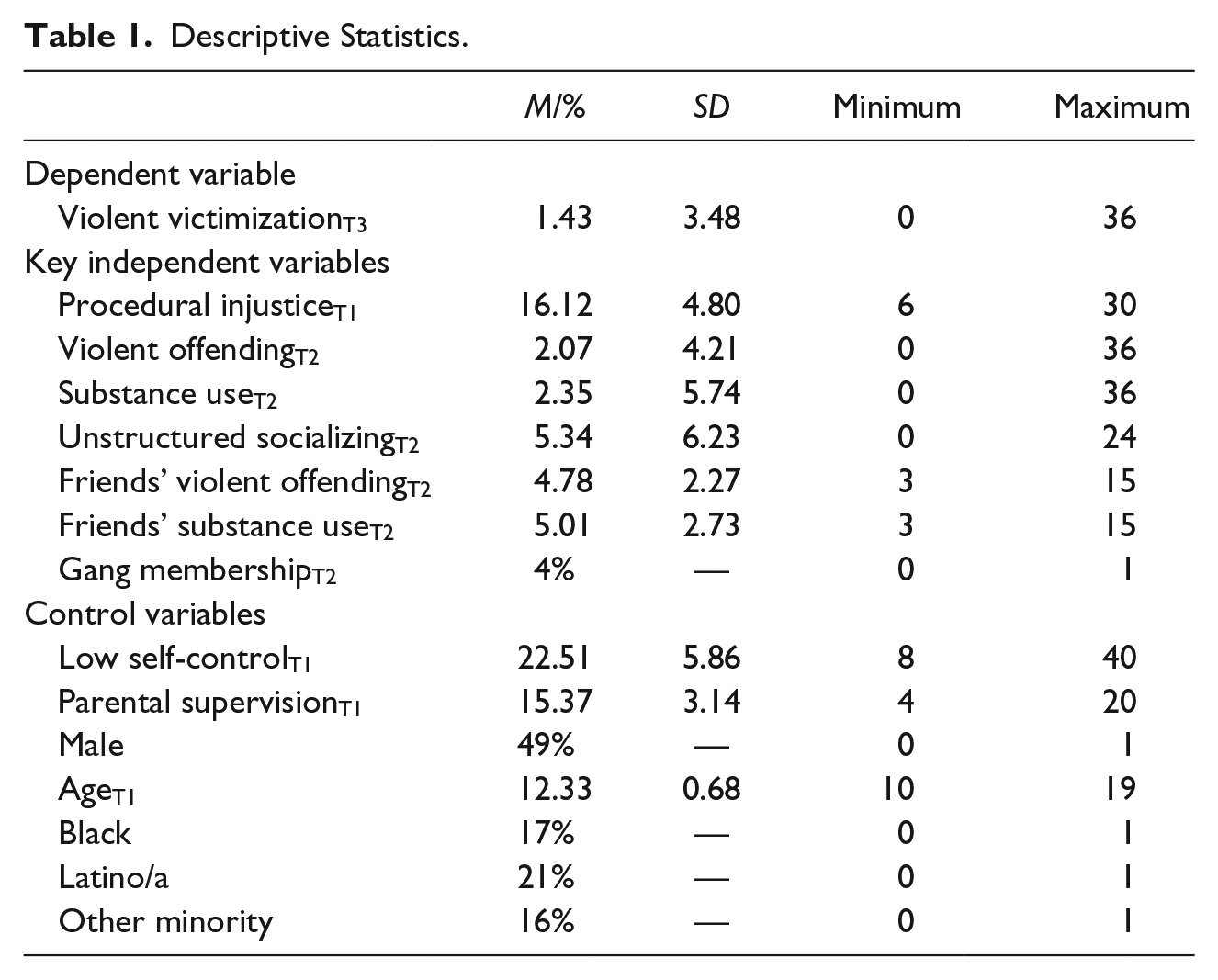
The key independent variable of interest for the present study—procedural injustice—was measured by asking respondents to indicate their level of agreement on a 5-point scale anchored from 1 (strongly disagree) to 5 (strongly agree) to the following questions: “Police officers are honest” (reverse coded), “Most police officers are usually rude,” “Most police officers are usually friendly” (reverse coded), “Police officers are usually courteous” (reverse coded), “Police officers are respectful toward people like me” (reverse coded), and “Police officers are prejudiced against minority persons.” These items were consistent with previous procedural justice research (Jackson, Bradford, Stanko, et al., 2012; McLean & Wolfe, 2016; Reisig et al., 2007; Tyler, 2005). Principal-axis factor analysis revealed the items loaded on a single factor (λ = 3.39; loadings > 0.50). The items were combined to form an additive procedural injustice scale (α = .84; skewness = 0.33). Higher scores on the scale indicated greater levels of perceived procedural injustice. Table 1 presents descriptive statistics for all variables used in the analyses.
Descriptive Statistics.
Risky Lifestyles
Six risky lifestyle measures were examined (see, for example, Stewart et al., 2004; Turanovic et al., 2015). The first variable, violent offending, captured respondents’ frequency of participation in violent criminal behavior during the 6 months prior to the Time-2 interview: “hit someone with the idea of hurting them,” “attacked someone with a weapon,” and “used a weapon or force to get money or things from people.” Responses on each item ranged from 0 to 12 and were summed into a three-item scale (α = .65).
Substance use measured the frequency with which individuals used alcohol, marijuana, or other illegal drugs in the 6 months leading up to the Time-2 interview (responses on each item ranged from 0 to 12). The items were combined to form an additive index that demonstrated good internal consistency (α = .74).
Unstructured socializing captured the amount of time adolescents participated in unsupervised social activities. Respondents were asked to indicate the average amount of time per week they spent “hanging around with your current friends not doing anything in particular where no adults are present” and “getting together with your current friends where drugs and alcohol are available.” Time spent in each activity ranged from 0 (no time) to 12 (12 or more hr per week) and the items were combined into a summated scale (α = .60).
The remaining risky lifestyle indicators captured differential association with violent or otherwise deviant peer groups. Friends’ violent offending was a three-item scale that measured the number of respondents’ friends who had “hit someone with the idea of hurting them,” “attacked someone with a weapon,” and “used a weapon or force to get money or things from people” in the previous 6 months. Closed-ended responses for each item ranged from 1 (none of them) to 5 (all of them). The scale exhibited good internal consistency (α = .76). Friends’ substance use captured the number of friends that used alcohol, marijuana, and other illegal drugs in the previous 6 months (1 = none of them, 5 = all of them). The scale items demonstrated strong internal consistency (α = .82) and were combined into a summated index. Finally, a binary measure—gang membership—was coded 1 for teens that reported gang membership at Time 2.
Dependent Variable
The dependent variable captured the frequency of violent victimization experienced by respondents in the months leading up to the Time-3 interview. Respondents were asked to indicate how many times in the past 6 months each of the following occurred: “been hit by someone trying to hurt you,” “had someone use a weapon or force to get money or things from you,” and “been attacked by someone with a weapon or by someone trying to seriously hurt or kill you.” Responses were coded so each item ranged from 0 to 12 (Turanovic & Pratt, 2013, 2014). Violent victimization was operationalized as an additive scale that exhibited good internal consistency (α = .65). Nearly 35% of teens reported at least one violent victimization.
Control Variables
Several correlates of violent victimization measured at the Time-1 interview were included in the multivariate equations to avoid potential spuriousness. Low self-control was an eight-item summated scale that captured the degree to which adolescents act impulsively, are short-sighted, pursue immediate gratification, and enjoy risk-taking behavior—all key elements of the construct (Gottfredson & Hirschi, 1990; Grasmick, Tittle, Bursick, & Arneklev, 1993): “I often act on the spur of the moment without stopping to think,” “I don’t devote much thought and effort to preparing for the future,” “I often do whatever brings me pleasure here and now, even at the cost of some distant goal,” “I’m more concerned with what happens to me in the short run than in the long run,” “I like to test myself every now and then by doing something a little risky,” “Sometimes I will take a risk just for the fun of it,” “I sometimes find it exciting to do things for which I might get in trouble,” and “Excitement and adventure are more important to me than security” (1 = strongly disagree, 5 = strongly agree; α = .83). The items were coded so higher values reflected lower self-control.
Parental supervision was a four-item scale: “When I go someplace, I leave a note for my parents or call them to tell them where I am,” “My parents know where I am when I am not at home or at school,” “I know how to get in touch with my parents if they are not at home,” and “My parents know who I am with if I am not at home” (1 = strongly disagree, 5 = strongly agree; α = .73). Finally, the following demographic characteristics were controlled for in all regression models: male (1 = male, 0 = female), age (in years at Time 1), Black (1 = yes, 0 = otherwise), Latino/a (1 = yes, 0 = otherwise), and other minority (1 = yes, 0 = otherwise; White served as the reference category).
Analytic Strategy
The analyses proceeded in two steps. First, a series of multivariate regression equations were estimated to determine whether individuals’ perceptions of procedural injustice were associated with participation in the risky lifestyles. Within this step, the six risky lifestyle measures were treated as outcomes in the regression models. Negative binomial regression was used to estimate the violent offending, substance use, unstructured socializing, friends’ violent offending, and friends’ substance use equations, given that the distribution of each scale was overdispersed (see Table 1). Importantly, logistic regression was used for the binary gang membership outcome. This stage in the analysis was also important because establishing a relationship between procedural injustice and risky lifestyles was a necessary empirical condition for gauging mediation in the subsequent victimization models (MacKinnon, Krull, & Lockwood, 2000).
Second, the influence of procedural injustice on violent victimization was assessed. Negative binomial regression was used because descriptive statistics revealed that the distribution of violent victimization was overdispersed. After establishing a baseline regarding the extent to which greater levels of perceived procedural unfairness were associated with violent victimization (Model 1), the risky lifestyle variables were added to the equation in a stepwise fashion. Specifically, the influence of each risky lifestyle and procedural injustice was assessed in separate equations (Models 2-7) to determine the extent to which risky activities mediated the procedural injustice–violent victimization relationship. The test statistic for comparing maximum-likelihood regression coefficients was used to assess the degree of mediation (Brame, Paternoster, Mazerolle, & Piquero, 1998). It was necessary to test mediation because the theoretical model we articulated suggests that risky lifestyles serve as the intervening mechanism by which procedural injustice is associated with victimization. The final equation (Model 8) estimated the simultaneous influence of procedural injustice and the six risky lifestyle indicators to assess the relative effects of each variable on victimization. Overall, this stage of the analysis allowed us to determine the extent to which our understanding of the complex correlates of victimization is enhanced by accounting for procedural injustice attitudes. 3
Results
Table 2 presents the results from a series of regression equations that explored whether individuals who perceive the police as procedurally unfair are more likely to participate in risky lifestyles. To begin, the likelihood-ratio tests of alpha for Models 1 through 5 in Table 2 showed that the distribution of scores for each of the risky lifestyle indicators was overdispersed which supported the use of negative binomial regression (χ2 = 3,101.95, 4,769.49, 3,616.25, 427.48, and 14.69, respectively; p < .01). Consistent with expectations, the results from Table 2 revealed that the procedural injustice scale had a positive and statistically significant association with each of the risky lifestyle variables. Adolescents in this sample who perceived the police as procedurally unfair had higher levels of self-reported violent offending (see Model 1; b = 0.05, p < .01) and substance use (see Model 2; b = 0.07, p < .01). These findings mirrored previous procedural justice research and provided confidence in the GREAT data for use in the current study. Furthermore, teens who believed the police are procedurally unfair reported spending more time in unstructured social activity (see Model 3; b = 0.03, p < .01) and associating with more violent (see Model 4; b = 0.04, p < .01) and substance-using friends (see Model 5; b = 0.01, p < .01). Finally, the logistic regression equation in Model 6 revealed that a one-unit increase in the procedural injustice scale was associated with a 10% increase in the odds of gang membership (odds ratio = 1.10). In sum, the results from Table 2 demonstrated that perceptions of procedural injustice were associated with more frequent participation in risky lifestyles even after controlling for well-known correlates such as low self-control and parental supervision. We now turn our attention to whether these results improve our understanding of the sources of violent victimization.
The Procedural Injustice Effect on Risky Lifestyles.
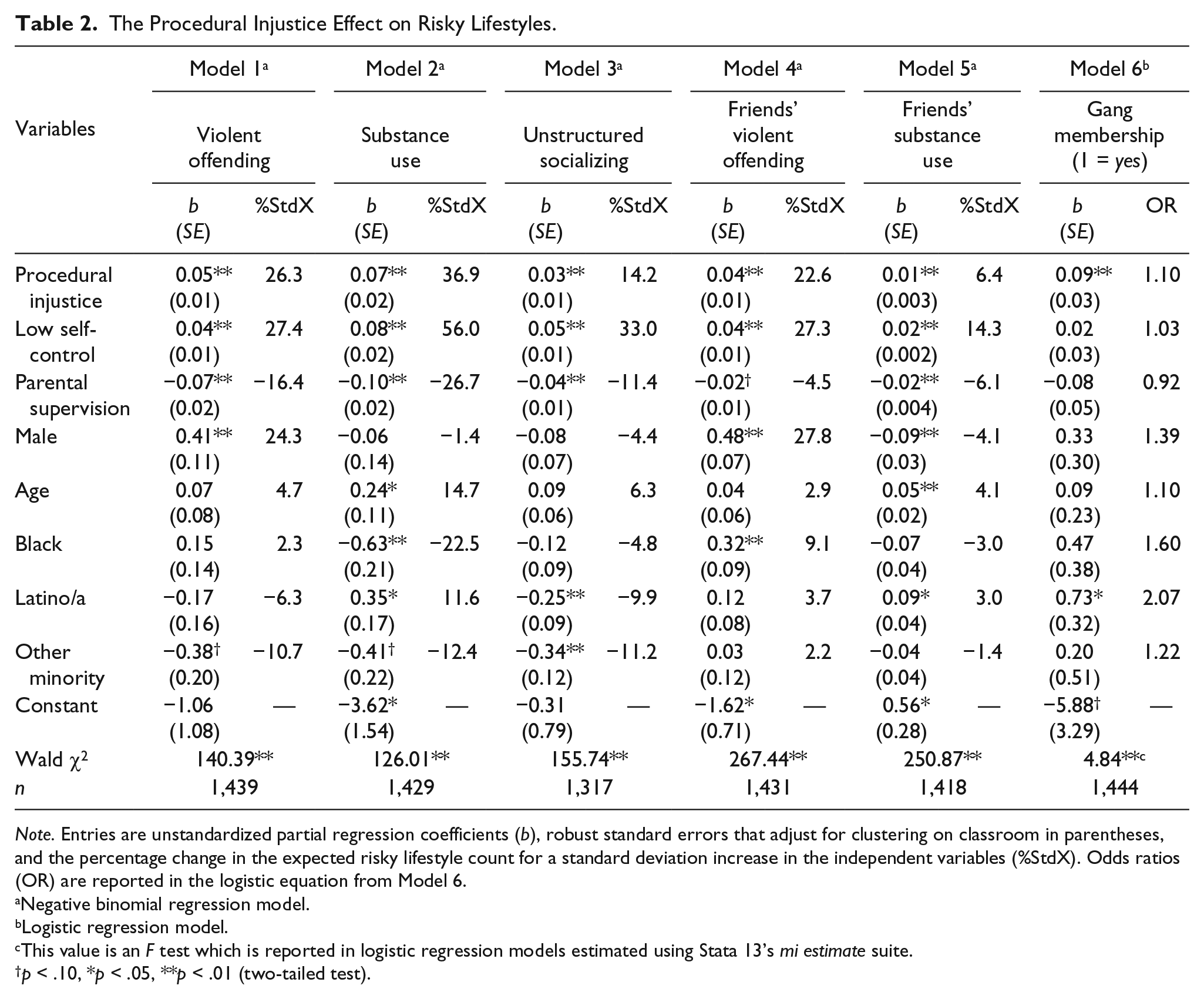
Note. Entries are unstandardized partial regression coefficients (b), robust standard errors that adjust for clustering on classroom in parentheses, and the percentage change in the expected risky lifestyle count for a standard deviation increase in the independent variables (%StdX). Odds ratios (OR) are reported in the logistic equation from Model 6.
Negative binomial regression model.
Logistic regression model.
This value is an F test which is reported in logistic regression models estimated using Stata 13’s mi estimate suite.
p < .10, *p < .05, **p < .01 (two-tailed test).
Table 3 presents the results from a series of eight negative binomial models that regressed the violent victimization scale onto the procedural injustice scale, risky lifestyle measures, and control variables. The likelihood-ratio tests of alpha for each of the models revealed that the distribution of scores for the violent victimization scale was overdispersed (e.g., χ2 = 2,705.79, p < .01 for Model 1). Model 1 confirmed a positive and statistically significant relationship between procedural injustice and violent victimization (b = 0.04, p < .05). More formally, the standardized effect (%StdX) demonstrated that each standard deviation increase in the procedural injustice scale corresponded with an 18.6% increase in the expected violent victimization count. Simply put, adolescents who believed the police were more procedurally unfair reported more victimization experience. Consistent with our earlier discussion, however, risky lifestyles should largely explain why procedural injustice was associated with victimization. We turn to this final topic next.
The Effect of Procedural Injustice and Risky Lifestyles on Violent Victimization.

Note. Entries are unstandardized partial regression coefficients (b), robust standard errors that adjust for clustering on classroom in parentheses, and the percentage change in the expected victimization count for a standard deviation increase in the independent variables (%StdX).
Negative binomial regression models.
p < .10, *p < .05, **p < .01 (two-tailed test).
In Models 2 through 7 in Table 3, our concern was with the degree to which the procedural injustice effect on victimization was mediated by each of the risky lifestyle measures. As expected, violent offending was positively and significantly associated with violent victimization (b = 0.10, p < .01; see Model 2). Inclusion of this risky lifestyle indicator into the equation reduced the procedural injustice effect by 75% and below statistical significance. However, a comparison of the maximum-likelihood regression coefficients revealed that the differences in the procedural injustice coefficients were not statistically significant (Brame et al., 1998).
A similar pattern of results emerged in the remaining models. Adolescent substance use (b = 0.05, p < .01; see Model 3), unstructured socializing (b = 0.04, p < .01; see Model 4), friends’ violent offending (b = 0.21, p < .01; see Model 5), friends’ substance use (b = 0.14, p < .01; see Model 6), and gang membership (b = 1.46, p < .01; see Model 7) were all associated with violent victimization in the expected direction. The addition of each risky lifestyle variable reduced the procedural injustice effect by between 25% and 75% and rendered it statistically insignificant in each model. Yet the comparison of coefficients tests revealed that the reduction in the procedural injustice effect was not statistically significant. Taken together, this empirical exercise demonstrated that each of the risky lifestyle measures partially mediated the procedural injustice effect on violent victimization—a finding largely consistent with our expectations.
The final model in Table 3 (see Model 8) presented the fully saturated equation where the simultaneous impact of all six risky lifestyle measures, procedural injustice, and the statistical controls on violent victimization was tested. The results showed that violent offending (b = 0.05, p < .05) and friends’ violent offending (b = 0.10, p < .05) were the risky lifestyles that remained significant predictors of violent victimization in the expected directions. 4 Our focus now turns to a discussion of the theoretical and practical implications of the current results.
Discussion
Decades of research highlights the importance of risky behaviors in elevating one’s risk of victimization (Cohen & Felson, 1979; Hindelang et al., 1978; Pratt & Turanovic, 2015). For the most part, however, scholars have paid far more attention to the consequences of risky activities than where they originate (see, Turanovic & Pratt, 2015). On that front, the victimization literature thus far has been heavily focused on low self-control as the primary source of risky lifestyles (Schreck et al., 2006; Stewart et al., 2004; Turanovic & Pratt, 2013, 2014). We argued here, however, that perceptions of procedural injustice might be an important precursor to the link between risky lifestyles and victimization as well. Using a longitudinal sample of adolescents, the results demonstrated that teens who viewed the police as procedurally unfair were more likely to participate in risky lifestyles that, in turn, increased their exposure to victimization. Based on these results, several conclusions are warranted.
To begin, our study is the first to demonstrate that individuals’ evaluations of legal authorities are an important correlate of risky lifestyles and subsequent violent victimization. Accordingly, our understanding of the complex sources of victimization is improved by including procedural injustice as a key predictor of risky lifestyles. Beyond individual traits such as low self-control, a social-psychological component that represents a weakened social control mechanism also appears to underlie adolescent involvement in risky lifestyles. In short, the perception of procedural injustice challenges the social control exerted over adolescent behavior. Such evaluations are associated with greater willingness to participate in risky behaviors which provide more opportunities for victimization. These findings not only contribute to the broader victimization literature, but also help extend the scope of procedural justice theory by adding risky lifestyles and victimization to the list of negative consequences that stem from procedural injustice. Accordingly, procedural injustice appears to have not only negative consequences for the public and police (e.g., lack of cooperation and greater criminal behavior) but also detrimental outcomes for the adolescents who harbor such perceptions.
It is important to emphasize that a key finding from this study was that procedural unfairness was linked to violent victimization by way of its connection with risky lifestyles. Young people in this sample who believed the police are procedurally unfair were more likely to engage in criminal behavior, use alcohol and drugs, participate unstructured socializing, associate with violent and substance-using peers, and be involved in a gang. These observations are important because they help specify the potential causal mechanisms by which procedural injustice is associated with violent victimization. In short, procedural injustice does not cause greater victimization. Rather, the perception of procedural injustice appears to partially knife-off adolescents’ ties to the police, thereby loosening social control and opening the door for participation in risky lifestyles conducive to victimization. This finding brings us to the next issue—the possible utility of theoretical integration.
In recent years, scholars have increasingly turned to perspectives such as self-control theory to help shed light on the role of risky lifestyles in victimization exposure (Holtfreter et al., 2008; Schreck et al., 2006; Turanovic & Pratt, 2014; Turanovic et al., 2015). Attempts to integrate lifestyle and self-control theories have proved vital in gaining a fuller understanding of the causes of victimization. The current analyses suggest that a similar possibility exists with procedural justice theory. Although procedural injustice does not have as strong of an influence on risky lifestyles as low self-control, we showed the relationships were robust to the potential confounding influence of self-control, parental supervision, and demographic controls (Pratt et al., 2014; Schreck, 1999; Turanovic & Pratt, 2014; Turanovic et al., 2015). Accordingly, future research that continues to integrate procedural justice and lifestyle/routine activity theories may be helpful in clarifying the connection between procedural injustice and other outcomes of interest. For example, scholars may wish to examine whether risky lifestyles partially account for the relationship between procedural injustice and lack of cooperation with police. Procedural injustice may lead to less cooperation with law enforcement, partially because it provides access to cynical legal socialization processes and relationships that reinforce the idea that the police should not be trusted or respected (Sampson & Bartusch, 1998).
Similarly, other frameworks may help specify the connection between perceived unfairness and undesirable outcomes. Recent research, for example, has used general strain theory (Agnew, 1992) to show that procedural injustice leads people to have negative emotions which partially accounts for their offending behavior (Barkworth & Murphy, 2015; Murphy, 2009; Murphy & Tyler, 2008). Other possibilities include neutralization theory (McLean & Wolfe, 2016) or self-control theory (Reisig, Wolfe, & Holtfreter, 2011; Wolfe, 2011). Finally, some scholars may contend that Hirschi’s (1969) social control theory subsumes the propositions offered in procedural justice theory. When viewed through a control theory lens, the procedural justice framework may offer a detailed articulation of how specific social bonds—legal orientations or ties to legal authorities—influence outcomes of interest to criminologists. It is clear that many possibilities for theoretical integration (and competition) exist for future research.
Although we were able to explore the relationships we specified in important ways, there were several things we could not do that represent opportunities for future research. For example, our focus on adolescents was intentional given that a significant portion of criminal behavior and victimization occurs during this segment of the life course (Farrington, 1986; Hirschi & Gottfredson, 1983). However, further research is required before the results can be generalized to individuals in other segments of the life span (see, Wolfe, 2015; Wolfe, Reisig, & Holtfreter, 2016). Also, a key advantage to the present study was its longitudinal nature which allowed us to establish correct temporal ordering of key variables. However, the 6-month period between each interview may mask larger procedural injustice effects. Research that uses shorter follow-up periods is required to determine whether procedural unfairness has a more immediate impact on individuals’ behavior. Finally, future research would benefit from including measures of procedural injustice stemming from direct encounters with the police. The current results were based on global perceptions that may contain a mixture of vicarious and direct-contact evaluations.
In the end, victimization is a complex phenomenon that has complex sources. Although research has clearly documented the role of individual and contextual factors, other, more cognitive-based social control sources have been largely neglected. This is where procedural justice theory comes into play and offers important insight regarding the multifaceted origins of victimization. Although our attention centered on the effect of procedural injustice, the benefits of procedurally fair police treatment are clear and our results should be a call for optimism. Indeed, fair treatment from the criminal justice system—something that agencies have considerable control over—may ultimately reduce participation in risky lifestyles and levels of victimization and, in turn, the harms that follow.
Footnotes
Acknowledgements
The authors are grateful to Travis Pratt and Justin Nix for their helpful comments and suggestions.
Declaration of Conflicting Interests
The author(s) declared no potential conflicts of interest with respect to the research, authorship, and/or publication of this article.
Funding
The author(s) received no financial support for the research, authorship, and/or publication of this article.