



Abstract
This study examines the concordance of self-reported and officially recorded criminal onset among a sample of prisoners in Queensland, Australia. Classified into one of four developmental stages, Gwet’s Agreement Coefficient 1 (AC1) is used to examine the concordance of these two popular data sources. Analysis is conducted across seven offense types, and comparisons are made between Indigenous and non-Indigenous offenders. Results indicate moderate agreement between self-reports and official records with greater concordance for violent and serious property offenses. With few exceptions, self-reported onset precedes officially recorded onset, and concordance was greater for Indigenous offenders. These findings have important methodological implications for criminological research, in particular, developmental and life-course theory, which emphasizes the theoretical importance of the timing and sequencing of criminal events.
Introduction
The criminal career paradigm offers researchers a framework for describing the longitudinal patterning of criminal activity, beginning with its onset, its progression, and ultimately its eventual desistance (Blumstein, Cohen, Roth, & Visher, 1986; Piquero, Farrington, & Blumstein, 2003). As well, the paradigm pays close attention to the timing and patterning of specific criminal events and their progression. On this point specifically, researchers have paid close attention to the age at which criminal activity begins (i.e., onset; Farrington et al., 1990) and the extent to which some crimes follow some type of progression from less to more serious offenses (Loeber, Farrington, Stouthamer-Loeber, & White, 2008). Depending on the data source, and recognizing that much of the knowledge base on these two issues specifically has relied on samples from the general population and/or birth cohorts, findings tend to suggest that onset begins in the early teens when assessed with official records (earlier when using self-reported data) and that less serious crimes tend to be committed earlier in the life course followed often (for those who continue offending) by more serious crimes later in the life course (see, for example, Moffitt, Caspi, & Silva, 2001; Piquero, Hawkins, Kazemian, & Petechuk, 2013).
One critically important methodological issue when studying criminal careers concerns the nature of the information used to measure criminal activity, that is, official or self-report records. Research on criminal careers has made use of both official records, to include police contacts, arrests, or convictions, as well as self-report surveys where respondents are asked to report on their delinquent and criminal involvement. There are strengths and weaknesses to both of these approaches (Thornberry & Krohn, 2003). For example, official records only capture events that come to the attention of the formal criminal justice system and may be biased due to police patrolling, attorney and judicial discretion, and other factors. As well, self-report records may be biased due to memory recall, telescoping, and in longitudinal studies panel fatigue and attrition. Unfortunately, due to data limitations and resource constraints, it is the exception and not the rule that criminal career studies contain both official and self-report data—especially in longitudinal studies (Piquero, Schubert, & Brame, 2014).
For the ongoing development of criminological theory, these methodological issues are not insignificant. For decades, criminologists have been focused on the timing of criminal onset, the age-graded nature of offense escalation, the commencement of desistence, as well as the nature and temporal ordering of criminal involvement across different crime types and offender typologies. Moffitt’s (1993) developmental taxonomy, for example, makes a clear theoretical distinction between the “adolescence-limited” and “life-course persistent” offenders and the different causal mechanisms that can be inferred by the timing of criminal onset and the subsequent development of antisocial behavior in adolescence and into adulthood. Recently, criminologists have called for a more nuanced approach to the theorization of late-onset offending (see McGee & Farrington, 2010)—specifically, whether the mounting empirical evidence is more an artifact of an overreliance on official administrative records, which tend to report a later onset age than self-report records indicate, or the consequence of other social phenomenon (Thornberry & Krohn, 2005). Our capacity to resolve many of the key debates in criminology will depend chiefly on the type of data we use and the decisions we take to operationalize the measurement of various criminal career parameters—decisions that must be informed by comparative methodological analysis using both official and self-report records where such an opportunity exists.
In this study, we use a random sample of data drawn from the total population of adult male prisoners in Queensland, Australia, in 2000/2001 to examine several of the issues highlighted above. Specifically, we examine agreement between self-reported and officially recorded age of onset across several different property and violent crimes. Then, we assess the concordance between the self-report and official reports of age at first arrest. We conclude by examining the extent to which a self-reported offense appeared in the presence of an official report of an offense. Collectively, these analyses offer a unique contribution to the descriptive research on criminal careers, which is an essential step in developing and testing the key tenants of criminological theory.
Prior Research
Given the complexity and importance of measurement in criminology, there have been very few studies dedicated to the analysis of concordance and its implications for the testing and refinement of criminological theory. Following the early methodological works by both Sellin and Wolfgang (1964) and Hindelang (1974), there does not yet exist an overwhelming consensus on the question of whether self-report and official records are sufficiently concordant such that both can be used as interchangeable proxies for criminology’s key dependent variables—crime and criminality. Instead, whether the concordance appears moderate or strong (Brame, Fagan, Piquero, Schubert, & Steinberg, 2004; Farrington, Loeber, Stouthamer-Loeber, Kammen, & Schmidt, 1996) seems dependent on a range of factors, including the method of comparison, the nature and source of the official records used (Hindelang, Hirschi, & Weis, 1979; Krohn, Lizotte, Phillips, Thornberry, & Bell, 2013), the crime types being measured and compared (Payne & Piquero, 2016), and the environment, context, and circumstances under which the self-reported information is collected (Berg, Slocum, & Loeber, 2013; Bosick, 2009; Lauritsen, 1998; Payne & Piquero, 2016). In all, most cross-sectional studies find at least moderate concordance (Hindelang et al., 1979; Kirk, 2006; Lab & Allen, 1984; Maxfield, Weller, & Widom, 2000; Tracy, 1987), despite the presence of both under and overreporting, as well as some differential validity by race and gender (Payne & Piquero, 2016; Piquero et al., 2014).
Although many of these concordance studies have focused on cross-sectional analyses of time-limited or lifetime prevalence and frequency measures, few have considered the relative difference between retrospectively self-reported and officially recorded onset ages by offense type. One key exception is the seminal work of Moffitt et al. (2001) and their study of the antisocial behavior of 1,000 boys and girls who participated in the Dunedin Study. Although limited somewhat by both left (at age 12) and right censoring (at age 21), their detailed analysis showed that self-reported onset typically preceded officially recorded onset by 3 to 5 years—a finding that was later replicated by Loeber and colleagues (2003) and one that has been more recently endorsed in a comprehensive review by Theobald and Farrington (2014).
In a separate and more recent study, Kirk (2006) examined the criminal histories of a sample of 1,775 Chicago youth as part of a multi-wave study known as the Project on Human Development in Chicago Neighborhoods (PHDCN). Using three of the seven waves of data collection, Kirk explored the discordance of self-reported and officially recorded criminal trajectories at ages 12, 15, and 18. Although not specifically an analysis of self-reported ages of onset, the longitudinal nature of these data allowed the age-specific prevalence and frequency of offending to be compared across multiple data sources and across multiple waves. Kirk’s results were similar to those reported in the extant literature, that is, most young offenders self-report the commencement of offending at ages younger than would have been indicated by official records. Moreover, the discordance between self-reported frequencies of offending improved with age (see also Farrington, Auty, Coid, & Turner, 2013).
Perhaps the most significant contribution to date on this topic was produced by Kazemian and Farrington (2005) in their comprehensive reanalysis of self-reported and officially recorded data from the 411 London boys from the Cambridge Study of Delinquent Development (CSDD). A particularly unique feature of their work was the comparative analysis of both prospectively (recorded during each new data collection wave) and retrospectively recalled ages of onset across a range of different offense types. The authors report considerable discordance between prospectively and retrospectively recalled onset, with the retrospective method yielding onset ages, which are older than those that are prospectively identified. In comparison with official records, the authors note that denial of offending (especially for less serious crimes) is common, but that self-reported data (preferably prospectively recorded) provide a more accurate overall assessment of an individual’s early criminal career.
At the other end of the developmental spectrum, empirical studies have also shown important discrepancies between self-reported and officially recorded onset—especially late- or adult-onset offending. In an additional analysis of the CSDD, McGee and Farrington (2010) examined the self-reported delinquency histories of those whose first conviction occurred on or after the age of 21. Notably, all of these so-called adult-onset offenders had some history of self-reported adolescent delinquency, although for the majority this delinquency was assessed as not sufficiently frequent or serious to have resulted in a conviction earlier than was actually recorded. One third of these adult-onset offenders, however, were assessed by the authors as committing enough crime to be nominally at risk of conviction, but had avoided formal detection because the majority of their offenses had low detection rates.
Current Study
On the available evidence, we conclude that it is not uncommon for an offender’s criminal activity to begin some years before their first formal contact with the criminal justice system. This is a not an unrealistic nor unexpected conclusion given that many criminological theories attempt to accommodate this early antisocial and criminal conduct (in schools and at home) as a key antecedent to the development of a more entrenched and formally recorded criminal career. What is not yet clear, however, is whether the disparity occurs only for the relatively minor offenses that dominate adolescent offending, or whether discordance between self-reported and officially recorded onset also occurs for the more serious offense types where official identification and apprehension are more likely to more quickly precede onset. If it is, then discordance between official and self-reported methods of onset is unlikely to be a developmental artifact alone, but a methodological one for which developmental and life-course criminologists must account. Similarly, where significant theoretical weight is given to the timing and temporal ordering of specific offender typologies and/or life-course events, then these disparities raise a number of important questions, especially if it turns out to be excessive and disproportionate for some offenders but not others. What implications would there be, for example, if formally identified early-onset offenders only represented a small fraction of the total pool of those who self-report early onset? What conclusions might we draw if officially recorded late-onset offenders are not, actually, late-onset offenders in their self-report and that this discordance is greater for some offenders and not others? Like those before us, we expect replication of these important findings to “indicate that criminal career research based on self-reports would yield different theoretical implications from research based on official records” (Farrington et al., 2003, p. 943).
Data and Method
The data for this study have been drawn from the Australian Institute of Criminology’s (AIC) Drug Use Careers of Offenders (DUCO) project (Makkai & Payne, 2003). Funded under the National Illicit Drug Strategy, DUCO was Australia’s largest national drug use and offending survey conducted with adult male prisoners in 2001 (Makkai & Payne, 2003), adult female prisoners in 2003 (Johnson, 2004), and male and female juvenile detainees in 2004 (Prichard & Payne, 2005). For the analysis presented herein, we use the data collected from 1,184 adult male prisoners interviewed in Queensland and selected using a geographically stratified systematic random sampling technique. 1 A detailed comparative analysis of our sample with the total inmate population revealed no significant differences in age, Indigenous status, or length of sentence (Makkai & Payne, 2003).
The data linkage of official criminal history records was conducted in 2007 as a partnership between the AIC, the Queensland Crime and Misconduct Commission (CMC), and Queensland Corrective Services (Payne, 2014). For each prisoner in the self-report sample, a criminal history record check was performed using the Queensland Police Record and Information Management Exchange (QPRIME). The record search was facilitated by the use of each prisoner’s corrective services identification number (collected at the time of interview), together with their name and date of birth. The linkage of these data was approved by the AIC’s Human Research Ethics Committee.
Variables
The analysis presented herein compares the self-reported and officially recorded ages of first offense, including the onset of offending for seven different offense types. For the overall measure of onset, the earliest age of self-report is estimated as the youngest age reported across all nine offense types included in the DUCO survey (see Appendix). The subsequent offense-specific analyses are limited to those seven offenses for which there is a direct and comparable set of official codes. These include motor vehicle theft, break and entering, fraud, assault, sexual assault (and other sexual offenses), robbery (armed and unarmed), and murder. 2 For each offense type, the offenders in this sample were asked, “How old were you when you first committed [offense]?” Responses were recorded in whole years.
The precise wording of each question is indicated in Table 1, together with the equivalent numerical codes used for the classification and identification of comparable offenses from each offender’s official record. In Australia, the classification of offenses is typically undertaken using the Australian and New Zealand Standard Offense Classification (ANZSOC) system, a hierarchical coding taxonomy developed by the Australian Bureau of Statistics (ABS; 2014) to standardize the national statistical measurement of victim, offender, and crime counts. For the purposes of this study, we count the earliest of all official records as the first offense irrespective of the court outcome. The age of first official offense was calculated using the date on which the offense occurred, relative to the offender’s date of birth. Where the offense date was either not recorded or unknown, the date of finalization in court was used. Finally, where multiple offenses were committed over several dates, the earliest of these dates is used. 3
Joint Distribution of Self-Reported and Officially Recorded Onset for Key Developmental Stages (%, n = 1,104).

Source. Drug Use Careers of Offenders Study—Queensland Longitudinal Follow-Up (AIC Computer File).
Note. Symmetry χ2(6) = 326.82, p = .00; AC1 = 0.23, p = .00. AC1 = Agreement Coefficient 1; AIC = Australian Institute of Criminology.
Percentage of category-specific official reports that were confirmed by self-reports.
Percentage of category-specific self-reports that were confirmed by official reports.
Overall concordance.
For Indigenous status, the offenders in this study were not asked to self-report their identification as Aboriginal or Torres Strait Islander. Instead, Indigenous status was identified from the administrative records provided by Queensland Corrective Services. In the present case, the Indigenous identifier counts any prisoner who had ever identified as an Aboriginal or Torres Strait Islander on any occasion of corrective services supervision (community or custodial).
Analysis Plan
We commence our analysis with an examination of the age of first self-reported and officially recorded offending, using both point estimates and confidence intervals as tools of comparison. We then proceed by partitioning the sample into four groups—allocation to which is determined by the developmental stage at which onset was recorded—including preteen early onset (under 13 years), adolescent onset (13-17 years), young adult onset (18-25 years), and late onset (26 years or above). 4 The partitioning process is repeated for both self-reported and official-recorded offending so that each offender is twice classified. Concordance between self-reported and officially recorded onset is examined both descriptively and using Gwet’s (2008) Agreement Coefficient 1 (AC1). AC1 is a relatively new agreement coefficient, which has been shown to overcome some of the known limitations of traditional agreement coefficients such as Cohen’s (1960) kappa. For example, Feinstein and Cicchetti (1990) identified the problem now commonly cited as the “kappa paradox,” where, as an agreement metric, the kappa statistic is prone to estimating unreasonably low values when the distribution of marginal frequencies is skewed toward one category. To overcome this problem, Gwet devised an alternative chance-corrected agreement measure using the average marginal distributions to correct for bias. Since then, AC1 has been shown to produce more reasonable measures of agreement (Shankar & Bangdiwala, 2014; Wongpakaran, Wongpakaran, Wedding, & Gwet, 2013). To interpret AC1, we use the Landis–Koch benchmark (Landis & Koch, 1977) from which agreement coefficients are qualitatively defined as either poor (<0.00), slight (0.01-0.20), fair (0.21-0.40), moderate (0.41-0.60), substantial (0.61-0.80), or almost perfect (0.81-1.00). We complement this concordance analysis with chi-square tests of symmetry across the joint distribution of self-reported and officially recorded onset parameters. A statistically significant result confirms that discordance is not equally distributed around the diagonal of the joint distribution. In other words, the distribution of discordance is uneven. Analyses are then repeated for a selection of seven separate offense types.
As a supplement to this analysis, we then consider the concordance of offense type at onset by classifying each offender according to his or her offense/s of onset. For both the self-reported and officially recorded data (classified separately), onset offenses are those that occurred at the age of onset. Aggregate classifications for property and violent offending are generated, as are individual estimates for each of the seven selected offense types. To conclude, we replicate these analyses separately for Indigenous (n = 214) and non-Indigenous offenders (n = 823).
Results
Ages at Onset
For the adult male offenders in this study, the average age of self-reported onset for any offense was 16 years (15.5-16.5). The youngest was 4 years, the oldest was 68 years, and the median was 14 years. For these same offenders, onset was officially recorded at an average age of 21 years (20.3-21.4), where the youngest was 10 years, the oldest was 62 years, and the median was 18 years. For both the self-reported and officially recorded data, the median age of onset was 2 to 3 years younger than the mean, confirming a long distributional tail of offenders in these data with disproportionately older ages of onset. Key to the comparison of these data in Figure 1 is that self-reported onset occurred, on average, 5 years earlier than officially recorded onset (or 4 years in terms of medians). By offense type, the average age of self-reported onset was significantly lower than officially recorded onset. This was the case for motor vehicle theft (16.7 vs. 20.1), break and enter (15.0 vs. 19.1), fraud (22.3 vs. 23.8), assault (19.7 vs. 22.7), and robbery (20.3 vs. 23.1). The exceptions were for sex offenses (29.1 vs. 28.0) and murder (27.7 vs. 28.3), where the differences were not statistically significant.
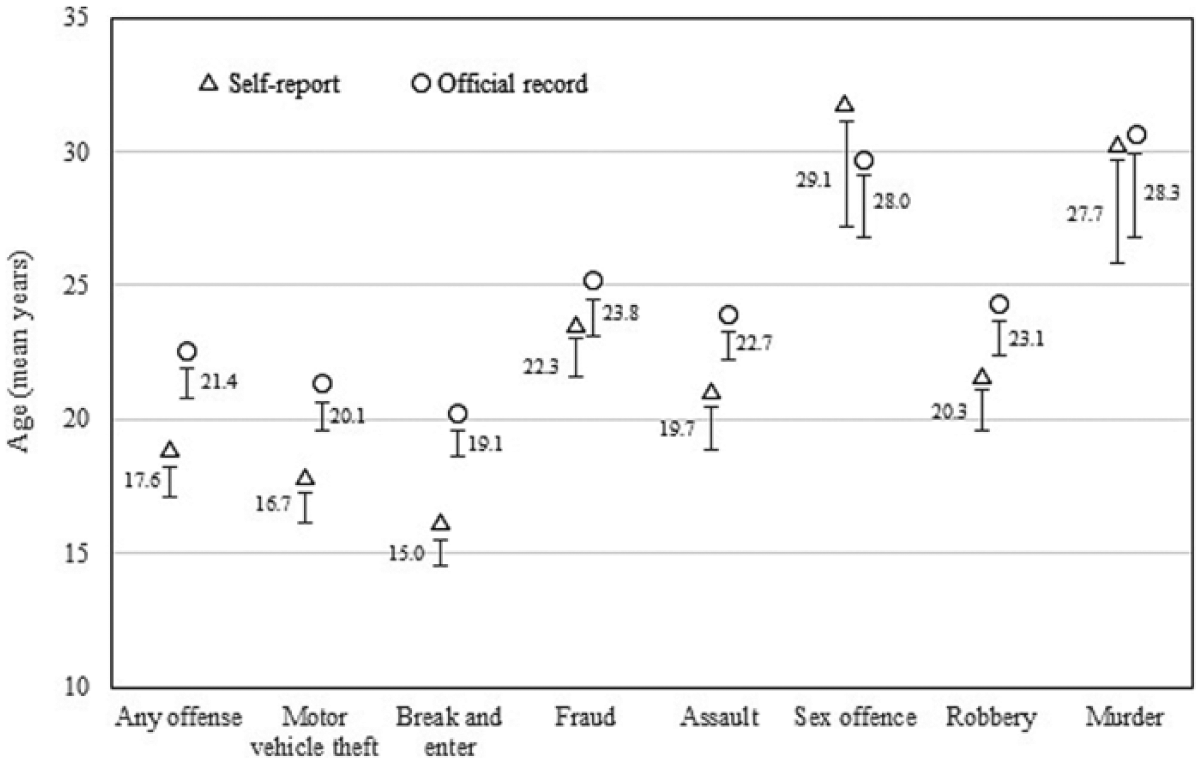
Self-reported and officially recorded age of onset (years).
For any offense, Table 1 presents the joint classification distribution of self-reported and officially recorded onset across four developmental stages. On the diagonal of the 4 × 4 table, running left to right, are the cells that represent concordance, which is the sum of these percentages reflecting the total proportion of offenders for whom self-reported and officially recorded data were consistent. In the cells above the diagonal are those cases where the self-reported age of onset occurred at a developmental stage later than was indicated by the official report, whereas the cells below the diagonal indicate those cases where the onset of official offending occurred later than self-reported offending. In the final row to the bottom of Table 1, we calculate the percentage of stage-specific self-reports that were confirmed by official records, while in the final column to the right, we calculate the percentage of stage-specific official reports that were confirmed by self-report.
Overall, almost 41% of offenders were consistently classified as having started their offending careers at the same developmental stage regardless of the data source. The measure of overall agreement between the self-reported and officially recorded data can be described as “fair” (AC1 = 0.23), while the test for symmetry confirms that discordance was not evenly distributed, χ2(6) = 326.82, p = .00. In other words, a larger proportion of offenders were older in their official records (49%) than they were older in their self-report (10%)—an expected finding given the differences in average onset ages shown earlier. This finding confirms comparisons of self-reported and officially recorded ages of onset in the Dunedin Study (see Moffitt et al., 2001).
The final row and column of Table 1 provide some additional insights into the nature and degree of developmental stage-specific concordance for each of the two data sources. For example, only 16% of offenders who self-reported preadolescent onset were later confirmed as having a preadolescent official record of offending. This improves somewhat at older developmental stages where, for example, 56% of self-reported adolescent-onset offenders, 47 of self-reported early-adult-onset offenders, and about 61% of self-reported late-onset offenders were all confirmed by their respective official records. Although these numbers are certainly an improvement, there is still considerable discordance.
When examined as a fraction of stage-specific official onset, there exists a very high concordance for preadolescent-onset offenders (~99%). In other words, for those whose official records indicated the commencement of offending before age 13, there was almost a 100% conformation by self-report. This falls to a little over 52% for officially recorded adolescent-onset offenders, 19% of early-adult-onset offenders, and about 33% for late-onset offenders. Again, where there was discordance, it was more often that the offenders self-reported offending at younger ages than would have been indicated by their official records. It is notable that more than half of all officially recorded late-onset offenders had self-reported the start of their offending in adolescence or earlier.
It is important to acknowledge here that these concordance analyses are somewhat influenced by the nature of the classification system because the more groups (or cut-points) used, the more likely discordance will be identified. To limit this, we present a reduced set of these data, this time dividing the offender population into only two groups—adult onset (18+) and juvenile onset (<18) 5 —chosen for their relevance to both policy and prior research in developmental/life-course criminology more generally. By reducing the number of classifications here, we expect concordance to improve; however, our interest is whether at this most basic developmental division, discordance remains a significant problem.
The results presented in Table 2 illustrate an overall concordance of about 66%. That is, two in every three offenders would be consistently classified as a juvenile or adult-onset offender regardless of which data source was used. The remaining 33% would be incorrectly classified, of which the vast majority are incorrectly classified as adult-onset offenders by official report despite self-reported onset as a juvenile (29%). For this reduced set of analyses, the agreement coefficient improves (AC1 = 0.36) but still remains within the range described by Landis and Koch as “fair.” The test of symmetry once again confirms the uneven distribution of discordance, χ2(1) = 185.3, p = .00.
Joint Distribution of Self-Reported and Officially Recorded Juvenile and Adult Onset (%, n = 1,104).

Source. Drug Use Careers of Offenders Study—Queensland Longitudinal Follow-Up (AIC Computer File).
Note. Symmetry χ2(1) = 185.3, p = .00; AC1 = 0 .36, p = .00. AC1 = Agreement Coefficient 1; AIC = Australian Institute of Criminology.
Percentage of category-specific official reports that were confirmed by self-reports.
Percentage of category-specific self-reports that were confirmed by official reports.
Overall concordance.
The classification-specific concordance measures illustrate a number of useful diagnostics. In particular, 90% of officially recorded juvenile offenders also self-reported juvenile onset. Thus, there are relatively few instances in which these offenders had self-reported onset at ages considerably older than was recorded on their official history. To the contrary, only 61% of officially recorded adult-onset offenders had also self-reported onset as an adult. The remaining 39%, when asked, had started offending as a juvenile. For those using self-report data, we find official records confirmed self-report in 60% of self-identified juvenile offenders and 79% of self-identified adult offenders.
The same analysis was then conducted for each of the seven selected offense types, and a summary of these key outcomes is presented in Table 3. For each offense type, offenders were cross-classified by self-reported and officially recorded developmental stages of onset, after which two summary indicators were calculated: concordance (the proportion of cases where self-reported onset was at the same developmental stage as officially recorded onset) and discordance (the proportion of cases where self-reported onset occurred at a different developmental stage). For the discordance measure, two submeasures were then calculated to indicate where self-report was younger than official report, and where self-report was older than official report. As a group, property offenses generally produced lower concordance estimates than violent offenses. The lowest concordance across developmental stages was found for break and enter offending (45%, AC1 = 0.29), followed by fraud (48%, AC1 = 0.34) and motor vehicle theft (49%, AC1 = 0.35). Of the violent offenses, a comparison of self-reported and officially recorded assault yielded the lowest concordance (46%, AC1 = 0.30), whereas concordance was considerably higher for sex offenses (63%, AC1 = 0.56), robbery (59%, AC1 = 0.48), and murder (85%, AC1 = 0.81). After reducing the data into a juvenile/adult developmental dichotomy, the concordance measures improved as expected, although the relative ordering of most offense types did not change. The exception to this was fraud, where the concordance of self-reported and officially recorded offending improved considerably from 48% to 77% (AC1 = 0.68).
Summary of Onset Concordance for Developmental Stages and Juvenile/Adult Classification, by Offense Type.

Source. Drug Use Careers of Offenders Study—Queensland Longitudinal Follow-Up (AIC Computer File).
Note. AC1 = Agreement Coefficient 1; AIC = Australian Institute of Criminology.
As already indicated, Table 3 includes a disaggregation of the prevalence of discordance across the joint distribution of the two onset measures. A comparison of these values by offense type reveals a number of important differences. For motor vehicle theft, break and enter, assault and robbery, it was more likely that discordance resulted when the age of self-reported onset was younger than the age of official onset. For fraud, sex offenses, and murder, however, discordance resulted more often when self-reported onset was older than the age of official onset.
Offenses at Onset
Given the discordance between self-reported and officially recorded ages of onset, it is reasonable to consider how this might affect the extent to which individuals are differentially classified with respect to the nature of their onset offending (despite whether that onset occurred at concordant ages). This is a particularly important issue, because the nature of one’s first officially recorded offense is often used in risk and other assessment procedures to determine the application or eligibility for specific interventions. In Table 4, each offender is classified according to the offense or offenses committed at the age of onset. The estimates for property and violent offenses are aggregated taking into account any self-reported or officially recorded offense of a property or violent nature. The offense subcategories are estimated for each of the seven specific offense types.
Concordance of Offenses Recorded in Year of Onset.

Source. Drug Use Careers of Offenders Study—Queensland Longitudinal Follow-Up (AIC Computer File).
Note. AIC = Australian Institute of Criminology.
Includes all property offenses (motor vehicle theft, shoplifting, break and enter, vandalism, fraud, and trading in stolen goods.
Includes all violent offenses (assault, sexual assault, robbery, and murder).
Overall, 835 offenders had self-reported property offending in the year of onset, whereas 833 offenders had, according to their official record, committed a property offense in the year of their first official offense. Between the two, 686 offenders were classified as property offenders at onset using both self-reported and officially recorded data—a concordance of 82%, respectively. For violent offending, 346 offenders had self-reported violence in the year of onset, whereas 441 had a violent offense officially recorded in the year of their first official offense. Between them, only 189 had a violent offense as both a self-reported and officially recorded onset offense. Of those who self-reported violence at onset, only 55% were confirmed by official report, whereas of those whose official records indicated violence at onset, only 43% were confirmed by self-report.
For each of the seven specific offense types, concordance appears more robust for self-reported onset than officially recorded onset. In all cases, for example, the offense of self-reported onset was more often confirmed by an official record of the same crime type.
Comparisons by Indigenous Status
Table 5 provides a summary of key findings disaggregated by Indigenous status. Of the 214 Indigenous offenders in this study, concordance of self-reported and officially recorded criminal onset was estimated at 47% across each of the four developmental stages, yielding an agreement coefficient that was interpreted as “fair” (AC1 = 0.33). For non-Indigenous offenders, only 40% of cases had concordant self-report and official records, yielding a lower agreement coefficient (AC1 = 0.21) and a difference that was statistically significant (difference = 0.12, Z = 2.78, p = .00). Consistent results were obtained even after the data were collapsed into a dichotomous comparison of juvenile and adult onset, though it is notable that the agreement coefficient for Indigenous offenders (AC1 = 0.63) improved considerably more than for non-Indigenous offenders (0.30)—a difference that remained statistically significant (difference = 0.32, Z = 5.89, p = .00).
Summary of Concordance Measures by Indigenous Status.

Source. Drug Use Careers of Offenders Study—Queensland Longitudinal Follow-Up (AIC Computer File).
Note. AC1 = Agreement Coefficient 1; AIC = Australian Institute of Criminology.
Although it appears that for Indigenous offenders self-reported and officially recorded data are more comparable overall, the underlying pattern of discordance reveals some notable results. Specifically, the proportion of discordant cases where official onset preceded self-reported onset was higher for Indigenous offenders. Across the four key developmental stages, 17% of Indigenous offenders self-reported their first offense at a developmental stage older than was indicated by their official record. The same was true for only 8% of non-Indigenous cases. Similarly, for the reduced analysis of juvenile and adult onset, the proportion of offenders for whom self-report was older than the official record was higher for Indigenous (9.8%) than for their non-Indigenous offenders (3.8%).
In our final set of analyses, we consider whether the concordance of onset offense classifications varies by Indigenous status (see Table 6). Specifically, we examine the agreement coefficients for the two broad offense categories—property and violence—concluding that in neither case was there a significant difference in the degree of concordance. For property offending, agreement was modestly but not significantly higher for Indigenous offenders (AC1 = 0.61 vs. AC1 = 0.56, Z = 1.11, p = .27), whereas for violent offending, the agreement was higher (but not significantly) for non-Indigenous offenders (AC1 = 0.33 vs. 0.28, Z = 1.00, p = .32) (see Table 6).
Concordance of Offenses Recorded in Year of Onset, by Indigenous Status.

Source. Drug Use Careers of Offenders Study—Queensland Longitudinal Follow-Up (AIC Computer File).
Note. Values in parentheses represent Standard Errors (SE). AC1 = Agreement Coefficient 1; AIC = Australian Institute of Criminology.
Includes all property offenses (motor vehicle theft, shoplifting, break and enter, vandalism, fraud, and trading in stolen goods.
Includes all violent offenses (assault, sexual assault, robbery, and murder).
Conclusion
At the heart of developmental and life-course approaches in criminology is the expectation that what causes or motivates individual involvement in crime will vary by age and at different developmental stages. Accordingly, what predicts the onset of crime will likely differ from that which at older ages influences escalation, continuity, and eventual desistance? Of key concern for developmental criminologists is, therefore, the question of longitudinal measurement and the extent to which various data sources can meaningfully and reliably capture both between-individual and within-individual variability in the trajectories of criminal engagement. Undoubtedly, the accurate measurement of when these trajectories begin is of paramount importance to developmental theory and crime policy.
In this article, we examined the concordance of self-reported and officially recorded onset using data from a representative sample of prisoners in Queensland, Australia. And although our study is constrained by some data limitations related to offense categorization, recall and memory bias, and bias with official records more generally, we found that the concordance of these data was considered “fair” across most measures; however, the disparities meant that only 47% of offenders were accurately placed into consistent developmental stages of self-reported and officially recorded onset. Notably, only 16% of preadolescent offenders had official records, which also reflected preadolescent offending. Given both theoretical and policy preoccupation with early-onset offending, this low degree of concordance has important implications, especially for early intervention programs and policies that target “early-onsetters” based on official records alone. To be sure, these data suggest that the vast majority of self-reported early-onset offenders only first appeared formally in the criminal justice system during or after adolescence, with as many as one in three first appearing as an adult despite a self-reported history of offending at a very young age.
On the contrary, the vast majority of officially identified preadolescent offenders also self-reported a history of preadolescent-onset offending. We conclude, therefore, that where an individual is identified as an early-onset offender in official records, he (at least in the case of the present study) will almost always confirm that early-onset offending in self-report. However, those with official records of early-onset offending represent only a small fraction of the total number of offenders who start their criminal careers early. What differentiates these offenders, both in terms of risk and protective factors, will be of great interest to early intervention researchers and practitioners, not to mention developmental criminologists interested in the apparently strong link between early-onset offending and the longitudinal development of criminal careers in later life.
At the other end of the developmental spectrum, this study also highlights some potential issues with the empirical examination and theoretical explication of late-onset offending. Of particular note, our analysis found that only one in three officially recorded late-onset offenders were actually late-onset offenders by self-report—a result that is broadly consistent with those earlier reported by McGee and Farrington (2010). Of the remaining two thirds, around half had self-reported the onset of offending in adolescence or earlier. In many ways, these data lend support to Thornberry and Krohn’s (2005) proposition that late-onset offenders are not necessarily different from their early- or adolescent-onset peers, just that early formal identification of offending was avoided because of the protections afforded by family or social status. In any case, that so many of the officially recorded late-onset offenders were not, in fact, late onset by self-report raises a number of important questions for those interested in theorizing from empirical studies where only official records are used.
The analysis of onset discordance by offense type is a relatively unique contribution of this study, and our results highlight a number of notable findings. First, discordance is not equal across the offense range, being larger, in general, for property crimes than for violent crimes. This most likely reflects the fact that violent offenses carry greater detection probabilities, and thus, self-reported onset will more often or more closely align with official records. Second, for most offenses, the discordance occurred most often because respondents reported younger ages of onset than was officially recorded in their criminal histories. The exception to this was for fraud, sex offenses, and murder, where discordance more frequently occurred because the respondent had self-reported an age of onset that was older than otherwise recorded on his or her official criminal history. This may reflect some degree of dishonesty among offenders of these relatively more serious crimes, although it remains unlikely because to report an age of onset, one needed to have earlier confirmed a lifetime prevalence of that offense. Presumably those who wanted to be dishonest about their serious offending would have denied any involvement in the first instance. The more likely explanation, at least for fraud and sex offending, is that the prosecution and conviction of these types of crimes can be unusually delayed, often as a result of delays in detection or reporting by victims. Although in the self-report survey, respondents were asked to nominate the age at which they first committed each offense, this may have been mistaken for the age of conviction, which, for the reasons above, can be many years after the police recorded the offense as having taken place. In either case, these offense-based differences serve as an important reminder of the methodological challenges that plague the longitudinal measurement of individual criminal careers.
Our analysis by Indigenous status revealed that the concordance of self-reported and officially recorded onset was also considered “fair,” but appeared to be more consistent in these data than was the case for non-Indigenous offenders. On one hand, this suggests that both data sources are more closely aligned and that official records offer a potentially more accurate proxy for actual onset when measured for Indigenous offending populations. On the other hand, these data might be interpreted as evidence that Indigenous offenders, unlike their non-Indigenous peers, are less often the beneficiaries of those protective factors that might normally lengthen the time between actual and official onset. That the concordance of these self-report and officially recorded data was higher for Indigenous offenders suggests either their self-report is more accurate, or that they are simply more likely to be apprehended and formally processed earlier and thus closer to their true age of onset—a sobering thought given that Indigenous Australians are overrepresented at all levels of the Australian criminal justice system.
While further exploration of these data is warranted, it is on this last point that we see the greatest need for further research. While discordance between self-report and official records was conceptualized as a methodological problem for developmental criminology, it is equally the case that discordance might represent a meaningful developmental outcome, one for which early intervention and prevention programs hope to increase (not decrease) irrespective of the potential methodological consequences. Delaying official contact with the criminal justice system, for example, may have significant tangible benefits for individuals and the community, and thus, discordance in early developmental phases is a largely desirable outcome for criminal justice practitioners and policy makers. Furthermore, as suggested by Thornberry and Krohn’s (2005) thesis of the “protected” late-onset offender, it is likely that this discordance has not only methodological and empirical relevance but significant theoretical implications as well. For developmental criminologists, understanding when and why crime does not appear in official records may offer valuable insight into various age, cohort, and sociodemographic contingent causal mechanisms for which developmental theory must account.
Footnotes
Appendix
Coding Rules for Self-Reported and Official Records.

| Offense category | Wording of self-report question | Official reports include (per ANZSOC) |
|---|---|---|
| Motor vehicle theft | How old were you when you first stole a motor vehicle [even if the police did not find out about it]? | 0811 (Theft of motor vehicle) |
| 0812 (Illegal use of a motor vehicle) | ||
| 0813 (Theft of motor vehicle parts or contents) | ||
| Break and enter/unlawful entry with intent | How old were you when you first broke into somewhere to steal something [even if the police did not find out about it]? | 0711 (Unlawful entry with intent/burglary, break and enter) |
| Fraud | How old were you when you first committed fraud, misappropriation, or embezzlement, even if the police did not find out about it? This includes forging cheques or misuse of credit cards. | 0911 (Obtain benefit by deception) |
| 0921 (Counterfeiting of currency) | ||
| 0922 (Forgery of documents) | ||
| 0923 (Possess equipment to make false/illegal instrument) | ||
| 0931 (Fraudulent trade practices) | ||
| 0932 (Misrepresentation of professional status) | ||
| 0933 (Illegal nonfraudulent trade practices) | ||
| 0991 (Dishonest conversion) | ||
| 0999 (Other fraud and deception offenses, NEC) | ||
| Assault | How old were you when you first physically assaulted someone or caused bodily harm, even if the police did not find out about it? | 0211 (Serious assault resulting in injury) |
| 0212 (Serious assault not resulting in injury) | ||
| 0213 (Common assault) | ||
| 0299 (Other acts intended to cause injury) | ||
| Sexual offending | How old were you when you first committed a sexual offense, even if the police did not find out about it? | 0311 (Aggravated sexual assault) |
| 0312 (Nonaggravated sexual assault) | ||
| 0321 (Nonassaultive sexual offenses against a child) | ||
| 0322 (Child pornography offenses) | ||
| 0323 (Sexual servitude offenses) | ||
| 0329 (Nonassaultive sexual offenses, NEC) | ||
| Robbery | How old were you when you first robbed someone without using a weapon, even if the police did not find out about it? | 0611 (Aggravated robbery) |
| How old were you when you first committed armed robbery, even if the police did not find out about it? | 0612 (Nonaggravated robbery) | |
| Murder | How old were you when you first killed someone, even if the police did not find out about it? | 0111 (Murder) |
| 0131 (Manslaughter) | ||
| 0132 (Driving casing death) Excludes 012 (Attempted murder) |
Source. Drug Use Careers of Offenders Study—Queensland Longitudinal Follow-Up (AIC Computer File).
Note. All questions were proceeded with “Have you ever committed . . . , even if the police did not find out about it?” Those respondents who in their self-report had never committed that offense were then skipped from the age of onset questions. ANZSOC = Australian and New Zealand Standard Offense Classification (ABS; 2014); NEC = not elsewhere classified; ABS = Australian Bureau of Statistics.
Declaration of Conflicting Interests
The author(s) declared no potential conflicts of interest with respect to the research, authorship, and/or publication of this article.
Funding
The author(s) received no financial support for the research, authorship, and/or publication of this article.