




Abstract
For repeat drug offenders, homelessness, unemployment, and lack of access to legitimate income and benefits are obstacles to community integration and quality-of-life improvement. Seattle’s Law Enforcement Assisted Diversion (LEAD) is a collaborative, prebooking diversion program that provides individuals suspected of low-level drug and prostitution offenses with legal assistance and harm reduction–oriented case management instead of prosecution and incarceration. We conducted this single-arm, within-subjects study to test changes in participants’ housing, employment, and income/benefits both prior and subsequent to their LEAD program referral. Findings indicated significant within-subjects improvements for LEAD participants (N = 176) across all outcomes of interest. Moreover, achieving housing and employment was associated with 17% and 33% fewer arrests during the follow-up, respectively.
The United States imprisons more of its population than any other country in the world, and incarceration rates, particularly among drug offenders, have increased exponentially since 2008 (Motivans, 2015; Schmitt, Warner, & Gupta, 2010; Walmsley, 2013). Homelessness also represents a large and growing problem in America, with up to 3.5 million Americans experiencing homelessness in any given year (Metraux, Roman, & Cho, 2008; National Law Center on Homelessness and Poverty, 2015; Shelton, Taylor, Bonner, & van den Bree, 2009). Although the relationship between homelessness and criminal recidivism is not well understood, the two appear to be inexorably linked (Metraux & Culhane, 2004; Metraux et al., 2008; Shelton et al., 2009) with one representing a risk factor for the other (Kushel, Hahn, Evans, Bangsberg, & Moss, 2005; Metraux & Culhane, 2006; National Health Care for the Homeless Council, 2013). For example, the prevalence of homelessness among incarcerated offenders is up to 11 times higher than in the general population (Greenberg & Rosenheck, 2008). Furthermore, incarceration is disproportionately high among homeless individuals (Metraux et al., 2008). A recent study indicated that nearly one quarter of homeless and marginally housed individuals had a history of incarceration (Kushel et al., 2005). People with unstable housing are more frequently arrested, incarcerated longer, and rearrested at higher rates than people with stable housing (McNiel, Binder, & Robinson, 2005; Weiser et al., 2009).
Both homeless and incarcerated populations share certain characteristics, including histories of housing instability, unemployment, poverty, lack of job skills/training, and substance-use problems (Burt et al., 1999; Conklin, Lincoln, & Tuthill, 2000; Freudenburg, 2001; Greenberg & Rosenheck, 2008; Langan & Levin, 2002; Shelton et al., 2009; Western & Beckett, 1999). Substance-use problems and ensuing drug offenses represent a particular challenge to policy makers because traditional policing efforts have not been found to improve public safety or decrease recidivism for drug offenders (Drug Policy Alliance, 2014; National Research Council, 2014; Walmsley, 2013; Wormith, 2002). Drug offenders instead cycle through the criminal justice system with such frequency that this phenomenon is often referred to as a “revolving door” (Warner & Kramer, 2009).
Research has indicated that the standard approach of prosecution and incarceration may contribute to the revolving door phenomenon by decreasing opportunities to obtain housing, employment, and legitimate income/benefits, thereby relegating offenders to continued work in illegal markets (Fletcher, 2013). Considering the numerous undesirable consequences of repeat drug offending at both the individual and societal level, there have been calls for innovative programs to engage repeat offenders and stop the revolving door (Warner & Kramer, 2009).
Seattle’s Law Enforcement Assisted Diversion (LEAD) represents one such program. LEAD is a collaborative, prebooking diversion program that offers individuals suspected of low-level drug and prostitution offenses case management and legal assistance instead of prosecution and incarceration. Case management entails connecting participants with existing resources in the community (e.g., legal advocacy, job training or placement, housing assistance, counseling) as well as providing financial support for the fulfillment of participants’ basic needs (e.g., motel stays, housing, food, clothing, treatment, and various additional items and services). Case managers use a harm reduction approach, which entails a nonjudgmental, compassionate style, client-driven goal setting, and no requirement of abstinence from substances (Collins et al., 2011). Legal assistance entails coordination of prosecution strategies (i.e., whether to file charges, recommend pretrial detention or release conditions, reduce charges, recommend incarceration after conviction, and/or dismiss charges for LEAD participants) to support rather than undermine participants’ tailored intervention plans with an eye toward maximizing community health and safety.
The current evaluation had two primary aims. First, we tested the associations of time (pre- and post-LEAD referral) and number of case management contacts with participants’ housing, employment, and legitimate income/benefits outcomes. Second, we tested the associations between these outcomes and recidivism following LEAD referral (i.e., arrests and charges during follow-up).
Method
Design
Parent evaluation
A larger parent evaluation entailed a nonrandomized controlled trial of LEAD versus the system as usual (i.e., booking and prosecution). Seattle Police Department’s (SPD) officer shifts were randomly divided into “red- and greenlight” shifts. Individuals suspected of offenses during greenlight shifts were screened for project eligibility by officers on duty and, provided they met inclusion criteria, were offered LEAD instead of booking and prosecution. In addition, individuals who were eligible for LEAD but were referred by officers outside of a criminal incident entered the program as “social contacts.” Participants encountered during redlight shifts and in designated areas comprised the “system-as-usual” control group. LEAD participants were referred to a case manager to complete an intake assessment and then received legal assistance and case management that was tailored to their needs.
Current evaluation
Because data on housing, employment, and income/benefits were collected by LEAD case managers in the course of their work, only LEAD participants—not control participants—were included in this evaluation. Thus, the design is a single-arm, within-subjects analysis of housing, employment, and income/benefits outcomes from a subset of participants in the parent evaluation (N = 176/318) from 1 month prior (baseline) through 18 months subsequent (follow-up) to their LEAD referral. Data for the additional recidivism analyses were only consistently available through the 6-month follow-up; thus, that set of analyses is restricted to 6 months post-LEAD referral.
Participants
Participants (N = 176) were adults (39% female) suspected of low-level drug or prostitution offenses who were diverted to LEAD instead of standard booking and prosecution between October 2011 and January 2014. The mean age was 42.62 years (SD = 11.01). As identified in police records, 57% participants were African American, 26% were European American, 6% were American Indian/Alaska Native or Pacific Islander, 4% were Multiracial, 4% were Hispanic/Latino/a, 1% were Asian American, and 2% were “Other.”
Measures
Written informed consent for program inclusion was obtained from all participants. Data sharing agreements were obtained from the appropriate entities. Because the present analyses comprised program evaluation, the University of Washington and Washington State IRBs deemed this project exempt from review. Demographic data were obtained from SPD and LEAD case management records. Case management contacts were defined as any phone or in-person communications between a LEAD case manager and participant lasting at least 5 min. Contact data were logged by case managers and stored in the agency’s database (AGENCY Software, Seattle, WA).
Baseline housing, employment, and income/benefits statuses were based on participants’ 1-month retrospective self-report to case managers during their baseline intake. Ongoing housing, employment, and income/benefit data were obtained by case managers throughout the 18-month follow-up and were documented in the agency’s database.
The housed/unhoused outcome was coded as follows: 1 = permanent housing and 0 = homeless (i.e., lacking a fixed, regular, and adequate nighttime residence; having a primary nighttime dwelling that is not a regular sleeping accommodation; living in a supervised shelter or transitional housing; exiting an institution that served as temporary residence when the individual had previously resided in a shelter or place not meant for human habitation; or facing imminent loss of housing when no subsequent residence is identified, and insufficient resources/support networks exist; The McKinney-Vento Homeless Assistance Act, 42 USC Section 11302, 2009). The sheltered/unsheltered outcome was coded as follows: 1 = housed or sheltered homeless (e.g., transitional housing, emergency shelter, motel/hotel) and 0 = unsheltered homeless (e.g., sleeping on the streets, in abandoned buildings).
The currently employed/not employed outcome was coded as follows: 1 = part- or full-time legitimate employment and 0 = vocational training/internship, retired, unemployed, and unable to work. The employment/nonemployment-continuum outcome was coded as follows: 1 = vocational training/internship; legitimate, paid employment; or retired from legitimate employment and 0 = unemployed or unable to work.
Income/benefits data were coded as follows: 1 = any legitimate income/benefits (i.e., Aid to Families With Dependent Children Program (AFDC)/Temporary Assistance for Needy Families (TANF); aged, blind, or disabled (ABD) funding; supplemental security income (SSI); social security disability insurance (SSDI); income from legitimate full- or part-time employment; pensions; unemployment compensation; veterans benefits) and 0 = no legitimate income/benefits.
Data on criminal recidivism (i.e., arrests, charges) were extracted by the King County Prosecuting Attorney’s office from the Federal Bureau of Investigation’s National Crime Information Center (NCIC) and were given to the evaluation team for analysis. In these analyses, arrests refer to having been taken into police custody for a crime committed 6 months prior and subsequent to LEAD referral. Arrests and charges were “new,” and thus did not include those involving parole or probation violations or failure to comply offenses pursuant to prior violations.
Data Analytic Plan
Effects of time and case management contacts on housing, employment, and income/benefits
Population-averaged generalized estimating equations (GEEs; Zeger & Liang, 1986) were used to test the relative prediction of housing, income, and employment outcomes by two sets of predictors. The first set included main effects of covariates (i.e., age, gender, race/ethnicity, and death during the study), time, and number of case management contacts. The second set included the Time × Case Management Contact interactions, which tested whether there were differential pre- to postreferral effects as a function of participants’ exposure to LEAD case management. The best-fitting model was determined by the lowest quasilikelihood under the independence model information criterion (QICu) score, with lower scores indicating the better fitting model (Hardin & Hilbe, 2003). Because outcomes were dichotomous, we specified Bernoulli distributions with the logit link. We assumed an exchangeable correlation structure to accommodate repeated measures on one individual, which served as the sole clustering variable (Hardin & Hilbe, 2003).
Recidivism analyses
A series of logistic regression models were used to test the relative predictive effects of the covariates, baseline recidivism, housing, employment, and income/benefits on recidivism over the 6-month follow-up.
For all models, resulting effect sizes were exponentiated and reported as odds ratios (ORs), where ORs < 1 indicate an inverse association, ORs = 1 indicate no association, and ORs > 1 indicate a positive association. Alphas were set to p = .05, indicating statistically significant results. Confidence intervals were set to 95%.
Results
Descriptive statistics for raw, unadjusted housing, income/benefits, and employment outcomes were calculated prior and subsequent to LEAD referral (see Table 1).
Unadjusted Descriptive Statistics for Outcomes.

Note. This table features unadjusted values. Postreferral values are comprised of the percentage of individuals fitting that category averaged over each month of the 18-month follow-up period. LEAD = Law Enforcement Assisted Diversion.
Associations Between Time, Case Management Contacts and Outcomes
Housing status
The model for sheltered status was significant (see Table 2 for model statistics). LEAD participants were over twice as likely to have been sheltered in any given month during the follow-up versus baseline. The interaction model was also significant (see Table 2). As shown in Figure 1, each contact with a case manager was associated with a 2% higher likelihood of being sheltered in any given month during the follow-up compared with baseline.
Omnibus Model and Parameter Statistics Showing the Association of Time and Case Manager Contacts with Housing, Employment, and Income/benefits Outcomes (N = 176).
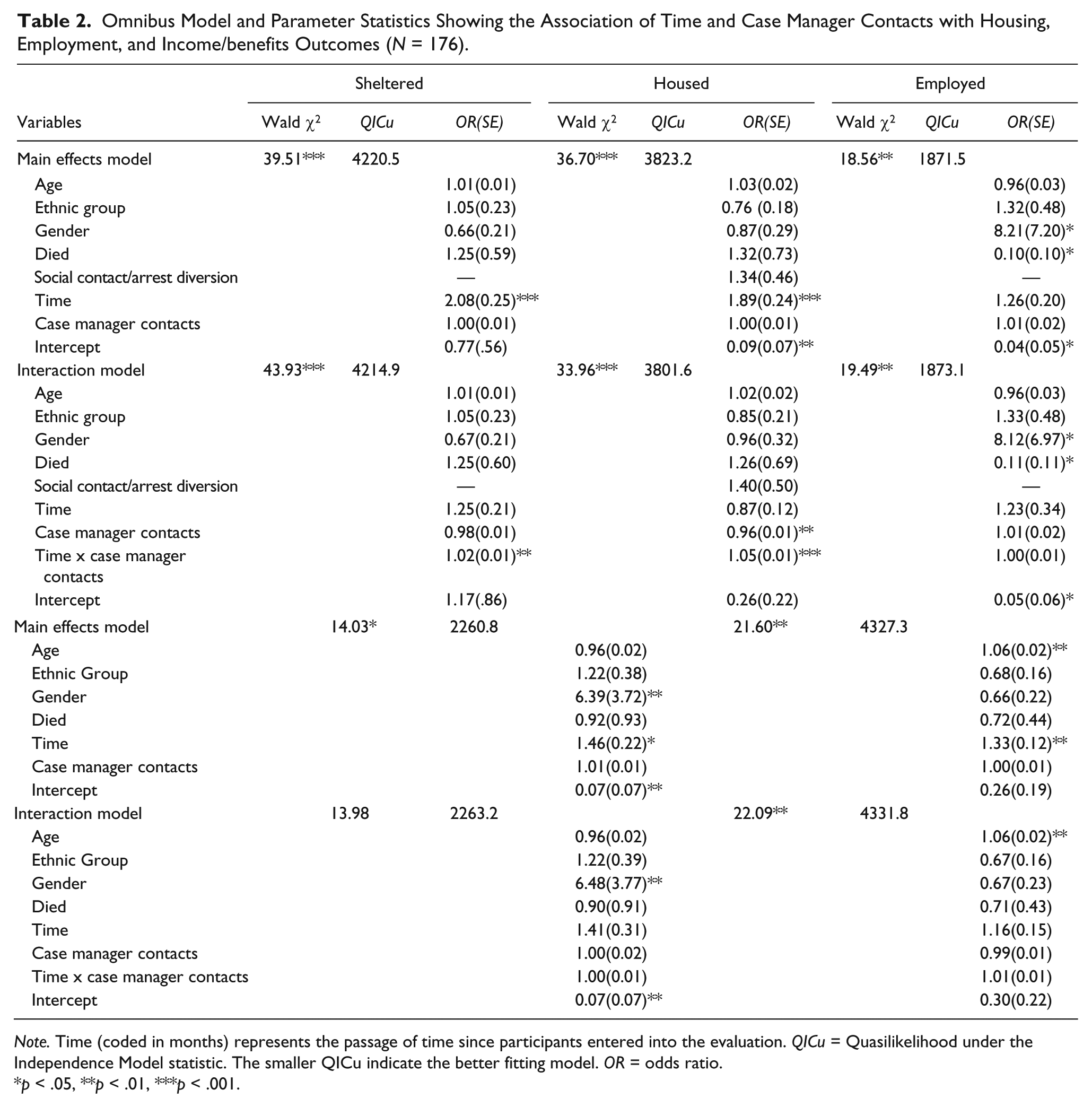
Note. Time (coded in months) represents the passage of time since participants entered into the evaluation. QICu = Quasilikelihood under the Independence Model statistic. The smaller QICu indicate the better fitting model. OR = odds ratio.
p < .05, **p < .01, ***p < .001.
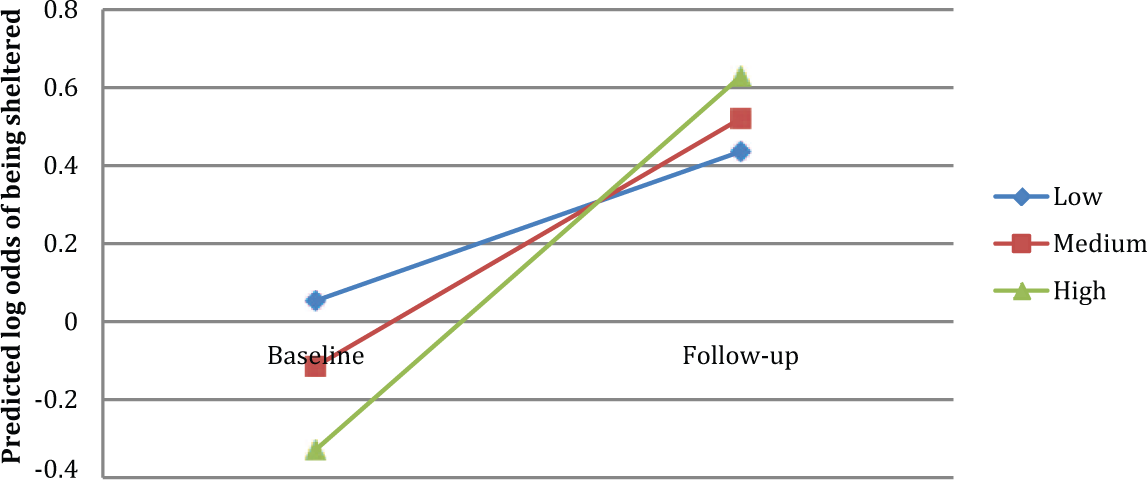
LEAD participants’ chances of being sheltered increased the more contact they had with case managers.
The model for housing status was significant (see Table 2). Participants were 89% more likely to have been housed at some point during the follow-up versus baseline. The interaction model was also significant. As shown in Figure 2, each case manager contact was associated with a 5% higher likelihood of being housed during the follow-up compared with baseline.

LEAD participants’ chances of being housed increased the more contact they had with case managers.
Employment status
The model of currently employed versus not employed participants was significant (see Table 2 for model statistics). There were, however, no significant changes in employment over time or as a function of case management contacts.
The model predicting being on the employment continuum was significant (see Table 2). Participants were 46% more likely to have been on the employment continuum at some point during the follow-up versus at baseline. The interaction model was, however, not significant (see Table 2 for model statistics). Case management contact was not a significant predictor in either model.
Income/benefits
The main effects model for having legitimate income/benefits was significant (see Table 2). Participants were 33% more likely to have received legitimate income/benefits during the follow-up versus at baseline. As shown in Table 2, the interaction model was significant; however, neither case management contacts nor the Time × Case Management interaction were significant predictors in either model.
Associations Between Housing, Employment, and Income/Benefits and Recidivism
The model for likelihood of arrest was significant (see Table 3 for model statistics). After controlling for baseline arrest and demographic variables, participants were 17% less likely to have been arrested during the 6-month follow-up for each month housed. Participants were 33% less likely to have been arrested for each month on the employment continuum.
Omnibus Model Effects and Parameters Showing the Association of Housing, Employment, and Income/Benefits With Recidivism (N = 176).
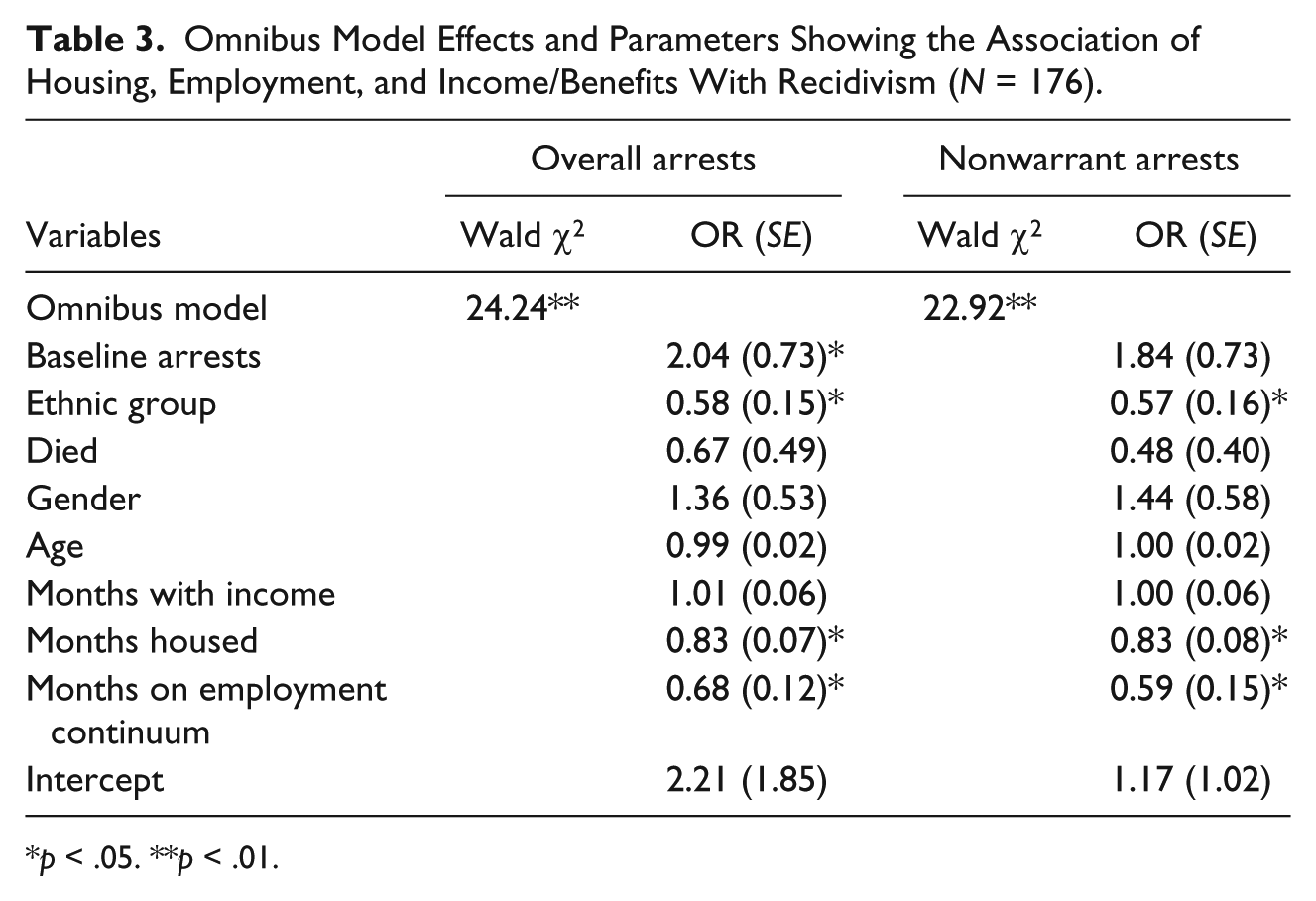
p < .05. **p < .01.
This pattern held even after warrant arrests were removed (see Table 3). For each additional month housed, participants were 17% less likely to have been arrested during the 6-month follow-up. For each additional month spent on the continuum to employment, participants were 41% less likely to have been arrested. The omnibus models for overall charges and felony charges were not significant (ps > .05).
Discussion
This evaluation documents housing, employment, and income/benefits outcomes subsequent to individuals’ referral to LEAD, as well as the potential additive effects of the amount of contact with LEAD case managers. Further analyses tested associations between participants’ housing, employment and income/benefits outcomes and recidivism following LEAD referrals. Overall, findings indicated that participants improved on all outcomes of interest subsequent to LEAD program involvement.
Housing Outcomes
Analyses of housing outcomes tested LEAD participants’ likelihood of being sheltered (vs. unsheltered) and housed (vs. unhoused) at baseline versus any given month in the 18 months following LEAD referral. Findings indicated that participants were twice as likely to have been sheltered and were 89% more likely to have obtained permanent housing after their referral. Each phone or in-person contact with case managers was associated with an additional 2% higher likelihood of being sheltered and a 5% higher likelihood of being housed. These findings are consistent with those of other studies, which have shown that the amount of contact and therapeutic alliance established during homeless outreach and case management are significant predictors of positive housing outcomes (Bybee, Mowbray, & Cohen, 1994; Bybee, Mowbray, & Cohen, 1995; Chinman, Rosenheck, & Lam, 2000).
Employment Outcomes
The raw percentages of employed participants were low: 7.4% and 9% of participants had full- or part-time employment prior and subsequent to their LEAD referrals, respectively. Although this percentage increased slightly over the course of the study, this increase was not statistically significant. However, when we expanded this analysis to include individuals who fell along the legitimate employment continuum (i.e., participating in vocational training/internships, being employed, being retired from legitimate employment), participants were 46% more likely to be on the employment continuum subsequent to referral. The overall number of people joining the employment continuum increased by 33%. This finding echoes those of other studies, which have indicated that criminal justice diversion and case management programs can help individuals make positive steps toward legitimate employment (Leukefeld, Webster, Staton-Tindall, & Duvall, 2007; Zlatic, Wilkerson, & McAllister, 2010).
Joining the employment continuum is a more realistic outcome to consider for the LEAD priority population than achievement of full- or part-time employment alone. This is a highly vulnerable population, with many individuals ineligible to work due to chronic physical or mental health disabilities. Furthermore, as repeat drug and prostitution offenders, LEAD participants had been working in illegal markets and regularly cycling in and out of the street-to-jail-to-street revolving door. Taken together, these population characteristics likely complicated and slowed participants’ reintegration into mainstream, legitimate employment. Thus, participants’ significant movement along the employment continuum is both realistic and encouraging.
We did not observe effects of case management contacts on employment outcomes. In retrospect, this lack of significant findings is not surprising given the various factors influencing whether a person is ready, willing, and/or able to engage along the employment continuum (Acosta & Toro, 2000; Burt et al., 1999; Dachner & Tarasuk, 2002; Ferguson, Bender, Thompson, Maccio, & Pollio, 2012; National Alliance to End Homelessness, 2016). Many of these factors, including the severity of existing disabilities, income status, client motivation, job readiness, and availability of suitable positions, are outside of a case manager’s control. This evaluation also featured a follow-up period of 18 months. Such a relatively short period of time may be adequate for simpler and more achievable goals, such as obtaining shelter and housing. It may not, however, be adequate for case managers to help participants fully achieve such multistep, complex tasks as attaining and maintaining full-time employment.
Income/Benefits Outcomes
Participants were 33% more likely to be connected to income/benefits subsequent to their LEAD involvement. Sources of income/benefits included income stemming from legitimate employment (e.g., wages, unemployment benefits, military pensions) as well as income from state and federal sources (e.g., ABD, SSI, SSDI, TANF). We did not, however, observe a significant association between number of contacts with case managers and income/benefits outcomes. Similar to employment, however, there are many mediating factors that determine an individual’s ability to secure income and benefits that are not within a case manager’s immediate control. Therefore, the further outcomes move away from those that case managers can directly influence, the less of a direct effect we may expect to see.
Associations Between Recidivism and Participants’ Housing, Employment, and Income/Benefits Status
Additional analyses showed that housing and employment obtained during participants’ LEAD involvement were associated with significantly less recidivism as measured by arrests. In other words, housing and employment appear to serve as independently predictive and protective factors against subsequent arrest. This finding corresponds to existing literature showing that employment and housing were associated with reduced risk of recidivism (Lowenkamp & Latessa, 2005; Morenoff & Harding, 2011).
Limitations
The limitations of this evaluation should be noted. First, specific features of the geographical location of this work shaped characteristics of Seattle’s LEAD priority population, program content, and the resulting evaluation. For example, roughly 82% of participants in this evaluation were homeless, which certainly contributed to participants’ needs and the resulting case management and legal assistance approaches. Thus, these findings may not generalize to communities where the LEAD priority population and existing systems (e.g., case management services, housing stock, criminal justice system) may differ.
Second, because we lack a control group for these particular analyses, the present design is not sufficient to demonstrate causality. In other words, we cannot be sure that observed changes are due to the LEAD program versus other confounding factors or statistical phenomena, such as regression to the mean. Causal conclusions cannot therefore be drawn based on these findings.
Fortunately, we can conclude that all effects are moving in a positive direction and that LEAD does not appear to have iatrogenic or negative effects for participants. Furthermore, our confidence that observed effects are attributable at least in part to LEAD is increased by the fact that the number of case management contacts predicted positive housing outcomes above and beyond what we would expect due to statistical regression to the mean.
Conclusions and Future Directions
Findings indicated improvements for LEAD participants across all primary outcomes of interest. In addition, LEAD case management appears to play a significant role in ameliorating housing outcomes. Finally, there were significant associations between improved housing and employment outcomes and reduced recidivism. Further study of LEAD programs is necessary to understand whether these effects are generalizable to other communities and to draw causal conclusions as to the programmatic components that are driving the observed LEAD effects. Future studies should include assessment and analysis of other relevant participant outcomes to elucidate LEAD’s impact on various aspects of participants’ lives, such as substance use and substance-related harm. Overall, this evaluation provided promising indications that LEAD positively affects individuals and communities, and slows down the jail-to-street-to-jail revolving door.
Footnotes
Declaration of Conflicting Interests
The author(s) declared no potential conflicts of interest with respect to the research, authorship, and/or publication of this article.
Funding
The author(s) disclosed receipt of the following financial support for the research, authorship, and/or publication of this article: This evaluation was supported by a grant from the Laura and John Arnold Foundation.