




Abstract
By tradition, the human trafficking discourse focuses on cross-border sex trafficking from impoverished countries to countries with a high standard of living. This article explores whether identified trafficking in the Netherlands corresponds to this. We introduce a model that identifies all possible trafficking situations, and with this, intends to prevent tunnel vision and identify blind spots. Subsequently, we analyze 768 trafficking cases identified by the Dutch Public Prosecution Service (2008-2012) and categorize each case according to our model: by form of exploitation and route of trafficking. The data show that (near-)domestic sex trafficking where victims are not pushed out of impoverished countries, but are recruited on native (or neighboring) soil, is the human trafficking situation most commonly identified.
Keywords
Introduction
The (international) definition of human trafficking includes widely divergent criminal conduct, and accordingly, human trafficking manifests in different ways. Yet, the typical trafficking association is still that of young females living in bad circumstances in more impoverished countries, who are lured with false promises of a better life to countries with a relatively high standard of living and end up being violently exploited through prostitution. The purpose of this article is to explore whether identified human trafficking in the Netherlands corresponds to this most common trafficking association. This will also provide insight into the actuality and focus of the actors responsible for the identification. We analyze 768 trafficking cases identified by the Dutch Public Prosecution Service (PPS) in the period 2008-2012, and group each case into the applicable human trafficking situation. We define a human trafficking situation by the applicable form of exploitation: sexual exploitation, nonsexual exploitation, or organ trafficking; and by the applicable route of trafficking, with regard to which we introduce an accessible model that identifies all the possible routes: arrived cross-border, departed cross-border, domestic and traversed cross-border trafficking.
Based on our findings, we aim to communicate two main points in this article. The first is that the focus in policies influences identification (“the more one looks, the more one sees”) and the second that domestic sex trafficking, where victims are recruited and exploited on native soil, is a trafficking situation of great concern, also in countries with a relatively high standard of living.
Definitions, Terminology, and Theoretical Framework
Human trafficking is a serious violation of human rights and of human dignity. It is a process in which a trafficker-offender compels a victim to provide services to or for a consumer-offender, of which the trafficker-offender profits. During the recruitment and/or exploitation part of the process, the trafficker-offender uses forms of coercion to control the victim, thereby infringing on the personal liberty of the victim. Human trafficking contains three interacting dimensions (Marcus, Sanson, Horning, Thompson, & Curtis, 2016): supply (victim), demand (consumer-offender), and a third party—the trafficker-offender (furthermore: trafficker)—that manipulates, abuses, forces, and/or takes advantage of the situation of supply and demand for his or her own gain. The consumer-offender, on the contrary, is not always an offender in the proper sense of the word, for he or she is not always punishable by law. For example, a customer of a restaurant that uses labor trafficking is a nonpunishable consumer-offender, whether intentional or unintentional. In situations in which the consumer-offender does act against a law, his or her crime constitutes an offense other than human trafficking, for example, a sexual offense in the example of a consumer-offender who purchases the sexual services of a minor. So while the demand side is an essential part of the phenomenon of human trafficking, it is not relevant to the legal definition of the offense of human trafficking, which accordingly only distinguishes two dimensions: the victim (supply side) and the trafficker (profit side).
Because Dutch human trafficking situations are the subject of our study, we use the Dutch legal definition of human trafficking as criminalized under Article 273f of the Dutch Criminal Code (DCC). Legislators in the Netherlands decided to take the definition as stated in the United Nations Protocol to Prevent, Suppress and Punish Trafficking in Persons (UN Palermo Protocol, 2000) almost verbatim. Article 3(a) of the UN Palermo Protocol provides the basis for national legislation: “‘Trafficking in persons’ shall mean the recruitment, transportation, transfer, harbouring or receipt of persons, by means of the threat or use of force or other forms of coercion, . . ., for the purpose of exploitation.”
Exploitation can occur in any sector. Essentially, three forms of exploitation can be distinguished: sexual exploitation, exploitation outside the sex industry (furthermore: nonsexual exploitation), and trafficking for the purpose of the removal of organs. Nonsexual exploitation entails all exploitation in any form of labor or services without a sexual component. This ranges from labor exploitation (e.g., in the agriculture sector or domestic work), to exploitation in services outside the domain of work and income (e.g., begging), and exploitation for criminal activities (e.g., theft or drug trafficking; Dutch Rapporteur, 2013).
Push and Pull Factors
Human trafficking is often explained by economic, social, and political conditions that push victims out of their country of origin and/or pull them toward another country. The basic idea is that victims originally live in futureless poverty and/or are structurally discriminated against in their home society and, for this reason, are easily motivated to leave everything behind in exchange for the mere promise of a better life abroad (Aronowitz, Theuermann, & Tyurykanova, 2010; Bales, 2007; DiRienzo & Das, 2017). Rather than being pushed to escape “the unlivable,” it is also acknowledged that victims are sometimes pulled by an idealized picture of the West (Hodge & Lietz, 2007; Tavcer, 2007; Webb & Burrows, 2009).
Depending on a country’s conditions, a country finds itself more on the push or more on the pull side of the explanatory framework. More impoverished countries (on the push side) are therefore thought of as typical “source countries,” and countries with a relatively high standard of living (on the pull side), like the Netherlands, are seen as typical “destination countries” (Bales, 2007; Davy, 2016; DiRienzo & Das, 2017; Hodge & Lietz, 2007; Noyori-Corbett & Moxley, 2016). We, however, argue in favor of the use of the terms “country of recruitment” and “country of exploitation,” instead of the commonly used terms “source country” (or home/exit/sending country/country of origin) and “destination country” (or host/receiving country). Because, as opposed to the terms “country of recruitment” and “country of exploitation” that merely indicate where the actions of a particular human trafficking situation take place, the commonly used terms classify whole countries as either of the following:
A country that solely attracts victims;
A country that solely repels victims;
A country that neither repels nor attracts victims, and only encounters trafficking situations in which it is solely involved as a so-called transit country for cross-border trafficking between other countries (e.g., due to its geographical location and/or transportation logistics, see also Perrin, 2010).
Simply classifying countries into one of these categories could result in tunnel vision, which creates the risk of failing to identify trafficking situations that do not fit into the classifications derived from the explanatory framework of push and pull factors, for example, a trafficking situation in which a country with a relatively high standard of living is the country of recruitment.
Four Routes of Trafficking
Human trafficking might involve border crossing, which is referred to in the literature as cross-border, international, or transnational trafficking. In this case, traffickers recruit victims in one country, and, if applicable, transport them through one or more countries of transit, and exploit or intend to exploit them in at least one country other than the country of recruitment. However, border crossing, or any movement whatsoever, is not part of the definition under the UN Palermo Protocol, or the Dutch legal definition of human trafficking. Consequently, the whole human trafficking process—from recruitment to exploitation—can take place at a single location within the borders of only one country. This country then serves simultaneously as both a country of recruitment and exploitation, generally referred to as domestic or internal trafficking (DiRienzo & Das, 2017; Logan, Walker, & Hunt, 2009; Winterdyk & Reichel, 2010).
In Figure 1, we introduce a model that identifies the four different routes of trafficking that can each occur in any country. These four routes of trafficking are based on where (i.e., in which countries) the actions of the process of human trafficking take place (i.e., recruitment, transportation, if any, and exploitation). Therefore, the route of trafficking in a particular human trafficking situation is derived from the country of recruitment, the countries of transit (if applicable), and the country of exploitation. This means that the victim’s country of origin (while often—yet not always—corresponding to the country of recruitment), as well as the trafficker’s country of origin—while of importance for a full understanding of a trafficking situation—are both irrelevant to determine the applicable route of trafficking. In the model (Figure 1), “country X” is the country whose perspective determines the trafficking route in a particular trafficking situation. The “other countries” in the model are all the countries in the world other than country X. In the “Results” section, we fill this model from the perspective of the Netherlands (country X = the Netherlands). Here, however, we show the abstract version of the model that can be adopted by any country in the world (country X can be any country).

Identification model of the four routes of trafficking from the perspective of country X.
There are four possible routes of trafficking from the perspective of country X, which we refer to as follows:
Arrived cross-border trafficking: With this trafficking route, country X is involved as the country of exploitation.
Departed cross-border trafficking: With this trafficking route, country X is involved as the country of recruitment.
Domestic trafficking: With this trafficking route, country X is involved as both the country of recruitment and the country of exploitation. In the model, this route of trafficking represents a circle instead of an arrow to emphasize that it does not require any internal movement. Therefore, victims recruited at Location A in country X and exploited at Location B in country X, as well as victims recruited and exploited at a single location in country X, are both victims of domestic trafficking.
Traversed cross-border trafficking: With this trafficking route, country X is involved as a country of transit.
The four trafficking routes do not all occur with equal frequency and differ in prevalence from country to country. However, the model points out the different trafficking routes that could each occur in any country, and with this, intends to prevent the classification of countries according to the applicable economic, social, and political push and pull factors.
Nine Human Trafficking Situations: Forms of Exploitation Combined With Routes of Trafficking
As mentioned before, we define a particular human trafficking situation by the applicable form of exploitation: (1) sexual exploitation, (2) nonsexual exploitation, and (3) organ trafficking, combined with the applicable route of trafficking: (I) arrived cross-border trafficking, (II) departed cross-border trafficking, (III) domestic trafficking, and (IV) traversed cross-border trafficking. This results into the following nine possible trafficking situations that can each occur in any country.
(I) arrived cross-border sex trafficking; (II) departed cross-border sex trafficking; (III) domestic sex trafficking; (IV) traversed cross-border sex trafficking.
(I) arrived cross-border trafficking for nonsexual exploitation; (II) departed cross-border trafficking for nonsexual exploitation; (III) domestic trafficking for nonsexual exploitation; (IV) traversed cross-border trafficking for nonsexual exploitation.
Trafficking for the purpose of organ removal.
In accordance with the explanatory framework of push and pull factors, the trafficking situation on the forefront of thought in the international human trafficking discourse is arrived cross-border sex trafficking (Situation 1.I) from the perspective of countries with a relatively high standard of living, such as the Netherlands, which equals departed cross-border sex trafficking (Situation 1.II) from the perspective of more impoverished countries (see also Laczko, 2005).
Contextual Framework
Human trafficking is a hidden crime, if only because victims in general are not inclined to raise the alarm out of feelings of fear, shame, guilt, or even loyalty or love toward their trafficker (Bales, Hesketh, & Silverman, 2015; De Vries & Dettmeijer-Vermeulen, 2015; Laczko, 2005; Macy & Graham, 2012; Tavcer, 2007). Consequently, trafficking situations are not easily identified and statistics on identified human trafficking contend with a dark figure: an unknown number of trafficking situations that remains hidden/unidentified. The identification of human trafficking situations, therefore, requires informed efforts; more identified human trafficking situations (as reflected in trafficking statistics) are probably the result of more resources and efforts to identify/combat human trafficking, rather than the result of an actual higher frequency (Aronowitz, 2010; De Vries & Dettmeijer-Vermeulen, 2015; Van Dijk, 2015). What is more, the identification strategies in antihuman trafficking policies are not evenly distributed across the nine possible trafficking situations (De Vries & Dettmeijer-Vermeulen, 2015; Gould, 2010; O’Brien, 2010). Thus, statistics on the different human trafficking situations based on their rates of identification might also misrepresent their relative frequency. It is therefore of great importance to interpret statistics on identified human trafficking within the context of the different identification efforts in policies.
The Focus of Antihuman Trafficking Policies in the Netherlands
Dutch antihuman trafficking policies predominantly focus on uncovering situations of sex trafficking. This is probably due to the fact that, in the Netherlands, the offense of human trafficking originally (from 1911 to 2005) only referred to sexual exploitation. More specifically, as by tradition and in line with the explanatory push and pull factors, the focus in the Netherlands is on arrived cross-border sex trafficking (Situation 1.I). To identify situations of arrived cross-border sex trafficking in the Netherlands, the identification strategies focus on possible victims originating from more impoverished countries who enter Dutch soil (i.e., during the transportation part of the trafficking process) or who provide sexual services on Dutch soil (i.e., during the exploitation part of the trafficking process).
Nowadays, domestic sex trafficking (Situation 1.III) that targets victims recruited on native soil also generates a lot of attention in the Netherlands. Usually, this particular trafficking situation is recognized as a concern in more impoverished regions (Aronowitz et al., 2010; Surtees, 2008). Because, when it starts with the recruitment of victims who find themselves trapped in situations of economic deprivation and/or social marginalization, it does—to some extent—comply with the explanatory push and pull factors, despite the fact that it does not involve the crossing of borders. Nevertheless, this trafficking situation became apparent in the Netherlands in the mid-1990s. Social workers were confronted with girls and young women who had been coerced into prostitution by their “boyfriends,” so-called “loverboys” (Bovenkerk & Van San, 2011). In the meantime, special policies have been put into place to address this “other sex trafficking problem” in the Netherlands.
Exploitation outside the sex industry has been criminalized as trafficking in the Netherlands only since 2005. Since then, the Dutch focus increasingly broadened to include trafficking for nonsexual exploitation. This can be illustrated by the growing number of sectors linked to exploitation outside the sex industry, which is in all probability at least partly due to the efforts made by various agencies to train their officials in this field (Dutch Rapporteur, 2013). Dutch antihuman trafficking policies on nonsexual exploitation mainly focus on arrived cross-border trafficking (Situation 2.I), a trafficking situation that complies with the explanatory framework of push and pull factors.
Even though organ trafficking (Situation 3) was also criminalized as trafficking in 2005, efforts to identify and fight these trafficking situations are still in its infancy (Ambagtsheer, Zaitch, & Weimar, 2013).
Given these developments in the antihuman trafficking policies in the Netherlands, it is to be expected that situations of arrived cross-border sex trafficking and domestic sex trafficking, followed by situations of arrived cross-border trafficking for nonsexual exploitation, are the most represented in the Dutch statistics on identified human trafficking.
Research Questions
Based on 768 human trafficking cases identified by the Dutch PPS in the period 2008-2012, we address the following research question in the “Results” section:
More specifically, we investigate the following: (a) What forms of exploitation are the victims in the identified human trafficking situations in the Netherlands recruited for? and (b) What routes of trafficking do victims pass through in the identified human trafficking situations in the Netherlands; that is, in which countries are they recruited, and in which countries do they end up being exploited?
In the “Discussion” section, we relate these findings to the most common trafficking association that fits the explanatory framework of push and pull factors, that is, arrived cross-border sex trafficking from more impoverished countries to the Netherlands. We also put the results in the context of Dutch antihuman trafficking policies and briefly compare them with some other European countries with a relatively high standard of living. Consequently, we identify the possible blind spots in the Netherlands as well as in other comparable countries and the overall international human trafficking discourse.
Data
There are two issues that require further consideration with regard to the subject of study, that is, identified human trafficking situations in the Netherlands. First, it is not clear at what point an observed (possible) human trafficking situation is identified—already at a first possible signal or only after a conviction—and by whom. There are various parties that “identify” trafficking situations—including the persons involved in the situations themselves (victims, traffickers, consumers), the general public, social workers, the police—and a trafficking situation identified by one party might not be considered as such by another. In this study, we use the legal definition of human trafficking provided by the DCC. Situations identified by law enforcement and the PPS are more likely to meet the legal criteria of trafficking than situations identified by other groups. Therefore, we define an identified human trafficking situation as one that is identified by the police and the PPS on the basis of completed criminal investigations, that is, human trafficking cases that are brought to court.
Second, it is not always easy to determine what constitutes a single human trafficking situation, as there are three dimensions of trafficking: supply (victim), profit (trafficker), and demand (consumer). A single victim might be victimized by multiple traffickers (or consumers), while a single trafficker (or consumer) might victimize multiple victims. We use the dimension of the trafficker to determine a single trafficking situation; one situation equals one trafficker regardless of the number of victims (or consumers). We chose to do this not only because this article is the first part of a wider study on traffickers but also for the practical reason that we define an identified human trafficking situation as one where the trafficker is brought to court.
Note that we refer to the subjects in our study as “traffickers,” despite the fact that not all of them were convicted. Also, as the legal definition of human trafficking covers various behavioral acts (see the behaviors as stated in the UN Palermo Protocol, that is, recruitment, transportation, transfer, harboring, or receipt of persons), not all of the traffickers are suspected of both recruiting and exploiting victims. While some traffickers are involved in every phase of the human trafficking process, others only fill one or a few particular roles in a trafficking network. However, according to criminal investigations, all of them are part of trafficking operations that recruit victims for the purpose of exploitation.
Data Collection
We used the database of the Dutch PPS as a starting point for our data collection on identified human trafficking situations in the Netherlands. The PPS database is a national database that contains information about the prosecution and trial of criminal offenses. At our request and with permission from the Minister of Security and Justice, the Research and Documentation Centre provided a dataset with all the cases registered by the PPS in the period from 2008 up to and including 2012 (reference date: April 2013) where there was at least a suspicion of the offense of human trafficking (i.e., registered under Article 250bis(old), 250ter(old), 250a(old), 273a(old), or 273f of the DCC). This dataset initially contained 1,139 human trafficking cases. In 324 of these cases, the traffickers were not subsequently summonsed for human trafficking specifically, mainly due to insufficient evidence. These cases were excluded, along with six other cases that concerned legal entities instead of persons and 27 cases regarding traffickers who were summonsed for human trafficking more than once in 2008-2012. We chose only their most recent case as the criterion case, which left us with 782 remaining cases to include.
Operationalization of the Variables
The dataset already included information on some basic characteristics of the traffickers such as gender, date of birth, and country of birth. To obtain information concerning the applicable forms of exploitation, countries of recruitment, countries of exploitation, and the exact dates the alleged trafficking started (to determine the age of the traffickers) and ended (to determine the most recent criterion case of the traffickers summonsed more than once), we also conducted a digital file analysis of the indictments in the 12 local registration systems of the PPS (in Dutch: “COMPAS”-registrations) from February up to and including April 2014. Out of the 782 cases, we were able to obtain the corresponding indictments of 768. Occasionally, an indictment did not include information on the country of recruitment. In these cases, the victim’s countries of origin, if mentioned, were registered to substitute the missing countries of recruitment, as these usually correspond. In a few other cases, the indictments only included the recruitment of victims for future exploitation that had not yet taken place, so in these cases, the registered countries of exploitation actually represent the intended countries of exploitation.
Data Analysis
Data were imported in and analyzed by SPSS version 21. In the “Results” section, we present the descriptive statistics of the collected variables: forms of exploitation (sexual, nonsexual, or organ trafficking), countries of recruitment, and countries of exploitation. On the basis of the last two, we grouped each of the 768 cases into the route of trafficking concerned from the perspective of the Netherlands (arrived cross-border, departed cross-border, domestic or traversed cross-border trafficking). We subsequently determined the applicable human trafficking situation for each case by a cross-tabulation between form of exploitation and route of trafficking. Note that one case might represent more than one trafficking situation because a trafficker may exploit victims both sexually and nonsexually, or because a trafficker may recruit multiple victims in both the country of exploitation and in other countries (which results into multiple routes of trafficking), and so on. To avoid counting cases more than once, we assigned each of the 768 cases to only one trafficking situation. The applied hierarchy is presented in the “Results” section.
Results
Forms of Exploitation
There were no cases of trafficking for the purpose of organ removal. Most of the 768 traffickers were involved in solely sexual exploitation (631; 82.2%), a smaller group in solely nonsexual exploitation (103; 13.4%), and an even smaller group in both (34; 4.4%).
An example of the latter is the case of a male trafficker in his early 20s. He feigned a loving relationship with two female, young, Dutch victims and subsequently manipulated them into smuggling cocaine from Surinam to the Netherlands, taking out telephone subscriptions, and making false reports of theft to the police. He also exploited one of them sexually. He took advantage of the fact that both victims were easily influenced because they had problems at home, no income, and, in the case of the victim he also exploited sexually, a mental handicap.
Countries of Recruitment and of Exploitation
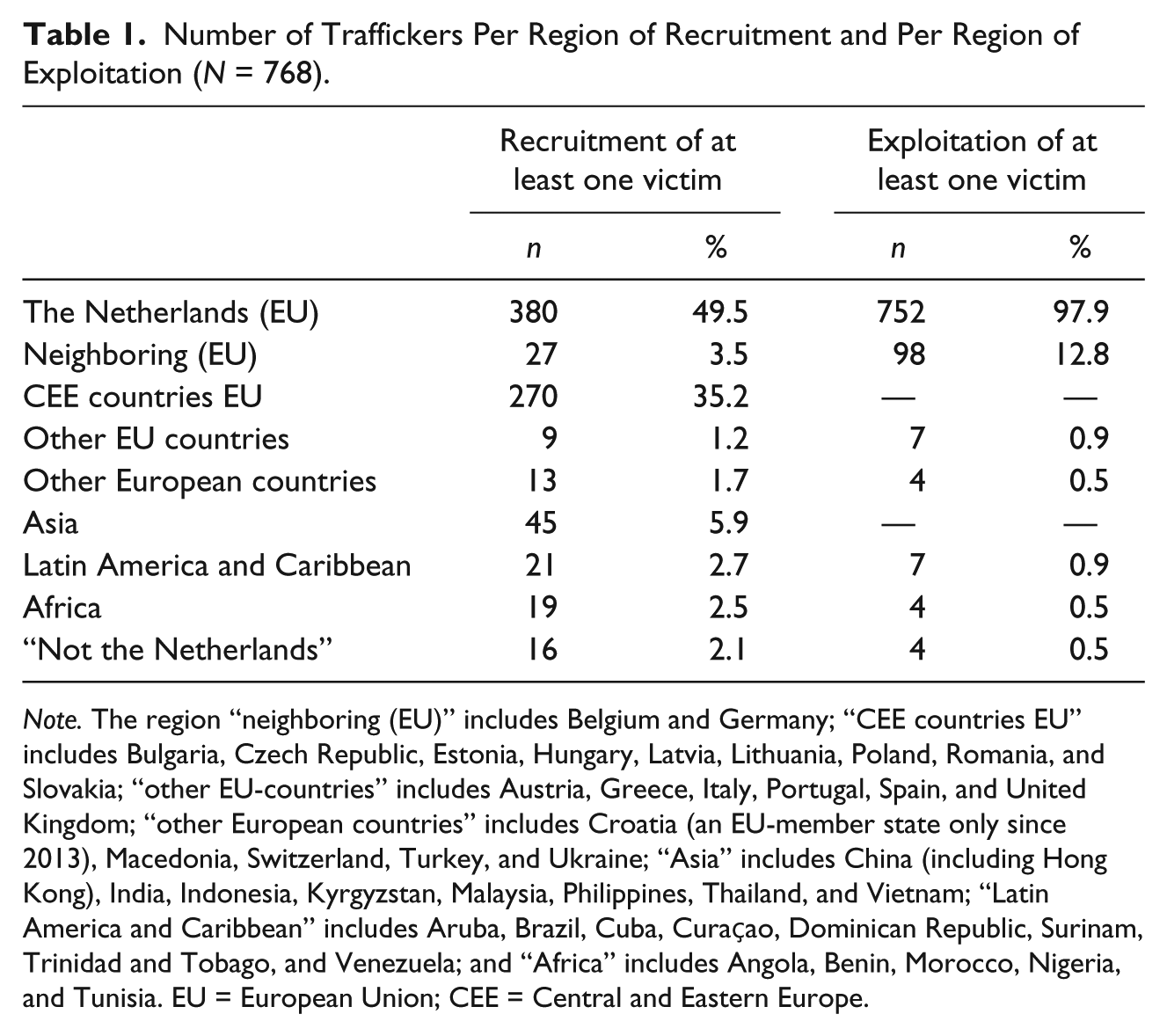
The 768 traffickers recruited their victims from 43 different countries and exploited them in 10 different countries. In Table 1, these countries are grouped into eight geographical regions and a separate group for unspecified countries other than the Netherlands (“not the Netherlands”). This table shows how many of the total 768 traffickers recruited at least one victim in each region, and how many of them exploited at least one victim in each region. Therefore, the different regions are not mutually exclusive, as the same trafficker may recruit multiple victims in different regions and/or exploit one or more victims in different regions.
Number of Traffickers Per Region of Recruitment and Per Region of Exploitation (N = 768).
Note. The region “neighboring (EU)” includes Belgium and Germany; “CEE countries EU” includes Bulgaria, Czech Republic, Estonia, Hungary, Latvia, Lithuania, Poland, Romania, and Slovakia; “other EU-countries” includes Austria, Greece, Italy, Portugal, Spain, and United Kingdom; “other European countries” includes Croatia (an EU-member state only since 2013), Macedonia, Switzerland, Turkey, and Ukraine; “Asia” includes China (including Hong Kong), India, Indonesia, Kyrgyzstan, Malaysia, Philippines, Thailand, and Vietnam; “Latin America and Caribbean” includes Aruba, Brazil, Cuba, Curaҫao, Dominican Republic, Surinam, Trinidad and Tobago, and Venezuela; and “Africa” includes Angola, Benin, Morocco, Nigeria, and Tunisia. EU = European Union; CEE = Central and Eastern Europe.
Half of the traffickers (49.5%) recruited victims in the Netherlands. The second most common recruitment region was “EU-countries in Central and Eastern Europe (CEE)” (35.2% of the traffickers), mostly Hungary (106; 13.8%), Romania (76; 9.9%), and Bulgaria (56; 7.3%). Asia ranked third (5.9%), with the largest number of traffickers recruiting victims in China (18; 2.3%). The neighboring countries of the Netherlands, Germany (23; 3.0%) and Belgium (11; 1.4%), were the fourth most popular region of recruitment (combined 3.5%). Almost all the traffickers (97.9%) exploited their victims in the Netherlands: 653 traffickers (85.0%) solely in the Netherlands and 99 (12.9%) in both the Netherlands and one or more other countries, predominantly, neighboring Belgium and/or Germany (89; 11.6%). 13 of the remaining 16 traffickers who did not exploit their victims in the Netherlands did recruit in the Netherlands. Nine of them exploited exclusively in the previously mentioned neighboring countries, and the other four in an unspecified country other than the Netherlands. Only three traffickers used the Netherlands solely as a country of transit for victims that were recruited in Nigeria and exploited in Italy.
Routes of Trafficking
Table 1 shows that the “neighboring countries of the Netherlands” is a prevalent region of exploitation and the only relevant region of exploitation besides the Netherlands. In addition, most—89 (90.8%)—of the 98 traffickers who exploited victims in neighboring Belgium and/or Germany also exploited their victims in the Netherlands, which implies that the exploitation of victims in neighboring countries not seldom coincides with exploitation in the Netherlands. While technically trafficking situations between the Netherlands and Belgium/Germany constitute cross-border trafficking, it is not inconceivable that these cross-border situations are more akin to domestic trafficking than to cross-border trafficking between the Netherlands and nonneighboring (other) countries (e.g., with regard to the types of traffickers and victims involved). Compared with the latter, the threshold both traffickers and victims must pass to get involved into trafficking between the Netherlands and neighboring Belgium/Germany is expected to be relatively low and equal to domestic trafficking (Aronowitz et al., 2010, see also Van Koppen, De Poot, & Blokland, 2010). Given the small geographic radius—in particular, when it involves the border regions—migration is not necessary. Therefore, the (psychological) effects of moving abroad are not applicable to both the trafficker and the victim, and in addition, the trafficker does not need a lot of resources and connections because the borders are easy to cross due to the Schengen Agreement (DiRienzo & Das, 2017). For this reason, we also distinguish arrived near-domestic and departed near-domestic trafficking as routes of trafficking, along with arrived cross-border, departed cross-border, domestic and traversed cross-border trafficking as defined before. This extra distinction also makes sense in the context of the explanatory framework of push and pull factors. Belgium and Germany are countries with a standard of living that is comparable with the Netherlands. Therefore, trafficking between the Netherlands and Belgium/Germany, that is, near-domestic trafficking, fully takes place in a region with a relatively high standard of living (just like domestic trafficking in the Netherlands), as opposed to cross-border trafficking between the Netherlands and nonneighboring countries (practically all more impoverished countries than the Netherlands, mostly CEE countries part of the European Union [EU], see Table 1).
Table 2 shows what (combinations of) routes of trafficking the 768 traffickers were involved in. The route of trafficking in bold represents the dominant route of trafficking according to our hierarchy as stated below. The empty cells represent possible (combinations of) routes of trafficking that did not occur.
Number of Traffickers per Combination of Routes of Trafficking (N = 768).
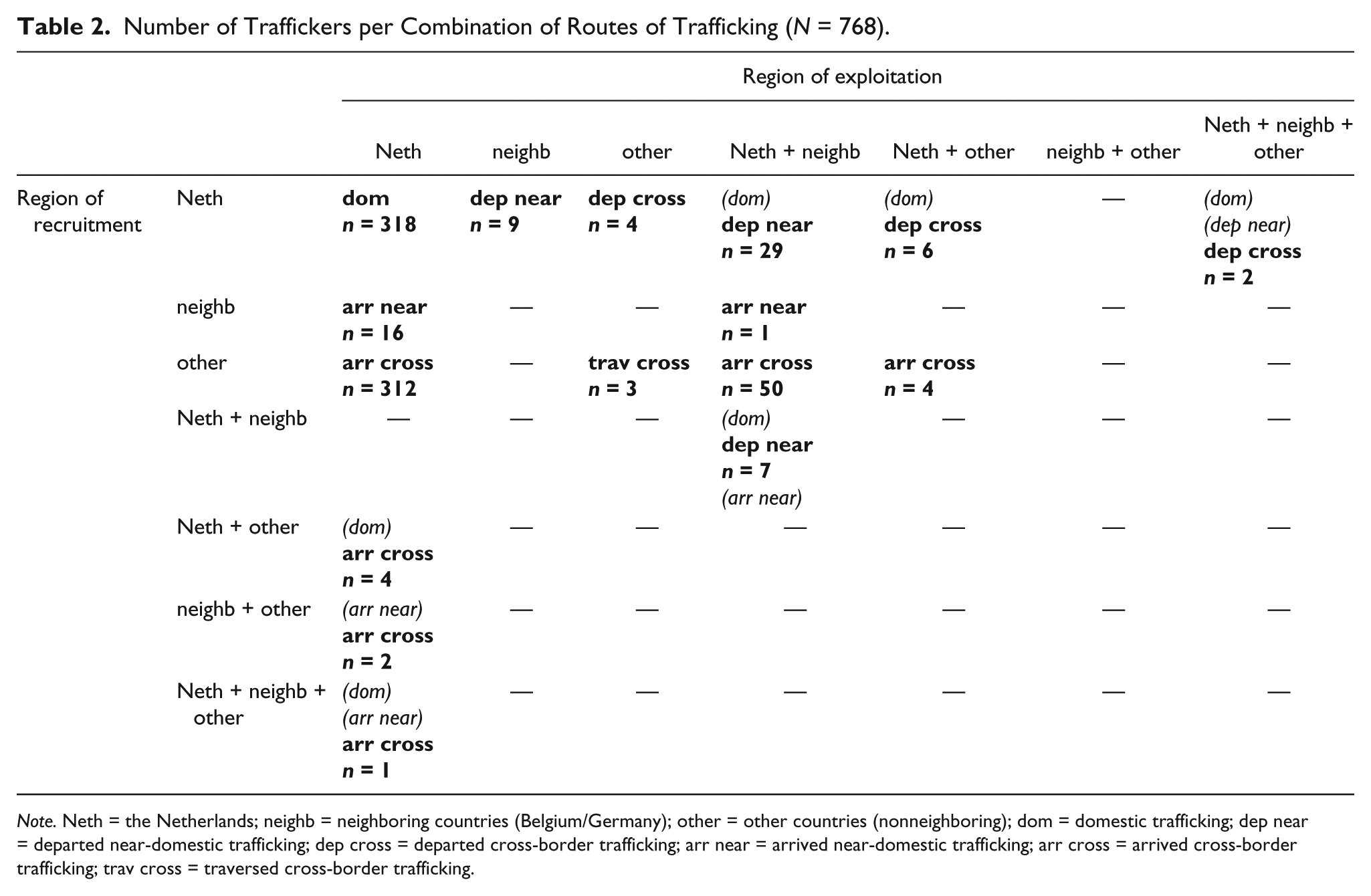
Note. Neth = the Netherlands; neighb = neighboring countries (Belgium/Germany); other = other countries (nonneighboring); dom = domestic trafficking; dep near = departed near-domestic trafficking; dep cross = departed cross-border trafficking; arr near = arrived near-domestic trafficking; arr cross = arrived cross-border trafficking; trav cross = traversed cross-border trafficking.
Of the 49 possible combinations of routes of trafficking, 16 occurred, and of the 768 traffickers, 106 (13.8%) were involved in more than one route of trafficking. To assign each trafficker to only one route, we established a hierarchy. Due to the expected higher threshold for traffickers and victims to get involved, cross-border trafficking (except traversed cross-border trafficking) ranks higher than near-domestic trafficking, and near-domestic trafficking ranks higher than domestic trafficking. Furthermore, because of the more rare occurrence, departed cross-border trafficking and departed near-domestic trafficking rank higher than arrived cross-border trafficking and arrived near-domestic trafficking. We only assign a trafficker to traversed cross-border trafficking when the Netherlands is exclusively used as a country of transit. According to this hierarchy and as shown in Table 2, three traffickers (0.4%) were assigned to traversed cross-border trafficking, 318 traffickers (41.4%) were assigned to domestic trafficking (while in total 367 were initially involved in this route), 17 traffickers (2.2%) were assigned to arrived near-domestic trafficking (while in total 27 were initially involved in this route), 45 traffickers (5.9%) were assigned to departed near-domestic trafficking (while in total 47 were initially involved in this route), all 373 traffickers (48.6%) involved in arrived cross-border trafficking were assigned to this route; and all 12 traffickers (1.6%) involved in departed cross-border trafficking were assigned to this route.
The hierarchy of the trafficking routes is applied in, inter alia, the following four cases involving co-offenders—two females and two males in their 20s and 30s—who recruited a male Dutch victim in the Netherlands. They took advantage of the victim’s illiteracy and their friendship to exploit him. They controlled all of his and his daughter’s finances, and convinced him that he owed them money. They violently forced him to provide several services, predominantly in the Netherlands. These services included doing construction work at their houses and their family’s houses, processing meat under poor working conditions, setting up a hemp farm in his own house, falsely reporting a burglary that they set up, starting a company and applying for subsidy, etc. Because one of the traffickers lived in Germany, the victim was also exploited there while he was doing construction work at this trafficker’s house (note that in these four cases, the traffickers are also the consumers of some of the services they forced the victim to provide). According to the hierarchy as outlined above, these cases are—from the perspective of the Netherlands—considered departed near-domestic trafficking (for nonsexual exploitation), regardless of the fact that the traffickers were also involved in domestic trafficking (for nonsexual exploitation).
Human Trafficking Situations: Forms of Exploitation Combined With Routes of Trafficking
Figure 2 shows the applicable routes of trafficking for both the 665 traffickers who exploited at least sexually (631 solely sexually and 34 both sexually and nonsexually) and the 103 traffickers who exploited solely nonsexually.
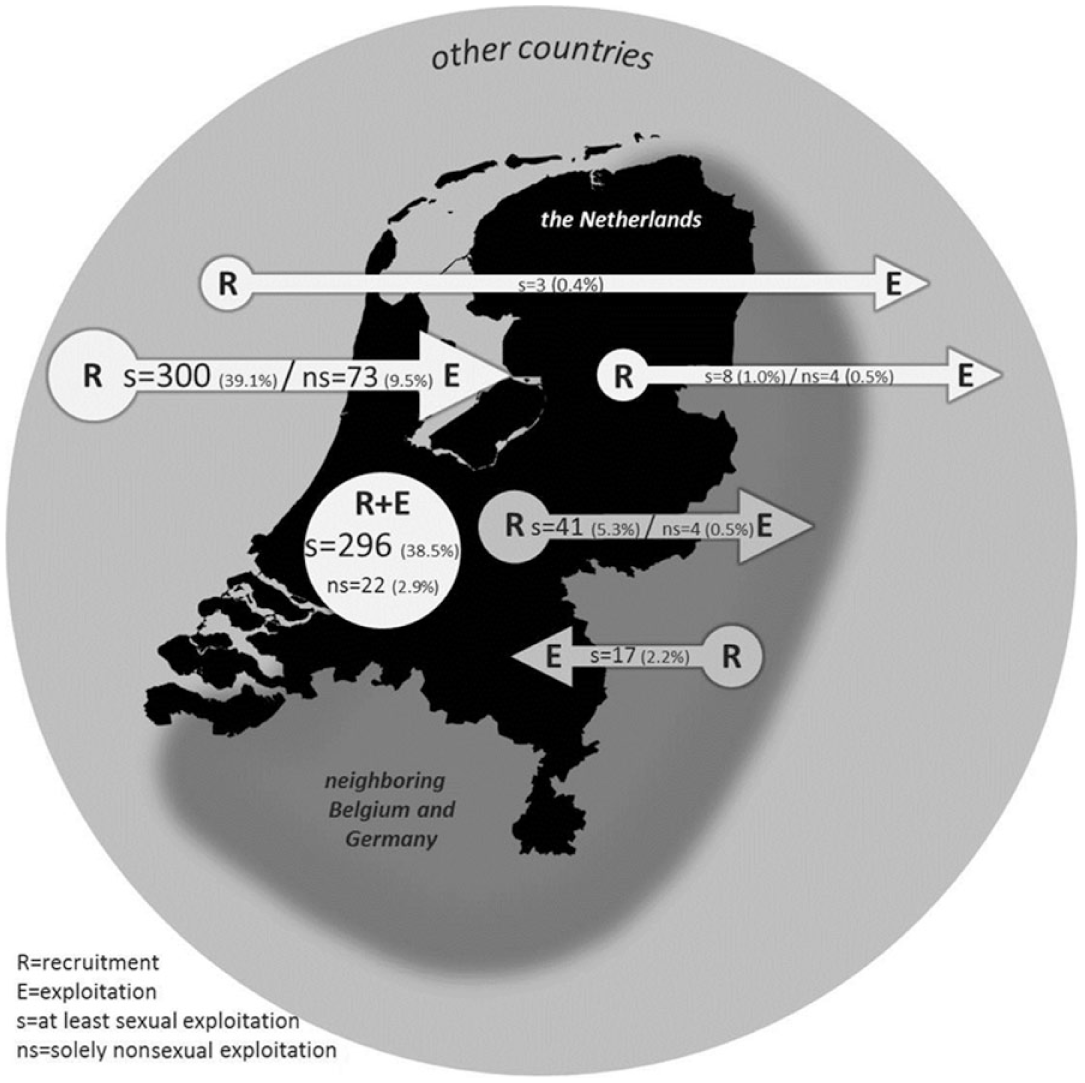
Number of traffickers per trafficking situation identified in the Netherlands in 2008-2012 (N = 768).
Out of the 13 possible trafficking situations that can occur (the nine trafficking situations as outlined before plus two forms of exploitation [sexual and nonsexual] times two near-domestic trafficking routes), the figure shows the 10 trafficking situations that were identified in the Netherlands in the 5-year time period (2008-2012). The most commonly identified situations are arrived cross-border sex trafficking (n = 300, 39.1%) and domestic sex trafficking (n = 296, 38.5%). Arrived cross-border trafficking for nonsexual exploitation is identified to a much lesser extent, but still ranks third (n = 73, 9.5%). The identification rates of the other seven situations vary between 41 traffickers (5.3%) involved in departed near-domestic sex trafficking and three traffickers (0.4%) involved in traversed cross-border sex trafficking.
The most interesting result might be that the largest group of traffickers (plurality) is involved in a sex trafficking situation with an expected relatively low threshold, that fully takes place in a region with a relatively high standard of living (in the Netherlands and/or neighboring Belgium/Germany), that is, (near-)domestic sex trafficking (n = 354, 46.1%: domestic sex trafficking, n = 296, plus departed near-domestic sex trafficking, n = 41, plus arrived near-domestic sex trafficking, n = 17).
Discussion
Because of the hidden nature of human trafficking, the subject of our study, identified trafficking situations in the Netherlands, is probably not representative of the total population of trafficking situations that occur in the Netherlands. Aside from occurrence, antihuman trafficking policies strongly influence the extent to which human trafficking situations are identified. Therefore, the comparison of the number of identified trafficking cases (between countries or between different time periods, for example) compares, for a large part, the efforts put into uncovering human trafficking (Aronowitz, 2010; De Vries & Dettmeijer-Vermeulen, 2015; Van Dijk, 2015). Moreover, as human trafficking manifests in different ways, the identification strategies vary too (e.g., with regard to where and by whom the different trafficking situations can be identified). It is therefore of great importance to separate trafficking statistics into the different possible human trafficking situations and analyze them within a proper context, that is, with respect to the different identification strategies of the different trafficking situations.
That is why in this article, we relate the identified situations in the Netherlands to the Dutch antihuman trafficking policies, that by tradition focus on sex trafficking from more impoverished countries to countries with a relatively high standard of living. However, the most striking feature of Dutch antihuman trafficking policies is that they also strongly focus on sex trafficking victims recruited on native soil (from the mid-1990s). Finally, in more recent years (from 2005), increased attention is given to victims from more impoverished countries who are exploited outside the sex industry, albeit to a much lesser extent compared with sex trafficking.
Our results show that arrived cross-border sex trafficking and domestic sex trafficking are indeed, by far, the most prevalently identified trafficking situations in the Netherlands. With arrived cross-border trafficking for nonsexual exploitation ranking third at distance, and no or only incidental identified other trafficking situations, the findings clearly reflect the focus in the Dutch antihuman trafficking policies and therefore suggest that the focus in policies indeed influences identification (“the more one looks, the more one sees”). In line with this, it emphasizes the fact that a more infrequent identification of a certain trafficking situation does not necessarily mean a less frequent occurrence. The infrequent identification could also be due to less focus in policies, or in other words, represent a blank spot (e.g., trafficking for nonsexual exploitation), or in the case of a total lack of identification even a blind spot (e.g., trafficking for the purpose of organ removal; Ambagtsheer et al., 2013; Dutch Rapporteur, 2012). Ironically, blank and blind spots often receive less policy priority exactly because less or no situations are known (as illustrated in Boerman, Grapendaal, Nieuwenhuis, & Stoffers, 2012), which creates a vicious circle.
Limitations
The data we collected on identified human trafficking in the Netherlands are based on the information included in the indictments as drafted by the PPS, that is, secondary data. The purpose of these indictments is to give a description of the alleged trafficking that is provable in court in the opinion of the PPS, rather than giving a description of the alleged trafficking that was identified by the PPS. Therefore, it is possible that a situation of trafficking as stated in the indictment is a mitigated description of the trafficking situation that the PPS actually identified.
Furthermore, victims are more visible—and more likely to be identified—while they are exploited than while they are recruited or transported. The fact that almost all of the identified Dutch trafficking cases (97.9%) involve exploitation in (at least) the Netherlands could be (partially) due to this. Another possible reason why trafficking situations where the Netherlands is solely involved as the country of recruitment (departed cross-border trafficking) or the country of transit (traversed cross-border trafficking) are a negligible part of the identified cases that are brought to court in the Netherlands is that the prosecution of these situations might preferably take place in the country of exploitation, instead of in the Netherlands.
Finally, with regard to the 768 identified traffickers, the police and the PPS are convinced that they are involved in human trafficking. However, this figure on one hand excludes traffickers who were at some point identified by the police and the PPS but who were not brought to court for some reason (false negatives); on the other hand, it possibly includes some “traffickers” who are wrongly suspected of trafficking (false positives).
Conclusion
Today, it is widely recognized that no country—regardless of its unique geographical, economic, social, or political conditions—is immune to human trafficking (Hodge & Lietz, 2007; Winterdyk & Reichel, 2010). However, the mindset overwhelmingly focuses on sex trafficking that is the result of differences in the economic, social, and political conditions of countries (push and pull factors): that is, cross-border sex trafficking from more impoverished countries to countries with a relatively high standard of living. Because this dominant explanatory framework of push and pull factors classifies whole countries as either “source countries” (i.e., more impoverished countries that are placed on the push side) or “destination countries” (i.e., countries with a relatively high standard of living that are placed on the pull side), it contributes to a narrow-minded perspective of trafficking.
Therefore, we introduced a model that intends to prevent the tunnel vision that easily follows from the explanatory push and pull factors and associated classifying terminology. Our model identifies all the possible trafficking routes that can occur in any country, based on the countries where the actions (recruitment, transportation, exploitation) of a particular trafficking situation take place. Subsequently, when combined with the different forms of exploitation, our model points out all the possible trafficking situations. By filling our model with identified cases, it becomes clear which trafficking situations seem to pose the biggest problems (i.e., receive the most attention by identifying actors) and which trafficking situations appear to be less relevant (i.e., are not focused on by identifying actors). While the absence of a specific identified trafficking situation may reflect an actual absence of occurrence, we argue that this absence might as well identify a blind spot. An indication of a blind spot arises when a certain trafficking situation lacks focus in policy and is not, or only rarely, identified in a country X (like organ trafficking in the Netherlands)—especially while this trafficking situation is prevalently identified in another country that is comparable with country X with respect to geographical, economic, social, and political conditions.
We filled our model with data from trafficking cases that were identified in the Netherlands. The most interesting result is that (near-)domestic sex trafficking is the most prevalently identified trafficking situation. This means that victims are not only sexually exploited in a country with a relatively high standard of living (in the Netherlands and/or neighboring Belgium/Germany) but are also recruited there. Generally, (near-)domestic sex trafficking in countries with a relatively high standard of living does not target victims originating from more impoverished countries and, consequently, is less obviously explained by the explanatory framework of push and pull factors. Therefore, it runs a higher risk of being disregarded or at least being misidentified (see also Aronowitz et al., 2010; Macy & Graham, 2012; Nichols & Heil, 2015). The Oxfordshire and Rotherham “child sexual exploitation scandals” in the United Kingdom, for example, where children were groomed for sexual exploitation on a large scale, are tragic consequences of misidentification. The fact that the sexual exploitation of these children went on for years was—at least partly—due to the fact that the victims were not recognized as victims but rather were seen as very difficult children that made bad choices (Bedford, 2015). It was inconceivable that, in a country like the United Kingdom, children of native soil could be victims of sexual exploitation. The cases were never placed in the context of human trafficking because it was not “trafficking from abroad” (Bedford, 2015; Brayley & Cockbain, 2014).
For years, the Netherlands was the only Western European country where this “other sex trafficking problem” was uncovered and proved to be a serious trafficking problem (as illustrated in the annual Trafficking in Persons [TIP] Reports published by the United States Department of State). Fortunately, this seems to be changing. In recent years, it had become more apparent in other Western European countries (like Germany and the United Kingdom, and to a lesser extent Belgium) that they are also involved in trafficking situations as a country of recruitment (Aronowitz et al., 2010; Brayley & Cockbain, 2014; Bubenitschek, Kannemann, & Wegel, 2011). This change can be seen in the “country narratives” of the annual TIP Reports (United States Department of State, 2002, 2005, 2007, 2010, 2013, 2017). The first mention of domestic sex trafficking in the Netherlands was relatively early (in the TIP Report published in 2002) compared with countries like Germany (2005) and the United Kingdom (2007). Subsequently, from 2007, the Netherlands is classified as also a source country (preferably: country of recruitment) in these reports, instead of only as a transit and a destination country (preferably: country of exploitation), which was also early when compared with Germany (2010) and the United Kingdom (2013). In the most recent published TIP Report (2017), Belgium is only classified as a “destination, transit and limited source country,” which—in cross-country comparison—suggests that domestic trafficking in Belgium might be a blank spot.
The numerous identified (near-)domestic sex trafficking cases in the Netherlands and the increased acknowledgment of this trafficking situation in other Western European countries indicate that this is a human trafficking situation of great concern, also in countries with a relatively high standard of living. This trafficking situation targets a different type of victim (i.e., a native victim), presumes a different type of trafficker (inter alia because of the expected relatively low threshold to get involved), as well as different motivations (another explanation than just the “pushing and pulling” of victims), and the requirement of different identification strategies. We therefore call for more research into its specific characteristics and challenges (just as Brayley & Cockbain, 2014; Winterdyk & Reichel, 2010). In this respect, it is worth mentioning the growing body of research dedicated to domestic minor/child sex trafficking (DMST/DCST, also referred to as the commercial sexual exploitation of children [CSEC]), particularly in the United States. Related to the fact that no coercion is required in the case of minors (in the United States as well as in the Netherlands), the literature recognizes two movements. Both acknowledge the existence of minors in prostitution, but disagreement exists on whether (Fedina, Williamson, & Perdue, 2016; Moore, Houck, Hirway, Barron, & Goldberg, 2017) or not (Marcus, Horning, Curtis, Sanson, & Thompson, 2014; Weitzer, 2015) these minors should (by definition) be seen as victims of human trafficking, and consequently whether or not the third parties involved in the sexual exploitation of the minors should (by definition) be seen as traffickers. On the basis of the data provided in this article, however, it is not possible to determine if the identified Dutch (near-)domestic sex trafficking cases are examples of DMST/DCST/CSEC. Thus, further research into these cases is required to determine if the victims are, in fact, under age at all (and if so, what forms of coercion, if any, were applied by the suspected traffickers/third parties).
In conclusion, we encourage the broadening of the international human trafficking discourse (in academia, politics, the operational fields of criminal investigations and victim assistance, etc.) to include trafficking situations outside the typical narrative, in any case domestic sex trafficking but also other possible blank/blind spots like trafficking for nonsexual exploitation and organ trafficking. This will lead to a more comprehensive knowledge of the phenomenon of human trafficking as a whole, which, in turn, will enable to combat these serious violations of human rights more effectively.
Footnotes
Acknowledgements
The authors express their thanks to Inge van Zwet for her help with the data collection.
Declaration of Conflicting Interests
The author(s) declared no potential conflicts of interest with respect to the research, authorship, and/or publication of this article.
Funding
The author(s) received no financial support for the research, authorship, and/or publication of this article.