



Abstract
The current study sought to replicate and extend an earlier investigation on mid- to late-adolescent delinquent males to a school-based sample of mixed-gender early- to midadolescents. Two pathways—one running from parental knowledge to peer deviance to participant delinquency and the other running from peer deviance to parental knowledge to participant delinquency—were tested in a group of 597 children (290 boys, 307 girls) from the Illinois Study of Bullying and Sexual Violence (ISBSV). The results of a comparison mediation analysis revealed that consistent with prior research, the knowledge-initiated pathway achieved significance but the peer-initiated pathway did not. These findings suggest that perceived parental knowledge has its greatest impact on delinquency indirectly by way of its effect on peer associations.
Research has consistently shown that parents and peers play leading roles in preventing and promoting future delinquent behavior in children and adolescents (Gifford-Smith, Dodge, Dishion, & McCord, 2005; Hoeve et al., 2009). A frequently voiced criticism of the research in these areas, however, is that parenting and peer effects are usually studied in isolation rather than in combination (Osgood & Anderson, 2004). In an early study examining the joint effect of parenting and peers on delinquency, Warr (1993) discovered that time spent with parents and other family members served as a barrier to the peer influence effect, whereas attachment to parents reduced delinquency indirectly by limiting the child’s exposure to delinquent peers. The results of the Warr (1993) investigation are important for several reasons. First, they indicate that parents and peers play equally salient roles in delinquency development. Second, they suggest that parental factors provide a context for subsequent activation or deactivation of social influence effects, such as those relating to association with deviant peers. Hence, parenting may be less responsible for directly influencing delinquency and more responsible for indirectly shaping delinquency through its effect on peer and other social factors. The purpose of the current investigation was to take another look at this issue using a longitudinal research design, a causal mediation model, and the parenting and peer factors of perceived parental knowledge (Stattin & Kerr, 2000) and friend deviance (Akers, 2009), respectively.
Outside of Warr (1993), there have been only a few longitudinal studies conducted on the combined effect of parental knowledge and peers as predictors of delinquency. In two such studies, Laird, Criss, Pettit, Dodge, and Bates (2008) determined that perceived parental knowledge mediated the relationship between friend delinquency and participant delinquency and Janssen, Eichelsheim, Deković, and Bruinsma (2016) ascertained that peer delinquency mediated the relationship between parental knowledge and participant delinquency. Unfortunately, these studies evaluated mediation by comparing constrained and unconstrained structural equation models or by performing a multilevel structural equation analysis, neither of which is currently considered appropriate for determining mediation (Preacher & Hayes, 2008b). In a third study, Ingram, Patchin, Huebner, McCluskey, and Bynum (2007) observed significant path coefficients running from parental knowledge to peer delinquency (a path of the indirect effect) and from peer delinquency to participant delinquency (b path of the indirect effect) but failed to evaluate the total indirect effect (ab). Evaluating the total indirect effect, Poulin and Denault (2012) observed that opposite sex friendships mediated the parental knowledge–delinquency relationship, but only in girls. The problem with this study was that it used the normal theory delta method (Sobel, 1982) to test for significance in the indirect effect. The normal theory Sobel test is generally considered nonoptimal for use in evaluating mediation hypotheses because the indirect effect normally assumes a skewed distribution (Hayes, 2013).
Investigating the parent-peer interface using a best practices approach to mediation analysis, Walters (2017) tested and compared the total indirect effects for target and control pathways using an approach that has been found to do a better job of modeling the nonnormal distribution of the indirect effect than the Sobel test: namely, 95% confidence intervals constructed using a bias-corrected bootstrapping procedure (Preacher, 2015). Applying data from the longitudinal Pathways to Desistance Study, Walters (2017) determined that involvement in unsupervised routine peer activities mediated the parental knowledge–participant delinquency relationship. Parental knowledge, however, failed to mediate the unsupervised routine activities–participant delinquency relationship. Given that the Walters (2017) investigation was conducted on a group of serious delinquents, all of whom were male, there is a need for replication using a mixed-gender sample of individuals who were not selected into the study based solely on their having been adjudicated delinquent or been found guilty of a crime. Not only did Walters (2017) employ a sample composed exclusively of delinquents, but also these delinquents were 14 to 19 years of age (M = 16) at the time of the baseline interview. In light of research showing that the relationship between perceived parental knowledge, peer deviance, and delinquency varies as a function of age (Forgatch et al., 2016), the Walters (2017) study needs to be replicated in a younger, mixed sex sample of participants, not all of whom present with a history of delinquency.
The present study was designed to replicate the Walters (2017) investigation with a different sample, a different set of independent, dependent, and mediator measures, and different control variables but using the same general mediational framework. The sample differed from Walters (2017) in that it was younger, contained both males and females, and was not restricted to delinquents. Contrasting the three main variables from the Walters (2017) investigation with the three main variables from the current study, the parental knowledge variable differed only slightly between studies, unsupervised routine peer activities was replaced by peer deviance, and serious delinquency was replaced by relatively minor delinquency. Control variables for the current study were standard demographic measures (age, sex, and race) and two indicators of social support. In that parental support appears to be one reason why perceived parental knowledge inhibits delinquency (Fletcher, Steinberg, & Williams-Wheeler, 2004; Willoughby & Hamza, 2011), a measure of family social support was included in this study as a control variable. Friend social support was likewise incorporated into the analysis as a control variable in accordance with the fact that peer deviance was the other independent/mediator variable in this study. It was hypothesized that the target or knowledge-initiated pathway (parental knowledge at Wave 1 → peer deviance at Wave 2 → participant delinquency at Wave 4) would be significant, the control or peer deviance–initiated pathway (peer deviance at Wave 1 → parental knowledge at Wave 2 → participant delinquency at Wave 4) would be nonsignificant, and the difference between the two pathways would be significant.
Method
Participants
The sample for the current study consisted of 597 children (290 boys, 307 girls) from four public schools in a single school district in Central Illinois. This sample represents 37.1% of the children (N = 1,607) who participated in at least one of the first four waves of the Illinois Study of Bullying and Sexual Violence (ISBSV; Espelage, Low, Anderson, & De La Rue, 2014). All participants in the current investigation had complete data on at least three of the five main variables (independent, dependent, and mediator variables) included in this study. The mean age of participants at Wave 1 of the ISBSV was 12.25 years (SD = 0.85, range = 10–14) and the ethnic breakdown was 52.6% Black or African American, 30.0% White or Caucasian, 3.5% Hispanic, 1.5% Asian or Pacific Islander, 1.5% Native American or Native Alaskan, and 11.0% Other. More than two thirds of the students attending the four schools covered by the ISBSV (69.3%) were low income and the district-wide mobility rate was 30.1%.
Ethical Considerations
Children provided their informed assent to participate in the ISBSV after their parents had provided their informed consent for the child’s participation. The ISBSV was initially approved by the University of Illinois at Urbana-Champaign Institutional Review Board (IRB) and the secondary data analysis reported in the current article was approved by the Kutztown University IRB.
Measures
Independent and mediator variables
Perceived parental knowledge and peer deviance were cross-lagged between Waves 1 and 2 of the ISBSV. The two cross-lags constituted the independent and mediator variables for two pathways compared in this study: the target pathway, which ran from perceived parental knowledge to peer deviance to participant delinquency, and a control pathway, which ran from peer deviance to perceived parental knowledge to participant delinquency.
Perceived parental knowledge was assessed with seven items from the eight-item Parental Supervision subscale of the Seattle Social Development scale (Arthur, Hawkins, Pollard, Catalano, & Baglioni, 2002). Items were reverse coded so that higher scores indicated less parental knowledge (3 = never, 2 = seldom, 1 = often, 0 = always). The seven items achieving corrected item-total correlations ≥ .60 on at least one administration of the scale were included on the Parental Knowledge scale (i.e., “Would your parents know if you did not come home on time?” “When I am not at home, one of my parents knows where I am and who I am with.” “The rules in my family are clear.” “My family has clear rules about alcohol and drug use.” “If you drank some beer or wine or liquor (vodka or gin) without your parents’ permission, would you be caught by your parents?” “If you carried a handgun without your parents’ permission, would you be caught by your parents?” “If you skipped school would you be caught by your parents?”). The item with the lowest corrected item-total correlations at Waves 1 and 2 was also the item that seemed to be measuring parental monitoring (“My parents ask if I’ve gotten my homework done”). As such, it was not included in the measure of perceived parental knowledge employed in the current investigation. Scores on the seven-item parental knowledge scale ranged from 0 to 21 and the scale displayed good internal consistency (α = .86-.87)
Friend or peer deviance was the other independent/mediator variable included in the current investigation. The construct of peer deviance was assessed with the eight-item Friend’s Delinquent Behavior scale from the Denver Youth Survey (Institute of Behavioral Sciences, 1987). This scale asks respondents to estimate the proportion of friends (0 = none of them, 1 = very few of them, 2 = some of them, 3 = most of them, 4 = all of them) who had engaged in the following eight delinquent acts (damaged or destroyed property, hit or threatened to hit someone, used alcohol, sold drugs, gotten drunk, carried a knife or gun, got into a physical fight, been hurt in a fight) over the past year or since the last survey. When summed, these items yielded a score that could range from 0 to 32. Scores on the Friend’s Delinquent Behavior scale correlated significantly with bullying behavior in the ISBSV and this scale demonstrated good internal consistency in the current sample of participants (α = .82-.85).
Dependent variable
Participant delinquency, as measured by the total score of the General Deviance Behavior Scale (GDBS; Jessor & Jessor, 1977), served as the dependent variable in the present study. Involvement in eight different delinquent acts (suspended from school, skipped school, stole from another student, sneaked into a theater or stadium without paying, cheated on a test, shoplifted, wrote on walls or sidewalks, and damaged school or other property) was assessed on a 5-point frequency scale (0 = never, 1 = 1 or 2 times, 2 = 3 to 5 times, 3 = 6 to 9 times, 4 = 10 or more times). Because the recall period was the last year or from the point of the preceding interview, delinquency scores from Wave 4 were used instead of delinquency scores from Wave 3. Ratings for each individual item were summed to produce a total score that could range from 0 to 32. The 18-month (Wave 1 to Wave 4) test–retest reliability of the GDBS was .33.
Control variables
There were five control variables in this study. Three of the control variables were demographic in nature: age (in years), sex (0 = male, 1 = female), and race (1 = White, 2 = non-White). The other two control variables were family social support and friend social support, both measured at Wave 1. The three-item family social support scale (e.g., “There are people in my family I can talk to, who care about my feelings and what happens to me.”) and three-item friend social support scale (e.g., “I have friends I can talk to, who give good suggestions and advice about my problems”) achieved internal consistency coefficients (α) of .80 and .86, respectively, in the current sample of participants.
It is normally recommended that precursor measures for each outcome be included in a mediation analysis for the purpose of establishing the causal order of variables (Cole & Maxwell, 2003). This was particularly important with respect to peer deviance given that the recall period for this measure was up to 12 months but the lag between waves was only 6 months. By including a precursor to the peer deviance mediator, it was possible to establish whether a change in peer deviance from Wave 1 to Wave 2 mediated the relationship between parental knowledge at Wave 1 and participant delinquency at Wave 4. Wave 1 precursors to the two mediators were added to regressions predicting Wave 2 parental knowledge and Wave 2 peer deviance, and a Wave 1 precursor to the dependent variable was added to the regression predicting Wave 4 participant delinquency.
Research Design
A fixed-sample panel design was created from Waves 1, 2, and 4 of the ISBSV. In addition, there were 6 months between Waves 1 and 2 and 1 year between Waves 2 and 4. As was previously noted, the recall period for the peer deviance and participant delinquency measures was 1 year or since the last survey, whereas only 6 months separated adjacent waves. This was one reason why delinquency was measured at Wave 4 and precursor measures (parental knowledge at Wave 1 and peer deviance at Wave 1) were added to the regression equations predicting the two mediator variables (parental knowledge at Wave 2 and peer deviance at Wave 2, respectively). The precursor to the dependent variable, participant delinquency, was also measured at Wave 1. The reason for selecting Wave 1 instead of Wave 2 on which to assess the precursor to delinquency was that positioning a precursor on the path between the independent and dependent variables greatly enhances the odds of a collider effect (Greenland, 2003). There were five control variables included in the present analysis—age, sex, race, family social support, and friend social support. All five of these variables were measured at Wave 1.
The comparison pathways approach (Walters, 2018) was utilized in the current mediation analysis. Such an approach entails comparing a target pathway to one or more control pathways. It was predicted that the target pathway (parental knowledge at Wave 1 → peer deviance at Wave 2 → participant delinquency at Wave 4) would be significant, a cross-lagged control pathway (peer deviance at Wave 1 → parental knowledge at Wave 2 → participant delinquency at Wave 4) would be nonsignificant, and the difference between the two pathways, as measured by the Preacher and Hayes (2008a) contrast test, would be significant. According to the comparison pathways approach, a small effect is registered when both the target and control pathways are significant and there is no difference between the two pathways. A moderate effect is recorded when the target pathway is significant and the control pathway is nonsignificant or the target pathway is significantly stronger than the control pathway. Finally, a large effect is indicated when the target pathway is significant, the control pathway is nonsignificant, and the difference between the two pathways is significant.
Data Analytic Strategy
Path analysis was performed using two independent variables cross-lagged with two parallel mediators. Three regression equations were computed in this path analysis. The outcome variables for these three regression equations were Wave 2 peer deviance (Peer-2), Wave 2 parental knowledge (Knowledge-2), and Wave 4 participant delinquency (Delinquency-4). All analyses were computed with MPlus 5.2 (Muthén & Muthén, 1998-2007) and a maximum likelihood (ML) estimator was employed. Indirect effects associated with the target and control pathways and the difference between the two indirect effects were evaluated using bias-corrected bootstrapped 95% confidence intervals (b = 5,000). There is a growing body of evidence showing that bootstrapping achieves significantly more accurate results than normal theory approaches such as the Sobel test when it comes to modeling the nonnormal distribution of indirect effects and accounting for nonnormality in the dependent variable (Hayes, 2013; MacKinnon, Kisbu-Sakarya, & Gottschall, 2013; Pituch & Stapleton, 2008; Preacher, 2015; Rucker, Preacher, Tormala, & Petty, 2011).
Sensitivity testing was conducted using Kenny’s (2013) “failsafe ef” procedure. The “failsafe ef” procedure is computed as follows: (rmy.x) × (sdm.x) × (sdy.x) / (sdm) × (sdy), where rmy.x stands for partial correlation between the mediator and dependent variables controlling for the independent variable and sd represents the standard deviation of the mediator or dependent variable, first controlling for and then not controlling for the independent variable. What the coefficient produced by the “failsafe ef” indicates is how strongly an unobserved covariate confounder would need to correlate with the mediator and dependent variables, controlling for the mediator and independent variables in the case of the dependent variable, to render the coefficient along the b path null. Because conditioning on the precursor to an outcome can inflate path coefficients and introduce endogenous selection bias into a regression analysis (Elwert & Winship, 2014), a second sensitivity analysis was performed whereby the precursors to the two mediator variables and one dependent variable were removed from their respective regression equations.
Missing Data
A little more than a quarter of the sample had complete data on all 11 variables (27.3%), with 38.5% of the sample missing data on one variable, 4.5% of the sample missing data on two or three variables, and 31.7% of the sample missing data on five or six variables. Seven variables had more than 5% missing data: Age (22.3%), Delinquency-1 (29.8%), Peer-1 (29.8%), Knowledge-1 (30.0%), Family Support (30.2%), Friend Support (30.2%), and Delinquency-4 (38.9%). Missing data were handled in this study with full information maximum likelihood (FIML), a procedure that makes inferences about the entire sample based on what is known about the observed data. Research indicates that parameters and standard errors estimated with FIML are significantly less biased than estimates produced by traditional missing data procedures such as simple imputation and listwise deletion (Allison, 2012; Newman, 2003; Peyre, Leplége, & Coste, 2011).
There are two assumptions upon which FIML is based: (a) that the data are missing at random (MAR) and (b) that the data are multivariate normal. The MAR assumption is normally unverifiable because the data needed to make this determination are, by definition, missing, although there was no reason to suspect that this assumption had been violated in the current study. Even if it had, research indicates that FIML is robust to most violations of the MAR assumption (Collins, Schafer, & Kam, 2001; R. Young & Johnson, 2013). Multivariate normality was tested by comparing the ML-estimated standard errors with standard errors estimated using MLR (maximum likelihood with robust standard errors). A comparison of the ML- and MLR-estimated standard errors revealed strong support for multivariate normality based on very small differences between the two sets of standard errors (range = 0.0%-8.3%; M = 2.2%).
Results
Preliminary Analyses
Descriptive statistics and correlations for the 11 control, independent, mediator, and dependent variables can be found in Table 1. As indicated by the results outlined in this table, about half of the variables achieved significant Bonferroni-corrected correlations. There was also no evidence of multicollinearity in any of the regression equations included in the present investigation (tolerance = .610-.936; variance inflation factor [VIF] = 1.069-1.640).
Descriptive Statistics and Correlations for the 11 Independent, Dependent, Mediator, and Control Variables.

Note. Variable = study variable; M = mean; SD = standard deviation; n = number of participants with nonmissing data; Range = range of scores in the current sample; Age = age (in years) at Wave 1; Sex = 0 (male) or 1 (female); Race = 1 (White) or 2 (non-White); Family Support = family social support at Wave 1; Friend Support = friend social support at Wave 1; Knowledge-1 = perceived parental knowledge at Wave 1; Knowledge-2 = perceived parental knowledge at Wave 2; Peer-1 = peer deviance at Wave 1; Peer-2 = peer deviance at Wave 2; Delinquency-1 = participant delinquency measured at Wave 1; Delinquency-4 = participant delinquency measured at Wave 4.
p < .00091 (Bonferroni-corrected alpha: .05 / 55 correlations).
Main Analysis
According to the results of a three-equation path analysis, the a (from independent variable to mediator) and b (from mediator to dependent variable) path coefficients of the target pathway (Knowledge-1 → Peer-2 → Delinquency-4) were both significant, whereas only the a path coefficient for the control pathway (Peer-1 → Knowledge-2 → Delinquency-4) was significant (see Table 2 and Figure 1). The total indirect effects were tested using bias-corrected bootstrapped 95% confidence intervals, the results of which indicated that only the target pathway achieved a significant indirect effect (i.e., confidence interval did not include zero; see Table 3).
Results of a Path Analysis of the Perceived Parental Knowledge–Participant Delinquency and Peer Deviance–Participant Delinquency Relationships.

Note. b (95% CI) = unstandardized coefficient and the lower and upper limits of the 95% confidence interval for the unstandardized coefficient (in parentheses); β = standardized coefficient; z = Wald z test; p = significance level of the Wald z test; Outcome = outcome variable for the regression equation; with = covariance; Knowledge-1 = perceived parental knowledge at Wave 1; Age = age (in years) at Wave 1; Sex = 0 (male) or 1 (female); Race = 1 (White) or 2 (non-White); Family Support = family social support at Wave 1; Friend Support = friend social support at Wave 1; Peer-1 = peer deviance at Wave 1; Knowledge-2 = perceived parental knowledge at Wave 2; Delinquency-4 = participant delinquency measured at Wave 4; Peer-2 = peer deviance at Wave 2; Delinquency-1 = participant delinquency measured at Wave 1; N = 597.
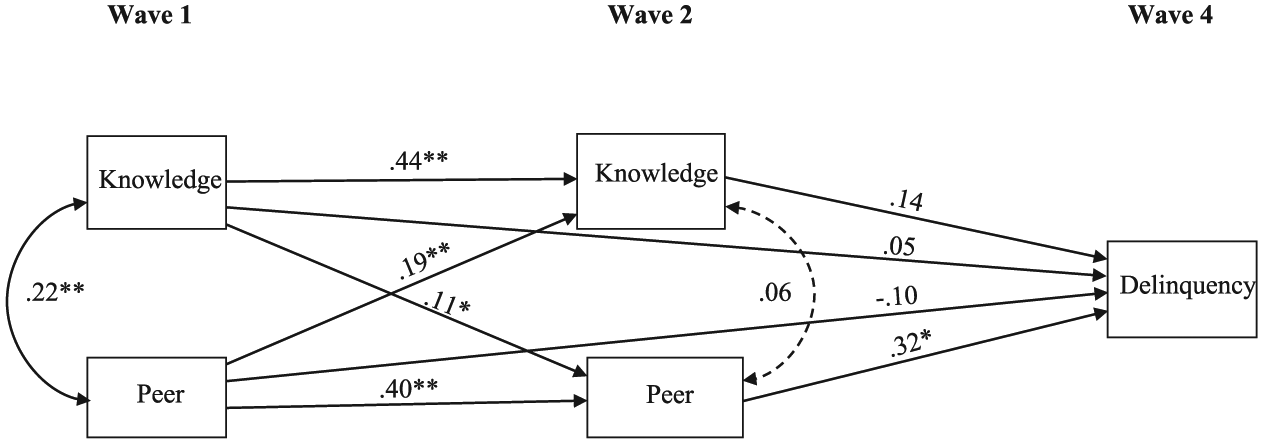
Maximum likelihood (ML) path analysis of perceived parental knowledge and peer deviance cross-lagged at Waves 1 and 2 as predictors of participant delinquency at Wave 4; N = 597.
Total, Direct, and Indirect Effects for Pathways Running From Parental Knowledge at Wave 1 and Peer Deviance at Wave 1 to Participant Delinquency at Wave 4.

Note. BCBCI = bias-corrected bootstrapped 95% confidence interval (b = 5,000); Estimate = unstandardized point estimate; Lower = lower boundary of the 95% confidence interval; Upper = upper boundary of the 95% confidence interval; Knowledge-1 = perceived parental knowledge at Wave 1; Knowledge-2 = perceived parental knowledge at Wave 2; Peer-1 = peer deviance at Wave 1; Peer-2 = peer deviance at Wave 2; Delinquency-4 = participant delinquency measured at Wave 4; Preacher–Hayes Contrast Test = test of the difference between the two indirect effects (peer mediated and knowledge mediated) using the procedure described in Preacher and Hayes (2008a); N = 597.
Sensitivity Testing
A sensitivity analysis designed to test for missing variable bias was conducted using Kenny’s (2013) “failsafe ef” procedure. The results of this analysis indicated that an unobserved covariate confounder would need to correlate .25 with the mediator (Peer-2) and .25 with the dependent variable (Deliquency-4), controlling for Knowledge-1 and Peer-2 in the case of the latter, to completely eliminate the significant mediating effect of peer deviance on the perceived parental knowledge–participant delinquency relationship. These findings indicate that the target pathway was moderately robust to omitted variable bias.
To test for the possibility of a collider effect or endogenous selection bias, the precursor measures for the three equations were removed and the analyses recalculated. The results of this second sensitivity analysis revealed significant a and b path coefficients for both the target and control pathways, significant indirect effects for both pathways, and no significant difference between pathways. These results do not change the overall conclusion that only the target pathway achieved significanc because they were performed solely for the purpose of ruling out a collider effect, which, in fact, they did.
Supplemental Analysis
Given that the current sample represents only 37% of participants from the first four waves of the ISBSV, a supplemental analysis was performed using the entire ISBSV complement (N = 1,607). Although this increased the amount of missing data in the analysis, only one variable out of 11 had more than 50% missing data (i.e., Delinquency-4, 70.6% missing data). The results of this supplemental analysis revealed that the a path coefficient of the target pathway approached significance (p = .06) and the b path coefficient achieved significance (p < .01), whereas the a path of the control pathway was significant (p < .001) and the b pathway was nonsignificant (p = .15). More importantly, the total indirect effect of the target pathway was significant (Estimate = 0.023, 95% BCCI = [.003, .065]) and the total indirect effect of the control pathway was nonsignificant (Estimate = 0.017, 95% BCCI = [–.004, .050]). As before, the difference between the two indirect effects was nonsignificant (Estimate = 0.006, 95% BCCI = [–.032, .048]).
Discussion
Ever since Stattin and Kerr (2000) arrived at the groundbreaking conclusion that the delinquency inhibiting effects of parental monitoring have more to do with general parental knowledge than with specific parenting techniques, investigators have been trying to figure out what it is about perceived parental knowledge that makes it such an effective deterrent to crime. The present study sought to advance current understanding of the delinquency dampening effects of perceived parental knowledge by replicating and extending results from a recent study on mid- to late-adolescent males with serious delinquent backgrounds (Walters, 2017) to a group of mixed-gender early- to midadolescent middle school students unselected for delinquency. Consistent with the results of the earlier Walters (2017) investigation, findings from the current study showed that perceived parental knowledge affected delinquency indirectly through its effect on peer deviance. Thus, in both studies, perceived parental knowledge failed to directly predict a change in delinquency even though both cross-lagged coefficients (parental knowledge → peer influence and peer influence → parental knowledge) were significant. As was observed in Walters (2017), perceived parental knowledge constrained peer deviance, which then served to hinder future delinquency. It would appear, then, that perceived parental knowledge’s role in reducing or restricting offspring delinquency is to inhibit a more proximal cause of delinquency in the form of involvement in unstructured routine peer activities (Walters, 2017) or association with delinquent peers (present study).
There are two theoretical interpretations that may help explain the current results. One interpretation is that peer deviance literally mediates the perceived parental knowledge–delinquency relationship. The problem with this interpretation is that peer deviance is a social variable and social variables tend not to be sufficiently malleable to serve as effective mediators (Walters & Mandracchia, 2017; Wu & Zumbo, 2008). It has been argued, however, that it is respondents’ perceptions of their friends’ deviance rather than actual friend deviance that drives the peer influence effect (Akers, 2009) and research indicates that respondent self-reported delinquency, respondent perceptions of peer delinquency, and peer-reported delinquency represent three distinct constructs (J. T. N. Young, Rebellon, Barnes, & Weerman, 2015). Being more pliable than social behavior, perceptions of peer deviance, along with social cognitive and affective variables, may serve as mediators of the perceived parental knowledge–delinquency relationship. An alternative theoretical interpretation of the current results is that peer deviance is really not a mediator at all but simply the first part of the peer influence effect (peer deviance → participant delinquency). Consequently, while a mediating effect was attributed to peer factors in the current and previous Walters (2017) investigations, these mediating effects could potentially represent a two-step process in which perceived parental knowledge serves as an antecedent to the peer influence effect.
A practical implication of the current results is that perceived parental knowledge plays a key role in delinquency initiation and maintenance but it does so by affecting peer relationships. In other words, perceived parental knowledge protects and buffers the child against the delinquency-promoting effects of association with a delinquent peer group or involvement in unsupervised routine peer activities. This is a relationship that has been observed with other aspects of parenting behavior such as authoritative parenting, attachment to parents, and time spent with family (Deutsch, Crockett, Wolff, & Russell, 2012; Simons, Wu, Conger, & Lorenz, 1994; Walters, 2016a, 2016b; Warr, 1993). What this means is that the effect of parenting on child misconduct does not end once a child turns 13 or 14, but shifts from a direct effect to an indirect one in which parenting acts to protect the child from crime-promoting environmental influences such as deviant peer associations and neighborhood disorder (Byrnes, Miller, Chen, & Grube, 2011). With respect to parental knowledge, there is evidence to suggest that children disclose more to parents with whom they share positive affection (Crouter & Head, 2002; Fletcher et al., 2004). Developing and preserving a positive parent–child relationship would, therefore, appear to be vital in preventing delinquency in youth from late childhood to early adulthood.
There are several study limitations that need to be considered within the context of the present results. First, there was a moderate degree of missing data. Second, to keep missing data from exceeding a moderate level (all variables < 40% missing data), nearly two thirds of the ISBSV participants had to be eliminated from the current investigation. Missing data were handled, as was previously mentioned, with FIML. As was also pointed out, there was no reason to suspect that the MAR assumption had been violated in this study and no evidence that the multivariate normality assumption was not satisfied. FIML has a strong record of effectively managing missing data (Allison, 2012; Newman, 2003; Peyre et al., 2011), even when its basic assumptions are moderately violated (Collins et al., 2001; R. Young & Johnson, 2013). However, studying fewer than half the available ISBSV participants to keep the missing data to a manageable level introduced another problem. Even though the ISBSV is not a nationally representative sample, it was largely representative of a single school district in Central Illinois (>95% participation across the four schools). It may, therefore, be possible that eliminating nearly two thirds of the participants from the ISBSV introduced bias into the analysis. To account for this possibility, all 1,607 children from the ISBSV were included in a supplemental analysis even though this meant using a variable (Delinquency-4) with nearly three quarters of its data missing. The results of this supplemental analysis paralleled those of the main analysis. A third possible limitation of this study is that most of the items on the delinquency scale referenced relatively minor offending. Although this extends the replication because the original Walters (2017) study focused on more serious offending, it would be helpful to know if the current results generalize to more serious forms of delinquency.
Findings from several studies (Deutsch et al., 2012; Simons et al., 1994; Walters, 2016a, 2016b, 2017; Warr, 1993, current investigation) now indicate that family and peer factors are equally important in encouraging and discouraging future delinquent behavior in youth. During adolescence, parenting and family factors serve a protective or buffering function, which when low, may open the door to deviant peer associations which then increase the child’s future prospects of engaging in delinquent behavior. One question the current study could not answer was whether the effect of peer deviance on the perceived parental knowledge–delinquency relationship is a true mediating effect, orchestrated perhaps by the respondent’s perception of peer deviance, or an antecedent effect of perceived parental knowledge on peer influence. Either way, perceived parental knowledge and perceived peer deviance are both critical in forming a complete understanding of delinquency development, the absence of one (perceived parental knowledge) apparently unleashing the other (peer influence). In the future, researchers might want to consider assessing perceived parental knowledge, perceived peer deviance, and self-reported delinquency at multiple points between mid-childhood and late adolescence to see whether the relationship between perceived parental knowledge and peer delinquency and their effect on delinquency change as a function of child age or maturity.
Footnotes
Declaration of Conflicting Interests
The author(s) declared no potential conflicts of interest with respect to the research, authorship, and/or publication of this article.
Funding
The author(s) disclosed receipt of the following financial support for the research, authorship, and/or publication of this article: Research for the current study was supported by the Centers for Disease Control & Prevention (#1U01/CE001677) to Dorothy Espelage (PI).