



Abstract
This work presents a time-series convergence (divergence) analysis for robbery rates in Mexico. Two distinctive features, in relation to previous studies, can be identified: first, the use of an autoregressive vector to better estimate the series dynamic compared with single-equation models, and second, the implementation of an escalation/de-escalation analysis is done using two variants of the same crime—high- and low-impact robberies. Our results suggest that modifications to the national security policy in Mexico have a direct—and rapid—effect on robbery crime trends. Moreover, the three phases of the dynamics between the rates coincide with the three major national security policies implemented in recent years: (a) 1997 to 2006, (b) 2007 to 2011, and (c) 2012 to 2018.
Introduction
In recent years, time-series methodologies have been increasingly used to perform convergence (divergence) analysis between different criminal rates. At a macro level, this type of analysis is used to establish relationships between the rates of different countries generally based on the thesis of modernization—convergence between rates—or conflict—divergence between rates (LaFree, 2005), where the development stage, and/or economic, social, and political processes play a fundamental role in reducing—convergence—or increasing—divergence—the disparities between rates (Eisner, 2001). This type of analysis has preferably been applied to homicide due to the conventionality of its definition (Kennedy, Forde, & Silverman, 1989). However, it is possible to find works that study a different array of crimes (P. J. Cook & Khmilevska, 2005; S. Cook & Watson, 2013).
At a micro level, analyses in national contexts have explained the influence of certain regional elements—such as local unemployment (S. Cook & Winfield, 2013)—on how rates behave. Alternatively, the effects of gender differences in crime have also been studied. Therein, the convergence between men and women implies that crimes are committed equally, regardless of the offender’s gender (Steffensmeier & Allan, 1996), whereas divergence implies that there are structural differences in gender that determine the commission of crimes (Ivkovićh, 1995). Finally, another large group of studies focuses on the analysis of convergence between victimization rates (National Crime Victimization Survey [NCVS]) and crime reports (Uniform Crime Reports [UCR]) (Biderman & Lynch, 1991; Blumstein, Cohen, & Rosenfeld, 1991; O’Brien, 1996), and methodological strategies (Catalano, 2006a, 2006b; McDowall & Loftin, 2006; Rosenfeld, 2006) regarding its determination. Commonly, supranational/national, homicide/offenses, male/female analyses are based on the general idea that there are external factors that determine the general behavior of long-term criminal tendencies—a condition known as cointegration (O’Brien, 1999; Saridakis, 2004). On the contrary, work on UCR/NCVS focuses on the relationship (or lack thereof) between the two rates without necessarily addressing an external variable such as occupation, employment, or gender.
In this context, there is an underexplored subject of analysis: the convergence between two variants or modalities of the same crime—high impact (HI) and low impact (LI) or with and without violence, for example—to try to establish some relationship between these criminal rates. This analysis could serve to study criminal escalation (Sherman et al., 1991) or de-escalation (Blumstein, Cohen, Roth, & Visher, 1986), not in terms of the trajectory of individual participation in crime but of the behavior of the national rate. Based on this approach, the object of analysis is neither the individual progression of a criminal profile nor the criminal contagion as a behavioral (Jones & Jones, 1995), psychological (Tapp & Occhipinti, 2016), or social issue (Glaeser, Sacerdote, & Scheinkman, 1996; Glaeser, Scheinkman, & Sacerdote, 2003). Most of the works mentioned herein analyze a group of people, usually prisoners, to foster an analysis that extracts general conclusions from specific cases. Thus, our proposal consists on identifying general patterns of convergence in different variants of the same crime. This will allow us to explore the behavioral dynamics of several modalities of crimes and, at the same time, determine whether macro factors have an effect on them.
It has been argued that, at a national level, it is difficult to establish a crime transfer relationship because (a) there is a growing population—one cannot know whether certain groups or individuals move from one type of crime to another—and (b) crimes are often left unreported—a thief may specialize and commit crimes in areas/conditions where complaints are not filed. Convergence analysis can account for patterns of escalation, de-escalation, or long-term stability—cointegration—between the crime’s time series. Although the limitations of this methodology have been pointed out (Osgood & Schreck, 2007; Spelman, 1994) and other studies have ruled out or diminished the relevance of the evidence of escalation (Piquero, Farrington, & Blumstein, 2003), measures based on the aggregation of individual patterns can be useful for decision-making process in public policy. This perspective can be seen as a variation of crime-type switching tables methodology (Blumstein, Cohen, & Farrington, 1988; Britt, 1996; Rojek & Erickson, 1982), where increasing offense frequency and increasing offense seriousness can be studied through the convergence of modalities of a particular crime.
In this sense, identifying the dynamics of the relationship between modalities of the same crime is appealing because it can suggest different strategies of containment and reduction, while allowing for an escalation effect analysis. In addition, the discussion regarding perceptions of crime seriousness (Ramchand, MacDonald, Haviland, & Morral, 2009) is avoided because the target subject of analysis is not taken from members of the general population or criminal justice professionals (LeBlanc, Côté, & Loeber, 1991) but from a legal distinction that is reflected in official statistics. By not attempting to measure escalation in a criminal life course—age—but in offense’s seriousness of the same crime, a simple scale can be determined without resorting to a complex set of judicial sentences (Kyvsgaard, 2003; Liu, Francis, & Soothill, 2011) or a crime severity score (Kempe, 1988; Wolfgang, Figlio, Tracy, & Singer, 1985).
From a public policy point of view, understanding the joint dynamics of modalities of the same crime can favor an efficient allocation of specific policing and prevention objectives. Under this approach, the presence of convergence between crime modalities imply that certain structural elements—for example, security policies—shape the changes of crime trends. Otherwise, the presence of divergence implies that specific elements of the crimes—psychology/demography—are determinant in the behavior of the series. In the latter case, if divergence is observed to persist over time, it means that structural differences cannot be reduced to a common trend. Finally, the presence of cointegration suggests that, even if short-term deviations are identified, the dynamics tend to be deterministic in the long run. That is, an equilibrium force causes them to move together through time. The last-mentioned can be interpreted as an element of coordination between crimes that the criminal justice system—police and prosecution—has failed to address systematically.
From the traditional statistical perspective, the convergence of two crimes is understood as the decrease in the difference between their criminal rates. However, if evidence of convergence is found, it is interesting to observe if this condition is maintained over time, that is, if a long-term relationship is present. If this were the case, what would happen with a type of crime could, with a high degree of certainty, be anticipated. For example, the LI robbery rate can be determined by observing the behavior of the HI rate. In other words, there would be no random factors affecting the relationship. Otherwise, and although the behavior of the variables can be predicted through the model, it could not be established with certainty that the pattern of relationship observed so far will remain in the future and/or tend to a long-term equilibrium relationship. In this sense, Greenberg (2001) presents a comprehensive study of the methodological difficulties one faces when modeling crime rate time series and their implication of the short- and long-term relationship analysis.
Most of the previous studies found in the convergence study of criminal rates use single-equation multivariate linear regression models as the main econometric technique. This type of analysis is limited because, by construction, it does not consider past information about the behavior of the series or the feedback effect between them. To include this information, it is necessary to work with a system of autoregressive equations—vector autoregressive model (VAR)—where the effect of the past of both series can be simultaneously incorporated into its present. In terms of the present work, through the use of these models, the behavior of LI robberies can be explained using its past, as well as the past of the dynamics of HI robberies (and vice versa). In this way, a superior predictive capacity is obtained as opposed to a single-equation time-series model. To illustrate this methodology, in this article we present a VAR model to estimate the escalation/de-escalation of robbery in Mexico from 1997 to 2016 under the convergence context.
Our research objective is to identify if HI and LI robbery rates in Mexico exhibit a convergence or divergence process. Moreover, it is of interest to observe if said relationship is preserved or rather modified by the 2007 to 2012 national security policy. We hypothesize that a divergence process arose between high and low robbery rates as a consequence of the “War on Drugs” policy, a period in which police forces focused on battling drug trafficking–related crimes, thus deterring strategies aimed to reducing other crimes. To the best of our knowledge, there are no previous works that analyze a convergence effect between two different modalities or classifications of a same crime. For this reason, the present work has two main intentions: (a) to guide the study of the convergence of crimes where a classification of their aggravating factors is presented and (b) to implement the VAR methodology to explore the convergence of HI and LI robberies in Mexico.
After this first section, the article is organized as follows: The “Robbery Rates Dynamics” section presents a literature review regarding robbery rates studies and the “Autoregressive Vectors” section presents the VAR models. The “Data Description and Method” section describes the data and methodology used in this work. The results of the model are presented in the “Results” section, while in the “Discussion” section, a discussion is presented. Closing remarks and an analysis about the implications of the results on national security policy in Mexico can be found in the “Implications in National Security Policy” section.
Robbery Rates Dynamics
Regardless of their potential utility, time-series analyses have seldom been used for the study of robbery rates, even when they have been included within a set of crimes as a part of testing theories relative to criminal behavior (Cohen & Felson, 1979). In the case of convergence studies, a similar situation is observed: Works were conducted using set of crimes (robbery included) but not considering classifications within each. For example, in the case of convergence of serious crime arrest rates for males and females (O’Brien, 1999), unemployment and crime (Hale & Sabbagh, 1991), crime, male youth and unemployment (Narayan & Smyth, 2004), economic activity and crime (Scorcu & Cellini, 1998), and crime patterns (Liu, 2006).
The behavior of different types of aggregated robbery rates is, however, an underexplored subject of analysis. As Cohen, Cantor, and Kluegel (1981) argue, this is possibly due to the fact that the use of aggregate robbery trends does not explain individual behavior at a cross-sectional level. This is relevant in the sense that, rather than focusing on macro behaviors, the debate about robbery has primarily been focused on offender decision making: rationality of target selection based on rational choice theory—reflective behavior (Cornish & Clarke, 1986) versus “bound rationality” based on spontaneous choices—motivation and opportunity (Jacobs, 2010; Topalli & Wright, 2004). This tendency has also resulted in criminologists’ growing interest for robbery explanations based on spatial dynamics: (a) the routine activities theory (Felson, 1998), (b) the crime pattern theory (Anselin, Cohen, Cook, Gorr, & Tita, 2000), and (c) the “hot spots” theory (Sherman & Weisburd, 1995). In almost every case, analysis is oriented toward particular experiences and not vast time series, or even narrowed down to robbery in specific urban areas. As pointed out by Deane, Messner, Stucky, McGeever, and Kubrin (2008), spatial modeling has focused on relatively small units by using aggregation of data census, either for confined spaces—neighborhoods (Kubrin & Weitzer, 2003)—or, at the most, for cities (Baller, Anselin, Messner, Deane, & Hawkins, 2001; Kubrin, Messner, Deane, McGeever, & Stucky, 2010). There are few cases, though, where a more general explanation is pursued, for example, across larger cities, and, to the best of our knowledge, where vast time series (particularly spatially oriented) have been used.
Yet, interesting work has been done and, even if it is not pertaining to this mainstream, it does contribute interesting examinations, for example, that of MacDonald (2002), which establishes a relationship between robbery rates and population density, or that of Miethe, Hughes, and McDowall (1991), which studies social instability in a neighborhood from the social disorganization theory perspective and correlates high residential mobility to high robbery rates. Within this work’s universe, those possibly closest are the ones attempting to link the behavior of robbery trends with the deterrent effect of policing. For example, Wilson and Boland (1978), further developed by Sampson and Cohen (1988), who argue that proactive policing based on a higher detention risk and the perception of the real probability of detention has a particularly high deterrent effect in this crime. Although none of these research studies employ time series, the main research question coincides with the present work: Policing can have positive effects in the behavior of national robbery trends, constituting a possible explanation for this crime.
In parallel, some work has been done using time-series methodologies that analyze variations of robbery (HI and LI) using murders and deaths associated as a parameter for robbery with violence. In this context, noteworthy research includes that of Zimring (1977) and Zimring and Zuehl (1986), which studies the determining factors of mortality rate in robbery in Detroit from 1962 through 1974, and that of P. J. Cook, which explores the relationship between gun availability and robbery/robbery murder, using cross-sectional data from 50 cities in the United States; robbery and injuries or deaths (P. J. Cook, 1986), using a small time series (1973-1979); and patterns of robbery violence (P. J. Cook, 1987) or robbery murder trends (P. J. Cook, 1985), using a large time series that encompasses 1968 through 1983 and analyzes the surge in violence in robbery in 52 cities in the United States based on the National Crime Survey done by the Bureau of Justice Statistics. Similar work is done by O’Flaherty and Sethi (2009), who study the decline of robbery rates based on a time series from 1993 to 2002 to test the deterrence theory (Funk & Kugler, 2003; Kessler & Levitt, 1999).
Autoregressive Vectors
When the behavior of two (or more) time series is being analyzed, patterns that suggest a dependency relationship between them can be easily identified when a graphical representation is being used. However, incorrect conclusions can be drawn if a potential nondirect connection between them is not considered, for example, if they are linked through a third variable that is not included in the original model. If the subjects of study are variables that describe the behavior of the human being, the unpredictability of their decisions is transferred to the behavior of the variable; hence, the importance to note that this random effect source has to be isolated from the “natural” dynamic of the variable. If the objective is to analyze whether two series are converging or diverging, the behavior of the stochastic component must be isolated to “clean” the fluctuations of the series. That is, one can identify if the trend shared by the series is a result of a systematic behavior of them or if it caused by the random factor. This process is referred to as relative convergence or divergence.
In general terms, when one wants to study the relationship between two—or more—series, it is sought that the estimated econometric model be able to distinguish the fluctuations generated by the stochastic nature of the variables generated by the causal relationship between them. To perform this procedure, the selected technique must be able to identify the causal shocks of the model and, subsequently, analyze their lasting impact. With this, it will be possible to explore the existence of a convergence process and whether this relationship is maintained—or not—over time. The latter condition is known as a long-term equilibrium relationship or cointegration condition. According to Sims (1980), the fundamental problem of conventional econometric models, such as single-equation models, is that a previous study must be done to establish if the variables should be treated as endogenous or exogenous. Moreover, it is necessary to determine if the equations of the system are identified to make an estimate. This is why Sims developed the VAR models, highlighting the following characteristics: (a) It is a system of simultaneous equations in which all variables are considered endogenous, (b) the current value of a variable is expressed as a linear function of the past values of all the variables included in the model, and (c) if each equation has the same number of lagged variables, it can be estimated through ordinary least squares (OLS). Formally, let
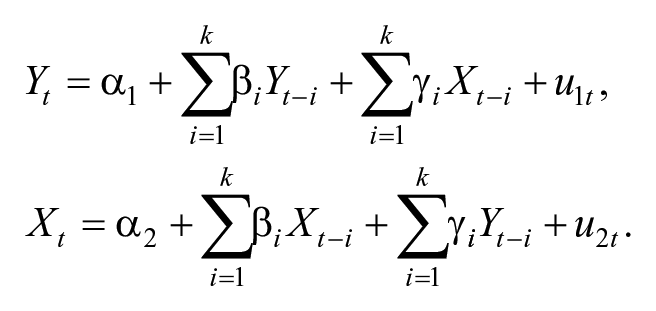
where α represents the constant and u the stochastic error term of each equation.
As described by Lütkepohl (2005), due to its advantages over single-equation models, one of the main uses of VAR models is to perform forecasts and structural analysis when multiple time series are considered. The process to generate a forecast through the VAR model can be summarized in the following steps:
Determining order of integration of each time series.
Determining the optimal lag
Verifying presence of cointegration and/or causality.
Using the information obtained in the previous steps and estimating the VAR model by using the OLS method.
Verifying the statistical characteristics of the parameters
Only after the adequacy of the model is verified, the VAR can be used to perform forecasts and make inference regarding the dynamic relationship of the series.
Each step uses statistical tests to identify its required elements. For the sake of brevity, a general explanation of each is presented in the next section along with a description of the data and methodology followed in this work.
Data Description and Methodology
To carry out this study, monthly data were used of the cases reported by the National Secretariat of the National Public Security System (SESNSP for its acronym in Spanish) for robberies at a national level. In Mexico, crimes are classified regarding their social impact. HI crimes are the ones affecting life, bodily integrity, personal freedom, and/or sexual security. On the contrary, LI crimes are the ones related to the loss of patrimony. This classification began to be used in 1990 as an element of distinction between judicial statistical information. The National Institute of Statistics and Geography (INEGI) has developed a catalog of crimes that has been used consistently over time and is, since 2010, called “Statistical Classification of Crimes.”
Following this classification, the present work analyzes two modalities of robberies: against people, HI, or against patrimony, LI. This crime was chosen to be analyzed because, within the Mexican classification, it is the only one that has two modalities or variations. The rest of the crimes belong entirely to a single classification. For example, homicide is HI while fraud is LI. The period of study is from January 1997 to December 2016 with 240 observations for both series. The selection of the period responds to the availability of data reported by the SESNSP and comprises three national security policies of different presidential periods. The first one includes a presidential term of the Institutional Revolutionary Party (PRI) under Ernesto Zedillo (1994-2000) and one of the National Action Party (PAN) in the hands of Vicente Fox (2000-2006). In this period, the national security policy was based on a traditional policing scheme focused on crimes of high social impact. The attention of the national security policy had a drastic change with the arrival of Felipe Calderón (2006-2012) to the presidency. The new strategy followed by the PAN government was characterized by the militarization of public security and the drug trafficking war. Finally, with the arrival of Enrique Peña (2012-2018), a third national security policy was designed under a withdrawal approach from the armed forces, implementation of social crime prevention mechanisms, and a return to crime policing schemes of high social impact. Based on the information above, it is assumed, at least theoretically, that crime-fighting efforts may focus on some variant of crime—HI for the first and third strategies in Mexico—or specific offenses—second strategy. Thus, if the analysis focuses on one type of crime, the trends of its modalities should be modified over time.
Figure 1 shows the behavior, in logarithms, of the reported cases of HI and LI robberies in Mexico for the study period. As can be observed, HI presents a generalized negative trend for the periods 1997-2006 and 2012-2016. This coincides with the objectives of national security strategies where HI crimes are pursued. For the intermediate period, 2006-2012, it is observed that both HI and LI present a positive trend, but for HI it is higher than for LI. The first step in estimating a VAR model is the verification of the stationarity conditions of the time series of interest. A series is said to be stationary if it presents a mean and a constant variance over time. If not, estimates by the OLS method would be spurious as they do not meet the BLUE (best linear unbiased estimator) requirements. The conventional way to proceed when the series is found to be nonstationary is to apply a difference to make it stationary. Once this step is done, the estimation is carried out using the stationary series. However, there is a problem with this procedure: When differentiating the series, all information regarding long-term trends is removed. This is the reason why a cointegration analysis performed to differentiated series is, by construction, erroneous. In the case of wanting to analyze both the short- and long-term relations, the order of integration of the series must be verified. If we find that the series are nonstationary, we continue to explore the condition of cointegration with the series in levels—without applying differences—and, in parallel, explore the short-term relationship using the differentiated series.
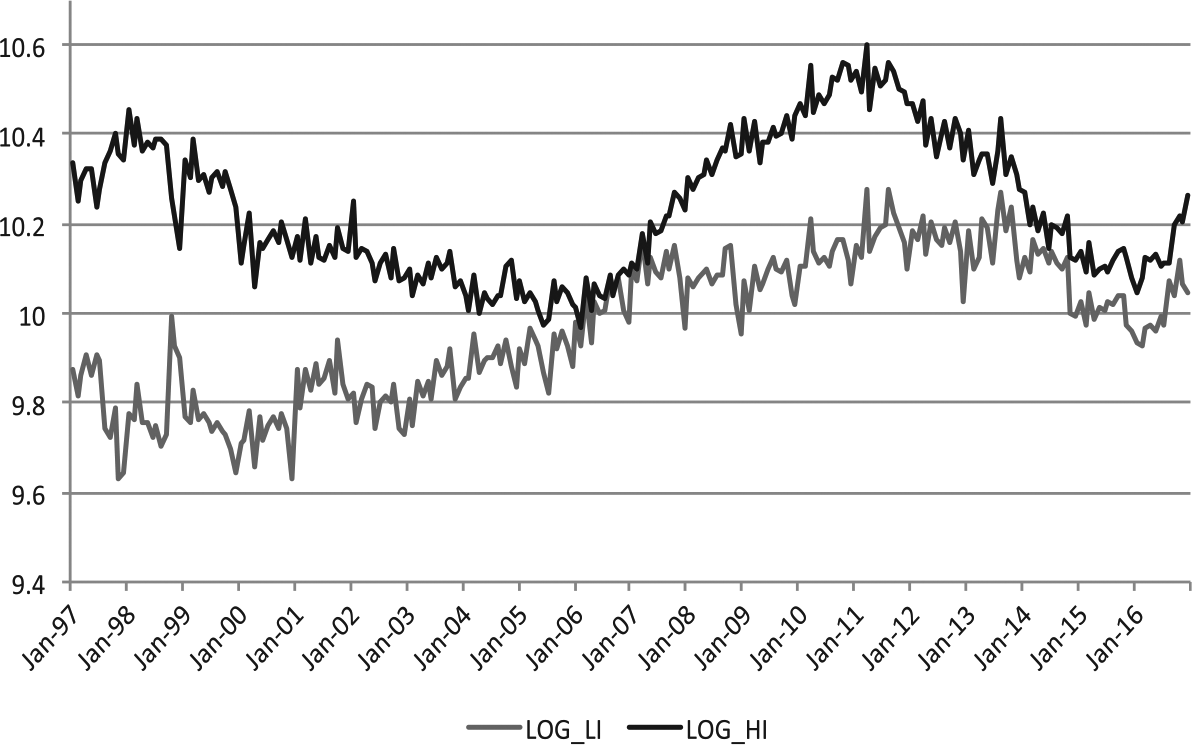
Monthly series of high- and low-impact robberies (logarithms) in Mexico: 1997-2016.
In criminal series (Hale, 1998, 1999; Osborn, 1995), the order of integration typically found is 1, that is, the series in levels are not stationary but, when the first difference is applied, the resulting series is. Also, as Perron (1990) clarifies, the presence of structural breaks conditions the identification of the stationarity conditions of the series. Therefore, a potential problem is encountered if the entire sample is used to determine the order of integration of the series. To counteract this, a tool must be used to capture the effect of structural breaks in the series while identifying if they are stationary. In the case of the logarithmic series of HI and LI robberies, the unit root test with structural break (Perron, 1997; Zivot & Andrews, 1992) suggests that there is a break in October 2006 for the HI series while for the LI series this break is in July 2005. As there is no single structural break date, it is recommended to select a break point within the range of dates that both series present and that is justified, either by the internal structure of the series or external elements such as news or policies. For that, through an inspection of the series, it is found that September 2006 is the only period where LI exceed HI robberies. Considering the above, we choose to separate the series into two subperiods. The first subperiod encompasses from January 1997 to September 2006 with 117 observations while the second subperiod of 123 observations comprises from October 2006 to December 2016. The full period, then, has 240 observations. Our analysis will focus on the comparison of the two subperiods, reporting the case with the totality of observations as an illustrative example. In addition to the previous step, the Augmented Dickey–Fuller (ADF) and Phillips–Perron (PP) unit root tests are performed to determine the order of integration of the series. The results are presented in Table 1. Both tests establish that, for the total period, both series present an order of integration 1. This result is maintained for both the first and second periods.
ADF and PP Unit Root Tests.
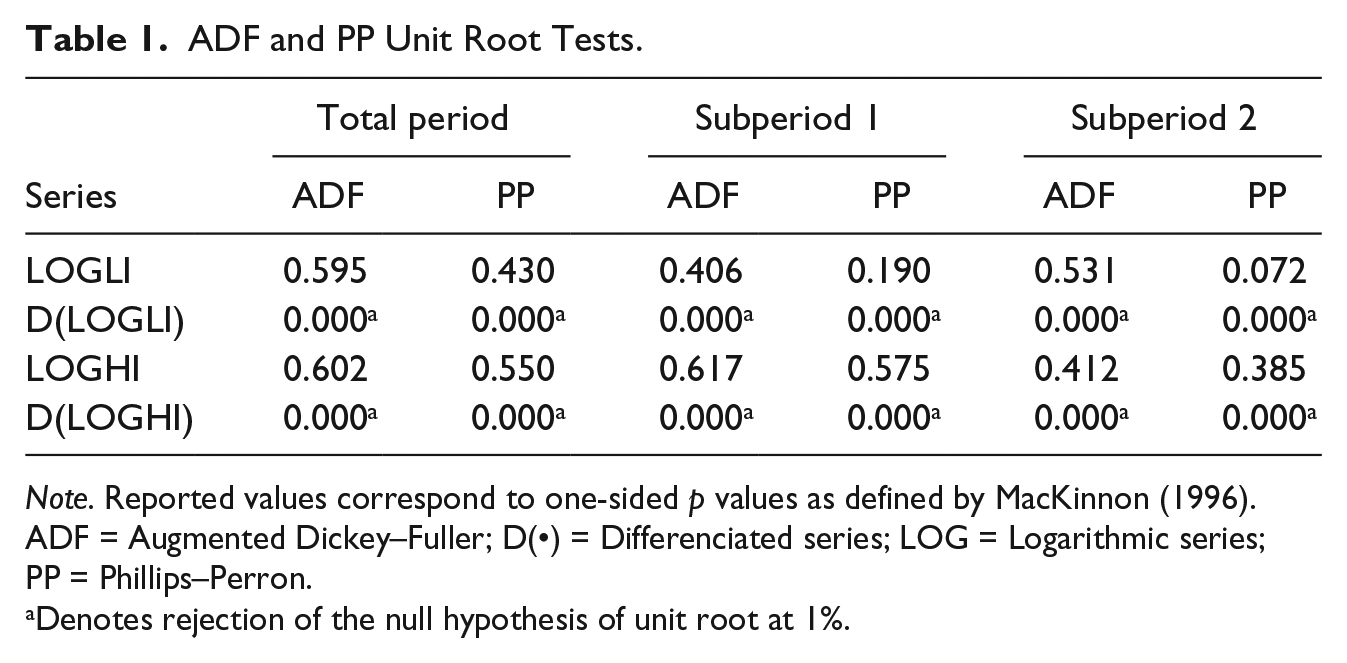
Note. Reported values correspond to one-sided p values as defined by MacKinnon (1996). ADF = Augmented Dickey–Fuller; D(•) = Differenciated series; LOG = Logarithmic series; PP = Phillips–Perron.
Denotes rejection of the null hypothesis of unit root at 1%.
The second step involves the determination of the optimal lag k to be used in the model. For it, the Akaike (Akaike information criterion [AIC]), the Schwarz (Schwarz information criterion [SIC]), and the Hannan–Quinn (HQ) information criterion were employed. The AIC indicates that the lag order that should be employed is 5, while the SIC and HQ indicate the lag should be 4. Because consensus is not met, to provide robust results, both lags are considered in the estimation of the model. After the adequacy of each model is verified, the comparison of the values provided by the above-mentioned information is performed to determine which of the models provides a better fit. In sum, up to this step, we must work with the differences of the logarithmic series to assure the necessary conditions for the estimation of the model according to the OLS method, and using the fourth and fifth lags, bearing in mind that, if the difference of the series is used, information about their long-term relationship will be lost. If we want to preserve the long-run properties, one could estimate an error correction model (ECM) and determine parameters for both, short- and long-run relationship. However, this can only be done if the series presents a cointegrating relationship. For that, the third step in the methodology is performed.
To determine the existence of a long-term relationship, the Johansen (1988, 1991) 1 cointegration test is carried out. For the three periods contemplated, no cointegration relation between the series is found. This means that, although it is possible that there is a short-term dependency relation, this relationship is not kept constant over time and, additionally, the series does not tend to a long-term equilibrium point. This is not a problem for the characterization of the dependency relationship; it simply implies that the results and the modeling of the series will only be significant in the short term. The lack of a long-term relationship between robberies makes theoretical sense, as its presence would imply that the judiciary system has been unable to identify—and correct—trends in robberies. In methodological terms, as the series are found to be integrated of order 1 -I (1)- and no evidence of cointegration between them is present, the technique used to estimate the relationship between the time series is a VAR.
To perform the analysis of the short-term dependency relation, we used the correlation statistic and the causality test. Table 2 shows that, when the total period is considered, the Pearson correlation between these series is .4384 while the Spearman rho is .4552. For the Subperiod 1, the values of the correlations are –.5870 and –.6435, respectively. Therefore, this subperiod can be categorized as the period in which a convergence process takes place. Once this point is reached, it would be expected that, if there were a short-term dependency relationship between the variables, its correlation would be positive and high. This result is precisely found in Subperiod 2, where the Pearson correlation is now .7209 while the Spearman rho is .7288. Recalling that the existence of a correlation measure does not imply a causal relationship between the series, we proceed to perform Granger causality tests. The results of this step are presented in Table 3.
Descriptive Statistics of the Logarithm of the Series of the High- and Low-Impact Monthly Robbery Cases in Mexico.
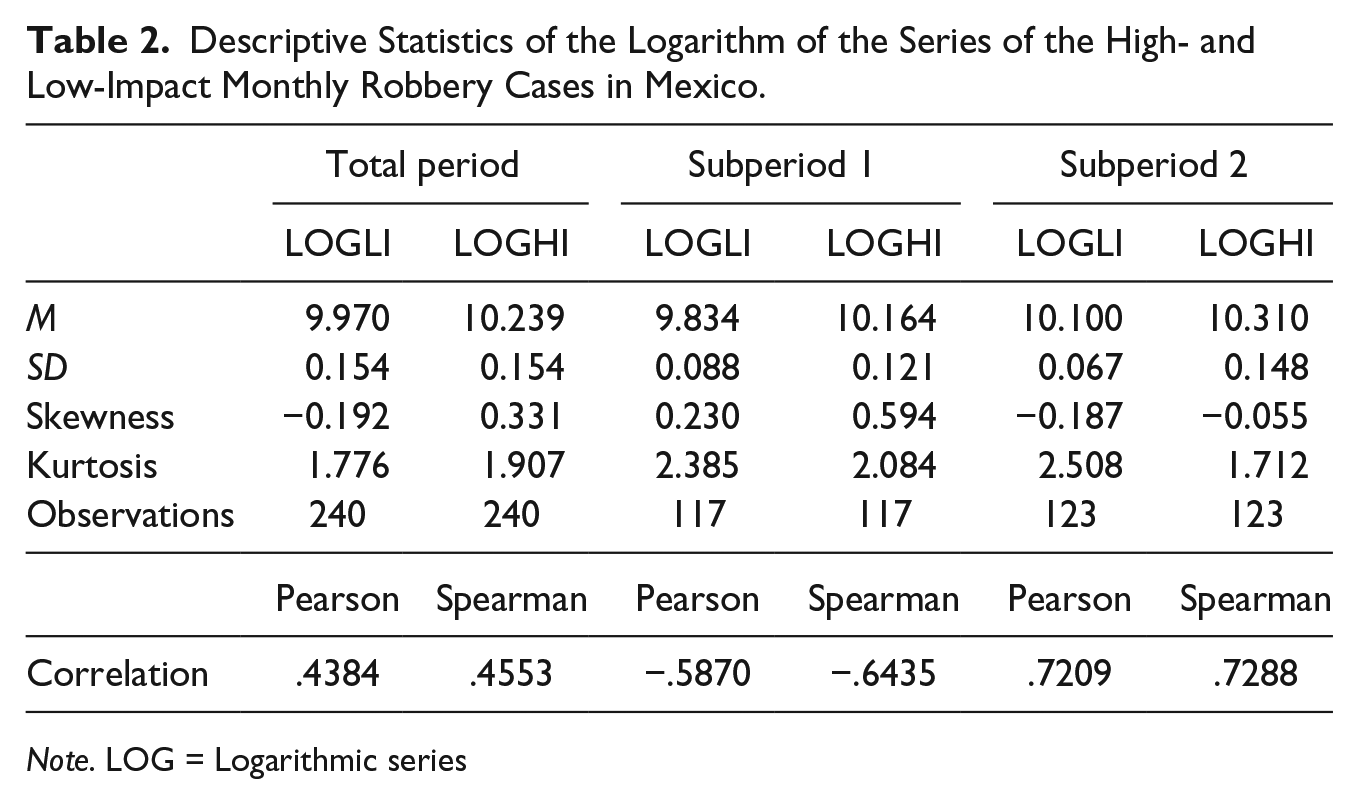
Note. LOG = Logarithmic series
Granger Causality Test.
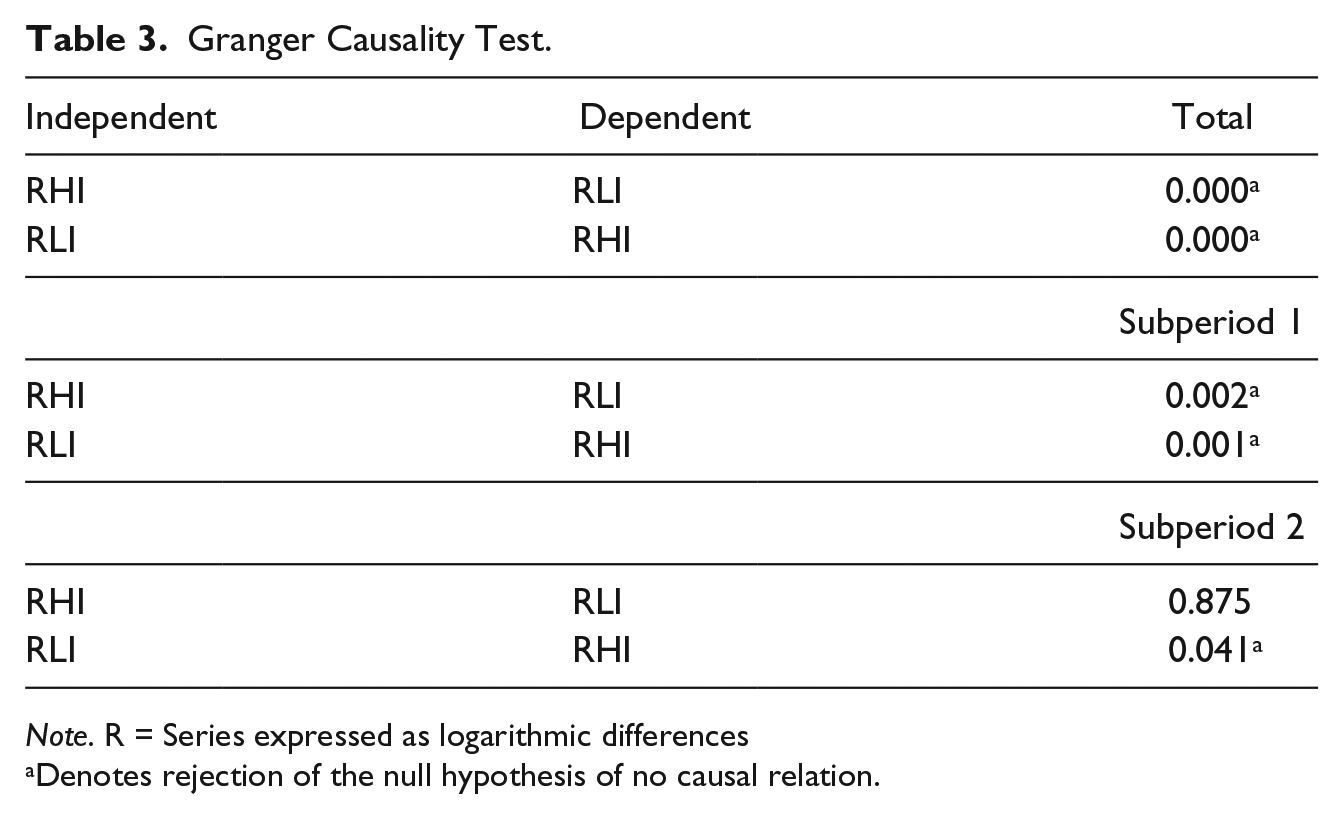
Note. R = Series expressed as logarithmic differences
Denotes rejection of the null hypothesis of no causal relation.
For the total period, there is a bidirectional causal relationship between the series. When subanalysis is performed, it is found that for the former this bidirectional causal relationship is maintained; however, in the second subperiod, only evidence of a causal relationship that runs from LI to HI is found. The previous result is consistent with the idea that, to reach a point of convergence, both variables must participate dynamically, while if that point is reached, such participation can be altered. In the case of robberies in Mexico, in the second subperiod it is found that LI theft serves to predict the behavior of HI ones, though not inversely.
Results
With the above information, Steps 4 and 5 are carried out: estimation and verification of the adequacy of the model. 2 After the selection of the VAR considering four lags in the system -VAR (4)- as the best fit, the model is used for forecasting the first difference of the logarithmic value of the series. As the variables of interest are the monthly robbery cases, the previous forecasted series are transformed to monthly counts. Figure 2 shows the result of these last steps. When selecting the period to be used for the forecast, 2 years are considered as it is the remaining time of the current president (Peña), so it is reasonable to expect no drastic modifications in the national security policy.
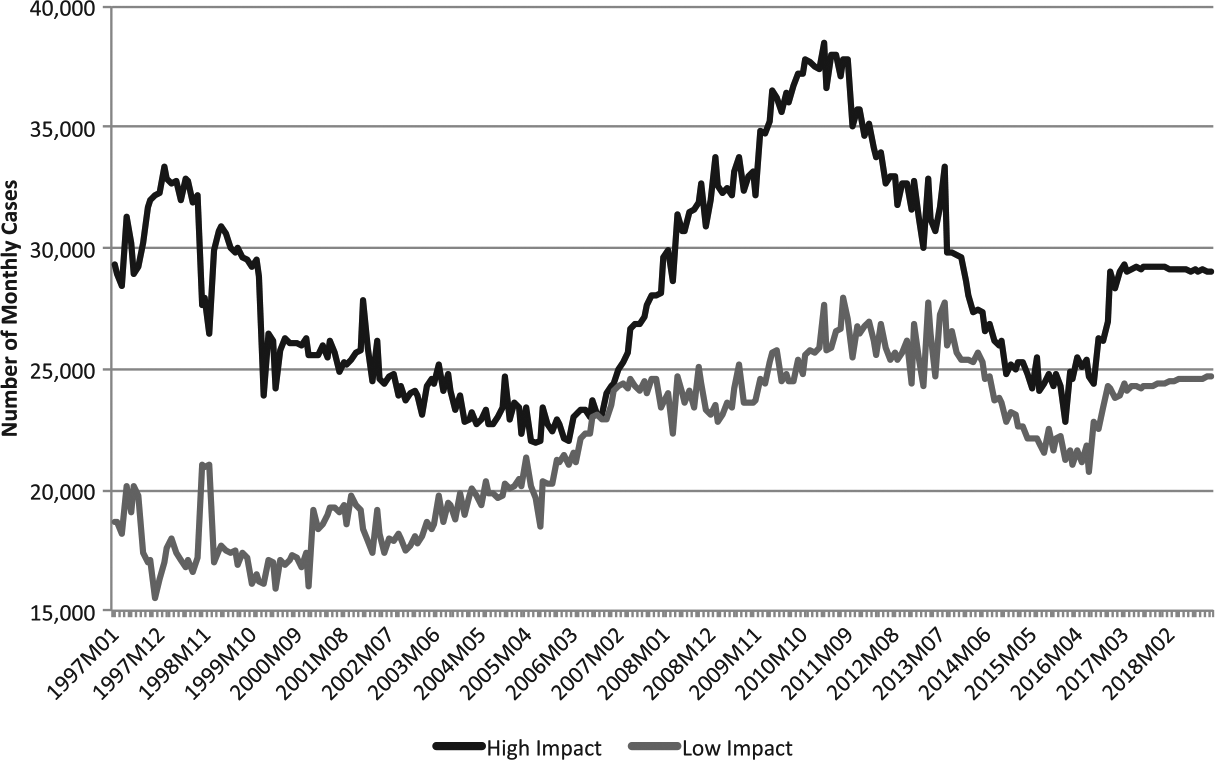
Forecast of high- and low-impact monthly robberies in Mexico.
From the forecasted series, three distinct phases can be identified with the results presented in Figure 1. The first phase, which was present from 1997 to 2006, shows a process of convergence between HI and LI thefts to a point where there are practically the same amounts of cases. Interestingly, it can be observed that in the second phase, from 2007 to the end of 2011, this trend is reversed, resulting in a process of divergence between the series. Moreover, both series show increasing trends compared with the previous phase, with HI robberies being the ones that grew the most. Finally, in the third phase, from 2012 to 2018—including our forecast—we observe a relatively uniform behavior between the series. This result suggests the presence of a stable short-term relationship, with a series difference of around 4,400 cases. It should be noted that the found stability cannot be classified as long term nor in equilibrium, as the presence of a cointegration relationship was previously rejected. That is, we cannot ensure that this difference is maintained over time or, moreover, that they have a balanced relationship between them. As a comparison of our results with previous convergence studies (Ivkovićh, 1995; LaFree, 2005; LaFree & Drass, 2002; O’Brien, 1999), the forecast of both series is used and the difference between them is calculated from the following way:
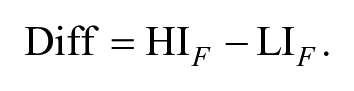
Figure 3 shows the constructed series. Therein, it can be observed that there is an increasingly narrow fluctuation between the series, namely, the maximum magnitude of the difference tends to be smaller over time. It is possible to identify that from late 1997 until the end of 2006, there is a marked process of convergence. Even though it shows a slight increase from mid-2014 to the end of 2016, our result suggests that the difference will tend to be placed in the 4,400 monthly cases in the next 2 years.
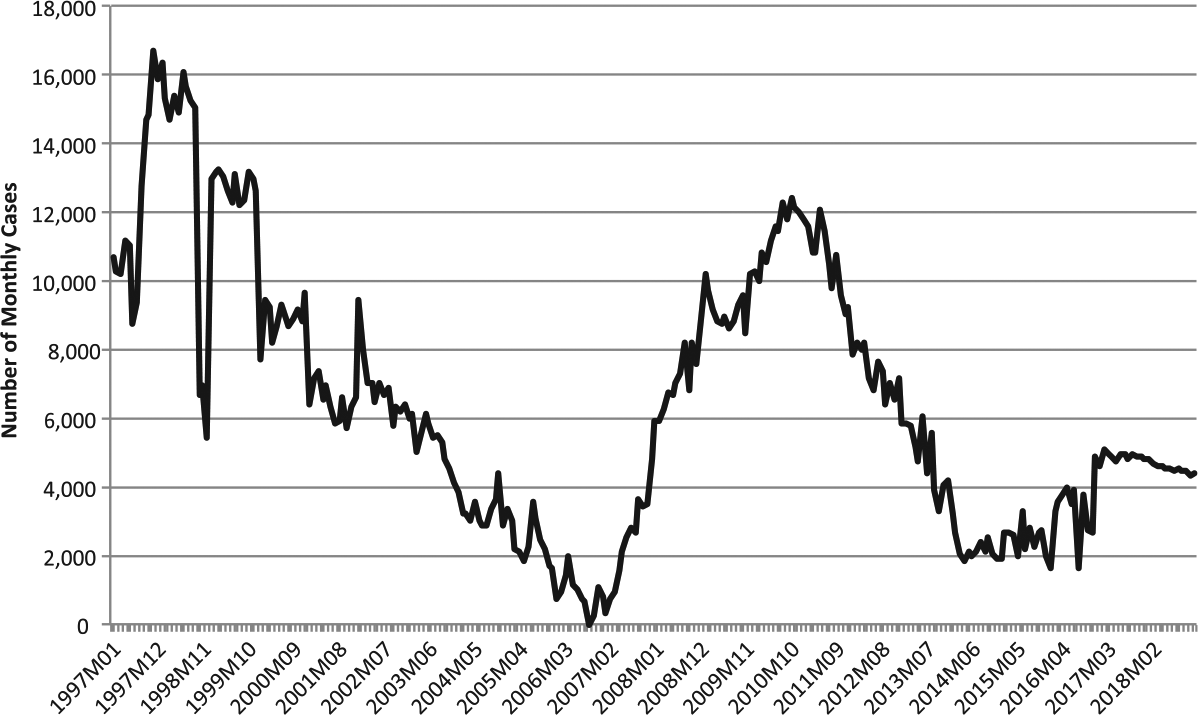
Difference between the forecast of high- and low-impact monthly robberies in Mexico.
Discussion
As illustrated by the results, the three phases of the behavior of the series—convergence (1997-2006), divergence (2007-2011), and short-term stability (2012-2018)—match with the three national security policies of (a) Ernesto Zedillo (1994-2000) and Vicente Fox (2000-2006), (b) Felipe Calderón (2006-2012), and (c) Enrique Peña (2012-2018). The process of convergence between HI and LI robberies present in the first phase (1997-2006) implies that the structural difference between both variations of crime is reduced substantially until reaching an equal point. This relationship can be derived from a process of de-escalation of crime: The pressure of strategic policing on HI crimes—violent robbery—reversed the process of crime specialization—from simple to violent robbery. Selective policing applied to violent robbery is strategic in the sense that, along with homicide, it is the crime that has the highest level of concurrence. This pressure could act as a deterrent or disincentive for certain criminal groups—auto theft bands, for example—that may prefer not to use violence in the crime commission.
This idea coincides with work that demonstrates the deterrent effect of policing as a factor of robbery rates reduction (MacDonald, 2002; Sampson & Cohen, 1988; Sampson & Morenoff, 2006; Wilson & Boland, 1978). A central discussion about robbery is also indirectly tested: rational choice versus bound rationality. If proactive policing based on an increased risk of detention and a heightened perception of the real possibility of detention does have a deterrent effect in robbery rates, then regardless of “bound rationality” based on needs, emotions, and opportunity (Jacobs, 2010; Topalli & Wright, 2004), there is a rational decision that has preeminence over all other factors, even if they do not disappear from the decision-making process (Cornish & Clarke, 1986). If this bound rationality had a dominant role, strategic policing would not necessarily have a direct effect on robbery rates. Thus, if a heightened perception of the real possibility of detention reduces robbery rate trends, it can be said that there is some form of rational choice involved.
During the second phase of the behavior of the series, the convergence process is reversed from 2007 to 2011, and this can be explained by the design and implementation of a new national public security strategy based on the army’s involvement in public safety tasks. In addition, a reorientation of policing toward trafficking and organized crime was carried out (War on Drugs). Indirect strategies—such as drug crop eradication—were abandoned due to the option of direct military confrontation (Guerrero, 2012). This decision involved a redistribution of police forces and crime reduction strategies that led to significant changes in the behavior of criminal charges not associated with drug trafficking.
Within the literature, there are plenty of hypotheses that explain the surge of violent robbery and which coincide with the political and policy-making situation in Mexico. For example, Brown (1984) argues that the 1970s urban war on drugs caused an increase in violent robberies committed by young individuals. They were exposed from a very young age to brutal scenes of murdered friends, neighbors, and family members, and rarely heard about detentions related with those deaths. It is possible that the violent nature and the impunity that characterized those homicides had a negative impact on young individuals who committed crimes; but the hypothesis that most strongly affected Mexico’s public security and policing strategy is the following: The concentration of police efforts on the persecution of narcotic-related crimes released pressure over the vigilance of violent robberies, which in turn caused them to escalate. This idea seems to, again, confirm the stance for strategic policing and rational choice.
Finally, during the third phase, from 2012 to 2018, a difference is predicted between variants of robbery that tends to be around 4,400 cases. Because there is no evidence of cointegration, it can be established that the relationship and results are conditioned to the short-term dynamic. The beginning of the presidency of Enrique Peña was characterized by the progressive withdrawal of the armed forces from public security. Although organized crime is still being focused on, the main effort of the new public security policy was to enhance social crime prevention. Although it is true that the difference between HI and LI robberies tends to be stable, this result shows, to some extent, inefficiencies in the new security strategy. Comparing forecasts of monthly cases for December 2018 (29,100 for HI and 24,700 for LI) with the number of cases in January 1997 (29,300 and 18,600, respectively), it can be seen that HI robberies are relatively at the same point while LI robberies have experienced a growth of approximately 6,000 cases per month. This implies that there has been no escalation from simple theft to violent robbery but rather an increase in LI crime and a containment of HI as a result of strategic policing. A progression from one crime to another does not seem to exist, rather a segmentation in each. In any case, it is possible to assume that there was a de-scaling process in robberies as the containment of violent robberies can be explained by a transfer to nonviolent robberies derived from the security policies implemented in Mexico. This coincides with previous hypotheses of strategic policing and rational choice. Even if Enrique Peña Nieto’s government implemented novel policies aimed toward a social prevention of crime, it is unlikely that their effect on reducing HI robbery was immediate. It is much more reasonable to conclude that the return of policing efforts caused this decrease in violent robbery rates.
Implications in National Security Policy
In all three examined periods, it is important to note that the Mexican security policy is defined at the federal level. Although there may be differences between state or municipal policies, the federal executive power in Mexico usually establishes the priority objectives of its management in the matter and accompanies these guidelines with (a) institutional support in the form of federal training of state police and municipal police; (b) federal police force presence when joint operations are executed in accordance with national policies; (c) economic resources in the form of police modernization programs, which require acceptance of federal guidelines and standards, such as the Contribution Fund for Public Security (FASP) and subsidy programs like Subsidy for the Strengthening of Public Security (FORTASEG), Subsidy for Security in Municipalities (SUBSEMUN), and Subsidy for Police Accreditation (SPA) (Bergman, 2007); and/or (d) the legislation and creation of political coordination bodies, for example, the National Conference of Governors (CONAGO), to consolidate it as a state policy. After the democratic transition of 2000, even with certain levels of autonomy, it is common that states and municipalities adopt federal policies (Philip, 2002). For this reason, referring to a “national” policy is in place, even when Mexico has a federal political system. Consequently, we can speak of national crime trends as a result of this national public security policy rather than local ones.
During the first phase—the government of Ernesto Zedillo (1994-2000) and Vicente Fox (2000-2006)—the pressure of policing strategies over violent robbery was accompanied by a reform of the Federal Penal Code that increased penalties for violent robbery by amending Article 371: “the applicable sentence will be from 5 to 15 years’ imprisonment” without the possibility of access to probation during the process. This situation worsened the scenario for HI robbery because of the added judicial pressure. The new severity of the sentences substantially increased the costs in this type of crime. In order with the rational choice hypothesis, the cost of the use of violence when committing robbery was an average of 10 years in prison, which discouraged such modality. According to the results, this double strategy proved effective in containing this violent crime.
During the second phase, changes in the security policy involved a restructuring of the police forces—at federal and local levels—and a reorientation of its objectives toward the recovery of territory controlled by drug cartels and dismantling of drug-dealing networks. This reconstruction was based on a militarization of public security through the participation of military forces in tasks of repression of drug cartels’ activities (Moloeznik, 2013). Due to the national policies of concentration of resources at federal level during a strong period of presidentialism—prior to 2000—the state and municipal governments were not properly prepared to deal with drug trafficking (Lawson, 2000). In many cases, the big cartels were very well-organized groups with a broad social base, territorial control, and use of sophisticated weapons (sometimes superior to that of the police). This added to the loss of prestige and the low levels of confidence of the public opinion in security corporations (Grayson, 2010), which, to a certain extent, forced president Felipe Calderón to resort to the military option to confront organized crime (Michaud, 2011). This policy was accompanied by the 2007 reform of the Federal Law Against Organized Crime that restricted constitutional guarantees for drug traffickers. Under this strategy, police forces concentrated on crimes related to drug trafficking, leading to the fragmentation of criminal groups and the diversification of criminal activities that were left out of cartel operations (Guerrero, 2013). The National Development Plan 2007-2012 states, in its eighth objective, that a frontal and effective combat to drug trafficking and other expressions of organized crime is needed to recover the strength of the state. Paradoxically, this strategy not only increased violence in the country due to confrontation between organized crime and armed forces, and the exacerbated struggle between drug trafficking cartels for internal markets; in a parallel form, it also amplified the use of violence in crimes such as robbery, worsening the general situation in the country (Guerrero, 2011).
Finally, during the third phase, the beginning years of Enrique Peña Nieto’s presidency, the security policy was characterized by a form of centralization of federal forces: the disappearance of the Public Security Secretariat and the subordination of both the federal police and the penitentiary system to the Ministry of Interior (Secretaría de Gobernación [SEGOB]). This modification followed the idea that the centralization would make it possible to reduce the lack of political coordination between the forces involved in the fight against organized crime, as it would (a) strengthen the role of SEGOB in the negotiations with state governors to adopt federal security policies and (b) grant access to the intelligence generated by the different institutions (Hope, 2013). This political move was accompanied by the progressive withdrawal of the armed forces from the public security, the creation of a national program of social prevention of violence and delinquency, and the formation of the national gendarmerie—a new police corporation with military training as a division of the Federal Police to replace the local police forces when they have been overcome or have lost their deterrent capacity (Felbab-Brown, 2009). These measures, in addition to the recovery of policing efforts, can be seen as elements that contributed to diminish violent robberies.
In sum, the present analysis suggests that the strategy of containment and reduction of drug trafficking, developed and implemented by President Calderón, had important effects on the trends of robbery modalities after a convergence point was previously met. Moreover, overall Mexican security policies have a direct—and rapid—impact on crime trends. This is fundamental to the policy-making process because strategic policing serves two objectives: Not only does it reduce violence in robberies (the most committed crime in the country), but it also improves the perception of safety in the population as HI robbery is one of the most important relative factors when it comes to fear of crime (Gray, Jackson, & Farrall, 2008; Romer, Jamieson, & Aday, 2003), which has negative effects over life quality.
Footnotes
Declaration of Conflicting Interests
The author(s) declared no potential conflicts of interest with respect to the research, authorship, and/or publication of this article.
Funding
The author(s) received no financial support for the research, authorship, and/or publication of this article.
