



Abstract
This study examines public perceptions of police militarization, specifically whether individuals believe police are too militarized, and support for practices associated with militarization. Drawing on concepts found in the legal socialization literature—legitimacy and legal cynicism—this study tests hypotheses regarding whether these constructs influence perceptions of militarization. Using a national sample of 702 American adults, a series of ordinary least squares regression models are used to analyze the relationships between legitimacy, cynicism, and perceptions of police militarization. Results suggested that higher levels of legitimacy reduced beliefs that police are too militarized while also increasing support for practices associated with militarization. Cynicism increased beliefs that the police are too militarized, but had no effect on support for militarization. Perceptions of militarization are thus influenced by legal socialization.
Owing to the civil unrest, and subsequent police response, seen in Ferguson, MO, and elsewhere across the United States in recent years, police have been increasingly scrutinized by policy makers, the media, and community stakeholders (Mac Donald, 2016; President’s Task Force on 21st Century Policing, 2015; Wolfe & Nix, 2016). This scrutiny has focused on police–community relations, with specific attention paid to community perceptions of law enforcement and policies such as stop-and-frisk and uses of force (e.g., Gau & Brunson, 2010; Tyler, 2006; Tyler, Fagan, & Geller, 2014; White & Fradella, 2016).
The police response following the events in Ferguson also highlighted another controversial practice that has been underway for some time: the acquisition and use of surplus military equipment and advanced surveillance technologies by local police departments (Balko, 2013; Crank, Kadleck, & Koski, 2010; Kraska, 2007). Indeed, the images and media coverage of heavily armed and armored police officers engaging civilians renewed interest in militarization among policy makers, practitioners, and academics (President’s Task Force on 21st Century Policing, 2015; Turner & Fox, 2017). The tensions surrounding the militarization of police are well documented, with some stakeholders deriding these practices as having gone too far and being oppressive and dangerous (e.g., American Civil Liberties Union [ACLU], 2014; Paul, 2014), with others claiming these practices are warranted and appropriate (Madhani, 2014). Owing to these criticisms, former President Obama issued an executive order in 2015 curtailing local law enforcement access to some surplus military equipment and weapons (Korte, 2015). In late 2017, President Trump rescinded the Obama-era executive order, allowing for local police to again acquire surplus military gear (Goldman, 2017). 1
Despite the scrutiny and criticism of police militarization in the wake of Ferguson, little research has examined public perceptions of these practices. Heartfelt beliefs likely influence perceptions of police militarization (Kraska & Cubellis, 1997). To understand these perceptions, this study draws on two concepts found in the legal socialization literature: legitimacy and legal cynicism (Fagan & Tyler, 2005; Tapp, 1976, 1991). Legitimacy-based explanations focus on the esteem in which police are held and the public support this engenders for police practices (Tyler, 2003, 2006). Higher levels of legitimacy should be inversely related to beliefs that the police are too militarized and, instead, be positively related to support for practices associated with militarization (Sunshine & Tyler, 2003). Cynicism-based explanations suggest the public is more wary, skeptical, or critical of the law (Carr, Napolitano, & Keating, 2007; Sampson & Bartusch, 1998). As a result, cynicism should be positively associated with beliefs that the police are too militarized and inversely related to support for these practices. Given the dearth of research on perceptions of militarization and the emphasis on its consequences for police–community relations, understanding how the public feels about these practices is a timely and necessary topic for criminology to address.
To that end, this study examines public perceptions of, and correlates of support for, police militarization. Consistent with characterizations by Kraska (2001; see Balko, 2013), we focus on three aspects of militarization: (a) perceptions of the blurring of lines between the military and police, specifically the notion that the police are too militarized; (b) the use of surplus military equipment, vehicles, and weapons by law enforcement; and (c) the use of advanced surveillance technologies by law enforcement. Using data from a national sample of more than 700 American adults and drawing on theories of police legitimacy and legal cynicism, we ask three research questions:
Our goal is to better explicate public perceptions of militarization. We begin by discussing the militarization of law enforcement.
Police Militarization
In seminal writings two decades ago, Kraska and colleagues (Kraska & Cubellis, 1997; Kraska & Kappeler, 1997) suggested the lines between American police and the Armed Forces were blurring. Although domestic law enforcement has always been militarized to some degree (Kraska, 2007, p. 3), the authors argued that agencies were beginning to look and act too much like the military. 2 This blurring involves the concepts of militarism and militarization. Militarism is the foundation for militarization (Aide & Thee, 1980; Berghahn, 1982); it involves “beliefs, values, and assumptions that stress the use of force and threat of violence as the most appropriate and efficacious means to solve problems” (Kraska, 2007, p. 503). 3 Police militarization, in turn, refers to the “process whereby civilian police increasingly draw from, and pattern themselves around, the tenets of militarism and the military model” (Kraska, 2007, p. 503). This patterning manifests as changes to police agencies.
The process of militarization occurs across four dimensions—material, cultural, organizational, and operational—of policing. Material militarization refers to the adoption and use of military weapons, equipment, and other advanced technologies by police. The adoption and manifestation of military appearance, beliefs, and values by police reflect cultural militarization. Organizational militarization involves the creation of elite or specialized squads within police agencies, such as Special Weapons and Tactics (SWAT) teams (Kraska & Kappeler, 1997). The patterning of police activities, particularly intelligence gathering and the handling of dangerous or risky situations, reflects operational militarization (Kraska, 2007). Taken together, these four dimensions and the concepts they reflect serve as tangible visual and behavioral indicators of police militarization (Kraska & Cubellis, 1997, pp. 610-611).
The movement toward police militarization is exemplified by the proliferation and use of police paramilitary units (den Heyer, 2014; Kraska & Kappeler, 1997). Originally developed in the late 1960s, these heavily armed and armored units were implemented in large American cities to respond to hostage situations, acts of terrorism, and incidents of civil unrest (Beck, 1972; Kraska & Kappeler, 1997). In response to rising crime rates of the 1980s and 1990s, federal initiatives began providing local agencies with funding and access to surplus military equipment (e.g., Pennella & Nacci, 1997). Consequently, paramilitary policing units became more widespread (Kraska & Cubellis, 1997; Kraska & Kappeler, 1997). As these units became more common, their use expanded to the serving of high-risk warrants and the conducting of proactive community patrols (ACLU, 2014; Balko, 2013). Overall, the use of surplus military weapons and equipment by police agencies reflects the “first generation” of police militarization.
Following the terror attacks of September 11, 2001, additional federal initiatives provided new opportunities to acquire new technologies to local law enforcement agencies (ACLU, 2014). These advanced technologies, some of which were developed for use by the military (Chaffetz & Cummings, 2016; Mackey & Courtney, 2016; Nunn, 2003), involve enhanced surveillance capacities. For example, facial recognition and license plate tracking software (Lum et al., 2016), unmanned aerial vehicles (UAVs) and robots (Gettinger, 2017), and cell phone site simulators (Bates, 2017; Monahan, 2016) are increasingly being used by police to monitor citizens and fight crime. Following the death of Freddie Gray in 2015, for instance, it was reported that the Baltimore Police Department had been surveilling the public for months via aircraft, using technology developed for use in the Iraq War (Reel, 2016; Stanley, 2016). These technologies reflect the next generation of police militarization.
Despite the trend toward police militarization over the past three decades (Maguire & King, 2004), as well as the increased scrutiny directed toward these practices in the wake of Ferguson, there is scant research on how the public feels regarding the militarization of law enforcement (Lockwood, Doyle, & Comiskey, 2018). Kraska and Cubellis (1997) suggested that “This issue [police militarization] involves heartfelt beliefs, values, and morals” (p. 627) and that deep polarizations are likely to exist regarding perceptions of these issues. Some may view militarization as an appropriate approach to crime control, and thus be unlikely to view it as being excessive. Others may oppose the movement toward militarization, feeling it has gone too far and is indicative of an increasingly oppressive police state (e.g., Meeks, 2006). Such a suggestion, and the resulting dichotomy, parallels two concepts in the legal socialization literature: legitimacy and legal cynicism.
Legal Socialization and Perceptions of Police
The growth of police militarization coincided with interest in the legitimacy of law enforcement, its sources, and consequences for police–community relations (Kraska, 1996; Tyler, 1990). Legal socialization refers to the processes producing internalized values, perceptions, and attitudes toward legal authorities and the law among members of the public (Reisig, Wolfe, & Holtfreter, 2011; Trinkner & Cohn, 2014; Tyler, 2006). We concentrate on two concepts found in this literature: legitimacy and legal cynicism. Both these concepts are a consequence of direct and vicarious experiences with institutional actors, such as the police, as well as broader exposure to law enforcement and the law through family, peers, and media (Brunson, 2007; Fagan & Tyler, 2005; Kaiser & Reisig, 2017; Parry, Moule, & Dario, 2017; Tyler & Huo, 2002; Wolfe, McLean, & Pratt, 2017). Tyler’s (2006) process-based model helps to delineate the linkages between legitimacy, legal cynicism, and perceptions of police.
Legitimacy reflects individuals’ orientations toward legal authorities and is predicated upon a variety of factors, including procedural and distributive justice, effectiveness, and shared values (e.g., Jackson et al., 2012; Jackson, Huq, Bradford, & Tyler, 2013; Lind & Tyler, 1988; Tankebe, 2013; Tankebe, Reisig, & Wang, 2016; Trinkner & Cohn, 2014). When police are perceived as treating citizens courteously and fairly, as making decisions objectively under the color of law, as effectively controlling crime, and as conveying a shared sense of right and wrong, they are viewed as more legitimate by the public (Mazerolle, Antrobus, Bennett, & Tyler, 2013; Tankebe, 2013; Worden & McLean, 2017a, 2017b). Legitimacy reflects the public’s trust in police and feelings of obligation to obey law enforcement (Reisig, Bratton, & Gertz, 2007; Tyler, 2006; Wolfe, Nix, Kaminski, & Rojek, 2016). The consequences of legitimacy involve a number of citizen behaviors, including increased cooperation with police and compliance with the law (Reisig et al., 2007; Tyler, 2006; Tyler & Huo, 2002).
Related to, but distinct from, legitimacy is legal cynicism (Kirk, Papachristos, Fagan, & Tyler, 2012). Legal cynicism reflects a belief that “laws or rules are not considered binding in the existential, present lives of respondents” (Sampson & Bartusch, 1998, p. 786; see also Durkheim, 1897/1997) and that the law and its enforcers are unresponsive and unable to maintain public safety (Kirk & Papachristos, 2011). Cynicism emerges due to alienation from mainstream social institutions and exposure to negative interactions with authority figures (Carr et al., 2007; Gau, 2015; Nivette, Eisner, Malti, & Ribeaud, 2015; Trinkner & Cohn, 2014). For instance, when police behave in unjust ways, such as by using excessive force or not respecting the law themselves (Huq, Jackson, & Trinkner, 2017), it undermines the notion that the law is morally right and appropriate (Hough, Jackson, Bradford, Myhill, & Quinton, 2010; Piquero, Fagan, Mulvey, Steinberg, & Odgers, 2005). Higher levels of cynicism have negative consequences for citizen behavior, such as reduced compliance with the law (Kaiser & Reisig, 2017; Reisig et al., 2011).
To be sure, although legitimacy and cynicism share some common antecedents, they are “not necessarily two sides of the same coin” (Kirk et al., 2012, p. 96; see also K. A. Wright & Gifford, 2017). Rather, Trinkner and Cohn (2014) distinguished the two concepts by noting that “legal cynicism is focused on one’s internalization of law-related norms; whereas legitimacy is focused on one’s orientation toward authority figures” (p. 603). While the former reflects more global perceptions of rules and norms, the latter specifically reflects willingness to trust and obey law enforcement. Together, these constructs are influential for the relationship between the public, the law, and legal authorities (Fagan & Tyler, 2005; Trinkner & Cohn, 2014).
Legitimacy and cynicism also contribute to the ease and effectiveness with which criminal justice actors operate. This is due to the effects of these orientations on public willingness to grant police wide latitude when enforcing the law. Legitimacy should facilitate support for, and reduce concerns about, police practices; cynicism should, alternatively, reduce support for such practices and inhibit willingness to empower police (Bayley, 2006; Gerber & Jackson, 2017; Pryce, 2016). Evidence supports the legitimacy–empowerment link. Sunshine and Tyler (2003) found legitimacy increased public willingness to empower police. Citizens who saw the police as legitimate were more supportive of police tactics (e.g., stop and question) and less willing to reduce police discretion. The legal socialization literature thus appears to provide a suitable basis for examining public perceptions of police militarization.
Existing Research
Tentative evidence suggests deep polarizations among the American public regarding police militarization. Shortly after the events of Ferguson, MO, a USA Today/Pew Research Center Poll found 44% of American adults had little confidence that police departments would use military equipment appropriately (Page, 2014). A handful of studies have also examined public support for the use of advanced technologies by police. A national poll by Monmouth University (2013) found 49% of American adults were somewhat or very confident that their local police department would use UAVs (“drones”) appropriately. Sakiyama, Miethe, Lieberman, Heen, and Tuttle (2017) found, among a national sample of American adults, roughly 60% of respondents supported using drones for detecting criminal activity, whereas roughly 50% supported using drones for monitoring crowds. Saulnier and Thompson (2016) similarly found that support for the use of UAVs by police varied across tasks (e.g., disaster response and issuing citations) and suggested that the process-based model (Tyler, 2006) was relevant for perceptions of police use of drones.
Merola and Lum (2014) and Lockwood et al. (2018) provided, to our knowledge, the only empirical assessments of legal socialization and support for specific aspects of police militarization. Merola and Lum (2014) found that individuals reporting higher levels of trust in police were consistently more likely to support police use of license plate recognition technology. For example, those who reported more trust in police were twice as likely to support the use of license plate recognition technology to learn about a suspect, compared with those who did not trust the police. Lockwood and colleagues (2018) examined public support for police use of surplus military weapons and equipment. Individuals reporting higher levels of satisfaction with police were consistently more supportive of these behaviors, whereas respondents who felt they had been harassed by police were less supportive. These findings provide tentative support for the link between legal socialization and perceptions of police militarization, although a more holistic treatment of the topic is necessary.
Current Study
Owing to the civil unrest, and subsequent police response, seen in Ferguson and other cities across the country in recent years, police militarization has been increasingly scrutinized by policy makers, the media, and community stakeholders. Kraska and Cubellis (1997) suggested that heartfelt beliefs shape perceptions of militarization. Consistent with prior research on legitimacy, cynicism, and empowerment of police (Pryce, 2016; Sunshine & Tyler, 2003), there is good reason to believe that these concepts influence public perceptions of, and support for, police militarization. This study seeks to answer three research questions: (a) What are the general beliefs about police militarization among the public? (b) What are the specific perceptions of militarization as it relates to various technologies and equipment? (c) What are the correlates of these perceptions? To address these questions, we test four hypotheses:
Answering these questions will provide a necessary baseline assessment of the characteristics shaping public perceptions of police militarization. In the following section, we detail the data and methods used to answer our research questions.
Data and Method
Data used in this study consist of a national sample of 702 American adults surveyed about their perceptions of police militarization. This study was part of a broader examination of public sentiments toward law enforcement. Data were collected in Spring 2017 using the Qualtrics online survey service. 4 Prior research suggests Qualtrics is able to effectively capture respondents who closely reflect census characteristics (e.g., gender, race, educational attainment, income, marital status, and urbanicity; see Heen, Lieberman, & Miethe, 2014). The service contains more than 13 million diverse users who are solicited to participate in survey research and is increasingly being used in social science research (e.g., Bushman, Moeller, Konrath, & Crocker, 2012; D. B. Wright & Skagerberg, 2012). Respondents were selected from the Qualtrics list of survey participants using stratified random sampling procedures. Participants were stratified on gender, race, and household income to mirror the composition of American adults from the 2010 U.S. Census. 5 A total of 705 individuals originally completed the instrument; three individuals were removed for failing attention checks (Oppenheimer, Meyvis, & Davidenko, 2009). The remaining 702 participants entered and completed the survey in a satisfactory manner. Responses were required for all questions, resulting in no missing data. Surveys were completed in an average of 18 min, and respondents were compensated above industry standards (US$3 upon completion) to encourage high response and completion rates in the study. Overall, the data are well suited for answering questions about perceptions of police militarization. Indeed, we use measures drawn from general theories linking individual beliefs to perceptions of police (Sampson & Bartusch, 1998; Tyler, 2006) and which have been suggested to influence perceptions of militarization (Kraska & Cubellis, 1997).
Dependent Variables
This study examines two dependent variables: beliefs that law enforcement is too militarized and support for police militarization.
Belief That Police Are Too Militarized is a three-item scale measuring beliefs about whether the police look and behave in ways that are too similar to the military (Kraska, 2007). These items included the following: (a) The line between the military and policing in the United States is too blurry, (b) law enforcement in the United States appears too much like the military, and (c) law enforcement in the United States acts too much like the military. Respondents indicated agreement with each statement on a Likert-type scale ranging from 1 (strongly disagree) to 4 (strongly agree). Responses were summed, with higher scores indicating stronger beliefs that the police are too militarized (mean interitem r =.60, α =.82). 6
Support for Police Militarization is a six-item scale measuring individuals’ sentiments toward police use of equipment commonly associated with militarization (e.g., surplus military equipment, style of dress, and advanced surveillance technologies, each of which are components of “material militarization”; Kraska, 2007). Respondents were asked whether law enforcement should be able to (a) use surplus military weapons (e.g., assault weapons—AR-15/M4 and submachine guns—MP5), (b) use surplus military vehicles (e.g., BearCat armored personnel carrier and mine-resistant ambush-protected vehicle [MRAP]), (c) use surplus military equipment (e.g., computers, tools, and generators; see, for example, Radil, Dezzani, & McAden, 2017), (d) wear military-style uniforms, (e) use drones and robots in their tactical operations, and (f) use technology to track cell phone locations (e.g., Stingray; Gettinger, 2017; Merola & Lum, 2014; Sakiyama et al., 2017). 7 Respondents indicated agreement with each statement on a Likert-type scale ranging from 1 (strongly disagree) to 4 (strongly agree). Responses were summed, with higher scores indicating more support for police militarization (mean interitem r = .53, α = .87).
Independent Variables
Police Legitimacy is an eight-item index measuring respondents’ feelings toward police. Measures of trust in police and obligation to obey were adapted from prior research (e.g., Reisig et al., 2007; Sunshine & Tyler, 2003). Respondents were asked the extent to which they agreed with the following: (a) Most police officers do their job well; (b) I respect the police and their authority; (c) I trust police officers; (d) I am confident in law enforcement; (e) in general, police officers act professionally; (f) the police can be trusted to make decisions that are best for my community; (g) you should accept police decisions, even if you think they are wrong; and (h) you should do what the police tell you even if you disagree. Responses to each item ranged from 1 (strongly disagree) to 4 (strongly agree) and, consistent with prior research, were summed together (e.g., Reisig et al., 2007; Tyler, 2006). Higher scores indicate stronger perceptions of police legitimacy (mean interitem r =.55, α = .90).
Legal Cynicism is a four-item scale measuring distrust of the law and law enforcement (Piquero et al., 2005; Reisig et al., 2011; Sampson & Bartusch, 1998). Respondents were asked the extent they agreed or disagreed with each of the following items: (a) Laws are meant to be broken, (b) it is okay to do anything you want, (c) there are no right or wrong ways to make money, and (d) a person has to live without thinking about the future. Response options for each item ranged from 1 (strongly disagree) to 4 (strongly agree). Items were summed, with higher scores indicating higher legal cynicism (mean interitem r = .42, α = .74). 8
We also account for sociodemographic characteristics that might influence perceptions of police. Political conservatism is measured using a two-item scale (r = .80), with respondents indicating how fiscally and socially conservative they are. Respondents were asked, “How would you describe your political views on [social/fiscal] issues?” Responses for each item range from 1 (extremely liberal) to 4 (extremely conservative). Higher scores indicate stronger conservative beliefs. Veteran (= 1, no military service = 0) is a dummy variable indicating whether the respondent reported being a current or former member of the U.S. Armed Forces, including the National Guard or Reserves (White, Mulvey, Fox, & Choate, 2012). We account for respondent age (in years) and whether the respondent is male (= 1, female = 0). Given the racial tensions that have emerged in the post-Ferguson era, we account for whether the respondent is Black (= 1) or Hispanic (= 1; Non-Hispanic, White = 0). Educational attainment is measured with a dummy variable indicating the respondent had completed a four-year college degree (= 1, less than college degree = 0). Income was originally measured as an ordinal variable, with responses ranging from 1 (less than US$15,000) to 7 (greater than US$90,000); categories were recoded using mean adjustment to create a continuous variable for ease of interpretation. Residence is measured as a dummy variable: urban (= 1, suburban or rural = 0). Finally, we account for whether the respondent is currently married (= 1, not married = 0) and whether they are a parent (= 1, no children = 0).
Analytic Strategy
To assess perceptions of police militarization, our analysis proceeds in three stages. First, given the dearth of research on perceptions of police militarization, we examine summary statistics of study variables. Second, we consider the zero-order correlations between theoretical constructs and outcomes of interest. Third, we examine correlates of these perceptions across dimensions of police militarization, using a series of ordinary least squares (OLS) regressions. All analyses were conducted using Stata 13 (StataCorp., College Station, TX).
Results
Summary Statistics and Zero-Order Correlations
Table 1 contains summary statistics of all study variables. This table shows there is substantial variation in both respondent belief that law enforcement is too militarized and support for practices associated with police militarization. For example, the sample mean for support of police militarization is 16.82 (range = 6-24), whereas the mean for beliefs that the police are too militarized is 7.16 (range = 3-12). Overall, these variations in perceptions of police militarization allow us to answer our first two research questions; perceptions of, and support for, police militarization vary quite a bit across respondents. Furthermore, this variation allows for the modeling of the correlates of each of these dependent variables to occur.
Summary Statistics of Study Variables (N = 702).
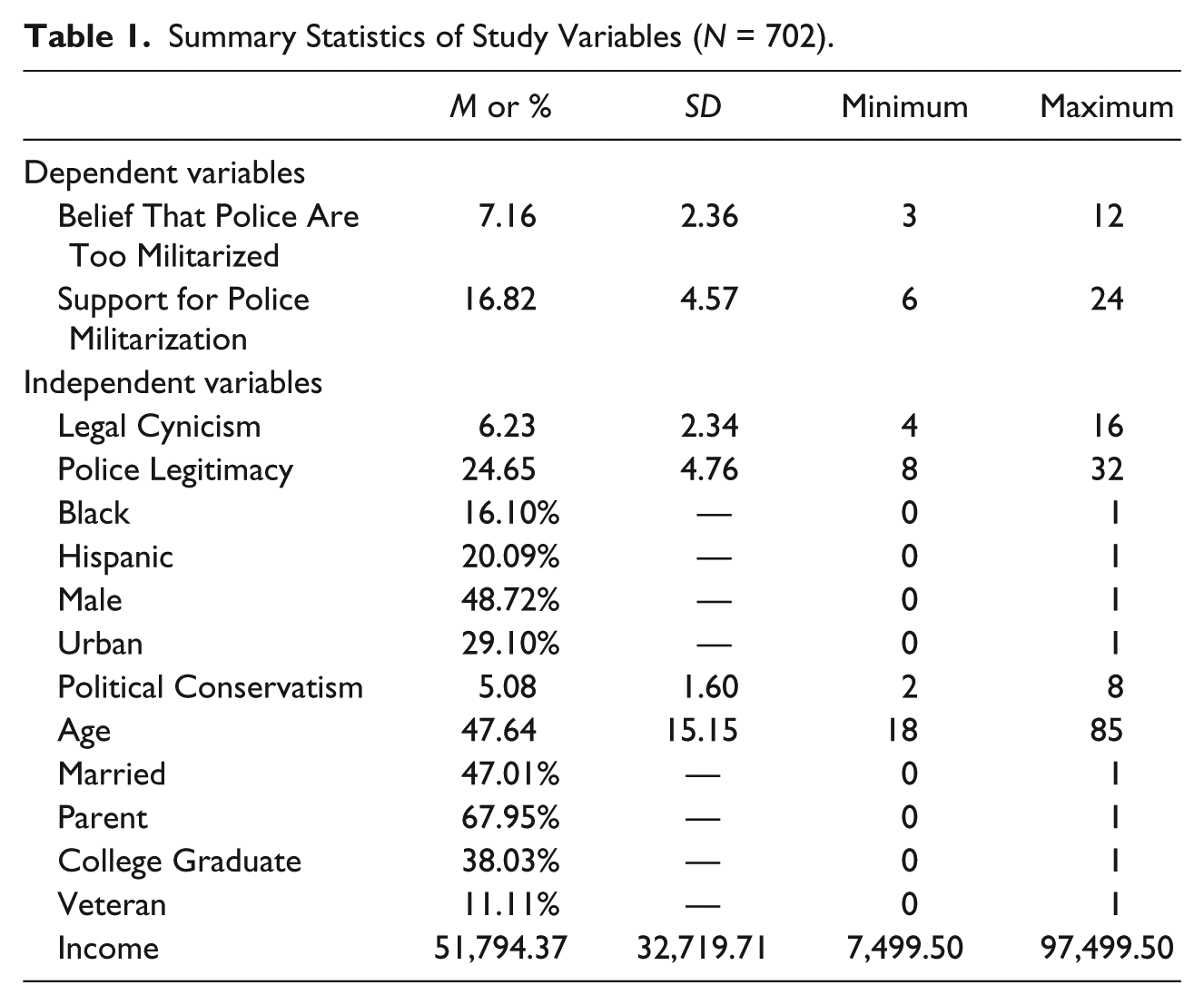
Among the key theoretical constructs of legal cynicism and police legitimacy, it appears that, in general, the public tends to have low levels of legal cynicism (M = 6.23) and a relatively high belief in the legitimacy of the police (M = 24.65). As the sample comprises adults, this is to be expected (Brown & Benedict, 2002; Tyler, 2006). With respect to demographics, approximately 16% of the sample were Black, 20% identified as Hispanic, and the remaining 63% were Non-Hispanic Whites. Approximately 49% of the sample was male. The average respondent was nearly 48 years of age, but ages ranged from 18 to 85 years. Most respondents lived in suburban or rural areas, whereas 29% lived in urban locations. There was a near-even split between high and low political conservatism among the respondents, with a median value of 5 and an average slightly above 5. Half of the sample was not currently married (52%), and two thirds of respondents (67%) had children. Roughly one third of the respondents (38%) had a college degree, 11% identified as current or former members of the U.S. armed forces, and respondent income averaged nearly US$52,000. Overall, the sample is demographically, geographically, and culturally diverse and is well suited for examining perceptions of police militarization.
Table 2 contains zero-order correlations between all study variables. The correlation matrix indicates that no multicollinearity is present between variables. Pearson’s r coefficients among independent variables do not exceed an absolute value of .48 (between income and married), well below the threshold indicative of multicollinearity (.7; see Hanushek & Jackson, 1977). Additional diagnostics were also conducted to ensure that multicollinearity would not bias regression estimates. Variance inflation factors did not exceed 1.28, below the conservative threshold of 2 (Fox, 1991). Condition indices approached but did not exceed 30, suggesting moderate levels of multicollinearity in the full models (Belsley, Kuh, & Welsch, 1980). This is likely due to the simultaneous presence of legal cynicism and legitimacy in the analysis. To temper concerns about any influence of multicollinearity on our results, we conduct analyses for each theoretical construct before evaluating their independent effects when included together in a regression.
Zero-Order Correlations Among Study Variables (N = 702).

p < .05.
Table 3 contains a series of OLS regressions predicting respondent perceptions of police being too militarized and presents both unstandardized and standardized coefficients. 9 Model 1 contains only respondent demographic characteristics, with subsequent models incorporating theoretical variables of interest. As Model 1 shows, we find little evidence of demographic differences regarding beliefs that police are too militarized; being older (b = −.02, p < .01) and more conservative (b = −.37, p < .001) were negatively related to these perceptions, whereas residing in an urban area (b = .40, p < .05) increased these perceptions. Model 2 adds legal cynicism into the regression, with results indicating cynicism increases perceptions that police are too militarized (b = .27, p < .001). Model 3 introduces police legitimacy into the regression, finding that it exerts a negative, significant effect on public perceptions (b = −.14, p < .001). Finally, Model 4 incorporates both legal cynicism and legitimacy into the regression simultaneously. Both constructs exert significant effects on respondent perceptions, in directions consistent with earlier models. Furthermore, the standardized beta coefficients indicate that the relative contribution of each construct on the dependent variable is nearly the same, albeit in opposite directions. Notably, political conservative continues to exert negative effects on the belief that police are too militarized, even when other theoretical constructs are introduced into the models. We next examine support for police militarization among respondents.
OLS Regressions Examining Correlates of Belief That Police Are Too Militarized (N = 702).

Note. OLS = ordinary least squares.
p < .05. **p < .01. ***p < .001.
Table 4 regresses support for police militarization on individual and demographic characteristics of respondents. As in the previous table, Model 1 contains only demographic characteristics. Being older (b = .05, p < .001) and more conservative (b = .80, p < .001) correspond with more support for police militarization, whereas being Black (b = −1.80, p < .001) reduces support for militarization. As Model 2 demonstrates, legal cynicism has no effect on support for militarization. Model 3 introduces legitimacy into the regression; legitimacy has a positive effect on support for police militarization (b = .47, p < .001). The relative contribution of legitimacy to support for police militarization is pronounced, and its inclusion nearly doubles the amount of variance explained in the model, compared with Model 1 (.20-.39). Notably, the incorporation of legitimacy into the regression model renders the effect of being Black statistically insignificant. Model 4 accounts for both legal cynicism and police legitimacy, with findings consistent with previous models. Throughout the models in Table 4, age and political conservatism have persisting, positive effects on support for police militarization. 10 Overall, these regressions allow us to answer our third research question; legitimacy and legal cynicism do influence perceptions of militarization, though somewhat inconsistently. We reserve discussion of these findings for the following section. 11
OLS Regressions Examining Correlates of Public Support for Police Militarization (N = 702).

Note. OLS = ordinary least squares.
p < .05. **p < .01. ***p < .001.
Discussion
Considering the civil unrest and the police response seen in Ferguson, MO, and elsewhere across the United States in recent years, police have been increasingly scrutinized by the media, policy makers, and community stakeholders. Some of this scrutiny has focused on police militarization. Indeed, in the past few years, even Presidents Obama and Trump weighed in on this very issue through executive orders (Goldman, 2017; Korte, 2015). Prominent stakeholders have contended that militarization and public perceptions of police are related, although this suggestion was largely speculative. Kraska and Cubellis (1997) suggested that heartfelt beliefs would influence how the public felt regarding militarization, although two decades after their seminal work little research has considered public sentiments toward police militarization. This study drew from the legal socialization literature to consider the effects of legitimacy and legal cynicism on perceptions of police militarization. A series of OLS regressions using a national sample of 702 American adults examined beliefs that police are too militarized and support for police militarization. Results warrant four broader points of discussion.
First, there is meaningful variation in perceptions of whether the police are too militarized and support for militarization. Baseline demographic evaluations (see Model 1 in Tables 3 and 4) demonstrate that some of this variation is a function of urban residence, age, or being Black. Two-way interaction terms found few conditional effects between race, age, gender, and urban residence (see Note 10). Further subsample analyses, particularly among Black or Hispanic respondents, or the use of more complex interaction terms is beyond the scope of this study due to sample size requirements needed for such subanalyses. This is a necessary trade-off in the use of a national sample. Future research would do well to consider oversampling race- or age-specific subsamples to help increase the sample needed to conduct analyses on the interaction of being young, urban, Black, and males on support for police militarization. In addition, gathering qualitative information on the specific experiences of those individuals would help to further understand the etiology and influences on perceptions of militarization. In short, research focusing on the experiences of individuals and communities who would be expected to be most likely to encounter police militarization, such as young, urban, Black men, would be worthwhile (e.g., Balko, 2013; Radil et al., 2017).
Second, the legal socialization literature appears to influence these perceptions. Consistent with Tyler’s (2006) process-based model, legitimacy is a strong, positive correlate of support for police militarization. When individuals view the police as more legitimate, they are more supportive of militarization. In contrast, legal cynicism has some negative effects on perceptions of police militarization. Higher levels of cynicism correspond with stronger beliefs that police are too militarized. It is important to note that the race effects present in Table 4—that Blacks are less supportive of militarization —disappear once legitimacy is accounted for. In other words, it appears that the overall support for police militarization by Black Americans is lower, as beliefs in police legitimacy among Blacks also tend to be lower. This finding comports with past research showing Blacks are less supportive of police because they do not trust them (Brunson, 2007; Carr et al., 2007; Gau & Brunson, 2010; Tyler & Huo, 2002). This suggests that the negative experiences Black Americans may have with police could lead to lower levels of legitimacy (compared with Whites; Tyler, 2006), which consequently relates to lower willingness to support aggressive policing strategies or tactics, such as militarization. These results also reinforce the importance of legitimacy for police and for police to cultivate legitimacy among the public if they want buy-in regarding militarization or other practices (Huq et al., 2017; Tyler, 2004). This appears to be especially true for garnering the support of minority citizens.
Taken together, these findings demonstrate that reduced support for, or opposition to, militarization and related practices cannot, and should not, be reduced to “anti-police” mentalities or cultures (e.g., Mac Donald, 2016). Rather, they are a largely a function of legitimacy. Results lend some credence to the suggestion by the President’s Task Force on 21st Century Policing (2015) regarding a link between legitimacy and militarization. That said, if militarization is to have negative consequences for perceptions of police, consistent with the suggestions of the President’s Task Force on 21st Century Policing (2015), it appears that strong selection effects are present and must be accounted for. It is worthwhile to continue teasing out the nuances of public perceptions of militarization. Our findings raise questions about where the public draws lines regarding the acceptability of police practices and whether there is consistency regarding aggregate (e.g., “police militarization” as a global construct) and situation-specific (e.g., deployment of SWAT for particular activities) police practices or behaviors (see Lockwood et al., 2018). Moving forward, further exploring the features that influence and distinguish between support and opposition to militarization and continuing to refine questions and methodologies in the study of militarization should be priorities for researchers.
In addition to legitimacy and cynicism, we also found robust, consistent effects of political orientation on belief that the police are too militarized and support for police militarization. Individuals who are more conservative are less likely to believe that the police are too militarized and are more supportive of practices associated with militarization. Prior research highlights the positive effects of conservatism on perceptions of police (e.g., Benson, 1981; Cao, Stack, & Sun, 1998; Zamble & Annesley, 1987). We see two fruitful avenues for further exploring the link between conservatism and perceptions of militarization. Silver and Pickett (2015) recently elaborated on how different types of conservatism influence perceptions of police behavior; extending their methods regarding the measurement of conservatism and how types of conservatism influence perceptions of militarization would be worthwhile. Another avenue would be examining the extent to which conservatism overlaps with the core normative values suggested to be relevant for institutional legitimacy (e.g., Mehozay & Factor, 2017). Given the current political and social divides witnessed in the United States, and their association with institutions including the police and government, these considerations may be especially relevant for future research on militarization.
Third, our findings regarding beliefs that the police are militarized have relevance for the process-based model of policing (Tyler, 2006). Police legitimacy consistently reduced beliefs among the public that law enforcement was too militarized, while cynicism increased such a belief. The latitude garnered by legitimacy (or inhibited, in the case of legal cynicism) does not merely influence the public’s willingness to empower police; it appears that these characteristics also influence whether the public even believes particular practices or trends exist in the first place. Kraska and Kappeler (1997, p. 2) suggested that militarization reflected the development of an “iron fist” within a “velvet glove” of community policing, or practices meant to enhance legitimacy among the public (Moore, 1992). Legitimacy would, in turn, shield agencies from criticism related to militarization. Our results offer tentative support for this suggestion and highlight a consequence of legitimacy that should be examined in future research (see also MacCoun, 2005). Furthermore, as legitimacy appears to act as a “psychological anchor” for evaluations and perceptions of law enforcement (Tyler, 2006), future research should also consider the mechanisms that link legitimacy to these perceptions of police.
Fourth, these findings have important implications for police practices. There are certainly instances where the acquisition and use of surplus military weapons and equipment or advanced surveillance technologies by police are warranted and appropriate, such as active shooter or hostage situations. Given the rarity of these situations, however, moving forward, law enforcement executives may wish to reconsider whether the use of equipment or tactics associated with militarization are justified (President’s Task Force on 21st Century Policing, 2015). If executives are able to articulate specific needs or justifications for use of equipment, they will be better able to address negative press or a skeptical public. In addition, recent evidence suggests police executives believe that effective, rather than procedurally just, policing promotes citizen cooperation, particularly in high-crime areas (Nix, 2017). Our results suggest police should be cognizant of the effects of legitimacy for empowerment by the public. We then necessarily reiterate the need for law enforcement to work to cultivate legitimacy through procedurally just practices.
This study is not without limitations. Consistent with the suggestion by Kraska and Cubellis (1997), we examined whether legitimacy and cynicism—two heartfelt individual beliefs—influence perceptions of militarization. Reciprocal influences between perceptions and these constructs are beyond our research design. Nonetheless, these variables behaved largely as expected, and past research on legal socialization and empowerment has also been cross-sectional. Second, contextual features also influence perceptions of police (Reisig & Parks, 2000; Weitzer, 1999), and there is good reason to believe context plays a role in shaping views about militarization. We expect that structural characteristics influence perceptions through the theoretical pathways used here. Third, there are other possible explanations for perceptions of militarization, including cultural (racial animosity, xenophobia; Unnever & Cullen, 2010; Wang, 2012), instrumental (fear of crime, government distrust), and more general beliefs and concerns which should be explored further (Nagin & Telep, 2017). There are also other technologies (e.g., long-range acoustic devices; Moynihan, 2017) available to police that were not examined, but should be the focus of future research. These limitations notwithstanding, this study is a necessary baseline assessment of how the public feels about police militarization.
In additional to these theoretical considerations, methodological concerns regarding the use of online samples must also be noted. Online samples are both a time- and cost-effective way for conducting social science research. Although convenience samples from online platforms are known to underrepresent minority individuals, it has been suggested that one of the best ways to combat this (as we do here) is through the use of survey panels where specific sample characteristics can be requested by researchers (e.g., Heen et al., 2014). In their comparison of online sampling platforms, Heen and colleagues (2014) found these platforms were able to provide samples within a 10% range of the actual population. An additional concern of online surveys is that they may be vulnerable to inattentive respondents hurrying through the survey (Oppenheimer et al., 2009). To guard against this, instructional manipulation checks (IMC) were included to identify suspect responses and exclude respondents who failed any checks. Alternative survey methods, such as the phone survey conducted by Lockwood and colleagues (2018), examining militarization have yielded similar results to ours, leading us to have confidence in our results. Nonetheless, there is a pressing need for both replication of our findings and additional research into public perceptions of militarization.
Overall, in the wake of Ferguson and in the absence of good data, anecdote and speculation seem to dominate discussions of contemporary policing practices and the communities that law enforcement serves (Shjarback, Pyrooz, Wolfe, & Decker, 2017). This study sought to bring data to bear on public perceptions of police militarization, a topic that has not been exempt from this trend (President’s Task Force on 21st Century Policing, 2015). To be clear, national conversations about both the causes and consequences of police practices, including militarization, necessarily require the input of the public. The events of Ferguson and elsewhere over the past few years have cast a long shadow, and understanding the ramifications of those events for both American police and the public is important. We encourage our colleagues to continue exploring these ramifications, including unpacking the complicated concept and topic of police militarization.
Footnotes
Appendix
Factor Analysis of Study Scales.

| Scales and items | Pattern loading | ||||
|---|---|---|---|---|---|
| 1 | 2 | 3 | 4 | 5 | |
| Legitimacy | |||||
| Trust in Police | |||||
| Most officers do their job well |
|
−.037 | −.020 | .084 | .068 |
| I respect police and their authority |
|
−.140 | −.113 | −.046 | .084 |
| I trust police officers |
|
−.036 | .062 | −.024 | .104 |
| I am confident in law enforcement |
|
−.009 | .062 | .007 | .105 |
| Police officers act professionally |
|
−.039 | −.014 | .058 | .081 |
| Police can be trusted to make decisions that are best for my community |
|
.024 | .104 | −.014 | .225 |
| Obligation to Obey | |||||
| You should accept police decisions, even if you think they are wrong | .331 | .195 | .052 | −.010 |
|
| You should do what the police tell you even if you disagree | .266 | .085 | −.137 | −.048 |
|
| Legal Cynicism | |||||
| It is okay to do anything you want | .085 | −.013 |
|
.012 | −.026 |
| There are no right or wrong ways to make money | −.015 | .022 |
|
−.086 | −.131 |
| Laws are meant to be broken | −.125 | .097 |
|
.144 | .044 |
| A person has to live without thinking about the future | .081 | −.076 |
|
−.067 | −.006 |
| Support for Police Militarization | |||||
| Law enforcement should be able to use surplus military weapons (e.g., assault weapons—AR-15/M4, and submachine guns—MP5) | −.173 |
|
.040 | −.008 | .209 |
| Law enforcement should be able to use surplus military (e.g., BearCat armored personnel carrier, and mine-resistant ambush-protected vehicle [MRAP]) | −.141 |
|
−.005 | −.019 | .163 |
| Law enforcement should be able to use surplus military equipment (e.g., computers, tools, generators, etc.) | −.026 |
|
−.054 | .058 | .055 |
| Law enforcement should be able to wear military-style uniforms | −.052 |
|
.040 | .037 | .144 |
| Law enforcement should be able to use drones and robots in their tactical operations | .190 |
|
−.004 | −.022 | −.240 |
| Law enforcement should be able to use technology to track cell phone locations (e.g., Stingray) | .390 |
|
−.027 | −.044 | −.297 |
| Law enforcement should be able to use automatic tracking and identification technologies (e.g., facial recognition software, license plate readers) a |
|
|
−.031 | .009 | −.338 |
| Belief That Police Are Too Militarized | |||||
| The line between the military and policing in the United States is too blurry | .047 | .159 | −.083 |
|
−.021 |
| Law enforcement in the United States appears too much like the military | .055 | −.084 | .040 |
|
−.028 |
| Law enforcement in the United States acts too much like the military | −.045 | −.087 | .029 |
|
−.023 |
| Eigenvalue | 7.995 | 2.571 | 1.899 | 1.461 | 1.05 |
Note. Pattern coefficients greater than an absolute value of .40 are given in bold.
Omitted from final scales due to cross-loading.
Acknowledgements
We thank the editor, Paul Tracy, and the anonymous reviewers for their useful comments and suggestions on previous versions of the manuscript. George Burruss, John Cochran, John Shjarback, Fred Turner, Faith Gifford, Scott Allen, and Bradley Stone each provided valuable feedback on the paper for which we are grateful.
Declaration of Conflicting Interests
The author(s) declared no potential conflicts of interest with respect to the research, authorship, and/or publication of this article.
Funding
The author(s) received no financial support for the research, authorship, and/or publication of this article.