




Abstract
This study used national-level two-wave longitudinal data from school principals (N = 850) to examine whether and the extent to which implementing school resource officers (SROs) with varying role profiles related to changes in crime recorded in schools and reported to police. We identified three common role profiles of SROs: Low Engagement, Full Triad, and Reactionary. Implementing SROs engaged primarily in law enforcement (i.e., Reactionary SROs) predicted increases in recording nonserious violent and property crimes and a decrease in reporting drug crime to the police, respectively. Implementing Full Triad SROs who were also engaged in additional roles (e.g., mentoring) predicted a reduction in recording nonserious violent crimes, but an increase in recording property crimes and reporting crime to law enforcement.
Although violent crime in schools has declined since the 1990s, school safety still remains a prevalent concern as many schools experience crime occurring on school grounds. In 2015, the violent victimization rate in schools was 21 per 1,000 and 23% of students reported being in a physical fight indicating that school crime and misbehavior remain an issue (Musu-Gillette, Zhang, Wang, Zhang, & Oudekirk, 2017). Although school crime is an important outcome on its own, the prevalence of these crimes may result in further negative outcomes such as disrupting the learning environment and producing fear and avoidant behaviors (Musu-Gillette et al., 2017; Randa & Wilcox, 2012).
One of the many initiatives to reduce school crime is the use of school resource officers (SROs). SROs are sworn police officers assigned to a school or school district and are typically charged with maintaining physical safety in the school. SROs are a relatively expensive intervention, with the estimated annual cost of each officer exceeding US$90,000 in one state (Kupchik, 2016). There has been a nationwide increase in the presence of school security personnel (including but not limited to SROs) since the 1990s. In the 1996-1997 school year, 10% of all public schools nationwide reported having police or other law enforcement representatives stationed at the school for at least 1 hr during the week (Kaufman et al., 1998). By the 2013-2014 school year, however, 43% of public schools had one or more security guards, security personnel, SROs, or other sworn law enforcement officers (Musu-Gillette et al., 2017). Thus, the partnership between law enforcement and educational agencies has grown markedly, funded by hundreds of millions of taxpayer dollars spent on SRO usage.
There is limited knowledge about the effectiveness of SROs in preventing school crime and the extent to which SROs facilitate the reporting of school crime incidents to the justice system. Studies assessing the effects of SROs typically focus on the mere presence or absence of SROs. However, this approach masks important variability in the actual roles and functions of SROs within schools. The largest professional organization of SROs—the National Association of School Resource Officers (NASRO)—notes that SROs’ roles vary considerably across schools depending on a variety of factors including the needs of the school, the personality of the SRO, and the working relationship between the SRO and school administration (Canady, James, & Nease, 2012). In an effort to describe SROs’ roles, NASRO’s triad model categorizes SROs’ roles into three broad categories: teaching, informal counseling, and law enforcement (Canady et al., 2012). However, not all SROs engage in these roles in the same ways (Finn, Shively, McDevitt, Lassiter, & Rich, 2005). Therefore, identifying common combinations of SROs’ roles may be a useful step for understanding the effects of SROs on schools. As such, the purpose of this study is to identify common profiles of SROs’ roles and to examine the impact of implementing SROs with varying role profiles on school crime outcomes.
Theoretical Perspectives
The logic of using SROs as a mechanism to reduce school crime rests on assumptions of rational actor models. Opportunity theories of crime suggest that the presence of SROs will reduce the opportunity for school crime to occur. For example, routine activity theory suggests that crime occurs when there is a confluence in time and space of a motivated offender, a suitable target, and a lack of capable guardianship (Cohen & Felson, 1979). SROs are expected to act as capable guardians whose presence decreases the likelihood that crime will occur. Similarly, deterrence theory suggests that individuals are less likely to commit crimes when they are more certain that they will be caught (Becker, 1968; Jensen, 1969; Piliavin, Gartner, Thornton, & Matsueda, 1986). Because SROs can patrol school property, their presence may deter crime by increasing perceptions of certainty. Students may consider the SRO in the calculation of potential costs of committing crimes because of direct or vicarious experiences with the officer. For example, if students observe others in the school being arrested or otherwise sanctioned by the SRO, these vicarious experiences may contribute to their decisions on whether to offend (Matsueda, Kreager, & Huizinga, 2006).
Other theoretical perspectives, however, suggest that SROs may not be effective deterrents and may actually have punitive and criminogenic effects in schools. For example, Kupchik and Monahan (2006) suggest that the use of SROs blurs the lines between schools and the justice system and facilitates the outsourcing of school discipline to formal institutions such as the juvenile courts. Similarly, Hirschfield (2008) indicates that SROs and other mechanisms of surveillance and crime control may contribute to the criminalization of students, thereby preparing them for future incarceration. Responding to incidents in this way may create a negative school environment which may lead to negative expectancy effects and more offending. Therefore, theoretical expectations relative to the effects of SROs on school crime are inconsistent and suggest that there may be some degree of variability in SRO effects across schools. One source of this variability may be the different roles that SROs play in schools.
Roles of SROs
In line with the NASRO triad model, Brown (2006) describes the roles that SROs serve as manifest and latent functions. Manifest functions include the law enforcement activities most often associated with the role of traditional police officers. These activities include addressing crime and disorder, patrolling school grounds, conducting investigations, performing sweeps for weapons and drugs, and making arrests (James & McCallion, 2013; Thomas, Towvim, Rosiak, & Anderson, 2013; Travis & Coon, 2005). Latent functions include additional activities such as teaching and mentoring. Teaching may include lecturing in classrooms on topics such as law enforcement, conflict resolution, and violence prevention (Kupchik & Bracy, 2010; Lawrence, 2007). Mentoring or counseling functions can vary widely from informal interactions in the hallways, providing students with advice, coaching a sports team, to helping students and families navigate the juvenile and/or criminal justice systems (Travis & Coon, 2005).
Several studies have examined the roles of SROs across different samples, finding substantial variability in what SROs do. Although SROs primarily serve as law enforcers (Rhodes, 2015). a considerable number of SROs served additional roles as well (Travis & Coon, 2005). For example, in addition to law enforcement functions, many officers also serve a teaching function, lecturing on topics such as alcohol awareness and conflict resolution as well as mentoring functions including helping students with court involvement and providing referrals to services. In a series of case studies of SRO programs, Finn and colleagues (2005) found that the average amount of time spent on various activities across the study sites varied widely, highlighting the diversity in roles across different school contexts.
However, these studies have only investigated whether or with what frequency SROs engage in individual roles; little attention has been given to identifying patterns of roles that are particularly common. Identifying these patterns of roles is likely a useful undertaking for multiple reasons. First, SROs do not only perform one role in a given school. Instead, they engage in multiple roles to address their numerous responsibilities. Thus, understanding profiles of SRO roles rather than focusing on single roles is a closer approximation of reality. Second, combinations of roles may have different effects on crime. For example, SROs who develop a rapport with students via mentoring and teaching may detect more crime through these conversations (Kupchik, 2010), but positive interactions through these activities may also lead students to conform to the behavioral expectations of the SROs (Hirschi, 1969).
Impacts of SROs by Roles
Currently, very little research has addressed the effects of SRO roles on outcomes related to school crime. Devlin and Gottfredson (2018) looked beyond the mere presence of SROs to assess whether school crime outcomes differed in schools with SROs that served a law enforcement only role and those who also taught or mentored in comparison to schools without SROs. The findings indicated that schools with law enforcement only SROs recorded more crimes than non-SRO schools, and more serious violent/weapon/drug crimes than schools with mixed approach SROs. Furthermore, schools with mixed approach SROs reported more crimes to police than law enforcement only schools. Although this study addressed SROs’ roles as they relate to school crime, it used a dichotomous measure of SROs’ roles that only examined whether they engaged in activities beyond law enforcement; this may be insufficient given the variety of roles and activities in which SROs engage (James & McCallion, 2013; Thomas et al., 2013; Travis & Coon, 2005). Examining how law enforcement and non–law enforcement roles co-occur is likely a valuable approach to build on these findings.
In this vein, one line of reasoning suggests that the presence of SROs may increase the incidence and detection of crime in schools. This notion is supported by qualitative work that suggests that the school environment becomes more punitive and more closely linked to criminal justice systems with the presence of SROs (Devine, 1996; Hirschfield, 2008; Kupchik, 2010; Kupchik & Monahan, 2006; Nolan, 2011). One potential explanation for this is that the presence of SROs may weaken students’ social bonds to the school and may consequently contribute to an increase in delinquency (Devine, 1996; Hirschi, 1969; Nolan, 2011). Along these lines, Theriot (2016) found that more interactions with SROs were associated with a decreased sense of school connectedness. Similarly, other research shows that students in schools with security personnel reported having poorer relationships with their teachers than students in schools without security personnel (Fisher, Gardella, & Tanner-Smith, 2019). As such, when SROs engage in roles beyond their law enforcement duties, more interactions between students and SROs may occur, potentially weakening student bonds to the school resulting in more crime.
In addition to the effects that SRO roles may have on actual crime, they may also increase the detection of these behaviors. Some research has indicated that SRO presence is associated with an increase in recorded crime (Na & Gottfredson, 2013), but it is unknown whether this is an increase in incidence or detection. Certain role profiles may affect the likelihood of crime detection. For example, if an officer serves as a teacher or mentor, students may seek their advice about an incident without realizing that this information could potentially be used against them (Petteruti, 2011). In addition, some SROs’ roles allow them to build relationships with students to use them as informants to increase detection (Kupchik, 2010). McDevitt and Panniello (2005) reported that students were more comfortable with SROs when they viewed them more positively and, thus, may be more likely to report crimes to SROs (Tyler & Fagan, 2008). Students may feel more comfortable reporting crime to SROs who serve roles beyond just law enforcement. Thus, SROs engaged in teaching and mentoring may effect crime detection differently from those only serving as law enforcers. Alternatively, SROs that focus primarily on law enforcement could also lead to increased detection if these SROs engage in more aggressive practices and searches than officers who spend more time teaching or mentoring. Further assessing the impacts of SRO role profiles may lead to an improved understanding of whether and in what circumstances more crimes occur and are reported to the police.
Current Study
This study builds on the existing SRO research while addressing some of the gaps in the literature. For example, although several studies have identified which individual roles of SROs are most common in schools, this study expands on these descriptive findings by identifying patterns of SRO roles that commonly occur together and linking those patterns to school crime outcomes. To our knowledge, this is the first study to assess SROs’ role profiles and link those role profiles to outcomes related to school crime, and it does so using national-level longitudinal data. This study addresses the following research questions:
Method
Data Source and Participants
The data used in this study come from restricted use versions of multiple waves of the School Survey on Crime and Safety (SSOCS), a nationally representative cross-sectional survey completed by school administrators (e.g., principals). This survey addressed several components relevant to school safety, including written policies and procedures for dealing with emergencies, addressing students’ crime and misbehavior, school security measures, and many other related constructs. For this study, we drew on data from the 2003 to 2004, 2005 to 2006, 2007 to 2008, and 2009 to 2010 versions of the SSOCS. The restricted use version of the SSOCS includes school identifiers that allowed us to link schools that were sampled in multiple waves. As such, we created a two-wave longitudinal data set by merging data from individual waves in schools that were sampled in more than one wave. Some schools appeared in three of the four waves of the SSOCS; in these cases, we randomly selected two waves to include in the data set. This process of merging cross-sectional data sets over time yielded a two-wave longitudinal data set of 850 schools, including 90 that added SROs between Time 1 and Time 2.
Measures
Dependent variables
The first outcome of interest was the number of recorded school crime incidents at Time 2. Similar to prior research (Devlin & Gottfredson, 2018; Fisher, Higgins, & Homer, 2019; Na & Gottfredson, 2013), crimes were grouped into categories including nonserious violent crime, property crime, serious violent crime, weapon crime, and drug crime. Nonserious violent crime consisted of person offenses of a lower level of severity including physical attacks without a weapon and threats of physical attacks with or without a weapon. Property crime consisted of theft and vandalism. Serious violent crime consisted of rape, sexual battery other than rape, robbery with or without a weapon, and physical attack with a weapon. Weapon crime consisted of possession of a knife or sharp object and possession of a firearm or explosive device, and drug crime include distribution, possession, or use of illegal drugs or alcohol. These crime type categories matched those of previous research to ensure adequate comparisons. Descriptive statistics for these crime categories and their constituent variables are displayed in Table 1. The second outcome of interest was the number of crimes reported to police across each of the crime categories at Time 2.
Composition of and Descriptive Statistics for Crime Categories (N = 850).

Note. All sample sizes are rounded to the nearest 10 to comply with Institute of Education Sciences (IES) restricted data use requirements.
Independent variables
The main independent variables consisted of the role profiles of the SROs. This focus on role profiles extends existing work on SROs’ roles (Devlin & Gottfredson, 2018) beyond a dichotomy of whether SROs engaged in activities beyond law enforcement to an empirically derived classification of role profiles that offer a more descriptive assessment of the roles of SROs with a given profile. The data for these role profiles came from school administrators in schools that implemented SROs between Time 1 and Time 2 (n = 90) who provided information about the responsibilities and functions these officers served. Although additional schools had SROs at Time 2, only the schools that implemented SROs between Time 1 and Time 2 were part of the treatment group, so only their data were used for identifying role profiles.
Administrators were asked to report whether (0 = no, 1 = yes) the officers participated in the following activities: (a) security enforcement and patrol, (b) maintaining school discipline and safety, (c) coordination with local police and emergency team, (d) identifying problems in the school and proactively seeking solutions to those problems, (e) training teachers and staff in school safety or crime prevention, (f) mentoring students, and (g) teaching a law-related education course or training students (e.g., drug-related education, criminal law or crime prevention course).
To identify these role profiles, we used latent class analysis (LCA). LCA is a mixture modeling approach that identifies common profiles based on a set of dichotomous dependent variables—in this case, the seven variables that addressed SROs’ roles. All LCA models were fit using Mplus 7. We ran five different LCA models ranging from a two- to six-class solution. We then compared the fit statistics (i.e., Akaike information criterion [AIC], Bayesian information criterion [BIC], sample size-adjusted BIC) of each model to identify the best fitting model, also examining the profiles identified in the various models to assess which models were substantively sensible. However, the fit statistics were not consistent in which class fit the data best. As such, we examined and interpreted each of the two-, three-, four-, and five-class solutions. The three-class solution was the most readily interpretable, and we therefore opted to use this model for our subsequent analyses. After identifying these three latent classes, we examined the predicted probability of each observation’s membership in each of the three latent classes. The entropy value of .98 indicates a high degree of separation among the classes, meaning that there was very little ambiguity in the class to which each school belonged. The modal predicted probabilities were used to assign each observation to one of the three identified role profiles, which we then interpreted based on the likelihood of SROs in each role profile to engage in each of the seven activities. Figure 1 graphically displays the results of this three-class LCA model, depicting the proportions of SROs in each of the latent classes that engaged in each of the seven activities.
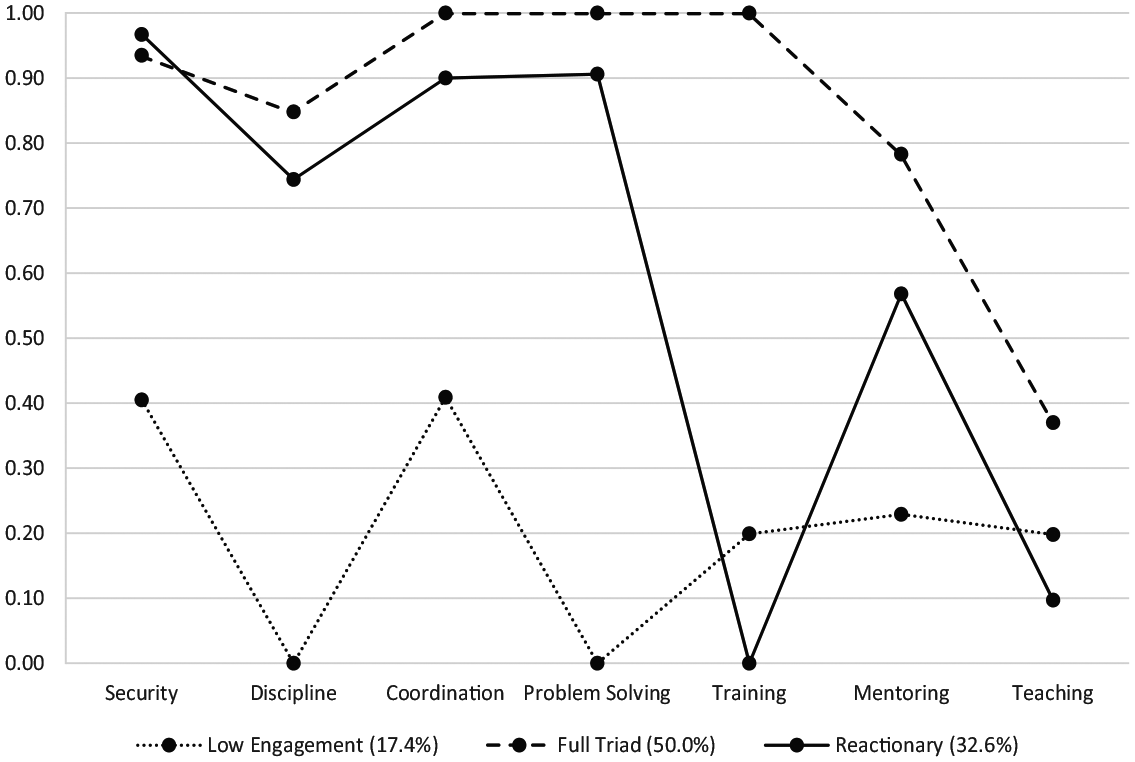
Role profiles of school resource officers by likelihood of engaging in each of seven roles (n = 90).
We named the first role profile Low Engagement (17.1% of the sample). This role profile was characterized by SROs who were reported to infrequently engage in each of the seven activities. This ranged from 0% of the SlROs maintaining school discipline and problem solving to 41% maintaining school security and coordinating with local law enforcement. The second role profile—Full Triad (50.0% of the sample)—demonstrated high levels of engagement across all activities. The Full Triad SROs were more likely to be engaged in each of the seven activities than SROs in either of the other two role profiles with only one exception. Only 37% of the Full Triad SROs taught classes (which was the highest percentage across all latent classes), but three quarters of the Full Triad SROs engaged in each of the other activities. The third role profile was named Reactionary (32.6% of the sample) because of these SROs’ high level of engagement in activities related to responding to crime, but low level of engagement in more proactive activities such as teaching, training, or mentoring. Specifically, Reactionary SROs were similar to Full Triad SROs in their likelihood to maintain school security, student discipline, coordinate with local law enforcement agencies, and participate in problem solving, whereas their involvement in training, mentoring, and teaching was lower.
Control variables
Several variables were used in the analyses to control for potentially confounding factors. First, we used the lagged measure of the dependent variable, the year of the first survey wave, and the number of years between waves. In addition, we used a series of variables that characterized the school, its constituent students, and the surrounding community. These included three continuous variables: (a) percent students limited English proficient, (b) percent special education students, and (c) percent students below 15th percentile in standardized tests. There were also six sets of dummy variables: (a) indicators of whether the school had an SRO present at no waves, both waves, or only the first wave; (b) percent minority students (less than 5%, 5%-20%, 20%-50%, 50% or more); (c) urbanicity (city, urban fringe, town, rural); (d) school size (<300; 300-499; 500-999; 1,000+); (e) school level (elementary, middle, secondary, combined); and (f) crime where the school is located (high; moderate; low). In addition, we controlled for the presence of a set of 20 school security measures that may have served functions similar to the SROs as spatial guardians or crime deterrents. These include the presence (Yes/No) of school practice to require visitor check in, access controlled locked/monitored doors, grounds have locked/monitored gates, students pass through metal detectors, random metal detector checks on students, closed campus for lunch, random dog sniffs for drugs, random sweeps for contraband not including dog sniffs, required drug testing for athletes, required drug testing for students in extra-curricular activities, required drug testing for any students, required uniforms, practice to enforce a strict dress code, provide school lockers to students, require clear book bags or ban book bags, require students to wear badge or photo ID, require faculty/staff to wear badge or photo ID, security camera(s) monitor the school, provide telephones in most classrooms, and provide two-way radios to any staff.
Analytic strategy
Following the identification of the SROs’ role profiles, we examined the relationship between implementing SROs with various role profiles and each of the outcome variables in the study. Our focal predictor in this set of analyses, therefore, was a set of dummy variables for each role profile with the reference value being the nonaddition of SROs. We then ran a series of zero-inflated negative binomial regression models predicting the recording and reporting of school crime. These models included the full set of control variables listed above. In all zero-inflated negative binomial models, we used the same set of predictors in the count equation unless otherwise specified in the tables. These analyses were conducted using Stata 14.
Results
We first examined sample characteristics for each of the four SRO categories: No SROs Added, Low Engagement, Full Triad, and Reactionary. The only significant differences in school characteristics across the four categories were in school size (schools that added Low Engagement SROs were smaller), the use of locked/monitored doors (schools that added Reactionary SROs used them more), a policy mandating clear or no book bags (schools that added Reactionary SROs used this more than schools that did not add SROs), and the use of student ID badges (schools that added Reactionary SROs used them more than schools that did not add SROs or schools that added Low Engagement SROs).
Next, we present the findings from the models predicting recorded crime and reported crime. For the zero-inflated negative binomial regression models, we only report on the part of the regression models that modeled the count of recorded or reported crimes; the results from the binary model are not presented given that the focus of this study was not on the presence or absence of crime, but on the amount recorded or reported.
Recorded Crime
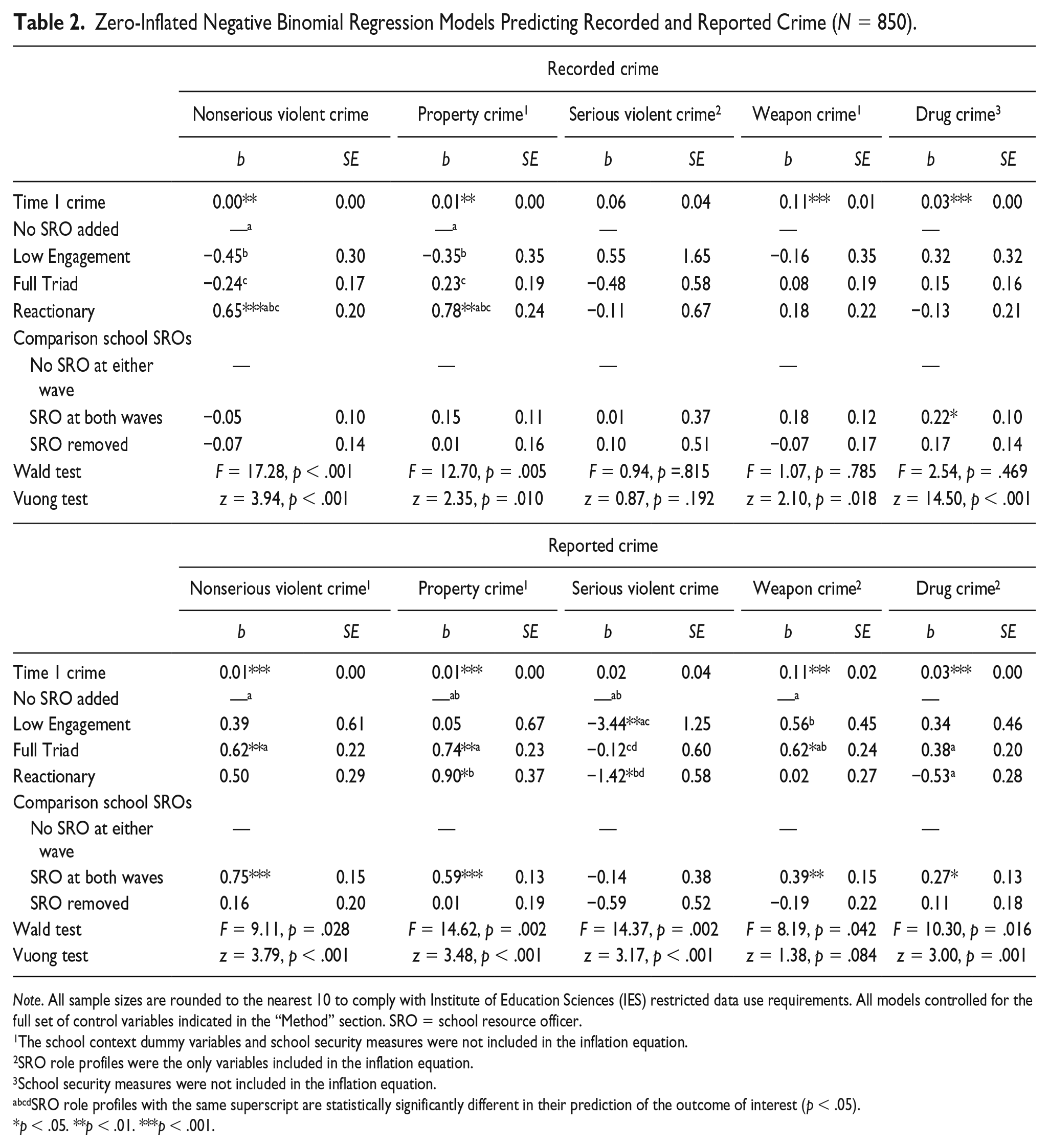
Recorded crime was the first outcome examined using a series of zero-inflated negative binomial regression models (see the top panel of Table 2). We used Wald tests that examined whether contrasts among each of the four levels of the SRO role profile variable were jointly equal to 0. Across these models, the only significant Wald tests were for the models predicting nonserious violent crime (Wald F = 17.28, p < .001) and property crime (Wald F = 12.70, p = .005). Specifically, this model showed that schools that implemented Reactionary SROs recorded significantly more nonserious violent crimes (b = 0.65, p = .001, 95% confidence interval [CI] = [0.25, 1.04], incident rate ratio [IRR] = 1.91) than schools that implemented Low Engagement SROs (b = −0.42, p = .156, 95% CI = [−1.01, 0.16], IRR = 0.64), Full Triad SROs (b = −0.24, p = .165, 95% CI = [−0.57, 0.10], IRR = 0.79), or schools that did not implement SROs (reference group). That is, relative to schools that did not implement SROs, among schools that recorded nonserious violent crime, schools that implemented Reactionary SROs increased the number of recorded nonserious violent crimes by 91% whereas schools that implemented Low Engagement or Full Triad SROs decreased the number of recorded nonserious violent crimes by 36% and 21%, respectively.
Zero-Inflated Negative Binomial Regression Models Predicting Recorded and Reported Crime (N = 850).
Note. All sample sizes are rounded to the nearest 10 to comply with Institute of Education Sciences (IES) restricted data use requirements. All models controlled for the full set of control variables indicated in the “Method” section. SRO = school resource officer.
1The school context dummy variables and school security measures were not included in the inflation equation.
2SRO role profiles were the only variables included in the inflation equation.
3School security measures were not included in the inflation equation.
SRO role profiles with the same superscript are statistically significantly different in their prediction of the outcome of interest (p < .05).
p < .05. **p < .01. ***p < .001.
Similarly, schools that implemented Reactionary SROs recorded significantly higher levels of property crimes (b = 0.78, p = .001, 95% CI = [0.31, 1.25], IRR = 2.18) than schools that implemented Low Engagement SROs (b = −0.35, p = .316, 95% CI = [−1.04, 0.34], IRR = 0.70), Full Triad SROs (b = 0.23, p = .230, 95% CI = [−0.14, 0.60], IRR = 1.26), or schools that did not implement SROs (reference group). That is, relative to schools that did not implement SROs, among schools that recorded property crime, schools that implemented Reactionary SROs increased the number of recorded property crimes by 118% whereas schools that implemented Low Engagement SROs decreased the number of recorded property crimes by 30% and schools that implemented Full Triad SROs increased the number of recorded property crimes by 26%. There were no differences among SROs’ role profiles in recording serious violent, weapon, or drug crime. Together, these models indicated that schools that implemented Reactionary SROs recorded more nonserious violent and property crimes.
Reported Crime
The bottom panel of Table 2 displays the model results predicting crime reported to police with the full set of controls added. All five models had significant Wald tests, including the models predicting nonserious violent crime (Wald F = 9.11, p = .028), property crime (Wald F = 14.62, p = .002), serious violent crime (Wald F = 14.37, p = .002), weapon crime (Wald F = 8.19, p = .042), and drug crime (Wald F = 10.30, p = .016). The model predicting nonserious violent crime showed that schools that implemented Full Triad SROs reported significantly more nonserious violent crimes to the police (b = 0.62, p = .004, 95% CI = [0.19, 1.06], IRR = 1.87) than schools that did not implement SROs (reference group). Schools that implemented Full Triad SROs reported 87% more nonserious violent crimes to police than schools that did not implement SROs.
A similar pattern was evident in the model predicting property crime such that schools that implemented either Full Triad SROs (b = 0.74, p = .001, 95% CI = [0.30, 1.19], IRR = 2.11) or Reactionary SROs (b = 0.90, p = .014, 95% CI = [0.18, 1.62], IRR = 2.47) reported more property crimes to the police than schools that did not implement SROs (reference group). That is, schools that implemented Full Triad SROs reported 111% more property crimes to the police than school that did not implement SROs and schools that implemented Reactionary SROs reported 147% more property crimes to the police than school that did not implement SROs.
The model predicting serious violent crime showed that schools that implemented either Low Engagement (b = −3.44, p = .006, 95% CI = [−5.89, –0.99], IRR = 0.03) or Reactionary SROs (b = −1.42, p = .015, 95% CI = [−2.57, –0.28], IRR = 0.24) reported significantly fewer serious violent crimes to police than schools that either implemented Full Triad SROs (b = −0.12, p = .841, 95% CI = [−1.32, 1.07], IRR = 0.89) or did not implement SROs (reference group). That is, relative to schools that did not implement SROs, schools that implemented Low Engagement SROs reported 97% fewer serious violent crimes to police and schools that implemented Reactionary SROs reported 76% fewer serious violent crimes to police. There was not a statistically significant difference in serious violent crime reporting rates between schools that implemented Full Triad SROs and schools that did not implement SROs.
The model predicting weapon crime showed that schools that implemented Full Triad SROs (b = 0.62, p = .010, 95% CI = [0.15, 1.08], IRR = 1.85) reported significantly more weapon crimes to police than schools that implemented Low Engagement SROs (b = 0.56, p = .211, 95% CI = [−0.32, 1.44], IRR = 1.75) or schools that did not implement SROs (reference group). That is, schools that implemented Full Triad SROs reported 85% more weapon crimes to police than schools that did not implement SROs whereas Low Engagement SROs reported only 75% more weapon crimes than schools that did not implement SROs.
Finally, the model predicting drug crime showed that schools that implemented Full Triad SROs (b = 0.38, p = .057, 95% CI = [−0.01, 0.78], IRR = 1.47) reported significantly more drug crimes to police than schools that implemented Reactionary SROs (b = −0.53, p = .055, 95% CI = [−1.08, 0.01], IRR = 0.59). That is, schools that implemented Full Triad SROs reported 47% more drug crimes to polices relative to schools that did not implement SROs (although this difference was not statistically significant) whereas schools that implemented Reactionary SROs reported 41% fewer drug crimes to police relative to schools that did not implement SROs (although this difference was also not statistically significant). Together, the findings from these five models consistently showed that schools that implemented Full Triad SROs had among the highest rates of reporting crimes of all types to the police. The pattern of findings for the other SRO role profiles was less consistent.
Discussion
Understanding the effects of implementing SROs in schools is a question of interest for researchers, policymakers, practitioners, and community members alike. This study identified three empirically derived subtypes of SROs and examined how these different role profiles may be differentially associated with outcomes related to school crime. The three role profiles included Low Engagement, Full Triad, and Reactionary SROs and extend prior work on SROs’ roles that categorized them as either “law enforcement only” or “mixed approach” (Devlin & Gottfredson, 2018). Instead, this study found that SROs across all three role profiles were likely to be engaged to varying degrees in roles both related to law enforcement and beyond. Although there is variability in SROs’ activities within each role profile, they provide a useful heuristic for understanding SROs’ overall approaches to their roles and responsibilities in schools.
The findings indicated that there were meaningful differences in recorded crime when implementing SROs with different role profiles. In particular, the schools that implemented Reactionary SROs—in comparison to schools that implemented any other type of SRO or did not implement SROs—recorded more nonserious violent crimes and property crimes. This finding is consistent with previous literature indicating that schools with SROs who have a law enforcement focus recorded more nonserious violent crimes (Devlin & Gottfredson, 2018) and may help explain findings from other studies indicating that the mere presence of SROs increases the recording of highly interpretable offenses such as disorderly conduct (Theriot, 2009). In the current sample, it is likely that there was a difference in recording nonserious violent and property crime outcomes compared with other crime types because these crimes may be more subjective and school authorities—including SROs—are likely to have more discretion in how to address these behaviors. It is unlikely that they are able to use a similar level of discretion in cases of weapon or drug possession or sexual battery, especially if schools have zero tolerance policies targeting these types of offenses. In addition, schools with Reactionary SROs may record more nonserious violent and property crimes due to increased detection. Given that Reactionary SROs are more law enforcement focused, they may detect and record more nonserious violent and property crimes. Although Full Triad SROs also engaged in law enforcement activities, their additional roles may prevent these less severe crimes or they may respond to these incidents in less formal ways resulting in fewer recorded incidents.
These findings call into question the appropriateness of opportunity theories as they pertain to SROs preventing crime and in schools. For instance, routine activity theory suggests that SROs should reduce crime by their mere presence because they offer capable guardianship (Cohen & Felson, 1979). Therefore, one would expect to see a reduction in school crime across all SRO types. However, there were different patterns of results for each role profile, suggesting that the guardianship provided by the mere presence of SROs is not a sufficient explanation. Instead, consistent with social bonding theory (Hirschi, 1969), implementing Full Triad SROs that engaged in more activities related to relationship building in addition to their law enforcement duties showed the largest reduction in crime whereas implementing SROs that acted as law enforcers without as much opportunity for relationship building (i.e., Reactionary SROs) showed the largest increase. Because of the limited opportunity to develop personal relationships, students may have viewed Reactionary SROs as unfair and untrustworthy relative to Full Triad SROs, and thus were less invested in behaving in ways that elicited their approval.
Even though more nonserious violent and property crimes were recorded by schools that implemented Reactionary SROs, the findings regarding schools’ reporting of these crimes to police was somewhat different. Schools that implemented Full Triad SROs were consistently the most likely to report crimes to the police. This is somewhat striking given that these schools were less likely than schools that implemented Reactionary SROs to record nonserious violent and property crimes in the school. Similarly, even though there was no change in the number of serious violent, weapon, or drug crimes recorded by schools regardless of the role profile of the SRO implemented, Full Triad SROs had the highest reporting rates.
One potential explanation for this finding is that the decision about which offenses to report to the police often lies with school authorities. Although some SROs may be more likely to use their discretion to record certain behaviors as nonserious or property crimes, either would have gone unnoticed or would not have been deemed criminal incidents by school administrators, the authority to decide the next steps is likely the school administrators. Prior research has speculated that school authorities who see SROs interacting with students in a teaching or mentoring capacity are more likely to involve the police because they may see trusting relationships developing through these additional activities (Devlin & Gottfredson, 2018). In this study, even though schools that implemented Reactionary SROs recorded consistent or higher levels crime, the school authorities may not have reported these crimes to police because they may not have observed trusting relationships in place. Therefore, Full Triad SROs are likely to generate stronger social bonds with students than SROs who are purely reactionary and school administrators may be more likely to refer incidents to law enforcement after seeing police in that light.
School authorities may also have more trust in Full Triad SROs due to an increase in police legitimacy and procedural justice. People are more likely to perceive the police as being legitimate when they act in procedurally just ways such as allowing citizens to provide their side of the story, making unbiased decisions, establishing trust, and showing respect (Paternoster, Brame, Bachman, & Sherman, 1997; Tyler, 2004; Tyler & Fagan, 2008). School administrators may feel that Full Triad SROs are more legitimate authorities if they establish trust and show respect by mentoring students and developing a rapport with them as well as teaching policing and law-related concepts to explain how police officers make decisions. As a result, it is likely that school administrators who witness Full Triad SROs engaging in activities that increase procedural justice and police legitimacy feel more comfortable reporting incidents to law enforcement agencies than school administrators who only see Reactionary SROs responding to incidents.
In addition, given that some crime types showed no statistically significant change in recording, but significant increases in reporting to the police, this study lends some support to the contention that SROs contribute to the outsourcing of school discipline to criminal justice systems (Hirschfield, 2008; Kupchik & Monahan, 2006), at least for the particular offenses measured in this study. However, there may be multiple pathways at play here. First, there may be an indirect effect as Reactionary SROs record more crimes that are handled in-house rather than referred externally. These incidents may have instead resulted in disciplinary actions such as suspensions or expulsions which may have a variety of negative consequences such as academic achievement, school dropout, offending, and involvement with the justice system (Cook, Gottfredson, & Na, 2010). Ultimately, Reactionary SROs may indirectly contribute to the school-to-prison pipeline through an increase in detection of incidents. Conversely, Full Triad SROs frequently reported no increases in recorded crime, but had higher levels of reporting crime to the police. Having a trusted member of a local law enforcement agency in the school may have strengthened the connection between the school and the justice system, thereby increasing school administrators’ willingness to involve the justice system.
Policy Implications
As schools continue to find ways to reduce crime, SROs are likely to continue to be a meaningful part of those efforts. The findings from this study suggest that it is worth focusing on the roles and functions of SROs. In particular, Reactionary SROs seem especially problematic, with higher recorded levels of nonserious violent crime compared with schools that added different sorts of SROs and non-SRO schools. Given that Reactionary SROs likely only interact with students during responses to problem behaviors, they do not have many opportunities to establish trusting relationships. As a result, students may not be particularly interested in conforming to the SROs’ expectations. However, implementing Full Triad SROs showed a reduction in schools’ recording of crime. Full Triad SROs looked similar to Reactionary SROs in the extent to which they responded to crime, but they also participated in training, teaching, and mentoring, affording them more opportunities to potentially build relationships with other members of the school community outside the context of responding to problem behaviors.
Drawing on Hirschi’s (1969) social bonding theory, we speculate that these relationships are a key part of the relatively beneficial outcomes associated with implementing Full Triad SROs though future research should confirm that the mechanism through which Full Triad SROs influence positive outcomes is building trusting relationships. As such, it may be beneficial for SROs to receive training related to relationship building with students. Prior research has suggested that hiring SROs that enjoy children and youth is important (Finn et al., 2005); we suggest that explicitly fostering these personality-related proclivities via formal training would provide SROs with additional tools to build positive relationships with students that appear to be beneficial for reducing crime. Similarly, schools and law enforcement agencies may find it beneficial to include SROs’ relationships with students as a meaningful and measurable outcome of interest when evaluating SROs and determining which officers should serve as SROs.
Across all the outcomes of interest, schools that added Low Engagement SROs were only distinguishable from schools that did not add any SROs in one model (i.e., predicting reporting serious violent crime to police)—they did not show an increase in crime as did schools with Reactionary SROs nor did they show an increase in reporting to police as with Full Triad SROs. This finding is particularly relevant for policymakers and practitioners who view the mere presence of SROs as an effective way of reducing school crime; this study suggests that hiring SROs who are more disengaged from the school is unlikely to move the needle on the outcomes measured here. Although this finding may be a factor of the relatively small sample of Low Engagement SROs (n = 20), it is consistent with social bonding theory that stresses the importance of relationships (Hirschi, 1969). Given that SROs are a relatively expensive intervention, it may be worth critically examining whether having Low Engagement SROs is worth the cost.
One of the main conclusions that we have drawn from this study is that SROs seem to be the most beneficial when they engage in activities that may help to build positive relationships with students. However, this may be a double-edged sword in that the same SROs who engage in activities that are likely to foster these positive relationships seem also more likely to contribute to an outsourcing of discipline that has the potential to criminalize students. It is recommended that training be provided for both SROs and school administrators regarding the outsourcing of discipline. Full Triad SROs and school administrators may benefit from training that provides them with resources to use as a response to incidents in schools rather than referring these incidents externally. Similarly, it may be useful to frame referrals to law enforcement as a last resort after exhausting all other disciplinary options within the school itself.
Limitations
This study’s findings should be interpreted in light of its limitations. First, similar to previous research, this study could only measure the amount of crime recorded and reported to police. Because one of the explicit functions of SROs is law enforcement, we cannot rule out the possibility that SROs increase the level of crime detection, regardless of the extent to which actual criminal behaviors changed. For example, it is possible that students actually engaged in fewer nonserious violent crimes after Reactionary SROs were implemented, but the SROs were ambitious in their crime detection, facilitating an increase in recorded nonserious violent crime. Although recorded crime is an important outcome on its own right, it does not necessarily speak directly to the overall amount of criminal behavior in the school. Second, although the longitudinal data set was constructed from nationally representative samples in the SSOCS, the current sample was not nationally representative because some schools were sampled in multiple waves of the survey. These schools were larger, more urban, and had a higher proportion of secondary schools than a nationally representative sample. Third, it is possible that the observed effects of implementing SROs may be confounded with increasing rates of crime between the two waves included in the study. Because data were only available at two time points, this hypothesis cannot be tested. Fourth, the seven items we used to construct the SROs’ role profiles do not constitute the full range of SROs’ activities on a daily basis, but instead offer a broad perspective on what administrators reported that SROs did in their schools. Despite these limitations, the SSOCS is the only data currently available which include several measures of SRO activities and functions, different crime types, a wide variety of school characteristics, and the ability to assess a large number of schools across the country over time. The findings from this study will be useful for informing future research as more data become available.
Conclusion
Implementing SROs is both a common and expensive intervention in schools nationwide, and the existing research on the effects of implementing SROs has been largely inconsistent in its findings. This study examined one potential reason for this heterogeneity in prior research on SROs’ effects, suggesting that SROs’ different role profiles may be associated with different outcomes related to crime. Indeed, we found that implementing SROs was associated with a reduction in the recording of nonserious violent and property crime when the SROs were engaged in all three dimensions of the triad model: teaching, informal counseling, and law enforcement. However, they also contributed to an increase in reporting crime to law enforcement. However, implementing SROs that were generally uninvolved in the school or were primarily engaged in activities related to law enforcement yielded either increases in recorded crime or were no different from schools that did not add SROs. If SROs are going to continue to be a part of school safety efforts, this study suggests that a key mechanism of maximizing their benefits is SROs’ engagement with members of the school community in an effort to build positive and trusting relationships.
Footnotes
Declaration of Conflicting Interests
The author(s) declared no potential conflicts of interest with respect to the research, authorship, and/or publication of this article.
Funding
The author(s) received no financial support for the research, authorship, and/or publication of this article.
