



Abstract
A large body of research demonstrates the toll stress takes on police. However, with recent high-profile force incidents that have fueled distrust of police especially within minority communities, there is reason to expect that minority officers experience stress differently than their white counterparts. Within the context of Agnew’s (1992) General Strain Theory, this study examines the relationship between police stress and misconduct. As well, since a police stress/anger relationship has been found, we also analyze racial differences in the extent to which negative affect (anger) mediates the stress/outcome relationship. Using data from a survey of over 1,400 police officers working in three large cities in Texas, we find that stress is significantly related to officers’ acts of misconduct within both races. Moreover, there are noticeable differences in the role anger plays in the stress/misconduct relationship among white and minority officers.
Introduction
The extent to which people experience stress in the workplace varies by occupation. Regardless of whether such rankings come from news magazines, television programs, or surveys, policing is consistently ranked as one of the most stressful (and dangerous) occupations (Piquero et al., 2013; Strauss, 2017). One explanation is that police officers have to make instantaneous decisions, often without all the necessary pieces of information, in volatile situations. These decisions are influenced by a myriad of factors, many of which officers cannot control, including individual, situational, environmental, and organizational characteristics. Moreover, officer decisions are oftentimes second-guessed not only within their own organization but also by external constituents. The isolated and cumulative nature of these stressful experiences is also likely to churn up a range of emotions, including anxiety, anger, or depression—many of which may be negative or detrimental to the officers. Finally, many officers cannot simply “turn off” the stress when they leave the workplace, and stressors tend to affect their personal lives in negative ways, such as with personal and interpersonal relationship problems (see e.g., Burke, 2016). Moreover, police experience unique stress compared to other occupations (Brough, 2004; Ivie & Garland, 2011). As a result, it is important not just to study the experiences of—and reactions to—police stress among officers for prevention and intervention strategies that may help officers deal with stress in the workplace but also to consider the range of theoretical frameworks for understanding the stress-reaction process among police officers. One of the most promising frameworks that has been used to understand police stress is Agnew’s (1992) General Strain Theory (GST).
As a theory that focuses on negative experiences and consequences, GST examines the extent to which various sources of strain generate negative emotional reactions which, in turn, can lead to deviant and/or criminal coping strategies. It is not difficult to see how GST maps onto the experience of police stress, and a good knowledge base applying GST to police stress has started to emerge (e.g., Bishopp & Boots, 2014; Gibson et al., 2001; Moon & Jonson, 2012; Shim et al., 2015; Swatt et al., 2007). Prior police stress studies, to a degree, demonstrate the utility of GST as an explanation of conduct other than criminal behavior; in this case, deviance among police personnel. Yet, there remain several gaps in this line of work, especially with respect to how the stress-emotion process may play out in different ways within the population of police officers.
In this study, we pay specific attention to how the stress-emotion-behavior relationship postulated by GST plays out across race/ethnicity in a large sample of urban police officers.
There is ample reason to anticipate that minority officers may experience different types of police stressors, which may produce different types of emotions that are subsequently related to different coping actions. This is so because minority officers are typically underrepresented within police agencies and are also unequally assigned to poor or high crime areas that are disproportionately minority—but especially Black (Fyfe, 1981). Minority officers are also viewed by some within their own communities as being part of “them” rather than “us” and that cops are “essentially blue” where occupation outweighs racial identity (see e.g., Brunson & Weitzer, 2009; Weitzer, 2000, p. 322). 1 In this way, officers may be enforcing laws and policies that have historically been over-imposed on the minority communities, which serves to undermine the legitimacy and favorable view of police (see Brunson, 2007). As a result, citizen perceptions of officers may also vary according to the officer’s race, and this view may also affect police-citizen encounters in non-constructive ways (see Peck, 2015; Weitzer, 2002). By focusing on the role emotions play in the stress/behavior relationship, the current study reveals important information about how certain behaviors manifest among police officers.
Before we present the results of our investigation, we first provide a broad overview of the main findings from the police stress literature. This is followed by an overview of Agnew’s GST as well as the empirical research emanating from it, with specific attention paid to its applications in the police stress literature. We then present the results of our study and conclude with some thoughts for theory, policy, and future research.
Key Findings from the Police Stress Literature
Sources of Police Stress
A wealth of empirical evidence documents the stressful nature of policing (e.g., Abdollahi, 2002; Webster, 2013). Constant public scrutiny, erratic shift work, and exposure to violence and trauma take their toll on police officers, as do the many policies, procedures, laws, and ordinances officers must abide by during the course of their careers (e.g., Amaranto et al., 2003; Violanti et al., 2016). Police also work in a constantly changing environment. Staff and leadership changes lead to unpredictability. Altercations with the public are becoming ever more sensitive. In light of all these concerns, researchers have identified four main sources of police stress: police work itself, the police organization, the criminal justice system, and the public.
Policing is not the most dangerous profession (Piquero et al., 2013), but it does contain a unique array of stressors that are different from and may exceed that of other occupations (Gächter et al., 2011). Among these intrinsic stressors, exposure to violence (and even the mere prospect of violent encounters) is arguably the most salient (Hartley et al., 2011), particularly in terms of mental and emotional health (Bishopp & Boots, 2014; Chopko, 2010; Pasillas et al., 2006). It can also affect physical health (Hartley et al., 2011) and job performance (Arnetz et al., 2009). The threat of violence notwithstanding, officers must make decisions that have serious negative consequences for the people involved, and they are frequently put in situations involving pain, crime, poverty, and citizens in despair. These sources of stress are often amplified by the fact that officers are forced to make split-second decisions (Crank & Caldero, 1991).
Violence, though, is relatively rare in policing (Hickman et al., 2011; Komarovskaya et al., 2011). Organizational stress is something most officers face more often (Aaron, 2000; Morash et al., 2006). Paperwork, “red tape,” and a lack of input into the decision-making process can cause stress, as can promotional practices, supervision, disciplinary regulations, and other departmental policies (Adams & Buck, 2010; Crank & Caldero, 1991; Shane, 2010; Violanti & Aron, 1995). Police officers are also expected to maintain higher personal and moral standards than members of the public, aggravating the situation (Storch & Panzarella, 1996). This even extends to off-duty settings, meaning stress can be a 24/7 affair in policing (Hickman et al., 2001).
Beyond police organizations, the criminal justice system can create another source of stress. For example, a Cincinnati study found that 56% of officers reported courts as stressful (Kroes et al., 1974), with the prospect of giving court testimony being particularly stressful (Sigler et al., 1991). Even the corrections system can be a source of stress for police officers, as some officers perceive that it cannot effectively rehabilitate criminals and releases offenders back into the community without serving sufficient time. For example, a perception also exists that certain parole officers are overly tolerant and allow parolees to commit multiple violations before being re-incarcerated (Kroes et al., 1974).
Finally, interacting with the public is a key source of stress in policing. As one officer observed, “Anytime you deal with the public they have certain images, stereotypes, and expectations of you. . . . Most people aren’t happy to see the police, as it is usually some sort of negative contact” (Crank & Caldero, 1991, p. 345). Indeed, Kroes et al. (1974) found that 22% of the officers interviewed were bothered by the public’s apathy and lack of support for the police, while 16% identified the police officer’s negative image as stressful. The problem persists to this day—and may well be getting worse. As Shjarback et al. (2017, p. 49) reported: This is a challenging time for American police. Officers now find themselves in a “social media era of policing” where many of their actions are potentially captured on video, uploaded to websites, live streamed, and viewed by millions of people.
Prior research on police stress has treated the phenomenon as largely universal, that is, affecting all police officers the same way. Some researchers have studied gender variations in police stress (e.g., Bishopp & Boots, 2014; Haarr & Morash, 2013; Menard & Arter, 2014). Others have conducted cross-national comparisons or analyzed samples of police officers from other countries (e.g., Menard & Arter, 2014; Yun et al., 2015). Rarely, however, have researchers examined the effect of officer race on police stress and related outcomes.
General Strain Theory and Police Stress
Recognizing problems with the more macro-based versions of strain theory, Agnew (1992) set out to conceptualize the theory at the social-psychological level by focusing on the negative experiences—and the reactions to those experiences—that persons may face. These strainful experiences take on one of three broad forms: (1) failure to attain positive goals (i.e., failed an important exam), (2) presentation of noxious stimuli (i.e., subject to physical abuse), and (3) removal of positive stimuli (i.e., death of a parent). Experiencing these strains, especially if they are cumulative and enduring, is hypothesized to generate negative emotional reactions, including, for example, anger, anxiety, rage, and depression. According to GST, persons cope with the experience of these emotions with strategies that may take the form of criminal or non-criminal behavior—contingent upon whether persons have social support (and other) moderating mechanisms.
Applying GST to policing is appropriate because of the nature and expectations of the job. Starting with the three types of strainful experiences, police officers may perceive that they may not be reducing crime and disorder or they may not pass a promotion test to attain the next highest rank—both of which could be examples of the failure to attain positive goals. With respect to the presentation of noxious stimuli, they may be assigned to shifts and/or beats that are un-pleasant due to specific locations and times that are difficult or they may be assigned a new partner that they do not care for very much. And with respect to the removal of positive stimuli, officers may be given a new assignment that takes them away from one that they enjoyed. All of these stressful experiences are specific events that may happen during the course of their jobs and exist above and beyond the legal and organizational pressures that they experience simply as a function of their profession. Not surprisingly, therefore, it has been reported that police officers suffer from various negative emotions due to their job and strains experienced from performing their duties, including in particular depression, which also has been found to be related to negative coping strategies and behaviors (see e.g., Gershon et al., 2009; Hartley et al., 2007; Patterson, 2003).
Policing researchers have exploited GST to examine police behavior and found evidence supporting a key aspect from the theory; when exposure to strain results in negative emotions, deviant behaviors increase. For instance, Moon and Jonson (2012) found that GST explained less organizational commitment, while others found that stress among certain personnel within an agency experience differential strains (Arter, 2008). Researchers also recognize that mechanisms within policing are prominent sources of stress. For example, using data from three large agencies in Texas, Bishopp and his colleagues (2016, 2018) found that certain pressures within an organizational as well as on the street (i.e., environment) significantly affected negative emotions and behavior. The effect of stress in policing is not confined to the U.S. as prior research in South Korea (Yun & Lee, 2015), China (Wu et al., 2019), Pakistan (Husain, 2019), and Canada (Menard & Arter, 2014) has demonstrated the profound impact of stress on police officers no matter the cultural or social norms in which they do their jobs.
Yet, simply showing that there is stress in policing does not provide evidence of GST’s ability to explain certain behaviors among police. GST’s usefulness for examining stress effects among police—and consequently how mediation effects are measured—are found in the main tenets of GST: (1) Increased levels of stress are associated with higher levels of negative emotions (e.g., anger); (2) Negative affective responses to stress mediate the relationship between stress (e.g., noxious stimuli) and problematic behavior; and (3) The mediation effect should remain when controlling for potential confounders and demographics. In policing, this could include many negatively viewed events such as traumatic incidents, fatigue, internal investigation of misconduct, and so on. These strains increase the risk of an individual experiencing certain negative emotions (e.g., anger, anxiety, depression, etc.) thus increasing the likelihood that deviant/criminal behavior will occur.
Several studies applying GST to police stress and behavior have found support for various aspects of the framework such that negative emotions such as anger (Bishopp et al., 2018), depression, anxiety (Swatt et al., 2007; Yun & Lee, 2015), and burnout (Bishopp et al., 2018) have been found to mediate the role of strain on maladaptive outcomes. However, which negative affective response is the mediator differs depending on the type of strain experienced and ultimately the maladaptive coping strategy (Bishopp et al., 2016). Similar to the broader GST literature, anger has been found to be the negative affective response most consistently found to meditate police officers stress. The literature also supports GST by demonstrating that the negative affective emotions lead to maladaptive coping strategies.
Higher levels of negative affect often increase officers’ likelihood of engaging in maladaptive coping. For instance, Swatt and colleagues (2007) found that officers who had higher levels of anxiety/depression were more likely to engage in problematic alcohol consumption than those with lower levels. Another factor that influenced whether or not officers engaged in maladaptive coping strategies was social support. Even when negative affective emotions were present for officers, if they had social support from families, friends, or other officers they were less likely to engage in maladaptive coping strategies than officers without support (Kurtz et al., 2015; Swatt et al., 2007; Yun & Lee, 2015). As a whole, GST has been an effective framework for examining police officer stress and related coping strategies and easily lends itself to informing policy responses within an agency to help officers manage stress and the negative emotions that arise from stressful experiences.
General Strain Theory and Officer Race
When GST is applied to explain racial differences in maladaptive behaviors, it focuses on how groups experience disproportionate strain or have fewer resources to cope with strain in a conventional way (Kaufman et al., 2008). In non-police samples, GST has been utilized to examine racial differences in criminal offending among juvenile offenders (Piquero & Sealock, 2010) and other forms of maladaptive behaviors such as alcohol and substance use (Akins et al., 2010; Peck et al., 2018; Preston, 2006; Steele, 2016). There are several types of strain that have been associated with race and crime: economic strain, family strain, educational strain, criminal victimization, discrimination, and community strain (Kaufman et al., 2008). Studies using a racial/ethnic framework have found mixed support for GST.
Having applied GST to both police samples and different racial groups, it would make sense that a next step would consist of applying GST to police officers comprised of different races/ethnicities. In an early study, Dowler (2005) found that Black officers perceived themselves as being criticized more often than their white counterparts. Black officers also reported being perceived as more militant than whites. With relation to stress, Roth found that Black officers were actually less depressed about their work than whites. Interestingly, race had no effect on self-reported burnout. In a related study, Hassell and Brandl (2009, p. 423) found that “. . .those officers who have the greatest representation in the organization (white, male, heterosexual) have the most favorable workplace experiences while those individuals who have the least representation (minority, female, gay/bisexual) have the least favorable workplace experiences.”
In another study of gender and race effects, He et al. (2005) found that female officers reported higher levels of stress than males and, more important in the present context, that white male officers reported significantly higher levels of stress than African American officers (emphasis added, p. 542). Although the effect was not very strong, the racial differences were contrary to expectations. In addition, it could have been sample-specific, that is, a one-city sample of Baltimore police officers surveyed in 1999. He et al. (2005) concluded that dynamic factors such as the work environment were more influential with respect to stress than static factors like race and gender. Also examining gender and racial differences, Pole and his colleagues (2001) found small but significant ethnic group differences in self-reported post-traumatic stress disorder (PTSD) symptoms within a sample of urban police officers. Among their sample, Hispanic officers reported higher PTSD symptom levels than their Black and white counterparts. Concerning the differential mediating effects of negative emotions, Anderson and Lo (2011) specifically considered how occupational stress affected the likelihood that officers of different racial groups would use physical aggression against an intimate partner. Overall, their results provided support for GST. They found negative emotions significantly explained intimate partner violence for African American officers, whereas both negative emotions and authoritarian spillover accounted for intimate partner violence in white officers. White officers were also 59% less likely than nonwhites to engage in intimate partner violence. Anderson and Lo (2011) demonstrated that GST is an appropriate mechanism to examine racial differences in stress and coping with police officers. More research is necessary, however, as there is a need to further investigate the interrelationships between race, police stress, negative emotions, and adverse outcomes in a wide array of agencies.
Current Focus
Although research on police stress has a solid foundation, much less considered are theoretical frameworks that seek to better specify the types of stress officers experience, how those stressors are interpreted and reacted to, and whether these relationships and effects vary across race. This study attends to this issue within the context of Agnew’s General Strain Theory and with a large sample of officers in different types of agencies throughout the state of Texas.
Data and Methods
Data were collected via the Police Work Experience Survey (PWES). 2 Qualtrics (2012) software was used to deliver the PWES via e-mail to the sampling frame which was all of the sworn personnel for three large Texas police agencies. Sworn refers to each agency member who was issued a Texas Commission on Law Enforcement Officer Standards and Education license. 3 The cities represented in this study are three of the largest urban areas in Texas, each having a population of over 500,000. Potential respondents forming the sampling frame were provided by departmental records from each agency when the PWES was initially distributed in December 2012 and reminder emails were sent once a week from December 2012 to February 2013. The average response rate for the three cities was 23.1%. 4
Previous research from PWES data has added to literature on police suicide ideation, police misconduct, emotional correlates of anger, depression, and burnout (e.g., Bishopp et al., 2018). Past research has not, however, considered the extent to which the GST framework is general in the sense that it helps to explain the strain/negative emotions/adverse outcome set of relationships similar across race/ethnicity. Prior GST research has shown that there are a range of negative emotions affecting one’s behavior, but none more prominent than anger. Accordingly, this study examines the mediation effect of anger on the relationships between environmental strain (ES) and organizational strain (OS) and maladaptive coping techniques observed among white and minority urban police officers.
Dependent Variables
Maladaptive coping techniques in the form of two types of misconduct were examined in this study. The two improper behaviors are cursing, yelling or otherwise verbally abusing citizens and purposely using more force than necessary making an arrest. Such behaviors are those that, if discovered by supervisory personnel, would likely result in an internal investigation and/or disciplinary action (Wolfe & Piquero, 2011). Misconduct was originally measured as a scale item with responses ranging from never (1) to daily (7). From the original PWES sample, mean scores for verbal abuse and using unnecessary force were low (1.69 and 1.09, respectively) and were subsequently dichotomized. The new outcome variables were measured as 0 = never, 1 = at least once in the past 6 months.
Key Independent Variable
The PWES utilized scale items to examine environmental and organizational strains. Regarding environmental strain (ES), respondents were queried about serious street-related incidents that prior research has found significantly induces stress among police officers (see Crank & Caldero, 1991; Violanti & Aron, 1995). Considered under the umbrella of environmental strain, statements measured officers’ personal experiences in the past 6 months and included “felonious death of a police colleague,” “felonious assault/injury to yourself,” “felonious death of a citizen,” “severe but non-fatal injury to police colleague,” “had to shoot a person in the line of duty,” “killed someone in the line of duty,” “responded to any call involving an incident which resulted with the death of a child (i.e., a person younger than 12 years of age)”, and “used your TASER to subdue a suspect.” Responses ranged from never (1) to daily (7) and mean scores were 1.39 and 1.41 for minority and white officers, respectively.
Likewise, organizational strain (OS) variables were measured through a set of statements gauging the respondents’ personal experiences with stress due to various relationships within the agency. Through a series of seven items, officers were asked if in the past 6 months they felt stress from: “working overtime,” “working second jobs,” “fatigue,” “receiving negative comments from the public,” “dealing with supervisors,” “participating in court proceedings,” and “being involved in informal investigations (e.g., internal affairs review).” Response options ranged from (1) never to (5) always. The mean responses for the organization strain scale for each racial group were 2.16 and 2.30 for minority and white officers, respectively.
Mediating Variables
The PWES captured three emotions that have, in the past, been shown to correlate with difficulties in officers’ personal and professional lives: anger, depression, and burnout. Although prior GST research implicates all of these in the framework, empirical research tends to find the most support for anger as a negative emotion. This study focused on anger which consisted of a three-item scale that gauged officers’ feelings while on-duty over the past 6 months. Survey participants were asked to respond to “I got into a physical confrontation because I was angry,” “I was extremely angry,” and “I took my anger out on someone who did not deserve it.” The responses ranged from never (1) to more than six times (5) (α = .59).
Controls
Piquero and Sealock (2010) recognized that GST is useful for explaining the impact of key demographic variables on problematic behavior. The current study thus controlled for a number of demographic variables. The sample was predominantly male (83%) and white (60%). The minority sample consisted largely of Hispanic (25%) and Black officers (11%), the remaining 4% self-reported as Asian, Native American, or other. The PWES race and gender variables were representative of local police departments across the U.S. with populations of 500,000 or more (male = 83.6%, white = 59.8%) (Reaves, 2015). The earliest age that one could enter police training among the agencies represented by the sample was 19.5.
For the current study, gender (1 = male) was measured on each racial group with 78% of minority officers were male and 87% of the white officers were male. Mean ages for minority officers (4.71) and white officers (4.87). Age was coded in an ordinal manner and the model response was in the fourth category (41–45 years old) and was the same among white and minority officers. In each group, less than half of the officers (minority = 45%; white = 43%) were in a patrol function (Patrol = 1, non-Patrol = 0) with 55% and 57%, respectively filling non-patrol related positions including administrative, special operations (e.g., SWAT), and investigative units. 5 See Table 1 for descriptive statistics.
Descriptive Statistics of PWES Sample, by Respondent Race/Ethnicity.

Analytic Strategy
Using a stepwise modeling approach, a series of logistic regression models were estimated to test Agnew’s (1992, 2006) assertion that anger mediates the relationship between strain and deviant behavior. Building upon prior research (e.g., Moon & Jonson, 2012; Shim et al., 2015; Swatt et al., 2007) we posit that anger will mediate the relationships between the two types of strain and police deviance.
Although not without its critics, Baron and Kenny (1986, p. 1176) provide a useful blueprint to test mediation via three necessary hypothesis tests: (1) The independent variable affects the mediator; (2) the independent variable is significantly related to the dependent variable; (3) full model estimations demonstrate that the mediator significantly reduces the effect of the independent variable on the dependent variable; and (4) the mediator must be significantly correlated with the dependent variable. 6 Full mediation occurs when the relationship between the independent variable and the dependent variable is no longer significant when accounting for the mediator. However, when no significant relationships are observed between the independent and dependent variable, mediation by negative affective responses cannot be assessed. On the other hand, few studies in social science research find such consistent mediation effects. Partial mediation is assumed if, in the full model, the size of the independent variable decreases but remains significant, or the independent variable remains significant but the p-value diminishes (e.g., p < .001 to p < .05), or both. In fact, Baron and Kenny recognized that social behavior may have several causes and therefore suggested that a more realistic goal is to examine mediators that significantly decrease the independent/dependent variable relationship rather than eliminating it (p. 1176). 7
Supporting Baron and Kenny’s approach, previous analyses of the PWES data observed partial and full mediation effects of negative emotions on strain and maladaptive coping (Bishopp & Boots, 2014; Bishopp et al., 2018; Bishopp et al., 2016)—but this line of work has not considered race differences which is this study’s main focus. To examine mediation effects more closely, the current study takes an original look at the PWES data and applies two modeling techniques specifically used for testing partial mediation. Through stepwise regression modeling, this study assessed the mediation effect of anger in the strain and police misconduct relationships.
Results
Two-sample t-tests were conducted to compare mean differences for ES and OS between two race groups (white and minority). T-tests indicated that there was no significant difference in ES between whites and minorities, t(1,437) = –1.17, p = .25, but there was for OS t(1,437) = –3.59, p < .001, indicating that whites reported more stress than minority officers. We also combined strain as a cumulative measure of strain and compared mean differences between groups and found a significant difference, t(1,137) = –3.17, p < .01, again indicating that whites experience more cumulative strain than their minority peers. Concerning anger, t-test results indicated significant differences for each emotion between the two groups. Specifically, the difference of means in anger (t[1,431] = –2.56, p < .01) were significantly different indicating white officers experienced a greater level of anger.
Verbally Abusing Citizens
In Table 2, both strains significantly increased the odds of verbal abuse for minority (ES OR = 4.85 p < .001; OS OR = 1.77; p < .001) and white (ES OR = 3.69, p < .001; OS OR = 1.90, p < .001) officers. This means that among minority officers the odds of verbal abuse increased by 385% with each one-unit increase in ES and by 77% with each one-unit increase in OS. For white officers, the odds of verbal abuse increased by 269% with each one-unit increase in ES and by 90% with each one-unit increase in OS.
Mediating Effect of Anger on the Relationship between Strain and Verbal Abuse.
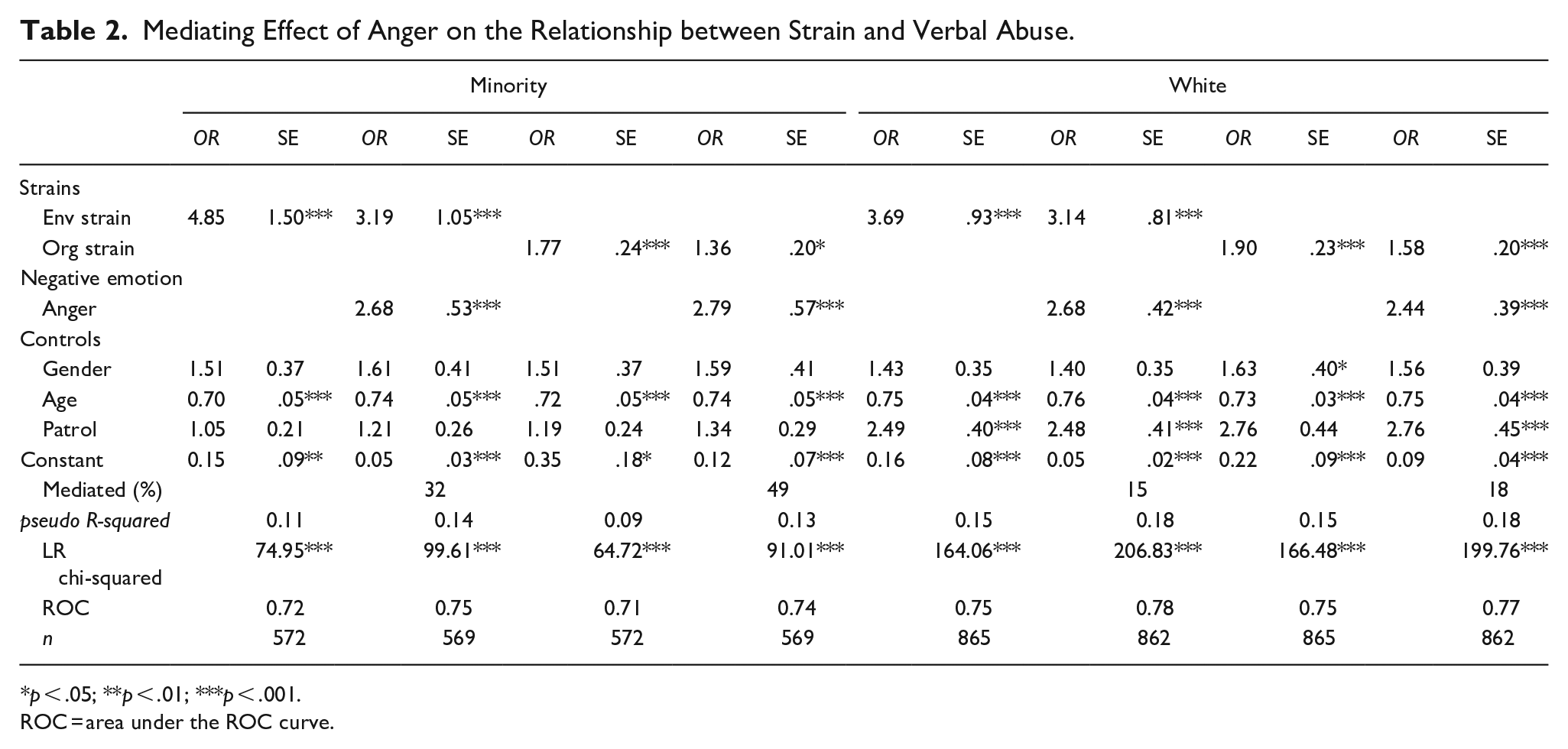
p < .05; **p < .01; ***p < .001.
ROC = area under the ROC curve.
Mediation effects in Tables 2 and 3 were assessed via Hicks-Tingley’s “medeff” command found in Stata 14 (StataCorp, 2015) which is an appropriate test for analyses of binary outcomes with continuous mediators (Hicks & Tingley, 2011). The first models for each type of strain were estimated sans negative emotion (anger) using logistic regression. The second model included the mediator, anger, thus were the full models. The “medeff” function estimates the impact causal mechanisms have on the relationship between independents variable and outcomes.
Mediating Effect of Anger on the Relationship between Strain and Use of Unnecessary Force.

p < .05; **p < .01; ***p < .001.
ROC = area under the ROC curve.
Utilizing the Hicks-Tingley method, Table 2 shows that the effect of anger for minority officers was statistically significant with about 32% 8 of the total effect of ES on verbal abuse being partially mediated (ES OR = 4.85; p < .001 vs. 3.19; p < .001) and approximately 49% of the effect of OS on verbal abuse was partially mediated (OS OR = 1.77, p < .001 vs. 1.36; p < .05). Analyses of white officers showed that the effect of anger was statistically significant with 15% of the total effect of ES on verbal abuse being partially mediated (ES OR = 3.69, p < .001 vs. 3.14; p < .001) and 18% of the total effect of OS on this type of misconduct was partially mediated (OS OR = 1.90, p < .001 vs. 1.58; p < .001). Results in Table 2, therefore, provide a nuanced view of the role negative emotion plays in the relationship between strain and misconduct and show that anger was able to partially mediate the effect of strain on verbal abuse for both white and minority officers but the effects of strain remained statistically significant though smaller with the inclusion of the significant effect for anger.
Using More Force than Necessary
Table 3 shows the mediation effect of anger on the strain/unnecessary force relationship. ES and OS increased the odds of using more force for minority (ES OR = 5.80, p < .001; OS OR = 1.61, p < .05) and white (ES OR = 4.44, p < .001; OS OR = 2.79, p < .001) officers. This means that each one-unit increase in ES and OS increased the odds of using unnecessary force increased among minority officers 480% and 61%, respectively. 9 For minority officers, anger was statistically significant with approximately 29% of the total effect of ES on using more force being partially mediated (ES OR = 3.62, p < .01). The effect of anger was statistically significant with as much as 78% of the total effect of OS on using more force and the OS coefficient was non-significant which indicates full mediation occurred (OS OR = 1.13, ns).
Among white officers, the first models for ES and OS show that strain increased the odds of using unnecessary force by 344% and 179%, respectively. Anger was significantly related to the outcome (ES OR = 4.34, p < .001). The negligible effect of anger on the relationship between ES and using unnecessary force suggests anger is directly related to using unnecessary force rather than acting as a mediator. The effect of anger was statistically significant with as much as 12% of the total effect of OS on using more force which indicates partial mediation occurred (OS OR = 2.52, p > .001). 10 As in Table 2, mediation effects in Table 3 models were assessed by utilizing Hicks-Tingley and results show that while anger is significantly related to unnecessary force for both racial groups it only partially mediated the independent effect(s) of strain in all but one relationship. Anger fully mediated the relationship between OS and unnecessary force for minority officers, but strain remained significant in all other models, though smaller in magnitude. 11
Discussion
There is little denying that police work is both difficult and dangerous. Officers encounter many stressors on a day-to-day basis, some of which are related to the police job on the street (environmental stress), while others are related to the police job in headquarters (organizational stress). It is also the case that officers react to these stressors in a variety of ways, but particularly within our sample with anger, and that these stressors may also influence how they cope. Within criminology, Agnew’s General Strain Theory explicates this set of interrelationships, linking strain to negative emotions to adverse coping behaviors. Using that model, the current study sought to contribute to the extant research by attempting to better specify the types of stress officers experience, how those stressors are interpreted and reacted to, and, most importantly, whether these relationships and effects vary across race. Using a large sample of officers in three different agencies throughout the state of Texas, we found regardless of race both environmental and organizational stress was significantly related to verbally abusing citizens and use of unnecessary force while making an arrest and that both types of stressors were related to anger, a result providing further evidence in support of the large body of GST research. It is important to note that counter to our expectation, we did not find many differences between white and minority officers.
Theoretically, our results offer support for GST, not just as framework that can help in understanding police stress and its reactions, but also as a framework that can help explain how, for the most part, police officers navigate their roles and situations and how they respond to the stress of the job. More importantly, these results provide important insight into policy and practice matters with respect to what they tell us about police officer experiences; largely that they appear, at least in our sample, to be more similar than different.
To be sure, it is hard to escape the stress that comes with being a police officer, not just the stress that emanates from their encounters with the public and criminals, but also the stress that is endemic to the organization that they work within. Much like professors in academia experience, these are stressors that are simply part of the job and they cannot be shielded from them. At the same time, the reactions to those stressors will sometimes be negative. Like people in other professions, police officers can become angry. The important difference, however, is that when police officers react in a deviant manner it could lead to the death or injury of a citizen or to the officers themselves; thus, how the officers react to those stressors is important. Do they lash out at other people? Do they lash out at themselves? Do they verbally or physically abuse citizens or family members? These are the types of outcomes that administrators within police agencies will want to diminish the likelihood of occurring. The implications of our results suggest that agencies working to increase mental health and/or diminish misconduct must understand that officers are susceptible to anger.
Before we further discuss implications of our work, we need to identify some limitations with our study. First, we examined two broad types of stressors that are endemic to the policing context. Future research should consider additional stressors—perhaps along the lines of certain assignments to certain beats and/or other types of strains that officers experience within their profession. Second, we only considered one negative emotion. While anger is central to both GST and the policing profession, other types of emotions may be worth considering such as fear and anxiety. Third, while we examined two serious forms of officer misconduct and coping strategies, they were decidedly negative in nature. Officers may cope in more positive ways (e.g., exercising, cooking, etc.). Next, we recognize that much like the use of positive coping mechanisms, misconduct may also be due to things that are not pressure-oriented. Only through additional data collection to include propensity and situational/opportunity factors would we be in a better position to adjudicate the merits of the GST argument compared to other theoretical correlates. Lastly, it is the case in police research more generally, getting officers to respond to surveys is not an easy task. Finding alternative ways of improving response rates would be helpful, especially since many of the findings obtained in this study are directly relevant to their well-being—and are invariant across racial groups.
Officer safety and wellness is critical for all police officers regardless of their race/ethnicity as well as for the agencies that they work for. It is no surprise, then, that the President’s Task Force on 21st Century Policing (2015) devoted a panel to the topic that specifically “considered the spectrum of mental and physical health issues faced by police officers from the day-to-day stress of the job, its likely effect on an officer’s physical health, and the need for mental health screening to traffic accidents, burnout, suicide, and how better to manage these issues to determine the length of an officer’s career” (p. 7). The Task Force laid out several recommendations in this area including more research into mental health, fitness, resilience, and nutrition (pp. 61–68).
One such example is a mindfulness training program led by researchers at the Center for Brain Health at The University of Texas at Dallas. According to developers of the program, participants in the program “will learn the science behind mindfulness and practice specific skills through guided mediation designed to enhance tactical decision-making, creative thinking, and real-time problem solving, all while regulating emotional responses to stress and learning to rest and recharge to do it all over again” (Center for Brain Health, 2019).
While it is certainly important to introduce programs designed to improve police mental wellness, such programs should be measured within an evidence-based paradigm. For instance, the President’s Task Force referenced evidence-base polices, programs, and practices throughout the document. There is little doubt that the Task Force fully intended agencies to utilize research methods in examining their own data. With that in mind, we recommend that agencies use the best available evidence-based research in developing officer wellness programs, and measure outcomes rigorously (see Sherman, 1998).
As the President’s Task Force (2015, p. 4) noted, “the wellness and safety of law enforcement officers is critical not only for the officers, their colleagues, and their agencies but also to public safety.” Given the challenges that police face in many communities, building trust, communication, and a collaborative spirit to working together to improve public safety is critically important. Understanding, navigating, and ameliorating some of the unnecessary sources of strain and channeling the emotional responses to them in a positive direction are outcomes that both the police and the community should seek to pursue.
Footnotes
Appendix
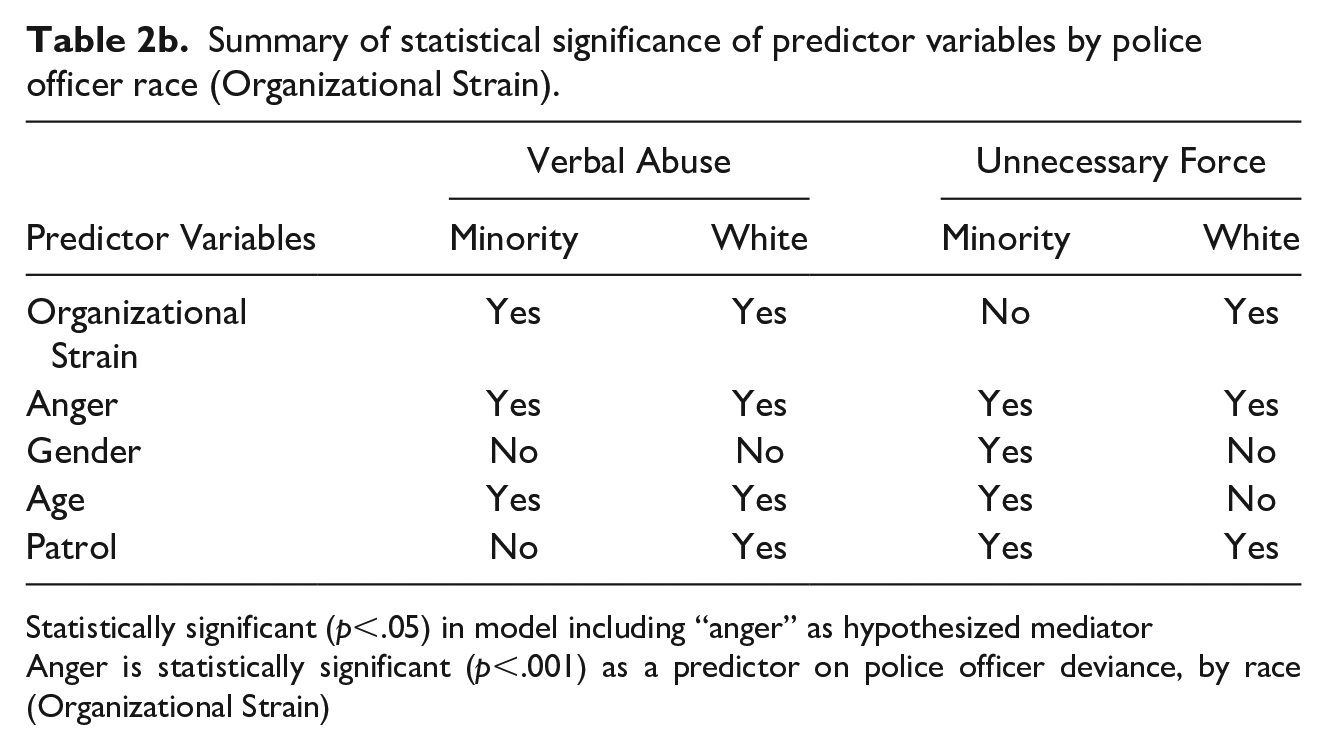
Summary of statistical significance of predictor variables by police officer race (Organizational Strain).
| Verbal Abuse |
Unnecessary Force |
|||
|---|---|---|---|---|
| Predictor Variables | Minority | White | Minority | White |
| Organizational Strain | Yes | Yes | No | Yes |
| Anger | Yes | Yes | Yes | Yes |
| Gender | No | No | Yes | No |
| Age | Yes | Yes | Yes | No |
| Patrol | No | Yes | Yes | Yes |
Statistically significant (p<.05) in model including “anger” as hypothesized mediator
Anger is statistically significant (p<.001) as a predictor on police officer deviance, by race (Organizational Strain)
Acknowledgements
Paul Tracy was a dear friend of mine since graduate school. His support and mentorship early in my graduate education will be forever remembered. – Steve Bishopp
Declaration of Conflicting Interests
The author(s) declared no potential conflicts of interest with respect to the research, authorship, and/or publication of this article.
Funding
The author(s) received no financial support for the research, authorship, and/or publication of this article.
