



Abstract
A large body of work has examined the factors contributing to low self-control among adolescents, with a predominant focus on individual and family characteristics. More recently, a small body of research has examined whether neighborhood characteristics influence self-control, with many finding null effects. We extend this research by considering whether neighborhood characteristics have a moderating influence rather than a direct effect. We examine several neighborhood characteristics, including collective efficacy, delinquency rate, and moral cynicism, as well as distinctive components of parenting effectiveness, including warmth, lack of hostility, and supervision. We find that neighborhoods do influence levels of self-control among juveniles, but primarily by helping or hindering the efforts of effective parents to instill self-control in their children.
The current study expands on a recently emerging body of empirical research that has examined the effect of neighborhood context on levels of self-control among juveniles with only modest and mixed support (Gibson et al., 2010; Meldrum, 2008; Meldrum & Hay, 2012; Pratt, Turner, & Piquero, 2004). We suggest a different way in which neighborhoods may influence self-control, perhaps explaining the inconsistent empirical findings thus far. Rather than exerting a direct effect on self-control, we argue that certain characteristics of neighborhoods may help or hinder effective parents in their efforts to instill self-control in their children. Stated plainly, we expect that neighborhood context will moderate the relationship between effective parenting and self-control.
We begin by briefly reviewing the individual-level literature that examines the effect of parenting on self-control. This is followed by a discussion of past attempts to directly link neighborhood characteristics to self-control in juveniles. We then elaborate several reasons why the effect of parenting on self-control may be moderated by neighborhood characteristics, with attention to the ways in which the effects of specific dimensions of effective parenting—parental warmth, lack of hostility, and supervision—might be moderated by specific dimensions of neighborhood context—collective efficacy, neighborhood delinquency, and moral cynicism. We then test our hypotheses using data from the Project on Human Development in Chicago Neighborhoods (PHDCN) and discuss the findings.
Parenting and Self-Control
A substantial body of research has examined the influence of self-control on numerous outcomes for juveniles and adults (for reviews, see Pratt & Cullen, 2000; Vazsonyi et al., 2017). Results have been largely supportive of the argument that those who are more “impulsive, insensitive, physical (as opposed to mental), risk-taking, short-sighted, and non-verbal” are less able to resist the easy, immediate gratification that crime and its analogous behaviors can provide (Gottfredson & Hirschi, 1990, p. 90). More recently, efforts have been directed at identifying the factors associated with the development of self-control itself, with particular attention paid to Gottfredson and Hirschi’s (1990) strong claim that effective parenting is the primary precursor to self-control, and perhaps the only one worthy of empirical attention. They argued that parents who effectively monitor the behavior of their children, recognize deviant behavior when it occurs, and appropriately punish such behavior will instill self-control in their children. Although findings have occasionally been mixed or unsupportive, most studies find support for the positive relationship between measures of effective parenting and self-control (for recent reviews, see Hay & Meldrum, 2016, and Li et al., 2019).
Many prior studies rely on Gottfredson and Hirschi’s definition of parenting as rooted in supervision and discipline, but some have questioned this limited conceptualization. Drawing largely on the work of Baumrind (1996), several scholars have expanded the list of parenting components to include factors such as warmth, supportiveness, attachment, involvement, and rational discourse, with many studies finding positive associations between these factors and self-control (Beaver et al., 2009; Burt 2020; Gibson et al., 2010; Hay & Forrest, 2006; Vazsonyi & Belliston, 2007; Watts & McNulty, 2014). For example, researchers in child and family psychology have found that warm and positive parent-child relationships enhance internalization of parental norms and values contributing to the development of self-regulation (Brody & Ge, 2001). Likewise, children of hostile and negative parents are less able to apply higher-order cognitive processes such as self-regulation and control, and are less motivated to learn these skills from their parents (Dix, 1991; Eisenberg et al., 2005). Some have even concluded that these parenting strategies are more predictive of self-control than the traditional components of parental monitoring and effective punishment (Burt et al., 2006; Hay, 2001).
Neighborhood Context and Self-Control
While most research on self-control examines individual and family characteristics as predictors, researchers have begun to examine neighborhood context as another contributing factor. Expectations for neighborhood effects are often rooted in the systemic model of social control (Bursik & Grasmick, 1993), and the collective socialization model identified in community perspectives on child development (Chase-Lansdale et al., 1997; Jencks & Mayer, 1990). These perspectives argue that social ties within the neighborhood may facilitate socialization of children beyond that provided by parents. Dense social networks can indirectly affect self-control by enhancing parental effectiveness through the reciprocated exchange of advice, material goods, and information about childrearing (Leventhal & Brooks-Gunn, 2000; Sampson et al., 1999; Simons et al., 2004; Wikström & Sampson, 2003). But neighbors can also directly affect juveniles’ self-control as neighborhood parents and other adults engage in informal supervision of activities, often taking on the responsibility of monitoring children other than their own, and sometimes directly intervening to discipline children for inappropriate behavior (Bursik & Grasmick, 1993; Sampson, 1987). Thus, even without local intimate relationships and dense friendship networks at the primary level, neighborhoods can serve as a parochial source of socialization, contributing to levels of self-control in juveniles in a manner similar to effective parents.
Though a very large body of research has examined the effects of various neighborhood characteristics on delinquency and offending, and several studies have examined the effects of neighborhood context on parenting characteristics (Rankin & Quane, 2002; Simons et al., 2005), only a handful of studies have examined the influence of neighborhood context on the development of self-control in children. Pratt et al. (2004) investigated whether neighborhood-level variables affect parenting behavior using a measure of adverse neighborhood conditions based on maternal reports of whether residents respected rules and laws, supervised their children, and cared about what went on in the neighborhood. Results revealed that adverse neighborhood conditions predicted both parental supervision and discipline, and that adverse neighborhood conditions predicted less self-control, even while controlling for parenting variables. A later study by the same authors found a significant association between neighborhood disadvantage and self-control, net of parental and school socialization (Turner et al., 2005). Thus, both studies found support for the notion that neighborhoods can be an important source of self-control.
Several other authors have conducted similar research, but more often with unsupportive results (Gibson et al., 2010; Meldrum, 2008; Meldrum & Hay, 2012) than supportive (Teasdale & Silver, 2009; Vera & Moon, 2013). For example, Gibson et al. (2010) found that although self-control among adolescents varied significantly across neighborhoods, characteristics such as concentrated disadvantage, residential stability, and various measures of child-based collective efficacy did not directly affect self-control after controlling for individual-level characteristics.
Moderating Effects of Neighborhood Context
One possible explanation for the inconsistent findings noted above is that prior research has not considered the possibility that the relationship between parenting and self-control is conditioned by neighborhood context. Rather than expecting neighborhood context to influence adolescent self-control directly, or indirectly through its effect on parental characteristics and practices, the ability of parents to instill self-control in their children may depend on the characteristics of their neighborhood. We argue that failing to examine the conditioning effect of neighborhood context presents an incomplete assessment of the impact of neighborhood characteristics on self-control in juveniles. Several important developments in the theoretical and empirical literature on communities and crime provide reasons to expect such a conditional relationship.
Collective Efficacy
Discussions of the role of collective socialization in the well-being of children have typically been rooted in Coleman’s (1990) emphasis on social ties among neighborhood parents and the reciprocated exchange of parenting information and norms. More recently, scholars have engaged the notion of collective efficacy, which places emphasis on mutual trust among neighbors and a shared willingness to intervene for the good of the neighborhood, specifically with regard to the supervision of children (Sampson et al., 1997). Extensive research has supported the argument that where collective efficacy is greater, neighbors are more willing to engage in informal social control, which leads to lower levels of crime and delinquency (Pratt & Cullen, 2005; Sampson, 2006).
The concept of collective efficacy as initially formulated and tested suggests a direct effect of community context on outcomes for juveniles. However, at times scholars have specifically discussed collective efficacy as important for providing a neighborhood context that is supportive of the process of socialization and that it facilitates effective childrearing (Sampson et al., 1999; Wikström & Sampson, 2003). For example, supervision and monitoring of children is a key component of effective parenting identified in the self-control literature. The supervisory view of parents cannot extend over the entire neighborhood, but their monitoring efforts may be facilitated, and the effects on self-control amplified, in neighborhoods where residents are more willing to collectively supervise local children. Supervision and intervention by neighborhood residents may not reach the level of socialization that can directly contribute to self-control in children, but the willingness of local residents to monitor the behavior of children may support and strengthen the socialization efforts of parents, thus enhancing their ability to effectively raise their children. In other words, rather than directly influencing the propensity for delinquency and offending among juveniles, collective efficacy may instead influence the process by which that propensity is developed, such as the extent to which parents are able to instill self-control in their children. Indeed, Wikström and Sampson (2003, p. 138) noted that interactions between individual and contextual influences have been largely understudied, are poorly understood, and “may be the most promising avenue [for] advancing knowledge about the role of the community context in crime causation.”
Criminal Opportunity
Criminal opportunity has held an uncertain status in the individual-level theoretical literature on self-control. Gottfredson and Hirschi (1990, p. 219) initially indicated that opportunity may be a conditioning factor in the relationship between self-control and offending, noting that, “under some conditions people with low self-control may have few opportunities to commit crimes, and under other conditions people with high self-control may have many opportunities to commit them.” They have also discussed the potential role of opportunity as a conditioning factor in the development of self-control itself. Many prior studies have found that criminal opportunity is an important predictor of offending, and that low self-control is more likely to lead to crime when perceived or objective opportunity is greater (Grasmick et al., 1993; Hay & Forrest, 2008; Lagrange & Silverman, 1999; Longshore, 1998).
This work suggests additional ways in which neighborhood context may affect the development of self-control, either directly or by conditioning the impact of parental effectiveness. Consistent with Cloward and Ohlin’s (1960) theory of differential opportunity, juveniles in neighborhoods with high rates of crime and delinquency are more likely to encounter cultural models that emphasize non-normative behavior, and conversely are less often exposed to prevailing prosocial models of behavior. They are also more likely to associate with peers who are criminal or delinquent. This variation in contextual exposure to opportunity has mostly been argued to have a direct influence on involvement in delinquency and crime, but it may also affect the ability of parents to effectively raise their children. An excess of criminal opportunities concentrated within the neighborhood may inhibit the ability of parents to encourage their children to resist the temptation of immediate gratification that criminal offending can provide. Thus, effective parenting may be less likely to translate into greater self-control when crime and criminal opportunities are abundant.
Moral Cynicism
Similar arguments can be made for a conditioning influence of moral cynicism on the relationship between effective parenting and self-control among adolescents. Research has shown that the deprivation found in some neighborhoods can lead residents to distrust formal social institutions such as the police and the justice system in general, and to question whether laws and other socially prescribed norms are justifiable given the challenges and blocked opportunities they regularly experience (Kirk & Matsuda, 2011; Kirk & Papachristos, 2011; Ross et al., 2001). In such contexts, residents may come to believe that the “rules of dominant society (and hence the legal system) are no longer binding or too weak to warrant trust” (Sampson & Bartusch, 1998, pp. 784–785). Extending these arguments, we contend that in neighborhoods characterized by a common sentiment that formal institutions of control are illegitimate and that socially prescribed norms are not applicable, values promoted by parents such as the importance of following rules, delaying gratification, and considering consequences, may be less compelling to their children. Thus, we expect that the relationship between effective parenting and self-control will be weaker in neighborhoods where moral cynicism is high.
Prior Research on the Conditioning Effect of Neighborhoods
To date, only three studies have investigated how parental characteristics and neighborhood context may combine to affect the development of self-control in children. Turner et al. (2005) analyzed samples split into low versus high neighborhood problems, finding that parental supervision and discipline were significantly related to self-control in low problem neighborhoods, but only parental supervision was significant in high-problem neighborhoods. However, none of the differences in effects were statistically significant. In other words, the authors did not find evidence that the relationship between parenting and self-control is significantly moderated by neighborhood context. Meldrum (2008) also found that the effect of parental monitoring on self-control was not significantly moderated by a measure of neighborhood problems. In contrast, a study by Turner et al. (2011) was more supportive. Splitting their sample of neighborhoods into “good” and “bad,” they found that measures of parental responsiveness and parental supervision were significantly related to self-control in good neighborhoods, but that only parental responsiveness was significantly related to self-control in bad neighborhoods. In short, Turner and colleagues have conducted the only test to date that has found empirical evidence for a moderating influence of neighborhood context on the relationship between parenting and self-control. 1
The Current Study
We extend these prior studies in several ways to develop a more comprehensive examination of the role of neighborhood context in the relationship between effective parenting and self-control. First, nearly all studies of self-control that incorporate neighborhood characteristics have considered only the possibility of direct effects, and they have found little support for the relevance of neighborhoods. A primary goal of our study is to examine whether neighborhood context moderates the effect of parenting on self-control.
Second, we believe the neighborhood measures that we utilize provide a more valid assessment of the potential for neighborhood context to influence the effect of parenting on self-control. The contextual measures used in prior studies of conditional effects tend to be broad and structural (e.g., concentrated disadvantage or residential mobility) or based on parental reports on multiple dimensions of neighborhood problems condensed into general indicators of “good” and “bad” neighborhoods. In contrast, our measures indicate more proximate, social-interactional conditions including collective efficacy, neighborhood delinquency, and normative attitudes regarding crime and law, which we believe could specifically influence the ability of effective parents to instill self-control in their children. The progression from a focus on broad structural measures toward social-interactional measures is seen as a critical factor in the evolution of research on neighborhood effects (Kubrin & Wo, 2016; Sampson et al., 2002).
Third, whereas prior research has conceptualized parenting only as a unidimensional construct, we further extend our analysis by testing whether the separate components of parenting have varying effects. The failure to separate parenting into distinct conceptual dimensions, the effects of which may be conditioned differently by distinct dimensions of neighborhood context, may explain the mixed and generally weak moderating contextual effects found in the handful of prior studies on this topic. We first follow prior research by examining whether distinct components of parenting vary in their direct effects on self-control, but more importantly, we go on to examine how the effect of each parenting component may be moderated by each measure of community context.
Though theory and prior research provide little guidance about which specific parenting factors may be most effective in which contexts, we can nonetheless offer some informed speculation. The greatest conceptual similarity between a parenting factor and a neighborhood characteristic seems to be between parental supervision and collective efficacy. As described above, the collective socialization model argues that neighborhoods can provide an alternative source of supervision and discipline, serving a purpose similar to effective parenting practices. Since collective efficacy is comprised of a shared willingness to monitor public areas—specifically the behavior of children—and to intervene when necessary, parental supervision may be most effective in neighborhoods where collective efficacy is also high.
Expectations are perhaps less clear for the relevance of moral cynicism and neighborhood delinquency for specific parenting practices. Children who have a warm, non-hostile relationship with their parents may be more likely to internalize prosocial parental messages about right and wrong if they reside in neighborhoods where the prevailing norms and behaviors are consistent with those messages. This suggests that the specific components of parental warmth and lack of hostility may have greater effects on self-control in neighborhoods with low moral cynicism and delinquency. Conversely, there is less expectation for a strong conditioning influence of collective efficacy on the effects of parental warmth and lack of hostility.
There is also reason to expect that the effect of parental supervision will be greater in neighborhoods with low levels of delinquency. Areas with high delinquency rates are likely to have more visible signs of disorder and crime, such as graffiti, fights, loitering, and drug transactions. These signs may convey to neighborhood youth that delinquent acts are unlikely to be detected and punished—a key component of how parents teach self-control. In short, neighborhoods that display signs of undetected and unpunished delinquency may contradict parental messaging about the likelihood of being caught and punished for misbehavior, thus diminishing the role of parental supervision in the development of self-control. In general, failure to separate parenting into distinct conceptual dimensions, the effects of which may be conditioned differently by distinct dimensions of neighborhood context, may explain the mixed and generally weak moderating contextual effects found in the handful of prior studies on this topic.
Finally, with the exception of Meldrum (2008), prior tests of conditional effects have relied solely on the responses of mothers for all of the key variables, including self-control, parental supervision, parental discipline, and neighborhood problems. Such an approach may be more susceptible to the confounding effects of response bias, since parents are reporting on the effectiveness of their own parenting practices at the same time as reporting on the outcomes in their children that those parenting practices should affect, as well as the conditions of the neighborhood within which that socialization process is occurring. The current study uses a measure of parenting effectiveness that supplements parent responses with direct observations of interactions between parents and children recorded during the interview. Moreover, rather than relying on parental perceptions of neighborhood conditions, we use measures of neighborhood context derived from a separate survey, independent of the source used for measuring parenting and self-control.
Data and Methods
All data come from the Project on Human Development in Chicago Neighborhoods (PHDCN). Neighborhood characteristics come from the Community Survey, which consisted of interviews in 1994 and 1995 with over 8,000 Chicago residents aggregated to 343 neighborhood clusters. Individual-level characteristics come from the Longitudinal Cohort Study which provides data for over 6,200 children and their families in a subset of 80 neighborhood clusters. We focus specifically on the 9-, 12-, and 15-year-old cohorts since these represent the ages during adolescence when self-control is presumably under development, and especially when there is greater potential for the influence of neighborhood characteristics. Pooling these cohorts generates a larger sample size, which is necessary to support the analysis of cross-level interactions across a large number of neighborhoods. 2 We use only the first wave of data, collected during the period 1994–1997, because the questions on self-control were only administered during this wave. These three cohorts provide an initial sample size of 2,345 cases, and after omitting cases with missing data the final sample size was 1,907 individuals nested within 79 neighborhood clusters. 3
Self-control
The dependent variable for this study—self-control—is measured using questions from the EASI temperament instrument (Buss & Plomin, 1975), which was administered to primary caregivers during the first wave of the study. The questions measure difficulty delaying gratification (e.g., “has trouble controlling impulses”), inability to delay decisions (e.g., “likes to plan things way ahead of time”), sensation seeking (e.g., “seeks new and exciting experiences”), and lack of persistence (e.g., “tends to give up easily”). These concepts are closely related to Gottfredson and Hirschi’s (1990) construct of self-control (Grasmick et al., 1993), and have been used by other researchers to study self-control (Gibson et al., 2010). Item responses ranged from 1 (uncharacteristic of the child) to 5 (characteristic) and were coded so that higher scores reflect higher self-control. In total, 17 items were standardized and averaged to form our index of self-control (α = 0.746). Details for these items, as well as those used for our other composite measures, are provided in Appendix A.
Parenting Effectiveness
Our measure of parental effectiveness is based on two forms of data gathered during in-home interviews performed during wave 1. First, interviewers observed interactions between the primary caregiver and their child during the course of in-home interviews. 4 Nine items were used to code positive interactions (parental warmth) and four items were used to code negative interactions (hostility). These measures are dichotomous with a score of one indicating more parental warmth or lower hostility. Second, primary caregivers self-reported answers to 13 questions indicating levels of child supervision. Individual items were recorded as yes or no, and coded so that a score of one indicates a higher degree of supervision. These 26 items were standardized and averaged to indicate overall parental effectiveness (α =.714), with higher scores reflecting a higher degree of parental effectiveness. To further assess reliability, we submitted these 26 items to an exploratory factor analysis using polychoric correlations. The first factor had an eigenvalue of 6.08 and explained over 26% of the variation in the items. However, this factor was most reflective of the interviewer-based items of parental warmth and lack of hostility, all of which had factor loadings ranging from 0.48 to 0.82, while the measures of supervision had factor loadings closer to 0.3, with one as low as 0.15. These results support our decision to extend the analysis to examine the three sub-components of the parenting measure, including parental warmth (α = .761), low parental hostility (α = .864), and parental supervision (α = .512). Though prior research has examined the effect of these characteristics on self-control (Gibson et al., 2010), no prior studies have tested whether neighborhood characteristics moderate their effects. 5
Neighborhood Characteristics
The three key contextual variables used in this study were collected as part of the PHDCN’s community survey. First, collective efficacy is comprised of five items indicating neighborhood cohesion and five items indicating informal social control. Next, neighborhood delinquency indicates the perceived amount of graffiti, gang fights, and mischievous loitering. Finally, moral cynicism indicates the degree to which respondents agreed or disagreed with five different statements measuring respondents’ views about the relevance of legal and ethical norms. These variables were coded so that higher scores reflect a higher degree of collective efficacy, neighborhood delinquency, and moral cynicism, with alpha values of 0.946, 0.915, and 0.657, respectively. We also include three structural neighborhood characteristics that are regularly included in neighborhood-level and multi-level analyses (concentrated disadvantage, residential instability, and immigrant concentration), though we consider them to be distal variables that are at least partly mediated by the key contextual characteristics described above.
Control Variables
We also control for several variables reflecting relevant characteristics of the children and their primary caregivers. These include gender, age in years, race, peer delinquency, and foreign-born status of children, and, for primary caregivers, age in years, marital status, employment status, residential stability, and a measure of SES from the source data which is a principal component score based on parental education, income, and the SEI score for most recent job. A more complete description of the key variables is included in Appendix A, and descriptive statistics for all variables are provided in Table 1.
Descriptive Statistics (N = 1,907).

Analytic Plan
The analysis consists of a series of multilevel regression models. 6 First, we estimate a model predicting self-control that includes individual and neighborhood covariates to examine whether parental effectiveness has a direct effect on self-control, net of other factors. The next three models each add a cross-level interaction term to the base model to assess whether the effect of parenting on self-control is conditioned by neighborhood context. Specifically, the interaction models assess the moderating influence of collective efficacy, neighborhood delinquency, and moral cynicism on the relationship between parenting and self-control while controlling for other relevant individual and parental characteristics. 7 Because these models use a cross-level interaction term (i.e., individual-level x neighborhood-level), the slope for parental effectiveness is allowed to vary across neighborhoods. 8 Finally, we replicate the conditional models using each component of the parenting variable rather than the composite index.
Results
The first model in Table 2 shows that the effects for most of the individual and family characteristics that are expected to affect self-control are, indeed, statistically significant and associated in the expected direction. For example, males and those with delinquent peers tend to have lower levels of self-control, as do those with younger or unmarried caregivers, while Hispanics and foreign-born juveniles tend to have higher levels of self-control. Surprisingly, juveniles from high-SES families tend to have lower levels of self-control. As expected, effective parenting is also associated with higher levels of self-control, as evidenced by the significant positive effect of parenting (b = 0.168). Since this study is concerned primarily with neighborhood influences, the random effects for the intercept and the slope for parenting are of greatest interest in this model. Here we see that even after controlling for individual characteristics, a significant amount of variation remains in both the intercept (b = 0.075) and the slope for effective parenting (b = 0.051), suggesting that neighborhoods play a meaningful role in the development of self-control above-and-beyond the influence of individual and parental characteristics.
Multilevel Models Showing Effects of Parenting and Neighborhood Characteristics on Self-Control.

p <= .05; **p <= .01.
Note: standard errors are cluster bootstrapped from 1,000 replications.
In Model 2 of Table 2, we examine whether specific neighborhood characteristics influence levels of self-control, and whether these variables explain the remaining neighborhood variability observed in the previous model. Of these level-2 variables, only the effect of immigrant concentration is statistically significant, and the coefficient (b = 0.056) indicates that children in neighborhoods with high concentrations of immigrants tend to have higher levels of self-control, even after controlling for immigrant status and other individual-level characteristics. Aside from this effect, none of the neighborhood characteristics are significantly associated with self-control. Thus, it is not surprising that we continue to observe significant variation in the intercept and the slope for parenting effectiveness across neighborhoods (b = 0.051 and b = 0.042, respectively). This is consistent with prior research that has sometimes found significant variability in self-control across neighborhoods, but with little success identifying neighborhood characteristics that are predictive of that variation (e.g., Gibson et al., 2010). However, as we contend above, the relevance of neighborhood context may lie not in its direct or indirect influence on children, but rather in its effect on the relationship between effective parenting and the development of self-control. This suggests estimating models that include a multiplicative effect between neighborhood and parenting characteristics, the results of which are presented in Table 3.
Multilevel Models Showing How Neighborhood Characteristics Condition the Effect of Parenting on Self-Control.

p <= .05; **p <= .01 (two-tailed).
Note: standard errors are cluster bootstrapped from 1,000 replications.
Each of the models shown in Table 3 adds a cross-level interaction between parenting effectiveness and one of the neighborhood characteristics hypothesized to condition the effect of parenting on self-control. The results in Model 1 show a significant interaction between collective efficacy and parenting (b = 0.084). This indicates that the positive effect of parenting on self-control is greater in neighborhoods with high levels of collective efficacy. This conditional effect is illustrated in Figure 1, where we see that the steepest slope for the effect of parenting on self-control is for neighborhoods with high collective efficacy. 9 Though the effect of parenting remains statistically significant in neighborhoods with average and high levels of collective efficacy, it is reduced by half in low efficacy neighborhoods (b = 0.169 to b = 0.085), and rendered non-significant. It is also important to note that at high levels of parental effectiveness, predicted levels of self-control are quite high regardless of the level of collective efficacy in the neighborhood, thus suggesting that effective parenting can largely overcome the adverse effect of low collective efficacy.

Effect of parenting moderated by collective efficay.
Models 2 and 3 of Table 3 present similar analyses, but substituting delinquency and moral cynicism as the conditioning neighborhood characteristics. The coefficient for the interaction of each neighborhood characteristic with parenting is statistically significant, indicating that both measures of neighborhood context affect the relationship between parental effectiveness and self-control. Since high levels of neighborhood delinquency and moral cynicism reflect adverse neighborhood conditions, the negative coefficient for each interaction term indicates that the positive impact that effective parents have on self-control is attenuated at higher levels of both neighborhood delinquency and cynicism. Specifically, the coefficient for the interaction between parenting effectiveness and delinquency rate (b = −0.057) indicates that the beneficial impact of effective parenting on self-control is weaker in neighborhoods with a high rate of delinquency. Likewise, the interaction effect for parenting and moral cynicism in Model 3 (b = −0.204) indicates that effective parenting translates less into self-control for children living in neighborhoods where moral cynicism is high. Figures 2 and 3 provide illustrations of these conditional effects. The slopes for parental effectiveness are steepest for neighborhoods with low delinquency and low moral cynicism, and in fact, the effect of parenting on self-control is not statistically significant in neighborhoods where moral cynicism is high. Again, similar to the moderating influence of collective efficacy, it is interesting to note that for children with highly effective parents, neighborhood context appears to be largely inconsequential.
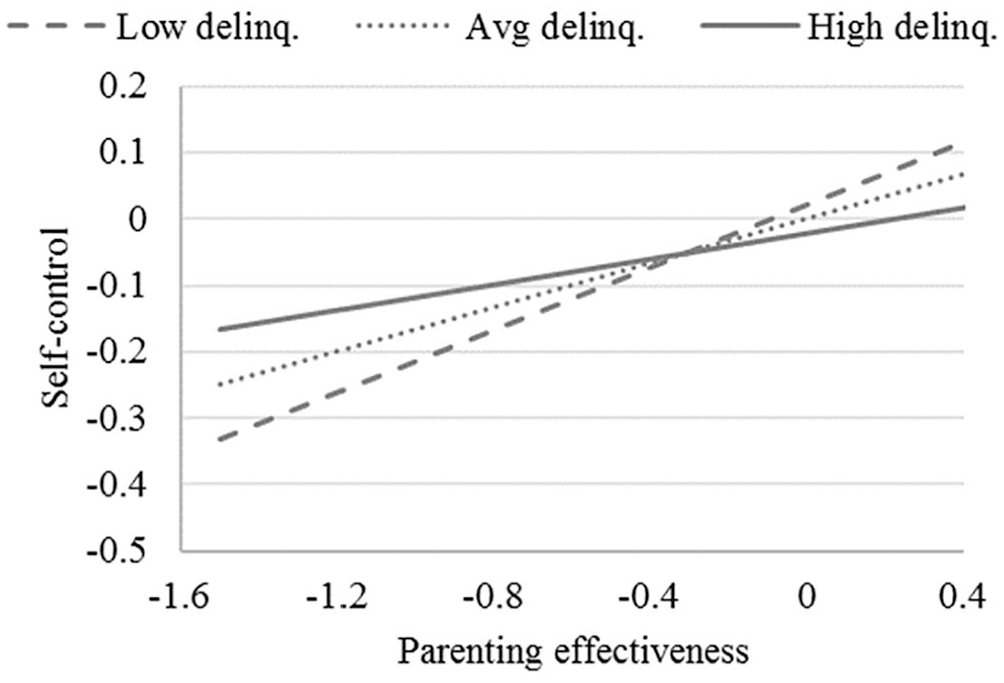
Effect of parenting moderated by delinquency rate.
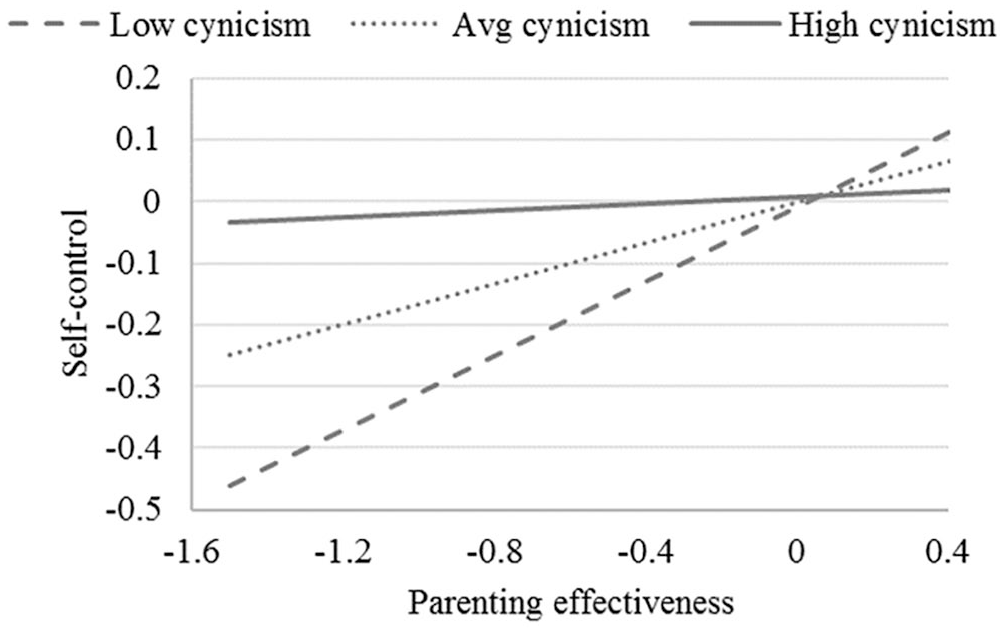
Effect of parenting moderated by moral cynicism.
All three figures reveal another important finding that is not apparent from the coefficients listed in Table 3, and one that was not expected. While the figures support our expectation that the slopes for parenting effectiveness would be steepest for neighborhoods with beneficial conditions, they also show that self-control tends to be lowest among children who have the least effective parents and live in the most favorable neighborhoods; the worst combination for the development of self-control is living in effective neighborhoods (high collective efficacy, low delinquency rates, and low moral cynicism) with ineffective parents. Put differently, neighborhood context is most relevant for children with ineffective parents, but, surprisingly, the negative consequence of having ineffective parents is greatest in the most effective neighborhoods. Indeed, for children living in the most adverse neighborhood conditions, levels of self-control tend to hover around the mean regardless of the effectiveness of their parents. While it is true that children with effective parents and living in the most positive neighborhood contexts tend to have the highest levels of self-control, the opposite expectation—that the lowest levels of self-control would be for children with ineffective parents living in adverse contexts—is not supported. We offer speculative explanations of this finding in the discussion.
Our final analysis disaggregates the composite index of parenting effectiveness into its three sub-components—parental warmth, lack of hostility, and supervision. This allows us to examine whether the conditioning effects of the neighborhood measures vary across the different aspects of parenting. As noted above, we expect that collective efficacy will most strongly moderate the effect of parental supervision, and that the effects of parental warmth and lack of hostility will be moderated more by moral cynicism and neighborhood delinquency. Rather than present all the coefficients from these nine models, we summarize just the conditional effects in Table 4. The results are mostly consistent with expectations. Looking across the row of coefficients for the cross-level interactions with collective efficacy, we see that the effects of parental warmth and lack of hostility are not significantly different in neighborhoods with varying levels of collective efficacy (b = −0.006 and b = 0.029, respectively). However, as predicted, collective efficacy does significantly moderate the effect of parental supervision, with the coefficient indicating that the positive effect of parental supervision on self-control is greater in neighborhoods with higher levels of collective efficacy. Looking at the next row of coefficients, we see that neighborhood delinquency significantly conditions the effects of both lack of hostility and supervision, but not parental warmth. The negative coefficients (b = −0.030 and b = −0.063) indicate that the contributions of lack of hostility and supervision to self-control are weaker in neighborhoods with high rates of delinquency. Lastly, and consistent with expectations, moral cynicism significantly moderates the effects of parental warmth and lack of hostility, but not supervision. Again, the benefits of warm and non-hostile parenting styles for the development of self-control are weaker in a context of high moral cynicism.
Coefficients Showing How Neighborhood Characteristics Condition the Effect of Each Parenting Component on Self-Control.

p <= .05; **p <= .01 (two-tailed).
Note: standard errors are cluster bootstrapped from 1,000 replications.
Discussion
A vast research literature has examined the factors associated with self-control, as well as the influence of neighborhood characteristics on numerous individual outcomes related to crime and delinquency. Yet, very few prior studies have examined the effect of neighborhood context on the development of self-control among juveniles, and the findings have been inconsistent. Some found that adverse neighborhood conditions were associated with lower levels of self-control, while others revealed little or no influence of neighborhood context. We expanded upon prior work by considering the possibility that while neighborhoods may not directly contribute to levels of self-control, residential context may influence the extent to which effective parents are able to promote self-control in their children. Using multilevel data for a large sample of Chicago youth, we found strong, consistent support for our expectation that positive parenting practices are more effectively translated into child self-control in neighborhoods with greater collective efficacy, in neighborhoods with lower neighborhood delinquency, and in neighborhoods where moral cynicism is low.
These results contribute to a growing body of research contradicting the claim that parenting is the sole source of variation in self-control among juveniles. We found several characteristics of juveniles and their caregivers that significantly affected self-control, including socioeconomic status, nativity, and marital status of parents. We also found that levels of self-control varied significantly across neighborhoods, and that this variation was not fully explained by individual and caregiver characteristics. However, it is important to note that the observed variation in self-control across neighborhoods was quite small relative to variation within neighborhoods, so the potential to directly enhance self-control by strengthening neighborhoods may be somewhat limited. This was reinforced by the paucity of significant direct neighborhood effects observed in the current study as well as in prior research. Although parenting is not the sole source of individual differences in self-control, it appears that individual and family factors are the key contributors, with little direct influence of neighborhood context.
Despite the absence of direct neighborhood effects, we believe our findings provide support for neighborhood-based criminological theories. As we described above, several theorists have suggested that neighborhoods can positively affect child development, including self-control, by providing an additional layer of supervision, by collectively socializing children, by encouraging the reciprocal exchange of resources and information, and in a negative fashion by exposing neighborhood children to attitudes and opportunities favorable to crime and delinquency. Most prior research on neighborhood effects has tested for direct influences of these neighborhood characteristics on individual outcomes, often concluding that neighborhoods have a much smaller role than individual and family characteristics, if they have any influence at all. Our findings suggest that rather than contributing directly to child development and behavior, the key role of neighborhoods may be to facilitate or impede the influence of individual and family characteristics. Thus, concepts from neighborhoods and crime theories such as private and parochial control, collective efficacy, collective socialization, and moral cynicism may be relevant for child outcomes even where prior research has found null effects.
However, when we examined graphical displays of these effects, we found that the story was not so straightforward. The beneficial impact of increases in parenting effectiveness is, as expected, greatest in the most favorable environments. At first glance, this appears to support our expectation that adverse neighborhood conditions may limit the ability of effective parents to instill self-control in their children, while favorable neighborhood contexts enhance, or better allow for, the beneficial impact of parenting. But under this interpretation we would also expect to find relatively low levels of self-control for children in the most adverse contexts, regardless of parenting effectiveness. This was not the case. Surprisingly, we found levels of self-control close to the mean for children living in the worst neighborhoods across all levels of parenting. We offer two post-hoc explanations.
The first explanation addresses the finding that the worst combination of parenting and neighborhood context for the development of self-control is having ineffective parents in the best neighborhoods rather than the worst neighborhoods. It bears repeating here the qualities of the “best” neighborhoods in the context of our study: effective neighborhoods have high collective efficacy, low delinquency, and low moral cynicism. At first glance, it may be tempting to conceptualize effective neighborhoods as also being economically privileged neighborhoods, and that the reason for our unexpected finding may be explained in terms of economics—poorly parented children in affluent environments may gain an entitlement mentality (“affluenza”) that may protect them from discipline and lead to self-indulgence and low self-control (Alderman, 2001; Sherman, 2017). However, our study specifically controls for economic advantage at both the neighborhood and caregiver level. This suggests that there must be some other qualitative difference aside from economics between “bad” parents in effective neighborhoods versus ineffective neighborhoods. One possibility is that the worst parents in the most effective neighborhoods may become more aware of their children’s antisocial attributes due to the ability of effective neighborhoods to recognize and report on these children’s demonstrations of low self-control. For example, neighbors in areas characterized by high collective efficacy are likely to be more inclined to report bad behavior of neighborhood children to their parents; neighborhoods characterized by low delinquency are likely to see delinquent behaviors as aberrant and out of place; and neighborhoods characterized by low moral cynicism are more likely to disagree with and report demonstrations of low self-control to parents. When ineffective parents in effective neighborhoods are informed of their children’s demonstrations of low self-control, they may find themselves unwilling or unable to correct these behaviors and improve self-control, but they may at least become more aware of their children’s self-control deficit relative to parents in ineffective neighborhoods that lack the same degree of identification, disagreement, and reporting of antisocial behaviors.
A second and related explanation calls into question the representative validity of the measurement of self-control used in the PHDCN and many other data sources. Recall that self-control of youth was measured using survey responses of the primary caregiver—in most cases the parent. In effective neighborhoods, where average levels of self-control tend to be higher, perhaps any demonstration of traits associated with low self-control are perceived by parents to be accentuated in comparison to other children in the neighborhood. This could be even more true of ineffective parents—those who poorly supervise their children, and display hostility rather than warmth—who may project negative traits onto their children in an effort to rationalize and justify their poor parenting efforts. These explanations are admittedly speculative, and such unexpected findings suggest the need for additional research to clarify our understanding of why poor parenting practices appear to be especially problematic for children who live in more effective neighborhoods.
We extended our analysis by examining the unique effects of three separate dimensions of parenting, considering the possibility that the pattern of direct and conditioning effects may vary across those dimensions. This finer grain of measurement provides an opportunity to illustrate the mechanisms through which neighborhood context can facilitate effective parenting. Moreover, since the expected pattern of effects is more complex in this stage of analysis, observed support for those expectations can bolster confidence in the internal validity of the findings. Indeed, the results supported our expectations that neighborhood collective efficacy would specifically enhance the effect of parental supervision, while neighborhood levels of delinquency and moral cynicism would dampen the effects of parental warmth and lack of hostility, while having no moderating influence on supervision. Perhaps the most common argument for the importance of neighborhoods in child socialization is the potential for residents to monitor the behavior of neighborhood children and effectively intervene when necessary. This closely resembles the concept of parental supervision that is discussed extensively in the criminological literature on self-control, so it should not be surprising that collective efficacy and parental supervision are interrelated in their effects on self-control. Though neighborhood supervision and informal social control may directly affect offending behavior, it appears that their influence on self-control operates through the facilitation of parental monitoring and intervention. Likewise, it is unclear why an external influence such as collective efficacy would enhance the beneficial effects of parental warmth and lack of hostility, which should both promote the internalization of parental values and the development of positive internal traits rather than providing supervision and punishment. The observed moderating influence of moral cynicism on the effects of parental warmth and lack of hostility, and the lack of a conditioning effect on parental supervision, reinforces these arguments.
Though the primary argument in this paper has been that neighborhood characteristics have moderating rather than direct effects, we did observe a direct effect for a single neighborhood characteristic. Our finding of a positive effect of neighborhood immigrant concentration indicates that living in a neighborhood with a larger concentration of immigrants contributes to self-control, even while controlling for the juvenile’s own immigrant status. This is consistent with the immigrant revitalization hypothesis, which argues that a greater concentration of immigrants, especially in disadvantaged communities, can lead to reductions in crime by reinvigorating the local economy, stabilizing neighborhoods, and bolstering social ties (Martinez, 2006; Martinez et al., 2004). However, we observed an effect of immigrant concentration even after controlling for many of these proposed mediating factors, including concentrated disadvantage, residential stability, and collective efficacy. Likewise, others have argued that an influx of immigrants reduces local crime by increasing the prevalence of intact families (Ousey & Kubrin, 2009), but we also accounted for the marital status and parenting effectiveness of caregivers. While these factors may explain some of the association between immigrant concentration and neighborhood crime rates, as well as levels of self-control in neighborhood children, the fact that we continue to observe an effect of immigrant concentration even after controlling for individual, parental, and neighborhood characteristics suggests that these explanations are incomplete. Future research should examine alternative explanations, perhaps by focusing on cultural factors not easily captured through structural controls and survey-based indicators. Moreover, following our call for further analysis of conditional effects, future research should test whether immigrant concentration facilitates parental efforts to instill self-control in their children.
We also suggest that future researchers examine the possibility of age-graded effects. We pooled cohorts of 9-, 12-, and 15-year-olds in order to have a sample size capable of effectively modeling numerous cross-level interactions for a large number of neighborhoods, but this prevents us from considering whether effects vary by age. Though in supplemental analyses we found a similar pattern of coefficients for each separate cohort, we suggest a more extensive analysis of age-specific effects. For example, parental warmth and lack of hostility may be more influential for younger children, while effective supervision is more relevant at older ages. Likewise, neighborhood context should have a greater influence at ages when children are more likely to spend time in the neighborhood. Taken together, this potential for age-graded parenting and neighborhood effects suggests that the conditioning influence of neighborhood context on the relationship between parenting effectiveness and self-control may also be contingent upon age.
Future researchers should also examine whether the findings of the current study vary by race. Prior research has shown that neighborhood context can have an especially strong impact on the socialization and behavioral outcomes of African American youth (Brody et al., 2003; Simons et al., 2004). Likewise, recently renewed calls for the development of a Black Criminology emphasize the inextricable role of racism in the everyday lived experiences of African Americans (Unnever et al., 2018). Not only do African Americans, on average, tend to live in far more disadvantaged neighborhoods than whites, but the confluence of neighborhood disadvantage with racism can lead to even greater deleterious effects for blacks (McLoyd, 1990; Myers and King, 1983). For these reasons, neighborhood effects may be especially relevant for parents of African American youth attempting to socialize their children, thus suggesting the importance of a race-sensitive analysis.
It is important to note that although we have interpreted the conditional effects in our analysis as neighborhood context moderating the relationship between parental effectiveness and self-control, it is equally appropriate to interpret those effects in a converse fashion. That is, we could also argue that the adverse impact of living in a neighborhood plagued by moral cynicism, or weak in collective efficacy, is mitigated by the efforts of highly effective parents. From this perspective, parents can serve as a protective influence, at least partially shielding children from the potentially harmful impacts of living in such neighborhoods, and helping them develop self-control and other pro-social traits despite their challenging residential environment. Regardless, the recommendations would be the same: help parents develop and implement effective parenting strategies, and strengthen neighborhoods in order to amplify the benefit of those parenting efforts for children.
In summary, it appears that a key role of neighborhood context in the development of self-control among juveniles lies in the facilitation or hindrance of socialization processes that occur between parents and their children. While it appears that neighborhoods cannot replace or directly supplement effective parents as a source of self-control, they can support or impede parental efforts. Recall that the collective socialization model argues that neighborhood adults contribute to child development and control by monitoring neighborhood children, identifying problem behavior, and sometimes disciplining children other than their own—a neighborhood-level corollary of Gottfredson and Hirschi’s explanation of how effective parenting instills self-control. Our results suggest that neighborhoods play a somewhat different role in the socialization of children. Rather than directly influencing self-control, neighborhoods provide a context that is either conducive to, or disruptive of, the messages that effective parents try to convey to their children. In this sense, it may ‘take a village to raise a child,’ but it appears that neighborhoods contribute by supporting, rather than duplicating, the positive impact of effective parents.
Footnotes
Appendix
Description of Selected Variables Included in the Analysis.

| Variable | Variable definition |
|---|---|
|
|
|
| Self-Control | 17-item standardized index; questions measuring difficulty delaying gratification (5 items), inability to delay decisions (4 items), sensation seeking (4 items), lack of persistence (4 items). Responses range from 1 (characteristic) to 5 (uncharacteristic). |
|
|
|
| Effective Parenting | 26-item standardized index comprised of the 3 domains listed below. Individual items were coded as yes/no, and coded so that higher scores reflect more parental warmth, lower hostility, and more supervision. |
| Parental Warmth | 9 items indicating the extent to which the primary caregiver exhibited warmth toward their child during the child’s interview. For example, conversing, responding to requests, offering encouragement, praising, conveying positive feelings, and caressing/kissing/hugging. |
| Lack of Hostility | 4 items indicating the extent to which the primary caregiver exhibited hostility toward their child during the child’s interview. For example, shouting, expressing annoyance, slapping/spanking, and scolding/criticizing. |
| Supervision | 13 items indicating the extent to which the primary caregiver supervises their child. For example, setting curfews, checking homework, disallowing sleepaways on school nights, requiring adult supervision after school, communicating with school teachers and counsellors, discussing hazards of drugs/alcohol, and refusing child alcohol at home. |
|
|
|
| Collective Efficacy | 10-item standardized index indicating neighborhood cohesion (5 items) and informal social control (5 items). For example, the degree to which the respondent agrees that neighbors feel close knit, are willing to help each other, get along with each other, share the same values, and can be trusted. Also, if neighbors would act/do something/organize if: children skipped school and were hanging out on corner, children were caught vandalizing, children were caught showing disrespect to an adult, a fight broke out in front of R’s house, budget cuts forced fire station closure. Responses ranged from 1 (strongly disagree) to 5 (strongly agree). |
| Delinquency Rate | 3-item standardized index indicating the perceived amount of graffiti, gang fights, and mischievous loitering in neighborhood. Responses ranged from 1 (not a problem) to 3 (a big problem). |
| ynicism | 5-item standardized index indicating the degree to which R believes “laws are made to be broken”; “it’s OK to do anything you want as long as you don’t hurt anyone”; “there are no right and wrong ways anymore, only easy and hard ways”; “fighting between friends or within families is nobody else’s business”; “nowadays, a person has to live for today and let tomorrow take care of itself.” Responses ranged from 1 (strongly disagree) to 5 (strongly agree). |
| Conc. Disad. | 6-item factor score from PHDCN comprised of percentages of poverty, public assistance, unemployment, female-headed families, black, and persons less than 18. |
| Imm. Concentration | 2-item factor score from PHDCN comprised of % Latino and % foreign-born. |
| Residential stability | 2-item factor score from PHDCN comprised of % in same house 5 years ago and % owner. |
|
|
Controls include child’s gender, age, race, and nativity status. Also includes primary caregiver age, years at current address, employment status, marital status, and a principal component score for SES from the source data based on primary caregiver’s education, income, and SEI from most recent job. We also include a mean index of 13 standardized items indicating peer delinquency, including the number who obey school rules, get into trouble, are considered good citizens, are honest, damage property, have stolen something worth >$5, attacked someone with a weapon, used marijuana, used alcohol, used tobacco, had sex, and how often they have asked R to go drinking or offered them marijuana. |
Declaration of Conflicting Interests
The author(s) declared no potential conflicts of interest with respect to the research, authorship, and/or publication of this article.
Funding
The author(s) received no financial support for the research, authorship, and/or publication of this article.
