



Abstract
Despite growing research on women’s offending trajectories, knowledge on the imprisonment experiences of women who are mothers is limited. This study used a nationally representative dataset of state and federal prisoners to identify and characterize subgroups of mothers based on incarceration histories. Group-based trajectory modeling identified four groups with distinct incarceration trajectories: stable escalating group, moderate declining group, adolescence-peak group, and young-adulthood-peak group. Bivariate analyses then suggested that different incarceration trajectories were associated with adverse life experiences (i.e., foster care placement, sexual abuse experience) and confinement experiences (i.e., number of episodes of prison confinement). Discussed are the future research directions and implications for criminal justice policies and interventions targeting imprisoned mothers.
Introduction
The United States has the largest population of imprisoned adult women worldwide (Sentencing Project, 2018; Walmsley, 2017). According to the Bureau of Justice Statistics, most of these incarcerated women have children who are minors (Shlafer et al., 2019). Although research on women’s offending trajectories has proliferated, the incarceration trajectories of women who are mothers remain relatively underexplored. The lack of rigorous scientific research inhibits our understanding of the collateral consequences of mothers who experience incarceration. Moreover, this knowledge gap compromises the effectiveness of criminal justice interventions and social services targeting this distinct population. This study used a nationwide survey dataset of state and federal prisoners to identify and characterize mothers with different incarceration trajectories over the life course.
Since the 1970s, the US correctional population has experienced an unprecedented increase (Travis et al., 2014). In 1972, less than 350,000 people were incarcerated compared to more than 2.2 million people in 2014 (Travis et al., 2014). Women represent the fastest-growing population in the correctional system (Brown & Chesney-Lind, 2019). Compared to an estimated 350% increase among men, the number of incarcerated women increased by nearly 800% in the past three decades, from 26,738 in 1980 to 225,060 in 2017 (Sentencing Project, 2018). More than half of these women are mothers of minor children (Shlafer et al., 2019). The rapid rise in the number of incarcerated women is not a result of the “natural” fluctuations in crime rates (Uggen & McElrath, 2014), but primarily due to more extensive law enforcement efforts, stiffer drug sentencing laws, and post-conviction barriers to reentry that uniquely affect women (Brown & Chesney-Lind, 2019; Sentencing Project, 2018).
Theoretical Framework
The unparalleled growth of female prisoners has led to growing research on their offending trajectories, which contributed to new theories of developmental trajectories. The theories related to developmental trajectories emerged in the 1980s. This group of theories emphasizes the importance of examining within-subject changes of offending career over time, including the onset, frequency, and duration of incarceration (Blumstein, 1986). The theories predict that within the offenders’ population, there are distinctive subgroups with distinctive etiologies that follow distinctive developmental trajectories of offenses (Chung et al., 2002). Moreover, offenders who follow different trajectories may have varying levels of risk for maladjustment problems in adulthood (Moffitt, 1993). The dual taxonomy theory by Moffitt (1993) is the most empirically-tested developmental trajectory theory. It was initially developed for male offenders but was applied subsequently to female offenders.
According to Moffitt et al. (2001), there are two categories of female offenders: life-course-persistent offenders and adolescence-limited offenders. The life-course-persistent offenders report multiple risk factors in childhood, such as family adversity and coercive parental discipline, have an early onset of minor offending and gradual involvement in more serious crime over the life course, and have poor adulthood outcomes in various domains. Although only 1% to 2% of women follow this trajectory, they are responsible for more than half of the offenses and the most devastating ones (Fergusson & Horwood, 2002). In contrast, the adolescence-limited offenders report few risk factors in childhood, have a transient expression of offending in adolescence due to peer influence and social mimicry, and desist from antisocial lifestyle as they transition to adulthood. Adolescence-limited offenders have fewer adverse consequences in adulthood than life-course-persistent offenders (Nagin et al., 1995). Approximately 15% to 30% of the incarcerated women follow this trajectory.
In addition to the life-course-persistent and adolescence-limited trajectories, other offending trajectories were identified in the literature (Evans, Abderhalden, et al., 2019; Jennings et al., 2010). A recent systematic review of 46 international studies on women’s offending development summarized the existence of other offending trajectories, including adolescence-delayed-onset trajectory, childhood-limited trajectory, and adulthood-onset trajectory (Fontaine et al., 2009). Half of the studies included in this review were conducted on women offenders in the United States (Fontaine et al., 2009). The adolescence-delayed-onset female offenders have similar risk factors to their life-course-persistent counterparts but with an onset of offending in adolescence. They manifest offending and mental and physical health problems in adulthood (Silverthorn & Frick, 1999). Although rarer than men, researchers have also identified the childhood-limited trajectory among women (Aguilar et al., 2000; Odgers et al., 2008). Compared to their adolescence-limited counterparts, childhood-limited female offenders appear to have fewer health problems in adulthood (Odgers et al., 2008). Additionally, researchers have identified women who follow the adulthood-onset trajectory. This group of women is hypothesized to have fewer childhood risk factors (Chung et al., 2002). However, it is unclear whether they have maladjustment problems in adulthood (McGee & Farrington, 2010).
Motherhood Status and Offending Trajectories
Although our knowledge of women’s offending trajectories has advanced significantly, there is a lack of research on the potentially unique offending trajectories of women who are mothers. The few studies that exist found that motherhood status is an essential factor related to women’s criminal behaviors (Arditti & Few, 2008; Chesney-Lind & Pasko, 2013). During the reentry process, women who are mothers may face additional stress and stigma compared to their nonmother counterparts. For instance, as needs related to their role as their children’s primary caregivers have rarely been considered in reentry programs, and released mothers often report a high level of maternal stress in reuniting with their children (Arditti & Few, 2006). Moreover, because of the perceived contradictions between criminal behavior and maternal role expectations, justice-involved women with children may be labeled as “inadequate mothers” (Dodge & Pogrebin, 2001). This often results in them being more socially isolated and receiving less support from family and friends (Kielty, 2006). Because of the additional stress and stigma, mothers may have higher recidivism rates compared to women who are not (Brown & Bloom, 2009; McGrath, 2012).
Nonetheless, being a mother may also motivate women to desist from crime (Arditti & Few, 2008; Giordano, 2010). Because women are often the primary caregivers of children (Glaze & Maruschak, 2008), they have high levels of concern for children’s well-being and distress over losing child custody (Arditti & Few, 2008; Michalsen, 2011). Research suggests that spending time caring for children and feeling influential and effective as mothers are related to women’s desistance from lawbreaking (Adams et al., 2017; Sampson & Laub, 2005). For women in highly disadvantaged neighborhoods with limited prosocial bonds such as employment and marriage, having children may be an especially positive informal social control process (Kreager et al., 2010). For these reasons, motherhood status may be associated with lower recidivism rates among women.
Because of the additional roles and responsibilities related to having children, mothers may have distinct incarceration trajectories compared to women who are not (Adams et al., 2017; McGrath, 2012). Related to the widespread use of a dichotomized incarceration history measure (i.e., with or without an incarceration history) in examining its consequences (Kirk & Wakefield, 2018; Wildeman & Turney, 2014), the nuances and heterogeneity of the incarceration histories of women who are mothers are not captured. This practice has potentially contributed to the contradictory findings documented about the effects of imprisonment (Schnittker et al., 2012; Zhao et al., 2018; Zhao et al., 2019). At present, there are some studies suggest that the stress and stigma related to incarceration have adverse physical and mental health consequences (Massoglia & Warner, 2011; Travis et al., 2014), whereas others indicate that incarceration has minimal impacts on the mothers’ well-being (e.g., Zhao et al., 2019).
The Current Study
This study used the Survey of Inmates in State and Federal Correctional Facilities (SISFCF) dataset to identify and characterize subgroups of incarcerated mothers that follow distinct incarceration trajectories. Guided by the developmental trajectory theories, we developed two research hypotheses. First, there are subgroups of mothers in state and federal prisons that follow distinct incarceration trajectories over the life course. Second, imprisoned mothers with distinct incarceration trajectories differ in terms of sociodemographic characteristics, adverse life experiences, and incarceration experiences. To the best of our knowledge, this is the first effort to understand the unique incarceration histories of women who are mothers. It will lay the foundation for future research on the consequences of incarceration as it develops the mother’s incarceration trajectories, a comprehensive and reliable measure of incarceration history. Further, through identifying and characterizing mothers with distinct incarceration histories, subgroups of mothers that are most embedded in the correctional system will be better understood. Findings of this nature are essential for efficient resource allocation and could translate to tailored criminal justice policies and interventions to prevent continued incarceration among this population.
Methods
Data and Sample
This study used the SISFCF 2004 for analysis. Collected periodically from 1974 to 2004, the SISFCF survey provides a nationally representative sample of individuals in state and federal prisons (James & Glaze, 2006; Maruschak et al., 2015). This survey was implemented again in 2016, renamed the Survey of Prison Inmates (SPI). However, because the SPI is not available for public use, the SISFCF 2004 is the most current national data on women prisoners.
Through personal interviews, participants reported their sociodemographic characteristics, adverse life experiences, and incarceration experiences. The SISFCF asked participants their total number of incarceration (for a maximum of 12 episodes) and collected precise and comprehensive longitudinal incarceration history data retrospectively. Specifically, regarding each incarceration episode, data were collected on the type of correctional facilities sentenced to, type of offenses convicted, date of admission (month and year), age of incarceration, duration of incarceration (days, months, and years), and how the participant was sentenced.
As this study focuses on the incarceration trajectories of women who are mothers, we excluded imprisoned women who do not have children and those with no previous incarceration history and still waiting for a sentence for the current confinement. Imprisoned mothers who do not have at least one complete incarceration history (including the date of admission and the duration of incarceration) were excluded as well. The final study sample was consisted of 881 imprisoned mothers.
Measures
Months of incarceration per year
The participant’s age at each incarceration was calculated using their age at the time of the interview and the year of each incarceration. The length of each episode of incarceration was assessed through three questions: “How much time did you actually serve in the (facility) for (read above offenses)? (years).” “How much time did you actually serve in the (facility) for (read above offenses)? (months).” and “How much time did you actually serve in the (facility) for (read above offenses)? (days).” Based on answers to these three questions, we derived the number of months the participant was incarcerated each time. Using the participant’s age at each incarceration and the total number of months served each time, we obtained the participant’s age at release. The number of months the participant had served per year was then calculated, which was the primary outcome measure in this study.
Sociodemographic characteristics
This study has incorporated important sociodemographic characteristics associated with criminal justice involvement in the analysis. Specifically, the participant’s age (Loeber & Farrington, 2014) and whether or not being a child caregiver (Chesney-Lind & Pasko, 2013) were included. Factors related to socioeconomic status (Zhao et al., 2019) such as racial and ethnic background (i.e., White American, African American, Hispanic, Asian American, Native American, Pacific Islander, and unknown), educational attainment (i.e., whether or not graduated from high school), employment status (i.e., employed vs unemployed), monthly income, housing stability, and marital status (i.e., married vs unmarried) were also incorporated.
Adverse life experiences
Participants also reported adverse life experiences, including prior involvement in the foster care system, whether the guardian had ever received welfare or public assistance, whether the participant had ever lived in public housing, the guardian’s substance use, and incarceration histories of the participant’s parents, siblings, and partners. Additionally, the SISFCF assessed participants’ past experiences of physical and sexual abuse (Bloom & Covington, 2008; Messina et al., 2007). Experience of sexual abuse was assessed using the following survey item: “Before your admission to prison, had anyone ever pressured or forced you to have any sexual contact against your will?” Participants who responded positively to this question were identified as having had a history of sexual abuse experiences. To determine physical abuse, parents were asked whether they were ever (a) pushed, grabbed, slapped, kicked, bit, or shoved before admitted to the prison, (b) hit with a fist, (c) beaten up, (d) choked, or (e) anyone had ever used a weapon against them. Positive response to any of these items was considered as having had a history of physical abuse.
Incarceration experiences
Indicators of each imprisonment experience, including the type of correctional facilities, type of offenses convicted, and the number of times being sentenced as adults, were included in the analysis. For each episode of incarceration, participants were asked about the type of correctional facilities they were sentenced to using the following survey item: “What type of institution were you sentenced to—a juvenile facility, local or county jail, state prison, other state facility, or federal facility?” Four continuous variables were created to represent the total number of confinements in jail, prison, juvenile facility, and other facilities.
Participants were also asked to name up to five offenses convicted in each incarceration. Guided by the Bureau of Justice Statistics’ categorizing of offenses, five continuous variables were created to represent the total number of violent offenses, property offenses, drug offenses, public order offenses, and other offenses. Moreover, participants were asked about how they were sentenced each time through the following survey item: “For the (read above offenses), were you sentenced as an adult, a youthful offender, or a juvenile?” If the participant was younger than 18 years and was sentenced as an adult, then the participant was categorized as had been sentenced as an adult. A continuous variable was created to represent the number of times participants were sentenced as adults.
Analytical procedure
Data analysis for this study preceded in two steps using the SAS 9.4 programming language. Semi-parametric group-based trajectory modeling was first employed to identify subgroups of mothers following distinct incarceration trajectories (Nagin, 1999, 2005) using the PROC TRAJ package (Jones et al., 2001). Instead of taking an exhaustive approach to construct the model choice set, we used a more practical two-stage model selection process (Nagin, 2005). In the first stage, we focused on choosing the number of groups to be included in the model. After presetting all trajectory polynomial as cubic, an increasingly larger number of groups was estimated. As the criminological literature suggested that the minimum number of groups is two and the maximum number is eight (Le Blanc, 2002), we estimated the model with two groups to the model with eight groups. The optimal number of groups was determined by the sample-dependent Bayesian Information Criterion (BIC) scores, Akaike Information Criterion (AIC) score, log-likelihood values, together with the interpretability of the model (Nagin, 2005).
Considering the first-stage decision on the number of groups, we focused on determining the shape of each trajectory in the second stage. Because all trajectory polynomials were preset as cubic (Jones et al., 2001), for non-significant cubic polynomials, the trajectory shape was redefined using the significant polynomial (i.e., quadratic or linear). The procedure also assigned participants a posterior probability of membership in each group. Participants were assigned to the group that they had the highest class probability. Because the preliminary observation of the data suggests that the minimum age of the first incarceration was ten years and only a few participants had incarceration history after the age of 53, the incarceration trajectories estimated in this study ranged from age 10 to 53 years. We then conducted ANOVA and Student–Newman–Keuls tests for continuous variables and χ2 tests for categorical variables to characterize mothers with distinct incarceration trajectories in terms of sociodemographic characteristics, adverse life experiences, and incarceration experiences. Unless otherwise indicated, the significance level (two-tailed) was set at p < .05.
Results
Group-Based Trajectory Modeling
The four-group model had the optimal model fit, as shown in Table 1. For either sample, the BIC score rose steadily as the number of groups increased from two to four and then declined. For N = 881, BIC was larger for the seven-group model than the four-group model, but overall, the BIC after the four-group model represented a steady decline (Nagin, 2005; Raftery, 1995; Schwarz, 1978). Another reason for selecting the four-group model was that each trajectory group maintained a reasonable size and good interpretability.
Using Fit Statistics to Select the Number of Groups to Include in the Model.

The parameter estimates for the four-group trajectory model was presented in Table 2. The actual and predicted trajectories for each estimated trajectory group were shown in Figure 1. Group 1 was the stable escalating group (n = 33, 3.75%). It comprised participants who had been incarcerated for an increasingly longer time each year from childhood (about half of the time) to late adulthood (ten months a year). The length of time incarcerated each year was measured in months. Probably due to the positive effects of being a mother on recidivism (Adams et al., 2017; Sampson & Laub, 2005), a large group of mothers belonged to Group 2, the moderate declining group (n = 665, 75.48%). Participants in this group were incarcerated for approximately half of the time each year from childhood to young adulthood. Their annual length of incarceration decreased in middle adulthood. Groups 3 and 4 were bell-shaped trajectories. Group 3 was the adolescence-peak trajectory (n = 109, 12.37%) and Group 4 was the young-adulthood-peak trajectory (n = 74, 8.40%). Participants in Group 3 were incarcerated for approximately ten months a year in adolescence. They then experienced a declined annual incarceration length afterward. Participants in Group 4 were incarcerated for short durations (less than half of the time) in childhood. Their months of incarceration per year peaked in young adulthood (approximately 11 to 12 months) then steadily declined.
Parameter Estimates for the Final Trajectory Model with Four Groups.

p < .05. **p < .01. ***p < .001.
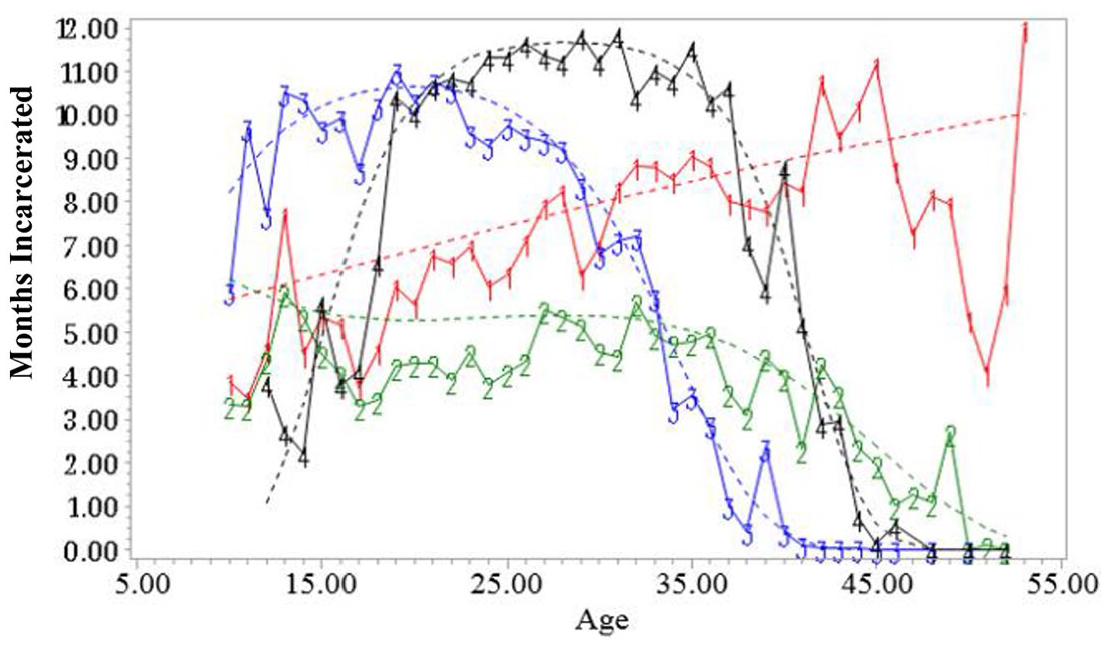
Retrospective histories of incarceration: months of incarceration per year (N = 881).
Sociodemographic Characteristics
The mean age of the participants was 37.58 years (Table 3). There was a significant difference in age among subgroups (F = 36.37, df = 3, p < .001). The stable escalating group had an older average age (49.39 years) compared to the other groups. The young-adulthood-peak group had a significantly older average age (42.00) than the moderate declining group and the adolescence-peak group. There was also a significant difference in the racial background (χ2 = 7.89, df = 3, p < .05). While a similar percentage of White Americans, African Americans, and Hispanics fall into each group, there were significantly more Native Americans (12.84%) in the adolescence-peak group and no Native Americans in the stable escalating group. No significant differences were observed among the four groups of mothers in high school graduation rate, employment status, income, housing stability, marital status, and whether or not being a child caregiver.
Sociodemographic Characteristics, Family Background, and Incarceration Experiences Among Incarcerated Mothers with Distinct Incarceration Trajectories, SISFCF (N = 881).

p < .05. **p < .01. ***p < .001.
Adverse Life Experiences
As shown in Table 3, there were significant differences in two adverse life experiences among mothers following distinct incarceration trajectories—foster care involvement and sexual abuse experiences. Specifically, a significantly greater percentage of participants in the adolescence-peak group was exposed to the foster care system (25.24%) than other groups (with an average of 10.47%). Moreover, the stable escalating group had a significantly lower prevalence of sexual abuse experience (19.35%) than the other groups (with an average of 45.79%).
Incarceration Experiences
In terms of incarceration experiences, the four groups of mothers were not significantly different in the type of offenses convicted and the number of times being sentenced as adults. The only significant difference was the total number of episodes of prison confinement (F = 16.67, df = 3, p < .001) (Table 3). The moderate declining group had a significantly fewer number of prison confinements (2.95) than other groups.
Discussion
Our findings support Moffitt et al. (2001) main proposition about distinctive developmental trajectories but suggest that a richer taxonomy may be necessary among imprisoned mothers. Specifically, group-based trajectory modeling identified four groups of mothers with distinct incarceration trajectories: stable escalating group, moderate declining group, adolescence-peak group, and young-adulthood-peak group. This finding confirmed our first hypothesis that there are subgroups of mothers in state and federal prisons that follow distinct incarceration trajectories over the life course. Bivariate analyses found that the stable escalating group had a lower rate of sexual abuse experience. The moderate declining group had a significantly fewer number of prison confinements. Moreover, the adolescence-peak group had a higher prevalence of foster care placement. These findings confirmed our second hypothesis that mothers with distinct incarceration trajectories differ in their background characteristics and incarceration experiences.
The stable escalating group resembles the lifetime-persistent-offending group with the incarceration history being persistent over the life course. Women in this group were more embedded in the correctional system than those in the lifetime-persistent-offending group as they experience prolonged imprisonment each year as they age. Different from lifetime-persistent offenders who had disadvantaged childhood experience and family background (Moffitt, 1993), imprisoned mothers in the stable escalating group were less likely to be minorities from marginalized socioeconomic backgrounds and less likely to experience traumatic life events such as sexual abuse. These women may be more representative of those imprisoned before this dramatic increase experienced in the past four decades.
According to the differential stress exposure theory (Vanroelen et al., 2010), subgroups of individuals with less access to resources and disproportionate exposure to stressors are more likely to have mental and behavioral health problems and consequently face considerable social difficulties such as criminal justice involvement (Zhao et al., 2019). However, findings from this study suggest that the subgroup of mothers that experienced less stressful life events was most embedded in the criminal justice system. This counterintuitive finding might be attributable to the absence of important criminogenic risk factors in the SISFCF dataset, such as the participants’ attachment to significant others (e.g., parents, partners) and social network composition (Collica, 2010; Wampler & Downs, 2010). Future primary data collection efforts that comprehensively capture the incarceration experiences and background characteristics of justice-involved mothers are essential to understand predictors of their imprisonment trajectories.
The moderate declining group was similar to the adolescence-limited group (Moffitt, 1993), but its incarceration trajectory extend to adulthood. The most distinct characteristic of mothers in the moderate declining group was that they had a significantly lower number of prison confinements than other groups. Compared to jail and other types of correctional facilities, prison represents a different level of involvement in the correctional system in terms of the length of sentence, distance to the aboriginal community, and type of conviction. Women being sentenced to prisons usually have long sentences and are imprisoned far away from their families, as there are far fewer prisons for women than for men (Wildeman et al., 2016). Therefore, they may be less likely to maintain connections with network members such as families and home-based friends (Christian, 2005; Comfort, 2009). Further, as mothers incarcerated in prisons are more likely to have felony convictions, they are less likely to secure stable employment and housing after release (Agan & Starr, 2017; Evans, Blount-Hill, et al., 2019). Because of these reasons, mothers with a fewer number of episodes of prison confinement may be less likely to experience severe and long-lasting collateral social reintegration consequences and, therefore, less likely to recidivate (Massoglia & Warner, 2011; Sabol et al., 2009). Considering the potential role of prison confinement in altering the incarceration trajectories of mothers, this finding suggests that future research should focus on examining the variation in consequences for mothers incarcerated in distinct types of correctional facilities. It also suggests the need for legislative and policy changes to reduce the use of prison confinements among women who are mothers.
Contributing to the developmental trajectory theories, a new incarceration trajectory observed in this study was the adolescence-peak trajectory. This trajectory resembles the well-known age–crime curve (Loeber & Farrington, 2014). While all four groups of incarcerated mothers had significantly higher rates of prior foster care placement than the general population (Children’s Bureau, 2020), mothers following the adolescence-peak trajectory had the highest prevalence. Given that the peak of incarceration among this group was around 18 years, the age that most foster youth being pushed out of the system (Shared Justice, 2017), there is potentially an association between foster care placement and criminal justice involvement.
Young women aged out of the foster care system, especially those who have children, might be especially vulnerable to the correctional system due to the lack of family support as they move into adulthood (Jonson-Reid & Barth, 2000; Reilly, 2003). Research suggests that young women in foster care are more than twice as likely as their peers not in foster care to become pregnant by age 19 years (Heather, 2011). Because of their limited social and economic resources, as well as challenges in transitioning from adolescence to young adulthood, such as establishing intimate relationships and secure employment, foster youth tend to exhibit more criminal behaviors than their peers as they approach adulthood (Cusick et al., 2010; Lindquist & Santavirta, 2014). For these reasons, coordination between the child welfare system and the criminal justice system to develop and implement policies and interventions that target the transitional needs of young women aging out of the foster care system is particularly needed.
The findings of this research are subject to several limitations. First, the survey relied on self-reports from incarcerated women who are mothers. Although all data collected are deidentified, the participant might still have concerns about reporting previous incarceration histories considering their legal status. Moreover, survey data are subject to recall bias. Incarcerated mothers may have missed incarceration histories unintentionally at the time of the interview. Second, the survey only documented the mothers’ incarceration trajectories for a maximum of 12 episodes, including the current incarceration. For the small number of mothers incarcerated more than 12 times, the incarceration trajectory data will be incomplete. Moreover, due to the nature of secondary data analysis, some potentially important criminogenic risk factors (e.g., social networks) were not collected and cannot be included in the analysis. Third, because the incarceration trajectories of imprisoned mothers were developed based on the number of months incarcerated each year, the identified trajectories do not reflect other incarceration history characteristics such as the frequency and duration of incarceration. Future research that investigates the incarceration histories of mothers using different indicators is necessary.
Fourth, women included in this study were confined in state and federal prisons, which might differ from women with only jail imprisonment histories. For this reason, caution is needed in generalizing incarceration trajectories identified in this study to other imprisoned women populations. Lastly, since the collection of the SISFCF, the number of women prisoners remained relatively stable (from 104,848 in 2004 to 110,845 in 2018; Carson, 2020; Harrison & Beck, 2005), and the offenses committed were only slightly different (Carson, 2020; Sabol et al., 2007; Sentencing Project, 2019). Although the racial gap in incarceration had narrowed (Hager, 2017), it is unlikely to significantly impact the incarceration trajectories of imprisoned mothers, which is the focus of this research. However, future research using the incarceration trajectories of imprisoned mothers identified in this study as the basis of comparison is encouraged to understand the potential changes in offending careers over time among women who are mothers.
Conclusion
Despite these limitations, this research provides a nuanced understanding of mothers’ incarceration experiences. The development of fine-grained comprehensive incarceration trajectories has laid the foundation for future research to generate rigorous knowledge of the consequences of incarceration on the imprisoned mothers and their children. The existence of distinct incarceration trajectories and the unique characteristics of mothers following different incarceration trajectories identified enable expansion of the developmental trajectory theories and suggest that criminal justice policies and practices should be tailored to the needs and challenges encountered by mothers following different imprisonment trajectories. Specifically, findings indicate that less use of prison confinements and more transitional services for youth aging out of the foster care system may potentially contribute to effective criminal justice intervention for women who are mothers. To generate knowledge on the challenges and needs unique to women who are mothers and inform criminal justice intervention development, future research comparing the incarceration trajectories of women with and without children is needed.
Footnotes
Declaration of Conflicting Interests
The author(s) declared no potential conflicts of interest with respect to the research, authorship, and/or publication of this article.
Funding
The author(s) disclosed receipt of the following financial support for the research, authorship and/or publication of this article: This work was supported by the 2019 Social Work HEALS Fellowship granted by the National Association of Social Workers Foundation, the Council on Social Work Education, and the New York Community Trust.
