



Abstract
Rather than serving as a deterrent, exclusionary discipline tends to lead to a host of short and long-term negative outcomes. The mechanisms which propel students from exclusionary discipline toward these negative outcomes is understudied. The negative impact of school sanctions is particularly salient among students of color; yet the reasons for this are unclear. Informed by Sherman’s defiance theory, this study utilizes data from the National Longitudinal Study of Adolescent and Adult Health (Add Health) to identify these mechanisms among a sample of white and black students. Results suggest that defiance theory provides a theoretically relevant framework for understanding the impact of school sanctions on future outcomes as well as how the effects vary across race.
Introduction
The relationship between low educational attainment and involvement in the criminal justice system is one of the strongest and most consistent findings in the criminological literature (Lochner, 2008; Lochner & Moretti, 2004; Machin et al., 2011). According to a recent report on the educational attainment of incarcerated persons, over half of federal, state, and jail inmates did not complete high school (Alliance for Excellent Education, 2013). Contributing to the relationship between school failure and criminal justice involvement is the use of exclusionary discipline in which students are either suspended or expelled from school. The relationship between school failure via exclusionary discipline and incarceration is so strong that it has been identified as the school-to-prison pipeline phenomenon (Skiba et al., 2014; Weissman, 2015).
The school-to-prison pipeline refers to the “the policies and practices that push our nation’s school children. . .out of the classrooms and into the juvenile and criminal justice system” (American Civil Liberties Union, 2014, p. 1). Scholars suggest the pipeline developed as a consequence to the implementation of zero-tolerance policies following the enactment of the 1994 Gun Free Schools Act (Cuellar & Markowitz, 2015; Way, 2011). These policies enacted uniform, predetermined sanctions to a wide array of disruptive behaviors regardless of the circumstances or context (Fissel et al., 2019; Skiba et al., 2014). The hope was that these indiscriminate and punitive policies would serve as a deterrent from future problem behaviors; although, much research has concluded that zero-tolerance policies are ineffective at deterring the most common problem behaviors such as fighting, disruption, and insubordination (Fissel et al. 2019; Shollenberger, 2015; Way, 2011). In fact, most research finds that exclusionary discipline works to exacerbate problem conduct and thus increases the likelihood of future problem behaviors, including delinquency, dropping out of school, and criminal offending (Fabelo et al., 2011; Mireles-Rios et al., 2020; Shollenberger, 2015).
The relationship between school exclusion and subsequent delinquency has been consistently documented with scholars concluding that the disruption to the educational process only serves to increase the likelihood of problematic and antisocial behaviors (Novak, 2019; Shollenberger, 2015). Research also demonstrates a significant link between school exclusion and dropping out of the school. In an 8-year study, Balfanz et al. (2014) found that one suspension in ninth grade doubled the likelihood of dropping out from 16% to 32%, while being suspended twice increased the risk to 42%. In fact, the relationship between school suspension and dropout is so strong that it convinced Suh and Suh (2007) to declare suspensions as a stronger predictor of dropping out than either grade point average or socioeconomic status. Even while the ineffectiveness of zero-tolerance policies is well documented, it has not discouraged the use of such policies in any significant way (Wang et al., 2020).
With the widespread adoption of zero-tolerance policies, the use of exclusionary discipline has increased substantially. Since 1974, the number of students suspended annually has doubled from 1.7 to 3.4 million (U.S. Department of Education, 2014). However, this increase has not affected the student population equally. Nationally, Black students are three times as likely to be suspended as White students (U.S. Department of Education, 2014). While in recent years, the rates of suspension have decreased to roughly 2.6 million students per year (5.3%); the racial disparity in the use of suspension has remained. A report by the U.S. Department of Education (2019) reveals that 13.7%of Black students received an out-of-school suspension in 2013 to 2014 compared to just 3.4% of White students. Similar trends exist for expulsion with .4% of Black students receiving an expulsion compared to .2% of White students (U.S. Department of Education, 2019).
In addition to being suspended and expelled at higher rates, Black students are far more likely to receive harsh disciplinary consequences than their White peers for similar behaviors (Skiba et al., 2011). Research consistently documents racial disproportionality in office disciplinary referrals, expulsion, school arrests, and corporal punishment with Black students much less likely to receive mild disciplinary action than their White peers (Gregory & Weinstein, 2008; Raeffale-Mendez & Knoff, 2003; Skiba et al., 2011). This discrepancy has been attributed to variety of factors including teachers’ misinterpretation or misclassification of Black students’ behavior (Rios, 2011; Way, 2011; Weissman, 2015), cultural incompetency (Toldson, 2011), and perceptions of Black youth as inherently deviant, dangerous, and aggressive (Chiricos & Eschholz, 2002; Weissman, 2015).
While exclusionary discipline has shown to be detrimental to students overall, both in terms of achievement and behavior, the school-to-prison pipeline phenomenon has largely been recognized as a unique reality for many suspended students of color, particularly Black youth (Skiba et al., 2014; Weissman, 2015). That is, the experience of suspension and/or expulsion hinders Black student achievement and increases the likelihood of criminal justice involvement more so than for similarly situated White students (Pesta, 2018). However, while this link exists, it seems unlikely that suspension and expulsion alone are a direct cause to these outcomes considering only a certain percentage of students who are suspended ultimately become involved in the juvenile and/or criminal justice system (Fabelo et al., 2011; Skiba et al., 2014). The mechanisms that ultimately propel students, particularly Black students, from school exclusion to subsequent juvenile and criminal justice contact are understudied (Pesta, 2018; Ramey, 2016); this study seeks to address this issue.
In this study, I contribute to the school-to-prison pipeline and criminological theory literature by incorporating Sherman’s defiance theory to explain, in part, the mechanisms that may push some students from school to prison by working to exacerbate rather than quell problem behaviors. Given the racial disparity in the use of exclusionary discipline and the school-to-prison pipeline, I contend that the central principles of defiance theory; those being, stigmatizing sanctions, perceived unfairness, and school bonding mediate the relationship between exclusionary discipline and dropout, delinquency, and criminal offending. Based on school punishment and defiance literature, I propose that perceptions of fairness and school bonding as well as their future impact vary across race. As such, this study extends the application of defiance theory by utilizing some of its principles to explain variations in the effect of school exclusion across a sample of White and Black students.
Background
Exclusionary Discipline as a Stigmatizing Sanction
By its very definition, exclusionary discipline is a form of social exclusion that prevents participation in social and educational activities (Burchardt et al., 2002; Jacobsen, 2019; Weissman, 2015). The physical removal from school is not only documented in official records but is directly and symbolically communicated to other teachers, administrators, and students (Weissman, 2015). School administrators are often motivated to harshly punish problem students in order to appease frustrated teachers, students, and concerned parents (Staples, 2014). This may result in an individual being stigmatized and labeled as a “troublemaker” or “bad kid” for which withdrawal from the social institution in order to avoid further rejection is likely (Casella, 2003; Link & Phelan, 2001; Pyne, 2019; Weissman, 2015). This process of stigmatization fosters exclusion from conventional society thereby increasing the likelihood of misbehavior rather than deterring it (Foster & Hagan, 2015; Novak, 2019).
In her comprehensive and groundbreaking study on student perceptions of suspension and expulsion, Weissman (2015) discovered that excluded students are well attuned to how others perceive them. As first illustrated in the work of Garfinkel (1956), public punishment acts as a type of degradation ceremony in which the accused receives messages about their value and worth. School suspensions are a similar method of public degradation in which students learn how others perceive them; ultimately affecting their personal and social identities (Pyne, 2019; Weissman, 2015). This negative labeling by others has long-lasting effects that follow students from year to year, school to school. Excluded students often report feeling as though school authorities—teachers, administrators and police—were waiting for them to make a mistake and that their behaviors were interpreted through a distorted lens (Weissman, 2015). Unable to shake others’ perceptions and in a type of self-fulfilling prophecy, a significant proportion of these students are suspended again and/or ultimately drop out of school (Pyne, 2019; Weissman, 2015).
More than physical isolation and exclusion from school and its authorities, many suspended students report experiencing interpersonal exclusion (Jacobsen, 2019). Interpersonal exclusion refers to the “deterioration of relationships with normative others as a result of punishment” (Jacobsen, 2019, p. 36). While often neglected in the broader literature on labeling and stigmatization, interpersonal exclusion is significant as conventional peers are often the way in which one learns social and behavioral norms and receives social support (Jacobsen, 2019). Suspension, through both physical separation and internal separation via rejection and withdrawal from conventional others, only serves to weaken the relationships to normative peers (Jacobsen, 2019; Novak, 2019). Thus, as is the case with institutional exclusion, interpersonal exclusion via suspension is associated with decreased normative friendships, greater involvement with delinquent others, and increases in substance use and delinquency (Jacobsen, 2019).
Exclusionary Discipline, Perceived Fairness, and Race
As demonstrated by prior research, school exclusion policies often serve to stigmatize students thereby increasing the likelihood of poor outcomes. In general, studies have shown that zero-tolerance policies and harsh disciplinary tactics result in increased perceptions of injustice and unfairness among students regardless of whether they experience the punishment directly (Fissel et al., 2019; Kirk & Matsuda, 2011). However, while the criminalization of school discipline is a national trend, research consistently documents that the use of exclusionary discipline falls disproportionately on students of color, specifically on Black students; an association cannot be accounted for by behavioral differences nor socioeconomic status (Fabelo et al., 2011; Skiba et al., 2011). Studies find that Black students are more likely to be referred for discipline, harshly punished, and arrested and thus, two to three times as likely than Whites to be suspended or expelled from school (U.S. Department of Education, 2014). In a study of Texas school disciplinary policies, Fabelo et al. (2011) found that only 3% of students had broken rules that would require suspension as punishment, such as carrying a weapon to school; leaving most decisions to suspend at the discretion of school administrators. As a result, Black students were 31% more likely to receive a discretionary suspension than White students, even after controlling for 83 other variables (Fabelo et al., 2011). As such, it is worthwhile to examine how perceptions of unfairness vary by race.
School punishment literature suggests that Black students tend to view punishments as unfair and thus illegitimate compared to their White peers (McNeely et al., 2002; Tyler, 1990; Verdungo, 2002). Studies document that minority students observe the use of out-of-school suspension as being applied unfairly and inconsistently and that this recognition reduces the legitimacy of authority (Verdungo, 2002; Weissman, 2015). A handful of studies have examined racial differences in students’ perceptions of treatment and how these perceptions affect their feelings toward school and its administrators. In a study of student discipline data, Gregory and Weinstein (2008) found that Black youth were over-represented in these types of referrals and that students were more defiant and less cooperative with teachers perceived as being untrustworthy, uncaring, and arbitrary in the exercise of their authority. Other studies suggest that Black students are more likely to perceive differential treatment in which they are more likely to get in trouble than White students, for similar and often lesser offenses (Drakeford, 2004). Moreover, Ruck and Wortley (2002) found that Black students were 7.41 times more likely than Whites to perceive worse treatment from teachers at their school and due to this were 17.5 times more likely to perceive discriminatory treatment in the application of suspension. Last, a recent study shows that perceptions of differential treatment were particularly salient for Black students resulting in feelings of an unsupportive learning environment and less trust in teachers and other school officials (Pena-Shaff et al., 2019).
As this research documents, since Black students experience harsher and more frequent application of school rules and punishment, they are much less likely to view school governance and its authorities as fair (Gregory et al., 2010; Peguero, 2012). Some procedural justice literature echoes a similar sentiment by suggesting that if punishment is applied proportionately, as is the case with White students, punishment is more likely accepted as fair thus reaffirming the legitimacy of authority figures and increasing compliance among Whites (Hagan et al., 2005; Tyler, 1990). For instance, in a recent study on exclusionary discipline and outcomes across race, Pesta (2018) found that suspension was associated with a decrease in future delinquency among White students whereas it was associated with an increase in the criminal offending among Black students. While there is consensus in the literature regarding racial differences in perceived fairness of school punishment, there appears to be little recent research on how perceptions of unfairness may translate into future delinquent and criminal behaviors (for exceptions see Rios, 2011; Weissman, 2015).
Exclusionary Discipline, School Bonding, and Race
School bonding, also referred to in the literature as school attachment, is often defined as a sense of belonging and membership in the social order of the school, is an important yet understudied aspect in the school-to-prison pipeline literature (Cernkovich & Giordano, 1992; Dornbusch et al., 2001; Johnson et al., 2001; Pyne, 2019). While most research on school-related concepts focus on performance and achievement, this much less understood aspect of the educational experience has important consequences in adolescents’ lives. For instance, research suggests that those who have positive feelings toward their school and feel a sense of belonging are less likely to drop out and engage in future problem behaviors (Dornbusch et al., 2001; Johnson et al., 2001; McNeely et al., 2002; Ramey, 2016). More recent findings suggest that school bonding decreases the risk for substance abuse, violence, and sexually risky behaviors (McNeely et al., 2002; Peguero et al., 2011).
School bonding taps into the affective component of the educational experience by capturing the extent to which students feel that they are embedded in and a part of their school communities (Dornbusch et al., 2001; Hirschi, 1969; Peguero et al., 2016). This becomes particularly important when investigating racial differences in the school-to-prison pipeline as minority students’ participation and engagement in school is shown to be influenced by feelings of comfort and belonging in academic institutions (Cernkovich & Giordano, 1992; Peguero, 2012). As such, there are several reasons to expect racial variation in school attachment. There is considerable evidence that racial minorities experience school in a qualitatively different way than Whites (Cernkovich & Giordano, 1992; Kopak, 2014; Peguero et al., 2016; Rios, 2011; Weissman, 2015). Foremost, racial and ethnic minorities are likely to experience the subtle and overt effects of a racialized education system (Kopak, 2014; Peguero et al., 2011). Research has found that Black youth in particular receive mixed messages about the value and reward of education (Kopak, 2014; Ogbu, 1988; Peguero et al., 2011). One the one hand, education is considered to be the great equalizer and a means toward greater opportunity and success for everyone regardless of race. However, Ogbu (1988) notes that while education may be valued among Blacks, certain realities attenuate the school bond including: (1) a job ceiling that restricts Black employment regardless of educational attainment, (2) socialization and life experiences, and (3) objective differences in the quality of education that prevent Black youth from being competitive in the job market. Most recently, scholars suggest that the increased disciplinary attention placed on Black students serves as a mechanism of socializing youth to expect and accept increased behavioral surveillance and educational failure (Hagan et al., 2005; Mireles-Rios et al., 2020; Peguero, 2012).
However, research regarding racial differences in school bonding are mixed. In their study of a nationally representative sample of adolescents, Johnson et al. (2001) discovered that Black students indicated lower levels of school attachment than both White and Hispanic students whereas Voelkl (1997) found that Black youth indicated higher levels of school belonging than White youth. Dornbusch et al. (2001) found that school attachment offered equal protection from cigarette, alcohol, and marijuana use for White and Black students. Cernkovich and Giordano (1992) concluded that while Black students reported higher levels of school attachment than Whites, each group experienced similar protective effects from delinquency. More recently, Peguero et al. (2011) discovered that while high levels of school attachment were associated with decreased misbehavior overall, the degree to which this bond decreases misbehavior varied by race. For Black students, higher levels of school attachment appeared to have minimal effect on the likelihood of school misbehavior (Peguero et al., 2011). And while literature documents racial differences in the level of school attachment, there are very few recent studies on how suspension impacts school bonding across race.
Of the existing studies that focus on the negative impact of school suspension across race, there are mixed findings. Pyne (2019) investigated how attitudes toward school, measured as emotional disengagement, were impacted by school suspension. Consistent with prior literature, Pyne (2019) found that suspension disproportionately affected Black male students yet the association between school exclusion and attitudes toward school did not significantly differ by race. However, the sample of suspended students in this study was quite small (n = 53) and therefore, as suggested by Pyne (2019), it is possible that any variation may have been undetected. A subsequent study by Mireles-Rios et al. (2020), found, similar to Pyne (2019), that suspended students are more likely to be Black males from economically disadvantaged backgrounds. However, in her study she discovered that suspended students have lower feelings trust and social belonging than non-suspended students and that suspensions were related to later emotional disengagement from school among Black and Latino students (Mireles-Rios et al., 2020). Given the scarcity of research on racial differences in the effect of suspension on perceived fairness and school bonding, this study will rely on Sherman’s defiance theory to examine how suspensions impact perceived fairness and school attachment and translate into poor behavioral outcomes across a sample of Black and White students.
Theoretical Framework
Defiance Theory
Sherman (1993) proposed a theory of defiance to explain the variation in the deterrent effect of official sanctions. He notes that empirical research on the deterrent effect of punishment in general has been inconsistent with studies concluding that sanctions decrease, increase, or have no effect on future criminal offending (Nagin & Pogarsky, 2001; Pratt et al., 2006). Integrating concepts from Braithwaite (1989) and Tyler (1990), Sherman (1993) developed a theory of defiance to address the observed differences in the deterrent effects of criminal sanctions.
Sherman presents the concept of defiance as an explanation for how punishment, particularly punishment that is perceived as unfair, increases the likelihood of criminal offending. Defiance is defined as “the net increase in the prevalence, incidence, or seriousness of future offending against a sanctioning community caused by a proud, shameless reaction to the administration of a criminal sanction” (Sherman, 1993, p. 459). There are four necessary conditions for defiance to occur: (1) the sanction must be defined by the offender as unfair; (2) the offender has poor bonds to society; (3) the sanction must be viewed by the offender as stigmatizing; and (4) the offender must deny the shame produced by the sanction. As such, sanctions will provoke defiance if the offender sees his/her punishment as illegitimate, has weakened bonds to the agent or institution, and feels shame over their behavior triggering isolation from the community. On the contrary, an offender will be deterred if the punishment is perceived as legitimate, is bonded to the agent or community, and accepts the shame of their behavior.
There are few studies that explicitly test all of components of defiance theory. One recent application of the theory embeds defiance within the life course perspective to explain persistent offending (Bouffard & Piquero, 2010). In their study of police contact, Bouffard and Piquero (2010) found persistent offenders, that is those who offend over the life course, were more likely to be poorly bonded and to perceive their sanction as unfair. While this finding supports two facets of defiance theory: perceived unfairness and poor bonds, there was less support for the role of the acceptance of shame in the production of defiance. As Bouffard and Piquero (2010) suggest, it appears the perception of sanctions and the level of social bonding of an individual are more determinant of defiance than the latter factors. In their study of female sex offender registrants, Klein et al. (2014) find support for all principles of defiance theory. Registered female sex offenders tend to perceive the registry itself as unjust, feel alienated from society due to the stigmatizing nature of the crime and the registry, and thus less likely to accept the shame (Klein et al., 2014).
While these two recent applications of defiance theory find that the perception of fairness and social bonding are influential in the process of defiance; neither study explicitly examines race. For instance, Bouffard and Piquero (2010) find that race is independently significant in predicting persistent offending however, it is not specifically examined within the context of defiance. In their study of female sex offenders, Klein et al. (2014) considers the effect of race but ultimately finds that it has little significance in the likelihood of defiant attitudes. However, this may be due to the universal stigma experienced by sex offenders, regardless of race. The inattention of race in empirical tests of defiance theory creates questions of its applicability across groups; this study will seek to remedy this gap.
Defiance Theory and Race
Empirical tests of defiance theory often control for race rather than examine its impact on the likelihood of a sanction producing deterrence or defiance. While Sherman (1993) suggests differences in sanctioning effects across groups, tests of his theory do not account for these potential differences across race. However, the procedural justice literature, a complement to defiance theory, often examines the racial differences in perceptions of unfairness of the sanctioning agent and various outcomes. One such study explores how the use of racial profiling impacts police legitimacy and the consequences of such actions among White and Black respondents (Tyler & Wakslak, 2004). Their study revealed that support for the police is undermined if the police are viewed as engaging in profiling but only among minority respondents, not Whites. Moreover, lower levels of support for police, influenced by perceptions of profiling, was associated with decreased compliance and cooperation. Thus, the unfairness of the sanction and the sanctioning agent had a measurable and tangible impact on actual behaviors.
Research conducted on youth perceptions of injustice also suggest differences across race. Based on the foundations of conflict theory, Hagan et al. (2005) investigated the notion that perceived injustice itself causes criminal behavior among youth. Consistent with prior research, they noted perceptions of injustice differed immensely between Black and White populations and while Black citizens perceive inequality and discrimination in education, employment, healthcare, and housing; the majority of White American believed that inequality is accounted for by differences in motivations and aspirations (Feagin & Sikes, 1994; Hagan et al., 2005; Hochschild, 1995). Hagan et al. (2005) examined data from more than 18,000 Chicago public school students focusing on their experiences and contact with police and how these impacted perceptions of justice across race. Hagan et al. (2005) reported that frequency of contact with police corresponded to minority group perceptions of injustice; in that, the more police-youth contact the higher the degree of perceived injustice. Recent work by McLean (2017) suggests a similar story. In his study of serious juvenile delinquents, McLean (2017) utilizes longitudinal data to evaluate whether strong ethnic identity diminishes the effect of perceived procedural justice on offending. Results suggested differences across groups with Black delinquents demonstrating a stronger association between perceptions of injustice and future offending when compared to other racial/ethnic groups; however, that effect diminishes greatly for individuals with strong ethnic identities (McLean, 2017).
In the original formulation of defiance theory, Sherman did not address race specifically, but rather posited that the deterrent effect of punishment differed across various social conditions including offender characteristics, type of offense, and perceptions of fairness. He does however suggest that sanctions are more likely to fail to deter crime among out-groups, such as racial or ethnic minorities, even while they deter in-groups (Sherman, 1993). In light of this, there is reason to deduce that school punishment may operate differently for Black and White students. While some related research, such as the procedural justice literature, consider the effect of race, the direct empirical tests of Sherman’s defiance theory do not account for its potential influence on the defiance process.
The Current Study
This study seeks to contextualize the school-to-prison pipeline by utilizing defiance theory as a framework to explicate how school sanctions vary in their effects. This study will examine the deterrent effect of school sanctions across a sample of Black and White students on the likelihood of future delinquency, dropping out of school, and future criminal offending. Focusing on perceived unfairness and school bonding, this research hopes to identify the aforementioned as the underlying mechanisms that push students from school exclusion to delinquency, dropout, and criminal offending. While only a partial test of Sherman’s theory, it is expected that perceived unfairness and weak school bonding will result in a continuation in the sanctioned behavior but the effects will vary by race. Figure 1 displays a conceptual model for the proposed relationship between school exclusion, perceptions of unfairness, school bonding, and the three negative outcomes. Given the racial disproportionality of exclusionary discipline, this study will test the following:
Hypothesis 1: Excluded Black students will be more likely to view their teachers as unfair than excluded White students.
Hypothesis 2: Excluded Black students will report lower attachment to school compared to their excluded White counterparts.
Hypothesis 3: Through perceptions of unfairness and weak school bonds, excluded Black students will be more likely to engage in delinquency, drop out of school, and offend into adulthood compared to their excluded White counterparts.

Conceptual model.
Method
Data and Sample
This study utilizes data from the National Longitudinal Study of Adolescent and Adult Health (Add Health). The original sample was compiled through a two-stage cluster sampling design producing a nationally representative sample of the U.S. student population in grades 7 to 12 (N = 12,105). The public use data set includes 6,504 initial respondents. Add Health currently includes four waves of data collected at various points from 1994 to 2008; this study utilizes Waves I - III. The retention rate from Wave I to Wave III is 77.4%. Wave I was collected during the 1994 to 1995 school year when participants were in grades 7 to 12. Wave II was collected 1 year later in 1996. Wave III was collected from 2001 to 2002 when participants were 18 to 26 years of age.
The sample was drawn from Waves I to III and only those who participated in each wave and had no missing data on the outcome variables were included in the analysis (n = 4,882). Respondents were eliminated from the sample if they were not enrolled in school during Wave I (n = 81) and if they had missing values on exclusionary discipline (n = 177). Moreover, because this project is concerned with differences between Black and White students, those who self-identified as belonging to another race or ethnicity were removed from analyses (n = 751). After applying these filters, the final sample is 3,873.
Analytic Plan
Descriptive statistics are provided for the full sample and also by exclusionary status and race. Analysis of variance models are utilized to report significant differences across exclusionary status and race. Multivariate regression with path analysis is used to model the pathways from exclusionary discipline to the proposed outcome while accounting for mediation effects of perceived unfairness and school bond for the full sample as well as for both excluded Whites and Blacks. The analysis was conducted using the gsem command in Stata 13. The primary benefit of using gsem is that it allows for the estimation of generalized linear responses, including binary, count, and ordinal outcomes, within the same model simultaneously (Acock, 2013). This is considerably more efficient than conducting several multivariate regressions due to different outcome distributions. This feature is particularly useful for this study considering that the outcome variables follow different distributions. One of the main advantages regression combined with path analysis is that it models the impact of intervening variables which allows the researcher to determine which pathways are the most significant and which paths are not (Acock, 2013). Last, an equality of coefficients test reports significant differences in the path coefficients across race (Paternoster et al., 1998).
Dependent Variables
Outcome variables for this study include the following behaviors associated with the school-to-prison pipeline: delinquency, dropping out of school, and criminal offending. Self-reported delinquency measured at Wave II is a composite variable derived from responses to questions pertaining to delinquent acts engaged in the past year (e.g., graffiti, larceny, assault, burglary, etc.). Due to the relative infrequency of these events, responses were collapsed into two categories with 0 representing no engagement in delinquency and 1 indicating engagement in the act one or more times. To distinguish between serious and minor acts, the measure was separated into two variables: serious and non-serious delinquency. Per the Office of Juvenile Justice and Delinquency Prevention, serious delinquency includes acts of violence or attempted violence as well as serious property crimes. This resulted in a measure ranging from 0 to 7. Non-serious delinquency includes acts of minor harm, such as graffiti or shoplifting, resulting in a measure ranging from 0 to 5.
Dropping out of school is measured retrospectively at Wave III. Dropout is a single item dichotomous measure comprised of the following question: “What was the highest grade or year of school you completed?” This was considered to be the most reliable measure of educational attainment as respondents are well into adulthood and would be more accurate in their reporting of their highest level of educational attainment.
Criminal offending is measured at Wave III and includes responses to questions pertaining to criminal acts engaged in the past year (e.g., larceny, grand larceny, assault, drug trafficking, aggravated assault, etc.). Again, due to the relative infrequency of these events, responses were collapsed into two categories with 0 representing no engagement in criminal offending and 1 indicating engagement in the act one or more times. As with the delinquency measure, criminal offending was separated into two variables: serious and non-serious. Again, serious offending constituted acts that imposed violence or attempted violence as well as serious property crimes resulting in a measure ranging from 0 to 7. Non-serious offending includes offenses of relatively minor harm, including theft and passing bad checks, resulting in a measure ranging from 0 to 5.
Measuring Defiance Concepts
Exclusionary discipline is a dichotomous variable measured at Wave I. It is comprised of the responses to the following questions: (1) Have you ever received an out-of-school suspension? (2) Have you ever been expelled? The combination of these two types of exclusionary discipline is often necessary as expulsion seldom occurs (Cuellar & Markowitz, 2015; Shollenberger, 2015; Skiba et al., 2014). Moreover, a supplementary analysis of this measure revealed that separating the two events left a very small sample of those expelled only (n = 48); too small to conduct any meaningful analysis.
To capture school bonding, students’ current feelings regarding school is measured at Wave I from answers to the following question: “How much do you agree with the following statements?” (1) You feel close to people at your school, (2) You feel like you are a part of your school, (3) You are happy to be at your school, (4) You feel safe at your school, (5) You feel that your teachers care about you, (6) You have trouble getting along with your teachers (reverse coded), and (7) You have trouble getting along with other students (reverse coded). Responses are on a Likert scale resulting in a measure of school bonding that ranges from 0 to 28 (α = .79).
While school resource officers (SRO) are generally responsible for disciplinary decisions in today’s school systems (Theriot, 2009), at the time this data was collected (1994–2001) teachers were the primary gatekeepers of school discipline referrals. As such, this study is interested in student perceptions of their teachers. Perception of unfairness is measured at Wave I using the item: “How much do you agree with the following statement? Teachers at my school treat students fairly.” Responses range from 0 to 4 with 0 indicating extreme fairness and 4 representing extreme unfairness.
Race was constructed from the response to the following question: “What is your race?” Race is restricted to White and Black respondents and coded as 0 = White, 1 = Black. This study is specifically interested in differences between White and Black student outcomes considering much of the existing school-to-prison pipeline research illustrates a uniquely large disparity between the two groups in regards to disciplinary experiences as well as negative outcomes (Shollenberger, 2015; Skiba et al., 2011).
Socio-Demographic and Control Variables
Several socio-demographic and control variables were obtained from Waves I to III. These are prior delinquency, parental education, parental income, disability status, family structure, sex, and age. Given the strong relationship between prior and current engagement in delinquency controlling for previous delinquent acts is imperative. Using the same questions as the Wave II delinquency variable, self-reported prior delinquency is measured at Wave I and asks the respondent about their engagement in delinquent acts in the year prior.
Since socioeconomic status is strongly associated with school discipline, parental income is obtained from the In-Home Parent questionnaire at Wave I using the following question, “About how much total income, before taxes did your family receive in 1994? Include your own income, the income of everyone else in your household, and income from welfare benefits, dividends, and all other sources.” Parental income is divided into seven categories: 0 = less than $10,000; 1 = $10,000 to 24,999; 2 = $25,000 to 49,999; 3 = $50,000 to 74,999; 4 = $75,000 to 99,999; 5 = $100,000 to 149,000; 6 = $150,000 and up.
The disability status of the student was obtained from the In-Home parent questionnaire at Wave I. Evidence suggests that having a disability significantly increases the likelihood of being suspended or expelled, particularly among minorities (U.S. Department of Education, 2014). Disability status is a dummy variable comprised from the responses to the following questions: (1) “Is your child mentally retarded?” and (2) “Does he/she have a specific learning disability, such as difficulties with attention, dyslexia, or some other reading, spelling, writing, or math disability?”
Family structure has long been shown to influence adolescent delinquency and school performance (Dornbusch et al., 2001; Hirschi, 1969). Family structure is a dichotomous variable in which 1 represents living with both biological parents and 0 indicates other family compositions such as divorced and remarried parents, single parent homes, etc. Age and sex were also included in the analysis.
Results
Descriptive Analyses: Full Sample
Table 1 shows the means or proportions and standard deviations of all the variables used in the analyses (N = 3,873). The range of the variable and the wave in which it was collected is also illustrated in Table 1. Weighted data and design-adjusted estimates were utilized for all analyses to account for the complex survey design of the Add Health study. 1
Descriptive Statistics, Full Sample (N = 3,873).
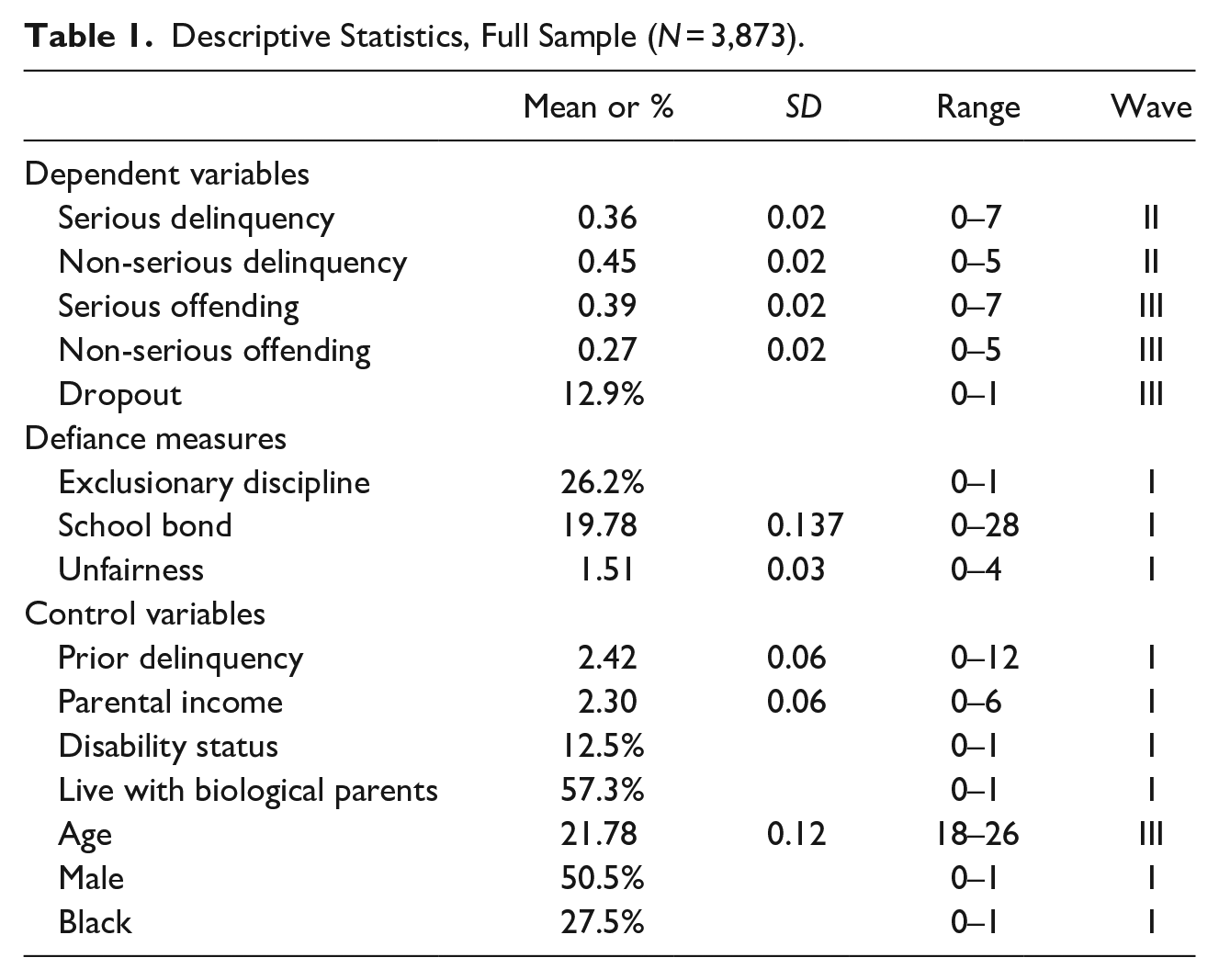
Beginning with socio-demographic characteristics, the sample is almost equally split between males and females, 50.5% and 49.5%, respectively. Non-Hispanic White students constitute roughly 73% of the sample while Non-Hispanic Blacks making up 27%. The mean of age of the sample at Wave III is 21.79 years. In terms of parental socioeconomic status, the average income of the sample is 2.30 indicating an annual income between $25,000 and $49,999. Roughly 12.5% of parents indicated that their child suffered from either a learning or developmental disability. The family structure variable indicates that a majority of students (57%) lived with both biological parents at Wave I while 42.7% had other various living situations such as residing with a step-parent(s), single-parent home, brother or sister as a guardian, or some other family combination. The mean score on the prior delinquency measure was 2.42 on a scale from 0 to 12.
Regarding measures of defiance, 26.2% of the sample experienced an out-of-school suspension or expulsion prior to the Wave I interview. The mean school bonding score was 19.78 on a scale from 0 to 28 and the mean unfairness score was 1.51. The mean serious delinquency and non-serious delinquency scores are 0.36 and 0.45, respectively. In terms of criminal offending, the mean serious offending score and non-serious offending scores are .39 and .27, respectively. Finally, almost 13% of the full sample dropped out of high school.
Multivariate Regression with Path Analyses: Full Sample
Tables 2 to 4 illustrate the results from the multivariate regression with path analysis for each outcome. First, for each outcome variable, results for the full sample show that exclusionary discipline has a significant impact on perceptions of unfairness and school bonding. Moreover, perceptions of unfairness appear to hinder school bonding in each of the models as well. In each model, exclusionary discipline increases perceptions of unfairness by 66% (exp(B) = 1.66, p < .001) and decreases the school bond by 68% (exp(B) = 0.32, p < .001). Perceptions of unfairness decrease the school bond by 85% (exp(B) = 0.15, p < .001). The differences across each model emerge in the paths from these intervening variables to the outcomes.
Generalized Path Analysis Results for (a) Serious Delinquency and (b) Non-Serious Delinquency.

Bold entries represents statistically significant relationships.
p < .05. **p < .01. ***p < .001.
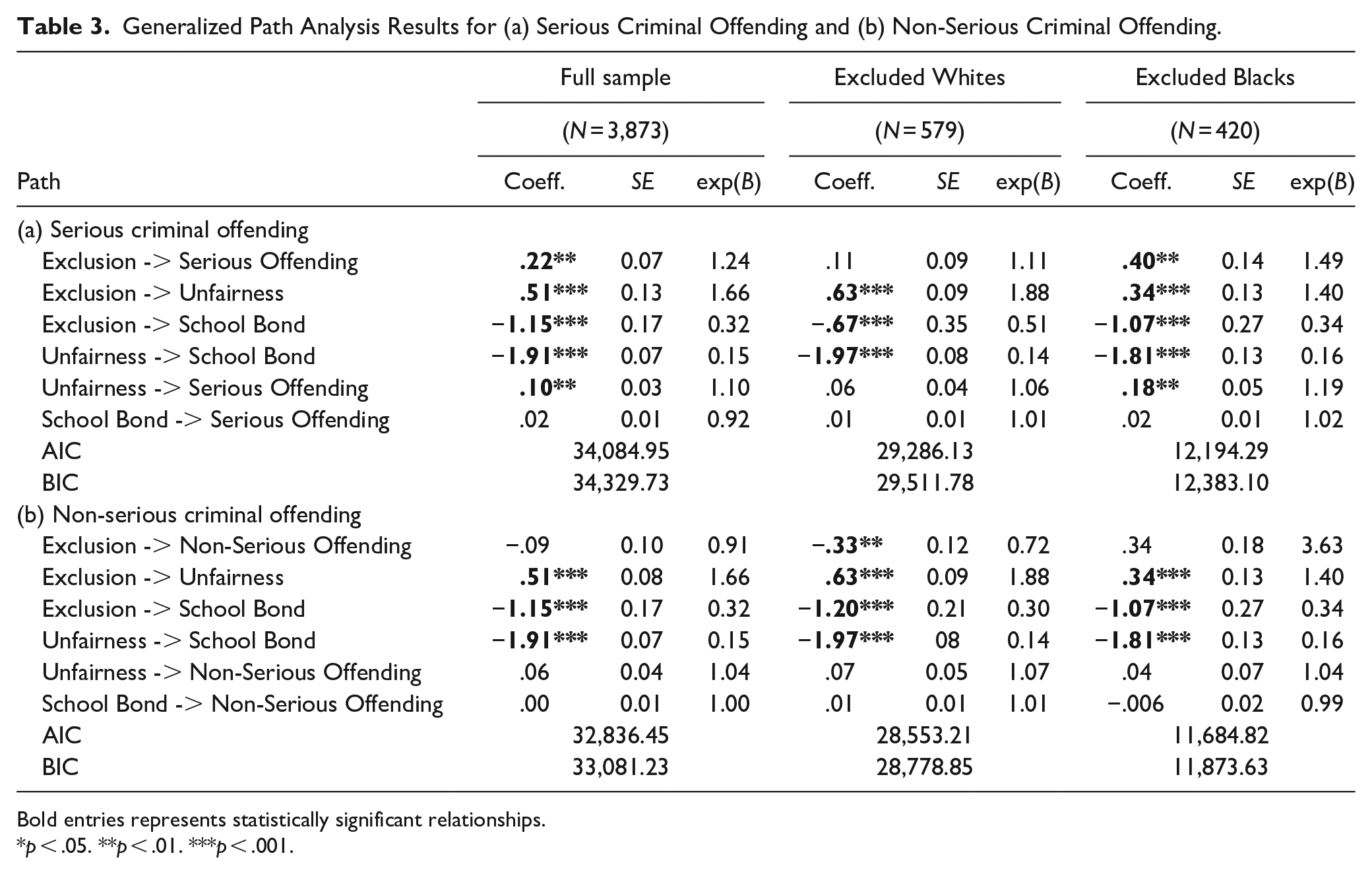
Generalized Path Analysis Results for (a) Serious Criminal Offending and (b) Non-Serious Criminal Offending.
Bold entries represents statistically significant relationships.
p < .05. **p < .01. ***p < .001.
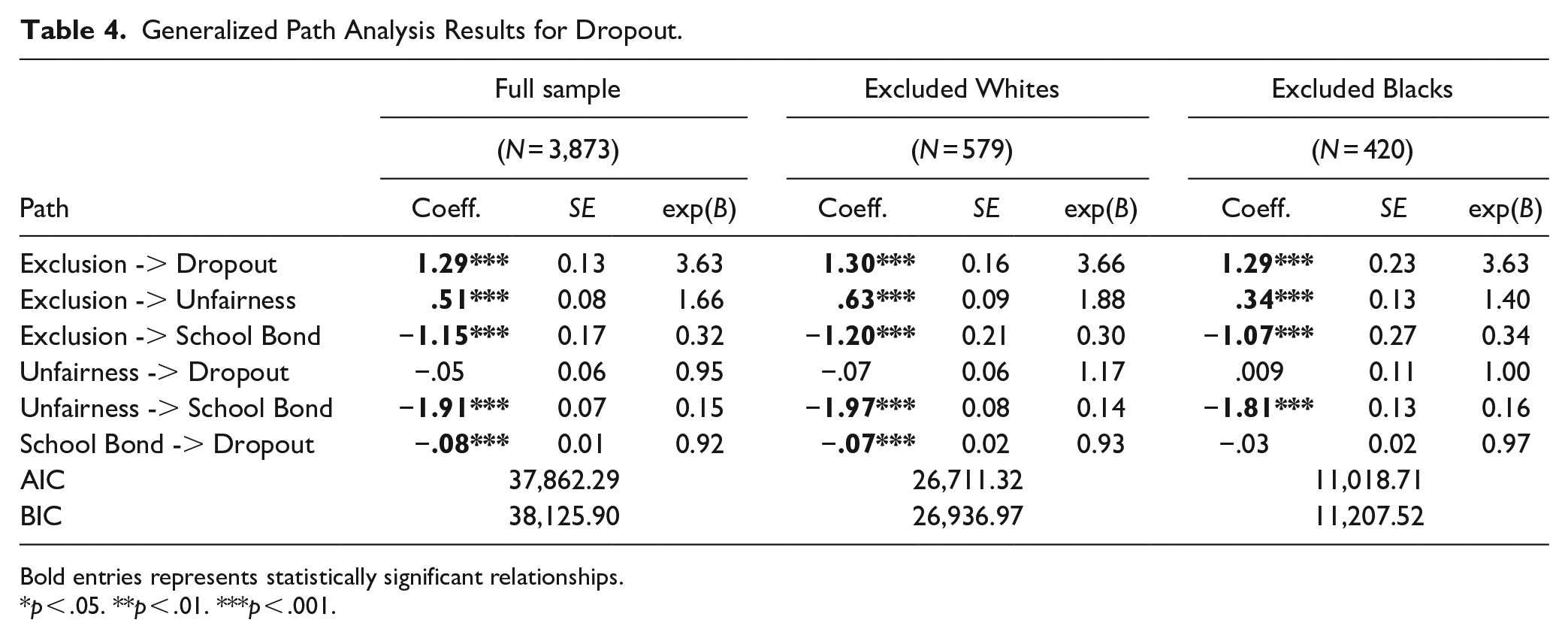
Generalized Path Analysis Results for Dropout.
Bold entries represents statistically significant relationships.
p < .05. **p < .01. ***p < .001.
Table 2a illustrates the results for the serious delinquency model. Exclusion from school alone increases the odds of engaging in serious delinquency by 22% (exp(B) = 1.22, p < .05). Moreover, perceptions of unfairness increase the odds of serious delinquency by 9% (exp(B) = 1.09, p < .05). Table 2b shows the results for the non-serious delinquency model. Neither exclusion, perceptions of unfairness, nor school bonding appears to have a significant effect on the likelihood of non-serious delinquency.
Table 3a shows the results for the serious criminal offending model. Here, we see that exclusion has a direct effect on serious offending increasing the odds by 24% (exp(B) = 1.24, p < .01). In addition, perceptions of unfairness increase the odds of serious offending by 10% (exp(B) = 1.10, p < .01). Table 3b displays the results for non-serious offending. Again, we see that there are no significant relationships to report.
Table 4 represents the results for the dropping out of school model. Here, exclusionary discipline has a significant direct effect on dropping out of school (exp(B) = 1.29, p < .001), increasing the odds of dropout by 3.63. Moreover, the indirect path from school bond to dropout is significant (exp(B) = 0.92, p < .001), decreasing the odds of dropping out by 8%. Although, perceptions of unfairness does not appear to have an independent effect on dropping out of school.
Multivariate Regression with Path Analyses: By Exclusion and Race
Tables 2 to 4 also illustrate the results of the multivariate regression with path analysis by exclusion and race. For all outcomes and both race groups, exclusionary discipline significantly affects perceptions of unfairness and school bonding with unfairness negatively influencing school bonding as well. Across each model, excluded Whites experience an increase in perceptions of unfairness by 88% (exp(B) = 1.88, p < .001). Exclusionary discipline decreases school bonding by 49% (exp(B) = 0.51, p < .001). Perceptions of unfairness is associated with an 86% decrease in school bonding (exp(B) = 0.14, p < .001). Similarly, across each model, excluded Blacks experience a 40% increase in perceptions of unfairness (exp(B) = 1.40, p < .001) and a 66% decrease in school bonding (exp(B) = 0.34, p < .001). Perceptions of unfairness is associated with an 84% decrease in school bonding (exp(B) = 0.16, p < .001). While it appears that the negative effects of exclusionary discipline are similar for both White and Black students, there are significant differences in the pathways from these variables to subsequent outcomes.
Table 2a shows the results for serious delinquency among excluded White and Black students. While the paths from exclusionary discipline are similar across each group, a difference emerges with regard to the effect of unfairness on serious delinquency. For excluded Black students, perceptions of unfairness increase the odds of serious delinquency by 19% (exp(B) = 1.19, p < .01); a relationship that does not appear for excluded Whites. In Table 2b, a significant path emerges from school bond to non-serious delinquency suggesting that the school bond decreases the odds of non-serious delinquency for excluded White students by 2%.
Table 3a represents the results for the serious criminal offending model. Here, exclusionary discipline has a direct effect on criminal offending for excluded Black students. Excluded Black students experience a 49% increase in the odds of criminal offending (exp(B) = 1.49, p < .01) whereas no such relationship exists for excluded Whites. Moreover, unlike excluded Whites, perceptions of unfairness is associated with a 19% increase in criminal offending among excluded Black students (exp(B) = 1.19, p < .01). Table 3b shows that while exclusion has no impact on serious criminal offending for excluded Whites, it does decrease the odds of non-serious offending by 28%.
Table 4 illustrates the results for dropping out of school. Both excluded Whites and Blacks experience an increase in the odds of dropping out school by 66% (exp(B) = 3.66, p < .001) and 63% (exp(B) = 3.63, p < .001), respectively. For excluded Whites, school bonding decreases the odds of dropping out by 7% (exp(B) = 0.93, p < .001); an effect not found for excluded Black students.
Equality of Coefficients Test
Equality of coefficients test was utilized to discern significant group differences between excluded White and Black students (Paternoster et al., 1998). Although there are fewer significant differences than expected, there are some notable relationships. In regard to serious criminal offending, a significant difference emerged in which being excluded from school had a direct effect on Black students (Z = −1.75, p < .05). Moreover, the effect of unfairness on the likelihood of serious criminal offending was more salient for excluded Black youth than their White counterparts (Z = −2.00, p < .05). Next, the effect of exclusion on non-serious delinquency which produced a deterrent effect for White youth, not Black youth was statistically different (Z = −3.10, p < .001). Excluded White and Black students differed in the effect of unfairness on the likelihood of serious delinquency, for which excluded Black youth were much more susceptible to (Z = −1.94, p < .05). Last, White and Black youth differed with respect to the impact of exclusionary discipline on perceptions of unfairness (Z = 1.84, p < .05), in which the experience of school exclusion resulted in increased perceived unfairness, while significant among both groups, was particular salient among Whites.
Discussion
The purpose of this study is twofold. First, to utilize defiance theory to explicate the mechanisms, perceived unfairness and school bonding, that work to propel students from school exclusion to subsequent negative outcomes. Second, this study aimed to test these relationships with a sample of White and Black students in order to determine if defiance is applicable across race.
The Role of Defiance: Perceptions of Unfairness and School Bonding
As discussed, the mechanisms that propel students from school exclusion to negative outcomes, such as delinquency, dropping out of school, and criminal offending are understudied (Pesta, 2018; Ramey, 2016). This study sought to determine if the components of defiance theory: stigmatizing sanctions, perceived unfairness, and school bonding played a role in the continuation of misbehavior from adolescence to adulthood. In general, the findings from this study suggest that the principles of defiance theory are important to the study of the effects of school punishment and various negative outcomes.
Results from the full sample analysis illustrate the importance of defiance concepts as each was significant in the process from exclusion to poor outcomes. We see that school exclusion, proposed throughout this study as a stigmatizing sanction, increased perceptions of unfairness, weakened school bonding, and also directly increased the likelihood of serious delinquency, serious criminal offending, and dropping out of school. Moreover, while school exclusion had a direct effect on each negative outcome, exclusion also worked indirectly through perceptions of unfairness and weakened school bonding to increase the likelihood of each negative outcome.
Of particular interest is the indirect path from school exclusion to both serious delinquency and serious criminal offending, both of which are mediated by perceptions of unfairness. In both models, school exclusion works to increase perceptions of unfairness, which in turn increases the likelihood of both serious delinquency and serious criminal offending. This result is in line with prior school punishment and procedural justice research which suggests that stigmatizing sanctions result in increased perceptions of injustice and unfairness among students (Fissel et al., 2019; Kirk & Matsuda, 2011). This study demonstrates such perceptions may have important behavioral implications by increasing engagement in both serious delinquency and serious criminal offending.
The Role of Defiance: Examining Racial Differences
This research also extends the applicability of defiance theory to race. Due the racial inequity of exclusionary discipline, it was posited that excluded Black students would have higher perceptions of unfairness (H1) and lower school bonding scores (H2) than their excluded White peers. Interestingly, it was excluded Whites who reported higher perceptions of unfairness (although, this was not statistically significantly different from excluded Blacks) and lower school bonding. These results are unexpected and inconsistent with defiance theory; however, this finding points to an interesting discussion.
While not shown, descriptive analyses were conducted across race groups. Results indicated that compared to White students as a whole, Black students reported higher perceptions of unfairness (1.64 compared to 1.48) and lower school bonding (19.2 compared to 19.9), both of which were statistically different. Prior research suggests that due to a host of racialized factors, black students have a tentative relationship with school both with teachers and as an institution (Cernkovich & Giordano, 1992; Rios, 2011; Weissman, 2015). Therefore, while the results show an unexpected relationship it is worthy to note the difference in baseline scores. This suggests if Black students as a whole are wearier of teachers and school in general, the stigma associated with exclusionary discipline may do less to impact their initial perceptions compared to White students (Hirschfield, 2008).
Hypothesis 3 suggested that due to the racial disparity in exclusionary discipline, excluded Black students would be more likely to develop defiance via perceptions of unfairness and weak school bonding resulting in higher levels of delinquency, dropout, and criminal offending. In other words, it was expected that excluded Black students would experience an exacerbation in problem behavior whereas excluded White students would experience a deterrent effect. While results show that both excluded Whites and Blacks experienced increases in perceived unfairness and weakened school bonding, the groups differed on how each translated into negative outcomes.
With regard to serious delinquency, it appears as though for excluded Black students, perceptions of unfairness work to increase the likelihood of serious delinquency; an effect not present for Whites. This finding supports prior research which suggests that due to its disproportionate application, Black youth are more likely to view punishments as unfair and illegitimate (McNeal & Dunbar, 2010; Weissman, 2015). Moreover, exclusion appears to deter White students from non-serious delinquency and dropping out of school via school bonding. This protective effect does not emerge for excluded Black students. This finding may point prior research which suggests that excluded Black students have a more tentative relationship with school due to the mixed messaging received about its value; a phenomenon not experienced by Whites (Cernkovich & Giordano, 1992; Ogbu, 1988; Peguero, 2012).
Again, the serious and non-serious criminal offending models demonstrate similar results. Excluded Black youth experience an increase in serious criminal offending, both directly and indirectly via perceptions of unfairness. Whereas, excluded White students experience a direct deterrent effect, in that exclusion itself works to deter non-serious criminal offending. This effect points to prior research that suggests Whites may be more apt to accept punishment as it is not applied to them in uniquely disproportionate ways (Hagan et al., 2005; Tyler, 1990).
Overall, it appears that the major difference between excluded Whites and Blacks is whether or not defiance translates into negative outcomes. For Whites, while being suspended or expelled does increase perceptions of unfairness and decreases school bonding it does not lead to negative outcomes. In fact, excluded Whites experience a deterrent effect. In other words, while school exclusion does increase two components of defiance, this does not necessarily translate into negative behavioral outcomes for Whites. Whereas for excluded Black students, perceptions of unfairness in particular increase the likelihood of both serious delinquency and criminal offending.
The findings from the serious and non-serious delinquency and criminal offending models, in particular, have important implications for racial disparity observed in the school-to-prison pipeline. As suggested by prior research, harsh punishments such as school suspensions and expulsions, do more to exacerbate problem behaviors than to quell them, at least for Black students. As discussed, this is likely because racial minorities, and Black students in particular are disproportionately the targets of these punitive policies, in effect increasing their distrust in school officials and decreasing their bond to the institution and its agents. Presumably, these students experience both institutional and interpersonal exclusion and drift further away from normative peers and institutions for which increased delinquent and criminal behavior is likely (Jacobsen, 2019; Novak, 2019; Pyne, 2019). Incidentally, these same harsh punishments, when experienced by White students still provoke perceptions of unfairness and decreased school bonds yet this does not translate into increased engagement in delinquency or criminal offending. In fact, excluded White youth experience a deterrent effect. Taken together, these findings help to shed light on how school exclusion can produce exacerbating and/or deterrent effects and how may help explain, at least in part, some of the racial disproportionality within the pipeline.
Limitations and Future Research
Although these findings contribute to and expand the applicability of defiance theory, limitations must be noted. First, it was not possible to include school-level characteristics into this study due to the restricted nature of said data. This is an important limitation as there are differences in disciplinary practices across schools in which those with a majority of poor, racial minority students have the most punitive policies (Skiba et al., 2014). However, the primary purpose of this study was not to predict exclusionary discipline but rather utilize it as an antecedent to predict defiance and subsequent behaviors. Next, the fundamental purpose of the Add Health data set was to collect information on health behaviors and while delinquency and criminal offending are a part of that, other important correlates of such behavior are not. Pertinent to this research is the lack of delinquent peer measures which have been shown to be influential on adolescent behavior independent of school factors (Matsueda & Anderson, 1998; Sampson & Laub, 1993).
Another significant limitation is the measure of unfairness. Sherman (1993) posits that the offender must perceive the sanction as unfair or unjust in order for defiance to occur. The measure used in this study captured student perceptions regarding the fairness of teachers in the school. It would have been ideal to be able to construct a measure which isolated perceptions of specific sanctions from those who experienced them but due to data limitations this was not possible. However, while this measure served as a general measure of unfairness, as noted by prior researchers, zero-tolerance policies and other harsh disciplinary tactics result in increased perceptions of injustice and unfairness among all students and particularly among those who experience sanctions directly (Fissel et al., 2019; Kirk & Matsuda, 2011).
Similarly, while this study focused on the effect of exclusionary discipline on the school bond, Sherman’s (1993) original work suggests that the offender exhibits poor bonds to society in general. This suggests that including multiple sources of bonds to society would have been ideal. As mentioned, this study was primarily concerned with the effect that a school-based sanction would have on bonds to that same institution however, observing how little influence the school bond exerted on the various outcomes relative to other variables, it may be that other bonds, such as those to family, are important in the development or mitigation of defiance and should be included in future research. Moreover, related to school bonding, students who were not enrolled in school in Wave I were excluded from the sample. This was done to protect temporal ordering. However, it should be noted that those who were not enrolled in school in Wave I could be among the least bonded to school but were subsequently excluded from analysis.
In terms of theoretical limitations, due to a lack of data gauging respondents’ acceptance or acknowledgement of the shame associated with punishment, a complete test of Sherman’s (1993) theory was not possible. This may be the key component to understanding how to better utilize punishment so that student accepts the shame but remains socially connected rather than isolated from school. Moreover, limitations within the data set raise some generalizability concerns. For instance, the Add Health data set has no indicators for how and why students define certain sanctions measures as unfair, nor does it gauge their particular perception and/or acceptance of specific punishments. The data for this simply does not exist. However, this study, albeit a partial one, does indicate some indirect support for two of the tenants of defiance. Even with these limitations, the contribution of this study to the school punishment literature is important as it demonstrates differences in the effect of exclusionary discipline across race, extending the utility and applicability of Sherman’s theory.
Future research should perhaps embark on a qualitative journey to collect data from excluded students about their perceptions, observations, and feelings about being sanctioned in order to test defiance theory in its entirety. By gaining an in-depth understanding of school exclusion and its negative effects, we can develop strategies to rebuild and reinforce the school bond, particularly for Black youth. Criminal sanctions, in this case school punishment, can be delivered in either reintegrative or stigmatizing ways; the former induces social shame on the act, whereas the latter places shame on the actor (Braithwaite, 1989). In other words, rather than doing a bad thing. . .you are a bad kid. As suggested in the work of Winslade and Williams (2017), school counselors may help with the reintegration process student’s experience when they return after a suspension. They note that oftentimes students are expected to return to school as if nothing has happened and in the hopes that they have learned something from the punishment however, if meaningful and reflective conversations are not being conducted with returning students it is likely student’s will have learned nothing from punishment (Winslade & Williams, 2017). Reintegrative shaming can work to reduce misbehavior whereas stigmatizing shame increases it. As such, reintegrative shaming techniques may help to successfully integrate rather than isolate students from their school environment.
Footnotes
Declaration of Conflicting Interests
The author(s) declared no potential conflicts of interest with respect to the research, authorship, and/or publication of this article.
Funding
The author(s) received no financial support for the research, authorship, and/or publication of this article.
