




Abstract
While there is ample research examining the short- and long-term effects of juvenile incarceration (broadly defined), less is known about the specific consequences of the most common form of youth incarceration, juvenile detention. We conducted a Rapid Evidence Review (RER), limiting our search to the past 10 years to include studies that captured modern juvenile justice practices, to assess the body of literature evaluating the effects of juvenile detention on youth outcomes. Our initial search yielded over 1,800 articles, but only three ultimately met criteria for inclusion in our review. We conclude that there is a profound lack of research regarding the consequences of juvenile detention, an issue that affects a large number of youth in the United States.
According to the 2017 Census of Youth in Residential Placement (CYRP), there were 43,580 youth incarcerated in private, local, and state facilities across the United States on the day of the census (Hockenberry, 2020). There are ample studies investigating the effects of incarceration on youth outcomes in multiple domains of functioning (Apel & Sweeten, 2010; Freeman, 1987; Geller & Curtis, 2011; Gilman et al., 2015; Hjalmarsson, 2008, 2009; Huebner, 2005, 2007; Lanctot et al., 2007; Laub & Sampson, 2003; Lopoo & Western, 2005; Loughran et al., 2009; Massoglia, 2008; Schnittker & John, 2007; Sugie & Turney, 2017; Tanner et al., 1999; Western, 2002; White et al., 2010). However, in most studies incarceration is broadly defined as confinement in a secure facility of any type. This makes it difficult to differentiate effects by confinement type and can lead to misuses of the available evidence base for policy- and system-level decision making. As the juvenile justice system increasingly faces a number of calls to action to incorporate practices that promote healthy youth development (National Research Council, 2013; Tuell et al., 2017), policymakers will need methods for interpreting and applying the relevant evidence. In the present study, we describe our use of a method of evidence translation, rapid evidence review (RER), designed to support state-level decision making regarding the use of juvenile detention.
For youth involved in the juvenile justice system, if incarceration is going to occur, it is likely to happen at the local level, in a facility designed for short-term detention. The most comprehensive source of data, the CYRP, is a 1-day count of youth in confinement, rather than a description of all admissions to facilities for a given time period. On the census day in 2017, there were 14,263 youth in state-run facilities, 16,633 youth in local facilities, and 12,684 youth in private facilities, but the researchers note, “because detention stays tend to be shorter compared with commitment placements, detained juveniles [who are more likely to be in a local facility] represent a much larger share of the population flow data than of 1-day count data” (Hockenberry, 2020, p. 2). This is reinforced with state-level data. For example, data from Washington State show that in 2018, there were 11,719 admissions to local juvenile detention centers and significant fewer admissions (445) to long-term state facilities (Gilman & Sanford, 2019; Washington State Partnership Council on Juvenile Justice, 2020). Given the large differences in average length of stay (9.2 days in detention vs. 347.0 days in state facilities in Washington), it is important to examine each facility type separately when attempting to determine their potential effects on youth. The purpose of the current study was to review the body of published literature to determine what evidence exists regarding the effects of juvenile detention on youth outcomes in both criminal and non-criminal domains.
Theoretical Considerations
Relevant Theories Regarding the Purpose of Detention
There is no single understanding of what role juvenile detention should play in the continuum of justice contact. This makes a synthesis of the effects of detention challenging. Research studies that aim to validate or discredit theories of effectiveness have to be understood in light of the authors’ understanding of detention’s role. In 1995, Earl Dunlap, the then-Executive Director of the National Juvenile Detention Association (NJDA) and Dr. David W. Roush, a justice system consultant, published an article that stands as a good summary of the paradoxes inherent in this institution (Dunlap & Roush, 1995). They note that detention suffers from a confusion of function and can become a catchall for contradictory purposes which may include meting out punishment, securely holding youth prior to hearings, holding youth who have no clear alternative placement, and as a space to provide health and treatment interventions. These functions, as argued by the authors, fall into either a “preventive” function in which the primary service is restraining a youth’s freedom, or a “therapeutic” function to provide helpful programs or rehabilitation. Despite the claims that detention can serve both roles, the historically dominant view of detention is as a place to physically restrict a youth’s freedom.
In 1989, the NJDA adopted the following definition: “Juvenile detention is the temporary and safe custody of juveniles who are accused of conduct subject to the jurisdiction of the court who require a restricted environment for their own or the community’s protection while pending legal action” (as cited in Roush, 1996, p. 33). Three years later, a very similarly worded definition was published in a document titled Juvenile Detention: A Nationally Recognized Definition (Stokes & Smith, 1999). In 2007 the NJDA revised the definition to emphasize that detention is part of a larger continuum of care within the juvenile justice system, and that it is both a place and a process (Clark, 2014). The updated definition, which still appears to be the most widely used today, reads: Juvenile detention, as part of the juvenile justice continuum, is a process that includes the temporary and safe custody of juveniles whose alleged conduct is subject to court jurisdiction and who require a restricted environment for their own and the community’s protection while pending legal action (as cited in Clark, 2014, p. 3).
Relevant Theories Regarding the Potential Effects of Detention
The policy literature largely focuses on the confinement role of detention for public safety while also claiming protection for youth, somewhat thinly defined. Using this conceptual frame, we would expect detention to be neutral regarding youth development and to perhaps lead to fewer youth crimes given the purported benefits. However, justice reform advocates point to the potential negative and far-reaching unintended consequences of juvenile detention.
Both life course theory (Elder, 1985; Gotlib & Wheaton, 1997; Sampson & Laub, 1992) and labeling theory (Lemert, 1951; Tannenbaum, 1938) are helpful in understanding why exposure to juvenile detention might affect youth outcomes in multiple domains. Broadly speaking, life course theory is concerned with how events in one developmental period affect future developmental stages through trajectories and turning points. Turning points can be negative or positive, but their defining feature is that they alter one’s life trajectory. Juvenile detention might act as a turning point for youth, changing their opportunity structures during the very important transition to adulthood (see Gilman et al., 2015).
Labeling theory can help explain why this turning point may result in negative outcomes, and scholars have identified three paths through which a criminal label (such as that which results from juvenile detention) might affect future functioning (Barrick, 2014). First, after a labeling event, individuals may internalize the label and take on the assigned identity (Bernburg et al., 2006; Farrington, 1977; Johnson et al., 2004; Wiley et al., 2013). Second, following the criminal label, social networks may change, either by external circumstances (such as exposure to other youth in juvenile detention) or by choice, resulting in individuals having new or more sustained relationships with antisocial peers (Farrington, 1977; Wiley et al., 2013). Finally, criminal labels may result in decreased structural and social opportunities (e.g., Bernburg & Krohn, 2003; Lopes et al., 2012). For example, youth with a history of incarceration may find it more difficult to find housing and employment or to participate in conventional social groups.
Incarceration and Youth Outcomes
Scholarly articles related to detention tend to focus on the needs of detained adolescents (King et al., 2011; Nordness et al., 2002; Teplin et al., 2002), effectiveness of programs offered within detention settings (Leve & Chamberlain, 2007; Simons et al., 2017), or are argument papers outlining the benefits and/or risks of detention (Mathys, 2017; Parent et al., 1994). For example, the risk of exacerbating trauma through detention is a frequent concern noted by policymakers and researchers alike (Abram et al., 2004; Ford & Blaustein, 2013; Langton et al., 2012). In a recent paper, authors Branson et al. (2017) conducted a systematic review of trauma-informed policies for the juvenile justice system and note in their introduction that involvement in the justice system places youth at risk of additional trauma exposure. However, the authors cite as examples studies of abuse during incarceration (Dierkhising et al., 2014) and aggressive policing (Geller et al., 2014), both of which are egregious examples of system failures rather than demonstrations of detention under conditions of ideal or as intended practice.
A second robust body of literature provides ample evidence that juvenile incarceration, when measured as a dichotomous indicator of ever having spent time in a locked facility of any type, can have negative effects on both criminal and non-criminal domains of functioning during adolescence and the transition to adulthood. Outcomes studied include criminal behavior (Gilman et al., 2015; Hjalmarsson, 2009; Loughran et al., 2009), education and employment (Apel & Sweeten, 2010; Freeman, 1987; Hjalmarsson, 2008; Huebner, 2005; Laub & Sampson, 2003; Tanner et al., 1999; Western, 2002), housing (Geller & Curtis, 2011), health and mental health (Massoglia, 2008; Schnittker & John, 2007; Sugie & Turney, 2017; White et al., 2010), and interpersonal and family relationships (Huebner, 2005, 2007; Lanctot et al., 2007; Lopoo & Western, 2005). With few exceptions (e.g., Hjalmarsson, 2008; Loughran et al., 2009; White et al., 2010) the extant research on incarceration points to negative effects on youth and young adult outcomes. However, definitions of incarceration vary widely across studies, and even within a single study, incarceration can indicate anything from a few hours in a temporary detention center to several years in a long-term rehabilitation facility. This makes it difficult to draw conclusions about how different types of incarceration experiences might affect youth.
The Current Study
Our paper has the dual goal of presenting the results of a rigorous review of the literature as well as describing an application of RER for informing criminal justice policy. The question of interest was: what is the impact of short-term juvenile detention on youth outcomes? The purpose of an RER is to assess the strength of evidence regarding a question of interest for practice and policy. In order to produce a review in a reasonable amount of time, the RER search process is limited in some way, typically by the timeframe of publication and scope of the question. RERs have been shown to be useful for impacting and guiding policy, especially in the health field (see Hailey et al., 2000), and are growing in use as a method to develop evidence-informed policy (Tricco et al., 2017). We conducted this RER as part of a larger effort to provide accurate and timely information to courts and their stakeholders in Washington State. Recent state legislation has sought to make changes to how juvenile courts utilize detention. This review was commissioned by policy makers and practitioners to make informed decisions about the use of juvenile detention going forward.
Method
Defining Juvenile Detention
One critical piece of this review was agreeing on a definition of juvenile detention to guide our search and selection criteria. Clark (2014) writes, “Many people struggle to understand the difference in the various types of confinement facilities in which young people may be held and the purpose of each facility type. Significant variation in how jurisdictions structure their juvenile justice systems contribute to this lack of understanding” (p. 1). Two defining features of the national definition outlined above are that detention involves a restricted environment and is temporary. In Washington State, juvenile detention is further defined by being local. The 21 juvenile detention centers across the state allow youth to remain in their communities in the vast majority of cases (see Gilman & Sanford, 2019). This geographic distinction is written into state statute; the juvenile offender sentencing grid 1 differentiates between local sanctions, or “LS,” which include community supervision, community restitution, and local detention, and commitment to one of four state-run Juvenile Rehabilitation (JR) facilities. If the youth’s sentence falls under “LS” according to the grid, a judge can order the youth to spend up to 30 days in a local detention center. Dispositions involving more serious sanctions will result in commitment to a JR facility, with commitment lengths ranging from 15 months up to the duration remaining until the youth’s 21st birthday (or age 25 in some specific cases). Pre-adjudicated youth will never be admitted to a JR facility. While youth can be ordered to detention following adjudication, the most common admission reasons are: (1) a youth has been accused of an offense and is waiting adjudication, (2) a youth is brought into custody as the result of a warrant, and (3) a youth has committed a violation of a court order.
Given our interest in conducting a literature review that could inform policy in Washington, for the purposes of this review, juvenile detention is defined as a facility for juvenile justice-involved youth that provides secure confinement, is locally operated, and is short term. While this definition may not match the definition used in every state, given the dearth of studies examining the effects of detention specifically, rather than incarceration more broadly, we believe the results of this review will make a very important contribution to the existing body of literature.
Procedures
For our review, we deviated from traditional systematic review methods to streamline our review in a few ways. First, we limited our search to articles published from 2009 onward (through February 2019), as we reasoned that studies of detention prior to this time may reflect outdated practices. Second, we relied on articles retrieved from our database search, and did not search the reference lists of relevant articles. Third, while initial screening and full text review were completed by at least two staff members, the study quality appraisal step was conducted by one PhD-level researcher. Finally, we present narrative summaries rather than conducting a meta-analysis. These methods allowed us to complete the review in approximately 4 months.
Only one of these decisions likely changed the outcome and conclusions of our review. Had we included studies published prior to 2009, it is likely that more studies would have met inclusion criteria. However, reform efforts of the last three decades have resulted in substantial changes in juvenile detention, including reducing or eliminating overcrowding issues, adopting more treatment-oriented approaches, and improving overall conditions of confinement (National Research Council, 2013). Thus, the decision to limit our search to the previous 10 years not only streamlined our study, but also increased the likelihood that studies reflected current practices.
Four staff members worked on the review, two PhD-level researchers and two research assistants (one masters-level and one bachelors-level). All four staff were experienced in conducting literature reviews (one with expertise in systematic review methodologies) and two were content experts. We followed the steps recommended in the World Health Organization (WHO) guidelines for conducting these types of reviews (Tricco et al., 2017). We solicited the question from the stakeholders and mapped the studies that emerged from the initial key word search terms. In the second stage, we discussed the results of the initial literature search and refined the search question. Based on this conversation, we remapped the studies using these refined terms, excluded studies, and synthesized the results of the relevant literature. We also used Tricco et al. (2015) review of rapid reviews to guide the writing of this manuscript with regard to study transparency and comprehensive reporting of our methods.
Search Strategy
We used the following databases to identify studies: Academic Search Complete, PsychInfo, and Web of Science, and general internet searches for gray literature. Searches were conducted using combinations of different search terms including “juvenile,” “youth,” “detention,” “confinement,” “incarceration,” “behavior,” “outcomes,” “consequences,” “controlled,” “comparison,” “experimental,” and “quasi-experimental.”
Selection Criteria and Screening
Titles and abstracts were reviewed and flagged for exclusion by two independent reviewers from the team. When there was disagreement, a third reviewer made the final decision. Common reasons for exclusion at this initial stage included: studies used an adult population, detention/incarceration was the dependent variable; and studies were not empiric (i.e., they were theoretical pieces). The full text of the remaining articles was reviewed by at least two independent reviewers using the criteria outlined in Table 1. There were two instances where the independent variable was called detention, but it was not clear from the article whether it met our definition, so we consulted either the study’s author or other published sources to clarify.
Inclusion Criteria for Rapid Evidence Review.

Article Review and Synthesis
The articles that met criteria for inclusion in the RER were assessed for quality using the Critical Appraisal Forms designed by the Center for Evidence-Based Management in an effort to identify study limitations and risks of bias. We created a data extraction form to record study objective, sample characteristics, independent variables measurement, study site, research design, comparison group description, outcome(s), strength of the effect, and limitations.
We intended to group studies together that assessed similar outcomes and synthesize the findings across studies for each domain. However, only three articles met criteria for inclusion in the review and each study examined a different outcome (court processing outcomes, recidivism, and health status). Thus, we review each study individually in the Results section below and provide the main findings in Table 2.
Summary of Studies Included in the Rapid Evidence Review.

Results
Our search resulted in 1,183 unduplicated titles, of which 1,136 were removed during the initial screening (see Figure 1). Of the 47 articles reviewed in full, 44 were excluded for the following primary reasons: the full text was not in English (one article); the article was a literature review (two articles); the study was descriptive only (two articles); the study addressed a different research question (four articles); the study either used an adults-only sample or a mixed age sample and did not disaggregate by age group (14 articles); and the study’s independent variable did not meet our stated definition of detention (21 articles).
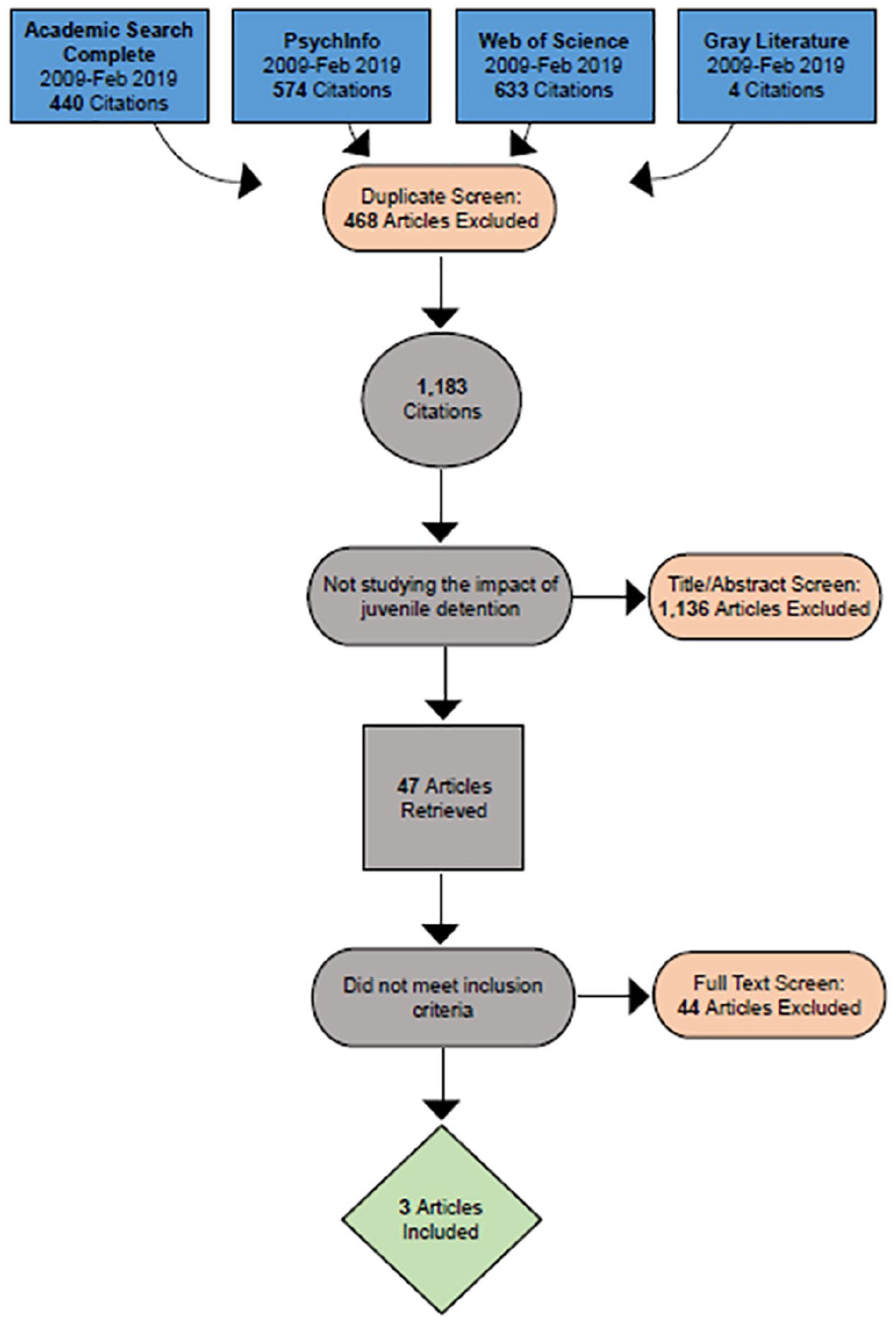
RER article selection flow chart.
Of the 21 articles not meeting our a prior definition, three were excluded because the independent variable was operationalized as exposure to juvenile detention or some other incarceration experience (e.g., a correctional facility), and the results were not disaggregated by facility type. Two were excluded because the independent variable was called detention, but was not short-term; the reported minimum length of stay was 6 months in one study and the mean length of stay in the second study was over 8 months. In the remaining 14 studies the independent variable was called something other than juvenile detention and there was either direct evidence that it did not meet our definition (e.g., it included a non-secure facility or the average lengths of stay was several months) or the authors did not provide a definition.
There were two articles that did not meet criteria for inclusion, but are worth mentioning. Dawkins and Sorensen (2015) found that higher statewide rates of juvenile detention and residential placement were significantly and positively related to aggregate levels of juvenile violent offending in the following year. The study used data from the national Census of Juveniles in Residential Placement (CJRP), which makes the distinction between detained and committed youth as well as local, state, and private facilities. Dawkins and Sorensen parsed out the effect of rates of detainment and commitment separately in their models. However, in the 2017 CJRP, 22% of detained youth were held in a state facility (Puzzanchera & Hockenberry, 2019), indicating the Dawkins and Sorenson study’s measure of detention likely did not align with our definition, specifically that detention involves a local facility.
A second study (Aizer & Doyle, 2015) found that juvenile incarceration was associated with a significant reduction in the likelihood of high school graduation and a significant increase in the likelihood of adult incarceration. The majority of youth in the study sample were incarcerated in the Cook County Temporary Juvenile Detention Center. However, youth who were placed in a state-run juvenile correctional facility were also included in the incarcerated sample, and the authors reported that these sentences ranged from 6 months to 2 years. The effects on outcomes were not reported by facility type. While it was only a small proportion of the sample who were incarcerated in a long-term state facility, this study nonetheless did not meet criteria for inclusion. The three studies that did meet criteria are summarized below.
Impact of Juvenile Detention of Court Outcomes
Rodriguez (2010) conducted an observational study of over 23,000 youth who were referred to a juvenile court for a criminal or status offense. The study had two aims: (1) to assess the impact of race and ethnicity on five court outcomes (diversion, detention, petition filing, petition dismissal, and disposition of out-of-home placement) and (2) To assess the impact of pre-adjudication detention on subsequent court outcomes (petition filing, petition dismissal, and out-of-home placement). Given our purpose, we focused on the results from the second aim.
The study was well designed and controlled for individual-level legal and extra-legal factors, as well as community-level factors in the hierarchical linear models predicting court outcomes. However, the author notes that she was unable to control for some characteristics that may have influenced the court’s decision making, including familial factors, psychosocial factors, and overall risk assessment scores. The results showed that pre-adjudication detention was significantly associated with a higher likelihood of a petition being filed, adjudication, and a disposition involving an out-of-home placement in a state facility (vs. community sanctions). Rodriguez posits that court officials might view youth who have been detained pre-adjudication as more culpable, more blameworthy, and less suitable for community sanctions.
Impact of Juvenile Detention on Recidivism
Huang et al. (2015) examined the effect of post-arrest placement decisions on recidivism for a sample of 213 crossover youth, defined as youth involved in both the child welfare system and the juvenile justice system. All youth in the sample were in an out-of-home child welfare placement at the time they experienced their first arrest for a violent offense. The aim of the study was to determine if certain types of placement changes (e.g., from a family home to a group home) after arrest would affect the likelihood of recidivism. However, 70 youth in the sample (33%) experienced detention within 90 days of their initial arrest, and this measure of detention was included as an independent variable in the final model predicting recidivism. The model also included age at first arrest, gender, race, whether there was more than one charge associated with the arrest, whether the youth was ordered to probation, the youth’s developmental stage at entry into the child welfare system, the number of placements prior to the first arrest, and, of course, the type of child welfare-related placement change.
The study was well designed to address its intended aim. Not surprisingly, the study did not include important confounding variables that likely affected both the youth’s likelihood of being placed in detention and the youth’s likelihood of re-arrest, namely the severity of the offense. However, the authors excluded any youth who were sentenced to a correctional placement following arrest so as not to capture any potential consequences of long-term placements, indicating that the sample was likely comprised of youth charged with lower-level offenses. The study met our definitional inclusion criteria, because one of the independent variables was explicitly called detention, and there was no indication it failed to meet the conditions of being secure, local, or short-term. In fact, as noted, the authors purposely excluded youth who were ordered to a long-term and/or state-operated facility.
The study found that, while youth who spent time in detention within 90 days of arrest had an elevated likelihood of re-arrest within 2 years, the association was not statistically significant. The study’s total sample size was relatively small (n = 213) and only one third of the sample experienced detention. It is possible the study lacked sufficient statistical power to detect significant differences. The sample size, as well as the sample composition, also make generalization for our purposes difficult, as the results seem to be applicable mainly to youth in the child welfare system who are arrested for low-level offenses, rather than to the full population of youth involved in the juvenile justice system who are at risk of detention.
Impact of Juvenile Detention on Health
Balogun et al. (2018) used a sample of 301 youth admitted to a juvenile detention facility in 2015 and 2016 to determine the extent to which youth who had previously been admitted to detention and youth with no history of detention differed on various health measures. The dependent variables included sexually transmitted infections, mental health symptoms, substance use, and sexual health behavior. The models controlled for age.
After controlling for age, the only statistically significant finding was that youth with a history of prior detention were more likely to have ever had sex. It is worth noting that the authors also examined differences in immunization rates between the two groups, and found that youth who had a prior detention admission were more likely to have received the Tdap immunization. However, it was unclear if any controls were included in the models predicting immunizations, so we did not include these results in Table 2. It can be argued that this study was more descriptive than quasi-experimental, but because the authors controlled for age in their outcome models, it met our inclusion criteria. The lack of control variables, as well as the lack of temporal ordering between the independent and dependent variables, eliminates the possibility of drawing causal inference from this study. Nonetheless, it is interesting that there were almost no significant differences between the two groups, even though one might assume that those who had a history of detention would generally be higher risk. The authors conclude that juvenile detention centers may offer some health screening and treatment services to the vulnerable populations they serve who otherwise would not have access to healthcare.
Discussion
This purpose of this review was to examine the extant juvenile detention and youth outcomes literature using RER methods. Our analysis found that despite numerous articles on the topic, there are very few empirical studies examining effectiveness or unintended consequences. Of the 1,183 articles we identified, only three studies specifically examined the effects of juvenile detention in a secure, locally-operated, and short-term facility on youth outcomes. Furthermore, only one of the three (Rodriguez, 2010) allows us to confidently make inferences about the potential causal relationship between juvenile detention and youth outcomes. Specifically, the results indicated that pre-adjudication detention was significantly associated with harsher court outcomes even after controlling for many salient confounding variables.
Balogun et al. (2018) provided an interesting description of two samples of youth, one with a history of detention and one without. However, without establishing temporal ordering between the independent and dependent variables or controlling for any factors beyond age, we cannot make conclusions about the effects of detention on health indicators. Huang et al. (2015) did not find a statistically significant relationship between detention and recidivism among a sample of crossover youth, but because the study was not designed to examine the effects of detention, it would not be wise to draw concrete conclusions from these results.
It is surprising that more studies have not examined the effects of juvenile detention on youth outcomes, given the enormous potential impact the results could have on juvenile justice policy and practice. First, far more youth experience short-term detention than commitment to a long-term state facility. Second, local officials have considerably more discretion over decisions that involve detention versus long-term facilities, as commitments to such facilities are much more likely to be dictated by sentencing guidelines. By contrast, post-adjudication detention is often imposed at the discretion of the judge, and decisions regarding pre-adjudication detention can be influenced by law enforcement practices, detention facility intake procedures (e.g., use of admission screening tools), and judicial determination. In addition, youth of color are overrepresented in detention and other residential placement populations (Gilman & Sanford, 2019; Hockenberry, 2020) and it is imperative that we know the impact of detention on youth outcomes so that juvenile justice systems do not exacerbate racial/ethnic inequities.
Our findings also hold implications for criminal justice research. As noted above, there is ample research examining the effects of incarceration on youth outcomes, both in the short and long term. Thus, it is not the case that this topic is ignored, but that very few studies focus specifically on juvenile detention or disaggregate by incarceration type when studying the consequences of ever having been incarcerated as a young person. Many researchers use secondary longitudinal data sets to examine the impact of justice involvement, including juvenile incarceration, on individual outcomes. Future research using such data sets should provide ample detail regarding how the independent variable was measured and what types of facilities were included, so that policy makers and practitioners can use the research to make informed decisions. Moreover, when samples include multiple types of incarceration, researchers should examine each incarceration type independently, when possible, as the policy implications for each analysis would vary substantially. Finally, more research studies that are specifically designed to assess the impact of juvenile detention on youth outcomes are needed.
Limitations and Considerations
The definitional inclusion criteria we used in our review may not align with every jurisdiction’s definition of detention. As noted above, results of the national CJRP show that juvenile detention isn’t defined consistently in every state; nationally in 2017, 22% of detained (i.e., pre-adjudicated) youth were in a state-run facility (Puzzanchera & Hockenberry, 2019). In Washington, only adjudicated youth would be committed to a state facility. However, if we were to relax this definition to allow studies that named the independent variable detention but included state facilities, only one additional study would have been included (Dawkins & Sorensen, 2015), and for readers who are interested, we noted it in the Results section above.
Another consideration is that in two of the three studies we reviewed, the primary aim was not to examine the effects of detention on youth outcomes. In Rodriguez (2010), the effects of pre-adjudication detention on youths’ court processing outcomes was presented as a secondary finding. In Huang et al. (2015), detention was included as a covariate in a controlled model predicting youth recidivism, allowing us to cautiously examine the relationship between detention and recidivism. It is possible that we missed other similar studies in our first screening of articles that would have proved useful, but because the primary research question was not related to the effects of detention, this information was not provided in the title or the abstract.
Finally, as with every rapid review, we made sacrifices in order to streamline the project and provide results to stakeholders in a reasonable timeframe. However, the most impactful decision was limiting our search to articles published from 2009 onward, and this was decided with input from our stakeholders, who wanted to see research that was reflective of current conditions, as practices have changed drastically over recent decades. We feel confident that other minor deviations we made from systematic review methods present minimal risk of bias, and we were careful to document our protocol so that potential risks are apparent to readers.
Conclusion
While juvenile detention rates have decreased sharply over the last several decades, detention is still widely used nationwide and thus, the potential impact of detention is enormous. In our RER, we found only three studies published between 2009 and early 2019 that evaluated the effects of juvenile detention, defined as confinement in a secure, locally-operated, short-term facility, on youth outcomes. Only one study was determined to have minimal risk of bias, and concluded that detention has negative consequences for court outcomes. If states and local jurisdictions are to make evidence-based policy decisions, much more research is needed on the consequences, intended or otherwise, of juvenile detention.
Footnotes
Declaration of Conflicting Interests
The author(s) declared no potential conflicts of interest with respect to the research, authorship, and/or publication of this article.
Funding
The author(s) received no financial support for the research, authorship, and/or publication of this article.
