




Abstract
Strain is an indivisible part of the military experience. Despite the well-documented association between strain and deviance in civilian settings, however, whether common forms of strain in the military produce deviant reactions among soldiers has yet to be established. In this study, we investigate the associations among various forms of strain and deviant behaviors among military service-members. Additionally, we examine the effects of mediating mechanisms linking strain to deviance through the lens of General Strain Theory (GST). We found that strain factors were all positively associated with each deviant behavior. Among the mediating factors, anger partially mediated the relationships between strain and all three deviant behaviors, while depression partially mediated only the relationship between strain and heavy alcohol use.
Military service is an important life transition that may significantly affect a variety of life domains. Although a few studies have found military service to only provide a setting for the continuation of previous behavioral patterns, extant research has generally depicted military participation as a major turning point in the life course, altering or redirecting life trajectories and behavioral patterns including those related to deviance and crime (MacLean & Elder, 2007; Teachman & Tedrow, 2016). One of the major factors leading to such significant changes in individuals’ lives and behaviors is exposure to a resocialization process during military service. In this resocialization process, individuals acquire new and diverse perspectives, internalize a novel set of norms and values compatible with military demands, establish relationships and social ties, and experience identity transformation. Especially in conscription or draft systems in which certain groups of individuals (generally men) are obligated to serve in the military for a finite period, military service may function as a significant source of socialization, shaping the identities, perspectives, and behavioral patterns of the whole society.
One of the major characteristics of this life-changing, transformative resocialization process is the stressful conditions that are unique to and inherent in the very nature of military service. Due to the primary responsibility of the armed forces being defending the nation, the expectation that it must maintain a certain level of readiness, and difficult and dangerous duties assigned to it, military service can be one of the most demanding occupations, both in the United States and worldwide. This demanding nature is accompanied by a variety of stressors that stem from role strain, conflicts between civilian and military values, disruptions in pre-existing relationships and social networks, negative unit experiences, physical and mental exhaustion, and exposure to traumatic events, to name a few (Bohannon et al., 1995; Bryant, 1979; Grinker & Spiegel, 1945; Hoge et al., 2004; Mitchell et al., 2011; Pflanz, 1999; Sampson & Laub, 1993). Extant research on civilian samples has shown that the majority of people use legitimate coping strategies in response to these kinds of stressors, either by removing the stressful demands themselves or changing their emotional reactions to those demands (Folkman, 1984; Lazarus & Launier, 1978; Thoits, 2010). Conversely, some individuals engage in deviance and crime as alternative coping strategies to alleviate negative emotions resulting from exposure to stressful conditions. For this reason, there is generally a strong correlation between stress or strain and deviance (Agnew & White, 1992; Drapela, 2006; Jang & Johnson, 2003; Kaufman, 2009; Neff & Waite, 2007).
Despite the prevalence of a variety of stressors in the military and the fact that those stressors might produce deviant reactions, it has not yet been established if there is a relationship between stressful life experiences and deviant behaviors among military service-members. This study seeks to address this neglected area of research by investigating the relationship between service-members’ exposure to different forms of strain and engagement in various deviant behaviors. Additionally, applying Agnew’s (1992) General Strain Theory (GST) framework, we aim to shed light on the mediating mechanisms by which stressful experiences among military service-members lead to deviant reactions, also allowing us to determining the feasibility of using GST in a military context. To achieve our objectives, we employed unique data collected from conscripts in the Turkish Armed Forces, which is a military institution that has adopted a conscription/draft system in which every Turkish man is obligated to serve in the military for a certain period of time.
Background
Serving in the military brings both opportunities and drawbacks for service-members, and both may have implications for their engagement in deviant behaviors. The bridging hypothesis suggests that military service may provide an opportunity for individuals to escape a disadvantaged background as service-members are often provided access to education, jobs, housing, and opportunities that may not be readily available in a civilian context, thereby allowing them to make better lives for themselves and their families (Browning et al., 1973; Elder, 1987). Moreover, military service may positively influence individuals’ lives by encouraging social independence, providing time away from the stress associated with transitioning to adulthood, offering exposure to a broad range of perspectives, and strengthening bonds with conventional society, all of which may prevent individuals from engaging in deviant or criminal behavior. (Elder, 1999; Orak & Walker, 2019; Sampson & Laub, 1993). Conversely, military service may disrupt individuals’ socialization process, interrupt existing social roles, and teach service-members how to solve their problems aggressively and with weapons (Hakeem, 1946; Sampson & Laub, 1996). More importantly, it may bring with it certain stresses and strains that are unique to the military experience, produce mental health problems and negative affective states such as depression, anxiety, and anger, and create adjustment problems such as post-traumatic stress disorder, all of which can potentially lead service-members to deviant and criminal pathways (Bohannon et al., 1995; Bouffard, 2005).
Research has shown that military personnel are subjected to a variety of stressors intrinsic to military organizations such as difficult and dangerous duties, negative unit experiences, physical exhaustion, blockage of career goals, exposure to traumatic events, negative combat experiences, and long deployment periods (Grinker & Spiegel, 1945; Hoge et al., 2004; Mitchell et al., 2011; Pflanz, 1999). It is also well-established that there is a strong correlation between stress and deviant behavior (Arter, 2008; Aseltine et al., 2000; Orak & Solakoglu, 2017; Slocum, 2010; Solakoglu & Orak, 2016). Yet the extant research has generally failed to address the mechanisms by which stressful experiences among military service-members lead to deviant reactions.
At this point, Agnew’s (1992) General Strain Theory (GST) may provide a useful framework for explaining potential relationships between stressful experiences and deviant reactions among military service-members. GST proposes that individuals commit crimes or exhibit deviant behaviors when they feel strain from a variety of sources, mainly caused by the removal of positive stimuli, occurrence of negative stimuli, or goal blockage (Agnew, 1992). In most cases, however, the relationship between strain and deviance is indirect. First, certain kinds of strain increase the likelihood of experiencing negative affective states such as depression, anger, despair, fear, and disappointment. Then, experiencing these negative affective states leads to the development of various coping strategies that may include engaging in deviant behaviors (as well as other, more legitimate coping techniques). In other words, individuals’ negative affective states have a buffering or mediating impact on the relationship between certain kinds of strain and deviance (Agnew, 1992). This suggests that individuals engage in deviant behaviors as a corrective activity to mitigate negative emotions resulting from exposure to certain forms of strain. Although the findings of some studies have not supported the mediation hypothesis (Broidy, 2001; Moon et al., 2009), the majority of the work on deviant behaviors and GST has found that strain is associated with deviant behaviors through the mediating effect of negative affective states such as anger, depression, despair, resentment, and fear (Agnew, 1992; Agnew et al., 2002; Brezina, 1996; Jang & Johnson, 2003).
Based on the findings of the pertinent literature on GST, we expect to find that: (1) an increase in the level of strain (i.e., unit strain, negative life experiences, and physical victimization) among conscripts will be associated with an increase in the likelihood of engaging in deviance (i.e., criminal offending, drug use, and heavy alcohol use), (2) an increase in the levels of negative affective states (i.e., depression and anger) among conscripts will be associated with an increase in the likelihood of engaging in deviance (i.e., criminal offending, drug use, and heavy alcohol use), and (3) the association between strain and deviance among conscripts will be mediated by both depression and anger.
Study Setting: The Turkish Armed Forces
Turkey is situated in a unique geographical area at the crossroads of Asia, Europe, the Middle East, and the Mediterranean Sea. Due to its strategic location and corresponding security concerns, it controls one of the largest military powers in the region. In Turkey, all male citizens must report for compulsory military service at the age of 20, though there are several exceptions (e.g., disability, continuing education). Young men who enlist in mandatory service can serve as short- or long-term conscripts, with the duration of service ranging from 6 to 12 months, based on their educational attainment. The Turkish Armed Forces had a population of over 628,000 military and civilian personnel at the time of the survey and it was made up of four major components including the Land Forces, Naval Forces, Air Force, and Gendarmerie Command. The latter’s main responsibility is the maintenance of public order outside of police jurisdictions. The number of conscripts in the general military population at the time of the survey was about 330,000, with the majority of conscripts serving in the Land Forces, followed by the Gendarmerie Command. Given that military service is compulsory and a large proportion of young males join the military at a critical stage in their lives, the Turkish military operates as a significant source of socialization that may shape their identities, perceptions, and behavioral patterns both in the short and long terms (Orak et al., 2020).
With regards to the deviant behaviors examined in the current study, in Turkey, drug use and criminal offending are punished by law (as is the case in a majority of countries around world), while heavy alcohol use is perceived as an undesirable behavior but carries no legal sanctions. Although alcohol use is legal for individuals over the age of 18, it is strictly prohibited within the military. Service-members who return to their units after the leave (e.g., weekend leave) under the influence of alcohol face harsh disciplinary actions. Given the destructive impacts of these behaviors on soldiers’ performance and level of readiness, as well as the order and discipline of military units, there are strict restrictions and regular attempts by unit commanders to discourage service-members from engaging in such behaviors. From this perspective, in addition to its intellectual merit, the results of the current study will be of critical importance for military practitioners and policy makers in the Turkish Armed Forces, allowing them to better understand the factors potentially promoting deviant behaviors among soldiers.
Methods
Data and Sample
This study draws upon data from the Mehmetcik Survey, which is a retrospective, cross-sectional, face-to-face survey conducted in 2015 to reveal the prevalence and causes of deviant behaviors among Turkish soldiers (Gurbuz et al., 2020). Surveys were distributed to 5,230 randomly selected Turkish soldiers serving in 117 randomly selected military units across the country. Both the military units and individuals within those units were selected according to the principles of simple random sampling. After removing respondents who did not want to take the survey or did not want to continue the survey at any point, as well as those who reported personal use of “Revalin” and/or “Takolin,” two genuine-sounding but non-existent drugs included by researchers to enhance reliability, the final sample size was 4,959. The average of the soldiers included in the final sample was approximately 21, 7% were married, 84% were the long-term conscripts (1 year), and all were male. About 7% of soldiers were serving in the Naval Forces, 7% in the Air Force, 26% in Gendarmerie, and about 60% in the Land Forces. About 21% of soldiers were serving in the eastern part of Turkey, where counter-terrorism operations against the Kurdistan Workers’ Party (PKK) were taking place, though participants were generally involved in low-risk activities. Close examination of the individual and unit characteristics of the final sample indicated that the sample sufficiently represented the target population (all conscripts in the Turkish Armed Forces).
The questionnaire developed for the survey was prepared based on the Youth in Europe Survey conducted by European Cities Against Drugs (ECAD 2009) to measure substance abuse problems and deviance in European cities, which has been utilized by numerous studies published in a variety of academic journals (e.g., Bernburg et al., 2009; Orak & Solakoglu, 2017). Thus, this research benefitted from the fact that the reliability of the questions had already been tested. Respondents were asked questions derived from the Youth in Europe Survey that addressed both their lives before and during military service. In addition to the questions derived from the Youth in Europe Survey, the Mehmetcik Survey asked questions touching on topics unique to military organizations, such as unit strain, unit bonding, rank, and relationships with commanders and military peers. Survey respondents were informed of the study’s purpose and that participation was voluntary and represented minimal risk. They were also guaranteed anonymity and assured that their responses would be recorded without individual identifiers, and the results would be reported only as grouped data. Surveys were implemented by the guidance and counseling services of each military unit. To prevent potential social desirability issues that might stem from respondents’ fear of their commanders, participation in the data collection processes by any of their superiors or commanders was prohibited. Also, soldiers were interviewed during military training time; their free-time was not impinged upon, ensuring that they paid attention only to the survey. The ethical approval required for the survey was given by the Department of Military Psychology and Combat Psychiatry at Gulhane Military Medical Academy in Ankara, Turkey.
Dependent Variables: Deviant Behaviors
Three measures of deviant behaviors are included in this study. Based on the measurement techniques employed in previous research (Sigfusdottir et al., 2004; Widdowson & Siennick, 2020), criminal offending was measured by an index including the measures of (1) stealing something worth less than three normal movie tickets (~50 Turkish Liras), (2) stealing something worth more than three normal movie tickets, (3) using physical violence to rob/steal, (4) breaking into a building or car, (5) damaging or vandalizing things that did not belong to them, and (6) committing another offense. Respondents were asked how often (if ever) they had done any of these activities during their military service. Response categories for each item ranged from 0 = never to 6 = 18 times or more (α = .79). Due to the positive skewness resulting from a high number of 0 responses, we dichotomized the variable as 0 = never committed an offense and 1 = committed an offense at least once during service. Similar to the measurement strategies used in recent research (Acion et al., 2013; Cesur et al., 2016; Nedelec et al., 2016), drug use was measured by an index that included measures of (1) unprescribed sleeping pills or tranquilizers, (2) cannabis (hashish or marijuana), (3) ecstasy, (4) cocaine, and (5) heroin. Respondents were asked how often (if ever) they used any of these drugs during their military service. Response categories for each item ranged from 0 = never to 6 = 40 times or more (alpha = 0.89). Since the majority of respondents reported never using drugs, their responses were dichotomized as 1 indicating a report of using drugs at least once and 0 indicating no drug use. Heavy alcohol use was measured as a proxy for heavy episodic drinking (Greenfield & Kerr, 2008; Midanik, 1999; Pape & Bye, 2017). Respondents were asked how many times they had gotten drunk during their military service. Response categories ranged from 0 = never to 6 = 40 or more times. As was the case with drug use, the majority of respondents reported that they had never gotten drunk during their service. Due to the positive skewness and violation of normal distribution assumption, we dichotomized the responses as 0 = never got drunk and 1 = got drunk at least once during service.
Independent Variables: Forms of Strain
To measure strain stemming from soldiers’ feelings about their military units, which is called unit strain, respondents were asked how well the following statements described their feelings: (1) I find military training pointless, (2) I get bored with military training, (3) Trainings is very hard, (4) I feel bad about my place in my unit, (5) I want to leave my unit, (6) I want to change my unit, and (7) I cannot get along with my commanders. Response categories for each statement ranged from 1 = rarely to 5 = almost always. To retain the original scale, responses were summed and divided by the number of statements (α = .74). In light of previous research (Sigfusdottir & Silver, 2009), soldiers’ negative life experiences during their military service were measured by an index that included 16 dichotomous (0–1) measures. Respondents were asked if during their military service they had ever experienced negative events such as a serious accident, severe illness, parents’ separation or divorce, serious argument with their parents, death of a parent or sibling, death of a friend, break-up with a girlfriend, parent losing their job, being a victim of sexual abuse, and being rejected by their friends. Values of the responses given for each measure were summed and a scale ranging from 0 to 16 was established (α = .91). Based on previously employed measurement techniques (Sigfusdottir et al., 2012), physical victimization was measured by a question asking respondents to report if they were ever a victim of physical violence during their military service. Response categories ranged from 0 = never to 6 = 18 or more times.
Mediating Variables: Negative Affective States
Relying on a shortened version of the Center for Epidemiologic Studies—Depression Scale (Radloff, 1991), depression was measured by an index that accounted for the following depressive symptoms: (1) feeling nervous, (2) feeling sad, (3) feeling lonely, (4) feeling sad or blue, (5) crying easily, (6) feeling hopeless, and (7) feeling like there is no one to whom they can talk. Respondents were asked how often they felt any of these negative emotions in the past week. Response categories for each item ranged from 1 = almost never to 4 = often. The values of the responses given for each statement were averaged to keep the original scale ranging from 1 to 4 (α = .92). Similar to measurement strategies employed in previous research (Jang & Rhodes, 2012; Keith et al., 2015), to measure the level of anger among soldiers, respondents were asked how well the following statements described their mood in the past week: (1) I was easily annoyed or irritated, (2) I experienced outbursts of anger that I could not control, (3) I wanted to break or damage things, (4) I had a fight with someone, and (5) I yelled at someone and threw things. Response categories for each statement ranged from 1 = almost never to 4 = often. The values of the responses to each statement were averaged and the overall scale ranged from 1 to 4 (α = .89).
Control Variables
This study also controlled for certain individual characteristics and behavioral patterns soldiers exhibited before beginning their military service. Respondents’ educational attainment was measured by questions asking about the highest level of education they completed, with response categories including 1 = less than primary school, 2 = primary school, 3 = middle school, 4 = high school, 5 = undergraduate education, and 6 = graduate education. Similarly, mother’s education and father’s education were control variables with response categories ranging from 1 = primary school or less to 6 = graduate education. Respondents’ marital status was also controlled for, with married individuals being assigned a value of 1 and all other arrangements (i.e., single, separated, divorced, etc.) a value of 0. Finally, respondents’ age was calculated based on their year of birth.
Analytic Strategy
Statistical analyses in the current study followed three interconnected steps. We began our analyses with a presentation of the descriptive statistics showing mean scores/percentages, standard deviations, and maximum and minimum values of all variables included in the study. Then, since all of our dependent variables (i.e., criminal offending, drug use, and heavy alcohol use) were binary outcomes, we performed a binary logistic regression analysis to assess the associations of independent and mediating variables with dependent variables, while also controlling for potential confounders. Finally, to assess mediation and reveal the direct and indirect effects of independent variables on dependent variables via mediating variables (Figure 1), we used the Karlson-Holm-Breen (KHB) method, which is a recently developed method used in many studies to reveal mediation effects in nonlinear models (Domènech-Abella et al., 2018; Gase et al., 2016; Karlson et al., 2012; Kohler et al., 2011; Yildiz, 2020).

Hypothesized mediation model predicting deviant behaviors.
In linear regression models, we can reveal the mediation effects in a straightforward way by comparing the estimates in two nested models including (1) the reduced model in which the independent variables are regressed against the dependent variable, and (2) the full model in which the mediating variables are added to the analyses in the presence of independent variables. In non-linear probability models (e.g., logit, probit), however, the coefficient estimates are dependent on the unexplained or the error variance in the model. The addition of new variables (e.g., mediators) in a non-linear probability model results in a reduction in the error variance and change the scale of coefficients, which is called rescaling. In other words, in non-linear models, the coefficients of independent variables do not only change due to the addition of mediating variables, but they also change due to rescaling. The KHB method allows for separating the mediating effect from the rescaling effect, which leads to the conclusion that the reduction in the coefficient of the dependent variable is caused by the addition of the mediating variable and not affected by the changes in the error variance (Kohler et al., 2011). For this reason, the KHB was one of the most suitable statistical methods for the current study. We were able to decompose the total effects of our independent variables into the sum of the direct and indirect effects, allowing us to reveal the relative magnitudes of each specific mediating effect. Additionally, the KHB method allowed us to control for the decomposition of potential confounding factors by including them in the models as concomitants.
For observations with missing values, we performed both list-wise deletion and a separate multiple imputation with chained equations. Both strategies yielded very similar results; we preferred the list-wise deletion over multiple imputation because the KHB method does not work with multiply-imputed data. Due to the clustered nature of data, we replaced the traditional standard errors with robust standard errors, which are known as Huber/White sandwich estimates. An examination of pairwise correlations between variables and the variance inflation factors of each variable showed that multicollinearity was not an issue in our analyses. For all calculations and statistical analyses, we used Stata 16 MP statistical software (StataCorp, 2019). To decompose the total effect of independent variables into a direct and indirect effects through mediating variables, we used the khb command with the options of concomitant, summary, disentangle, and notable.
Results
Descriptive Statistics
Table 1 presents descriptive statistics for all of the variables used in the analyses. Respondents’ ages ranged from 19 to 26, with a mean of 21.56. Approximately 7% of the respondents were married. Average educational attainment among respondents was 3.91 on a scale of 1 to 6, suggesting that on average, most respondents had either graduated from middle school or high school. The mean score of father’s education was 2.74 and 2.25 for mother’s education on a scale of 1 to 6, indicating that on average, the level of educational attainment among respondents’ parents was either primary or middle school.
Descriptive Statistics of All Study Variables (n = 4,104).

SD = standard deviation.
An analysis of independent variables demonstrated that the mean score for physical victimization during military service was about 1.11 on a scale from 0 to 6, demonstrating that respondents generally marked one of the following three categories: never been victimized, victimized one time, or victimized two to five times. The mean score for negative life experiences during military service was about 2.06, with a standard deviation of 2.75 on a scale from 0 to 16, showing that most of the respondents did not experience such negative events during their service. The average score for unit strain was about 2.55, with a standard deviation of 1.01. This suggested that, on average, the majority of respondents felt a certain amount of strain related to their military units. Mediating variables were measured on a 4-point scale, with response categories ranging from rarely (1) to often (4). The mean value for anger during military service was 1.80 with a standard deviation of 0.78, indicating that the average respondent either rarely or sometimes showed symptoms of anger during their military service. Similarly, the mean score for depression during military service was about 1.94 with a standard deviation of 0.79, which showed that on average, respondents either rarely or sometimes showed symptoms of depression during their military service.
Finally, the descriptive statistics revealed that a majority of the respondents reported they had never engaged in criminal offending, drug use, or heavy alcohol use. More specifically, about 4% of respondents reported criminal offending, about 6% reported drug use, and about 13% reported heavy alcohol use. It is not surprising that the rate of heavy alcohol use is higher than that of criminal offending or drug use, given the easier access to alcoholic drinks and common use of them in the military for stress relief. The difference might also be due to the nature and potential consequences of these behaviors. Although heavy alcohol use (an informal form of deviance) is an undesirable behavior in the military, it may not always result in legal punishment. Conversely, criminal offending and drug use are formal deviant behaviors that may lead to legal consequences.
Binary Logistic Regression Results
Table 2 reports the results of the binary logistic regression analyses that predicted the odds of engaging in criminal offending, drug use, and heavy alcohol use among conscripts. To facilitate interpretation, results of the analyses are presented in the form of an odds ratio (OR), which represents the likelihood that an outcome will occur given a particular intervention/effect as compared to the likelihood of the outcome occurring in the absence of that intervention/effect. The values of odds ratio higher than 1 indicates an increased likelihood that the outcome will occur, while values lower than 1 indicate a decreased likelihood. The findings reveal that unit strain was positively associated with the odds of engaging in criminal offending (p < .05), drug use (p < .001), and heavy alcohol use (p < .001). More specifically, a one-unit increase in unit strain increased the odds of engaging in criminal offending about 1.28 times, drug use about 1.25 times, and heavy alcohol use about 1.18 times when all other confounders were held constant. Similarly, negative life experiences were positively associated with the odds of all the dependent variables, with a one-unit increase in stressful life experiences leading to a 1.17-times increase in the odds of engaging in criminal offending, 1.14-times increase in the odds of engaging in drug use, and 1.10-times increase in the odds of engaging in heavy alcohol use, all else being unchanged (p < .001). Our final independent variable, physical victimization, was also positively associated with all of the dependent variables. A one-unit increase in physical victimization was associated with a 1.33-times increase in the odds of criminal offending (p < .005), 1.17-times increase in the odds of drug use (p < .05), and 1.20-times increase in the odds of heavy alcohol use (p < .05) when all other variables were held constant.
Binary Logistic Regression Results Predicting Deviance among Conscripts.
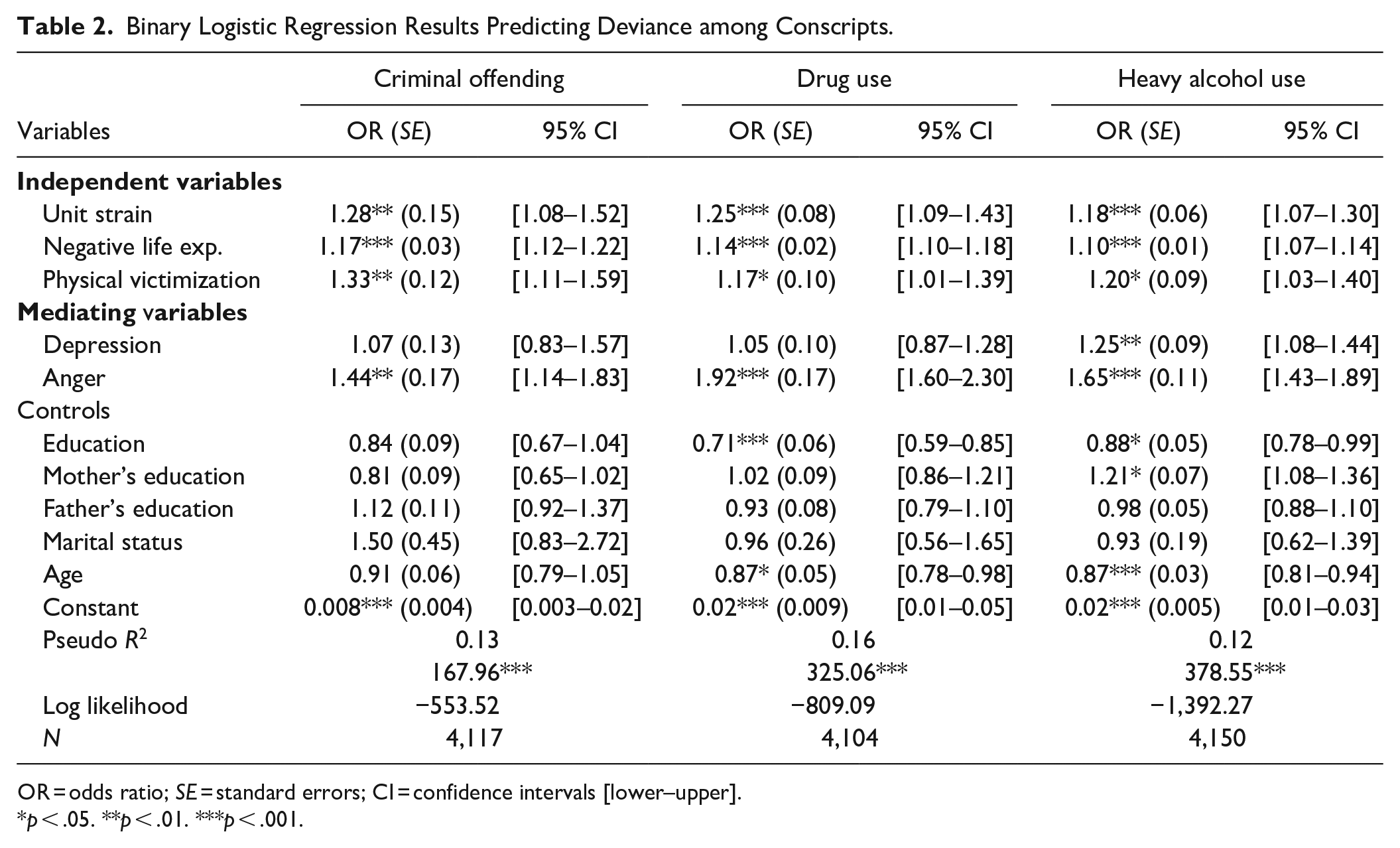
OR = odds ratio; SE = standard errors; CI = confidence intervals [lower–upper].
p < .05. **p < .01. ***p < .001.
Different patterns were seen with regards to the associations between mediating and dependent variables. Depression was significantly associated with heavy alcohol use but not criminal offending or drug use. All else being equal, a one-unit increase in the level of depression was associated with a 1.25-times increase in the odds of heavy alcohol use (p < .05). Anger was positively and significantly associated with all three dependent variables. More specifically, a one-unit increase in the level of anger was associated with a 1.44-times increase in the odds of criminal offending (p < .005), 1.92-times increase in the odds of drug use (p < .001), and 1.65-times increase in the odds of heavy alcohol use (p < .001) when all other variables were held constant. All of these findings suggest that anger may mediate the relationships among all dependent and independent variables, while depression may only mediate the relationship between the independent variables and heavy alcohol use. Since logistic regression is a non-linear probability model, it is not possible to interpret the mediating effects using traditional approaches. For this reason, as a next step, we employed the KHB method to decompose the direct and indirect effects of the independent variables on the dependent variables via mediating variables and reveal if these effects were statistically significant.
Results of the Mediation Analyses
Table 3 presents the results of the KHB analyses that decomposed the direct and indirect effects of the independent variables on the dependent variables. For each independent variable, results of the KHB analyses are presented in the form of percentages representing the total effect and the partition of the total effect according to the direct effect and indirect effect via depression and anger. The findings reveal that about 24% of the total effect of unit strain on criminal offending was the mediation effect of negative affective states (p < .05). More specifically, depression’s contribution to the mediation was about 4% (p > .05; not significant), while anger’s contribution was about 20% (p < .05). The proportion of the mediating effect comprising the total effect of unit strain on drug use was about 36% and a substantial proportion of this indirect effect was via anger (33%; p < .05). With regards to the relationship between unit strain and heavy alcohol use, the mediating effect constituted nearly 47% of the total effect, 31% via anger (p < .05), and 16% via depression (p < .05).
Decomposition of Direct and Indirect Effects on Deviance.

Note. All models are adjusted for education, mother’s education, father’s education, marital status, and age. Sample sizes for criminal offending, drug use, and heavy alcohol use are 4,117, 4,104, and 4,150, respectively. B = coefficient; SE = standard errors.
p < .05.
There were similar patterns in the effect of negative life experiences on the dependent variables. Nearly 16% of the total effect of negative life experiences on criminal offending was the mediating effect of negative affective states, with depression’s contribution being about 5% (p > .05; not significant) and anger’s contribution being about 11% (p < .05). The proportion of the mediating effect in the total effect of negative life experiences on drug use was about 24%, nearly all of which was via anger (p < .05). Concerning heavy alcohol use, the mediating effect constituted nearly 33% of the total effect of negative life experiences, 13% via depression (p < .05), and 20% via anger (p < .05).
Nearly 20% of the total effect of physical victimization on criminal offending was a mediating effect and about 17% of the total effect was via anger (p < .05). For drug use, the proportion of the mediating effect to the total effect of physical victimization was about 43%, 3% via depression (p > .05; not significant) and 40% via anger (p < .05). Finally, the mediating effect constituted about 37% of the total effect of physical victimization on heavy alcohol use, 10% via depression (p < .05), and 27% via anger (p < .05).
Discussion
Military service is a key source of socialization and constitutes a milestone in the lives of a large number of individuals worldwide. Although the military provides opportunities to its members, the stressful and demanding nature of service can create important challenges that are difficult to overcome. Previous studies on civilian populations have shown that deviance is one pathway individuals may follow in response to stressful life conditions (Agnew & White, 1992; Drapela, 2006; Jang & Johnson, 2003; Kaufman, 2009; Neff & Waite, 2007). Despite the well-documented association between stress and deviance, previous work has generally failed to address the potential relationship between soldiers’ exposure to stressors and resulting deviant behaviors. From this perspective, this study examined the associations between unit strain, negative life experiences during military service, and physical victimization and criminal offending, drug use, and heavy alcohol use among members of the Turkish Armed Forces. Additionally, based on the propositions of the General Strain Theory (GST), we investigated the potential mediating roles of depression and anger on the relationship between strain and deviance. Guided by the literature on stress and deviance and the GST framework, we expected to find: (1) a positive association between different forms of strain and deviance, (2) a positive association between negative affective states and deviance, and (3) mediation of the strain-deviance association by negative affective states. The results of the series of statistical analyses generally support our hypotheses, with a few exceptions. Specifically, supporting our first hypothesis, the binary logistic regression results demonstrated that unit strain, negative life experiences, and physical victimization were all associated with an increase in the likelihood of engaging in criminal offending, drug use, and heavy alcohol use, findings that also confirm those of previous research conducted on civilian samples and validate these findings in a military context (Arter, 2008; Aseltine et al., 2000; Orak & Solakoglu, 2017; Slocum, 2010; Solakoglu & Orak, 2016).
The findings also partially support our second hypothesis. We found that anger was positively associated with all three deviant behaviors. In contrast to our expectations, however, depression was only associated with an increased level of heavy alcohol use. This result may imply that soldiers with feelings of anger may engage in both formal deviance (e.g., criminal offending, drug use) and informal deviance (e.g., heavy alcohol use), while those with feelings of depression may be more likely to engage in informal forms of deviance. Although this result contradicts our initial hypothesis, it is consistent with earlier studies finding that anger, as compared to internalizing symptoms such as depression, was the key emotional response to strain, leading to criminal coping. This is likely because it produces feelings of revenge, reduces self-control mechanisms, and leads to other aggressive attributes (Agnew & White, 1992; Broidy & Agnew, 1997; Hoffmann & Spence, 2010; Mazerolle et al., 2003; Peck et al., 2018). Finally, the results of the KHB analyses partially support our third hypothesis regarding the mediation effect. More specifically, we found that anger partially mediated the relationships among all three forms of strain and deviant behaviors, with the proportion of its mediating effect ranging from 11% at a minimum (in the negative life experiences-criminal offending relationship) to 40% at a maximum (in the physical victimization-drug use relationship). Conversely, depression mediated the relationships of all three forms of strain with heavy alcohol use, with mediating proportions of 16%, 13%, and 10% for unit strain, negative life experiences, and physical victimization, respectively. Though this finding did not fully support our hypothesis, especially with regards to depression, it does confirm the findings of the aforementioned studies identifying the relatively more important role of anger.
This study provides valuable insights, adding to the literature on deviance, mental health, and the military. There are several aspects of this study that may have important implications for both policymakers and researchers. First, it addresses an under-studied but highly critical issue among military service-members and provides a comprehensive picture of how exposure to different forms of stressors in the military is associated with engagement in a variety of deviant behaviors. Considering the transformative impact of the military on individuals’ identities and behavioral patterns, engagement in deviant behaviors during service may have destructive consequences for individuals, both during and after their service. Thus, the results of this research are crucial to policymakers seeking to understand the potential causes of this issue and develop programs and support systems preventing deviance in service-members. Second, through the lens of GST, this study sheds light on how certain emotional reactions to strain buffer its relationship with deviant behaviors. More specifically, we showed that some negative affective states such as depression may be more relevant when it comes to informal deviance (e.g., alcohol use), while others such as anger may be relevant to both formal and informal deviance. We hope that our findings will serve as a foundation for future work to separately investigate the different mediating impacts of negative affective states on formal and informal deviant behaviors. Third, although it was not the primary purpose of this study, this work also demonstrates the feasibility of applying GST in a military setting and different cultural contexts. Another important aspect of the current study is its methodological approach. Unlike many other studies interpreting the mediating effects of variables by comparing the coefficients in two nested models—which is problematic for non-linear models—we used an innovative analytic strategy (i.e., KHB) that allowed us to disentangle the unique effects of each mediating variable for each relationship. Finally, to the best of our knowledge, this study is one of the few to examine the relationship between strain and deviance among current military service-members (for other studies, see Bucher, 2011; Mowen et al., 2020), and the first to highlight this relationship in a draft system outside the U.S.
Despite the crucial contributions the current research makes, it is important to note that it does have some limitations. The most important is its inability to establish causal relationships between variables. Since this study relies on observational, cross-sectional data, we were only able to reveal correlations between variables, and the conditions of temporal order and non-spuriousness were not met. While these correlations do not indicate any causal relationships, they still imply that stressful conditions in the military may serve as a source of deviant behaviors. The second limitation concerns the generalizability of the results. Since this study was limited to the context of the Turkish military, caution is advised when generalizing its findings to military institutions in other countries, especially those with All-Volunteer Force (AVF) system. Despite the generalizability issue, however, this study still represents a notable effort at developing a greater understanding of this issue, and the results may have implications regarding application of GST to explain deviant behaviors among soldiers. Another limitation of the current research is the lack of certain demographic variables that are generally available in similar studies conducted in other countries. These variables include race and ethnicity, social class, and sex. Since no strict lines distinguish one ethnic group from another and class boundaries are not as strong in Turkey as in some other countries, these variables were not included in the data. Also, since military service is mandatory only for males in Turkey, sex was omitted. Finally, due to the restrictions in data and issues with the pre-military variables of deviance, we were not able to control for these pre-military conditions in this study.
Footnotes
Declaration of Conflicting Interests
The author(s) declared no potential conflicts of interest with respect to the research, authorship, and/or publication of this article.
Funding
The author(s) received no financial support for the research, authorship, and/or publication of this article.
