



Abstract
This paper investigates whether homicide rates among the European Union (EU) member countries tend to converge over the period 1990 to 2018. We use the concept of β-convergence proposed by Barro and Sala-i-Martin (1992) and employ the Generalized Method of Moments (GMM, hereafter) methodology for 2-years span panel data of 26 EU member countries. The results provide strong evidence for both absolute and conditional convergence of homicide rates across EU countries. Moreover, speed of homicide convergence is increased by the control variables, namely GDP per capita and unemployment rate. Hence, we conclude that the economic integration contributes to the process of convergence in homicide rates in the EU.
JEL classification: O47; C23; K42
Introduction
One of the key objectives of the EU is to create an area of security for its citizens without internal borders. In order to achieve this, the EU makes efforts to harmonize national policies in the Justice and Home Affairs (JHA) field, undertakes joint actions and aims to strengthen cooperation between police and judicial authorities. 1 In 2015, with the launch of the European Agenda on Security and the creation of the “Security Union” concept, the EU has taken an important step toward creating an area of security. The Security Union’s main aim is to promote convergence and to reduce disparities between the levels of development in security dimensions of member countries. Progress toward “an Effective and Genuine Security Union” has been reported in a series of communications, and Security Union remains at the top of the EU’s new Security Strategy 2020 to 2025.
Regardless of whether or not the EU achieves its eventual goal of building a Security Union, EU efforts show a pattern of convergence in physical security conditions among member countries. Since the 1990s, the EU member countries have recorded remarkable improvements in their physical security conditions, seen in the significant reduction in the number of homicides (Aebi & Linde, 2012; Dijk & Tseloni, 2012; Tseloni et al., 2010). As can be seen in Table 1, over the period 1990 to 2018 homicide rates have decreased in all EU countries with the exceptions of Belgium, Cyprus, Denmark, Hungary, and Malta. Moreover, the Central and Eastern European countries of Croatia, Czechia, Slovenia, and Estonia, which had relatively high homicide rates in the 1990s, have recorded marked reductions. Although the achievements so far are pointing improvements in homicide rates at the EU level, it is not clear whether there is a convergence in homicide rates across the member countries.
Levels and Growth Rates of Homicides, 1990 to 2018.
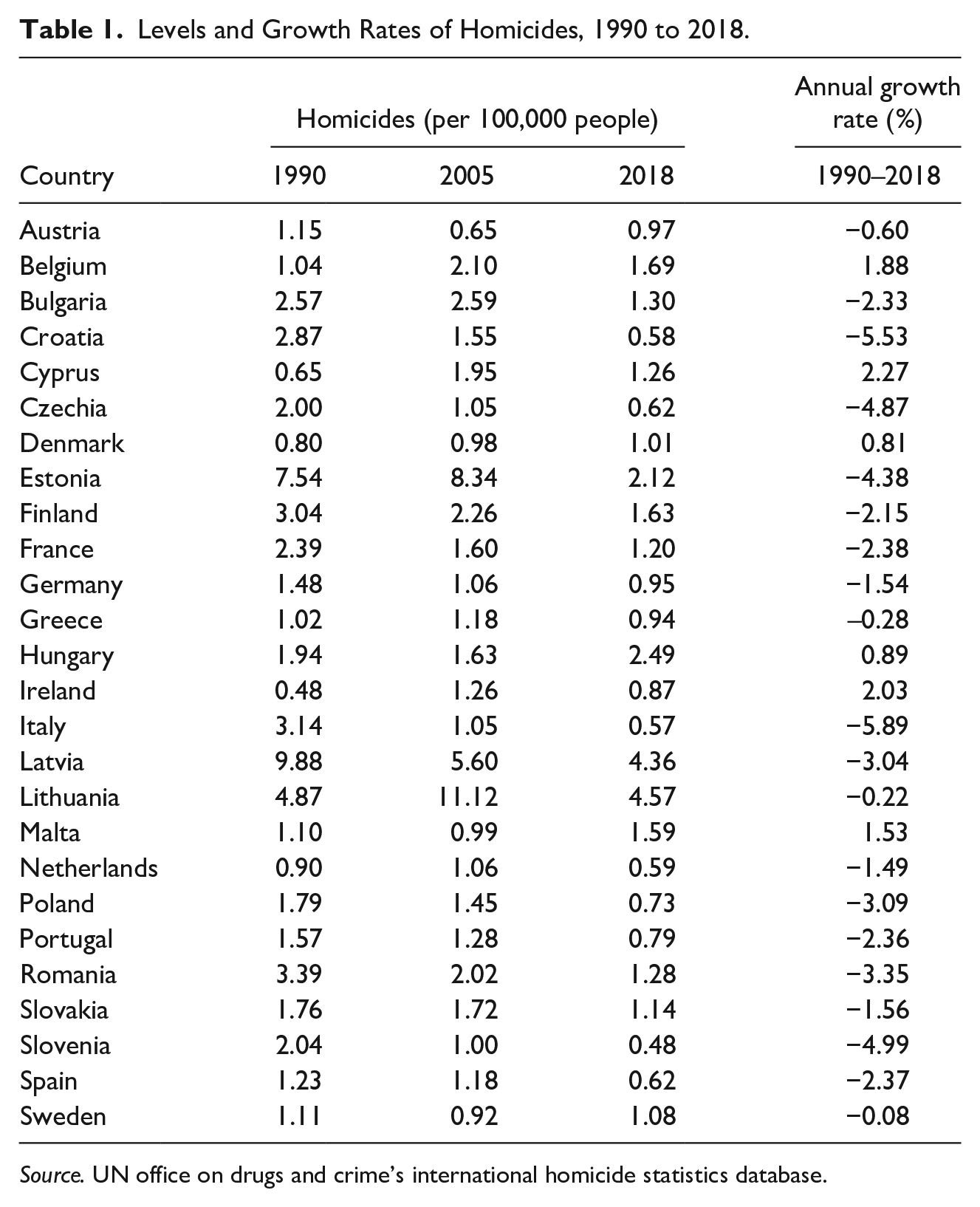
Source. UN office on drugs and crime’s international homicide statistics database.
The main aim of this study is to empirically investigate whether homicide rates across the EU countries tend to converge over time. 2 We use the concept of β-convergence proposed by Barro and Sala-i-Martin (1992), and employ the Generalized Method of Moments (GMM, hereafter) methodology on a dataset covering 26 EU member countries over the period between 1990 and 2018. This investigation is particularly of interest because EU homicide convergence might have important policy implications for developing cooperation and designing effective crime-fighting policies. Such convergence also reinforces the promise of an area of security, which was a central principle in the creation of the EU, thereby contributing to the legitimacy of the EU project.
In addition to absolute convergence, we also estimate conditional convergence to investigate whether the EU economic integration process plays a role in homicide convergence across member countries. Two grand theories in the cross-country comparative criminology literature, namely, modernization and conflict, both emphasize the process of economic development and its key role in convergence and divergence, respectively. Specifically, modernization theory, which is originally built on Durkheim’s (1951) theory of anomie, suggests that countries with a similar process of development would converge to similar crime rates in the long-run (La FREE & Drass, 2002; Neapolitan et al., 1997; Shelley, 1981). On the other hand, conflict theory argues that crime rates would diverge over time due to the uneven development process between developed and developing countries (Bohm, 1982; Greenberg, 1980; Taylor et al., 2013). Hence, using the concept of conditional convergence and controlling for GDP per capita and unemployment rate, we aim to analyze the role of the EU economic integration in homicide rate convergence of member countries. 3 This analysis is important for the policymakers because member countries expect close relationship between the economic and social dimensions of the EU. If economic integration is accompanied by divergence of homicide rates, the overall support for the EU project may deteriorate as EU membership is no longer seen as a win–win game.
Despite a well-established literature on modernization and conflict theories, relatively few studies conduct cross-country analyses of convergence behavior of crime rates. Prior studies have generally focused on the convergence of crime rates within a single country (Chang & Choi, 2016; Çiftçi & Akkoç, 2019; Cook & Winfield, 2013; Fondevila & Massa, 2018; McDowall & Loftin, 2005, 2009; Winsberg, 1993). To the best of our knowledge, only two studies have concentrated on the cross-country convergence behavior of crime rates. LaFree (2005) investigates the convergence of homicides within and between developed and developing countries over the period 1956 to 2000, using time series methods on homicide data of 23 developed and 11 developing countries, and finds no statistically significant evidence of convergence between developed and developing countries, but strong evidence for convergence across developed countries. Kollias et al. (2018) analyze convergence patterns of total crime rates among 16 European countries over the period 1972 to 2012, and find strong evidence for convergence in overall crime rates for the whole sample.
Among the very few studies of cross-country convergence in crime rates, the study of Kollias et al. (2018) for European countries is of importance for its resemblance to the present paper. However, our study differs from that of Kollias et al. (2018) in three respects. First, while Kollias et al. (2018) assess convergence in European countries including non-EU members such as Norway and the United Kingdom, this paper focuses specifically on EU member countries, and thus would be of interest to the EU policymakers. Secondly, our sample period is also different, and specifically covers the years between 1990 and 2018, in which major EU common internal security policies are implemented. Finally, rather than total recorded crime rates, our analysis relies on homicide data, which are generally recognized to be the most valid measure of cross-national crime (Bennett & Lynch, 1990; Gartner, 1990; LaFree, 2005; Pratt & Godsey, 2003). 4
The main contribution of this study to the related literature is three-fold. First, to the best of our knowledge, this is the first study that investigates convergence of homicide rates across EU countries. Second, unlike previous studies, which used the concept of absolute (unconditional) convergence to investigate the cross-country convergence patterns, we use both the absolute and conditional convergence approaches. In particular, our conditional convergence analysis offers empirical evidence on the role of EU economic integration in the homicide convergence process. Finally, the present study offers methodological contribution to the literature on crime rate convergence. Unlike other studies, which investigate convergence in crime rates with estimation methods such as Pooled OLS and Within Group estimator, we use GMM methodology and employ Difference GMM, proposed by Arellano and Bond (1991), and System GMM approach proposed by Arellano and Bover (1995) and Blundell and Bond (1998). The latter estimators are more suitable especially for the estimation of convergence models because (i) it yields more consistent and efficient parameter estimates in which independent variables are not strictly exogenous, (ii) it overcomes the endogeneity problem which arises with the inclusion of lagged dependent variable, and (iii) it is very well fitted for dynamic panel data models with a small number of time periods and relatively larger cross-sections.
Methodology and Data
Methodology
For the estimation of absolute and conditional convergence of homicide rates across the EU member countries, we employ dynamic panel data methodology in the tradition of Bond et al. (2001), Caselli et al. (1996), Hoeffler (2002), and Islam (1995).
We conjecture the following dynamic panel equation for the estimation of homicide rate convergence:

where
In order to estimate absolute and conditional convergence equations, we use two GMM estimators, namely Difference GMM estimator, proposed by Arellano and Bond (1991), and System GMM estimator, proposed by Blundell and Bond (1998), as a one-step panel econometric analysis. Although other estimation methods, such as Pooled OLS and Within Groups are also used in convergence analyses, these may be biased and inconsistent if unobserved time invariant country effects are omitted in a dynamic panel data models (Hsiao, 2014; Nickell, 1981). In several respects, two-step estimations may yield more efficient estimates than one-step estimator, but the efficiency gain would be small, and the asymptotic standard errors related to the two-step GMM estimators may be biased downwards in small samples (Blundell & Bond, 1998; Hoeffler, 2002). Due to limited number of periods in our estimations, it was decided to use one-step GMM estimations. For all the estimates, the lagged dependent variable is assumed to be predetermined, and the control variables are regarded as endogenous. Furthermore, in order to obtain robust standard errors, we apply “Windmeijer finite-sample correction” (Windmeijer, 2005).
To ensure the consistency of the GMM estimations, four key diagnostics should be provided. First, there should be no serial correlation in the error term. Arellano and Bond (1991) test investigates the first and the second order serial correlations in the first-differenced residuals. The second-order correlation in first differences is taken into consideration for the analysis of the first-order serial correlation in levels, since this will detect the correlation between
Data
The empirical analysis is based on panel data of 26 European Union member countries, and the data is transformed into 2-year span data, covering the period 1990 to 2018. 6 The source of data of homicides (per 100,000 people), GDP per capita at constant 2010 US$ in millions, unemployment rate is retrieved from the World Bank Databank.
We use 2-year span data to eliminate serial correlation problem and to evade the effect of business cycle fluctuations, since the application of GMM methodology requires there to be fewer time-periods than the number of cross-sectional units. Therefore, we obtain 15 data points for each 26 EU member countries, for example, 1990, 1992,. . ., 2018. In addition, in order to interpret results on absolute and conditional convergence, all series are used in their natural logarithm. Table 2 presents basic statistics for the series in the study.
Descriptive Statistics of 2-Year Span Data.
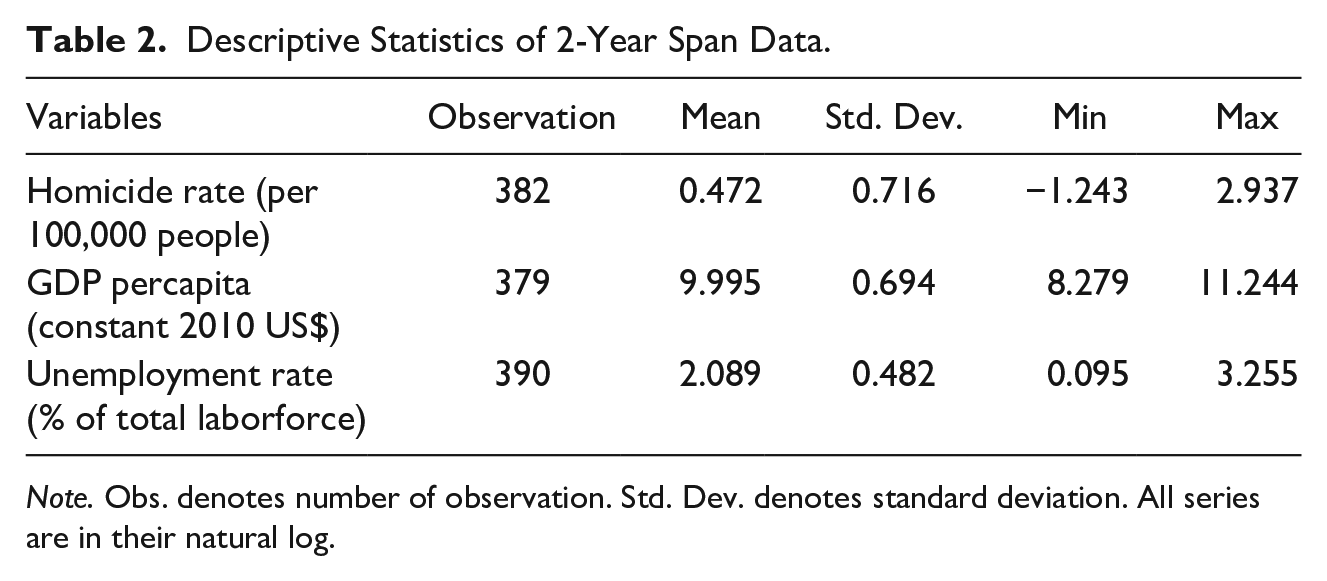
Note. Obs. denotes number of observation. Std. Dev. denotes standard deviation. All series are in their natural log.
Empirical results
The GMM regression results from estimating equation (1) with 2-year span data of 26 EU countries over the period 1990 to 2018 are reported in Table 3.
7
The left part of Table 3, columns 1–4, shows the result of one-step Difference GMM estimation, and the right, columns 5–8 shows the results from one-step System GMM estimation. All estimations include time effects. In both parts, the first rows show
GMM Estimates From a Panel of 2-Year Span Data.
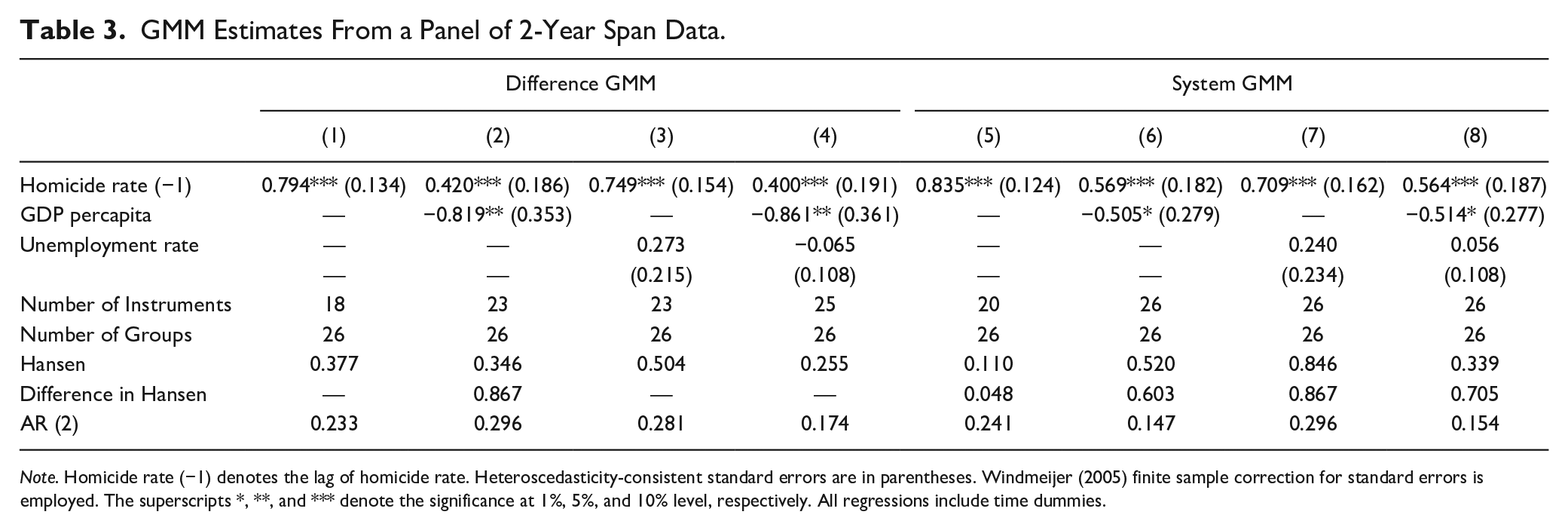
Note. Homicide rate (−1) denotes the lag of homicide rate. Heteroscedasticity-consistent standard errors are in parentheses. Windmeijer (2005) finite sample correction for standard errors is employed. The superscripts *, **, and *** denote the significance at 1%, 5%, and 10% level, respectively. All regressions include time dummies.
In Table 3, column (1) and column (5) show the estimation results of absolute (unconditional) convergence by using Difference and System GMM respectively. In both estimations, the estimated coefficients of lagged homicide rate are statistically significantly different from zero and between 0 and 1, 0.794 and 0.835, respectively, hence indicating the existence of convergence. These results suggest absolute convergence rates per year at around 10.3% with Difference GMM and 8.25% with System GMM estimator. 8 For Difference GMM estimation, we found a higher speed of convergence than for System GMM estimation. 9
In columns (2) and (3) and in columns (6) and (7) of Table 3, we include the control variables one by one into the model to estimate by Difference GMM and System GMM, respectively. In column (4) and (8) estimation results using two control variables are provided. In accordance with priori expectations, conditional convergence regressions yield lower
The results shown in column (4) and (8) reveal that adding a control variable accelerates the conditional convergence rate, although unemployment rate is not necessarily significant. The main reason is that the inclusion of an explanatory variable strengthens the instrument set significantly in GMM regressions (Hoeffler, 2002). For example, in column (2), GDP per capita is the only control variable whereas in column (4), in addition to GDP per capita, unemployment rate is added in the regression, and as seen in the reported results, the estimation in (4) reveals a higher speed of conditional convergence. Similar results are observed in estimations (6) and (8).
In Table 3, the last three rows present Arellano-Bond test results for no second-order serial correlation in the error term, which is represented by AR (2), Hansen test for the validity of instruments, and Difference-in-Hansen test for the validity additional moment conditions. In all estimations, the p-values given by AR (2) provide no evidence for second order serial correlation in disturbances. We present p-values for Hansen test, which has the validity of the over-identifying restrictions as a null hypothesis (Hansen, 1982). In all estimations, we do not reject the null hypothesis of the Hansen, which supports the validity of our instruments in both absolute and conditional senses. Furthermore, the additional moment conditions are also valid since the null hypothesis of Difference-in Hansen is not rejected. In order to check the rule of thumb, we also present the number of cross sections and the number of instruments. However, in our estimations, the number of cross sections is not always relatively greater than the number of instruments, a condition which partly satisfies the rule of thumb.
Limitations
This study has some limitations. One limitation is the missing data. Homicide rates for each member state and year are not available in our sample. There is a lack of data for the period 1990 to 1995, particularly for the Central and Eastern European countries. Inclusion of these data may strengthen or weaken our conclusions about the convergence of homicide rates in the EU The second limitation is that we only examined cross-country convergence in homicide rates. As we discussed earlier, in cross-country analysis, homicide data is more reliable than data for other types of crime. Homicide rates, however, are not representative of other crimes and may follow different patterns from other crime rates (Aebi & Linde, 2012; Lynch & Pridemore, 2011; Rogers & Pridemore, 2018). Therefore, we do not draw conclusions about the convergence of crime rates across EU member countries. The third limitation is that our results are only valid for the period 1990 to 2018. Modernization theory is mainly used to explain long-term changes in crime rates between countries. This is why some criminologists have tested this theory over centuries rather than decades (Elias, 2000; Gurr, 1981; Pinker, 2011). If we could have more than 30 years of data, we would draw stronger conclusions about modernization theory. We need to be cautious not to generalize our results to different countries. While similar economic trends emerged between countries, different homicide patterns could be observed. In fact, despite improving economic conditions, homicide rates have risen in several countries in Latin America and the United States in recent decades (Baumer & Wolff, 2014; Bergman, 2018; Rogers & Pridemore, 2017; Tuttle et al., 2018). Demographics, incarceration, police, and drug usage are some of the reasons given for the rise in homicide rates. These factors are well discussed in the literature explaining the recent rise in homicide rates in the United States (Mancik et al., 2021; Rennó Santos et al., 2019; Rosenfeld, 2016; Rosenfeld et al., 2017). However, we did not delve into them, as this is beyond the scope of our research. This may be the subject of our future.
Concluding Remarks and Policy Implications
This study empirically investigates whether homicide rates across the EU countries tend to converge over time. To this end, we use the concept of β-convergence proposed by Barro and Sala-i-Martin (1992), and employ the GMM methodology on a dataset covering 26 EU member countries over the period between 1990 and 2018. We assess two types of convergence: absolute (unconditional) and conditional on control variables, including GDP per capita and unemployment rate. The findings reveal clear evidence for absolute and conditional convergence of homicide rates across the EU countries. The control variables generally yield higher speed of convergence, suggesting that the EU economic integration played a role in accelerating homicide rate convergence. The results also provide empirical support for the modernization prediction that crime rates across countries with similar development processes tend to become similar in the long-run.
The findings of this paper suggest that policies toward a genuine and effective Security Union are beneficial for EU member countries in causing their homicide rates to follow a pattern of convergence. Hence, regardless of whether the EU is able to achieve a Security Union, greater cooperation and further policy integration in Justice and Home Affairs (JHA) field can bring benefits to all member countries. The results of conditional convergence also suggest that pursuing growth strategies could also be beneficial, fostering greater convergence in homicide rates among member countries.
Possible extensions to this study would be to investigate the same issue with an expanded data set to include, in particular, low-income countries, and rates for different types of crime. However, these developments depend on the availability of the necessary data.
Footnotes
Declaration of Conflicting Interests
The author(s) declared no potential conflicts of interest with respect to the research, authorship, and/or publication of this article.
Funding
The author(s) received no financial support for the research, authorship, and/or publication of this article.
